Article

Mobility and Quality of Life in Unilateral Transtibial Prosthetic Users with Unmet Mobility Needs: A Multicenter Randomized Comparison of a Novel Prosthetic Foot and ESAR Feet


1
CSMR de la Tour de Gassies, UGECAM d’Aquitaine, 33520 Bruges, France
2
Department of Physical Medicine and Rehabilitation, Nîmes University Hospital (CHU de Nîmes), 30240 Le Grau-du-Roi, France
3
EuroMov Digital Health in Motion (EuroMov DHM), University of Montpellier, IMT Mines Alès, 34090 Montpellier, France
4
Medical Office, Research & Development Department, Össur Iceland ehf., 110 Reykjavik, Iceland
5
Clin-Experts, 75013 Paris, France
6
Clinique Provence-Bourbonne, 13400 Aubagne, France
7
Regional Rehabilitation Institute (IRR), 54000 Nancy, France
*
Author to whom correspondence should be addressed.
Prosthesis 2026, 8(9), 96; https://doi.org/10.3390/prosthesis8090096 (registering DOI)
Submission received: 30 April 2026 / Revised: 28 August 2026 / Accepted: 7 September 2026 / Published: 21 September 2026
(This article belongs to the Section Orthopedics and Rehabilitation)

Abstract

Background: Prosthetic foot design continues to evolve to better address the functional needs and daily challenges of individuals with lower limb loss. Energy-Storing and Returning (ESAR) feet are widely prescribed for individuals with transtibial amputation; however, many users continue to report limitations. A novel prosthetic foot incorporates a pivot mechanism intended to enhance ankle motion and support a more natural gait. Objectives: We aimed to compare mobility, comfort, quality of life, and user satisfaction between a novel prosthetic foot and commonly prescribed ESAR feet in adults with unilateral transtibial amputation with unmet mobility needs. Methods: A prospective, multicenter, randomized cross-over trial was conducted across seven rehabilitation centers in France. Thirty adults with unilateral transtibial amputation, all regular ESAR users, were randomized to one of two sequences: their prescribed ESAR foot followed by the novel foot, or the reverse. Each device was worn for four weeks. The primary outcome was mobility assessed using the Prosthetic Limb Users Survey of Mobility (PLUS-M) T-score. Data were analyzed using linear mixed-effects models. Secondary outcomes included comfort, quality of life, satisfaction, falls, participant preference, and adverse events. Results: All participants completed the study. Mobility scores were significantly higher with the novel foot compared to the prescribed ESAR foot (least squares mean PLUS-M/FC-12 T-score: 60.2 vs. 52.3; difference 7.9; p < 0.001). Participants reported greater comfort, improved quality of life (LS mean difference 5.7; p = 0.001), and higher satisfaction with the novel prosthesis (LS mean difference 0.4; p = 0.002). No falls occurred with the novel foot, compared with three falls with the ESAR foot. Most participants (96.7%) preferred the novel foot. No device-related adverse events were reported. Conclusions: In adults with unilateral transtibial amputation, the novel pivot foot was associated with improvements in mobility, comfort, quality of life, and satisfaction compared to commonly prescribed ESAR feet, supporting its potential benefits for individuals with higher mobility demands.

1. Introduction

Lower limb amputation, particularly transtibial amputation (TTA), is a life-altering event that significantly impacts mobility, independence, and overall quality of life [1]. Individuals with TTA face substantial biomechanical and functional challenges due to the loss of the ankle–foot complex, which plays a critical role in shock absorption, stability, and forward propulsion during gait [2]. The biological ankle contributes a large proportion of positive mechanical work during late stance through active plantarflexor musculature. Its absence alters lower-limb kinematics and kinetics, resulting in reduced distal push-off and compensatory redistribution of mechanical work toward proximal joints [3,4].
Consequently, individuals with TTA demonstrate increased metabolic energy expenditure during walking, reported to be approximately 10–30% higher than in unimpaired individuals [5]. To compensate, they often adopt strategies such as increased reliance on proximal joints, asymmetric gait patterns, and altered spatiotemporal parameters [6,7]. While functionally necessary, these adaptations can increase joint loading on the intact limb, thereby elevating the risk of secondary musculoskeletal conditions, including knee osteoarthritis, hip pain, and low-back disorders [8,9]. These findings underscore the importance of prosthetic ankle–foot designs that restore functional ankle behavior, reduce gait asymmetry, and minimize metabolic cost.
Among prosthetic components, the foot plays a central role in mobility outcomes and user satisfaction. Conventional feet, such as the solid ankle cushion heel (SACH) foot, provide structural support and shock absorption but do not store or return energy, limiting assistance during late stance and push-off [10]. In contrast, Energy-Storing and Returning (ESAR) feet incorporate elastic elements, typically carbon fiber, to store energy during stance and return it at push-off, more closely replicating biological ankle function [10,11]. Clinical studies show that ESAR feet can improve step length symmetry, increase push-off work, and enhance center-of-mass progression compared with non-dynamic feet [12,13]. They also preserve gait stability, which may explain user preference over conventional designs [12]. ESAR feet are typically recommended for higher-functioning individuals who ambulate outdoors, navigate uneven terrain, or engage in vocational and recreational activities [10,11]. Positive work output remains substantially lower than that of the intact limb and, as with all passive ESAR prosthetic feet, cannot exceed the energy stored during loading, reflecting their inherent limitation to generate net positive work [10,11].
Despite technological advancements, some users often report persistent limitations, including perceived instability on slopes and stairs [14], increased fatigue during prolonged walking, and reduced confidence in daily activities [15]. Given that mobility is a key determinant of quality-of-life following lower limb amputation [16], these challenges highlight a critical gap between the capabilities of passive ESAR designs and the demands of real-world mobility.
Recent innovations have focused on enhancing energy return, ankle range of motion, and adaptability without compromising stability. Hydraulic ankle–foot systems, which use passive fluid-controlled mechanisms to increase ankle range of motion, have been associated with improvements in selected biomechanical outcomes compared with ESAR feet, including minimum toe clearance [17,18,19] as well as improved performance in most activities of daily living [20]. More recently, microprocessor-controlled ankle–foot prostheses represent a further technological advancement, combining ankle motion, adaptative resistance, and, in some designs, active push-off with the ability to generate net positive work [21]. In a large retrospective analysis of real-world clinical data, Wurdeman et al. reported improved mobility outcomes, as measured by the Prosthetic Limb Users Survey of Mobility (PLUS-M), in users of microprocessor-controlled ankle–foot systems compared with other prosthetic foot categories, after adjustment for key clinical and demographic factors [22]. While these devices have demonstrated improvements in selected biomechanical outcomes compared with traditional ESAR feet, their complexity, cost, and maintenance requirements may limit widespread adoption. Moreover, robust clinical evidence for improvements in user-reported outcomes remains limited.
Consequently, there remains a need for prosthetic solutions that enhance ankle function and dynamic response while retaining the simplicity and reliability of traditional ESAR feet. In response to these challenges, a novel prosthetic ESAR foot has been developed that incorporates a multi-blade carbon fiber structure with a mechanical pivot mechanism, resulting in a mechanically articulated ankle–foot system.
By incorporating multiple axes of rotation and optimized blade geometry, it aims to provide a more physiological gait and improved dynamic response than conventional ESAR feet [23,24,25]. Preliminary biomechanical data suggest improvements in ankle power, range of motion, and contralateral limb loading [26]; however evidence of actual benefits for the user remains limited.
Few rigorous studies have compared advanced ESAR feet with a novel pivot-mechanism prosthetic foot in representative transtibial populations, without the use of clinical outcome measures [27,28]. Given the importance of user-centered outcomes, such as mobility, comfort, quality of life, satisfaction, falls, and adverse events, well-designed clinical trials are needed to determine whether these innovations translate into meaningful functional benefits. Accordingly, this study was designed as a prospective, multicenter, randomized crossover trial to compare a novel pivot-mechanism foot with contemporary ESAR feet. The primary hypothesis was that the novel foot would yield superior improvements in mobility, assessed using the Prosthetic Limb Users Survey of Mobility (PLUS-M) Functional Capacity 12 (FC-12) T-score, a patient-centered measure that reflects functional benefits observed in previous biomechanical studies, with secondary objectives including comfort, quality of life, satisfaction, falls, and adverse events.

2. Materials and Methods

A randomized, cross-over clinical investigation was conducted to evaluate the effects of a novel prosthetic foot compared with participants prescribed ESAR foot. In this two-period cross-over design, participants were randomly assigned to start with either their prescribed ESAR foot or the novel foot, followed by crossover to the other device after four weeks. Each participant served as their own control to minimize individual differences and enhance statistical power. The study was conducted between October 2023 and May 2025 across seven rehabilitation centers in France to support a reimbursement application. This trial was retrospectively registered at ClinicalTrials.gov (NCT06627361) in September 2024. The delay in registration occurred because the investigation was initiated as part of a post-market evidence generation program intended to support a reimbursement submission, and prospective registration was not identified as a requirement at study initiation. Registration was subsequently completed to ensure transparency, and the protocol, endpoints, and analysis plan remained unchanged.
Eligible participants were adults (≥18 years old) with unilateral transtibial amputation, who had been using a high-activity ESAR foot (designed for K3/K4 activity level) for at least six months and ≥8 h per day. Inclusion criteria required a normalized PLUS-M/FC 12 T-score < 50 for vascular amputees or <55 for traumatic and other causes, and adequate socket comfort (Socket Comfort Score ≥ 6) [29]. These PLUS-M/FC 12 thresholds were based on the median T-scores reported in the development sample of transtibial amputation patients of vascular and traumatic origin, respectively [30], for a population selection strategy based on distributional values. Participants were also required to demonstrate functional mobility consistent with community ambulation, defined as the ability or need to ambulate beyond the home environment, including mobility within buildings other than the home, mobility outside the home and other buildings, and travel to various community locations, in accordance with the International Classification of Functioning, Disability and Health domains d4601, d4602, and d4608. These criteria were intended to enroll participants who have unmet mobility needs and may benefit from the novel foot.
Exclusion criteria included bilateral or transfemoral amputation, use of a temporary prosthesis, planned prosthetic changes, progressive conditions affecting mobility or study follow-up, osseointegration, lack of consent, legal protection status, lack of health insurance, or inability to understand study instructions.
Participants were randomized in a 1:1 ratio to one of two sequences: (1) prescribed ESAR foot followed by the novel foot, or (2) novel foot followed by the prescribed ESAR foot. Allocation was determined by a computer-generated randomization schedule with permuted blocks of six and implemented through a centralized web-based system (CleanWeb) after informed consent and completion of baseline assessments. Allocation remained concealed until assignment. Standardized fitting procedures and alignments were performed by certified prosthetists at all centers at the start of each period. The investigational device was the PRO-FLEX PIVOT ® (Össur Iceland ehf., Reykjavik, Iceland) (see Figure 1).
The primary endpoint was mobility, assessed using the 12-item Prosthetic Limb Users Survey of Mobility (PLUS-M/FC-12) T-score, a validated measure of self-reported mobility across a range of activities [31,32,33]. Secondary endpoints included prosthesis comfort (numeric rating scale for overall prosthesis comfort and for comfort during specific walking conditions such as level ground, slopes, and stairs), quality of life (using the quality-of-life module of the Orthotics and Prosthetics Users’ Survey, OPUS) [34], satisfaction with the prosthetic foot (ESAT—Évaluation de la Satisfaction envers une Aide Technique (French version of the QUEST 2.0 [35,36]) comprising device- and service-related satisfaction domains rated on a 5-point Likert scale), falls, participant preference, and adverse events.
Outcome measures were collected at baseline and at the end of each four-week period. Participants were instructed to maintain their usual activity level and report any changes in health status or prosthesis use.
The primary analysis was performed on the full analysis set (FAS), including all participants who completed both periods with available outcome data. PLUS-M/FC-12 T-scores were analyzed using a linear mixed-effects model to account for repeated measures within participants. The model included fixed effects for treatment, period, sequence and study centre, and a random intercept for subject nested within sequence. Models were fitted using Restricted Maximum Likelihood (REML), assuming a variance components covariance structure, and degrees of freedom were estimated using the containment method. Sensitivity analyses were performed to assess the robustness of the primary findings, including analysis on the full analysis set (FAS) and per-protocol (PP) populations, using Wilcoxon signed-rank tests, as well as the primary model with missing data imputed from the other foot in the event of missing data. Secondary endpoints were analyzed using parametric or non-parametric tests according to data distribution.
A sample size of 30 participants provided 90% power to detect a between-device difference of 6.3 in the primary endpoint, based on a minimum detectable change (MDC90) of 4.5 points, a pre-specified moderate-to-large standardized effect size of 0.7, and an assumed standard deviation of 9, accounting for a 20% drop-out rate [30]. Statistical significance was set at p ≤ 0.05, with 95% confidence intervals.
All participants provided written informed consent. Data confidentiality was maintained in accordance with French and European regulations, and all adverse events were monitored and reported according to established guidelines.

3. Results

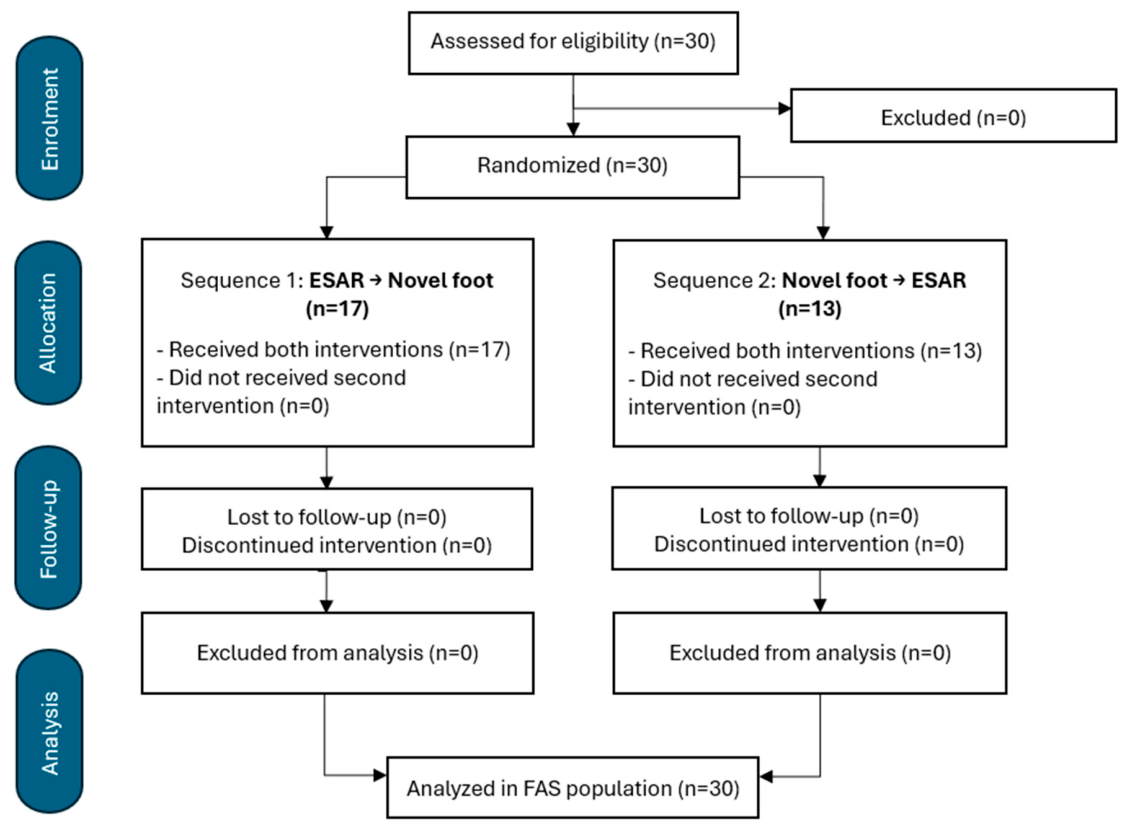
A total of 30 participants were enrolled, randomized, and completed the study (see Table 1). Seventeen were assigned to the sequence starting with their prescribed ESAR foot, while thirteen began with the novel foot (see Figure 2). The majority were male (83.3%), with a mean time since amputation of 15.5 ± 16.6 years. Most amputations were traumatic (70%). Participants had been using a prosthesis for an average of 15.2 ± 16.4 years and were all regular ESAR foot users. Only 36.7% were professionally active, 56.7% had relevant medical histories, and 46.7% were receiving at least one associated treatment. No withdrawals or losses to follow-up occurred. The Full Analysis Set (FAS) population included all 30 participants. One participant did not meet the predefined compliance criterion for daily prosthesis wear time, constituting a major protocol deviation, and was therefore excluded from the PP population. Consequently, the PP population comprised 29 participants. This participant remained included in the FAS analyses and was excluded only from the pre-specified PP analysis of the primary endpoint. No missing observations were recorded for the primary or secondary endpoint, and no data imputation was performed. Two participants underwent prosthetic modifications during the study. In one participant, the prosthetic foot category was downgraded during the second period with the novel foot, as the initially selected foot was considered too dynamic. The category was changed from 6 to 5 to reduce energy return and push-off. The second participant underwent a modification of the suspension system, involving a change in both the liner and the valve.

3.1. Primary Endpoint

Mobility, assessed using the PLUS-M/FC-12 T-score, was significantly higher with the novel foot compared with the prescribed ESAR foot. LS mean scores were 60.2 ± 1.2 versus 52.3 ± 1.2, respectively, with a between-treatment difference of 7.9 points (95% CI 5.0–10.8; p < 0.001) (see Table 2), exceeding the minimum detectable change (MDC) of 4.5 points and thus suggesting a significant improvement. No significant period (p = 0.353), sequence (p = 0.901) or centre effects (p = 0.246) were observed, and sensitivity analyses confirmed the robustness of the treatment effect. Higher scores indicate better mobility.

3.2. Secondary Endpoints

Comfort, assessed using a numeric rating scale (NRS; 0–5, anchored at 0 = “not at all comfortable” and 5 = “very comfortable”), was significantly higher with the novel foot across all evaluated walking conditions, including level ground, slopes, and stairs (all p < 0.001). No period effects were observed across all conditions tested. However, sequence effects were detected for specific conditions such as stair ascent/descent and slope downward (see Supplementary Tables S1 and S2).
Quality of life, measured using the OPUS RASCH-transformed score (0–100), was significantly higher with the novel foot (LS mean ± SEM: 67.9 ± 1.8) compared with the ESAR foot (62.2 ± 1.8), corresponding to a mean difference of 5.7 points (SEM 1.6; 95% CI 2.4–8.9; p = 0.001). No period (p = 0.510) or sequence (p = 0.673) effects were identified.
Satisfaction with the prosthetic technology, assessed using the ESAT questionnaire, was significantly greater with the novel foot (LS mean ± SEM: 4.6 ± 0.1) than with the ESAR foot (4.2 ± 0.1), with a mean difference of 0.4 points (95% CI 0.2–0.6; p = 0.002). Satisfaction with services showed a smaller, non-significant difference between devices (p = 0.079). No period or sequence effects were observed for both components (see Supplementary Tables S1 and S2).
Three falls (involving two participants) were reported during the ESAR foot period, whereas no falls occurred during use of the novel foot. At study completion, 29 of 30 participants (96.7%; 95% CI 83.3–99.4) expressed a preference for the novel foot.
No statistically significant difference between devices was observed in Timed Up and Go performance. LS mean change from baseline was −0.9 s (95% CI −1.3 to −0.4) for the novel foot and −0.5 s (95% CI −1.0–0.0) for the ESAR foot (p = 0.125). No period (p = 0.920) and sequence (p = 0.777) effects were observed.

3.3. Adverse Events

A total of four adverse events (AEs) were reported by four different participants. None were related to the study devices, or the investigational procedure. No serious adverse event was reported. The reported adverse events included: one traffic accident, one heat-induced blister, one episode of post-vaccination asthenia, and episodes of phantom pain. All adverse events were resolved, except for the heat-induced blister.

4. Discussion

This multicenter, randomized crossover study compared a novel prosthetic foot with prescribed ESAR feet in individuals with unilateral transtibial amputation who reported unmet mobility needs. Use of the novel foot demonstrated statistically significant improvements in mobility, comfort, and quality of life, as measured by PLUS-M/FC-12, OPUS, and ESAT scores. The 7.9-point improvement in PLUS-M/FC-12 T-score exceeded the minimum detectable change, suggesting a detectable improvement in self-reported mobility beyond measurement error. In addition, 96.7% of participants indicated a preference for the novel foot at study completion.
The choice of a patient-reported outcome as the primary endpoint was made to reflect real-world functional impact from the user perspective and may not fully reflect underlying biomechanical changes. However, these results complement previous research showing that dynamic prosthetic feet may reduce gait asymmetry and perceived effort while supporting participation in varied environments [10,37,38]. The observed improvements suggest that the novel foot may help address commonly reported limitations of conventional ESAR devices, including instability, fatigue, and dissatisfaction [10,12].
Although participants reported significant improvement in mobility, comfort, quality of life and satisfaction with the device, no statistically significant difference was observed in TUG performance. This finding suggests that the benefits identified in the present study were primarily captured through patient-reported outcomes reflecting everyday mobility experiences, rather than through this objective performance-based measure. The TUG assesses a brief standardized task under controlled conditions and may therefore be less sensitive to perceived benefits experienced across a wider range of real-world environments and activities. Furthermore, statistically significant findings observed across secondary outcomes should be interpreted as exploratory, as no hierarchical testing procedure or multiplicity adjustment was applied. However, the consistent direction of effects across mobility, comfort, quality of life, and satisfaction outcomes strengthens confidence in the overall clinical relevance of the observed benefits.
The study population specifically included individuals who had not achieved satisfactory mobility with their prescribed ESAR feet, reflecting a group with persistent functional limitations. This criterion was selected to support a future reimbursement application in France. However, this targeted inclusion introduces a selection bias, as the sample is not representative of the broader population of prosthetic users. Instead, it is enriched for individuals who are more likely to experience limitations with conventional ESAR devices and, consequently, may derive greater benefit from alternative interventions. As a result, the findings are most directly applicable to users’ experiencing limitations with conventional ESAR devices. Whether similar benefits would be observed in broader transtibial populations remains to be determined, and future studies including a wider range of activity levels and mobility profiles are warranted.
In addition to mobility, improvements in OPUS and ESAT scores indicate enhanced comfort, satisfaction, and social participation. Together with previously reported biomechanical findings from the literature, these results contribute to a more comprehensive understanding of prosthetic performance [7]. These findings highlight the importance of shared decision-making and device trialing to ensure alignment with functional goals and real-world demands [8,16].
Advanced ESAR feet, including the novel foot evaluated here, may be particularly suitable for active users or those who regularly navigate uneven terrain. However, despite their ability to store and return energy, passive devices remain inherently limited in their capacity to generate net positive mechanical work at the ankle joint. In contrast, powered ankle–foot prostheses have demonstrated the ability to provide active push-off, leading to improvements in metabolic economy and interlimb work symmetry, particularly under conditions such as uphill walking [39].
Implementation of the novel foot was feasible across multiple centers, with standardized fitting and alignment procedures successfully deployed and performed at each center, which may introduce inter-center variability in prosthesis fitting. Detailed information regarding the comparator feet, including stiffness category, duration of prior use, wear status, and associated prosthetic components, was not prospectively collected because these variables were not considered relevant to the study objectives. Nevertheless, comparator feet were all classified as high-activity ESAR feet. The investigational foot category was selected according to the manufacturer’s fitting recommendations based on participant body weight and foot size. Furthermore, two participants required prosthetic adjustments during the study, including an adaptation of the foot category within the same investigational foot family and a modification of the suspension system. These adjustments reflected routine clinical care and optimization of the prosthetic fitting rather than changes in prosthetic technology. Given the small number of affected participants, their impact on the overall study findings is expected to be limited; however, a minor influence on individual outcomes cannot be entirely excluded. These observations further emphasize the importance of clinician training and user education to optimize device performance and maintain functional gains.
Guidance on alignment, maintenance, and gait strategies can support user adaptation and maximize the benefits of advanced prosthetic technologies [37,38]. Integration with structured rehabilitation or gait training may further enhance functional outcomes, suggesting that advanced prosthetic feet are most effective when combined with comprehensive user-centered care.
Several limitations should be considered. Blinding was not feasible, introducing potential expectation bias. As a crossover study, adaptation effects may also have influenced outcomes, as participants could benefit from increased familiarity with prosthetic use over time. In addition, no washout period was implemented between study conditions, which raises the possibility of carryover effects, whereby performance or perceptions associated with the first device may have influenced outcomes observed with the second device. However, implementing a washout period in prosthetic crossover studies is challenging because there is no established duration sufficient to eliminate device-specific adaptation and learning effects, even if participants temporarily return to their usual prosthetic configuration. Moreover, requiring participants to alter or restrict their established prosthetic use for an extended period solely for research purposes may be difficult to justify from both practical and ethical perspectives.
Significant sequence effects were observed for several comfort-related outcomes and should therefore be interpreted with caution, as treatment order may have influenced subjective comfort ratings. Nevertheless, descriptive analyses stratified by randomized sequence showed that comfort scores consistently favored the novel foot in both sequence groups, although the magnitude of the treatment effect varied between sequences.
The sample size, while adequate for detecting differences in primary outcomes, limited detailed subgroup analyses by age, sex, cause of amputation, or comorbidities. The four-week per-device follow-up does not capture long-term durability, maintenance requirements, or potential secondary complications such as joint pain or overuse injuries [26]. Additionally, the predominance of older male participants may limit generalizability to younger adults, women, or individuals with differing activity profiles or amputation etiologies.
These limitations highlight areas for future research. Longitudinal studies should evaluate device durability, adaptation, and sustained functional benefits. Inclusion of more diverse populations will enhance external validity. Comparative effectiveness studies under real-world conditions can clarify device performance during routine use [40]. Health economic analyses are needed to assess cost-effectiveness, including device costs, fall-related injuries, healthcare utilization, productivity, and quality-adjusted life years (QALYs), providing evidence to support reimbursement and access to advanced prosthetic technologies [32]. Biomechanical investigations remain important for elucidating mechanisms underlying observed gains. Studies examining gait symmetry, energy expenditure, joint loading, and muscle activation patterns can inform device optimization, alignment strategies, and rehabilitation approaches. Additionally, qualitative research on user experiences and shared decision-making can deepen understanding of preferences, barriers, and facilitators, guiding clinical guidelines and future device innovation [16]. These efforts may also clarify how observed short-term functional gains translate into long-term adherence and sustained quality-of-life improvements.
In summary, the novel foot was associated with improvements in mobility, comfort, satisfaction, and quality of life for individuals with unmet mobility needs. High rates of user preference were also observed, suggesting potential advantages in both functional performance and user experience within this specific cohort. Integration into clinical practice appears feasible when combined with user-centered prescription, training, and education. Further research addressing long-term outcomes, diverse populations, cost-effectiveness, biomechanics, and user experiences will support evidence-based optimization of prosthetic care, ensuring that advanced devices enhance functional independence, well-being, and equitable access for individuals living with limb loss.

5. Conclusions

The novel foot demonstrated improvements in perceived mobility, comfort, satisfaction, and quality of life for individuals with unilateral transtibial amputation and unmet mobility needs. User preference indicated its potential to enhance mobility and effectiveness in daily activities. These findings suggest that the device may represent a valuable clinical option when prescribed with appropriate fitting, training, and user-centered prescription approaches.
However, these benefits may be most pronounced in users who have not achieved satisfactory mobility with conventional ESAR feet. Future research should focus on long-term outcomes, diverse populations, biomechanical mechanisms, and cost-effectiveness to support evidence-based optimization of prosthetic care.

Supplementary Materials

The following supporting information can be downloaded at: https://www.mdpi.com/article/10.3390/prosthesis8090096/s1, Table S1: Summary of fixed effects (F-statistics, degrees of freedom, and p-values) for all study endpoints, FAS population (n = 30); Table S2: Descriptive statistics stratified by randomized sequence and treatment condition for comfort-related endpoints showing significant sequence effects, FAS population (n = 30).

Author Contributions

Conceptualization, N.M. and M.M.; methodology, N.M. and M.M.; software, M.M.; validation, N.M. and M.M.; formal analysis, M.M.; investigation, R.K., E.P. and M.T.; resources, R.K., E.P. and M.T.; data curation, M.M.; writing—original draft preparation, L.R.; writing—review and editing, R.K., E.P., M.M., M.T. and N.M.; visualization, L.R.; supervision, N.M. and M.M.; project administration, R.K., E.P. and M.T.; funding acquisition, M.M. All authors have read and agreed to the published version of the manuscript.

Funding

This research was funded by Össur France. No specific grant or funding number was assigned. Clin-Experts provided contract research services on behalf of the sponsor.

Institutional Review Board Statement

The study was conducted in accordance with the Declaration of Helsinki and Good Clinical Practice guidelines. Ethical approval was obtained from the CPP EST IV Ethics Committee on 25 September 2023, and the trial was registered on ClinicalTrials.gov (NCT06627361).

Informed Consent Statement

Informed consent was obtained from all subjects involved in the study. Written informed consent has been obtained from the patients to publish this paper.

Data Availability Statement

The data presented in this study are available on request from the corresponding author due to privacy restrictions. The authors had access to the study data required for interpretation of the findings and preparation of the manuscript.

Acknowledgments

We thank all participants, investigators, and clinical staff for their contributions to this study. Other investigators: Physical Medicine and Rehabilitation Physicians, France: Brigitte Charton, LADAPT Moselle—CSSR, 57100 Thionville; Patrice Schumacker, Centre L’Espoir, 59260 Hellemmes-Lille; Isabelle Loiret, Centre Louis Pierquin, IRR Nancy-UGECAM Nord-Est, 54000 Nancy—DevAH (Développement-Adaptation-Handicap), Université de Lorraine, 54000 Nancy; Houeadkor Jephte, Pôle St-Hélier, 35000 Rennes; Physical Medicine and Rehabilitation Physiotherapist and Research Director, France: Bastien Fraudet, Pôle St-Hélier, 35000 Rennes; Medical Officer, reviewer: Knut Lechler, Medical Office, Research & Development Department, Össur Iceland ehf., 110 Reykjavik, Iceland.

Conflicts of Interest

Laurine Roussillon is employed by Össur Iceland ehf., Reykjavik, Iceland, manufacturer of the PRO-FLEX PIVOT® foot, and contributed to manuscript preparation. Dr Marc Marty is employed by Clin-Experts, a clinical research organization involved in study design, data management, statistical analyses, and medical writing support. Statistical analyses were performed according to a pre-specified statistical analysis plan finalized prior to database lock. No independent external statistician was involved in the analysis. The sponsor was involved in study funding and contributed to study design. The remaining authors declare no conflicts of interest. All authors had access to the study results, participated in interpretation of the findings, critically reviewed the manuscript, approved the final version, and retained final responsibility for the decision to submit the manuscript for publication.

Abbreviations

The following abbreviations are used in this manuscript:
AEAdverse event
CHUCentre Hospitalo-Universitaire (teaching hospital)
CIConfidence Interval
CTMClinical Trial Monitor
ESATEvaluation de la Satisfaction envers une Aide Technique (French version of the QUEST 2.0)
ESAREnergy-Storing and Returning
FASFull Analysis Set
IRRInstitut Régional de Réadaptation (Regional Rehabilitation Center)
LSMLeast Squares Mean
MDCMinimal Detectable Change
MDC90Minimal Detectable Change at the 90% Confidence Level
NRSNumeric Rating Scale
OPUSOrthotics and Prosthetics Users’ Survey
PLUS-M/FC 12Prosthetic Limb Users Survey of Mobility, Functional Capacity 12
PPPer-protocol
QALYQuality-Adjusted Life Year
QOLQuality Of Life
SACHSolid Ankle Cushion Heel
SDStandard deviation
SEMStandard Error of the Mean
TTATranstibial amputation
TUGTimed Up and Go

References

  1. Washington, E.D.; Williams, A.E. An exploratory phenomenological study exploring the experiences of people with systemic disease who have undergone lower limb amputation and its impact on their psychological well-being. Prosthet. Orthot. Int. 2016, 40, 44–50. [Google Scholar] [CrossRef] [Scilit] [PubMed]
  2. Bayón, C.; Su, P.-F.; Gard, S.A.; Lipschutz, R.D.; Kuiken, T.A. The effects of increased prosthetic ankle motions on the gait of persons with bilateral transtibial amputations. Am. J. Phys. Med. Rehabil. 2010, 89, 34–47. [Google Scholar] [CrossRef] [Scilit] [PubMed]
  3. Winter, D.A. The Biomechanics and Motor Control of Human Gait; University of Waterloo Press: Waterloo, ON, Canada, 1987. [Google Scholar]
  4. Weinert-Aplin, R.; Howard, D.; Twiste, M.; Jarvis, H.; Bennett, A.; Baker, R. Energy flow analysis of amputee walking shows a proximally directed transfer of energy in intact limbs, compared to a distally directed transfer in prosthetic limbs at push-off. Med. Eng. Phys. 2017, 39, 73–82. [Google Scholar] [CrossRef] [Scilit] [PubMed]
  5. Ingraham, K.A.; Choi, H.; Gardinier, E.S.; Remy, C.D.; Gates, D.H. Choosing appropriate prosthetic ankle work to reduce the metabolic cost of individuals with transtibial amputation. Sci. Rep. 2018, 8, 15303. [Google Scholar] [CrossRef] [Scilit] [PubMed]
  6. Nolan, L.; Wit, A.; Dudziński, K.; Lees, A.; Lake, M.; Wychowański, M. Adjustments in gait symmetry with walking speed in trans-femoral and trans-tibial amputees. Gait Posture 2003, 17, 142–151. [Google Scholar] [CrossRef] [Scilit] [PubMed]
  7. Silverman, A.K.; Fey, N.P.; Portillo, A.; Walden, J.G.; Bosker, G.; Neptune, R.R. Compensatory mechanisms in below-knee amputee gait in response to increasing steady-state walking speeds. Gait Posture 2008, 28, 602–609. [Google Scholar] [CrossRef] [Scilit] [PubMed]
  8. Gailey, R.; Allen, K.; Castles, J.; Kucharik, J.; Roeder, M. Review of secondary physical conditions associated with lower-limb amputation and long-term prosthesis use. J. Rehabil. Res. Dev. 2008, 45, 15–29. [Google Scholar] [CrossRef] [Scilit] [PubMed]
  9. Norvell, D.C.; Czerniecki, J.M.; Reiber, G.E.; Maynard, C.; Pecoraro, J.A.; Weiss, N.S. The Prevalence of Knee Pain and Symptomatic Knee Osteoarthritis among Veteran Traumatic Amputees and Nonamputees. Arch. Phys. Med. Rehabil. 2005, 86, 487–493. [Google Scholar] [CrossRef] [Scilit] [PubMed]
  10. Hafner, B.J.; Sanders, J.E.; Czerniecki, J.M.; Fergason, J. Transtibial energy-storage-and-return prosthetic devices: A review of energy concepts and a proposed nomenclature. J. Rehabil. Res. Dev. 2002, 39, 1–11. [Google Scholar] [PubMed]
  11. Versluys, R.; Beyl, P.; Van Damme, M.; Desomer, A.; Van Ham, R.; Lefeber, D. Prosthetic feet: State-of-the-art review and the importance of mimicking human ankle-foot biomechanics. Disabil. Rehabil. Assist. Technol. 2009, 4, 65–75. [Google Scholar] [CrossRef] [Scilit] [PubMed]
  12. Houdijk, H.; Wezenberg, D.; Hak, L.; Cutti, A.G. Energy storing and return prosthetic feet improve step length symmetry while preserving margins of stability in persons with transtibial amputation. J. Neuroeng. Rehabil. 2018, 15, 76. [Google Scholar] [CrossRef] [Scilit] [PubMed]
  13. Agrawal, V.; Gailey, R.; O’Toole, C.; Gaunaurd, I.; Finnieston, A. Influence of Gait Training and Prosthetic Foot Category on External Work Symmetry during Unilateral Transtibial Amputee Gait. Prosthet. Orthot. Int. 2013, 37, 396–403. [Google Scholar] [CrossRef] [Scilit] [PubMed]
  14. Karimi, M.; Yeganeh, N.; Makarov, I.; Sverrisson, Á.Ö.; Gunnarsson, K.F.; Briem, K.; Brynjólfsson, S.; Kristjánsson, Á.; Unnthorsson, R. Haptic feedback systems for lower-limb prosthetic applications: A review of system design, user experience, and clinical insights. Bioengineering 2025, 12, 989. [Google Scholar] [CrossRef] [Scilit] [PubMed]
  15. Hoque, E.; Zawad, S.; Rasel, A. Lower-limb amputation and gait abnormalities: Exploring challenges and technological innovations. In Rehabilitation Engineering—Advances and Applications; IntechOpen: London, UK, 2025. [Google Scholar]
  16. Wurdeman, S.R.; Stevens, P.M.; Campbell, J.H. Mobility analysis of amputees (MAAT I): Quality of life and satisfaction are strongly related to mobility for patients with a lower limb prosthesis. Prosthet. Orthot. Int. 2018, 42, 498–503. [Google Scholar] [CrossRef] [Scilit] [PubMed]
  17. Johnson, L.; De Asha, A.R.; Munjal, R.; Kulkarni, J.; Buckley, J.G. Toe clearance when walking in people with unilateral transtibial amputation: Effects of passive hydraulic ankle. J. Rehabil. Res. Dev. 2014, 51, 429–437. [Google Scholar] [CrossRef] [Scilit] [PubMed]
  18. Riveras, M.; Ravera, E.; Ewins, D.; Shaheen, A.F.; Catalfamo-Formento, P. Minimum toe clearance and tripping probability in people with unilateral transtibial amputation walking on ramps with different prosthetic designs. Gait Posture 2020, 81, 41–48. [Google Scholar] [CrossRef] [Scilit] [PubMed]
  19. Riveras, M.; Oldfield, M.; Catalfamo-Formento, P. Angular kinematics at minimum toe clearance in people with transtibial amputation using articulated and nonarticulated prosthesis. J. Biomech. Eng. 2025, 147, 011009. [Google Scholar] [CrossRef] [Scilit] [PubMed]
  20. Herr, H.M.; Grabowski, A.M. Bionic ankle-foot prosthesis normalizes walking gait for persons with leg amputation. Proc. Biol. Sci. 2012, 279, 457–464. [Google Scholar] [CrossRef] [Scilit] [PubMed]
  21. Kamacı, G.K.; Artuç, Ş.E.; Ceylan, H.; Tekin, E.; Kanlıoğlu, O.; Örücü Atar, M.; Demir, Y.; Aydemir, K. Comparison of different types of prosthetic feet in patients with unilateral transtibial amputation: Patient perspective. J. Orthop. Sci. 2026, 31, 358–363. [Google Scholar] [CrossRef] [Scilit] [PubMed]
  22. Wurdeman, S.R.; Stevens, P.M.; Campbell, J.H. Mobility analysis of amputees (MAAT 5): Impact of five common prosthetic ankle-foot categories for individuals with diabetic/dysvascular amputation. J. Rehabil. Assist. Technol. Eng. 2019, 6, 2055668318820784. [Google Scholar] [CrossRef] [Scilit] [PubMed]
  23. Müller, R.; Tronicke, L.; Abel, R.; Lechler, K. Prosthetic push-off power in trans-tibial amputee level ground walking: A systematic review. PLoS ONE 2019, 14, e0225032. [Google Scholar] [CrossRef] [Scilit] [PubMed]
  24. Heitzmann, D.W.W.; Salami, F.; De Asha, A.R.; Block, J.; Putz, C.; Wolf, S.I.; Alimusaj, M. Benefits of an increased prosthetic ankle range of motion for individuals with a trans-tibial amputation walking with a new prosthetic foot. Gait Posture 2018, 64, 174–180. [Google Scholar] [CrossRef] [Scilit] [PubMed]
  25. Childers, W.L.; Takahashi, K.Z. Increasing prosthetic foot energy return affects whole-body mechanics during walking on level ground and slopes. Sci. Rep. 2018, 8, 5354. [Google Scholar] [CrossRef] [Scilit] [PubMed]
  26. Runciman, P.; Cockcroft, J.; Derman, W. A novel pivot ankle/foot prosthesis reduces sound side loading and risk for osteoarthritis: A pragmatic randomized controlled trial. Prosthet. Orthot. Int. 2022, 46, 258–266. [Google Scholar] [CrossRef] [Scilit] [PubMed]
  27. Andrag, L.; Kunorozva, L.; Derman, W.; Runciman, P. Knee contact forces of individuals with osteoarthritis and those with lower limb amputation: A systematic review. Am. J. Phys. Med. Rehabil. 2025, 104, 210–218. [Google Scholar] [CrossRef] [Scilit] [PubMed]
  28. Andrag, L.; Derman, W.; Cockcroft, J.; Runciman, P. Is biomechanical loading reduced in individuals with unilateral transtibial amputation during fast-paced walking when using different ankle/foot prostheses? A pragmatic randomized controlled trial. Prosthet. Orthot. Int. 2025, 49, 148–158. [Google Scholar] [CrossRef] [Scilit] [PubMed]
  29. Hanspal, R.S.; Fisher, K.; Nieveen, R. Prosthetic socket fit comfort score. Disabil. Rehabil. 2003, 25, 1278–1280. [Google Scholar] [CrossRef] [Scilit] [PubMed]
  30. Hafner, B.J.; Amtmann, D.; Morgan, S.J.; Abrahamson, D.C.; Askew, R.L.; Bamer, A.M.; Salem, R.; Gaunaurd, I.A.; Gailey, R.S. Development of an item bank for measuring prosthetic mobility in people with lower limb amputation: The Prosthetic Limb Users Survey of Mobility (PLUS-M). PMR 2023, 15, 456–473. [Google Scholar] [CrossRef] [Scilit] [PubMed]
  31. Hafner, B.J.; Morgan, S.J.; Abrahamson, D.C.; Amtmann, D. Characterizing mobility from the prosthetic limb user’s perspective: Use of focus groups to guide development of the Prosthetic Limb Users Survey of Mobility. Prosthet. Orthot. Int. 2016, 40, 582–590. [Google Scholar] [PubMed]
  32. Hafner, B.J.; Gaunaurd, I.A.; Morgan, S.J.; Amtmann, D.; Salem, R.; Gailey, R.S. Construct validity of the Prosthetic Limb Users Survey of Mobility (PLUS-M) in adults with lower limb amputation. Arch. Phys. Med. Rehabil. 2017, 98, 277–285. [Google Scholar] [CrossRef] [Scilit] [PubMed]
  33. Karatzios, C.; Loiret, I.; Luthi, F.; Leger, B.; Le Carre, J.; Saubade, M.; Muff, G.; Benaim, C. Transcultural adaptation and validation of a French version of the Prosthetic Limb Users Survey of Mobility 12-item short form (PLUS-M/FC-12) in active amputees. Ann. Phys. Rehabil. Med. 2019, 62, 142–148. [Google Scholar] [CrossRef] [Scilit] [PubMed]
  34. Heinemann, A.W.; Bode, R.K.; O’Reilly, C. Development and measurement properties of the Orthotics and Prosthetics Users’ Survey (OPUS): A comprehensive set of clinical outcome instruments. Prosthet. Orthot. Int. 2003, 27, 191–206. [Google Scholar] [PubMed]
  35. Demers, L.; Wessels, R.D.; Weiss-Lambrou, R.; Ska, B.; De Witte, L.P. An international content validation of the Quebec User Evaluation of Satisfaction with Assistive Technology (QUEST). Occup. Ther. Int. 1999, 6, 159–175. [Google Scholar] [CrossRef] [Scilit]
  36. Demers, L.; Weiss-Lambrou, R.; Ska, B. The Quebec User Evaluation of Satisfaction with Assistive Technology (QUEST 2.0): An overview of recent progress. Technol. Disabil. 2002, 14, 101–105. [Google Scholar] [CrossRef] [Scilit]
  37. Fey, N.P.; Klute, G.K.; Neptune, R.R. The Influence of Energy Storage and Return Foot Stiffness on Walking Mechanics and Muscle Activity in Below-Knee Amputees. Clin. Biomech. 2011, 26, 1025–1032. [Google Scholar] [CrossRef] [Scilit] [PubMed]
  38. Ventura, J.D.; Klute, G.K.; Neptune, R.R. The Effect of Prosthetic Ankle Energy Storage and Return Properties on Muscle Activity in Below-Knee Amputee Walking. Gait Posture 2011, 33, 220–226. [Google Scholar] [CrossRef] [Scilit] [PubMed]
  39. Montgomery, J.; Grabowski, A. Use of a powered ankle-foot prosthesis reduces the metabolic cost of uphill walking and improves leg work symmetry in people with transtibial amputations. J. R. Soc. Interface 2018, 15, 145. [Google Scholar] [CrossRef] [Scilit] [PubMed]
  40. Morgan, S.J.; McDonald, C.L.; Halsne, E.G.; Cheever, S.M.; Salem, R.; Kramer, P.A.; Hafner, B.J. Laboratory- and community-based health outcomes in people with transtibial amputation using crossover and energy-storing prosthetic feet: A randomized crossover trial. PLoS ONE 2018, 13, e0189652. [Google Scholar] [CrossRef] [Scilit] [PubMed]
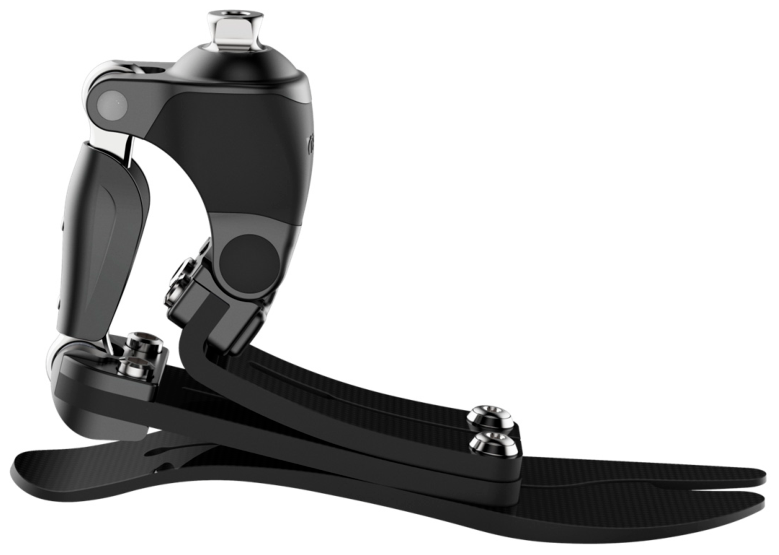
Figure 1. Novel foot: PRO-FLEX PIVOT® (Össur Iceland ehf., Reykjavik, Iceland), a mechanically articulated ankle–foot system combining carbon-fiber blades with an articulated ankle joint.
Prosthesis 08 00096 g001
Figure 2. Flow of participants through the study (details of eligibility, randomization, and inclusion in the full analysis set are shown in the diagram).
Prosthesis 08 00096 g002
Table 1. Participant demographics, amputation characteristics, and prosthetic details.
DemographicNovel Foot →
Prescribed Foot (N = 13)
Prescribed Foot → Novel Foot (N = 17)Total
(N = 30)
Gender, n (%)
Male12 (92.3%)13 (76.5%)25 (83.3%)
Female1 (7.7%)4 (23.5%)5 (16.7%)
Age, years
Mean (SD) [min–max]
57.0 (13.0)
[28.0–70.0]
55.3 (17.1)
[23.0–76.0]
56.0 (15.2)
[23.0–76.0]
Body Mass Index, kg/m2
Mean (SD) [min–max]
26.7 (3.3)
[22.0–33.4]
27.0 (6.2)
[15.4–38.3]
26.9 (5.1)
[15.4–38.3]
Time since amputation, years
Mean (SD) [min–max]
13.5 (14.5)
[1.0–46.0]
17.1 (18.3)
[1.0–58.0]
15.5 (16.6)
[1–58.0]
Cause of amputation, n (%)
Traumatic10 (76.9%)11 (64.7%)21 (70.0%)
Vascular3 (23.1%)3 (17.6%)6 (20.0%)
Congenital-1 (5.9%)1 (3.3%)
Other-1 (5.9%)1 (3.3%)
Infection-1 (5.9%)1 (3.3%)
Socket comfort score at baseline
(0–10)
Mean (SD) [min–max]
7.2 (1.0)
[6.0–9.0]
7.7 (0.8)
[6.0–9.0]
7.5 (0.9)
[6.0–9.0]
PLUS-M/FC-12 T-score (21.8–71.4)
Mean (SD) [min–max]
51.2 (2.7)
[45.8–54.4]
50.3 (4.3)
[41.5–54.4]
50.7 (3.7)
[41.5–54.4]
Prescribed ESAR foot, n (%)
Pro-Flex XC a2 (15)8 (47) 10 (33)
Pro-Flex LP a1 (8)1 (6)2 (7)
Pro-Flex ST a1 (8)3 (18)4 (13)
Taleo b3 (23)1 (6)4 (13)
Talux a3 (23)03 (10)
Other 13 (23)4 (24)7 (23)
a Össur; b Ottobock; 1 Soleus (College Park Industries), Freedom Agilix (Proteor), Xtend Foot (Lindhe Xtend), Vari-Flex (Össur), Rush (Proteor), ShockWave (Proteor) a.
Table 2. Summary of study endpoint score at the end of each period.
Novel Foot
(N = 30)
Prescribed ESAR Foot
(N = 30)
Between-Treatment Differencep-Value *
LSM (SEM)95% CILSM (SEM)95% CILSM (SEM)95% CI
Primary endpoint
PLUS-M/FC-12 T-score 60.2 (1.2) [57.7; 62.6]52.3 (1.2)[49.8; 54.7]7.9 (1.4)[5.0; 10.8]<0.001
Secondary endpoints
Overall prosthesis comfort 14.3 (0.1)[4.0; 4.6]3.7 (0.1)[3.4; 4.0]0.6 (0.2)[0.3; 1.0]<0.001
Comfort on downward slopes 14.0 (0.2)[3.7; 4.4]2.9 (0.2)[2.6; 3.3]1.1 (0.2)[0.6; 1.6]<0.001
Comfort on uphill terrain 14.0 (0.2)[3.7; 4.4]3.0 (0.2)[2.7; 3.4]1.0 (0.2)[0.6; 1.4]<0.001
Comfort when climbing stairs 14.2 (0.2)[3.8; 4.5]3.3 (0.2)[2.9; 3.6]0.9 (0.2)[0.5; 1.3]<0.001
Comfort when descending 1 stairs 4.0 (0.2)[3.6; 4.4]3.1 (0.2)[2.7; 3.5]0.9 (0.2)[0.4; 1.4]0.001
OPUS QOL RASCH score 267.9 (1.8)[64.1; 71.6]62.2 (1.8)[58.5; 65.9]5.7 (1.6)[2.4; 8.9]0.001
ESAT—Satisfaction with technology (mean of 8 items) 34.6 (0.1)[4.4; 4.8]4.2 (0.1)[4.0; 4.4]0.4 (0.1)[0.2; 0.6]0.002 #
ESAT—Satisfaction with services (mean of 4 items) 34.8 (0.1)[4.6; 4.9]4.6 (0.1)[4.4; 4.8]0.2 (0.1)[0.0; 0.4]0.079 #
TUG score at the end of each period in seconds
Mean (SD) [min–max]
7.4 (2.2)[5.1–13.3]7.8 (2.4)[4.9–15.2]---
TUG change from baseline in seconds−0.9 (0.2)[−1.3; −0.4]−0.5 (0.2)[−1.0; 0.0]−0.4 (0.2)[−0.8; 0.1]0.125
* p-values are from linear mixed-effects model including fixed effects for treatment, period, and sequence, and a random effect for subject, without adjustment for baseline. # p-values are from a linear mixed-effects model. 1 Current comfort of the prosthesis when walking, range 0–5. The higher the score, the better the comfort. 2 The full questionnaire comprises 23 questions rated from 0 to 4. The higher the score [0–92], the better the perceived quality of life. The score is converted to a score ranging from 0 to 100 (RASCH score). 3 Items are rated on a 5-level ordinal scale, ranging as follows: 1: not satisfied at all; 2: not very satisfied; 3: more or less satisfied; 4: quite satisfied; 5: very satisfied. Italicized entries indicate variables reported as Mean (SD) [min-max]. All other outcomes are reported as LSM (SEM) or 95% confidence intervals, as specified in the corresponding columns. LSM: least squares mean, SEM: standard error of the mean, CI: Confidence Interval, TUG: Timed Up and Go.
Disclaimer/Publisher’s Note: The statements, opinions and data contained in all publications are solely those of the individual author(s) and contributor(s) and not of MDPI and/or the editor(s). MDPI and/or the editor(s) disclaim responsibility for any injury to people or property resulting from any ideas, methods, instructions or products referred to in the content.