


Abstract
Background/Objectives: Oral function impairment negatively impacts nutrition, health, and quality of life in older adults. While retaining ≥20 natural teeth is often recommended for maintaining oral function, its validity is uncertain, particularly for those who adapt to tooth loss with dentures. This study aimed to determine the minimum number of remaining functional teeth necessary to prevent oral hypofunction in older adults, focusing on two diagnostic criteria: decreased masticatory function and reduced occlusal force. Methods: A total of 154 participants (≥60 years) were included. Oral examination assessed the number of remaining functional teeth. To assess masticatory function, masticatory performance was objectively measured using a visual scoring method of gummy jelly, and occlusal force was quantified with pressure-sensitive film. Pearson’s correlation analyzed relationships among variables, while receiver operating characteristic (ROC) analysis identified optimal tooth number cut-offs for detecting decreased masticatory function (score ≤ 2) and reduced occlusal force (<500 N). Results: Significant positive correlations were found between the number of remaining functional teeth and both masticatory performance (r = 0.591, p < 0.001) and occlusal force (r = 0.453, p < 0.001). ROC indicated that 17 teeth was the optimal threshold for identifying both decreased masticatory performance and reduced occlusal force, with sensitivities of 0.79 and 0.72 and specificities of 0.93 and 0.88, respectively. Conclusions: Retention of 17 or more remaining functional teeth may be sufficient to maintain adequate masticatory performance and occlusal force. These findings serves as a preliminary guide for treatment planning and targeted interventions focused on preserving tooth retention and improving oral function in aging populations.
1. Introduction
The global population is rapidly aging, with projections indicating that by 2030, one in six people will be 60 years or older, rising to 2.1 billion by 2050 [1]. This demographic shift presents significant challenges, particularly in terms of physical and oral frailty among older adults. The Global Burden of Disease Study highlights that over 280 million older adults globally are affected by oral disorders, ranking oral health as the 22nd leading cause of disability-adjusted life-years. Oral frailty, which affects approximately 32% of older adults, is closely associated with an increased risk of physical frailty, impairing daily activities and increasing the burden on healthcare systems [2].
In response to this growing concern, the Japanese Society of Gerontology has established comprehensive diagnostic criteria for oral hypofunction, comprising seven key parameters: poor oral hygiene, oral dryness, reduced occlusal force, decreased tongue-lip motor function, decreased tongue pressure, decreased masticatory function, and deterioration of swallowing function [3]. A diagnosis of oral hypofunction is made when an individual exhibits three or more of these criteria.
Importantly, oral hypofunction is a reversible condition if detected early. Timely dental intervention and appropriate oral health management strategies can restore and maintain oral function. However, if left untreated, oral hypofunction can progress to more severe oral dysfunction, significantly impacting essential daily activities like eating, chewing, and swallowing [4]. Early detection and treatment of oral hypofunction are crucial for preventing its advancement to irreversible stages. Regular dental check-ups and oral function assessments can help identify signs of oral hypofunction before they worsen. Proactive management, including targeted interventions and function-specific exercises, can effectively reverse the condition and prevent the onset of more severe oral health issues [5,6].
One of the primary indicators of oral function is masticatory function, which can be assessed using both objective and subjective methods [7]. Direct objective assessment included chewing tests by testing masticatory performance with standardized test foods like gummy jelly, offering reliability but requiring specialized equipment and being costly [8,9]. Mixing ability tests using color-changing chewing gums are quicker and easier, suitable for various patient groups, but may not detect subtle differences in masticatory capacity [10]. Subjective methods, such as food acceptance questionnaires, provide a convenient approach but may be limited by cultural dietary differences and patient communication abilities [9]. Occlusal force was defined as the indirect objective assessment of masticatory function, which can be measured using pressure-indicating film during maximum clenching [11]. This method correlates well with masticatory function and the remaining functional teeth but is influenced by muscular weakness. Each approach has advantages and limitations. Objective methods often provide more precise data but may be time-consuming and costly. Subjective methods are more accessible but potentially less accurate. The choice of assessment method should consider the specific patient population and research objectives [12].
Tooth retention is a crucial factor in maintaining oral function and overall health. Tooth loss is associated with increased frailty, poor oral health, and a heightened risk of systemic diseases. In a previous study, a lower tooth count was significantly associated with cognitive frailty, reinforcing the idea that oral health affects individuals’ perceptions of their overall health and plays an important role in healthy aging [13]. In Japan, a public health initiative encourages individuals to maintain at least 20 natural teeth by age 80 [4,14]. Retaining over 20 teeth is essential for preventing oral hypofunction and offers benefits such as reducing dementia risk, preventing falls, and decreasing all-cause mortality risk [15]. Despite the established importance of tooth retention, no study has specifically investigated the number of remaining functional teeth in relation to oral hypofunction. Previous research has only confirmed that the number of natural teeth is the key to masticatory performance and has only stated that maintaining 20 or more teeth is extremely important for reducing masticatory difficulties [16].
This study aimed to establish a simple predictor of oral hypofunction by focusing on two diagnostic criteria: decreased masticatory function and reduced occlusal force. Given that the number of remaining functional teeth can be assessed without specialized tools, it served as a potential indicator of oral hypofunction. We hypothesized that the number of remaining functional teeth is positively correlated with masticatory performance and occlusal force. Specifically, this study aimed to: (i) investigate the relationship between the number of remaining functional teeth and objective assessments of masticatory performance and occlusal force, and (ii) determine the minimum number of teeth required to prevent decreased masticatory performance and reduced occlusal force, which serve as diagnostic criteria for oral hypofunction in older adults.
2. Materials and Methods
This study was designed as a cross-sectional survey and conducted in accordance with the standards of the Helsinki Declaration [17] and the STROBE (Strengthening the Reporting of Observational Studies in Epidemiology) [18]. The study was conducted with the approval of the Khon Kaen University Ethics Committee (Approval No. HE640294).
2.1. Participants
The study participants were individuals aged 60 years or older who visited Khon Kaen University Dental Hospital for prosthodontic treatment between January 2020 and January 2022. Exclusion criteria included individuals with orofacial pain, severe periodontitis, jaw deformities, dysphagia, neuromuscular disorders, complications related to existing dentures (if applicable), a fully edentulous arch without prosthetic replacement, or those unable to comply with study protocols. The sample size required for the receiver operating characteristic (ROC) analysis was determined based on the method proposed by Obuchowski and McClish [19]. To achieve a statistical power of 80% (β = 0.20) at a significance level of 0.05 (α = 0.05), with an expected area under the curve (AUC) of 0.80 and a null hypothesis value of 0.5, the minimum sample size was estimated. The proportion of participants with decreased masticatory function and reduced occlusal force was set at 50% based on past research data [20]. The R package “pROC” (version 1.19.0.1) was used for the calculations. Based on these assumptions, a total of 56 participants were required to ensure the robustness of the ROC analysis.
The study’s objectives, procedures, and benefits were thoroughly explained to all participants. Each participant was given sufficient time to consider their participation and ask questions. Written informed consent was obtained from all participants prior to enrollment, ensuring that only those meeting eligibility criteria and providing voluntary, documented consent participated in the study. After applying exclusion criteria, 154 participants (75 men and 79 women) were included, exceeding the intended sample size.
2.2. Oral Assessment Setting
Oral examinations were conducted with participants lying supine on a dental chair under bright artificial lighting. The number of remaining functional teeth was assessed, including natural and treated teeth, pontics, and implants. Wisdom teeth that were impacted or had high degrees of torsion or slant, retained roots, and teeth with grade 3 mobility were excluded.
Participants chewed a piece of gummy jelly (UHA Mikakuto Co., Ltd., Osaka, Japan) 30 times and expectorated the fragments onto gauze over a paper cup. The fragments were washed, stretched on the gauze to avoid overlapping, and visually scored using a standardized sheet with scores from 0 to 9. The examiner determined the score by comparing the fragments with the visual scoring sheet [21]. For participants with removable dentures, assessment was conducted with dentures in place. A score of 2 or less defined decreased masticatory function [22,23].
Participants were instructed to bite using their entire dentition on a pressure-sensitive film (Dental Prescale II® without pressure filter, GC Corporation, Tokyo, Japan) for 3 s. Occlusal force was measured at maximum intercuspation. The Dental Prescale II records the maximum occlusal force of the entire dentition in bilateral contacts, ensuring that all teeth made proper contact with the pressure-sensitive film during the measurement. After the participant completed the biting procedure, the film was analyzed using an Occlusal Force Analyzer (GC Corp, Tokyo, Japan), which employs image analysis software to process scans of the Prescale II film captured by an optical image scanner (GT-X830: Seiko Epson Corp., Nagano, Japan). For participants wearing dentures, the test was performed with the dentures in place [3,24]. Automatic cleaning by the pressure filter function was not performed. A reduced occlusal force was defined as a value of less than 500 N [25].
2.3. Statistical Analyses
The normality of data distribution was assessed using the Kolmogorov–Smirnov test. For non-normal data, a square root or logarithmic transformation was applied. Relationships between the number of remaining functional teeth, masticatory performance, and occlusal force were assessed using Pearson’s correlation coefficient and simple linear regression.
Participants were stratified into three age groups (60–69 years, 70–79 years, and 80 years or older) to assess differences between groups for each testing method. Participants were also categorized into three groups based on the remaining functional teeth (0–9, 10–19, and 20 or more) to evaluate group differences. In addition, participants were grouped according to the type of denture (complete denture, partial denture, and no denture). An analysis of variance (ANOVA) and Tukey’s test were used to compare differences.
The optimal cut-off value for the number of remaining functional teeth to determine decreased masticatory function was established using ROC analysis. Decreased masticatory function was defined as a visual score of 0 to 2 on the gummy jelly. The number of remaining functional teeth, ranging from 1 to 27, was analyzed. Sensitivity and specificity were calculated for each number of remaining functional teeth, with the optimum cut-off value derived using two criteria: (1) the point nearest to the upper-left corner and (2) the point maximizing the product of sensitivity and specificity [26].
Similarly, the optimal cut-off for remaining functional teeth was determined to classify “reduced occlusal force,” defined as occlusal force less than 500 N. Remaining functional teeth from 1 to 27 were considered, and ROC analysis assessed accuracy in predicting reduced occlusal force. The cut-off value was determined following the same procedure as for decreased masticatory function.
All data analyses were conducted using SPSS software (Version 25.0, IBM Corporation, Armonk, NY, USA), with p < 0.05 considered statistically significant.
3. Results
Table 1 presents characteristics of 154 participants (48.7% male, 51.3% female) and associations among remaining functional teeth, masticatory performance, occlusal force, and demographic factors. Females had significantly more remaining functional teeth than males. No significant gender difference was observed in masticatory performance (p = 0.31). Occlusal force was significantly higher in males than in females.
Table 1.
Participant characteristics and the associations between the number of remaining functional teeth, masticatory performance, occlusal force, and demographic factors.
Age-related differences were significant for remaining functional teeth and masticatory performance, but not occlusal force (p = 0.14). Participants aged 60–69 years had significantly more remaining functional teeth than those aged 70–79 years and ≥80 years. Masticatory performance declined with age, with significant differences between those aged 60–69 years, 70–79 years, and ≥80 years.
Participants with ≥20 teeth had significantly higher masticatory performance and occlusal force than those with 0–9 teeth or 10–19 teeth.
Participants wearing complete dentures exhibited significantly lower masticatory performance and occlusal force compared to those wearing partial dentures or no dentures. Similarly, participants with partial dentures demonstrated significantly lower masticatory performance than those with no dentures. However, no significant difference in occlusal force was observed between the partial denture and no denture groups.
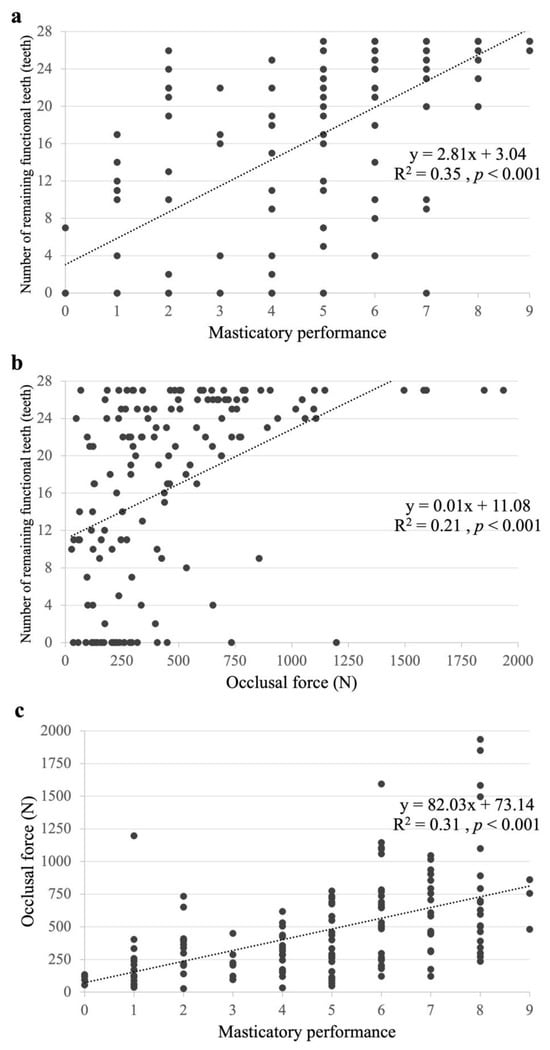
Figure 1 shows the relationship between the number of remaining functional teeth, masticatory performance, and masticatory force. A strong positive correlation was found between the number of remaining functional teeth and masticatory function (r = 0.591, p < 0.001). This indicates that the more teeth you have remaining, the better your masticatory function. A moderate positive correlation was found between the number of remaining functional teeth and occlusal force (r = 0.453, p < 0.001), suggesting that the number of teeth has an effect on occlusal force. Similarly, a moderately strong correlation was found between masticatory function and occlusal force (r = 0.553, p < 0.001), indicating that improvements in masticatory function tended to be associated with greater occlusal force. Linear regression analysis further confirmed these relationships, with a significant regression line indicating a predictive association between these variables.
Figure 1.
Correlations between the number of remaining functional teeth, masticatory performance, and occlusal force: (a) Relationship between the number of remaining functional teeth and masticatory performance with regression line. (b) Relationship between the number of remaining functional teeth and occlusal force with the regression line. (c) Relationship between masticatory performance and occlusal force with regression line. Note: R2: the coefficient of determination.
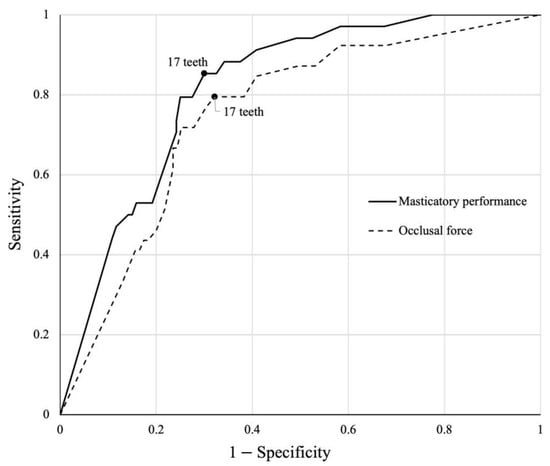
Figure 2 shows the ROC curve for masticatory performance and occlusal force, examining the diagnostic ability for oral hypofunction based on remaining functional teeth. For masticatory performance, the AUC was 0.85, demonstrating excellent discrimination. The optimal cut-off value was 17 teeth, with a sensitivity of 0.79 and a specificity of 0.93. For occlusal force, the AUC was 0.79, indicating good diagnostic accuracy. The cut-off value was also 17 teeth, with a sensitivity of 0.72 and a specificity of 0.88. These results highlight that 17 remaining functional teeth reliably distinguish individuals with reduced occlusal force, with good sensitivity and specificity, supporting its clinical utility and performance in identifying oral hypofunction.
Figure 2.
Receiver operating characteristic curve of the masticatory performance and the occlusal force. Masticatory performance: area under curve = 0.85; cut-off value of the number of remaining functional teeth = 17 teeth; sensitivity = 0.79; specificity = 0.93. Occlusal force: area under curve = 0.79; cut-off value of the number of remaining functional teeth = 17 teeth; sensitivity = 0.72; specificity = 0.88.
Table 2 shows the compatibility between remaining functional teeth and masticatory performance in detecting oral hypofunction. Among those with 0–16 teeth, 27 out of 60 participants (45.0%) had poor masticatory performance, whereas only 7 out of 94 participants (7.4%) in the ≥17 teeth group exhibited poor masticatory performance. Conversely, 87 out of 94 participants (92.6%) with ≥17 teeth had good masticatory performance. The Kappa coefficient was 0.41 (p < 0.001), suggesting a moderate agreement between remaining functional teeth and masticatory performance classification.
Table 2.
Compatibility between the number of remaining functional teeth and the masticatory performance for detecting oral hypofunction.
Table 3 shows the compatibility between the remaining functional teeth and occlusal force in detecting oral hypofunction. Among participants with 0–16 teeth, 28 out of 60 (46.7%) had poor occlusal force, while 32 out of 60 (53.3%) had good occlusal force. For those with ≥17 teeth, 11 out of 94 (11.7%) exhibited poor occlusal force, whereas 83 out of 94 (88.3%) had good occlusal force. The Kappa coefficient was 0.37 (p < 0.001), suggesting a fair agreement between remaining functional teeth and occlusal force classification.
Table 3.
Compatibility between the number of remaining functional teeth and the occlusal force for detecting oral hypofunction.
4. Discussion
This study evaluated the minimum number of remaining functional teeth required to prevent oral hypofunction and assessed its potential as a diagnostic tool in older adults. We found that retaining at least 17 teeth is sufficient to maintain masticatory function and occlusal force, providing a practical and effective threshold for identifying oral hypofunction.
Among the seven criteria for detecting oral hypofunction [3], we focused on decreased masticatory function and reduced occlusal force to identify the minimum number of remaining functional teeth required to avoid the stage of oral hypofunction. This selection was based on the well-established positive correlation between the number of remaining functional teeth, masticatory function, and occlusal force [8,23,27,28,29]. Our findings confirm that the number of remaining functional teeth is positively correlated with both masticatory performance and occlusal force, and we observed a significant correlation between masticatory performance and occlusal force. These results are consistent with those reported in previous studies [8,23,27,28,29]. The positive associations between the number of remaining functional teeth, masticatory performance, and occlusal force reinforce the critical role of maintaining teeth for preserving functional oral health in older adults. These relationships emphasize the potential of counting remaining functional teeth as a practical predictor for early detection of oral hypofunction.
To assess masticatory performance objectively, the guidelines for oral hypofunction recommend using glucose concentration measurements from chewed gummy jelly to determine decreased masticatory function [3]. In this method, participants chew the gummy jelly, and the amount of glucose released is measured using a specialized testing system (Gluco Sensor GS-II, GC Corporation). However, for our study, we chose to use an alternative brand of test gummy jelly (UHA Mikakuto) due to its advantages in terms of measurement accuracy and discrimination ability [30]. Additionally, we implemented the visual scoring method instead of glucose measurements, as it does not require specialized equipment and has demonstrated sufficient validity, showing a strong correlation with glucose concentration results [22]. The criterion for decreased masticatory function in conventional oral hypofunction was set as a visual score of 2 or lower, based on the lower quartile of the Eichner C classification observed in epidemiological studies [23].
To assess occlusal force, we employed direct measurement using pressure-sensitive film, following established protocols [3]. A threshold of <500 N was applied to define reduced occlusal force, as outlined in existing guidelines for oral hypofunction [25]. These guidelines suggest using the number of remaining functional teeth as an indirect indicator of occlusal force, with fewer than 20 teeth proposed as a marker for reduced occlusal force [3]. However, our study found that a threshold of fewer than 17 functional teeth may be more appropriate, offering a more precise and clinically relevant cut-off value. Unlike previous studies that broadly linked the number of remaining functional teeth to frailty characteristics, such as weight loss, weakness, and reduced physical activity [31,32]. Our study directly examined the relationship between the number of remaining functional teeth and occlusal force. This provides valuable insights into how tooth retention directly influences occlusal function, which is fundamental for maintaining oral and systemic health.
The ROC analysis highlighted the utility of the number of functional teeth as a diagnostic tool for identifying oral hypofunction, particularly in terms of masticatory performance and occlusal force. The diagnostic accuracy, reflected by the AUC values, demonstrated excellent potential for detecting decreased masticatory function and acceptable, nearly excellent, accuracy for reduced occlusal force. These findings reinforce the relevance of using the number of remaining functional teeth as a practical clinical marker for assessing oral function.
The cut-off value of ≥17 teeth emerged as a consistent threshold across both diagnostic indicators, providing a reliable reference point for differentiating between normal and impaired oral function. This threshold balances sensitivity and specificity effectively, surpassing the recommended combined threshold of 1.5 for diagnostic utility [33]. Notably, the slightly higher diagnostic accuracy for masticatory performance suggests that tooth retention may have a more direct influence on masticatory function than on occlusal force, which may depend on additional factors, such as muscle strength and the posterior occlusal area [34]. These distinctions highlight the multifactorial nature of occlusal function and the nuanced role of tooth retention in maintaining overall oral health. While our primary focus utilized the total count of remaining functional teeth as a simplified, practical indicator, it was crucial to recognize that the functional integrity reflected by this 17-tooth cut-off may implicitly relate to the maintenance of specific functional configurations, rather than mere quantity. We defined ‘remaining functional teeth’ by excluding those severely compromised (e.g., retained roots, high mobility), thereby indirectly focusing on teeth capable of contributing to the posterior occlusal support and overall occlusal units. Although our results highlighted the utility of a simple tooth count, the functional adequacy at the 17-tooth threshold was likely dependent on retaining essential posterior occlusal pairs. Future research should prioritize disaggregating the contribution of specific functional configurations, e.g., the number of occlusal units, to validate if this numerical threshold correlates strongly with the necessary arch symmetry and posterior support required for sustained oral function in older adults.
We also investigated the effect of denture type on masticatory performance and occlusal force. Participants who wore complete dentures exhibited significantly lower masticatory performance and occlusal force compared to those with partial dentures or no dentures. Additionally, participants wearing partial dentures had significantly lower masticatory performance than those with no dentures. However, no significant difference in occlusal force was observed between the partial denture and no denture groups. Importantly, the mean number of remaining functional teeth in the partial denture group was 17.3, which closely aligns with the cut-off value identified in this study. This finding further indicates that 17 teeth may be an appropriate threshold for maintaining oral function. When patients experience tooth loss, partial dentures can help improve masticatory function, with partially edentulous patients demonstrating approximately 70% improvement depending on the denture type and distribution of remaining natural teeth. Replacement of lost teeth with fixed prostheses or implant-supported fixed prostheses may provide even greater improvements in oral function. However, in older adults, maintaining or achieving a minimum functional dentition may sometimes require complex rehabilitative interventions, particularly in the posterior maxilla, where severe bone resorption is common. Advanced surgical and implant-supported rehabilitations, such as split-crest techniques and maxillary reconstruction, can be successfully used to restore functional occlusion and long-term stability in compromised older patients. Previous study demonstrated favorable 5-year outcomes of maxillary and mandibular split crest techniques with immediate implant placement, highlighting that complex rehabilitation may be justified to achieve adequate functional dentition in selected cases [35]. These findings suggest that the 17-tooth threshold should not be viewed solely as a preventive parameter, but rather as a rehabilitative goal that can be achieved through various treatment modalities in older patients with compromised oral health.
The type and quality of prosthetic materials also have a significant influence on long-term functional outcomes and should be carefully considered when restoring patients with exactly or close to 17 remaining functional teeth. This rehabilitation-focused perspective links our proposed tooth-number threshold to real-world clinical strategies, emphasizing that achieving the minimum functional dentition of 17 teeth may require comprehensive treatment planning that includes both preventive and restorative approaches tailored to individual patient needs and anatomical constraints [36].
Our findings have important clinical implications, and the revision of the threshold that 17 teeth are sufficient for optimal maintenance of oral function will directly affect treatment planning and patient care strategies and will provide more achievable and evidence-based guidelines for maintaining oral health in older adults. The focus has traditionally been on maintaining 20 teeth, a recommendation that was based on limited evidence from single-center prosthodontic samples with very small groups of participants aged over 80 years. Our data show that chewing function and occlusal forces can be maintained adequately with as few as 17 teeth. This may reduce the need for invasive or expensive interventions such as extensive prosthetic treatment. Lowering the threshold to 17 teeth also provides a more realistic and achievable goal, particularly for populations around the world with high rates of tooth loss and for those who are unable to maintain more teeth due to aging or disease. By emphasizing 17 teeth rather than 20, it is possible to set achievable goals that will help prevent a decline in oral function while also reducing patient anxiety. In addition, counting the number of remaining functional teeth is a simple, equipment-free method. This approach, which is inexpensive and economical, such as measuring occlusal force and masticatory performance, may be valuable in large-scale epidemiological studies around the world. However, this cut-off of 17 teeth must be framed cautiously as a preliminary indicator specific to our study, rather than a definitive, universal clinical standard. While tooth count appears to be a simple, useful predictor, further validation across broader and more diverse populations is essential before this threshold can guide clinical guidelines or treatment planning for aging populations. We recommend ongoing efforts to establish robust, evidence-based standards for functional tooth retention.
When considering the Shortened Dental Arch (SDA) concept advocated for maintaining oral function with a reduced number of teeth, focusing on preserving occlusal pairs in the anterior region and at least four occlusal units in the posterior region (a pair of occluding posterior teeth, 1 molar unit being considered equal to 2 premolar units). This model emphasized the importance of arch symmetry and suggested that a functional dentition could be achieved even with a shortened arch [37]. In contrast, our study established a quantitative benchmark, identifying a minimum of 17 remaining functional teeth as necessary to prevent oral hypofunction specifically in older adults. This threshold differed from the SDA concept, which was a qualitative, structural model applicable to the general adult population. The SDA framework evaluated oral function by the release of light-absorbing material when chewing raw carrots, whereas our study employed a different methodology focused on older adults.
A potential limitation of the study, the sample was from a single dental hospital in Thailand, which may limit generalizability. Additionally, factors like age, gender, tooth alignment, occlusion, number of occlusal units, denture status, and the overall status of remaining functional teeth also affect masticatory function and occlusal force. Other parameters influencing oral hypofunction, such as oral hygiene, dryness, tongue–lip motor function, tongue pressure, and swallowing function, were not investigated. Future studies with larger, diverse samples should explore these factors for a comprehensive understanding of oral hypofunction in older adults.
5. Conclusions
Our findings indicate that utilizing the number of remaining functional teeth as a predictor for masticatory performance and occlusal force was appropriate. This correlation suggests that dental professionals can use tooth count as a simple yet effective tool to assess and predict an individual’s oral function, particularly in olderpopulations where comprehensive examinations may be challenging.
Furthermore, to mitigate oral hypofunction in older adults, a minimum of 17 functional teeth should be retained. This threshold provides a tangible goal for both patients and healthcare providers in preserving oral health and functionality. Moreover, this information can serve as a preliminary guide for preventive strategies and treatment planning, focusing on tooth preservation and targeted interventions to maintain or improve oral function in aging populations.
Author Contributions
Conceptualization, K.S., Y.H. and T.O.; methodology, Y.H. and T.O.; software, Y.H. and K.H.; validation, Y.H.; formal analysis, K.S., Y.H., J.P., A.K. and K.H.; investigation, K.S.; resources, K.S. and Y.H.; data curation, K.S.; writing—original draft presentation, K.S.; writing—review and editing, Y.H., J.P., A.K., K.H. and T.O.; visualization, K.S., Y.H. and T.O.; supervision, Y.H., K.H. and T.O.; project administration, K.S. and Y.H.; funding acquisition, K.S., Y.H. and T.O. All authors have read and agreed to the published version of the manuscript.
Funding
This research received no external funding.
Institutional Review Board Statement
This study was conducted in accordance with the Declaration of Helsinki and approved by the Center for Ethics in Human Research of Khon Kaen University (#HE640294, date of approval: 6 May 2021).
Informed Consent Statement
Informed consent was obtained from all subjects involved in the study. Written informed consent has been obtained from the patient(s) to publish this paper.
Data Availability Statement
The material described in the findings of this study, including all relevant raw data, will be freely available to any scientist wishing to use them for non-commercial purposes by contacting the corresponding author without breaching patient confidentiality.
Acknowledgments
We would like to express our appreciation to the authors’ institutions: the Department of Prosthodontics, Faculty of Dentistry, Khon Kaen University, Khon Kaen, Thailand, Thailand Oral Health Plan for the Elderly, Department of Health, Thailand, and the Division of Comprehensive Prosthodontics, Faculty of Dentistry and Graduate School of Medical and Dental Sciences, Niigata University, Niigata, Japan.
Conflicts of Interest
The authors declare no conflicts of interest.
References
- World Health Oraganization. Ageing and Health. Available online: https://www.who.int/news-room/fact-sheets/detail/ageing-and-health (accessed on 31 October 2024).
- Zhou, Y.; Zhou, L.; Zhang, W.; Chen, Y.; She, K.; Zhang, H.; Gao, Y.; Yin, X. Prevalence and influencing factors of oral frailty in older adults: A systematic review and meta-analysis. Front. Public Health 2024, 12, 1457187. [Google Scholar] [CrossRef] [Scilit]
- Minakuchi, S.; Tsuga, K.; Ikebe, K.; Ueda, T.; Tamura, F.; Nagao, K.; Furuya, J.; Matsuo, K.; Yamamoto, K.; Kanazawa, M.; et al. Oral hypofunction in the older population: Position paper of the Japanese Society of Gerodontology in 2016. Gerodontology 2018, 35, 317–324. [Google Scholar] [CrossRef] [Scilit]
- Hasegawa, Y.; Sakuramoto-Sadakane, A.; Nagai, K.; Tamaoka, J.; Oshitani, M.; Ono, T.; Sawada, T.; Shinmura, K.; Kishimoto, H. Does Oral Hypofunction Promote Social Withdrawal in the Older Adults? A Longitudinal Survey of Elderly Subjects in Rural Japan. Int. J. Environ. Res. Public Health 2020, 17, 8904. [Google Scholar] [CrossRef] [Scilit]
- Hatanaka, Y.; Furuya, J.; Sato, Y.; Taue, R.; Uchida, Y.; Shichita, T.; Osawa, T. Regular Oral Health Management Improved Oral Function of Outpatients with Oral Hypofunction in Dental Hospital: A Longitudinal Study. Int. J. Environ. Res. Public Health 2022, 19, 2154. [Google Scholar] [CrossRef] [Scilit]
- Shirahase, R.; Watanabe, Y.; Saito, T.; Sunakawa, Y.; Matsushita, Y.; Tsugayasu, H.; Yamazaki, Y. A Cross-Sectional Study on the Relationship between Oral Function and Sarcopenia in Japanese Patients with Regular Dental Maintenance. Int. J. Environ. Res. Public Health 2022, 19, 5178. [Google Scholar] [CrossRef] [Scilit]
- Gonçalves, T.; Schimmel, M.; van der Bilt, A.; Chen, J.; van der Glas, H.W.; Kohyama, K.; Hennequin, M.; Peyron, M.A.; Woda, A.; Leles, C.R.; et al. Consensus on the terminologies and methodologies for masticatory assessment. J. Oral Rehabil. 2021, 48, 745–761. [Google Scholar] [CrossRef] [Scilit]
- Suwanarpa, K.; Hasegawa, Y.; Salazar, S.; Kikuchi, S.; Yoshimoto, T.; Paphangkorakit, J.; Hori, K.; Ono, T. Can masticatory performance be predicted by using food acceptance questionnaire in elderly patients with removable dentures? J. Oral Rehabil. 2021, 48, 582–591. [Google Scholar] [CrossRef] [Scilit]
- Suwanarpa, K.; Hasegawa, Y.; Paphangkorakit, J.; Pitiphat, W.; Hori, K.; Ono, T. Development of the Food Acceptance Questionnaire for Thai Partial and Complete Edentulism. Nutrients 2024, 16, 1432. [Google Scholar] [CrossRef] [Scilit] [PubMed]
- Limpuangthip, N.; Somkotra, T.; Arksornnukit, M. Subjective and objective measures for evaluating masticatory ability and associating factors of complete denture wearers: A clinical study. J. Prosthet. Dent. 2021, 125, 287–293. [Google Scholar] [CrossRef] [Scilit]
- Maruyama, M.; Morita, K.; Kimura, H.; Nishio, F.; Yoshida, M.; Tsuga, K. Association between masticatory ability and oral functions. J. Clin. Exp. Dent. 2020, 12, e1011–e1014. [Google Scholar] [CrossRef] [Scilit]
- Maekawa, K.; Motohashi, Y.; Igarashi, K.; Mino, T.; Kawai, Y.; Kang, Y.; Hirai, T.; Kuboki, T. Associations between measured masticatory function and cognitive status: A systematic review. Gerodontology 2024, 41, 452–463. [Google Scholar] [CrossRef] [Scilit] [PubMed]
- Zhang, X.M.; Wu, X.; Chen, W. The Association between Number of Teeth and Cognitive Frailty in Older Adults: A Cross-Sectional Study. Nutr. Health Aging 2022, 26, 430–438. [Google Scholar] [CrossRef] [Scilit]
- Gotfredsen, K.; Walls, A.W. What dentition assures oral function? Clin. Oral Implant. Res. 2007, 18, 34–45. [Google Scholar] [CrossRef] [Scilit]
- Jang, J.-H.; Kim, J.-L.; Kim, J.-H. Association between denture use, chewing ability, and all-cause mortality in middle-aged and older adults who exercised regularly in Korea. Sci. Rep. 2021, 11, 6061. [Google Scholar] [CrossRef] [Scilit]
- Mameno, T.; Tsujioka, Y.; Fukutake, M.; Murotani, Y.; Takahashi, T.; Hatta, K.; Gondo, Y.; Kamide, K.; Ishizaki, T.; Masui, Y.; et al. Relationship between the number of teeth, occlusal force, occlusal contact area, and dietary hardness in older Japanese adults: The SONIC study. J. Prosthodont. Res. 2024, 68, 400–406. [Google Scholar] [CrossRef] [Scilit]
- Association, W.M. World Medical Association Declaration of Helsinki: Ethical principles for medical research involving human subjects. JAMA 2013, 310, 2191–2194. [Google Scholar]
- Von Elm, E.; Altman, D.G.; Egger, M.; Pocock, S.J.; Gotzsche, P.C.; Vandenbroucke, J.P.; Initiative, S. The Strengthening the Reporting of Observational Studies in Epidemiology (STROBE) statement: Guidelines for reporting observational studies. Ann. Intern. Med. 2007, 147, 573–577. [Google Scholar] [CrossRef] [Scilit]
- Obuchowski, N.A.; McClish, D.K. Sample size determination for diagnostic accuracy studies involving binormal ROC curve indices. Stat. Med. 1997, 16, 1529–1542. [Google Scholar] [CrossRef] [Scilit]
- Imagawa, N.; Kato-Kogoe, N.; Suzuki, K.; Omori, M.; Suwa, Y.; Inoue, K.; Nakano, H.; Yamamoto, K.; Kamiya, K.; Ikehara, S.; et al. Relationship between Oral Function and Occlusal Bite Force in the Elderly. J. Hard Tissue Biol. 2020, 29, 165–168. [Google Scholar] [CrossRef] [Scilit]
- Nokubi, T.; Yoshimuta, Y.; Nokubi, F.; Yasui, S.; Kusunoki, C.; Ono, T.; Maeda, Y.; Yokota, K. Validity and reliability of a visual scoring method for masticatory ability using test gummy jelly. Gerodontology 2013, 30, 76–82. [Google Scholar] [CrossRef] [Scilit] [PubMed]
- Murakami, K.; Hori, K.; Yoneda, H.; Sato, N.; Suwanarpa, K.; Sta Maria, M.T.; Marito, P.; Nokubi, T.; Ono, T. Compatibility of two types of gummy jelly tests for detecting decreased masticatory function. Gerodontology 2022, 39, 10–16. [Google Scholar] [CrossRef] [Scilit]
- Kosaka, T.; Ono, T.; Kida, M.; Kikui, M.; Yamamoto, M.; Yasui, S.; Nokubi, T.; Maeda, Y.; Kokubo, Y.; Watanabe, M.; et al. A multifactorial model of masticatory performance: The Suita study. J. Oral Rehabil. 2016, 43, 340–347. [Google Scholar] [CrossRef] [Scilit]
- Suzuki, T.; Kumagai, H.; Watanabe, T.; Uchida, T.; Nagao, M. Evaluation of complete denture occlusal contacts using pressure-sensitive sheets. Int. J. Prosthodont. 1997, 10, 386–391. [Google Scholar] [PubMed]
- Horibe, Y.; Matsuo, K.; Ikebe, K.; Minakuchi, S.; Sato, Y.; Sakurai, K.; Ueda, T. Relationship between two pressure-sensitive films for testing reduced occlusal force in diagnostic criteria for oral hypofunction. Gerodontology 2022, 39, 3–9. [Google Scholar] [CrossRef] [Scilit] [PubMed]
- Mashige, F. Preparation of receiver-operating characteristic (ROC) curves and determination of optimum cut-off values. Int. J. Anal. Bio-Sci. 2005, 28, 133–139. [Google Scholar]
- Ikebe, K.; Matsuda, K.; Kagawa, R.; Enoki, K.; Okada, T.; Yoshida, M.; Maeda, Y. Masticatory performance in older subjects with varying degrees of tooth loss. J. Dent. 2012, 40, 71–76. [Google Scholar] [CrossRef] [Scilit] [PubMed]
- Ikebe, K.; Matsuda, K.; Kagawa, R.; Enoki, K.; Yoshida, M.; Maeda, Y.; Nokubi, T. Association of masticatory performance with age, gender, number of teeth, occlusal force and salivary flow in Japanese older adults: Is ageing a risk factor for masticatory dysfunction? Arch. Oral Biol. 2011, 56, 991–996. [Google Scholar] [CrossRef] [Scilit]
- Matsui, D.; Yamamoto, T.; Nishigaki, M.; Miyatani, F.; Watanabe, I.; Koyama, T.; Ozaki, E.; Kuriyama, N.; Kanamura, N.; Watanabe, Y. Validity of self-reported number of teeth and oral health variables. BMC Oral Health 2016, 17, 17. [Google Scholar] [CrossRef] [Scilit]
- Ikebe, K.; Morii, K.; Matsuda, K.; Hazeyama, T.; Nokubi, T. Reproducibility and Accuracy in Measuring Masticatory Performance Using Test Gummy Jelly. Prosthodont. Res. Pract. 2005, 4, 9–15. [Google Scholar]
- De Andrade, F.B.; Lebrão, M.L.; Santos, J.L.; Duarte, Y.A. Relationship between oral health and frailty in community-dwelling elderly individuals in Brazil. J. Ame Geriatr. Soc. 2013, 61, 809–814. [Google Scholar] [CrossRef] [Scilit]
- Mikami, R.; Komagamine, Y.; Aoyama, N.; Mizutani, K.; Sasaki, Y.; Iwata, T.; Minakuchi, S.; Kanazawa, M. Association between occlusal supports and nutritional status in older adults: A systematic review. J. Dent. Sci. 2024, 19, 813–827. [Google Scholar] [CrossRef] [Scilit] [PubMed]
- Power, M.; Fell, G.; Wright, M. Principles for high-quality, high-value testing. Evid.-Based Med. 2013, 18, 5–10. [Google Scholar] [CrossRef] [Scilit] [PubMed]
- Kim, S.; Doh, R.M.; Yoo, L.; Jeong, S.A.; Jung, B.Y. Assessment of Age-Related Changes on Masticatory Function in a Population with Normal Dentition. Int. J. Environ. Res. Public Health 2021, 18, 6899. [Google Scholar] [CrossRef] [Scilit] [PubMed]
- Crespi, R.; Toti, P.; Covani, U.; Crespi, G.; Menchini-Fabris, G.B. Maxillary and Mandibular Split Crest Technique with Immediate Implant Placement: A 5-Year Cone Beam Retrospective Study. Int. J. Oral Maxillofac. Implant. 2021, 36, 999–1007. [Google Scholar] [CrossRef] [Scilit]
- Mihali, S.G.; Hiller, A. State-of-the-Art Zirconia and Glass–Ceramic Materials in Restorative Dentistry: Properties, Clinical Applications, Challenges, and Future Perspectives. Appl. Sci. 2025, 15, 12841. [Google Scholar] [CrossRef] [Scilit]
- Kayser, A.F. Shortened dental arch: A therapeutic concept in reduced dentitions and certain high-risk groups. Int. J. Periodontics Restor. Dent. 1989, 9, 426–449. [Google Scholar]

Disclaimer/Publisher’s Note: The statements, opinions and data contained in all publications are solely those of the individual author(s) and contributor(s) and not of MDPI and/or the editor(s). MDPI and/or the editor(s) disclaim responsibility for any injury to people or property resulting from any ideas, methods, instructions or products referred to in the content. |
© 2026 by the authors. Licensee MDPI, Basel, Switzerland. This article is an open access article distributed under the terms and conditions of the Creative Commons Attribution (CC BY) license.