
Article

A Phenomenological Koide Cone Selector for Charged-Lepton Masses in a Neutral-Parent Reconstruction Ansatz

Research Department, Silicon Minds Inc., Clarksville, MD 21029, USA
Quantum Rep. 2026, 8(3), 70; https://doi.org/10.3390/quantum8030070
Submission received: 2 June 2026 / Revised: 22 July 2026 / Accepted: 25 July 2026 / Published: 27 July 2026

Abstract

The charged-lepton pole masses exhibit the well-known Koide relation, in which the square-root geometry reduces the three-mass pattern to a one-angle problem. This paper first gives a self-contained algebraic formulation of that geometry: the Koide condition is equivalent to equality between the democratic and orthogonal components of the charged-lepton root vector, and the resulting spectrum lies on a cone around the democratic direction. The geometric equivalence and the one-angle parameterization are exact. A reconstruction framework is then summarized to motivate a neutral-parent interpretation of the root space. In this framework, premetric equivalence gives equal structural weighting, the Indefinite Reconstruction Stability Principle motivates minimal saturation, and persistent charged readouts are associated with carrier-supported codimension-two holonomy structure. The remaining Koide cone angle is assigned by a phenomenological weak-closure selector constructed from the electron, proton, and neutron masses and the low-energy fine-structure constant. No continuous coefficient is optimized against the muon or tau mass, but the selector was formulated retrospectively rather than selected from a prespecified finite hypothesis class. The retained baseline selector gives a muon mass output of approximately 105.6565 MeV and a tau mass output of approximately 1776.94 MeV, with relative deviations of approximately 0.0017 percent below and 0.00061 percent above the adopted pole-mass values. Accordingly, the numerical agreement is reported descriptively and is not assigned a look-elsewhere-corrected statistical significance. The selector is an ansatz motivated by the reconstruction picture; its full form and coefficients are not yet derived from a complete premetric calculus or matched to a post-readout effective action. Therefore, the result is presented as reproducible pole mass phenomenology and as a concrete target for future formal reconstruction rather than as a derivation of running Standard Model Yukawa couplings.

1. Introduction

The electron, muon, and tau have the same electric charge, spin, and Standard Model gauge assignments, yet their masses span more than three orders of magnitude [1]. The low-energy fine-structure constant used later is taken from the CODATA 2022 recommended values [2]. In the Standard Model, the charged-lepton masses enter after electroweak symmetry breaking through
m i ( μ ) = y i ( μ ) v ( μ ) 2 , i = e , μ , τ ,
where the Yukawa couplings are independent parameters of the renormalized low-energy theory [3,4,5,6,7,8,9,10]. The Higgs mechanism explains how the masses occur once the Yukawa couplings are specified, but does not determine their observed hierarchy.
The numerical clue considered here is Koide’s relation,
Q m e + m μ + m τ ( m e + m μ + m τ ) 2 2 3 .
Its geometric interpretation in square-root mass space is known. In the notation used below, the charged-lepton root vector lies at approximately a 45-degree angle to the democratic direction ( 1 , 1 , 1 ) [11,12,13,14,15]. The present paper does not claim novelty for this geometric fact. Its narrower novelty is a proposed weak closure selector for the remaining angle on the Koide cone and an interpretation of that selector within a neutral-parent reconstruction framework.
The claim level is deliberately restricted. The numerical relation studied in this paper concerns charged-lepton pole masses and low-energy boundary quantities. It is not asserted to be a relation among running MS ¯ masses or Yukawa couplings at an arbitrary renormalization scale. The exact, phenomenological, and interpretive layers are separated as follows:
  • The equivalence between Koide’s relation and equal-norm root-space balance is algebraic.
  • The one-angle Koide cone parameterization and the electron-zero boundary are algebraic.
  • The weak closure equation is a phenomenological selector.
  • The neutral-parent reconstruction picture supplies a proposed structural interpretation, not a completed premetric derivation or post-readout effective theory matching.
This distinction is summarized in Table 1. It is maintained throughout the paper because the principal nontrivial numerical formula is not yet derived from a complete premetric reconstruction calculus or matched to a post-readout effective theory.
The broader reconstruction program has developed finite-action phase behavior, emergent carrier response, premetric admissibility, and codimension-two defect classification in earlier work [16,17,18]. The recently published neutral-parent particle archetype [18] provides the structural background for the present phenomenological specialization. To make the paper independently readable, Section 4 gives a self-contained account of the terms actually used here, including reconstruction, readout, IRSP, saturation, premetric equal weighting, the carrier, codimension-two holonomy, and the neutral parent.
A related recent study developed a distinct structural construction of the charged-lepton hierarchy within the same broader neutral-parent framework [19]. That work uses level-wise equal weight chamber counting to obtain a nested charged-endpoint tower for m μ / m e , followed by a neutral-overlap correction and a solar-angle target. The present paper addresses a different and deliberately more phenomenological question: it treats the Koide cone as an exact geometric reduction and examines whether its remaining angle can be selected from the low-energy boundary quantities m e , m p , m n , and α ( 0 ) . The endpoint tower of [19] is neither used as an input nor reproduced here. Therefore, the two constructions are distinct candidate selectors, not independent confirmations of one another. A complete reconstruction calculus must ultimately derive, relate, or discriminate between them.
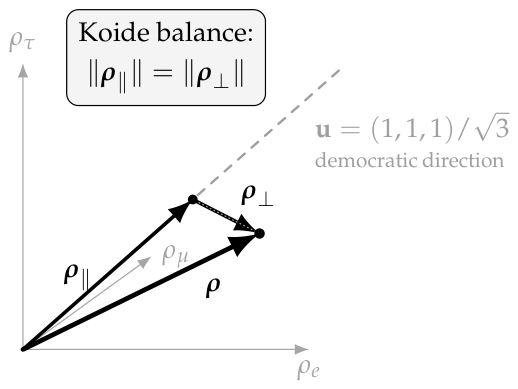
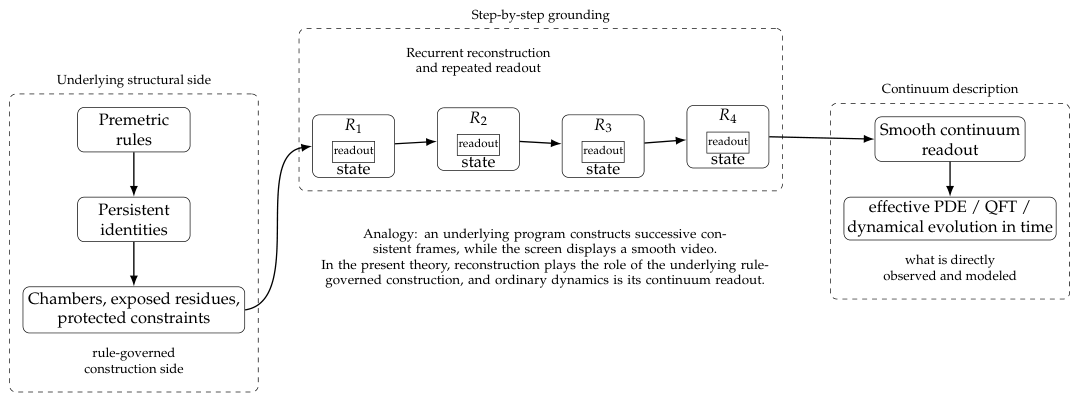
A final point should be stated explicitly at the outset. In the present view, reconstruction and the Standard Model do not compete at the same level. Reconstruction and the neutral-parent architecture are intended to describe premetric structural physics before readout, whereas the Standard Model remains the correct and indispensable effective theory after readout. The exact root-space geometry is illustrated in Figure 1, while Section 4 makes this division of labor explicit and illustrates it with the frame-by-frame analogy in Figure 2.
The paper is organized as follows: Section 2 states the pole mass scope and reviews Koide’s relation; Section 3 derives the exact root-space geometry, its N-channel extension, and the one-angle cone; Section 4 summarizes the reconstruction framework; Section 5 connects that framework to the charged-lepton root vector without claiming a derivation of family replication; Section 6 introduces the phenomenological weak-closure selector; Section 7 provides a reproducible numerical evaluation; Section 8 discusses pole masses, running parameters, and the Standard Model; Section 9 compares the proposal with representative Koide and flavor approaches; Section 10 states limitations and falsifiability conditions; Section 11 discusses the interpretation of the result; and Section 12 concludes the paper. Appendix A records a separately labeled post hoc screening diagnostic.

2. Pole Mass Scope and the Koide Relation

2.1. Pole Masses and Running Yukawa Couplings

The distinction between pole masses and running parameters is essential. The renormalized Standard Model relation in Equation (1) contains scheme- and scale-dependent quantities. By contrast, the numerical Koide relation is most accurate when evaluated with low-energy charged-lepton pole masses [20,21,22]. The present paper studies
m e pole , m μ pole , m τ pole ,
and uses the superscript “pole” only where ambiguity could arise.
For compactness, in the numerical sections we write m e , m μ , m τ for the pole masses. This notation does not imply that
y i ( μ ) = 2 m i pole v ( μ )
is a scale-independent identity. Matching a pole mass to a running Yukawa coupling requires the usual radiative and scheme-dependent corrections. Thus, the relation proposed below is an infrared mass relation, not a direct high-scale flavor boundary condition.
Using representative values consistent with the adopted PDG/CODATA inputs,
m e = 0.510998950 MeV , m μ = 105.6583755 MeV , m τ = 1776.93 MeV ,
one obtains
Q 0.66666446 , Q 2 3 2.20 × 10 6 .
The tau uncertainty currently dominates the empirical uncertainty of the comparison.

2.2. Root Variables

Choose an arbitrary common mass scale μ 0 > 0 and define the dimensionless non-negative root mass vector
ρ = ( ρ e , ρ μ , ρ τ ) = m e μ 0 , m μ μ 0 , m τ μ 0 .
Equivalently,
m i = μ 0 ρ i 2 , μ 0 > 0 .
All subsequent root-space relations are homogeneous, so the arbitrary scale μ 0 cancels from mass ratios and angular statements. Therefore, one may set μ 0 = 1 in a chosen system of mass units for the purely algebraic calculations. Equation (8) is not a replacement for the Higgs mechanism but a proposed deeper encoding of the infrared mass ratios.
Let
u = 1 3 ( 1 , 1 , 1 )
be the democratic unit vector. Decompose
ρ = ρ + ρ , ρ = ( ρ · u ) u , ρ · u = 0 .
The next section records the exact consequences of this decomposition before any reconstruction interpretation is introduced.

3. Exact Koide Cone Geometry

3.1. Equal-Norm Decomposition

Theorem 1
(Koide/equal-norm equivalence). Let m i = μ 0 ρ i 2 with ρ i 0 not all zero and μ 0 > 0 , and let u = ( 1 , 1 , 1 ) / 3 . Then,
ρ = ρ
is equivalent to
m e + m μ + m τ ( m e + m μ + m τ ) 2 = 2 3 .
Proof. 
Orthogonality gives
ρ 2 = ρ 2 + ρ 2 .
Therefore, Equation (11) is equivalent to
ρ 2 = 2 ρ 2 .
Since
ρ 2 = ρ e 2 + ρ μ 2 + ρ τ 2
and
ρ 2 = ( ρ · u ) 2 = ( ρ e + ρ μ + ρ τ ) 2 3 ,
we obtain
ρ e 2 + ρ μ 2 + ρ τ 2 = 2 3 ( ρ e + ρ μ + ρ τ ) 2 .
Substituting m i = μ 0 ρ i 2 proves Equation (12). The reverse implication follows by reversing the steps. □
The theorem is an identity in Euclidean root space. Figure 1 summarizes the decomposition visually and is helpful for reading the later reconstruction interpretation. Calling ρ a parent component and ρ a channel-splitting component is an additional interpretation developed later.
The N = 3 equal sector power interpretation was also developed in [19]. The present theorem isolates the underlying Euclidean equivalence from that reconstruction interpretation, while Theorem 2 extends the algebraic statement to an arbitrary number of channels.

3.2. The General N-Channel Statement

The equal-norm geometry is not intrinsically restricted to three components. This observation is useful because it prevents a geometric identity from being misrepresented as a derivation of three fermion generations.
Theorem 2
(N-channel equal-norm relation). Let N 2 be an integer, and let ρ = ( ρ 1 , , ρ N ) R N with ρ i 0 not all zero, μ 0 > 0 , and m i = μ 0 ρ i 2 , and define
u N = 1 N ( 1 , , 1 ) .
If
ρ = ρ ,
then
i = 1 N m i i = 1 N m i 2 = 2 N .
Conversely, Equation (20) implies equal norm.
Proof. 
The proof is identical to Theorem 1, using
( ρ · u N ) 2 = 1 N i ρ i 2 .
For the empirically observed charged-lepton triplet, N = 3 gives 2 / 3 . The present paper takes that observed three-channel sector as its domain. It does not derive family replication or prove that additional charged-lepton families are impossible. A future reconstruction theory would need an independent closure argument for why the admissible charged-lepton readout terminates at three channels.

3.3. One-Angle Parameterization

Choose an orthonormal basis
u = 1 3 ( 1 , 1 , 1 ) , v = 1 2 ( 1 , 1 , 0 ) , w = 1 6 ( 1 , 1 , 2 ) .
If the equal-norm condition holds, every point on a chosen branch of the Koide cone can be written as
ρ ( θ ) = R u + cos θ v + sin θ w , R > 0 .
Thus,
f e ( θ ) = 1 3 + cos θ 2 + sin θ 6 ,
f μ ( θ ) = 1 3 cos θ 2 + sin θ 6 ,
f τ ( θ ) = 1 3 2 sin θ 6 ,
and
m e : m μ : m τ = f e ( θ ) 2 : f μ ( θ ) 2 : f τ ( θ ) 2 .
Therefore, Koide reduces the mass ratio problem to a single orientation angle, though it does not determine that angle.

3.4. Electron-Zero Boundary

On the branch used here, the electron component vanishes at
θ 0 = 7 π 12 , f e ( θ 0 ) = 0 .
Write
θ * = θ 0 + Δ θ .
Then, for small positive Δ θ ,
f e ( θ * ) = f e ( θ 0 ) Δ θ + O ( Δ θ 2 ) ,
so the electron mass behaves as
m e = μ 0 R 2 f e ( θ * ) 2 ( Δ θ ) 2 .
The observed hierarchy is geometrically compatible with a point near an electron-zero boundary. The remaining question is why the displacement has the observed magnitude. The phenomenological selector introduced in Section 6 addresses this question.

4. Reconstruction Framework Underlying the Ansatz

The reconstruction framework supplies the theoretical setting for the neutral-parent interpretation and motivates the categories used in the selector. It is not necessary to accept the framework in order to verify the algebra or the numerical outputs; conversely, the numerical success of the selector does not by itself establish the framework. This section defines the framework in a self-contained way and distinguishes its structural principles from the phenomenological formula tested later.

4.1. Premetric Reconstruction and Readout

Definition 1
(Premetric reconstruction). Reconstruction is the admissible formation and continued stabilization of relational structure from a level at which metric distance, physical time, local energy, field labels, and particle identities have not yet been differentiated.
The word “premetric” does not denote an earlier era inside an already-existing spacetime but a structural level at which the conditions required for a spacetime description are selected. The logical order is schematically
premetric admissibility stable relational structure metric and field readout .
The first arrow is an admissibility relation, not necessarily a temporal process. Effective time belongs to the readout level.
Definition 2
(Readout). Readout is the representation of an admissible structural class as effective metric, field, particle, and observable data within a reconstructed spacetime regime.
A schematic readout map is
R : A pre P eff ,
where A pre denotes a premetric admissibility class and P eff an effective physical description. Readout is not an arbitrary numerical assignment. Structural invariants selected before metric differentiation constrain the quantities available after readout. In this paper, the root-space balance and channel organization are interpreted as such structural constraints, whereas the particular weak-closure coefficients remain phenomenological.

4.2. Division of Labor: Reconstruction Before Readout, Standard Model After Readout

The intended division of labor is limited. Reconstruction concerns the admissibility, closure, and persistence of structures before metric and field readout. Once effective particles and fields have been read out, the Standard Model remains the indispensable theory of their dynamics and precision interactions. The present framework proposes possible structural boundary conditions for effective masses and ratios; it does not replace post-readout quantum field theory.
Figure 2 is an illustrative frame-by-frame video analogy for this division. Rule-governed reconstruction corresponds to the construction of successive consistent frames, whereas effective continuum dynamics corresponds to the smooth video seen on the screen. This is only an analogy for recurrent grounding and readout, not a claim that the universe is a digital simulation.

4.3. Indefinite Reconstruction Stability Principle

Definition 3
(Indefinite Reconstruction Stability Principle). The Indefinite Reconstruction Stability Principle (IRSP) states that a physically persistent structure must preserve its defining compatibility class under indefinite admissible reconstruction.
If
X 0 X 1 X 2
is an admissible continuation, then the identity-defining data of X must remain reconstructible at every stage. The IRSP excludes configurations that require arbitrary global repair at each continuation, isolated disturbances for which the identity dissolves into the background, and incomplete branch structures that cannot maintain closure. Earlier work develops the topological and reconstruction aspects of this requirement [16,17].

4.4. Minimal Saturation

A working consequence of the IRSP used in the present paper is the minimal saturation principle:
When a stable structure admits a finite set of independent directions required for closure, the minimal persistent realization contains the directions needed for closure but does not add independent directions for which no structural requirement exists.
Saturation excludes under-realization. It also excludes unforced extension beyond the directions required for closure. In the charged-lepton root space, the relevant decomposition is
A = ρ 2 , B = ρ 2 .
The leading saturation hypothesis is
A = B .
Equation (36) is a selection hypothesis of the reconstruction interpretation. The fact that it is equivalent to Koide’s relation is the exact algebraic result of Theorem 1. This distinction is important: IRSP motivates the balance point, but the present phenomenological paper does not derive that point from a complete premetric dynamics.

4.5. Premetric Equivalence and Equal Structural Weighting

Before readout, structurally equivalent channels cannot be distinguished by mass, energy, metric distance, or dynamical frequency, as those are post-readout quantities. In the absence of a differentiating structural invariant, equivalent admissible channels are assigned equal structural weight. For three channels, this gives
u = 1 3 ( 1 , 1 , 1 ) .
Equal structural weighting is not introduced as a quantum probability rule. It expresses the absence of a premetric admissibility distinction among otherwise equivalent channels. In the present application, equal weighting defines the democratic parent direction, while saturation concerns the norm balance between that direction and its orthogonal complement:
premetric equivalence u , minimal saturation ρ = ρ .

4.6. Carrier, U ( 1 ) Phase, and Persistent Defects

The carrier is the effective non-empty support through which phase comparison, geometric response, and persistent defect identity are represented after readout. It is not an additional material substance inserted into the spacetime. A local disturbance with no invariant obstruction may relax into the carrier. A persistent particle-like readout requires a diagnostic that survives admissible deformation.
For a codimension-two defect D, a punctured transverse neighborhood has a linking circle
N ( D ) D S 1 .
A compact U ( 1 ) phase supports a loop holonomy
W Γ = exp i Γ A , Γ S 1 ,
which can distinguish the defect from the background even when local field profiles are continuously deformed. The standard mathematical role of connections and holonomy is well established [23,24,25,26]; the specific use of codimension-two linking as a reconstruction admissibility criterion is developed in [17].
The codimension-two language is carrier-level and transverse. The present paper does not assert that a measured charged lepton is a spatially extended cosmic string-like object. At accessible energies, charged leptons retain the usual pointlike, Lorentz-covariant, and chiral Standard Model description. A future reconstruction theory must explain how that effective readout follows from the carrier-level linking structure and must remain consistent with precision bounds on lepton compositeness.

4.7. Neutral-Parent Archetype

Definition 4
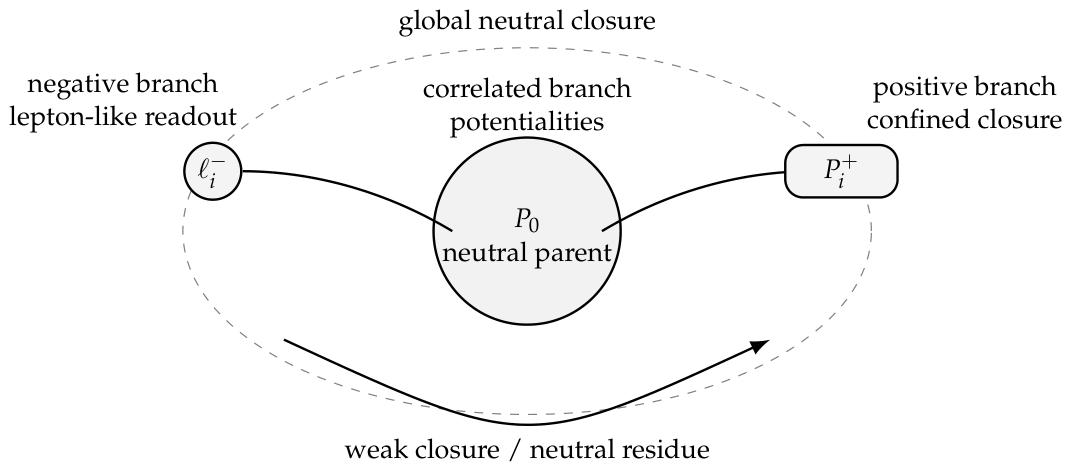
(Neutral parent). A neutral parent is a globally closed pre-realization structure with charged endpoints that arise only through correlated branch resolution. It is not an additional on-shell Standard Model particle, and does not contain already-formed daughter particles.
The generic closure is
P 0 C C + , Q ( P 0 ) = 0 , Q ( C ) + Q ( C + ) = 0 .
The carrier-resolution particle archetype developed in [18] uses the schematic first resolution
P 0 Z 2 Z 2 + Z 3 ,
where the negative branch admits lepton-like readout and the positive branch continues toward confined closure. The present paper does not re-derive that archetype. Only its most conservative consequence is used here, namely, that the charged-lepton channels may be organized as correlated possibilities of a common neutral closure rather than as unrelated primitive mass inputs. The application-specific correlated-branch structure is developed in Section 5.

4.8. Quadratic Response and the Role of Lagrangians

Near a stable readout configuration, a residual response may be expanded as
F [ δ q ] = F [ 0 ] + 1 2 Q ( δ q , δ q ) + O ( δ q 3 )
when the admissible first variation vanishes. This motivates the quadratic mass encoding in Equation (8). In the present paper, that encoding is a structural ansatz, not a derivation of the charged-lepton self-energies.
The reconstruction framework does not reject Lagrangian physics. It places conventional spacetime Lagrangians downstream of readout, because a local action already presupposes a manifold, metric measure, fields, derivatives, and causal organization. However, this does not remove the need for calculability: a complete reconstruction theory must derive a post-readout effective action that recovers the Standard Model description. The present work has not done so; therefore, the weak-closure coefficients below remain phenomenological assignments.

4.9. Assumption Ledger

The phenomenological analysis uses the following assumptions:
Assumption 1.
Charged-lepton pole masses are quadratic readouts of root-level residual amplitudes.
Assumption 2.
The observed charged-lepton channels are correlated potentialities of a common neutral-parent structure.
Assumption 3.
Premetric equivalence defines the democratic parent direction.
Assumption 4.
Minimal saturation motivates equal norm between common-parent and channel-splitting components.
Assumption 5.
The positive compensating sector supplies an infrared closure scale.
Assumption 6.
Low-energy U ( 1 ) dressing and finite positive-end response supply the first retained corrections in the phenomenological selector.
Assumptions 1–5 organize the reconstruction interpretation. The equivalence between equal-norm balance and Koide is exact algebra. Assumption 6 leads to the phenomenological formula tested in Section 6 and Section 7.

5. Neutral-Parent Interpretation of Charged-Lepton Root Space

The observed charged-lepton triplet defines
ρ = ( ρ e , ρ μ , ρ τ ) .
The reconstruction interpretation assigns
ρ common neutral - parent readout , ρ channel differentiation .
Premetric equivalence motivates the democratic axis, and minimal saturation motivates the balance condition. Therefore, the logical relation is
equal structural weighting common neutral parent minimal saturation ρ = ρ Q = 2 3 .
Only the final equivalence is theorem-level. The preceding implication is the reconstruction selection hypothesis.

5.1. Why a Neutral Parent Is Useful

If the three charged leptons are treated as unrelated primitive objects, the three root amplitudes remain independent data. A common parent instead defines a distinguished symmetric direction and a correlated splitting plane. This provides a structural setting in which Koide’s permutation-symmetric geometry can be interpreted rather than merely restated.
A realized branch is written schematically as
P 0 ( P i + , i , ν ¯ i ) , i = e , μ , τ ,
where P i + denotes the positive compensating sector and the neutrino marks weak closure. Equation (47) is not a statement that one low-energy neutron has three kinematically accessible decay channels. Free neutron beta decay realizes only the electron channel. The notation labels structural channel possibilities within the broader neutral-parent archetype. Figure 3 illustrates this correlated-branch picture.

5.2. Three Observed Channels, Not a Derivation of Three Generations

This paper does not derive the existence of three generations; rather, it takes the observed three-family charged-lepton sector as its empirical domain and applies Theorem 2 conditionally to N = 3 .
This restriction is scientifically useful. It isolates the actual result: conditional on a three-channel equal-weight root space, saturation has exactly the Koide form. A future neutral-parent theory must supply an independent selection theorem for the number of families. No such theorem is claimed in the present phenomenological study.

5.3. Relation to Pointlike Standard Model Leptons

The neutral-parent language is not a conventional compositeness model with a predicted finite lepton radius. It introduces a pre-readout closure architecture whose infrared endpoint is represented by the ordinary charged lepton field. The present calculation does not modify Standard Model propagators, form factors, chirality assignments, or electroweak vertices. Therefore, this paper does not claim that it can be used to compute compositeness bounds by itself, nor does it claim an experimentally resolvable internal lepton size. Deriving the pointlike chiral readout from the carrier-level structure remains an open premetric-to-effective matching problem.

6. Phenomenological Weak-Closure Selector

Status of the selector. The equations in this section define a phenomenological ansatz. The reconstruction picture motivates the categories of terms, but a complete premetric calculus or post-readout effective action does not yet derive the full expression or all of its coefficients.
Koide geometry fixes the charged-lepton root vector to a cone, leaving the angle θ * undetermined. The ansatz identifies the small displacement from the electron-zero boundary with a dimensionless weak-closure mismatch:
Δ θ 2 = Δ M closure M + conf .
The square appears because the angle is a root-level displacement, while the closure numerator is a mass-level response.

6.1. Infrared Boundary Quantities

For the ground electron-like branch, the positive compensating scale is identified phenomenologically with the proton mass,
M + conf m p .
The neutron–proton boundary asymmetry and beta-continuum scale are
Δ n p = m n m p , Q β = m n m p m e .
The analogy with neutron beta decay
n p + e + ν ¯ e
provides a closure architecture, not a derivation that QCD must determine the muon and tau masses. The nucleon masses are measured infrared boundary inputs. In the Standard Model, their values depend on QCD, light-quark masses, isospin breaking, and electromagnetic effects [27,28,29,30,31].

6.2. Leading Selector

The leading closure numerator is
N 0 = m n m p + 1 3 m e .
The coefficient 1 / 3 is fixed inside the ansatz by the squared projection of the electron channel basis vector e e = ( 1 , 0 , 0 ) onto the democratic direction:
| e e · u | 2 = 1 3 .
The leading angular displacement is
Δ θ 0 = N 0 m p .

6.3. Retained Low-Energy Terms

The retained numerator is
N 2 = m n m p + 1 3 m e + α Q β + Q β 2 2 m p ,
with
Δ θ 2 = N 2 m p , θ * = 7 π 12 + Δ θ 2 .
The term α Q β is interpreted as the first low-energy U ( 1 ) dressing of the weak continuum. The term Q β 2 / ( 2 m p ) has the form of the leading finite heavy-end recoil response. The coefficients are not fitted continuously to m μ or m τ , but the choice to retain these terms is a model assumption.

6.4. Mass Outputs

Once θ * is specified, the electron mass fixes the common normalization. Equations (24)–(26) give
m μ out = m e f μ ( θ * ) f e ( θ * ) 2 , m τ out = m e f τ ( θ * ) f e ( θ * ) 2 .
The notation “out” is used to emphasize that these are outputs of the phenomenological selector, not yet predictions of a completed premetric calculus with demonstrated effective-theory matching. The same angle determines both masses; the two outputs are not independently adjusted.
Table 2 states the status of each ingredient. This ledger prevents “no fitted continuous parameter” from being confused with “formally derived from the reconstruction framework”.

7. Numerical Evaluation and Reproducibility

7.1. Inputs and Comparison Values

The calculation uses the low-energy inputs listed in Table 3. The charged-lepton, proton, and neutron masses are taken from the Particle Data Group review [1], while the fine-structure constant is taken from the CODATA 2022 recommended values [2]. The uncertainties shown here are one-standard-deviation uncertainties. Intermediate central values are carried with guard digits for reproducibility; the displayed digits do not imply corresponding experimental precision.
The muon and tau masses are used only for comparison with the selector outputs:
m μ obs = 105.6583755 ± 0.0000023 MeV , m τ obs = 1776.93 ± 0.09 MeV .
The derived beta-continuum scale is
Q β = 0.782333410 MeV .
The successive contributions are
m n m p + m e 3 = 1.463665343 MeV ,
α Q β = 0.005708963 MeV ,
Q β 2 2 m p = 0.000326156 MeV ,
so that
N 2 = 1.469700462 MeV , Δ θ 2 0.039577651 .
For convenience, Table 4 collects the complete end-to-end numerical chain in one place. This table makes explicit which quantities are inputs, which are derived selector quantities, and which are outputs compared with experiment.

7.2. Successive Selector Levels

Table 5 shows the effect of the retained terms. The relative deviation is defined by
δ i = 100 m i out m i obs 1 % .
The retained baseline selector gives
m μ ( 2 ) = 105.6565336 MeV , m τ ( 2 ) = 1776.940763 MeV .
The corresponding relative deviations are
δ μ ( 2 ) = 0.001743 % , δ τ ( 2 ) = + 0.000606 % .
Table 5. Outputs obtained from the successive levels of the retained baseline construction. The nominal measurement-level residuals of the final selector are given separately in Table 6.
Selector Numerator m μ out (MeV) δ μ m τ out (MeV) δ τ
N 0 106.1406 + 0.4564 % 1784.368 + 0.4186 %
N 0 + α Q β 105.6826 + 0.0229 % 1777.341 + 0.0231 %
N 2 105.6565 0.001743 % 1776.941 + 0.000606 %
Observed pole mass105.65837551776.93
Table 6. Propagated standard uncertainties, residuals, and nominal measurement-level standardized residuals for the baseline selector. The final column excludes model-form uncertainty, and is not a goodness-of-fit significance for the reconstruction framework.
Channel m i out ± σ i input
(MeV)
m i obs ± σ i obs
(MeV)
Δ m i
(MeV)
P i meas
μ 105.6565336 ± 0.0000494 105.6583755 ± 0.0000023 0.0018419 37.27
τ 1776.940763 ± 0.000758 1776.93 ± 0.09 + 0.010763 + 0.12

7.3. Measurement-Level Uncertainties and Statistical Scope

The uncertainty of each selector output is obtained by linear propagation of the input uncertainties:
σ i input 2 = a m i out x a σ x a 2 , x a { m e , m p , m n , α 1 } .
Correlations among the tabulated inputs, and correlations between the inputs and the comparison masses are neglected; therefore, the resulting propagated uncertainties are nominal uncorrelated-input estimates. For the baseline N 2 selector, they are approximately
σ μ input 4.94 × 10 5 MeV , σ τ input 7.58 × 10 4 MeV .
For comparison with experiment, define the combined measurement-level standard deviation and nominal standardized residual by
σ i comb = σ i input 2 + σ i obs 2 , P i meas = m i out m i obs σ i comb .
The superscript emphasizes that P i meas uses measurement uncertainties only; it is not a model-significance statistic.
The value P μ meas 37.3 requires direct interpretation. It does not mean that the reconstruction framework has been tested or excluded at 37.3 σ ; rather, if N 2 were claimed as an exact precision-complete mass formula and only the quoted measurement uncertainties were admitted, its muon output would be incompatible with exact equality. Instead, the baseline selector is presented as a phenomenological approximation. Because its model-form uncertainty has neither been derived nor quantified, the standardized residual cannot be converted into a likelihood or goodness-of-fit significance for the framework.
A separate selection effect is equally important. The selector and its retained term set were formulated retrospectively, not chosen from a prespecified finite hypothesis family. Therefore, the relevant expression space and number of effective trials are undefined, and no meaningful look-elsewhere-corrected p-value can be assigned. The absence of a continuously optimized coefficient does not remove this model selection freedom; the numerical proximity is descriptive and hypothesis-generating. Confirmatory evidence would require coefficients derived independently of the compared masses or genuinely out-of-sample consequences fixed before comparison. The residual-motivated screening diagnostic is accordingly separated into Appendix A, and is not counted as independent validation.

8. Renormalization-Scale Status and the Standard Model

8.1. The Relation Is Imposed at the Pole Mass Level

Koide’s relation is not generally preserved when charged-lepton running masses are evolved to higher scales. Explicit analyses and related phenomenological discussions show that the Koide parameter constructed from running masses differs from the pole mass value even though the lepton mass ratios may run comparatively slowly [20,21,22,32,33]. Therefore, the selector in this paper is defined as
S m e pole , m p , m n , α ( 0 ) m μ pole , m τ pole out
rather than
S μ y e ( μ ) , y μ ( μ ) , y τ ( μ ) .
A future complete reconstruction theory must explain why the structural relation appears at the infrared pole mass level. In reconstruction language, one possible interpretation is that the selector is a post-dressing readout condition: the premetric structure constrains the final infrared observables after Standard Model electromagnetic and weak dressing. At present, this is an interpretation rather than a demonstrated cancellation of radiative corrections.

8.2. Compatibility with the Higgs Mechanism

The Standard Model mass relation remains
m i ( μ ) = y i ( μ ) v ( μ ) 2 .
The present proposal does not add a new Higgs multiplet, alter electroweak vertices, or replace perturbative matching; it only asks whether the infrared pattern of the pole masses may be a readout of a deeper correlated structure. If a future theory derives the selector, it must also derive the matching between the structural root amplitudes and the running Standard Model parameters.
As such, it is more accurate to say that the ansatz concerns the observed charged-lepton mass hierarchy than to say that it already explains the Standard Model Yukawa hierarchy. The latter claim requires a formal reconstruction theory with scale- and scheme-aware matching that the present paper does not provide.

8.3. Post-Readout Effective Action

The absence of a fundamental conventional spacetime Lagrangian at the premetric level does not imply an absence of effective dynamics. After readout, the usual Standard Model and gravitational effective actions apply. A successful reconstruction completion should produce a map of the form
A pre R g μ ν , A μ , ψ i , H , EFT S eff ,
and should recover Lorentz covariance, chirality, gauge invariance, and renormalized observables. The selector studied here is a phenomenological constraint on the right-hand side of this chain that is proposed to reflect structure on the left-hand side.

9. Comparison with Representative Approaches

The Koide literature contains empirical formulas, geometric parameterizations, flavor-symmetry models, radiative stability mechanisms, and extensions to neutrinos and quarks [11,13,15,21,33,34,35]. Table 7 states the scope of the present proposal relative to representative examples.
The novelty of the present paper is not in the exact root-space equivalence but in the proposal of the particular baseline selector
Δ θ 2 = m n m p + m e / 3 + α Q β + Q β 2 / ( 2 m p ) m p
and its interpretation within the reconstruction framework. The related structural endpoint construction in [19] instead uses protected chamber and nested interface counting without the nucleon and fine-structure inputs used here, and also gives a neutral solar overlap target. The two expressions are distinct candidate selectors of the same remaining Koide cone degree of freedom. Thus, their numerical agreements cannot be multiplied or treated as independent evidence; a complete reconstruction calculus must derive their relationship or select between them. Unlike flavor models, the present study does not supply a Yukawa matrix, mixing matrix, or high-scale symmetry-breaking sector. Unlike the Sumino mechanism, it does not calculate radiative protection. Its strength is the compact and reproducible two-mass output from one common angle, while its weakness is the absence of a complete derivation of the selector.

10. Limitations, Falsifiability, and Future Derivation Targets

10.1. Current Limitations

The present result has seven principal limitations.
First, the selector is an ansatz. While its term categories are motivated, the complete numerator is not derived from a premetric calculus or effective action. The residual-motivated screening expression in Appendix A is explicitly post hoc, and is not part of the principal selector or an independent validation.
Second, the proton and neutron masses are empirical QCD-dominated boundary inputs. The paper does not derive a hadron–lepton mass relation from QCD, and beta decay alone does not establish such a relation.
Third, the relation is evaluated at the pole mass level. The paper does not predict running Yukawa couplings or explain radiative stability.
Fourth, the framework does not derive the existence of exactly three charged lepton generations. The N-channel theorem isolates what is algebraically true for any channel count.
Fifth, the carrier-level codimension-two structure is not yet mapped to a complete pointlike, chiral, Lorentz-covariant lepton readout. No finite compositeness radius is predicted.
Sixth, the uncertainty associated with omitted structural terms is not quantified. Propagated experimental input errors are small, but do not represent model-form uncertainty. Because the expression space was not prespecified, no trials factor or look-elsewhere-corrected significance is available.
Seventh, the related structural endpoint tower in [19] selects the same remaining Koide cone degree of freedom by a different construction. The present framework does not yet derive an equivalence between the two selectors or determine which of them is fundamental.

10.2. Falsifiable Content

Once the inputs and retained terms are fixed, Equation (57) gives unique outputs, and no separate adjustment of the muon and tau channels is allowed. If N 2 were interpreted as an exact mass formula, its muon output would already fail at current measurement precision, as Table 6 shows. The narrower claim made here is that it is a retrospective phenomenological approximation and a target for derivation. A formal completion would be weakened if it required channel-specific adjustments comparable to the retained numerator or could not specify its model-form uncertainty and prospective consequences.
The selector should also be regarded as fixed for the purpose of future tests. Adding further terms after each new measurement without an independent structural rule would convert the construction into an unconstrained numerical fit. Therefore, any next-order term must be specified by a derivation or a prior selection principle, not chosen solely to remove the remaining residual.

10.3. Formal Derivation and Matching Targets

A complete theory should derive the following:
  • The quadratic root-response law from the reconstruction calculus.
  • The equal-norm saturation condition without assuming the Koide value.
  • The selection of the observed number of charged-lepton channels.
  • The positive-end scale and the appearance of the neutron–proton boundary asymmetry.
  • The coefficients of the electromagnetic and recoil terms.
  • The post-readout effective action and its RG matching to pole masses.
  • The pointlike chiral lepton readout and consistency with precision bounds.
  • The relation, if any, between the present low-energy selector and the structural endpoint tower of [19].
The published neutral-parent carrier-closure theory [18] addresses the broader archetype, and [19] develops a distinct charged-endpoint construction. The present paper isolates an alternative pole mass phenomenology that a complete theory must either derive or exclude.

11. Discussion

The results presented in this paper are testable. Koide’s relation supplies an exact cone, not a complete mass theory. The reconstruction framework supplies a coherent interpretation of the democratic direction, equal-norm balance, persistent defects, and neutral closure, but does not yet calculate the selector from first principles. The weak-closure formula is the interface between these two levels.
The most nontrivial feature of the numerical result is not merely that two numbers are close to experiment; the electron mass fixes the normalization and also enters the selector, with one angle fixed from m e , m p , m n , α ( 0 ) determining both heavier masses. The retained baseline sequence from N 0 through N 2 improves both outputs. This common-angle constraint is more restrictive than adding independent corrections to m μ and m τ , but is not an out-of-sample test because the selector was formulated with knowledge of the charged-lepton spectrum.
At the same time, absence of continuous fitting does not remove all freedom. The selector contains discrete modeling choices in the identification of the positive scale with m p , the retained expansion order, and the physical interpretation of the terms. Therefore, the manuscript treats the numerical agreement as motivation for formal investigation rather than as a calibrated significance claim or proof that the neutral-parent mechanism is established. The distinct structural endpoint tower in [19] reinforces the need for model discrimination; the two constructions cannot be treated as independent confirmations merely because both organize the same charged-lepton data.
The reconstruction framework is relevant because it reverses the usual explanatory order. Rather than beginning with three independent particles and asking why their Yukawa couplings happen to satisfy a square-root relation, it begins with a neutral correlated structure, equal premetric weighting, and a stable readout. In this order, the democratic direction and a common splitting plane are natural objects. Whether the precise weak-closure selector follows from this architecture remains the decisive open question.

12. Conclusions

This paper has separated three levels of the charged-lepton construction.
First, the algebraic level is exact. For the charged-lepton root vector, Koide’s relation is equivalent to equal norm between the democratic projection and the orthogonal component. The allowed spectra lie on a cone and are controlled up to normalization by one angle. Near the electron-zero boundary, the electron mass is quadratic in the angular displacement. The general N-channel result gives 2 / N , showing explicitly that the geometry does not by itself derive the number of generations.
Second, the reconstruction level supplies a proposed interpretation. Premetric equivalence defines equal structural weighting, the IRSP motivates persistent closure, minimal saturation motivates the equal-norm point, a U ( 1 ) carrier and codimension-two linking provide a possible persistence mechanism, and the neutral-parent archetype organizes charged channels as correlated branch possibilities. These ideas are presented in a self-contained way and are connected to previously published reconstruction work; importantly, they do not replace the Standard Model description of pointlike chiral leptons.
Third, the numerical level is phenomenological. The baseline weak-closure selector
Δ θ 2 = m n m p + m e / 3 + α Q β + Q β 2 / ( 2 m p ) m p , Q β = m n m p m e ,
uses measured low-energy boundary inputs and no continuously optimized coefficient. It gives
m μ out 105.6565 MeV , m τ out 1776.94 MeV ,
with relative deviations of approximately 0.0017 % and + 0.00061 % from the adopted pole masses. These deviations are descriptive: the selector was constructed retrospectively, its model-form uncertainty is not known, and no look-elsewhere-corrected significance is claimed.
Therefore, the present work does not claim a completed derivation from a premetric calculus or a demonstrated matching to the charged-lepton Yukawa couplings of the effective Standard Model. It identifies an exact geometric reduction, a transparent and reproducible pole mass selector, and a neutral-parent reconstruction architecture that may explain why such a selector exists. The central future task is to derive the selector, its coefficients, and its infrared pole mass status from a complete reconstruction calculus and the corresponding post-readout effective theory, then to determine its relation to the distinct structural endpoint construction already reported in [19].

Funding

This research received no external funding.

Data Availability Statement

The original contributions presented in this study are included in the article. Further inquiries can be directed to the corresponding author.

Conflicts of Interest

Bin Li is an employee of Silicon Minds Inc. The views expressed in this article are those of the author and do not necessarily represent the views of Silicon Minds Inc.

Appendix A. Exploratory Post Hoc Screening Diagnostic

The construction in this appendix was formulated after inspection of the residual left by the baseline N 2 selector. As such, it represents a post hoc exploratory diagnostic, not an independent prediction or validation of the reconstruction framework. It is retained here in order to reproducibly document the numerical pattern and state a possible target for future derivation.

Appendix A.1. Inverse Residual Diagnostic

The observed muon and tau masses may be inverted separately to determine the closure numerator preferred by each channel. Let Δ θ obs ( μ ) and Δ θ obs ( τ ) denote the angles obtained by solving the common Koide cone mass formulas on the chosen near-electron-zero branch with the observed muon and tau masses, respectively. Define
N obs ( μ ) = m p Δ θ obs ( μ ) 2 , N obs ( τ ) = m p Δ θ obs ( τ ) 2 .
Using the comparison values in Equation (58) gives
N obs ( μ ) 1.469677401 MeV , N obs ( τ ) 1.469709243 MeV ,
whereas the baseline lies between the two inferred values,
N obs ( μ ) < N 2 < N obs ( τ ) .
At numerator level, the offsets relative to N 2 are approximately 23.06 eV on the muon side and + 8.78 eV on the tau side. This comparison uses the observed masses and is diagnostic by construction.

Appendix A.2. Candidate Scale and Heuristic Coefficient

After the preceding residual was examined, the electromagnetic scale
α 2 Q β 41.66 eV
was considered as a possible omitted order. The direction and magnitude of this correction were not specified before comparison with the charged-lepton data.
A discrete coefficient was then assembled from the Standard Model hypercharges of one generation [9,10]. In the convention Q em = T 3 + Y , the left-handed lepton and quark doublets have
Y L = 1 2 , Y Q = 1 6 , 3 Y Q + Y L = 0 .
The exploratory screening prescription is
C scr = | Y L | + 1 3 Y Q = 1 2 + 1 18 = 5 9 .
Equation (A6) is not a recognized electroweak invariant and is not derived from the Standard Model or from a completed reconstruction calculus; it is a reconstruction-motivated heuristic prescription constructed after the N 2 residual was known. An exact match to the adopted muon central value would require C scr 0.55354 , close to but not equal to 5 / 9 0.55556 ; this proximity does not remove the post hoc selection issue.
The resulting candidate numerator and angle are
N 3 = N 2 5 9 α 2 Q β , Δ θ 3 = N 3 m p , θ * ( 3 ) = 7 π 12 + Δ θ 3 .
Numerically,
N 3 = 1.469677317 MeV , Δ θ 3 0.039577340 ,
which gives
m μ ( 3 ) = 105.6583822 MeV , m τ ( 3 ) = 1776.969130 MeV .
Table A1. Exploratory N 3 outputs. The standardized residuals use only measurement and propagated input uncertainties. Because N 3 was constructed after inspection of the N 2 residual, these values are descriptive and cannot be counted as independent validation.
Channel m i ( 3 ) (MeV) δ i ( 3 ) Δ m i (MeV) P i meas
μ 105.6583822 + 0.00000634 % + 0.0000067 + 0.14
τ 1776.969130 + 0.002202 % + 0.039130 + 0.43
The few-electronvolt muon residual shows that the heuristic term closely tracks the already inspected residual. It does not supply confirmatory evidence. Only an independent derivation of the scale, sign, and coefficient arrived at without using the compared charged-lepton residual could promote this diagnostic to the level of predictive correction.

References

  1. Navas, S.; Amsler, C.; Gutsche, T.; Hanhart, C.; Hernández-Rey, J.; Lourenço, C.; Masoni, A.; Mikhasenko, M.; Mitchell, R.; Particle Data Group; et al. Review of Particle Physics. Phys. Rev. D 2024, 110, 030001. [Google Scholar] [CrossRef]
  2. Mohr, P.J.; Newell, D.B.; Taylor, B.N.; Tiesinga, E. CODATA Recommended Values of the Fundamental Physical Constants: 2022. Rev. Mod. Phys. 2025, 97, 025002. [Google Scholar] [CrossRef]
  3. Glashow, S.L. Partial-Symmetries of Weak Interactions. Nucl. Phys. 1961, 22, 579–588. [Google Scholar] [CrossRef]
  4. Weinberg, S. A Model of Leptons. Phys. Rev. Lett. 1967, 19, 1264–1266. [Google Scholar] [CrossRef]
  5. Salam, A. Weak and Electromagnetic Interactions. In Elementary Particle Theory: Relativistic Groups and Analyticity; Svartholm, N., Ed.; Almqvist and Wiksell: Stockholm, Sweden, 1968; pp. 367–377. [Google Scholar]
  6. Higgs, P.W. Broken Symmetries and the Masses of Gauge Bosons. Phys. Rev. Lett. 1964, 13, 508–509. [Google Scholar] [CrossRef]
  7. Englert, F.; Brout, R. Broken Symmetry and the Mass of Gauge Vector Mesons. Phys. Rev. Lett. 1964, 13, 321–323. [Google Scholar] [CrossRef]
  8. Guralnik, G.S.; Hagen, C.R.; Kibble, T.W.B. Global Conservation Laws and Massless Particles. Phys. Rev. Lett. 1964, 13, 585–587. [Google Scholar] [CrossRef]
  9. Peskin, M.E.; Schroeder, D.V. An Introduction to Quantum Field Theory; Addison-Wesley: Reading, MA, USA, 1995. [Google Scholar]
  10. Weinberg, S. The Quantum Theory of Fields, Volume I: Foundations; Cambridge University Press: Cambridge, UK, 1995. [Google Scholar]
  11. Koide, Y. New View of Quark and Lepton Mass Hierarchy. Phys. Rev. D 1983, 28, 252–254. [Google Scholar] [CrossRef]
  12. Koide, Y. Fermion-Boson Two-Body Model of Quarks and Leptons and Cabibbo Mixing. Lett. Nuovo Cimento 1982, 34, 201–205. [Google Scholar] [CrossRef]
  13. Foot, R. A Note on Koide’s Lepton Mass Relation. arXiv 1994, arXiv:hep-ph/9402242. [Google Scholar]
  14. Koide, Y. Challenge to the Mystery of the Charged Lepton Mass Formula. arXiv 2005, arXiv:hep-ph/0506247. [Google Scholar]
  15. Goffinet, F. A Bottom-Up Approach to Fermion Masses. Ph.D. Thesis, Université Catholique de Louvain, Ottignies-Louvain-la-Neuve, Belgium, 2008. [Google Scholar]
  16. Li, B. Geometric Origin of Quantum Waves from Finite Action. Quantum Rep. 2025, 7, 61. [Google Scholar] [CrossRef]
  17. Li, B. Topological Classification of Admissible Reconstruction Operations. Int. J. Topol. 2026, 3, 8. [Google Scholar] [CrossRef]
  18. Li, B. Particle Structure from Codimension-Two Carrier Closure. Symmetry 2026, 18, 1154. [Google Scholar] [CrossRef]
  19. Li, B. A Structural Origin of the Charged-Lepton Hierarchy. Symmetry 2026, 18, 1232. [Google Scholar] [CrossRef]
  20. Xing, Z.-Z.; Zhang, H. On the Koide-Like Relations for the Running Masses of Charged Leptons, Neutrinos and Quarks. Phys. Lett. B 2006, 635, 107–111. [Google Scholar] [CrossRef][Green Version]
  21. Sumino, Y. Family Gauge Symmetry and Koide’s Mass Formula. Phys. Lett. B 2009, 671, 477–480. [Google Scholar] [CrossRef][Green Version]
  22. Koide, Y. What Physics Does the Charged Lepton Mass Relation Tell Us? arXiv 2018, arXiv:1809.00425. [Google Scholar]
  23. Aharonov, Y.; Bohm, D. Significance of Electromagnetic Potentials in the Quantum Theory. Phys. Rev. 1959, 115, 485–491. [Google Scholar] [CrossRef]
  24. Wu, T.T.; Yang, C.N. Concept of Nonintegrable Phase Factors and Global Formulation of Gauge Fields. Phys. Rev. D 1975, 12, 3845–3857. [Google Scholar] [CrossRef]
  25. Nakahara, M. Geometry, Topology and Physics, 2nd ed.; Institute of Physics Publishing: Bristol, UK, 2003. [Google Scholar]
  26. Frankel, T. The Geometry of Physics: An Introduction, 3rd ed.; Cambridge University Press: Cambridge, UK, 2011. [Google Scholar]
  27. Gross, D.J.; Wilczek, F. Ultraviolet Behavior of Non-Abelian Gauge Theories. Phys. Rev. Lett. 1973, 30, 1343–1346. [Google Scholar] [CrossRef]
  28. Politzer, H.D. Reliable Perturbative Results for Strong Interactions? Phys. Rev. Lett. 1973, 30, 1346–1349. [Google Scholar] [CrossRef]
  29. Wilson, K.G. Confinement of Quarks. Phys. Rev. D 1974, 10, 2445–2459. [Google Scholar] [CrossRef]
  30. Dürr, S.; Fodor, Z.; Frison, J.; Hoelbling, C.; Hoffmann, R.; Katz, S.D.; Krieg, S.; Kurth, T.; Lellouch, L.; Lippert, T.; et al. Ab Initio Determination of Light Hadron Masses. Science 2008, 322, 1224–1227. [Google Scholar] [CrossRef] [PubMed]
  31. Aoki, S.; Aoki, Y.; Bečirević, D.; Blum, T.; Colangelo, G.; Collins, S.; Della Morte, M.; Dimopoulos, P.; Dürr, S.; Fukaya, H.; et al. FLAG Review 2019: Flavour Lattice Averaging Group. Eur. Phys. J. C 2020, 80, 113. [Google Scholar] [CrossRef]
  32. Li, N.; Ma, B.-Q. Energy Scale Independence of Koide’s Relation for Quark and Lepton Masses. Phys. Rev. D 2006, 73, 013009. [Google Scholar] [CrossRef][Green Version]
  33. Rodejohann, W.; Zhang, H. Extension of an Empirical Charged Lepton Mass Relation to the Neutrino Sector. Phys. Lett. B 2011, 698, 152–156. [Google Scholar] [CrossRef][Green Version]
  34. Brannen, C.A. The Lepton Masses. Unpublished manuscript. 2006. Available online: https://brannenworks.com/MASSES2.pdf (accessed on 24 July 2026).
  35. Rivero, A.; Gsponer, A. The Strange Formula of Dr. Koide. arXiv 2005, arXiv:hep-ph/0505220. [Google Scholar]
Figure 1. Root-space decomposition. Koide’s relation is equivalent to equality of the norms of the projection along the democratic axis and the orthogonal component. The interpretation of these components as common-parent and channel-splitting modes is introduced in Section 5.
Quantumrep 08 00070 g001
Figure 2. Frame-by-frame analogy for recurrent reconstruction and continuum readout. Rule-governed construction produces successive consistent readout states, while effective PDE or QFT describes their smooth continuum appearance. The analogy does not assert that reality is a digital simulation.
Quantumrep 08 00070 g002
Figure 3. Neutral-parent interpretation. Charged endpoints are correlated branches of a globally neutral closure. The diagram is structural and does not depict an additional on-shell Standard Model particle or a spatially resolved composite lepton.
Quantumrep 08 00070 g003
Table 1. Status of the main statements in the manuscript.
StatementStatus
Koide is equivalent to a 45-degree orientation in charged-lepton root spaceKnown algebraic geometry
Equal norm of democratic and orthogonal components is equivalent to KoideExact algebraic result
A Koide mass-ratio spectrum is controlled by one orientation angleExact parameterization
The observed spectrum lies near an electron-zero boundaryEmpirical geometric fact
The democratic component represents a common neutral-parent modeReconstruction interpretation
The equal-norm point is selected by minimal saturationReconstruction-motivated hypothesis
The weak-closure equation selects the physical angleRetrospective phenomenological ansatz
The ansatz predicts running Standard Model Yukawa couplingsNot claimed
The framework derives why exactly three generations existNot claimed
Table 2. Term-by-term ledger for the phenomenological selector.
TermMotivation Within the AnsatzStatus
m n m p Positive-sector infrared boundary asymmetryMeasured boundary input
m e / 3 Democratic projection of the minimal electron channelGeometrically fixed within ansatz
α Q β First low-energy U ( 1 ) dressing of weak continuumPhenomenological retained term
Q β 2 / ( 2 m p ) Leading finite positive-end recoil formPhenomenological retained term
Division by m p Positive compensating response scaleEmpirical scale identification
Square rootConversion from mass-level response to root-level angleStructural response rule
Table 3. Numerical inputs used in the selector. The muon and tau masses are not inputs.
QuantityValueStandard UncertaintyRoleSource
m e 0.51099895000 MeV 1.5 × 10 10 MeV Normalization and electron projection[1]
m p 938.27208816 MeV 2.9 × 10 7 MeV Positive-end response scale[1]
m n 939.56542052 MeV 5.4 × 10 7 MeV Neutral boundary mass[1]
α 1 137.035999177 2.1 × 10 8 Low-energy electromagnetic dressing[2]
Table 4. Compact end-to-end summary of the numerical construction. The quantities m μ obs and m τ obs are comparison values, and are not used as selector inputs.
QuantityValueStatus
m e 0.51099895000 MeV Input
m p 938.27208816 MeV Input
m n 939.56542052 MeV Input
α 1 137.035999177 Input
Q β 0.782333410 MeV Derived
N 2 1.469700462 MeV Baseline numerator
Δ θ 2 0.039577651 Baseline angle
m μ ( 2 ) 105.6565336 MeV Baseline output
m τ ( 2 ) 1776.940763 MeV Baseline output
Table 7. Representative approaches to charged-lepton mass relations. The table is schematic and is intended to clarify differences in scope rather than to rank the models.
ApproachMain ObjectMass StatusFree StructureDistinctive Feature
Koide’s original relationEmpirical square-root mass relationPrimarily pole massesOverall scale plus orientationHighly accurate triplet relation
Foot geometryAngle between root vector and democratic axisPole-mass geometryOrientation angleTransparent 45-degree interpretation
Brannen/GoffinetPhase or algebraic reformulationsPhenomenologyModel dependentExplore parameterizations and extensions
Xing–Zhang RG analysisKoide parameter under scale evolutionRunning and pole massesStandard RG inputsMakes scale dependence explicit
Sumino mechanismFamily gauge symmetry and radiative cancellationDesigned to protect pole relationAdditional gauge structureField-theoretic radiative mechanism
Flavor-texture modelsYukawa matrices and family symmetriesUsually running parameters at a model scaleSymmetry assignments and flavonsAddress broader flavor structure
Structural endpoint tower [19]Equal-weight chamber counts and nested Z n endpoint refinementsPole-mass ratiosDiscrete exposure postulatesLinks m μ / m e to a neutral solar-overlap target
Present workKoide cone plus weak-closure selectorPole masses and low-energy inputsRetrospective term choices; no continuously fitted coefficientConnects one angle to four low-energy inputs in a neutral-parent ansatz
Disclaimer/Publisher’s Note: The statements, opinions and data contained in all publications are solely those of the individual author(s) and contributor(s) and not of MDPI and/or the editor(s). MDPI and/or the editor(s) disclaim responsibility for any injury to people or property resulting from any ideas, methods, instructions or products referred to in the content.