1. Introduction
Exponential reweighting of a reference probability law,
is a standard operation. It appears in Gibbs reweighting, likelihood tilting, and maximum-entropy updating relative to a prior distribution [
1]. In a single probability space, this construction is unproblematic: for any real array
F, the reweighted distribution is positive and normalized.
The situation is different in a Bell scenario. A CHSH table is not a single probability distribution but a family of conditional distributions, one for each pair of measurement settings. Positivity and normalization inside each setting block are therefore not the only requirements. The four setting-conditioned distributions must also be compatible with each other through the no-signalling constraints.
A CHSH box is a family of distributions
indexed by Alice’s setting
x, Bob’s setting
y, and outcomes
. Although each setting pair
can be normalized separately, the different setting pairs are linked by no-signalling constraints. These constraints require Alice’s marginal distribution to be independent of Bob’s setting, and Bob’s marginal distribution to be independent of Alice’s setting [
2,
3,
4,
5]. The Bell-local bound 2, the Tsirelson bound
, and the no-signalling constraints describe different levels of admissibility in the CHSH scenario. The Bell bound concerns the local hidden-variable polytope. The Tsirelson bound constrains quantum-realizable CHSH correlations. No-signalling is a broader compatibility condition on the family of setting-wise distributions: it requires that the local marginal readout of one party is indistinguishable under changes of the other party’s setting. The present paper studies this no-signalling compatibility condition, not the characterization of the local or quantum sets themselves.
This paper studies the following question: if a no-signalling CHSH box is exponentially tilted setting by setting, when does the resulting box remain no-signalling? Let
be a strictly positive reference box and let
be a residual array. We define
For each fixed
, this is a valid probability distribution. The nontrivial question is whether the four setting-wise distributions still fit together into a no-signalling box.
This is a probability-level admissibility problem. A setting-wise exponential tilt can be perfectly well defined inside each measurement context while still shifting Alice’s or Bob’s marginal distribution across the remote setting. In this operational sense, the tilt may introduce signalling into the probability table. We do not mean that a physical faster-than-light communication process has been generated. Rather, “signalling” means that the local marginal distribution becomes dependent on the remote measurement setting.
This question is relevant whenever Bell-type probability tables are reweighted, biased, post-processed, or used as diagnostic objects. Such situations arise naturally in robustness analyses, self-testing, device-independent reasoning, resource-theoretic treatments of nonlocality, and quantum-cryptographic contexts. In all such settings, one must distinguish genuine joint-correlation structure from transformations that inadvertently introduce remote-setting dependence in local marginals.
Recent pedagogical and experimental discussions of Bell tests, including optical emulations of quantum-state tomography and Bell-test scenarios, also illustrate the continuing role of CHSH-type correlations as a finite-dimensional testbed for quantum and no-signalling constraints [
6].
We focus on the binary CHSH scenario, with
. The main reference point is the unbiased Tsirelson CHSH box, whose CHSH value is
and whose local marginals are unbiased [
7]. This box is useful because it is exactly no-signalling and lies on the quantum boundary.
The use of the Tsirelson box should not be read as a claim that this paper is primarily about Tsirelson’s theorem. The unbiased Tsirelson box is used as a symmetric, strictly positive, no-signalling reference point. Its role is computational and geometric: it allows the linearized no-signalling Jacobian and its Gram matrix to be computed explicitly.
Contribution and Relation to Prior Work
The eight-dimensional structure of the binary no-signalling polytope is well known; it goes back to Barrett et al. [
8] and is reviewed in [
5]. The dimension count itself is therefore not new. The contribution of this paper is to recover and analyze the local no-signalling structure in exponential-tilt coordinates.
The present question is related to, but distinct from, the literature on no-signalling boxes as information-theoretic resources and on causal or locality-preserving maps. Work on no-signalling boxes, quantum no-signalling boxes, and causal quantum operations asks when a global operation preserves the operational no-signalling structure. In particular, Piani, M. Horodecki, P. Horodecki and R. Horodecki studied causal quantum operations and showed that strong restrictions arise when one requires global transformations to preserve no-signalling structure [
9]. The object studied here is narrower: we do not consider general completely positive maps or arbitrary resource transformations. Instead, we study setting-wise exponential reweightings of classical CHSH probability tables.
The analysis has two stages. First, we write the exact nonlinear compatibility equations for an exponentially tilted box. Second, we linearize these equations around a no-signalling reference box in order to identify the residual directions that do not create first-order signalling leakage. Thus the main result is a first-order admissibility criterion, not a complete nonlinear classification of all exactly no-signalling residual tilts.
Specifically, we
- (i)
Identify a four-dimensional setting-only redundancy in the residual representation: residual arrays of the form leave the box unchanged;
- (ii)
Derive the exact no-signalling compatibility equations for the tilted box ;
- (iii)
Compute the linearized no-signalling map at a no-signalling reference box;
- (iv)
Specialize to the unbiased Tsirelson box and compute the Gram matrix
explicitly, obtaining singular values
- (v)
Conclude that the linearized admissible kernel has dimension 12, and that quotienting by the four-dimensional redundancy gives an eight-dimensional gauge-free admissible tangent space;
- (vi)
Prove the scaling law
so that generic residual directions give first-order no-signalling leakage, while tangent-admissible directions give only second-order leakage;
- (vii)
Exhibit an explicit local-additive residual which is local in algebraic form but still produces first-order signalling leakage.
Thus the contribution is not the eight-dimensional no-signalling description itself, which is standard. The contribution is to recover and analyze this admissibility structure in exponential residual coordinates, to compute the corresponding Jacobian explicitly at the Tsirelson reference box, and to show that a residual which is local in algebraic form need not be no-signalling safe after setting-wise normalization of a correlated reference box.
The last point is important. A residual may be written as an Alice-only term plus a Bob-only term, yet still fail to preserve no-signalling after setting-wise reweighting of a correlated reference box. Thus locality of the residual expression is not the same as causal admissibility of the resulting probability table.
The scope of the paper is deliberately limited. No-signalling is a necessary condition for quantum realizability, but it is not sufficient. A tilted box may remain no-signalling while leaving the quantum set, and may even have a CHSH value above . Such values should not be interpreted as physical violations of Tsirelson’s theorem. They only show that the probability-level tilt need not correspond to measurements on a quantum state. The present paper studies first-order no-signalling admissibility, not full quantum admissibility.
This paper is organized as follows.
Section 2 recalls CHSH boxes and the no-signalling constraints.
Section 3 defines exponential tilts and the setting-only redundancy.
Section 4 gives the exact compatibility equations.
Section 5 derives the linearized constraint.
Section 6 computes the Jacobian spectrum at the unbiased Tsirelson box.
Section 7 gives the dimension count.
Section 8 studies the residual classes, including the local-additive counterexample.
Section 9 reports the numerical verification.
Section 10 discusses finite-shot scaling, and
Section 11 clarifies the relation to quantum admissibility.
2. CHSH Boxes and No-Signalling
We work in the standard binary Bell scenario. Alice chooses a setting
, Bob chooses a setting
, and the corresponding outcomes are
. A CHSH box is a family of conditional probabilities
satisfying
for every setting pair
.
There are four setting pairs and four outcomes per setting pair. Since each setting pair distribution has one normalization constraint, the space of normalized binary boxes has dimension
For later use, define the sign variables
The correlator associated with setting pair
is
The CHSH value of a box
P is the scalar
The CHSH scenario is often used both as the simplest test case for Bell nonlocality and as a finite-dimensional model in which the local, quantum, and no-signalling sets can be compared geometrically. The present paper does not alter this standard geometry; rather, it studies how the no-signalling constraints appear when conditional probability tables are parametrized by setting-wise exponential residual tilts.
The no-signalling condition says that one party’s marginal distribution cannot depend on the other party’s choice of setting. Thus Alice’s marginal
must be independent of
y, and Bob’s marginal
must be independent of
x.
Because the outcomes are binary, it is enough to impose these conditions for outcome 0 on each side; the outcome 1 conditions then follow from normalization. We therefore define
and
The no-signalling map is
Thus
Throughout this paper, denotes the Euclidean norm on or unless otherwise stated. Since all norms are equivalent in finite dimension, the asymptotic scaling statements are unchanged if another norm is used.
3. Exponential Tilts of CHSH Boxes
Definition 1 (Exponential tilt of a Bell box)
. Let be a strictly positive reference box. A residual array is . The associated exponential tilt isStrict positivity of ensures that the tilt is globally well defined and that F can be recovered from up to a coordinate redundancy described below. For each fixed
, Equation (
14) is a single-context exponential tilt of four outcome probabilities, hence positive and normalized. What is not automatic is compatibility between different setting pairs: setting-wise normalization may move Alice’s or Bob’s marginals and so take a no-signalling box outside the no-signalling set.
Thus the issue is not normalization inside a single measurement context, but compatibility across contexts. A residual tilt may be a perfectly valid probability update for each fixed setting pair while failing the joint no-signalling consistency test for the whole CHSH box.
Setting-Only Redundancy
The residual representation has an immediate redundancy. If
F depends only on the settings,
the factor
is common to all four outcomes and cancels in the following normalization:
Define the redundancy subspace
The four free parameters are the constants
. We use the term “redundancy” (or “residual gauge” in the coordinate sense) only to mean that different residual arrays describe the same probability box; this is not a Yang–Mills-type gauge symmetry, just a consequence of setting-wise normalization. The physically relevant residual information is the equivalence class
.
It is important to distinguish this setting-only residual redundancy from a marginal-zero perturbation of the probability table. A residual array of the form
does not leave the box unchanged because it has vanishing marginal probability. It leaves the box unchanged because the corresponding exponential factor is constant within each setting block and is removed before any marginal comparison is made. Consequently,
and therefore
Thus these directions are not physical deformations of the probability table; they are coordinate redundancies of the exponential residual parametrization.
4. Exact No-Signalling Compatibility
A residual F is no-signalling admissible relative to if . This condition is nonlinear in F because the normalization factor depends on the setting pair.
Although the equations below are written for a representative residual array F, the condition depends only on the tilted box . Hence it is invariant under the setting-only redundancy . Equivalently, no-signalling admissibility is a property of the residual equivalence class , not of a particular representative.
The Alice marginal of the tilted box is
so independence from
y requires
for all
. Similarly, Bob’s marginal independence from
x requires
for all
. Equations (
21) and (
22) are the exact admissibility conditions; the rest of this paper analyses their local form near
.
These equations are necessary and sufficient for exact no-signalling of the tilted box . They are nonlinear because each setting block has its own normalization factor. The linearized analysis below studies the tangent version of these exact conditions at .
5. Linearized No-Signalling Constraint and Analytic Jacobian
The exact compatibility equations are nonlinear in
F. To extract the local admissible directions we expand around
. Write
with
, and define the
expectation at setting
using
From
we have
hence
Only the centered residual
matters at first order. The setting-wise average is removed by the normalization; this is the infinitesimal form of the redundancy of
Section 3.
This already shows why the linearized problem is a tangent problem on residual equivalence classes. Adding a setting-only residual changes by exactly the same setting-only amount and therefore does not change the centered first-order deformation. Thus the Jacobian below acts trivially on the infinitesimal version of the setting-only redundancy .
Theorem 1 (First-order no-signalling constraint)
. Assume is no-signalling. Then is no-signalling at first order in ϵ if and only ifand Proof. According to (
25), Alice’s marginal is
Since
is no-signalling,
is already independent of
y. The tilted box is no-signalling at first order on Alice’s side precisely when the first-order correction is independent of
y, which is (
26). Bob’s condition (
27) follows using the symmetric argument. □
We denote the corresponding linear map as
. The linearly admissible residual tangent space is
Membership in
is a first-order condition. It does not imply that
is exactly no-signalling for finite
; it means that the first-order signalling leakage vanishes. Exact finite-
no-signalling is governed by the nonlinear compatibility Equations (
21) and (
22).
Differentiating (
25) entry-wise gives
The derivative is setting-local: variables
affect only the probability block with the same setting pair
. Consequently each row of
has support only on the two setting blocks compared by the corresponding no-signalling component:
couples blocks
and
;
couples blocks
and
. This setting-local block structure is the key to the rank computation in the next section.
In this sense the Jacobian is not an arbitrary matrix: its sparsity encodes the operational structure of no-signalling. Each row compares two setting blocks that differ only in the remote setting.
6. The Tsirelson CHSH Box
We now specialize to the unbiased Tsirelson CHSH box. Let
and
, and define
The local marginals are unbiased,
, so
. The CHSH value is
the Tsirelson value [
7].
The role of this reference point is local and geometric. We use the unbiased Tsirelson box because it is strictly positive, exactly no-signalling, has unbiased local marginals, and lies on the quantum boundary. The calculation below should therefore be read as a closed-form linearization at a symmetric reference box, not as a claim about all quantum correlations.
Proposition 1 (Closed-form Gram matrix and singular values)
. At the unbiased Tsirelson box, the Gram matrix of isIts eigenvalues are , hence the singular values of areIn particular . Geometrically, these singular values measure the first-order sensitivity of the no-signalling constraints to residual-coordinate perturbations at the Tsirelson reference box. The two singular-value scales show that the linearized leakage is anisotropic: two orthogonal combinations of marginal-compatibility constraints respond with strength , while two respond with strength . This should not be read as a new physical scale; it is a local geometric property of the exponential-tilt parametrization at the chosen reference box.
Proof. We compute the row vectors of
from (
30). Using Theorem 1 and (
30), the entry of the row corresponding to
in column
is
and similarly for the
rows by exchanging the roles of the two parties.
For the unbiased Tsirelson box,
with
, so the marginals are
for all settings. We will use the identities
both of which follow directly from
and the orthogonality relations
,
.
Diagonal entries. Fix
x, and consider the
row inner product with itself. By the setting-local block structure, this row has support only on the two blocks
and
, with sign
and
respectively. The entry of the row at column
is
where the second equality uses
. Squaring and summing,
using (
36) and the fact that, when
,
, the cross and
terms cancel. At the unbiased Tsirelson value
, this gives
per block; summing over the two blocks
and
that the
row touches gives the diagonal entry
. The same value arises for each of the four diagonal entries according to the symmetric argument on
.
Off-diagonal Alice–Alice and Bob–Bob entries. The rows and are supported on disjoint setting blocks (settings versus for all y), so their inner product vanishes. The same argument shows the entry vanishes.
Cross Alice–Bob entries. The rows
and
touch the single common block
. On that block, the
A-row entries are
and the
B-row entries are
with
,
. Expanding the product and using (
36),
where the last equality uses
. Substituting
and the appropriate signs gives the six off-diagonal entries:
on common block
yields
;
on common block
with
yields
; and analogously for the remaining pairs. The pattern shown in (
33) follows.
It remains to compute the eigenvalues of (
33). The
matrix
is real symmetric with trace
. By inspection,
form an orthonormal basis of
. Direct substitution gives
so
G has eigenvalues
, each with multiplicity 2. Their square roots give the singular values of
,
and all four are non-zero, so
. □
The Gram matrix (
33) and singular values were also verified numerically by independent central differences; the analytic and numerical Jacobians agreed to
. The full
matrix
in closed form, together with its block-by-block structure, is recorded in
Appendix A.
7. Dimension Count and Parametrization
The residual array has real components, and the redundancy subspace has dimension 4, so the residual quotient has dimension 12. This matches the dimension of the normalized CHSH box space.
Proposition 2 (Residual coordinates parameterize positive boxes)
. Let be a strictly positive box and let Q be any strictly positive normalized box on the same setting/outcome alphabet. DefineThen , and the equivalence class is uniquely determined by Q. Proof. Setting-wise,
so
and
. If
is any other residual with
, then
for each
, so
depends only on
and lies in
. □
In the binary case, the no-signalling polytope is parameterized by
with eight real parameters
and the positivity constraints
The interior is therefore eight-dimensional [
5,
8]. This dimension count is known; the point of the present analysis is that it is recovered from residual exponential-tilt coordinates after quotienting the setting-wise redundancy. Concretely, combining Propositions 1 and 2, the local dimension count at the Tsirelson reference is
The bottom line agrees dimensionally with the eight-parameter description of binary no-signalling boxes. No-signalling does not eliminate all nontrivial residual tilts; it removes the four first-order signalling directions and leaves an eight-dimensional gauge-free tangent space of locally admissible residual deformations.
This final eight-dimensional space should therefore be interpreted carefully. It is not proposed as a new no-signalling polytope dimension; that dimension is standard. The new point is that the same dimension is recovered from exponential residual coordinates after removing the setting-only redundancy and imposing the first-order no-signalling constraint.
8. Scaling and Residual Classes
The Taylor expansion of the no-signalling map gives the local diagnostic used in our verification.
Proposition 3 (Scaling of no-signalling leakage)
. Let be no-signalling and a residual direction. Then, for any norm on ,and consequently This follows immediately from and Theorem 1; the map is smooth in a neighbourhood of since . We test the prediction on four residual classes.
The distinction in (
47) is local. A residual in
suppresses signalling leakage to the second order, but this does not mean that the finite-
tilted box is exactly no-signalling. Exact no-signalling at finite tilt strength is still governed by the nonlinear compatibility Equations (
21) and (
22).
- (i)
Generic random residuals
A random has almost surely, so Proposition 3 predicts . Throughout, “generic” refers to a property holding outside a proper Lebesgue-null linear subspace of the relevant residual space; for the random class this is the kernel , which is twelve-dimensional in .
- (ii)
Admissible tangent residuals
We sample by drawing a random vector and projecting onto the kernel. The linear term vanishes and Proposition 3 predicts . Such residuals are not exactly no-signalling at finite ; they are locally admissible.
- (iii)
Setting-only redundancy residuals
produces exactly. These are not physical deformations of the box but redundancies of the residual representation.
This class is qualitatively different from the admissible tangent class: setting-only residuals vanish exactly after setting-wise normalization, whereas tangent-admissible residuals generally produce non-zero higher-order effects.
- (iv)
Local-additive residuals
A local-additive residual is
The form is local: an Alice-only piece plus a Bob-only piece. Setting-wise exponential reweighting, however, acts on the joint distribution
, so algebraic locality of the residual is not, by itself, sufficient for no-signalling compatibility of the resulting probability table.
This distinction is central for the interpretation of the examples below. The residual expression may separate into Alice and Bob terms, but the normalization is performed on the correlated joint distribution in each setting block. As a result, a local-additive residual can shift a remote marginal even though it contains no explicit nonlocal term.
Proposition 4 (Local-additive residuals are not no-signalling safe). Let be the unbiased Tsirelson CHSH box. The subset of local-additive residuals satisfying the linearized no-signalling condition is a proper linear subspace of the local-additive subspace; in particular there exist non-zero local-additive residuals with .
Proof. We exhibit an explicit local-additive element outside ; this implies that the admissible subset is a proper linear subspace of the local-additive directions.
Take
and
,
,
, so
Using (
30), the setting-wise expectation
vanishes for both
y, so the centred residual at
is
. Then, according to (
26),
where the last equality uses
at the unbiased Tsirelson box. With
this gives
Hence
To see that this remote-marginal shift is observable at finite
, direct evaluation of (
14) at
gives
The displayed marginal difference is
, in agreement with the first-order component prediction
. The Euclidean norm of the full no-signalling vector is predicted to be
.
The CHSH correlator is unchanged at first order,
: the first-order correction to each individual correlator
equals
using that
is independent of
a and
. This vanishes because the unbiased marginal gives
□
The example separates two notions that are easily confused. A residual may be local as an algebraic expression in outcomes and settings while still failing to preserve no-signalling when applied to a non-factorising reference box. The numerical verification below shows that local-additive residuals behave like generic residuals on the no-signalling axis while leaving the CHSH value unchanged at first order.
Operationally, this means that CHSH stability alone is not enough to certify no-signalling stability under residual tilts. A deformation can leave the correlator unchanged at first order while still producing a detectable remote-marginal shift. This is why the no-signalling vector, rather than only the CHSH value, is the central diagnostic in the
Section 9.
9. Numerical Verification
The following computations are consistency checks of the analytic scaling law; the proofs are in
Section 6 and
Section 8.
The computations are exact-probability calculations, not simulations of loophole-free Bell experiments. Their purpose is to verify the local scaling predicted by Proposition 3 and to illustrate how different residual classes behave under the no-signalling diagnostic.
The Jacobian
at the unbiased Tsirelson reference was evaluated both numerically (central differences) and from the closed form derived in
Section 5; the two agreed to
The singular values of the analytic Jacobian were
, matching Proposition 1.
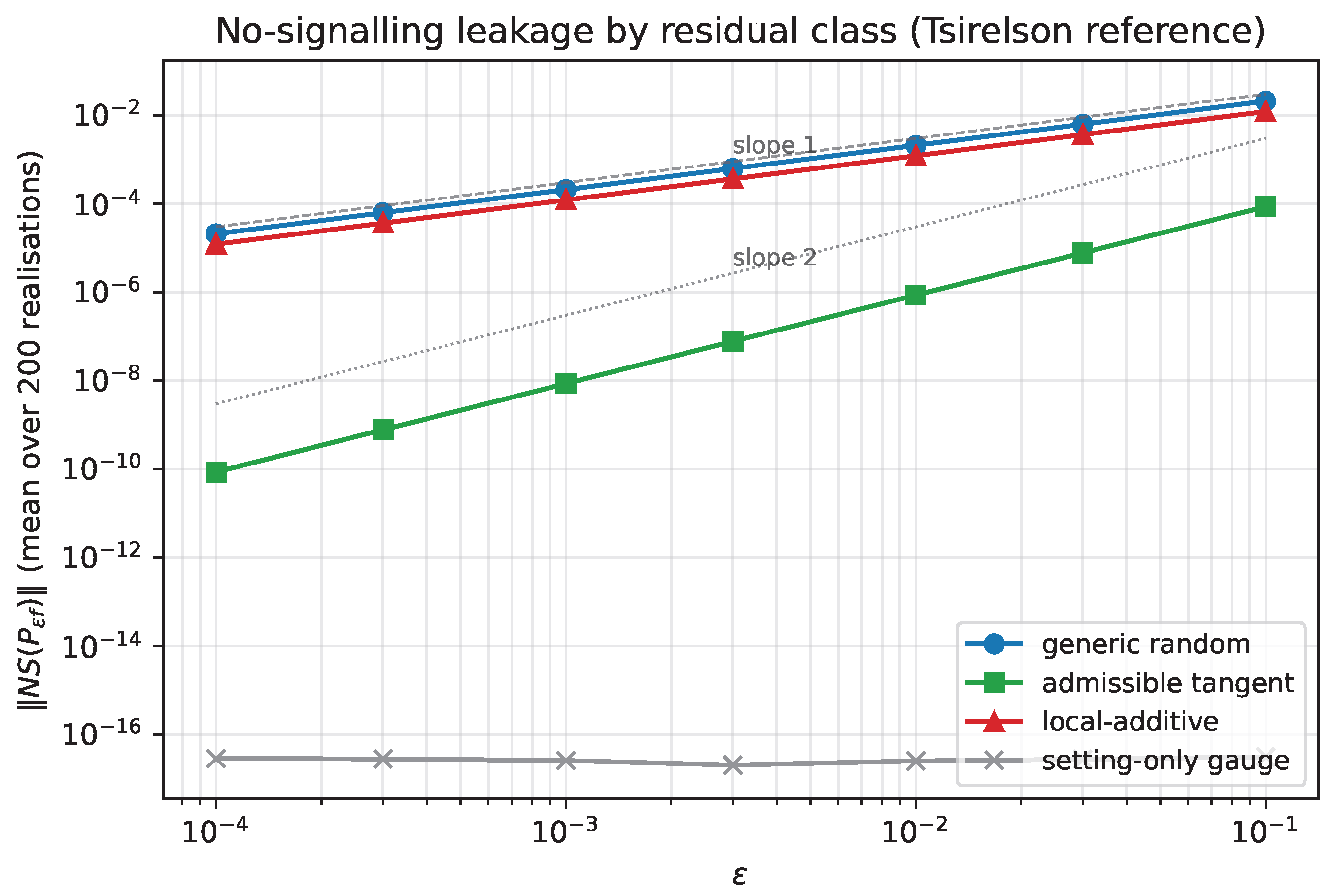
For the scaling test we drew 200 unit-norm residual directions from each of the four classes and evaluated
on the geometric grid
For each realisation we fitted
on the small-
portion
to avoid the non-asymptotic regime; slopes were averaged across realisations. The results are summarized in
Table 1.
A mean sweep over the same 200 realisations is shown in
Table 2.
The fitted slopes match the predictions of Proposition 3 to four decimal places. Two features deserve comment.
First, redundancy residuals produce no-signalling residuals at the level of machine precision (∼), confirming that they leave the box invariant exactly, not only to first order.
Second, the CHSH columns expose the structural difference between random and local-additive residuals. Random residuals shift CHSH at first order in , while local-additive residuals leave CHSH invariant up to , even though their no-signalling leakage is itself and indistinguishable in slope from the random class. This confirms Proposition 4: local-additive residuals preserve correlators but break no-signalling at first order through the remote marginals.
This is the numerical counterpart of the local-additive counterexample: a deformation can be nearly invisible in the CHSH value while still being visible in the marginal no-signalling diagnostic. The no-signalling norm therefore captures information that the CHSH scalar alone does not.
The corresponding log–log plot is shown in
Figure 1.
10. Sampling Noise
The scaling laws above are statements about exact-probability boxes. This paper does not analyse loophole-free Bell data; it studies the analytic structure of exponential tilts. Nevertheless, the finite-shot detectability of the two regimes is worth noting.
This section should therefore be read only as a detectability estimate for marginal no-signalling leakage, not as an experimental analysis of Bell-test data. The quantities considered here are empirical deviations from exact-probability tables under finite sampling.
Suppose
N shots are taken for each setting pair
. Even if the exact box is perfectly no-signalling, binomial fluctuations in the empirical marginals give
A generic residual produces exact leakage of order
, which becomes visible above the sampling floor when
An admissible tangent residual produces only
exact leakage; resolving it against the same floor requires
Admissible tangent residuals are therefore much harder to detect through finite-shot no-signalling leakage. Finite-shot tests should be read primarily as recoverability tests for sufficiently large residual signals, not as the cleanest evidence for the differential scaling of Proposition 3.
The practical message is that first-order signalling leakage is statistically much easier to detect than second-order leakage. This supports the use of the linearized no-signalling Jacobian as a diagnostic for identifying residual directions that are dangerous at leading order.
11. Tsirelson and Quantum-Admissibility Caution
No-signalling is necessary for causal admissibility but not sufficient for quantum realizability. The set of quantum correlations is a proper subset of the no-signalling set [
5,
7,
10,
11]. A tilted box may preserve no-signalling, or preserve it to first order, while moving outside the set of boxes obtainable from measurements on a single quantum state.
This distinction is essential for the interpretation of the results. The present paper studies probability-level transformations of CHSH tables. It does not assert that every admissible residual tilt can be implemented by a quantum state and fixed measurement operators. Nor does it claim that a no-signalling tilt is automatically allowed by quantum mechanics.
This is visible in the CHSH columns of
Table 2. Random residual directions can move the table above
. Such a value is not a physical violation of Tsirelson’s theorem; the tilted boxes are setting-wise reweightings of probability tables and need not correspond to a quantum state with a fixed family of measurement operators. They are probability-level deformations, not automatic quantum realizations. The implication chain is
but not conversely.
The present paper studies the no-signalling part of this implication chain. A further quantum-admissibility analysis would require imposing additional constraints, for example through the geometry of the quantum set or through hierarchy-based tests such as the NPA hierarchy. That problem is outside the scope of the present first-order no-signalling analysis.
12. Conclusions
We have given a first-order admissibility analysis of exponential residual tilts of CHSH boxes. The four main results are as follows:
- (1)
The residual representation has a four-dimensional setting-only redundancy , in which different residual arrays describe the same probability box;
- (2)
The linearized no-signalling Jacobian at the unbiased Tsirelson box has the closed-form Gram matrix (
33) with singular values
, hence rank 4 and kernel of dimension 12; the gauge-free admissible space has dimension
, recovering the eight-parameter no-signalling description from a residual-coordinate perspective;
- (3)
The scaling dichotomy for generic f and for holds exactly and is verified to four decimals on 200 realisations per class;
- (4)
Local-additive residuals are not automatically no-signalling safe; an explicit non-zero counterexample shifts a remote marginal at first order while leaving the CHSH correlator invariant.
These results should be read as a local no-signalling admissibility criterion for exponential tilts, not as a full classification of all exactly no-signalling tilts. The exact nonlinear admissibility problem is given by the compatibility Equations (
21) and (
22); the Jacobian analysis identifies the tangent directions that do not create first-order signalling leakage.
We do not claim that Born statistics are experimentally false, that every no-signalling residual tilt is quantum-realizable, or that the CHSH value can physically exceed . The probability boxes studied here are mathematical exponential tilts of a reference box; they are not, by themselves, loophole-free Bell experiments or guaranteed quantum realizations. Exponential tilts of Bell boxes require additional admissibility constraints if they are to be interpreted physically.
The main conceptual lesson is that setting-wise normalization is not enough in a Bell scenario. A transformation can be locally well defined inside each measurement context and still fail to preserve the cross-setting marginal constraints. Conversely, a deformation can leave the CHSH value nearly unchanged while producing first-order leakage in the no-signalling vector. For this reason, no-signalling preservation is a separate admissibility condition that must be checked directly.
The natural next steps are nonlinear classification of exactly no-signalling residuals; the identification of directions simultaneously tangent to the no-signalling and quantum sets at the Tsirelson box; and studying the structured residuals generated by a comparison geometry rather than arbitrary arrays .
A further direction is to relate the residual-coordinate criterion to device-independent and resource-theoretic settings in which Bell probability tables are reweighted, post-processed, or used as diagnostic objects. Such applications would require combining the present no-signalling analysis with additional quantum-admissibility or protocol constraints.