1. Introduction
Quantum entanglement is one of the most thoroughly verified and conceptually consequential phenomena in modern physics. Correlations between measurements performed on spatially separated systems have been confirmed across a broad range of experimental platforms, including photons, trapped ions, and solid-state spins [
1,
2,
3,
4,
5,
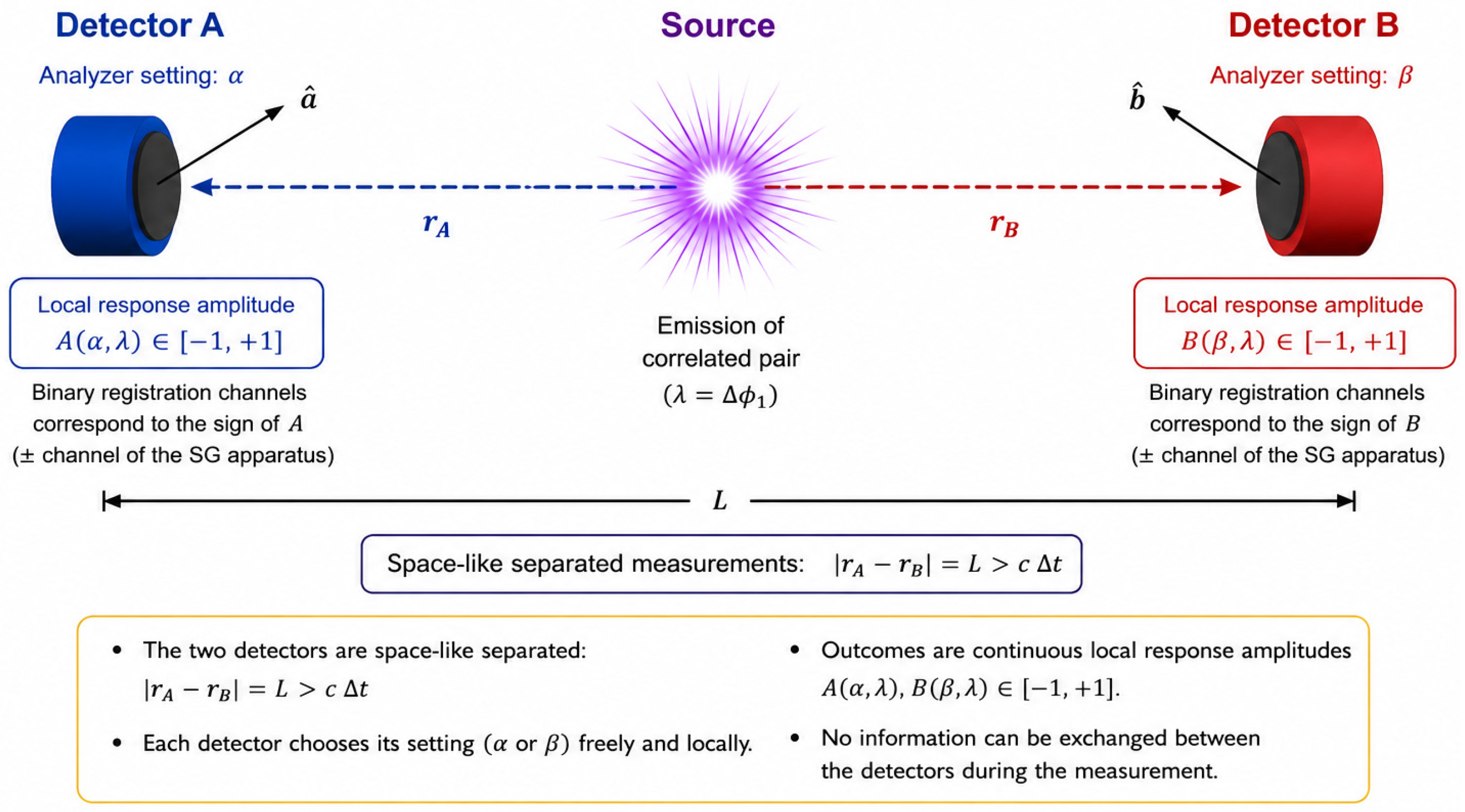
6]. These correlations are quantitatively described by quantum mechanics and are commonly analyzed within the framework of Bell-type inequalities, which constrain the class of theoretical models capable of reproducing them. Despite this experimental success, the physical origin of such correlations—and the assumptions required to derive them—remains a foundational question. How entanglement correlations arise, and whether they admit any description in terms of local physical variables, continues to motivate research at the intersection of quantum foundations, measurement theory, and field theory. The experimental geometry is shown in
Figure 1.
In this work, we develop a specific local model for spin entanglement correlations. The central element is a physical internal phase Δφ(x,t), derived from two real field components φ(x,t) and χ(x,t) associated with each fermion. Entanglement is encoded as a phase relation established at the moment of pair creation; once established, the two particles evolve independently. Spin measurements are modeled as deterministic local filters that respond only to the internal phase carried by the arriving particle and the orientation of the local analyzer. The model’s central claim is deliberately circumscribed: when the continuous analog detector outputs are subjected to Pearson normalization, the resulting correlation function reproduces the functional form of the quantum singlet correlator.
Since Einstein, realist approaches to quantum mechanics have sought frameworks that preserve both locality and determinism, while Bell’s theorem is widely understood to constrain broad classes of such models. The present framework departs from the assumptions typically targeted by Bell-type analyses: rather than pre-assigning discrete spin values for all possible analyzer orientations, it introduces a continuous internal phase field as the relevant hidden variable. Each local detector response is generated at the measurement event by filtering this phase against the local analyzer orientation—a purely local operation. The model preserves parameter independence and no-signaling throughout, while permitting outcome dependence in the statistical description, consistent with Bell’s framework.
Recent work has renewed interest in local, relational, and field-theoretic approaches to quantum measurement and entanglement [
7,
8,
9,
10,
11,
12]. These approaches share an emphasis on the locality of measurement interactions and on internal or relational degrees of freedom as alternatives to nonlocal state collapse. The present paper is aligned with this direction but distinguishes itself through an explicit real-field ontology: spin correlations are attributed to a continuous internal phase derived from local physical fields, with measurement responses determined entirely by the local phase structure and the local analyzer setting. The empirical target—the functional form of the quantum singlet correlator—is motivated by the extensive and now loophole-free experimental verification of Bell-type correlations [
1,
2,
3,
4,
5,
6].
1.1. Motivation
Earlier real-field, geometric, and phase-based proposals for quantum correlations frequently leave one or more structural elements implicit or underspecified: the physical ontology of the hidden variable, the mechanism by which the pair correlation is established locally, the deterministic rule governing each measurement, or the connection between the hidden variable and the operationally defined spin observable. The present framework makes all four elements explicit. The internal phase Δφ is treated as a genuine physical field-derived variable; the correlated phase relation between the two particles is established locally at the creation event; and each local detector response is generated by a deterministic response function that depends only on the locally carried phase and the local analyzer orientation. This transparency is the primary motivation for the present approach.
1.2. Purpose of This Work
The scope of this article is deliberately circumscribed. It does not address Lagrangian formulation, charge quantization, gravitational coupling, or the full dynamical equations of the underlying coupled-field theory. Instead, it isolates and examines a single question: can a local continuous phase variable, fixed relationally at pair creation and filtered deterministically at each measurement site, reproduce the functional form of the quantum singlet correlation after appropriate normalization of the continuous detector outputs? The derivation below answers this question affirmatively, within the analog-response formulation developed here. The paper does not claim any new quantitative prediction distinguishable from standard quantum mechanics in existing Bell-test experiments; the contribution is ontological and conceptual. The principal symbols are summarized in
Table 1.
2. Ontological Framework and Internal Phase Structure
In the present framework, each fermion is modeled as a localized excitation of two real coupled fields, φ and χ, defined in ordinary spacetime. These fields are not introduced as mathematical components of a complex wavefunction; they are interpreted as physically real field components. Their mutual coupling generates an internal oscillatory degree of freedom. The hidden variable relevant for spin measurements is the local relative phase between these two components:
Equivalently, in purely real terms, Δφ is the relational phase between the two coupled fields—the angle parametrizing the orientation of the ordered pair (φ, χ) in its two-dimensional internal configuration space. The parameters κ and ω characterize the underlying dynamics but do not enter the present kinematic derivation, which depends only on the existence of this phase variable.
The relative phase Δφ is not merely a label. It characterizes the internal circulating structure of the coupled fields. In the broader coupled-field interpretation, this internal structure is associated with the magnetic moment and hence with the operational manifestation of spin in a Stern–Gerlach measurement. Throughout the paper, Δφ denotes an internal phase variable and should not be confused with spatial orientation angles such as θ or with analyzer settings such as α and β.
Transformation law and the double-cover structure.
The internal configuration space of the (φ, χ) pair has the topology of U(1): the pair rotates continuously under the internal symmetry of the coupled-field dynamics, and Δφ is the angle of this rotation. The physically critical question is how a rotation of the external measurement apparatus by angle α acts on this internal variable.
The fields φ and χ are not scalar fields under spatial rotations. In the CF framework, their coupled dynamics—governed by the CF Lagrangian with coupling parameter κ—generate a half-integer spin structure. This means the field pair (φ, χ) carries a spinor representation of the spatial rotation group, not a vector representation. The distinction is topological: in a vector representation, a 2π rotation of the physical frame returns the field to its original configuration. In a spinor representation, a 4π rotation is required for the field to complete a closed trajectory in its configuration space. Equivalently, the minimal-energy closed orbit of the (φ, χ) pair in its internal configuration space corresponds to a 4π rotation in physical space, not 2π. This half-integer winding number is the defining property of a spinor representation. It has a concrete algebraic manifestation in the Noether current of the CF Lagrangian, which provides an internal derivation of the 4π periodicity rather than importing it by analogy from quantum mechanics.
The Noether current and the physical origin of 4π periodicity. The CF Lagrangian for the coupled real field pair (φ, χ) admits a continuous internal U(1) symmetry corresponding to rotations in the (φ, χ) plane. By Noether’s theorem, this symmetry generates a conserved current , which is bilinear in the fields and whose spatial integral yields the conserved charge associated with the internal circulation. The CF coupling term—which is odd under the discrete exchange (φ, χ) → (−φ, −χ)—means that the minimal-period solution of the field equations completes one full internal cycle for every 2π advance of the spatial rotation angle. A physical rotation of the measurement frame by 2π therefore maps (φ, χ) → (−φ, −χ), which shifts the internal phase by λ → λ + π. Because Jμ is quadratic in (φ, χ), it is invariant under this sign flip: the two sign reversals cancel, and the conserved charge is unchanged. Jμ cannot distinguish a 2π rotation from the identity—it is a true scalar observable under 2π rotation. The local detector response, however, is not quadratic in the fields. It is a linear projection of the internal phase direction onto the analyzer reference direction: A(α, λ) = cos(λ − 2α). Under a 2π physical rotation, λ → λ + π, and therefore A(α, λ) → cos(λ + π − 2α) = −cos(λ − 2α). The detector response reverses sign. Only under a 4π physical rotation does λ → λ + 2π, restoring cos(λ + 2π − 2α) = cos(λ − 2α) and returning the response to its original value. The 4π periodicity of the measurement outcome is therefore not imposed by assumption. It is a structural consequence of the distinction between the quadratic Noether current—which is blind to the field sign flip—and the linear phase projection that constitutes the physical detector response. The double-angle factor 2α in A(α, λ) = cos(λ − 2α) follows directly: a physical rotation of the analyzer by α shifts the internal phase reference by 2α, consistent with the 4π periodicity just derived.
The consequence for the transformation law is direct. Under a physical rotation of the measurement frame by angle α, the internal phase transforms as:
The factor of 2 is not imported from quantum mechanics by analogy. It follows from the spinorial winding structure just described: because the internal phase must complete two full cycles for every one full cycle of the physical rotation, the effective coupling between the analyzer angle and the internal phase reference is 2α rather than α.
Geometric interpretation and the response function.
The transformation law Δφ → Δφ − 2α has a direct geometric interpretation in the internal configuration space. The internal phase direction is represented by the unit vector (cos Δφ, sin Δφ). Because of the double-cover structure, a physical analyzer orientation α corresponds to a reference direction (cos 2α, sin 2α) in the internal space—the analyzer angle is doubled when mapped into the internal phase plane. The local detector response—the projection of the particle’s internal phase direction onto the analyzer reference direction—is therefore the inner product:
where λ ≡ Δφ is the internal phase at the measurement event. This expression is not a phenomenological ansatz. It is a geometric projection in the internal field configuration space: one unit vector carried by the particle and one defined by the analyzer orientation, with the doubling arising entirely from the spinorial transformation law of the (φ, χ) pair.
The response function A(α,λ) = cos(λ − 2α) is therefore fully determined by three ingredients:
The existence of a continuous internal phase degree of freedom λ derived from the real field pair (φ, χ);
The spinorial transformation law of that field pair under spatial rotations, which produces the factor 2α;
The projection geometry of the Stern–Gerlach interaction, which selects the component of the internal phase along the analyzer reference direction in the doubled internal space.
No assumption is made about quantum mechanical operators, eigenstates, or Hilbert-space structure. The cosine form and the double-angle factor emerge from the real-field geometry of the internal configuration space and the topological winding structure of the coupled-field dynamics.
When a fermion pair is created at a common spacetime event, the two particles inherit a definite phase relation fixed locally at the source. For the singlet-like case considered in the main text, this relation is represented by a phase offset of
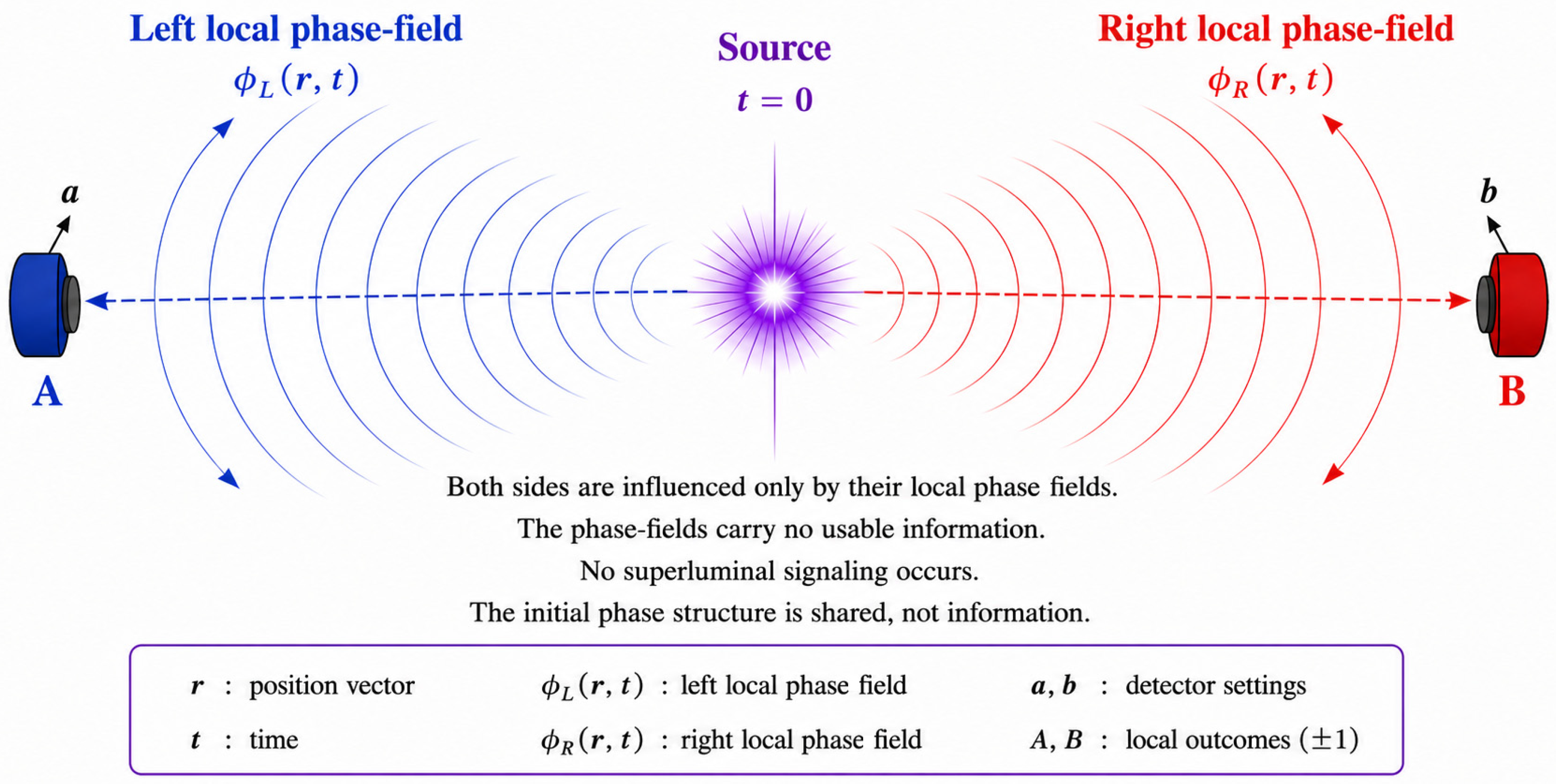
. After separation, each particle evolves locally and carries its own internal phase structure. Measurements do not reveal pre-existing discrete spin values; instead, they act as local filters on the phase configuration carried by each particle. The local propagation picture is shown in
Figure 2.
At pair creation, the common interaction event establishes a relational phase offset between the two particles. This offset is a shared initial condition, not a continuing dynamical influence. No later synchronization, communication, or enforcement between the separated particles is assumed.
Appendix A summarizes how different fixed phase offsets correspond to singlet-like and triplet-like correlation structures.
It is also important to distinguish the internal phase used here from a wavefunction phase. The model does not assume a globally propagating quantum wavefunction, nor does it require the individual phases to remain strictly invariant along every trajectory. The derivation requires only that, over the ensemble of emitted pairs, the relevant phase variable retains the statistical structure imposed at emission.
Measurements are modeled as
deterministic local-response functions acting on the internal field configuration at the spacetime location of the measurement. For a Stern–Gerlach analyzer oriented at angle
, the local response amplitude is determined solely by the local analyzer orientation and the local internal phase:
The appearance of the factor 2α reflects the double-cover relation between physical rotations and internal phase rotations characteristic of spin-½ systems. A rotation of the analyzer by an angle α corresponds to a rotation of the internal phase reference by 2α, consistent with the SU(2) to SO(3) mapping in which a 2π spatial rotation corresponds to a 4π phase rotation.
Concretely, each emitted pair is characterized by a single shared phase parameter λ ∈ [0, 2π), uniformly distributed over the ensemble.
The two particles carry correlated internal phases defined by:
Thus, the pair is fully described by a single hidden variable λ, with the π offset encoding the singlet-like anti-correlation at creation.
These variables represent the internal phase configuration derived from the underlying real fields and constitute the complete hidden-variable description of the pair at the level relevant for spin measurements.
For the second particle measured at orientation β, the local response is:
The minus sign in B(β,λ) is equivalent to a π phase shift:
Thus, the anti-correlation between the two particles can be represented either as a phase shift in λ2 or as an explicit sign in the response function.
These mappings are deterministic and depend only on the local analyzer setting and the locally carried phase variable. No dependence on remote settings is introduced.
The two-particle statistics are obtained by averaging over the ensemble of initial phases λ, assumed to be uniformly distributed.
In the statistical description, the internal phase Δφ evaluated at the measurement event is denoted by and treated as a uniformly distributed variable over the ensemble.
The correlation function is therefore defined as the expectation value of the product of local detector-response functions, for analyzers oriented at angles α and β:
where the average is taken over the ensemble of emitted pairs, characterized by a uniform distribution of λ.
This explicit formulation shows that the model is fully specified by:
- (i)
A shared initial phase variable λ;
- (ii)
Deterministic local response functions A and B;
- (iii)
An ensemble average over λ.
No additional structure, operator algebra, or nonlocal mechanism is required.
2.1. Phase Distribution for Unpolarized Particles
For unpolarized fermions, Δφ is uniformly distributed in [0, 2π). This matches the rotational invariance of spin-½ measurements in quantum theory. The internal phase Δφ is a scalar angular variable defined modulo 2π, parametrizing the relative orientation of the two real field components (φ, χ) in their internal configuration space.
The derivation of the correlation function depends only on the statistical distribution of the initial phase relation at emission and not on strict phase invariance along individual trajectories.
Environmental interactions may introduce phase perturbations or phase diffusion; however, as in standard quantum experiments, the observed correlations persist provided that decoherence does not fully randomize the relevant phase variable before measurement. The derivation requires only that the phase distribution at the time of measurement retains the statistical structure imposed at emission, not strict phase coherence of individual realizations. Under such conditions, the ensemble retains the correlation structure determined at the source.
2.2. Origin of Spin in the Phase-Field Framework
In the CF framework, fermionic spin is not a primitive geometric vector but an emergent internal degree of freedom arising from the phase relation between two coupled real fields. This internal structure is not directly observable. Instead, spin manifests operationally through the interaction of an induced current with external electromagnetic fields: a nontrivial phase relation between the coupled fields generates an effective circulating current, which gives rise to a magnetic moment. This magnetic moment couples to external magnetic fields and provides the operational definition of spin. In CF language, the chain is: phase difference → circulating current → magnetic moment. Measurements therefore do not access spin itself, but only its projection via the energy of this coupling. This is entirely consistent with the local response function A(α,λ) = cos(λ − 2α) introduced above, where λ encodes the internal phase configuration and α defines the external analyzer orientation.
3. Entanglement as a Local Initial Condition
Entanglement arises at the moment of pair creation. When a singlet-like pair is emitted from a common event, kinematic phase-locking imposes the constraint
This constraint is local, involves no action at a distance, and is analogous to two classical rotors manufactured with opposite orientation. After separation, the fields evolve independently and locally. No additional coordination occurs.
In this framework, spin is not a pre-existing property but a local detector response determined by the internal phase.
A phase difference of π leads to anti-correlated outcomes (singlet-like behavior), while identical phases would produce correlated outcomes (triplet-like behavior).
Locality of the Constraint
Bell’s theorem [
13] encodes shared information between particles in a variable λ. In this model, λ is identified with the internal phase of particle 1, λ ≡ Δφ
13, while the phase of particle 2 is fixed by the π relation. Thus, all correlations can be expressed in terms of a single integration variable λ, which is a genuine physical field degree of freedom—not an abstract label. The π relation reflects the minimal-energy geometric configuration established at creation and does not require dynamical enforcement after separation.
4. Measurement as Local Filtering
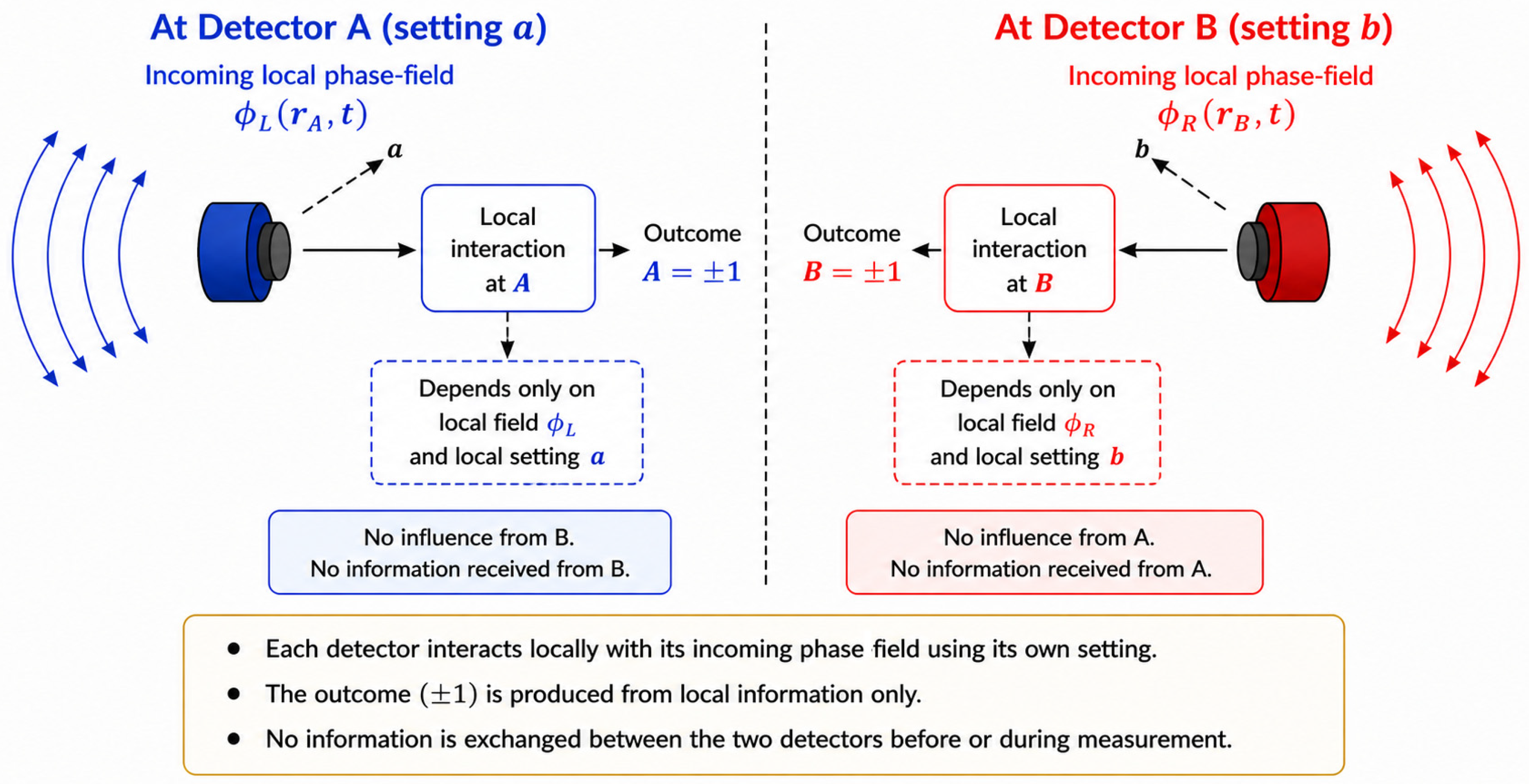
The local response function A(α,λ) = cos(λ − 2α), introduced and justified in §2, is a local projection of the internal phase λ onto the analyzer direction α; the response amplitude lies in [−1, +1] and is fully deterministic. No transformation λ → λ′(α) is defined: the phase is fixed at pair creation and serves only as an input to the response function. Consequently, a measurement at one location does not modify the phase carried by the distant particle. Parameter independence (P(A|α,β) = P(A|α) for all β) and no-signaling follow immediately. The detector interaction mechanism is shown in
Figure 3.
The doubling α → 2α follows from the SU(2) → SO(3) two-to-one mapping: rotation of the measurement axis by α corresponds to a rotation of the internal phase reference frame by 2α, consistent with the spin-½ double-cover structure established in §2.
5. Derivation of Quantum Correlations
5.1. Derivation of E(α,β)
Let λ = Δφ for particle 1, with uniform distribution on [0, 2π). Particle 2 has Δφ2 = λ + π. The local outputs are given by A(α,λ) = cos(λ − 2α) and B(β,λ) = −cos(λ − 2β).
The raw product moment of the analog local outputs evaluates to ⟨AB⟩ = −½ cos 2(α − β), as derived in
Appendix B. Because the detector-response amplitudes are continuous analog variables rather than dichotomic ±1 observables, the relevant correlation quantity is the Pearson-normalized correlation coefficient (see
Appendix B.3 for detailed justification). Since ⟨A
2⟩ = ⟨B
2⟩ = 1/2, normalization yields E(α,β) = −cos 2(α − β), matching the quantum singlet correlation in functional form.
Although real Stern–Gerlach apparatuses ultimately register particles in one of two discrete output channels conventionally associated with ±1 outcomes, the quantities entering the present correlation derivation are continuous local phase-projection responses generated during the detector interaction itself. The underlying hidden phase-field state is continuous, and the local detector response reflects the projection of this internal phase structure onto the analyzer orientation. The binary detector channel corresponds operationally to the sign of the local projection, whereas the ensemble correlation structure is determined by the full continuous projection amplitude prior to final binary registration.
5.2. Relation to Bell-Type Dichotomic Models
Bell’s theorem establishes that any model in which the joint probability factorizes as
with λ distributed independently of the settings must satisfy the CHSH inequality |S| ≤ 2, where S is formed from raw expectation values ⟨AB⟩ of bounded observables. The present model satisfies this factorization exactly: A depends only on (α,λ), B depends only on (β,λ), and λ is uniformly distributed independently of α and β.
Bell’s theorem therefore applies without qualification to the raw product moment, and the result correctly respects the classical CHSH bound, yielding . There is therefore no contradiction with Bell’s theorem at the level of the raw correlator.
The normalized correlator E(α,β) = −cos2(α − β) with does not represent a violation of this bound. It represents a structurally distinct quantity—the Pearson correlation coefficient of the continuous analog outputs—and the question of whether Bell’s bound of 2 applies to this quantity requires separate examination.
Bell’s original derivation proceeds from using the pointwise constraint |A(α,λ)| ≤ 1 and |B(β,λ)| ≤ 1. This yields the CHSH bound under the implicit assumption that the marginal variances satisfy ⟨A2⟩ = ⟨B2⟩ = 1. For the continuous response functions used here, ⟨A2⟩ = ⟨B2⟩ = 1/2. The raw product moment is suppressed by this reduced variance relative to the dichotomic case. Bell’s bound of 2 on the raw CHSH combination therefore does not translate directly into a bound of 2 on the Pearson-normalized CHSH combination, because the normalization rescales each correlator by the inverse of the marginal variance.
To make this precise, define the Pearson-normalized CHSH combination as:
where each
. Since
uniformly across all setting combinations, we have
throughout, and therefore
. The factor of 2 arises entirely from the reduced marginal variance of the continuous response functions relative to the dichotomic case assumed in Bell’s derivation. The Tsirelson value
is thus the variance-corrected image of the classical raw value
, rescaled by the same factor of 2 that separates the marginal variances.
This relationship can be stated as a precise structural observation: for a Bell-local model with continuous response functions satisfying ⟨A2⟩ = ⟨B2⟩ = 1/2, the Pearson-normalized CHSH combination is exactly twice the raw CHSH combination. Since the raw combination saturates at for the cosine correlator, the normalized combination saturates at . The appearance of the Tsirelson value is therefore not a violation of Bell’s theorem but a consequence of the variance structure of continuous phase-projection responses combined with the cosine angular dependence imposed by the SU(2) double-cover geometry.
The claim of the present framework is therefore circumscribed as follows. The model is Bell-local, and its raw correlator satisfies the classical CHSH bound. The Pearson-normalized correlator, which is the operationally appropriate correlation measure for continuous analog detector outputs as argued in
Appendix B.3, reproduces the functional form and numerical value of the quantum singlet correlator. This correspondence is a structural result: it follows from the combination of local phase-projection dynamics, the SU(2) double-cover factor, and the specific variance structure of continuous bounded response functions. It does not constitute a counterexample to Bell’s theorem, nor does it claim that a local model produces dichotomic Bell-test statistics indistinguishable from quantum mechanics. The scope of the result is precisely the normalized continuous-response correlation structure, and the paper makes no claim beyond this scope.
5.3. Formal CHSH Evaluation of the Correlation Function
To confirm that the normalized analog correlator reproduces the same functional dependence and numerical CHSH value as the quantum singlet correlator, we evaluate the CHSH combination S = E(α,β) − E(α,β′) + E(α′,β) + E(α′,β′) (one standard sign convention; |S| is the relevant quantity) using the optimal angles:
The four correlations are then
Thus, the normalized Pearson correlator, when inserted into the CHSH expression, yields the same numerical CHSH value for the normalized analog correlator |S| = 2√2, reproducing the same numerical CHSH value associated with the quantum singlet correlation; as noted above, the raw product moment ⟨AB⟩ would not saturate this bound without normalization.
5.4. Binary Registration and the Continuous Response
A potential objection to the present framework is the following. Real Stern–Gerlach detectors ultimately register a binary outcome: the particle arrives at the spin-up or spin-down channel. The correlation measured experimentally is therefore
For A = cos(λ − 2α) and B = −cos(λ − 2β), one can compute this directly. Since sgn(cos(λ − 2α)) = +1 when λ − 2α ∈ (−π/2, π/2) and −1 otherwise, the product sgn(A)·sgn(B) is a square-wave function of λ. The ensemble average over uniform λ gives:
This is a triangular function, not a cosine. The present framework therefore does not reproduce the quantum singlet correlation at the level of binary detector outcomes. This is an honest and important limitation that must be stated explicitly.
The model’s claim is restricted to the pre-binary continuous response level. Whether the continuous projection amplitude is physically accessible—and whether it could be measured in time-resolved or weak-measurement protocols—is an open experimental question discussed in §10. The framework should therefore be understood as providing a local ontological picture of the pre-registration measurement dynamics, not as a replacement for the standard quantum mechanical account of binary Bell-test statistics.
This distinction does not undermine the conceptual contribution. The cosine dependence at the continuous-response level, arising from local phase dynamics, is a structural result. Its connection to observable binary statistics requires either (a) an additional physical model of the binary registration process that preserves the cosine structure, or (b) experimental access to the continuous response prior to thresholding. Both directions are left for future work.
6. Locality and No-Signaling
The joint statistics are generated from a shared phase variable established locally at pair creation. The model is local in the operational sense that A depends only on α and λ, while B depends only on β and λ. Therefore, a change in the remote setting cannot affect the local response, and no signaling is possible.
The partial differential equations governing Δφ13(x,t) and Δφ2(x,t) evolve independently after separation. No term allows superluminal influence, ensuring compatibility with relativistic locality.
The phase distribution satisfies ρ(λ|α,β) = ρ(λ), confirming that no setting dependence is introduced before or during the measurement.
The model maintains parameter independence: A does not depend on β, and B does not depend on α. It does not, however, impose outcome independence in the usual Bell-factorization sense. The distinction is important: the violation of outcome independence reflects the shared source variable and the paired statistical description, but it does not imply any exchange of signals between the separated detectors.
Environmental interactions, whether Markovian or non-Markovian, do not alter the locality or deterministic structure of the model. Markovian noise would lead to gradual phase diffusion and ensemble dephasing, while non-Markovian environments could introduce temporal correlations in the phase evolution. In both cases, the shared initial phase relation established at pair creation remains a common cause, and no dependence on remote measurement settings is introduced.
While the present framework is formulated without Hilbert-space operators, the response functions A(α,λ) and B(β,λ) play a role analogous to measurement operators by mapping internal phase configurations to observable outcomes. This correspondence is provided to facilitate comparison with conventional quantum formulations.
Determinism and Statistical Description
A potential point of confusion concerns the role of randomness in the present framework.
The internal phase parameter λ is assumed to be distributed uniformly over the ensemble of emitted pairs. This statistical distribution does not reflect intrinsic stochasticity of the underlying dynamics, but rather the lack of control over the precise initial conditions at the moment of pair creation.
At the level of individual events, the model is fully deterministic: once λ is specified, the local detector responses are uniquely determined by the local response functions. No stochastic evolution, collapse mechanism, or probabilistic transition is introduced.
The apparent randomness arises solely at the ensemble level, in the same sense as in classical statistical mechanics, where deterministic dynamics coexist with probabilistic descriptions due to incomplete knowledge of initial conditions.
In this sense, the model is deterministic in its ontology, while statistical in its empirical predictions. The probability distribution over λ is therefore epistemic rather than ontological.
7. Comparison with Earlier Approaches
This model differs in several key respects from earlier phase-based and real-field approaches. Clifford-algebra methods proposed by Christian [
14] use algebraic structures without specifying physical field dynamics (irrespective of the controversies surrounding that program). Adenier and Khrennikov [
15] examine superdeterminism assumptions in pilot-wave hydrodynamics but do not introduce a physical internal phase variable. Goyal et al. [
16] develop a local-realistic model grounded in classical statistics rather than a real-field ontology. Geometric algebra models by Hestenes [
17] and others provide elegant mathematical formalisms but lack explicit PDE-based internal phase dynamics. De Broglie–Vigier theories use stochastic hidden variables, whereas the present model is fully deterministic.
The distinctive features of the present work are: an explicit real-field ontology, an internal phase defined from physical fields, kinematic phase-locking at emission, a deterministic local filtering rule, reproduction of the quantum singlet correlation in functional form after normalization of the continuous analog outputs, and the absence of nonlocality and signaling.
Philbin’s 2015 local deterministic model [
18] uses optical-polarization-like classical fields but lacks the kinematic phase-locking that produces strict Δφ
13 + Δφ
2 = π.
While these approaches differ in formalism and ontology, they share the objective of accounting for quantum correlations without explicit nonlocal dynamics. The locality and no-signaling properties established here are consistent with the analysis of quantum non-locality in [
19] and the consistent-histories framework of [
20]; the local realistic model of [
21] provides an independent point of comparison in the NMR context. The present framework contributes to this landscape by providing a minimal real-field model in which spin correlations arise from local phase structure and deterministic response.
8. Experimental Implications
Although the present work is conceptual and does not claim experimentally verified deviations from standard quantum mechanics, the phase-field framework suggests that possible observable signatures, if they exist, would most likely appear in time-resolved or phase-sensitive measurement protocols rather than in conventional static Bell-type experiments. More detailed possible experimental directions are discussed in
Section 10.
9. Discussion
This work presents a deterministic local-response framework for representing spin-½ singlet-correlation structure in terms of real-valued internal field variables. The central result is that the quantum singlet correlation can be reproduced in functional form by local response functions acting on an ensemble of shared initial phase relations, provided that the detector responses are treated as continuous analog quantities and normalized by the Pearson prescription.
Within this interpretation, entanglement correlations arise from a common phase relation fixed at pair creation together with deterministic local measurement responses. The mechanism is not a replacement for standard quantum mechanics; rather, it is an ontological model that reproduces a particular correlation structure under explicitly stated assumptions.
A key conceptual point clarified in this manuscript is the distinction between shared initial conditions and nonlocal influence. The internal phase relation established at pair creation functions as a common cause, not as a dynamically maintained constraint or signaling mechanism. After separation, each particle evolves independently, and local detector responses are generated solely from local field configurations and local analyzer settings. This structure preserves locality, parameter independence, and no-signaling by construction.
The appearance of the double-angle dependence in the local measurement response reflects the double-cover rotational structure characteristic of spin-½ systems. In contrast to operator-based derivations in Hilbert space, this structure arises here from the rotational properties of the ordered real field pair itself. The resulting correlation function is therefore obtained without invoking measurement operators, eigenstates, or projection postulates.
From a broader perspective, the present approach offers a concrete ontological alternative to standard quantum descriptions of entanglement. Rather than treating correlations as fundamental and irreducible, the model demonstrates how they can arise from local physical structure combined with ensemble statistics. While the framework reproduces the functional form of the standard singlet correlation, it does not claim empirical distinction at the level of conventional Bell tests. Potential discriminating signatures, if any, would require experiments sensitive to controlled phase perturbations or decoherence pathways and are left for future investigation.
Finally, the purpose of this work is not to refute quantum mechanics. The purpose is to show that one hallmark functional form of quantum correlation can be represented within a local deterministic phase-field ontology when the relevant variables are continuous and phase-like, and when the measured analog responses are normalized statistically. In this sense, the framework complements existing interpretations by offering a concrete real-field picture while leaving the empirical success of quantum mechanics intact.
10. Possible Experimental Directions
The present framework is primarily conceptual and ontological, and it does not claim at this stage to provide experimentally verified deviations from standard quantum mechanics. Nevertheless, because the model represents spin-entanglement correlations in terms of continuous local phase-projection amplitudes prior to final binary detector registration, it suggests several experimental directions that may be useful for future investigation.
One possible direction is time-resolved Stern–Gerlach measurement. Standard Stern–Gerlach experiments usually record only the final separated detector outcomes. In the present framework, however, the physically relevant local response is not only the final + or − detector outcome, but also the continuous buildup of the local phase-projection amplitude during the measurement interaction. An experiment capable of resolving the transient detector response before final channel registration could therefore test whether the measurement process contains phase-dependent intermediate structure not visible in ordinary dichotomic counting statistics.
Another possible direction is the use of sequential analyzer configurations. In such experiments, a particle would pass through two or more controlled analyzer stages with adjustable relative orientations. The framework predicts that the final binary outcome is preceded by a continuous local projection process whose effective response depends on the relative phase between the internal field configuration and the analyzer orientation. Sequential measurements may therefore provide a way to examine whether the internal phase-projection structure behaves consistently under repeated or partially interrupted measurement interactions.
A further possible direction is the introduction of controlled local phase perturbations before detection. For example, weak magnetic-field gradients, controlled path delays, or other phase-sensitive perturbations could be applied locally before the analyzer stage. The aim would not be to contradict the standard singlet correlation in ordinary measurements, but to search for possible transient or phase-sensitive signatures in the detector-response buildup. Such experiments could help determine whether the continuous response variables introduced in this framework have operational significance beyond the final normalized correlation function.
Yet another possible direction is the study of weak, partial, or delayed measurement protocols. Since the present model distinguishes between the underlying continuous response and the eventual binary registration, weak or incomplete measurements may be especially relevant. These protocols could examine whether local detector responses exhibit reproducible analog features before being reduced to final discrete outcomes.
These proposed directions should be regarded as preliminary. The present manuscript does not claim that such experiments already demonstrate deviations from standard quantum mechanics, nor does it assert that the framework has been experimentally validated. Rather, the purpose of identifying these directions is to indicate how the continuous phase-field interpretation may, in future work, be connected to operationally testable measurement dynamics. This would be particularly important if the framework is to move beyond an alternative representation of known correlations and toward a physically distinguishable account of the measurement process.
11. Conclusions
This paper has presented a local deterministic phase-field framework for spin entanglement correlations. The framework rests on three ingredients: a continuous internal phase degree of freedom derived from two real coupled fields, a kinematic phase-locking condition established locally at pair creation, and deterministic local filtering at each measurement site. From these ingredients, the raw product moment of the continuous local outputs evaluates to ⟨AB⟩ = −½ cos 2(α − β). Pearson normalization of the continuous analog responses then yields E(α,β) = −cos 2(α − β), which matches the quantum singlet correlator in functional form. Insertion of this normalized correlator into the CHSH expression yields |S| = 2√2, reproducing the Tsirelson value without introducing any nonlocal dynamics or signaling mechanism.
The framework reproduces the normalized correlation structure of Bell-type experiments using continuous local detector-response amplitudes rather than pre-assigned dichotomic observables. Locality, parameter independence, and no-signaling are preserved by the structure of the model: the response at each detector depends only on the local phase and the local analyzer setting, with no dependence on the remote setting or the remote outcome. Outcome dependence arises from the shared source variable and is consistent with Bell’s framework; it does not entail any exchange of signals between the separated detectors.
The contribution of this work is conceptual rather than predictive. The framework does not claim to reproduce Bell-test statistics at the level of discrete dichotomic ±1 outcomes, nor does it make quantitative predictions distinguishable from standard quantum mechanics in existing experiments. What it does demonstrate is that the functional form of the singlet correlation can emerge from a strictly local deterministic ontology, provided that the detector responses are treated as continuous analog quantities and normalized by the Pearson prescription. This is a non-trivial structural result: the cosine angular dependence, the double-angle factor, and the Tsirelson-valued CHSH combination all follow from local phase-field dynamics without invoking Hilbert-space operators, projection postulates, or nonlocal state update.
More broadly, the framework illustrates that quantum entanglement correlations are compatible with local deterministic descriptions when the hidden variables are continuous phase-like quantities rather than discrete pre-assigned spin values. Whether this compatibility can be extended to other correlation structures, or whether the phase-field dynamics can be made dynamically explicit within a full Lagrangian formulation, are natural directions for future work. The present results contribute to the ongoing exploration of ontological interpretations of quantum mechanics, and do so in a way that leaves the established empirical structure of quantum theory entirely intact.
Future work will be required to determine whether the continuous phase-field description proposed here can lead to experimentally distinguishable signatures in time-resolved or phase-sensitive measurement protocols.