1. Introduction
1.1. Background and Main Question
Bell–CHSH is a theorem about
unconditional expectations. Under measurement independence (MI), Bell locality, and bounded outcomes, local hidden variable (LHV) models satisfy the CHSH inequality
[
1,
2]. Modern experiments violate CHSH and, thereby, exclude the corresponding Bell-local MI model class, subject to the standard experimental controls (spacelike separation, random settings, etc.) [
3,
4,
5,
6].
The CHSH algebra is pointwise in the hidden variable . To apply it to experimental data, however, one also needs the four correlators entering the reported CHSH statistic to be expectations under a single hidden-variable law. This is exactly where selection can matter.
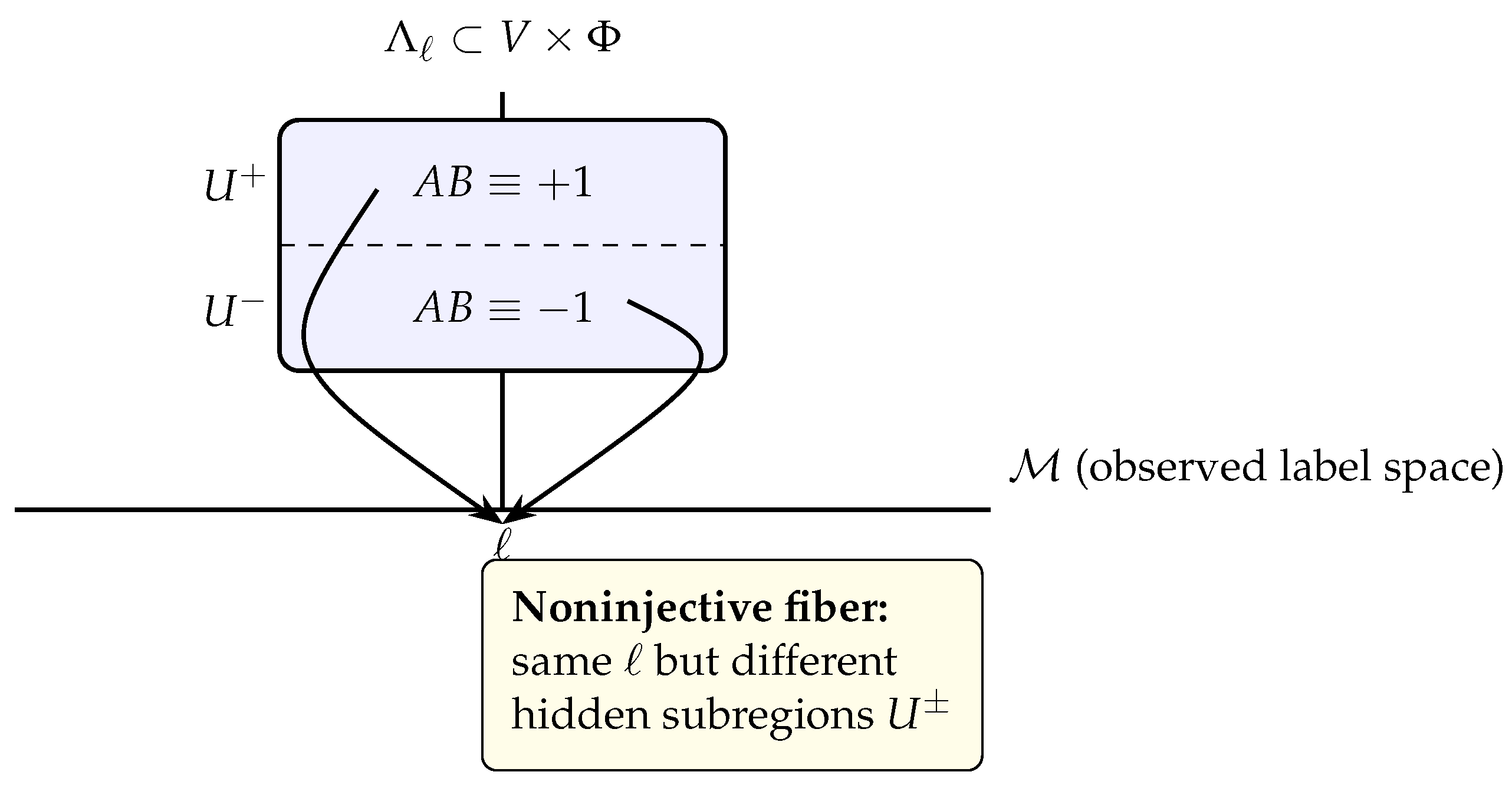
In real Bell-test pipelines, the data used for estimating correlations are typically defined by an acceptance rule (sometimes explicit, sometimes implicit): detector thresholds, hardware gates, coincidence matching, time windows, quality cuts, dead-time exclusions, or analysis filters. Conditioning on acceptance can change the hidden-variable law, and that change can depend on the settings.
This paper studies the following operational question:
If the accepted hidden-variable law depends on the setting pair, how much can CHSH be inflated above 2 within Bell-local, measurement-independent models, and what experimental diagnostics can bound or audit that inflation?
1.2. Why Quantitative Upper Bounds Help
A reported violation is often read as “Bell-local MI models are excluded”. That inference is correct once one has justified that the reported correlators are computed under a single (or effectively single) accepted hidden-variable law. If, instead, the accepted ensemble changes with settings then the CHSH value can be inflated by selection alone, and a quantitative analysis must include information about that selection dependence.
A quantitative upper bound serves two roles:
- (i)
Necessary-condition reading. If is large, the bound yields a minimum required magnitude of setting-dependent selection that any Bell-local MI selection-based explanation would need.
- (ii)
Exclusion-test reading. If an experiment can independently upper-bound selection dependence below a threshold then the bound can be used to rule out Bell-local MI selection-based explanations.
1.3. Related Work and Positioning
Selection-based loopholes in Bell tests have a long history. Early analyses include Pearle’s data-rejection model [
7] and the efficiency thresholds developed by Garg–Mermin [
8] and Eberhard [
9]. For coincidence-time selection, see Larsson–Gill [
10]. Modern “loophole-free” experiments close the detection loophole by event-ready architectures or by using loss-inclusive inequalities rather than coincidence-conditioned CHSH [
4,
5,
6].
Mathematically, the setting-dependent accepted laws studied here are closely related to the measurement-dependence (relaxed MI) literature, which allows
to depend on settings and derives relaxed Bell bounds under variational-distance constraints; see, e.g., [
11,
12,
13]. The physical distinction emphasized here is that we assume MI at emission (a fixed prior
) and attribute the setting dependence to conditioning on acceptance.
1.4. Contributions and Roadmap
1.4.1. Theory
We model selection by an acceptance probability
and the corresponding accepted laws
. We then prove sharp total variation (TV) bounds on CHSH inflation under setting-dependent acceptance: for any reference law
,
where
Q is the CHSH quartet of setting pairs. Optimizing over
yields the intrinsic dispersion bound
and a simple corollary
. We also provide an explicit local deterministic construction showing the constants are optimal.
1.4.2. Audit Protocol
Because selection dependence is generally not identifiable from accepted outcomes alone, we propose a two-lane audit protocol based on auxiliary tags:
- (i)
a prior-relative lane comparing accepted-tag distributions to all-trial tag distributions (fair-sampling diagnostics), and
- (ii)
a prior-free lane comparing accepted-tag distributions across setting pairs (dispersion diagnostics).
On finite tag alphabets, the resolved dispersion statistic is computable by linear programming.
1.4.3. Outline
Section 2 defines the model and the main notation.
Section 3 separates two distinct selection effects: prior-relative bias versus across-setting dispersion.
Section 4 proves the main bounds and Tsirelson-scale necessary conditions.
Section 5 gives a sharpness example.
Section 6 develops the audit protocol, including tag sufficiency and LP computation.
Section 7 discusses how the framework maps to representative Bell-test architectures.
1.5. Scope and Non-Claims
This paper does not dispute Bell’s theorem and does not allege flaws in any specific experiment. It provides a general selection calculus, sharp quantitative bounds, and audit targets. Whether a given experiment permits significant setting-dependent selection is an empirical question that depends on the detailed pipeline.
4. Universal CHSH Bounds Under Setting-Dependent Acceptance
This section proves the main quantitative statement of the paper: even under measurement independence and Bell locality, the observed CHSH value can exceed 2 if the four correlators are computed under four different accepted hidden-variable laws. The amount of possible inflation is controlled by total variation distances among those laws.
Throughout, fix a CHSH quartet of settings
and
, and use the shorthand
Recall the standard CHSH functional
4.1. Pointwise CHSH Algebra and the Unconditional Theorem
Lemma 2
(Pointwise CHSH bound).
Fix and settings . Let and . Then, Proof. Rewrite
By the triangle inequality and
,
For any real
, one has
. With
,
and
, the right-hand side is at most 2. □
Theorem 1
(Unconditional Bell–CHSH).
Assume measurement independence, Bell locality, and bounded outcomes. Then, the unconditional correlators satisfy Proof. Define the bounded measurable function
Then,
. Using
and Lemma 2,
□
Remark 3
(Where selection enters). Theorem 1 is a statement about unconditional expectations under the MI prior ρ. In experiments, correlators are often computed after conditioning on acceptance, i.e., under . The rest of this section quantifies how this conditioning can inflate CHSH when depends on .
4.2. Main Inflation Bound: Reference-Measure Form
Theorem 2 (CHSH inflation bound (reference-measure form)).
Assume measurement independence, Bell locality, and bounded outcomes. Fix a CHSH quartet and abbreviate . Then, for every reference law , Proof. Let
, so
. Define
Then,
By the triangle inequality,
Because are expectations under the same measure , Theorem 1 (with replaced by ) yields .
Remark 4
(How to read Theorem 2). Theorem 2 separates two effects:
a single-measure CHSH contribution (bounded by 2);
a penalty for using four measures instead of one, quantified by TV distances to an arbitrary reference law μ.
Optimizing over μ yields an intrinsic “distance-to-one-law” parameter for the quartet.
4.3. Intrinsic Dispersion and Diameter Bounds
Recall the dispersion and diameter from Definition 4:
Corollary 1
(Intrinsic dispersion bound).
Proof. Take the infimum of (
12) over
and use the definition of
. The cap
is trivial because
. □
Corollary 2
(CHSH holds on accepted data under quartet setting-independence). If (equivalently ), then .
Proof. If
then (
14) gives
. □
Proof. Choose
in (
12). Then,
Cap by 4. □
Remark 5
(Dispersion vs. diameter).
is the sharp intrinsic “distance to a single accepted law” for the quartet. The diameter is easier to estimate from pairwise comparisons and yields the explicit bound (15). By Proposition 2, one always has , so the diameter bound is generally looser but operationally convenient. 4.4. Prior-Relative (Fair-Sampling) Bounds as Corollaries
Proposition 3
(Single-correlator bias bound).
For every setting pair , Proof. Let
so
. Then,
and Lemma 1 gives (
16). □
Corollary 4
(Prior-relative CHSH inflation bound).
Let . Then, Proof. Apply Theorem 2 with
:
Then, bound
and cap by 4. □
Remark 6
(When prior-relative bounds are loose). If acceptance is setting-independent on the quartet but not fair (i.e., for all ) then CHSH holds on accepted data (), but may be large. In such cases, correctly measures bias relative to unconditional correlators but it overestimates CHSH inflation. For CHSH inflation, dispersion parameters and are the relevant controls.
4.5. Tsirelson-Scale Necessary Conditions
The next corollaries are immediate but operationally useful: they convert an observed CHSH value into necessary amounts of selection dependence.
Corollary 5
(Necessary dispersion for Tsirelson-scale CHSH).
If a Bell-local MI model reproduces on a quartet by setting-dependent acceptance then Proof. From Corollary 1, implies . From Corollary 3, implies . □
Corollary 6
(Necessary fair-sampling deviation for Tsirelson-scale CHSH).
If a Bell-local MI model reproduces on a quartet by setting-dependent acceptance thenEquivalently, for at least one pair in the quartet, Proof. From Corollary 4,
implies (
19). □
4.6. A Coarse Acceptance-Rate-Only Fairness Bound
The next bound is coarse but useful in practice: it upper-bounds fair-sampling deviation for a fixed setting pair using only the acceptance rate.
Proposition 4
(Acceptance-rate bound on fair-sampling deviation).
For each setting pair , Proof. Fix
and abbreviate
and
. From Definition 1,
Therefore,
Now,
and
. The function
is convex on
, and the set of
-valued random variables with fixed mean
Z is convex. A convex functional attains its maximum on this set at an extreme point, which here corresponds to a two-point distribution on
, i.e., a Bernoulli(
Z) variable. For Bernoulli(
Z),
Hence,
, and substituting yields
□
Remark 7
(Interpretation). If then the accepted law cannot be far from the prior at that setting pair. This does not, by itself, control dispersion across setting pairs: the accepted laws may still differ substantially even if all acceptance rates are moderate.
5. Sharpness: A Saturating Local Construction
The constants in the dispersion and diameter bounds are optimal: there exist Bell-local MI models in which attains the bounds as equalities.
Proposition 5
(Sharpness of the constants). Fix any . There exists a measurement-independent Bell-local deterministic model (with outcomes in ) and a setting-dependent acceptance rule , such that for a single CHSH quartet :
- (i)
each setting pair has fair-sampling deviation (hence );
- (ii)
the quartet dispersion and diameter satisfy and ;
- (iii)
the observed CHSH value satisfies so Corollaries 1 and 3 are tight.
Proof of Construction and verification. Let
with the uniform prior
. Define deterministic outputs by
For
write
. A direct check yields
hence,
.
For each
, define a density with respect to
by
where
.
Since , each satisfies .
For the three pairs with
, the variable
takes values
on three points and
on one point, and
. Thus, the minimum of
is
for
. For the remaining pair
with
, one has
, and
takes values
(on one point) and
(on three points), so, again,
. Hence, each
is a valid density.
Define by .
Because
,
Therefore,
Consequently,
For
with the above
distributions,
Hence,
so
.
Since
is uniform on four points, each
assigns masses
. For each
, the density
takes exactly two values: three “high” values,
and one “low” value,
with the location of the low value depending on
and distinct across the four setting pairs. Therefore, any two distinct measures differ on exactly two points, and their TV distance is
Hence,
, and the diameter bound (
15) is attained:
.
For
, Corollary 1 implies
, so
and
. On the other hand, choosing
in Definition 4 gives
Thus,
and
.
Let
, and choose
Define
. Then,
and
, and Definition 1 yields
as required. □
Remark 8
(Meaning of the sharpness construction). Proposition 5 is a proof-of-possibility statement: even under Bell locality and measurement independence, setting-dependent acceptance can inflate CHSH up to the limits given by the TV geometry of the accepted laws. It does not claim that such re-weightings occur in any specific experiment.
6. Experimental Audit Protocol
The bounds in
Section 4 are informative only if one can independently constrain the relevant TV quantities. In complete generality, neither the fair-sampling deviations
nor the dispersions
and
are identifiable from accepted
outcome data alone: acceptance can act on unobserved degrees of freedom. This section therefore formulates audit targets based on auxiliary
tags.
6.1. Audit Goals: Two Distinct Questions
A CHSH violation computed on accepted trials can be inflated above 2 if the accepted law depends on . Accordingly, we audit two different properties:
- (i)
Prior-relative bias / fair sampling (Lane A). For each setting pair , how close is to the MI prior ? This controls the difference between accepted and unconditional correlators via Proposition 3.
- (ii)
Across-setting dispersion (Lane B). For a tested quartet, how close are to being a single common law? This controls the CHSH inflation via Corollaries 1 and 3.
Lane A requires an empirical proxy for the prior marginal distribution of a tag, which, in turn, requires a definition of “all trials” (accepted and rejected). This is natural in event-ready or clocked/pulsed experiments. In continuous-wave coincidence-matching experiments, a trial definition is not intrinsic and must be imposed (e.g., by time bins).
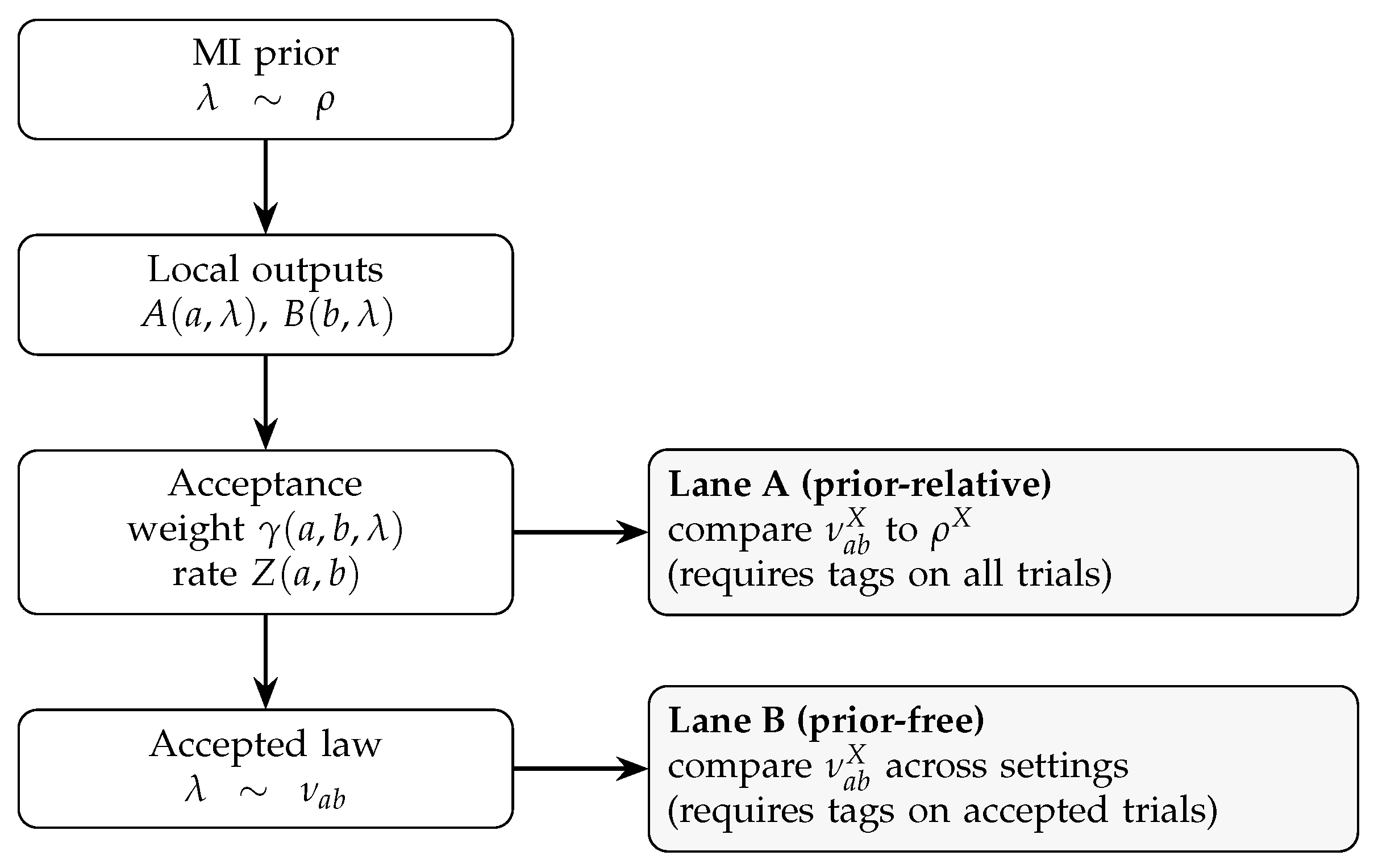
6.2. Schematic: Selection and the Two Audit Lanes
Figure 1 summarizes how acceptance can change the hidden-variable law from the MI prior
to a setting-pair dependent accepted law
, and how Lane A and Lane B audits attach to different parts of the pipeline.
6.3. Tags and Pushforward (Tag) Distributions
Let be a measurable tag. Operationally, X may represent a discretized arrival-time residual, pulse-energy monitor bin, spectral bin, detector-state flag, or any auxiliary feature that can plausibly influence acceptance. For computability, we often take finite, but the definitions do not require finiteness.
For a measure
, define its pushforward (tag distribution)
In particular,
6.4. Lane A: Prior-Relative Fair-Sampling Diagnostics
Definition 5
(Resolved fair-sampling deviation).
For a setting pair , define the resolved deviation at tag resolution X byFor a quartet Q, define . Theorem 3
(Data processing for fair-sampling deviation).
For every measurable tag X and every setting pair ,In particular, . Proof. Total variation is contractive under measurable maps: for any T, . Apply this with , , and . □
Remark 9
(Operational meaning and limitation). How different the accepted-tag distribution is from the all-trial tag distribution is measured by . It is a lower bound on the true hidden-variable deviation : selection that acts only on untagged degrees of freedom may not be visible in . To obtain an upper bound on from data, one needs an additional assumption: for example, that acceptance depends on λ only through the observed tag X (or approximately so).
6.5. Acceptance-Rate Representation on Tags (Optional)
Assume
and
. Write
From Definition 1,
Define the tag-level re-weighting factor
Interpreting
, this reads
Then,
This expresses the Lane-A audit as follows:
how much does acceptance probability vary across tag bins? 6.6. Lane B: Prior-Free Dispersion Diagnostics on Accepted Tags
Lane B targets the quantities that actually control CHSH inflation: how the accepted laws vary across setting pairs. This does not require knowledge of the prior . Instead, it uses tag distributions within accepted data at each setting pair.
Fix a quartet and write for the accepted-tag law at setting pair .
Definition 6
(Resolved diameter and resolved dispersion).
Define the resolved quartet diameterand the resolved quartet dispersion Theorem 4
(Data processing for dispersion).
For every measurable tag X, Proof. Contractivity under
X yields
for each pair. Taking maxima gives
. Similarly, for any
one has
; hence,
which is
. □
Remark 10
(Interpretation).
A large observed or is direct evidence that the accepted ensemble depends on settings at the resolution of the measured tag. Conversely, a small resolved value does not guarantee small hidden dispersion unless one has reason to believe the tag is sufficient (Section 6.7). 6.7. Tag Sufficiency: When Resolved Dispersion Becomes Exact
The inequalities and are one-sided in general. The following sufficiency condition (a standard statistical concept) makes them equalities.
Definition 7
(Tag sufficiency for the accepted family).
Let be measurable. We say that X is sufficient for the accepted family
if there exists a Markov kernel from to Λ, such that for every setting pair ,Equivalently (on standard measurable spaces), the conditional law does not depend on for -almost every x. Proposition 6
(Exactness of TV geometry under sufficiency).
Assume X is sufficient in the sense of Definition 7. Then, for any two setting pairs and ,Consequently, for any quartet Q, Proof. Let and .
By contractivity under the map
X,
By sufficiency,
and
for the same kernel
. By contractivity under
,
Combining the two inequalities yields equality for pairwise Tvs. Taking maxima over the quartet gives .
For dispersion, fix any
and define
. Then, for each
,
hence,
Taking the infimum over
yields
, while Theorem 4 gives
. Thus,
. □
Remark 11
(How sufficiency is used in practice). Sufficiency means that all setting dependence of the accepted law is already visible in the tag marginal , while the conditional distribution of the remaining (unobserved) degrees of freedom given X is setting-independent. Under this assumption, resolved quantities and can be substituted for and in Corollaries 1 and 3.
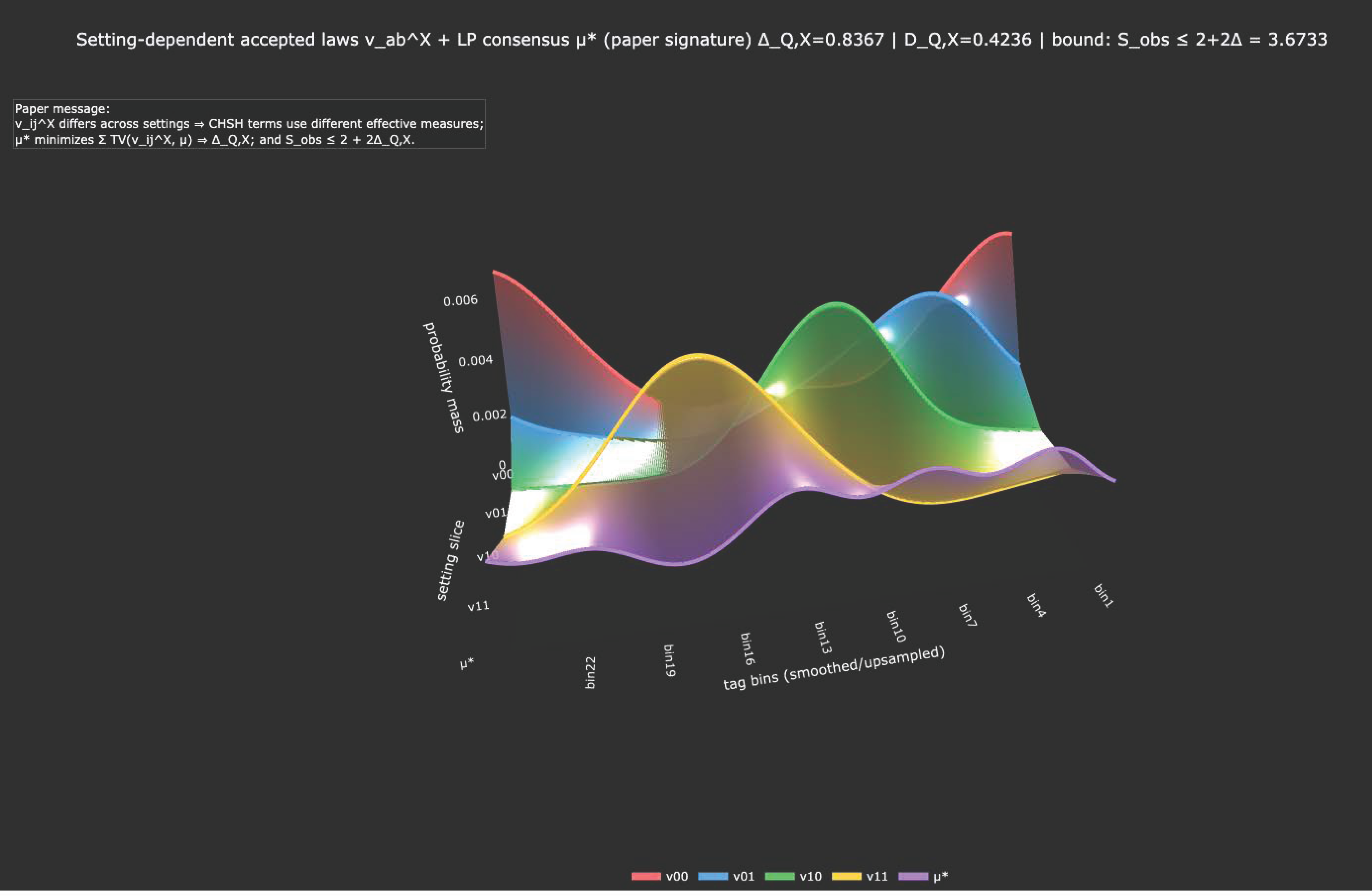
6.8. Computing on Finite Tag Alphabets (Linear Programming)
When is finite, is computable by a small linear program. This makes the Lane-B dispersion audit operational on accepted-tag histograms.
Theorem 5
(LP form of
on a finite space).
Let and let (in our application and ). DefineThen, equals the optimum of the linear programAn optimal minimizer exists. Proof. On a finite alphabet,
. Introducing epigraph variables
yields (
24). The feasible set is compact and the objective is continuous, so a minimizer exists. □
Remark 12
(Lower-bound vs. upper-bound use).
Because (Theorem 4), the LP value computed from tag data provides a certified lower bound
on the hidden dispersion:To use dispersion bounds as an exclusion
tool for selection-based local explanations, one needs an upper
bound on or . Tag sufficiency (Definition 7) is one route: if X is sufficient then (Proposition 6). 6.9. Estimators and Uncertainty (Discrete Tags)
Assume .
Assume a trial definition exists and
X is recorded on all trials. Let
be the empirical distribution of
X across all trials, and let
be the empirical distribution of
X across accepted trials at setting pair
. Then, the plug-in estimate
is natural. Uncertainty can be quantified by nonparametric bootstrap resampling of trials within each setting cell and within the all-trials pool.
For each setting pair in the quartet, estimate
from accepted trials. Estimate pairwise TVs by
Set
as the maximum of the six pairwise TVs. Compute
by solving the LP (
24) with inputs
. Bootstrap within each setting cell provides uncertainty bands.
6.10. Decision Logic: What Audits Can Certify vs. What They Can Exclude
Because total variation is contractive under coarse-graining, the directly measurable tag quantities and are, in general, lower bounds on and . This creates an asymmetry between certification and exclusion.
If is large then acceptance is demonstrably non-fair at the resolution of X.
If or is large then the accepted ensemble demonstrably differs across settings at the resolution of X.
These findings do not prove that a Bell-local model actually explains the observed CHSH violation, but they demonstrate that the pipeline contains setting-dependent selection structure strong enough (at measured resolution) to support selection-based inflation in principle.
To use Corollary 1 or 3 as exclusion tools, one needs an upper bound on or . Such an upper bound typically requires at least one of the following:
an architecture guarantee implying setting-independent acceptance on the tested quartet (forcing );
a justified sufficiency assumption that the measured tag X captures essentially all setting dependence of the accepted law (so that ); or
a physics-based constraint on unobserved degrees of freedom that limits unresolved selection dependence.
Suppose an experiment provides an external upper confidence bound
and an estimate
with standard error
. Then, Corollary 3 yields the exclusion condition
Analogously, using dispersion: excludes models with .
6.11. A Publication-Ready “Selection Statement” Checklist
To make selection semantics explicit (analogous to standard discussions of MI and spacelike separation), it is useful to include a short selection statement in Bell-test publications:
- S1.
Trial definition. What counts as a trial? (Pulse, clock bin, herald, fixed time bins, etc.)
- S2.
Outcome alphabet. Are no-click events retained as outcomes (loss-inclusive analysis), or are correlations conditioned on detection/coincidence?
- S3.
Acceptance rule. List every step that discards trials or conditions the analysis (thresholds, coincidence windows, invalid flags, quality cuts).
- S4.
Acceptance rates. Report by setting pair (with uncertainty), and note the coarse bound from Proposition 4.
- S5.
Tag-based fair-sampling audit (Lane A). If feasible, report at least one tag X recorded on all trials and the resolved deviations .
- S6.
Tag-based dispersion audit (Lane B). Report at least one accepted-tag dispersion diagnostic across settings (pairwise TVs, , and/or via LP).
6.12. Robustness Sweeps (Threshold/Window Sensitivity)
Many acceptance mechanisms enter through analysis parameters (e.g., coincidence window width, timing offsets, discriminator thresholds, filter bandwidth). A useful diagnostic is to repeat the full analysis over a modest grid of such parameters and report the stability of correlators and the CHSH value.
Let
denote a tuning parameter controlling acceptance (or a small grid of parameters). Let
be the estimated CHSH value obtained under parameter
. Define the empirical range
Large sensitivity indicates that acceptance details matter operationally. Small sensitivity supports robustness, but by itself does not yield an upper bound on hidden dispersion: selection could still act on degrees of freedom not varied or not observed. In this framework, sweeps are most useful for guiding tag choice and checking whether resolved quantities
and
remain stable under reasonable analysis variations.
7. Discussion
7.1. How the Selection Model Maps to Experimental Architectures
The acceptance function is intentionally general: it can represent independent local detections, coincidence-time pairing, and pipeline-level cuts. Nevertheless, different experimental architectures naturally constrain the plausible setting dependence.
In event-ready Bell tests, trials are often defined by a herald event that is generated before the local settings are chosen (or outside their past light cones in the relevant frame). If acceptance is determined solely by that herald event and is causally prior to the setting choices then one expects and, hence, is setting-independent. In that regime, Corollary 2 implies CHSH holds on accepted data without requiring fair sampling. Setting dependence can re-enter if additional discards occur after settings are chosen (e.g., basis-dependent invalid flags).
Many modern photonic experiments avoid conditioning on coincidence by treating no-click as an outcome and using a loss-inclusive inequality (e.g., Clauser–Horne or Eberhard-type analyses) [
5,
6,
9,
14]. In such analyses, the Bell functional is evaluated per trial, reducing the specific selection-induced CHSH inflation mechanism studied here. Nevertheless, any additional discards or conditioning steps (overflows, dead-time cuts, invalid-trial flags) reintroduce a nontrivial acceptance rule and should be disclosed and audited.
In continuous-wave experiments without a natural trial clock, coincidence pairs are often produced by a matching rule on two time-tag streams. This is a paradigmatic joint acceptance rule and can generate setting-dependent accepted laws if the matching probability depends on settings or if settings induce timing shifts [
10]. In that regime, Lane-B dispersion audits using time-residual tags are particularly natural.
7.2. Relation to Relaxed Measurement Independence
Mathematically, the accepted laws
behave like a setting-dependent hidden-variable law
. This connects the present bounds to the measurement-dependence literature [
11,
12,
13], which controls the variability of
(often in variational distance) to obtain relaxed Bell inequalities.
The conceptual distinction here is physical: we assume MI at emission (a fixed prior ) and attribute setting dependence to conditioning on acceptance. In practice, both mechanisms can be present, and separating them experimentally requires careful design and disclosure.
7.3. Limitations and What the Framework Does (And Does Not) Deliver
The main limitation is identifiability: tag-based audits typically provide lower bounds on hidden selection structure (e.g., ). To convert an audit into an upper bound, one needs a justified sufficiency assumption or an architecture argument.
The value of the present framework is that it makes the needed information explicit: an observed CHSH violation excludes Bell-local MI models once one has controlled (or quantitatively bounded) the across-setting dispersion of accepted hidden-variable laws.
7.4. Context: “Locality” Has Inequivalent Formalizations; A Small Taxonomy of CHSH Model Classes
The main results of this paper concern a
classical Bell-local, measurement-independent (MI) model class with possible
setting-dependent acceptance (selection), where CHSH inflation is controlled by the dispersion of the accepted hidden-variable laws
(
Section 4,
Section 5 and
Section 6).
A recurring source of interpretive confusion in the Bell literature is that the word “locality” is used in multiple inequivalent technical senses. In this paper,
Bell locality means the existence of local response functions
and
on a single probability space
(
Section 2.1). This is stronger than the
microcausal (operator-algebraic) locality axiom used in algebraic QFT, which requires only that Alice-side observables commute with Bob-side observables. Under microcausality, the universal CHSH upper bound is Tsirelson’s
[
15,
16], not 2; a self-contained derivation via the Bell-operator commutator identity is given in
Appendix G.
Table 3 summarizes a minimal “no-exception-list” taxonomy: different hypothesis classes have different sharp CHSH bounds. This paper’s contribution is the second row: a sharp, quantitative bound for CHSH computed on accepted data when the accepted ensemble can vary with settings.
8. Conclusions
Bell–CHSH is a theorem about unconditional correlations: under measurement independence, Bell locality, and bounded outcomes, the CHSH value satisfies (Theorem 1). Experimental correlators are often computed on an accepted subset of trials, and acceptance can depend on settings. When the accepted hidden-variable law varies across setting pairs, the correlators entering CHSH are expectations under different measures, and CHSH can exceed 2 within Bell-local MI models by selection alone.
We quantified this effect in total variation distance. The main bound (Theorem 2) yields sharp universal inequalities:
where
measures the quartet’s intrinsic distance to any single common accepted law and
is the quartet diameter. The constants are optimal (Proposition 5). Consequently, Tsirelson-scale values
require substantial across-setting dispersion within any Bell-local MI selection-based explanation.
Finally, we proposed a two-lane experimental audit protocol: Lane A provides prior-relative fair-sampling diagnostics using all-trial tags, while Lane B provides prior-free dispersion diagnostics using accepted-tag distributions across settings. On finite tag alphabets, the resolved dispersion statistic is computable by linear programming (Theorem 5). The aim is not to dispute Bell’s theorem, but to make explicit which quantitative selection information is needed to interpret observed CHSH violations as excluding Bell-local measurement-independent models. Bell–CHSH is a theorem about unconditional/shared-ensemble expectations; in real pipelines, the key empirical question is whether the reported correlators are expectations under a single accepted law.