
Comparative Analysis of Quantum Technology Policies in the United States and China: Strategic Directions and Philosophical Foundations


Abstract
1. Introduction
1.1. Research Background
- (1)
- What are the key differences between China and the U.S. in the quantum technology policy objectives and implementation strategies?
- (2)
- How might these policy approaches be interpreted through the lens of political institutions and cultural philosophical perspectives?
- (3)
- How do these differences shape future international cooperation and technological competition?
1.2. Research Status
1.3. Research Objectives and Methods
2. Data and Methods
2.1. Data Sources
- All policy documents are sourced from government agencies or authoritative institutions.
- Priority is given to reports published by government-affiliated organizations or institutions with high academic credibility.
- A cross-verification approach was applied to ensure accuracy and consistency across multiple sources.
2.2. Data Processing
2.3. Analytical Methods
- (a)
- Quantitative Analysis
- (b)
- Temporal Analysis and Policy Evolution Trends
- (c)
- Qualitative Analysis
- (d)
- Key Contributions
3. Results
3.1. Quantitative Analysis Results
- (a)
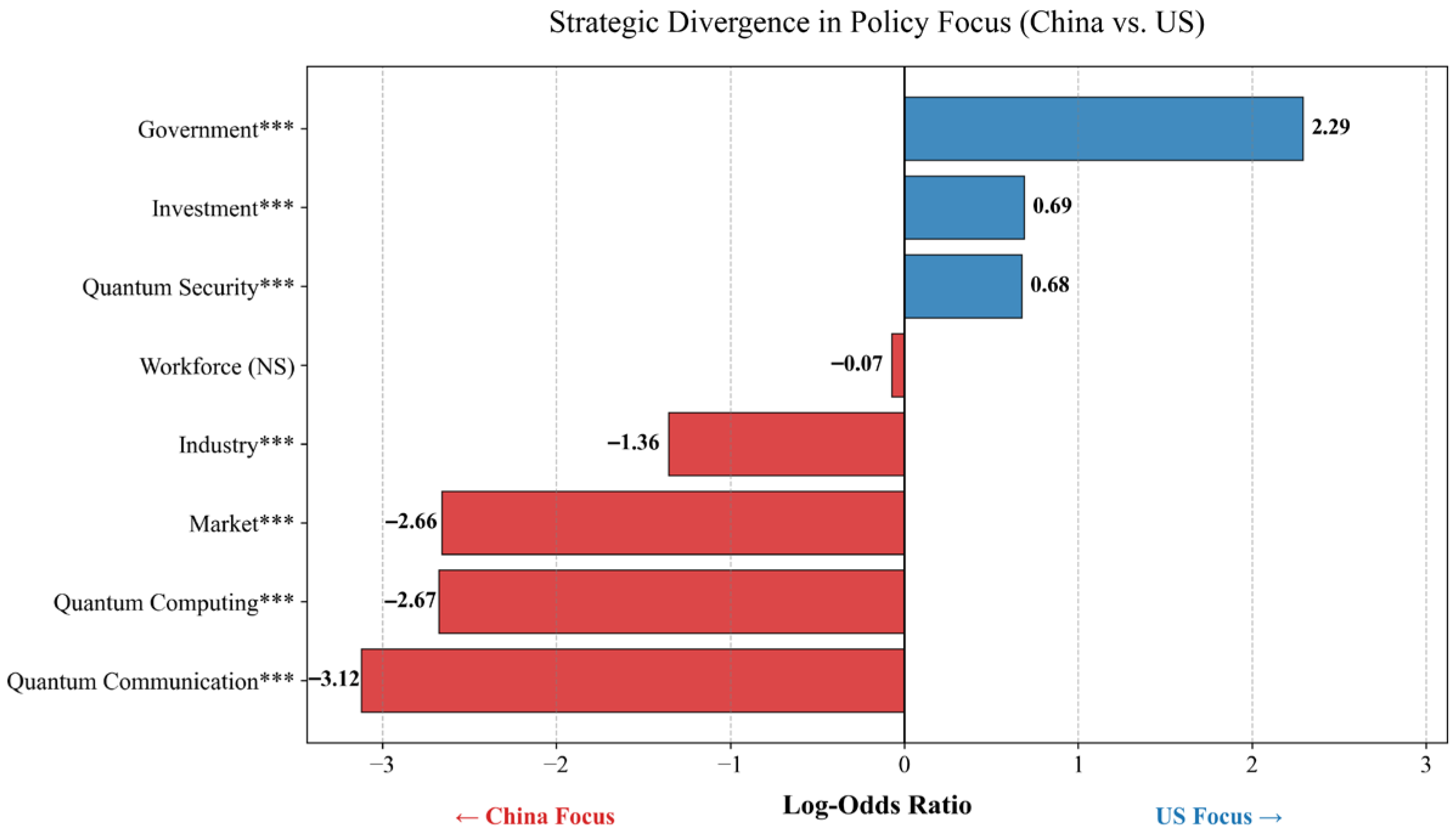
- Keyword Analysis
- (b)
- Technological Pathway Differences
- (c)
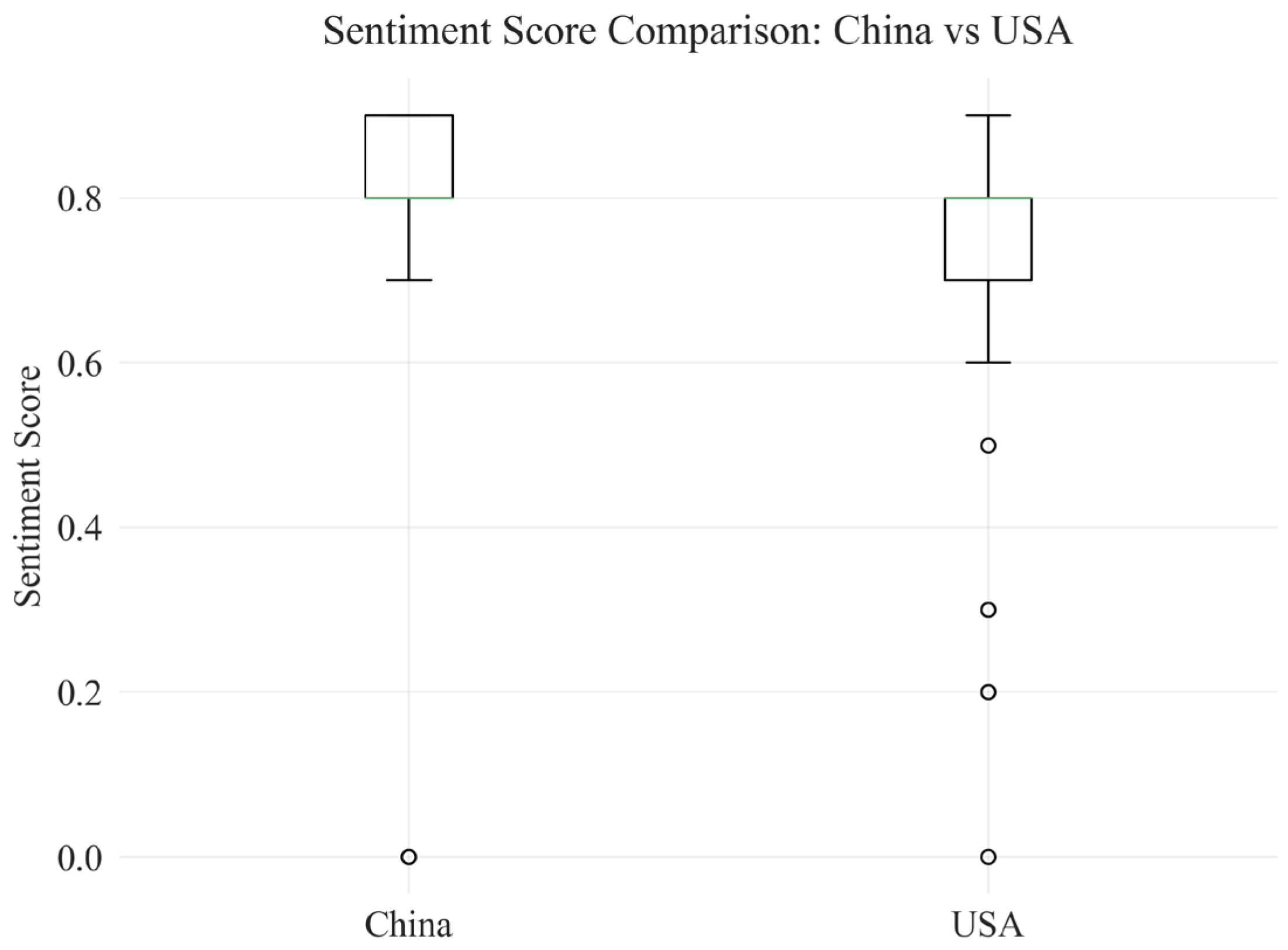
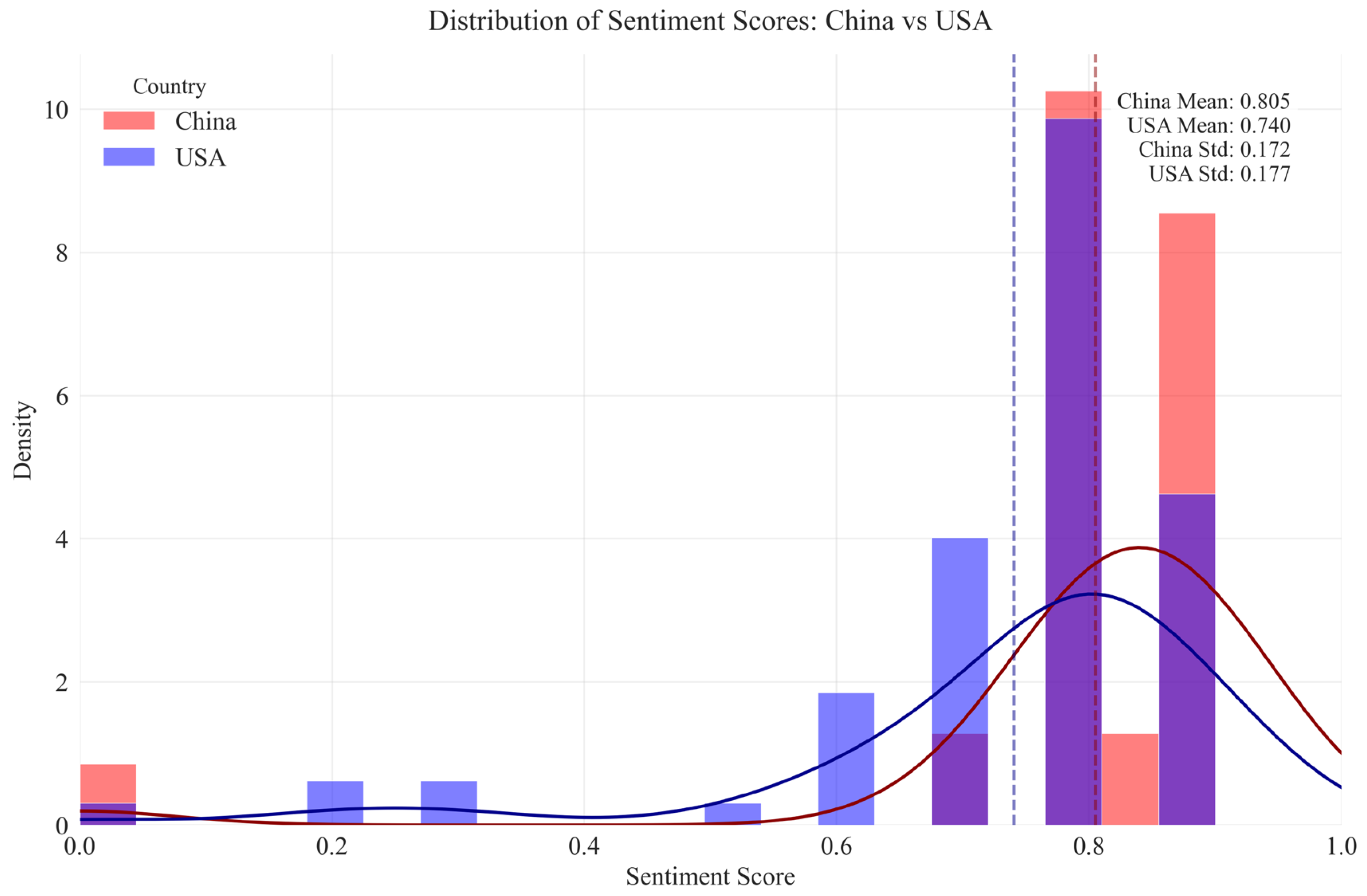
- Sentiment Analysis
- (d)
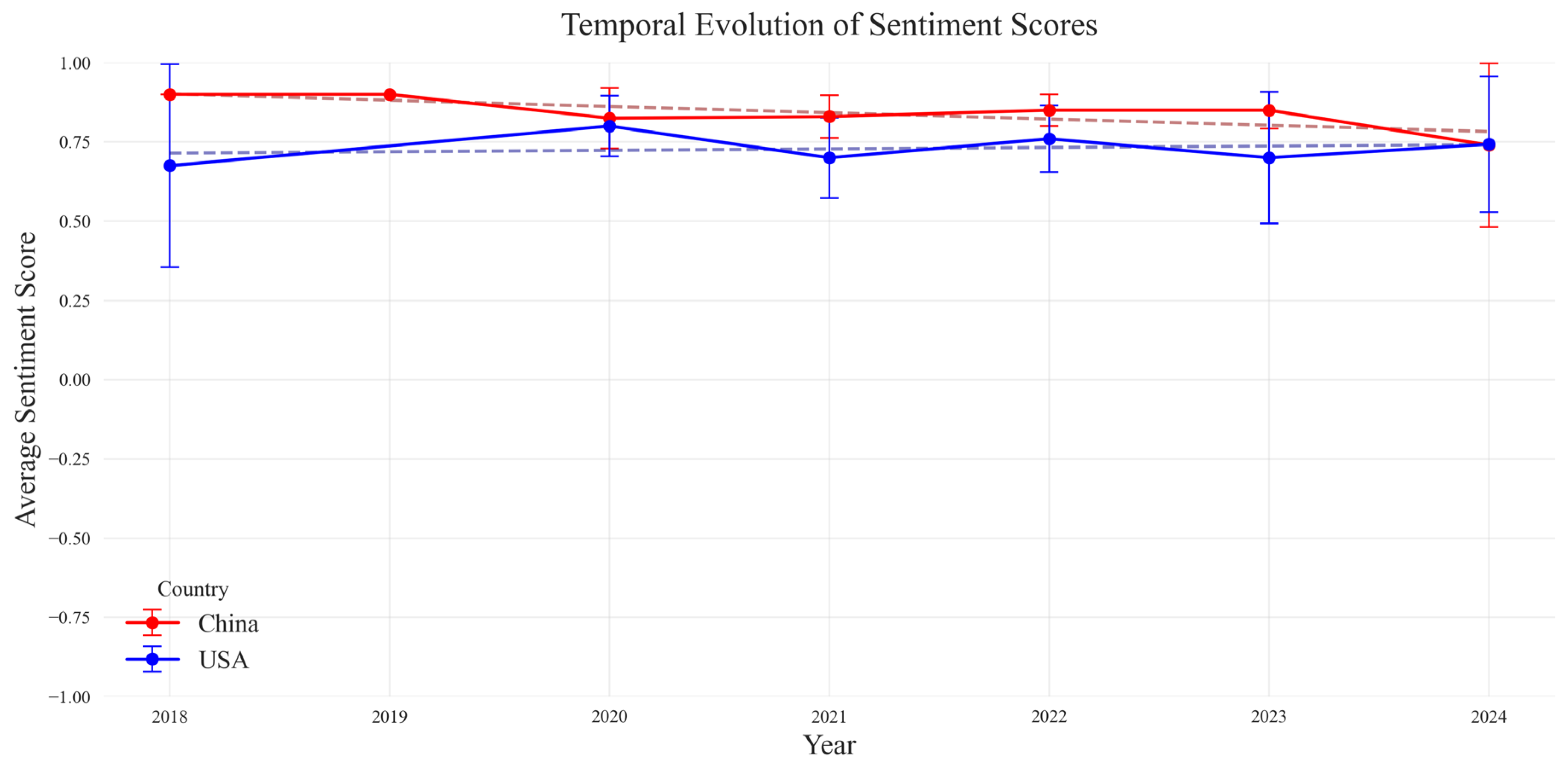
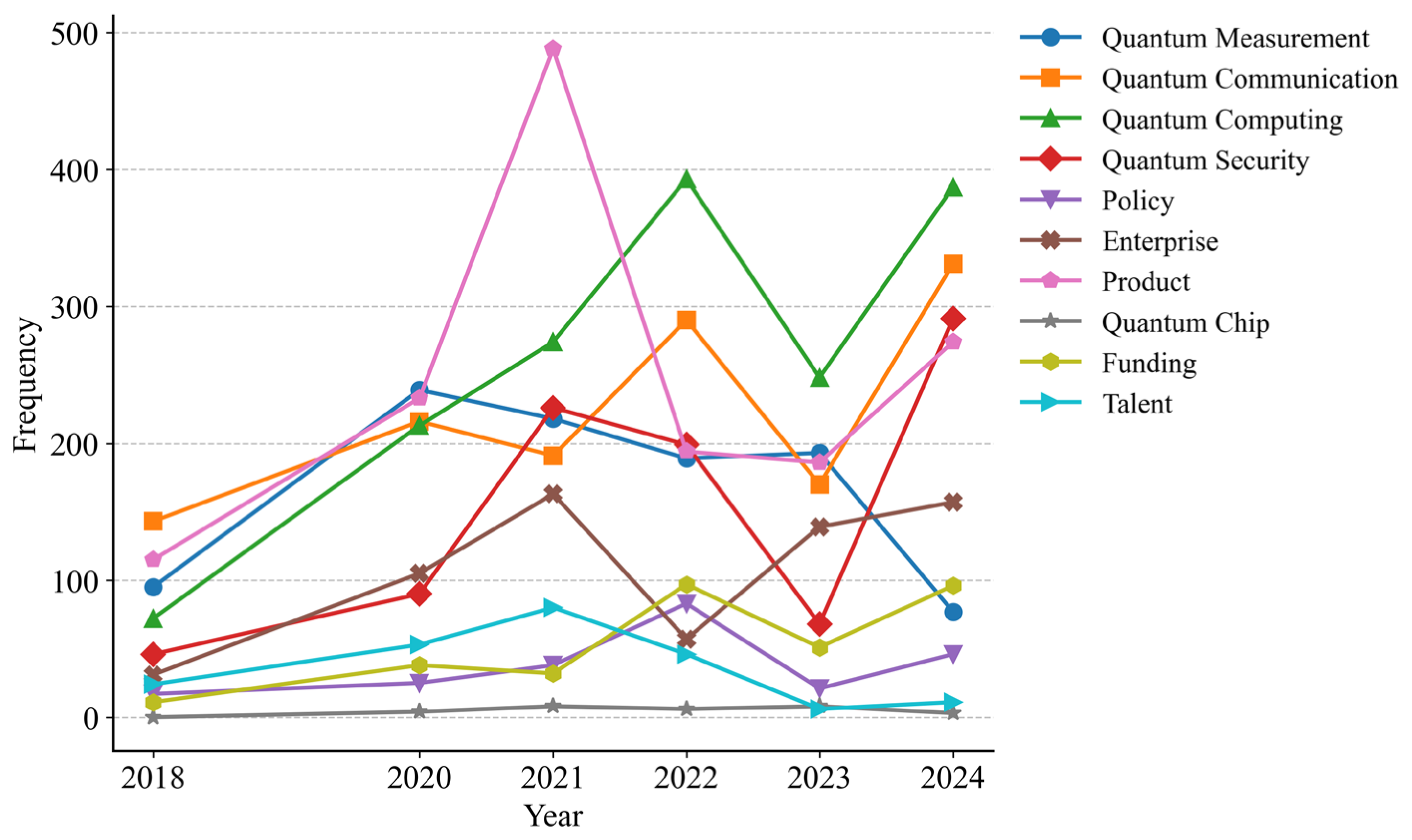
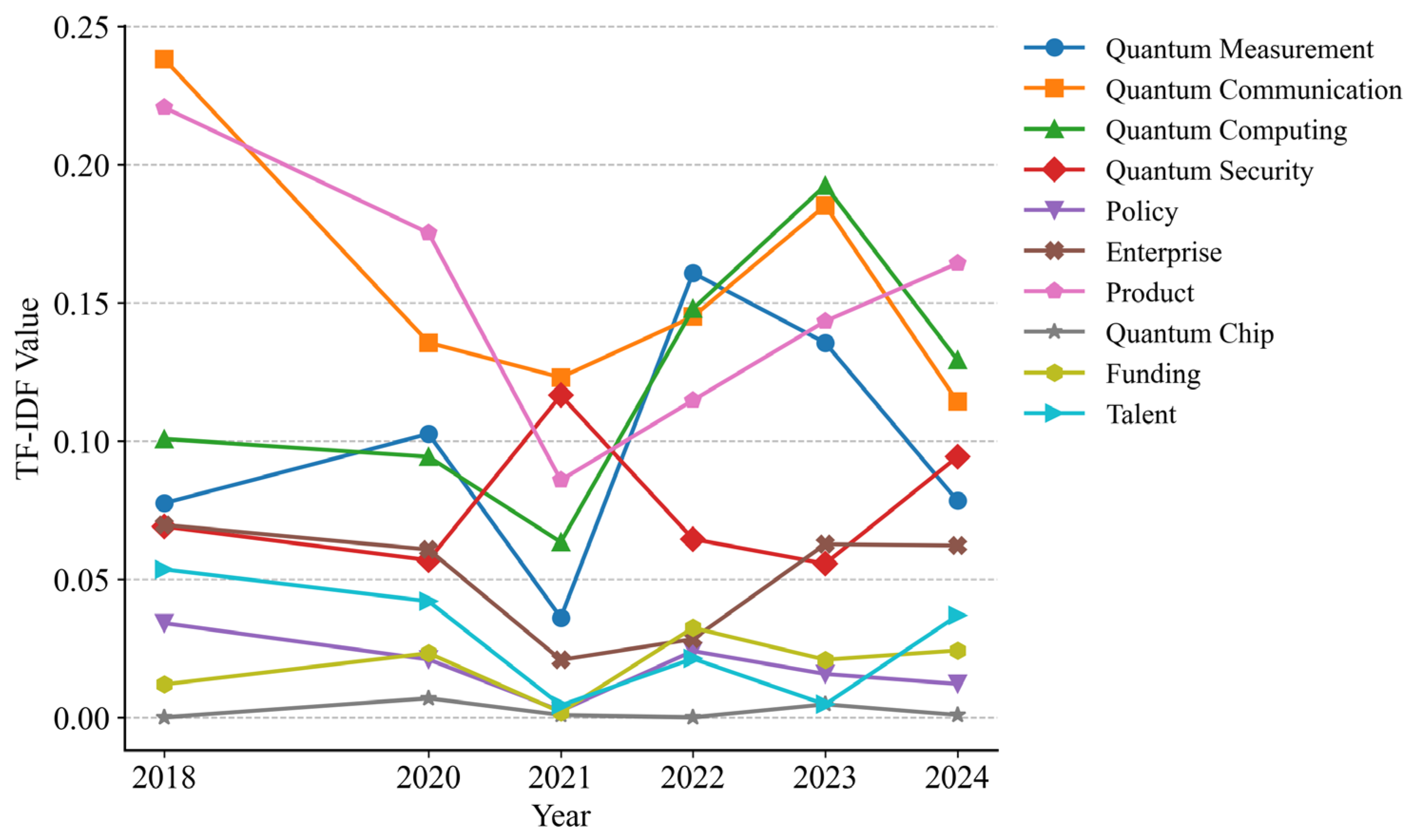
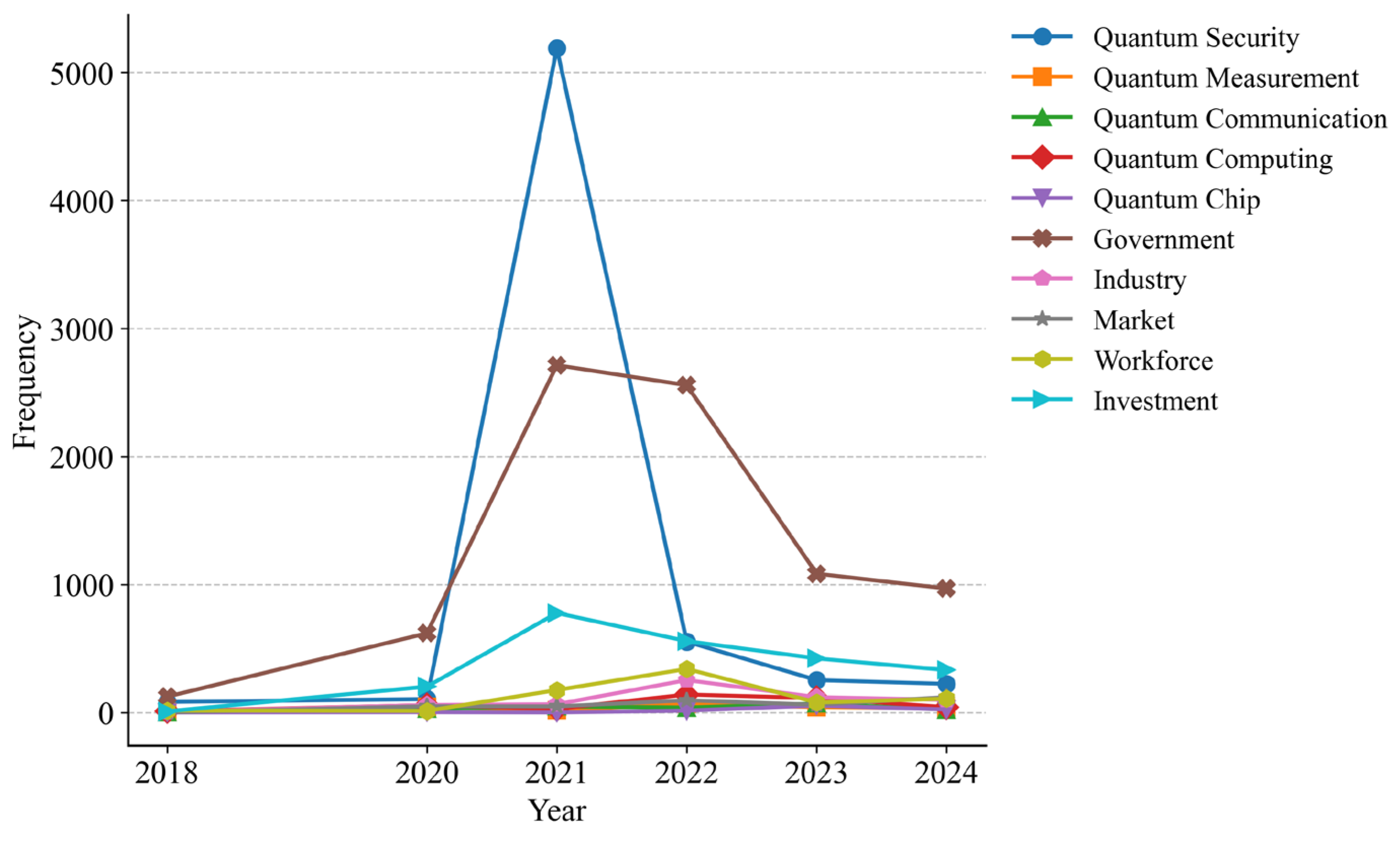
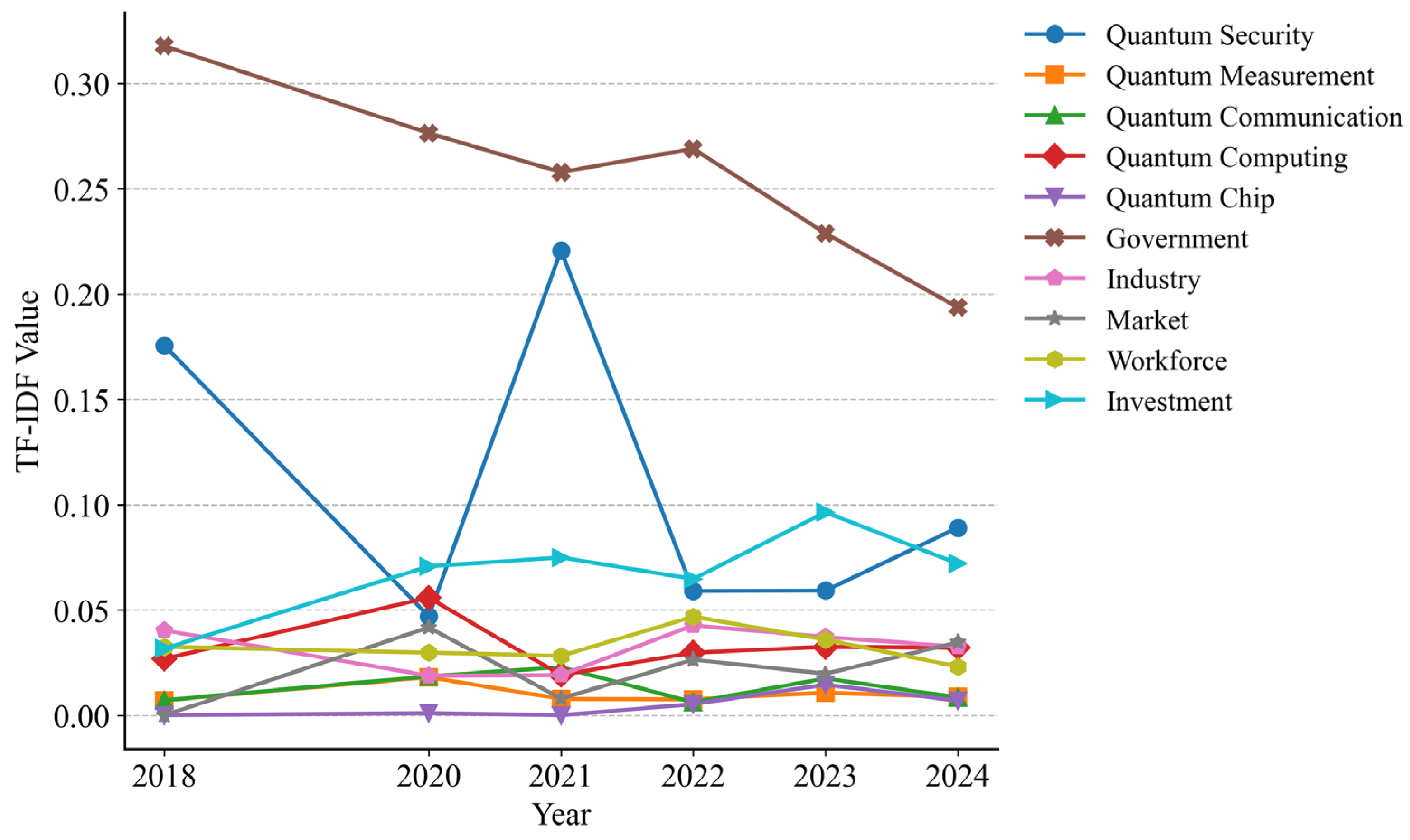
- Time Series Analysis
- (e)
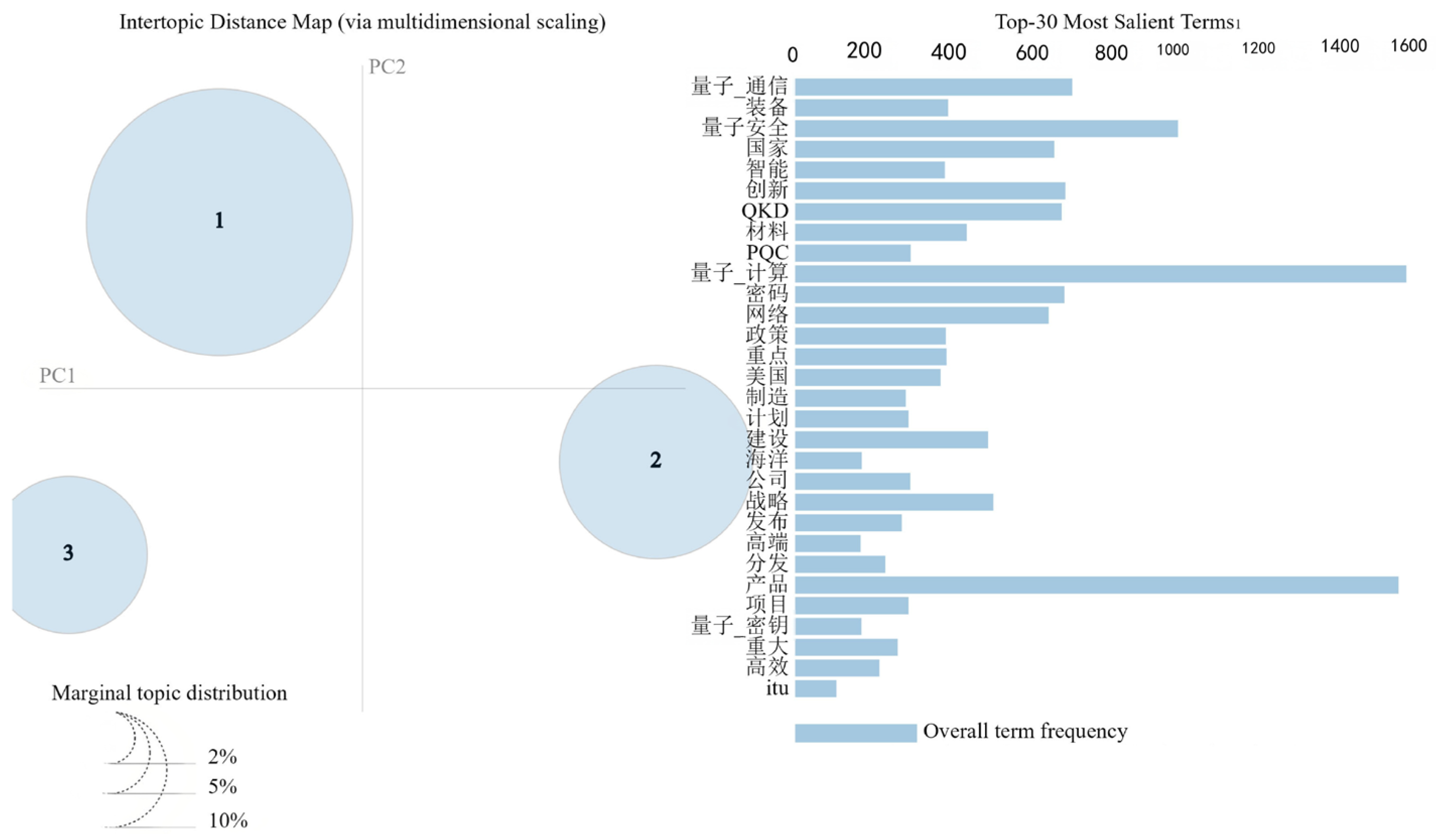
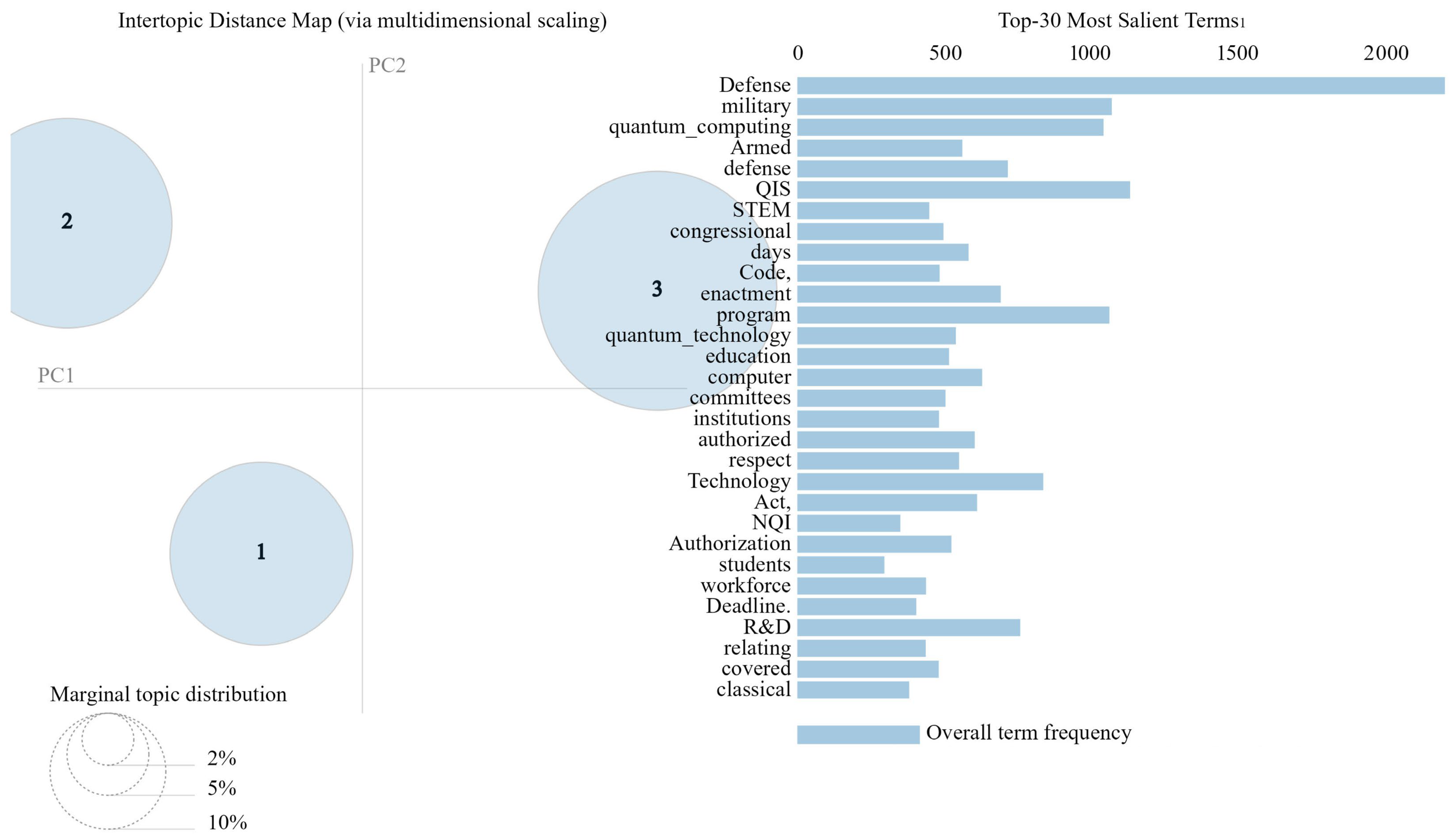
- Latent Semantic Analysis
3.2. Qualitative Analysis Results
- (a)
- Policy Objectives
- (b)
- Policy Logic
3.3. Summary
4. Discussion
4.1. Cultural and Philosophical Roots of Policy Differences
4.2. Implications for Global Technology Governance
4.3. Research Limitations and Future Directions
5. Conclusions
Author Contributions
Funding
Data Availability Statement
Acknowledgments
Conflicts of Interest
References
- Seskir, Z.C.; Willoughby, K.W. Global innovation and competition in quantum technology, viewed through the lens of patents and artificial intelligence. Int. J. Intellect. Prop. Manag. 2023, 13, 40–61. [Google Scholar] [CrossRef]
- Seskir, Z.C.; Umbrello, S.; Coenen, C.; Vermaas, P.E. Democratization of quantum technologies. Quantum Sci. Technol. 2023, 8, 024005. [Google Scholar] [CrossRef]
- Coenen, C.; Grunwald, A. Responsible research and innovation (RRI) in quantum technology. Ethics Inf. Technol. 2017, 19, 277–294. [Google Scholar]
- Inglesant, P.; Ten Holter, C.; Jirotka, M.; Williams, R. Asleep at the wheel? Responsible Innovation in quantum computing. Technol. Anal. Strateg. Manag. 2021, 33, 1364–1376. [Google Scholar] [CrossRef]
- Kania, E.B. China’s quest for quantum advantage—Strategic and defense innovation at a new frontier. J. Strateg. Stud. 2021, 44, 922–952. [Google Scholar] [CrossRef]
- Ishida, K.; Byun, I.; Nagaoka, I.; Fukumitsu, K.; Tanaka, M.; Kawakami, S.; Tanimoto, T.; Ono, T.; Kim, J.; Inoue, K. Superconductor computing for neural networks. IEEE Micro 2021, 41, 19–26. [Google Scholar] [CrossRef]
- Ke, F.; Chen, O.; Wang, Y.; Yoshikawa, N. Demonstration of a 47.8 GHz high-speed FFT processor using single-flux-quantum technology. IEEE Trans. Appl. Supercond. 2021, 31, 1–5. [Google Scholar]
- Brin, D. Convergence: Artificial Intelligence and Quantum Computing: Social, Economic, and Policy Impacts; John Wiley & Sons: Hoboken, NJ, USA, 2022. [Google Scholar]
- Ren, J.; Tang, G.; Wang, F.; Li, S.; Qu, P.; Gao, X.; Ying, L.; Yang, S.; Liu, B.; Zhang, X.; et al. Superconducting single flux quantum (SFQ) technology for power-efficiency computing. CCF Trans. High Perform. Comput. 2022, 4, 182–210. [Google Scholar] [CrossRef]
- Zhu, Y.; Wan, Q. Lithium niobate/lithium tantalate single-crystal thin films for post-Moore era chip applications. Moore More 2024, 1, 6. [Google Scholar]
- Krause, J. The Quantum Race: US-Chinese Competition for Leadership in Quantum Technologies; University of California: Berkeley, CA, USA, 2024. [Google Scholar]
- Singh, M.; Carlson, A.H. An Introduction to Quantum Computing and Its Applications. Cyber Def. Rev. 2024, 9, 73–92. [Google Scholar]
- Cao, Y.; Zhao, Y.; Wang, Q.; Zhang, J.; Ng, S.X.; Hanzo, L. The evolution of quantum key distribution networks: On the road to the qinternet. IEEE Commun. Surv. Tutor. 2022, 24, 839–894. [Google Scholar] [CrossRef]
- Ren, S.; Wang, Y.; Su, X. Hybrid quantum key distribution network. Sci. China Inf. Sci. 2022, 65, 200502. [Google Scholar] [CrossRef]
- Zhang, C.X.; Wu, D.; Cui, P.W.; Ma, J.; Wang, Y.; An, J. Research progress in quantum key distribution. Chin. Phys. B 2023, 32, 124207. [Google Scholar] [CrossRef]
- Wu, X. Technology, power, and uncontrolled great power strategic competition between China and the United States. China Int. Strategy Rev. 2020, 2, 99–119. [Google Scholar] [CrossRef]
- Liman, A.; Weber, K. Quantum computing: Bridging the national security–digital sovereignty divide. Eur. J. Risk Regul. 2023, 14, 476–483. [Google Scholar] [CrossRef]
- Liu, Y.; Wu, Y.; Guo, D. A Comparative Study of China and US’s Future Industry Development Strategy and Typical Future Industry Innovation Capability. In Proceedings of the 2024 Portland International Conference on Management of Engineering and Technology (PICMET), Portland, OR, USA, 4–8 August 2024; IEEE: New York, NY, USA, 2024; pp. 1–8. [Google Scholar]
- Brooks, M. Beyond quantum supremacy: The hunt for useful quantum computers. Nature 2019, 574, 19–22. [Google Scholar] [CrossRef]
- AbuGhanem, M.; Eleuch, H. NISQ computers: A path to quantum supremacy. IEEE Access 2024, 12, 102941–102961. [Google Scholar] [CrossRef]
- Sajeed, S.; Chaiwongkhot, P.; Huang, A.; Qin, H.; Egorov, V.; Kozubov, A.; Gaidash, A.; Chistiakov, V.; Vasiliev, A.; Gleim, A.; et al. An approach for security evaluation and certification of a complete quantum communication system. Sci. Rep. 2021, 11, 5110. [Google Scholar] [CrossRef]
- Huang, Y.; Qi, Z.; Yang, Y.; Zhang, Y.; Li, Y.; Zheng, Y.; Chen, X. A sixteen-user time-bin entangled quantum communication network with fully connected topology. Laser Photonics Rev. 2025, 19, 2301026. [Google Scholar] [CrossRef]
- Kumar, G. Exploring the Role of Quantum Computing in Cryptography. Innov. J. Integr. Res. Technol. Innov. 2025, 1, 1–7. [Google Scholar]
- Raymer, M.G.; Monroe, C. The US national quantum initiative. Quantum Sci. Technol. 2019, 4, 020504. [Google Scholar] [CrossRef]
- Wolbring, G. Auditing the ‘social’of quantum technologies: A scoping review. Societies 2022, 12, 41. [Google Scholar] [CrossRef]
- Kop, M.; Aboy, M.; Minssen, T. Intellectual property in quantum computing and market power: A theoretical discussion and empirical analysis. J. Intellect. Prop. Law Pract. 2022, 17, 613–628. [Google Scholar] [CrossRef]
- Aboy, M.; Minssen, T.; Kop, M. Mapping the patent landscape of quantum technologies: Patenting trends, innovation and policy implications. IIC-Int. Rev. Intellect. Prop. Compet. Law 2022, 53, 853–882. [Google Scholar] [CrossRef]
- Mavani, C.; Mistry, H.K.; Patel, R.; Goswami, A. The Role of Cybersecurity in Protecting Intellectual Property. Int. J. Recent Innov. Trends Comput. Commun. 2024, 12, 529–538. [Google Scholar]
- Kostka, G. China–A Rising Tech Power?: National Ambitions and Local Realities; Rowman & Littlefield: Lanham, MD, USA, 2024. [Google Scholar]
- Zheng, B.; Tang, S.; Fan, Q. Guiding principles in developing world-class disciplines at the University of Science and Technology of China: A case study of the development and innovation of quantum information science. Cult. Sci. 2018, 1, 155–168. [Google Scholar] [CrossRef]
- Castelvecchi, D. The quantum internet has arrived (and it hasn’t). Nature 2018, 554, 289–293. [Google Scholar] [CrossRef]
- Li, X.; Chen, W. Economic impacts of quantum computing: Strategies for integrating quantum technologies into business models. Eig. Rev. Sci. Technol. 2023, 7, 277–290. [Google Scholar]
- Salton, G.; Buckley, C. Term-weighting approaches in automatic text retrieval. Inf. Process. Manag. 1988, 24, 513–523. [Google Scholar] [CrossRef]
- Blei, D.M.; Ng, A.Y.; Jordan, M.I. Latent dirichlet allocation. J. Mach. Learn. Res. 2003, 3, 993–1022. [Google Scholar]
- Kania, E.B. China’s Threat to American Government and Private Sector Research and Innovation Leadership. Testimony Before the House Permanent Select Committee on Intelligence; Center for a New American Security: Washington, DC, USA, 2018; p. 19. Available online: https://www.cnas.org/publications/congressional-testimony/testimony-before-the-house-permanent-select-committee-on-intelligence (accessed on 20 January 2026).
- Grobman, S. Quantum computing’s cyber-threat to national security. Prism 2020, 9, 52–67. [Google Scholar]
- Smith, F.L., III. Quantum technology hype and national security. Secur. Dialogue 2020, 51, 499–516. [Google Scholar] [CrossRef]
- Bayerstadler, A.; Becquin, G.; Binder, J.; Botter, T.; Ehm, H.; Ehmer, T.; Erdmann, M.; Gaus, N.; Harbach, P.; Quantum Technology and Application Consortium—QUTAC; et al. Industry quantum computing applications. EPJ Quantum Technol. 2021, 8, 1–17. [Google Scholar] [CrossRef]
- Egger, D.J.; Gambella, C.; Marecek, J.; McFaddin, S.; Mevissen, M.; Raymond, R.; Simonetto, A.; Woerner, S.; Yndurain, E. Quantum computing for finance: State-of-the-art and future prospects. IEEE Trans. Quantum Eng. 2020, 1, 1–24. [Google Scholar]
- Whig, P.; Remala, R.; Mudunuru, K.R.; Quraishi, S. Integrating AI and quantum technologies for sustainable supply chain management. In Quantum Computing and Supply Chain Management: A New Era of Optimization; IGI Global: Hershey, PA, USA, 2024; pp. 267–283. [Google Scholar]



| China Keyword (EN) | Original (CN) | TF-IDF | Norm. Freq. | U.S. Keyword | TF-IDF | Norm. Freq. |
|---|---|---|---|---|---|---|
| Quantum | 量子 | 0.295 | 3.09% | Quantum | 0.262 | 1.78% |
| Technology | 技术 | 0.241 | 2.66% | Government | 0.211 | 1.55% |
| Research | 研究 | 0.149 | 1.80% | Research | 0.176 | 1.25% |
| Quantum Comm. | 量子通信 | 0.125 | 0.92% | Organization | 0.085 | 0.73% |
| Product | 产品 | 0.118 | 0.95% | Quantum Security | 0.073 | 1.23% |
| Quantum Computing | 量子计算 | 0.101 | 1.06% | Investment | 0.067 | 0.44% |
| Development | 发展 | 0.093 | 1.14% | Technology | 0.063 | 0.40% |
| Quantum Measure. | 量子测量 | 0.092 | 0.71% | QIS | 0.060 | 0.23% |
| Application | 应用 | 0.089 | 1.14% | Information | 0.052 | 0.36% |
| Quantum Security | 量子安全 | 0.085 | 0.62% | Technologies | 0.051 | 0.20% |
Disclaimer/Publisher’s Note: The statements, opinions and data contained in all publications are solely those of the individual author(s) and contributor(s) and not of MDPI and/or the editor(s). MDPI and/or the editor(s) disclaim responsibility for any injury to people or property resulting from any ideas, methods, instructions or products referred to in the content. |
© 2026 by the authors. Licensee MDPI, Basel, Switzerland. This article is an open access article distributed under the terms and conditions of the Creative Commons Attribution (CC BY) license.
Share and Cite
Wang, S.; Ni, C. Comparative Analysis of Quantum Technology Policies in the United States and China: Strategic Directions and Philosophical Foundations. Quantum Rep. 2026, 8, 9. https://doi.org/10.3390/quantum8010009
Wang S, Ni C. Comparative Analysis of Quantum Technology Policies in the United States and China: Strategic Directions and Philosophical Foundations. Quantum Reports. 2026; 8(1):9. https://doi.org/10.3390/quantum8010009
Chicago/Turabian StyleWang, Shangkun, and Chunle Ni. 2026. "Comparative Analysis of Quantum Technology Policies in the United States and China: Strategic Directions and Philosophical Foundations" Quantum Reports 8, no. 1: 9. https://doi.org/10.3390/quantum8010009
APA StyleWang, S., & Ni, C. (2026). Comparative Analysis of Quantum Technology Policies in the United States and China: Strategic Directions and Philosophical Foundations. Quantum Reports, 8(1), 9. https://doi.org/10.3390/quantum8010009