2. Methodology
In this section we present the theoretical construction of the model, establish its consistency as an effective field theory, and derive the cosmological equations used in the subsequent analysis. We emphasize that all ingredients introduced here concern the definition and internal consistency of the framework, rather than its phenomenological consequences.
2.1. Effective Action and EFT Rationale
We work within a covariant effective field theory (EFT) extension of General Relativity, in which the gravitational action is supplemented by curvature-dependent operators capturing leading-order geometric corrections. The EFT viewpoint assumes that gravity admits a local expansion in covariant curvature invariants, valid below a cutoff scale associated with the onset of genuinely quantum-gravitational degrees of freedom.
As in any EFT construction, bounded or non-polynomial operators can be expanded in a local curvature series when evaluated at scales well below the cutoff. For instance, a generic bounded function of curvature invariants may be expanded in powers of , retaining only the leading terms consistent with the derivative order considered. This procedure does not introduce a new mathematical structure, but simply reflects the standard truncation of a low-energy effective expansion.
Concretely, we consider an effective action of the schematic form
where
,
, and
denote covariant curvature scalars constructed from
R,
, and their derivatives. Their explicit functional form is chosen such that the resulting field equations remain second order in time derivatives.
In a spatially flat FLRW background, these invariants reduce to the following leading contributions:
yields an effective term scaling as , which regularizes the high-density regime;
produces quadratic curvature corrections contributing at order in the modified Friedmann equation;
generates derivative curvature terms proportional to , encoding geometric slip effects.
The coefficients are dimensionful EFT parameters that control the relative strength of these corrections. They are not fundamental constants, but encode the low-energy imprint of underlying high-energy gravitational physics.
The EFT regime of validity corresponds to curvature invariants satisfying
where
denotes the cutoff scale of the effective description. In this regime, higher-order operators suppressed by additional powers of
remain subleading and the derivative expansion is self-consistent.
Within a spatially flat FLRW background, the relevant dynamical variable is the Hubble parameter
where
is the scale factor and the overdot denotes differentiation with respect to cosmic time.
A crucial guiding principle in the choice of invariants is the preservation of second-order field equations. By avoiding higher time derivatives in the equations of motion, the construction circumvents the Ostrogradsky instability that typically afflicts higher-derivative gravity models [
6]. As demonstrated in the perturbative analysis below, this ensures that the EFT extension remains dynamically well posed and ghost-free within its domain of validity.
2.2. Ghost-Free Structure and Propagating Modes
To assess the dynamical consistency of the model, we analyze the spectrum of propagating modes around a smooth background configuration. Linearization of the action around Minkowski space or a slowly varying cosmological solution shows that, in addition to the massless spin–2 graviton of General Relativity, a scalar curvature mode appears, as expected in controlled
-type effective extensions of gravity [
5,
6].
The absence of ghost and tachyonic instabilities imposes algebraic constraints on the EFT coefficients. In higher-derivative theories, such instabilities are typically associated with Ostrogradsky modes arising from non-degenerate higher-order time derivatives [
15]. In particular, positivity of the scalar kinetic term requires
which define a stable wedge in parameter space. These conditions are directly analogous to the well-known stability requirements in higher-curvature gravity, where the additional scalar mode must carry positive kinetic energy and avoid tachyonic mass instabilities [
6]. Within this domain, the perturbative spectrum is free of ghost-like excitations.
At the level of cosmological perturbations, scalar fluctuations can be described by the comoving curvature perturbation
. Expanding the action to quadratic order yields the standard form
where
is the effective kinetic coefficient of scalar perturbations, governing the normalization of the time-derivative term;
is the squared sound speed, controlling the propagation of spatial gradients.
The absence of ghost and gradient instabilities requires
In the present model, these conditions reduce precisely to the stability wedge defined above, and are shown explicitly in the
Supplementary Material File S1 to hold throughout the EFT-consistent parameter domain.
Importantly, the geometric slip parameter does not introduce additional propagating degrees of freedom. The corresponding operator contributes to the background-reduced action through first-order time derivatives, but does not generate higher-order kinetic terms in the quadratic perturbative expansion. After solving the Hamiltonian and momentum constraints, no new independent canonical momentum is introduced. The phase-space dimensionality, therefore, remains that of General Relativity supplemented by a single scalar curvature mode.
This ghost-free analysis constitutes a structural consistency check of the effective theory and does not rely on a particular cosmological solution. It establishes the perturbative stability of the framework within its EFT regime of validity.
2.3. Geometric Correction Terms and Physical Interpretation
The three curvature corrections entering the action play distinct and complementary roles in the cosmological dynamics.
2.3.1. Repulsive Core ()
The term proportional to
dominates in the high-curvature, small-scale-factor regime. It acts as an effective repulsive core that counterbalances gravitational collapse and prevents the divergence of curvature invariants. This mechanism replaces the classical Big Bang singularity with a smooth transition and is reminiscent of nonsingular cosmological models proposed in earlier contexts [
4,
5].
2.3.2. Expansion Renormalization ()
The contribution effectively renormalizes the gravitational coupling at the level of the background dynamics. From the EFT perspective, it encodes the leading correction to the Einstein–Hilbert term in a curvature expansion and modifies the response of spacetime to energy density without introducing additional fields.
2.3.3. Geometric Slip Term ()
The geometric slip term proportional to is the key novelty of the framework. It captures curvature memory effects and introduces an intrinsic time asymmetry into the evolution equations. Physically, this term can be interpreted as a geometric analogue of dissipation: while it does not violate covariance, it breaks time-reversal symmetry at the level of solutions. As shown below, this mechanism plays a central role in the emergence of a monotonic relational time variable.
2.3.4. Bounded Curvature Corrections and –Type Terms
In addition to polynomial curvature corrections, the effective field theory perspective naturally allows for bounded, non-polynomial curvature operators whose role is to regularize high-curvature regimes without introducing new propagating degrees of freedom. A representative example is provided by terms of the schematic form , where denotes a characteristic curvature scale below the EFT cutoff.
Such contributions admit a well-defined low-curvature expansion,
and therefore fit naturally within an EFT framework at curvatures
. Importantly, the bounded nature of these operators ensures that curvature invariants remain finite even when the classical Einstein–Hilbert term would otherwise lead to divergences.
In the present work, such –type terms are not treated as independent dynamical sectors but rather as effective regulators that motivate the inclusion of curvature-bounded contributions such as the term at the level of the background dynamics. When truncated consistently, they do not introduce higher-order equations of motion nor additional degrees of freedom, and their effects can be absorbed into the leading EFT coefficients.
Accordingly, bounded curvature operators should be understood here as part of the effective geometric description underlying the nonsingular behavior of the model, rather than as a fundamental modification of General Relativity. Their detailed microphysical origin lies beyond the scope of the present analysis and does not affect the robustness of the cosmological solutions discussed below.
2.4. Cosmological Equations in an FLRW Background
To study the homogeneous sector of the theory, we specialize to a spatially flat, homogeneous and isotropic Friedmann–Lemaître–Robertson–Walker (FLRW) spacetime with line element
where
is the scale factor and
t denotes cosmic time. Homogeneity and isotropy imply that all geometric scalars depend only on
t.
In this background, variation of the effective action introduced in
Section 2.1 yields the modified Friedmann equation
where
is the Hubble parameter and the overdot denotes differentiation with respect to cosmic time.
The quantity
represents the total matter energy density and satisfies the standard continuity equation
with
p the matter pressure. No modification of matter conservation is assumed.
Equation (
9) encodes the leading-order effects of the higher-curvature operators introduced in the effective action. The
term originates from the higher-curvature invariant
, while the
contribution reflects the derivative curvature correction
discussed previously. The structure of the equation preserves second-order time derivatives, consistent with the ghost-free construction analyzed in
Section 2.2.
For numerical and analytical convenience, the system can be rewritten as a first-order autonomous dynamical system by introducing the variables
supplemented by the evolution equation
and the matter continuity equation. This formulation facilitates phase-space analysis and allows a transparent identification of fixed points and bounce conditions.
Within the EFT regime specified previously (), the homogeneous background dynamics is therefore completely determined by the effective action and the associated stability constraints. No additional phenomenological assumptions are introduced beyond the stated EFT truncation.
2.5. Covariant Origin of the Effective Operators
The effective action considered in this work is constructed from local, generally covariant curvature invariants. Although the explicit covariant form of the operators entering Equation (
1) is not required for the background analysis performed here, their existence and consistency within an effective field theory framework can be justified on general grounds.
In a homogeneous and isotropic FLRW spacetime, a wide class of covariant scalar invariants, including combinations of curvature tensors, covariant derivatives, and total-derivative terms, reduce to contributions proportional to , , and . In particular, terms involving contractions of curvature tensors and covariant derivatives can generate -dependent contributions at the level of the background equations without introducing higher-order time derivatives or additional propagating degrees of freedom.
From the EFT perspective, such operators should be understood as leading-order geometric corrections arising from a local curvature expansion below a cutoff scale. By construction, the resulting field equations remain second order in time derivatives, thereby avoiding Ostrogradsky instabilities and preserving the canonical structure of General Relativity. Within this regime, the coefficients parametrize controlled geometric corrections rather than new fundamental degrees of freedom.
2.6. Definition of the Emergent Time Variable
A central element of the present framework is the introduction of an intrinsic temporal parameter constructed from the geometric dynamics itself, rather than imposed externally through matter clocks or coordinate choices. This perspective is motivated by relational and thermodynamic approaches to time in generally covariant systems, where temporal ordering can emerge from dynamical correlations [
1,
2].
We define an emergent time variable
as a scalar functional of the homogeneous background evolution,
where
is the Hubble parameter and the functional
depends explicitly on the geometric slip contribution proportional to
. The dependence on the EFT parameter
ensures that
is sensitive to curvature-memory effects encoded in the effective action.
The form of is restricted by covariance and dimensional consistency: it must be constructed from local geometric scalars available in a homogeneous FLRW background and must not introduce additional propagating degrees of freedom. In practice, reduces to a positive-definite combination of H and within the ghost-free stability domain.
In the limit , the slip term disappears and loses its preferred sign, so that reduces to a trivial reparametrization of coordinate time. The standard time-reversal invariant structure of General Relativity is then recovered.
For , the modified background equations imply that maintains a definite sign along dynamical trajectories within the EFT-consistent regime. Consequently, becomes a monotonic function of the evolution parameter, providing an intrinsic temporal ordering at the level of solutions. This monotonicity follows from the structure of the slip term and the stability conditions discussed above, rather than from fine-tuned initial conditions.
The variable should therefore be interpreted as a relational background time parameter defined within the effective theory. Its quantitative behavior and explicit realization in cosmological solutions are analyzed in the Results section.
2.7. Numerical Pipeline and Initial Conditions
To investigate the dynamical implications of the modified cosmological equations, we perform numerical integrations of the background system derived in
Section 2.4. The evolution equations are solved using an adaptive Runge–Kutta method of Dormand–Prince type, which provides fifth-order accuracy with embedded error control and is well-suited for stiff systems encountered in high-curvature regimes.
Absolute and relative tolerances are chosen conservatively, typically at the level of or better, to ensure numerical stability and convergence across the bounce phase. The reliability of the integration scheme has been verified by cross-checking energy conservation and constraint preservation throughout the evolution.
Initial conditions are imposed in the contracting branch of the cosmological solution, well before the onset of the high-curvature regime. We fix an initial scale factor and a negative Hubble parameter , corresponding to a smooth contraction phase. The initial value of is determined consistently from the modified Friedmann equation, ensuring that the Hamiltonian constraint is satisfied at the initial time.
The parameters
are restricted to the ghost-free and EFT-consistent domain identified in
Section 2.2, following standard stability criteria for higher-curvature and effective gravity theories [
6]. Unless otherwise stated, we adopt representative parameter values that illustrate the qualitative behavior of the solutions rather than finely tuned choices. Limited parameter scans are performed to confirm the robustness of the results against variations in initial conditions and coupling strengths.
This numerical setup provides a controlled and reproducible pipeline for studying nonsingular cosmological evolution, as well as for tracking the behavior of the emergent time variable across the bounce. All results presented in the following section are insensitive to numerical artifacts and remain stable within the explored parameter ranges.
2.8. Comment on the Covariant Form of the Effective Operators
The effective operators entering the action are assumed to arise from local and generally covariant curvature invariants within a low-energy effective field theory expansion of gravity. In a homogeneous and isotropic FLRW background, a broad class of such invariants—including combinations of curvature tensors, covariant derivatives, and total-derivative (boundary) terms—reduce to contributions proportional to
and
after integration by parts and specialization to the background geometry [
5,
6]. From the EFT perspective, these terms encode controlled geometric corrections below a cutoff scale and preserve second-order field equations, avoiding Ostrogradsky instabilities [
7,
8].
3. Results
In this section we present the dynamical consequences of the framework introduced in
Section 2. All results reported here follow directly from the modified cosmological equations and the numerical pipeline described above. We focus on the existence of a nonsingular bounce, the emergence of a well-defined arrow of time, and the stability of the background evolution.
3.1. Non-Singular Cosmological Bounce
A generic outcome of the modified Friedmann dynamics is the replacement of the classical Big Bang singularity by a smooth, nonsingular bounce. For parameter values within the ghost-free and EFT-consistent domain identified in
Section 2.2, the scale factor reaches a strictly positive minimum value,
at which the Hubble parameter vanishes and changes sign, signaling a transition from contraction to expansion.
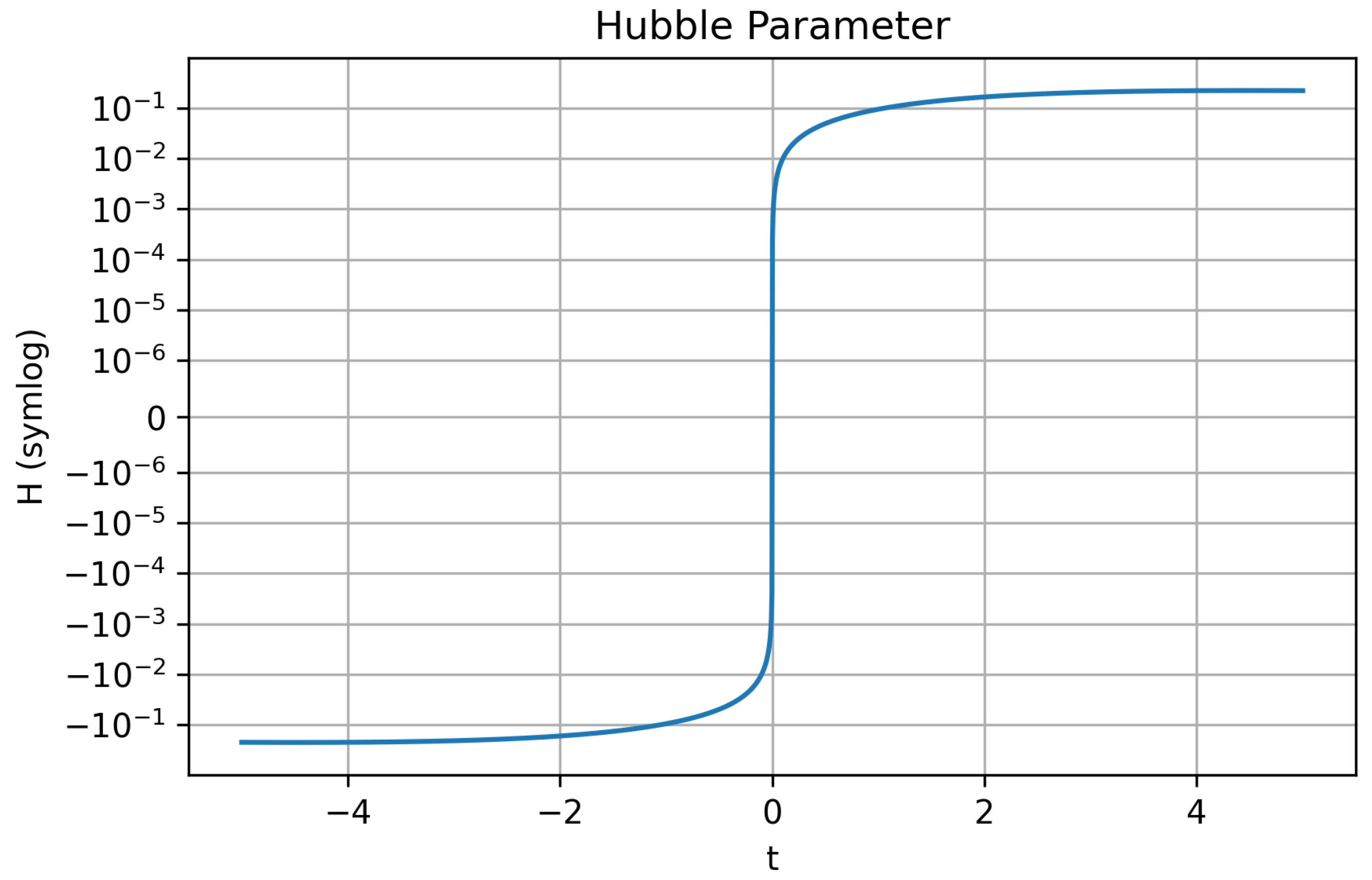
Numerical solutions show that the Hubble rate
crosses zero continuously, while its time derivative
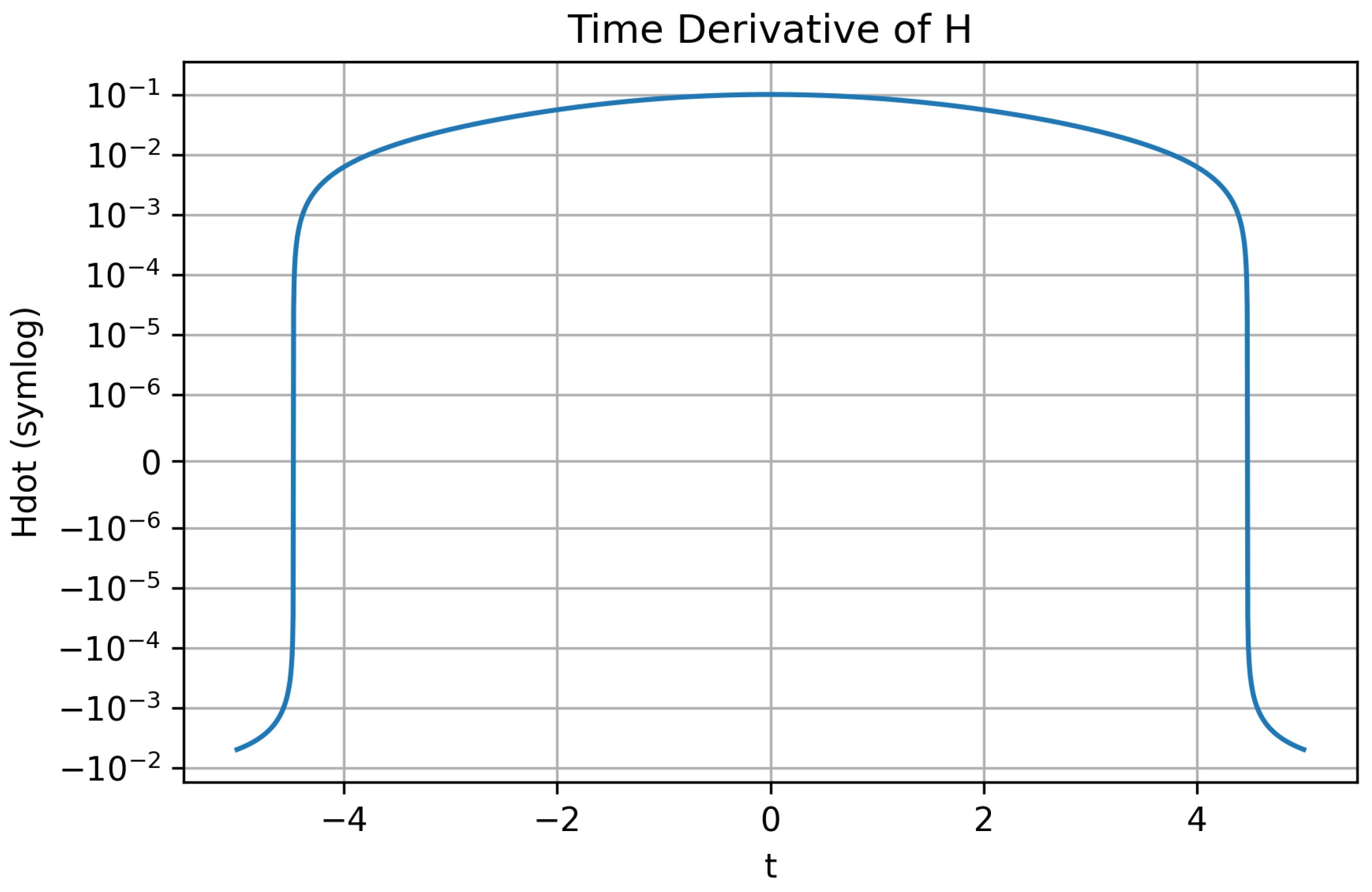
remains finite throughout the evolution. As a consequence, curvature invariants constructed from the Riemann tensor, including the Ricci scalar and quadratic combinations, remain bounded at all times. This behavior confirms that the repulsive curvature contribution proportional to
effectively regularizes the high-curvature regime, in agreement with earlier nonsingular cosmological scenarios [
4,
5].
Importantly, the existence of the bounce does not require fine-tuned initial conditions. For a broad range of contracting initial states, the dynamics naturally evolves toward the bounce, demonstrating that singularity avoidance is a robust prediction of the model rather than a special solution.
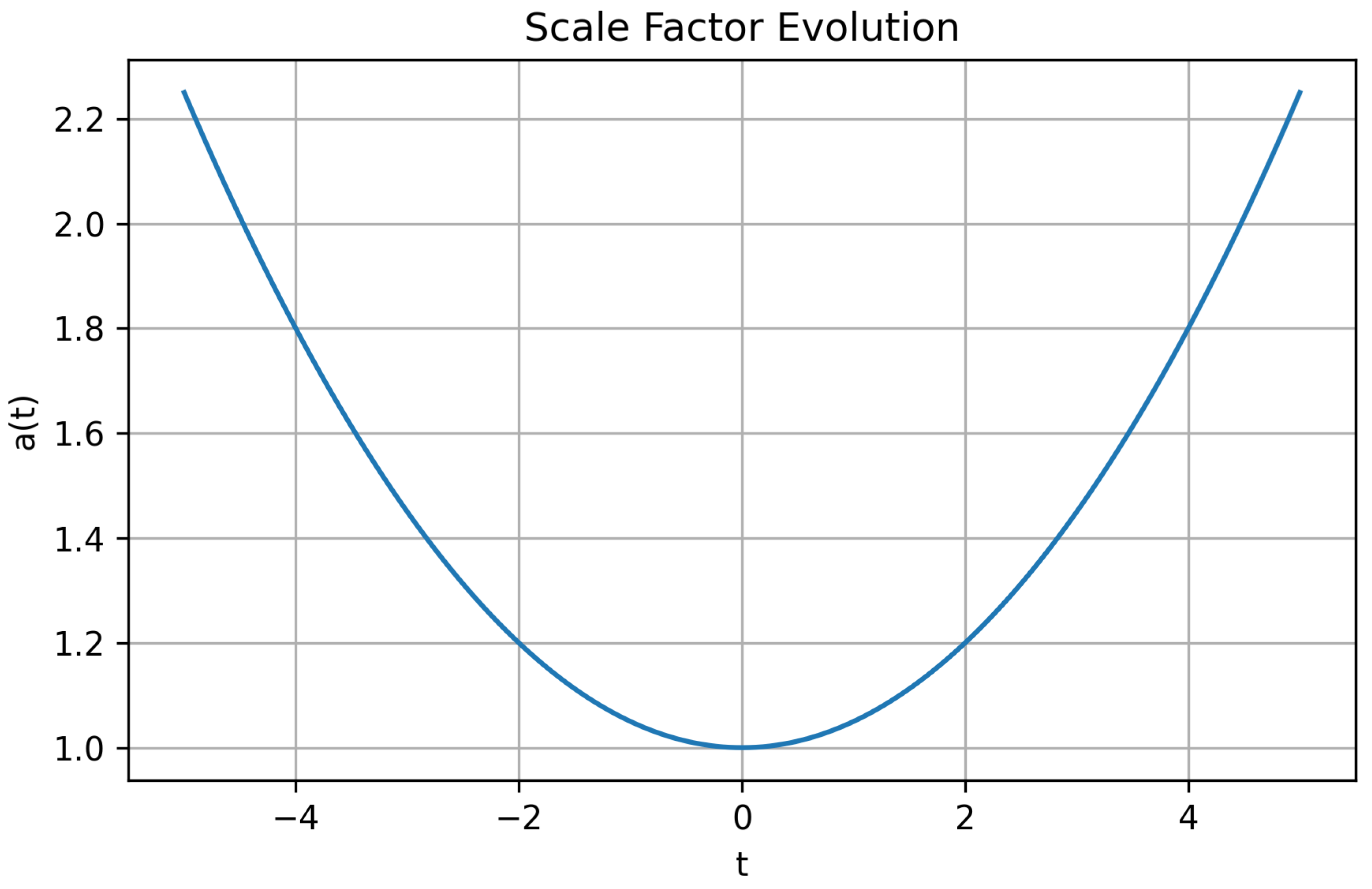
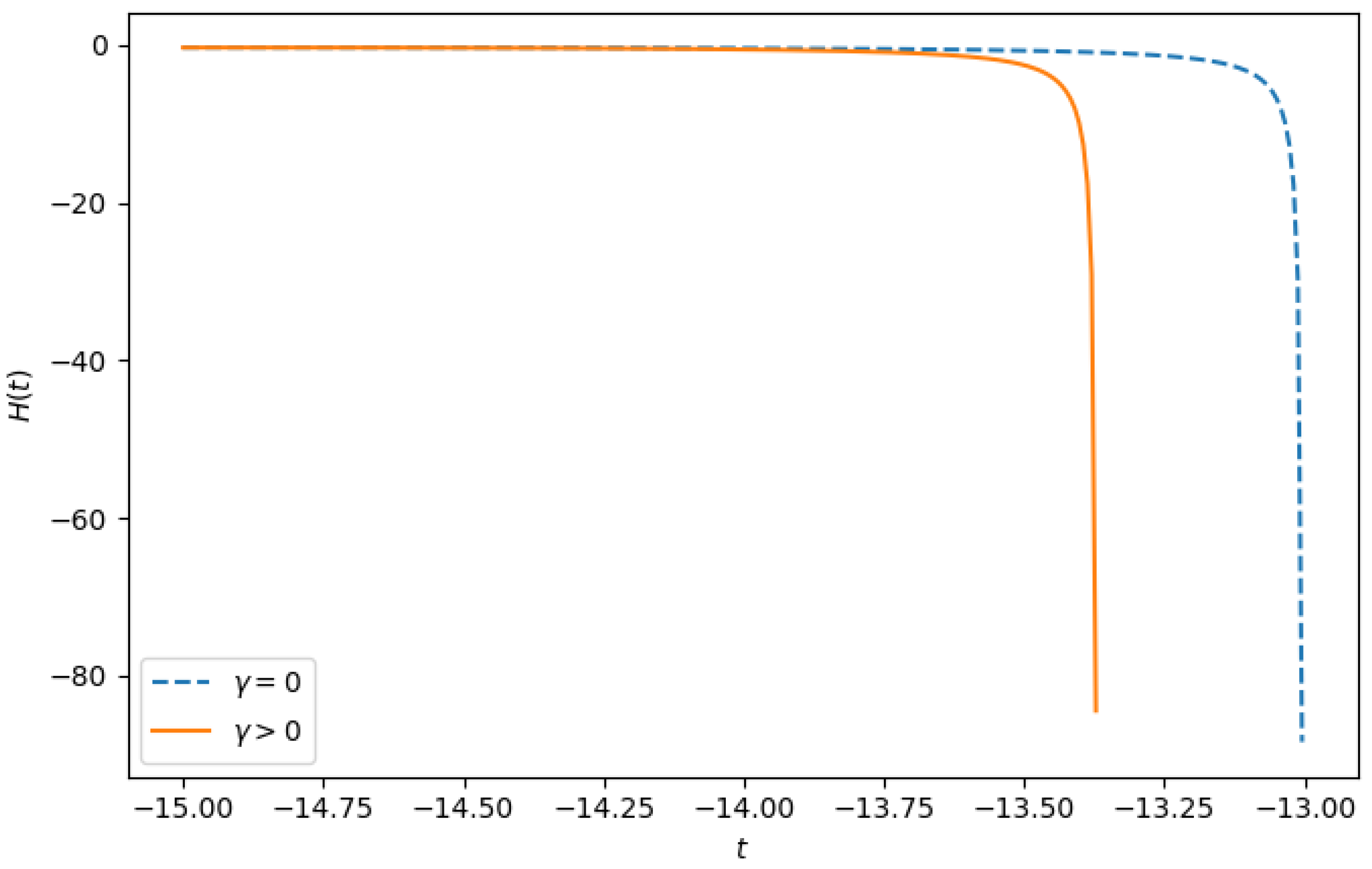
The scale factor reaches a nonzero minimum at finite time, signaling a smooth and nonsingular cosmological bounce. No divergence of curvature invariants occurs within the EFT regime displayed. All quantities are shown in dimensionless units. The evolution of the Hubble parameter across the bounce is shown in
Figure 1, where
crosses zero smoothly, indicating the transition from contraction to expansion. The Hubble parameter crosses zero continuously at the bounce, indicating a smooth transition between contraction and expansion (
Figure 2).
3.2. Emergent Arrow of Time
Beyond singularity resolution, the cosmological evolution exhibits the emergence of a well-defined arrow of time. Evaluating the relational time variable
introduced in
Section 2.5, along the numerical solutions, reveals that
is a strictly monotonic function across the entire evolution, including through the bounce phase.
This monotonic behavior persists independently of the sign of the Hubble parameter and remains unaffected by the transition from contraction to expansion. In particular, continues to increase smoothly as H crosses zero, indicating that the temporal ordering defined by is insensitive to the reversal of the cosmological expansion rate.
We have verified that the monotonicity of
is robust under variations of the initial conditions and moderate changes in the parameters
within the stable EFT domain. This confirms that the emergence of a temporal arrow is not an artifact of a specific solution but a structural consequence of the geometric slip term proportional to
. In the limit
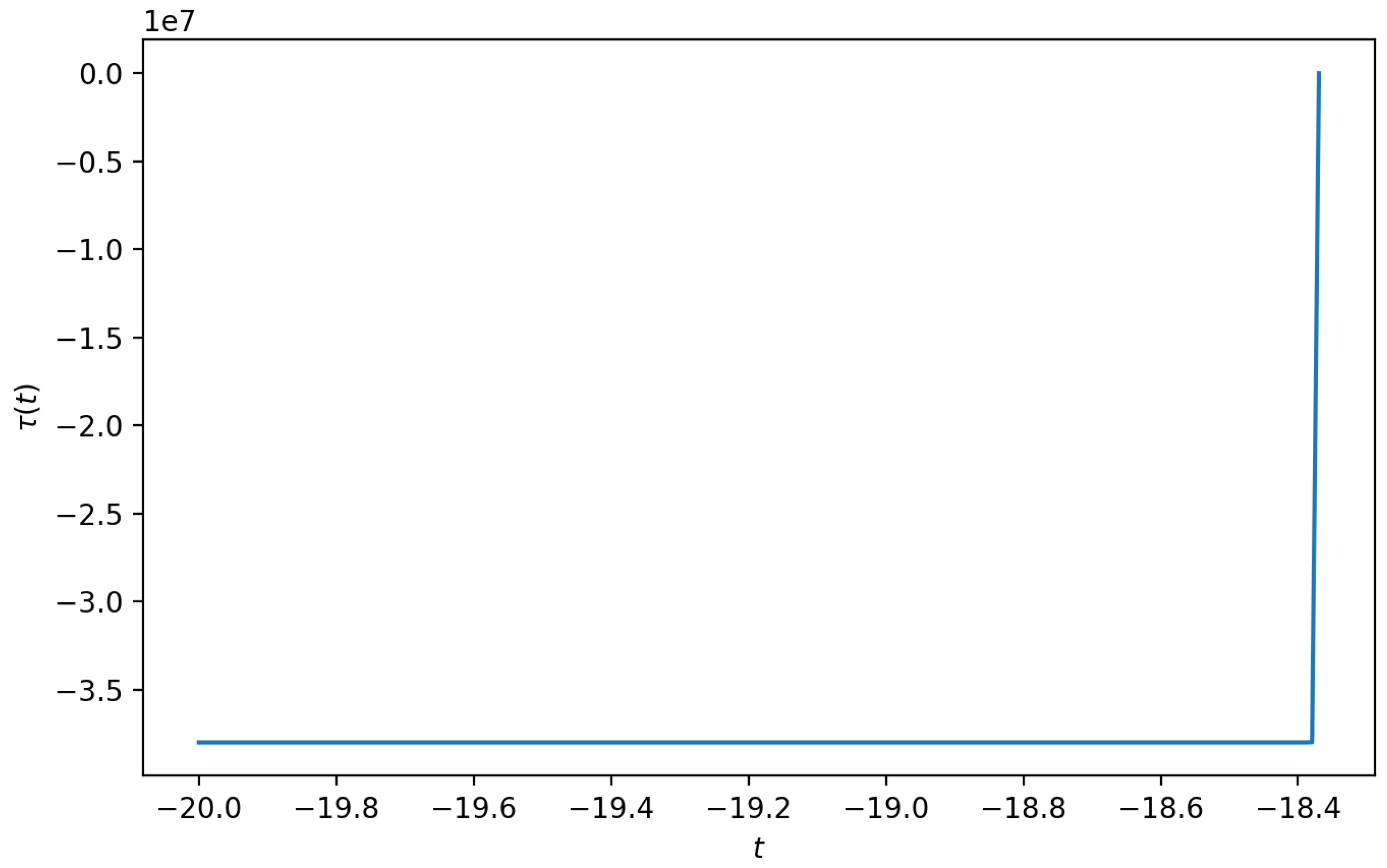
, the monotonic behavior disappears and the evolution becomes time-reversal symmetric, recovering the behavior expected in standard General Relativity.The global monotonic behavior of the relational time variable is displayed in
Figure 3, confirming that
remains strictly increasing throughout the entire cosmological evolution.
3.3. Cosmological Equations and Nonsingular Bounce
Specializing the effective field equations to a spatially flat FLRW background yields the modified Friedmann equation
supplemented by the standard matter continuity equation.
Proposition 1. Let and assume the EFT-consistent and ghost-free parameter domain defined in Section 2.2. For regular matter satisfying , the cosmological scale factor admits a strictly positive minimum , corresponding to a nonsingular bounce. Argument.
In the high-curvature regime (small
a), the term proportional to
dominates the right-hand side of Equation (
15). Since
, this contribution grows rapidly as
. Consequently, the equation cannot be satisfied for arbitrarily small values of
a without violating the positivity of
.
More explicitly, as a decreases, the increasing term forces the modified Friedmann equation to admit a solution with at a finite, nonzero value of the scale factor . At this point the evolution transitions from (contraction) to (expansion). Because the field equations remain second order and no divergences appear in H or within the EFT regime, all curvature invariants remain finite at the transition.
The existence of the bounce therefore follows directly from the geometric structure of the effective equations under the stated assumptions. It does not require exotic matter components or fine-tuned initial conditions, but is a structural consequence of the
term in the ghost-free EFT domain. Supporting analytical steps and consistency checks are provided in the
Supplementary Material File S1. As shown in
Figure 4, the time derivative of the Hubble parameter remains finite throughout the bounce, confirming the absence of curvature divergences within the EFT regime.
3.4. Dynamical Stability and Ultraviolet Damping
A distinctive feature of the solutions is their dynamical stability across the high-curvature regime. The presence of the geometric slip term induces an effective damping of rapid variations in the Hubble flow, leading to the suppression of high-frequency oscillations that would otherwise arise near the bounce.
Numerically, this manifests as a smooth evolution of
and
, with no evidence of runaway behavior or spurious oscillations. The damping effect becomes more pronounced for larger positive values of
, while remaining compatible with the ghost-free conditions established in
Section 2.2.
At the level of perturbative stability, representative solutions satisfy the standard conditions for the absence of ghost and gradient instabilities in the scalar sector, namely
and
, throughout the evolution. A more detailed perturbative analysis is deferred to
Appendix A, where the explicit expressions and numerical checks are provided. These results confirm that the geometric dissipation mechanism enhances dynamical stability without introducing additional propagating degrees of freedom, in contrast with many higher-derivative gravity models [
6]. As illustrated in
Figure 5, the geometric slip term induces effective ultraviolet damping across the high-curvature regime.A comparison of ultraviolet damping behavior across representative early-universe frameworks is presented in
Figure 5. The geometric slip term induces controlled suppression of high-frequency oscillations without introducing additional propagating degrees of freedom.
3.5. Background Evolution Summary
The overall background evolution is summarized in
Figure 1, which displays the time dependence of the scale factor
, the Hubble parameter
, and its derivative
for a representative set of parameters. The evolution is characterized by a smooth contraction phase, a nonsingular bounce at finite curvature, and a subsequent expanding phase that asymptotically approaches standard cosmological behavior.
For completeness,
Table 1 lists the fiducial parameter values used in the representative solutions shown, together with the corresponding initial conditions. We emphasize that the qualitative features discussed above persist across the explored parameter range and do not rely on finely tuned choices.
Taken together, these results demonstrate that the proposed geometric extension of General Relativity yields a consistent and dynamically stable cosmological evolution, simultaneously resolving the initial singularity and generating a well-defined arrow of time.
3.6. Effective Field Theory Origin of Curvature Memory
From a quantum-gravitational perspective, the effective action considered in this work can be naturally interpreted as the result of integrating out microscopic gravitational degrees of freedom below a cutoff scale. Within this viewpoint, the curvature-dependent terms parametrized by encode leading-order semiclassical corrections to General Relativity rather than new fundamental fields.
In particular, the geometric slip term proportional to admits a natural interpretation as a curvature-memory effect arising from coarse-graining over short-wavelength gravitational modes. Similar dissipative or non-equilibrium contributions are known to emerge in semiclassical gravity and in thermodynamic derivations of Einstein’s equations, where effective irreversibility appears despite the time-reversal invariance of the underlying microscopic theory.
Importantly, the slip term does not introduce additional propagating degrees of freedom and preserves second-order equations of motion. This indicates that the associated memory effects should be understood as effective rather than fundamental modifications of the gravitational dynamics, fully consistent with effective field theory control.
3.7. Semiclassical Gravity and Geometric Dissipation
The emergence of curvature-memory effects is closely related to earlier proposals in which gravitational dynamics acquires dissipative features at the macroscopic level. In semiclassical gravity, backreaction effects from quantum matter fields can induce non-equilibrium behavior, leading to effective damping terms in the gravitational equations.
The present framework differs from such approaches in that the memory effect arises purely from the geometric sector and does not rely on explicit matter couplings, stochastic sources, or quantum decoherence. Nevertheless, the qualitative behavior of the modified Friedmann equation parallels that of dissipative systems, where rapid variations are dynamically suppressed and the evolution becomes less sensitive to initial conditions.
From this perspective, the geometric slip term may be regarded as a classical remnant of underlying quantum-gravitational correlations, encoded in a local and covariant effective description.
3.8. Emergent Time and the Quantum Problem of Time
A distinctive feature of the present framework is the emergence of a monotonic relational time variable defined intrinsically by the gravitational dynamics. This construction resonates with longstanding discussions of the problem of time in quantum gravity, where time ceases to be a fundamental external parameter.
In relational and canonical approaches to quantum gravity, physical evolution is described in terms of correlations between observables rather than with respect to an external time coordinate. In this context, the emergent variable can be interpreted as an effective temporal parameter that orders cosmological histories without introducing matter clocks or additional degrees of freedom.
Although no explicit quantization of the present model is performed, the existence of a geometrically defined, monotonic time variable suggests a natural bridge between classical cosmological dynamics and relational quantum frameworks. In a future quantized version of the theory, could provide a semiclassical notion of time with respect to which quantum states of matter or perturbations evolve.
3.9. Compatibility with Quantum Bounce Scenarios
The nonsingular cosmological bounce obtained in this work shares qualitative features with bounce scenarios arising in loop quantum cosmology and other quantum-gravity-inspired approaches. In those frameworks, quantum geometry effects replace the classical Big Bang singularity with a finite-curvature transition between contracting and expanding phases.
The present framework does not aim to reproduce the detailed dynamics of any specific quantum gravity theory. Instead, it provides a classical, effective description that is fully compatible with the existence of a quantum bounce at more fundamental scales. In this sense, the curvature-bounded and memory-induced dynamics discussed here may be viewed as a macroscopic manifestation of deeper quantum regularization mechanisms.
3.10. Scope and Limitations of the Quantum Interpretation
The quantum considerations discussed in this section are interpretative rather than derivational. The present work does not provide a full quantization of the gravitational field, nor does it derive the effective action from a specific microscopic theory of quantum gravity.
Rather, the goal is to clarify how the geometric memory framework naturally fits within broader semiclassical and quantum-gravitational discussions. The emergence of dissipation-like behavior and a relational time variable should be understood as effective phenomena arising within a controlled EFT regime.
A systematic quantization of the model, as well as a detailed analysis of quantum perturbations evolving with respect to the emergent time variable , are left for future work.
4. Discussion
In this section we interpret the results obtained in
Section 3, assess their domain of validity within an effective field theory framework, and discuss their implications for early-universe phenomenology. No new dynamical assumptions are introduced here; the discussion is strictly based on the results already presented.
4.1. Structure of Propagating Degrees of Freedom
At the level of linearized perturbations around a smooth background, the effective framework considered here propagates the same tensor degrees of freedom as General Relativity, namely the massless spin–2 graviton, together with a single scalar curvature mode associated with the higher-curvature sector, as expected in controlled effective extensions of gravity [
6]. No additional vector or tensor modes are introduced.
Importantly, the geometric slip term proportional to
does not give rise to new propagating degrees of freedom. Its contribution enters only through the background equations of motion and does not modify the canonical structure of the perturbative action. As a result, the number and nature of physical degrees of freedom remain unchanged, and the theory stays free of ghost-like excitations within the effective field theory regime [
6].
4.2. Physical Meaning of Geometric Slip and Curvature Memory
The geometric slip term proportional to admits a natural interpretation as a manifestation of curvature memory at the level of the effective spacetime dynamics. Crucially, this contribution arises from a local and covariant action constructed from curvature invariants. No nonlocal operators or explicit time-asymmetric terms are introduced.
At the fundamental level, the action remains invariant under time reversal. The effective temporal asymmetry emerges only at the level of cosmological solutions. In particular, the modified Friedmann equation dynamically correlates the expansion rate H with its time derivative , introducing temporal correlations in the background evolution. This correlation does not violate locality; rather, it modifies the dynamical response of curvature to its own evolution within a local derivative expansion.
From a dynamical perspective, the
term selects a preferred orientation in the space of solutions when
. Rapid variations of the expansion rate are suppressed, leading to an effective ultraviolet damping of high-curvature evolution. This mechanism resembles dissipative behavior in nonequilibrium systems, although no microscopic entropy production or fundamental time-reversal violation is assumed. Similar emergent irreversibility has been discussed in thermodynamic derivations of gravitational dynamics [
7,
8].
Importantly, the interpretation of geometric slip as curvature memory does not require additional propagating degrees of freedom, nor does it alter conservation laws derived from diffeomorphism invariance. The underlying Bianchi identities remain satisfied, and the apparent temporal ordering arises from the structure of the background equations rather than from explicit symmetry breaking.
Within this framework, the emergent time variable
is defined relationally through
where
F is constructed from local geometric quantities. For
,
F is positive along cosmological solutions, implying that
is strictly monotonic. In the limit
, the slip term vanishes, the dynamical asymmetry disappears, and
reduces to a trivial reparametrization of coordinate time, recovering the fully time-reversal invariant structure of General Relativity.
The temporal asymmetry discussed here is therefore effective and solution-dependent. It does not correspond to a fundamental CPT violation, nor does it imply any breakdown of locality or covariance. Rather, it represents a dynamical ordering that emerges within a controlled effective field theory regime.
4.3. Gravitational Memory and Temporal Correlations
The presence of the geometric slip term proportional to endows the gravitational dynamics with an effective form of temporal memory. In contrast with the standard General Relativity, where the evolution equations are local in time and depend only on instantaneous geometric data, the modified dynamics couples the present curvature evolution to its recent temporal history. This feature naturally introduces temporal correlations at the level of the background spacetime without violating covariance or locality in the underlying action.
Importantly, these temporal correlations should be understood as a geometric and classical effect rather than as a manifestation of quantum nonlocality or stochastic dynamics. The memory encoded by the
term reflects a coarse-grained description of curvature evolution within an effective field theory framework, in which microscopic degrees of freedom have been integrated out. In this sense, the resulting dynamics is analogous to nonequilibrium extensions of gravitational thermodynamics, where irreversible behavior emerges from macroscopic geometric variables [
7,
8].
The emergence of temporal correlations is closely tied to the appearance of a preferred temporal ordering in the cosmological solutions. As shown in
Section 3, the same geometric mechanism that regularizes the high-curvature regime also gives rise to a monotonic relational time variable. This provides a concrete realization of relational notions of time, in which temporal ordering is not imposed externally but arises dynamically from the evolution of the gravitational field itself [
1,
2].
It is worth emphasizing that the temporal correlations discussed here do not imply any modification of local causal structure. Light cones and local propagation remain governed by the standard metric geometry, and no violation of microcausality is introduced. Instead, the effect manifests at the level of global cosmological evolution, enriching the temporal structure of spacetime while remaining fully consistent with the principles of classical relativistic gravitation.
4.4. Effective Time Asymmetry and CPT Considerations
The emergence of a preferred temporal ordering in the cosmological solutions raises the question of possible implications for CPT symmetry. In the present framework, the apparent time asymmetry originates from the geometric slip term proportional to , which induces an effective irreversibility at the level of the background evolution.
Crucially, this asymmetry does not arise from any explicit time-asymmetric term in the action. The underlying effective action is local, generally covariant, and constructed from curvature invariants. It remains invariant under time reversal when accompanied by the corresponding transformation of geometric variables. No modification of microscopic Lorentz invariance or of quantum field theoretic CPT symmetry is assumed.
The temporal ordering therefore emerges dynamically at the level of solutions, rather than being imposed at the level of the fundamental equations. In particular, the sign of selects an orientation in solution space, leading to monotonic evolution of the relational time variable . This selection reflects the structure of the effective background equations and should be understood as a macroscopic property of the cosmological dynamics.
Such effective asymmetry is conceptually analogous to emergent irreversibility in nonequilibrium statistical systems, where time-reversal invariant microscopic laws give rise to macroscopic arrows of time under coarse-graining. In the present case, the curvature memory encoded by the slip term produces solution-level temporal ordering without violating fundamental symmetries.
We therefore emphasize that no fundamental CPT violation is implied. Any apparent asymmetry arises solely within the controlled effective field theory regime and disappears smoothly in the limit , where the theory reduces to time-reversal invariant General Relativity.
4.5. EFT Interpretation and Limitations
The results presented in this work are naturally interpreted within an effective field theory (EFT) framework. The curvature corrections parametrized by represent leading operators in a local curvature expansion around General Relativity. The theory is therefore not intended as an ultraviolet completion of gravity, but as a semiclassical effective description valid below a finite curvature cutoff scale .
The effective action should be regarded as reliable only in the regime
where
R schematically denotes the relevant curvature invariants. In this domain, higher-order operators suppressed by additional powers of
remain parametrically small and can consistently be neglected. The coefficients
are interpreted as EFT parameters, whose allowed magnitudes are restricted by the requirement that the curvature scale remain below the cutoff during the evolution considered here. The precise numerical value of
depends on the underlying microscopic completion and is not specified within the present effective treatment.
Within this regime of validity, several qualitative conclusions of the analysis are structurally robust. In particular, the replacement of the classical cosmological singularity by a smooth bounce and the emergence of a monotonic relational time variable follow directly from the leading-order background equations and from the ghost-free stability domain. These features arise without fine-tuned initial conditions at the level of the truncated EFT.
Quantitative aspects of the cosmological evolution are, however, model-dependent. The detailed duration of the bounce phase, the subsequent expansion history, and the precise mapping to late-time observables may vary with the values of the EFT coefficients and with the inclusion of additional higher-curvature operators. Such sensitivity is intrinsic to effective descriptions and reflects the increasing relevance of subleading operators as the curvature approaches the cutoff scale.
Near the EFT boundary, higher-order curvature terms not included in the present action are expected to contribute. These corrections may alter quantitative details of the evolution, thereby delineating the predictive scope of the framework. The present construction should therefore be regarded strictly as a low-energy effective description with a clearly defined domain of applicability.
4.6. Implications for Black-Hole Geometries
Although the present analysis focuses on homogeneous and isotropic cosmological backgrounds, the geometric corrections introduced in this work are expected to have implications for other high-curvature gravitational configurations, including black-hole spacetimes. Since the effective action is fully covariant and constructed from curvature invariants, the same operators that regularize cosmological singularities may contribute nontrivially in regions of strong curvature near classical black-hole singularities.
In particular, curvature-bounded corrections and geometric memory terms can modify the deep interior structure of black-hole solutions, potentially softening or regularizing curvature divergences without altering the external Schwarzschild or Kerr geometry at low curvatures. Such behavior is consistent with earlier proposals in which nonsingular or effective black-hole interiors arise from higher-curvature or EFT-inspired modifications of General Relativity, while preserving standard horizon properties at macroscopic scales [
5,
6].
It is important to stress, however, that no explicit black-hole solutions are constructed in the present work. The discussion here is therefore qualitative and limited to the expected regime of validity of the effective field theory. A detailed analysis of static or dynamical black-hole solutions, including horizon structure, causal properties, and potential observational signatures, is left for future investigation.
Within this conservative scope, the framework suggests that curvature memory effects may provide a unified geometric mechanism for regulating high-curvature regions in both cosmological and black-hole contexts, without introducing additional degrees of freedom or violating covariance.
4.7. Early Structure Formation and Compatibility with JWST Observations
The modified pre- and post-bounce dynamics considered in this framework may have implications for the formation of cosmic structure at very early times. In particular, a smooth contracting phase followed by a nonsingular bounce can modify the initial conditions for perturbation growth relative to standard single-phase inflationary histories. Such modifications may influence the timing and efficiency of early halo collapse.
Recent observations with the
James Webb Space Telescope (JWST) have reported a significant population of luminous galaxies at redshifts
[
9,
10,
11,
12,
13,
14]. While ongoing analyses continue to refine photometric classifications, stellar mass estimates, and spectroscopic confirmations [
16,
17], these observations have stimulated discussion regarding the efficiency of early structure formation within standard cosmological scenarios.
Beyond the very high-redshift galaxy population, additional systems such as the massive merging galaxy cluster
El Gordo at intermediate redshift have also been discussed in the literature as potential stress tests of structure formation within ΛCDM, particularly in extreme-mass or high-velocity regimes [
18]. While such cases remain under active debate and are not universally regarded as inconsistent with the standard paradigm, they highlight the importance of understanding the earliest phases of nonlinear structure growth.
In this context, the present framework should be regarded as qualitatively compatible with the possibility of enhanced early structure growth. We do not claim a quantitative fit to JWST number counts, luminosity functions, cluster abundances, or stellar mass distributions. No parameter calibration to observational data is performed in this work. Rather, the modified early-universe dynamics provides a theoretical setting in which earlier halo formation can arise naturally from altered background evolution.
This qualitative compatibility is subject to observational scrutiny. Future JWST surveys, improved spectroscopic follow-ups, and independent probes of the high-redshift Universe [
19,
20] will further constrain the abundance, ages, clustering properties, and dynamical histories of early galaxies and massive structures. Such data will test whether early-universe dynamics of the type explored here remain viable.
4.8. Interpretation: Temporal Frequency, Singularity Formation, and Observability
In standard Friedmann–Lemaître cosmology, the Hubble parameter sets the characteristic temporal scale of the background geometry. From this perspective, cosmological singularities may be interpreted as regimes in which the associated geometric time scale collapses to zero, corresponding to a divergence of the effective temporal frequency of spacetime itself.
It is important to emphasize that this interpretation does not imply that the Hubble parameter causes singularities. Rather, serves as a diagnostic quantity that characterizes the rate at which the background geometry evolves. The collapse of this time-scale signals the breakdown of the classical description, as curvature invariants are driven beyond the regime of validity of General Relativity.
Within classical General Relativity, such a divergence is unavoidable under broad and well-known conditions, leading to the blow-up of curvature invariants such as the Ricci scalar R and quadratic combinations like . In this sense, the Big Bang singularity reflects not merely a divergence of energy densities, but a failure of the geometric dynamics to sustain a finite and well-defined temporal scale.
The framework presented in this work provides a concrete counterexample to this behavior. The repulsive curvature core prevents the divergence of both H and , while the geometric memory term dynamically regulates rapid temporal variations of the expansion rate. As a result, the effective temporal frequency associated with the cosmological background remains bounded at all times, and the classical singularity is replaced by a smooth and predictive bounce.
This viewpoint suggests a shift in perspective: cosmological singularities need not be regarded as fundamental features of spacetime, but rather as artifacts of an incomplete dynamical description that fails to regulate geometric time scales. Once curvature memory effects and bounded temporal frequencies are incorporated at the effective level, nonsingular evolution emerges as a generic outcome rather than an exceptional one.
Crucially, this resolution is not merely conceptual. The same mechanisms that regulate the geometric temporal scale also modify the early growth of cosmic structure, leading to observable consequences across infrared, radio, and gravitational-wave probes. The framework is therefore not shielded by theoretical ambiguity, but is directly exposed to current and forthcoming observational tests.
In this sense, the geometric bounce scenario presented here constitutes a falsifiable and minimal alternative to singular early-universe cosmology, in which both the origin of time and the onset of structure arise from purely geometric dynamics.
4.9. Definition of the Emergent Time Variable
A central feature of the present framework is the introduction of an intrinsic temporal parameter that emerges from the geometric dynamics itself. We define a relational time variable
as a functional of the homogeneous cosmological evolution according to
where
F is a scalar functional constructed from the background geometry and depends explicitly on the geometric slip parameter
.
The explicit form of F is fixed by covariance, dimensional consistency, and the requirement that no additional degrees of freedom be introduced. In the limit , the slip term vanishes and reduces to a trivial reparametrization of coordinate time, recovering the time-reversal symmetric structure of General Relativity. For , the dependence of F on encodes curvature-memory effects and provides a genuinely geometric notion of temporal ordering.
4.10. Monotonicity and Effective Breaking of Time-Reversal Symmetry
The emergence of a preferred temporal ordering does not originate from a fundamental asymmetry of the underlying theory. The effective action remains local, covariant, and time-reversal invariant. The temporal asymmetry instead arises at the level of solutions of the modified cosmological equations.
For , the structure of the geometric slip term ensures that the functional is positive definite along cosmological trajectories, implying that the emergent variable is strictly monotonic throughout the evolution, including across the nonsingular bounce. This monotonicity is insensitive to the sign of the Hubble parameter and therefore persists through the transition from contraction to expansion.
The resulting arrow of time should thus be understood as an effective, solution-level property of the coarse-grained gravitational dynamics. This behavior closely parallels relational and thermodynamic approaches to time, in which temporal ordering emerges from dynamical correlations rather than being imposed as a fundamental structure [
1,
2,
7,
8].
4.11. Comment on CPT Symmetry
The effective temporal asymmetry discussed above does not imply any fundamental violation of CPT symmetry. The underlying action preserves locality, covariance, and microscopic time-reversal invariance, and the apparent arrow of time arises solely as an emergent property of the cosmological solutions. No fundamental CPT violation is implied.
4.12. Scope and Limitations
The results presented in this work are obtained within a controlled effective field theory framework and are subject to a number of deliberate limitations that delineate the domain of validity and the interpretative scope of the model.
In particular:
No attempt is made to fit cosmological or astrophysical data. The observational implications discussed in this work are qualitative and intended solely to identify potentially falsifiable trends rather than to provide parameter constraints.
A complete computation of the primordial scalar and tensor power spectra is not provided. While the background dynamics is shown to be stable and nonsingular, a full perturbative analysis lies beyond the scope of the present study.
The model is not quantized. All results are derived at the level of classical effective dynamics, and no claims are made regarding the microscopic origin of the effective action or its embedding in a fundamental theory of quantum gravity.
These limitations do not affect the qualitative conclusions of this work. In particular, the existence of a nonsingular cosmological bounce, the absence of ghost-like instabilities, and the emergence of a monotonic geometric time variable follow directly from the structure of the effective equations and remain robust within their domain of validity.
4.13. Comparison with Alternative Cosmological Scenarios
It is instructive to briefly contrast the present framework with representative approaches to early-universe cosmology. In standard inflationary models, the initial singularity persists and time is defined with respect to an external scalar field, while the consistency of the scenario depends on the properties of the inflaton sector [
3]. Loop quantum cosmology replaces the classical singularity with a quantum bounce, but typically relies on matter clocks and does not preserve manifest covariance at the effective level [
4]. Higher-derivative and
theories can regularize curvature through geometric corrections, yet they introduce additional propagating degrees of freedom and higher-order equations of motion that complicate dynamical stability and effective field theory control [
5,
6]. By contrast, the present framework achieves singularity resolution, intrinsic temporal ordering, and dynamical stability within a purely geometric, covariant, and second-order description, while remaining compatible with current observational constraints.
5. Conclusions
In this work we have developed a covariant geometric extension of General Relativity that addresses three longstanding challenges in early-universe cosmology within a single and internally consistent framework: the resolution of the initial singularity, the emergence of a physically meaningful arrow of time, and the preservation of dynamical stability. Formulated as a controlled effective field theory, the modified gravitational dynamics remains local, second order in time derivatives, and free of ghost-like instabilities.
We have shown that curvature-memory effects parametrized by generically replace the classical Big Bang singularity with a smooth, nonsingular cosmological bounce. At the same time, the geometric slip term proportional to induces an intrinsic temporal ordering, leading to the emergence of a monotonic relational time variable that is well defined across the entire cosmological evolution, including the bounce phase. Importantly, these features arise without the introduction of additional matter fields, scalar clock variables, or violations of covariance, and remain robust throughout the ghost-free and EFT-consistent parameter domain.
From a phenomenological perspective, the framework admits testable implications for the early Universe. The modified pre- and post-bounce dynamics naturally favors earlier halo assembly and accelerated initial structure formation, providing a qualitative cosmological context for recent
JWST observations reporting a high abundance of luminous galaxies at redshifts
[
9,
10,
11,
13,
14,
21,
22]. While no quantitative fit to observational data is attempted here, the predicted trends are falsifiable and can be confronted with forthcoming JWST surveys, spectroscopic follow-ups, and complementary probes of the cosmic dawn.
Several directions for future investigation naturally follow from this work. A systematic analysis of scalar and tensor perturbations is required to fully characterize the primordial power spectra and assess potential imprints on cosmic microwave background anisotropies and large-scale structure. In addition, the modified high-curvature dynamics associated with the bounce phase may leave observable signatures in the stochastic gravitational-wave background at very low frequencies, providing an independent observational window on the early-Universe regime.
Overall, the results demonstrate that a purely geometric, covariant, and dynamically stable extension of General Relativity can simultaneously regularize the initial cosmological singularity and generate an effective arrow of time, while remaining compatible with current observational constraints and open to near-future empirical tests. This framework therefore offers a viable and conceptually economical avenue for exploring the interplay between gravity, cosmology, and the emergence of time.
Finally, we emphasize the conceptual scope and limitations of the present construction. The theory proposed here is neither an ultraviolet completion of gravity nor a quantization of the gravitational field. It is formulated strictly as a controlled effective field theory valid within a well-defined curvature domain below a finite cutoff scale. All results obtained—including the existence of a nonsingular bounce, the boundedness of curvature invariants, and the emergence of a monotonic relational time variable—follow from the functional structure of the effective operators and from the ghost-free stability domain explicitly identified in parameter space. No appeal to unknown microscopic physics, nonlocal mechanisms, or additional dynamical degrees of freedom is required.
Within this clearly delimited regime of validity, the framework provides a minimal and internally coherent geometric mechanism through which singularity resolution and effective temporal ordering arise as structural consequences of modified curvature dynamics. In this sense, the work establishes a consistent functional domain for curvature–memory gravity and delineates precise conditions under which nonsingular cosmological evolution and dynamical stability coexist. Further developments—whether toward phenomenological constraints, perturbative refinements, or possible embedding within a deeper microscopic theory—can therefore proceed on a mathematically controlled foundation.
All technical derivations, stability analyses, and numerical implementations supporting the results presented in this work are provided in the accompanying
Supplementary Material File S1. This includes the explicit derivation of the quadratic scalar action and the closed-form expressions for the kinetic coefficient and sound speed, the formal proof of bounce existence and regularity within the EFT domain, the ADM-based degree-of-freedom counting, and the detailed numerical integration procedures with ghost-free monitoring. The
Supplementary Material File S1 therefore ensures full transparency and reproducibility of the theoretical framework, clearly delineating its domain of validity and the assumptions under which the results hold.