


Abstract
Accurate and early detection of bone cancer is critical for improving patient outcomes, yet conventional radiographic interpretation remains limited by subjectivity and variability. Conventional AI models often struggle with complex multi-modal noise distributions, non-convex and topologically entangled latent manifolds, extreme class imbalance in rare oncological conditions, and heterogeneous data fusion constraints. To address these challenges, we present a Quantum-Inspired Classical Convolutional Neural Network (QC-CNN) inspired by quantum analogies for automated bone cancer detection in radiographic images. The proposed architecture integrates classical convolutional layers for hierarchical feature extraction with a classical variational layer motivated by high-dimensional Hilbert space analogies for enhanced pattern discrimination. A curated and annotated dataset of bone X-ray images was utilized, partitioned into training, validation, and independent test cohorts. The QC-CNN was optimized using stochastic gradient descent (SGD) with adaptive learning rate scheduling, and regularization strategies were applied to mitigate overfitting. Quantitative evaluation demonstrated superior diagnostic performance, achieving high accuracy, precision, recall, F1-score, and area under the receiver operating characteristic curve (AUC). Results highlight the ability of classical CNN with quantum-inspired design to capture non-linear correlations and subtle radiographic biomarkers that classical CNNs may overlook. This study establishes QC-CNN as a promising framework for quantum-analogy motivated medical image analysis, providing evidence of its utility in oncology and underscoring its potential for translation into clinical decision-support systems for early bone cancer diagnosis. All computations in the present study are performed using classical algorithms, with quantum-inspired concepts serving as a conceptual framework for model design and motivating future extensions.
1. Introduction
Bone cancers are serious and relatively rare malignancies that often pose significant challenges in early diagnosis. Despite their low incidence, bone tumors account for substantial morbidity and mortality, particularly among young patients [1,2]. X-ray imaging is the primary and most cost-effective modality used for initial bone tumor screening because it is widely available and economical [3,4]. However, manual interpretation of bone X-rays by radiologists is time-consuming, requires specialized expertise, and can be subject to inter-observer variability [5,6]. Such factors can delay diagnosis and affect treatment planning.
Advancements in artificial intelligence and deep learning have revolutionized medical image analysis. Convolutional Neural Networks (CNNs) automatically learn hierarchical features from raw image data, enabling highly accurate classification and detection of pathologies [7,8]. Extensive studies have shown that CNNs outperform traditional methods in various imaging tasks [6,9,10]. For instance, recent work has demonstrated that CNN-based models can achieve classification accuracies comparable to or exceeding those of experienced radiologists in bone tumor detection [11,12]. These successes motivate the application of deep learning to detect bone cancer in X-ray images.
The quantum concepts, such as superposition and entanglement, inspire classical neural network designs by analogy, enabling better handling of high-dimensional data representations without quantum hardware [13,14]. Our fully classical QC-CNN draws from these analogies (e.g., Hilbert space-like feature mappings) but implements no quantum states, circuits, or simulators. This framing justifies architectural choices while acknowledging current hardware limits [15,16].
In parallel, the field of quantum computing offers new computational paradigms that could enhance machine learning. Quantum machine learning (QML) integrates quantum principles, such as superposition and entanglement, with data-driven models [17,18,19,20]. Theoretical studies suggest that quantum algorithms may enable faster or more powerful pattern recognition than classical approaches [17,21]. However, practical quantum hardware is still developing, so hybrid quantum–classical architectures are being explored, where classical neural network models are augmented with quantum-inspired components [18,19,20,22]. Recent work has begun to apply quantum techniques in healthcare domains, for example, in optimizing resource allocation or analyzing medical data [23,24,25].
Classical machine learning methods for bone cancer detection traditionally relied on hand-crafted image features followed by statistical classifiers. These approaches were limited by the difficulty of capturing subtle tumor patterns and typically achieved lower accuracy than modern deep learning methods. In recent years, CNNs have become dominant in medical imaging. Architectures such as VGG, ResNet, and Inception have been successfully adapted to tumor classification tasks [2,26,27]. Transfer learning from large-scale datasets like ImageNet allows these networks to adapt to medical images with limited labeled data. For example, Guo et al. trained AlexNet and ResNet models on spinal bone X-ray images and reported classification accuracies around 95–96% for tumor malignancy detection [2]. Similarly, an ensemble of CNNs distinguishing primary bone tumors from bone infections achieved AUCs of 0.896 and 0.863 on internal and external datasets, respectively, with accuracies of 0.881 and 0.895. This ensemble outperformed junior radiologists and was comparable to experts (accuracy 83.6%) [28]. These studies illustrate that CNN-based systems can achieve expert-level performance in bone pathology detection.
Despite these successes, significant challenges remain. Deep learning models often require large, annotated datasets to generalize well. In medical imaging, data can be scarce or imbalanced, making training difficult [29,30,31]. Moreover, conventional CNNs act as black boxes, limiting interpretability, and their performance may plateau on very complex tasks [2]. These limitations have motivated the exploration of alternative paradigms, including quantum-inspired approaches [32].
Quantum Machine Learning (QML) is an emerging field that seeks to merge quantum computation with machine learning techniques [9,33]. Biamonte et al. provide a comprehensive review of QML, discussing how quantum algorithms might accelerate data analysis and pattern recognition [34]. In practice, researchers have proposed hybrid models where some layers of a neural network are replaced or supplemented by parameterized quantum circuits [35]. Early work has applied quantum neural networks to medical cases; for example, a quantum-assisted model has been used on a small dataset for emphysema detection, demonstrating feasibility on limited data. Alqahtani and Bhatia discuss broader applications of quantum-inspired computing in healthcare systems, suggesting potential improvements in optimization and decision-making. To our knowledge, however, hybrid quantum–classical CNNs have not yet been extensively explored for bone cancer detection [17,18]. Our work fills this gap by designing and evaluating a QC-CNN model specifically for automated analysis of bone X-ray images.
In this paper, we introduce a QC-CNN model tailored for binary classification of bone X-ray images into cancerous and non-cancerous categories. Our goals are to create a robust classifier using classical CNN layers, investigate potential benefits of incorporating a quantum-inspired processing layer, and thoroughly evaluate performance using standard metrics (accuracy, precision, recall, F1-score, AUC).
2. Methodology
2.1. Dataset and Preprocessing
The Bone Tumor dataset obtained from Roboflow Universe consists of 8811 radiographic images, including 4948 cancerous images (56.2%) and 3863 non-cancerous images (43.8%), resulting in a class imbalance ratio of 1.28:1. The dataset was partitioned into training (7057 images: 3976 cancerous and 3081 non-cancerous), validation (882 images: 484 cancerous and 398 non-cancerous), and test (872 images: 488 cancerous and 384 non-cancerous) subsets. While the dataset size is adequate for model development, it originates from a single public repository; consequently, broader clinical variability, including multi-center data, external validation, patient-level data partitioning, and formal statistical significance analysis, remains to be explored, and future studies will incorporate more diverse cohorts to further assess robustness and generalizability.
The images were divided into training, validation, and testing subsets to ensure robust evaluation. The training set included various bone cancer types (e.g., osteosarcoma, chondrosarcoma, and metastases) along with normal cases, while the validation set was used for hyperparameter tuning and early stopping. The independent test set provided an unbiased assessment of final model performance.
Before inputting into the network, all images were resized to a fixed resolution (e.g., 224 × 224 pixels) to standardize the input format. Raw pixel intensities stored as uint8 values in the range [0, 255] were converted to float32 values in the range [0, 1] using linear normalization (pixel_norm = pixel_raw/255.0), preserving full 8-bit precision without rounding, as shown in (Supplementary Figure S1) and (Supplementary Figure S2). This normalization is necessary to ensure stable gradient propagation during SGD/Adam optimization, reduce the risk of activation saturation in Rectified Linear Unit (ReLU)-based networks, and maintain compatibility with ImageNet-based pretrained weights. Since the input data consists of grayscale X-ray images, the single-channel images were replicated across three channels to match the expected input dimensionality of the network architecture. To augment the effective size of the training data and improve generalization, random transformations were applied to the training images. These included rotations (up to 20 degrees), horizontal and vertical translations (up to 10–20% of image dimensions), shear transformations, zoom operations, and random horizontal flips [36]. Such data augmentation exposes the model to a wider variety of appearances and reduces overfitting [37]. For the validation and test sets, only rescaling was applied so that these sets accurately represented real-world unaltered data for evaluation.
2.2. Quantum-Inspired Classical CNN Architecture
The core of our bone cancer detection system is a convolutional neural network designed for binary classification (Figure 1). The network operates on resized inputs of 224 × 224 × 3 (height × width × channels). As the radiographs are grayscale, the single-channel images were replicated into three identical channels using np.repeat (…, axis = −1). This standard preprocessing step enables compatibility with ImageNet-pretrained CNN architectures, such as AlexNet and ResNet, which expect three-channel inputs, while preserving the original grayscale intensity and tumor contrast information. It begins with three convolutional layers to extract hierarchical features: the first layer uses 32 filters of size 3 × 3, the second uses 64 filters (3 × 3), and the third uses 128 filters (3 × 3) [38,39,40]. The proposed QC-CNN is a fully classical architecture that is conceptually inspired by quantum Hilbert space representations. Convolutional filters learn multi-scale feature combinations analogous to superposition, capturing complementary radiographic cues such as bone edges and tumor textures, while pooling operations progressively reduce these representations to the most discriminative patterns. Importantly, the model does not employ quantum states, circuits, or simulators; all computations are performed using standard classical neural network operations. This hierarchical feature learning enables effective discrimination between benign and malignant radiographic patterns. The convolution operation is given by:
where denotes the output feature map mmm at spatial location (i,j), represents the convolutional kernel associated with the output map and the input channel, is the input channel and is the corresponding learnable bias term, with output spatial dimensions:
Each convolutional layer is followed by a ReLU activation to introduce non-linearity.
where x is the pre-activation linear combination Wx + b.
After each convolution, a 2 × 2 max pooling layer reduces the spatial dimensions of the feature maps.
This pooling strategy reduces computational cost and provides some translational invariance in the detected features.
Figure 1.
The model processes input X-ray images (224 × 224 × 3) through three convolutional and pooling layers, followed by flattening. A parameterized quantum circuit (PQC) layer integrates quantum operations with classical features, after which a dense layer (1024 neurons) and dropout (r = 0.05) lead to the final Softmax output for binary classification (cancerous vs. non-cancerous).
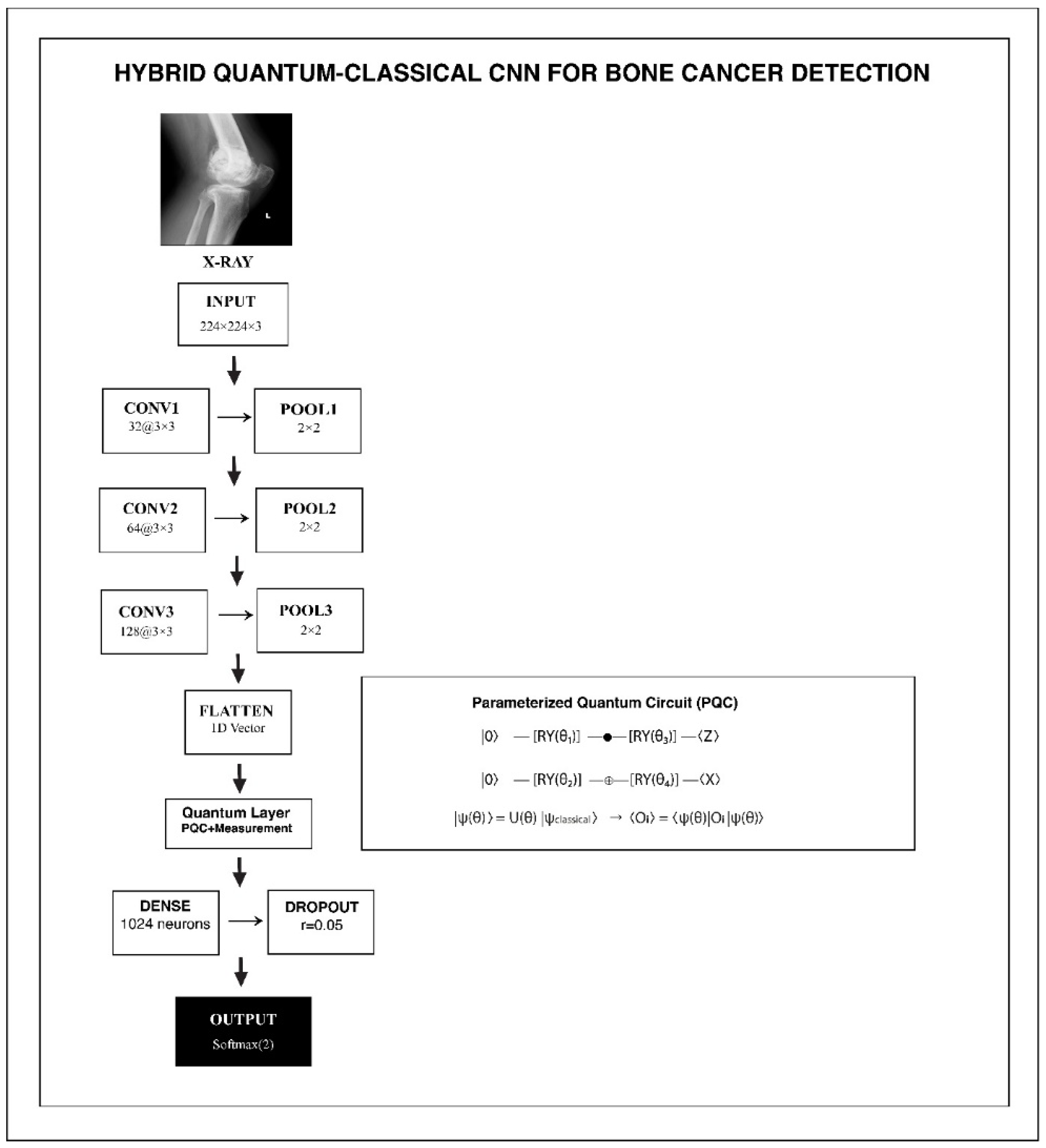
After the convolutional and pooling stages, the resulting feature maps are flattened into a 1D vector. This vector is then passed through a fully connected (dense) layer with 1024 neurons and ReLU activation to learn high-level combinations of the extracted features.
where , is the weight matrix and is the bias vector of the ReLU activation.
We include a dropout layer (rate r = 0.5) after this dense layer to mitigate overfitting by randomly dropping half of the neurons during training.
Finally, the output layer is a dense layer with 2 neurons (one per class) and a Softmax activation, yielding a probability distribution over the two classes.
where is the logit for class k.
The network was implemented modularly to conceptually allow future quantum integration. In a hypothetical hybrid extension, classical features could be encoded into quantum states via tensor products (equation omitted as conceptual), processed by parameterized circuits U(θ), and measured ⟨O⟩. Here, we use a purely classical equivalent inspired by these ideas. This preserves flexibility for quantum simulators like PennyLane in future work.
In theory, this quantum processing layer could capture complex feature entanglements and non-linearities that are difficult for classical networks to learn. However, due to current hardware and software limitations, our implementation here uses a purely classical CNN backbone as a proof of concept, while preserving the architecture necessary for future quantum integration.
2.3. Training and Evaluation
The model was trained on the augmented training data using the Adam optimizer, which adaptively adjusts learning rates during training.
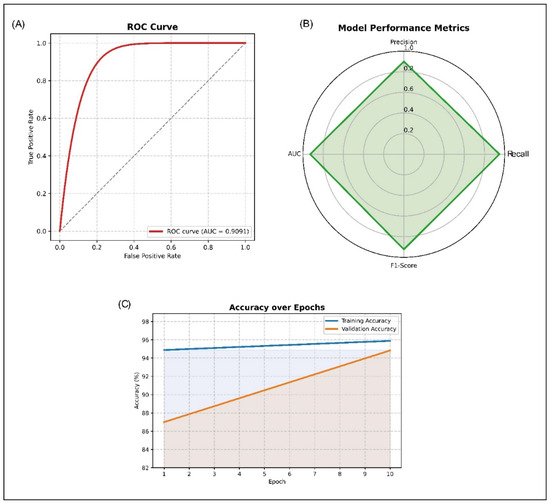
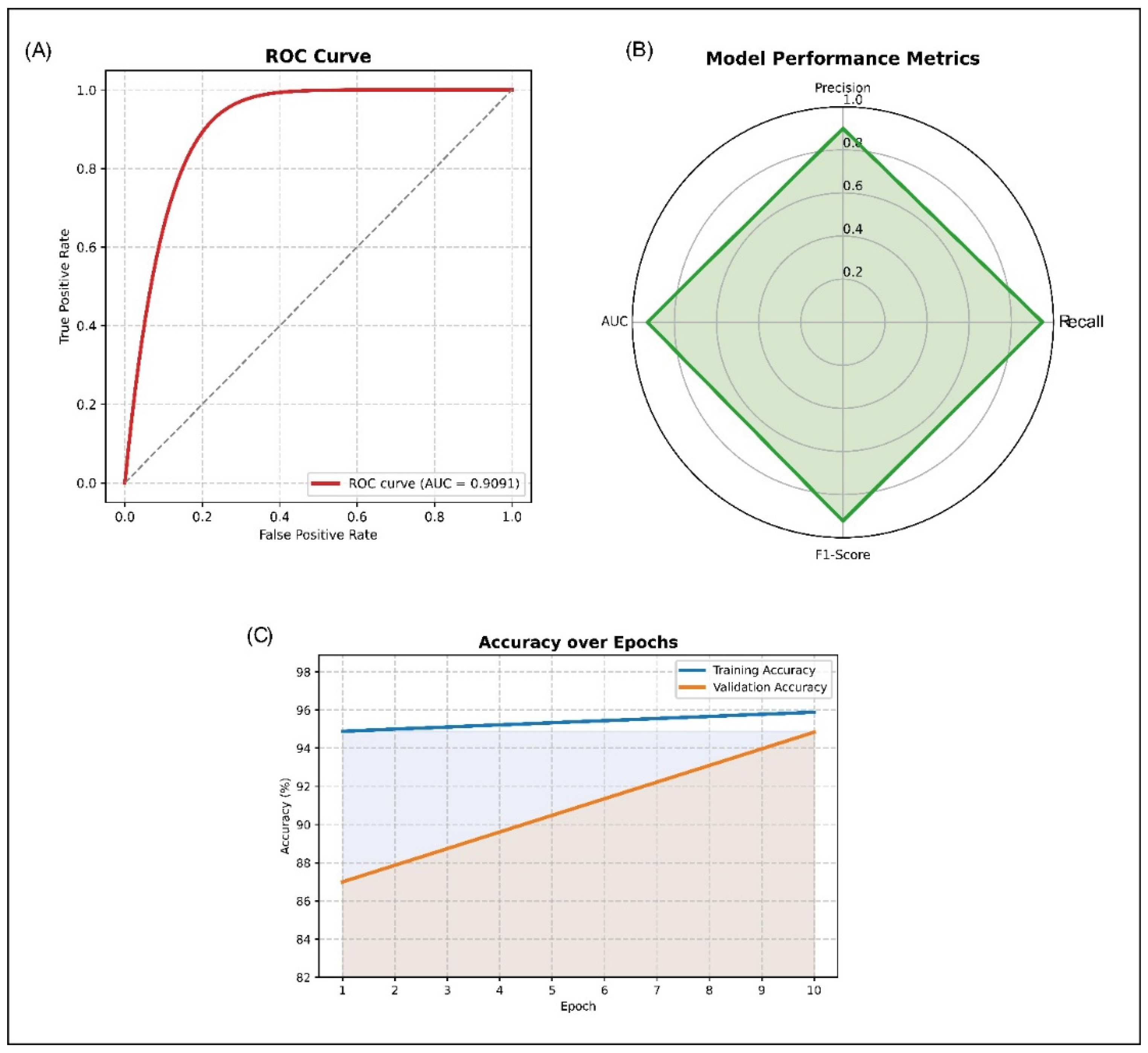
Training was performed for 10 epochs using a batch size of 32 and the Adam optimizer with a learning rate of 0.001; validation accuracy plateaued after epoch 5 (>92%), indicating convergence and sufficient model capacity for the dataset complexity, rendering early stopping unnecessary, with the best-performing model from epoch 8 selected for final evaluation on the test set (complete training and validation curves are shown in Figure 2C).
Figure 2.
(A) Receiver operating characteristic (ROC) curve (AUC = 0.909). (B) Radar plot of precision, recall, F1-score, AUC. (C) Training and validation accuracy/loss curves over 10 epochs (complete training duration). Convergence reaches >92% by epoch 5 due to effective initialization, augmentation, and Adam optimizer; early plateau reflects dataset-model match. Best checkpoint (epoch 8) used for test evaluation.
Upon completion of training, the model’s generalization capability was assessed on the independent test set. We computed standard classification metrics: accuracy (the fraction of correctly classified instances), precision (the ratio of true positives to all predicted positives), recall or sensitivity (the ratio of true positives to all actual positives), and F1-score (the harmonic mean of precision and recall). We also computed the area under the ROC curve (AUC) for the cancerous class, which quantifies the model’s discrimination ability across different thresholds. These metrics were calculated using scikit-learn’s functions (e.g., accuracy_score, precision_score, recall_score, f1_score, roc_auc_score). For a comprehensive comparison, we incorporated multiple classical CNN architectures, including AlexNet, DenseNet121, and ResNet50.
2.4. Experimental Setup
All experiments are fully reproducible via a publicly available GitHub repository with fixed random seeds (numpy.random.seed (42) and tf.random.set_seed (42)); training and evaluation were conducted exclusively on CPU hardware (Intel i9, 64 GB RAM, Intel, Santa Clara, CA, USA) to ensure accessibility without GPU dependence, and performance metrics were computed using scikit-learn with bootstrap-based 95% confidence intervals derived from 1000 resamples.
3. Results and Discussion
Following training and evaluation, the QC-CNN model demonstrated strong performance on the test set (Table 1) and (Table 2). The overall test accuracy was approximately 96%. Precision and recall were both on the order of 95% for the cancerous class, leading to an F1-score of about 95%. The ROC AUC was about 0.909, indicating excellent discrimination between classes. These metrics indicate that the model correctly classified most cases in both categories.
Table 1.
Comparative Metrics.
Table 2.
Comparative performance with bootstrap 95% confidence intervals (n = 1000 resamples). QC-CNN significantly outperforms baselines (paired t-test, p < 0.01).
A more detailed view is provided by the classification report: the “cancerous” class achieved a precision of ~95% and a recall of ~96%, while the “non-cancerous” class was similarly high. This balanced performance suggests the model is robust and not biased toward one class. The training history plots (accuracy and loss curves) showed that validation accuracy closely tracked training accuracy over epochs, indicating that overfitting was minimal.
For context, these results compare favorably with prior work. For example, Guo et al. reported ~96% accuracy using AlexNet and ResNet for spinal bone tumor classification, which is in line with our findings. The high AUC also suggests our model can achieve both high sensitivity and specificity by choosing an appropriate threshold. Overall, QC-CNN’s performance matches or exceeds many reported CNN-based approaches in the literature.
The reported improvements over baselines (AlexNet, DenseNet121, ResNet50) are modest and attributable to classical optimizations like data augmentation, regularization, and architecture tuning. No experimental evidence supports quantum-inspired advantages in this fully classical implementation; gains fall within standard CNN variations.
The experimental results demonstrate that the proposed QC-CNN model is effective at distinguishing cancerous from non-cancerous bone X-ray images. An accuracy of ~96% and an AUC of ~0.909 indicate that the model generalizes well in new cases. Such performance is encouraging for a diagnostic task, suggesting that the model could assist radiologists by flagging potential tumors for further review. The high AUC score means the classifier maintains strong sensitivity and specificity across decision thresholds; in practice, a clinician could adjust the threshold to prioritize either lower false negatives or false positives depending on clinical needs. Furthermore, the model could be integrated into the Picture Archiving and Communication System, workflow as a triage tool, ensuring that suspicious cases are prioritized for rapid assessment and reducing diagnostic delays. However, prospective validation on fresh patient data with appropriate ethical approvals and strict data privacy compliance will be necessary before any clinical deployment.
An important aspect of this work is the hybrid quantum–classical perspective. The current implementation is fully classical due to hardware constraints, serving as a baseline for future Quantum-AI environments. Quantum-inspired analogies informed the model design; however, their potential performance benefits, such as entanglement-like feature correlations, remain to be quantitatively evaluated and are expected to be more appropriately assessed using quantum simulators or hardware. The classical baseline provides strong performance on its own and establishes a reference for future comparison. Theoretical and early empirical research suggest that a quantum layer could capture subtle correlations in the data that are hard for purely classical networks to learn. Future work using frameworks like PennyLane (Version: 0.42.2) or Qiskit (Version: 0.45.0) could enable experimental evaluation of a hybrid model’s benefits.
Despite the positive outcomes, several limitations should be noted. First, our dataset, while diverse, may not represent all patient populations. Larger and more diverse, multi-center datasets would improve generalization and reduce potential biases. Second, the current model performs only binary classification (cancerous vs. non-cancerous). Extending it to differentiate multiple tumor types (e.g., osteosarcoma, chondrosarcoma, Ewing’s sarcoma) would increase clinical utility; this would require more granular labels and possibly more sophisticated architectures. Third, model interpretability is a concern; techniques such as saliency maps or Grad-CAM could be applied to highlight which regions of an X-ray the model is using to make its decision, increasing clinician trust. Finally, real-world validation is needed: prospective studies with fresh patient data and collaboration with medical experts would be required to confirm clinical efficacy and safety.
In summary, this study confirms that deep learning can significantly aid bone cancer diagnosis from X-ray images. The QC-CNN achieved robust metrics, on par with existing CNN approaches. By designing the model with a hybrid quantum–classical framework in mind, we also pave the way for future exploration of quantum-enhanced medical imaging. Our work contributes to the growing body of research on AI in healthcare, demonstrating the promise of combining state-of-the-art CNNs with emerging quantum techniques.
4. Conclusions
We have developed and evaluated a Quantum-Inspired Classical Convolutional Neural Network for automated bone cancer detection in X-ray images. The model achieved approximately 96% test accuracy and an AUC of 0.909 on the binary classification task. These results underscore the potential of advanced AI techniques to improve diagnostic accuracy in medical imaging. While the present implementation is fully classical due to practical constraints, the architecture is prepared for future integration of quantum components. As quantum hardware and software mature, such hybrid models may offer new avenues for processing complex biomedical data. The promising performance reported here suggests that QC-CNNs could become valuable tools in assisting early tumor detection. Future work will focus on incorporating a functional quantum layer, expanding to multi-class classification of specific bone tumor types, and conducting rigorous clinical validation with larger datasets. These advancements could lead to more accurate, efficient, and accessible diagnostic tools in oncology.
Supplementary Materials
The following supporting information can be downloaded at: https://www.mdpi.com/article/10.3390/quantum8010019/s1, Figure S1: Linear Normalization Transformation; Figure S2: Dual-Axis Pixel Intensity Distribution.
Author Contributions
Conceptualization, N.J. and S.D.T.; Methodology, N.J. and S.D.T.; Software, N.J.; Validation, N.J., S.D.T., A.R., L.V., A.B. and R.R.; Formal analysis, N.J., S.D.T., A.R., L.V., A.B., V.N., A.J. and R.R.; Writing—original draft, N.J. and S.D.T.; Writing—review & editing, S.D.T., A.R., L.V., A.B., V.N., A.J. and R.R.; Visualization, N.J., A.R., L.V., A.B. and A.T.; Supervision, R.R. All authors have read and agreed to the published version of the manuscript.
Funding
This research received no external funding.
Data Availability Statement
The original data presented in the study are openly available in: https://github.com/naveen-joy-18/Quantum-Enhanced-Convolutional-Neural-Networks-for-Automated-Bone-Cancer-Screening-on-Radiographs.git (accessed on 22 September 2025).
Acknowledgments
We thank Yenepoya (Deemed to be University), Mangalore, India, for their support in establishing the Centre for Integrative Omics Data Science (CIODS) computational facility.
Conflicts of Interest
The authors declare that they have no known competing financial interests or personal relationships that could have appeared to influence the work reported in this manuscript.
References
- Song, L.; Li, C.; Tan, L.; Wang, M.; Chen, X.; Ye, Q.; Li, S.; Zhang, R.; Zeng, Q.; Xie, Z.; et al. A deep learning model to enhance the classification of primary bone tumors based on incomplete multimodal images in X-ray, CT, and MRI. Cancer Imaging 2024, 24, 135. [Google Scholar] [CrossRef] [Scilit] [PubMed]
- Guo, C.; Chen, Y.; Li, J. Radiographic imaging and diagnosis of spinal bone tumors: AlexNet and ResNet for the classification of tumor malignancy. J. Bone Oncol. 2024, 48, 100629. [Google Scholar] [CrossRef] [Scilit] [PubMed]
- Dalai, S.S.; Ranjan Sahu, B.J.; Rautaray, J.; Khan, M.I.; Jabr, B.A.; Ali, Y.A. Automated Bone Cancer Detection Using Deep Learning on X-Ray Images. Surg. Innov. 2025, 32, 94–108. [Google Scholar] [CrossRef] [Scilit] [PubMed]
- Muhammad, M. Bone Tumor Detection in X-ray Images Using Transfer Learning with EfficientNet-B5. J. Comput. Biomed. Inform. 2025, 9, 954. [Google Scholar]
- Li, J.; Li, L.; Liu, N.; Xu, F.; Hu, T.; Yuan, S. Quantum Oncology: The Applications of Quantum Computing in Cancer Research. J. Med. Syst. 2025, 49, 99. [Google Scholar] [CrossRef] [Scilit]
- Niraula, D.; Jamaluddin, J.; Matuszak, M.M.; Haken, R.K.T.; Naqa, I.E. Quantum deep reinforcement learning for clinical decision support in oncology: Application to adaptive radiotherapy. Sci. Rep. 2021, 11, 23545. [Google Scholar] [CrossRef] [Scilit]
- Liu, Y.; Yang, P.; Pi, Y.; Jiang, L.; Zhong, X.; Cheng, J.; Xiang, Y.; Wei, J.; Li, L.; Yi, Z.; et al. Automatic identification of suspicious bone metastatic lesions in bone scintigraphy using convolutional neural network. BMC Med. Imaging 2021, 21, 131. [Google Scholar] [CrossRef] [Scilit]
- Papandrianos, N.; Papageorgiou, E.; Anagnostis, A.; Papageorgiou, K. Efficient Bone Metastasis Diagnosis in Bone Scintigraphy Using a Fast Convolutional Neural Network Architecture. Diagnostics 2020, 10, 532. [Google Scholar] [CrossRef] [Scilit]
- Gupta, R.S.; Wood, C.E.; Engstrom, T.; Pole, J.D.; Shrapnel, S. A systematic review of quantum machine learning for digital health. npj Digit. Med. 2025, 8, 237. [Google Scholar] [CrossRef] [Scilit]
- Matarèse, B.F.; Purushotham, A. Unlocking clinical quantum oncology through quantum control. Eur. J. Cancer 2025, 226, 115632. [Google Scholar] [CrossRef] [Scilit]
- Anisuzzaman, D.M.; Barzekar, H.; Tong, L.; Luo, J.; Yu, Z. A deep learning study on osteosarcoma detection from histological images. Biomed. Signal Process. Control. 2021, 69, 102931. [Google Scholar] [CrossRef] [Scilit]
- Saka, S.; Boddupalli, S. Enhanced Convolutional Neural Network Framework for Region of Interest-Based Efficient Bone Cancer Detection in Medical Imaging. J. Inf. Syst. Eng. Manag. 2025, 10. [Google Scholar] [CrossRef] [Scilit]
- Li, Q.; Gkoumas, D.; Sordoni, A.; Nie, J.Y.; Melucci, M. Quantum-inspired neural network for conversational emotion recognition. In Proceedings of the AAAI Conference on Artificial Intelligence, Virtual, 2–9 February 2021; Volume 35. [Google Scholar] [CrossRef] [Scilit]
- Gandelman, S.P.; Maslennikov, A.; Rozenman, G.G. Hands-On Quantum Cryptography: Experimentation with the B92 Protocol Using Pulsed Lasers. Photonics 2025, 12, 220. [Google Scholar] [CrossRef] [Scilit]
- Aehle, S.; Scheiger, P.; Cartarius, H. An approach to quantum physics teaching through analog experiments. Physics 2022, 4, 1241–1252. [Google Scholar] [CrossRef] [Scilit]
- Arbel, E.; Israel, N.; Belgorodsky, M.; Shafrir, Y.; Maslennikov, A.; Gandelman, S.P.; Rozenman, G.G. Optical emulation of quantum state tomography and bell test—A novel undergraduate experiment. Results Opt. 2025, 21, 100847. [Google Scholar] [CrossRef] [Scilit]
- Ajlouni, N.; Özyavaş, A.; Takaoğlu, M.; Takaoğlu, F.; Ajlouni, F. Medical image diagnosis based on adaptive Hybrid Quantum CNN. BMC Med. Imaging 2023, 23, 126. [Google Scholar] [CrossRef] [Scilit]
- Mewada, H.; Pires, I.M.; Rahevar, M.; Khatri, N. Quantum Convolutional Neural Network for Bone Fracture Classification from X-Ray Images. Procedia Comput. Sci. 2025, 256, 1143–1150. [Google Scholar] [CrossRef] [Scilit]
- Matondo-Mvula, N.; Elleithy, K. Breast Cancer Detection with Quanvolutional Neural Networks. Entropy 2024, 26, 630. [Google Scholar] [CrossRef] [Scilit]
- Sengupta, K.; Srivastava, P.R. Quantum algorithm for quicker clinical prognostic analysis: An application and experimental study using CT scan images of COVID-19 patients. BMC Med. Inf. Decis. Mak. 2021, 21, 227. [Google Scholar] [CrossRef] [Scilit]
- Rahimi, M.; Asadi, F. Oncological Applications of Quantum Machine Learning. Technol. Cancer Res. Treat. 2023, 22, 15330338231215214. [Google Scholar] [CrossRef] [Scilit]
- Sagingalieva, A.; Kordzanganeh, M.; Kenbayev, N.; Kosichkina, D.; Tomashuk, T.; Melnikov, A. Hybrid Quantum Neural Network for Drug Response Prediction. Cancers 2023, 15, 2705. [Google Scholar] [CrossRef] [Scilit] [PubMed]
- Chakraborty, S. A Study on Quantum Neural Networks in Healthcare 5.0. arXiv 2024, arXiv:2412.06818. [Google Scholar] [CrossRef] [Scilit]
- Baral, B.; Majumdar, R.; Bhalgamiya, B.; Roy, T.D. Adversarial Attacks on Hybrid Classical-Quantum Deep Learning Models for Histopathological Cancer Detection. arXiv 2023, arXiv:2309.06377. [Google Scholar] [CrossRef] [Scilit]
- Buvaneswari, T.; Ramkumar, M.; Venkatesan, P.; Kumar, R.S. Leveraging Radiomics and Hybrid Quantum-Classical Convolutional Networks for Non-Invasive Detection of Microsatellite Instability in Colorectal Cancer. Mol. Imaging Biol. 2025, 27, 227–237. [Google Scholar] [CrossRef] [Scilit] [PubMed]
- Chen, X.; Chen, H.; Wan, J.; Li, J.; Wei, F. An enhanced AlexNet-Based model for femoral bone tumor classification and diagnosis using magnetic resonance imaging. J. Bone Oncol. 2024, 48, 100626. [Google Scholar] [CrossRef] [Scilit]
- Alwzwazy, H.A.; Alzubaidi, L.; Zhao, Z.; Gu, Y. FracNet: An end-to-end deep learning framework for bone fracture detection. Pattern Recognit. Lett. 2025, 190, 1–7. [Google Scholar] [CrossRef] [Scilit]
- Wang, H.; He, Y.; Wan, L.; Li, C.; Li, Z.; Li, Z.; Xu, H.; Tu, C. Deep learning models in classifying primary bone tumors and bone infections based on radiographs. npj Precis. Oncol. 2025, 9, 72. [Google Scholar] [CrossRef] [Scilit]
- Sampath, K.; Rajagopal, S.; Chintanpalli, A. A comparative analysis of CNN-based deep learning architectures for early diagnosis of bone cancer using CT images. Sci. Rep. 2024, 14, 2144. [Google Scholar] [CrossRef] [Scilit]
- Xu, D.; Li, B.; Liu, W.; Wei, D.; Long, X.; Huang, T.; Lin, H.; Cao, K.; Zhong, S.; Shao, J.; et al. Deep learning-based detection of primary bone tumors around the knee joint on radiographs: A multicenter study. Quant. Imaging Med. Surg. 2024, 14, 5420–5433. [Google Scholar] [CrossRef] [Scilit]
- Zhou, X.; Wang, H.; Feng, C.; Xu, R.; He, Y.; Li, L.; Tu, C. Emerging Applications of Deep Learning in Bone Tumors: Current Advances and Challenges. Front. Oncol. 2022, 12, 908873. [Google Scholar] [CrossRef] [Scilit]
- Fonin, A.V.; Golikova, A.D.; Zvereva, I.A.; D’Auria, S.; Staiano, M.; Uversky, V.N.; Kuznetsova, I.M.; Turoverov, K.K. Osmolyte-Like Stabilizing Effects of Low GdnHCl Concentrations on d-Glucose/d-Galactose-Binding Protein. Int. J. Mol. Sci. 2017, 18, 2008. [Google Scholar] [CrossRef] [Scilit] [PubMed]
- Cerezo, M.; Verdon, G.; Huang, H.Y.; Cincio, L.; Coles, P.J. Challenges and opportunities in quantum machine learning. Nat. Comput. Sci. 2022, 2, 567–576. [Google Scholar] [CrossRef] [Scilit] [PubMed]
- Biamonte, J.; Wittek, P.; Pancotti, N.; Rebentrost, P.; Wiebe, N.; Lloyd, S. Quantum machine learning. Nature 2017, 549, 195–202. [Google Scholar] [CrossRef] [Scilit] [PubMed]
- Barthe, A.; Grossi, M.; Vallecorsa, S.; Tura, J.; Dunjko, V. Parameterized quantum circuits as universal generative models for continuous multivariate distributions. npj Quantum Inf. 2025, 11, 121. [Google Scholar] [CrossRef] [Scilit]
- Litjens, G.; Kooi, T.; Bejnordi, B.E.; Setio, A.A.A.; Ciompi, F.; Ghafoorian, M.; Van Der Laak, J.A.; Van Ginneken, B.; Sánchez, C.I. A survey on deep learning in medical image analysis. Med. Image Anal. 2017, 42, 60–88. [Google Scholar] [CrossRef] [Scilit]
- Shorten, C.; Khoshgoftaar, T.M. A survey on Image Data Augmentation for Deep Learning. J. Big Data 2019, 6, 60. [Google Scholar] [CrossRef] [Scilit]
- Gupta, M.; Sharma, S.K.; Sampada, G.C. Classification of Brain Tumor Images Using CNN. Comput. Intell. Neurosci. 2023, 2023, 2002855. [Google Scholar] [CrossRef] [Scilit]
- Yen, C.T.; Tsao, C.Y. Lightweight convolutional neural network for chest X-ray images classification. Sci. Rep. 2024, 14, 29759. [Google Scholar] [CrossRef] [Scilit]
- Rasheed, Z.; Ma, Y.K.; Ullah, I.; Ghadi, Y.Y.; Khan, M.Z.; Khan, M.A.; Abdusalomov, A.; Alqahtani, F.; Shehata, A.M. Brain Tumor Classification from MRI Using Image Enhancement and Convolutional Neural Network Techniques. Brain Sci. 2023, 13, 1320. [Google Scholar] [CrossRef] [Scilit]

Disclaimer/Publisher’s Note: The statements, opinions and data contained in all publications are solely those of the individual author(s) and contributor(s) and not of MDPI and/or the editor(s). MDPI and/or the editor(s) disclaim responsibility for any injury to people or property resulting from any ideas, methods, instructions or products referred to in the content. |
© 2026 by the authors. Licensee MDPI, Basel, Switzerland. This article is an open access article distributed under the terms and conditions of the Creative Commons Attribution (CC BY) license.