1. Introduction
The purpose of this work is to emphasize the surprising (although well known) relationship between two areas that at first sight appear unrelated: one-dimensional random walks, and the statistical distribution of magnetic quantum numbers m arising in the quantum theory of angular momentum. Although these three subjects share deep structural similarities, the connection between angular momentum, quantum statistics, and random walks is rarely presented in a unified manner; angular momentum is traditionally introduced through group theory and operator algebra, random walks through probability theory and stochastic processes, and quantum statistics through ensembles and thermodynamic concepts. As a result, each field has developed its own language and intuition, with the links between them often remaining implicit. What seems to still be missing in the literature is a synthetic physical picture showing that the same mathematical structures can be interpreted simultaneously as quantum mechanical rules, statistical laws, and stochastic dynamics. Based on this viewpoint, the present review does not aim primarily at introducing new technical results but rather at building conceptual bridges between atomic physics, statistical physics, and stochastic processes. By presenting angular momentum not only as an abstract algebraic object but also as a dynamical and statistical process, our goal is to provide a common framework that enhances physical understanding and makes these ideas more accessible to non-specialists.
In fact, a deep mathematical connection ties these subjects together through the rules governing the addition of angular momenta and the underlying rotational symmetry group. When a total angular momentum vector is formed by composing individual angular momenta (or quantum spins), the possible values of its projection on a fixed axis give rise to a distribution that can be mapped directly onto a constrained random walk problem. Indeed, one way to understand quantum angular momentum is to think of it as a kind of “random walk” on a sphere. In classical mechanics, angular momentum describes how a particle spins or orbits around a point. In quantum mechanics, the situation is more subtle: the particle can only occupy discrete angular momentum states, and transitions between these states can be pictured as a particle taking steps on a lattice of allowed orientations, similar to a random walker hopping between points. Each step corresponds to a possible change in the angular momentum projection along a chosen axis. Over time, the statistics of these steps determine the overall distribution of angular momentum states, just as the statistics of a random walk determine the spread of a particle in space. This analogy provides an intuitive way to visualize why angular momentum in atoms is quantized and why certain transitions are allowed while others are forbidden.
The angular momentum for a particle (in the present work, we are mainly interested in fermions, more precisely electrons) is such that
with
. Thus, the quantum number
m corresponds to the projection of the angular momentum vector onto a fixed axis (often the
axis). When combining several elementary angular momenta (for instance the spins of several particles, or orbital momenta, or both [
1,
2]), the vector composition of these moments may be seen as a random walk in three-dimensional space. Each elementary angular momentum
is a “step” of length
in a random direction (if no preferred orientation is imposed). The sum
then corresponds to the total displacement vector after a certain number of steps. This is a random walk on the sphere, with fixed step lengths but random directions.
In this context, the distribution of possible values of
M, i.e., the eigenvalue of the projection operator
corresponds to the distribution of the
z-component of the total displacement vector of a random walk. If one performs an isotropic random walk of
N independent steps, it follows by the central limit theorem (CLT) that the
z-projection of the total displacement [
3] is a Gaussian distribution centered at zero:
where
. This is mainly due to the fact that in the quantum limit, the allowed
m values are discrete
but the distribution of their weights (or multiplicities) becomes approximately Gaussian for large
j.
The link between angular momentum theory and random walks is well established [
4,
5,
6]. Zhang et al. have put forward a scheme for implementing quantum walks on the spin-orbital angular momentum space of photons [
7,
8]. Recently, Shi et al. advanced this connection in a remarkable study. Coupled angular momentum eigenstates are fundamental in atomic and nuclear physics computations [
9]. To construct eigenstates of the total angular momentum
from two individual angular momenta
and
, the authors proposed a quantum walk-based framework that circumvents the classical requirement of handling
nonzero Clebsch–Gordan (CG) coefficients. This approach can be interpreted as a unitary method for computing CG coefficients on a quantum computer, with a typical complexity of
and a worst-case complexity of
. Equivalently, it allows the dense CG unitary to be broken down into a sequence of sparser unitary operations. In practice, their protocol generates angular momentum eigenstates by sequentially applying Hamiltonians that deterministically evolve an initial state into the target final states, which are generally highly entangled in the computational basis. Unlike standard quantum walks with predetermined Hamiltonians, Shi et al. engineered Hamiltonians within
, inspired by (but distinct from) those associated with magnetic resonance and dipole interactions. To achieve deterministic state preparation, they utilized projection and destructive interference to effectively “pinch” the quantum walks, ensuring that each step performs a unit-probability population transfer within a two-level system. The authors tested their state preparation scheme on classical computers, successfully reproducing CG coefficient tables, and also demonstrated small-scale examples on contemporary quantum hardware.
Our present goal is much less ambitious and is mostly of didactic purpose. We concentrate on the discrete quantum case consisting of the addition of
N spins 1/2. In
Section 2, we use a combinatorial and generating-function approach for the sum and obtain the Gaussian limit. In
Section 3, the random walk view in one dimension (1D) is introduced. The connection with statistical physics through the link between microscopic and macroscopic states is discussed in
Section 4, together with entropy considerations and an asymptotic study. The 1D random walk on a finite segment with reflective boundaries is investigated in
Section 5. The importance of Pascal triangles evoked in
Section 3 is emphasized in
Section 6. Finally, the random walk in three dimensions, together with its continuous limit, are mentioned in
Section 7. Throughout the article, we try to present both the formulae and physical ideas behind each step.
3. Random Walks in One Dimension
Let us consider an infinite sequence of boxes labeled by relative integers rising from left to right. We place a token on the “start” box (number 0) and randomly select “heads” or “tails” as the move of the token. According to the result, we want to know the probability of finding the token in box
n. We can denote the number of ways to reach this box by
. It is clear that at the rank which precedes the
token, the latter must be found in the boxes
or
. Thus, we have
It is easy to show by recurrence (induction) that
if
N and
n have the same parity with
and 0 in the opposite case. It can be shown that
is zero if
is odd or if
. It is of course also easy to show that
In
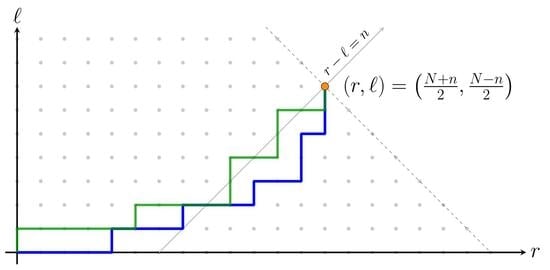
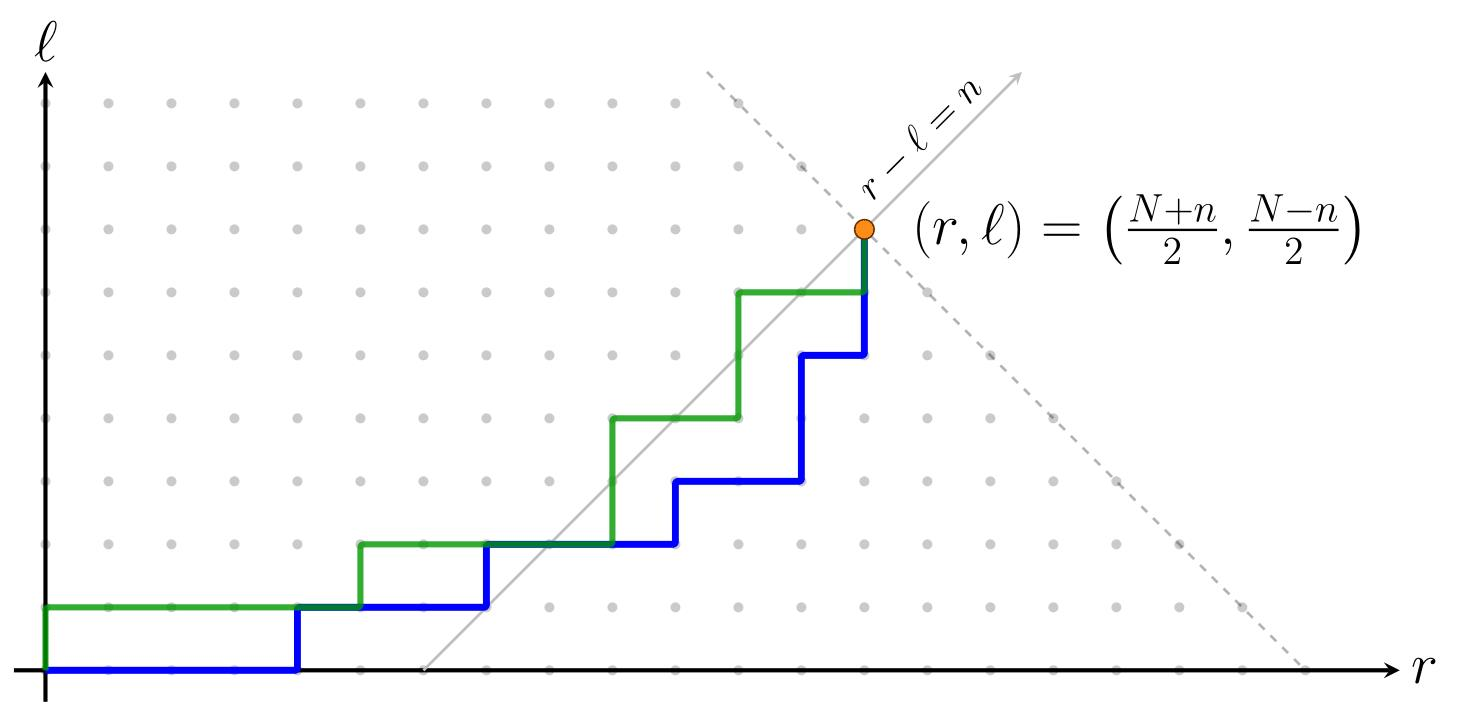
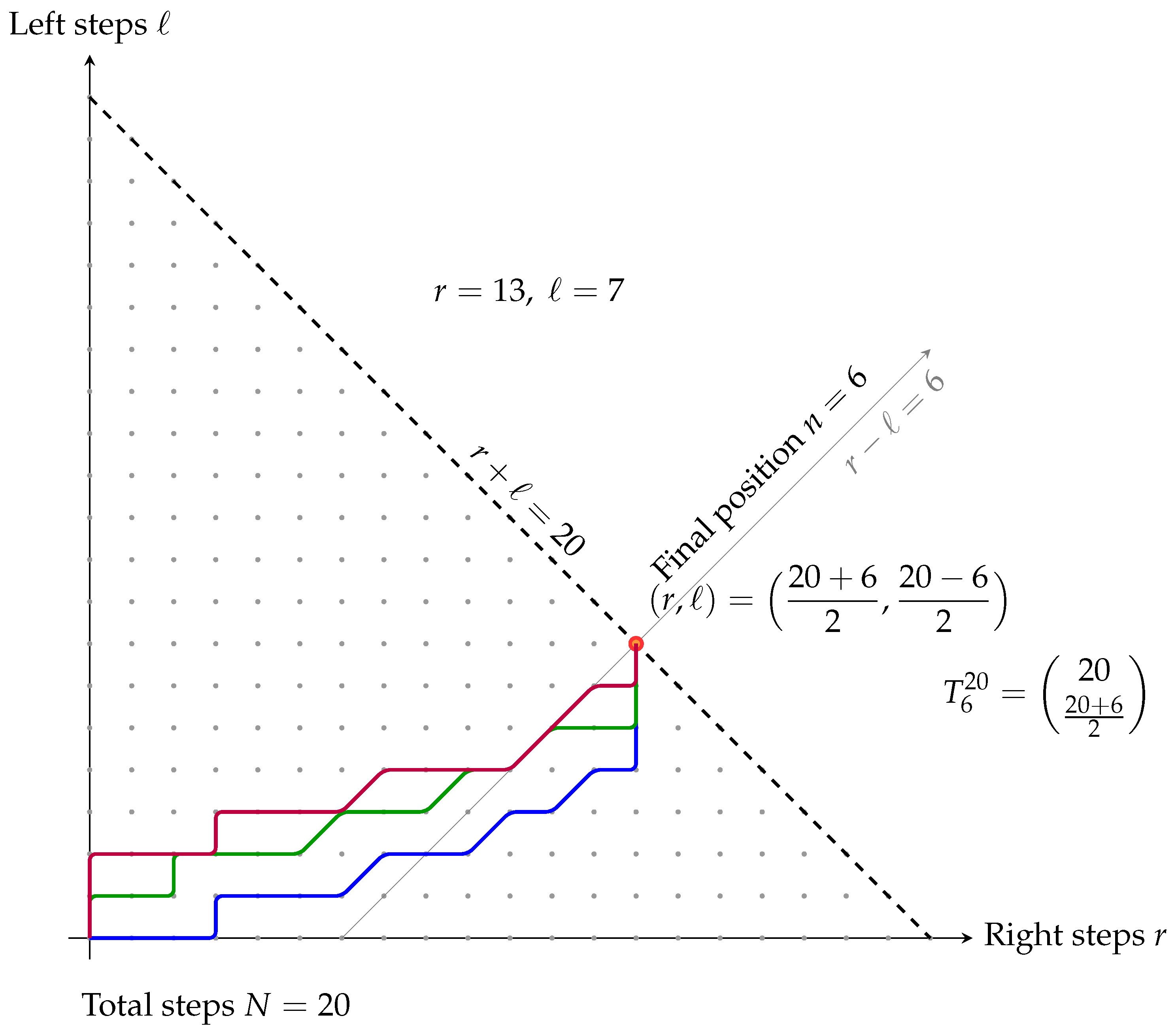
Figure 1, each point
represents the state of the random walk after
r steps to the right,
ℓ steps to the left, a total number of steps
, and a final position
.
The quantity
counts the number of possible paths of length
N that end at position
n. In the diagram, this corresponds to all lattice paths starting at
, moving one unit horizontally for each right step, one unit vertically for each left step, and ending at the point
, where
The diagonal lines
represent the states that are reachable after
N steps. The slanted lines
represent all states corresponding to the same final position. Their intersection gives the lattice point
associated with
. To end at position
n after
N steps, the walk must contain
right steps. The number of ways to choose which of the
N steps are right steps is exactly the binomial coefficient above. Therefore,
counts the number of paths in the diagram that reach the point
. The probability of these trajectories is
and the corresponding entropy of the system reads
where we have set the Boltzmann constant
equal to 1. One might be tempted to interpret the growth of entropy with
N as temporal growth, but this would not be justified. We see this immediately by assuming that, at a certain moment, the token happens to return to the starting square, at which point we ask the following question: how can we measure our ignorance about the position of the token
N moves earlier? Entropy would then become a function of time with its sign reversed, that is, a function decreasing in time!
In fact, statistical entropy merely measures our ignorance concerning random phenomena. When a process is not deterministic, we are equally ignorant of both the past and future of the system under study. Entropy is only indirectly related to the flow of time; here, past and future play strictly symmetric roles.
5. Random Walk on a Finite Segment with Reflective Boundaries
For a 1D walk, a direct analogy with
-spins can be made. Indeed, it turns out that the sum
with
is exactly a 1D random walk with steps
. For a single step
,
Hence, for
N steps one has
The characteristic function of a single step
is
. For the sum (
N steps), we have
The distribution is obtained by the inverse Fourier transform:
The rapid decay of
near
yields the Gaussian (expand
). The approximate distribution is
The above results show that the distribution after
N steps is binomial and tends to a Gaussian for large
N. The variance grows linearly with
N (
), which is the signature of a diffusive behavior. The projections
act as independent steps. For large
N, the continuum/diffusion approximation applies and the probability density obeys the diffusion equation
with
and initial condition
.
At this point, it is worth noting something interesting. While the connection between random walks and diffusion is well known, the case of sub-diffusion is less familiar. Sub-diffusion is a type of anomalous diffusion in which a particle spreads more slowly than it would in normal (Brownian) diffusion. In normal diffusion, the mean squared displacement of a particle grows linearly with time:
In sub-diffusion, the mean squared displacement grows slower than linearly, typically following a power law
where
is the ensemble-averaged mean squared displacement,
being the “sub-diffusion exponent”. Sub-diffusion actually occurs in systems where the particle’s motion is hindered by obstacles, traps, binding sites, or a heterogeneous environment. This concerns examples such as diffusion in crowded cellular environments or cytoplasm, transport in porous media or gels, and charge carrier motion in disordered semiconductors. Sub-diffusion is “slower than normal” because the particle can become trapped or delayed, leading to long waiting times between steps. Mathematically, it turns out that sub-diffusion can often be modeled using continuous-time random walks with heavy-tailed waiting times, leading to fractional diffusion equations, which generalize the normal diffusion equation with fractional time derivatives [
11,
12].
5.1. Folded Pascal Triangle
We have seen in
Section 3 that for an infinite number of sites, the number of trajectories is given by
which corresponds to Pascal’s triangle. Let us now consider a random walk on
sites:
with the following rule. If the walker reaches one of the boundaries
, it reflects, i.e., the next step reverses direction (right becomes left and vice versa). Let
denote the number of trajectories reaching position
n after
N steps.
Certain quantum systems, such as spin chains arranged in a ring or systems with a
-type symmetry, identify spin projections that differ by a multiple of
[
13,
14]. For example, a total spin
and
would be considered equivalent due to the symmetry (for simplicity, we have used the notation
). Certain conservation or quantization conditions (such as angular momentum quantum numbers in a periodic magnetic field) only distinguish
. This also occurs in “cyclic” spin systems or in quantum mechanical models with periodic potentials. The modulo
constraint does not change the local structure of individual spins, but identifies global configurations according to a symmetry or periodicity. For the finite segment with reflections, trajectories that would have gone beyond the boundaries are reflected back inside. Each sequence corresponds to choosing
steps of
out of
N total steps. This leads to a “folded Pascal triangle” [
15,
16,
17]; the formula
correctly counts all configurations allowed under this constraint, using a combinatorial inclusion–exclusion method (the Poincaré sieve formula) similar to the method of images [
18,
19]. This can be easily understood by simple counting (combinatorial) arguments. Without any constraints, the number of sequences of
N steps
that sum to
n is simply given by Equation (
1). Suppose that we want the total sum to be counted modulo
. Not all paths are distinct anymore; some sequences are considered equivalent under shifts by multiples of
, while some paths may exceed boundaries and must be “reflected”. Each integer
k corresponds to “imaginary reflections” of paths that would violate the periodic boundary condition. The factor
alternately adds and subtracts contributions to enforce the constraint correctly, similar to an inclusion–exclusion principle. Only terms where
is an integer between 0 and
N contribute; all other terms are zero. In short, this formula counts paths or spin configurations with a periodic or modular constraint, generalizing the classical unconstrained binomial count.
5.2. Large N Behavior
The folded Pascal triangle produces a distribution concentrated near the center (
). For
, the distribution reaches a quasi-stationary state: the probability is maximal near
and minimal at the boundaries
. For
,
approaches a stationary and symmetric distribution concentrated at the center. The probabilities near the boundaries tend to zero, and the overall shape resembles a discrete sine profile. Indeed, we can rewrite the sum as a sampled alternating comb. Let
and set
meaning that
is the probability mass of the total displacement
x (sum of
N independent
steps). The indices in the sum correspond to
Therefore,
Thus,
is the value at
of the convolution of
F with an alternating Dirac comb of period
. In other words, it is the sampling of
F on the lattice
with alternating signs. Assume now that
N is large enough that the local CLT applies; for
x in the central region (i.e.,
),
uniformly for
(or more generally, on any range growing slower than a suitable power of
N). We denote the Gaussian approximation by
Hence, for the purpose of asymptotics when the sample points
remain in a region where the approximation is valid, we may replace
F by
up to a controllable error:
We now apply the Poisson summation to the alternating lattice sum:
where
is the Fourier transform. To include the factor
, observe that
and consequently
Applying the Poisson summation to the function
is equivalent to applying the standard formula to the function
and evaluating at integer
. A more direct and convenient way is to write the alternating sign as a shift in the dual lattice:
This can be checked by writing
and noting that the frequency shift
appears in the dual sum.
Applying this identity with
,
, and
, we obtain the approximation
up to the small error induced by replacing
F with
(which can be controlled by the local CLT remainder bounds and the exponentially small tails of
).
The Fourier transform of the Gaussian
is explicit:
Hence, substituting
gives
Therefore,
Under the assumption
, the Gaussian damping factor
decays extremely rapidly as
increases; the smallest values of
are attained at
and
, for which
. For
with
, we have
. Thus, the corresponding exponential is suppressed by a factor
with
, which is negligible when
. Consequently the main contribution to the sum in Equation (
10) comes from the two nearest dual lattice points
and
; keeping only these two terms yields a good asymptotic approximation. Let us calculate the two dominant terms:
and
Adding these two dominant contributions gives
leading to order
Carefully restoring the phase contributions that arise if one shifts by
(this shift reflects the original choice of indexing and parity conventions) and combining symmetric contributions can produce a factor proportional to sin rather than cos. The trigonometric dependence becomes
after keeping the leading-order phase and using the fact that
induces the half–period shift coming from the alternating factor. The Gaussian prefactor
tends to 1 as
; thus, in the limit
, the small-frequency envelope becomes flat and only the geometric trigonometric factor remains. The replacement
contributes a controlled error by the local CLT (uniform on the central range), and the discarded
r-terms are exponentially small because the Gaussian factor in Equations (
11) and (
12) decays like
for
. Hence, the two-term truncation above is justified and one obtains the asymptotic statement (with explicit error bounds available upon tracing the CLT remainder and the tail of the dual sum).
To summarize, by combining the local CLT approximation, Poisson summation with the half-integer shift induced by
, and the Gaussian Fourier envelope, we find that in the regime
, the normalized alternating periodic sum is governed by the lowest dual lattice modes (those with
). These modes encode a half-period phase; therefore, they produce a trigonometric factor which (up to the normalization/observable convention, e.g., taking a difference or a squared modulus) yields
A finite segment with reflections modifies the usual Pascal triangle. The folded Pascal triangle accounts for the reflective boundaries. For large
N, the distribution is concentrated near the center and vanishes at the boundaries. This can be interpreted as the fundamental mode of diffusion with reflective boundary conditions.
5.3. Example for
We consider a random walk on
sites:
with reflective boundaries at
. Let
be the number of trajectories reaching
n after
N steps. We compute
using reflection (“folded Pascal triangle”).
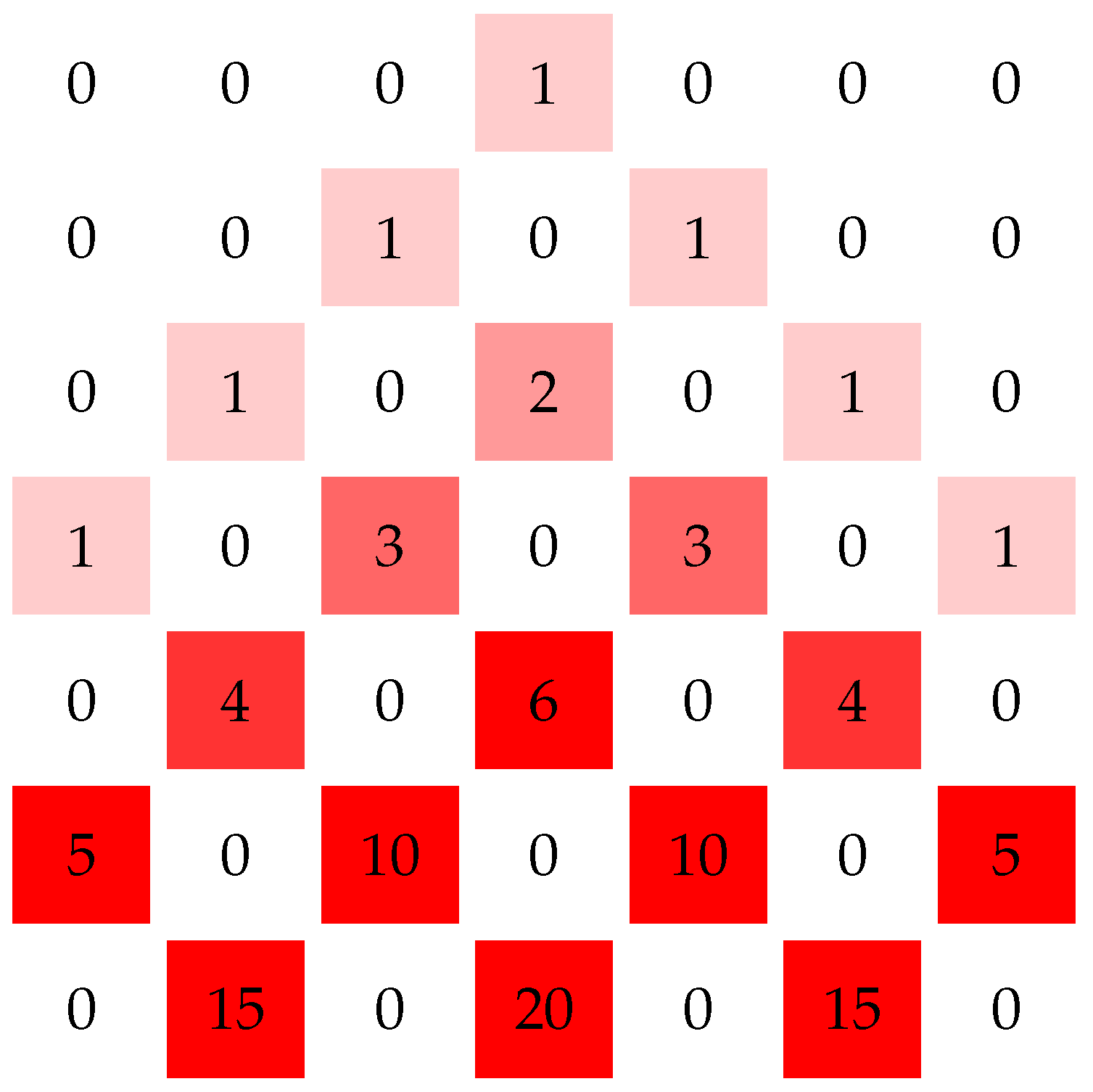
In
Figure 4, each row corresponds to the number of steps
N. Columns correspond to positions
. Values are symmetric with respect to
due to reflection at the boundaries. For increasing
N, the trajectories accumulate near the center (
) while decreasing at the boundaries (
). This illustrates the “folded Pascal triangle”, in which numbers that would extend beyond the boundaries are reflected back inside. If
(sites
, i.e., 5 sites) and
, then for the macrostate
we have
7. Random Walk in Three Dimensions, Continuous Limit
Let us now consider a vectorial random walk in 3D (addition of vector moments). Consider vectorial steps
of length
and an “isotropically” random direction. The sum
is a random walk in
. For an isotropic step of fixed length
a, each Cartesian component has
which is because
. The vectorial CLT tells us that for large
N, each component of
approaches a Gaussian with variance
for a 3D walk with fixed step
a. Thus, the
z-projection is normally distributed, which makes it the 3D analogue of the 1D walk. The distribution of the magnitude
follows a Maxwell-like law in the Gaussian limit (density proportional to
).
It is instructive to compare the quantum and classical cases (fixed vs. fluctuating magnitude). If the total magnitude
is fixed (for instance, if
J has a known value), then the distribution of the projection
for an isotropic direction is given by the distribution of
. Because
is uniform on
for uniformly random directions on the sphere, the continuous density of
M is
This is a flat distribution and applies when
J is fixed but the direction is uniformly random. If the magnitude
J fluctuates (as when summing many fixed-length steps), then
is a sum of many contributions and tends to a Gaussian; hence,
m has an approximately Gaussian law (even though each configuration has its own
J). This occurs when many elementary moments are added: although each vector has a fixed length, the resultant magnitude varies and the components are Gaussian. In short, “
M uniform on
” applies when conditioning on a fixed total magnitude and isotropic orientation; the Gaussian appears when summing many contributions (CLT) and looking at the marginal of one component without conditioning on the total magnitude. Adding
N spin-
particles, each
. Then, the total projection
corresponds exactly to a 1D random walk with steps
. The distribution of
M is binomial, and reads
For
, the binomial tends to a normal law
Thus, this is a purely quantum random walk in the space of
M.
The direction of the total moment
is random if the system is isotropic. The values of
m correspond to the projection of this random vector onto a fixed axis. If the direction of
is uniformly distributed on the sphere, then the probability density for the projection
is proportional to
; hence,
which is the classical distribution for an isotropic projection (similar to a “continuous” random walk).
8. Conclusions
In this work, we have shed light on the connections between two domains that at first glance appear unrelated: random walks and the distribution of angular momentum projections in quantum physics. By examining random walks through the lens of microstate probabilities in statistical physics, we have shown how their structure mirrors the combinatorial properties underlying the vector composition of angular momenta. This parallel reflects a deep mathematical link rooted in rotational symmetry. Viewing angular momentum transitions as a constrained random walk on a discrete set of quantum states provides a perspective in which the quantization of angular momentum, selection rules and coupling schemes naturally emerge as restrictions on the allowed “steps” of the walk. Repeated transitions between angular momentum states then generate statistical distributions in much the same way as a random walk produces diffusion in space. This interpretation offers a direct physical intuition for quantum statistics and opens the door to concepts such as diffusion, sub-diffusion, and localization in angular momentum space.
In addition to establishing these correspondences, our results illustrate the usefulness of this perspective for modeling angular momentum in atomic physics. This approach not only provides a unified way of interpreting distributions of magnetic and quantum numbers but also suggests potential applications in areas such as quantum computing, where the organization and manipulation of angular momentum states play an essential role.
The ideas discussed in the present work are not limited to spin-
particles; even for arbitrary
, the composition of projections
reduces to summing bounded discrete variables:
The resulting distribution of
m again tends to a Gaussian for a large number of added moments, in other words to the behavior of a multidimensional random walk (or a walk on the sphere). For arbitrary spins
, if each
can take values
, then the generating function becomes
The characteristic function still shows convergence to a Gaussian provided that there are sufficiently many independent terms with finite variance. The generating function enables one to calculate the multiplicities of total angular momentum states
J. The distribution of
M contains combinatorial information; the decomposition into subspaces of total
J (allowed
J values and their degeneracies) is handled with Clebsch–Gordan coefficients and the representation theory of SU(2). For large
N, most states cluster around a mean
J, and the marginal density of
M approaches a Gaussian by the same CLT logic. In real systems (magnetic resonance, statistical magnetism, spin ensembles), this explains why the total magnetic component often appears Gaussian and why the classical vector approximation works when the number of contributions is large.