
Review

Classical and Quantum Linear Wave Equations: Review, Applications and Perspectives

by
Zdzislaw E. Musielak
Department of Physics, University of Texas at Arlington, Arlington, TX 76019, USA
Quantum Rep. 2025, 7(4), 60; https://doi.org/10.3390/quantum7040060
Submission received: 20 October 2025 / Revised: 27 November 2025 / Accepted: 28 November 2025 / Published: 5 December 2025
(This article belongs to the Special Issue 100 Years of Quantum Mechanics)

Abstract

Theories of modern physics are based on dynamical equations that describe the evolution of particles and waves in space and time. In classical physics, particles and waves are described by different equations, but this distinction disappears in quantum physics, which is predominantly based on wave-like equations. The main purpose of this paper is to present a comprehensive review of all known classical and quantum linear wave equations for scalar wavefunctions, and to discuss their origin and applications to a broad range of physical problems.

1. Introduction

In nonrelativistic and relativistic classical physics, particles and waves are treated separately because they represent different physical phenomena and require different dynamical equations to describe their behavior in space and evolution in time. Equations of motion for dynamical systems that consist of classical particles are obtained from the Newton laws of dynamics or their relativistic generalization (e.g., [1,2,3,4]), and typically, these equations are either first or second-order ordinary differential equations (ODEs). The dependent variable in these equations is a displacement, which is a function of time. However, the propagation of waves is described by a wave equation, which in its standard form is either a first- or second-order partial differential equation (PDE) that is symmetric in time and space derivatives. The dependent variable in the wave equation is a wavefunction that depends explicitly on the independent variables, which are time and space coordinates; the wavefunction for classical waves will be called the classical wavefunction.
In general, forms of the wave equations can be different depending on the types of waves considered and the structure of the background medium that supports them (e.g., [5,6,7,8,9,10]). Note that only classical linear wave equations are considered in this review paper.
In modern quantum physics, the distinction between particles and waves is not as clear as it is in classical physics. The main reason is that quantum particles are described by using a quantum wavefunction, whose temporal and spatial evolution is determined by the Schrödinger Equation [11] that is the basic equation of nonrelativistic quantum mechanics [12,13,14,15]. However, the Schrödinger equation is also used to describe classical waves in different physical settings, which requires replacing the quantum wavefunction by the classical one (e.g., [16,17,18,19,20]). The physical meaning of the classical and quantum wavefunctions is different despite the fact that they are typically scalar functions. An exception is the Lévy–Leblond equation in nonrelativistic quantum mechanics (NRQMs) that describes an elementary particle with spin, and it requires its wavefunction to be a spinor [21,22]; thus, the equation becomes a spinor wave equation. All quantum wave equations considered here are linear.
In relativistic quantum mechanics (RQMs), the wavefunctions are either scalars, vectors, spinors, or tensors (e.g., [23]). Electromagnetic waves are represented by the vector wavefunctions, which are the varying-wave electric and magnetic fields (e.g., [10]). In RQM (e.g., [24]), and quantum field theory (QFT) (e.g., [25]), the Klein–Gordon [26,27], Proca [28], and Dirac [29] equations are the wave equations for the scalar, vector and spinor wavefunctions, respectively, and they describe quantum fields with no spin (scalar), spin 1 (vector), and spin 1 / 2 (spinor), respectively. Moreover, the Rarita–Schwinger wave equation [30], with its tensor–spinor wavefunction, describes a quantum field with spin 3 / 2 , while tensor wavefunctions may describe a field with spin 2 (e.g., [31]). The quanta of such fields are identified with elementary particles of the Standard Model (e.g., [24,25]). Throughout this paper, quantum objects of NRQM are called elementary or quantum particles, but such objects in RQM/QFT are referred to as fields and their quanta.
This paper presents a comprehensive review of nonrelativistic and relativistic linear wave equations for scalar wavefunctions that play dominant roles in modern classical and quantum physics. Three nonrelativistic linear wave equations for classical waves considered in this review are as follows: one symmetric equation, which is the basic wave equation, and two asymmetric equations, which are identified as the Schrödinger-like and new wave equations. The latter two equations are complementary to each other, and they are used to describe classical waves [32]. Physical properties of these three equations, relationships between them, and their solutions are reviewed, and some applications to acoustic wave propagation in isothermal and non-isothermal atmospheres are presented and discussed.
There are also two nonrelativistic quantum linear wave equations reviewed in this paper: the Schrödinger and new asymmetric equations, which describe the time and space evolution of the quantum wavefunctions in NRQM. The quantum wave equations are complementary to each other, and their applications to the quantum measurement problem, a theory of quantum jumps, and a theory of galactic cold dark matter (DM) halos are presented and discussed.
Among different wave equations of RQM (e.g., [24]), only those with scalar wavefunctions are considered in this paper. One of them is the relativistic wave equation, and the other is the Klein–Gordon equation [24,25,26,27]. It is shown that in the nonrelativistic limit, these two equations reduce to the basic and Schrödinger-like wave equations, respectively. Since neither the relativistic wave equation nor the Klein–Gordon equation gives the new asymmetric wave equation in the nonrelativistic limit, a generalization of this asymmetric equation to its relativistic form is presented and used to develop a quantum field theory, whose possible applications are discussed.
The paper is organized as follows: group theory derivation of nonrelativistic equations is given in Section 2; classical linear wave equations, their solutions, and applications are presented and discussed in Section 3 and Section 4; respectively; Section 5 contains a new fundamental classical linear wave equation; nonrelativistic quantum linear wave equations and their applications are described in Section 6 and Section 7, respectively; Section 8 contains summary of nonrelativistic equations; relativistic wave equations and their applications are presented in Section 9 and Section 10, respectively; a summary of relativistic linear equations is described in Section 11; further application perspectives are discussed in Section 12; and Conclusions are given in Section 13.

2. Group Theory Derivation of Nonrelativistic Equations

2.1. Galilean Group and Eigenvalue Equations

In Galilean relativity the space and time are separated and their metrics are given by d s 1 2 = d x 2 + d y 2 + d z 2 and d s 2 2 = d t 2 , where x, y and z are spatial coordinates and t is time. The transformations that make the metrics invariant form the Galilean group of the metric, G , whose mathematical structure is
G = S ( 4 ) s H ( 6 ) ,
where S ( 4 ) is a four-parameter subgroup of rotations in space and translation in time, and H ( 6 ) is a six-parameter subgroup of Galilean boosts and translations in space [21,22]. In addition, s represents the semi-direct product.
The group G is a ten-parameter Lie group and H ( 6 ) is its invariant Abelian subgroup. It is well known that the irreducible representations (irreps) of H ( 6 ) are one-dimensional [21,22,33,34,35], and they provide labels for all the irreps of G . Classification of the irreps of this group by Bargmann [35] demonstrated that the scalar and spinor irreps are physical, but the vector and tensor irreps are not because they do not allow for the elementary particle localization. Therefore, in NRQM, only scalar and spinor wavefunctions are allowed, and the Schrödinger [11,12,13,14,15] and Lévy–Leblond [21,22] equations describe their temporal and spatial evolution in Galilean spacetime.
On the other hand, S ( 4 ) is not an invariant subgroup of G , which means that only selected labels of the irreps of S ( 4 ) can be used to label the irreps of G . This can be explained by considering the detailed structure of the group G and its subgroups S ( 4 ) and H ( 6 ) , which is
G = [ T ( 1 ) R ( 3 ) ] s [ T ( 3 ) B ( 3 ) ] ,
where T ( 1 ) is a one-parameter subgroup of translation in time, and R ( 3 ) , T ( 3 ) , and B ( 3 ) are three-parameter subgroups of rotations and translations in space and Galilean boosts, respectively, (e.g., [2,21]), and ⊗ represents the direct product.
A set of N functions that transform under elements of the group G forms a basis of an N-dimensional representation given by a set of N × N matrices A for each irrep and for each element of the group if, and only if,
α ^ f l ( i ) = m A m l ( α ^ ) f m ( i ) ,
where α is one of the elements of the group, i labels the irreps, l is one of the members of the set of N functions satisfying Equation (3), and the sum of m is over the N members of the set [36,37]. The transformation can be written separately for space translations and boosts, which gives
T a ϕ ( t , x ) ϕ ( t , x + a ) = e i k · a ϕ ( t , x ) ,
and
B v ϕ ( t , x ) ϕ ( t , x + v t ) = e i k · v t ϕ ( t , x ) ,
where ϕ ( x , t ) is a scalar wavefunction, a represents a translation in space, and v is the velocity of Galilean boosts. It is seen that the real vector k labels the one-dimensional irreps of H ( 6 ) , and that these labels are preserved in the irreps of the in G because H ( 6 ) is an invariant subgroup of the group.
The wavefunction ϕ ( x , t ) can be expanded inTaylor series and the results are
ϕ ( t , x + a ) = e i ( i a · ) ϕ ( t , x ) ,
and
ϕ ( t , x + v t ) = e i ( i t v · ) ϕ ( t , x ) .
Comparing Equations (4) and (6), and Equations (5) and (7), we obtain
i ϕ ( t , x ) = k ϕ ( t , x ) ,
which is the same eigenvalue equation for the boosts and translations in space. This is expected since the generators of translations and boosts are P ^ = i and V ^ = t P ^ , respectively, which means that the eigenvalues of these operators must be the same. The obtained eigenvalue equations are the necessary conditions for ϕ ( t , x ) to transform as one of the irreps of G , and to be an eigenfunction of the generators of the invariant subgroup H ( 6 ) .
Since the subgroup S ( 4 ) is not an invariant subgroup of G , the above procedure cannot be applied to it. Note also that T ( 1 ) being an invariant subgroup of S ( 4 ) is not helpful because T ( 1 ) is not the ’little group’ of G (see Appendix in [36]); only a ’little group’ can provide the required labels for the irreps of G , in addition to those already given by the subgroups T ( 3 ) and B ( 3 ) . The solution to this problem was proposed in [36], where the new wavefunction ϕ ω ( t , x ) was defined, and the generator of translation, E ^ = i / t , was introduced, with [ E ^ , P ^ ] = 0 and [ E ^ , V ^ ] 0 ; note that E ^ , P ^ , and V ^ may not be eigenoperators of the same wavefunction ϕ ( r , t ) . Then, ϕ ω ( t , x ) satisfies the following eigenvalue equation:
i t ϕ ω ( t , x ) = ω ϕ ω ( t , x ) ,
where ϕ ω ( t , x ) = η e ( t , x ) ϕ ( t , x ) , with η e ( t , x ) being a smooth and differentiable function of t to be determined.
The difference between the eigenfunctions ϕ ( t , x ) and ϕ ω ( t , x ) is represented by η e ( t , x ) , whose specific form must be determined from physical conditions. Proposition 1 and its proof presented in [36] demonstrate that the Schrödinger-like equations become Galilean invariant if and ony if η e ( t , x ) = η e ( t , x ) = 1 . This is an important physical result as it shows that the operators E ^ , P ^ and V ^ must have the same eigenfunctions [36,37], and that Equations (8) and (9) can be written as the following set of eigenvalue equations:
i t ϕ ( t , x ) = ω ϕ ( t , x ) ,
and
i ϕ ( t , x ) = k ϕ ( t , x ) ,
which are used to derive all nonrelativistic equations presented in this paper.
The eigenvalue equations given by Equations (10) and (11) are consistent with both the irreps of G as well as with the Galilean group of the metric or Galilean Principle of Relativity. In [36], the two eigenvalue equations were used to find dynamical equations for elementary particles in Galilean space and time, and the role played by η e ( t , x ) was investigated. A set of Schrödinger-like equations was obtained with extra terms accounting for η e ( t , x ) .
The above method to derive dynamical equations in the Galilean space and time is different from a customary approach in which the dynamical equations are obtained by using the Casimir operator of the Galilean group of the metric. However, the Casimir operator of G does not connect Galilean space and time, and therefore it cannot be used to derive any dynamical equation. Thus, it is required that G is extended to directly account for the space and time connection, which is achieved by introducing an invariant Abelian subgroup T ( 3 + 1 ) of translations in space and time, and obtaining the so-called extended Galilean group, whose structure is G e = [ R ( 1 ) B ( 3 ) ] s [ T ( 3 + 1 ) U ( 1 ) ] , where U ( 1 ) is a one-parameter unitary group (e.g., [21,22,33,36,37]); the structure of this group is similar to the Poincaré group (e.g., [38,39,40]). The group G e has its Casimir operator that connects Galilean space and time, and this operator gives the Schrödinger equation; however, the main problem with this approach is that G e is not the group of the Galilean metrics. In other words, G e was ’designed’ based on the already known Schrödinger equation in such a way that its Casimir operator gives the required equation.

2.2. Symmetric and Asymmetric Equations

There are only three independent second-order PDEs for the scalar wavefunction ϕ ( t , x ) that can be derived from the eigenvalue equations given by Equations (10) and (11). One of these PDEs is symmetric in time and space derivatives, and the other two equations are asymmetric. The resulting symmetric second-order equation is
t 2 ω k 2 2 ϕ ( t , x ) = 0 ,
and the remaining two asymmetric second-order equations are
i ω t + ω k 2 2 ϕ ( t , x ) = 0 ,
and
t 2 i ω k 2 k · ϕ ( t , x ) = 0 ,
where the eigenvalues and their ratios are the coefficients in these equations. Since the eigenvalues ω and k can be any real numbers (see Equations (10) and (11)), there are infinite sets of the symmetric and asymmetric PDEs resulting from the eigenvalue equations.
By assigning physical meaning to the eigenvalues and their ratios, specific equations may be selected out of the infinite sets, and these selected equations will describe different physical phenomena. Such phenomena may range from wave propagation in classical physics to descriptiosn of elementary particles in quantum mechanics. This requires that the different wavefunction ϕ ( t , x ) is used to describe different physical phenomena. In the following, the role of the symmetric and asymmetric equations in classical physics is explored and discussed.

3. Nonrelativistic Classical Linear Wave Equations

3.1. Wave Equations in Classical Physics

By identifying the eigenvalues ω and k as frequency and wavevector of classical waves, respectively, the characteristic wave speed, c w = ω / k , can be introduced. As a result, three different wave equations are obtained from Equations (12)–(14). Each one of these wave equations is of a different form and has a different solution that requires different ϕ ( t , x ) for each equation.
The symmetric equation given by Equation (12) becomes
t 2 c w 2 2 ϕ W ( t , x ) = 0 ,
and the two asymmetric equations given by Equations (13) and (14) can be written as
i ω t + c w 2 2 ϕ S ( t , x ) = 0 ,
and
t 2 i c w 2 k · ϕ N ( t , x ) = 0 .
It is seen that Equation (15) is the well-known basic wave equation (BWE), while Equation (16) is a Schrödinger-like wave equation (SWE), and Equation (17) is a new wave equation (NWE). From a mathematical point of view, the BWE is a hyperbolic equation, while the two other equations are parabolic. Despite these mathematical differences, all three equations depend directly on the wave speed c w 2 , and it is shown that they are the wave equations for classical waves. Novel features of the SWE and NWE are their explicit dependence on the wave frequency ω and the wavevector k , respectively, which makes them different than the BWE. Nevertheless, the solutions to these equations represent freely propagating waves, as is now demonstrated.

3.2. Solutions to Wave Equations

Let classical waves be considered in a stationary frame, in which the eigenvalues ω and k are constant, and the wave speed also remains constant. Then, in this frame, the BWE is satisfied by either
ϕ W ( t , x ) = A e i ( ω t k · x ) + B e i ( ω t + k · x ) ,
or
ϕ W ( t , x ) = C e i ( ω t k · x ) + D e i ( ω t + k · x ) ,
where A, B, C, and D are constants to be determined by specifying boundary conditions. Substitution of any of these solutions into the BWE results in the dispersion relation ω 2 = k 2 c w 2 , which describes freely propagating waves.
The difference between the solutions given by Equations (18) and (19) reflects the fact that 1 = ± i , which shows that the choice of the solutions is a matter of convention and it has no physical effect. Moreover, the solutions given by Equation (19) can also be considered as the complex conjugate solutions of those given by Equation (18), and vice versa (see Section 3.3). The solutions with the coefficients A and C describe the forward waves, and the solutions with B and D represent the backward waves. The maximum in these solutions occurs when ω t = k · r , and it can be shown that this maximum propagates in the direction of k , which is defined as the forward wave.
For the Schrödinger-like wave equation given by Equation (16), the only solutions that describe freely propagating classical waves are
ϕ S ( t , x ) = A e i ( ω t k · x ) + B e i ( ω t + k · x ) ,
and they are the same as those given by Equation (18), which means that they correspond to the root i , and represent the forward and backward waves. By substituting these solutions into the SWE, the dispersion relation ω 2 = k 2 c w 2 is obtained. The two other solutions given by Equation (19), when substituted into the SWE, give the dispersion relation ω = i k c w , which describes exponentially decaying oscillations. However, these solutions represent propagating waves in the SWE for the complex conjugate wavefunction ϕ S * ( t , x ) (see Section 3.3).
Among the four solutions given by Equations (18) and (19), the new wave equation (see Equation (17)) allows only for the following two physical solutions
ϕ N ( t , x ) = A e i ( ω t k · x ) + D e i ( ω t + k · x ) ,
where the first and second solutions represent the forward and backward propagating waves, and they correspond to the roots i and + i , respectively. Substituting any of these two solutions into the NWE gives the dispersion relation ω 2 = k 2 c w 2 . The two other solutions of Equations (18) and (19), when substituted into the NWE lead, to the exponentially decaying oscillations with ω = + i k c w ; however, they become the propagating wave solutions to the NWE for the complex conjugate wavefunction ϕ N * ( t , x ) (see Section 3.3). This shows that there is some symmetry between the solutions to the SWE and NWE, which is an additional implication that these equations are complementary.
From a mathematical point of view, neither of the roots 1 = ± i is more primary than the other; thus, there is no algebraic difference between them. In other words, all the results of complex variable analysis remain valid when either + i or i is selected. The same is true for the solutions to the BWE, as they account for + i and i in Equations (18) and (19), respectively, and all of them represent freely propagating waves. However, according to Equations (20) and (21), the solutions to the SWE and NWE are sensitive to the choice of either the root + i or i , which is an interesting result that is now discussed.
The two physical solutions to the SWE given by Equation (20) account only for the i root, and they correctly describe freely propagating waves. Now, the physical solution with the coefficient A to the NWE (see Equation (21)) accounts only for i ; however, the other one with the coefficient D corresponds to + i . Thus, the two physical solutions to the NWE require both ± i . Comparison of the solutions given by Equations (20) and (21) to those given by Equations (18) and (19) shows that there are some missing solutions to both the SWE and NWE. The results of Section 3.3 show that these missing solutions become the propagating wave solutions in the SWE and NWE written for their complex conjugate wavefunctions ϕ S * ( t , x ) and ϕ N * ( t , x ) , respectively.
The presented results demonstrate that there are three different classical wave equations that can be derived from the eigenvalue equations, and that these equations can be identified as the basic, Schrödinger-like, and new wave equations. Each one of these equations can be used to describe the propagation of waves, and the solutions to these equations represent both the forward and backward propagating waves. Although the BWE is not sensitive to the choice of the roots of 1 = ± i , the physical solutions to the SWE and NWE require special selections of the roots. The selection is such that the SWE and NWE together account for the same solutions as the BWE, which implies that these two wave equations are complementary to each other. Moreover, the SWE and its complex conjugate account for the same solutions as the BWE, and so does the NWE when its complex conjugate equation is also taken into account.

3.3. Lagrangians for Wave Equations

The classical wave equations derived from the eigenvalue equations can also be obtained from the Lagrangian formalism, which requires prior knowledge of Lagrangians. Typically, the Lagrangians are presented without explaining their origin. The main reason is that thereare no methods to derive them from first principles. Historically, most equations of modern physics were established first, and only then were their Lagrangians found, often by guessing their specific forms.
Once the Lagrangians are known, the process of finding the resulting equations of motion is straightforward and it requires substituting these Lagrangians into the Euler–Lagrange (E-L) equation. Despite some progress in deriving Lagrangians for physical systems described by ODEs (e.g., [41,42,43,44,45,46,47,48,49,50]), similar work for PDEs has only limited applications (e.g., [51,52,53,54]). In the following, the Lagrangians for the BWE, SWE, and NWE are presented together with the required E-L equations.
The E-L equation for the Lagrangian L ( ϕ , t ϕ , ϕ ) is given by
L ϕ t L ( t ϕ ) · L ( ϕ ) = 0 .
To find the dynamical equation that describes the temporal and spatial evolution of the classical wavefunction ϕ ( t , x ) , the Lagrangian L ( ϕ , t ϕ , ϕ ) must be known a priori.
Since the BWE given by Equation (15) is hyperbolic, its Lagrangian is known [9], and given as
L B W E ( t ϕ W , ϕ W ) = 1 2 c w 2 ( t ϕ W ) 2 ( ϕ W ) 2 ,
where c w = const. Substituting this Lagrangian into the E-L equation (see Equation (22)), with L = L B W E and ϕ = ϕ W , gives the basic wave equation.
The Schrödinger-like wave equation given by Equation (16) is parabolic, which requires a special form of its Lagrangian that involves both ϕ and its complex conjugate ϕ * [51]. The form of this Lagrangian is
L S W E ( ϕ S , ϕ S * , t ϕ S , t ϕ S * , ϕ S , ϕ S * ) = i 2 ϕ S * t ϕ S ϕ S t ϕ S * c w 2 ω ( ϕ S * ) · ( ϕ S ) .
This Lagrangian gives the Schrödinger-like wave equation when substituted to the E-L equation for the variations in ϕ = ϕ S * . On the other hand, the variations in ϕ = ϕ S lead to the complex conjugate Schrödinger-like wave equation given by
i ω t c w 2 2 ϕ S * ( t , x ) = 0 ,
with the propagating wave solutions
ϕ S * ( t , x ) = C e i ( ω t k · x ) + D e i ( ω t + k · x ) ,
which account for the root + i . Comparison of these solutions to those given by Equation (20) shows that the SWE for ϕ S * ( t , x ) and ϕ S ( t , x ) allows for the solutions that account for both roots ± i , which is the same as the BWE.
The new wave equation given by Equation (17) is a parabolic PDE, and its Lagrangian can be constructed [55] and written in the following form
L N W E ( ϕ N , ϕ N * , t ϕ N , t ϕ N * , ϕ N , ϕ N * ) = ( t ϕ N * ) ( t ϕ N ) + + i 2 c w 2 ϕ N * ( k · ϕ N ) ϕ N ( k · ϕ N * ) .
Substitution of this Lagrangian into the E-L equation
L N W E ϕ N * t L N W E ( t ϕ N * ) ( k · ) · L N W E ( k · ϕ N * ) = 0 ,
gives the NWE for the wavefunction ϕ N . However, if ϕ N * in the E-L equation is replaced by ϕ N , and the variations are performed with respect to the latter, the result is the NWE for the complex conjugate wavefunction
t 2 + i c w 2 k · ϕ N * ( t , x ) = 0 ,
with the following propagating wave solutions
ϕ N * ( t , x ) = C e i ( ω t k · x ) + B e i ( ω t + k · x ) .
Similar to the wave solutions given by Equation (21) for ϕ N ( t , x ) , the obtained solutions for ϕ N * ( t , x ) require both roots ± i . Nevertheless, the combined wave solutions for the wavefunction and its complex conjugate are the same as those found for the BWE and SWE and given by Equations (18) and (19).
The SWE and NWE for the complex conjugate wavefunctions ϕ S * ( t , x ) and ϕ N * ( t , x ) resulting from the above Lagrangians can also be derived from the eigenvalue equations (see Equations (10) and (11)) after they are converted into their complex conjugate forms. Then, the procedures presented in Section 2.2 and Section 3.1 give the required Equations (25) and (29), independently of the Lagrangian formalism.
The presented results demonstrate that the BWE, SWE, and NWE give the same description of freely propagating waves, and that each one of these wave equations accounts for both the forward and backward waves. Selection between the two mathematical roots 1 = ± i plays no physical role in the wave description by the BWE and SWE if, and only if, the SWE for the complex conjugate wavefunction ϕ N * ( t , x ) is also accounted for. Then, both the forward and backward waves in these equations are represented by the solutions when either + i or i is chosen.
An interesting result is that the forward and backward wave solutions to the NWE are only obtained when both roots are taken into account. Specifically, if i is selected, then the solution for ϕ N ( t , x ) describes the forward waves, but in order to find the backward wave solution for this wavefunction, the root + i must be chosen; however, for ϕ N * ( t , x ) , the opposite root selection must be made. The physical reason for this situation is the presence of the wavevector k in the NWE and its role in defining the forward and backward wave solutions.

4. Applications of Classical Linear Wave Equations

4.1. Acoustic Waves in Isothermal Atmosphere

Having derived the basic, Schrödinger-like, and new wave equations, and demonstrated that each one of them can be used to describe waves freely propagating in a uniform background medium, the wave equations are now applied to the acoustic wave propagation in an isothermal medium with the density gradient caused by the presence of gravity. The problem was originally formulated and solved by Lamb [56,57,58], who derived the acoustic wave equation with one additional term that was identified as the acoustic cutoff frequency. After introducing the concept of the acoustic cutoff, Lamb used it to determine the conditions for propagating and non-propagating waves.
Following Lamb [56,57,58], let acoustic waves be propagating in the z-direction in an isothermal medium with unifom gravity g = g z ^ and the density gradient ρ 0 ( z ) = ρ 00 exp ( z / H ) , where ρ 00 is the gas density at the height z = 0 and H = c s 2 / γ g is the density (pressure) scale height, with c s being the speed of sound and γ denoting the ratio of specific heats. In this model, the background gas pressure p 0 and gas density ρ 0 vary exponentially with height z; however, the temperature T 0 remains constant, which gives H = const and c s = const. Since the background medium is stratified and isothermal, it is often referred to as an isothermal atmosphere.
Acoustic waves propagating in this atmosphere are described by the following wave variables: velocity u ( t , z ) , pressure p ( t , z ) , and density ρ ( t , z ) perturbations. The acoustic wave equation (AWE) for these variables is derived by transforming the wave variables u 1 ( t , z ) = u ( t , z ) ρ 0 1 / 2 , p 1 ( t , z ) = p ( t , z ) ρ 0 1 / 2 and ρ 1 ( t , z ) = ρ ( t , z ) ρ 0 1 / 2 , and using the hydrodynamic equations (e.g., [56,57,58,59]). The resulting AWE can be written as
t 2 c s 2 z 2 + Ω a c 2 [ u 1 ( t , z ) , p 1 ( t , z ) , ρ 1 ( t , z ) ] = 0 .
where z = / z , c s = [ γ p 0 ( z ) / ρ 0 ( z ) ] 1 / 2 = [ γ R T 0 / μ ] 1 / 2 , R is the gas constant, and the Lamb (acoustic) cutoff frequency Ω a c = c s / 2 H = γ g / 2 c s remains constant in the entire atmosphere. The form of the wave equation is the same for each transformed wave variable, and it does not change in the atmosphere. The Lamb cutoff frequency describes the effects of the density (pressure) gradient on the acoustic wave propagation, and it is used to determine the wave propagation conditions.
Since the coefficients in the AWE are constant, the solutions given by either Equation (18) or Equation (19) can be used to obtain the following dispersion relation
ω 2 Ω a c 2 = k z 2 c w 2 ,
where k z is the z component of the wavevector k . The dispersion relation is the same for any chosen wave variable, and it shows that acoustic waves are propagating if, and only if, ω > Ω a c , and that they become evanescent if ω Ω a c ; thus, Ω a c is the cutoff frequency for the waves as first shown by Lamb [56].
The SWE and NWE can also be used to describe the acoustic wave propagation in an isothermal atmosphere. By applying the eigenvalue equation given by Equation (10) to the AWE, the SWE becomes
i ω t + c s 2 z 2 + Ω a c 2 [ u 1 ( t , z ) , p 1 ( t , z ) , ρ 1 ( t , z ) ] = 0 .
Now, using Equation (11), the AWE becomes
t 2 i c s 2 k z z + Ω a c 2 [ u 1 ( t , z ) , p 1 ( t , z ) , ρ 1 ( t , z ) ] = 0 .
An interesting result is that the SWE and NWE can be derived from the AWE by using the temporal and spatial eigenvalue equations, respectively.
The derived SWE and NWE give the same dispersion relation (see Equation (32)) when the solutions to the SWE and NWE given by Equations (20) and (21) are substituted into the respective wave equations. Moreover, the same dispersion relation is also obtained when the wave solutions given by Equations (26) and (30) are substituted into the SWE and NWE for their corresponding complex conjugate wavefunctions, respectively. Thus, the presented results demonstrate that each of the considered wave equations (see Equations (25) and (29)) gives the same description of the wave propagation in the background media with the wave speed being constant.

4.2. Acoustic Waves in Nonisothermal Atmosphere

In realistic physical settings, waves propagate in media with gradients in their physical parameters, and such gradients make the wave speed and wave cutoff functions of position, and in some circumstances also time. For media with different gradients, the resulting wave equations can be derived by using the continuity, momentum, and energy equations. The forms of derived wave equations can be different for different wave variables, and they may also vary depending on the gradients (e.g., [59,60,61,62,63,64,65]).
Let the AWE be given in the following general form
t 2 c s 2 ( z ) z 2 + Ω a c 2 ( z ) u ( t , z ) = 0 .
with the wave speed and cutoff varying with the atmospheric height z. Using the transformation u ( t , z ) = u ¯ ( z ) exp ( ± ω t ) , with ω = const, the equation can be written as
c s 2 ( z ) d z 2 + ( ω 2 Ω a c 2 ( z ) ) u ¯ ( z ) = 0 .
where d z = d / d z . With fixed ω and the cutoff Ω a c being a function of z, there will be an atmospheric height at which ω = Ω a c , and above this height Ω a c > ω . This change in the sign of the second term in Equation (36) will affect the resulting solutions that can be found either analytically or numerically, depending on specific forms of c s ( z ) and Ω a c ( z ) . In general, the solutions corresponding to ω > Ω a c are periodic, and non-periodic in the opposite case. However, at the height where ω = Ω a c , the solutions are linear in z.
It can also be shown that the SWE, obtained from Equation (35) by using the eigenvalue equation given by Equation (10), can be transformed into the same form as that of Equation (36); the same can be carried out for the SWE written for its complex conjugate wavefunction. This demonstrates that the AWE and SWE give the same description of acoustic waves in media with gradients in their physical parameters and predict the same atmospheric height ( ω = Ω a c ) at which acoustic waves become evanescent.
The NWE can also be derived from Equation (35) by using the eigenvalue equation given by Equation (11), and after the transformation, one obtains
c s 2 ( z ) k z = 0 d z + ( ω 2 Ω a c 2 ( z ) ) u ¯ ( z ) = 0 ,
where k z = 0 = ω / c s ( z = 0 ) = const as required by the eigenvalue equation used in this derivation; the atmospheric height z = 0 is set up at the location of a periodic driver of monochromatic acoustic waves with their constant frequency ω . The condition for the source to generate propagating waves is ω > Ω a c ( z = 0 ) or k z = 0 > 1 / 2 H p ( z = 0 ) . Comparison of Equation (37) to Equation (36) shows that both equations display the same condition for the acoustic wave propagation. However, since the transformed NWE equation explicitly depends on the fixed wavevector k z = 0 at the wave source, the solutions to Equation (37) must also be a function of this wavevector, whose value is determined by the properties of the source.
The results obtained in Section 4.1 for an isothermal atmosphere showed that the three wave equations give the same cutoff frequency, which implies that reflection and transmission coefficients resulting from these equations will also be identical. However, a more interesting case is when the background atmosphere is non-isothermal. Again, the BWE, SWE, and NWE give the same cutoff frequency, which means that the atmospheric height at which reflection or transmission takes place is also the same. However, a new result is that the NWE requires that the location of a wave source is specified, and that this location determines conditions for the wave generation. In other words, there are some limitations on frequencies of waves that can or cannot be generated by the source, and hence the effects on wave propagation, reflection, and transmission.
Different aspects of acoustic wave propagation in different physical settings were investigated by using methods based on either global and local dispersion relations, the WKB approximation, or finding analytical solutions to acoustic wave equations for special cases (e.g., [55,56,57,58,59,60,61,62,63,64,65]). Attempts were also made to use the oscillation and turning point theorems to determine the periodic or evanescent nature of the solutions without formally solving the wave equation (e.g., [65] and their Appendix B). There are also numerous studies of acoustic waves in applied physics and engineering (e.g., [66,67,68,69,70]) as well as in astrophysics (e.g., [71,72]). Specifically, variations in the acoustic cutoff frequency in the solar atmosphere were established observationally [73,74] and reproduced theoretically by performing numerical simulations of the acoustic wave propagation in a stratified, non-isothermal, and partially ionized solar atmosphere (e.g., [75,76]). In all these studies, the basic wave equation (BWE), with its required modifications to account for properties of the considered background media, was exclusively used; however, see [55] for some studies of acoustic waves using both the SWE and NWE.

5. Galilean Invariance of Classical Linear Wave Equations

5.1. Schrödinger-like Wave Equation

In Galilean relativity, space and time are separated, and they obey two different metrics (see Section 2.1). As a result, for the wave equations to be Galilean invariant, they must be asymmetric in time and space derivatives. Clearly, by being symmetric, the BWE cannot be Galilean invariant [9,21,22,55]. However, both the SWE and NWE are asymmetric, thus their Galilean invariance is now explored.
Let S and S be two inertial frames moving with respect to each other with the velocity v = const, which allows writing the Galilean boosts as x = x v t with t = t . In addition to the Galilean boosts, the Galilean group also contains rotations in space and translations in space and time. It is easy to verify that the SWE is invariant with respect to all rotations and translations. Now, it remains to test the SWE for its invariance with respect to the Galilean boosts.
After the Galilean transformations, the SWE given by Equation (16) becomes
i t + c w 2 ω 2 ϕ S ( t , x ) = 0 ,
where the original and transformed wavefunctions [14] are related by
ϕ S ( t , x ) = ϕ S ( t , x + v t ) = ϕ S ( t , x ) e i η o ( t , x ) ,
with η o ( t , x ) being the phase factor given by
η o ( t , x ) = ω 2 c w 2 v · x + v 2 t / 2 .
There are two conditions for Galilean invariance of the SWE: the coefficient c w 2 / ω = c w 2 / ω must be the same in all inertial frames, and the frame-dependent phase factor must be eliminated, so the wave solutions are the same for all Galilean observers. The first condition requires that
k = k ω 2 c w 2 v ,
and
ω = ω 1 + v 2 4 c w 2 k · v .
are satisfied [55], as only in this case, the SWE preserves its form in all inertial frames; the same is true for the SWE for the complex conjugate wavefunction ϕ * ( t , x ) . To satisfy the second condition, the following constraint must be imposed on the original and transformed wavefunctions
| ϕ S ( t , x ) | 2 = | ϕ S ( t , x ) | 2 .
In general, this constraint is not obeyed by classical waves. The reason is that Galilean invariance requires that both ϕ S ( t , x ) and ϕ S ( t , x ) be the same in all inertial frames, which is not the case because of the frame-dependent phase factor. Thus, the SWE is not a fundamental equation for classical waves.

5.2. New Wave Equation and the Doppler Effect

Now, Galilean invariance of the NWE requires its invariance with respect to translations in space and time, rotations, and boosts. It is easy to verify that the NWE is invariant with respect to all Galilean translations. Similarly, the NWE is invariant with respect to rotations, because k · = k · , which is valid for passive rotations that preserve directions of vectors (see below). The final step is to consider the invariance of the NWE with respect to Galilean boosts.
Applying the Galilean transformations to the NWE given by Equation (17), one obtains
t 2 i c w 2 k · ϕ N ( t , x ) = 0 ,
where ϕ N ( t , x ) is the Galilean transform wavefunction. For Equation (44) to be Galilean invariant, it is required that the condition
2 ( v · ) t ( v · ) 2 ϕ N ( t , x ) = 0 ,
is satisfied.
Following [32], any function ϕ N ( t , x ) = ϕ N ( r ) , where r = x + v t / 2 , is the solution to Equation (45). Taking ϕ N ( t , x ) = ϕ N ( t , x ) = ϕ N ( r ) , and k = const, then Equation (44) becomes
d k · r 2 4 i c w v 2 d k · r ϕ N ( k · r ) = 0 ,
where d k · r = d / d ( k · r ) .
The transformed NWE given by Equation (46) is valid in the inertial frame S . To guarantee its Galilean invariance, its form must remain the same when transformed to the inertial frame S. In other words, in the frame S, the transformed NWE must have the following form
d k · r 2 4 i c w v 2 d k · r ϕ N ( k · r ) = 0 ,
where d k · r = d / d ( k · r ) , k = const and r is obtained directly from r by using the Galilean transformations x = x v t and t = t to, which give r = x v t / 2 .
Having obtained the transformed wave equations in the same form, Galilean invariance requires that the solutions to these equations are the same in all inertial frames, which means that ϕ N ( k · r ) = ϕ N ( k · r ) . To obey this requirement, the following conditions must be satisfied: (i) k · r = k · r , and (ii) c w = c w . These are the necessary and sufficient conditions for the transformed NWE to be Galilean invariant. However, the second condition cannot be satisfied because it violates the Principle of Galilean Relativity that requires c w = c w ± v ; this problem is addressed below after the validity and consequences of the first condition are discussed.
The wavevectors k = k k ^ and k = k k ^ , where k ^ and k ^ are the unit vectors, can be evaluated by using the dispersion relations presented in Section 3.2. The results are k = ω / c w and k = ω / c w . Then, the condition k · r = k · r gives k = k or ( ω / c w ) k ^ = ( ω / c w ) k ^ that, together with c w = c w ± v , result in
ω = ω c w ± v c w ( k ^ · k ^ ) ,
which is the expression for the Doppler effect with the wave source ( ω and k ^ ) located in the frame S, and the observer ( ω and k ^ ) associated with S ; since the observer is moving away from the source, Equation (48) is valid with the ‘−’ sign. The process can be reversed by the wave source moving with S and the observer located in S. This shows that the NWE naturally accounts for the Doppler effect.

5.3. Weak Galilean Invariance of New Wave Equation

Based on the above results, the transformed NWE given by Equations (46) and (47) can be written as
d k · r 2 4 i β j 2 d k · r ϕ N j ( k · r ) = 0 ,
where j = 1 and 2, with β 1 = ( c w / v ) ± 1 valid in the frame S , and β 2 = c w / v valid in the frame S. It is seen that the form of the equation is the same in both frames, but because of the difference in the coefficients β j , the resulting solutions are not the same in these inertial frames.
The general form of the solutions to Equation (49) is
ϕ N j ( k · r ) = i 4 C 1 β j 2 e 4 i β j 2 ( k · r ) + C 2 ,
and its real part is given by
ϕ N j ( k · r ) = A j sin [ 4 β j 2 ( k · r ) ] ,
where the wave amplitude A j = C 1 / ( 4 β j 2 ) , and C 2 = 0 . Since k · r = ( k · x ) ( k · v ) t / 2 , the solution given by Equation (51) describes a forward wave. However, the functions cos θ x and cos θ v in the scalar products may change sign if either 0 ° < θ x < 90 ° or 0 ° < θ v < 90 ° , which results in a backward wave; if both θ x and θ v change their signs, then the solution describes the forward wave. Note also that the condition k · r = k · r required for Galilean invariance gives k = k , which describes the Doppler effect.
The form of Equation (49) and its solutions show that the first condition for Galilean invariance is accounted for in these equations, but the second condition is not; instead, the requirement c w = c w ± v based on the Principle of Galilean Relativity is used. According to Equation (51), all inertial observers see similar sinusoidal wave but the factor β j 2 makes the wave amplitude A j and wave phase ( 4 β j 2 k · r ) different for different observers; measurements of the wave parameters performed by the observers give different results. Hence, this invariance is called ’weak Galilean invariance’, and it is now explored whether this invariance is sufficient to make the NWE fundamental.

5.4. Fundamental Classical Wave Equation

A dynamical equation is called fundamental if it is local, Galilean invariant, has its Lagrangian that can be used to derive it from the E-L equation, and remains gauge invariant [77]. The BWE, SWE, and NWE are local as they are second-order PDEs and they have their Lagrangians (see Section 3.3). Gauge invariance is related to interactions and it does not affect free waves and particles. The results presented above demonstrated that neither the BWE nor SWE are Galilean invariant, and that the NWE obeys the so-called weak Galilean invariance.
A possibility of making the NWE fundamental is now explored by following [55]. The basic idea is that for a slow moving inertial frame with v < < c w , the wave speed in the frames S and S are practically the same, c w c w , and this is consistent with the Principle of Galilean Relativity. Then, the factors β 1 β 2 β w = c w / v are the same in these frames, and Equation (49) becomes
d k · r 2 4 i β w 2 d k · r ϕ N j ( k · r ) = 0 ,
and it remains the same in both frames, or any other inertial frame that moves with v < < c w . After performing one integration and taking the integration constant equal to zero, the equation can be written as the following eigenvalue equation
i d k · r ϕ N j = K w ϕ N j ,
where the eigenvalue K w = 4 β w 2 = const; it is an interesting result that the transformed NWE can be cast in the form of the eigenvalue equation. The real part of the eigenfunction can be written as
ϕ N j ( k · r ) = A w sin [ 4 β w 2 ( k · r ) ] ,
where A w = C 1 / ( K w ) = const, and it is also the solution to Equation (52). Based on the discussion in Section 5.3, this solution describes both forward and backward waves depending on the angles between the wavevector k and the direction of either x or v .
The transformed NWE given by Equation (49) as well as the eigenvalue equation are Galilean invariant for all inertial frames that move with velocities v < < c w . This was first recognized in [55], where it was suggested that c w c w and ω ω in all such frames, and that the coefficient β w = const plays a similar role for classical waves in Galilean relativity as the speed of light c plays in Special Theory of Relativity (STR) for electromagnetic (EM) waves. However, while c = const is the basic principle of nature and the foundation of STR, the coefficient β w = const is the necessary condition for Galilean invariance, and it is only valid in the frames that move with v < < c w ; these frames form a subset of all available inertial frames.
Since there is a Lagrangian that can be used to derive Equation (49) from the E-L equation [55], the transformed NWE can be considered as a fundamental wave equation for classical waves in slo- moving inertial frames. This transformed NWE may play the same role for classical waves in such frames as Newton’s laws play for classical particles.

6. Nonrelativistic Quantum Linear Wave Equations

6.1. Asymmetric Equations of Quantum Physics

The group theory derivation of second-order PDEs presented in Section 2 shows that there is only one symmetric equation and two asymmetric equations that can be obtained from the eigenvalue equations. In describing microscopic objects of nonrelativistic quantum physics, it is important that dynamical equations that represent such objects are consistent with Galilean relativity, which requires that the spatial and temporal metrics are separated. As a result, quantum dynamical equations must be asymmetric, and two infinite sets of such equations were obtained in Section 2.1 (see Equations (8) and (9)).
The PDEs in the infinite sets depend explicitly on the eigenvalues ω and k , which must be specified in order to obtain dynamical equations that describe physical phenomena at the microscopic level. In Galilean relativity, the energy–momentum relationship is given by E = p 2 / 2 m , where E, p, and m are the kinetic energy, momentum, and mass of the free particles, respectively. To relate the coefficient ω / k 2 in Equation (8) to the energy–momentum relationship, one may consider ω / k 2 = α o / 2 m , with α o being a constant to be determined from the physical properties of matter.
Using the de Broglie relationship p = k , the coefficient ω / k 2 becomes
ω = α o k 2 2 m = α o p 2 2 m 2 = α o 2 E = α o ω ,
which shows that this expression is valid if, and only if, α o is the Planck constant, or more specifically, α o / 2 m = / 2 m . Then, Equation (8) becomes the Schrödinger equation (SE) of nonrelativistic QM (e.g., [14,15]) given by
i t + 2 m 2 ψ S ( t , x ) = 0 ,
where the wavefunction ϕ S ( t , x ) for classical waves described by the SWE is replaced by ψ S ( t , x ) , which represents a probability amplitude in quantum theories (e.g., [14,15]); the replacement is made to emphasize the differences in physical meaning between both wavefunctions. Note also that both and m remain the same for all Galilean observers.
The solutions to the Schrödinger equation given by Equation (56) represent the time and space evolution of the wavefunction ψ S ( t , x ) for a free particle moving in empty space. The equation can be solved by using either Cartesian or spherical coordinates and separating the variables, and the resulting temporal and spatial solutions are oscillatory in time and space; more specifically, the spatial solutions are given by spherical Bessel functions (e.g., [14,15]). Then, | ψ S ( t , x ) | 2 gives the probability of finding the particle at a location x (see Section 7.1).
The de Broglie relationship can also be used to determine the coefficient ω 2 / k 2 in Equation (9). The coefficient becomes ω 2 / k 2 = ε o / 2 m , where ε o = ω o is a fixed quanta of energy, with ω o being a fixed frequency [32]. Then, the resulting new asymmetric equation (NAE) can be written as
t 2 i ε o 2 m k o · ψ N ( t , x ) = 0 ,
or
1 ω o t 2 i 2 m k o · ψ N ( t , x ) = 0 ,
where the wavefunction ϕ N ( t , x ) for classical waves described by the NWE is replaced by ψ N ( t , x ) to stress its physical meaning as a probability amplitude [32]. The latter is calculated in Section 7.2 and Section 7.3, where the NAE is used to solve some quantum problems; normalization of ψ N ( t , x ) is also discussed for the presented solutions. Note also that the wavevector k o may, or may not, be directly related to the fixed frequency ω o ; nevertheless, both are required to be specified.
The new asymmetric equation describes the time and space evolution of the wavefunction ψ N ( t , x ) , which represents an elementary particle freely moving in space. However, the presence of k o and ω o in the NAE makes this description different than that given by the SE, since in order to solve the NAE, both k o and ω o are external parameters to a considered quantum system and they must be specified independently from the system; several examples are given and discussed in Section 7.
When , m, ω o , and k o have the same value for all Galilean observations, the coefficients in Equations (56)–(58) are constant and the SE and NAE are complementary to each other. As compared to the SE, the additional feature of the NAE is its direct dependence on ω o and on the direction and magnitude of k o . For both the SE and NAE, a Wigner function that represents the quasi-probability distribution (e.g., [14]) can be calculated. In the following, it is demonstrated that the SE and NAE are fundamental equations of physics and that they can be used to describe different physical phenomena in quantum physics.

6.2. Schrödinger Equation

The eigenvalue equations given by Equations (10) and (11), which were used to derive the symmetric and asymmetric equations, can also be used to define operators of energy, E ^ , and momentum, P ^ . Multiplying the eigenvalue equations by , one obtains E ^ ψ S = E ψ S and P ^ ψ S = p ψ S , where the energy and momentum operators are E ^ = i t and P ^ = i , and their eigenvalues are given by E = ω and p = k , respectively. Using these results, the SE given by Equation (56) can be written in its operator form as
E ^ ψ S = 1 2 m P ^ · P ^ ψ S ,
which gives the following relationship between its eigenvalues
E = p · p 2 m = p 2 2 m = E k i n E S E .
This shows that the SE is based on the nonrelativistic kinetic energy, E k i n = E S E , which is a well-known result (e.g., [14,15]).
The Schödinger equation given by Equation (56) is asymmetric and its Galilean invariance is well-established (e.g., [14,15,23,39,40]). To demonstrate Galilean invariance of this equation, the procedure described in Section 5.1 must be followed. According to this procedure, the phase factor is
η ( t , x ) = ω 2 c w 2 v · x + v 2 t / 2 ,
which must be introduced (see Equation (40)), and used to transform the original wavefunction ψ S ( t , x ) = ψ S ( t , x + v t ) = ψ S ( t , x ) e i η ( t , x ) . The presence of the phase factor in the transformed wavefunction guarantees Galilean invariance because in NRQM, the measurable quantity must satisfy
| ψ S ( t , x ) | 2 = | ψ S ( t , x ) | 2 ,
and be the same for all Galilean observers associated with the extended Galilean group G e , because of the presence of the subgroup U ( 1 ) G e . Thus, the SE for free elementary particles is Galilean invariant, which means that its form is the same in all inertial frames; however, its solutions are different because of the presence of the phase factor. These differences do not violate Galilean invariance because the observers can calculate this factor using Equation (61), and also because neither the wavefunction nor the phase factor can be directly measurable. The only measurable quantity | ψ S ( t , x ) | 2 is not affected by this factor. Note that Galilean invariance of the SE may be violated by introducing some potentials that may not be Galilean invariant, as shown in Section 7.

6.3. New Asymmetric Equation

Since the quantum wavefunctions ψ S ( t , x ) and ψ N ( t , x ) obey different equations (see Equations (56) and (57)), the energy E ^ and momentum P ^ operators acting on these functions have different eigenvalues. The resulting eigenvalue equations for ψ N ( t , x ) are: E ^ ψ N = ε o E ψ N and ( k o · P ^ ) ψ N = ( p o · P ^ ) ψ N = p o p ψ N , with ε o = ω o , p o = k o , E = ω and p = k ; note that both ω o and k o must be specified. Then, Equation (57) can be written in the following form
1 ε o E ^ 2 ψ N = 1 2 m p o · P ^ ψ N ,
and the relationship between the eigenvalues becomes
E 2 = ε o p o p p 2 2 m = ε o k o k E k i n ,
where E k i n is the kinetic energy of a free quantum system that is unaffected by the external influences imposed on the system by specifying ω o and k o . Then, the energy relationship that underlies the NAE is given by
E = ± ε o E k i n k o k E k i n E N A E ,
which shows that the NAE is also based on the nonrelativistic kinetic energy, and that the coefficient under the square root determines changes in the kinetic energy of the system resulting from the external influences (for more details, see Section 7.4).
The results presented in Section 5.1 demonstrate that the transformed NWE given by Equation (52) is Galilean invariant. Using the same procedure, it can be shown that the NAE given by Equation (57) is also Galilean invariant and that its invariance does not require any phase factor [32]. The transformed NAE is given by
d k o · r 2 i ε o ε v d k o · r ψ N ( k o · r ) = 0 ,
where r = x + v t / 2 , d k · r = d / d ( k · r ) , and ε v = m v 2 / 2 is the kinetic energy of a particle with mass m that is confined to an inertial frame moving with the velocity v = | v | ; the term originates from the coefficient 4 / v 2 resulting from the Galilean transformations as shown by Equation (47). The equation describes an elementary particle whose motion is free without any external fields or potentials present, and it requires that ε o , ω o , and k o are specified (see Section 7).
The transformed NAE can be integrated, and its solution is
ψ N ( k o · r ) = i C 1 ε v ε o e i ε o ( k o · r ) / ε v + C 2 ,
where C 1 and C 2 are constants of integration. Since the ratio ε o / ε v is the same for all Galilean observers and ψ N ( k o · r ) = ψ N ( k o · r ) , which guarantees that | ψ N ( k o · r ) | 2 = | ψ N ( k o · r ) | 2 , the NAE for free elementary particles is Galilean invariant, and so are its solutions. However, if some potentials are included in the NAE, and if they are not Galilean invariant, the invariance of the NAE may not be valid.

6.4. Fundamental Equations of Quantum Physics

As stated in Section 5.1, an equation is called fundamental if it is local, Galilean invariant, and its Lagrangian is known [77]. Two of these requirements (locality and invariance) are already fulfilled by the SE and NAE. Moreover, the Lagrangians for the SWE and transformed NWE are given by Equations (24) and (48), respectively. By modifying the coefficients in these Lagrangians and replacing the wavefunctions, they become the Lagrangians for the SE (see Equation (56)) and NAE (see Equation (57)), and they can be written as
L S E ( ψ S , ψ S * , t ψ S , t ψ S * , ψ S , ψ S * ) = i 2 ψ S * t ψ S ψ S t ψ S * 2 m ( ψ S * ) · ( ψ S ) ,
and
L N A E ( ϕ N , ϕ N * , t ϕ N , t ϕ N * , ϕ N , ϕ N * ) = ( t ϕ N * ) ( t ϕ N ) + + i ε o 2 m ϕ N * ( k o · ϕ N ) ϕ N ( k o · ϕ N * ) .
Existence of L S E and L N A E guarantees that the corresponding actions are well-defined and that they can be converted into the generating functions of the Hamilton–Jacobi representations; in other words, both equations admit this representation (e.g., [2,3,4]). Now, the Lagrangian also exists for the Galilean invariant equation (see Equation (67)), and it can be written as
L N A E ( d k · r ψ N , k o · r ) = 1 2 d k o · r ϕ N ( k · r ) 2 e i ( k o · r ) ε o / ε v .
Using the phase factor η ( t , x ) , Galilean invariance of L S E ( ψ S , ψ S * , t ψ S , t ψ S * , ψ S , ψ S * ) can be shown (e.g., [14]). However, Galilean invariance of L N A E ( d k o · r ψ N , k o · r ) was already demonstrated in [55], where it was also shown that no phase factor was required.
The presented results show that the SE and NAE are fundamental equations of quantum physics for scalar wavefunctions. Both equations were derived by using the eigenvalue equations, which are the necessary conditions that the scalar wavefunctions transform as one of the irreps of the Galilean group of the metrics G (see Section 2.1). The group also allows for spinor wavefunctions, but they are not included in this review. However, it must be noted that the Lévy–Leblond equation for its spinor wavefunction is Galilean invariant and, therefore, it is a fundamental equation of QM [21,22]. The equation can be derived from the eigenvalue equations for spinor eigenfunctions [78], and its generalized form was also obtained [79]. Thus, there are three fundamental equations of nonrelativistic quantum physics.
A comparison of the SE and NAE shows that the former allows for the quanta of energy ω to be of any frequency; however, the latter is valid only when the quanta of energy ε o = ω o is fixed at one frequency ω o . Moreover, the evolution of the quantum wavefunction ψ N ( t , x ) described by the NAE depends on the direction of k o and it is determined by the term k o · ϕ . The SE does not show such a directional dependence. Since the NAE requires specifying k o or ω o as they are related, physical applications of the NAE are very different than those of the SE in QM (e.g., [12,13,14,15]). By being complementary, the NAE may describe some physical phenomena that the SE fails to account for, such as the quantum measurement problem or quantum jumps, or the quantum structure of cold DM galactic halos, as is now demonstrated.

7. Applications of Quantum Linear Wave Equations

7.1. Application Criteria

There are two complementary quantum wave equations, namely the Schrödinger equation (Equation (56)) and the new asymmetric equation (Equation (57)); it is important to point out that their mathematical structure is different and, therefore, they describe different quantum phenomena. In general, the SE describes free elementary particles in space, and also particles affected by external forces or potentials, like the energy levels for electrons in a hydrogen atom. However, it fails to account properly for either measurements performed on atoms or quantum jumps representing absorption of emission of EM radiation by atoms [14,15]. Both the quantum measurement problem and quantum jumps can be described by the NAE, and predictions of theories based on the NAE are consistent with Born’s postulates for quantum measurements and Bohr’s quantum jumps, respectively. The theories of these processes based on the NAE are presented and discussed in Section 7.2 and Section 7.3.
Since all models of galactic cold dark matter (DM) halos constructed by using the SE have failed, some attempts were made to use the NAE to develop such models. The obtained results demonstrate that the halo’s structure may resemble atoms, which may be sources of gravitational radiation that may contribute to the gravitational wave background. The models are described in Section 7.4, where it is also proposed that this contribution can be detected by some currently operating astronomical detectors.

7.2. The Quantum Measurement Problem

The longstanding quantum measurement problem has attracted the attention of many physicists (e.g., [12,13,80,81,82,83,84,85,86,87,88,89,90,91,92,93,94,95,96,97,98,99,100,101,102,103,104,105,106,107]), whose proposed solutions range from the objective wavefunction collapse theories based on the Copenhagen interpretation (e.g., [81,82,83,84,89,90,91,92,93], such as continuous spontanous localization [85,86,87,88], and quantum decoherence [93,94,95,96,97,98,99,100], to non-local hidden variables [89,93], many-word interpretations [81,89,93], and gravitational influence on the collapse [101,102]. A quantum system interacting with its surroundings is called an open quantum system, and significant progress in studying such systems has been made during the last few decades, with the Theory of Open Quantum Systems being established (e.g., [103,104,105,106,107]). Despite all those attempts, the problem still remains unsolved (e.g., [100,102,103]). A possible solution was proposed in [108], and its main results are now briefly described.
The Schrödinger equation (SE) with the Coulomb potential, V ( r ) = e 2 / ( 4 π ϵ r ) , describes a hydrogen atom by giving the solutions for the wavefunction in terms of Laguerre’s polynomials (the radial dependence) and spherical harmonics (the angular dependence), and correctly predicting its quantum energy levels. The results given by the SE are valid prior to making a measurement on a quantum system. If the measurement is made, then the SE fails to describe the process. Thus, it was proposed [108] that the effects of measurements on the quantum wavefunction are described by the new asymmetric equation (NAE), which is complementary to the SE.
Since neither the SE nor the NAE is Galilean invariant when the Coulomb potential is accounted for, the NAE given by Equation (58) is now applied to the measurement problem. Then, setting ω o = ω a p and k o = k ap , where ω a p and k ap represent the frequency and wavevector of EM waves used by a measuring apparatus, respectively, the NAE equation can be written as
i ω a p t 2 + 2 2 m k a p · e 2 4 π ϵ r ψ N ( t , x ) = 0 .
There are similarities between this equation and the SE written for a hydrogen atom (see [14,15]); their coefficients have similar forms, but the orders of the temporal and spatial derivatives are different. However, the most important difference is the explicit presence of ω a p and k a p in the NAE, and the fact that they are directly associated with EM waves used to perform measurements.
To solve Equation (71), the spherical variables are separated into the temporal and spatial (radial only) components, ψ N ( t , r ) = χ ( t ) η ( r ) , with the separation constant μ 2 = E n = ( m / 2 n 2 2 ) ( e 2 / 4 π ϵ ) 2 . This gives
d 2 χ d t 2 + i ε a p 2 m n 2 a B 2 χ = 0 ,
and
d η d r + 1 ( k ^ ap · r ^ ) k a p a B 1 n 2 a B 2 r η = 0 ,
where ε a p = ω a p , a B = ( 4 π ϵ 2 ) / m e 2 is the Bohr radius, and k ^ ap and r ^ are the unit vectors of k a p and r , respectively. Note that if r = 2 n 2 a B , then d η / d r = 0 , which can be identified with Born’s position measurement principles (e.g., [12,13,14]) that a quantum particle gets confined into a measurement eigenstate after its interaction with a measuring apparatus (see the solutions below and the results presented in Figure 1 and Figure 2).
Using i = ( 1 / 2 + i / 2 ) 2 , the solutions to Equation (72) are
χ ( t ) = C ± exp ± i 1 2 + i 2 ε a p 2 m t n a B ,
where C ± are the integration constants corresponding to the ± solutions. Both solutions with C + and C are physical and they correspond to t + and t , respectively. In the following, only the solution with C + is considered because measurements occur when t > 0 . Then, the real part of the solution is
R e [ χ ( t ) ] = C + cos ε a p m t 2 n a B exp ε a p m t 2 n a B
The arguments in the exponential and cosine functions can be estimated for selected frequencies of the EM spectrum. The estimates give ( ε a p / m / a B ) to be of the order of ∼ 10 15 s−1, ∼ 10 16 s−1, and ∼ 10 17 s−1 for typical ranges of frequencies in the optical, ultraviolet, and X-ray parts of the spectrum, respectively. Thus, with the cosine function being periodic, the exponential function decays very rapidly for any t > 0 . This rapid decay of the wavefunction in time predicted by the NAE and its temporal solutions may be identified as the duration of the measurement after which the electron resumes its original orbital.
Defining β a p = [ ( k ^ ap · r ^ ) k a p a B ] 1 , the solution to Equation (73) can be written as
η ( r ) = η 0 r 2 β a p exp β a p n 2 r a B ,
where the normalization constant η 0 is evaluated from
4 π 0 r 2 | η ( r ) | 2 d r = 1 ,
which shows that η o = η o , n ( β a p ) . In spherical symmetry, the vectors k ^ ap and r ^ can always be aligned; thus, k ^ ap · r ^ = 1 and β a p = ( k a p a B ) 1 = λ a p / a B , where λ a p is the wavelength of EM waves used in the measuring process.
Introducing r a = r / a B , the radial probability density in a spherical shell volume element is given by
P n ( r a ) = d P ( r a ) d r a = η o , n 2 ( β a p ) r a 4 β a p + 2 e 2 ( β a p / n 2 ) r a ,
where η o , n 2 ( β a p ) = 1 / I n ( β a p ) , and the integral I n ( β a p ) can be evaluated by using
I n ( β a p ) = 0 r a 4 β a p + 2 e 2 ( β a p / n 2 ) r a = 1 ( 2 β a p ) 4 β a p + 3 Γ ( 4 β a p + 3 ) ,
which is valid if R e ( 2 β a p ) > 0 and R e ( 4 β a p + 2 ) > 1 .
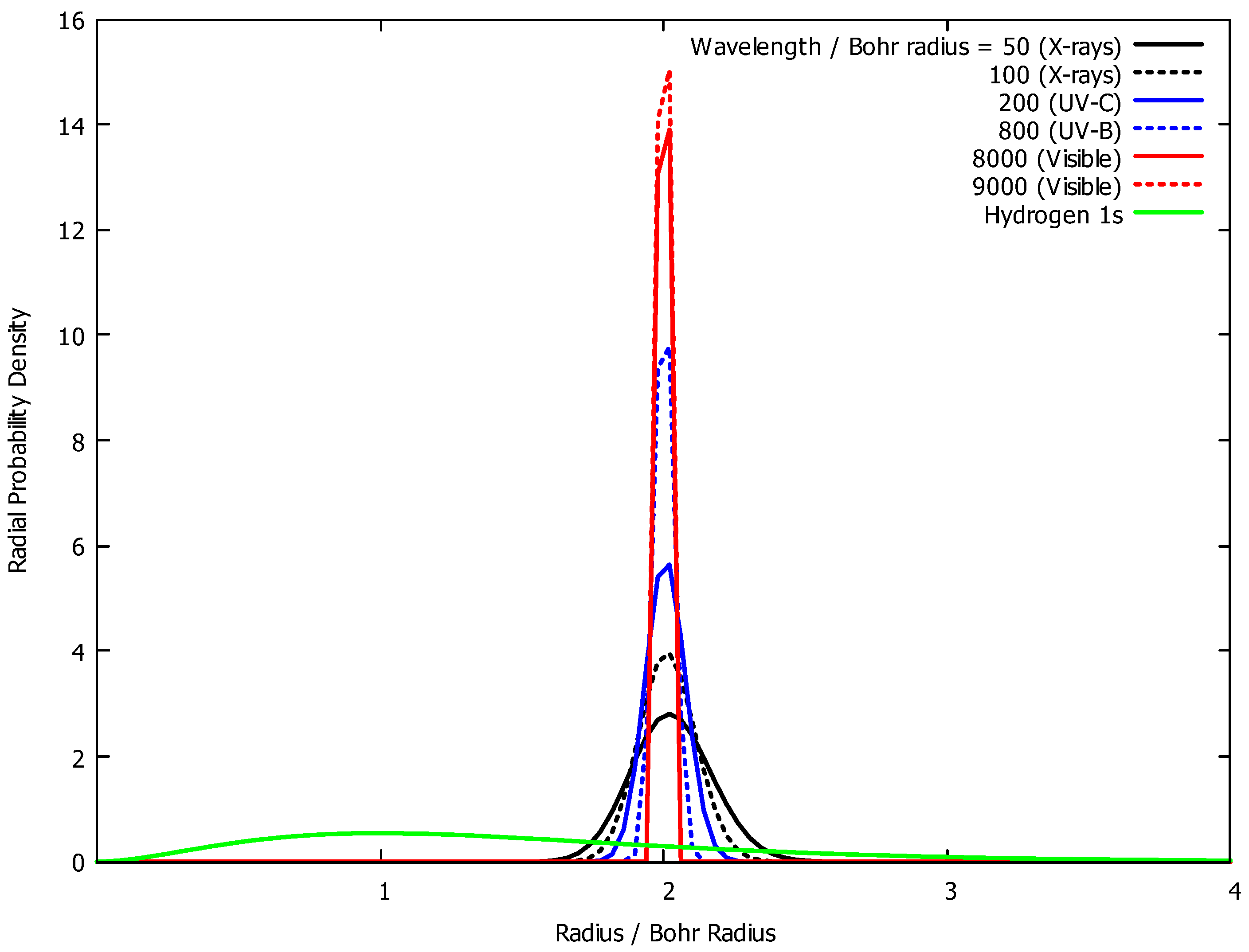
The radial probability density P 1 ( r a ) calculated for n = 1 and for different values of β a p , which varies from 50 to 9000, is plotted in Figure 1. The considered range of β a p corresponds to λ a p = 50 a B and 100 a B (X-rays), λ a p = 200 a B and 800 a B (ultraviolet), and λ a p = 8000 a B and 9000 a B (visible), and it can be extended to the other parts of the EM spectrum. The results presented in Figure 1 are also compared to the radial probability density, P 1 s ( r a ) = 4 r a 2 e 2 r a , for the hydrogen 1 s orbital plotted for comparison.
The maxima of P 1 ( r a ) plotted in Figure 1 are shifted towards the larger values of r a for shorter wavelengths, such as X-rays and UV. However, in the limit λ a p , one finds r = 2 a B , and
P 1 ( r a ) = lim λ a p η o , 1 2 ( λ a p ) r a 4 λ a p / a o + 2 e 2 ( λ a p / a o ) r a = δ ( r 2 a B ) ,
where δ ( r 2 a B ) is the Dirac delta function. This confirms that for very long wavelengths, P 1 ( r = 2 r a ) = 1 , which is the classical limit of the measuring process. The main result is that a quantum particle interacting with a measuring apparatus gets confined into a measurement eigenstate, or in a well-defined position at r = 2 a B as originally suggested by Born’s position measurement principles (e.g., [12,13,14]).
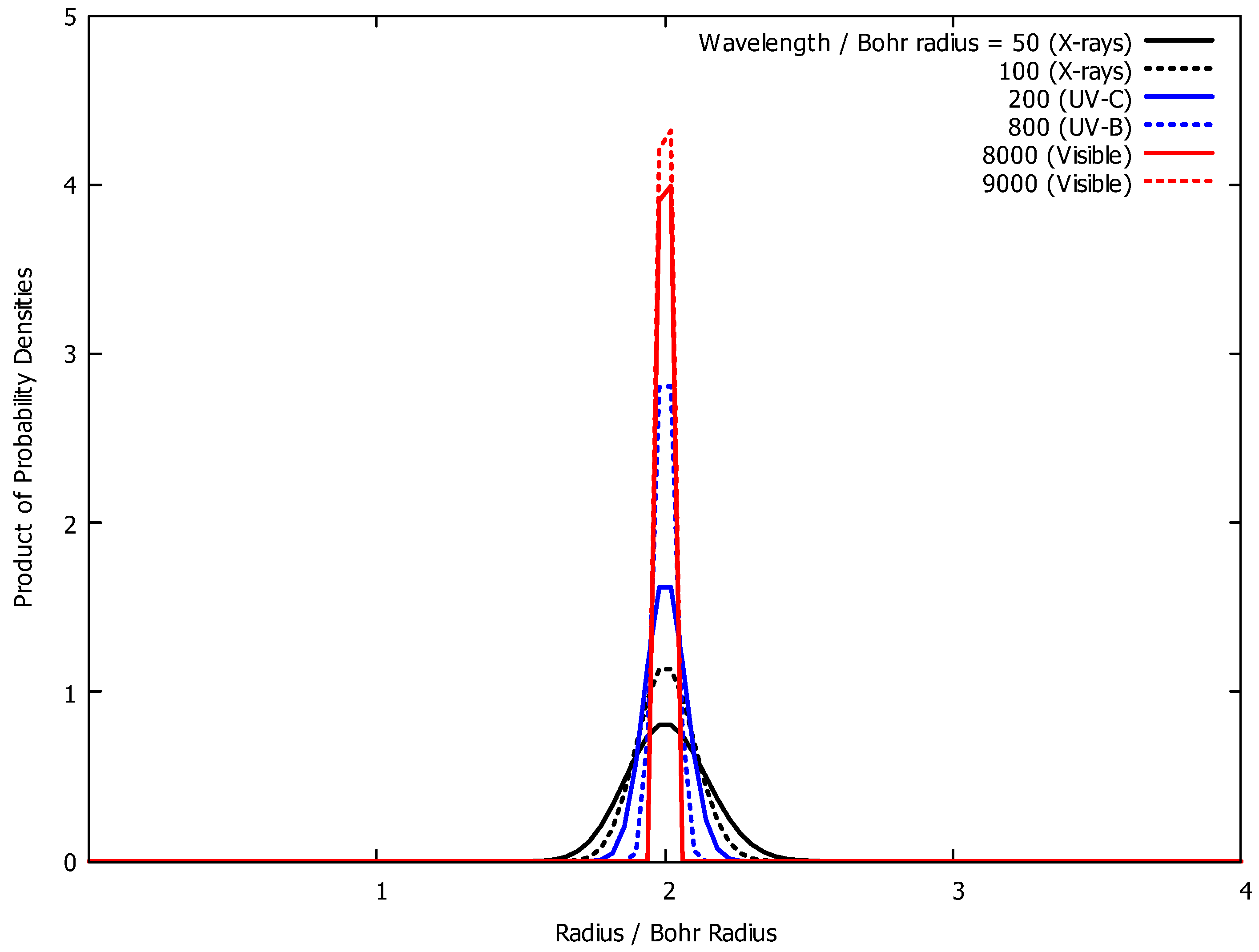
To account for the electron’s initial probability density on the 1 s orbital, the product P ( r a ) = P 1 s ( r a ) × P 1 ( r a ) is calculated and plotted in Figure 2. The probability densities plotted in Figure 2 are narrower and centered at r = 2 a o as compared with those in Figure 1. This demonstrates how the original electron’s probability density is changed due to the measurement process. Thus, the results of Figure 2 are in better agreement with Born’s position measurement postulates than those shown in Figure 1.
The above theoretical results can be verified experimentally by using a quantum microscope similar to that designed by an international team of researchers [109], who used it to measure the orbital structure of Stark states in an excited hydrogen atom (see their Figure 3). They reported a similar trend in shifting the maxima and broadening the density distributions for shorter wavelengths as those presented in Figure 2. There are several other measuring methods developed to study the quantum-classical correspondence [110,111,112,113], but some of these methods may not be suitable to observe single orbitals in a hydrogen atom [110].
The obtained results demonstrate that the NAE also has the potential to be used to develop new quantum-based technologies, which could verify its validity and applicability. As described in a recent comprehensive review [114], cryptographic systems and secure direct communications, as well as emerging fields like the quantum internet, are all based on modern quantum technologies; the potential of developing new quantum technologies based on the NAE remains to be explored.
The obtained results demonstrate that while the Schrödinger equation describes the evolution of the wavefunction prior to any measurement, the new asymmetric equation represents the behavior of the wavefunction during the measurement process, or its transition from unitary (reversible) to non-unitary (irreversible) evolution in time. This shows that both equations are required in nonrelativistic quantum mechanics to fully describe the temporal and spatial behavior of the wavefunction.

7.3. Theory of Quantum Jumps

Quantum jumps represent transitions of electrons between discrete atoms’ energy levels, and electromagnetic radiation of a specific frequency is absorbed or emitted by the atoms. In Bohr’s hydrogen atom model [115], it was postulated that such transitions cannot be properly described by mechanics. Then, the concept of quantum jumps was introduced, which were assumed to be instantaneous [13,14,15,116,117]. However, some physicists, notably Schrödinger [118], argued against such instantaneous quantum jumps by pointing out that no process in the real world happens in zero time. Then, the idea of quantum jumps being random and instantaneous has become associated with the Copenhagen interpretation of NRQM (e.g., [13,14,15]).
The first direct observations of quantum jumps [119,120,121] showed that excited individual atoms remain in this state for periods ranging from a few tenths of a second to a few seconds before jumping again. The results were confirmed by other experiments (e.g., [122,123,124]), which also demonstrated that the jumps were random and abrupt. However, more recent experimental results [125] demonstrated that quantum jumps are not instantaneous, but instead they occur in finite time. Moreover, attosecond spectroscopy [126] was used to determine the absolute timing of quantum jumps (e.g., [127,128]). The duration of quantum jumps was also established theoretically (e.g., [129]), and a quantum trajectories theory was suggested as a possible explanation of the data [130,131,132]. A different theory of quantum jumps was proposed in [133], and this theory and its main results are now briefly described.
A theory of quantum jumps presented herein is based on the NAE given by Equation (58) and modified to include the Coulomb potential and EM radiation absorbed or emitted by a hydrogen atom. Taking ω o and k o to be the frequency and wavevector of this EM radiation, then, they are given by
ω o = R E n f 2 n i 2 n f 2 n i 2 ,
and
k o = k o k ^ o = ω o c k ^ o = R E c n f 2 n i 2 n f 2 n i 2 k ^ o .
where R E = 2 / 2 m a B 2 is the Rydberg constant and a B = ( 4 π ϵ o 2 ) / m e 2 is the Bohr radius. In addition, n i and n f are the prinicipal quantum numbers denoting the initial and final states, respectively; for absorption, n f > n i and for emission, n f < n i .
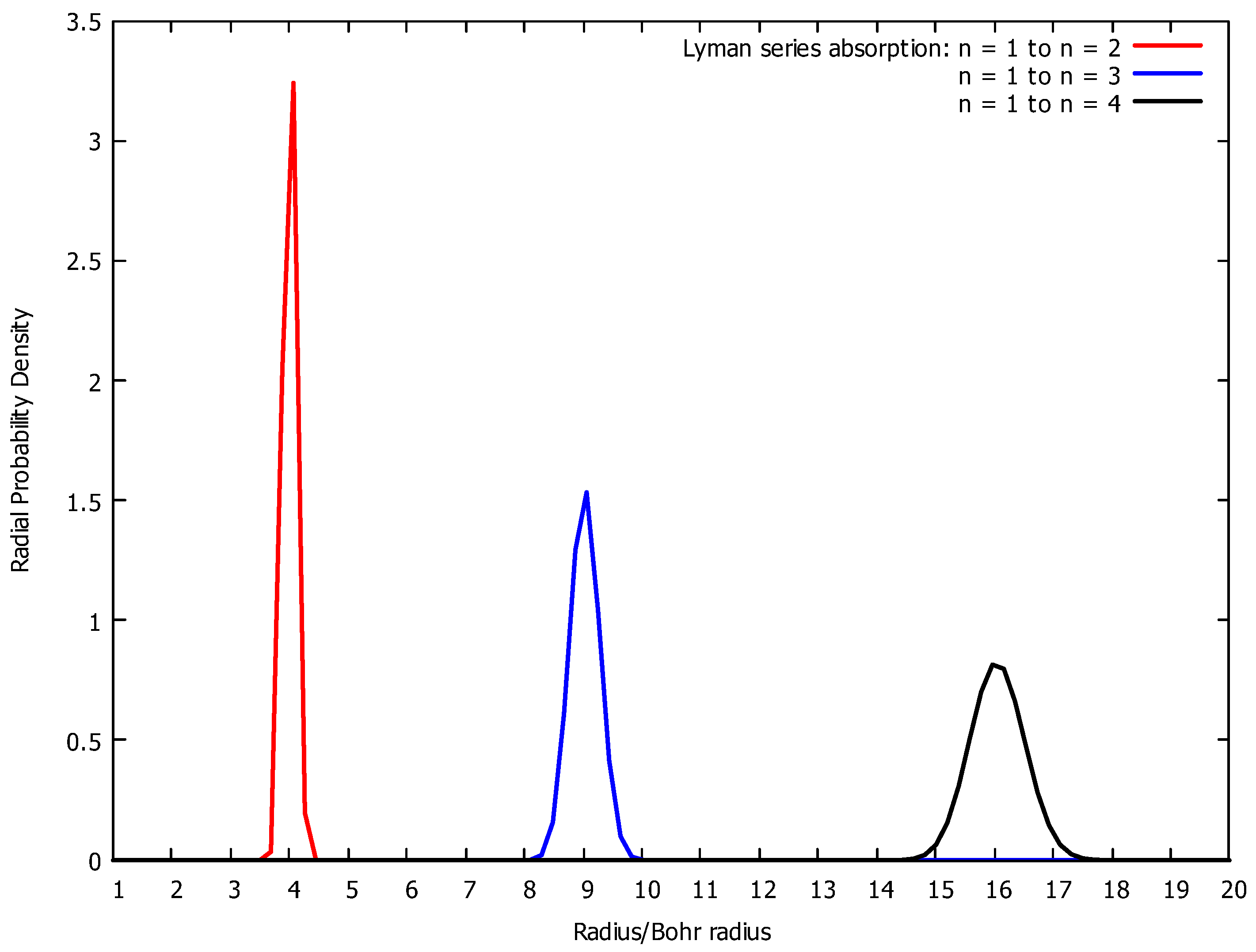
Figure 3. The radial probability density P n ( r a ) in a spherical shell volume element corresponding to each transition is plotted versus the ratio of radius to the Bohr radius, r / a B . The plotted probability densities are for the Lyman series absorption from n i = 1 to n f = 2 , 3 and 4 (after [133]).
Quantumrep 07 00060 g003
Then, Equation (58) with x = r , can be written in the following form
i ω o 2 t 2 + λ C 4 π ( ω o ) ( k ^ o · ) 2 m a B 1 r ϕ A ( t , r ) = 0 ,
where λ C = h / m c is the Compton wavelength. After separation, the variables (the radial component only) ϕ A ( t , r ) = χ ( t ) η ( r ) , and taking the separation constant μ 2 = E n = ( 2 / 2 m ) ( 1 / n a B ) 2 , the resulting equations are
d 2 χ d t 2 + i ω o m n 2 a B 2 χ = 0 ,
and
d η d r + 2 ( k ^ o · r ^ ) k o a B 1 n 2 a B 1 r η = 0 ,
where r ^ is a unit vector in the direction of r , n is the principle quantum number, and n = n f for absorption and n = n i for emission; since the solutions also depend on n, one obtains χ ( t ) = χ n ( t ) and η ( r ) = η n ( r ) . Note that if r = n 2 a B , then d η / d r = 0 , which can be identified with Bohr’s rule for quantum jumps (e.g., [12,13,14]); thus, Equation (85) is a mathematical representation of the rules (see the solutions below and Figure 3 and Figure 4).
With i = ( 1 / 2 + i / 2 ) 2 , the solutions to Equation (84) are
χ n ( t ) = C ± exp ± i 1 2 + i 2 Ω n t ,
where the integration constants are C ± , and Ω n is the characteristic frequency given by
Ω n = 1 n a B ω o m .
Both solutions with C + and C are physical and they correspond to t + and t , respectively. In the following, only the solution with C + is considered because quantum jumps occur when t > 0 . The real part of the solution is
R e [ χ n ( t ) ] = C + cos ( Ω n t ) exp ( Ω n t ) ,
and it shows that the temporal component χ n ( t ) of the wavefunction ϕ A ( t , r ) decays exponentially over time. The rate of this exponential decay depends on the value of the characteristic frequency Ω n , which can be used to define the duration time of a single quantum jump T n = 2 π / Ω n .
The theory predicts the characteristic frequency Ω n 10 16 s−1 for the Lyman series absorption and Ω n 10 15 s−1 for the Balmer series absorption, which gives the corresponding time scales T n 10 16 s and T n 10 15 s (see Table 1). The obtained time scales are very short but they are finite, which means that the jumps are not instantaneous but instead they take place in finite times. This is in agreement with the experimental data reported in [125]; however, direct comparisons between the calculated time scales and those observed cannot be made because the latter were determined for large ’artificial atoms’ described in detail in [125].
After presenting and discussing the temporal solutions, Equation (85) is now solved, and its spatial solutions are used to find the radial probability density for both the Lyman and Balmer series absorptions. Since in spherical symmetry k ^ o · r ^ = 1 , Equation (85) becomes
d η n d r a + β o 1 n 2 1 r a η n = 0 ,
where r a = r / a B and
β o = 8 π a B λ c n f 2 n i 2 n f 2 n i 2 .
It is seen that Equation (89) directly displays Bohr’s rule for quantum jumps r a = n 2 or r = n 2 a B (e.g., [3,4,5]).
The solution to Equation (89) is
η n ( r ) = η o , n r a β o exp β o n 2 r a ,
with η o , n being given by the normalization condition
4 π a B 3 0 r a 2 | η n ( r a ) | 2 d r a = 1 .
Since the integral can be evaluated, the final solution can be written as
η o , n 2 ( β o ) = 1 4 π a B 3 Γ ( 2 β o + 3 ) 2 β o n 2 2 β o + 3 .
Using this solution, the radial probability density is given by
P n ( r a ) d P n ( r a ) d r a = 1 Γ ( 2 β o + 3 ) 2 β o n 2 2 β o + 3 r a 2 ( β o + 1 ) e ( 2 β o / n 2 ) r a ,
which gives o P n ( r a ) d r a = 1 .
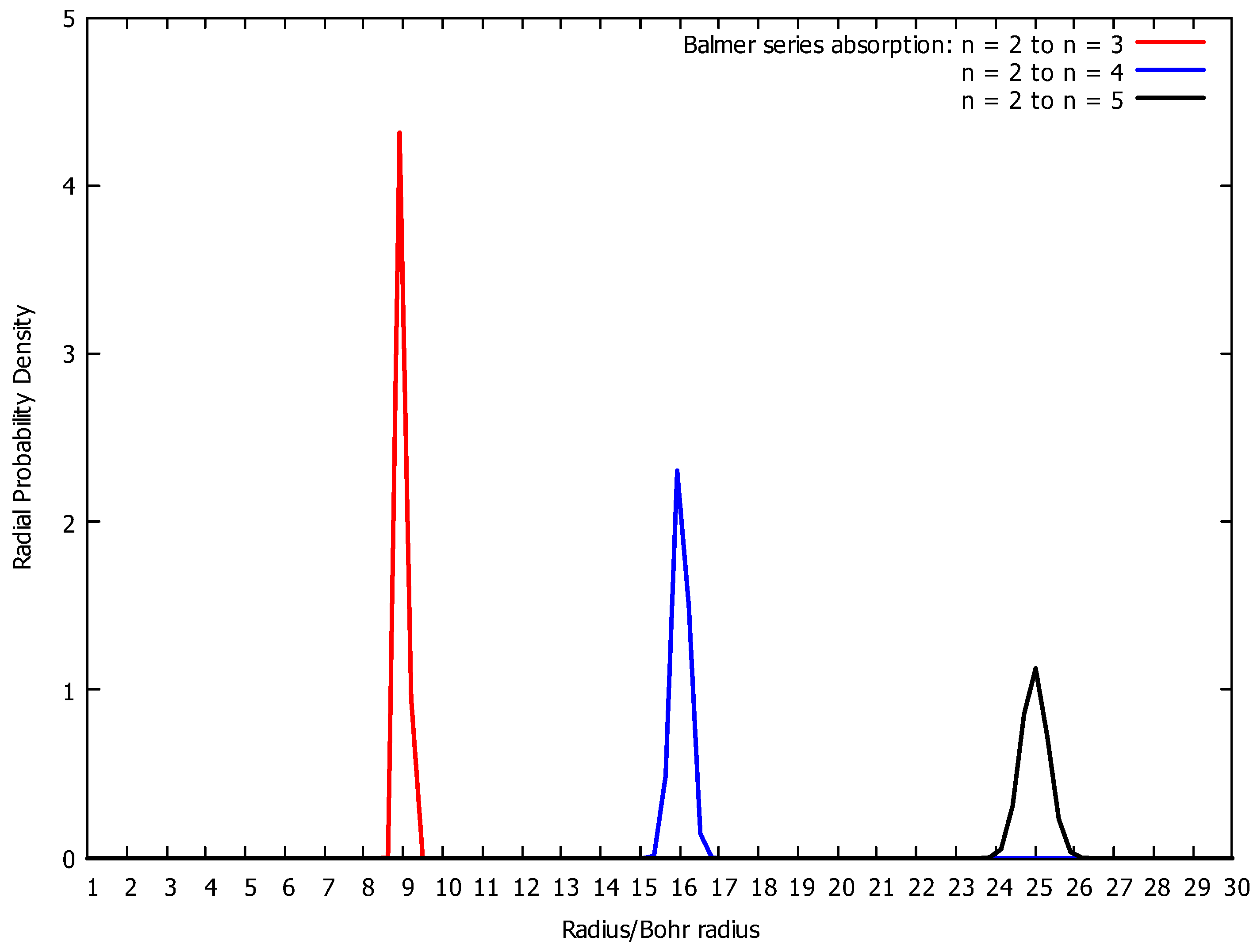
The radial probability densities of finding the electron in the excited states for the Lyman and Balmer series absorption are plotted in Figure 3 and Figure 4, respectively. As shown, the resulting radial probability densities are centered at r a = 4, 9, and 16 for the Lyman series, and at r a = 9, 16, and 25 for the Balmer series; the predictions are consistent with the Bohr rules for quantum jumps [115,116,117]. The shapes of these probability curves range from very narrow for the lowest n f to much wider for higer values of n f .
It is difficult to measure the duration of quantum jumps because there are no precise time-measuring devices that capture the beginning of a quantum jump. In measurements reported by Minev et al. [125], the time scales associated with quantum jumps were of an order of microseconds. However, their measurements were performed on large artificial atoms; thus, they cannot be compared to the time scales predicted in this paper. On the other hand, it is possible to estimate the frequencies ω o and Ω n given by Equations (81) and (87) for a Rydberg atom with large values of n > 500 , or even n > 1000 (e.g., [134]). Estimates based on Equations (81) and (87) demonstrate that T n 10 6 s would require Rydberg states with n > 1000 ; it remains to be determined whether such predictions are relevant to the experimental data reported in [125].
Absolute time scales of quantum jumps were established by chronoscope measurements of the photoelectric effect and gave the duration of the photoexcitation process to be of the order of 10 17 s [127,128]. However, estimates based on the Franck–Condon principle gave durations of quantum jumps to be of the order of 10 15 s, while others based on a resonance of the atomic electron resulted in 5 · 10 17 s [129]. This shows that the duration times for different quantum jumps corresponding to the Lyman and Balmer series given in Table 1 lie well within the above range of the empirical and theoretical evaluations.
As demonstrated by the experiments [119,120,121,122,123,124,125,126,127,128], the jumps are random and abrupt, but after they happened, the electron spends from a few tenths of a second to a few seconds in the excited state before it jumps back to its original orbital. The radial probability densities in spherical shell volume elements computed for the Lyman and Balmer series absorptions (see Figure 3 and Figure 4) may last for the time periods determined by the experiments. Thus, it was proposed [133] that the presented radial probability densities be observed experimentally by using a quantum microscope similar to that designed in [109] or other methods suitable to observe single orbitals in a hydrogen atom [110,111,112,113].

7.4. Role of New Asymmetric Equation in Quantum Theories

In general, quantum mechanical systems can be divided into two different classes: (A) systems that undergo continuous and uninterrupted evolution in time and space, and do not interact with any classical environment, and (B) systems that interact with their environment, which causes their spatial and temporal evolution to become interrupted and discontinuous. Examples of the systems of class (A) are free quantum particles, or particles bounded in potential wells like electrons in atoms, and others. However, typical examples of the systems of class (B) are atoms with their quantum jumps, or atoms on which measurements by classical devices are performed, but also quantum particles that decay or undergo tunelling, and others. The evolution of the systems of class (A) is unitary, and described by the Schrödinger equation (SE), but it is non-unitary for the systems of class (B), whose evolution is described by the new asymmetric equation (NAE), as the results presented in Section 7.2 and Section 7.3 demonstrated.
Since both the SE and NAE are nonrelativistic, Galilean observers may be classified as ’passive’ in reference to those who use the SE to study the systems of class (A), and ’active’, who take the NAE to investigate the systems of class (B). Note that only the active observers may influence the quantum system’s behavior because of their freedom in specifying the NAE’s parameters, which can be used to perform measurements or describe quantum jumps. An interesting result is that the NAE predicts Born’s position measurement postulates and also explicitly displays Bohr’s rules for quantum jumps, which may imply that the NAE correctly describes both quantum processes. Nevertheless, despite these results, experimental verifications are required. If the NAE proves successful in passing such verifications, then it can be used to study other non-unitary processes in NRQM, and also to develop new quantum-based technologies. The NAE may also give a new perspective on the foundation of NRQM.
Using the energy E ^ and momentum P ^ operators, Equation (58) can be written in the following form (see Equation (63))
E ^ 2 ψ N = ε o 2 m p o · P ^ ψ N ,
where ε o = ω o and p o = k o . With the eigenvalues E = ω and p = k of the operators E ^ and P ^ , respectively, Equation (95) becomes
E 2 = ε o | k ^ o · k ^ | k o k E k i n ,
where k ^ o and k ^ are the unit vectors. Equation (96) can also be rewritten as
E = ± ε o E k i n | k ^ o · k ^ | k o k E k i n E N A E ,
which shows that based on its energy content, the NAE describes the evolution of a quantum system that absorbs or emits energy specified by ω o and k o (see Equation (65)).
In both quantum models considered in Section 7.2 and Section 7.3, the Coulomb potential V ( r ) was also included, and this potential can be added to the kinetic energy of the system, so that E t o t = E k i n + V ( r ) , which represents the total energy of the system with ω o = 0 and k o = 0 . Then, the changes in the system’s energy resulting from ω o 0 and k o 0 are, according to the NAE, given by
E t o t ± E = 1 ± ε o E k i n | k ^ o · k ^ | k o k E k i n + V ( r ) ,
where the signs ‘−’ and ‘+’ correspond to emission and absorption, respectively. In other words, the NAE describes dynamical changes in the system when its energy increases or decreases due to emission or absorption of radiation. This shows that despite the fact that the SE and NAE are complementary, they represent fundamentally different quantum processes, and that both these equations may be needed in NRQM to properly describe all its quantum systems.

7.5. Theories of Galactic Dark Matter Halos

According to the Planck 2018 mission [135], dark matter (DM) constitutes 26.8% of the total mass-energy density of the Universe, which is almost 5.5 times more than the amount of ordinary matter in the entire Universe. Many different theories of DM have been proposed (e.g., [136,137,138,139,140,141,142,143,144,145,146,147,148,149,150,151,152,153,154]), and several different experiments have been searching for DM particles, but no DM particle has yet been discovered (e.g., [155,156,157,158]). Thus, the nature and origin of DM still remain unknown.
A theory of DM based on the Schrödinger equation was proposed by Sin [144], who postulated the existence of extremely light bosonic DM particles with masses of the order of 10 24 eV. In this theory, the SE was solved on the galactic scale because of the very long Compton wavelength of such DM particles. The gravitational potential added to the SE was found by solving the Poisson equation with the DM density as the forcing term. The theory was further extended (e.g., [143], and references therein), who used the masses of the order of 10 22 eV. However, more detailed studies [159,160] demonstrated that the theory requires different masses of DM particles for different galactic halos. Since this is difficult to justify from a physical point of view, the theory based on the SE failed to correctly describe DM in galactic halos.
Since the developed quantum theory of DM based on the SE failed, it was suggested that the NAE, being complementary to SE, may describe the quantum structure of DM [32]. If this is correct, then a pair of DM particles may only exchange the quanta of energy ε o = ω o , whose frequency ω o is fixed for DM particles. This means that while ordinary matter emits or absorbs radiation at a broad range of frequencies, DM’s emission or absorption is restricted to only one specific frequency ω o that is characteristic of DM particles. A theory of a pair of DM particles interacting only gravitationally was formulated [161]; however, the main disadvantage of the developed theory is the lack of gravitational effects of the halo on the pair, and the assumption of the halo’s constant density. Recently, the theory was generalized to account for the effects of the halo, including its non-constant density [162], as is now shown.
In a galactic DM halo with its radius R h and mass M h , a DM particle of mass m is at a point P located at the distance r (spherical coordinate) from the center of the halo. The balance between the force of gravity, F g ( r ) = G M ( r ) m / r 2 , and the centrifugal force, F c ( r ) = m r Ω c 2 ( r ) , gives the circular orbital frequency of the particle
Ω c 2 ( r ) = G M ( r ) r 3 ,
where M ( r ) = 4 π 0 r ρ ( r ˜ ) r ˜ 2 d r ˜ , with ρ ( r ) being the density of DM inside the halo, which must be specified. This circular frequency guarantees that DM particles are confined gravitationally to their orbits. To account for this effect, Ω c 2 ( r ) is included in Equation (57) to play the role of a potential for the particles, whose proper description on their orbits is given by the developed quantum theory; note that physical units of Ω c 2 ( r ) are consistent with the remaining terms of Equation (57). Thus, the result is
t 2 i ε o 2 m k o · + Ω c 2 ( r ) Φ ( t , r ) = 0 ,
where ε o = ω o is a fixed quanta of energy of DM particles, r ^ = r / r , and Φ ( t , r ) is a scalar wavefunction of DM particles. Note that no angle dependence on θ nor on ϕ is considered, and that Equation (100) is the governing equation for the DM halo model [162,163].
To find the solutions of Equation (100), the independent variables are separated as Φ ( t , r ) = χ ( t ) η ( r ) , which gives the following time-independent equation
d η η = i 2 m ε o | k o · r ^ | μ 2 Ω c 2 ( r ) d r ,
where μ 2 is the separation constant to be determined. The general solutions are complex [162]; however, their real part can be written as
η ( r ) = η o cos 2 G m 3 [ μ 2 r I c ( r ) ] ε o 2 | k ^ o · r ^ | ,
where I c ( r ) = 0 r Ω c 2 ( r ˜ ) d r ˜ and k o = k o k ^ o , with k o = 1 / λ o and λ o = G m 2 / ε o = const being the characteristic wavelength. Physically, this wavelength represents a distance between a pair of gravitationally interacting DM particles at which their gravitational and quantum energies are equal. It is postulated that only at such distances the pair can emit or absorb the quanta of energy ε o = ω o . Since the interaction is gravitational only, the pair emits or absorbs a quanta called the dark graviton of frequency ω o , whose wavelength is Λ o and the dispersion relation is ω o = c Λ o (see Table 2).
Based on the above relationships between the parameters, the frequency ω o and wavelength Λ o can be expressed in terms of k o as ω o = ( G m 2 / ) k o and Λ o = ( G m 2 / c ) k o . However, since neither ω o nor m is known for DM, the results presented in Table 2 are obtained by using the quantization rule given by Equation (105) from which ω o can be estimated for a given value of m, and then Λ o can also be evaluated [163].
In the solution given by Equation (102), the maxima of the cosine function take place when the argument is ± 2 n π , with n = 0 , 1, 2, 3, …, where the ’+’ and ’−’ signs represent the orbits inside and outside the halo. Considering only the inside orbits, the separation constant can be evaluated from
μ 2 = 1 r I c ( r ) + n π ω o 2 | k ^ o · r ^ | 2 G m 3 r ,
which requires r = R h , r ^ = R ^ h , and finding I c ( R h ) that is given by
I c ( R h ) = 0 R h Ω c 2 ( r ˜ ) d r ˜ = C ρ R h Ω h 2 ,
where C ρ is a dimensionless constant that depends on the halo’s density profile, and Ω h 2 = G M h / R h 3 is the orbital frequency at the edge of the halo; Ω h 2 corresponds to the orbital velocity v h 2 , which is two times smaller that the escape velocity v e s c 2 at the edge of the halo (e.g., [163,164]).
With the separation constant μ 2 = C ρ Ω n 2 , the quantization condition for the orbits inside the halo can be written as
Ω n 2 = Ω h 2 + n π κ h ω o 2 ,
or
E n 2 = E h 2 + n π κ h ε o 2 ,
where E n = Ω n , E h = Ω h , and κ h = 2 / G m 3 C ρ R h is a dimensionless constant. Note that | k ^ · R ^ h | = 1 because the unit vector R ^ h is not restricted and it can be aligned with the unit vector k ^ . Moreover, the location r n of the quantized orbits Ω n can also be calculated by using the conservation of angular momentum [162,163].
According to the presented theory, galactic DM halos may have their quantum structures that resemble atoms. There are several DM halo models with given density profiles (e.g., [164,165,166,167,168,169]) and one such density profile is known as the NFW density profile [167]. The theory has been applied to the models with the constant and linear density profiles [162], and to the NFW density profile [163]. The quantum theory of a galactic DM halo with the NFW density profile predicts that the halo has two components: a core that occupies 6% of the size of the halo and contains 10% of its total mass, and an envelope that occupies 94% of the size of the halo and contains 90% of its total mass [163].
Table 2. Selected masses of DM particles and the resulting parameter k h and the DM characteristic frequency ω o (after [163]).
Mass of DM Particle [kg]Parameter k h Frequency ω o [Hz]Reference to Known Masses
1.7 · 10 25 3.2 · 10 16 10 8 100 Protons
1.7 · 10 26 3.2 · 10 13 10 10 10 Protons
1.7 · 10 27 3.2 · 10 10 10 12 Proton
9.1 · 10 31 2.0 10 17 Electron
1.0 · 10 58 1.6 · 10 84 10 59 Extremely light boson [143,144]
1.0 · 10 61 1.6 · 10 87 10 62 Ultra-light axion [170]
The density in the envelope is described by the NFW profile, and the orbits inside the halo are quantized according to the rules given by Equations (105) and (106). The dependence of the quantization rules on the parameter κ h makes the differences between the orbits not exact multiples of ω o , whose value is fixed for DM. As a result, there are not quantum jumps between the orbits, and the DM particles, which are spinless and without charges, are confined to them. The only exception may be orbits near the core, where the density of the orbits is so high that some quantum jumps may occur. Moreover, exchange of DM particles between the core and its nearby orbits may also take place.
The theory shows that the core’s density is constant, which means that there are no quantized orbits inside the core. Instead, the DM particles move randomly and frequently collide with each other; they may also form pairs that emit or absorb quanta of energy ε o = ω o if the distance between the particles in the pair is λ o . The quanta of energy are called dark gravitons, and they may be abundant in the core. The characteristic frequency of DM, ω o , may be estimated for a given mass m of the DM particles; see Table 1, in which m is expressed in terms the proton’s mass m p = 0.938 G e V = ≃ 1.7 · 10 27 kg.
The results given in Table 1 demonstrate that larger masses give higher frequencies ω o of radiation that can be emitted and absorbed as dark gravitons, which are quanta of gravitational interaction of the DM particles. The abundance of dark gravitons in the core may contribute to the gravitational wave background (e.g., [171]), which has been recently discovered [172,173]. The presented theory demonstrates that the contributions from the envelope should be significantly smaller because of the lack of quantum jumps [169]. Therefore, the low-frequency emission given in Table 1 should be enhanced at the center of galactic halos, which can also be identified with the centers of their host galaxies. This localized nature of the predicted emission can be detected observationally by the NANOGrav detector [172,173], or some future missions devoted to the detection of very-low-frequency gravitational waves.
The presented results show that galactic cold DM halos resemble giant atoms, in which the cores play the same role as nuclei in atoms, and the quantized orbits in the halo’s envelopes play the same roles as electron shells in the outermost layers of atoms. Obviously, there are enormous differences between the atomic and halo scales, and they are caused by the huge differences between the strength of gravitational and electromagnetic forces. Nevertheless, the fact that galactic cold DM halos may resemble atoms is an interesting result that may have profound cosmological implications.
It must be pointed out that the obtained analytical models of galactic DM halos require a DM density profile to be specified, and that the NFW density profile was used to construct the models. In future work, this requirement of specifying a density profile can be removed by simultaneously solving the new governing equation and the Poisson equation. By solving both equations numerically, with the forcing term given by the square of the wave function in the Poisson equation, the DM potential can be computed, and the simultaneous solutions to the equations can be obtained (e.g., [144,159,160]); however, such numerical work has not yet been performed.

7.6. Role of New Asymmetric Equation in Dark Matter Modeling

The new asymmetric equation (NAE) used to model the galactic dark matter halo differs from the NAE used to describe quantum systems because of its different potential and different physical meaning of its parameters ω o and k o . The NAE requires that these two parameters are specified based on the physical setting of a considered problem. In other words, there is a certain freedom in selecting the parameters, but their choice must be physically justified. Therefore, in the model of galactic DM halo, the parameter k o = k o k ^ o , is used to introduce gravitational interactions between a pair of DM particles; note that in this model, DM particles are allowed to interact only gravitationally.
As a result of this interaction, a quanta called dark graviton can be emitted (or absorbed) if, and only if, the gravitational potential energy, G m 2 / r , between the particles separated by distance r becomes equal to their quantum energy given by ε o = ω o . The distance at which this occurs is λ o = G m 2 / ε o that is then used to define k o = 1 / λ o . It is postulated that when two DM particles reach their separation distance λ o , such a pair may emit or absorb the energy ε o = ω o . Since the particles interact only gravitationally, this energy is emitted or absorbed as gravitational waves of frequency ω o , whose wavelength is Λ o , and the dispersion relation is ω o = c Λ o
Based on the above relationships between the parameters, the frequency ω o and wavelength Λ o can be expressed in terms of k o as ω o = ( G m 2 / ) k o and Λ o = ( G m 2 / c ) k o . However, since neither ω o nor m is known for DM, the value of k o cannot be determined from this relationship. Therefore, the quantization rule given by Equation (105) is used to estimate ω o for a given mass m of DM particles [163]. Then, Λ o is also evaluated as shown in Table 2.
The energy E ^ and momentum P ^ operators are now used to write Equation (100) in the following form
E ^ 2 Φ = ε o 2 m p o · P ^ + 2 Ω c 2 ( r ) Φ ,
where p o = k o , and Ω c 2 ( r ) is given by Equation (99). With the eigenvalues E = ω and p = k of the operators E ^ and P ^ , respectively, Equation (107) becomes
E 2 = ε o | k ^ o · k ^ | k o k E k i n + 2 Ω c 2 ( r ) ,
where k ^ o and k ^ are the unit vectors. After some simple algebraic steps, the equation can be written as
1 Ω c 2 ( r ) ω 2 E 2 = ε o | k ^ o · k ^ | k o k E k i n ,
or as
1 Ω c 2 ( r ) ω 2 1 / 2 E = ± ε o E k i n | k ^ o · k ^ | k o k E k i n ,
where ε o = ω o . This shows that the NAE describes a galactic DM halo with emission and absorption of energy ε o by pairs of its particles. It also demonstrates that if these particles have their frequency ω = Ω c ( r ) , then they are confined to the halo’s orbit with this frequency at a given r, and they neither radiate nor absorb any quanta of energy. In this case, the LHS of Equation (110) becomes zero, so in order for the RHS to also be zero, it is required that k o = 0 or λ o (no interaction between DM particles), which gives ω o = 0 (no emitted or absorbed radiation by DM) as predicted by the model. The DM particles also neither emit nor absorb any radiation when ω < Ω c ( r ) . According to this model, most emission and absorption take place in the halo’s core (no quantum orbits) or in its vicinity (high density of quantum orbits), where formation of pairs of DM particles is the most probable [163].

8. Summary: Nonrelativistic Linear Wave Equations

The irreps of the extended Galilean group are used to derive infinite sets of symmetric and asymmetric second-order PDEs for scalar wavefunctions. By specifying physical settings, the wave equations for classical and quantum wavefunctions are obtained from the infinite sets. There are three wave equations describing classical waves, namely the basic, Schrödinger-like, and new wave equations, and they give the same description of waves; however, for the latter two equations, their complex conjugate forms must also be considered. There are two wave equations for quantum wavefunctions—the Schrödinger and new asymmetric equations—and the basic difference between them is that the former is used for passive (not interacting with a system) observers, and active observers who use the latter can directly influence the system and its behavior.
The obtained results demonstrate that classical waves can be described by any of the three wave equations. However, for the wave description to be the same as these wave equations, the Schrödinger-like and new wave equations for the complex conjugate wavefunctions must also be considered. Applications of the results to acoustic wave propagation in isothermal and nonisothermal stratified media show that the wave equations give the same acoustic cutoff frequency and the wave propagation conditions. Among the three wave equations, only the new wave equation is a fundamental equation of classical physics, which means that its wave description is the same for all Galilean observers whose inertial frames move much slower than the wave speed. This fundamental wave equation describes both forward and backward waves, and it also accounts for the Doppler effect. It is suggested that this equation may play the same role for classical waves as Newton’s laws play for classical particles.
The main difference between the classical and quantum wave equations is that the former require the eigenvalues to be the wave frequency and wavevector, but for the latter, the eigenvalues must be expressed in terms of the Planck constant and the particle’s mass. The Schrödinger and new asymmetric equations are fundamental and complementary to each other; however, the main difference is the explicit dependence of the latter on the eigenvalues that must be specified. This property of the new asymmetric equation allows using it to develop novel theories of the quantum measurement problem, quantum jumps, and galactic cold dark matter halos; none of these problems could previously be solved by using the Schrödinger equation. Thus, both the Schrödinger and new asymmetric equations may be required in nonrelativistic quantum mechanics to fully describe the behavior of the wavefunction.

9. Relativistic Linear Wave Equations

9.1. Poincaré Group and Eigenvalue Equations

The background spacetime of Special Theory of Relativity (STR) is flat with its Minkowski metric given by d s 2 = c 2 d t 2 d x 2 d y 2 d z 2 , where x, y, and z are spatial coordinates, and t is time (e.g., [10]). The description of physical events is best carried out with four vectors, x μ = ( t , x , y , z ) with μ = 0, 1, 2, and 3, rather than three vectors, x = x j = ( x , y , z ) with j = 1, 2, and 3, and t being a separate variable. The coordinate transformations that leave this metric invariant are called the Lorentz transformations, and they form the representation of the Poincaré group (e.g., [38]).
The Lorentz transformations x μ = Λ ν μ x ν , where Λ ν μ is the transformation matrix that represents rotations and boosts (e.g., [10]), can be extended to include translations in time and space a μ , so the Lorentz transformations become x μ = Λ ν μ x ν + a μ . Since the translations form a separate group typically denoted by T ( 3 + 1 ) , the Lorentz group S O ( 3 , 1 ) and the group T ( 3 + 1 ) can be combined together to form a new group called either the inhomogeneous Lorentz group or the Poincaré group that is the spatio-temporal group [24,25,31]. Denoting the Poincaré group by P, its mathematical structure can be written as P = S O ( 3 , 1 ) s T ( 3 + 1 ) , where s is the semi-direct product and T ( 3 + 1 ) is an invariant subgroup; the latter guarantees that the irreps of T ( 3 + 1 ) are also the irreps of the entire group P (e.g., [38,39]).
Wigner [40] classified the irreps of the Poincaré group and showed that all the scalar, vector, spinor and tensor irreps of P are physical. As a result, there are dynamical equations for the wavefunctions corresponding to all the irreps of P in QFT (e.g., [24,25]). According to Wigner [38,40], the necessary condition that all observers identify the same elementary particle is that its wavefunction Φ ( x μ ) transforms one of the irreps of P. The condition can be expressed mathematically as the eigenvalue equation [174,175] written in the following form
i μ Φ = k μ Φ ,
where μ = / x μ = ( / t , c ) , and k μ = ( ω , c k x , c k y , c k z ) are labels of the irreps that also label the wavefunction Φ ( x μ ) ; in the nonrelativistic limit, Equation (111) reduces to Equations (10) and (11). The above eigenvalue equation is not invariant with respect to all the transformations that form the representation of P; however, the equation can be used to derive other dynamical equations that are Poincaré invariant [174,175].

9.2. Klein–Gordon Equation and Its Nonrelativistic Limit

In order to obtain a Poincaré invariant dynamical equation, the following scalar product must be calculated by using the eigenvalue equation
μ μ Φ = k μ k μ Φ = ω 2 k 2 Φ .
where k 2 = ( k x ) 2 + ( k y ) 2 + ( k z ) 2 . The equation is commonly known as the Klein–Gordon (KG) equation [26,27]. In a stationary inertial frame k j = 0 , which gives ω = Ω o = m c 2 / . Then, the KG equation becomes
μ μ + Ω o 2 Φ = 0 ,
with ω 1 , 2 = ± c 2 k 2 + Ω o 2 being its solutions after the Fourier transforms in space and time Φ = Φ o exp [ i ( ω t k j x j ) ] are performed, where Φ o = const.
It is seen that the KG equation has one single parameter, Ω o , which is the same in all inertial frames (or Poincaré invariant) because it is defined by the universal constants and c as well as by the particle’s rest mass m, which is also constant. Then, Ω o = m c 2 , which is the quantum energy Ω that corresponds to the rest energy m c 2 dimension (e.g., [24]). If m = 0 , then Equation (113) reduces to the relativistic wave equation with c being the wave speed; however, the resulting wave equation would not describe electromagnetic (EM) waves because Φ is a scalar wavefunction, but EM waves require a vector wavefunction [24,25].
The derived KG equation results from the eigenvalue equation that represents the necessary condition that the wavefunction transforms as one of the irreps of the Poincaré group. In textbooks (e.g., [24,25]), the KG equation is obtained by applying the energy, E ^ = i t , and momentum, P ^ = i , operators to the energy–momentum relationship [10,24]
E 2 = p 2 c 2 + m 2 c 4 .
gives Equation (113) with Ω o defined above.
To demonstrate that the KG equation is Poincaré invariant, let two inertial observers, who use sets of coordinates x μ and x μ , describe the state of the wavefunction by the following two scalar functions: Φ ( x μ ) and Φ ( x μ ) . In spacetime with the Minkowski metric, the two sets of coordinates are related to each other by the Lorentz transformations. The coordinate transformations give ( μ μ ) Φ ( x μ ) = ( μ μ ) Φ ( x μ ) , which shows that the operator ( μ μ ) has the same form in all inertial frames. Since Ω o = const, it also remains the same for all inertial observers, which means that the KG equation is Poincaré invariant.
It must also be noted that the operator ( μ μ ) is one of two Casimir operators for the Poincaré group, and that for this operator, the eigenvalue is Ω o 2 , or the elementary particle’s mass m 2 in the natural units [25]. The other Casimir operator of the Poincaré group yields a constant that can be related to the angular momentum in the rest frame (for finite ω o ) and provides another label that is associated with the spin of the particle. However, for spin-zero elementary particles represented by the scalar wavefunction Φ , the operator ( μ μ ) is sufficient; this operator can be used to develop higher-derivative KG equations for scalar wavefunctions.
As pointed out in Section 5.1, a dynamical equation is fundamental if, and only if, it is local, Poincaré invariant, gauge invariant, and its Lagrangian exists (e.g., [77]). The above results demonstrate that the KG equation is local and Poincaré invariant. Moreover, the considered KG equation describes free particles, which means that its gauge invariance is not required. In the entire Minkowski 4D spacetime, the action is defined as S ( μ Φ , Φ ) = L ( μ Φ , Φ ) d x 4 , where L ( μ ϕ , ϕ ) is the Lagrangian density [51]. The necessary condition for a stationary action δ S ( μ ϕ , ϕ ) = 0 is given by
μ L ( μ Φ ) L Φ = 0 ,
which is the E-L equation for the scalar wavefunction Φ ( x μ ) .
The Lagrangian density for the KG equation [25,51] is given by
L K G = 1 2 ( μ Φ ) ( μ Φ ) Ω o 2 Φ 2 ,
and its substitution L = L K G into the E-L equation gives the KG equation. This shows that the KG equation can also be obtained from its Lagrangian density, whose prior knowledge is required; however, there are no methods to derive such Lagrangians from first principles (e.g., [51]).
Applying the nonrelativistic limit to the KG equation (Equation (113)), the Schrödinger equation for free particles is obtained, and the procedure of reducing the KG equation to the SE can be found in [24]; specific applications of the procedure are described in Section 9.4.
Based on the above results, there is another way to take the nonrelativistic limit to the KG equation. In this approach, the total energy E in the energy–momentum relationship (see Equation (114)) is the sum of the kinetic energy E k i n and the rest energy E r e s t = m c 2 , which can be written as
E k i n = m c 2 1 + p 2 m 2 c 2 m c 2 .
Then, a Taylor expansion of the square root with application of the nonrelativistic limit to it (e.g., [10]) gives
E k i n p 2 2 m ,
whose nonrelativistic form is E k i n = p 2 / 2 m (see Equation (60)). Replacing E k i n E ^ = i t and p P ^ = i (see Section 6.2), and Φ ( t , x ) ϕ S ( t , x ) , the resulting equation becomes
i t + 2 m 2 ϕ S ( t , x ) = 0 ,
which is the Schrödinger equation. Thus, the above results demonstrate that in the nonrelativistic limit, the KG equation reduces to the SE given by Equation (56).

9.3. Higher-Derivative Klein–Gordon Equations

Multiple applications of the operators ( μ ) and ( μ ) to the eigenvalue equation (see Equation (111)) give the so-called higher-derivative (HD) KG equations
μ μ m Ω o 2 m Φ = 0 ,
and
μ μ n + Ω o 2 n Φ = 0 ,
where m and n are even and odd positive integers, respectively. This shows that there are two distinct sets of HD KG equations: one infinite set with the even powers of ( μ μ ) and the ’minus’ sign, and the other infinite set with the odd powers of ( μ μ ) and the ’plus’ sign [176,177]. The HD KG equations in both infinite sets are Poincaré invariant.
By factorizing the derived HD KG equations, one obtains
μ μ m Ω o 2 m Φ = μ μ + Ω o 2 μ μ Ω o 2 l = 1 m / 2 μ μ m 2 l Ω o 2 ( l 1 ) Φ ,
and
μ μ m + Ω o 2 m Φ = μ μ + Ω o 2 l = 1 n 1 l + 1 μ μ n l Ω o 2 ( l 1 ) Φ ,
which shows that the factorization of the HD KG equations always gives the original KG equation (see Equation (113)); however, Equation (122) also has the second factor μ μ Ω o 2 , which is a KG equation with the minus sign.
The terms in square brackets provide solutions for which the ω s are purely imaginary. Therefore, to obtain physically meaningful solutions, the higher-derivative terms in both the even and odd higher-derivative KG equations offer nothing more than the KG equation and its solutions [176,177]. By using these results, it is seen that in the lowest order, Equations (122) and (123) give ( μ μ ) 2 Ω o 4 Φ = 0 and the KG equation, respectively. Thus, the only new HD KG equation is the fourth-order KG equation that is now considered.

9.4. Fourth-Order Klein–Gordon Equation and Its Nonrelativistic Limit

The results of the previous section show that among an infinite number of HD KG equations, the only new one is the fourth-order KG equation given by
( μ μ ) 2 Ω o 4 Φ = 0 ,
where the constant Ω o = m c 2 / has the unit of frequency. By performing the Fourier transforms in space and time, the solutions to the equation can be found, and they are given by ω 1 , 2 = ± c 2 k 2 + Ω o 2 and ω 3 , 4 = ± c 2 k 2 Ω o 2 ; these solutions are discussed in Section 10.2, where some applications of the fourth-order KG equation are presented.
The Lagrange density for the fourth-order KG equation can be written as
L 4 t h K G = 1 2 ( μ ) 2 Φ ) ( μ ) 2 Φ Ω o 2 Φ 2 ,
and its substitution into the following E-L equation
( μ ) 2 L 4 t h K G [ ( μ ) 2 Φ ] + ( μ ) 2 L 4 t h K G [ ( μ ) 2 Φ ] + L 4 t h K G Φ = 0 ,
gives the fourth-order KG equation.
After demonstrating that the KG equation in the nonrelativistic limit reduces to the Schrödinger equation for free particles, the fourth-order KG equation given by Equation (124) is now considered in the nonrelativistic limit by following the procedure presented by Greiner [24]. The procedure requires that the wavefunction is transformed by using Φ ( x μ ) = ϕ S ( x j ) exp ( i Ω o t ) , and that in the nonrelativistic limit the following inequalities are valid: | t ϕ S | < < Ω o ϕ S and | t 2 ϕ S | < < Ω o | t ϕ S | [24,31]. Then, the resulting equation is
i t + 2 m 2 ψ S ( t , x ) + 2 m 2 c 2 2 i t + 4 m 2 ϕ S ( t , x ) = 0 ,
with the ratio 2 / m 2 c 2 < < 1 . Since c is still present in this ratio, the result is not valid in the nonrelativistic limit, which requires 2 / m 2 c 2 0 and allows reducing the above equation to the Schrödinger equation [177].
Thus, one may conclude that the KG equation, as well as the HD KG equations in the nonrelativistic limit, give the Schrödinger equation, and this result is independent of the order of the KG equations. Physical implications of this result are discussed in Section 10.

9.5. New Relativistic Equation and Its Nonrelativistic Limit

The new asymmetric equation given by either Equation (57) or Equation (58) is nonrelativistic and its corresponding energy E ^ and momentum P ^ operators satisfy the following eigenvalue equations for the wavefunction ψ N ( x μ ) : E ^ ψ N = ε o E ψ N and ( k o · P ^ ) ψ N = ( p o · P ^ ) ψ N = p o p ψ N , with ε o = ω o , p o = k o , E = ω and p = k , and where ω o and k o are required to be specified (see Section 7).
With E and p being the eigenvalues of the corresponding operators E ^ = i t , and momentum, P ^ = i , one finds
E 2 1 ε o 2 E ^ 4 = 1 ε o 2 4 t 4 ,
and with p ( / p o ) ( k ^ o · P ^ ) , where k o = k o k ^ o , p 2 becomes
p 2 4 p o 2 ( k o · ) 2 = 2 ( k ^ o · ) 2 .
Using the energy–momentum relationship given by Equation (114), and introducing the relativistic wavefunction Ψ ( x μ ) , the following new relativistic equation (NRE) is obtained
t 4 Ψ + ω o 2 ( c k ^ o · ) 2 Ω o 2 Ψ = 0 ,
where Ω o = m c 2 / is the characteristic frequency of the quantum energy Ω o , which is equal to the rest energy m c 2 of the massive scalar field Ψ ( x μ ) . The derived equation has one fixed parameter Ω o that is fully determined by the two universal constants and c, and the rest mass m of a relativistic particle described by the field Ψ ( x μ ) . There are also two other constant parameters, namely ω o and k o , which are related to each other and are required to be specified (see Section 10). The equation of this form has never appeared in the physical and mathematical literature.
Since ω o , k o , and Ω o are constant parameters in Equation (130), the Fourier transforms in space and time Ψ = Ψ o exp [ i ( ω t k · x ) ] , where Ψ o = const, can be performed, and the obtained plane-wave solutions require the following characteristic frequencies: ω 1 , 2 = ± ω k and ω 3 , 4 = ± i ω k , where
ω k = ω o 1 / 2 [ c 2 k 2 ( k ^ o · k ^ ) 2 + Ω o 2 ] 1 / 4 ,
with k = k k ^ . Now, ω 1 , 2 are real; thus, they are physically acceptable solutions. However, purely imaginary solutions ω 3 , 4 must be neglected as they cause Ψ to decay exponentially in time; thus, despite Equation (130) being a fourth-order PDE, only two of its four solutions are physical. If k ^ o · k ^ = 1 , then Equation (131) can be written as ω k = ω o ω K G , where ω K G = c 2 k 2 + Ω o 2 . This shows that the main difference between the solutions to the KG and NRE is the explicit presence of ω o in the latter, and that ω o will affect any QFT theory constructed using the NRE (see Section 10). Note also that in a stationary inertial frame k = 0 , the real solutions are reduced to ω 1 , 2 = ± ω o Ω o .
The derived NRE is fourth-order in time and second-order in space derivatives, which may indicate its asymmetric form. However, the equation also explicitly depends on the external parameter ω 0 , whose presence makes the equation symmetric in space and time. This is required by STR, and it is consistent with the fact that the NRE was derived directly from the relativistic energy–momentum relationship. As shown above, the NRE has only two solutions that are physically acceptable.
The Lagrange density of the NRE exists and it is given by
L N R E = ( t 2 Ψ ) ( t 2 Ψ * ) + ω o 2 2 Ψ ( c k ^ o · ) 2 Ψ * + Ψ * ( c k ^ o · ) 2 Ψ ω o 2 Ω o 2 Ψ Ψ * ,
and its substitution into the E-L equation (see Equation (126))
( t ) 2 L N R E ( t 2 Ψ * ) + ( c k ^ o · ) 2 L N R E [ ( c k ^ o · ) 2 Ψ * ] + L N R E Ψ * = 0 ,
yields the NRE given by Equation (130).
It is expected that the derived NRE reduces to the new asymmetric equation given by Equation (58) in the nonrelativistic limit. This can be demonstrated by considering the energy–momentum relationship in the nonrelativistic limit, which gives E k i n = p 2 / 2 m (see Equation (118)). According to Equations (128) and (129), ( ω o ) 2 E k i n 2 E ^ 4 and p 2 = p o p p o P ^ , respectively. With E ^ = i t , P ^ = i , p o = k o , and Ψ ψ N , the resulting equation is
1 ω o t 2 i 2 m k o · ψ N ( t , x ) = 0 ,
which is the new asymmetric equation (see Equation (58)), with its parameters ω o and k o to be specified for different problems of nonrelativistic physics as shown in Section 7.
The new asymmetric equation can also be obtained directly from the NRE by using the procedure developed by Greiner [24]. The procedure requires performing the following transformation Ψ ( t , x ) = ψ N ( t , x ) exp ( i ω o Ω o t ) , and reducing the order of time derivatives by applying | t ψ N | < < ω o Ω o ) ψ N , | t 2 ψ N | < < ω o Ω o ) | t ψ N | , and so on [24,31]. Then, using p 2 = p o p p o P ^ , the new asymmetric equation is obtained.
Thus, both independent methods allow reducing the NRE to the new asymmetric equation in the nonrelativistic limit.

10. Selected Applications of Relativistic Linear Wave Equations

10.1. Relativistic Equations for Classical Waves

The main purpose of deriving the above KG, fourth-order KG, and new relativistic equations was to use them to construct quantum field theories. However, these equations can also be used to describe relativistic classical waves, as is now demonstrated. For relativistic classical waves, m = 0 , which gives Ω o = 0 , and allows writing the KG equation (see Equation (113)) as μ μ Φ ( x ) = 0 , whose explicit form is
[ t 2 c w 2 2 ] Φ ( x ) = 0 ,
with c w representing the wave speed. Note that if c w = c , this relativistic wave equation does not describe electromagnetic (EM) waves because Φ ( x ) is a scalar wavefunction, but EM waves require a vector wavefunction [24,25]. Nevertheless, by upgrading Φ ( x ) to a vector field, the resulting wave equation describes freely propagating EM waves. Performing Fourier transforms in space and time, the wave dispersion relation ω = ± c w k is obtained.
The fourth-order KG equation given by Equation (124) for classical waves reduces to ( μ μ ) 2 Φ ( x ) = 0 or to
[ t 2 c w 2 2 ] 2 Φ ( x ) = 0 .
After making the Fourier transforms in space and time, one obtains ω 4 2 ω 2 c 2 k 2 + c 4 k 4 = 0 , whose solutions yield the same dispersion relation, ω = ± c k , as that found for Equation (135).
As demonstrated in Section 2.2, classical waves require that the eigenvalues in ω and k are considered to be wave frequency and wavevector. This means that in Equation (130), the parameters ω o = ω and k o = k , and that the equation for classical waves can be written as
1 ω 2 t 4 Ψ + c w 2 ( k · ) 2 Ψ = 0 .
After the Fourier transforms in space and time are performed, one obtains ω 4 2 ω 2 c 2 k 2 = 0 , which gives the dispersion relation ω = ± c w k .
The obtained results demonstrate that the three different relativistic wave equations give the same disperison relation, which implies that relativistic classical waves can be described by any of these equations.

10.2. Quantum Field Theory Based on Fourth-Order Klein–Gordon Equation

The Klein–Gordon (KG), higher-derivative Klein–Gordon (HD KG), and new relativistic (NRE) equations can be used to developed different quantum field theories. In most QFT textbooks, one can find quantum field theories developed for real and complex scalar fields that are described by the KG (e.g., [24,25]); specific applications to different QFT settings are also presented, and therefore they will not be repeated in this paper.
The basic idea of constructing a higher derivative quantum field theory (HD QFT), with derivatives in space and time being higher than the second-order, was originally developed for electrodynamics by Podolski [178,179] and then extended by others [180,181,182,183] to QFT. A field theory with derivatives of arbitrary order was constructed for a scalar field by Weldon [184,185]. In more recent work (e.g., [186,187]), some attempts were made to develop Ostrogradsky-ghost-free theories, as well as an HD QFT for scalar fields in curved spacetime [188].
As shown in Section 9.3, there are two distinct infinite sets of HD KG equations, namely one set with even powers and another with odd powers. It was also demonstrated that the HD KG equations with the odd powers offer nothing else except the original KG equation, and that all the HD KG equations with even powers can be reduced to the fourth-order KG equation (e.g., [176,177]). Based on these results, the only higher-derivative QFT that can be formulated must be based on the fourth-order KG equation. The development of this theory is now described by following [176,177], in which the original Weldon’s method [184,185] was used.
According to Equation (124), the fourth-order KG equation is ( μ μ ) 2 Ω o 4 Φ = 0 , and its Lagrangian given by Equation (125) can be written as L = 1 2 ( μ ) 2 Φ ( μ ) 2 Φ Ω 0 4 Φ 2 . By performing the Fourier transform in space
Φ ( t , x ) = d 3 k ( 2 π ) 3 ϕ ( t , k ) e i k · x ,
the resulting Lagrangian becomes
L = 1 2 2 ϕ t 2 2 + 2 k 2 2 ϕ t 2 + ( k 4 Ω 0 4 ) ϕ 2 e 2 i k · x ,
which is a special case of the most general form of the Poincaré invariant Lagrangians for scalar fields given by Weldon [185]. Substitution of this Lagrangian into the E-L equation gives the following ordinary differential equation for ϕ ( t )
4 ϕ t 4 + 2 k 2 2 ϕ t 2 + ( k 4 Ω 0 4 ) ϕ = 0 ,
To find solutions to Equation (140), it is assumed that ϕ ( t , k ) = A ( k ) e i ω t , where A ( k ) and ω are to be determined. The solutions for ϕ ( t , k ) correspond to the following frequencies ω 1 ± = ± k 2 + Ω 0 2 and ω 2 ± = ± k 2 Ω 0 2 . Thus, the general solution can be written as
ϕ ( t , k ) = r = 1 2 a r ( k ) e i ω r t + b r ( k ) e i ω r t ,
where a r and b r represent A for different values of ω , and ω r is either ω 1 + or ω 2 + , both being positive and real.
To perform quantization, it is required that ϕ is replaced by its operator ϕ ^ , and that the following operators are introduced
ϕ ^ 1 = ϕ ^ = r = 1 2 a ^ r e i ω r t + b ^ r e i ω r t ,
and
ϕ ^ 2 = d ϕ ^ d t = r = 1 2 a ^ r ( i ω r ) e i ω r t + b ^ r ( i ω r ) e i ω r t .
Then, the conjugate momenta Π ^ 1 and Π ^ 2 are obtained by using Weldon’s Equation (2.12) [185], which gives
Π ^ 1 = r = 1 2 ω r ( 2 k 2 + ω r 2 ) i a ^ r e i ω r t + i b ^ r e i ω r t ,
and
Π ^ 2 = r = 1 2 ω r 2 a ^ r e i ω r t + b ^ r e i ω r t ,
with the following commutation relationships: [ Π ^ m , ϕ ^ n ] = i δ m n , [ ϕ ^ j , ϕ ^ l ] = 0 and [ Π ^ j , Π ^ l ] = 0 , where m = 1 and 2, and n = 1 and 2.
Higher-derivative Lagrangians were originally introduced by Ostrogradski [189], who defined the Hamiltonian H ^ as
H ^ = L ^ + Π ^ 1 ϕ ^ 2 + Π ^ 2 d 2 ϕ ^ 1 d t 2 ,
which gives
H ^ = 2 r = 1 2 ω r 2 ( k 2 + ω r 2 ) a ^ r b ^ r + b ^ r a ^ r .
Defining R r = 1 / [ 4 ω r ( k 2 ω r 2 ) ] and using [ a ^ r , b ^ s ] = δ r s R s , the Hamiltonian becomes
H ^ = r = 1 2 ω r b ^ r a ^ r R r + 1 2 ,
and the following commutators [ H ^ , a ^ r ] = ω r a ^ r , [ H ^ , b ^ r ] = ω r b ^ r and [ H ^ , ϕ ^ n ] = i d ϕ ^ n / d t , where n = 1 and 2, are satisfied. If the field operators ϕ ^ 1 and ϕ ^ 2 are self-adjoint, then b ^ r = a ^ r with [ a ^ r , a ^ s ] = δ r s R s . Taking positive and real ω r , the final Hamiltonian for this field theory can be written as
H ^ = r = 1 2 ω r a ^ r a ^ r R r + 1 2 ,
where ω r ω 1 + , and a ^ r and a ^ r are the creation and annihilation operators corresponding to this frequency.
Following Weldon [185], the natural vacuum | vac > of the Fock space can be defined as a ^ r | vac > = 0 with the zero-point energy H ^ | vac > = E 0 | vac > , where E 0 = ( ω 1 + + ω 2 + ) / 2 . For a one-particle state, one finds H ^ a ^ r | vac > = ( ω r + E 0 ) a ^ r | vac > , with its norm being given by < vac | a ^ r a ^ r | vac > = R r .
The selected solutions ω 1 ± = ± k 2 + Ω 0 2 are always real if k 2 > 0 and Ω 0 2 > 0 , and it describes spinless, massive, and charged particles; the solutions with ω 1 and ω 1 + represent particles (positive energy) and antiparticles (negative energy), respectively. Now, the solutions ω 2 ± = ± k 2 Ω 0 2 are only real if k 2 > Ω 0 2 ; however, typical physical conditions require that Ω 0 2 > k 2 , which makes ω 2 ± complex. A possible solution is to postulate that Ω ˜ 0 = i Ω 0 , which is equivalent to the assumption that the mass of an elementary particle is imaginary. In this case, the solutions with Ω ˜ 0 describe hypothetical particles whose speed is superluminal. Such particles are known as tachyons [190,191], and tachyonic quantum field theories were formulated for tachyonic fields [177,192], which also become important in some versions of string theory (e.g., [193]); nevertheless, the existence of tachyons has not yet been established experimentally.

10.3. Hawking Radiation and Nonlocality

Recently, the higher-derivative effects resulting from the fourth-order Klein–Gordon on the flux of Hawking radiation [194,195] emitted by a Schwarzschild black hole (e.g., [195]) were determined [177], and the main result found was that the emitted flux increased by a factor of 2 for both massless and massive scalar fields; the rates of generation of tachyons from the black hole were also estimated and compared to those obtained from different tachyon production mechnisms [177].
Another interesting application of the fourth-order Klein–Gordon equation to explain nonlocality in NRQM was also proposed and discussed in [177]. The EPR thought experiment suggested by Einstein, Podolsky, and Rosen (EPR) [196] intended to demonstrate a lack of completeness in quantum mechanics. Then, theoretical work by Bell (e.g., [197]) verified experimentally by Aspect, Zeilinger, and others (e.g., [198,199]) confirmed that NRQM is complete but nonlocal.
The proposed explanation of nonlocality is based on the solutions of the fourth-order Klein–Gordon equations (see Section 10.1), which allow for both time-like ( ω 1 ± ) and space-like ( ω 2 ± ) solutions for scalar fields described by this equation. The field dynamics represented by the time-like and space-like solutions coexist, which means that the field has both components. It is the space-like field component that may be responsible for ’instantaneous communication’ between two particles separated by a large distance in the EPR thought experiment; however, this should not be confused with superluminal (tachyon)-mediated interaction [177].
To clarify the distinction between space-like and time-like dynamics, it must be kept in mind that time-like dynamics occur at a spatial point and are responsible for the evolution of the Hamiltonian, which concurs with one of the NRQM axioms that the time evolution of the wavefunction is governed by the Hamiltonian. In this case, classical information or energy is then confined to the subluminal realm, so there is no causality violation. On the other hand, space-like dynamics is governed by the distinctly quantum mechanical nature of matter, which is the noncommutivity of its observables [177]; any space-like contact between different parts of the field communicates the nonclassical information without affecting the Hamiltonian.
Since the proposed explanation of nonlocality requires the fourth-order Klein–Gordon equation, the quantum field described by this equation is relativistic, as only such a field can have both time-like and space-like components; note that the latter is not present in the non-relativistic limit as shown in Section 9.4. Thus, the obtained results demonstrate that quantum mechanical nonlocality has its relativistic origin and nature.

10.4. Constructing Quantum Field Theory with New Relativistic Equation

The new relativistic equation t 4 Ψ + ω o 2 ( c k ^ o · ) 2 Ω o 2 Ψ = 0 and its Lagrange density given by Equation (132) have terms that contain time derivatives higher than second-order. Therefore, to develop a QFT based on the NRE and its Lagrangian density, it is required that Weldon’s method [185] is used and accordingly modified.
The Lagrange density given by Equation (132) is Fourier transformed using
Ψ ^ ( t , k ) = d 3 k ( 2 π ) 3 ψ ( t , k ) e i k · x ,
and
Ψ * ^ ( t , k ) = d 3 k ( 2 π ) 3 ψ * ( t , k ) e i k · x ,
which give the following Lagrangian
L = t 2 ψ t 2 ψ * + ω o 2 ( k ^ o · k ^ ) 2 c 2 k 2 Ω o 2 ψ ψ * .
Substitution of this Lagrangian into the E-L equation (see Equation (133)) yields in the following dynamical equation for ψ ( t , k )
t 4 ψ ω o 2 2 ( k ^ o · k ^ ) 2 c 2 k 2 + Ω o 2 ψ = 0 .
Solutions to Equation (153) are found by using ψ ( t , k ) = A ( k ) e i ω t , where A ( k ) must be determined, and the characteristic frequencies are: ω 1 , 2 = ± ω k and ω 3 , 4 = ± i ω k , with ω k = ω o 1 / 2 [ c 2 k 2 ( k ^ o · k ^ ) 2 + Ω o 2 ] 1 / 4 (see Equation (131)), and k = k k ^ . The physically acceptable solutions are only ω 1 , 2 as the purely imaginary solutions with ω 3 , 4 make the field Ψ to decay exponentially in time; thus, they are neglected. The physically acceptable solutions describe positive and negative energy states of the matter; it is an interesting result that the fourth-order in time NRE gives only two physical solutions that are the same as those obtained from the KG equation (see Section 9.2).
Having obtained the two physically acceptable solutions, they are used to perform quantization, which requires ψ ( t , k ) ψ ^ ( t , k ) . Then, selecting the positive frequency ω 1 , the general solution for ψ ^ ( t , k ) can be written as
ψ ^ ( t , k ) = a ^ ( k ) e i ω 1 t + b ^ ( k ) e i ω 1 t ,
where a ^ ( k ) and b ^ ( k ) are the operators that represent the values of A ( k ) for ω 1 . However, the general solution for ψ ^ * ( t , k ) with the negative ω 2 becomes
ψ ^ * ( t , k ) = a ^ ( k ) e i ω 2 t + b ^ ( k ) e i ω 2 t ,
where a ^ and b ^ are the operators that represent the values of A ( k ) for ω 2 . Then, the procedure described in Section 10.2 (or in [184,185]) can be used to construct a QFT based on the NRE, which is not the main aim of this review paper, and it will be presented elsewhere.
As the above results show, the resulting QFT will depend on two parameters, ω o and k ^ o , which are to be specified. By using this theory, an inertial observer may use an EM wave, with its parameters specified, to probe the field and determine the efficiency of absorbing the wave by the field; since the field is complex and scalar, it is charged, and its charges interact with the wave. Some energy carried by the wave is absorbed by the field; thus, the wave amplitude decreases, and this reduction in the wave intensity can be directly measured. The Poynting vector can also be utilized to determine the wave energy absorbed.
The absorption of the wave energy by the field involves the transfer of the photon’s energy of the EM wave into the internal energy of the scalar field. This increase in the field energy is described by the NRE, which can be used to construct a QFT, whose quanta will be different than those described by the KG equation coupled to electromagnetic fields (e.g., [200,201,202]); such coupling can be introduced by performing local gauge transformations to the KG equation [25]. The differences and their physical implications can be fully understood once the QFT based on the NRE is formulated.

11. Summary: Relativistic Linear Wave Equations

The irreps of the Poincaré group were used to obtain the eigenvalue equation, which represents the necessary condition that the field transforms as one of these irreps, and that all inertial observers identify the same quanta of a scalar field. The eigenvalue equation was then used to derive the Klein–Gordon equation, and it was shown that it reduces to the Schrödinger equation in the nonrelativistic limit. By using the eigenvalue equation, an infinite number of even and odd higher-derivative Klein–Gordon equations was also obtained. Factorization of these equations showed that the odd equations were reduced to the regular Klein–Gordon equation. However, for the even equations in their lowest order, they were reduced to the fourth-order Klein–Gordon equation, whose non-relativistic limit also gives the Schrödinger equation.
Among possible applications of the regular and fourth-order Klein–Gordon equations, a description of classical relativitic waves was considered, and a quantum field theory based on the fourth-order Klein–Gordon equation was developed. Then this higher-derivative quantum field theory was used to discuss its effects on Hawking radiation from black holes. It was also shown that only relativistic and higher-order equations, such as the fourth-order Klein–Gordon equation, may be used to explain nonlocality in quantum theories.
The form of the new relativistic equation derived in this paper (see Section 9.5) is very different than any known relativistic wave equation. The main difference is that the equation is fourth-order in time and second-order in space derivatives, which may imply its asymmetric form. However, the presence of the external parameter ω 0 in the equation makes it symmetric in space and time with only two physically valid solutions. In the nonrelativistic limit, the equation reduces to the new asymmetric equation (see Section 6.3). The main advantage of the new relativistic equation is that it can be used to describe interactions of complex scalar fields with EM waves after their frequency is specified by fixing the value of ω o by inertial observers.

12. Other Application Perspectives

The applications of the linear new asymmetric equations to classical waves and quantum systems presented in this review paper are limited to only several examples that have already appeared in published papers. However, the new nonrelativistic and relativistic wave equations may broaden connections to current research in some optical, acoustic, and analog-quantum systems, and such application perspectives may allow going beyond traditional formulations in these diverse fields of research. Specifically, the new wave equations may be used to describe surface gravity waves, whose studies by the linear Schrödinger equation have served as an analog of a broad variety of phenomena in optics and quantum mechanics (e.g., [203]).
The new wave equations may also form the basis for theories underlying experiments that explore quantum state tomography and Bell inequality tests (e.g., [204]), as well as to study quantum Rabi rings as analogies to quantum magnetism (e.g., [205]). An interesting research on pilot-wave hydrodynamics, which reproduces many quantum phenomena on microscopic scales in fluids (e.g., [206]), could also potentially benefit from the new wave equations presented in this review paper. The equations may also be used to describe free-space optical communication that utilizes light polarization for the advancement of quantum communication (e.g., [207]). In some of these diverse areas of research, the parameters ω o and k o may arise naturally, which would indicate that the new asymmetric wave equations should be considered in studying these physical phenomena.
Among other possible applications of the new relativistic equation (NRE) given by Equation (130), effects of dark matter, gravitational waves, and cosmological constant on scalar fields are now considered. The parameters ω o and k ^ o can be used to characterize scalar gravitational waves, whose existence was predicted by scalar-tensor theories of gravity (e.g., [208] and references therein), and effects of these waves on a complex scalar field can be described by the NRE; such studies can be used to test strong gravity fields and their effects on scalar fields.
A model of dark matter galactic halo presented in Section 7.4, for details see [169], is based on the nonrelativistic new asymmetric equation (NAE), and it predicts that DM emits only one characteristic frequency identified with ω o , and related to k o . By using the values for these characteristic parameters of DM (see Table 1) for ω o and k ^ o in the NRE, the latter can be used to study the behavior of scalar fields in the DM background, or to formulate a quantum field theory for scalar fields in this background. Studies of interactions of ultralight scalar fields representing DM with some fields describing particles of the Standard Model were already performed in [202].
The cosmological constant, Λ , was originally introduced by Einstein in 1917 into his field equations, which are the basis of his General Theory of Relativity (GTR) [209,210,211,212,213], to obtain a steady-state model of the Universe [213,214]. It was shown by de Sitter [211] that Λ may lead to an exponentially expanding Universe. Further work on models of the Universe with Λ was carried out by Lemaitre [212,213]. The history of Λ , its physical meaning, and roles played in modeling of the Universe can be found in some review papers (e.g., [214,215,216]) and in most GTR textbooks (e.g., [217,218,219]).
The discovery of dark energy (DE) independently by the Supernova Cosmology Project [220] and the High-z Supernova Search [221] has initiated theoretical work on identifying its origin and physical nature. The proposed theories are based either on the cosmological constant (e.g., [222,223,224]), or a scalar field called quintessence (e.g., [225]), or tachyonic fields (e.g., [226]); however, as of today, the origin and nature of DE still remain unknown (e.g., [220,222]).
Since Λ is related to the energy density of the vacuum [216,219], and it might also be responsible for the existence of DE (e.g., [222,223,224]), the effects caused by Λ on a complex scalar field described by the NRE can be investigated. This requires that the parameters ω o and k o are expressed in terms of Λ , and that the theory is formulated by using the NRE. To achieve this, one may take k o = k o k ^ o with k o = k Λ = Λ , and ω o = ω Λ = c k Λ , where Λ = 1.3 · 10 52 m−2 (e.g., [31,216]). Then, k o = 2.25 · 10 48 m s−2 and ω o = 3.42 · 10 18 s−1. The value of ω o can be substituted into Equation (130), and by taking k ^ o to be in any direction, a QFT can be developed and used to demonstrate the effects of Λ on a complex scalar field described by the NRE and its quanta.
Another possible application of the NRE is to specify its parameter ω o by using the Planck time and by taking k ^ o to be in any direction. The Planck time, length, and mass are three unique physical parameters originally introduced in 1906 by Planck [227]. It has been shown that the hypothesis of the existence of an observer-independent length scale cannot be easily reconciled with STR; thus, it was postulated that STR must be modified [228], and this modification of STR is now known as ’doubly special relativity’. Then, the principles of STR were modified to ensure that the value of the mass scale is the same for any inertial observer, which requires that the speed of light goes to infinity for finite momentum (but infinite energy), and it makes the Planck scale world to be non-relativistic with the Lorentz transformation being deformed [227,229].
As of today, there is no observational evidence for a quantity with the dimension of length or energy that would be the Planck value and remain invariant for all inertial observers; however, there are some experimental attempts to probe the Planck scale by using quantum optics [230] and also generate non-classical light due to Planck-scale effects [231]. It is possible to formulate a quantum field theory by using the NRE with ω o = ω P l = 2 π / t P l , where the Planck time t P l = G / c 5 = 5 · 10 44 s, and such theory would supply the mathematical background for experimental measurements that probe the Planck-scale physics. It must be pointed out that such a theory would not require discrete spacetime, as is common in lattice quantum theories (e.g., [232,233,234]), which means that the theory would still remain a field theory.

13. Conclusions

The main purpose of this paper is to present a comprehensive review of all known classical and quantum linear wave equations for scalar wavefunctions, and to discuss their origin and applications to a broad range of physical problems. Among classical wave equations, the emphasis was given to the basic, Schrödinger-like, and new wave equations, and it was shown that they give the same description of waves if the complex conjugate forms of the latter two equations are considered. Applications of the results to acoustic wave propagation in isothermal and nonisothermal stratified media were presented and discussed. It was demonstrated that the new wave equation describes both forward and backward waves, and it also accounts for the Doppler effect, and it was suggested that it may play the same role for classical waves as Newton’s laws play for classical particles.
The Schrödinger and new asymmetric equations are the only two nonrelativistic quantum wave equations that are fundamental and complementary to each other. However, only the latter shows its explicit dependence on the eigenvalues that become parameters to be specified. Because of this novel property of the new asymmetric equation, it was used to develop theories of quantum measurement, quantum jumps, and galactic cold dark matter halos. Since some previous attempts failed to solve these problems by using the Schrödinger equation, it was suggested that both the Schrödinger and new asymmetric equations may be required in nonrelativistic quantum mechanics to fully describe the behavior of the wavefunction.
The derived relativistic linear wave equations include the Klein–Gordon equation and its generalization to even and odd higher-derivative Klein–Gordon equations, as well as the new relativistic equation. It was shown that all higher-derivative Klein–Gordon equations reduce to the regular and fourth-order Klein–Gordon equations, and that the former and latter give the Schrödinger equation in the nonrelativistic limit. A quantum field theory was formulated based on the fourth-order equation, which was then used to discuss its effects on Hawking radiation from black holes, and also to explain nonlocality in quantum theories.
The new relativistic equation obtained in this paper is very different than any previously considered relativistic wave equation. The main difference is that the equation contains the external parameter that must be specified independently of the quantum system that this equation describes. It was also demonstrated that in the nonrelativistic limit, the equation becomes the new asymmetric equation. Possible applications of this new relativistic equation include probing complex scalar fields by EM waves, interactions of such fields with gravitational waves, dark matter, and the cosmological constant. The equation can also be used to formulate a quantum field theory in which the Planck time determines the external parameter. The advantage of this theory is that it preserves continuity of the background spacetime contrary to lattice quantum theories, which require discrete spacetime.
The reference list of this review paper is only a small subset of all papers and books published by physicists, mathematicians, and engineers on waves and different aspects of their behavior in various classical and quantum settings. The selection of the cited papers by the author was guided by their direct relevance to the covered topics. However, the author respects the fact that other scientists working in this field may have different opinions on this matter.

Funding

This research received no external funding.

Data Availability Statement

No new data were created or analyzed in this study. Data sharing is not applicable to this article.

Acknowledgments

I am grateful to two anonymous reviewers for their constructive comments, stimulating questions and insightful suggestions that allowed me to significantly improve the original version of this paper. My special thanks to Reviewer 1 for providing references to recent papers in several areas of physics where the new wave equations described in this paper may be considered for future applications.

Conflicts of Interest

The author declares no conflicts of interest.

References

  1. Landau, L.D.; Lifschitz, E.M. Mechanics; Pergamon Press: Oxford, UK, 1969. [Google Scholar]
  2. Arnold, V.I. Mathematical Methods of Classical Mechanics; Springer: New York, NY, USA, 1978. [Google Scholar]
  3. Goldstein, H.; Poole, C.P.; Safko, J.L. Classical Mechanics, 3rd ed.; Addison-Wesley: San Francisco, CA, USA, 2002. [Google Scholar]
  4. José, J.V.; Saletan, E.J. Classical Dynamics; A Contemporary Approach; Cambridge University Press: Cambridge, UK, 2002. [Google Scholar]
  5. Towne, D.H. Wave Phenomena; Dover Publ., Inc.: New York, NY, USA, 1967. [Google Scholar]
  6. Elmore, W.C.; Heald, M.A. Physics of Waves; Dover Publ., Inc.: New York, NY, USA, 1969. [Google Scholar]
  7. Main, I.G. Vibrations and Waves in Physics; Cambridge University Press: Cambridge, UK, 1993. [Google Scholar]
  8. Pain, H.J. The Physics of Vibrations and Waves; John Wiley & Sons: New York, NY, USA, 1993. [Google Scholar]
  9. Whitman, G.B. Linear and Nonlinear Waves; John Wiley & Sons, Inc: New York, NY, USA, 1999. [Google Scholar]
  10. Ohanian, H.C. Special Relativity: A Modern Introduction; Physics Curriculum & Instruction, Inc.: Lakeville, MN, USA, 2001. [Google Scholar]
  11. Schrödinger, E. Quantisierung als Eigenwertproblem. Ann. D. Phys. 1926, 79, 361. [Google Scholar] [CrossRef]
  12. von Neumann, J. Mathematical Foundations of Quantum Mechanics; Princeton University Press: Princeton, NJ, USA, 1955. [Google Scholar]
  13. Weinberg, S. Lectures on Quantum Mechanics; Cambridge University Press: Cambridge, UK, 2017. [Google Scholar]
  14. Merzbacher, E. Quantum Mechanics; John Wiley & Sons, Inc.: New York, NY, USA, 1998. [Google Scholar]
  15. Gasiorowicz, S. Quantum Physics; John Wiley & Sons: New York, NY, USA, 2003. [Google Scholar]
  16. Flatté, S.M. The Schrödinger equation in classical physics. Am. J. Phys. 1986, 54, 1088. [Google Scholar] [CrossRef]
  17. Aktosun, T.; Weber, R. Inverse spectra-scattering problem with two sets of discrete spectra for the radial Schrödinger equation. Inverse Probl. 2006, 22, 89. [Google Scholar] [CrossRef][Green Version]
  18. Hilbert, S.A.; Batelaan, H. Acoustic analog to quantum mechanical level splitting. Am. J. Phys. 2007, 75, 1003. [Google Scholar] [CrossRef]
  19. White, H.; Bailey, P.; Lawrence, J.; George, J.; Vera, J. A discussion on a dynamic vacuum model: Derivation of Helmholtz equation from Schrödinger equation. Phys. Open 2019, 1, 100009. [Google Scholar] [CrossRef]
  20. Kocherginsky, N.M. Interpretation of Schrödinger equation based on classical mechanics and spin. Quantum Stud. Math. Found. 2021, 8, 217. [Google Scholar] [CrossRef]
  21. Levy–Leblond, J.-M. Galilei Group and Nonrelativistic Quantum Mechanics. J. Math. Phys. 1963, 4, 776. [Google Scholar] [CrossRef]
  22. Levy–Leblond, J.-M. Nonrelativistic particles and wave equations. Commun. Math. Phys. 1967, 6, 286. [Google Scholar] [CrossRef]
  23. Fushchich, W.I.; Nikitin, A.G. Symmetries of Equations of Quantum Mechanics; Allerton Press: Allerton, NY, USA, 1994. [Google Scholar]
  24. Greiner, W. Relativistic Quantum Mechanics; Springer: Berlin/Heidelberg, Germany, 1990. [Google Scholar]
  25. Kaku, M. Quantum Field Theory, A Modern Introduction; Oxford University Press: Oxford, UK, 1993. [Google Scholar]
  26. Klein, O. Quantentheorie und fünfdimensionale Relativitätstheorie. Z. Phys. 1926, 37, 895. [Google Scholar] [CrossRef]
  27. Gordon, W. Der Comptoneffekt nach der Schrödingerschen Theorie. Zeit. F. Phys 1927, 40, 117. [Google Scholar] [CrossRef]
  28. Dirac, P.A.M. The Quantum Theory of the Electron. Proc. R. Soc. 1928, A117, 610. [Google Scholar]
  29. Proca, A. Sur la théorie ondulatoire des électrons positifs et négatifs. J. Phys. Radium 1936, 7, 347. [Google Scholar] [CrossRef]
  30. Rarita, W.; Schwinger, J. On a Theory of Particles with Half-Integral Spin. Phys. Rev. 1941, 60, 61. [Google Scholar] [CrossRef]
  31. Zee, A. Quantum Field Theory in a Nutshell; Princeton University Press: Princeton, NJ, USA, 2003. [Google Scholar]
  32. Musielak, Z.E. New equation of nonrelativistic physics and theory of dark matter. Int. J. Mod. Phys. A 2021, 36, 2150042. [Google Scholar] [CrossRef]
  33. Levy–Leblond, J.-M. Group-Theoretical Foundations of Classical Mechanics: The Lagrangian Gauge Problem. J. Math. Phys. 1969, 12, 64. [Google Scholar] [CrossRef]
  34. Inönu, E.; Wigner, E.P. Representations of the Galilei group. Nuovo C. 1952, 9, 705. [Google Scholar] [CrossRef]
  35. Bargmann, V. On Unitary Ray Representations of Continuous Groups. Ann. Math. 1954, 59, 1–46. [Google Scholar] [CrossRef]
  36. Musielak, Z.E.; Fry, J.L. Physical theories in Galilean space-time and the origin of Schrödinger-like equations. Ann. Phys. 2009, 324, 296. [Google Scholar] [CrossRef]
  37. Musielak, Z.E.; Fry, J.L. General Dynamical Equations for Free Particles and Their Galilean Invariance. Int. J. Theor. Phys. 2009, 48, 1194. [Google Scholar] [CrossRef]
  38. Kim, Y.S.; Noz, M.E. Theory and Applications of the Poincaré Group; Reidel: Dordrecht, The Netherlands, 1986. [Google Scholar]
  39. Sternberg, S. Group Theory and Physics; Cambridge University Press: Cambridge, UK, 1994. [Google Scholar]
  40. Wigner, E.P. On Unitary Representations of the Inhomogeneous Lorentz Group. Ann. Math. 1939, 40, 149. [Google Scholar] [CrossRef]
  41. Lopuszanski, J. The Inverse Variational Problems in Classical Mechanics; World Scientific: Singapore, 1999. [Google Scholar]
  42. El-Nabulsi, R.A. A fractional approach of nonconservative Lagrangian dynamics. Fiz. A 2005, 14, 289. [Google Scholar]
  43. El-Nabulsi, R.A. A periodic functional approach to the calculus of variations and the problem of time-dependent damped harmonic oscillators. App. Math. Lett. 2011, 24, 1647. [Google Scholar]
  44. Nucci, M.C.; Leach, P.G.L. Lagrangians galore. J. Math. Phys. 2007, 48, 123510. [Google Scholar] [CrossRef]
  45. Nucci, M.C.; Leach, P.G.L. Jacobi last multiplier and Lagrangians for multidimensional linear systems. J. Math. Phys. 2008, 49, 073517. [Google Scholar] [CrossRef]
  46. Musielak, Z.E. Standard and non-standard Lagrangians for dissipative dynamical systems with variable coefficients. J. Phys. A Math. Theor. 2008, 41, 055205. [Google Scholar] [CrossRef]
  47. Musielak, Z.E. General conditions for the existence of non-standard Lagrangians for dissipative dynamical systems. Chaos Solitons Fractals 2009, 42, 2645–2652. [Google Scholar] [CrossRef]
  48. Cieśliński, J.L.; Nikiciuk, T. A direct approach to the construction of standard and non-standard Lagrangians for dissipative-like dynamical systems with variable coefficients. J. Phys. A Math. Theor. 2010, 43, 175205. [Google Scholar] [CrossRef]
  49. Das, R.; Musielak, Z.E. General null Lagrangians and their novel role in classical dynamics. Phys. Scr. 2022, 97, 125213. [Google Scholar] [CrossRef]
  50. Pham, D.T.; Musielak, Z.E. Novel roles of standard Lagrangians in population dynamics modeling and their ecological implications. Mathematics 2023, 11, 3653. [Google Scholar] [CrossRef]
  51. Doughty, N.A. Lagrangian Interactions; Addison-Wesley: New York, NY, USA, 1990. [Google Scholar]
  52. Musielak, Z.E. Standard Lagrangians for wave, Laplace and Tricomi-like equations with variable coefficients. J. Phys. A Math. Theor. 2010, 43, 425205. [Google Scholar] [CrossRef]
  53. He, J.-H. A review of the variational iteration method for nonlinear oscillators. Appl. Math. Lett. 2013, 26, 158. [Google Scholar] [CrossRef][Green Version]
  54. El-Nabulsi, R.A. Damped quantum wave equation from non-standard Lagrangians and damping terms removal. Waves Rand. Complex Media 2023, 33, 1027. [Google Scholar] [CrossRef]
  55. Musielak, Z.E. A new fundamental asymmetric wave equation and its application to acoustic wave propagation. Adv. Math. Phys. 2023, 2023, 57366419. [Google Scholar] [CrossRef]
  56. Lamb, H. On atmospheric oscillations. Proc. R. Soc. Lond. Ser. A 1910, 34, 551. [Google Scholar]
  57. Lamb, H. Hydrodynamics; Dover Publ., Inc.: New York, NY, USA, 1945. [Google Scholar]
  58. Lamb, H. The Dynamical Theory of Sound; Dover Publ., Inc.: Mineola, NY, USA, 1960. [Google Scholar]
  59. Campos, L.M.B.C. On waves in gases. Part 2: Interaction of sound with magnetic and internal modes. Rev. Mod. Phys. 1987, 59, 336. [Google Scholar] [CrossRef]
  60. Fleck, B.; Schmitz, F. The 3-min oscillations of the solar chromosphere. Astron. Astrophys. 1991, 250, 235. [Google Scholar]
  61. Lee, U. Acoustic oscillations of Jupiter. Astrophys. J. 1993, 405, 359. [Google Scholar] [CrossRef]
  62. Suda, N.; Nawa, K.; Fukao, Y. Earth’s background oscillations. Science 1998, 279, 2089. [Google Scholar] [CrossRef][Green Version]
  63. Solomons, E.M.; Blumrich, R.; Heimann, D. Eulerian time-dependent model for sound propagation over a finite-impedance ground surface. Camparison with frequency-domain model. Acta Acoust. United Acoust. 2002, 88, 483. [Google Scholar]
  64. Rhie, J.; Romanowicz, B. Excitation of Earth’s continuous free oscillations by atmospheric-ocean-seafloor coupling. Nature 2004, 431, 552. [Google Scholar] [CrossRef]
  65. Musielak, Z.E.; Musielak, D.E.; Mobashi, H. Method to determine acoustic cutoff frequencies in nonisothermal atmosphere. Phys. Rev. E 2006, 73, 036612-1. [Google Scholar] [CrossRef]
  66. Candel, S.M. A Review of Numerical Methods in Acoustic Wave Propagation. In Recent Advances in Aeroacoustics; Krothapalli, A., Smith, C.A., Eds.; Springer: New York, NY, USA, 1986. [Google Scholar]
  67. Kallistratova, M.A. Acoustic Waves in the Turbulent Atmosphere: A Review. J. Atmos. Ocean. Techn. 2002, 19, 1139. [Google Scholar] [CrossRef]
  68. Zhang, Y.Q.; Zhang, T.; Quyang, H.; Li, T.Y. Efficient SPH simulation of time-domain acoustic wave propagation. Eng. Anal. Bound. Elem. 2016, 62, 112–122. [Google Scholar] [CrossRef]
  69. Kaya, Y.B.; Ranjbar, M. A Review on Methods and Appraoches in Underwater Acoustics. Comp. Res. Prog. Appl. Sci. Eng. 2020, 6, 220. [Google Scholar]
  70. Ben-Ami, Y.; Manela, A. Acoustic wave propagation at nonadiabatic conditions: The continuum limit of a thin acoustic layer. Phys. Rev. Fluids 2020, 5, 033401. [Google Scholar] [CrossRef]
  71. Basu, S. Global seismology of the Sun. Living Rev. Sol. Phys. 2016, 13, 2. [Google Scholar] [CrossRef]
  72. Garcia, R.; Ballot, J. Asteroseismology of solar-type stars. Living Rev. Sol. Phys. 2019, 16, 4. [Google Scholar] [CrossRef]
  73. Wiśniewska, A.; Musielak, Z.E.; Staiger, J.; Roth, M. Observational Evidence for Variations of the Acoustic Cutoff Frequency with Height in the Solar Atmosphere. Astrophy. J. 2016, 819, L23. [Google Scholar] [CrossRef]
  74. Kayshap, P.; Murawski, K.; Musielak, Z.E.; Srivastava, A.K.; Dwivedi, B.N. Vertical Propagation of Acoustic Waves in the Solar Inter-Network as Observed by IRIS. Mon. Not. R. Astron. Soc. 2018, 479, 5512. [Google Scholar] [CrossRef]
  75. Murawski, K.; Musielak, Z.E.; Konkol, P.; Wiśniewska, A. Variation of Acoustic Period with Height in the Solar Atmosphere: Theory versus Observations. Astrophy. J. 2016, 827, 37. [Google Scholar] [CrossRef]
  76. Kuźma, B.; Kadowaki, L.H.S.; Murawski, K.; Musielak, Z.E.; Poedts, S.; Yuan, D.; Feng, X. Magnetoacoustic cutoff effect in numerical simulations of the partially ionized solar atmosphere. Philos. Trans. R. Soc. A 2024, 382, 20230218. [Google Scholar] [CrossRef]
  77. Susskind, L.; Friedman, A. Special Relativity and Classical Field Theory; Basic Books: New York, NY, USA, 2017. [Google Scholar]
  78. Huegle, R.; Musielak, Z.E.; Fry, J.L. Fundamental dynamical equations for spinor wavefunctions: I. Lévy–Leblond and Schrödinger equations. J. Phys. A Math. Theor. 2012, 45, 145205. [Google Scholar] [CrossRef]
  79. Huegle, R.; Musielak, Z.E.; Fry, J.L. Generalized Lévy–Leblond and Schrödinger equations for Spinor Wavefunctions. Adv. Stud. Theor. Phys 2013, 7, 825. [Google Scholar] [CrossRef]
  80. Born, M. The Statistical Interpretation of Quantum Mechanics, in Nobel Lectures, Physics 1942–1952; Elsevier Publ. Comp.: Amsterdam, Holland, 1954. [Google Scholar]
  81. Everett, H. “Relative State” Formulation of Quantum Mechanics. Rev. Mod. Phys. 1957, 29, 454. [Google Scholar] [CrossRef]
  82. Wigner, E.P. The Problem of Measurement. Am. J. Phys. 1963, 31, 6. [Google Scholar] [CrossRef]
  83. Zeh, H.D. On the Interpretation of Measurement in Quantum Theory. Found. Phys. 1970, 1, 69. [Google Scholar] [CrossRef]
  84. Ballentine, L.E. The Statistical Interpretation of Quantum Mechanics. Rev. Mod. Phys. 1970, 42, 358. [Google Scholar] [CrossRef]
  85. Ghirardi, G.-C.; Rimini, A.; Weber, T. A General Argument against Superluminal Transmission through the Quantum Mechanical Measurement Process. Lett. Nuovo C. 1980, 27, 293. [Google Scholar] [CrossRef]
  86. Ghirardi, G.-C.; Rimini, A.; Weber, T. Unified dynamics for microscopic and macroscopic systems. Phys. Rev. D 1986, 34, 470. [Google Scholar] [CrossRef]
  87. Pearle, P. Combining stochastic dynamical state-vector reduction with spontaneous localization. Phys. Rev. A 1989, 39, 2277. [Google Scholar] [CrossRef]
  88. Ghirardi, G.-C.; Pearle, P.; Rimini, A. Markov processes in Hilbert space and continuous spontaneous localization of systems of identical particles. Phys. Rev. A 1990, 42, 78. [Google Scholar] [CrossRef] [PubMed]
  89. Wheeler, J.A.; Zurek, W.H. Quantum Theory of Measurement; Princeton University Press: Princeton, NJ, USA, 1983. [Google Scholar]
  90. Van Kampten, N.G. Ten Theorems about Quantum Mechanical Measurements. Phys. A 1988, 153, 153. [Google Scholar] [CrossRef]
  91. Bell, J.S. Against ’measurement’. Phys. World 1990, 3, 33. [Google Scholar] [CrossRef]
  92. Maudlin, T. Three measurement problems. Topoi 1995, 14, 7. [Google Scholar] [CrossRef]
  93. Mittelstaedt, P. The Interpretation of Quantum Mechanics and the Measurement Process; Cambridge University Press: Cambridge, UK, 1998. [Google Scholar]
  94. Danos, M.; Kieu, T.D. Measurement in Quantum Physics. Int. J. Mod. Phys. E 1999, 8, 257. [Google Scholar] [CrossRef]
  95. Zurek, W.H. Decoherence, einselection, and the quantum origins of the classical. Rev. Mod. Phys. 2003, 75, 715. [Google Scholar] [CrossRef]
  96. Joos, E.; Zeh, H.D.; Kiefer, C.; Giulini, D.; Kupsch, J.; Stamatescu, I.-O. Decoherence and the Appearance of a Classical World in Quantum Theory; Springer: Berlin/Heidelberg, Germany, 2003. [Google Scholar]
  97. Scholsshauer, M. Decoherence, the measurement problem, and interpretations of quantum mechanics. Rev. Mod. Phys. 2005, 76, 1267. [Google Scholar] [CrossRef]
  98. Allahverdyan, A.E.; Balian, R.; Nieuwenhuizen, T.M. Understanding quantum measurement from the solution of dynamical models. Phys. Rep. 2013, 525, 1–166. [Google Scholar] [CrossRef]
  99. Masanes, L.; Galley, T.D.; Müller, M.P. The measurement postulates of quantum mechanics are operationally redundant. Nat. Commun. 2019, 10, 1361. [Google Scholar] [CrossRef]
  100. Hance, J.R.; Hossenfelder, S. What does it take to solve the measurement problem? J. Phys. Commun. 2022, 6, 102001. [Google Scholar] [CrossRef]
  101. Penrose, R. On Gravity’s role in Quantum State Reduction. Gen. Relat. Gravit. 1996, 28, 581. [Google Scholar] [CrossRef]
  102. Shaghoulian, E. Quantum gravity and the measurement problem in quantum mechanics. arXiv 2023, arXiv:2305.10635. [Google Scholar] [CrossRef]
  103. Breuer, H.-P.; Petruccione, F. The Theory of Open Quantum Systems; Oxford University Press: Oxford, UK, 2007. [Google Scholar]
  104. Wang, H.; Ashhab, S.; Nori, F. Quantum algorithm for simulating the dynamics of an open quantum system. Phys. Rev. A 2011, 83, 062317. [Google Scholar] [CrossRef]
  105. Wang, D.-S.; Berry, D.W.; de Oliveira, M.C.; Sanders, B.C. Solovay-Kitaev Decomposition Strategy for Single-Qubit Channels. Phys. Rev. Lett. 2013, 111, 130504. [Google Scholar] [CrossRef]
  106. Lu, H.; Liu, C.; Wang, D.-S.; Chen, L.-K.; Li, Z.-D.; Yao, X.-C.; Li, L.; Liu, N.-L.; Peng, C.-Z.; Sanders, B.C.; et al. Experimental quantum channel simulation. Phys. Rev. A 2017, 95, 042310. [Google Scholar] [CrossRef]
  107. Xin, T.; Wei, S.-J.; Pedernales, J.S.; Solano, E.; Long, G.-L. Quantum simulation of quantum channels in nuclear magnetic resonance. Phys. Rev. A 2017, 96, 062303. [Google Scholar] [CrossRef]
  108. Musielak, Z.E. A Solution to the Quantum Measurement Problem. Quantum Rep. 2024, 6, 522. [Google Scholar] [CrossRef]
  109. Stodolna, A.S.; Rouzée, A.; Lépine, F.; Cohen, S.; Robicheaux, F.; Gijsbertsen, A.; Jungmann, J.H.; Bordas, C.; Vrakking, M.J.J. Hydrogen Atoms under Magnification: Direct Observation of the Nodal Structure of Stark States. Phys. Rev. Lett. 2013, 110, 213001. [Google Scholar] [CrossRef]
  110. McCarthy, I.E.; Weigold, E. Wavefunction mapping in collision experiments. Rep. Progr. Phys. 1988, 51, 299. [Google Scholar] [CrossRef]
  111. Noordam, L.D.; Jones, R.R. Probing Rydberg electron dynamics. J. Mod. Opt. 1997, 44, 2515. [Google Scholar] [CrossRef]
  112. Itatani, J.; Levesque, J.; Zeidler, D.; Niikura, H.; Pépin, H.; Kieffer, J.C.; Corkum, P.B.; Villeneuve, D.M. Tomographic imaging of molecular orbitals. Nature 2004, 432, 867. [Google Scholar] [CrossRef]
  113. Shafir, D.; Mairesse, Y.; Villeneuve, D.M.; Corkum, P.B.; Dudovich, N. Atomic wavefunctions probed through strong-field light–matter interaction. Nat. Phys. 2009, 5, 412. [Google Scholar] [CrossRef]
  114. Pan, D.; Long, G.L.; Yin, L.; Sheng, Y.B.; Ruan, D.; Ng, S.X.; Lu, J.; Hanzo, L. The evolution of quantum secure direct communication: On the road to the qinternet. IEEE Commun. Surv. Tutor. 2024, 26, 1898. [Google Scholar] [CrossRef]
  115. Bohr, N. On the constitution of atoms and molecules. Lond. Edinb. Dublin Phil. Mag. J. Sci. 1913, 26, 1–25. [Google Scholar] [CrossRef]
  116. Baggott, J. The Meaning of Quantum Theory; Oxford University Press: Oxford, UK, 1992. [Google Scholar]
  117. House, J.E. Fundamentals of Quantum Mechanics; Academic Presss: Cambridge, MA, USA, 2017. [Google Scholar]
  118. Schrödinger, E. Are there quantum jumps? Br. J. Phil. Sci. 1952, 3, 109. [Google Scholar] [CrossRef]
  119. Nagourney, W.; Sandberg, J.; Dehmelt, H. Shelved optical electron amplifier: Observation of quantum jumps. Phys. Rev. Lett. 1986, 56, 2797. [Google Scholar] [CrossRef]
  120. Sauter, T.; Neuhauser, W.; Blatt, R.; Toschek, P.E. Observation of quantum jumps. Phys. Rev. Lett. 1986, 57, 1696. [Google Scholar] [CrossRef]
  121. Bergquist, J.C.; Hulet, R.J.; Itano, W.M.; Wineland, D.J. Observation of quantum jumps in a single atom. Phys. Rev. Lett. 1986, 57, 1699. [Google Scholar] [CrossRef]
  122. Basché, T.; Kummer, S.; Bräuchle, C. Direct spectroscopic observation of quantum jumps of a single molecule. Nature 1995, 373, 132. [Google Scholar] [CrossRef]
  123. Gleyzes, S.; Kuhr, S.; Guerlin, C.; Bernu, J.; Deléglise, S.; Hoff, U.B.; Brune, M.; Raimond, J.-M.; Haroche, S. Quantum jumps of light recording the birth and death of a photon in a cavity. Nature 2007, 446, 297. [Google Scholar] [CrossRef]
  124. Guerlin, C.; Bernu, J.; Deléglise, S.; Sayrin, C.; Gleyzes, S.; Kuhr, S.; Brune, M.; Raimond, J.-M.; Haroche, S. Progressive field-state collapse and quantum non-demolition photon counting. Nature 2007, 448, 889. [Google Scholar] [CrossRef]
  125. Minev, Z.K.; Mundhada, S.O.; Shankar, S.; Reinhold, P.; Gutiérrez-Jáuregui, R.; Schoelkopf, R.J.; Mirrahimi, M.; Carmichael, H.J.; Devoret, M.H. To catch and reverse a quantum jump mid-flight. Nature 2019, 570, 200. [Google Scholar] [CrossRef]
  126. Pazourek, A.; Nagele, S.; Burgdörfer, J. Attosecond chronoscopy of photoemission. Rev. Mod. Phys. 2015, 87, 765. [Google Scholar] [CrossRef]
  127. Ossiander, M.; Siegrist, F.; Shirvanyan, V.; Pazourek, R.; Sommer, A.; Latka, T.; Guggenmos, A.; Nagele, S.; Feist, J.; Burgdörfer, J.; et al. Attosecond correlation dynamics. Nat. Phys. 2017, 13, 280. [Google Scholar] [CrossRef]
  128. Ossiander, M.; Riemensberger, J.; Neppl, S.; Mittermair, M.; Scäffer, M.; Duensing, A.; Wagner, M.S.; Heider, R.; Wurzer, M.; Gerl, M.; et al. Absolute timing of the photoelectric effect. Nature 2018, 561, 374. [Google Scholar] [CrossRef] [PubMed]
  129. de la Pena, L.; Cetto, A.M. and Valdés-Hernández, A. How fast are quantum jumps? Phys. Lett. A 2020, 384, 126880. [Google Scholar] [CrossRef]
  130. Gisin, N. Quantum Measurements and Stochastic Processes. Phys. Rev. Lett. 1984, 52, 1657. [Google Scholar] [CrossRef]
  131. Schack, R.; Brun, T.A.; Percival, I.C. Quantum state diffusion, localization and quantum dispersion entropy. J. Phys. A 1995, 28, 5401. [Google Scholar] [CrossRef]
  132. Brun, T.A. A simple model of quantum trajectories. Am. J. Phys. 2002, 70, 719. [Google Scholar] [CrossRef]
  133. Musielak, Z.E. A theory of quantum jumps and its applications to Lyman and Balmer series. Quantum Stud. Math. Found. 2025, 12, 23. [Google Scholar] [CrossRef]
  134. Saffman, M.; Walker, T.G.; Molmer, K. Quantum information with Rydberg atoms. Rev. Mod. Phys. 2010, 82, 2313. [Google Scholar] [CrossRef]
  135. Aghanim, N.; Akrami, Y.; Ashdown, M.; Aumont, J.; Baccigalupi, G.; Ballardini, M.; Banday, A.J.; Barreiro, R.B.; Bartolo, N.; Basak, S.; et al. Planck 2018 results—VI. Cosmological parameters. Astron. Astrophys. 2020, 641, A6. [Google Scholar]
  136. Rees, M.J. Dark Matter—Introduction. Astro-Physics 2003, 361, 2427. [Google Scholar]
  137. Freeman, K.; McNamara, G. Search of Dark Matter; Springer Praxis: Chichester, UK, 2006. [Google Scholar]
  138. Papantonopoulos, L. (Ed.) The Invisible Universe: Dark Matter and Dark Energy; Lecture Notes in Physics 720; Springer: Berlin/Heidelberg, Germany, 2007. [Google Scholar]
  139. Sanders, R.H. The Dark Matter Problem: A Historical Perspective; Cambridge University Press: Cambridge, UK, 2010. [Google Scholar]
  140. Ostriker, J.P.; Mitton, S. Heart of Darkness, Unraveling the Mysteries of the Invisible Universe; Princeton University Press: Princeton, NJ, USA; Oxford, UK, 2013. [Google Scholar]
  141. Bartone, G.; Hooper, D. History of dark matter. Rev. Mod. Phys. 2018, 90, 045002. [Google Scholar] [CrossRef]
  142. Oks, E. Brief review of recent advances in understanding dark matter and dark energy. New Astron. Rev. 2021, 93, 101632. [Google Scholar] [CrossRef]
  143. Hui, L. Wave Dark Matter. Ann. Rev. Astron. Astrophys. 2021, 59, 247. [Google Scholar] [CrossRef]
  144. Sin, S.-J. Late-time phase transition and the galactic halo as a Bose liquid. Phys. Rev. D 1994, 50, 365. [Google Scholar] [CrossRef]
  145. Overduin, J.M.; Wesson, P.S. Dark matter and background light. Phys. Rep. 2004, 283, 337. [Google Scholar] [CrossRef]
  146. Barbier, R.; Berat, C.; Besancon, M.; Chemtob, M.; Deandrea, A.; Dudas, E.; Fayet, P.; Lavignac, S.; Moreau, G.; Perez, E.; et al. R-parity violating supersymmetry. Phys. Rep. 2005, 420, 1–195. [Google Scholar] [CrossRef]
  147. Sugita, K.; Okamoto, Y.; Sekine, M. Dark Matter Candidate Particles, CP Violation and Higgs Bosons. Int. J. Theor. Phys. 2008, 47, 2875. [Google Scholar] [CrossRef]
  148. Arkani-Hamed, N.; Finkbeiner, D.P.; Slatyer, T.R.; Weiner, N. A theory of dark matter. Phys. Rev. D 2009, 79, 015014. [Google Scholar] [CrossRef]
  149. Komatsu, E.; Smith, K.M.; Dunkley, J.; Bennett, C.L.; Gold, B.; Hinshaw, G.; Jarosik, N.; Larson, D.; Nolta, M.R.; Page, L.; et al. Seven-year Wilkinson Microwave Anisotropy Probe (WMAP) Observations: Cosmological Interpretation. Astrophys. J. Suppl. 2011, 192, 18–47. [Google Scholar] [CrossRef]
  150. Undagoita, T.M.; Rauch, L. Dark matter direct-detection experiments. J. Phys. G 2016, 43, 013001. [Google Scholar] [CrossRef]
  151. Aprile, E.; Aalbers, J.; Agostini, F.; Alfonsi, M.; Althueser, L.; Amaro, F.D.; Anthony, M.; Antochi, V.C.; Arneodo, F.; Baudis, L. (The XENON Collaboration). Constraining the Spin-Dependent WIMP-Nucleon Cross Sections with XENON1T. Phys. Rev. Lett. 2019, 122, 141301. [Google Scholar] [CrossRef]
  152. Giagu, S. WIMP Dark Matter Searches with the ATLAS Detector at the LHC. Front. Phys. 2019, 7, 75. [Google Scholar] [CrossRef]
  153. Ko, Y.J.; Park, H.K. Comments on bosonic super-WIMPs search experiments. arXiv 2021, arXiv:2105.11109. [Google Scholar] [CrossRef]
  154. Watson, T.B.; Musielak, Z.E. Chiral symmetry in Dirac equation and its effects on neutrino masses and dark matter. Int. J. Mod. Phys. A 2020, 35, 2050189. [Google Scholar] [CrossRef]
  155. Ackermann, M.; Ajello, M.; Albert, A.; Atwood, W.B.; Baldini, L.; Ballet, J.; Barbiellini, G.; Bastieri, D.; Bechtol, K.; Bellazzini, R.; et al. (The Fermi-LAT Collaboration). Constraining Dark Matter Models from a Combined Analysis of Milky Way Satellites with the Fermi Large Area Telescope. Phys. Rev. Lett. 2011, 107, 241302. [Google Scholar] [CrossRef]
  156. Ibarra, A.; Tran, D.; Weniger, C. Indirect Searches for Decaying Dark Matter. Int. J. Mod. Phys. A 2013, 28, 1330040. [Google Scholar] [CrossRef]
  157. Hochberg, Y.; Kahn, Y.F.; Leane, R.K.; Rajendran, S.; Van Tilburg, K.; Yu, T.-T.; Zurek, K.M. New appraoches to dark matter detection. Nat. Rev. Phys. 2022, 4, 637. [Google Scholar] [CrossRef]
  158. Sadoulet, B. Forty years of dark matter searches. Nucl. Phys. B 2024, 1003, 116509. [Google Scholar] [CrossRef]
  159. Spivey, S.C.; Musielak, Z.E.; Fry, J.L. Astronomical constraints on quantum theories of cold dark matter—I. Einasto density profile for galactic haloes. Mon. Not. R. Astron. Soc. 2013, 428, 712. [Google Scholar] [CrossRef][Green Version]
  160. Spivey, S.C.; Musielak, Z.E.; Fry, J.L. Astronomical constraints on quantum theories of cold dark matter—II. Supermassive black holes and luminous matter. Mon. Not. R. Astron. Soc. 2015, 448, 1574. [Google Scholar] [CrossRef]
  161. Musielak, Z.E. New nonrelativistic quantum theory of cold dark matter. Int. J. Mod. Phys. A 2022, 37, 2250137. [Google Scholar] [CrossRef]
  162. Musielak, Z.E. Quantum theory of cold dark matter halos. Int. J. Mod. Phys. D 2023, 32, 2350083. [Google Scholar] [CrossRef]
  163. Musielak, Z.E. Quantum model of galactic halos with an Navarro-Frenk-White dark matter profiles. Astron. Astrophys. 2024, 687, A170. [Google Scholar] [CrossRef]
  164. Bushev, A.N. Principal properties of the velocity distribution of dark matter particles on the outskirts of the Solar system. Mon. Not. R. Astron. Soc. 2011, 417, L83. [Google Scholar] [CrossRef]
  165. Garrett, K.; Duda, G. Dark Matter: A Primer. Adv. Astron. 2011, 2011, 968283. [Google Scholar] [CrossRef]
  166. Einasto, J.; Haud, U. Galactic models with massive corona. I—Method. II—Galaxy. Astron. Astrophys. 1989, 223, 89. [Google Scholar]
  167. Navarro, J.F.; Frenk, C.S.; White, S.D. The Structure of Cold Dark Matter Halos. Astrophys. J. 1996, 462, 563. [Google Scholar] [CrossRef]
  168. Merritt, D.; Graham, A.W.; Moore, B.; Diemand, J.; Terzić, B. Empirical Models for Dark Matter Halos. I. Nonparametric Construction of Density Profiles and Comparison with Parametric Models. Astron. J. 2006, 132, 2685. [Google Scholar] [CrossRef]
  169. Navarro, J.F.; Ludlow, A.; Springel, V.; Wang, J.; Vogelsberger, M.; White, S.D.M.; Jenkins, A.; Frenk, C.S.; Helmi, A. The diversity and similarity of simulated cold dark matter haloes. Mon. Not. R. Astron. Soc. 2010, 402, 21. [Google Scholar] [CrossRef]
  170. Rogers, K.K.; Hlozek, R.; Laguë, A.; Ivanov, M.M.; Philcox, O.H.E. Cabass, G.; Akitsue, K.; Marsh, D.J.E. Ultra-light axions and the S8 tension: Joint constraints from the cosmic microwave background and galaxy clustering. J. Cosm. Astropart. Phys. 2023, 6, 023. [Google Scholar] [CrossRef]
  171. Romano, J.D.; Cornish, N.J. Detection methods for stochastic gravitational-wave backgrounds: A unified treatment. Living Rev. Relativ. 2017, 20, 2. [Google Scholar] [CrossRef]
  172. Caprini, C. Strong evidence for the discovery of a gravitational wave background. Nat. Rev. Phys. 2024, 6, 291. [Google Scholar] [CrossRef]
  173. Agazie, G.; Anumarlapudi, A.; Archibald, A.M.; Arzoumanian, Z.; Baker, P.T.; Bécsy, B.; Blecha, L.; Brazier, A.; Brook, P.R.; Burke-Spolaor, S.; et al. The NANOGrav 15 yr Data Set: Evidence for a Gravitational-wave Background. Astrophys. J. 2023, 951, L40. [Google Scholar] [CrossRef]
  174. Fry, J.L.; Musielak, Z.E. Fundamental theories of waves and particles formulated without classical mass. Ann. Phys. 2010, 325, 2668. [Google Scholar] [CrossRef]
  175. Fry, J.L.; Musielak, Z.E.; Chang, T.-W. Relativistic wave and particle mechanics formulated without classical mass. Ann. Phys. 2011, 326, 1972. [Google Scholar] [CrossRef]
  176. Musielak, Z.E.; Fry, J.L.; Kanan, G.W. New fundamental dynamical equation for higher derivative quantum field theories. Adv. Theor. Phys. 2015, 9, 213. [Google Scholar] [CrossRef]
  177. Kanan, G.W. Higher-Derivative Quantum Field Theory and Its Implications for Hawking Radiation and Nonlocality. Ph.D. Thesis, The University of Texas at Arlington, Arlington, TX, USA, 2024. [Google Scholar]
  178. Podolsky, B. A Generalized Electrodynamics Part I—Non-Quantum. Phys. Rev. 1942, 62, 68. [Google Scholar] [CrossRef]
  179. Podolsky, B.; Kikuchi, C. A Generalized Electrodynamics Part II—Quantum. Phys. Rev. 1944, 65, 228. [Google Scholar] [CrossRef]
  180. Green, A.E.S. On Infinities in Generalized Meson-Field Theory. Phys. Rev. 1948, 73, 26. [Google Scholar] [CrossRef]
  181. De Souza, L.M.C.C.; Rodrigues, P.R. Field theory with higher derivatives-Hamiltonian structure. J. Phys. A 1969, 2, 304. [Google Scholar] [CrossRef]
  182. Giambiagi, J.J. Huyghens’ principle in (2n + 1) dimensions for nonlocal pseudodifferential operators of the type □α. Nuovo Cimento A 1991, 104, 1841. [Google Scholar] [CrossRef]
  183. Bolibi, C.G.; Giambiagi, J.J. Arbitrary powers of D’Alembertians and the Huygens’ principle. J. Math. Phys. 1993, 34, 610. [Google Scholar] [CrossRef][Green Version]
  184. Weldon, H.A. Finite-temperature retarded and advanced fields. Nucl. Phys. B 1998, 534, 467. [Google Scholar] [CrossRef]
  185. Weldon, H.A. Quantization of higher-derivative field theories. Ann. Phys. 2003, 305, 137. [Google Scholar] [CrossRef]
  186. Crisostomi, M.; Klein, R.; Roest, D. Higher derivative field theories. J. High Energy Phys. 2017, 6, 124. [Google Scholar] [CrossRef]
  187. Raidal, M.; Veermäe, H. On the quantisation of complex higher derivative theories and avoiding the Ostrogradsky ghost. Nucl. Phys. B 2017, 916, 607. [Google Scholar] [CrossRef]
  188. Gibbons, G.W.; Pope, C.N.; Solodukhin, S. Higher derivative scalar quantum field theory in curved spacetime. Phys. Rev. D 2019, 100, 105008. [Google Scholar] [CrossRef]
  189. Ostrogradsky, M. Mémoires sur les équations différentielles, relatives au problème des isopérimètres. Acad. Impériale Sci. St-Pétersbourg VI 1850, 4, 385. [Google Scholar]
  190. Feinberg, G. Possibility of Faster-Than-Light Particles. Phys. Rev. 1967, 159, 1089. [Google Scholar] [CrossRef]
  191. Schwartz, C. Some improvements in the theory of faster-than-light particles. Phys. Rev. D 1982, 25, 356. [Google Scholar] [CrossRef]
  192. Schwartz, C. Toward a quantum theory of tachyon fields. Int. J. Mod. Phys. A 2016, 31, 1650041. [Google Scholar] [CrossRef]
  193. Sen, A. Tachyons in String Theory. Ann. Henri Poincaré 2003, 4 (Suppl. 1), S31. [Google Scholar] [CrossRef]
  194. Hawking, S.W. Particle creation by black holes. Commun. Math. Phys. 1975, 43, 199. [Google Scholar] [CrossRef]
  195. Parker, L.; Toms, D. Quantum Field Theory in Curved Spacetime: Quantized Fields and Gravity; Cambridge University Press: Cambridge, UK, 2009. [Google Scholar]
  196. Einstein, A.; Podolsky, B.; Rosen, N. Can Quantum-Mechanical Description of Physical Reality Be Considered Complete? Phys. Rev. 1935, 47, 777. [Google Scholar] [CrossRef]
  197. Bell, J. On the Einstein Podolsky Rosen paradox. Physics 1964, 1, 195. [Google Scholar] [CrossRef]
  198. Aspect, A.; Dalibard, J.; Roger, G. Experimental Test of Bell’s Inequalities Using Time-Varying Analyzers. Phys. Rev. Lett. 1982, 49, 1804. [Google Scholar] [CrossRef]
  199. Zeilinger, A. Quantum entanglement: A fundamental concept finding its applications. Phys. Scr. 1998, 1998, 203. [Google Scholar] [CrossRef]
  200. Sogut, K.; Havare, A. On the scalar particle creation by electromagnetic fields in Robertson–Walker spacetime. Nucl. Phys. B 2015, 901, 76. [Google Scholar] [CrossRef][Green Version]
  201. Saha, B. Interacting Scalar and Electromagnetic Fields in f(R,T) Theory of Gravity. Int. J. Theor. Phys. 2015, 54, 3776. [Google Scholar] [CrossRef]
  202. Morisaki, S.; Suyama, T. Detectability of ultralight scalar field dark matter with gravitational-wave detectors. Phys. Rev. D 2019, 100, 123512. [Google Scholar] [CrossRef]
  203. Rozenman, G.G.; Fu, S.; Arie, A.; Shemer, L. Quantum Mechanical and Optical Analogies in Surface Gravity Water Waves. Fluids 2019, 4, 96. [Google Scholar] [CrossRef]
  204. Arbel, E.; Israel, N.; Belgorodsky, M.; Shafrir, Y.; Maslennikov, A.; Gandelman, S.P.; Rozenman, G.G. Optical emulation of quantum state tomography and Bell test—A novel undergraduate experiment. Results Opt. 2025, 21, 100847. [Google Scholar] [CrossRef]
  205. Padilla, D.F.; Pu, H.; Cheng, G.-J.; Zhang, Y.-Y. Understanding the quantum rabi ring using analogies to quantum magnetism. Phys. Rev. Lett. 2022, 229, 183602. [Google Scholar] [CrossRef]
  206. Bush, J.W.M.; Frumkin, V.; Sáenz, P.J. Perspectives on pilot-wave hydrodynamics. Appl. Phys. Lett. 2024, 125, 030503. [Google Scholar] [CrossRef]
  207. Savino, N.; Leamer, J.; Saripalli, R.; Zhang, W.; Bondar, D.; Glasser, R. Robust Free-Space Optical Communication Utilizing Polarization for the Advancement of Quantum Communication. Entropy 2024, 26, 309. [Google Scholar] [CrossRef]
  208. Chiba, T.; Harada, T.; Nakao, K. Chapter 6. Gravitational Physics in Scalar-Tensor Theories: Tests of Strong Field Gravity. Prog. Theor. Phys. Suppl. 1997, 128, 335. [Google Scholar] [CrossRef]
  209. Einstein, A. The foundation of the general theory of relativity. Ann. Phys. 1916, 354, 769. [Google Scholar] [CrossRef]
  210. Einstein, A. Cosmological Considerations in the General Theory of Relativity. Sitzungsber. Preuss. Akad. Wiss. Berlin 1917, 142. [Google Scholar]
  211. de Sitter, W. On Einstein’s Theory of Gravitation and its Astronomical Consequences. Third Paper. Mon. Not. R. Astron. Soc. 1917, 78, 3. [Google Scholar] [CrossRef]
  212. Lemaître, G. Note on de Sitter’s universe. J. Math. Phys. 1925, 4, 188. [Google Scholar] [CrossRef]
  213. Lemaître, G. L’Univers en expansion. Ann. Soc. Sci. Brux. 1933, 91, 483. [Google Scholar]
  214. Carroll, S.M.; Press, W.H.; Turner, E.L. The cosmological constant. Annu. Rev. Astron. Astrophys. 1992, 30, 499. [Google Scholar] [CrossRef]
  215. Ellis, G.F.R. A historical review of how the cosmological constant has fared in general relativity and cosmology. Chaos Solitons Fractals 2003, 16, 505. [Google Scholar] [CrossRef]
  216. Bousso, R. The cosmological constant. Gen. Relativ. Gravit. 2008, 40, 607. [Google Scholar] [CrossRef]
  217. Wald, R.M. General Relativity; The University of Chicago Press: Chicago, IL, USA; London, UK, 1984. [Google Scholar]
  218. Torretti, R. Relativity and Geometry; Dover Publications, Inc.: New York, NY, USA, 1996. [Google Scholar]
  219. Hobson, M.P.; Efstathiou, G.; Lasenby, A.N. General Relativity, An Introduction for Physicists; Cambridge University Press: Cambridge, UK, 2006. [Google Scholar]
  220. Perlmutter, S.; Aldering, G.; Goldhaber, G.; Knop, R.A.; Nugent, P.; Castro, P.G.; Deustua, S.; Fabbro, S.; Goobar, A.; Groom, D.E.; et al. Measurements of Ω and Λ from 42 High-Redshift Supernovae. Astrophys. J. 1999, 517, 565. [Google Scholar] [CrossRef]
  221. Riess, A.G.; Filippenko, A.V.; Challis, P.; Clocchiatti, A.; Diercks, A.; Garnavich, P.M.; Gillil, R.L.; Hogan, C.J.; Jha, S.; Kirshner, R.P.; et al. Observational Evidence from Supernovae for an Accelerating Universe and a Cosmological Constant. Astron. J. 1998, 116, 1009. [Google Scholar] [CrossRef]
  222. Frieman, J.A.; Turner, M.B.; Huterer, D. Dark Energy and the Accelerating Universe. Annu. Rev. Astron. Astrophys. 2008, 46, 385. [Google Scholar] [CrossRef]
  223. Astier, P. The expansion of the universe observed with supernovae. Rep. Prog. Phys. 2012, 75, 116901. [Google Scholar] [CrossRef] [PubMed]
  224. Peebles, P.J.E.; Ratra, B. The cosmological constant and dark energy. Rev. Mod. Phys. 2003, 75, 559. [Google Scholar] [CrossRef]
  225. Steinhardt, P.J.; Wang, L.M.; Zlatev, I. Cosmological tracking solutions. Phys. Rev. D 1999, 59, 123504. [Google Scholar] [CrossRef]
  226. Bagla, J.S.; Jassal, H.K.; Padmanabhan, T. Cosmology with tachyon field as dark energy. Phys. Rev. D 2003, 47, 063504. [Google Scholar] [CrossRef]
  227. Planck, M. The Theory of Heat Radiation; Dover Publ., Inc.: New York, NY, USA, 2013. [Google Scholar]
  228. Amelino-Camelia, G. Testable scenario for relativity with minimum length. Phys. Lett. B 2001, 510, 255. [Google Scholar] [CrossRef]
  229. Kowalski-Glikman, J. Observer-independent quantum of mass. Phys. Lett. A 2001, 286, 391. [Google Scholar] [CrossRef]
  230. Pikovski, I.; Vanner, M.; Aspelmeyer, M.; Kim, M.S.; Brukner, Č. Probing Planck-scale physics with quantum optics. Nat. Phys. 2012, 8, 393. [Google Scholar] [CrossRef]
  231. Artigas, D.; Martinea, K.; Mielczarek, J. Squeezing of light from Planck-scale physics. Phys. Rev. D 2024, 109, 024028. [Google Scholar] [CrossRef]
  232. Montvay, I.; Münster, G. Quantum Fields on a Lattice; Cambridge University Press: Cambridge, UK, 1997. [Google Scholar]
  233. Smit, J. Introduction to Quantum Fields on a Lattice; Cambridge University Press: Cambridge, UK, 2003. [Google Scholar]
  234. Schaich, D. Lattice studies of supersymmetric gauge theories. Eur. Phys. J. Spec. Top. 2023, 232, 305. [Google Scholar] [CrossRef]
Figure 1. The radial probability density, P 1 ( r a ) , is plotted versus the ratio of radius to the Bohr radius, r / a B , for n = 1 and β a p = λ a p / a B that ranges from X-rays to the ultraviolet and visible parts of the EM spectrum. The theoretically predicted P 1 ( r a ) is compared to the radial probability density, P 1 s ( r a ) , for the hydrogen 1 s orbital (after [108]).
Quantumrep 07 00060 g001
Figure 2. The product of the radial probability densities, P ( r a ) = P 1 ( r a ) × P 1 s ( r a ) , plotted versus the ratio of radius to the Bohr radius, r / a B , for n = 1 , and β a p = λ a p / a B that ranges from X-rays to the visible part of the EM spectrum (after [108]).
Quantumrep 07 00060 g002
Figure 4. The radial probability density P n ( r a ) in a spherical shell volume element corresponding to each transition is plotted versus the ratio of radius to the Bohr radius, r / a B . The plotted probability densities are for the Balmer series absorption from n i = 2 to n f = 3 , 4 and 5 (after [133]).
Quantumrep 07 00060 g004
Table 1. Theoretical predictions of the characteristic frequency Ω n and the duration time T n during the quantum jumps corresponding to the Lyman and Balmer series resulting from absorption of EM radiation with frequency ω o (after [129]).
Lyman and Balmer Series n = n f ω o [s−1] Ω n [s−1] T n [s]
Ly- α 2 1.549 · 10 16 1.265 · 10 16 5.0 · 10 16
Ly- β 3 1.836 · 10 16 9.171 · 10 15 6.9 · 10 16
Ly- γ 4 1.936 · 10 16 7.061 · 10 15 8.9 · 10 16
H α 3 2.868 · 10 15 3.623 · 10 15 1.7 · 10 15
H β 4 3.872 · 10 15 3.158 · 10 15 2.0 · 10 15
H γ 5 4.336 · 10 15 2.673 · 10 15 2.4 · 10 15
Disclaimer/Publisher’s Note: The statements, opinions and data contained in all publications are solely those of the individual author(s) and contributor(s) and not of MDPI and/or the editor(s). MDPI and/or the editor(s) disclaim responsibility for any injury to people or property resulting from any ideas, methods, instructions or products referred to in the content.