
Article

Analysis of Pantograph–Catenary Current Collection Performance Under Speed-Upgrading Operating Conditions

1
China Academy of Railway Sciences Group Co., Ltd., Beijing 100081, China
2
National Rail Transit Electrification and Automation Engineering Technique Research Center, Southwest Jiaotong University, Chengdu 610031, China
3
Sichuan Development International Commercial Spaceport Co., Ltd., Chengdu 615099, China
*
Author to whom correspondence should be addressed.
Vehicles 2026, 8(5), 95; https://doi.org/10.3390/vehicles8050095

Submission received: 13 February 2026 / Revised: 14 March 2026 / Accepted: 17 March 2026 / Published: 22 April 2026
(This article belongs to the Special Issue Planning and Operations for Modern Railway Transport Systems)

Abstract

To support the safe operation and technological promotion of existing line speed-up projects, this paper presents an assessment method for pantograph–catenary contact performance under the 200 km/h speed conditions, using the Guangzhou–Shenzhen Lines I and II speed-up projects as representative case studies. Based on the ANCF method, a refined pantograph–catenary coupling dynamic model is established to accurately characterize the large deformation and geometric nonlinear behavior of the catenary system. Model validation is achieved using actual measurement data from the CR400AF train. Based on this model, systematic simulation analyses were conducted to evaluate the current collection performance of four mainstream train models—CR300AF, CR400BF, CRH380A, and CRH380B—under both single-unit and double-unit operation conditions. Results indicate that dynamic contact force metrics for pantograph–catenary interactions meet all limit requirements specified in the Technical Specifications for Dynamic Acceptance of High-Speed Railway Projects under all operating conditions. This demonstrates that the pantograph–catenary system on the analyzed Guangzhou–Shenzhen Line exhibits excellent dynamic stability and safety under the targeted speed-up scheme, providing simulation-based justification for implementing the speed enhancement project.

1. Introduction

Upgrading the operating speed of existing railway lines serves as a pivotal strategy for enhancing the overall capacity and efficiency of railway networks. However, due to the complexity of line conditions and the coupling dynamics between the pantograph and catenary, successful implementation heavily relies on precise prediction and evaluation of the current collection performance of the catenary and pantograph [1,2]. The Guangzhou–Shenzhen Railway (Lines I and II), serving as a backbone intercity route in the Guangdong–Hong Kong–Macao Greater Bay Area, has undergone multiple operational speed adjustments. It began at 200 km/h in 2007 under CRH1 EMU conditions, then was uniformly reduced to 160 km/h in 2022 due to safety considerations for mixed-type train operations. This process vividly illustrates the practical challenges of upgrading existing lines.
Currently, with the large-scale deployment of new-generation EMUs, the proposal to increase the maximum speed on the Guangzhou–Shenzhen Line to 200 km/h has gained a new technological foundation. However, the core challenge in upgrading existing lines lies in ensuring the dynamic stability of the pantograph–catenary system at higher speeds under constrained track conditions. As a key indicator of current collection quality, the fluctuation characteristics of the pantograph–catenary contact force are strongly influenced by the nonlinear geometry of the catenary, structural damping, and the dynamic response of the pantograph [3,4,5,6].
The ANCF method employs continuously varying shape functions to circumvent the rotational degrees of freedom and geometric linearization assumptions inherent in traditional finite element approaches. This provides a rigorous theoretical framework for the precise dynamic modeling of contact systems exhibiting large deformations and significant rotations [7,8,9]. However, existing research has primarily focused on idealized lines or single train types. For actual operational lines (such as the Guangzhou–Shenzhen Line), there remains a significant gap in forward-looking assessments of speed-up performance that systematically covers both single-unit and double-unit operation modes under mixed-train scenarios. There is a particular lack of high-confidence simulation tools validated by real-world data that can support speed increases from 160 km/h to 200 km/h, and further to 220 km/h.
To this end, this paper constructs a refined pantograph–catenary coupling dynamic model based on ANCF and conducts systematic simulation evaluations tailored to the practical requirement of accelerating the Guangzhou–Shenzhen line to 200 km/h. The main contributions of this study are:
(1)
By integrating measured line parameters with pantograph test rig data, a nonlinear dynamic model of the catenary system based on ANCF beam and cable elements was established. The pantograph was modeled as a three-dimensional mass–spring–damper system, with dynamic coupling achieved through a penalty function approach.
(2)
Using actual test data from EMUs on the Guangzhou–Shenzhen Line, the model underwent multi-level validation to ensure its prediction errors consistently remained below 10% across the target speed range, demonstrating engineering-grade reliability.
(3)
Simulation analysis was conducted on the dynamic contact force between the pantograph and catenary for four train models—CR300AF, CR400BF, CRH380A, and CRH380B—across 12 operating conditions encompassing single-unit (200/220 km/h) and double-unit (200 km/h) configurations. Standardized safety assessments were performed in accordance with the TB 10761-2024 [10] specification.
(4)
Through quantitative analysis, this study conclusively demonstrates the safety of current collection under the existing track and pantograph–catenary system conditions for the proposed speed-up plan on the Guangzhou–Shenzhen Line. It provides simulation-based evidence for “train type-speed” matching decisions, thereby preventing operational efficiency losses caused by rigid train-type restrictions.

2. Finite Element Model of the Pantograph–Catenary System

To achieve precise prediction of complex dynamic interactions between the pantograph and catenary under speed-upgrading operations on the Guangzhou–Shenzhen Line, this paper establishes a multibody dynamics coupling simulation framework based on the ANCF and a reduced mass parameter model. This model comprehensively accounts for the actual spatial geometry and nonlinear mechanical properties of the catenary. It ensures consistency between the initial simulation state and the actual line configuration through the target configuration under dead load (TCUD) based on measured configurations [11].

2.1. Nonlinear Catenary Finite Element Model

The catenary system comprises key components such as the contact wire, messenger wire, droppers, elastic suspension cable, and steady arms. The mechanical properties of each component significantly influence the overall dynamic behavior of the pantograph–catenary interaction [12,13]. This study employs a 12-degree-of-freedom three-dimensional ANCF beam element to discretize the contact wire, messenger wire, and elastic suspension cable, precisely capturing their geometric nonlinear characteristics [14,15]. The droppers are modeled using ANCF cable elements subjected solely to tension, accurately reflecting their unidirectional load-bearing characteristics [16,17,18]. Steady arms are simplified as linear beam elements capable of rotation about support points. The masses at connection points between components are treated as concentrated masses and integrated into the system mass matrix [19]. The degree-of-freedom vectors for each element are defined as:
e = r i T r i χ T r j T r j χ T T .
where r i and r j denote the position vectors of the element’s first and last nodes in the global coordinate system, respectively. χ [ 0 , L 0 ] represents the natural coordinates along the element axis in the undeformed configuration, and L 0 is the initial length of the element. The shape function matrix S ( χ ) constructed using cubic Hermite interpolation polynomials ensures the continuity of the displacement field and its first derivatives within the element. The position of any point within the element can be expressed as:
r = S e .
To accurately describe geometric nonlinear effects, the Green–Lagrange strain tensor is employed to compute element deformation [20]. Axial strain and curvature are defined respectively as:
ε l = 1 2 r χ T r χ 1 = 1 2 e T S χ T S χ e 1 ,   κ = 2 r χ 2 = e T 2 S χ 2 T 2 S χ 2 e .
The strain energy U of the ANCF element consists of axial tensile energy and bending strain energy:
U = 1 2 0 L 0 ( E A ε l 2 + E I κ 2 ) d χ .
where E represents the Young’s modulus of the material, A denotes the cross-sectional area, and I signifies the sectional moment of inertia. Based on the variational principle, performing the first-order variation in the degrees of freedom for the strain energy of the ANCF element yields the generalized elastic force vector:
Q = U e T = K e e .
By performing a second-order variational analysis on the potential energy function, the element tangent stiffness matrix K e can be obtained. This matrix fully characterizes the stiffness properties of the element under any deformation state. Based on this, the tangent stiffness matrix related to the node displacement increment Δ e and the initial length increment Δ L 0 can be further derived:
Δ F = K T Δ e + K L Δ L 0 .
The cable element employs a similar modeling approach, but its constitutive relationship includes only a tensile stiffness term. When the unit is in a compressed state, the axial stiffness automatically resets to zero. This characteristic accurately reflects the unidirectional loading behavior of actual cables.
To obtain the initial equilibrium configuration of the catenary system under the combined effects of self-weight and pretension, the target configuration under dead load (TCUD) is introduced, in which the initial length of each element is incorporated into the static equilibrium equations as an additional unknown. By systematically assembling the matrices of all elements, the global incremental equilibrium equation of the catenary system can be derived:
Δ F G = K T G Δ U C + K L G Δ L 0 .
where Δ F G represents the change in the overall unbalanced force of the catenary, while K T G and K L G denote the overall stiffness matrices related to the node displacement change Δ U C and the initial length adjustment Δ L 0 of the element, respectively.
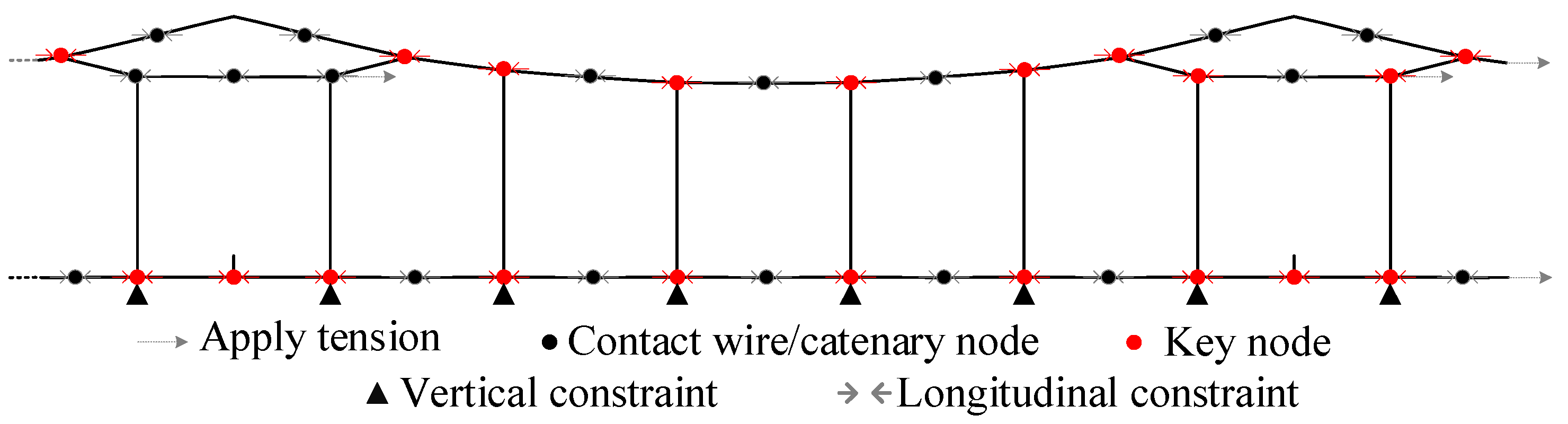
Due to the non-square nature of matrix K T G   K L G , the system possesses an infinite number of solutions. To ensure the uniqueness of the static equilibrium solution, appropriate constraints must be introduced. Based on actual design parameters of the catenary, this study applies the following three types of constraints:
(1)
Vertical position constraints at suspension points along the contact wire to account for reserved sag;
(2)
Longitudinal direction constraints at each node to suppress undesirable longitudinal movement;
(3)
Tension constraints applied to the elastic suspension cable, messenger wire, and contact wire endpoints.
The application of the aforementioned boundary conditions and constraints is illustrated in Figure 1, which clearly shows the vertical position constraints at the suspension points of the contact wire, the longitudinal displacement constraints at each node, and the tension constraints at the endpoints of critical components. These three types of constraints work synergistically to reduce the dimensionality of the system stiffness matrix, thereby uniquely determining the initial equilibrium configuration of the catenary system under the combined effects of self-weight and pretension.
It should be noted that the aforementioned boundary conditions and constraints are activated only during the initial equilibrium solution phase of the system. Their purpose is to ensure the uniqueness and physical plausibility of the static solution [21]. Once the configuration of the catenary system under its own weight and prestress is determined, these auxiliary constraints are immediately released. The system then regains its full dynamic degrees of freedom to proceed with subsequent dynamic response analysis.
After obtaining the initial configuration, the consistent mass matrix M C G and Rayleigh damping matrix C C G are introduced to establish the complete dynamic equations for the catenary system [22]:
M C G U ¨ C t + C C G U ˙ C t + K C G t U C t = F C G t .
where K C G represents the overall stiffness characteristics of the catenary system, while C C G characterizes its energy dissipation mechanism. The system damping parameters are identified based on measured vibration data from typical catenary sections of China’s high-speed railways. The state vector U C ( t ) fully encompasses the motion information of all system nodes, whereas the excitation vector U C ( t ) integrates the effects of pantograph contact force and other external loads [23].

2.2. Dynamic Model of the Pantograph

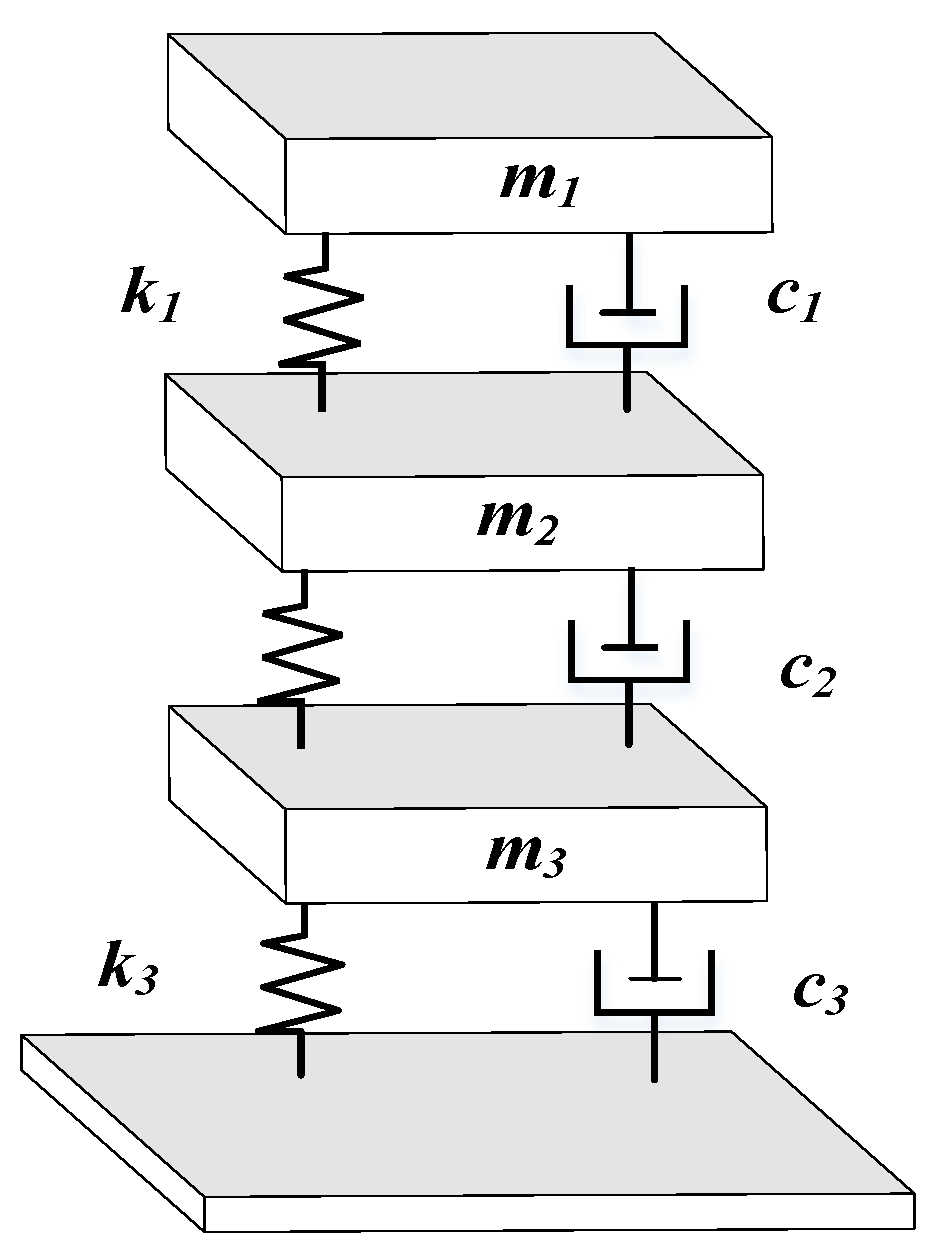
To accurately characterize the dynamic behavior of pantographs under high-speed operating conditions, this paper establishes a three-degree-of-freedom pantograph dynamics model based on linearized parameters [24,25]. This model employs a mass–spring–damper system to simulate the pantograph’s key dynamic characteristics. Its structural design is based on the physical configuration of the pantograph and its energy transfer pathways, effectively capturing the pantograph–catenary coupled vibration characteristics within the 0–20 Hz frequency range, covering the primary dynamic response frequency band of the pantograph–catenary system [26,27,28].
The model decomposes the pantograph system into three key dynamic components: the pantograph head ( m 1 ), the upper frame ( m 2 ), and the lower frame ( m 3 ). Dynamic coupling between subsystems is achieved through linear springs ( k 1 , k 2 , k 3 ) representing structural stiffness and linear dampers ( c 1 , c 2 , c 3 ) representing energy dissipation, forming a complete series vibration system [29].
It should be noted that the three-degree-of-freedom reduced mass model established in this paper is a standard modeling approach widely adopted in the study of pantograph–catenary system dynamics [13,14,30,31]. The mass, stiffness, and damping parameters in the model are directly measured and provided by pantograph manufacturers based on physical bench tests. For analyzing pantograph–catenary coupling characteristics within the target speed range of this study (200–220 km/h), the applicability and accuracy of this model have been fully validated using measured data in Section 3.

2.3. Pantograph–Catenary Coupling and Numerical Solution

To accurately describe the dynamic contact behavior between the contact strips and contact wire, this paper employs a contact force modeling method based on the penalty function approach [32,33,34]. The contact force F c at the interface can be derived based on the penetration displacement between the two contacting bodies.
F c = k s δ δ > 0 0   δ 0   .
where k s represents the contact stiffness, and the relative penetration δ is defined as the change in the normal distance between the contact strips and the contact wire at the point of contact.
At the same time, to ensure both high accuracy and numerical stability in the dynamic simulation results, this paper employs a systematic numerical control strategy. Regarding the pantograph–catenary contact algorithm, the contact stiffness parameter is set to a large value of 2 × 10⁵ N/m. This magnitude effectively suppresses non-physical oscillations potentially triggered by abrupt changes in contact states, thereby ensuring the smoothness of the contact force time history and stable convergence of the computational process.
For the time discretization strategy, the simulation employs a fixed-step integration scheme with a sampling frequency set to 2000 Hz. This frequency significantly exceeds the primary frequency range of the pantograph–catenary system’s dynamic response, satisfying the Nyquist sampling theorem and thereby ensuring numerical stability during dynamic simulation. To control errors introduced by finite element discretization, the contact wire was meticulously meshed with uniform element sizes set at 0.25 m. This dimension maintains computational efficiency while keeping spatial discretization errors within acceptable limits, significantly enhancing the accuracy of dynamic response solutions.
The dynamic behavior of the pantograph in the simulation is modeled using a three-degree-of-freedom reduced mass model, as shown in Figure 2. The equivalent mass, stiffness, and damping parameters were provided by the manufacturer to ensure consistency between the model parameters and the physical characteristics. The specific parameter configuration is detailed in Table 1.

3. Validation and Calibration of Simulation Models

3.1. Experimental Overview

This study’s research data is based on comprehensive speed-upgrading tests conducted on the Guangzhou–Shenzhen Railway Lines I and II. Utilizing field measurement results from CR400AF EMUs operating on these lines, the refined simulation model established in this paper underwent systematic validation and parameter refinement. The testing process strictly adhered to engineering validation procedures, employing high-precision detection methods to obtain measured dynamic response data of pantograph–catenary interactions under diverse operating conditions and across multiple dimensions. This provided an authentic and reliable basis for constructing, validating, and refining the simulation model.
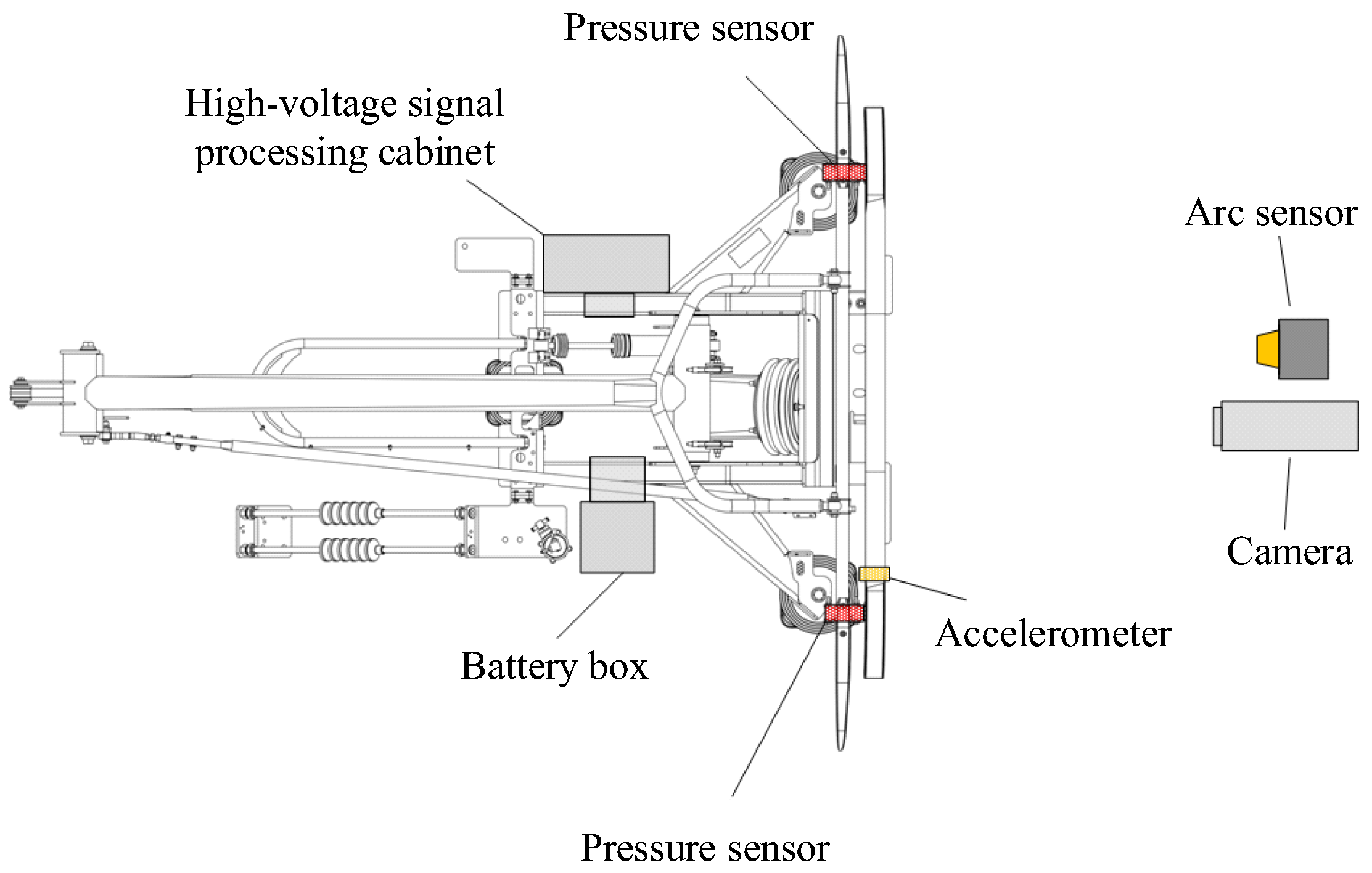
According to the requirements of China’s Technical Specification for the Dynamic Acceptance of High-Speed Railway Projects (TB 10761-2024) [10], the most critical parameter describing the dynamic performance of the pantograph–catenary system is the contact force between the pantograph and the catenary. This contact force can be measured in accordance with the measurement standards specified in the TB 10761-2024 [10]. By integrating contact force sensors, acceleration sensors, signal processing, and transmission devices onto the test pantograph, the measurement signals are fed in real time to the data acquisition system within the EMU for centralized processing. This enables the acquisition of pantograph–catenary current collection performance parameters during EMU operation. The arrangement of detection points on the test pantograph is shown in Figure 3.
Two pressure sensors are installed at the two support points of the pantograph to measure the force between the pantograph head and the framework. A vertical accelerometer is mounted on the pantograph strips to measure the contribution of inertial forces from the pantograph strips. The measured contact force can be expressed as:
f c meas = ( f sp 1 + f sp 2 ) + m strip a strip 1 + f acro .
where f sp 1 and f sp 2 represent the output values of the two sets of pressure sensors beneath the pantograph strips, a strip 1 denotes the output value of the accelerometer on the pantograph strips, m strip signifies the equivalent mass of the pantograph strips, and f acro indicates the aerodynamic contribution to the contact force. According to the TB 10761-2024 [10], the measured contact force shall use the statistical data of the contact force after 0–20 Hz filtering as the primary evaluation indicator to ensure good current collection quality.
The field tests were conducted on the section from K49+500 to K58+750 of the Guangzhou–Shenzhen Line as the primary study area, as the catenary configuration in this section is highly representative. To enable further refined simulation and comparative analysis, two typical consecutive tensioning sections were identified within this range as the specific modeling objects: the K54+400 to K56+724 tensioning section on the Guangzhou–Shenzhen Line I, and the K54+172 to K56+518 tensioning section on the Guangzhou–Shenzhen Line II.
The experimental operating conditions were comprehensively designed to cover the requirements of the speed-upgrading performance evaluation, including single-unit operation at speeds of 200 km/h and 220 km/h, as well as double-unit operation at 200 km/h. For the double configuration, particular emphasis was placed on the current collection characteristics of the trailing pantograph in order to assess the model’s capability to predict dynamic responses under complex coupled excitations. All simulation input parameters were derived from real engineering data, ensuring the accuracy and reliability of the input conditions.

3.2. Single-Unit EMUs Model Verification

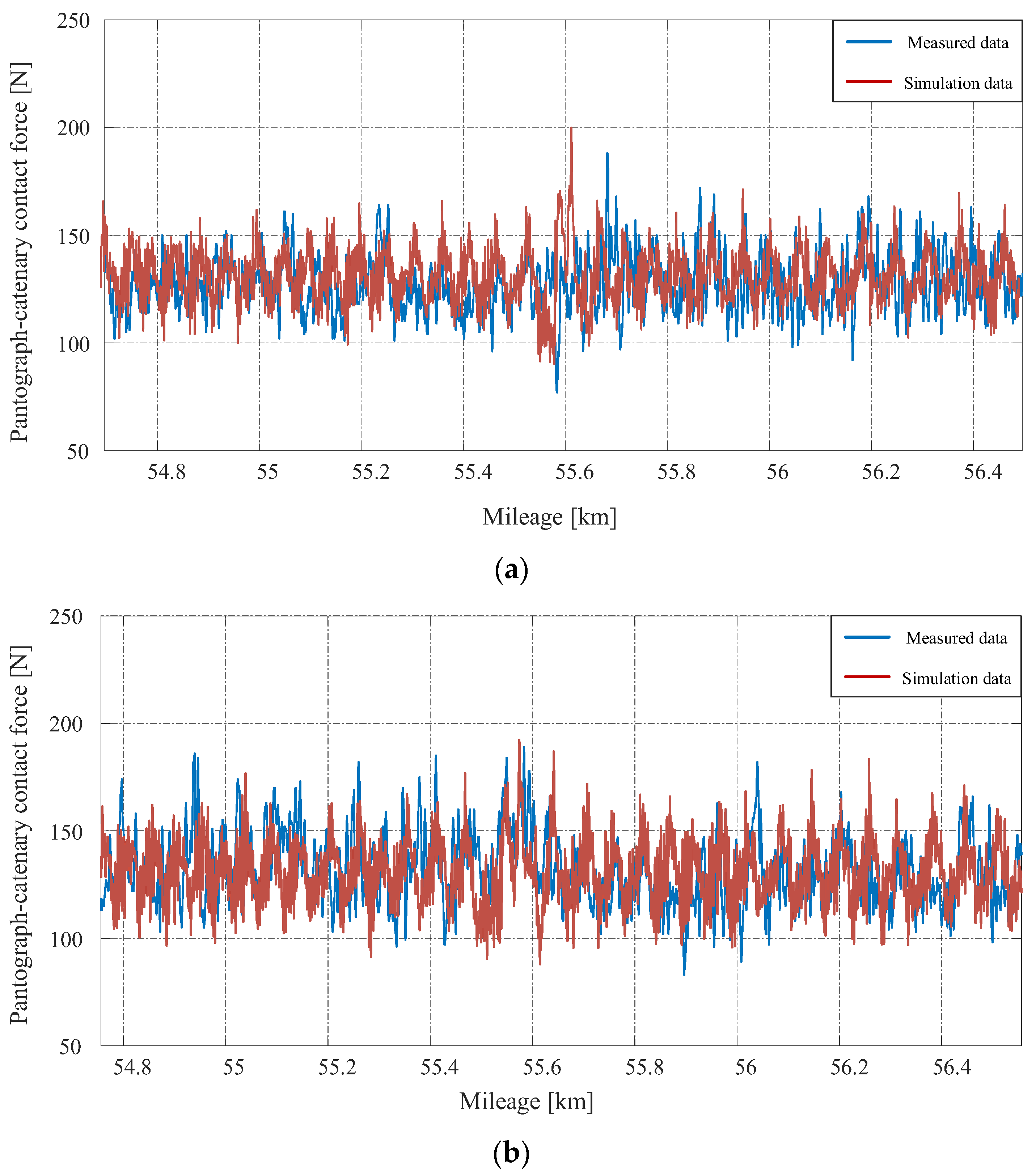
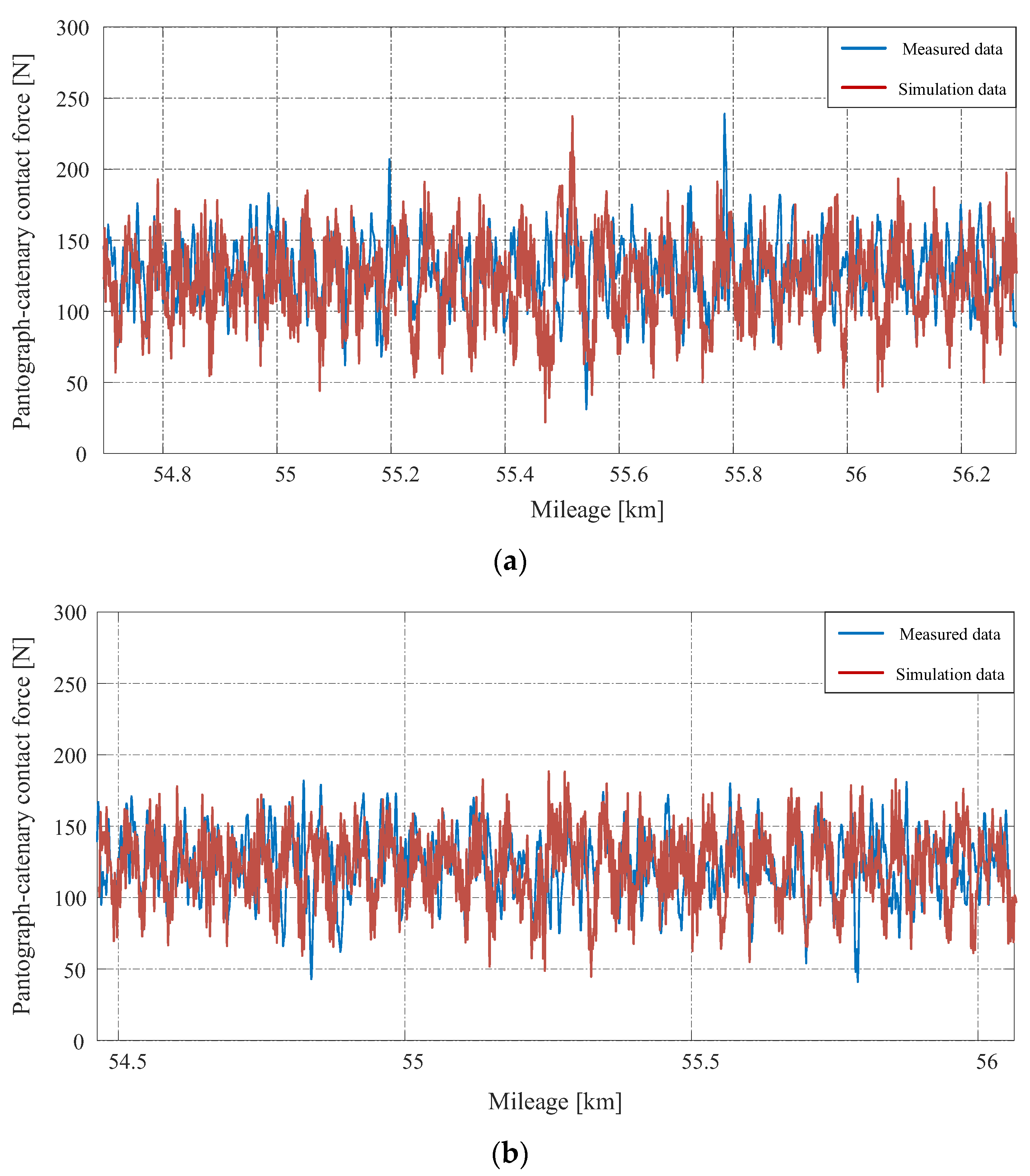
To validate the accuracy of the constructed pantograph–catenary coupling dynamic model under conventional high-speed operating conditions, measured data from CR400AF single-unit EMUs operating at 200 km/h on the Guangzhou–Shenzhen Lines I and II were selected as the calibration benchmark. Figure 4 shows the comparison results between simulated and measured contact force time–history curves within the Guangzhou–Shenzhen I and II Line sections.
As shown in Figure 4, within the focus section, the simulated contact force fluctuation range between the single pantograph and the contact wire is consistent with the test data. To further quantitatively evaluate the model’s predictive accuracy and statistical properties, Table 2 compares the simulated values with the measured values for four core statistical indicators of the contact force.
As shown in Table 2, the simulated values of all statistical indicators closely match the measured values. Specifically, for the maximum contact force indicator, the largest error occurred under Line I operating conditions at 6.43%; the mean value error was controlled within 3.2%; and the standard deviation error remained below 8.4%. The maximum error for all statistical indicators did not exceed 10%. According to the TB 10761-2024 [10], for dynamic simulation models of pantograph–catenary systems, the relative error between simulation results and measured data for key statistical indicators (such as mean contact force, standard deviation, maximum value, and minimum value) must be controlled within 10%. This is generally considered to indicate that the model possesses good engineering credibility, sufficient to support performance evaluations for pantograph–catenary system compatibility design, parameter optimization, and speed-upgrading retrofit schemes. These comparison results demonstrate that the established simulation model exhibits excellent predictive accuracy and reliability under 200 km/h single-unit operation conditions. It accurately reflects the steady-state current-collection characteristics of the pantograph–catenary system during actual operation, providing effective validation and theoretical basis for subsequent simulation analyses under speed-upgrading conditions.

3.3. Double-Unit EMUs Model Verification

Under double-unit train operation conditions, the catenary must withstand alternating excitation and spatial coupling effects from both front and rear pantographs, exhibiting significantly complex and strongly nonlinear dynamic behavior. This study focuses on the CR400AF–CR400AF double-unit EMU, conducting systematic and rigorous validation of the simulation model for the current collection performance of the trailing pantograph during typical operating conditions at 200 km/h. The comparison results between the simulation outcomes of key pantograph–catenary current collection performance parameters and field measurement data are shown in Figure 5.
As illustrated in Figure 5, the simulated pantograph–catenary contact force curve of the trailing pantograph under double-unit operation at 200 km/h agrees well with the experimental measurements from the speed-upgrading test. A more detailed quantitative comparison of the statistical indicators of the contact force between simulation and experiment for this specific working condition is presented in Table 3.
As shown in Table 3, under complex dynamic conditions of double-unit operation, this model maintains exceptional accuracy in predicting key indicators of pantograph–catenary contact force. The prediction error for the maximum contact force was only 3.87% and 5.69% on Lines I and II, respectively, indicating the model’s ability to effectively capture peak dynamic loads under double-pantograph coupling. The standard deviation error of the contact force was controlled within 6.67% and 6.14%, reflecting the model’s good reliability in quantifying the system’s dynamic stability and current collection fluctuation characteristics. Particularly noteworthy is the average contact force prediction error of just 0.31% on Line I and below 8% on Line II, fully validating the model’s high fidelity in characterizing steady-state current-collection performance. Although the minimum contact force error reached 9.85% on Line II, the absolute deviation between simulated and measured values was only 4.48 N, which does not affect the overall assessment of system contact loss risk and current collection safety.
In summary, under core operating conditions, the model developed in this study exhibits prediction errors below 10% for the vast majority of key statistical indicators. Furthermore, the mean and standard deviation of the errors in assessing current collection quality are generally lower. According to the requirements for pantograph–catenary dynamic simulation specified in the TB 10761-2024 [10], the relative error between simulated and measured values for key statistical indicators must be controlled within 10%. In this study, the maximum error for all key statistical indicators under all validated operating conditions was better than this standard. This level of accuracy fully meets the requirements for engineering evaluation of the dynamic performance of high-speed railway pantograph–catenary systems.

4. Simulation Analysis of Pantograph–Catenary Current Collection Performance Under Speed-Upgrading Conditions

This chapter conducts a systematic simulation analysis of the current collection performance of four EMU types—CR300AF, CR400BF, CRH380A, and CRH380B—under speed-upgrading operating conditions on the Guangzhou–Shenzhen Lines I and II, based on a validated pantograph–catenary coupling dynamics model. The evaluated operating conditions include single-unit operation at 200 km/h, single-unit operation at 220 km/h, and double-unit operation at 200 km/h, covering key operational scenarios in the current speed-upgrading retrofit project.

4.1. Evaluation Indicators and Standards

In the assessment of dynamic coupling performance within the pantograph–catenary system, contact pressure is widely regarded as the most critical evaluation metric. During high-speed train operation, the dynamic interaction between the contact strips and the contact wire is highly complex. The spatiotemporal evolution of contact force directly reflects the stability, continuity, and reliability of energy transfer at the pantograph–catenary interface, serving as the decisive factor in assessing current collection quality. To quantitatively evaluate dynamic contact force, four core statistical characteristics are typically extracted: mean, standard deviation, maximum value, and minimum value [35].
This study strictly adheres to the technical requirements of Clause 8.2.4 in the TB 10761-2024 [10]. This clause establishes dynamic performance evaluation criteria based on statistical parameters of pantograph–catenary contact force, with the following specific technical provisions:
The maximum and minimum contact forces (unit: N) must satisfy:
F max F m + 3 σ ,   F min 20 .
This regulation aims to prevent abnormal contact wire wear or mechanical damage to pantographs caused by extreme loads by imposing an upper limit on contact force. Simultaneously, by establishing a lower limit for contact force, it prevents contact loss due to insufficient contact force, thereby ensuring the continuity and stability of current collection.
The average contact force F m (unit: N) shall fall within the permissible range determined by the test speed v j (unit: km/h). Its upper limit F m , max and lower limit F m , min are defined by the following formula:
F m , max 0.00047 ν j 2 + 90 ( ν j 200 km / h ) ,   F m , max 0.00097 ν j 2 + 97 ( ν j > 200 km / h ) ,   F m , min 0.00047 ν j 2 + 60 .
Contact force standard deviation σ (unit: N) is used to measure the intensity of dynamic fluctuations in contact pressure, with its permissible upper limit correlated to the average value:
σ 0.3 × F m .
This constraint ensures that the degree of dynamic contact force dispersion remains within a controllable range, serving as a key indicator for evaluating the system’s operational stability and dynamic tracking performance.

4.2. Analysis of Current Collection Performance for Single-Unit EMUs

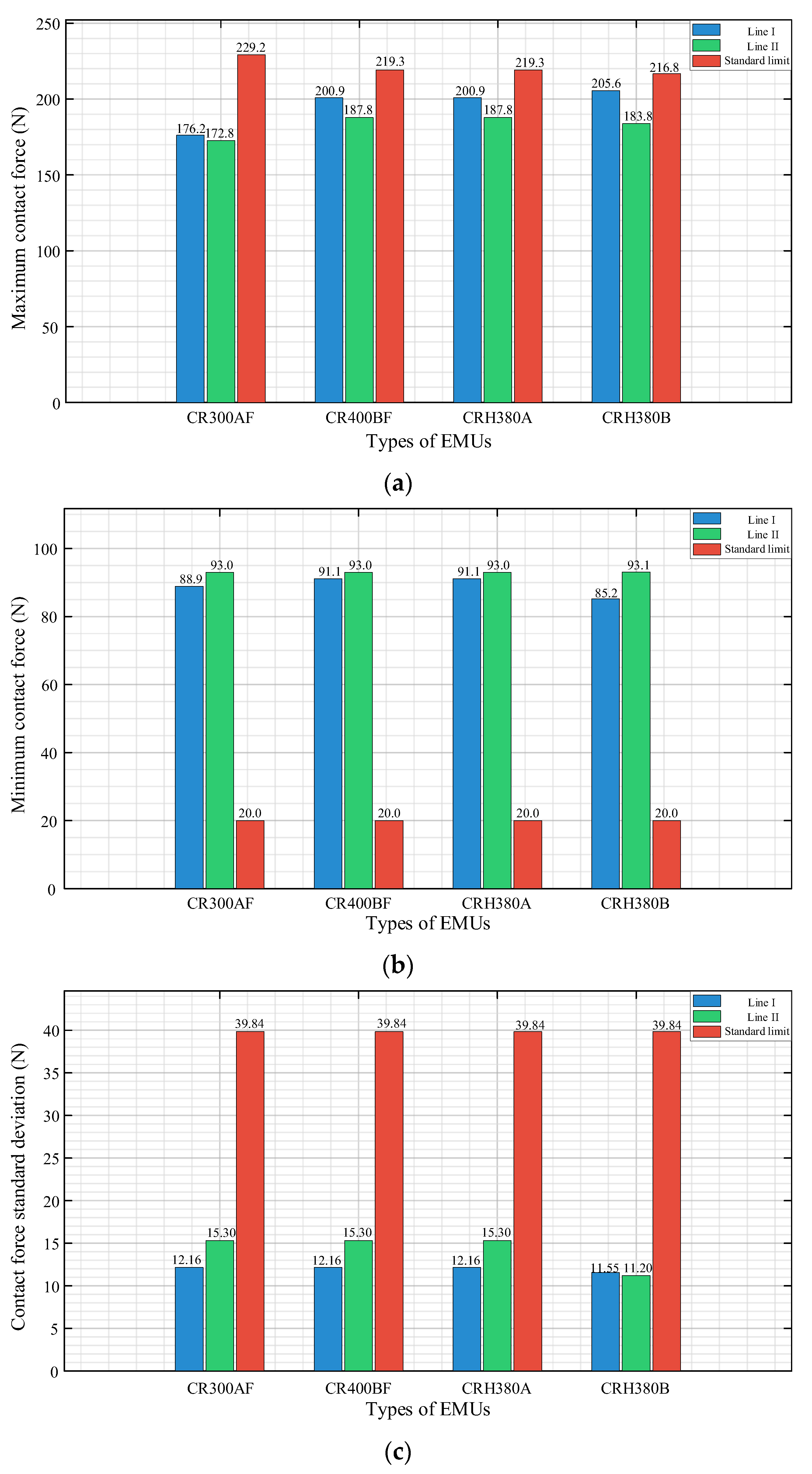
Based on two typical continuous anchor section catenary models constructed within the K49+500 to K58+750 segment of the Guangzhou–Shenzhen Lines I and II, simulation analysis was conducted on the pantograph–catenary contact performance of four single-unit EMU models—CR300AF, CR400BF, CRH380A, and CRH380B—under speed-upgrading conditions. Figure 6 presents the comparative results of statistical indicators for pantograph–catenary contact forces at a running speed of 200 km/h for the aforementioned models.
Analysis of the pantograph–catenary contact force statistics for the four vehicle types operating at 200 km/h in single-unit mode on the Guangzhou–Shenzhen Lines I and II (as shown in Figure 6) indicates that all contact force metrics for every vehicle type meet the standard limit requirements.
For the maximum contact force metric, the CR300AF recorded 172.8 N under Line II operating conditions, representing only 75.4% of the limit value of 229.2 N. CRH380B recorded 205.6 N under Line I conditions, representing 94.8% of the limit value of 216.8 N. These results indicate that at 200 km/h operating speeds, the peak loads of the pantograph–catenary system remain entirely within safe and controllable ranges. Excessive contact forces will not cause abnormal wear on the catenary wire or damage to the contact strips. Regarding minimum contact force, all simulated values significantly exceed the 20 N safety threshold. Specifically, CR300AF achieves 93.0 N under Line II conditions—4.65 times the threshold—while CRH380B reaches 85.2 N under Line I conditions—still 4.26 times the threshold. This fully ensures continuity of pantograph–catenary contact and effectively prevents contact loss risks.
Regarding contact force stability, the standard deviation simulation values for all models ranged from just 11.2 N to 15.3 N, with none exceeding 40% of the specification limit of 39.84 N. Taking the CRH380B under Line II operating conditions as an example, its standard deviation was 11.2 N, representing only 28.1% of the limit; the CR300AF’s standard deviation under Line II conditions was 15.3 N, representing just 38.4% of the limit. These quantitative data demonstrate that the pantograph–catenary system exhibits exceptional dynamic stability at 200 km/h, with minimal contact force fluctuations and a smooth, reliable current collection process.
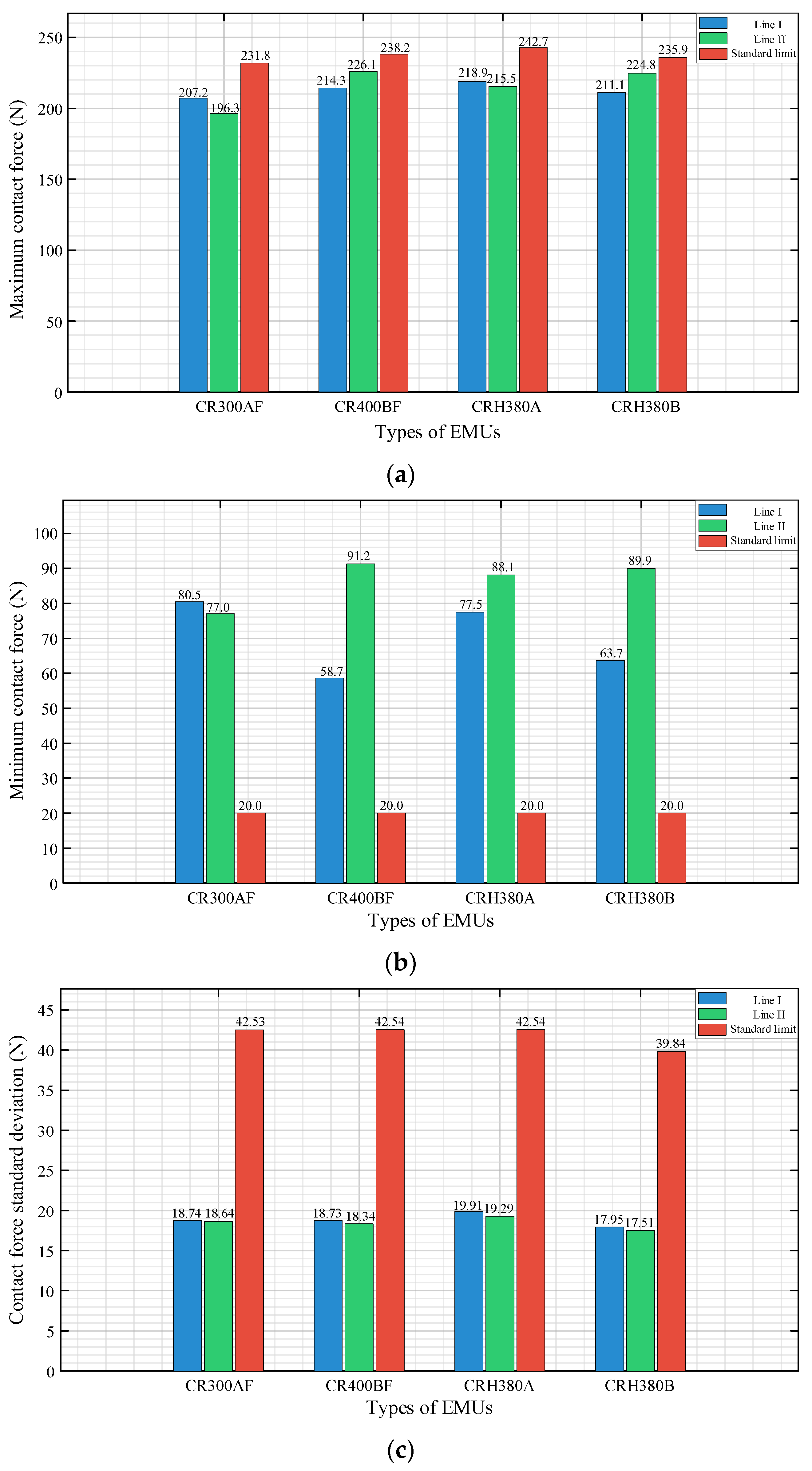
Comprehensive evaluations indicate that at operating speeds of 200 km/h, the existing pantograph–catenary system demonstrates excellent dynamic compatibility with all types of EMUs. All key performance indicators maintain ample safety margins, fully confirming that the catenary systems on the Guangzhou–Shenzhen Lines I and II possess outstanding safety reserves and operational stability at current speed levels. This ensures robust support for the continuous and reliable current collection of high-speed trains. To further evaluate speed-upgrading potential, simulation analysis was conducted based on existing models to assess pantograph–catenary current collection performance for the four single-unit EMU types under 220 km/h speed-upgrading conditions. Figure 7 presents comparative results for corresponding contact force statistical indicators.
Analysis of the data presented in Figure 7 shows that after the speed was increased to 220 km/h, the pantograph–catenary contact performance of all models continues to fully meet specification requirements while maintaining a significant safety margin. Regarding maximum contact force, the CR400BF achieved its peak value of 226.1 N under Line II operating conditions, representing only 94.9% of the limit value of 238.2 N. CR300AF recorded 196.3 N under Line II conditions, representing only 84.7% of the standard limit of 231.8 N. The minimum contact force metric also demonstrated robust performance, with all simulated values far exceeding the 20 N safety threshold. Among these, CR400BF achieved 91.2 N under Line II conditions—4.56 times the safety threshold; even under CR400BF’s Line I operating condition with a lower minimum value (58.7 N), it still reached 2.94 times the safety threshold, fully ensuring the continuity of pantograph–catenary contact.
Regarding dynamic stability, the standard deviation simulation values for all models ranged between 17.51 N and 19.91 N, all significantly below the specification limits. The CRH380B exhibited the lowest standard deviation under Line II conditions at 17.51 N, representing only 44.0% of the corresponding limit of 39.84 N. CRH380A exhibited the highest standard deviation of 19.91 N under Line I conditions, representing only 46.8% of the limit (42.54 N). These results demonstrate that even at speeds elevated to 220 km/h, the dynamic interaction between the pantograph and catenary remains stable and controllable, with contact force fluctuations maintained within an ideal range.
A comprehensive analysis demonstrates that under the operating condition of speed increase to 220 km/h, the pantograph–catenary system of the Guangzhou–Shenzhen Railway Line and various EMU types maintain excellent dynamic compatibility. The control of contact force extremes remains effective, with stable fluctuation characteristics and all key performance indicators retaining sufficient safety margins. From a quantitative perspective, this study substantiates the technical feasibility of increasing the operational speed of single EMUs on the Guangzhou–Shenzhen Line to 220 km/h, providing robust data-driven support for operational decision-making.

4.3. Analysis of Current Collection Performance for Double-Unit EMUs

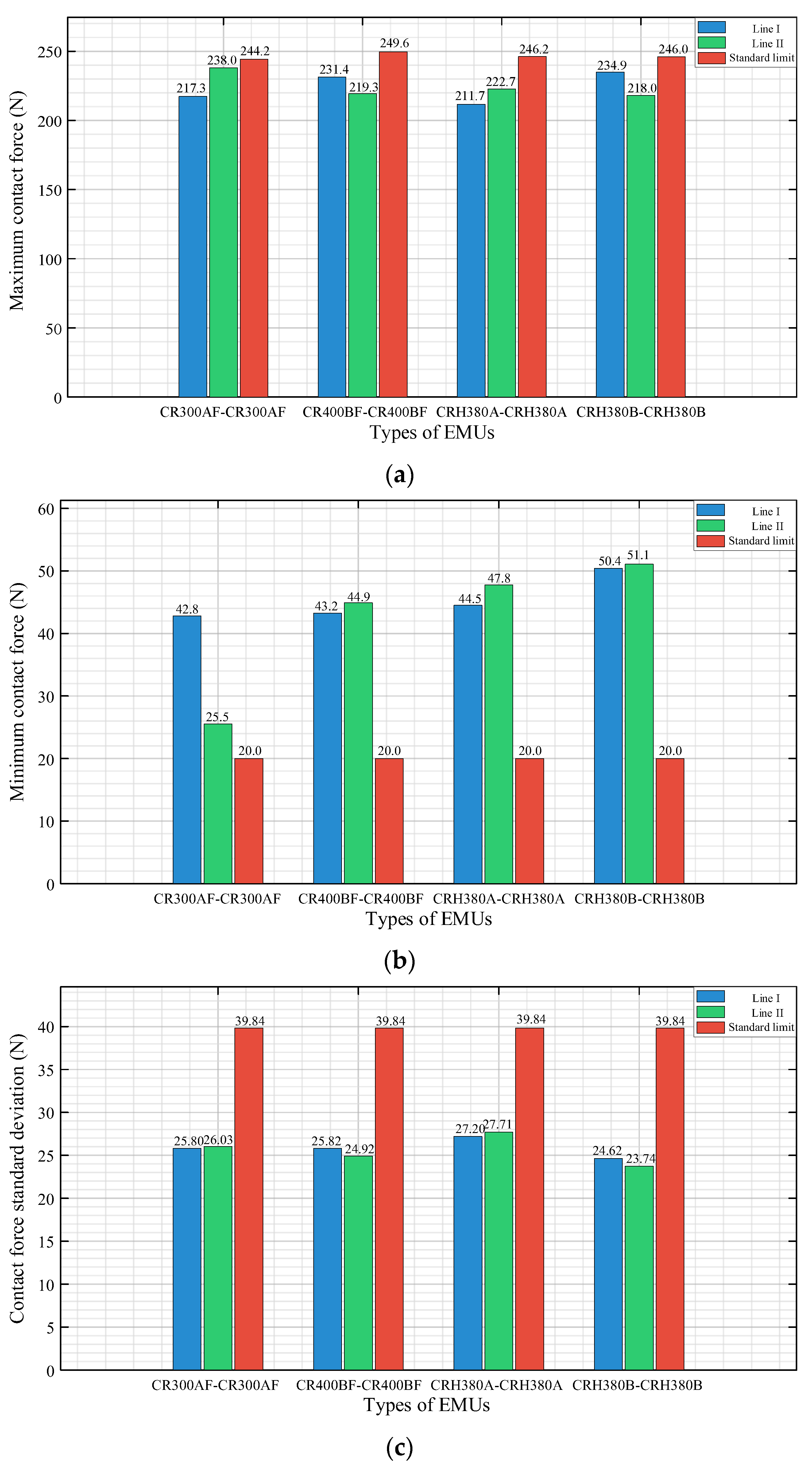
The operation of double-unit EMUs is a key method for enhancing railway transportation capacity, but their pantograph–catenary interaction conditions are more complex than those of single-unit operations. With double pantographs operating simultaneously within the same anchor section, a multi-input–multi-output coupled dynamic system is formed. The trailing pantograph not only undergoes self-excitation but also experiences the superimposed effects of residual vibrations transmitted from the front pantograph through the rear catenary, resulting in the most severe operating conditions. Therefore, simulation analysis focuses on the current collection performance of the trailing pantograph. To comprehensively evaluate the current collection safety of coupled EMUs under high-speed conditions, this study simulates the current collection performance of the trailing pantograph for the four aforementioned EMU models operating coupled at 200 km/h on the Guangzhou–Shenzhen Lines I and II. The statistical results are shown in Figure 8.
Analysis of the contact force simulation data for the trailing pantograph of the four types of double-unit EMUs operating at 200 km/h in Figure 8 reveals that under complex double-unit operation conditions, the pantograph–catenary interaction exhibits certain characteristic changes. However, all key performance indicators continue to fully meet regulatory requirements.
The contact force exhibits a pronounced double-pantograph coupling effect, with maximum values generally approaching but not exceeding the safety threshold. Specifically, the CR300AF–CR300AF configuration reached 238.0 N under Line II conditions, representing 97.5% of the corresponding limit of 244.2 N, thus maintaining the required safety margin. Regarding minimum contact force, all simulated values significantly exceeded the 20 N safety threshold. CR300AF–CR300AF recorded a minimum of 25.5 N under Line II conditions—27.5% above the safety threshold—while CRH380B–CRH380B reached 51.1 N under Line II conditions, equivalent to 2.56 times the safety threshold, ensuring sustained stability of pantograph–catenary contact.
Regarding dynamic stability characteristics, the standard deviation simulation values for all models ranged from 23.74 N to 27.71 N, representing a significant increase compared to single-unit operation conditions. Detailed analysis indicates that the CRH380A–CRH380A model achieved a standard deviation of 27.71 N under Line II conditions, equivalent to 69.6% of the regulatory limit of 39.84 N. The CRH380B–CRH380B model recorded a standard deviation of 23.74 N under Line II conditions, representing 59.6% of the limit. These quantitative results directly reflect the dynamic impact of contact wire vibrations induced by front pantograph excitation on the operational state of the trailing pantograph, though the fluctuation amplitude remains entirely within controllable limits.
It is noteworthy that the standard deviation of trailing pantograph contact force varies significantly across different train combinations. Taking the Guangzhou–Shenzhen Line II as an example, the CRH380A–CRH380A combination exhibits a standard deviation of 27.71 N, approximately 4 N higher than that of the CRH380B–CRH380B combination (23.74 N).
This disparity primarily stems from differing dynamic characteristics of the pantographs. As indicated by the pantograph equivalent mass model parameters in Table 1, the pantograph head mass (m1 = 7.63 kg) of the DSA380 pantograph assigned to CRH380A is greater than that of the CX-018 pantograph (m1 = 5.3 kg) assigned to CRH380B. According to existing research [36,37], a heavier pantograph head reduces the quality of current collection. The fundamental reason for this is that when the pantograph head is heavier, a more pronounced inertial impact occurs at the moment of contact, thereby inducing stronger residual vibrations in the catenary system and leading to an increase in the standard deviation of the contact force for the trailing pantograph. Nevertheless, the fluctuation amplitude for all combinations remained within standard limits, validating the safety and reliability of the existing system under the accelerated speed objectives.
Overall, under 200 km/h operating conditions on the Guangzhou–Shenzhen I and II lines, all contact force metrics between the trailing pantograph and contact wire of the four heavy-duty EMU sets met standard limits, with key indicators consistently maintaining significant safety margins. No instances of contact force amplitude exceeding limits or contact loss occurred across all models, with operational stability metrics also remaining well below permissible upper bounds. Results confirm that all four double-unit trains possess safe and stable current collection capabilities under current line conditions, with pantograph–catenary system compatibility meeting high-speed operational requirements. This provides dynamic validation of the technical feasibility of the Guangzhou–Shenzhen Line’s catenary system to support double-unit train operations at 200 km/h.

5. Conclusions

This study addresses critical issues concerning pantograph–catenary contact safety in speed-upgrading projects. It establishes a refined pantograph–catenary coupling simulation system integrating a nonlinear dynamic catenary model based on absolute node coordinates with a three-lumped-masses pantograph model. The model underwent systematic validation and parameter refinement using actual measurement data from CR400AF trains operating in both single-unit and double-unit configurations, confirming its predictive accuracy. Based on this foundation, the system comprehensively evaluated the pantograph–catenary current collection performance of four train types—CR300AF, CR400BF, CRH380A, and CRH380B—under speed-upgrading conditions. Key findings are as follows:
(1)
Model validation results demonstrate that the simulated and measured contact force curves exhibit high consistency in waveform trends, fluctuation amplitudes, and characteristic peaks. Among statistical metrics, the maximum error for single-unit operation at 200 km/h is 9.49%, while the maximum error for double-unit operation at 200 km/h is 9.85%. All errors remain below 10%, confirming the model’s high engineering credibility and adaptability to operational conditions.
(2)
Simulation analysis of single-unit operation conditions shows that for all four vehicle types, the maximum, minimum, and standard deviation values of pantograph–catenary contact force at speeds of 200 km/h and 220 km/h all meet the standard requirements. The maximum contact force values were 205.6 N and 226.1 N, respectively, both below the corresponding speed-level standard requirements of 216.8 N and 238.2 N. Additionally, the maximum contact force standard deviations of 15.30 N and 19.91 N were significantly below the established standards of 39.84 N and 42.54 N.
(3)
Simulation analysis of double-unit operation conditions indicates that at 200 km/h, the pantograph–catenary contact force metrics for the trailing pantographs of all train formations meet specification requirements. The maximum contact force was 238.0 N, below the standard requirement of 244.2 N. The maximum contact force standard deviation was 27.71 N, significantly lower than the standard requirement of 39.84 N. This verifies that the pantograph–catenary system maintains excellent dynamic stability and current collection safety during double-unit operation.
It should be noted that although this study has achieved systematic progress in the simulation-based evaluation of pantograph–catenary current collection performance under speed-upgrading conditions, several limitations remain. The present work primarily focuses on compliance verification of the dynamic contact force, without extending to the long-term effects of contact wire and strips wear prediction and fatigue life assessment, or the investigation of electromechanical coupling characteristics within the pantograph–catenary system. In addition, the model validation data are mainly derived from a single train type (CR400AF), and its general applicability under multi-train mixed operation scenarios and a broader speed range still requires further verification. Future research may further incorporate the Archard wear model and Miner fatigue criterion to establish correlations between dynamic contact forces and wear evolution, as well as fatigue life. Concurrently, electromagnetic and thermal field analyses should be coupled to investigate electromechanical coupling characteristics. The model’s universality should be validated through simulations and experimental comparisons across multiple vehicle types and higher speeds.

Author Contributions

Conceptualization, L.W. and Y.L.; methodology, L.W. and D.Z.; software, X.W., T.X. and Y.S.; validation, Y.L. and X.W.; formal analysis, L.W. and D.Z.; investigation, L.W. and Y.L.; resources, L.W. and D.Z.; data curation, X.W. and T.X.; writing—original draft preparation, L.W. and Y.L.; writing—review and editing, D.Z. and X.W.; visualization, Y.L.; supervision, Y.S.; project administration, Y.S.; funding acquisition, L.W. and Y.S. All authors have read and agreed to the published version of the manuscript.

Funding

This research was funded by the National Natural Science Foundation of China (U2468230), Scientific and Technological Research and Development Program of China State Railway Group Co., Ltd. (L2025G002), Guangshen Railway Co., Ltd. Entrusted Scientific Research and Testing Project (25JGZC0005YF), Sichuan Science and Technology Program (2026YFHZ0062).

Data Availability Statement

The original contributions presented in this study are included in the article. Further inquiries can be directed to the corresponding author.

Conflicts of Interest

Authors L.W. and T.X. were employed by the company China Academy of Railway Sciences Group Co., Ltd., Author D.Z. was employed by the company Sichuan Development International Commercial Spaceport Co., Ltd. The remaining authors declare that the research was conducted in the absence of any commercial or financial relationships that could be construed as a potential conflict of interest.

Abbreviations

The following abbreviations are used in this manuscript:
EMUElectric multiple unit
ANCFAbsolute Nodal Coordinate Formulation

References

  1. Cheng, Y.; Yan, J.; Zhang, F.; Li, M.; Zhou, N.; Shi, C.; Jin, B.; Zhang, W. Surrogate modeling of pantograph-catenary system interactions. Mech. Syst. Signal Process. 2025, 224, 112134. [Google Scholar] [CrossRef]
  2. Zhai, W.; Cai, C. Effect of locomotive vibrations on pantograph-catenary system dynamics. Veh. Syst. Dyn. 1998, 29, 47–58. [Google Scholar] [CrossRef]
  3. Song, Y. Study on High-Speed Railway Pantograph-Catenary Current Collection Quality Under Environmental Wind Load. Ph.D. Thesis, Southwest Jiaotong University, Chengdu, China, 2018. [Google Scholar]
  4. Zhang, W. The development of China’s high-speed railway systems and a study of the dynamics of coupled systems in high-speed trains. Proc. Inst. Mech. Eng. Part F J. Rail Rapid Transit 2014, 228, 367–377. [Google Scholar] [CrossRef]
  5. Wang, H.; Song, Y.; Yang, H.; Liu, Z. Generalized Koopman Neural Operator for Data-Driven Modeling of Electric Railway Pantograph–Catenary Systems. IEEE Trans. Transp. Electrif. 2025, 11, 14100–14112. [Google Scholar] [CrossRef]
  6. Wang, X.; Song, Y.; Yang, H.; Wang, H.; Lu, B.; Liu, Z. A time-frequency dual-domain deep learning approach for high-speed pantograph-catenary dynamic performance prediction. Mech. Syst. Signal Process. 2025, 238, 113258. [Google Scholar] [CrossRef]
  7. Song, Y.; Duan, F.; Liu, Z. Analysis of Critical Speed for High-Speed Railway Pantograph-Catenary System. IEEE Trans. Veh. Technol. 2022, 71, 3547–3555. [Google Scholar] [CrossRef]
  8. Song, Y.; Liu, Z.; Wang, H.; Lu, X.; Zhang, J. Nonlinear modelling of high-speed catenary based on analytical expressions of cable and truss elements. Veh. Syst. Dyn. 2015, 53, 1455–1479. [Google Scholar] [CrossRef]
  9. Liu, Z.; Song, Y.; Han, Y.; Wang, H.; Zhang, J.; Han, Z. Advances of research on high-speed railway catenary. J. Mod. Transp. 2017, 26, 1–23. [Google Scholar] [CrossRef]
  10. TB 10761-2024; Technical Specification for Dynamic Acceptance of High-Speed Railway Projects. China Railway Publishing House: Beijing, China, 2024.
  11. Song, Y.; Liu, Z.; Lu, X. Dynamic Performance of High-Speed Railway Overhead Contact Line Interacting with Pantograph Considering Local Dropper Defect. IEEE Trans. Veh. Technol. 2020, 69, 5958–5967. [Google Scholar] [CrossRef]
  12. Zhao, F.; Liu, Z.; Zhang, X. Simulation of High-speed Pantograph-catenary System Dynamic Performance Based on Finite Element Model. J. China Railw. Soc. 2012, 34, 33–38. [Google Scholar] [CrossRef]
  13. Liu, Z.; Song, Y.; Gao, S.; Wang, H. Review of Perspectives on Pantograph-Catenary Interaction Research for High-Speed Railways Operating at 400 Km/h and Above. IEEE Trans. Transp. Electrif. 2024, 10, 7236–7257. [Google Scholar] [CrossRef]
  14. Hu, X.; Yu, S.; Wang, X.; Guan, J.; Song, Y. Simulation Study on the Pantograph–Catenary System for 400 km/h High-Speed Railways. J. China Railw. Soc. 2018, 40, 48–56. [Google Scholar] [CrossRef]
  15. Guan, J.; Tian, Z.; Wu, J. Research of 160km/h Transition Structure Proposal between Overhead Conductor Railand Contact Line Based on Dynamic Simulation. J. China Railw. Soc. 2018, 40, 48–56. [Google Scholar] [CrossRef]
  16. Lopez-Garcia, O.; Carnicero, A.; Torres, V. Computation of the initial equilibrium of railway overheads based on the catenary equation. Eng. Struct. 2006, 28, 1387–1394. [Google Scholar] [CrossRef]
  17. Mei, G. The Dynamic Study of Pantogeraph/Catenary System. Ph.D. Thesis, Southwest Jiaotong University, Chengdu, China, 2011. [Google Scholar]
  18. Peng, C.; Yang, C.; Xue, J.; Gong, Y.; Zhang, W. An adaptive variable-length cable element method for form-finding analysis of railway catenaries in an absolute nodal coordinate formulation. Eur. J. Mech. A-Solids 2022, 93, 104545. [Google Scholar] [CrossRef]
  19. Anastasio, D.; Fasana, A.; Garibaldi, L.; Marchesiello, S. Analytical investigation of railway overhead contact wire dynamics and comparison with experimental results. Mech. Syst. Signal Process. 2019, 116, 277–292. [Google Scholar] [CrossRef]
  20. Vo, D.; Nanakorn, P.; Bui, T.Q. A total Lagrangian Timoshenko beam formulation for geometrically nonlinear isogeometric analysis of spatial beam structures. Acta Mech. 2020, 231, 3673–3701. [Google Scholar] [CrossRef]
  21. Zhang, H.; Zhao, Y.; Wang, X.; Pan, L.; Wang, Z. Study on the Wear Characteristics of the Positioning Device in High-Speed Railway Catenary Systems. Electr. Railw. 2024, 35, 54–58+67. [Google Scholar] [CrossRef]
  22. Lu, X.; Lin, Z.; Yang, J.; Deng, Y.; Ding, R. Study on Dynamic Performance Index of Overhead Contact System of 400 km/h High-speed Railway. High Speed Railw. Technol. 2021, 12, 96–101. [Google Scholar] [CrossRef]
  23. Navik, P.; Ronnquist, A.; Stichel, S. Identification of system damping in railway catenary wire systems from full-scale measurements. Eng. Struct. 2016, 113, 71–78. [Google Scholar] [CrossRef]
  24. Lesser, M.; Karlsson, L.; Drugge, L. An interactive model of a pantograph-catenary system. Veh. Syst. Dyn. 1996, 25, 397–412. [Google Scholar] [CrossRef]
  25. Wang, X.; Song, Y.; Lu, B.; Wang, H.; Liu, Z. Assessment of Current Collection Performance of Rail Pantograph-Catenary Considering Long Suspension Bridges. IEEE Trans. Instrum. Meas. 2025, 74, 3522408. [Google Scholar] [CrossRef]
  26. Kim, J.W.; Chae, H.C.; Park, B.S.; Lee, S.Y.; Han, S.S.; Jang, J.H. State sensitivity analysis of the pantograph system for a high-speed rail vehicle considering span length and static uplift force. J. Sound Vib. 2007, 303, 405–427. [Google Scholar] [CrossRef]
  27. Zhou, N.; Lv, Q.; Yang, Y.; Zhang, W. Statement of methods. Veh. Syst. Dyn. 2015, 53, 380–391. [Google Scholar] [CrossRef]
  28. Pan, L.; Peng, P.; Chen, L.; He, F. Numerical analysis of pantograph-catenary coupling vibration for high-speed railways. AIP Adv. 2024, 14, 9. [Google Scholar] [CrossRef]
  29. Zhang, J.; Zhang, H.; Song, B.; Xie, S.; Liu, Z. A New Active Control Strategy for Pantograph in High-Speed Electrified Railways Based on Multi-Objective Robust Control. IEEE Access 2019, 7, 173719–173730. [Google Scholar] [CrossRef]
  30. Bruni, S.; Bucca, G.; Facchinetti, A.; Gregori, S.; Pombo, J. Recent developments on pantograph-overhead line interaction. Veh. Syst. Dyn. 2025, 63, 1358–1394. [Google Scholar] [CrossRef]
  31. Lu, W.; Zhou, N.; Cheng, H.; Wang, X.; Chen, Y.; Zhang, W. Research on Pantograph-Catenary Dynamics Characteristics in Mixed Double Pantographs Formation of Different Types. Urban Mass Transit 2025, 28, 165–171. [Google Scholar] [CrossRef]
  32. Song, Y.; Wang, Z.; Liu, Z.; Wang, R. A spatial coupling model to study dynamic performance of pantograph-catenary with vehicle-track excitation. Mech. Syst. Signal Process. 2021, 151, 107336. [Google Scholar] [CrossRef]
  33. Yao, Y.; Zou, D.; Zhou, N.; Mei, G.; Wang, J.; Zhang, W. A study on the mechanism of vehicle body vibration affecting the dynamic interaction in the pantograph-catenary system. Veh. Syst. Dyn. 2020, 59, 1335–1354. [Google Scholar] [CrossRef]
  34. Cho, Y.H. Numerical simulation of the dynamic responses of railway overhead contact lines to a moving pantograph, considering a nonlinear dropper. J. Sound Vib. 2008, 315, 433–454. [Google Scholar] [CrossRef]
  35. Yang, H.; Liu, Z.; Cui, H.; Ma, N.; Wang, H.; Zhang, C.; Song, Y. An Electrified Railway Catenary Component Anomaly Detection Frame Based on Invariant Normal Region Prototype with Segment Anything Model. IEEE Trans. Transp. Electrif. 2025, 12, 1391–1402. [Google Scholar] [CrossRef]
  36. Pombo, J.; Ambrósio, J. Influence of pantograph suspension characteristics on the contact quality with the catenary for high speed trains. Comput. Struct. 2012, 110–111, 32–42. [Google Scholar] [CrossRef]
  37. Park, T.-J.; Han, C.-S.; Jang, J.-H. Dynamic sensitivity analysis for the pantograph of a high-speed rail vehicle. J. Sound Vib. 2003, 266, 235–260. [Google Scholar] [CrossRef]
Figure 1. Schematic illustration of the application of boundary conditions in the catenary system.
Vehicles 08 00095 g001
Figure 2. Three-degree-of-freedom reduced mass model of the pantograph.
Vehicles 08 00095 g002
Figure 3. Schematic diagram of installation measurement point layout for pantograph.
Vehicles 08 00095 g003
Figure 4. Comparison of pantograph–catenary contact force of the CR400AF EMU at 200 km/h: (a) Guangzhou–Shenzhen Line I; (b) Guangzhou–Shenzhen Line II.
Vehicles 08 00095 g004
Figure 5. Comparison of pantograph contact force at 200 km/h for trailing pantograph: (a) Guangzhou–Shenzhen Line I; (b) Guangzhou–Shenzhen Line II.
Vehicles 08 00095 g005
Figure 6. Comparison of statistical indices of pantograph–catenary contact force for single-unit EMUs at 200 km/h: (a) maximum pantograph–catenary contact force; (b) minimum pantograph–catenary contact force; and (c) standard deviation of pantograph–catenary contact force. The standard limits shown in the figures are derived from the TB 10761-2024 [10].
Vehicles 08 00095 g006
Figure 7. Comparison of statistical indices of pantograph–catenary contact force for single-unit EMUs at 220 km/h: (a) maximum pantograph–catenary contact force; (b) minimum pantograph–catenary contact force; and (c) standard deviation of pantograph–catenary contact force.
Vehicles 08 00095 g007
Figure 8. Comparative analysis of statistical indices of pantograph–catenary contact force for double-unit EMUs at 200 km/h: (a) maximum pantograph–catenary contact force; (b) minimum pantograph–catenary contact force; and (c) standard deviation of pantograph–catenary contact force.
Vehicles 08 00095 g008
Table 1. Parameters related to the calculated mass model of pantographs mounted on different EMUs.
EMU ModelCR300AFCR400AFCR400BFCRH380ACRH380B
Pantograph modelDSA250CX-GI030CX-GI032DSA380CX-018
m1/kg8.025.965.967.635.3
m2/kg712.3512.35612
m3/kg6.358.918.915.88.5
c1/(N·s·m−1)54416000600094306000
c2/(N·s·m−1)639113,00013,00014,10013,000
c3/(N·s·m−1)8010100.110
k1/(N·m−1)02525025
k2/(N·m−1)01515015
k3/(N·m−1)7015015070150
Pantograph distance/m208.3205.2220202.8220
Table 2. Comparison and validation of simulated and measured data for contact force indicators between pantograph and catenary in single-unit operating conditions.
Line ILine IIMaximum Error
maximum valuemeasured value1881896.43%
simulated value200.9187.8
minimum valuemeasured value77839.49%
simulated value91.193.0
mean valuemeasured value127.84130.753.18%
simulated value132.04132.01
standard deviationmeasured value13.7916.138.36%
simulated value12.1615.30
Table 3. Comparison and validation of simulated and measured data for pantograph–-catenary contact force in double-unit operation.
Line ILine III-Line ErrorII-Line Error
maximum valuemeasured value2392233.87%5.69%
simulated value248.62226.06
minimum valuemeasured value31416.79%9.85%
simulated value33.2645.48
mean valuemeasured value128.06121.560.31%7.98%
simulated value132.17132.10
standard deviationmeasured value22.4422.026.67%6.14%
simulated value24.0423.46
Disclaimer/Publisher’s Note: The statements, opinions and data contained in all publications are solely those of the individual author(s) and contributor(s) and not of MDPI and/or the editor(s). MDPI and/or the editor(s) disclaim responsibility for any injury to people or property resulting from any ideas, methods, instructions or products referred to in the content.