The energy performance assessment framework employed in this work relies on the coupled simulation of the vehicle longitudinal dynamics and the functional behavior of the principal elements of the electric powertrain, namely the permanent magnet synchronous motor (PMSM), the traction inverter, and the onboard energy source. Within the adopted modeling assumptions, this integrated approach enables a consistent estimation of power flow distribution and overall energy demand under operating conditions representative of the WLTP driving cycle.
The numerical model workflow follows a sequential structure. Starting from the prescribed vehicle speed profile, the required traction forces and drivetrain operating points are derived, which subsequently allows for the evaluation of component-level electrical and mechanical loads. Based on these results, the specific energy consumption, achievable driving range, and relevant stress indicators of the electric propulsion system are quantified for the investigated operating scenarios.
2.1. Longitudinal Vehicle Dynamic Model
The longitudinal vehicle dynamics are modeled to compute the traction force required to follow the prescribed WLTP speed profile. The model accounts for aerodynamic drag, rolling resistance, inertial effects, and road load contributions. The resulting drivetrain operating points are used as inputs for the electric powertrain component models.
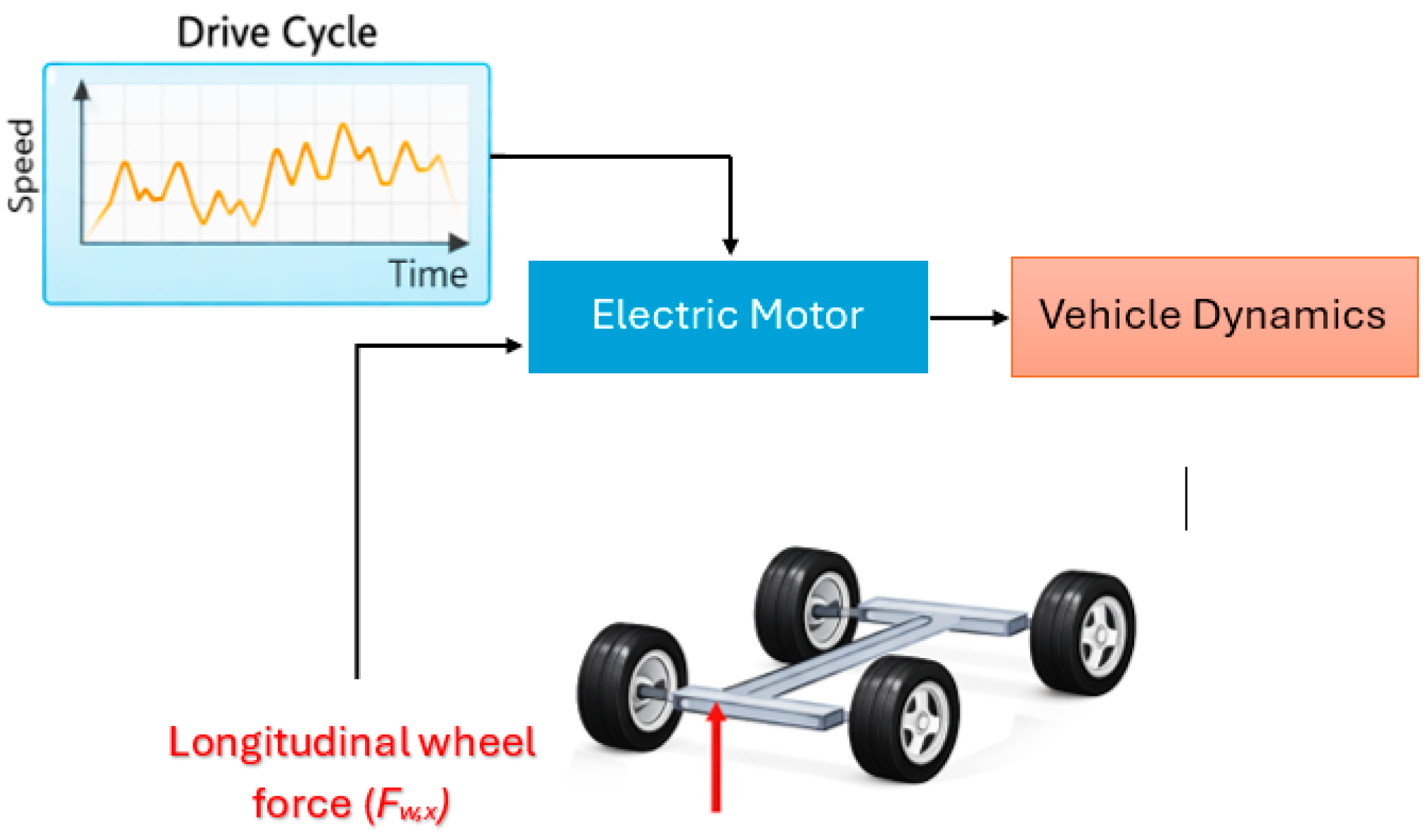
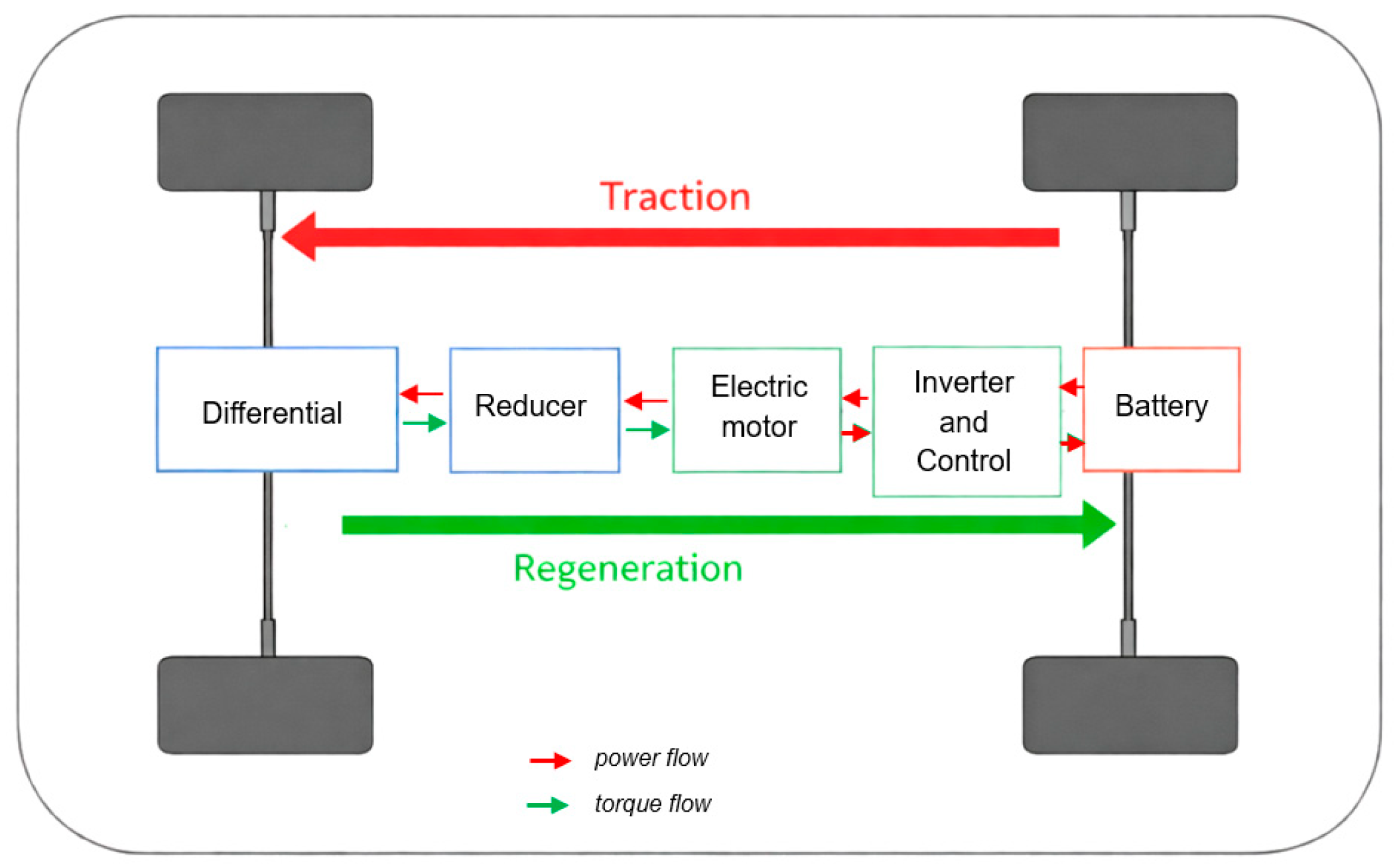
A backward-facing modeling strategy (
Figure 1) is adopted, whereby the prescribed vehicle speed profile is used to derive the corresponding traction force and drivetrain operating conditions [
1,
3,
4].
The vehicle considered in the investigation is a compact-class BEV equipped with a front-mounted PMSM-based electric powertrain, mechanically coupled to the driven wheels through a fixed-ratio transmission (final drive) and a differential.
The vehicle is modeled using longitudinal dynamics, neglecting lateral and vertical effects. The equation of motion in the longitudinal direction [
4] is given by:
where
denotes the total longitudinal wheel force,
is the rolling resistance,
is the aerodynamic drag,
is the grade resistance, and
is the inertial resistance. The term total longitudinal force is used to emphasize the net force required at the wheels to overcome resistive and inertial effects.
For battery electric vehicles (BEVs), the rolling resistance force represents energy losses associated with the interaction between the pneumatic tires and the road surface. It is commonly modeled as a function of the vehicle weight
and the rolling resistance coefficient
:
For passenger BEVs equipped with low rolling resistance tires, typical values of
range between 0.008 and 0.015 [
31]. In this work, a speed-dependent formulation is adopted:
where
is the vehicle speed in km/h. This semi-empirical expression is implemented within the longitudinal vehicle dynamics model to provide a realistic estimation of rolling resistance over the WLTP operating range.
The aerodynamic resistance
is given by:
where
is the air density (
) corresponding to the International Standard Atmosphere conditions (dry air at 15 °C and 1 atm), commonly adopted in vehicle longitudinal dynamics modeling,
denotes the aerodynamic drag coefficient,
is the frontal projected area of the vehicle, and
is the vehicle speed relative to the ambient air.
The grade resistance
corresponds to the longitudinal component of the vehicle weight acting along the direction of motion and is given by:
where
is the road inclination, typically expressed as a percentage grade
. Since the WLTP cycle is defined for level-road conditions, the grade resistance term is neglected in the present analysis.
The inertial resistance
represents the force required to overcome the vehicle’s inertia during longitudinal acceleration or deceleration and is formulated as:
where
is the longitudinal acceleration,
is the gravitational acceleration, and
accounts for the contribution of rotating masses to the equivalent translational inertia. For the considered BEV with a single-speed drivetrain,
is evaluated using a speed-dependent empirical expression:
which yields higher values at low speeds and approaches unity at high speeds. To preserve model simplicity, a constant value of
is adopted.
By substituting the individual resistance components into (1) and considering WLTP level-road conditions, the required longitudinal wheel force becomes:
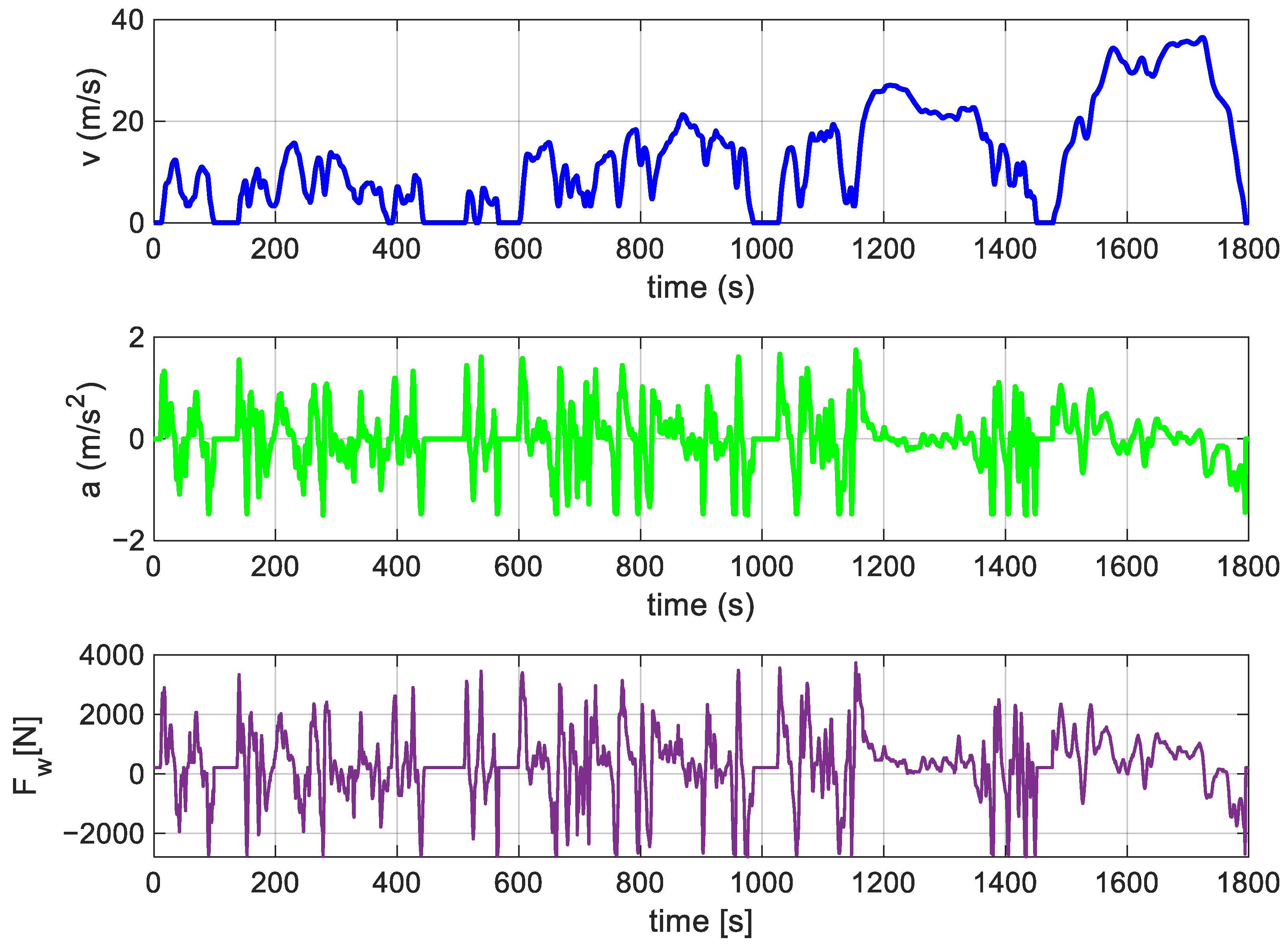
Figure 2 illustrates the temporal distribution of the vehicle velocity
, acceleration
, and longitudinal force
. The vehicle speed profile used for the determination of the longitudinal forces corresponds to the WLTP driving cycle, as detailed in
Section 2.6.
The instantaneous mechanical power at the wheels is computed as:
Based on the imposed speed profile, the wheel angular speed is obtained as:
where
is the rolling radius of the wheel.
The electric motor angular speed is obtained by applying the transmission ratio:
The mechanical torque at the wheels is determined from the power balance condition as:
while the torque demand at the electric motor shaft is obtained by accounting for the transmission ratio and drivetrain efficiency:
where
is the fixed transmission ratio and
is the drivetrain efficiency.
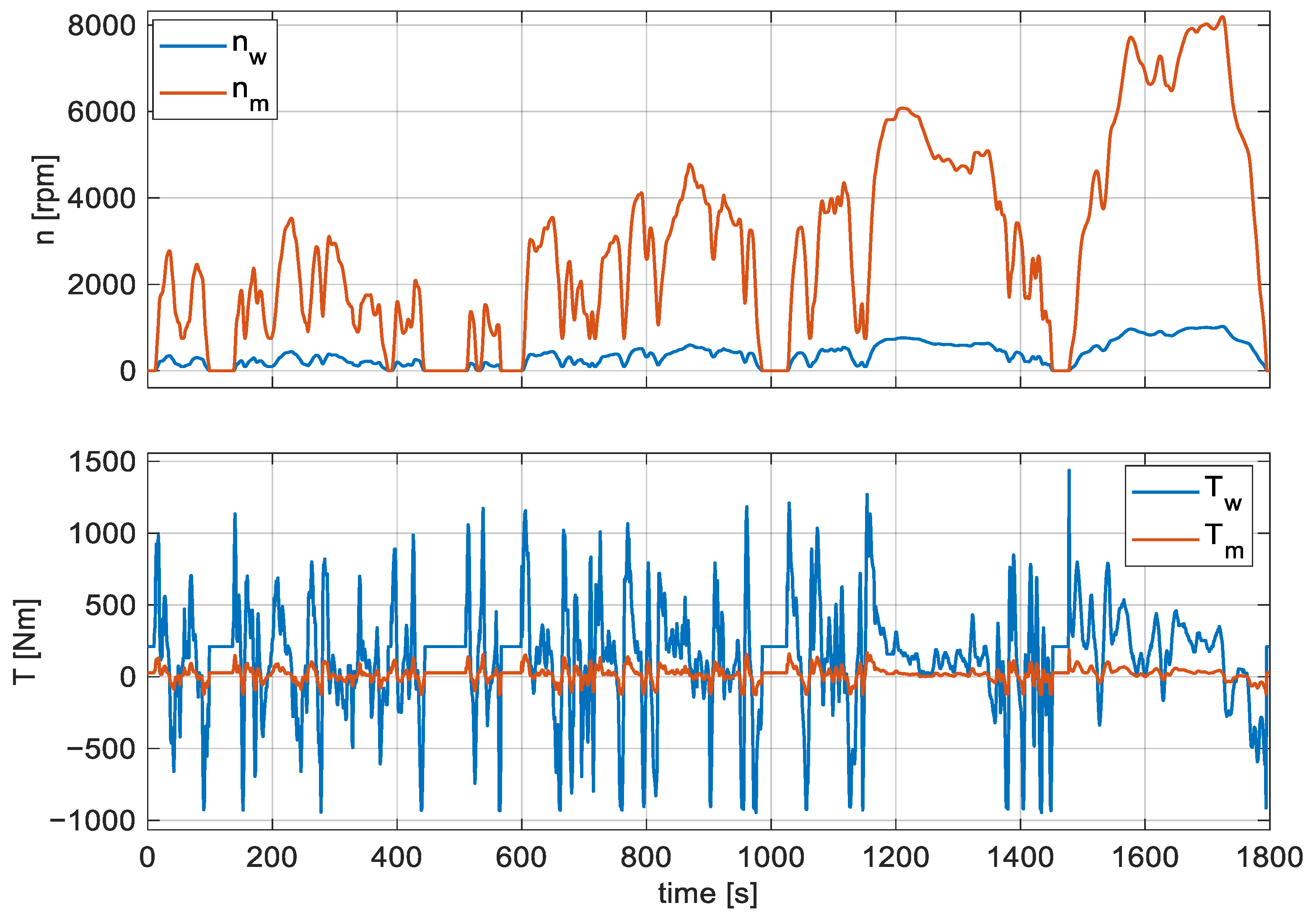
Figure 3 presents the time evolution of the rotational speed, and mechanical torque at both the wheel and the electric motor shaft levels, confirming the validity of the adopted kinematic and dynamic conversion for mapping the WLTP driving cycle onto the torque–speed operating domain of the electric motor.
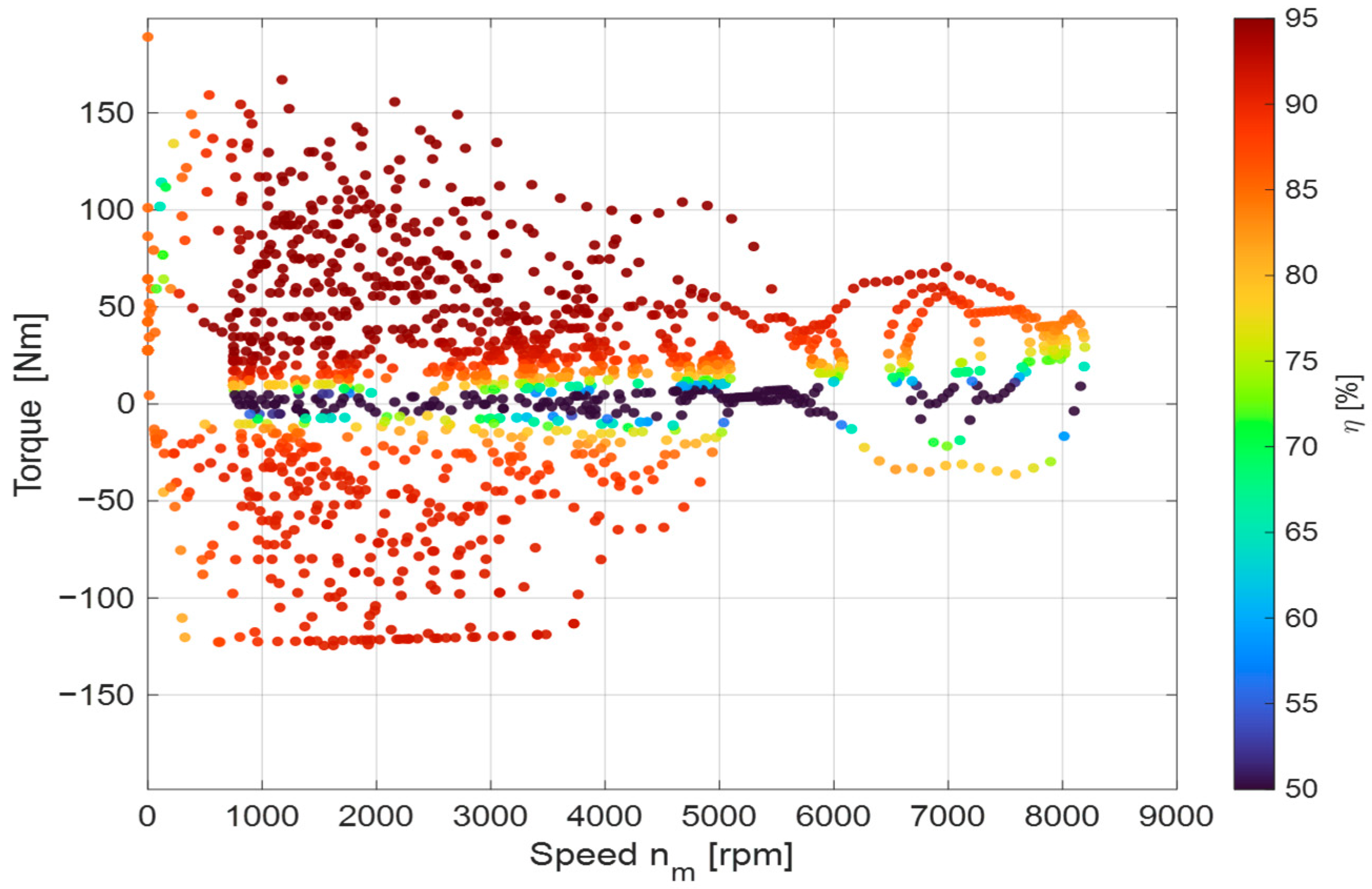
This transformation enables the direct mapping of the vehicle speed profile onto the operating domain of the electric motor, defined by the pairs, which are subsequently used to evaluate efficiency, current demand, and the overall energy performance of the propulsion system.
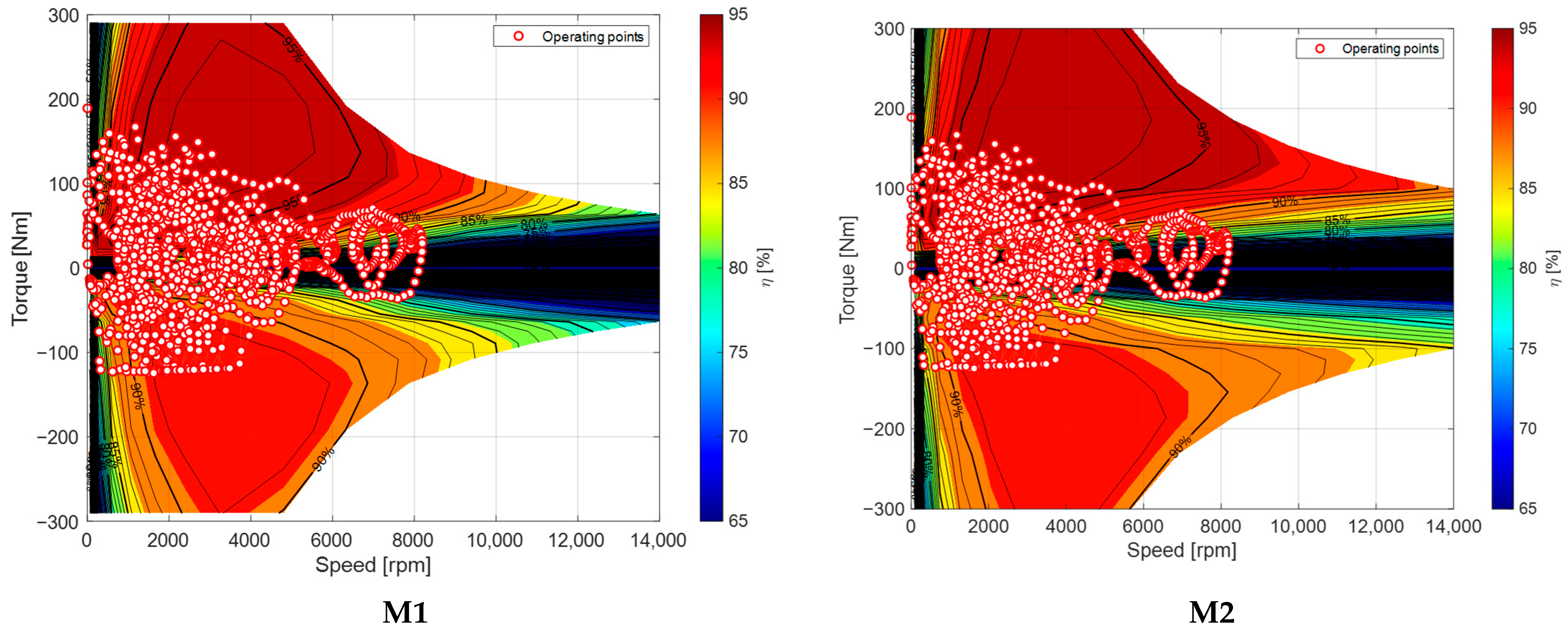
Figure 4 illustrates the distribution of the electric motor operating points in the torque–speed plane over the WLTP driving cycle. A high concentration of points is observed in the low- to medium-speed and moderate-torque region, corresponding to urban and extra-urban driving phases, while torque peaks occur at low speeds and the operating domain extends toward higher rotational speeds during high-velocity segments. This distribution provides the foundation for the efficiency mapping and energy consumption analysis presented in the following sections [
4,
5,
24].
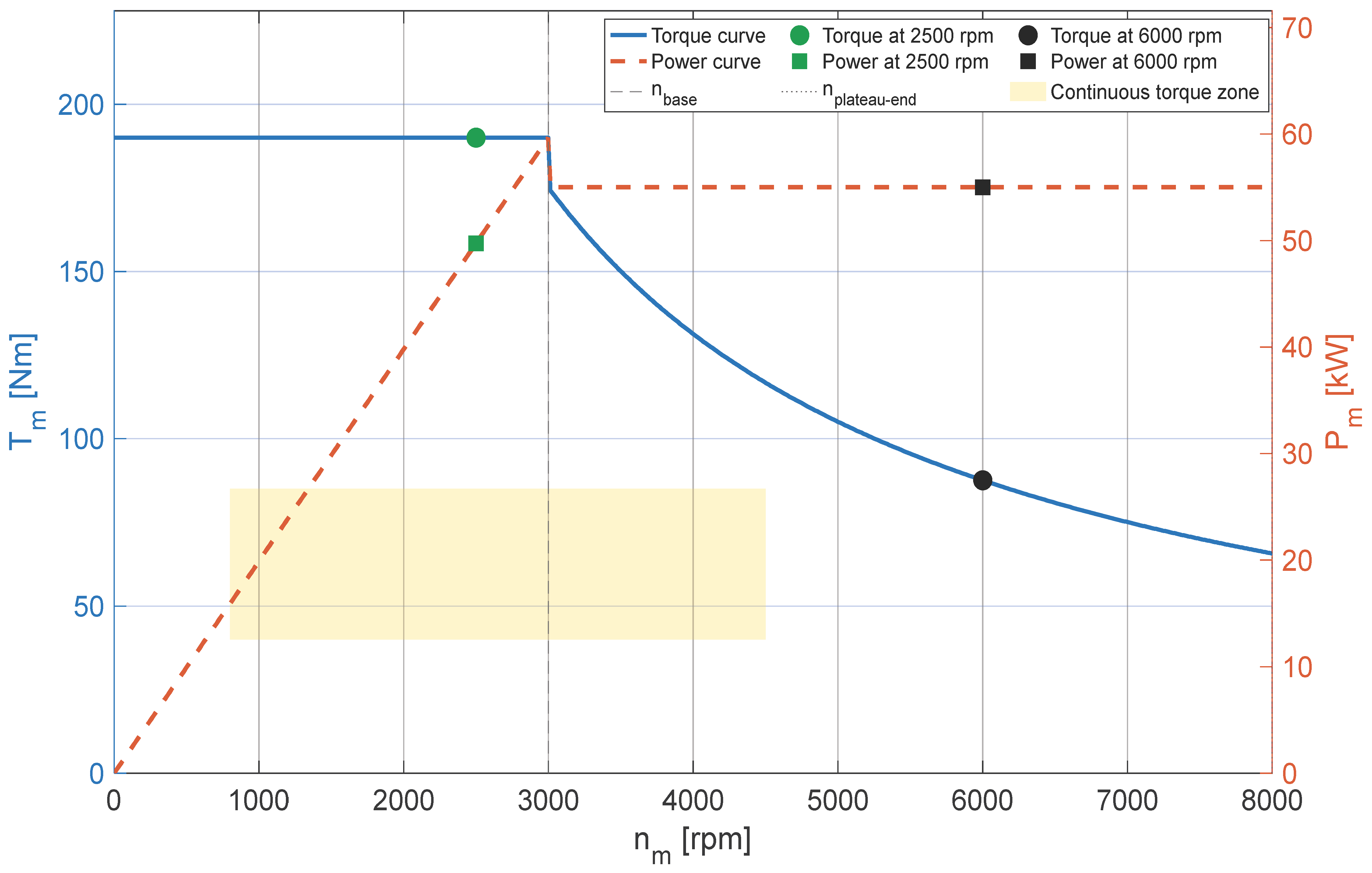
For interpretative purposes, the idealized torque–speed characteristic of the traction motor is introduced in
Figure 5. This representation distinguishes the constant-torque region, limited by current capability, and the constant-power region, limited by the available inverter voltage under flux-weakening operation.
The comparison between the actual operating points and this characteristic curve provides insight into motor loading, peak versus continuous operating conditions, and the adequacy of the selected motor and transmission parameters.
2.3. PMSM Model and Efficiency Maps
The energy consumption analysis of the electric vehicle equipped with a PMSM is based on the correlation between the traction requirements imposed by standardized driving cycles and the electromagnetic characteristics of the traction motor. This approach enables the direct integration of motor efficiency maps into cycle-based energy assessments and is widely adopted in energy-oriented vehicle simulations [
1,
3,
6].
The adopted methodology consists of three main stages:
Derivation of electromagnetic characteristics and efficiency maps by finite element analysis (FEM);
Projection of the WLTP operating points onto these maps to identify the dominant operating regions;
Evaluation of the vehicle energy balance, including specific energy consumption and the contribution of regenerative braking.
This framework is used to comparatively assess two PMSM traction motor configurations designed with the objective of reducing the permanent magnet mass while maintaining equivalent torque–speed performance levels, with potential benefits in terms of cost, sustainability, and supply-chain robustness for electric vehicle applications [
6,
8,
18]. Furthermore, the impact of these design choices on the driving range and overall energy performance of the electric vehicle is assessed.
To ensure a fair comparison between the investigated rotor topologies, both PMSM variants are evaluated under identical electrical supply conditions, geometric constraints, and thermal limits. This ensures that any observed differences in efficiency, energy consumption, or driving range originate solely from the rotor topology.
To satisfy the torque and power requirements derived from the vehicle longitudinal dynamic model, two PMSM designs are considered. Both configurations share an identical stator geometry and overall dimensional envelope, while differing exclusively in the rotor magnetic topology. The constructive and electromagnetic constraints adopted for the PMSM design are summarized in
Table 2.
The geometric dimensions were defined as design inputs, following the imposition of the electromagnetic and constructive constraints outlined previously. The stator outer and inner diameters are 250 mm and 170 mm, respectively, while the rotor outer diameter and shaft diameter are 168.5 mm and 65 mm. The active axial length is set to 160 mm. These dimensions are representative of traction motors for compact-class BEVs and allow continuous mechanical power levels of 70–90 kW, with peak power values of 100–120 kW over limited time intervals of 30–60 s.
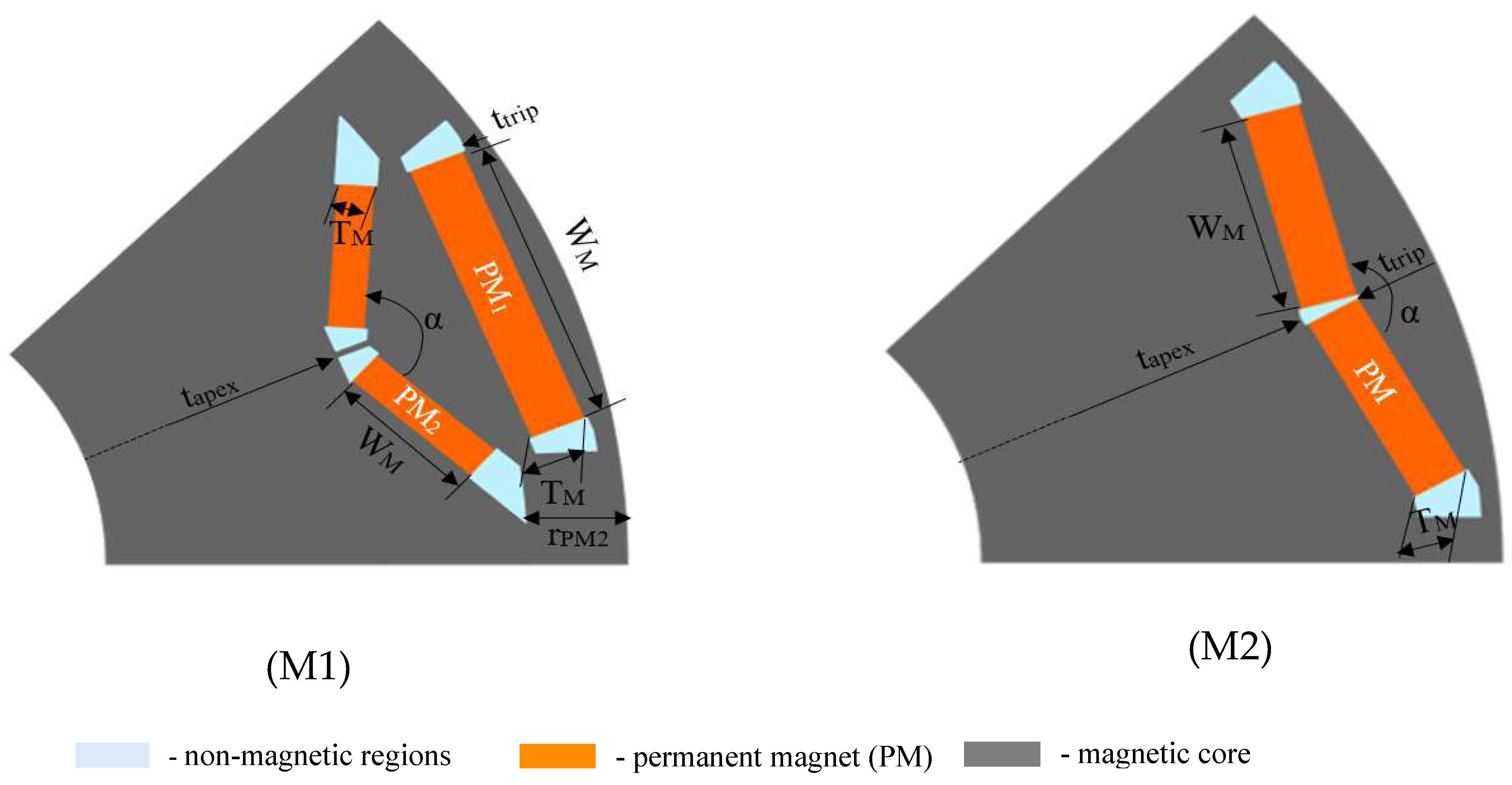
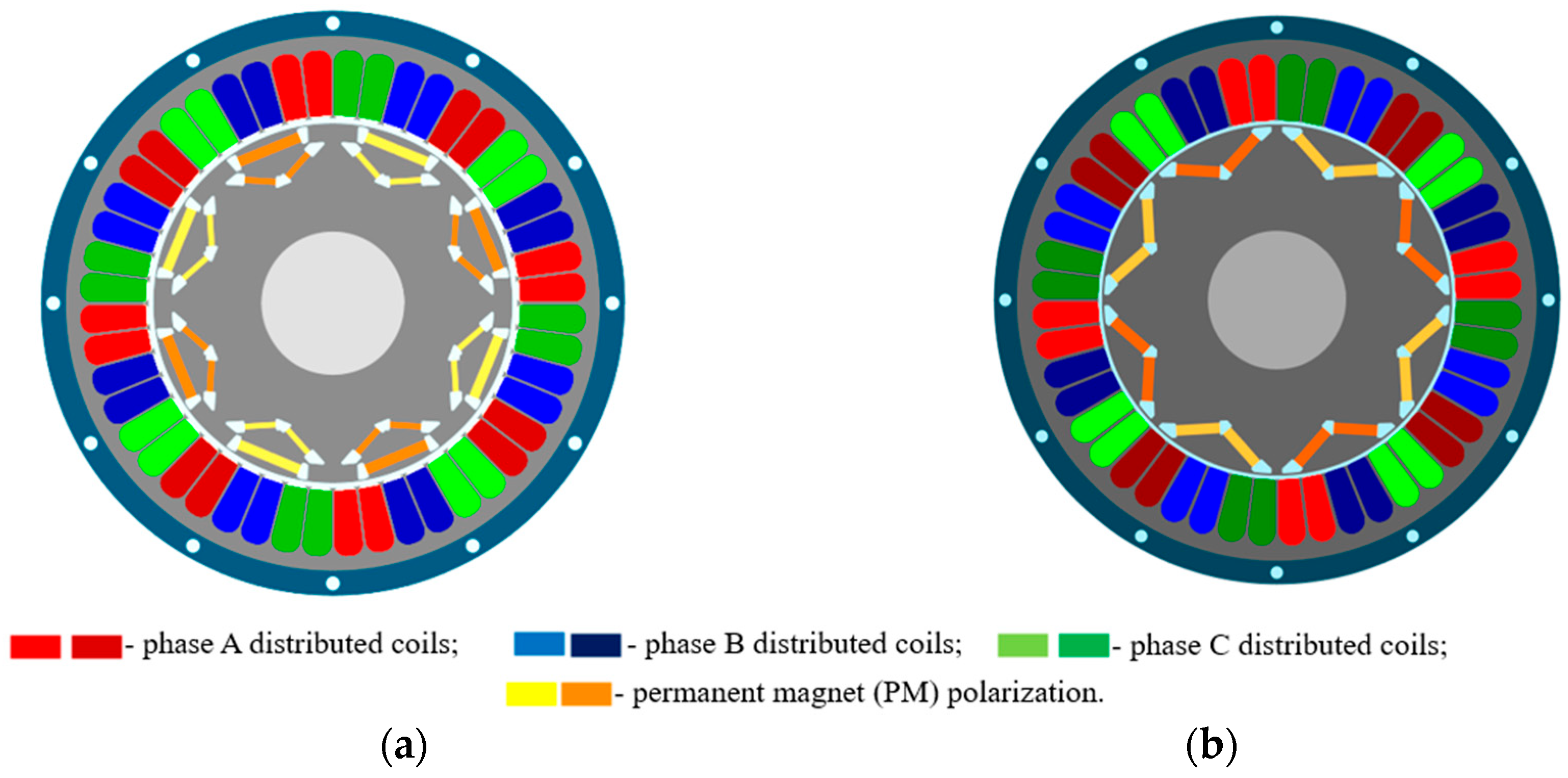
Both designs employ interior permanent magnet (IPM) rotor configurations as presented in
Figure 7 using NdFeB magnets doped with Dy/Tb and are equipped with three-phase hairpin windings, which are commonly adopted in automotive traction motors due to their high slot fill factor, favorable thermal behavior, and suitability for high-current operation [
8,
21]. Liquid cooling and a Class H insulation system are assumed to ensure reliable operation under WLTP duty conditions.
The two PMSM rotor configurations investigated in this study are denoted as M1 and M2. The design parameters introduced in this section serve exclusively to define and differentiate the two topologies, while their electromagnetic performance and energy-related results are presented separately in
Section 3.
The M1 rotor adopts a dual-layer IPM configuration, with two permanent magnet layers embedded in each rotor pole. This topology enhances the air-gap flux density and increases the contribution of permanent magnet torque, leading to improved torque capability at low speeds and increased resistance to demagnetization under high-load conditions, as reported for multilayer IPM designs [
16,
18]. However, this solution requires a larger volume of permanent magnetic material and involves higher manufacturing complexity.
In contrast, the M2 rotor employs a single-layer V-shaped IPM arrangement, which is widely adopted in production electric vehicles. This configuration provides a balanced contribution of permanent magnet torque and reluctance torque, enabling efficient operation over a wider speed range and improved field-weakening capability [
16,
17,
18]. The V-shaped configuration facilitates extended high-speed operation while reducing the required permanent magnet mass, offering a favorable compromise between cost, efficiency, and performance.
By maintaining identical stator geometry and winding characteristics, the influence of the rotor magnetic topology on torque production, efficiency distribution, and operating range can be isolated and quantitatively evaluated by FEM.
The geometric parameters used to describe the embedded permanent magnets are defined in
Figure 8, where only symbolic notations are indicated. In this figure,
and
denote the tangential width and radial thickness of the magnets, respectively,
is the V-angle,
and
represent the embedding depths at the magnet tip and at the V-apex, and
indicates the radial position of the inner magnet layer.
The corresponding numerical values for each configuration are reported in
Table 3. To reduce parasitic effects, an axial skew of 3.94° mechanical (approximately 7.9° electrical), corresponding to one stator slot pitch for an eight-pole rotor, is applied to the rotor magnets in both designs. This measure mitigates cogging torque and torque ripple, contributing to smoother operation and reduced acoustic noise, particularly at low speeds [
8,
14].
Although the total motor masses of the two configurations are comparable, relevant differences arise at the rotor level due to the redistribution of active materials between permanent magnets and laminated ferromagnetic steel. These differences are summarized in
Table 4.
The M1 configuration employs a higher amount of NdFeB permanent magnets, resulting in an increased mass of active magnetic material at the rotor level. This design choice favors higher electromagnetic torque capability at low and medium speeds, at the expense of increased material cost and reduced sustainability.
In contrast, the M2 configuration achieves a reduction of approximately 17% in permanent magnet mass by compensating with a larger volume of laminated ferromagnetic material. This solution leads to a more advantageous trade-off between performance, material cost, and resource availability.
The rotor inertia values of the two configurations differ only marginally, with M2 exhibiting slightly higher inertia. This variation is sufficiently small so that it is not expected to significantly affect the longitudinal dynamic behavior of the investigated electric vehicle.
A physically based evaluation of the inertia coefficient, accounting for rotor inertia and drivetrain parameters, is given by:
For the investigated motor configurations, this expression leads to , which closely matches the value obtained from the empirical speed-dependent formulation adopted in the vehicle dynamic model.
The obtained values for the total motor mass and rotor component masses fall within realistic ranges for traction motors used in compact electric vehicles, thereby confirming the dimensional and constructive plausibility of the two proposed PMSM configurations and providing a coherent basis for the subsequent electromagnetic analysis.
To ensure methodological transparency and reproducibility, this subsection provides a detailed description of the finite element modeling procedure used to generate the PMSM electromagnetic performance maps, including the simulation environment, modeling assumptions, meshing strategy, material properties, and boundary conditions.
The electromagnetic behavior of the two PMSM traction motor configurations (M1 and M2) was investigated using a two-dimensional finite element model implemented in Altair FluxMotor Advanced, which is specifically dedicated to the design and electromagnetic analysis of rotating electrical machines and is based on a 2D magneto-quasi-static formulation. The problem was formulated using the magnetic vector potential
, derived from Maxwell’s equations under magneto-quasi-static conditions. The governing equation solved over the computational domain is:
where
denotes the magnetic vector potential,
is the magnetic reluctivity,
represents the impressed current density in the stator windings, and
denotes the magnetization vector of the permanent magnets. Nonlinear magnetic material behavior was accounted for by means of B–H characteristics for the ferromagnetic regions.
The machine geometries were discretized using second-order triangular finite elements with local mesh refinement in the air-gap region to accurately capture the high magnetic field gradients. A mesh refinement verification was conducted to ensure numerical convergence of the electromagnetic torque and loss calculations, indicating that further mesh densification produces negligible variations in the computed results.
Accordingly, the resulting nonlinear system of equations was solved using an iterative Newton–Raphson scheme combined with sparse matrix solvers. The numerical solution accuracy was verified through mesh refinement and convergence checks to ensure stable evaluation of torque and electromagnetic losses. Steady-state electromagnetic solutions were computed for discrete operating points corresponding to different current and speed levels, enabling the generation of torque–speed, power–speed, efficiency, and loss maps for both motor configurations. The electromagnetic torque was evaluated using Maxwell stress tensor and co-energy methods, as implemented in the Flux solver. The computed results were subsequently employed for the derivation of efficiency maps and loss distributions for the electromagnetic evaluation, operating conditions relevant to the investigated BEV application were defined. A line voltage of 400 V was assumed, consistent with the battery and inverter architecture, together with a nominal current of 250 A and a maximum rotational speed of 14,000 rpm, representative of traction applications in the C-segment. The adopted control strategy is Maximum Torque Per Voltage (MTPV), which allows extension of the operating range beyond the base speed by optimally exploiting the inverter voltage limit.
Since high-speed operation has a direct impact on electromagnetic losses and thermal behavior, the simulations were carried out assuming a reference winding temperature of 150 °C. This value remains below the admissible limit of the Class H insulation system (180 °C), ensuring an adequate thermal safety margin under driving-cycle conditions.
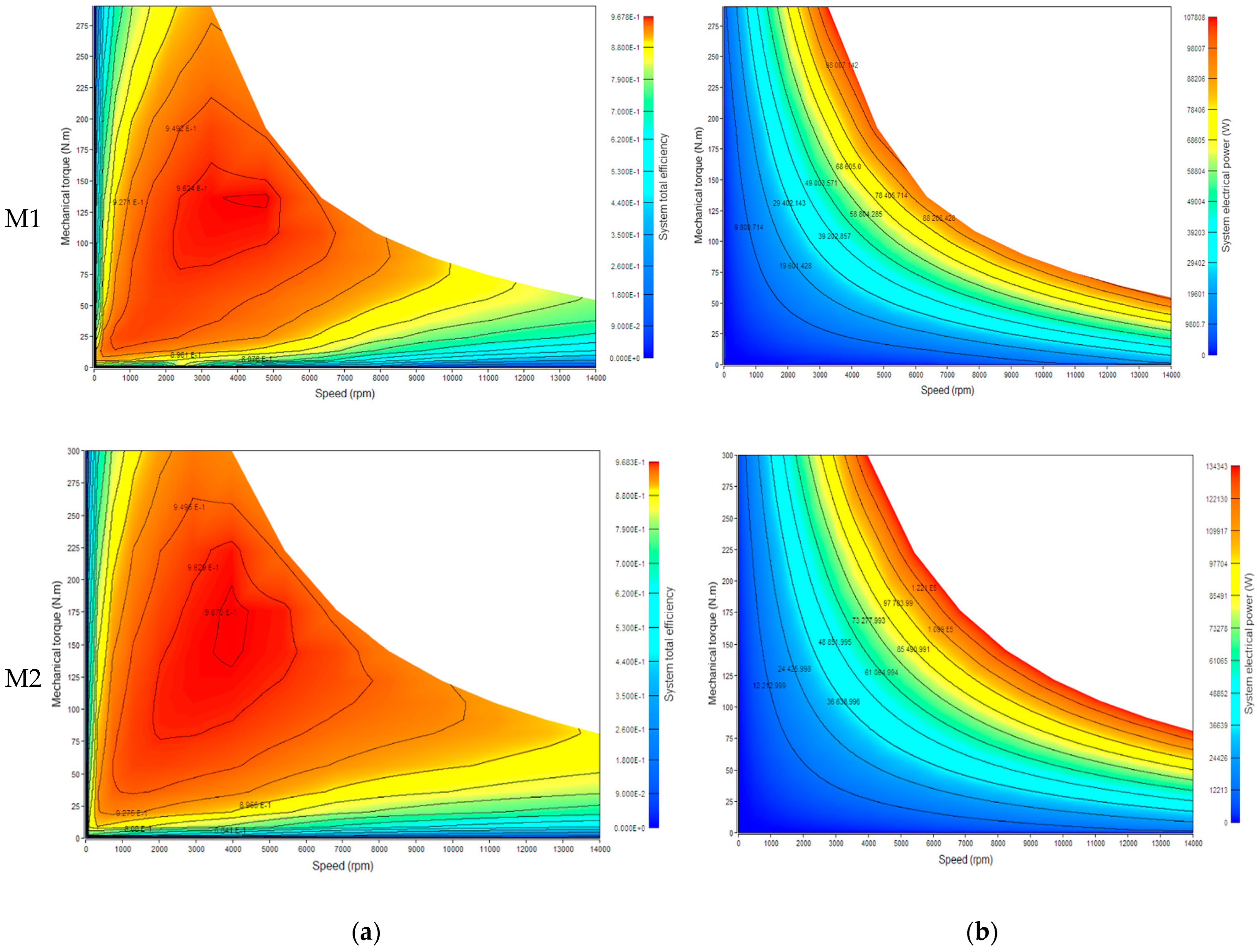
The FEM simulations yielded efficiency maps, phase current distributions, electromagnetic loss maps, and characteristic torque–speed and power–speed curves for both motor configurations, as illustrated in
Figure 9 Such FEM-based performance mapping is a well-established approach for traction motor evaluation and energy simulation of electric vehicles [
6,
21,
22,
23]. The resulting efficiency and loss maps constitute the input data for the vehicle-level WLTP energy simulations presented in the following sections.
A comparative analysis of the efficiency maps highlights distinct functional differences between the two rotor architectures. The M1 configuration exhibits peak efficiency values in the medium-speed and high-torque region, which corresponds to the dominant operating regimes of the WLTP driving cycle. In these regions, lower current levels are required to deliver the same mechanical power, resulting in reduced Joule losses and improved overall efficiency.
By contrast, the M2 configuration extends the high-efficiency operating region toward higher rotational speeds and demonstrates superior performance under field-weakening conditions. The V-shaped magnet rotor architecture facilitates high-speed operation with more balanced current requirements and a more uniform loss distribution, which is beneficial in terms of thermal stability and extended operation beyond the base speed.
The analysis of total electromagnetic losses further confirms these trends. M1 exhibits higher losses under maximum torque conditions and at elevated speeds, mainly due to the stronger magnetic flux associated with the increased permanent magnet content. In contrast, M2 shows a more gradual increase in losses across the operating range, leading to more favorable thermal behavior during high-speed operation.
The resulting efficiency and loss maps constitute the basis for the subsequent vehicle-level analysis, in which the operating points derived from the vehicle longitudinal dynamic model are superimposed onto the motor performance maps. This procedure enables the evaluation of energy consumption, efficiency distribution, and overall propulsion system performance over the WLTP driving cycle, as well as a comparative assessment of the impact of the two PMSM topologies on the driving range of the electric vehicle.
2.4. Traction Inverter Model and Electrical Losses
Within the energy conversion chain of the electric propulsion system, the traction inverter is responsible for converting the direct current supplied by the battery pack into the three-phase alternating current required by the permanent magnet synchronous motor (PMSM). During regenerative braking operation, the inverter enables bidirectional power flow, allowing the electrical energy generated by the machine to be transferred back to the battery.
In the adopted energy modeling framework, the motor efficiency
accounts exclusively for the internal electromagnetic losses of the PMSM, namely copper losses in the stator windings and magnetic losses in the ferromagnetic core, as derived from the FEM-based efficiency maps. The losses associated with the traction inverter are not included in motor efficiency and are therefore modeled separately, in accordance with common practice in energy-oriented electric vehicle simulations [
6,
7,
21].
The power dissipated in the inverter is modeled as the sum of conduction losses and switching losses, according to the following expression:
where
denotes the line current corresponding to the operating point, and
is the electrical frequency of the rotating magnetic field, defined as:
with
representing the number of pole pairs and
the motor rotational speed expressed in revolutions per minute. The coefficients
and
are employed as lumped parameters to approximate conduction and switching losses, respectively. These coefficients do not correspond to a specific semiconductor technology but rather represent equivalent loss factors commonly adopted in system-level energy simulations, where the focus is placed on overall power flow and relative energy differences rather than on detailed device-level modeling [
6,
7].
This simplified formulation captures the combined influence of current magnitude and electrical frequency on inverter losses and is particularly suitable for transient operating conditions such as those encountered in standardized driving cycles (e.g., WLTP) [
7,
9].
In traction mode, the mechanical power required at the wheels
is referred to the motor shaft by accounting for the drivetrain efficiency
, according to:
where
denotes the transmission efficiency.
The electrical power drawn from the battery is then expressed as:
During regenerative braking, the power flow is reversed, and the inverter operates in bidirectional mode. In this study, the effective regenerative power delivered to the battery is not computed explicitly at inverter level but is determined by the battery and regenerative braking model presented in
Section 2.5, which accounts for generator efficiency and system-level limitations. Consequently, inverter losses during regenerative operation are implicitly included through the adopted battery-side formulation.
The inverter model is implemented using efficiency-based loss representation derived from steady-state operating maps, without explicit switching-frequency modeling. The battery is represented using an energy-based model referenced to usable capacity, neglecting detailed electrochemical dynamics. These assumptions are considered appropriate for cycle-level energy analysis but may not capture transient or temperature-dependent effects.
This explicit separation between motor losses, inverter losses, and battery behavior ensures a transparent and consistent formulation of the energy balance and is aligned with established modeling practices for electric vehicle energy consumption analysis [
6,
7,
26].
2.5. Energy Source (Battery) Model and Operational Constraints
The energy source of the analyzed battery electric vehicle is a lithium-ion battery pack based on NMC pouch cells, with a usable energy of 85 kWh. The pack is configured in a 108s5p architecture, meaning that 108 cells are connected in series in each string to reach the required voltage level, while five such strings are connected in parallel to increase the overall capacity and current capability. Assuming a nominal NMC cell voltage of approximately 3.7 V, the 108-series configuration results in a pack voltage compatible with a 400 V traction system. The difference between gross and usable energy reflects the defined state-of-charge operating window implemented to ensure battery durability and lifetime [
3,
30,
32].
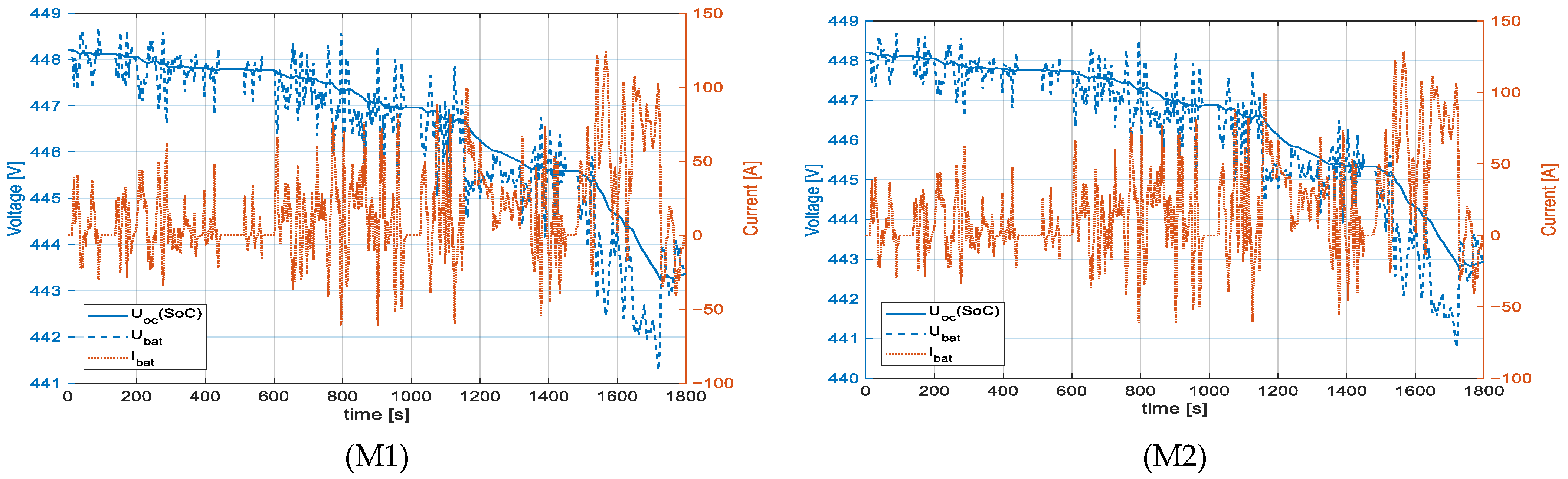
The battery is modeled using a simplified equivalent electrical circuit, consisting of an open-circuit voltage source and an internal resistance. The open-circuit voltage of the pack is expressed as a function of SoC as:
where
denotes the number of series-connected cells and
is approximated as a piecewise function of SoC based on representative voltage points. Accordingly, the pack open-circuit voltage varies between approximately 362 V at low SoC and 448 V at full charge.
Under load, the battery terminal voltage is given by:
with
represents the equivalent internal resistance of the battery pack.
For the WLTP-based simulations, the initial state of charge is set to SoC = 100%. Owing to the limited SoC variation over a single WLTP cycle, the open-circuit voltage is assumed quasi-constant during one cycle, and its average value is used for computing battery current, voltage drop, and power balance. This assumption is consistent with common practice in cycle-level energy simulations and does not affect the comparative nature of the analysis between the two PMSM configurations. This modeling approach is widely adopted in energy-oriented electric vehicle simulations due to its robustness and low computational burden [
5,
9,
32].
The instantaneous electrical power at the battery terminals is defined as:
The battery current is obtained by solving the corresponding power balance equation:
which yields:
This formulation enables the direct computation of battery currents in both traction (discharge) and regenerative braking (charge) modes and provides a consistent basis for evaluating battery losses and power limitations.
Regenerative braking is modeled explicitly through the reversal of power flow whenever the longitudinal acceleration becomes negative and the mechanical power at the wheels is negative. Under these conditions, the power flow follows the sequence: wheels → transmission → motor → inverter → battery.
The electromechanical energy conversion efficiency during regenerative braking is evaluated pointwise using the FEM-derived motor efficiency maps. Instead of computing a dedicated generator-mode FEM map, the generator efficiency is approximated by mirroring the motoring efficiency map and applying a correction factor
, such as:
This correction accounts for the additional losses associated with generator operation and control, while preserving the spatial distribution of efficiency obtained from the electromagnetic analysis.
At system level, a global regenerative efficiency factor is introduced to account for the fact that only a fraction of the mechanically available braking energy is effectively recovered and transferred to the battery. This factor represents the combined effects of brake blending with mechanical brakes, battery charging power limitations, and SoC and thermal constraints imposed by the BMS, and is independent of the PMSM electromagnetic efficiency.
The electrical power injected into the battery during regenerative braking is expressed as:
where
is evaluated at the instantaneous operating point
.
The corresponding regenerative battery current is obtained as:
For the investigated configuration, it is assumed that battery current, SoC, and temperature limits imposed by the BMS are not reached over the WLTP cycle, such that regenerative braking is governed primarily by the dynamic requirements of the driving profile. This assumption is consistent with previous studies on cycle-level energy consumption of compact-class BEVs [
5,
9,
27].
This battery and regenerative braking modeling approach provides a consistent and sufficiently accurate representation of energy extraction and recuperation, while avoiding unnecessary complexity relative to the main objective of the study, namely the comparative assessment of the energy performance of the two PMSM rotor topologies. The resulting battery power and current profiles constitute the basis for the WLTP-based energy balance and driving range evaluation presented in the following section.
2.6. WLTP Driving Cycle and Integrated Energy Simulation Procedure
The energy performance of the analyzed battery electric vehicle is evaluated by simulating its operation over the Worldwide Harmonized Light Vehicles Test Procedure (WLTP), which is adopted as an international reference for the assessment of energy consumption and driving range of electric vehicles [
24,
33].
The WLTP driving cycle is defined by a longitudinal vehicle speed profile
applied over a total duration of
, corresponding to a traveled distance of
. The cycle includes representative urban, extra-urban, and high-speed driving phases, covering a wide range of operating conditions relevant for compact-class BEVs [
24,
25,
34].
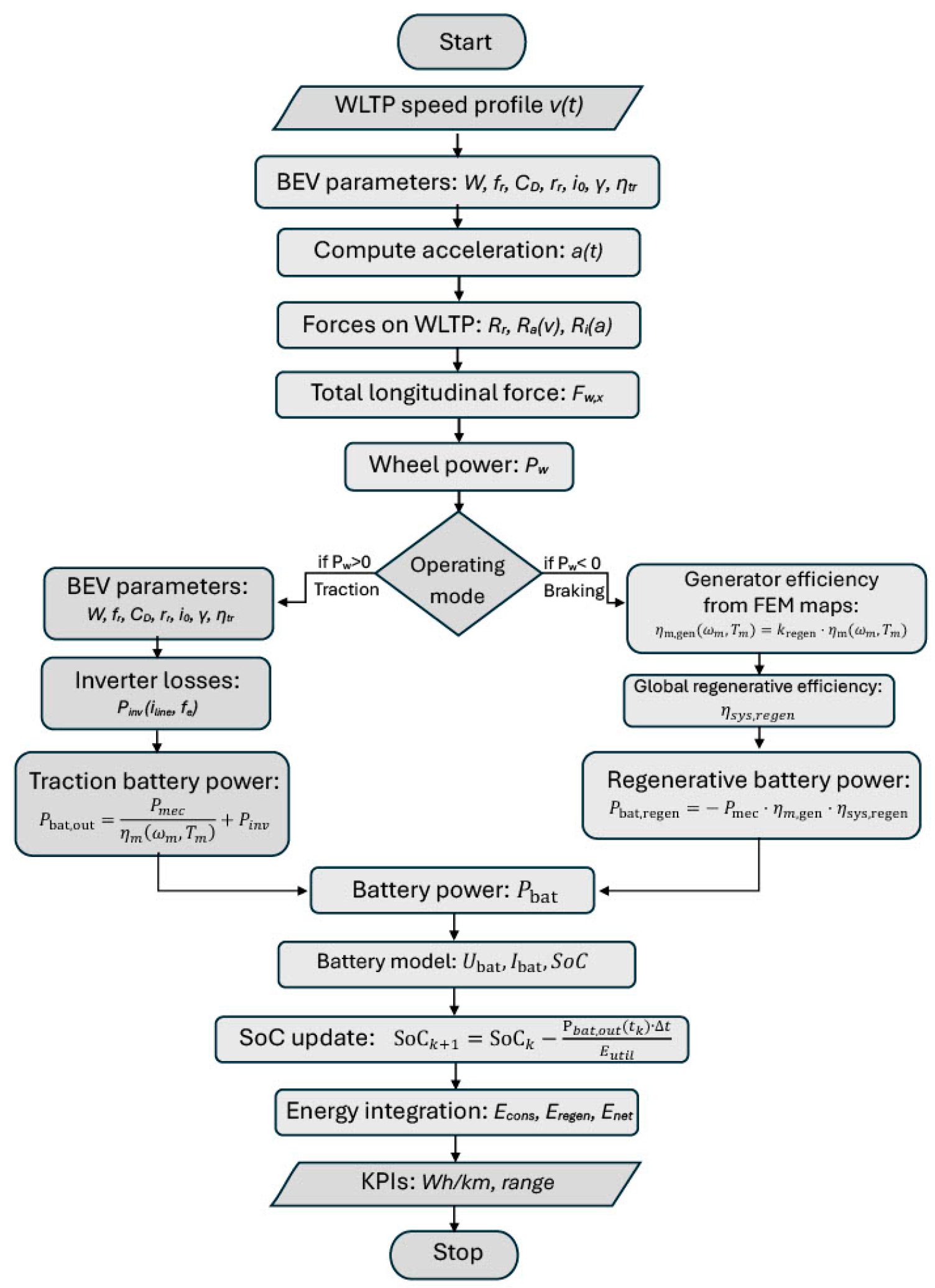
The energy simulation is performed using a deterministic, sequential workflow in which the imposed speed profile is successively transformed into mechanical and electrical quantities along the propulsion chain. Starting from the WLTP speed profile, the longitudinal vehicle model provides the required traction or braking forces at the wheels. These are then converted into mechanical torque and speed demands at the electric motor shaft, which are mapped onto the FEM-derived motor efficiency and current maps. Subsequently, inverter losses and battery electrical behavior are considered to determine the instantaneous battery power and current.
The overall structure of the energy simulation procedure, including the interaction between the WLTP driving cycle, the longitudinal vehicle dynamics, the electric motor, the traction inverter, and the battery model, is summarized in
Figure 10.
The battery power constitutes the central quantity for the cycle-level energy balance. Positive battery power corresponds to traction operation and battery discharge, while negative battery power corresponds to regenerative braking and battery charging. The battery current is used consistently throughout the WLTP simulation.
The electrical energy exchanged with the battery over one driving cycle is obtained by integrating the battery power over time. In the numerical implementation, this integral is evaluated using a discrete summation over the WLTP time steps. The energy consumed from the battery is computed as:
Similarly, the total energy recovered through regenerative braking is computed by integrating the negative battery power:
The net electrical energy extracted from the battery over one WLTP cycle is then expressed as:
The evolution of the battery state of charge is determined from the incremental energy balance, referenced to the usable battery energy
:
This formulation naturally accounts for both discharge and recharge phases and ensures energetic consistency over the entire driving cycle [
5,
9].
Based on net energy consumption and the WLTP cycle distance, the specific energy consumption is calculated as:
The driving range is subsequently estimated as:
The approximation in (27) and (28) results from the discrete-time integration of battery power using the WLTP sampling interval (Δt = 1 s). Given the relatively smooth variation in battery power over the driving cycle and the high temporal resolution of the WLTP speed profile, the numerical integration error is negligible compared to other modeling uncertainties, such as drivetrain efficiency assumptions and aerodynamic parameters.
Equation (32) assumes that the specific energy consumption obtained over one WLTP cycle is representative and scales linearly with the usable battery energy. This approximation neglects certain second-order effects, such as state-of-charge-dependent efficiency variations or thermal drift during extended operation. However, since the analysis is performed under identical boundary conditions for both motor topologies, this approximation does not affect the relative comparison, which constitutes the primary objective of this study.
The proposed WLTP-based simulation framework enables a coherent and reproducible evaluation of energy consumption, recuperated energy, and driving range, while maintaining a clear separation between component-level models and cycle-level energy accounting. By directly linking the FEM-derived electromagnetic performance of the PMSM traction motors to realistic vehicle operating conditions, the methodology provides a robust basis for the comparative energy assessment of the investigated motor topologies, in line with state-of-the-art BEV energy simulation approaches [
4,
5,
6,
9,
10,
11,
12].
The above formulation provides a consistent description of the vehicle longitudinal dynamics, drivetrain power flow, and battery energy balance used in the WLTP-based simulations. This integrated approach enables the evaluation of rotor topology effects on vehicle-level energy consumption and driving range under realistic operating conditions.