Article

Optimizing a Heavy-Haul Railway Train Formation Plan for Maximized Transport Capacity

School of Traffic and Transportation, Beijing Jiaotong University, Beijing 100044, China
*
Author to whom correspondence should be addressed.
Vehicles 2026, 8(3), 45; https://doi.org/10.3390/vehicles8030045
Submission received: 23 December 2025 / Revised: 5 February 2026 / Accepted: 25 February 2026 / Published: 28 February 2026
(This article belongs to the Special Issue Models and Algorithms for Railway Line Planning Problems)

Abstract

Heavy-haul railways are important for bulk freight transport, and improving their transport capacity is essential for railway operators to enhance operational efficiency. This study develops an integer linear programming model for train formation planning that maximizes transport capacity, incorporating key practical constraints such as section headway, station capacity, and locomotive matching. This study makes two main contributions: (1) explicit formulation of transport-capacity maximization as the primary objective; and (2) incorporation of specific train formation rules through linear resource-flow coefficients that characterize the combination and decomposition operations. The model is applied to the Shuozhou–Huanghua Railway in a case study. Experimental results show that the optimized train formation plan increases total freight volume from 2810.4 thousand tons to 3080.0 thousand tons, representing a capacity improvement of approximately 9.6%. This result is achieved by adjusting the mix of train tonnage levels, increasing combination operations for medium-capacity trains, and reallocating locomotive types in accordance with traction requirements. The study demonstrates that a capacity-oriented optimization framework can effectively support train-formation plan decisions under practical operational constraints, providing railway operators with a systematic tool to enhance line utilization without expanding infrastructure.

1. Introduction

1.1. Background

Heavy-haul railways, characterized by their high capacity, efficiency, and cost-effectiveness, have become the main arteries for transporting energy and raw materials, playing a critical role in supporting regional and global economic development. As global economic uncertainty increases, the stability of logistics chains for bulk commodities becomes particularly crucial. For instance, Guimarães et al. [1] highlighted that, despite global economic fluctuations such as the 2008 financial crisis and the COVID-19 pandemic, rail freight production has demonstrated remarkable resilience, further underscoring the central role of railways in safeguarding national economies and export trade. To sustain such high-load transport tasks, heavy-haul railway systems rely on extremely precise operational organization and infrastructure maintenance. Optimization at every level, from micro-level wheel–rail contact geometry [2] to macro-level traffic organization, directly impacts the overall efficacy of the system.
In the context of heavy-haul railway operations management, the organization of wagon flow is the core mechanism that realizes this transport potential. It involves the integrated planning and dynamic management of wagon flow, train movement, and station activities. This system aims to optimize the allocation of transportation resources and enhance the overall network capacity and operational efficiency, which is essential for ensuring the safety, efficiency, and reliability of heavy-haul rail transport. As the concrete embodiment of wagon flow organization, the train formation plan specifies the types, quantities, consist configurations, and destinations of trains to be assembled at technical stations, forming the foundational basis for developing train timetables and daily service plans. A scientifically sound and rational train formation plan is of critical importance; it effectively reduces the transit and detention time of railcars at technical stations and shortens the duration of train combination operations. Consequently, it improves the utilization efficiency of station tracks, reduces operational costs, and ultimately enhances the overall transportation capacity of mainline railways by accelerating the turnover of wagon flow.

1.2. Formulation of the Problem of Interest for This Investigation

Despite the growing importance of heavy-haul railways, maximizing transport capacity through the optimization of train formation remains a significant challenge in practical operations. Unlike conventional railways, heavy-haul technical stations focus primarily on the combination and decomposition of high-tonnage trains. This process is strictly constrained by fixed station infrastructure and complex operational rules. Furthermore, with the evolution of train control technologies toward autonomy and intelligence—such as the application of Train-Centric Communication-Based Autonomous Train Control Systems (ATCS) [3] and the enhancement of autonomous route management in stations [4]—there is new potential for reducing headway and increasing station passing capacity. However, existing formation planning often fails to fully exploit these potential capacity gains and tends to overlook the differences in tracking intervals for trains of different traction masses in various sections.
Moreover, the long consists and high-tonnage characteristics of heavy-haul trains make their longitudinal dynamics and braking operations extremely complex. Research by He et al. [5] indicates that optimizing cyclic braking manipulation on long, steep downgrades is vital for ensuring the safe and smooth operation of trains. This implies that train formation plans must not only consider macro-level flow matching but also adhere to these micro-level operational safety constraints. Therefore, the core problem of this investigation is: how to determine the optimal train formation scheme by establishing a mathematical model that maximizes the overall line transport capacity while satisfying practical constraints such as section headway, station combination/decomposition capacity, and strict formation rules.

1.3. Survey of the Literature

The optimization of heavy-haul railway operations management has consistently been a central issue for enhancing overall network efficiency. Early research primarily focused on the macro-level framework and methodologies for wagon flow organization. For instance, Han et al. [6] proposed organizing loading terminals into three hierarchical levels: strategic loading points, loading areas, and loading zones. Xiang et al. [7] adopted a bi-level optimization approach, proposing a multi-objective optimization method for heavy-haul wagon flow organization. As research deepened, scholars began integrating more practical factors. Tong et al. [8] considered the impact of environmental (carbon tax), economic, and time costs on shippers’ choice behavior in their modeling, conducting collaborative research on pricing strategy and train diagram optimization.
Within the implementation of operations management, train-formation plan optimization directly determines the efficiency of wagon flow consolidation and decomposition, constituting a major research focus. Studies in this area mainly revolve around optimization at loading sites and technical stations. For loading sites, Zhao et al. [9] established an optimization model aiming to minimize combination time and maximize corridor traffic volume. For technical stations, Zhuo et al. [10] constructed a multi-objective optimization model for mixed-group trains, targeting minimum transportation costs and shortest total cargo transit times. Lan et al. [11] focused on the collaborative optimization of train formation and wagon flow routing, while Wang et al. [12] employed time discretization techniques for the detailed modeling of train combinations at technical stations. Regarding solution methodologies, scholars have widely applied heuristic and intelligent optimization algorithms [13,14].
Simultaneously, recent advancements in related fields provide new perspectives and technical support for optimizing formation plans. In terms of train control, Song et al. [3] proposed a Train-Centric Communication-Based Autonomous Train Control System (ATCS) aimed at breaking information isolation and improving train tracking intervals and architecture utilization. Subsequently, Song et al. [4] further investigated autonomous route management at stations under ATCS, verifying its effectiveness in enhancing station passing capacity using Colored Petri Nets (CPNs). These studies suggest that improving operational efficiency at stations and sections is key to releasing line potential. Regarding infrastructure and vehicle interaction, Wang et al. [2] improved heavy-haul rail profiles through numerical optimization to enhance wheel–rail contact and reduce wear, providing a physical basis for high-density transport. In terms of train manipulation and safety, He et al. [5] established a high-precision longitudinal dynamics model to optimize and evaluate cyclic braking manipulation for heavy-haul trains, emphasizing the importance of operational safety for long-consist trains under complex conditions.
Whether at the macro or operational level, the ultimate goal is the coordinated and efficient use of transport capacity, making capacity-aware operation optimization a crucial research direction. This strand of research aims to match demand with infrastructure and equipment resources. On one hand, studies have focused on exploiting and optimizing capacity at specific links. For instance, Zhang et al. [15] investigated the impact of train combination and decomposition on line capacity, and Li et al. [16] developed a wagon flow routing optimization model based on the coordinated utilization of station and track capacity. On the other hand, research has approached the problem from a systemic, top-down perspective for overall capacity coordination. For example, Zhou et al. [17] aimed at enhancing the capacity of the collection and distribution system by coordinating loading and unloading capabilities. Gan [18] established a multi-objective programming model for train operation plans with different traction masses, considering factors like designed transport capacity, utilization rate of carrying capacity, and the number of locomotives and dedicated wagons. Furthermore, Zhou et al. [19] decomposed the problem into two phases—the Train Service Planning Problem and Train Timetabling Problem—systematically coordinating transport demand with operational resources.
While existing research on heavy-haul train formation plans has yielded significant results, most studies predominantly focus on minimizing operational costs by optimizing time or direct expenses. However, these approaches often overlook the intricate operational rules and physical constraints governing actual train assembly. Neglecting these factors can lead to suboptimal strategies that negatively impact economic performance, maintenance needs, and operational conditions. For instance, failing to align formation plans with wheel–rail interaction characteristics or braking constraints may accelerate infrastructure degradation and compromise operational safety. Furthermore, few studies prioritize maximizing the overall line capacity as the primary objective—a critical necessity for ensuring supply chain stability during peak operational periods.


1.4. Scope and Contribution of This Study

In light of these limitations, this paper develops an optimization model for heavy-haul train formation planning with the objective of maximizing transport capacity. The scope of this study covers the entire process from wagon flow collection to technical station combination and mainline transport, focusing on the combination/decomposition capacities of technical stations and section headway constraints.
The main contributions of this study are as follows:
(1)
It formulates the maximization of line transport capacity as the primary objective for the train formation plan, distinguishing it from traditional cost-minimization models to better suit the demands of peak heavy-haul transport;
(2)
It incorporates specific train formation rules through linear resource-flow coefficients, which represent combination and decomposition operations and locomotive matching requirements, ensuring the optimized plan adheres to practical physical and safety constraints.

1.5. Organization of the Paper

The paper is organized as follows: Section 2 defines the heavy-haul railway train formation plan problem. Section 3 introduces an optimization model that addresses transport-capacity maximization and train formation rules. Section 4 demonstrates the model’s practical applicability via a case study on Shuozhou–Huanghua Railway, where results of the case study show the effectiveness of the optimization model. Section 5 summarizes key findings, discusses methodological limitations, and outlines potential research directions.

2. Problem Description

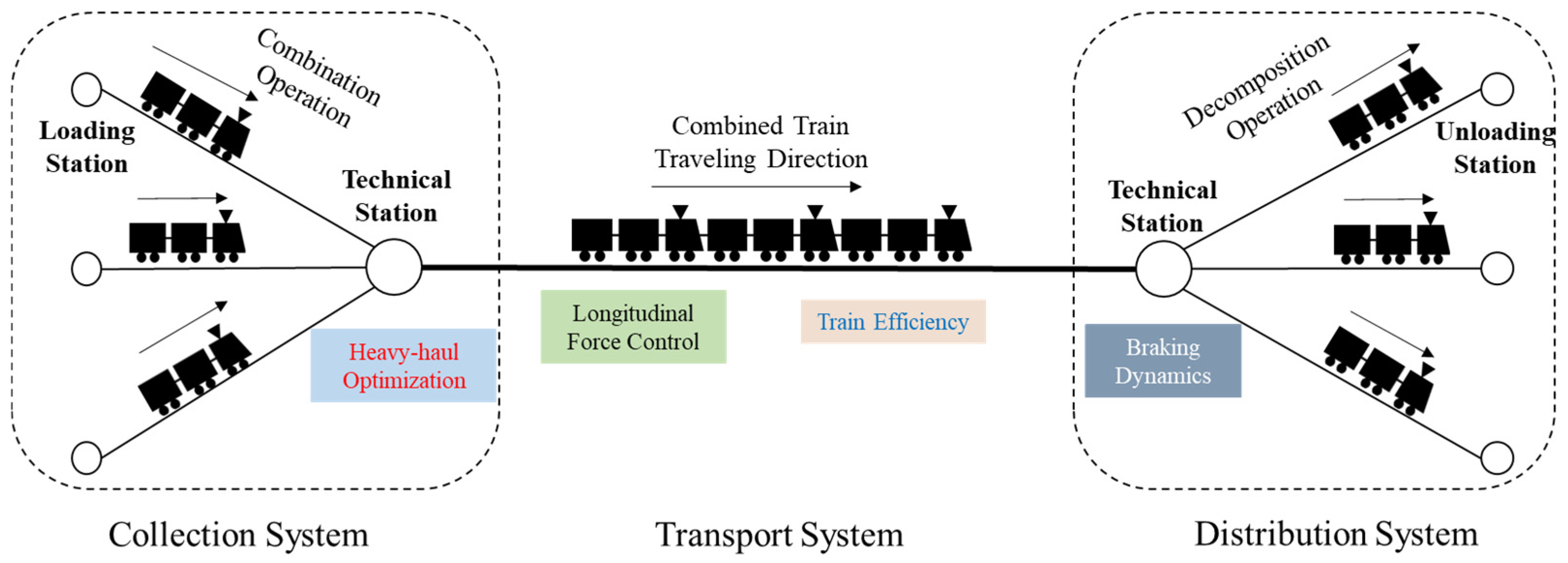
Heavy-haul railway systems consist of three subsystems: collection, transport, and distribution, as Figure 1 shows. The collection system gathers trains from loading stations and combines them at a technical station. The transport system moves combined trains along the mainline, while the distribution system decomposes them for delivery to unloading stations.
Unlike conventional railway technical stations, which follow the workflow of “arrival–decomposition–accumulation–formation–departure,” heavy-haul railway technical stations primarily focus on two types of operations: train combination and train decomposition. When a unit train arrives from the collection system, it enters the technical station and proceeds to a designated arrival–departure track according to its routing plan. Once another unit train scheduled for combination arrives and occupies the adjacent track, the two trains are coupled according to applicable formation rules. After the combination process is completed, the combined train departs from the track and, following necessary inspection, exits the technical station. Similarly, when a combined train arrives at a station for decomposition, it undergoes a reverse process: the train is uncoupled into unit trains on the arrival–departure tracks, which then depart for their respective destinations according to the operating plan.
As illustrated in the above process, the combination and decomposition capacity of a technical station serves as the primary constraint for the train formation plan. This is because train combination and decomposition operations occupy fixed infrastructure within the station, including arrival–departure tracks and turnouts, while locomotive uncoupling and recoupling also require the use of locomotive running tracks. A higher station capacity enables more trains to be combined or decomposed within a given period, thereby increasing the number of combined trains and enhancing the overall line haul capacity. Furthermore, due to factors such as signaling systems and block modes on heavy-haul railways, the tracking interval between trains of different traction masses varies on mainline sections, leading to differences in section capacity. Since the train formation plan determines the proportion of trains with different traction masses (tonnage levels), and each tonnage level corresponds to a specific tracking interval, the formulation of the train formation plan directly affects the utilization rate of sectional capacity. Additionally, track maintenance windows interrupt railway operations, and trains are required to reduce speed before and after these windows, significantly impacting line capacity. Therefore, this study focuses on optimizing the train formation plan under the constraints of sectional capacity and station combination/decomposition capacity, specifically during non-maintenance window periods.
In this study, the overall line transport capacity is defined as the total freight volume passing through line sections within the planning period. The objective is to address the following problem: based on given inputs, such as the number of trains accessing upstream technical stations and station track conditions, determine the combination and decomposition schemes for various train types at each station, with the aim of maximizing the total freight volume passing through line sections during the planning period.

3. Mathematical Formulation

3.1. Assumptions

In order to simplify the mathematical modeling, we define the assumptions for this study as follows:
  • The heavy-haul railway line remains unchanged and no expansion or renovation is carried out;
  • The railcars of the combined stations are all sourced from the upstream collection system that has a sufficient supply of railcars;
  • During the process of a heavy-haul train traveling from the loading station to the unloading station, only the combination and decomposition operations are carried out at the technical stations, and no other stations are stopped;
  • During the combination operation of heavy-haul trains, only railcars with the same direction are allowed to be combined into the same train.

3.2. Symbols and Variables

The symbols and variables adopted in our mathematical model, along with their definitions, are shown in Table 1 and Table 2.

3.3. Model Constraints

3.3.1. Section Capacity

The train formation plan of heavy-haul railway determines the number of trains with different traction masses operating within a given railway section. Since trains with varying traction masses have different headway intervals, their impacts on the sectional carrying capacity also differ. A feasible train formation plan must ensure that the sum of headway intervals for all trains in the section does not exceed the available time under the section’s capacity constraint:
t T τ l , t · f l , t H l ,   l L .
In the formula, the number of trains in section l is determined by the number of trains departing from the departure station:
f l , t = d D n s , t , d o u t ,   s S ,     t T .

3.3.2. Station Operational Capacity

The number of train combination and decomposition operations at a heavy-haul railway technical station is constrained by its operational capacity, which is influenced by factors such as station size, layout, length of arrival–departure tracks, switch configuration, and the availability of operational equipment. Generally, trains with higher traction masses require more time for combination or decomposition. Therefore, the train formation plan must ensure that the total time required for all combination and decomposition operations at the station does not exceed the total available operational duration provided by the station:
d D i , j T σ s , i , j c o m · y i , j d , s + d D i , j T σ s , i , j d e c o m · z i , j , d d , s H s ,   s S t e c h .

3.3.3. Formation Rules

Due to their substantial load capacity, heavy-haul trains place a high priority on operational safety during both combination and decomposition processes, which must strictly adhere to established train formation rules. Based on an investigation of existing heavy-haul railway operations, this study proposes the following formation rules:
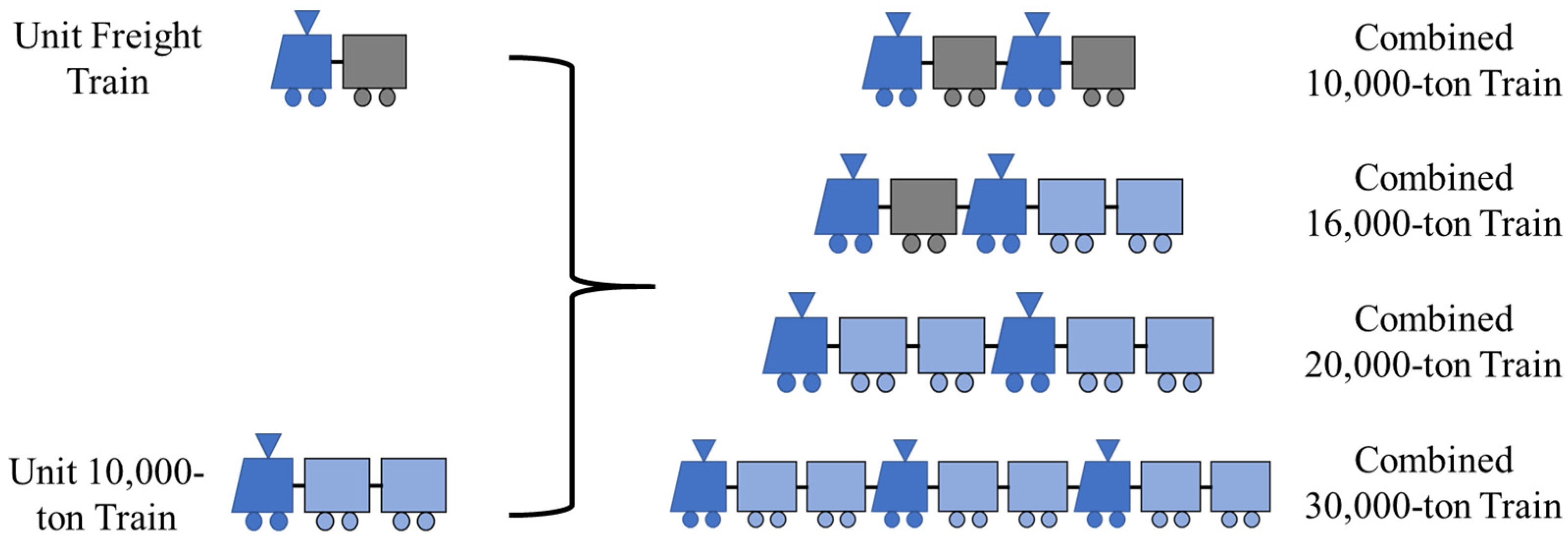
  • Trains operating on heavy-haul railways include general freight trains, 10,000-ton freight trains, 16,000-ton freight trains, 20,000-ton freight trains, and 30,000-ton freight trains. Among these, unit trains consist of general freight trains and 10,000-ton freight trains.
  • In addition to operating as unit trains, 10,000-ton freight trains can also be formed by combining two general freight trains.
  • A 16,000-ton freight train is formed by combining one 10,000-ton freight train with one general freight train.
  • A 20,000-ton freight train is formed by combining two 10,000-ton freight trains.
  • A 30,000-ton freight train is formed by combining three 10,000-ton freight trains.
A schematic diagram illustrating these formation rules is provided in Figure 2.
To facilitate model formulation, this study treats heavy-haul trains as movable resources and converts train combination and decomposition operations into the acquisition and release of these resources, represented by resource utilization coefficients bi,t and at,j. Here, bi,t denotes the number of resources of train type i required to form one train of type t, and at,j indicates the number of resources of train type j released when one train of type t is decomposed. Based on the aforementioned train formation rules and these resource utilization coefficients, the formation rule constraint is expressed as follows:
n s , t , d o u t = n s , t , d i n + i T ( b i , t y i , t d , s b i , t z i , t d , s ) j T ( a t , j y t , j d , s a t , j z t , j d , s ) ,   s S t e c h , t T , d D .
In Equation (5), for all technical stations that perform only combination operations, all z t , j d , s coefficients are set to 0, as no decomposition occurs. Conversely, for stations that conduct only decomposition operations, all y t , j d , s coefficients are set to 0.
Furthermore, the values of the coefficients in Equation (5) correspond directly to the train formation rules, as specified below:
  • General freight trains can be combined to 10,000-ton and 16,000-ton trains, with corresponding resource utilization coefficients set for a0,1 = 2 and a0,2 = 1.
  • A 10,000-ton train can be formed by combining two general freight trains, with coefficient b0,1 = 1. The 16,000-ton, 20,000-ton, and 30,000-ton trains require 1, 2, and 3 units of 10,000-ton trains, respectively, corresponding to coefficients a1,2 = 1, a1,3 = 2 and a1,4 = 3.
  • A 16,000-ton train is formed by combining one 10,000-ton train and one general freight train, reflected by coefficient b0,2 = b1,2 = 1.
  • The 20,000-ton and 30,000-ton trains are formed by combining two and three 10,000-ton trains, respectively, as indicated by coefficients b1,3 = b1,4 = 1.
For both combination and decomposition operations, the volume of operations must not exceed the number of available train resources arriving from the upstream section; otherwise, the train formation plan would be infeasible. This constraint is formulated as follows:
j T a t , j y t , j d , s n s , t , d i n + i T b i , t y i , t d , s + j T a t , j z t , j d , s ,   s S t e c h , t T , d D ;
z i , j d , s n s , j , d i n + i T b i , j y i , j d , s ,   s S t e c h , j T , d D .

3.3.4. Locomotive Operation

Heavy-haul railway technical stations are equipped with locomotive depots for storing lead locomotives. When a heavy-haul train arrives from the upstream section, a lead locomotive departs from the locomotive depot, couples with the train, and then hauls the train out of the technical station after completing combination or decomposition operations. The number of locomotives stored in the station’s locomotive depot is subject to its capacity limit, expressed as follows:
t T x s , t , k M s , k ,   s S t e c h ,   k K .
Different formation configurations of heavy-haul trains (e.g., 10,000-ton, 20,000-ton, and 30,000-ton) require corresponding types of lead locomotives. If the tractive power provided by a locomotive is insufficient, it may fail to haul higher-mass trains properly and pose safety risks; conversely, excessive tractive power leads to inefficient use of locomotive resources. Therefore, locomotives must be matched with the mass category of the trains they haul, as specified below:
d D k K a t , k n s , t , d o u t k K x s , t , k ,   s S t e c h , t T .

3.3.5. Unloading Stations and Traction Mass

Unloading stations on heavy-haul railways primarily handle freight unloading operations and generally do not perform train combination or decomposition processes. Since this study focuses exclusively on the loaded train direction, trains arriving at unloading stations are not subject to further locomotive coupling or departure operations:
n s , t , d o u t = 0 ,   s = d D .
In the distribution system of a heavy-haul railway, certain sections may impose traction mass restrictions. This means that only specific types of heavy-haul trains—such as general freight trains and 10,000-ton trains—are permitted to operate on these sections:
f l 0 , t = 0 ,   l 0 L , t T ˜ l .
In the model, the number of trains arriving at and departing from technical stations, the number of combination and decomposition operations performed at these stations, the number of trains operating in railway sections, and the number of locomotives assigned for traction are all defined as non-negative integers:
n s , t , d o u t , n s , t , d i n , f l , t , x s , t , k , y i , j d , s , z i , j d , s * .

3.4. Model Objective Function

The objective of this study is to maximize the total transportation capacity of the heavy-haul railway over the research period, which is quantitatively represented as the total tonnage of freight dispatched from all stations along the railway:
max   Z = l L t T w t · f l , t .

4. Numerical Experiments

The model that our study proposes is an integer linear programming (ILP) problem, which can be solved by commercial solvers. Therefore, in the subsequent numerical experiments, our study uses GUROBI to solve the model. All experiments are based on the scenario of Shuozhou–Huanghua Railway, implemented in MATLAB R2021a and executed on a Windows 10 personal computer equipped with a GenuineIntel Core i5-8265U CPU which made in China and 8 GB of RAM.

4.1. Parameter Settings

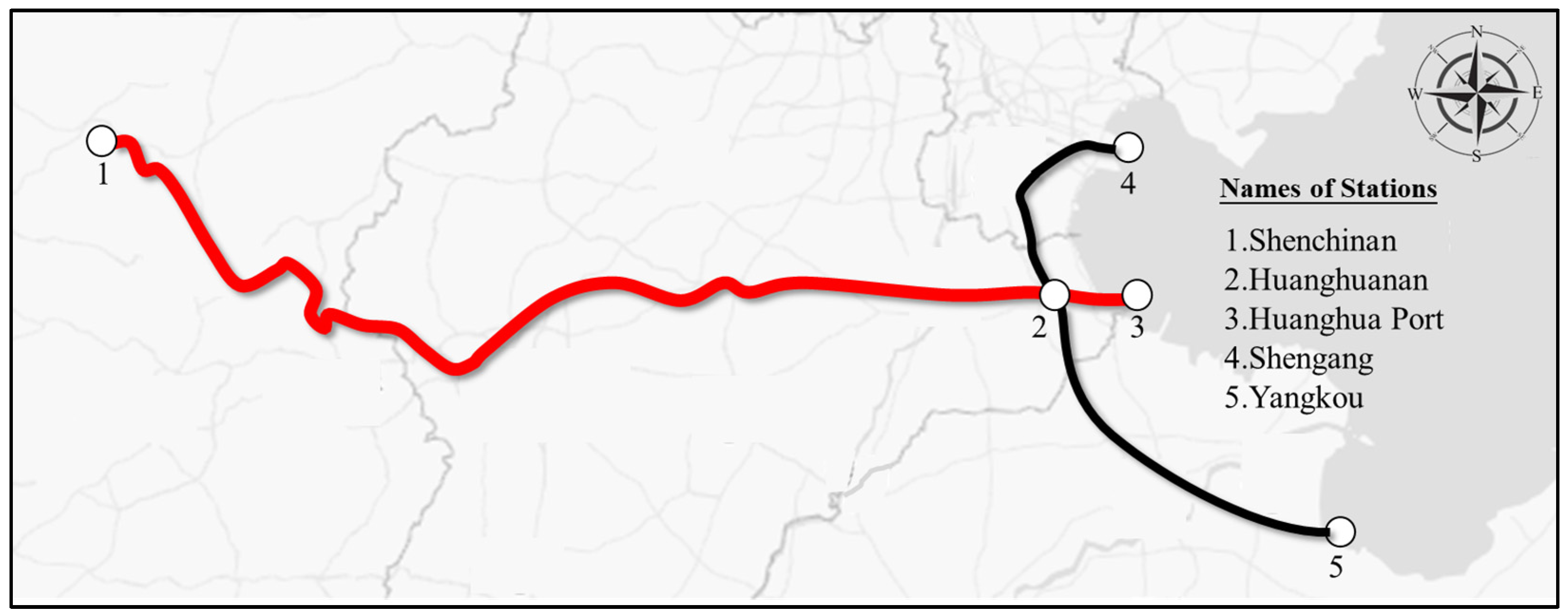
The Shuozhou–Huanghua Railway is a 594 km double-track, electrified, heavy-haul line connecting Shanxi and Hebei provinces. It includes a main line from Shenchinan (Station 1) to Huanghua Port (Station 3), with branch lines to Shengang (Station 4) and Yangkou (Station 5) from Huanghuanan (Station 2). Both its designed and operating speeds are 120 km/h. Furthermore, the Shuozhou–Huanghua Railway connects at Huanghuanan (Station 2) with two branch lines: the Huanghua–Wanjia Dock Railway and the Huanghua–Dajiawa Railway. The Huanghua–Wanjia Dock Railway is a single-track, electrified line running from Huanghuanan to Shengang (Station 4) in Tianjin, covering 64.8 km. Similarly, the Huanghua–Dajiawa Railway is a single-track, electrified line extending from Huanghuanan to Yangkou (Station 5) in Dongying, Shandong Province, with a length of 216.8 km.
In terms of station operations, Shenchinan functions as a technical station. It receives freight cars from upstream collection systems, and performs consist combination operations before dispatching trains downstream via the Shuozhou–Huanghua Railway main line. Huanghuanan serves as a technical station, where arriving trains are decomposed. After breakup, the trains may proceed along the Shuozhou–Huanghua Railway to Huanghua Port for unloading, or alternatively, enter the Huanghua–Wanjia Dock Railway or Huanghua–Dajiawa Railway to reach Shengang and Yangkou, respectively, for cargo unloading. Figure 3 shows the whole route and station distribution.
The Shuozhou–Huanghua Railway operates five types of heavy-haul freight trains: general freight trains, 10,000-ton trains, 16,000-ton trains, 20,000-ton trains, and 30,000-ton trains, represented by the set T = {1, 2, 3, 4, 5}, respectively. Due to line constraints, not all these train types can operate on the Huanghua–Wanjia Dock Railway or the Huanghua–Dajiawa Railway. Specifically, only general freight trains are permitted on the Huanghua–Wanjia Dock Railway, while the Huanghua–Dajiawa Railway allows general freight trains and 10,000-ton trains. As this study focuses on train formation plans for non-maintenance days, all line sections are assumed to be available throughout the day, i.e., the available time Hl is 1440 min. The minimum headway times for each railway section are provided in Table 3.
The Shuozhou–Huanghua Railway utilizes several types of locomotives, among which the SS4 and HXD1 serve as the primary lead locomotive types, denoted by K = {1, 2}, respectively. The railway operates five train formation modes, each with a different traction weight. To ensure safe and stable train operation, different formation modes must be hauled by specific locomotive types. The corresponding traction mass and assigned lead locomotive types for each formation mode are listed in Table 4.
Each technical station along the Shuozhou–Huanghua Railway is equipped with an associated locomotive depot, whose primary function is to provide stabling and servicing support for locomotive units. After trains arriving from upstream complete their combination and decomposition operations, the locomotives depart from the depot, couple with the trains, and proceed to haul them toward the next section. During the process of train combination and decomposition, the arrival–departure tracks of the station are occupied, which in turn impacts the station’s overall operational capacity. This capacity can be quantified as follows:
H s = 1440 · M · ( 1 γ )
where M represents the number of arrival–departure tracks of the technical station and γ represents the idle track coefficient, reflecting the degree of imbalance in track utilization. Given the pronounced uneven distribution of train arrivals and departures on the Shuozhou–Huanghua Railway, γ is set to 0.15. Furthermore, key parameters such as the operational capacity of technical stations, locomotive depot capacities, and associated processing times are presented in Table 5.

4.2. Results Analysis

In this experiment, the train composition input from the upstream of Shenchinan is as follows: 82 general freight trains (50 for Huanghua Port, 19 for Shengang, and 13 for Yangkou); 96 ten-thousand-ton trains (60 destined for Huanghua Port, 22 for Shengang, and 14 for Yangkou). Based on the previously established model parameters, the MATLAB platform was utilized to invoke the GUROBI solver for solution optimization. The results were obtained rapidly, with an optimality gap of merely 0.81%. The original train formation plan and the optimized plan derived from the model, the number of different train types operated in each section, and the results of the locomotive type assigned are presented in Table 6, Table 7 and Table 8, respectively.
The comparative analyses in Table 6, Table 7 and Table 8 reveal significant changes in the optimized train formation plan regarding train combination/decomposition operations, distribution of train types across sections, and locomotive resource allocation, ultimately leading to an effective improvement in total transport capacity. As shown in Table 6, the number of combination operations increased notably after optimization, especially from general freight trains (Type 1) to 16,000-ton trains (Type 3), which rose sharply from 1 to 35. Corresponding adjustments were also made in decomposition operations. This shift indicates that the model tends to form more medium-tonnage trains through additional combination operations, thereby balancing the operational capacity of technical stations with line-haul efficiency. The change reflects how the optimization model actively utilizes combination operations to raise the average traction mass of trains under given constraints of station processing time and locomotive availability, thereby moving more freight within the same sectional time window.
Table 7 further illustrates the changes in the distribution of train types across sections after optimization. Compared with the original plan, the number of 16,000-ton trains increased noticeably in both the “Shenchinan–Huanghuanan” and “Huanghuanan–Huanghua Port” sections, while 30,000-ton trains were reduced to only one, and 10,000-ton trains decreased in number. This suggests that, under the objective of maximizing transport capacity, the model prefers train types that offer a better trade-off between sectional headway and station processing time. The 16,000-ton train, with its moderate traction mass and relatively reasonable headway interval, emerges as a key contributor to enhancing overall capacity. The total transport capacity rose from 2810.4 thousand tons to 3080.0 thousand tons, an increase of approximately 9.6%, which confirms the effectiveness of the train formation plan model aimed at capacity maximization.
Regarding locomotive allocation (Table 8), the optimized plan adjusts the numbers of SS4 and HXD1 locomotives deployed at both Shenchinan and Huanghuanan stations. In particular, Huanghuanan station uses more SS4-type and fewer HXD1 locomotives, which aligns with the fact that, after decomposition, the station handles more medium- and low-tonnage trains requiring corresponding traction power. This reallocation of locomotive resources demonstrates that the model incorporates not only train formation rules and sectional capacity, but also the matching between locomotive types and train tonnage levels into the overall optimization framework. It thereby avoids resource wastage or safety risks caused by under- or over-powered traction, reflecting the model’s ability to coordinate multiple practical constraints.
In summary, the optimization model achieves a better balance between station operational capacity and line-haul efficiency by finely tuning combination/decomposition strategies, appropriately matching train tonnage with sectional capacity, and dynamically allocating locomotive resources. Its core strength lies in explicitly targeting transport-capacity maximization while systematically integrating multiple real-world constraints, such as formation rules, station operations, and locomotive matching. Consequently, without altering the input wagon flow, the model significantly enhances overall line transport performance. These results not only validate the theoretical soundness of the model, but also provide actionable decision support for heavy-haul railway train formation plans during high-demand periods, such as coal transport surges.

5. Conclusions and Future Research

5.1. Main Contributions

This study proposes an optimization method for train formation planning with the primary objective of maximizing the overall line transport capacity. Distinct from traditional models that prioritize cost minimization, the integer linear programming (ILP) model constructed in this paper places capacity maximization at the core, better aligning with the operational demands of heavy-haul railways during peak periods. Specifically, the main contributions of this study include:
(1)
The establishment of a mathematical model that comprehensively integrates constraints such as section headway, technical station combination/decomposition capacities, and locomotive turnover, effectively bridging macro-level traffic allocation with micro-level operational capabilities;
(2)
The introduction of linear resource-flow coefficients to accurately describe the complex formation rules and locomotive matching logic for heavy-haul trains (e.g., 10,000-ton and 20,000-ton trains) at technical stations, ensuring the physical feasibility of the optimized solutions;
(3)
A case study based on the Shuozhou–Huanghua Railway validates the effectiveness of the model, with results demonstrating that the optimized formation plan significantly enhances the saturated passing capacity of the line.

5.2. Possible Applications

The proposed optimization model holds significant practical value, particularly for high-density, high-volume, heavy-haul railway corridors.
Firstly, it is directly applicable to complex lines similar to the Shuozhou–Huanghua Railway, which handles not only single-commodity coal transport but also mixed traffic of varying tonnages (e.g., mixing 10,000-ton and 20,000-ton trains). It assists dispatching departments in formulating more scientific daily operation plans.
Secondly, during seasonal transport peaks or emergency supply guarantee missions, the model serves as a decision-support tool, enabling operators to identify system bottlenecks and rapidly release potential capacity by adjusting train formation proportions.
Furthermore, the logical framework of this method can be extended to other bulk-cargo logistics networks to solve flow routing problems that are strongly constrained by node processing capacities.

5.3. Future Developments

While this study has yielded positive results, certain simplifying assumptions were made during model construction. These assumptions define the scope of applicability and highlight avenues for future research.
The current model relies primarily on a deterministic assumption, presuming that parameters such as section running times, technical station processing times, and freight demand are deterministic and known throughout the planning horizon. Consequently, the model is most applicable to scenarios characterized by a relatively stable operational environment, strong adherence to schedules, and minimal external disturbances. However, in practical operations, stochastic variations caused by equipment failures, adverse weather, or sudden fluctuations in wagon flow are inevitable.
To address these limitations, future work can expand upon the model in the following areas:
(1)
Robust Optimization: By relaxing the deterministic assumption, future research could incorporate stochastic programming or robust optimization techniques. This would account for uncertainties in section running times and station operations, thereby enhancing the resilience of the formation plan against unexpected delays.
(2)
Dynamic Formation Adjustment: Research could focus on dynamic adjustment mechanisms under non-ideal conditions, facilitating a transition from “static planning” to “dynamic dispatching.”
(3)
Multi-System Synergy: Future developments could integrate train formation planning with train timetabling and maintenance scheduling into a unified modeling framework. This would allow for a comprehensive assessment of the formation plan’s impact on infrastructure maintenance needs and long-term economic performance.

5.4. General Conclusions

In summary, this paper effectively addresses the problem of maximizing transport capacity under complex constraints in heavy-haul railways through the construction of a refined ILP model. The findings not only enrich the theoretical framework of railway transport organization but also provide robust technical support for scientific decision-making by heavy-haul railway operators under capacity-constrained conditions. With further research into model robustness and dynamic adaptability, this method is poised to play an increasingly significant role in intelligent railway transport organization.

Author Contributions

Conceptualization, Y.B.; methodology, Y.B. and Y.C.; software, Y.C.; validation, Y.B. and Y.C.; formal analysis, S.H.; investigation, S.H.; resources, Y.B.; data curation, S.H.; writing—original draft preparation, S.H.; writing—review and editing, S.H. and Y.C.; visualization, S.H.; supervision, Y.B. and Y.C.; project administration, Y.B.; funding acquisition, Y.B. All authors have read and agreed to the published version of the manuscript.

Funding

This research was funded by the National Key Research and Development Program of China under Grant No. 2025YFF0524300 and the National Natural Science Foundation of China under Grant No. U2569203.

Data Availability Statement

The original contributions presented in this study are included in the article. Further inquiries can be directed to the corresponding author.

Conflicts of Interest

The authors declare no conflict of interest.

References

  1. Guimarães, A.; Couto, A.; Lobo, A. Rail freight production in Brazil: Projecting scenarios in times of global uncertainty. J. Rail Transp. Plan. Manag. 2023, 27, 100403. [Google Scholar] [CrossRef]
  2. Wang, P.; Gao, L.; Xin, T.; Cai, X.; Xiao, H. Study on the numerical optimization of rail profiles for heavy haul railways. Proc. Inst. Mech. Eng. Part F J. Rail Rapid Transit 2017, 231, 649–665. [Google Scholar] [CrossRef]
  3. Song, H.; Gao, S.; Li, Y.; Liu, L.; Dong, H. Train-centric communication based autonomous train control system. IEEE Trans. Intell. Veh. 2023, 8, 721–730. [Google Scholar] [CrossRef]
  4. Song, H.; Li, L.; Li, Y.; Tan, L.; Dong, H. Functional safety and performance analysis of autonomous route management for autonomous train control system. IEEE Trans. Intell. Veh. 2024, 25, 13291–13301. [Google Scholar] [CrossRef]
  5. He, W.; Chang, C.; Li, L.; Song, Y. Research on optimization and evaluation method of heavy-haul train cyclic braking manipulation. Railw. Sci. 2025, 4, 231–248. [Google Scholar] [CrossRef]
  6. Han, X.; Zhang, J.; Peng, Q. Optimization of railcar flow combination scheme for strategic loading domain based on heavy haul transportation. J. Southwest Jiaotong Univ. 2012, 47, 1057–1063. (In Chinese) [Google Scholar]
  7. Xiang, X.; Zhu, X. An optimization strategy for improving the economic performance of heavy-haul railway networks. J. Transp. Eng. 2016, 142, 04016003. [Google Scholar] [CrossRef]
  8. Tong, R.; Mao, B.; Du, P.; Wei, R.; Huang, J. Comprehensive optimization of operation planning and pricing of backhaul for heavy-haul railways transportation. J. Transp. Syst. Eng. Inf. Technol. 2023, 23, 217–224. (In Chinese) [Google Scholar]
  9. Zhao, P.; Zhang, J.; Tang, B. Study on the optimization model of car flow organization in the loading area of heavy haul railway based on the combined trains. China Railw. Sci. 2010, 31, 116–121. (In Chinese) [Google Scholar]
  10. Zhuo, Q.; Chen, W.; Song, Z.; Yu, X. A model and an algorithm for generating mixed group train operation scheme of heavy-haul railway transportation. J. Railw. Sci. Eng. 2025, 22, 569–578. (In Chinese) [Google Scholar]
  11. Lan, Z.; He, S.; Xu, Y.; Wang, Y. Optimizing train formation plan with car flow routing and train routing by Benders-and-price approach. IEEE Access 2019, 7, 178496–178510. [Google Scholar] [CrossRef]
  12. Wang, D.; Zhao, J.; Peng, Q. Optimizing the loaded train combination problem at a heavy-haul marshalling station. Transp. Res. Part E 2022, 162, 102717. [Google Scholar] [CrossRef]
  13. Jin, X.; Xue, F.; He, C. Operation proportion of heavy haul trains considering the utilization ratio of arrival-departure track capacity. J. Transp. Eng. Inf. 2018, 16, 88–97. (In Chinese) [Google Scholar]
  14. Zhuo, Q.; Chen, W.; Yuan, Z. Optimizing mixed group train operation for heavy-haul railway transportation: A case study in China. Mathematics 2023, 11, 4712. [Google Scholar] [CrossRef]
  15. Zhang, J.; Yang, H.; Wei, Y. Modeling feedback scheme of empty cars in unloading end of heavy haul railway. J. Transp. Syst. Eng. Inf. Technol. 2008, 8, 96–102. (In Chinese) [Google Scholar] [CrossRef]
  16. Li, G.; He, S.; Song, R.; Song, Z.; Xue, S. Railway car routing optimization based on the coordinated utilization of station-line capacities. IET Intell. Transp. Syst. 2022, 17, 897–911. [Google Scholar]
  17. Zhou, H.; Zhou, L.; Tang, J. Research on capacity coordination of loading and unloading wagon flow on heavy-haul railway. In Proceedings of the 5th International Conference on Civil Engineering and Transportation, Guangzhou, China, 28–29 November 2015. [Google Scholar]
  18. Gan, Z. Study on heavy-haul train transportation organization scheme in Menghua railway. Western China Commun. Sci. Techn. 2016, 10, 71–75. (In Chinese) [Google Scholar]
  19. Zhou, H.; Zhou, L.; Guo, B.; Bai, Z.; Wang, Z.; Yang, L. A scheduling approach for the combination scheme and train timetable of a heavy-haul railway. Mathematics 2021, 9, 3068. [Google Scholar] [CrossRef]
Figure 1. Heavy-haul railway collection, transport, and distribution systems with key operational challenges.
Vehicles 08 00045 g001
Figure 2. Formation rules in heavy-haul railway technical station.
Vehicles 08 00045 g002
Figure 3. Shuozhou–Huanghua heavy-haul railway system (source: https://map.baidu.com).
Vehicles 08 00045 g003
Table 1. Notations and parameters of the model.
NotationsDefinitions
S Set   of   stations .   S = { 1 ,   2 ,   ,   s } ,   S = S t e c h D
S t e c h Set of technical stations.
DSet of unloading stations.
LSet of sections. L = {1, 2, …, l} where l = (i, j) refers to the link between station i and j.
TSet of train types.
T ˜ l Set of operation-allowed train types in section l.
KSet of locomotives.
w t The traction mass of train type t (thousand tons).
τ l , t The headway of train type t in section l (min).
H l The available transport time of section l (min).
H s The available operation time of station s (min).
σ s , i , j c o m The time for station s to combine train type i into train type j (min).
σ s , i , j d e c o m The time for station s to decompose train type i into train type j (min).
M s , k The number of locomotives k possessed by station s.
a t , k The number of locomotives k to draw train type t.
Table 2. Variables of the model.
VariablesDefinitions
n s , t , d i n Integer Variable. The number of trains of type t arriving at the upstream end of station s and bound for unloading station d.
n s , t , d o u t Integer Variable. The number of trains of type t departing from station s and bound for unloading station d.
f l , t Decision Variable. The number of trains of type t running on the section l.
x s , t , k Decision Variable. The number of locomotives k used in train type t departing from station s.
y i , j d , s Decision Variable. The number of combination operations performed at station s to convert trains of type i bound for unloading station d into trains of type j.
z i , j d , s Decision Variable. The number of decomposition operations performed at station s to convert trains of type i bound for unloading station d into trains of type j.
Table 3. The headway times for each railway section.
SectionsHeadway (τ, min)
General10,000-Ton16,000-Ton20,000-Ton30,000-Ton
Shenchinan–Huanghuanan91213.51520
Huanghuanan–Huanghua Port91213.51520
Huanghuanan–Shengang20
Huanghuanan–Yangkou2030
Table 4. The traction weight and assigned lead locomotive type for each train formation mode.
Formation ModeTM 1 (Thousand Tons)NL_SS4 2NL_HXD1 3
General Freight Train610
10,000-ton Train11.611
16,000-ton Train1611
20,000-ton Train22.602
30,000-ton Train32.613
1 TM: traction mass; 2 NL_SS4: number of locomotives type_SS4; 3 NL_HXD1: number of locomotives type_HXD1.
Table 6. Contrast of the original train formation plan and the optimized plan.
CategoryNCO 1NDO 2
1–2 31–32–42–52–13–14–25–2
Original32122025180
Optimized203511171391
1 NCO: number of combination operations; 2 NDO: number of decompositions; 3 ij: train type i combined/decomposed to train type j.
Table 5. The available capacity, locomotive depot capacities, and operational times for each train technical station.
StationAC 1 (min)LDC 2OT 3 (min)
10,000-Ton16,000-Ton20,000-Ton30,000-Ton
Shenchinan36,720400150170180200
Huanghuanan24,480250150170180200
1 AC: available capacity; 2 LDC: locomotive depot capacity; 3 OT: operational time.
Table 7. Contrast of the number of different train types operated in each railway section and the total transport capacity before and after optimization.
CategorySectionsNDTT 1TTC 2 (Thousand Tons)
General10,000-Ton16,000-Ton20,000-Ton30,000-Ton
OriginalShenchinan–Huanghuanan95013402810.4
Huanghuanan–Huanghua Port7250260
Huanghuanan–Shengang300000
Huanghuanan–Yangkou1219000
OptimizedShenchinan–Huanghuanan3922352213080.0
Huanghuanan–Huanghua Port201522130
Huanghuanan–Shengang400000
Huanghuanan–Yangkou1122000
1 NDTT: number of different train types; 2 TTC: total transport capacity (i.e., objective function).
Table 8. The results of locomotive type assigned for each technical station.
StationSS4_UsedHXD1_Used
Shenchinan97104
Huanghuanan13085
Disclaimer/Publisher’s Note: The statements, opinions and data contained in all publications are solely those of the individual author(s) and contributor(s) and not of MDPI and/or the editor(s). MDPI and/or the editor(s) disclaim responsibility for any injury to people or property resulting from any ideas, methods, instructions or products referred to in the content.