
Article

Joint Optimization of Dynamic Pricing and Flexible Refund Fees for Railway Services
1
Jiangxi Provincial Key Laboratory of Comprehensive Stereoscopic Traffic Information Perception and Fusion, East China Jiaotong University, Nanchang 330013, China
2
School of Transportation Engineering, East China Jiaotong University, Nanchang 330013, China
3
Passenger Transport Department, China Railway Beijing Group Co., Ltd., Beijing 100089, China
*
Author to whom correspondence should be addressed.
Vehicles 2026, 8(2), 31; https://doi.org/10.3390/vehicles8020031

Submission received: 28 December 2025 / Revised: 25 January 2026 / Accepted: 30 January 2026 / Published: 6 February 2026
(This article belongs to the Special Issue Models and Algorithms for Railway Line Planning Problems)

Abstract

This study explores strategies for dynamic pricing and flexible refund fee setting in railway line services, aiming to optimize ticket sales revenue by integrating refund mechanisms into the revenue management framework. By introducing a consistent concept of opportunity cost applicable to both passengers and railway operators, we propose an integrated approach that combines dynamic pricing with flexible refund fees grounded in the demand-driven opportunity cost of seat resources. A dynamic programming model is constructed to quantify the opportunity cost of seat resources. To address the computational challenges arising from the model’s scale, state and time dimension compression methods are applied to develop an approximate linear programming model with fewer constraints. The proposed model is solved using a turning point search algorithm and a constraint generation algorithm. Numerical experiments and ticket sales simulations are conducted to verify the feasibility of the proposed methods and to explore the application effects of different pricing strategy combinations. The results demonstrate that the integration of dynamic pricing and flexible refund fees can significantly enhance ticket sales revenue, particularly in scenarios of supply shortfall.

1. Introduction

1.1. Background

High-speed railways (HSRs) have become the backbone of intercity transportation globally, facilitating the efficient and low-carbon mobility for billions of passengers annually. With the global advancement of market-oriented reforms in the railway sector—reflecting broader efforts to liberalize the competitive segments of transportation networks—railway operators worldwide are increasingly adopting pricing mechanisms to balance passenger demand and seat resource utilization, achieving demand smoothing (“peak shaving and valley filling”) while optimizing operational revenue. Two distinct pricing approaches have evolved to address different management levels: differentiated pricing operates at the strategic level, involving long-term market segmentation (e.g., business vs. leisure passengers, peak vs. off-peak periods) and a fixed-fare tier design to align with pre-defined demand patterns. In contrast, dynamic pricing functions at the operational level, enabling real-time fare adjustments during the pre-sale period in response to evolving booking trends, remaining seat inventory, and short-term demand fluctuations, making it a critical tool for addressing the day-to-day variability of passenger demand that strategic differentiated pricing cannot fully capture.
Refund fee mechanisms, as a critical component of the railway pricing ecosystem, serve a pivotal role in modulating passenger behavioral patterns and preserving operational revenue integrity for railway operators. Currently, the majority of railway operators worldwide adhere to fixed refund fees as the standard operational practice. A fixed refund fee refers to a pre-determined, non-adaptive penalty structure that imposes a uniform percentage of the ticket fare as a cancellation fee, typically calibrated based on the time interval between cancellation and departure (e.g., 5–20% of the ticket price). However, the fixed refund fee mechanism often lacks the adaptability to synchronize with the real-time volatility of dynamically adjusted fares, resulting in temporal inconsistencies between ticket prices and their corresponding refund costs. For instance, a rigid 20% refund penalty may impose an unreasonable burden on passengers who initiate cancellations shortly after procuring a dynamically escalated high-value ticket (due to mismatched value perception), while simultaneously failing to adequately compensate operators for forgone rebooking opportunities when passengers cancel near the departure time for dynamically discounted low-priced tickets. This structural misalignment not only reduces passenger acceptance of dynamic pricing, but also attenuates the efficacy of dynamic pricing as an operational tool for demand balancing and revenue optimization.
To address this gap, this study proposes an integrated operational framework that endogenizes flexible refund fees into dynamic pricing for a railway line, with the opportunity cost of seat resources serving as the unifying basis for the real-time calibration of refund costs. Specifically, the framework quantifies the optimal manner in which refund fees should dynamically adjust in tandem with ticket price fluctuations, thereby aligning passengers’ cancellation incentives with operators’ revenue preservation objectives, while ensuring the consistency of the price and the refund fee throughout the pre-sale period.

1.2. Related Works

The proposed problem can be categorized as addressing the management of public transport services. Prior to operational launch, strategic planning must first be formulated, including vehicle routing, station stop design, and service frequency. These elements determine the type and capacity of public transport services, and the research focusing on this issue is termed the Transit Network Design Problem (TNDP)—a topic extensively explored over the past five decades [1]. For instance, an optimal strategy-based transit assignment model was proposed to address passenger route choice behavior [2], while equilibrium models tailored for large-scale transit networks were developed to tackle computational challenges in complex network structures [3]. More recently, a section network representation method for bus user assignment was introduced, which augments the real transit network into a section-based graph to mitigate the mathematical complexity inherent in multi-path and common-line scenarios [4].
Research on ticket reservation originated in the aviation industry, with early static models predicated on six simplifying assumptions, such as sequential arrivals of passengers purchasing low-to-high price services, independent demand across different services, and the exclusion of cancellations or no-shows [5]. Extensive research has since focused on optimizing railway pricing, as pricing mechanisms regulate transportation demand by shaping passengers’ travel choices. To capture this characteristic in mathematical model construction, contemporary studies have advanced beyond early frameworks that solely considered the impact of passenger volume on ticket sales [6]. Instead, passengers’ responses to price fluctuations are primarily characterized through demand elasticity [7] or specialized choice models [8,9], enabling more accurate reflections of dynamic demand-price interactions in railway operations.
To address the inherent volatility of passenger demand, dynamic models have been introduced to generate real-time adaptive pricing. Dynamic programming models are introduced to characterize passenger arrivals as Poisson processes [10]. For network-wide pricing problems, bid price mechanisms were designed to generate structured and rational pricing while responding to demand fluctuations [11]. To solve complex dynamic pricing problems, model approximations such as Choice-Based Deterministic Linear Programming (CDLP) [12] and Alternative Deterministic Linear Programming (ADLP) [13] have been developed to enhance accuracy by integrating demand dynamics. Corresponding solution strategies include Linear Programming-based Approximate Dynamic Programming (LP-based ADP) [14] and simulation-driven approaches such as Q-learning [15] and least squares policy iteration [16]. Affine approximations were also extended for heterogeneous bid prices [17], providing a foundation for integrating flexible refund mechanisms with dynamic pricing in railway systems.
Notably, refund mechanisms have received limited attention in railway research, primarily because refunds are not treated as a regular scenario in practical operations. However, during peak ticketing periods, passengers’ booking behaviors are not one-off; instead, they tend to make multiple comparisons and decisions across parallel train services or even different transportation modes before finalizing their travel plans [18,19]. Additionally, from the authors’ perspective, the alignment of refund fees with dynamic pricing has not been addressed. Specifically, the fixed refund fee mechanism fails to adapt to real-time fluctuations in dynamically adjusted fares, leading to inequitable outcomes.

1.3. Contributions

To fill the aforementioned research gaps, this study proposes an integrated method to combine dynamic pricing and flexible refund fees based on the opportunity cost of seat resources. Our contributions are threefold. First, we construct a dynamic programming model that quantifies the opportunity costs of seat resources while incorporating passenger price sensitivity, establishing a universally applicable framework for endogenizing a flexible refund fee mechanism into railway dynamic pricing with the consistency of the price and the refund fee as a guiding constraint. Second, we develop an approximate linear programming model by compressing the state and time dimensions, which effectively addresses the scalability issue of integrated pricing-refund systems in diverse railway networks featuring nested seat resources and time-varying opportunity costs. Third, we validate the proposed model using numerical experiments and ticket sales simulations across scenarios with varying demand intensities, verifying its superiority in revenue optimization compared with traditional pricing–refund combinations.

2. Problem Description

2.1. Ticket Reservation Management

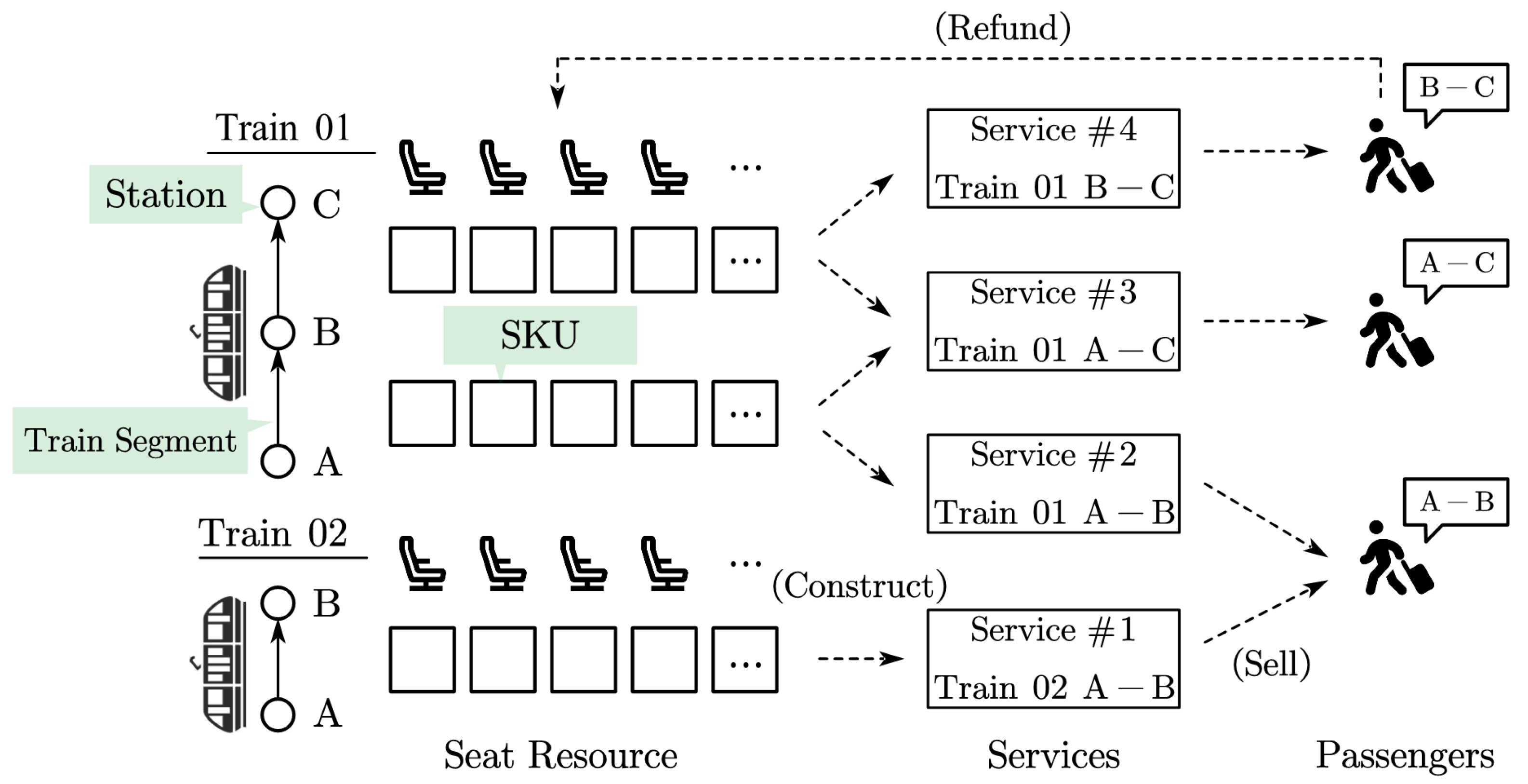
Railway ticket sales can be viewed as the flow of seat resources from railway operators to passengers in the form of passenger transport services. The scale of seat resources is quantified using Stock Keeping Units (SKUs) across different train sections. An SKU is the smallest unit of seat inventory, referring to a specific seat over a specific train segment. Each ticket sale entails the transfer of usage rights for one or several SKUs from the railway enterprise to the passenger. Conversely, the refund process represents a reverse resale of seat resources, where passengers transfer the associated usage rights back to the railway operator. The flow of seat resources and the interrelationships between key concepts in ticket sales are illustrated in Figure 1.
As a core operational strategy for traffic demand management, dynamic pricing adjusts ticket fares in real time based on the remaining inventory of SKUs and predicted market demand. Its fundamental principle is to align the time-varying ticket prices of passenger transport services with the current supply-demand dynamics, thereby safeguarding the maximum potential future revenue from seat resources. To formalize this problem, we introduce the following notation system: let J denote the set of all transport services, T represent the length of the pre-sale horizon, and r t , j denote the price of service j at time t. Let I denote the set of all train segments and x t , i represent the remaining quantity of SKUs corresponding to train segment i at time t.
Similar to dynamic pricing, the refund fee also varies over time. For the sake of a unified analytical perspective, this study adopts the refund amount w t , j in mathematical models—i.e., the sum returned to passengers by the operator upon ticket cancellation—instead of the refund fee. Even so, the refund fee can still be readily derived from the ticket price and the refund amount. Under the fixed refund fee mechanism, the refund amount is a step function correlated with the ticket price paid at the time of booking and the current refund time t. However, this mechanism is inherently inequitable, as the price at which the operator sells a given set of SKUs to passengers does not align with the effective price at which it repurchases those same SKUs from passengers via the refund process. The primary objective of this study is to jointly determine the dynamic ticket price r t , j and the corresponding refund amount w t , j to maximize ticket sales revenue, with the consistent constraint at any given time, aligned with SKU value changes.
To achieve this objective, we introduce opportunity cost as the unifying metric for measuring the value of SKUs, with the consideration of three inherent characteristics of railway SKUs: (1) Non-renewability: Given the railway system’s long planning cycle and relatively fixed train configurations during the pre-sale period, seat resources cannot be replenished in the pre-sale period. (2) Perishability: Seat resources lose all their value once the train departs. (3) Variability: Passenger demand varies significantly across different time periods and origin-destination (OD) pairs. These characteristics dictate that railway ticket pricing must not only consider train operation costs, but also passenger demand dynamics to maximize revenue. In practical pricing practice, the popularity of each train section is first inferred from OD passenger demand data, which then serves as the basis for formulating both ticket prices and refund fee.
In this study, we define the opportunity cost of an SKU as the highest revenue it can achieve under the optimal sales strategy. It reflects the expected future sales revenue. If the SKUs of a train segment remain unsold until the end of the pre-sale period, it indicates a low opportunity cost. Conversely, popular train segment have high opportunity costs. With complete knowledge of passenger demand, the opportunity cost of an SKU decreases continuously as the ticket sales process progresses, reaching zero at the end of the pre-sale period.

2.2. Opportunity-Cost-Based Pricing Strategy

First, let’s introduce the opportunity-cost-based pricing rule. We assume each service j is assigned a set of pre-defined price tiers, denoted by R j . At any time t during the ticket reservation horizon, the selling price r t , j of service j can only be selected from this fixed set of tiers. Let π t , i represent the opportunity cost of train segment i at time t. The pricing rule for service j at time t is then defined as follows: select the lowest price tier from R j that is not less than the sum of the opportunity costs of all SKUs corresponding to service j, which can be formulated as Equation (1).
r t , j = min r R j r i I j π t , i 0
This rule is designed to guarantee the maximization of ticket sales revenue: if a service is priced below the total opportunity cost of its corresponding segments, at least one SKU will be sold at a price lower than its economic value, which directly conflicts with the core goal of revenue optimization.
To illustrate this pricing rule more intuitively, we present a concrete example: consider a train operating from Station A to Station E, with intermediate stops at Stations B, C, and D (i.e., the service covers four sequential segments: A–B, B–C, C–D, D–E). For the A–E passenger service j, the pre-defined price tiers are set as R j = 600 , 700 , 900 . Suppose the current opportunity costs of SKUs for the segments A–B, B–C, C–D, and D–E are 150, 200, 350, and 100, respectively. The total opportunity cost of all segments for the A–E service is calculated as i I j π t , i = 150 + 200 + 350 + 100 = 800 . With the above pricing rule, we select the minimum tier in R j that is greater than or equal to 800: the tiers of 600 and 700 are both lower than the total opportunity cost (800) and thus excluded, leaving only 900 as the eligible price. Accordingly, the selling price of the A–E service at time t is set to 900. It is worth noting that the supply and demand relationship within the pre-sale period is not unchanged during the ticket reservation horizon. To reflect the dynamic changes in supply and demand, the opportunity cost π t , i will also change over time.
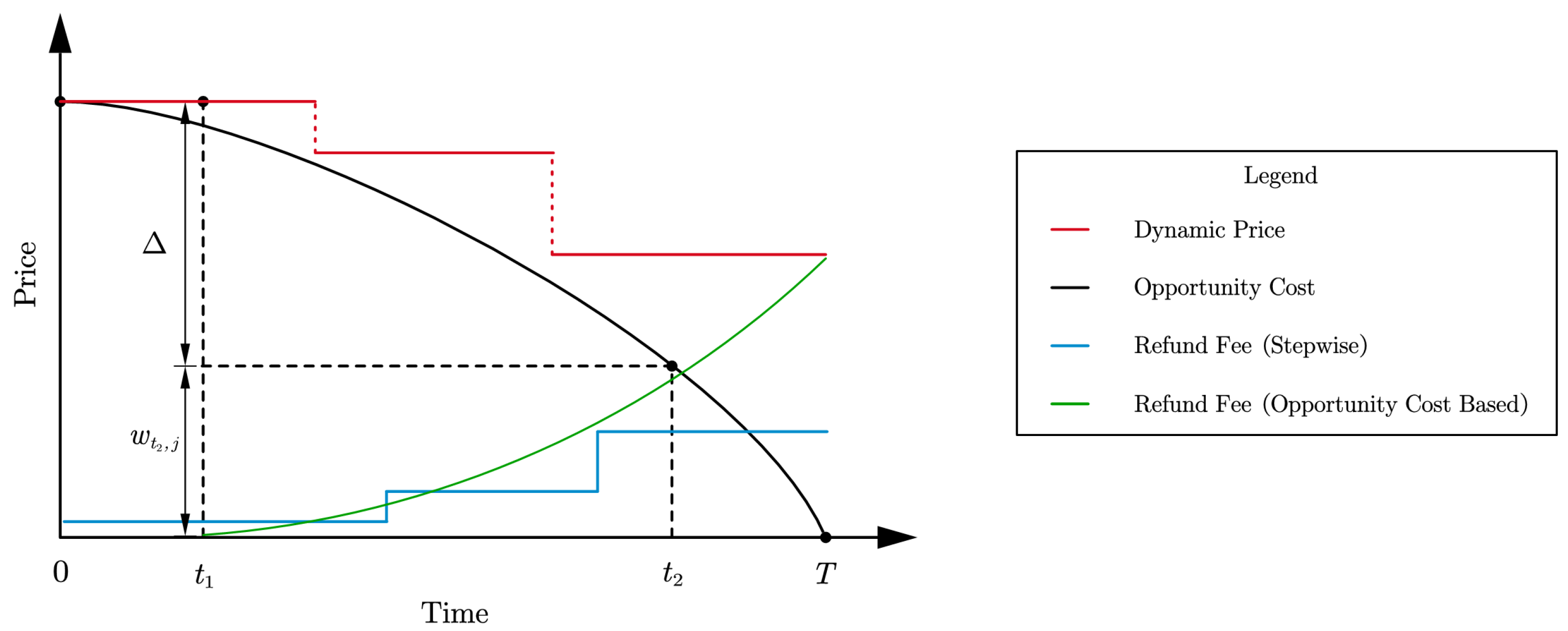
We define the amount retained by the operator after a ticket refund, which constitutes part of the profit, as the refund fee. Similar to the principle of pricing, opportunity cost can also serve as the basis for determining the refund fee. Suppose the price and opportunity cost of a specific ticket fluctuate over the pre-sale period, as illustrated in Figure 2. For a passenger who purchases a ticket at time t 1 and initiates a refund at time t 2 , the applicable refund fee varies depending on the calculation method adopted. When the opportunity-cost-based refund fee is applied, the refund amount to the passenger is determined based on the opportunity cost curve. Specifically, the refund fee is defined as the difference Δ between the ticket price at time t 1 and the refund amount (the sum of opportunity costs of all corresponding SKUs) at time t 2 , represented by w t 2 , j . We can plot the curve of the refund fee as a function of t 2 , as shown by the green line in Figure 2. Similarly, we can also draw the curve of the stepwise refund fee (the blue line in the figure). A comparison reveals that the opportunity-cost-based refund fee not only retains the rational trend of increasing as the interval between refund initiation and train departure narrows, but also exhibits a smoother, more adaptive variation pattern—outperforming the rigid, discontinuous stepwise fluctuations of the traditional stepwise refund fee. It should be noted that when the opportunity-cost-based refund fee is adopted, the refund amount can be calculated using Equation (2).
w t , j = i I j π t , i
Using opportunity cost to determine refund fees can avoid some unreasonable situations associated with stepwise refund fees. When the interval between the passenger’s ticket purchase and refund t 2 t 1 is very short (e.g., a wrong ticket purchase followed by a refund), if the refund fee is based on opportunity cost, the passenger can almost receive a full refund. In contrast, with a tiered refund fee, a refund fee proportional to the ticket price must be paid, especially for popular services with high ticket prices. When the interval t 2 t 1 is very long (e.g., purchasing a ticket at the beginning of the pre-sale period and refunding it close to departure), if the refund fee is based on opportunity cost, the refund fee will be close to the ticket price, with no loss to the railway enterprise. However, with a stepwise refund fee, even at the current highest refund fee (e.g., this value is set to 20% in China), the railway enterprise would still incur a loss of 80% of the ticket value. It is evident from the above examples that determining the refund fee based on opportunity cost better reflects the loss of opportunity cost and complies with the pricing laws of general perishable services.
Based on the above analysis, we argue that incorporating a flexible opportunity-cost-based refund fee mechanism into dynamic pricing is necessary. For passengers, it mitigates unreasonable losses arising from short-notice cancellations; for operators, it preserves the value of rebooking opportunities generated by late cancellations. Collectively, these merits enhance the practical applicability and stakeholder acceptance of the integrated dynamic pricing and refund framework.

3. Model

3.1. Ticket Sales Process

In existing studies, methods for calculating opportunity cost are divided into two categories: (1) constructing linear programming models and using the shadow prices of SKUs as bidding prices, and (2) constructing dynamic programming models and treating the bidding price as a parameter of the linear approximation of the value function. Since the first method can only solve static bidding prices and is not suitable for dynamic pricing, this study adopts the second method.
To simplify the expression of the ticket sales process, this study makes the following assumptions: (1) Passengers purchase only one ticket at a time, without considering group ticket purchases and the time spent on information collection, thinking, and comparison. (2) The ticketing system responds to passengers’ ticket purchase requests one by one. The symbols used in this study are shown in Table 1.
The ticket sales process may be approximated as a discrete-time process of length T, commencing at time t = 1 and concluding at time t = T . Provided T is sufficiently large, three events occur within each discrete time interval: (1) passenger ticket purchase, (2) passenger ticket refund, and (3) no passenger ticket purchase or refund. The remaining seat resources at the start of the discrete time interval t are represented by the remaining SKU vector x t = , x t , i , , i I . If a ticket for service j is sold during time interval t, the remaining seat resource vector for the subsequent time interval t + 1 is calculated as x t + 1 = x t e j . Here, e j denotes the seat resource consumption vector for service j. It is a 0-1 vector with e j 0 , 1 I , where the element corresponding to a train segment takes the value of 1 if the i-th segment is utilized by service j, and 0 otherwise.
The probability of a passenger of OD pair l purchasing service j is related to price vector r t , denoted as f l , j r t . Assuming the probability of a passenger appearing in each discrete time interval t is ρ t , the probability that this passenger has OD pair l is λ t , l , and the probability of the passenger purchasing a ticket is denoted as ε t . Then, the probability of service j being sold within time interval t is P t , j Sell r t , y t = ρ t · λ t , l · ε t · f l , j r t · y t , j , where y t , j indicates whether service j is sold during time interval t.
Typically, passenger choice theory serves as the theoretical foundation for f l , j r t . In this study, we adopt the multinomial logit (MNL) model, whose formulation is presented in Equation (3), where u l , j r t , j denotes the utility of service j when priced at r t , j . Specially, we let u l denote the utility of failing to travel. These utility values, along with λ t , l , ρ and ε t , can be derived through statistical methods—for instance, they can be calibrated from panel data [10,20]. Notably, the service set J here can include services from multiple trains, thus enabling the consideration of passengers’ choice behavior among different trains. In addition, the MNL model can be replaced with other passenger choice models, such as the nested Logit model [12] or the ordered preference list (OPL) model [21]. Consistent with this calibration logic, the values of ρ , λ t , l , ε t and the specific form of f l , j r t are treated as known values or functions in subsequent discussions.
f l , j r t = u l , j r t , j h J u l , h r t , h + u l
To account for ticket refunds, we introduce the variable P t , j Refund as the probability of a passenger refund at time t. Typically, the number of refunding passengers is correlated with the number of passengers who have already purchased tickets by time t. We could track the number of passengers who have purchased service j by time t by introducing a cumulative variable S t , j , and iteratively update S t , j and P t , j Refund through recursion. However, considering that the number of refunds usually constitutes a small fraction of the total number of ticket purchases, we simplify the problem by assuming that the refund process is independent, with P t , j Refund P t , j Sell r t , y t for arbitrary t and j. Therefore, the probability of refunding service j within time interval t can be approximately calculated by P t , j Refund = ρ t · λ t , l · ( 1 ε t ) .

3.2. The Dynamic Programming Model

Before calculating the opportunity cost, we first consider the optimal pricing problem, that is, the maximum revenue given the initial seat resources x 0 . According to the assumptions, the ticket sales process is expressed as a Markov decision process model, where the remaining quantity of seat resources x t at each time interval t depends only on the events that occurred in the previous time interval. Let V t ( x ) represent the maximum expected revenue corresponding to the remaining quantity of seat resources x at time t. V t ( x ) can be recursively calculated using the Bellman equation shown in Equation (4). Its boundary conditions are V T ( x ) = 0 and V t ( 0 ) = 0 , indicating that the revenue is zero after the train departs or when the seat resources are exhausted. Y t , j ( x ) represents the seat resource inventory constraints, meaning that service j can only be sold when the remaining quantity of SKUs x t , i in all related train sections is greater than 0. r t , j R j indicates that the price must be selected within the specified price tiers.
V t x t = max r t , y t j J P t , j Sell r t , y t r t , j + V t + 1 x t e j + j J P t , j Refund V t + 1 x t + e j w t , j + 1 j J P t , j Sell r t , y t j J P t , j Refund V t + 1 x t , t , x t N | J | , y t Y x t , r t , j R j
According to the definition of opportunity cost, the sum of the opportunity costs of all SKUs should equal the maximum ticket sales revenue. That is, at any time interval t, the remaining quantity of seat resources x t and the maximum expected revenue V t ( x ) should satisfy Equation (5), where θ t is the correction term.
V t x t = θ t + i I π t , i x t , i , θ t 0 , π t , i 0
To obtain a monotonically decreasing opportunity cost, it is assumed that π t , i π t + 1 , i and θ t θ t + 1 hold. The goal of this study is to solve for the opportunity cost π t , i , so it is not necessary to directly solve Equation (4). Instead, it is transformed into an equivalent linear programming model [22], and combined with Equation (5) to obtain the linear programming model M1 for π t , i and θ t . By solving model M1, the opportunity cost π t , i that changes over time can be obtained.
M 1 : m i n π t , i , θ t θ 1 + i I π 1 , i c i s . t . θ t θ t + 1 + i I π t , i Q t , i r t , y t + i I π t , i π t + 1 , i x t , i i I π t , i F t , i R t r t , y t t , x t N | J | , y t , j Y x t , r t , j R j π t , i π t + 1 , i , i I , t θ t θ t + 1 , t π t , i 0 , θ t 0
For simplicity, let R t r t , y t = j J P Sell r t , j , y t , j r t , j , Q t , i r t , y t = j J [ P Sell r t , j , y t , j P Refund ] · 1 i I j and F t , i = j J P Refund · 1 i I j . The indicator function 1 i I j takes the value 1 when the service j utilities a unit of inventory from the segment i, and 0 otherwise. Specifically, the boundary conditions yield θ T + 1 = 0 and π T + 1 , i = 0 for arbitrary train segment i I .

4. Solution Method

4.1. State Dimension Compression

Although model M1 contains only linear constraints, direct solution proves challenging due to the combination of constraint sets: pre-sale duration T, remaining inventory quantity x t , j , pricing r t , j , and sales status y t , j . This study constructs an approximate model for solution based on the problem’s properties.
By the definition of opportunity cost, the opportunity cost of each inventory unit π t , i decreases monotonically as t increases, implying that π t , i π t + 1 , i t , i holds. When inventory units for a train section i remain unsold (i.e., x t , i 1 ), the inequality π t , i π t + 1 , i x t , i π t , i π t + 1 , i is satisfied. The premise for selling passenger services is that at least one unsold inventory unit remains across all train sections traversed. Let the set I y t denote the set of train sections that must possess residual inventory units under the given condition y t and X y t denote all possible inventory states under the given condition y t . Then, Equation (6) holds.
i π t , i π t + 1 , i x t , i i I y t π t , i π t + 1 , i , x t X y t
Substituting Equation (6) into the constraints for M1 and applying inequality scaling eliminates the variable x t , i . The new constraints are shown in Equation (7).
θ t θ t + 1 + i I 1 i I y t + F t , i π t , i 1 i I y t Q t , i r t , y t π t + 1 , i R t r t , y t t , y t { 0 , 1 } | J | , r t , j R j

4.2. Time Dimension Compression

The number of time intervals T requires calibration with historical data [20], typically on a large scale. For instance, a case study involving merely 100 passengers generated approximately 10 4 time intervals. Compressing the number of time intervals during solution significantly reduces computational complexity. Considering that opportunity cost variations are relatively minor before peak ticket-purchasing periods, assume that an inflection point t = α exists in the sequence of optimal opportunity costs π t , i across all train segments. The opportunity cost remains unchanged before the inflection point, i.e., π t , i = π t + 1 , i , t α . At this point, Equation (7) can be transformed into Equation (8):
θ t θ t + 1 + i I F t , i Q t , i r t , y t π t , i R t r t , y t , t α , y t { 0 , 1 } | J | , r t , j R j
By definition, given y t and r t , the values of R t r t , y t , Q t , i r t , y t , and F t , i are identical for any t < α . Therefore, in Equation (8), all terms except θ t θ t + 1 are identical. Summing both sides of the constraint inequality corresponding to 0 t α yields Equation (9).
θ 1 θ α α + i I F t , i Q t , i r t , y t π t , i R t r t , y t , y t { 0 , 1 } | J | , r t , j R j
By substituting the relevant constraints where t α with Equation (9), a new model M2 is obtained. Compared to model M1, it eliminates all variables and constraints associated with t α . If an optimal solution θ * , π * for M2 is found, we can construct a solution ( θ ˜ , π ˜ ) for model M1 via Equations (10) and (11).
θ ˜ t = θ 1 * + θ α * θ 1 * α · t t = 1 , , α 1 θ t * t = α T
π ˜ t , i = π 1 , i * t = 1 , , α 1 π t , i * t = α T
M 2 : min π t , i , θ t θ 1 + i π 1 , i c i s . t . θ 1 θ α α + i I F t , i Q t , i r t , y t π t , i R t r t , y t , y t { 0 , 1 } | J | , r t , j R j θ t θ t + 1 + i I 1 i I y t + F t , i π t , i 1 i I y t Q t , i r t , y t π t + 1 , i R t r t , y t t α , y t { 0 , 1 } | J | , r t , j R j π t , i π t + 1 , i , t , i θ t θ t + 1 , t π t , i 0 , θ t 0
Although model M2 effectively reduces the number of variables and constraints, in practical solution-seeking, the value of α is not known. By employing a turning-point search algorithm (Algorithm 1), one may search backwards from T to find reasonable values for α .
Algorithm 1. Turning-point Search Algorithm
1. Initialization. Set α = T , specify the search step size α step and convergence threshold μ .
2. Solve model M2 and record the objective function value V α and the optimal solution ( θ ˜ , π ˜ ) .
3. Convergence assessment. If α = 1 or 1 < α < T and V α + 1 V α μ , terminate the solution process; the current ( θ ˜ , π ˜ ) constitutes the optimal solution. Otherwise, update α = max 1 , α α step and return to step 2.

4.3. Constraint Generation Algorithm

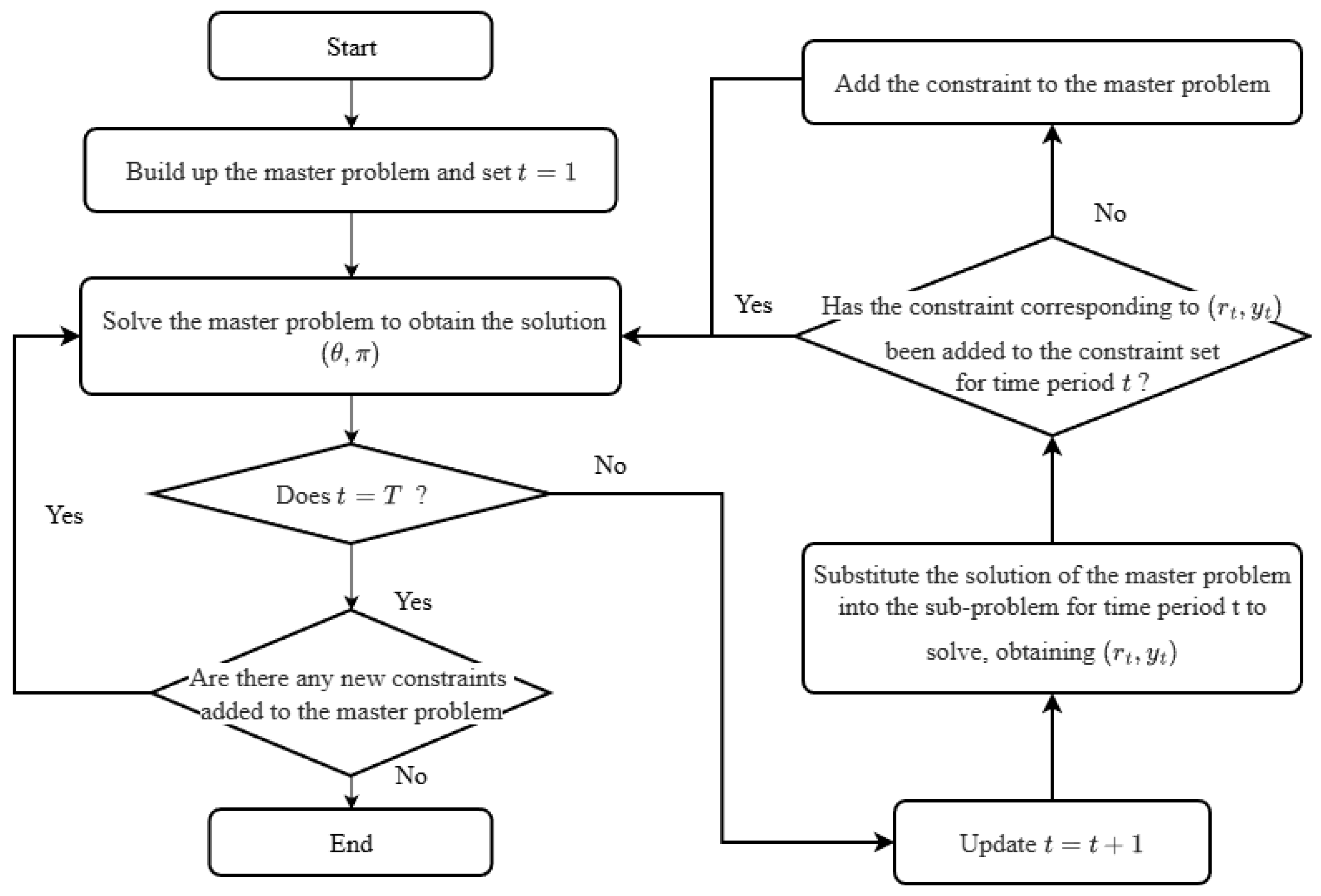
The number of constraints in model M2 typically far exceeds the number of variables. A constraint generation approach may be employed for solution, following this fundamental strategy: (1) For each time interval t, select a subset of constraints to construct a principal problem that is readily solvable. (2) Substitute the solution of the principal problem into the constraint generation subproblem to determine whether all constraints of the original problem are satisfied. (3) If any constraint remains unsatisfied, incorporate it into the principal problem and repeat the process until a solution is achieved. The algorithmic flow of constraint generation is illustrated in Figure 3.
The constraint generation sub-problems for model M2 are given by Equations (12) and (13). These can be solved through the further design of heuristic algorithms.
max r t , y t R t r t , y t i I 1 i I y t + F t , i π t , i 1 i I y t Q t , i r t , y t π t + 1 , i θ t + θ t + 1
max r t , y t R t r t , y t i I F t , i Q t , i r t , y t θ 1 θ α α

5. Numerical Experiments

5.1. Data and Experiment Settings

This section presents numerical experiments to validate the proposed model, evaluate its performance, and demonstrate its applicability in practical railway ticketing scenarios. To align with real-world operational contexts, we select the second-class seat sales of train G15, which runs from Beijing South Station to Shanghai Hongqiao Station in China, as a representative case study. For computational convenience, we assume that a total of 500 s-class seats are available for this service, paired with a 48-h pre-sale period. Passenger demand distributions across all OD pairs for this route are summarized in Table 2. Additionally, the total number of time periods T is set to 15,971, derived by approximating the continuous pre-sale process as a Poisson process [10]. Note that, in this case, we only consider a single train service, so the choice between multiple trains is excluded from the discussion. While these factors are critical to revenue in real-world scenarios, the primary objective of this experiment is to verify the effectiveness of different pricing and refund fee strategies.
Ticket prices for each OD pair are presented in Table 3. For the implementation of dynamic pricing, an additional two price tiers are assigned to each OD pair: specifically, a 10% premium tier and a 10% discount tier relative to the baseline fare.
To enable a comparative analysis, we introduce China’s current stepwise railway refund fee mechanism as the baseline benchmark, under which no refund fee is levied for cancellations initiated more than 8 days before the scheduled departure time, whereas a 5% refund fee applies to cancellations made between 48 h and 8 days prior to departure, a 10% refund fee is imposed on cancellations occurring between 24 h and 48 h before departure, and a 20% refund fee is charged for any cancellations initiated less than 24 h ahead of the scheduled departure time.

5.2. Solving the Opportunity Cost Curve

Building on the experimental setup outlined earlier for train G15’s second-class seat operations, we proceeded to implement the dynamic decomposition approximation algorithm to solve the proposed pricing and refund optimization model. The case study presented above achieved convergence within 20 iterations, a testament to the algorithm’s computational efficiency and stability in handling large-scale railway ticketing optimization problems. Further analysis of the opportunity cost dynamics revealed that its inflection point emerged 130 min prior to the ticket sales deadline, aligning with the pre-defined discrete time segment division and reflecting the critical threshold where seat resource scarcity begins to exert a dominant influence on cost fluctuations.
We first evaluated the performance of different algorithms on small-scale cases, with tests conducted across varying numbers of time intervals. We compared three solution approaches: direct solution of the dynamic programming model in Equation (4), the state dimension compression method alone, and the combined state and time dimension compression method. The results are presented in Table 4. The combined application of both dimension compression techniques yields a substantial reduction in solution time.
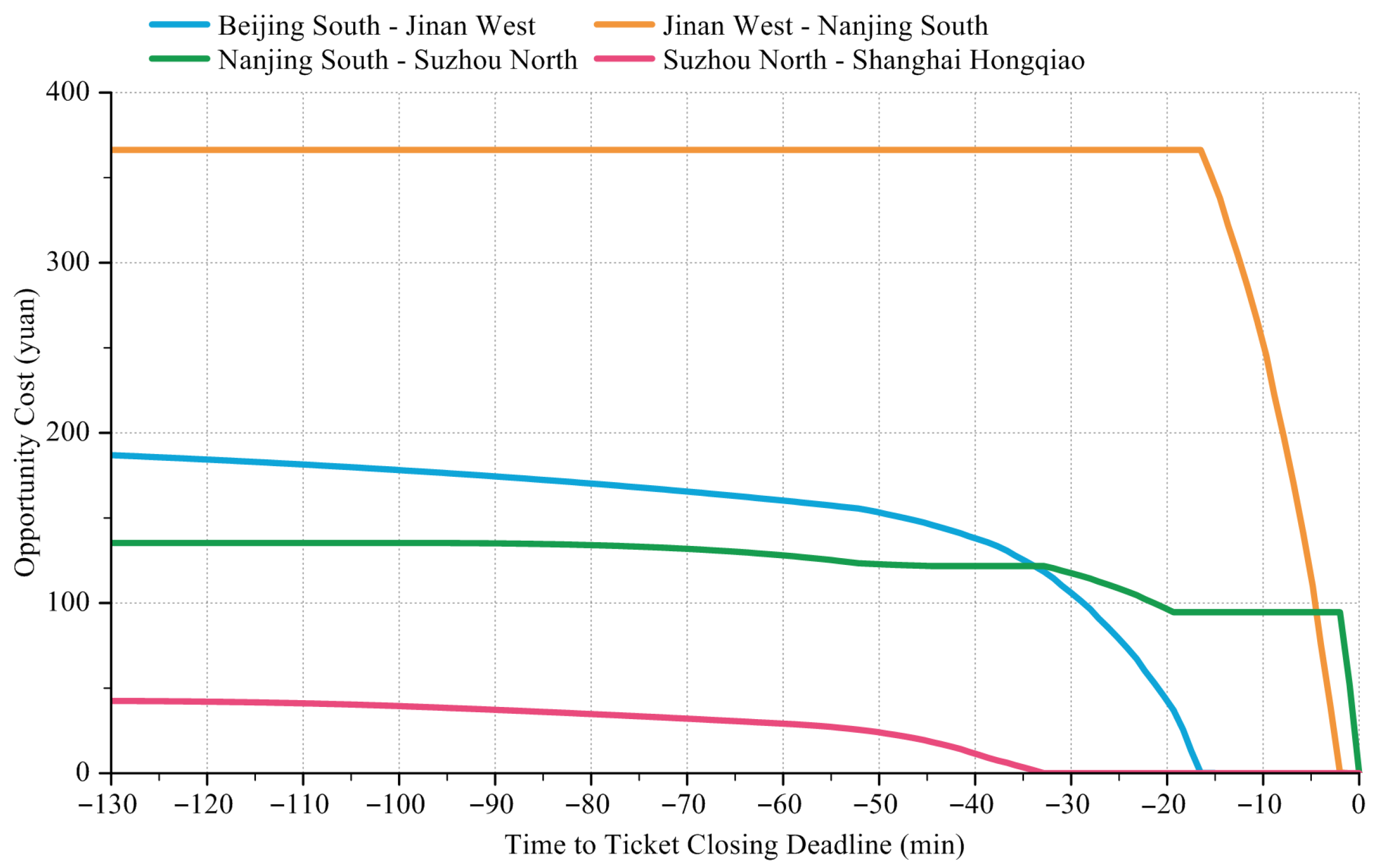
Opportunity cost values for all route segments are visualized in Figure 4, with distinct temporal variation patterns observed across different OD pairs. Specifically, for the Nanjing South–Suzhou North segment, the opportunity cost underwent a gradual decline starting 55 min prior to departure, before dropping sharply to zero in the final five minutes leading up to departure. For the Beijing South–Jinan West segment, the opportunity cost began a steady decrease 120 min before departure and reached zero 15 min ahead of the scheduled departure time. As for the Jinan West–Nanjing South segment, its opportunity cost remained above 350 yuan until 20 min prior to departure, sharply decreasing to zero exactly at departure time. Notably, the Suzhou North–Shanghai Hongqiao segment maintained a consistently low opportunity cost throughout the pre-sale period, owing to relatively weak passenger demand intensity in this short-distance section. These divergent trends underscore the critical role of segment-specific demand characteristics in shaping opportunity cost dynamics, laying a foundation for the subsequent comparative analysis of different refund mechanisms.
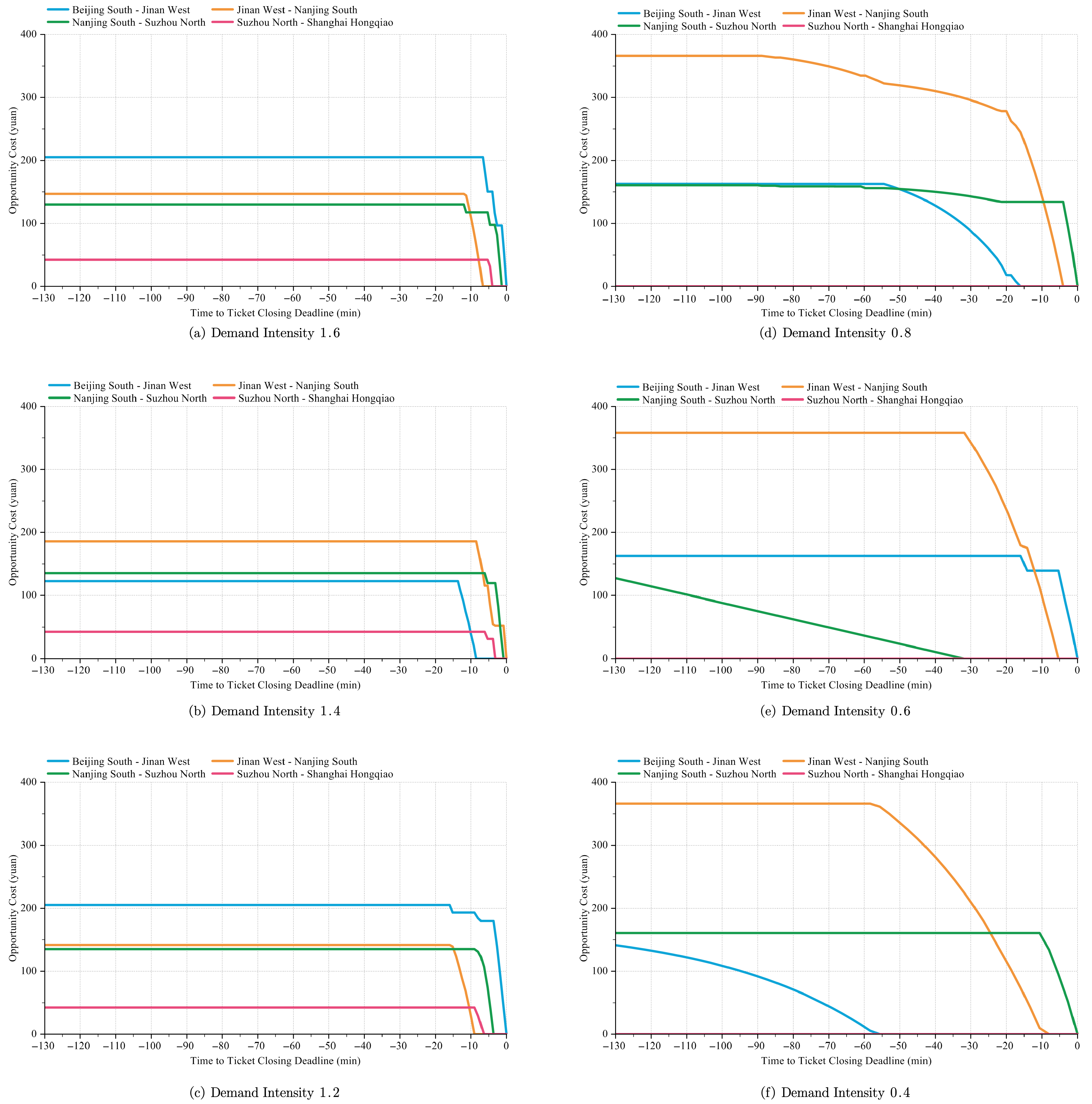
To further validate the impact of passenger demand on opportunity cost curves, demand intensity coefficients were applied to the demand levels shown in Table 2. The resulting opportunity cost curves for varying demand intensities are depicted in Figure 5. Due to the coupling relationship between seating capacity and passenger services, opportunity costs do not exhibit strictly monotonic variation with demand fluctuations. For instance, the opportunity cost for the Jinan West—Nanjing South section actually increased following a reduction in demand intensity.

5.3. Simulation Experiment

Simulation is an effective method for validating pricing mechanisms, especially for uncertain public transport networks. It enables the verification of performance under various random scenarios [23]. To empirically validate the effectiveness of the proposed dynamic pricing framework, we conducted a ticket sales simulation experiment to compare four distinct pricing–refund strategy combinations: dynamic pricing paired with a flexible refund fee, dynamic pricing paired with fixed refund fee, fixed pricing paired with a flexible refund fee, and fixed pricing paired with a fixed refund fee. Each simulation iteration randomly generated a passenger cohort with heterogeneous OD pairs and price sensitivities, mirroring the diversity of real-world railway travelers. To capture realistic passenger choice behavior, we incorporated an external option representing the scenario where potential passengers abandon travel plans or switch to alternative transportation modes in response to prohibitively high ticket fares. Each strategy group was subjected to 100 independent simulation runs to ensure statistical robustness, and the average values of key performance metrics were computed as the final results for each group, which are summarized in Table 5.
The simulation results demonstrate that the dynamic pricing–flexible refund fee combination (Group 1) yielded the highest net revenue, defined as total ticket sales revenue net of refund-related expenditures. While the fixed pricing–flexible refund fee combination (Group 3) generated the highest gross ticket sales, its comparatively lower refund fee income translated to a net revenue figure that lagged behind that of Group 1. In contrast, the dynamic pricing–fixed refund fee combination (Group 2) registered the lowest gross ticket sales alongside the minimal amount of refund fees collected throughout the simulation. With respect to passenger service volume—a key indicator of operational accessibility—the dynamic pricing–flexible refund fee combination (Group 1) also marginally outperformed the remaining three strategy combinations.
To verify the reliability and stability of the simulation results, we conducted statistical analysis on the 100 simulation runs. For key outcome indicators (e.g., operator revenue, average refund amount), the coefficient of variation (CV) is less than 3%, and the 95% confidence interval of the mean falls within ±5% of the group average.
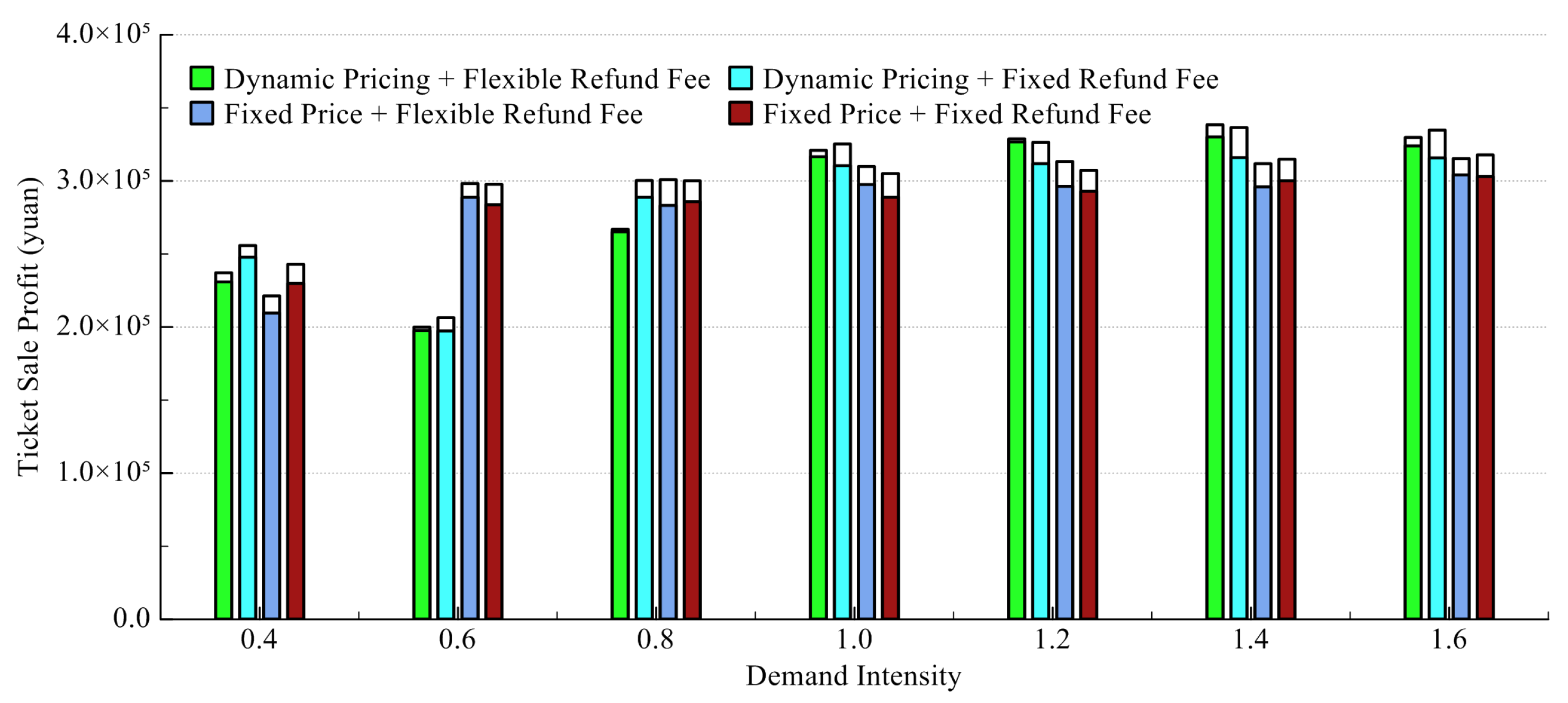
Figure 6 illustrates how different pricing–refund strategy combinations affect ticket sales revenue across varying levels of demand intensity, where shaded regions denote ticket sales revenue and unshaded regions represent refund-related expenditures. When demand intensity exceeds the threshold value of 1.0, the dynamic pricing–flexible cancellation fee combination delivers the highest revenue among the four strategy options. In contrast, when demand intensity drops below 1.0, the fixed pricing–fixed cancellation fee combination exhibits more robust revenue performance. From a revenue maximization standpoint, the dynamic pricing–flexible cancellation fee strategy emerges as the optimal choice as demand intensity gradually rises.

6. Conclusions

This study explores integrated dynamic pricing strategies for railway line services coupled with flexible cancellation fee mechanisms, with the consistency of price and refund fees between operators and passengers as a guiding constraint. By developing a dynamic programming framework and designing an approximate solution algorithm, we effectively mitigate the computational complexity inherent in large-scale railway revenue optimization problems. Empirical case studies not only verify the feasibility and efficiency of the proposed solution algorithm, but also demonstrate the practical applicability of dynamic pricing strategies when integrated with flexible cancellation fee structures. Simulation experiments further reveal that the synergistic combination of dynamic pricing and flexible cancellation fees yields a substantial boost in ticket sales revenue—while maintaining passenger acceptance through value matching—particularly during periods of seat supply scarcity.
From a practical implementation perspective, the efficiency of the proposed dynamic pricing framework hinges on the accuracy of opportunity cost curves, which serve as the core theoretical foundation of this study. For railway operators, the dynamic and volatile nature of the passenger transportation market requires the frequent recalibration of opportunity cost estimates to reflect real-time fluctuations in passenger demand and seat inventory. Accordingly, future research directions could focus on developing adaptive, real-time updating mechanisms for opportunity cost estimation; additionally, exploring the integration of this framework with advanced passenger choice models would further enhance its practical value for railway operators.

Author Contributions

Conceptualization, methodology and validation, W.Y. and Z.R.; writing—original draft preparation, Z.R.; writing—review and editing, Z.Z. and Y.K.; data curation, Z.Z. All authors have read and agreed to the published version of the manuscript.

Funding

This research was funded by National Natural Science Foundation of China (No. 72561010), Jiangxi Provincial Natural Science Foundation Project (No. 20252BAC200184), Project of the Key Research Base of Philosophy and Social Sciences of Jiangxi Province (23ZXSKJD19) and Humanities and Social Sciences Research Projects of Universities in Jiangxi Province (grant number JC25238).

Data Availability Statement

The original contributions presented in this study are included in the article. Further inquiries can be directed to the corresponding author.

Conflicts of Interest

Zhongrui Zhou is employees of Passenger Transport Department, China Railway Beijing Group Co., Ltd. The remaining authors declare that the research was conducted in the absence of any commercial or financial relationships that could be construed as a potential conflict of interest.

References

  1. Owais, M. Transit network design problem: A half century of methodological research. Innov. Infrastruct. Solut. 2025, 11, 3. [Google Scholar] [CrossRef]
  2. Spiess, H.; Florian, M. Optimal strategies: A new assignment model for transit networks. Transp. Res. Part Methodol. 1989, 23, 83–102. [Google Scholar] [CrossRef]
  3. Nguyen, S.; Pallottino, S. Equilibrium traffic assignment for large scale transit networks. Eur. J. Oper. Res. 1988, 37, 176–186. [Google Scholar] [CrossRef]
  4. Almutairi, A.; Owais, M.; Ahmed, A.S. Notes on Bus User Assignment Problem Using Section Network Representation Method. Appl. Sci. 2024, 14, 3406. [Google Scholar] [CrossRef]
  5. Talluri, K.T.; Ryzin, G.J.V. The Theory and Practice of Revenue Management; Springer: Dordrecht, The Netherlands, 2004. [Google Scholar]
  6. Ciancimino, A.; Inzerillo, G.; Lucidi, S.; Palagi, L. A Mathematical Programming Approach for the Solution of the Railway Yield Management Problem. Transp. Sci. 1999, 33, 135–256. [Google Scholar] [CrossRef]
  7. Xu, G.; Zhong, L.; Hu, X.; Liu, W. Optimal pricing and seat allocation schemes in passenger railway systems. Transp. Res. Part E Logist. Transp. Rev. 2022, 157, 102580. [Google Scholar] [CrossRef]
  8. Hetrakul, P.; Cirillo, C. A latent class choice based model system for railway optimal pricing and seat allocation. Transp. Res. Part E Logist. Transp. Rev. 2014, 61, 68–83. [Google Scholar] [CrossRef]
  9. Wang, X.; Wang, H.; Zhang, X. Stochastic seat allocation models for passenger rail transportation under customer choice. Transp. Res. Part E Logist. Transp. Rev. 2016, 96, 95–112. [Google Scholar] [CrossRef]
  10. Lee, T.C.; Hersh, M. A Model for Dynamic Airline Seat Inventory Control with Multiple Seat Bookings. Transp. Sci. 1993, 27, 252–265. [Google Scholar] [CrossRef]
  11. Talluri, K.; Ryzin, G.V. An Analysis of Bid-Price Controls for Network Revenue Management. Manag. Sci. 1998, 44, 1577–1593. [Google Scholar] [CrossRef]
  12. Talluri, K.; Ryzin, G.V. Revenue Management Under a General Discrete Choice Model of Consumer Behavior. Manag. Sci. J. Inst. Oper. Res. Manag. Sci. 2004, 50, 15–33. [Google Scholar] [CrossRef]
  13. Kunnumkal, S.; Talluri, K. Choice Network Revenue Management Based on New Tractable Approximations. Transp. Sci. 2019, 53, 1501–1799. [Google Scholar] [CrossRef]
  14. Adelman, D. Dynamic Bid Prices in Revenue Management. Oper. Res. 2007, 55, 647–661. [Google Scholar] [CrossRef]
  15. Gosavi, A. A Reinforcement Learning Algorithm Based on Policy Iteration for Average Reward: Empirical Results with Yield Management and Convergence Analysis. Mach. Learn. 2004, 55, 5–29. [Google Scholar] [CrossRef]
  16. Koch, S. Least squares approximate policy iteration for learning bid prices in choice-based revenue management. Comput. Oper. Res. 2017, 77, 240–253. [Google Scholar] [CrossRef]
  17. Meissner, J.; Strauss, A. Network Revenue Management with Inventory-Sensitive Bid Prices and Customer Choice. Eur. J. Oper. Res. 2011, 216, 459–468. [Google Scholar] [CrossRef]
  18. Blanchet, J.; Gallego, G.; Goyal, V. A Markov Chain Approximation to Choice Modeling. Oper. Res. 2016, 64, 886–905. [Google Scholar] [CrossRef]
  19. Berbeglia, G. Discrete choice models based on random walks. Oper. Res. Lett. 2016, 44, 234–237. [Google Scholar] [CrossRef]
  20. Vulcano, G.; Ratliff, R. Estimating Primary Demand for Substitutable Products from Sales Transaction Data. Oper. Res. 2011, 60, 313–334. [Google Scholar] [CrossRef]
  21. Hosseinalifam, M.; Marcotte, P.; Savard, G. Network capacity control under a nonparametric demand choice model. Oper. Res. Lett. 2015, 43, 461–466. [Google Scholar] [CrossRef]
  22. Puterman, M.L. Markov Decision Processes: Discrete Stochastic Dynamic Programming; John Wiley & Sons, Inc.: Hoboken, NJ, USA, 1994; p. 353. [Google Scholar]
  23. Owais, M.; Hassan, T. Incorporating Dynamic Bus Stop Simulation into Static Transit Assignment Models. Int. J. Civ. Eng. 2018, 16, 67–77. [Google Scholar] [CrossRef]
Figure 1. Flow of seat resources during ticket sales.
Vehicles 08 00031 g001
Figure 2. Illustration of opportunity cost calculation.
Vehicles 08 00031 g002
Figure 3. Flowchart of the constraint generation algorithm.
Vehicles 08 00031 g003
Figure 4. Opportunity cost curves for Train G15.
Vehicles 08 00031 g004
Figure 5. Opportunity cost curves under different levels of demand intensity.
Vehicles 08 00031 g005
Figure 6. Ticket sales revenue under different demand intensity levels.
Vehicles 08 00031 g006
Table 1. Definition of notations.
SymbolMeaning
TLength of the pre-sale period
ISet of all train sections
JSet of all services
LSet of all OD pairs
XSet of all possible SKU states
x t , i Remaining quantity of SKUs in section i at time t
y t , j 0-1 variable, equals 1 if service j is available for sale at time t
π t , i Opportunity cost of section i at time t
r t , j Price of service j at time t
w t , j Refund amount for service j at time t
e j Vector representing the seat resources consumed by service j
ρ t Probability of passengers entering the ticketing system at time t
λ t , l Probability that the OD of passengers purchasing tickets at time t is l
ϵ t Probability of passengers purchasing tickets at time t
V t ( x ) Maximum expected revenue corresponding to the remaining quantity of seat resources x at time t
Table 2. Passenger demand.
Origin/DestinationJinan WestNanjing SouthSuzhou NorthShanghai Hongqiao
Beijing South1004540350
Jinan West-903045
Nanjing South--80180
Suzhou North---50
Table 3. Baseline ticket price settings.
Origin/DestinationJinan WestNanjing SouthSuzhou NorthShanghai Hongqiao
Beijing South223504627625
Jinan West-313439479
Nanjing South--118142
Suzhou North---38
Table 4. Solution performance (seconds).
#Length of HorizonDPState Dimension CompressionState and Time Dimension Compression
1100>10 h5429533
2200-10,841598
3500-25,755704
410,000->10 h2217
Table 5. Simulation results.
IndicatorDynamic Pricing with Flexible Refund FeeDynamic Pricing with Fixed Refund FeeFixed Price with Flexible Refund FeeFixed Price with Fixed Refund Fee (Baseline)
Income304,964 (−0.22%)303,913 (−0.56%)308,240 (+0.85%)305,636
Refund amount10,014 (−33.33%)15,595 (+3.82%)15,285 (+1.76%)15,021
Profit294,949 (+1.49%)288,318 (−0.79%)292,954 (+0.80%)290,615
Number of passengers served781 (+3)781 (+3)683 (−95)778
Average number of refunds39 (+1)40 (+2)30 (−8)38
Average ticket revenue390 (−3)389 (−4)428 (+35)393
Average refund expenditure257 (−141)395 (−3)509 (−111)398
Disclaimer/Publisher’s Note: The statements, opinions and data contained in all publications are solely those of the individual author(s) and contributor(s) and not of MDPI and/or the editor(s). MDPI and/or the editor(s) disclaim responsibility for any injury to people or property resulting from any ideas, methods, instructions or products referred to in the content.