1. Introduction
Milk and dairy products are among the most frequently adulterated food commodities worldwide due to their high commercial value, extensive consumption, and complex production chains [
1]. Food fraud in the dairy sector represents a major economic and public health concern, particularly when adulteration practices compromise nutritional quality or consumer trust. According to Spink and Moyer [
2], food fraud should be considered an emerging public health threat, while other researchers [
3] described economically motivated adulteration as a widespread issue affecting global food supply chains and emphasized the increasing complexity of food fraud incidents involving multiple adulteration strategies. In addition, Danezis et al. [
4] highlighted that modern food authentication increasingly relies on integrated analytical approaches combining physicochemical, spectroscopic, and chemometric techniques for detecting sophisticated food fraud practices. Milk adulteration may involve the addition of water, low-cost substitutes, chemical preservatives, sugars, salts, or other compounds intended to manipulate compositional characteristics and increase economic profit [
5,
6].
Among the various adulteration practices applied to milk, dilution with water remains one of the most common due to its simplicity and immediate economic benefit. However, simple dilution is often accompanied by the addition of compensatory substances intended to restore physicochemical parameters altered by water addition. These compounds may include sugars, salts, starches, or other soluble materials capable of modifying density, freezing point, conductivity, and total solids content [
7,
8,
9]. Such combined adulteration strategies significantly complicate routine authenticity assessment because the added substances may partially restore analytical values toward those observed in authentic milk.
The detection of milk adulteration has therefore become an important field of research in food authenticity and quality control. Traditional methods for detecting water addition are primarily based on physicochemical parameters such as density, freezing point depression, electrical conductivity, fat content, and total solids [
10,
11,
12]. Among these parameters, freezing point depression is widely considered one of the most sensitive indicators of water dilution because it is strongly associated with the concentration of dissolved milk constituents. Studies by Konuspayeva et al. [
11] demonstrated that variations in milk composition can significantly influence freezing point values and consequently affect fraud detection reliability.
Although conventional physicochemical analyses remain widely used in routine dairy quality control, several studies have highlighted their limitations when compensatory adulterants are present. Previous investigations [
13,
14,
15] demonstrated that certain adulterants may substantially alter milk compositional profiles and interfere with routine analytical interpretation. Similarly, Grassi and Casiraghi [
16] emphasized that modern milk fraud increasingly involves sophisticated masking strategies capable of reducing the effectiveness of traditional screening approaches.
Recent advances in analytical chemistry have led to the development of more sophisticated techniques for food authenticity assessment. Spectroscopic and chemometric methods, including Fourier-transform infrared spectroscopy (FTIR), near-infrared spectroscopy (NIR), nuclear magnetic resonance (NMR), and multivariate statistical analysis, have shown promising applications in milk fraud detection [
17,
18,
19,
20,
21,
22]. These methods allow rapid screening of milk samples and can improve the detection of subtle compositional changes associated with adulteration. However, many of these approaches require advanced instrumentation, chemometric expertise, or extensive calibration procedures, limiting their routine implementation in some dairy laboratories.
Carbohydrate-based adulterants represent a particularly important category of masking agents in diluted milk. Sugars such as sucrose may artificially increase dissolved solids and modify physicochemical properties, thereby reducing the detectability of water addition. Previous studies [
23,
24] demonstrated the usefulness of chromatographic methods for determining sugars in milk and dairy products. Enzymatic spectrophotometric assays have also been successfully applied for sucrose determination due to their specificity, simplicity, and rapid analytical performance [
25].
Although numerous studies have investigated milk adulteration in bovine milk, comparatively fewer investigations have focused on small-ruminant milk. Goat and sheep milk possess distinct compositional and physicochemical characteristics that may influence the analytical performance of adulteration detection methods [
26]. Furthermore, breed-related and seasonal variability may significantly affect fat, protein, lactose, and total solids concentrations in small-ruminant milk, potentially influencing the robustness of routine authenticity assessment methods. In the present study, goat milk originated from Eghoria goats and sheep milk from Chios sheep, both commonly used dairy breeds in Greece.
Studies specifically examining combined adulteration involving both water dilution and sugar-mediated masking in goat and sheep milk remain limited. Most available investigations focus either on single adulterants or on bovine milk matrices. Consequently, there is a need for integrated analytical approaches capable of detecting more complex adulteration scenarios in small-ruminant milk.
Therefore, the objective of the present study was to investigate a combined analytical workflow for detecting water dilution masked by sucrose addition in goat and sheep milk. The proposed approach integrates routine physicochemical analysis with targeted characterization of the adulterant powder and enzymatic spectrophotometric determination of sucrose. The study also evaluates the influence of sucrose addition on major milk physicochemical parameters and examines the applicability of the proposed methodology for detecting complex milk adulteration practices relevant to dairy authenticity control.
2. Materials and Methods
2.1. Milk Samples
Raw goat and sheep milk samples were collected from two local dairy farms located in the village of Sohos, near Thessaloniki, participating in the GRAEGA CHEESE research project. Goat milk originated from animals of the Eghoria breed, while sheep milk was obtained from animals of the Chios breed. A total of 30 goat milk samples and 30 sheep milk samples were included in the study. Samples were transported to the lab under refrigerated conditions (4 °C) within 2 h. Following transportation, samples from each milk type were combined and thoroughly homogenized in order to obtain representative bulk samples for the experimental procedures and analyzed shortly after homogenization to ensure minimal compositional changes. Initial analyses were performed to determine baseline physicochemical parameters, including fat, protein, lactose, total solids, mineral content, density, pH, and freezing point.
2.2. Preparation of Adulterated Samples
Controlled adulteration experiments were performed to simulate milk dilution and sucrose addition. Milk samples were diluted with water at concentrations of 1%, 2%, 3%, 6%, 10%, and 15%. Parallel experiments were conducted by adding aqueous solutions of the adulterant powder suspected of containing sucrose. These solutions were prepared at concentrations corresponding to sucrose levels ranging from 0.1% to 1.5%. The experiments included two adulteration scenarios: water dilution only and water dilution combined with sucrose addition. All experiments were conducted in duplicate to ensure reproducibility.
2.3. Physicochemical Analysis
Physicochemical properties of milk samples were measured using an automated milk analyzer capable of determining multiple parameters simultaneously, namely a FUNKE GERBER LactoStar Dairy Analyzer (Berlin, Germany), following the manufacturer’s instructions. The instrument was calibrated prior to analysis using certified reference standards to ensure measurement accuracy and repeatability. The following parameters were measured: fat content, protein concentration, lactose concentration, total solids, density, mineral content, freezing point, and pH. Milk pH was measured with an electronic Consort pH meter (Turnhout, Belgium).
2.4. Characterization of the Adulterant Powder
The powder used in this study was obtained from a local farmer and was selected as a representative sucrose-based adulterant commonly associated with milk fraud practices. The physicochemical and elemental composition of the powder was evaluated using conventional analytical methods. Moisture content was determined gravimetrically. Fat content was measured using Soxhlet extraction, and total nitrogen was determined using the Kjeldahl method. Salt content was determined using titration techniques.
Elemental analysis was performed using inductively coupled plasma–atomic emission spectroscopy (ICP-AES). The elements analyzed included calcium, magnesium, sodium, phosphorus, potassium, iron, zinc, copper, manganese, and lead.
Carbohydrate composition was determined using high-performance liquid chromatography with refractive index detection (HPLC-RI). The chromatographic method allowed the identification and quantification of sugars, including sucrose.
2.5. Enzymatic Detection and Quantitative Determination of Sucrose
Qualitative detection of sucrose was performed using a commercial enzymatic assay kit (BIOTECHNOLOGY PRODUCTS MenidiMedica, Menidi, Greece) for milk adulteration analysis. The method is based on the enzymatic hydrolysis of sucrose to glucose and fructose, followed by a chromogenic reaction generating a violet-colored complex proportional to sucrose concentration. The assay was carried out according to the manufacturer’s instructions.
Quantitative measurements were obtained using photometric detection following enzymatic reaction with a Shimadzu model UV-1601 spectrophotometer (Tokyo, Japan). Calibration curves were prepared using sucrose standards at concentrations ranging from 0.1% to 15%. Prior to analysis, milk samples were filtered to minimize turbidity and analytical interference. Absorbance measurements were performed at 505 nm according to the manufacturer’s instructions.
2.6. Statistical Analysis
Data were analyzed using IBM SPSS Statistics (Version 29; IBM Corp., Armonk, NY, USA). One-way analysis of variance (ANOVA) was applied to evaluate differences among dilution levels and treatment groups. Duncan’s multiple range test was used for post hoc comparisons.
Differences were considered statistically significant at p < 0.05. Results are expressed as mean ± standard deviation (SD) of duplicate measurements (n = 2).
3. Results
3.1. Characterization of the Adulterant Powder
The suspected adulterant powder was initially characterized in order to determine its chemical nature and evaluate its potential role as a masking agent in milk adulteration. Conventional chemical analysis showed that the powder differed substantially from typical dairy-derived powders. It contained very low-fat content (0.39%) and low protein concentration (2.68%), while a relatively high sodium chloride content (5.76%) was detected. Elemental analysis by ICP-AES further confirmed the presence of elevated sodium levels (4.86% w/w), supporting the results obtained by classical chemical analysis. The increased sodium content suggested that the powder could influence physicochemical parameters such as freezing point and conductivity, both of which are commonly used in routine milk quality control. High-performance liquid chromatography with refractive index detection (HPLC-RI) was then used to determine the carbohydrate composition of the powder. The chromatographic analysis demonstrated that the powder consisted predominantly of sucrose (91.4% w/w). This finding confirmed that the material was not a conventional dairy ingredient but rather a sucrose-rich substance capable of increasing dissolved solids when added to diluted milk. To further assess its potential masking effect, aqueous solutions of the powder were analyzed using the milk analyzer. The 10% powder solution produced values resembling some compositional characteristics of milk, particularly total solids, proteins, lactose, and density, although fat content remained negligible. These results indicated that the powder could artificially modify routine analytical parameters and potentially mask the effects of water dilution.
Overall, the analytical characterization confirmed that the adulterant used in the experimental trials was primarily sucrose-based, with elevated sodium content, and therefore suitable for evaluating a combined adulteration scenario involving water dilution and sugar-mediated masking.
3.2. Effect of Water Dilution on Physicochemical Properties of Goat Milk
Progressive water dilution caused systematic changes in the physicochemical characteristics of goat milk (
Table 1). Protein content decreased significantly from 4.10% in the control sample to 3.51% at 15% dilution. Similarly, total solids decreased from 9.70% to 8.33%, while lactose and fat content also showed progressive reductions with increasing dilution level. Density values decreased consistently following water addition, from 1.0300 in the control sample to 1.0269 at 15% dilution. In parallel, freezing point values became progressively less negative, shifting from −0.5605 °C in the control sample to −0.4975 °C at the highest dilution level. These findings are consistent with the reduction in dissolved solids caused by water addition. One-way ANOVA demonstrated statistically significant differences (
p < 0.05) among dilution levels for protein, total solids, lactose, density, freezing point, and fat content. Duncan’s multiple range test further demonstrated progressive statistical separation among dilution treatments. Among the evaluated parameters, density and freezing point exhibited the strongest statistical differentiation and analytical sensitivity to dilution.
Duplicate measurements showed low standard deviations across treatments, indicating satisfactory analytical repeatability and stability of the experimental procedure.
3.3. Effect of Sucrose Addition in Diluted Goat Milk
The addition of sucrose solution markedly altered the physicochemical profile of diluted goat milk and partially masked the effects of water adulteration (
Table 1). The measured protein values increased following sucrose addition, reaching values between 4.05% and 4.14% in most treatments, approaching or exceeding control levels despite the presence of dilution. A similar masking effect was observed for total solids. While water dilution alone reduced total solids to 8.33% at 15% dilution, the addition of sucrose restored total solids values to approximately 9.72–9.81%, close to the original undiluted milk. Density was also strongly affected by sucrose addition. Following dilution alone, density values progressively decreased, whereas samples supplemented with sucrose exhibited density values ranging from 1.0301 to 1.0325, indicating restoration of dissolved solid concentration. The most pronounced effect of sucrose addition was observed in the freezing point depression. In contrast to diluted samples, whose freezing point values became less negative, sucrose supplementation caused a marked decrease in freezing point values, reaching −0.6200 °C at 15% dilution. This indicates that sucrose addition effectively compensated for the dilution-induced changes in dissolved solutes and substantially masked the adulteration effect.
The masking effect of sucrose became increasingly evident at higher dilution levels, particularly for density, total solids, and freezing point values. In several treatments, sucrose supplementation restored physicochemical parameters close to those observed in authentic milk samples, thereby reducing the detectability of dilution based solely on routine physicochemical measurements.
One-way ANOVA revealed highly significant differences (p < 0.001) between diluted samples and diluted samples supplemented with sucrose for protein, total solids, density, and freezing point values. Duncan’s multiple range test further confirmed distinct statistical groupings among treatment levels. Protein and total solids showed progressive statistical separation with increasing dilution, while density and freezing point demonstrated the clearest differentiation between dilution-only samples and sucrose-supplemented samples. These findings indicate that sucrose addition significantly modifies the analytical response of routine physicochemical measurements used for milk quality control.
3.4. Qualitative and Quantitative Determination of Sucrose
Qualitative analysis using a commercial enzymatic kit confirmed the presence of sucrose in the spiked milk samples. A distinct color change to violet was observed in all samples containing added sucrose, whereas no color change occurred in the blank sample without adulteration. However, the lowest sucrose concentration tested (0.1%) did not produce a detectable color change, suggesting that the qualitative assay has a detection threshold slightly above this concentration under the experimental conditions.
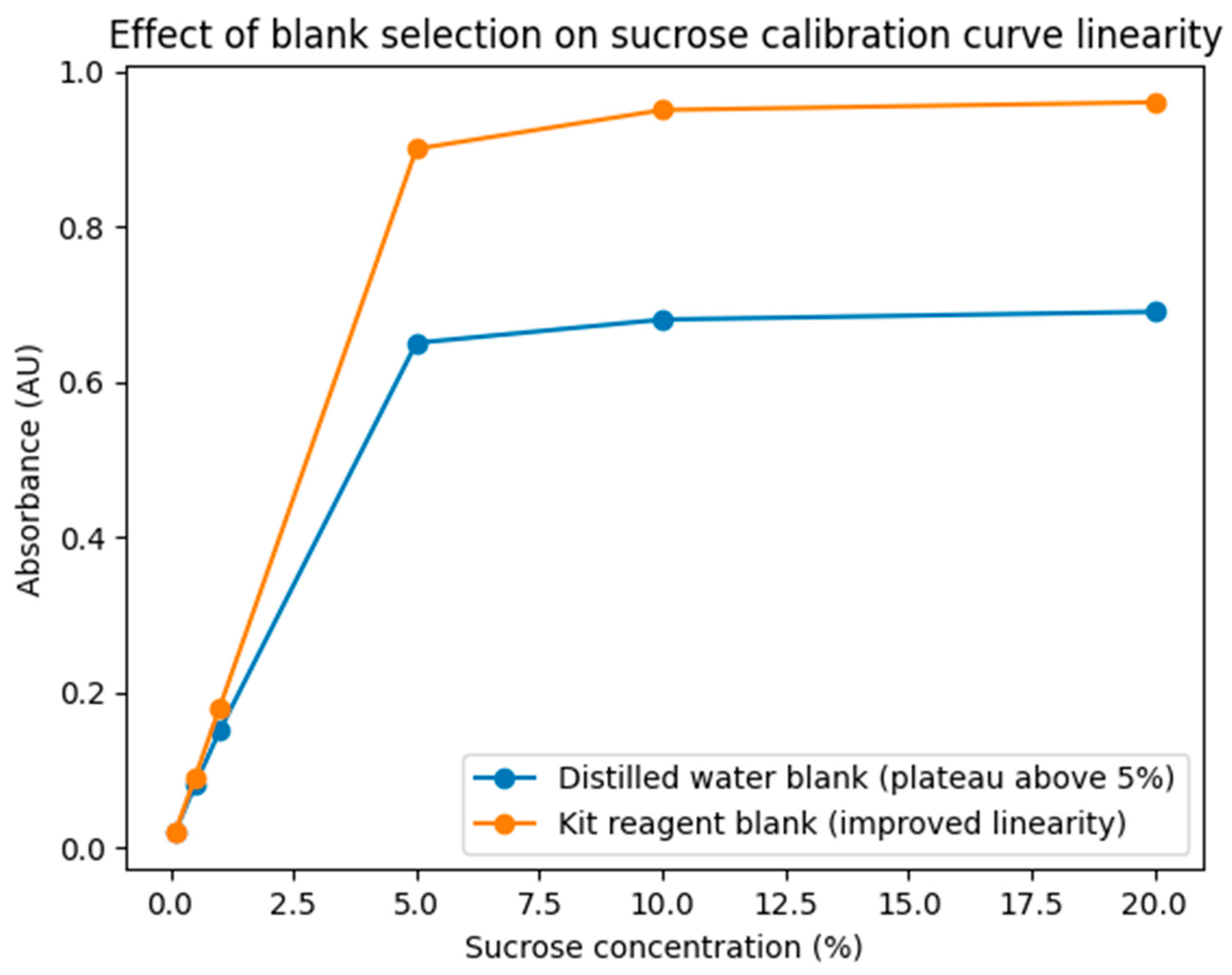
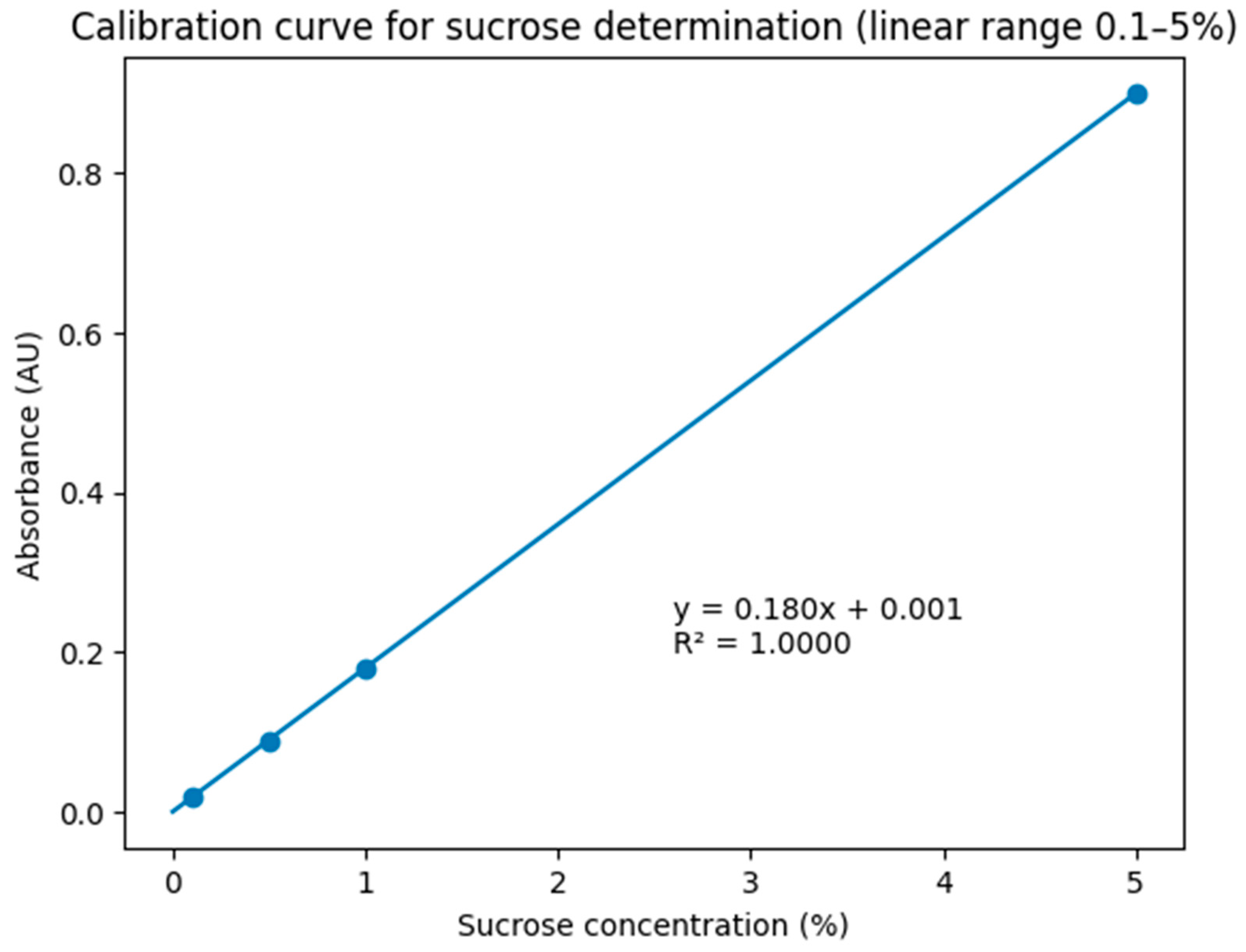
The quantitative determination of sucrose was performed using the same enzymatic kit coupled with spectrophotometric detection. Calibration curves were initially constructed using sucrose standards ranging from 0.1 to 15%. Good linearity was observed at lower concentrations, whereas signal saturation occurred above approximately 5%, resulting in a plateau region in the calibration curve (
Figure 1). To improve calibration accuracy, the curve was reconstructed using the kit reagent as the blank instead of distilled water. This approach improved the linearity of the calibration, although the higher concentration points (10 and 15%) were still excluded due to non-linearity (
Figure 2). During the analysis of the spiked milk samples, initial measurements produced false-positive sucrose concentrations, which were attributed to sample turbidity. The introduction of an additional filtration step prior to spectrophotometric measurement eliminated this interference and produced reliable results. Calibration curves prepared from the adulterated milk samples exhibited satisfactory linearity and repeatability when measurements were performed on three different days, confirming the suitability of the method for sucrose quantification in milk matrices.
The enzymatic spectrophotometric assay successfully detected sucrose concentrations above 0.1%, while satisfactory analytical repeatability and calibration performance were observed within the lower concentration range of the assay.
3.5. Application to Sheep Milk
The same experimental approach was applied to sheep milk samples (
Table 2). As observed for goat milk, dilution with water caused reductions in fat, protein, lactose, and total solids, along with an increase in the freezing point.
Progressive water dilution resulted in statistically significant decreases (p < 0.05) in protein concentration, total solids, density, and freezing point depression. Similar to goat milk, density and freezing point exhibited the strongest analytical sensitivity and statistical differentiation among dilution treatments.
When sucrose solutions were added to the diluted sheep milk, several compositional parameters again approached the values of the control samples, particularly total solids and density, demonstrating that the adulteration strategy could similarly mask dilution in this matrix. One-way ANOVA demonstrated highly significant differences (p < 0.001) between diluted samples and diluted samples supplemented with sucrose for all evaluated parameters. The strongest statistical differentiation was observed for total solids and density, highlighting the pronounced masking effect of sucrose addition in sheep milk.
Qualitative testing confirmed the presence of sucrose in all spiked samples except at the lowest concentration tested (0.1%). Quantitative analysis using the enzymatic method showed reproducible calibration curves across three independent experimental runs, confirming the applicability of the method for sucrose determination in sheep milk.
Duplicate measurements demonstrated low standard deviations across experimental treatments, indicating satisfactory repeatability and robustness of the analytical methodology.
4. Discussion
Food fraud in the dairy sector remains a persistent issue for both regulatory authorities and the dairy industry itself, particularly in high-value dairy products where economically motivated adulteration may compromise both product authenticity and consumer confidence. Among the different forms of economically motivated adulteration, the addition of water to milk continues to be one of the most common practices because it is simple to apply and provides an immediate economic advantage. In products of particularly high commercial value, such as milk from small ruminants, this type of fraud may be accompanied by the addition of other substances intended to compensate for the compositional changes caused by dilution. Previous studies [
3,
4,
14,
17] have shown that economically motivated adulteration frequently involves compounds capable of restoring physicochemical characteristics, allowing adulterated products to escape conventional quality control procedures.
The same researchers [
3,
4] highlighted that modern food fraud practices increasingly involve sophisticated multi-component adulteration strategies specifically designed to evade conventional analytical controls. The findings of the present study support these observations, demonstrating that sucrose addition can substantially alter the compositional profile of diluted milk and partially conceal the effects of water adulteration.
As anticipated, progressive dilution with water resulted in clear and systematic modifications in the physicochemical characteristics of both goat and sheep milk. In goat milk, dilution led to measurable reductions in protein, fat, lactose, total solids, and density, while freezing point values shifted toward less negative levels. Similar behavior was observed in sheep milk samples. These changes are directly associated with the decrease in dissolved milk constituents following water addition. Among all evaluated parameters, freezing point and density appeared particularly sensitive to dilution, showing the strongest statistical differentiation between authentic and adulterated milk samples. Similar observations were recently reported by Liang et al. [
27], who demonstrated that density- and freezing point-related measurements remain highly sensitive indicators for detecting water adulteration in milk. Since the freezing point of milk is closely linked to the concentration of dissolved solutes, it has long been regarded as one of the most reliable indicators for detecting water addition in milk, as previously described [
12,
14].
Zhang et al. [
12] reported that freezing point depression remains one of the most sensitive routine parameters for identifying water adulteration, whereas Santos et al. [
14] emphasized the close relationship between dissolved solids and physicochemical authenticity indicators. Earlier investigations have likewise confirmed that the addition of water increases freezing point values due to the reduction in osmotic pressure caused by lower solute concentrations.
The statistical evaluation performed in this study further highlighted the strong impact of dilution on milk composition. One-way ANOVA revealed statistically significant differences (p < 0.05) among dilution levels for protein, total solids, lactose, density, freezing point, and fat content. In both goat and sheep milk, density and freezing point showed the most pronounced statistical separation between authentic and adulterated samples. Duncan’s multiple range test also demonstrated a progressive differentiation among dilution treatments, further supporting the sensitivity of these parameters to dilution-induced compositional changes.
At the same time, the results clearly showed that sucrose addition can considerably influence these physicochemical indicators. Following the addition of sucrose-containing solutions to diluted milk samples, several parameters, particularly total solids, density, and freezing point, shifted toward values comparable to those of authentic milk. In some instances, sucrose partially restored or substantially modified several physicochemical characteristics of diluted milk despite substantial dilution. This behavior is most likely related to the increase in dissolved solids introduced by the added sugar, which instrumentally modified several routine analytical measurements without restoring the original biological composition of the milk. Similar masking practices have been reported previously in studies of milk adulteration, where sugars, salts, or other additives were used to restore the apparent composition of diluted milk and thereby avoid detection through routine analytical controls [
4,
14,
17].
Nicolaou et al. [
17] similarly demonstrated that adulterants capable of altering physicochemical properties may significantly compromise the effectiveness of conventional milk authentication methods when these are applied as standalone analytical tools.
The masking effect of sucrose appeared particularly pronounced in sheep milk samples, where total solids and density displayed very strong statistical differentiation after sucrose supplementation. The ANOVA results for sheep milk showed highly significant differences (p < 0.001), with total solids and density presenting the strongest statistical differentiation among the evaluated parameters. These findings suggest that sucrose addition can strongly interfere with routine physicochemical quality control measurements and markedly reduce the detectability of water adulteration.
Additional evidence regarding the identity of the adulterant was obtained through the physicochemical and elemental characterization of the adulterant powder. Conventional chemical analyses revealed very low levels of fat and protein together with elevated sodium concentrations, while chromatographic analysis confirmed that the powder consisted mainly of sucrose (91.4% w/w). ICP-AES analysis further supported the presence of high sodium content. The elevated sucrose concentration adequately explains the restoration of total solids, density, and freezing point values observed after its addition to diluted milk. Moreover, the increased sodium concentration may also contribute to modifications in freezing point depression and other physicochemical indicators commonly applied in milk quality assessment, as previously noted by Nicolaou et al.
The use of carbohydrate-based additives in milk adulteration has already been documented in several investigations focusing on fraudulent practices within dairy supply chains. Previous studies [
7,
14,
28] have highlighted that sugar-based adulterants can substantially modify milk compositional profiles and complicate the interpretation of routine analytical results. Similarly, Grassi and Casiraghi [
16] emphasized that compensatory adulterants may interfere with conventional physicochemical quality control parameters and reduce the effectiveness of routine authenticity screening methods. In the present study, the analytical characterization confirmed that the examined powder was suitable for reproducing a realistic combined adulteration scenario involving both water dilution and sugar-mediated masking.
The qualitative screening method used in this work, based on an enzymatic colorimetric reaction, proved effective for detecting sucrose in most adulterated milk samples. Enzymatic assays are widely applied in food analysis due to their specificity, relatively straightforward implementation, and rapid response time [
25]. However, the results also showed that the lowest sucrose concentration tested (0.1%) could not be detected by the assay, indicating reduced sensitivity at very low concentrations. Comparable detection limits have previously been reported for enzymatic carbohydrate detection methods used in complex food matrices.
Quantitative sucrose determination by spectrophotometric detection demonstrated satisfactory repeatability, low analytical variability, and acceptable linearity within the lower concentration range of the calibration curve. Nevertheless, signal saturation was observed at higher concentrations, leading to deviations from linearity above approximately 5% sucrose. This type of behavior is typical in enzymatic assays when analyte concentrations exceed the effective operational range of the reaction system [
29]. During the analyses, false-positive signals associated with sample turbidity were also encountered. Milk is a highly complex colloidal matrix containing proteins, lipids, and mineral particles that may interfere with optical measurements and generate analytical artifacts [
12]. The incorporation of a simple filtration step before spectrophotometric measurement substantially reduced turbidity and improved the reliability of the obtained results.
Breed-related compositional differences may additionally contribute to analytical variability among milk types. In the present study, goat milk originated from Eghoria goats, whereas sheep milk originated from Chios sheep, both widely used dairy breeds in Greece. Sheep milk is generally characterized by higher concentrations of fat, protein, and total solids compared with goat or cow milk [
26]. Despite these inherent compositional differences, both milk types exhibited comparable adulteration patterns following water dilution and sucrose addition. This suggests that the adulteration strategy investigated here may be broadly applicable across different milk matrices and could potentially affect a wide variety of dairy products.
From an analytical perspective, the findings of this study underline the limitations of relying solely on traditional milk quality control parameters when dealing with more sophisticated adulteration practices. Measurements such as density, freezing point, and total solids remain useful as screening indicators for simple dilution; however, their effectiveness may be considerably reduced when compensatory substances are present. Previous studies [
3,
4,
14] have therefore emphasized the importance of combining routine physicochemical measurements with targeted analytical methods capable of detecting specific adulterants.
Danezis et al. further emphasized that modern food fraud detection increasingly depends on multi-level analytical approaches that combine conventional physicochemical screening with targeted identification techniques. Similar conclusions were reported by Nicolaou et al. [
4], who also highlighted the limitations of depending exclusively on routine physicochemical measurements for milk authenticity assessment.
Within this framework, the analytical approach proposed in the present study, which integrates physicochemical screening with targeted sucrose detection, offers a practical strategy for identifying milk adulteration involving both dilution and sugar addition. The combination of rapid screening tools with more selective analytical methods is increasingly recommended within food fraud detection systems and may contribute to more effective monitoring of dairy supply chains, as highlighted by Everstine et al. and Danezis et al. [
3,
4]. Such integrated analytical approaches are essential for safeguarding consumers, improving dairy authenticity surveillance, and preserving confidence in high-value dairy products.
One limitation of the present study is that all experiments were performed under controlled laboratory conditions using experimentally adulterated samples. Although duplicate analytical measurements were used in the present study, low standard deviations and high analytical repeatability were consistently observed across treatments. Homogenized bulk milk samples were intentionally used in order to minimize compositional heterogeneity and improve experimental standardization; therefore, variability associated with individual animals or farms was not specifically evaluated. Future research should focus on validation using naturally suspected samples collected directly from commercial dairy supply chains. Nevertheless, the consistency observed in both the analytical and statistical results highlights the strong potential of the proposed methodology for routine authenticity assessment in dairy products.
Overall, the present findings reinforce the importance of integrated analytical strategies for detecting increasingly sophisticated milk adulteration practices and contribute to ongoing efforts aimed at strengthening dairy authenticity control and consumer protection.
The proposed methodology may therefore represent a useful complementary tool for routine dairy quality control laboratories involved in milk authenticity monitoring and food fraud prevention.
5. Conclusions
The findings of the present study clearly demonstrate that water dilution in both goat and sheep milk leads to substantial alterations in key physicochemical parameters, including reductions in protein, fat, lactose, total solids, and density, together with freezing point shifts toward less negative values. These changes are directly linked to the decrease in dissolved milk constituents caused by water addition and further confirm the usefulness of physicochemical measurements as primary indicators of milk dilution.
Statistical evaluation further highlighted the strong effect of dilution on milk composition. One-way ANOVA revealed statistically significant differences among dilution levels for protein, total solids, density, and freezing point values in both milk types. Among all examined parameters, density and freezing point showed the highest analytical sensitivity and provided the clearest differentiation between authentic and adulterated samples.
At the same time, the results demonstrated that sucrose addition can significantly modify these analytical indicators and partially conceal the effects of water adulteration. The presence of sucrose restored several physicochemical characteristics, particularly total solids and density, to levels approaching those of authentic milk. In parallel, freezing point depression became markedly more negative following sucrose supplementation, effectively compensating for the compositional changes induced by dilution. These observations underline the limitations of relying solely on routine physicochemical measurements for the detection of more sophisticated adulteration practices involving compensatory additives.
The masking effect of sucrose was especially evident in sheep milk, where total solids and density showed the strongest statistical differentiation after sucrose addition. Although goat and sheep milk differ naturally in composition, both matrices exhibited very similar adulteration patterns, suggesting that the fraud strategy investigated in this study could potentially be applied across a broad range of dairy products.
The characterization of the unknown adulterant powder showed that it consisted predominantly of sucrose (91.4% w/w) combined with elevated sodium concentrations. The analytical results indicate that sucrose-rich materials of this type may be used as low-cost additives to manipulate the apparent composition of diluted milk and interfere with conventional authenticity assessment procedures.
The enzymatic spectrophotometric assay applied in this study proved to be a practical and effective approach for sucrose detection in adulterated milk samples. The method showed satisfactory repeatability and successfully detected sucrose concentrations above 0.1%. Nevertheless, the saturation effects observed at higher concentrations emphasize the importance of appropriate calibration ranges and careful sample preparation, particularly when complex matrices such as milk are analyzed.
Overall, the present study demonstrates that conventional physicochemical measurements alone may not always be sufficient for identifying complex milk adulteration strategies involving water dilution combined with sugar-based masking. The combination of routine compositional analysis with targeted analytical techniques for sucrose detection offers a more reliable and robust approach for identifying sophisticated milk fraud practices.
Future work should focus on validating the proposed methodology using naturally suspected samples obtained from commercial dairy supply chains, as well as evaluating its applicability to additional dairy products and alternative adulteration scenarios.