Article

Sugarcane Polyphenols as a Nutritional Strategy to Reduce Somatic Cell Count and Preserve Milk and Yogurt Characteristics


by
Elizangela Domenis Marino
1,
Gercino Ferreira Virgínio Júnior
2,
Ariany Faria de Toledo
1,
Izally Carvalho Gervásio
3,
Simara Larissa Fanalli
3,
Carlos Eduardo Cardoso de Aguiar Freire
3,
Samuel Ferreira Gonçalves
3,
Carolina de Souza Moreira
3,
Matthew Flavel
4,
Luiz Carlos Roma Júnior
5,
Weber Vilas Bôas Soares
5,
Aline Silva Mello Cesar
3 and
Carla Maris Machado Bittar
1,*
1
Department of Animal Science, “Luiz de Queiroz” College of Agriculture, University of São Paulo, Piracicaba 13418-260, Brazil
2
School of Agricultural and Veterinary Sciences, São Paulo State University (UNESP), Jaboticabal 14884-900, Brazil
3
Department of Food Science and Technology, “Luiz de Queiroz” College of Agriculture, University of São Paulo, Piracicaba 13418-260, Brazil
4
The Product Makers, Pty Ltd., 50-60 Popes Rd., P.O. Box 3173, Keysborough, VIC 3173, Australia
5
Animal Science Institute (IZ), Nova Odessa 13460-000, Brazil
*
Author to whom correspondence should be addressed.
Dairy 2026, 7(2), 22; https://doi.org/10.3390/dairy7020022
Submission received: 11 January 2026 / Revised: 26 February 2026 / Accepted: 3 March 2026 / Published: 5 March 2026
(This article belongs to the Section Dairy Animal Nutrition and Welfare)

Abstract

The present study evaluated the effects of sugarcane-derived polyphenol nutritional supplement on milk production, milk composition, and somatic cell count (SCC) in lactating Holstein cows. A second objective was to evaluate the quality and stability of yogurt produced with milk from supplemented cows. Sixteen cows (20 ± 2 L/d milk, 120 ± 21 days in milk, 550 ± 82 kg body weight) were assigned to either a control group or a polyphenol-supplemented group in a randomized block design for a six-week evaluation period. Milk yield and individual milk samples for composition analysis (fat, protein, lactose, non-fat solids, casein, free fatty acids, and milk urea nitrogen) were recorded weekly, and only SCC was monitored three times per week. Yogurt was produced from pooled milk of each treatment and evaluated for fermentation parameters (pH, titratable acidity), shelf life, and sensory attributes were evaluated using a triangle test (discriminative sensory analysis). Polyphenol supplementation did not significantly affect milk yield or composition (p > 0.05), but reduced SCC considerably (238 × 103 vs. 593 × 103 cells/mL; p < 0.01). Yogurt fermentation and storage parameters were not significantly affected by supplementation, although pH and titratable acidity changed considerably over time (p < 0.01). Sensory analysis indicated that only 37.3% of panelists correctly identified differences between yogurts, which did not differ from chance expectation in the triangle test. These results demonstrate that polyphenol supplementation can improve udder health, evidenced by reduced SCC, without compromising milk yield, composition, or yogurt quality. Polyphenols thus represent a promising nutritional supplement for enhancing dairy cow health and maintaining product quality.

1. Introduction

The dairy industry continually seeks nutritional strategies to enhance milk quality, improve animal health, and increase production efficiency, while meeting consumer demand for safe and high-quality dairy products. Among these strategies, polyphenols, a diverse group of bioactive compounds widely present in plant-based feeds, have attracted attention for their antioxidant, anti-inflammatory, and antimicrobial properties [1]. In ruminants, dietary polyphenols such as tannins have been reported to modulate rumen fermentation and microbial populations, potentially improving animal health and product quality without adversely affecting production performance [2,3]. However, the extent to which these mechanisms operate under different dietary and physiological conditions remains variable.
Somatic cell count (SCC) is a well-established indicator of mammary gland health; elevated SCC is associated with subclinical or clinical mastitis and has a detrimental effects on milk composition, coagulation properties (e.g., prolonged rennet coagulation time), and shelf life [4,5,6]. Therefore, nutritional interventions that reduce oxidative stress and inflammation in the mammary gland, such as polyphenol supplementation, may contribute to lowering the incidence of SCC and improving milk quality. By improving immune function and mitigating inflammatory responses, through mechanisms such as upregulation of antioxidant enzymes, reduction in pro-inflammatory cytokines (e.g., IL-1β, IL-6, TNF-α), and modulation of signaling pathways (e.g., TGF-β1/p38/JNK), polyphenols may impact both animal welfare and milk quality [7,8,9].
Recent studies have increasingly explored the inclusion of plant-derived polyphenols in dairy cow diets as a strategy to support health and product quality [2,10,11,12]. Research has focused mainly on their antioxidant and anti-inflammatory potential, as well as on effects on milk quality parameters, including SCC and fatty acid profiles [10,11,12]. However, most available studies have emphasized animal-level responses, whereas limited attention has been given to the technological and sensory implications of such dietary interventions on fermented dairy products [1,10].
In addition to animal health effects, dietary polyphenols may influence milk composition, including protein, fat, and fatty acid profiles, which are essential for the nutritional and functional properties of dairy products [1,8]. This relationship is particularly relevant for fermented dairy products such as yogurt, one of the most widely consumed dairy foods worldwide, whose quality is strongly determined by the physicochemical properties of the milk used for its manufacture [13]. Even small changes in milk composition can alter fermentation kinetics, acidification behavior, gel formation, shelf life, and sensory perception of yogurt [14]. Consequently, parameters such as pH, titratable acidity, and sensory attributes represent key quality indicators, reinforcing the importance of evaluating how dietary interventions applied to dairy cows are reflected in yogurt quality and consumer acceptance [15,16].
Despite growing interest in polyphenols as a dietary supplement in dairy production, few studies have simultaneously evaluated their effects on milk production, SCC, and downstream dairy product quality under controlled conditions. Addressing this gap, the present study aimed to investigate the impact of dietary polyphenol supplementation for lactating Holstein cows on milk yield, composition, somatic cell count, and yogurt quality, including milk fermentation kinetics, shelf life, and sensory properties. By integrating production, health, and product analyses, this work provides comprehensive insights into the potential of polyphenols to enhance both animal health and dairy product quality.

2. Materials and Methods

2.1. Animals and Experimental Design

The study was conducted at the Dairy Cattle Research and Development Center of the Animal Science Institute, Nova Odessa, São Paulo, Brazil, from 24 October to 2 December, totaling 6 weeks (42 days) of evaluation, preceded by a 15-day adaptation period. Sixteen multiparous Holstein cows were used, with an average lactation number of 4.1 ± 2, average daily milk production of 20 ± 2 L, days-in-milk (DIM) of 120 ± 21, and body weight of 550 ± 82 kg.
A randomized block design was applied, with cows blocked according to milk production and DIM prior to random assignment to treatments. Each block consisted of two cows, and within each block, cows were randomly assigned to one of the two treatments: Control: oral administration of 50 mL/d of placebo (water); or Polyphenol: oral administration of 50 mL/d of a sugarcane-derived polyphenol-rich extract (Polygain™; The Product Makers Australia, Keysborough, Australia). Treatments were administered orally using a 50 mL syringe immediately after the morning milking. All cows were housed in a single paddock equipped with shade and a covered, shared cement trough, providing 0.70 m of feedline per cow.

2.2. Polyphenol Extract and Justification of the Supplemented Dose

The polyphenol source evaluated in this experiment was a commercially available extract obtained from sugarcane (Polygain™; The Product Makers Australia, Keysborough, Australia). Because the chemical profile of the specific batch used here was not determined analytically, information regarding its composition was based on previously published characterizations of the same product [17,18]. These studies report a complex but reproducible profile of low-molecular-weight compounds across different production batches, supporting the use of published compositional data as a reference. Earlier metabolomic assessments using untargeted GC–MS have identified a complex mixture of more than one hundred low-molecular-weight compounds, including amino acids, organic and phenolic acids, carbohydrates, and sugar alcohols. Among these, mono- and disaccharides (such as glucose, fructose, and sorbose), trans-4-hydroxycinnamic acid, vanillic acid, and pyroglutamate repeatedly appear as major constituents [17]. Previous reports also highlight substantial antioxidant capacity measured by ORAC, along with detectable contributions of minerals and carbohydrate fractions [18]. As with many plant-derived extracts, some degree of natural variability among production batches is expected.
The supplemented dose (50 mL/cow per day) was determined by body weight–based scaling from a previous in vivo study with the same extract. Prathap et al. [19] supplied 3.2 mL/day to sheep weighing approximately 40 kg; when this quantity is scaled proportionally to the body mass of a mature 650 kg dairy cow, the resulting equivalent dose is roughly 50 mL/day. This strategy ensured that the biological exposure in the present study was aligned with levels previously shown to modulate fermentation parameters and antioxidant responses in ruminants [20].

2.3. Milking and Milk Sampling

Cows were milked twice daily (07:00 and 15:00) using an automated milking system (Delaval, Dalarna, Sweden). Standard hygiene procedures were applied, including pre- and post-dipping with commercial disinfectants (LacticSan and UdderSan, SaniQuimica, Valinhos, Brazil).
Milk yield was recorded electronically at each milking. Weekly milk samples were collected during morning milking in tubes containing a preservative (2-Bromo-2-nitro-1,3-propanediol) and transported on ice to the laboratory. Milk composition, including protein, fat, lactose, solids non-fat, casein, and free fatty acids, were analyzed once per week using FT-IR spectrometry (MilkScan FT1, Foss, Hilleroed, Denmark), resulting in a total of 6 samples per cow over the experimental period. Somatic cell counts (SCC) were determined three times per week by flow cytometry (BacSomatic, Foss, Hilleroed, Denmark), totaling 18 measures per cow.

2.4. Diet and Feeding Management

The cows were fed a total mixed ration (TMR) formulated by NASEM [21], and composed of sorghum silage, brewer’s grain, a commercial concentrate (Agroindústria Três Irmãos, Mococa, Brazil), and Tifton 85 hay (Table 1). The TMR was offered twice daily (07:00 and 14:00 h) during milking. Feed was provided ad libitum, and dry matter intake was determined at the group level by weighing the total amount of feed offered to the cows and the corresponding orts collected the following morning. Individual dry matter intake was not measured.
Representative samples of each ingredient and the TMR were collected daily and pooled weekly for chemical analysis. Dry matter (DM; method 930.15), ashes (method 942.05), ether extract (EE; method 920.39), and crude protein (CP; N × 6.25; method 984.13) were determined according to the Association of Official Analytical Chemists [22]. Starch was determined using the commercial kit Total Starch Assay (AA/AMG, K-TSTA-100A, Megazyme, Neogen, Dublin, Ireland; method 996.11). Neutral detergent fiber (NDF), acid detergent fiber (ADF), and lignin were determined according to the procedures of Van Soest et al. [23]. Non-fiber carbohydrates (NFC) were estimated using the equation proposed by Mertens [24]: NFC(%DM) = 100 − (CP + EE + NDF + Ashes), where CP, EE, NDF, and ash are expressed as a percentage of DM.

2.5. Yogurt Production and Analysis

During the sixth week of the experiment, approximately 150 L of milk from each treatment were collected, pooled by treatment, homogenized, and transported under refrigeration to the Sensory Laboratory of the Department of Food Science and Technology at ESALQ/USP for yogurt manufacture. Yogurt was produced in 1 L batches using pasteurized milk, without further standardization of fat or protein content, in order to preserve the intrinsic compositional characteristics resulting from each dietary treatment.
Milk was heat-treated at 95 °C for 5 min to ensure microbiological safety and to promote whey protein denaturation, favoring gel formation, and subsequently cooled to 42 °C. A commercial lyophilized starter culture (BioRich®, Chr. Hansen, Valinhos, Brazil), containing Lactobacillus acidophilus LA-5®, Bifidobacterium lactis BB-12®, and Streptococcus thermophilus, was added at the manufacturer-recommended inoculation rate. Fermentation was conducted at 42 ± 2 °C under controlled conditions until the yogurt reached a target pH of 4.6, which was defined as the endpoint of incubation. All processing steps were conducted identically for both treatments to ensure comparability between yogurts.
Yogurt pH and titratable acidity were measured in triplicate during fermentation and subsequently at 10-day intervals throughout 40 days of refrigerated storage at 4 °C. Titratable acidity was determined according to AOAC method 947.05 [25]. Briefly, 10 mL of yogurt were placed in an Erlenmeyer flask in triplicate, three drops of phenolphthalein indicator (Merck Millipore, Darmstadt, Germany) were added, and samples were titrated with 0.1 N NaOH until the appearance of a persistent pale pink color. Results were expressed as degrees Dornic (°D), where 1 mL of 0.1 N NaOH corresponds to 1 °Dornic.
The yogurt evaluation system was designed to assess fermentation kinetics and physicochemical stability during refrigerated storage, as well as global sensory discrimination, allowing the identification of potential downstream effects of dietary polyphenol supplementation on yogurt quality and shelf life without the use of descriptive sensory profiling.

2.6. Sensory Evaluation Procedures

A triangular discrimination test was conducted in accordance with ISO (4120:2021) [26]. In each session, panelists received three coded samples simultaneously, two identical and one different, presented in randomized order, and were instructed to identify the sample perceived as different. The test assessed overall perceptible flavor differences between yogurts, without characterization of specific sensory attributes. The sensory evaluation was carried out under double-blind conditions, ensuring that both the participants and the investigators responsible for distributing the samples were unaware of the origin of each product, thus avoiding any bias in perception or test administration.
The sensory panel consisted of 189 participants, including students, staff, and faculty members from the university community, all over 18 years of age, healthy, non-smokers, and without direct involvement in the study. Before beginning the procedure, volunteers signed an informed consent form and completed a sociodemographic questionnaire. The evaluation was conducted in individual booths, under white light and at room temperature, in the sensory analysis laboratory of the Department of Food Science and Technology at ESALQ/USP.
Each participant received three coded samples, two originating from the same treatment and the third without treatment (control), presented in random order. The evaluators were instructed to identify which of the three samples differed in terms of flavor, and between each sample, they were also instructed to eat an unsalted cracker and drink water to cleanse the palate. The results obtained were used to calculate the probability of correct identification and the relative risk associated with detecting flavor differences between the two treatments.

2.7. Statistical Analysis

Data were analyzed using the MIXED procedure of SAS (version 9.4; SAS Institute Inc., Cary, NC, USA). Statistical significance was declared at p ≤ 0.05, and trends were discussed at 0.05 < p < 0.10. Polyphenol supplementation was included as a fixed effect, and block (based on days in milk and baseline milk yield) was included as a random effect. For animal-related variables (milk yield, milk composition, SCC, and milk urea nitrogen), data were analyzed as repeated measures over time, with week as the repeated factor and cow within treatment specified as the subject.
For yogurt pH and titratable acidity, the response variables were pH and acidity values measured during fermentation and storage. Treatment, time, and their interaction were included as fixed effects. Because milk was pooled by treatment prior to yogurt manufacture, the pooled milk constituted the experimental unit. Measurements collected over time were analyzed as repeated measures, and analytical triplicates were treated as subsamples incorporated into the residual error.
Sensory responses were analyzed as binary data (correct = 1; incorrect = 0) assuming a binomial distribution and logit link function using the LOGISTIC procedure of SAS. The intercept-only model was used to estimate the probability of correct discrimination, and results were compared with the probability of correct response expected by chance (1/3) in a triangle test. The experimental unit was the individual panelist (n = 189).
Assumptions of normality and homoscedasticity were evaluated for all continuous variables. Somatic cell count data were log-transformed [log2(SCC/100) + 3] prior to analysis to meet model assumptions.

3. Results

3.1. Effects on Milk Production, Composition, and Somatic Cell Count

Polyphenol supplementation in cows producing an average of 20 L/d at 120 days in milk did not significantly affect milk yield or composition (p > 0.05; Table 2). However, SCC was significantly reduced by polyphenol supplementation (p < 0.01). Except for protein, casein, acidity, and SCC, all other milk composition parameters were influenced by the week of evaluation, indicating temporal variation. The average group dry matter intake per cow was 21.8 kg DM/d, with a day-to-day variation of ±0.48 kg.

3.2. Yogurt Production, pH, Titratable Acidity, and Shelf Life

During yogurt production, mean pH values were 5.31 and 5.27 for the Control and Polyphenol groups, respectively, with no significant treatment effect (p = 0.765). A substantial effect of fermentation time was observed (p < 0.0001; Figure 1a). Similarly, titratable acidity (°Dornic) averaged 36.6 and 37.5 for Control and Polyphenol, respectively, with no treatment effect (p = 0.644), but a significant effect of time (p < 0.0001; Figure 1b), reflecting normal lactic fermentation dynamics.
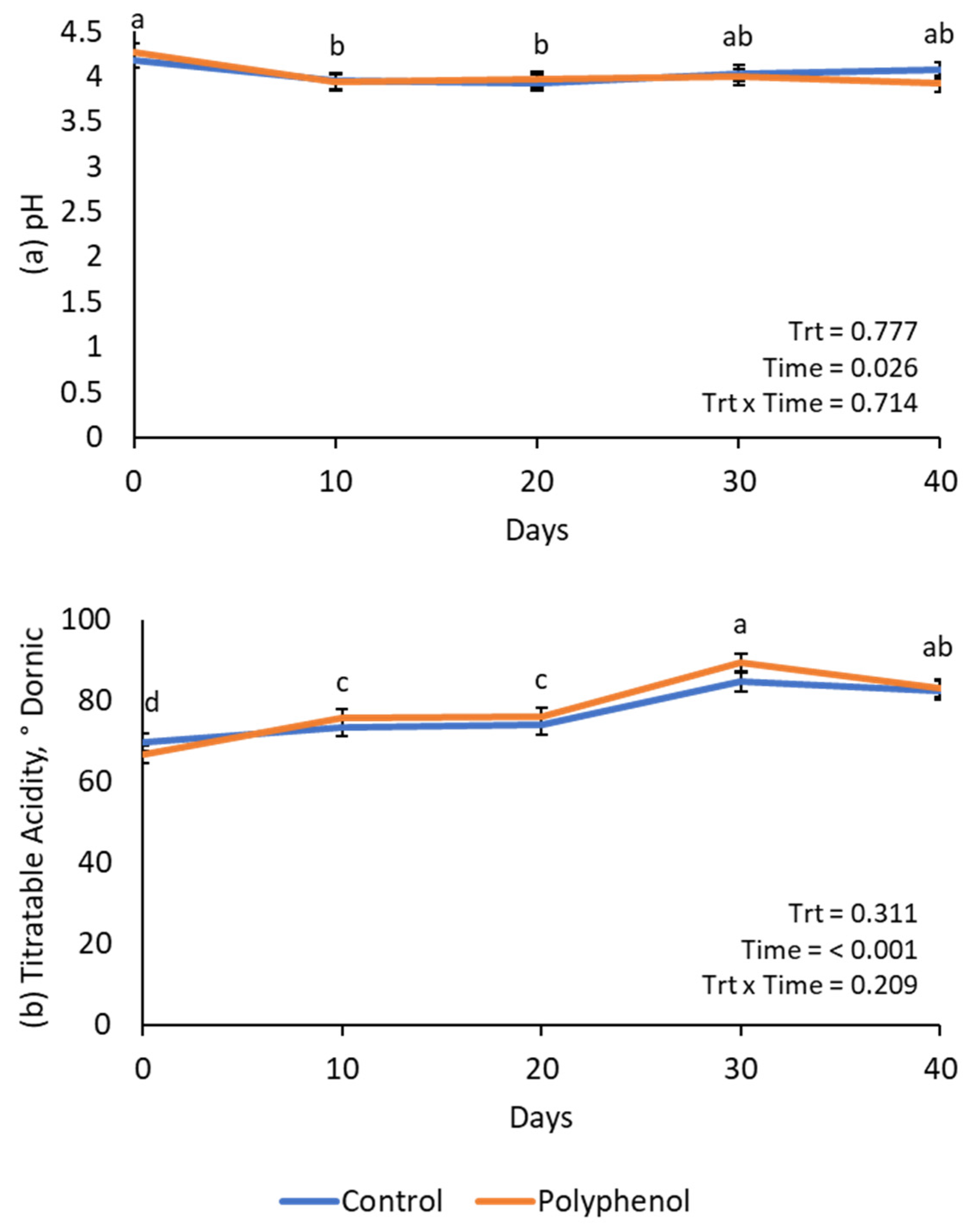
During storage at 4 °C, the yogurt pH averaged 4.03 and 4.02 for the Control and Polyphenol treatments, respectively, with no significant difference between the treatments (p = 0.777). However, time had a substantial influence on pH (p = 0.026; Figure 2a). Titratable acidity during storage was 76.8 and 78.1 °D for Control and Polyphenol, respectively, again without treatment differences (p = 0.311), but with significant temporal variation (p < 0.0001; Figure 2b).

3.3. Sensory Results

In total, 190 consumers participated in the triangle test. Of these, 71 (37.3%) correctly identified the yogurt with a different flavor, while 119 (62.7%) did not perceive any distinction. Logistic regression indicated an average probability of 37.4% for correct identification, corresponding to an odds ratio of 0.60. The intercept was statistically significant (β = −0.5164 ± 0.1500; p = 0.0006), indicating that participants were less likely to detect flavor changes in the yogurt produced from the milk of supplemented cows.

4. Discussion

This study evaluated the effects of a sugar-extract polyphenol supplementation in the diet on milk yield, composition, SCC, and selected physicochemical and sensory properties of yogurt in lactating Holstein cows. The main finding was a significant reduction in SCC, indicating improved udder health, while milk yield, composition, and yogurt properties remained largely unaffected.

4.1. Implications for Milk Production and Quality

Polyphenol supplementation did not significantly affect milk yield or the main compositional parameters, including fat, protein, lactose, and solids non-fat [1]. These results are consistent with Daddam et al. [27], who found no effect of antioxidant supplementation on milk yield. The absence of a response is likely related to the lack of direct galactagogue activity of polyphenols [28]. Some studies, however, have reported alterations in milk fatty acid profiles, such as reductions in saturated fatty acids [1], which may reflect differences in polyphenol source, dose, or experimental conditions, including the supplementation period. In the present study, milk fatty acid composition and microbiota were not analyzed; assessing these parameters could provide further insight into the effects of dietary polyphenol supplementation on overall milk quality.
The reduction in SCC observed in this study suggests a potential positive effect of polyphenols on mammary gland status. SCC is widely recognized as a biomarker of subclinical mastitis, with higher values associated with inflammation and infection [4]. Polyphenols may contribute to reductions in SCC through antioxidant and anti-inflammatory actions, such as scavenging of reactive oxygen species and modulation of NF-κB and MAPK pathways, as suggested by previous studies [9,29]. They may also exert antimicrobial activity against mastitis-causing pathogens, such as Staphylococcus aureus and Escherichia coli [30,31]. Similar effects on SCC have been observed with polyphenol-rich byproducts, such as grape seed extract, cocoa husks, and coffee grounds, which reduced SCC, with variable impacts on milk quality in different species depending on the study [1,32,33,34,35,36,37]. Together with previous findings, our results suggest that supplementation with sugarcane-extract polyphenols reduces SCC without compromising milk quality.
Evidence from companion paper using the same cows and sugarcane-derived extract provides additional context for interpreting the present findings. In that study, Marino et al. [20], polyphenol supplementation was associated with increased circulating glucose without detectable changes in rumen fermentation profiles or methane emissions. Although ruminal and metabolic parameters were not measured in the present study, these observations suggest that the effects of sugarcane-derived polyphenols may involve systemic metabolic or immunomodulatory pathways rather than direct alterations in rumen fermentation. This interpretation is consistent with the reduction in SCC observed herein, but should be considered hypothesis-generating rather than conclusive.
The absence of significant effects on milk yield and composition should be interpreted in light of the intrinsic biological variability of lactating dairy cows, particularly for production and compositional traits, which may reduce statistical power in studies with limited sample size [21]. In addition, although the biological responses observed are consistent with antioxidant, anti-inflammatory, and systemic metabolic actions described for polyphenols [8,18,19], these mechanisms were not directly assessed in the present study, as oxidative stress markers, inflammatory indicators, and circulating polyphenol metabolites were not measured. Therefore, any discussion of anti-inflammatory, antioxidant, or antimicrobial mechanisms should be interpreted as hypothesis-driven and supported by existing literature, rather than as direct evidence generated within the present experiment.
Furthermore, the chemical profile of the specific batch of sugarcane-derived polyphenol extract used in this experiment was not analytically confirmed; nevertheless, previously published metabolomic characterizations of the same commercial product provide a reasonable basis for interpreting the observed biological effects [17,18]. Finally, the supplementation dose, extrapolated from prior experiments conducted in sheep [19], appears to have been sufficient to elicit consistent improvements in SCC but may not have reached the threshold required to induce measurable changes in milk synthesis in lactating dairy cows. Accordingly, the lack of production responses should be viewed not as an absence of biological efficacy, but rather as evidence of selective, health-oriented effects that are likely influenced by dose and physiological context.

4.2. Yogurt Physicochemical and Sensory Properties

The evaluation of yogurt quality revealed that polyphenol supplementation did not significantly impact pH or titratable acidity, either during fermentation or throughout the 40-day refrigerated shelf life. Consistent with these observations, the titratable acidity measured during storage was 76.8 and 78.1 °D for the Control and Polyphenol treatments, respectively. These values fall within the Codex Alimentarius [38] recommended range of 60–120 °D for yogurt, confirming that both treatments maintained physicochemical parameters compatible with established quality standards over the evaluated period.
This finding suggests that polyphenols in the diet do not interfere with the lactic acid fermentation process or the biochemical stability of yogurt under standard storage conditions. Time had a significant effect on both pH and titratable acidity, reflecting the expected dynamics of microbial metabolism and acidification during fermentation and storage, consistent with established yogurt maturation patterns [14].
The lack of differences in the measured parameters (pH, titratable acidity, and sensory discrimination) indicates that polyphenols do not compromise these aspects of yogurt stability or safety. However, other quality attributes, including texture, viscosity, color, flavor profiling, and microbiological composition, were not evaluated and could provide additional insight into potential treatment effects. Polyphenols may exert subtle protective effects by stabilizing milk proteins and lipids through antioxidant mechanisms, potentially preventing oxidative degradation, though these effects may not be detectable in routine physicochemical analyses.
Although dietary polyphenol supplementation can reduce SCC and potentially improve milk health indicators, its routine adoption in commercial dairy systems may be limited by economic considerations. The cost of supplementation, which varies with product source, dose, and market conditions, represents an additional expense that must be balanced against the expected health benefits and production outcomes.
Additional factors limiting routine adoption include the availability of commercial polyphenol extracts, challenges in consistent daily administration to animals, and the need to maintain effective dosing throughout lactation. These practical constraints, combined with variable responses depending on herd management and diet, help explain why polyphenol supplementation is not yet widespread in dairy production.

4.3. Sensory Attributes

The results obtained reinforce a pattern frequently observed in sensory differentiation studies applied to dairy products, even when nutritional or metabolic modifications occur in the raw material, these changes do not always translate into perceptible differences for untrained consumers. According to ISO 4120:2021 [26], the low proportion of correct responses in the triangle test indicates the absence of a sensory stimulus strong enough to generate consistent discrimination. Thus, the identification probability of 37.4% observed in this study approaches the level expected by chance, suggesting that the effects of polyphenol supplementation on yogurt flavor are subtle.
It is important to note that the triangle test applied in this study is a discriminative method, designed to detect overall sensory differences between products rather than to characterize specific attributes such as bitterness, astringency, or aroma intensity. Therefore, although a small proportion of participants correctly identified a difference between samples, the test does not allow the attribution of this perception to particular sensory descriptors. The identification of specific flavor attributes potentially affected by dietary polyphenols would require descriptive sensory analysis conducted by trained panelists, which was beyond the scope of the present study.
Furthermore, it is known that the yogurt matrix has high sensory complexity, resulting from the interaction between volatile compounds derived from fermentation, organic acids, and milk proteins [39,40]. As discussed by Meilgaard, Civille, and Carr [41], this complexity tends to mask small variations originating from raw milk, reducing the ability of consumer panels to detect fine differences. Thus, even if polyphenols slightly alter the metabolic profile of milk, as demonstrated by studies documenting modest changes in bioactive compounds and lipid profiles after dietary supplementation [1], such modifications may not exceed the perceptual threshold of the evaluators. Although no perceptible sensory differences were detected, instrumental analyses such as rheological or textural measurements could provide additional insight into potential structural modifications induced by dietary polyphenols. This represents a limitation of the present study and should be addressed in future research.
Another relevant point concerns the nature of phenolic compounds. Although polyphenols can participate in lipid oxidation reactions, impart astringent notes, or influence aroma in certain foods, their transfer to milk and subsequent sensory impact tend to be limited. Harun et al. [1] highlight that many secondary metabolites present in the animal diet undergo extensive ruminal degradation, which reduces their presence in milk at concentrations capable of producing pronounced sensory alterations. Thus, the results observed here are consistent with the literature suggesting that plant supplementation rarely causes strong organoleptic changes in fermented dairy products.
The use of untrained consumers should also be considered when interpreting the results. Consumers may exhibit greater individual variability and lower sensitivity to subtle differences compared to trained assessors [42,43]. However, this characteristic makes the test more suitable for evaluating sensory impact from a real market perspective, reinforcing the applicability of the results: if differences do exist, they are small enough not to be detected by most consumers.
Taken together, the findings indicate that the supplementation of cows with polyphenols, under the evaluated conditions, does not compromise the flavor nor generate perceptible alterations in the yogurt produced. This outcome is positive for the development of functional products, suggesting that improvements in the nutritional or bioactive profile of milk can be achieved without compromising sensory acceptance, an important aspect for the adoption of dietary strategies aimed at animal and human health and well-being.

5. Conclusions

Polyphenol supplementation for lactating Holstein cows did not significantly affect milk production or composition but led to a reduction in SCC, indicating potential benefits for udder health status. While no significant differences were observed in yogurt quality and shelf life, sensory analysis suggested subtle influences on milk flavor. These findings contribute to the growing body of evidence supporting the role of polyphenols in improving dairy cow health without negatively affecting milk quality. Further research is needed to elucidate the mechanisms underlying these effects and to optimize supplementation strategies for enhancing dairy production and product quality.

Author Contributions

Conceptualization, C.M.M.B. and L.C.R.J.; methodology, C.M.M.B., L.C.R.J. and A.S.M.C.; formal analysis, E.D.M., A.F.d.T., I.C.G., S.L.F., C.E.C.d.A.F., S.F.G., C.d.S.M. and A.S.M.C.; investigation, E.D.M., I.C.G., S.L.F., C.E.C.d.A.F., S.F.G., W.V.B.S. and C.d.S.M.; resources, C.M.M.B., L.C.R.J., M.F. and A.S.M.C.; data curation, E.D.M., G.F.V.J. and C.M.M.B.; writing—original draft preparation, E.D.M. and G.F.V.J.; writing—review and editing, G.F.V.J. and C.M.M.B.; supervision, C.M.M.B., L.C.R.J. and A.S.M.C.; project administration, C.M.M.B.; funding acquisition, C.M.M.B., M.F. and L.C.R.J. All authors have read and agreed to the published version of the manuscript.

Funding

This research was financially supported by The Product Makers (Process No. 2022/1537). The funder had no role in study design, data collection and analysis, decision to publish, or preparation of the manuscript.

Institutional Review Board Statement

All procedures performed in this study were approved in 5 August 2022 by the Animal Care and Use Committee of the Animal Science Institute (CEUA/IZ; protocol no. 361-2022). Sensory evaluations were also approved in 28 November 2022 by the Ethics Committee of Human Research of the College of Agriculture “Luiz de Queiroz,” University of São Paulo (CAAE/ESALQ-USP; No. 64568422.5.0000.5395).

Informed Consent Statement

Informed consent was obtained from all subjects involved in the study.

Data Availability Statement

The original contributions presented in this study are included in the article. Further inquiries can be directed to the corresponding author(s).

Acknowledgments

The authors would like to acknowledge the continued support received from Luiz de Queiroz College of Agriculture. We are grateful to Coordenação de Aperfeiçoamento de Pessoal de Nível Superior-Brasil (CAPES).

Conflicts of Interest

The authors declare that the research was conducted in the absence of any commercial or financial relationships that could be construed as a potential conflict of interest. Author M.F. is an employee of The Product Makers (the funding source for this study), but confirms that this affiliation did not influence the study design, data collection and analysis, decision to publish, or preparation of the manuscript.

References

  1. Harun, N.L.A.; Mohd Yusof, H.; Samsudin, A.A.; Sazili, A.Q.; Goh, Y.M. Effect of Polyphenol Supplementation on Milk Composition and Fatty Acid of Dairy Animal: A Systematic Review. Ruminants 2025, 5, 15. [Google Scholar] [CrossRef]
  2. Patra, A.K.; Saxena, J. Exploitation of dietary tannins to improve rumen metabolism and ruminant nutrition. J. Sci. Food Agric. 2011, 91, 24–37. [Google Scholar] [CrossRef] [PubMed]
  3. Serra, V.; Salvatori, G.; Pastorelli, G. Dietary Polyphenol Supplementation in Food Producing Animals: Effects on the Quality of Derived Products. Animals 2021, 11, 401. [Google Scholar] [CrossRef]
  4. Ruegg, P.L. A 100-Year Review: Mastitis detection, management, and prevention. J. Dairy Sci. 2017, 100, 10381–10397. [Google Scholar] [CrossRef]
  5. Riveros-Galán, D.S.; Obando-Chaves, M. Mastitis, somatic cell count and its impact on dairy product quality… An omission in Colombia: A literature review. Rev. Colomb. Cienc. Pecu. 2021, 34, 241–253. [Google Scholar] [CrossRef]
  6. Niero, G.; Koczura, M.; De Marchi, M.; Currò, S.; Kreuzer, M.; Turille, G.; Berard, J. Are cheese-making properties of dual purpose cattle impaired by highland grazing? A case study using Aosta Red Pied cows. Ital. J. Anim. Sci. 2018, 17, 827–834. [Google Scholar] [CrossRef]
  7. Yahfoufi, N.; Alsadi, N.; Jambi, M.; Matar, C. The Immunomodulatory and Anti-Inflammatory Role of Polyphenols. Nutrients 2018, 10, 1618. [Google Scholar] [CrossRef]
  8. Di Meo, M.C.; Giacco, A.; Zarrelli, A.; Mandrone, V.M.; D’Angelo, L.; Silvestri, E.; De Girolamo, P.; Varricchio, E. Effects of Olea europaea L. Polyphenols on the Animal Welfare and Milk Quality in Dairy Cows. Animals 2023, 13, 3225. [Google Scholar] [CrossRef]
  9. Xu, R.; Zhu, M.; Cao, J.; Guo, M. Tea Polyphenols Protect the Mammary Gland of Dairy Cows by Enhancing Antioxidant Capacity and Regulating the TGF-β1/p38/JNK Pathway. Metabolites 2022, 12, 1009. [Google Scholar] [CrossRef]
  10. Vasta, V.; Luciano, G. The effects of dietary consumption of plants secondary compounds on small ruminants’ products quality. Small Rumin. Res. 2011, 101, 150–159. [Google Scholar] [CrossRef]
  11. Wickramasinghe, H.K.J.P.; Stepanchenko, N.; Oconitrillo, M.J.; Goetz, B.M.; Abeyta, M.A.; Gorden, P.J.; Baumgard, L.H.; Appuhamy, J.A.D.R.N. Effects of a phytogenic feed additive on weaned dairy heifer calves subjected to a diurnal heat stress bout. J. Dairy Sci. 2023, 106, 6114–6127. [Google Scholar] [CrossRef]
  12. Menci, R.; Natalello, A.; Luciano, G.; Priolo, A.; Valenti, B.; Farina, G.; Caccamo, M.; Niderkorn, V.; Coppa, M. Effect of dietary tannin supplementation on cow milk quality in two different grazing seasons. Sci. Rep. 2021, 111, 19654. [Google Scholar] [CrossRef]
  13. Pappa, E.C.; Kondyli, E.; Pappas, A.C.; Kyriakaki, P.; Zoidis, E.; Papalamprou, L.; Karageorgou, A.; Simitzis, P.; Goliomytis, M.; Tsiplakou, E.; et al. Physicochemical Characteristics of Commercially Available Greek Yoghurts. Dairy 2024, 5, 436–450. [Google Scholar] [CrossRef]
  14. Tamime, A.Y.; Robinson, R.K. Tamime and Robinson’s Yoghurt; Woodhead Publishing Limited: Cambridge, UK, 2007; ISBN 978-1-84569-213-1. [Google Scholar]
  15. Matela, K.S.; Pillai, M.K.; Thamae, T. Evaluation of pH, titratable acidity, syneresis and sensory profiles of some yoghurt samples from the Kingdom of Lesotho. Food Res. 2019, 3, 693–697. [Google Scholar] [CrossRef]
  16. Gomes, J.J.L.; Duarte, A.M.; Batista, A.S.M.; de Figueiredo, R.M.F.; de Sousa, E.P.; de Souza, E.L.; Queiroga, R.d.C.R.D.E. Physicochemical and sensory properties of fermented dairy beverages made with goat’s milk, cow’s milk and a mixture of the two milks. LWT—Food Sci. Technol. 2013, 54, 18–24. [Google Scholar] [CrossRef]
  17. Daneshmand, A.; Young, P.; Campbell, B.; Kheravii, S.K.; Sharma, N.K.; Afshari, R.; Dias, D.A.; Flavel, M.; Kitchen, B.; Wu, S.B. In vitro inhibitory activities of sugarcane extract on avian Eimeria sporozoites. Int. J. Parasitol. Drugs Drug Resist. 2021, 17, 1–4. [Google Scholar] [CrossRef] [PubMed]
  18. Deseo, M.A.; Elkins, A.; Rochfort, S.; Kitchen, B. Antioxidant activity and polyphenol composition of sugarcane molasses extract. Food Chem. 2020, 314, 126180. [Google Scholar] [CrossRef] [PubMed]
  19. Prathap, P.; Chauhan, S.S.; Flavel, M.; Mitchell, S.; Cottrell, J.J.; Leury, B.J.; Dunshea, F.R. Effects of Sugarcane-Derived Polyphenol Supplementation on Methane Production and Rumen Microbial Diversity of Second-Cross Lambs. Animals 2024, 14, 905. [Google Scholar] [CrossRef] [PubMed]
  20. Marino, E.D.; de Toledo, A.F.; Virgínio Júnior, G.F.; Mendes, L.W.; Soares, W.V.B.; Roma Júnior, L.C.; Bittar, C.M.M. Effects of sugarcane-derived polyphenol supplementation on ruminal fermentation, methane emission, and microbiome in Holstein cows. Front. Anim. Sci. 2026, 6, 1739442. [Google Scholar] [CrossRef]
  21. NASEM. Nutrient Requirements of Dairy Cattle, 8th ed.; National Academies Press: Washington, DC, USA, 2021; ISBN 978-0-309-67777-6. [Google Scholar]
  22. Association of Official Analytical Chemists. AOAC Official Methods of Analysis, 18th ed.; AOAC International: Gaithersburg, MD, USA, 2012. [Google Scholar]
  23. Van Soest, P.J.; Robertson, J.B.; Lewis, B.A. Methods for Dietary Fiber, Neutral Detergent Fiber, and Nonstarch Polysaccharides in Relation to Animal Nutrition. J. Dairy Sci. 1991, 74, 3583–3597. [Google Scholar] [CrossRef]
  24. Mertens, D.R. Creating a System for Meeting the Fiber Requirements of Dairy Cows. J. Dairy Sci. 1997, 80, 1463–1481. [Google Scholar] [CrossRef] [PubMed]
  25. AOAC. Official Methods of Analysis of AOAC, 15th ed.; Association of Official Analytical Chemists: Arlington, VA, USA, 1990. [Google Scholar]
  26. ISO 4120:2021; Sensory Analysis—Methodology—Triangle Test. International Organization for Standardization: Geneva, Switzerland, 2021.
  27. Daddam, J.R.; Daniel, D.; Kra, G.; Pelech, I.; Portnick, Y.; Moallem, U.; Lavon, Y.; Zachut, M. Plant polyphenol extract supplementation affects performance, welfare, and the Nrf2-oxidative stress response in adipose tissue of heat-stressed dairy cows. J. Dairy Sci. 2023, 106, 9807–9821. [Google Scholar] [CrossRef] [PubMed]
  28. Kelleher, S.L.; Burkinshaw, S.; Kuyooro, S.E. Polyphenols and Lactation: Molecular Evidence to Support the Use of Botanical Galactagogues. Mol. Nutr. Food Res. 2024, 68, 2300703. [Google Scholar] [CrossRef]
  29. Castillo, C.; Pereira, V.; Abuelo, Á.; Hernández, J. Effect of Supplementation with Antioxidants on the Quality of Bovine Milk and Meat Production. Sci. World J. 2013, 2013, 616098. [Google Scholar] [CrossRef]
  30. Saeed, S.I.; Kamaruzzaman, N.F.; Gahamanyi, N.; Nguyen, T.T.H.; Hossain, D.; Kahwa, I. Confronting the complexities of antimicrobial management for Staphylococcus aureus causing bovine mastitis: An innovative paradigm. Ir. Vet. J. 2024, 77, 4. [Google Scholar] [CrossRef]
  31. Konputtar, A.; Aengwanich, W.; Saraphol, B.; Yossapol, M. Antimicrobial activity of polyphenols extracted from Thai medical plants on extended-spectrum beta-lactamase-producing Escherichia coli isolates from healthy dairy cows. Pol. J. Vet. Sci. 2022, 25, 501–510. [Google Scholar] [CrossRef]
  32. Antunović, Z.; Novoselec, J.; Klir Šalavardić, Ž.; Steiner, Z.; Drenjančević, M.; Pavić, V.; Đidara, M.; Ronta, M.; Jakobek Barron, L.; Mioč, B. The Effect of Grape Seed Cake as a Dietary Supplement Rich in Polyphenols on the Quantity and Quality of Milk, Metabolic Profile of Blood, and Antioxidative Status of Lactating Dairy Goats. Agriculture 2024, 14, 479. [Google Scholar] [CrossRef]
  33. Carta, S.; Tsiplakou, E.; Nicolussi, P.; Pulina, G.; Nudda, A. Effects of spent coffee grounds on production traits, haematological parameters, and antioxidant activity of blood and milk in dairy goats. Animal 2022, 16, 100501. [Google Scholar] [CrossRef] [PubMed]
  34. Nudda, A.; Carta, S.; Battacone, G.; Pulina, G. Feeding and Nutritional Factors That Affect Somatic Cell Counts in Milk of Sheep and Goats. Vet. Sci. 2023, 10, 454. [Google Scholar] [CrossRef]
  35. Carta, S.; Nudda, A.; Cappai, M.G.; Lunesu, M.F.; Atzori, A.S.; Battacone, G.; Pulina, G. Short communication: Cocoa husks can effectively replace soybean hulls in dairy sheep diets—Effects on milk production traits and hematological parameters. J. Dairy Sci. 2020, 103, 1553–1558. [Google Scholar] [CrossRef]
  36. Nudda, A.; Correddu, F.; Marzano, A.; Battacone, G.; Nicolussi, P.; Bonelli, P.; Pulina, G. Effects of diets containing grape seed, linseed, or both on milk production traits, liver and kidney activities, and immunity of lactating dairy ewes. J. Dairy Sci. 2015, 98, 1157–1166. [Google Scholar] [CrossRef]
  37. Ahmed, A.; Flavel, M.; Mitchell, S.; Macnab, G.; Dunuarachchige, M.D.; Desai, A.; Jois, M. Increased Milk Yield and Reduced Enteric Methane Concentration on a Commercial Dairy Farm Associated with Dietary Inclusion of Sugarcane Extract (Saccharum officinarum). Animals 2023, 13, 3300. [Google Scholar] [CrossRef]
  38. CODEX STAN 243-2003; Codex Alimentarius Norma Para El Yogurt. Codex Alimentarius Commission: Rome, Italy, 2003.
  39. Pan, D.D.; Wu, Z.; Peng, T.; Zeng, X.Q.; Li, H. Volatile organic compounds profile during milk fermentation by Lactobacillus pentosus and correlations between volatiles flavor and carbohydrate metabolism. J. Dairy Sci. 2014, 97, 624–631. [Google Scholar] [CrossRef]
  40. Papaioannou, G.; Kosma, I.; Badeka, A.V.; Kontominas, M.G. Profile of Volatile Compounds in Dessert Yogurts Prepared from Cow and Goat Milk, Using Different Starter Cultures and Probiotics. Foods 2021, 10, 3153. [Google Scholar] [CrossRef] [PubMed]
  41. Meilgaard, M.C.; Civille, G.V.; Carr, B.T. Sensory Evaluation Techniques, 3rd ed.; CRC Press: Boca Raton, FL, USA, 2007; ISBN 978-0-8493-3839-7. [Google Scholar]
  42. Alexi, N.; Nanou, E.; Lazo, O.; Guerrero, L.; Grigorakis, K.; Byrne, D.V. Check-All-That-Apply (CATA) with semi-trained assessors: Sensory profiles closer to descriptive analysis or consumer elicited data? Food Qual. Prefer. 2018, 64, 11–20. [Google Scholar] [CrossRef]
  43. Mello, L.S.S.; Almeida, E.L.; Melo, L. Discrimination of sensory attributes by trained assessors and consumers in semi-sweet hard dough biscuits and their drivers of liking and disliking. Food Res. Int. 2019, 122, 599–609. [Google Scholar] [CrossRef] [PubMed]
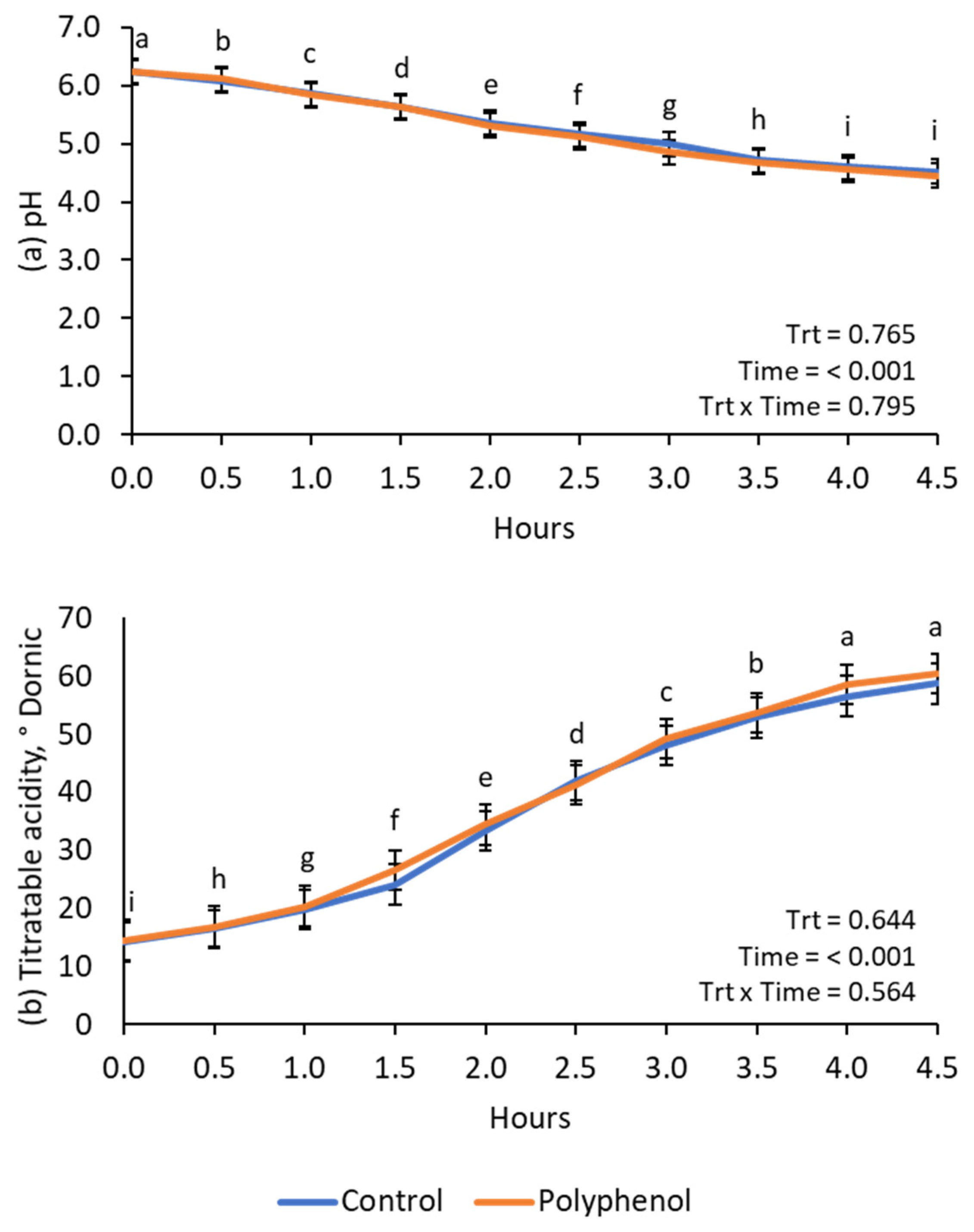
Figure 1. Temporal variation in yogurt (a) pH and (b) titratable acidity throughout fermentation (0 to 4.5 h after inoculation). Lowercase letters indicate differences among fermentation times (p < 0.05).
Dairy 07 00022 g001
Figure 2. Temporal changes in yogurt (a) pH and (b) titratable acidity throughout 40 d of shelf life under refrigeration. Lowercase letters indicate differences among fermentation times (p < 0.05).
Dairy 07 00022 g002
Table 1. Chemical composition and ingredients of the experimental diets (% of DM).
ItemSilageBrewer’s GrainConcentrate 1HayTMR
Proportion in TMR (%)27.787.9831.2433.00-
Dry matter, %33.4022.7088.9080.4046.3
Crude protein, %11.3027.7023.5015.4015.80
Acid detergent fiber, %38.6026.105.6037.2025.40
Neutral detergent fiber, %60.9056.7011.2066.7050.30
Ether extract, %3.4011.002.703.402.80
Non-fiber carbohydrates, %20.6011.6027.3012.5024.30
Starch, %13.005.80-0.70-
Ashes, %6.003.505.306.906.70
1 Commercial concentrate (Agroindústria Três Irmãos, Mococa, SP, Brazil).
Table 2. Milk production, composition, and SCC of lactating Holstein cows fed with and without polyphenol-rich sugarcane extract.
ItemTreatment 1SEM 2p-Value 3
ControlPolyphenolTrtWeekTrt × Week
Milk production (kg)20.0221.91 1.9340.49<0.010.4272
Fat (%)3.773.66 0.2370.740.010.97
Protein (%)3.203.15 0.0980.790.460.80
Non-fatty solids (%)8.638.75 0.1000.410.030.38
Lactose (%)4.564.44 0.0760.290.010.41
Casein (%)2.552.54 0.0780.940.400.51
Titratable acidity (°d)14.5614.69 0.2950.760.060.78
Free fatty acids (mmol/kg)0.460.52 0.0310.16<0.010.24
Urea nitrogen (mg/dL)15.9015.00 1.0140.54<0.010.99
SCC log-transformed 43.35 a1.38 b0.0210.010.290.87
SCC (×103 cell/mL)593238----
1 Treatment: Cows treated with polyphenol; Control: Cows not treated with polyphenol. 2 SEM: Standard error of the mean. 3 Treat: Treatment effect; Week: Effect of week; Treat × Week: Effect of interaction between treatment and week. 4 SCC log-transformed as LS SCC = log2 (SCC/100) + 3. Significance level less than or equal to 5% (p < 0.05). a,b Means within a row with different superscript letters differ significantly (p < 0.05).
Disclaimer/Publisher’s Note: The statements, opinions and data contained in all publications are solely those of the individual author(s) and contributor(s) and not of MDPI and/or the editor(s). MDPI and/or the editor(s) disclaim responsibility for any injury to people or property resulting from any ideas, methods, instructions or products referred to in the content.