
Isolated Dicyanoaurate(I) as a Polycentered σ-Hole Interaction Acceptor: A Combined Crystallographic and Theoretical Survey


Abstract
1. Introduction
2. Materials and Methods
Computational Details
3. Results and Discussion
3.1. Identification of Noncovalent Interactions
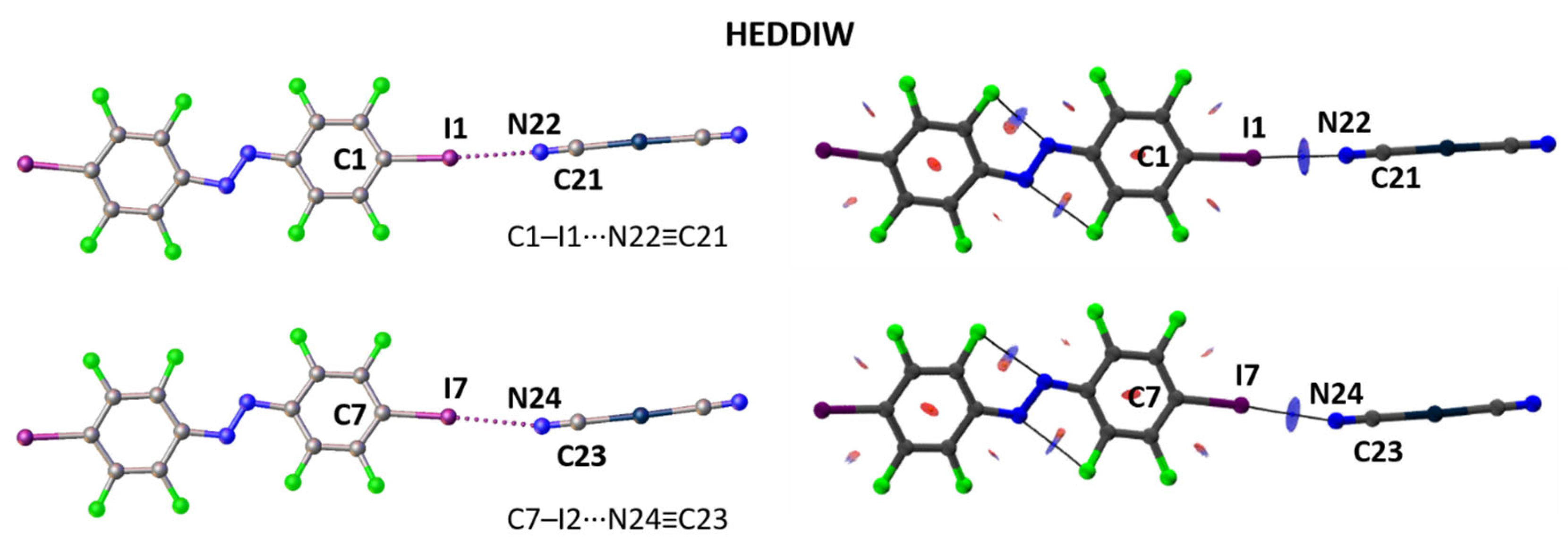
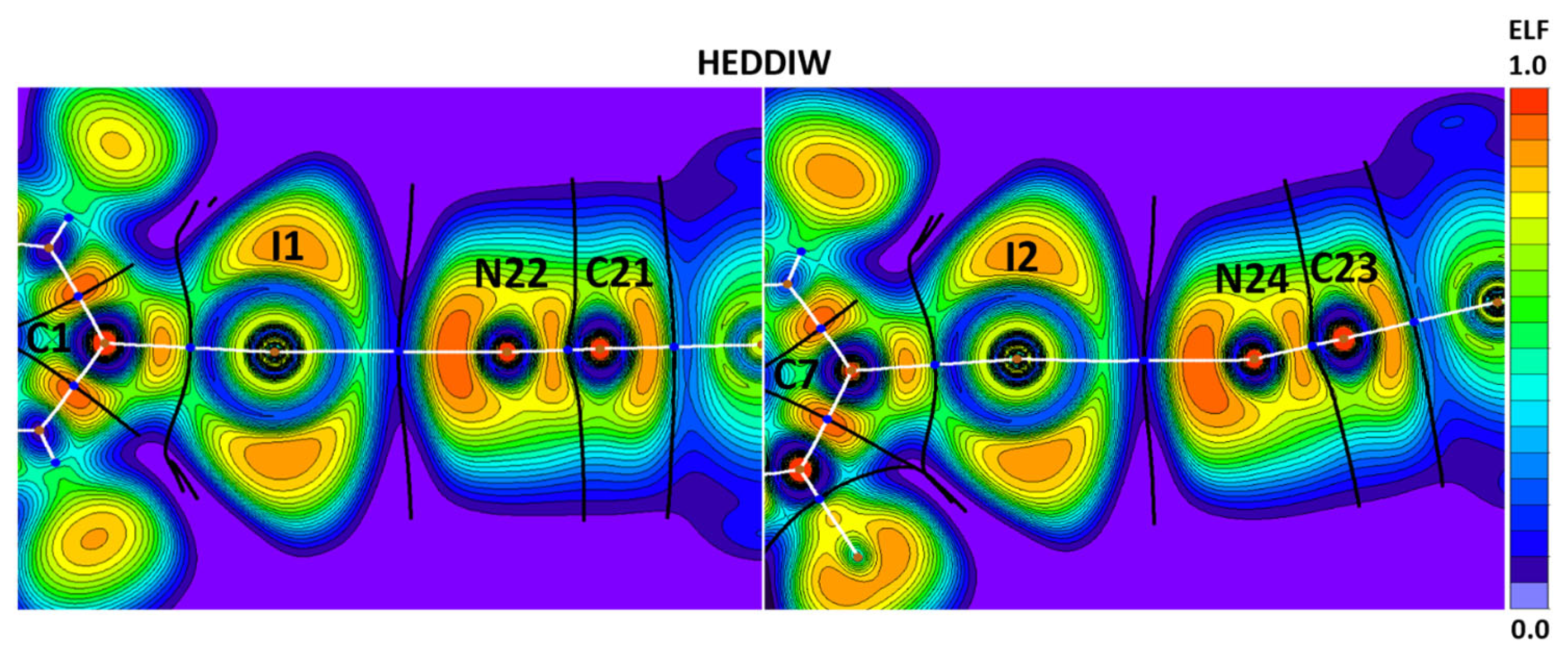
3.2. Halogen Bonding with Nitrogen Atom
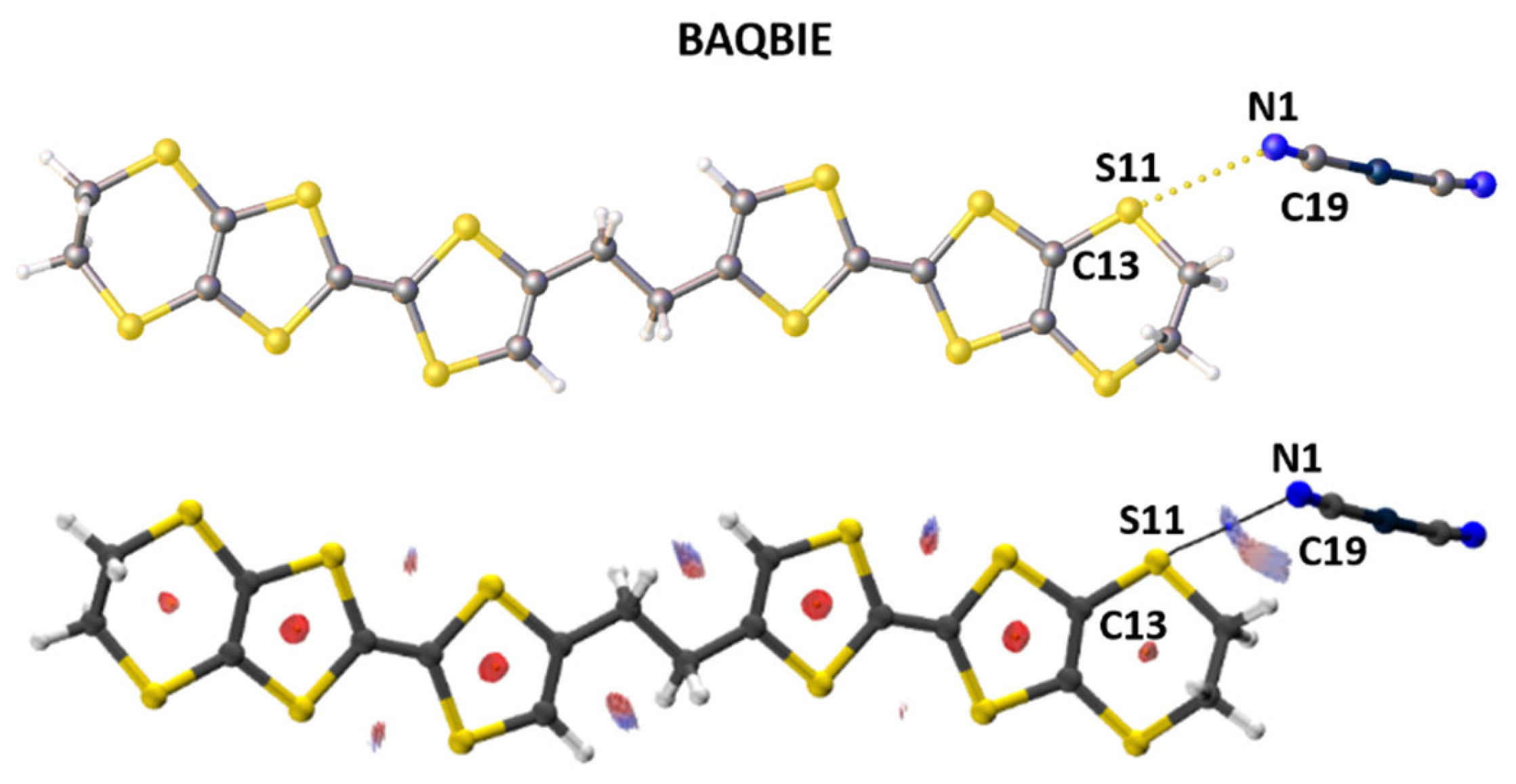
3.3. Chalcogen Bonding with Nitrogen Atom
3.4. Pnictogen Bonding with Nitrogen Atom
3.5. Tetrel Bonding with Nitrogen Atom
3.6. σ-Hole Interactions with π-Electrons of C≡N Triple Bond
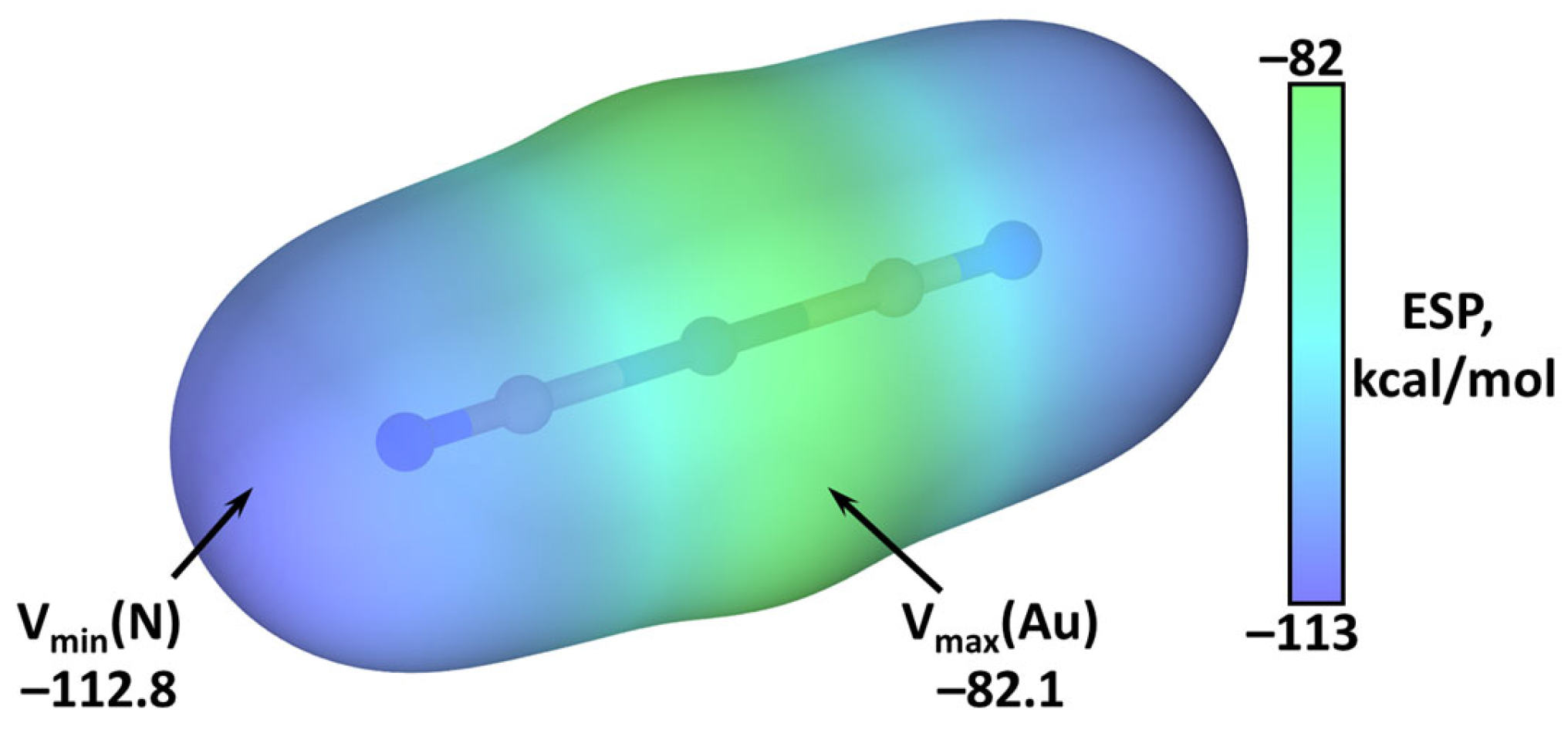
3.7. Au Nucleophilicity in σ-Hole Interactions
3.8. Calculated Dimerization Energies
4. Conclusions
Supplementary Materials
Author Contributions
Funding
Data Availability Statement
Acknowledgments
Conflicts of Interest
References
- Arunan, E.; Desiraju, G.R.; Klein, R.A.; Sadlej, J.; Scheiner, S.; Alkorta, I.; Clary, D.C.; Crabtree, R.H.; Dannenberg, J.J.; Hobza, P.; et al. Definition of the Hydrogen Bond (IUPAC Recommendations 2011). Pure Appl. Chem. 2011, 83, 1637–1641. [Google Scholar] [CrossRef]
- Desiraju, G.R.; Ho, P.S.; Kloo, L.; Legon, A.C.; Marquardt, R.; Metrangolo, P.; Politzer, P.; Resnati, G.; Rissanen, K. Definition of the Halogen Bond (IUPAC Recommendations 2013). Pure Appl. Chem. 2013, 85, 1711–1713. [Google Scholar] [CrossRef]
- Aakeroy, C.B.; Bryce, D.L.; Desiraju, G.R.; Frontera, A.; Legon, A.C.; Nicotra, F.; Rissanen, K.; Scheiner, S.; Terraneo, G.; Metrangolo, P.; et al. Definition of the Chalcogen Bond (IUPAC Recommendations 2019). Pure Appl. Chem. 2019, 91, 1889–1892. [Google Scholar] [CrossRef]
- Resnati, G.; Bryce, D.L.; Desiraju, G.R.; Frontera, A.; Krossing, I.; Legon, A.C.; Metrangolo, P.; Nicotra, F.; Rissanen, K.; Scheiner, S.; et al. Definition of the Pnictogen Bond (IUPAC Recommendations 2023). Pure Appl. Chem. 2024, 96, 135–145. [Google Scholar] [CrossRef]
- Scilabra, P.; Kumar, V.; Ursini, M.; Resnati, G. Close Contacts Involving Germanium and Tin in Crystal Structures: Experimental Evidence of Tetrel Bonds. J. Mol. Model. 2018, 24, 37. [Google Scholar] [CrossRef] [PubMed]
- Daolio, A.; Scilabra, P.; Terraneo, G.; Resnati, G. C(sp3) Atoms as Tetrel Bond Donors: A Crystallographic Survey. Coord. Chem. Rev. 2020, 413, 213265. [Google Scholar] [CrossRef]
- Varadwaj, P.R.; Varadwaj, A.; Marques, H.M.; Yamashita, K. Definition of the Tetrel Bond. CrystEngComm 2023, 25, 1411–1423. [Google Scholar] [CrossRef]
- Suslonov, V.V.; Soldatova, N.S.; Postnikov, P.S.; Resnati, G.; Kukushkin, V.Y.; Ivanov, D.M.; Bokach, N.A. Diaryliodonium Tetracyanidometallates Self-Assemble into Halogen-Bonded Square-Like Arrays. Cryst. Growth Des. 2022, 22, 2749–2758. [Google Scholar] [CrossRef]
- Imakubo, T.; Shirahata, T.; Kibune, M.; Yoshino, H. Hybrid Organic/Inorganic Supramolecular Conductors D2[Au(CN)4] [D = Diiodo(ethylenedichalcogeno)tetrachalcogenofulvalene], Including a New Ambient Pressure Superconductor. Eur. J. Inorg. Chem. 2007, 2007, 4727–4735. [Google Scholar] [CrossRef]
- Ormond-Prout, J.E.; Smart, P.; Brammer, L. Cyanometallates as Halogen Bond Acceptors. Cryst. Growth Des. 2012, 12, 205–216. [Google Scholar] [CrossRef]
- Jakupec, N.; Fotović, L.; Stilinović, V. The Effect of Halogen Bonding on Protonated Hexacyanoferrate Networks in Hexacyanoferrates of Halogenopyridines. CrystEngComm 2020, 22, 8142–8150. [Google Scholar] [CrossRef]
- Sellin, M.; Rupf, S.M.; Zhang, Y.; Malischewski, M. Bi- and Trifurcated Halogen Bonding M–C≡N···I in 1D, 2D, and 3D Supramolecular Network Structures of Co-Crystallized Diiodoacetylene C2I2 and Tetracyanonickelate [Ni(CN)4]2−. Cryst. Growth Des. 2020, 20, 7104–7110. [Google Scholar] [CrossRef]
- Sellin, M.; Rupf, S.M.; Malischewski, M. Cubic Three-Dimensional Networks of the Cyanometalate [Fe(CN)6]3− with the Ditopic Halogen Bond Donor Diiodoacetylene C2I2. Cryst. Growth Des. 2021, 21, 5515–5520. [Google Scholar] [CrossRef]
- Aliyarova, I.S.; Koziakova, A.V.; Ivanov, D.M.; Soldatova, N.S.; Postnikov, P.S. Supramolecular Organization of Diaryliodonium Dicyanoargentates(I) Provided by Iodine(III)–Cyanide Halogen Bonding. Inorganics 2025, 13, 157. [Google Scholar]
- Mallah, E.; Sweidan, K.; Abu-Salem, Q.; Abu Dayyih, W.; Steimann, M. 2-Bromo-1,3-diisopropyl-4,5-dimethyl-1H-imidazol-3-ium Dicyanidoargentate. Acta Crystallogr. E 2012, 68, m17. [Google Scholar] [CrossRef] [PubMed]
- Klapötke, T.M.; Krumm, B.; Mayer, P.; Piotrowski, H.; Schwab, I.; Vogt, M. Synthesis and Structures of Triorganotelluronium Pseudohalides. Eur. J. Inorg. Chem. 2002, 2002, 2701–2709. [Google Scholar]
- Imakubo, T.; Sawa, H.; Kato, R. Novel Radical Cation Salts of Organic π-Donors Containing Iodine Atom(s): The First Application of Strong Intermolecular-I∙∙∙X− (X = CN, halogen atom) Interaction to Molecular Conductors. Synth. Met. 1995, 73, 117–122. [Google Scholar] [CrossRef]
- Qu, J.; Gu, W.; Liu, X. Synthesis, Crystal Structure and Luminescent Properties of Two Complexes Containing [Au(CN)2]− Building Blocks. J. Coord. Chem. 2008, 61, 618–626. [Google Scholar] [CrossRef]
- Deák, A.; Jobbágy, C.; Marsi, G.; Molnár, M.; Szakács, Z.; Baranyai, P. Anion-, Solvent-, Temperature-, and Mechano-Responsive Photoluminescence in Gold(I) Diphosphine-Based Dimers. Chem. Eur. J. 2015, 21, 11495–11508. [Google Scholar] [CrossRef] [PubMed]
- Dong, W.; Sun, Y.-Q.; Yu, B.; Zhou, H.-B.; Song, H.-B.; Liu, Z.-Q.; Wang, Q.-M.; Liao, D.-Z.; Jiang, Z.-H.; Yan, S.-P.; et al. Synthesis, Crystal Structures and Luminescent Properties of Two Supramolecular Assemblies Containing [Au(CN)2]− Building Block. New J. Chem. 2004, 28, 1347–1351. [Google Scholar] [CrossRef]
- Reinheimer, E.W.; Olejniczak, I.; Łapiński, A.; Swietlik, R.; Jeannin, O.; Fourmigué, M. Structural Distortions upon Oxidation in Heteroleptic [Cp(2)W(dmit)] Tungsten Dithiolene Complex: Combined Structural, Spectroscopic, and Magnetic Studies. Inorg. Chem. 2010, 49, 9777–9787. [Google Scholar] [CrossRef] [PubMed]
- Schwellnus, A.H.; Denner, L.; Boeyens, J.C.A. The Crystal Structure of Lysidine · HAu(CN)2−—A Model Compound of a Weak-base Anion-exchange Resin Loaded with Gold Cyanide. Polyhedron 1990, 9, 975–979. [Google Scholar] [CrossRef]
- Djemel, A.; Stefanczyk, O.; Marchivie, M.; Trzop, E.; Collet, E.; Desplanches, C.; Delimi, R.; Chastanet, G. Solvatomorphism-Induced 45 K Hysteresis Width in a Spin-Crossover Mononuclear Compound. Chem. Eur. J. 2018, 24, 14760–14767. [Google Scholar] [CrossRef] [PubMed]
- Pham, D.M.; Rios, D.; Olmstead, M.M.; Balch, A.L. Assisted Self-association of Dicyanoaurate, [Au(CN)2]−, and Dicyanoargentate, [Ag(CN)2]−, through Hydrogen Bonding to Metal Ammonia Complexes. Inorg. Chim. Acta 2005, 358, 4261–4269. [Google Scholar] [CrossRef]
- Stender, M.; Olmstead, M.M.; Balch, A.L.; Rios, D.; Attar, S. Cation and Hydrogen Bonding Effects on the Self-association and Luminescence of the Dicyanoaurate ion, [Au(CN)2]−. Dalton Trans. 2003, 4282–4287. [Google Scholar] [CrossRef]
- King, P.; Henkelis, J.J.; Kilner, C.A.; Halcrow, M.A. Four New Spin-crossover Salts of [Fe(3-bpp)2]2+ (3-bpp=2,6-bis[1H-pyrazol-3-yl]pyridine). Polyhedron 2013, 52, 1449−1456. [Google Scholar] [CrossRef]
- White, F.; Sykora, R.E. Crystal Structure of Bis-(2,2′:6′,2″-terpyridine-κ(3)N,N′,N″)nickel(II) Dicyanidoaurate(I). Acta Cryst. E 2014, 70, 519–521. [Google Scholar] [CrossRef] [PubMed]
- Stork, J.R.; Rios, D.; Pham, D.; Bicocca, V.; Olmstead, M.M.; Balch, A.L. Metal−Metal Interactions in Platinum(II)/Gold(I) or Platinum(II)/Silver(I) Salts Containing Planar Cations and Linear Anions. Inorg. Chem. 2005, 44, 3466–3472. [Google Scholar] [CrossRef] [PubMed]
- Conejo-Rodríguez, V.; Peñas-Defrutos, M.N.; Espinet, P. d8⋯d10 RhI⋯AuI Interactions in Rh 2,6-xylylisocyanide Complexes with [Au(CN)2]−: Bond Analysis and Crystal Effects. Chem. Comm. 2019, 55, 5005–5008. [Google Scholar] [CrossRef] [PubMed]
- Döring, C.; Jones, P.G. Aminkomplexe des Goldes, Teil 7: Pseudosymmetrie bei Aminkomplexen des Gold(I)-cyanids [1]/Amine Complexes of Gold, Part 7: Pseudosymmetry in Amine Complexes of Gold(I) Cyanide. Z. Naturforschung B 2013, 68, 474–492. [Google Scholar] [CrossRef]
- Pyykkö, P.; Li, J.; Runeberg, N. Predicted Ligand Dependence of the Au(I)∙∙∙Au(I) Attraction in (XAuPH3)2. Chem. Phys. Lett. 1994, 218, 133–138. [Google Scholar] [CrossRef]
- Chen, J.-X.; Zhang, W.-H.; Tang, X.-Y.; Ren, Z.-G.; Li, H.-X.; Zhang, Y.; Lang, J.-P. Toward Rational Construction of Gold, Gold−Silver, and Gold−Mercury String Complexes: Syntheses, Structures, and Properties of [Au(Tab)2]2L2 (L = I and PF6), {[(Tab)2M][Au(CN)2]}2 (M = Au and Ag), and {[Hg(Tab)2][Au(CN)2]2} [Tab = 4-(Trimethylammonio)benzenethiolate]. Inorg. Chem. 2006, 45, 7671–7680. [Google Scholar] [CrossRef] [PubMed]
- Priola, E.; Curetti, N.; Marabello, D.; Andreo, J.; Giordana, A.; Andreo, L.; Benna, P.; Freire, P.T.C.; Benzi, P.; Operti, L.; et al. Crystal Engineering of Aurophilic Supramolecular Architectures and Coordination Polymers Based on Butterfly-like Copper–Dicyanoaurate Complexes: Vapochromism, P–T Behaviour and Multi-metallic Cocrystal Formation. CrystEngComm 2022, 24, 2336–2348. [Google Scholar] [CrossRef]
- Cramer, R.E.; Smith, D.W.; VanDoorne, W. The Structures of [24-Pyrimidinium crown-6][Au(CN)2]4(NO3)2·2H2O, [24-Pyrimidinium crown-6][Au(CN)2]6·5H2O, and [16-Pyrimidinium crown-4][Au(CN)2]4·6.5H2O, in Which Aurophilic Interactions Produce Trimers, Tetramers, and Chains of Au(CN)2− Ions. Inorg. Chem. 1998, 37, 5895–5901. [Google Scholar] [CrossRef]
- Stender, M.; White-Morris, R.L.; Olmstead, M.M.; Balch, A.L. New Structural Features of Unsupported Chains of Metal Ions in Luminescent [(NH3)4Pt][Au(CN)2]2·1.5(H2O) and Related Salts. Inorg. Chem. 2003, 42, 4504–4506. [Google Scholar] [CrossRef] [PubMed]
- Patel, E.N.; Arthur, R.B.; Nicholas, A.D.; Reinheimer, E.W.; Omary, M.A.; Brichacek, M.; Patterson, H.H. Synthesis, Structure and Photophysical Properties of a 2D Network with Gold Dicyanide Donors Coordinated to Aza[5]helicene Viologen Acceptors. Dalton Trans. 2019, 48, 10288–10297. [Google Scholar] [CrossRef] [PubMed]
- Ma, Y.; Zhou, N.; Chen, X.-P.; Cao, D.; Liao, D.-Z.; Yan, S.-P. Synthesis, Structural, and Magnetic Properties of a Supramolecular Assembly Constructed from Radical Cations and [Au(CN)2]− Anions. J. Coord. Chem. 2009, 62, 3913–3920. [Google Scholar] [CrossRef]
- Nicholas, A.D.; Bullard, R.M.; Pike, R.D.; Patterson, H.H. Photophysical Investigation of Silver/Gold Dicyanometallates and Tetramethylammonium Networks: An Experimental and Theoretical Investigation. Eur. J. Inorg. Chem. 2019, 2019, 956–962. [Google Scholar] [CrossRef]
- Chen, Y.; Cheng, G.; Li, K.; Shelar, D.P.; Lu, W.; Che, C.-M. Phosphorescent Polymeric Nanomaterials with Metallophilic d10⋯d10 Interactions Self-assembled from [Au(NHC)2]+ and [M(CN)2]−. Chem. Sci. 2014, 5, 1348–1353. [Google Scholar] [CrossRef]
- Liu, Q.; Xie, M.; Chang, X.; Gao, Q.; Chen, Y.; Lu, W. Correlating Thermochromic and Mechanochromic Phosphorescence with Polymorphs of a Complex Gold(I) Double Salt with Infinite Aurophilicity. Chem. Commun. 2018, 54, 12844–12847. [Google Scholar] [CrossRef] [PubMed]
- Liu, Q.; Xie, M.; Chang, X.; Cao, S.; Zou, C.; Fu, W.-F.; Che, C.-M.; Chen, Y.; Lu, W. Tunable Multicolor Phosphorescence of Crystalline Polymeric Complex Salts with Metallophilic Backbones. Angew. Chem. Int. Ed. 2018, 57, 6279–6283. [Google Scholar] [CrossRef] [PubMed]
- Priola, E.; Giordana, A.; Gomila, R.M.; Zangrando, E.; Andreo, L.; Rabezzana, R.; Operti, L.; Diana, E.; Mahmoudi, G.; Frontera, A. Metallophilic Interactions in Silver(I) Dicyanoaurate Complexes. Dalton Trans. 2022, 51, 5818–5827. [Google Scholar] [CrossRef] [PubMed]
- Phillips, V.; Baddour, F.G.; Lasanta, T.; López-de-Luzuriaga, J.M.; Bacon, J.W.; Golen, J.A.; Rheingold, A.L.; Doerrer, L.H. Metal–Metal Stacking Patterns Between and with [Pt(tpy)X]+ Cations. Inorg. Chim. Acta 2010, 364, 195–204. [Google Scholar] [CrossRef]
- Christopherson, J.-C.; Potts, K.P.; Bushuyev, O.S.; Topić, F.; Huskić, I.; Rissanen, K.; Barrett, C.J.; Friščić, T. Assembly and dichroism of a four-component halogen-bonded metal–organic cocrystal salt solvate involving dicyanoaurate(I) acceptors. Faraday Discuss. 2017, 203, 441–457. [Google Scholar] [CrossRef] [PubMed]
- Liau, R.Y.; Ehlich, H.; Schier, A.; Schmidbaur, H. Bis(triphenylphosphoranylidene)ammonium Dicyanoaurate(I). Z. Naturforschung B 2002, 57, 1085–1089. [Google Scholar] [CrossRef]
- Novikov, A.S. Theoretical Confirmation of Existence of X∙∙∙Au Non-covalent Contacts. Inorg. Chim. Acta 2018, 471, 126–129. [Google Scholar] [CrossRef]
- Fujita, W. Ferromagnetic Ordering in the Organic Radical Cation Salt BBDTA·Au(CN)2 at 8.2 K. Dalton Trans. 2015, 44, 903–907. [Google Scholar] [CrossRef] [PubMed]
- Furuta, K.; Kohno, S.; Shirahata, T.; Misaki, Y. Molecular Conductors with Effectively Half-Filled Electronic States Based on Tetrathiafulvalene Derivatives Condensed with a 2-Isopropylidene-1,3-dithiole Ring. Eur. J. Inorg. Chem. 2014, 2014, 3982–3988. [Google Scholar] [CrossRef]
- Allen, F.H.; Bruno, I.J. Bond Lengths in Organic and Metal-organic Compounds Revisited: X−H Bond Lengths from Neutron Diffraction Data. Acta Cryst. B 2010, 66, 380–386. [Google Scholar] [CrossRef] [PubMed]
- Dolomanov, O.V.; Bourhis, L.J.; Gildea, R.J.; Howard, J.A.K.; Puschmann, H. OLEX2: A Complete Structure Solution, Refinement and Analysis Program. J. Appl. Crystallogr. 2009, 42, 339–341. [Google Scholar] [CrossRef]
- Neese, F. Software update: The ORCA program system—Version 5.0. WIREs Comput. Mol. Sci. 2022, 12, e1606. [Google Scholar] [CrossRef]
- Tao, J.; Perdew, J.P.; Staroverov, V.N.; Scuseria, G.E. Climbing the Density Functional Ladder: Nonempirical Meta-Generalized Gradient Approximation Designed for Molecules and Solids. Phys. Rev. Lett. 2003, 91, 146401. [Google Scholar] [CrossRef] [PubMed]
- Grimme, S.; Antony, J.; Ehrlich, S.; Krieg, H. A Consistent and Accurate ab initio Parametrization of Density Functional Dispersion Correction (DFT-D) for the 94 Elements H-Pu. J. Chem. Phys. 2010, 132, 154104–154119. [Google Scholar] [CrossRef] [PubMed]
- Canal Neto, A.; Ferreira, I.B.; Jorge, F.E.; de Oliveira, A.Z. All-electron Triple Zeta Basis Sets for ZORA Calculations: Application in Studies of Atoms and Molecules. Chem. Phys. Lett. 2021, 771, 138548. [Google Scholar] [CrossRef]
- Pritchard, B.P.; Altarawy, D.; Didier, B.; Gibson, T.D.; Windus, T.L. New Basis Set Exchange: An Open, Up-to-Date Resource for the Molecular Sciences Community. J. Chem. Inform. Model. 2019, 59, 4814–4820. [Google Scholar] [CrossRef] [PubMed]
- Ren, X.; Rinke, P.; Blum, V.; Wieferink, J.; Tkatchenko, A.; Sanfilippo, A.; Reuter, K.; Scheffler, M. Resolution-of-Identity Approach to Hartree–Fock, Hybrid Density Functionals, RPA, MP2 and GW with Numeric Atom-centered Orbital Basis Functions. New J. Phys. 2012, 14, 053020. [Google Scholar] [CrossRef]
- Stoychev, G.L.; Auer, A.A.; Neese, F. Automatic Generation of Auxiliary Basis Sets. J. Chem. Theor. Comput. 2017, 13, 554–562. [Google Scholar] [CrossRef] [PubMed]
- Lenthe, E.V.; Baerends, E.J.; Snijders, J.G. Relativistic Regular Two-component Hamiltonians. J. Chem. Phys. 1993, 99, 4597–4610. [Google Scholar] [CrossRef]
- van Lenthe, E.; Baerends, E.J.; Snijders, J.G. Relativistic Total Energy Using Regular Approximations. J. Chem. Phys. 1994, 101, 9783–9792. [Google Scholar] [CrossRef]
- van Lenthe, E.; Snijders, J.G.; Baerends, E.J. The Zero-Order Regular Approximation for Relativistic Effects: The Effect of Spin–orbit Coupling in Closed Shell Molecules. J. Chem. Phys. 1996, 105, 6505–6516. [Google Scholar] [CrossRef]
- van Lenthe, E.; Ehlers, A.; Baerends, E.-J. Geometry Optimizations in the Zero Order Regular Approximation for Relativistic Effects. J. Chem. Phys. 1999, 110, 8943–8953. [Google Scholar] [CrossRef]
- van Lenthe, E.; van Leeuwen, R.; Baerends, E.J.; Snijders, J.G. Relativistic Regular Two-component Hamiltonians. Int. J. Quantum Chem. 1996, 57, 281–293. [Google Scholar]
- Bader, R.F.W. A Quantum Theory of Molecular Structure and its Applications. Chem. Rev. 1991, 91, 893–928. [Google Scholar] [CrossRef]
- Bader, R.F.W.; Nguyen-Dang, T.T. Quantum Theory of Atoms in Molecules–Dalton Revisited. In Advances in Quantum Chemistry; Löwdin, P.-O., Ed.; Academic Press: Cambridge, MA, USA, 1981; Volume 14, pp. 63–124. [Google Scholar]
- Espinosa, E.; Alkorta, I.; Elguero, J.; Molins, E. From Weak to Strong Interactions: A Comprehensive Analysis of the Topological and Energetic Properties of the Electron Density Distribution Involving X–H∙∙∙F–Y Systems. J. Chem. Phys. 2002, 117, 5529–5542. [Google Scholar] [CrossRef]
- Becke, A.D.; Edgecombe, K.E. A Simple Measure of Electron Localization in Atomic And Molecular Systems. J. Chem. Phys. 1990, 92, 5397–5403. [Google Scholar] [CrossRef]
- Savin, A.; Nesper, R.; Wengert, S.; Fassler, T.F. ELF: The Electron Localization Function. Angew. Chem. Int. Ed. 1997, 36, 1809–1832. [Google Scholar] [CrossRef]
- Silvi, B.; Savin, A. Classification of Chemical Bonds Based on Topological Analysis of Electron Localization Functions. Nature 1994, 371, 683–686. [Google Scholar] [CrossRef]
- Bartashevich, E.V.; Matveychuk, Y.V.; Troitskaya, E.A.; Tsirelson, V.G. Characterizing the Multiple Non-covalent Interactions in N, S-heterocycles–Diiodine Complexes with Focus on Halogen Bonding. Comput. Theor. Chem. 2014, 1037, 53–62. [Google Scholar] [CrossRef]
- Bartashevich, E.; Yushina, I.; Kropotina, K.; Muhitdinova, S.; Tsirelson, V. Testing the Tools for Revealing and Characterizing the Iodine-Iodine Halogen Bond in Crystals. Acta Crystallogr. Sect. B 2017, 73, 217–226. [Google Scholar] [CrossRef] [PubMed]
- Lamberts, K.; Handels, P.; Englert, U.; Aubert, E.; Espinosa, E. Stabilization of Polyiodide Chains via Anion⋯Anion Interactions: Experiment and Theory. CrystEngComm 2016, 18, 3832–3841. [Google Scholar] [CrossRef]
- Bartashevich, E.; Mukhitdinova, S.; Yushina, I.; Tsirelson, V. Electronic Criterion for Categorizing the Chalcogen and Halogen Bonds: Sulfur–Iodine Interactions in Crystals. Acta Crystallogr. Sect. B 2019, 75, 117–126. [Google Scholar] [CrossRef] [PubMed]
- Bartashevich, E.; Matveychuk, Y.; Tsirelson, V. Identification of the Tetrel Bonds between Halide Anions and Carbon Atom of Methyl Groups Using Electronic Criterion. Molecules 2019, 24, 1083. [Google Scholar] [CrossRef] [PubMed]
- Mata, I.; Molins, E.; Alkorta, I.; Espinosa, E. Topological Properties of the Electrostatic Potential in Weak and Moderate N···H Hydrogen Bonds. J. Phys. Chem. A 2007, 111, 6425–6433. [Google Scholar] [CrossRef] [PubMed]
- Lu, T.; Chen, F.W. Multiwfn: A Multifunctional Wavefunction Analyzer. J. Comput. Chem. 2012, 33, 580–592. [Google Scholar] [CrossRef] [PubMed]
- Lu, T. A Comprehensive Electron Wavefunction Analysis Toolbox for Chemists. Multiwfn. J. Chem. Phys. 2024, 161, 082503. [Google Scholar] [CrossRef] [PubMed]
- Humphrey, W.; Dalke, A.; Schulten, K. VMD: Visual Molecular Dynamics. J. Mol. Graph. 1996, 14, 33–38. [Google Scholar] [CrossRef] [PubMed]
- Weinhold, F.; Landis, C.R. Natural Bond Orbitals and Extensions of Localized Bonding Concepts. Chem. Educ. Res. Pract. 2001, 2, 91–104. [Google Scholar] [CrossRef]
- Reed, A.E.; Curtiss, L.A.; Weinhold, F. Intermolecular Interactions From a Natural Bond Orbital, Donor-acceptor Viewpoint. Chem. Rev. 1988, 88, 899–926. [Google Scholar] [CrossRef]
- Glendening, E.D.; Badenhoop, J.K.; Reed, A.E.; Carpenter, J.E.; Bohmann, J.A.; Morales, C.M.; Karafiloglou, P.; Landis, C.R.; Weinhold, F. NBO 7.0; Theoretical Chemistry Institute, University of Wisconsin: Madison, WI, USA, 2018. [Google Scholar]
- Boys, S.F.; Bernardi, F. Calculation of Small Molecular Interactions by Differences of Separate Total Energies—Some Procedures with Reduced Errors. Mol. Phys. 1970, 19, 553. [Google Scholar] [CrossRef]
- Scrocco, E.; Tomasi, J. Electronic Molecular Structure, Reactivity and Intermolecular Forces: An Euristic Interpretation by Means of Electrostatic Molecular Potentials. In Advances in Quantum Chemistry; Löwdin, P.-O., Ed.; Academic Press: Cambridge, MA, USA, 1978; Volume 11, pp. 115–193. [Google Scholar]
- Scrocco, E.; Tomasi, J. The Electrostatic Molecular Potential as a Tool for the Interpretation of Molecular Properties. In New Concepts II; Springer: Berlin/Heidelberg, Germany, 1973; pp. 95–170. [Google Scholar]
- Brinck, T.; Murray, J.S.; Politzer, P. Surface Electrostatic Potentials of Halogenated Methanes as Indicators of Directional Intermolecular Interactions. Int. J. Quantum Chem. 1992, 44, 57–64. [Google Scholar] [CrossRef]
- Bader, R.F.W.; Carroll, M.T.; Cheeseman, J.R.; Chang, C. Properties of Atoms in Molecules: Atomic Volumes. J. Am. Chem. Soc. 1987, 109, 7968–7979. [Google Scholar] [CrossRef]
- Bondi, A. Van der Waals Volumes and Radii. J. Phys. Chem. 1964, 68, 441–451. [Google Scholar] [CrossRef]
- Formigué, M.; Mézière, C.; Canadell, E.; Zitoun, D.; Bechgaard, K.; Auban-Senzier, P. Covalent Linking of β-Slabs of EDT–TTF Moieties: Bis(ethylenedithiotetrathiafulvalenyl)ethane and Its 1:1 Radical Cation Salt with Au(CN)2−. Adv. Mater. 1999, 11, 766–769. [Google Scholar]
- Tsujimoto, K.; Ogasawara, R.; Kishi, Y.; Fujiwara, H. TTF–fluorene Dyads and their M(CN)2− (M = Ag, Au) Salts Designed for Photoresponsive Conducting Materials. New J. Chem. 2014, 38, 406–418. [Google Scholar] [CrossRef]
- Madalan, A.M.; Réthoré, C.; Fourmigué, M.; Canadell, E.; Lopes, E.B.; Almeida, M.; Auban-Senzier, P.; Avarvari, N. Order Versus Disorder in Chiral Tetrathiafulvalene-Oxazoline Radical-Cation Salts: Structural and Theoretical Investigations and Physical Properties. Chem. Eur. J. 2010, 16, 528–537. [Google Scholar] [CrossRef] [PubMed]
- Osada, M.; Kumagai, T.; Sugimoto, M.; Nishida, J.; Yamashita, Y. Novel TTF Vinylogues Containing Phenyl Groups at the Vinyl Positions. Synth. Met. 2005, 152, 429–432. [Google Scholar] [CrossRef]
- Mori, T.; Misaki, Y.; Yamabe, T. Structure and Physical Properties of (EP-TTP)2Au(CN)2. Bull. Chem. Soc. Jpn. 1994, 67, 3187–3190. [Google Scholar] [CrossRef]
- Takimiya, K.; Oharuda, A.; Morikami, A.; Aso, Y.; Otsubo, T. Improved Synthesis of Double-Bridged Tetraselenafulvalenophanes and Formation of Their Conductive Radical Cation Salts. Eur. J. Org. Chem. 2000, 2000, 3013–3019. [Google Scholar]
- Beno, M.A.; Firestone, M.A.; Leung, P.C.W.; Sowa, L.M.; Wang, H.H.; Williams, J.M.; Whangbo, M.H. Crystal and Band Electronic Structures of a New Class of 2:1 Organic Conducting Salts α′–(BEDT-TTF)2X, X− = Ag(CN)2−, Au(CN)2− and AuBr2−. Solid State Comm. 1986, 57, 735–739. [Google Scholar] [CrossRef]
- Amberger, E.; Fuchs, H.; Polborn, K. t-(ET)2Au(CN)2 and t-(ET)2AuBr2, Organic Radical Cation Salts with Twist Stucture. Angew. Chem. Int. Ed. 1986, 25, 729–731. [Google Scholar] [CrossRef]
- Sharutin, V.; Popkova, M.; Tarasova, T. Synthesis and Structure of Gold Complexes: [[Ph4P][Au(CN)2] and [(4-MeC6H4)4Sb][Au(CN)2]·H2O. Bull. South Ural State Univ. Ser. Chem. 2018, 10, 55–61. [Google Scholar] [CrossRef][Green Version]
- Naito, T.; Tateno, A.; Udagawa, T.; Kobayashi, H.; Kato, R.; Kobayashi, A.; Nogami, T. Synthesis, Structures and Electrical Properties of the Charge-transfer Salts of 4,5-ethylenedithio-4′,5′-(2-oxatrimethylenedithio)diselenadithiafulvalene (EOST) with Linear Anions [I−, IBr2−, ICl2−, I2Br−, AuBr2−, Au(CN)2−]. Faraday Trans. 1994, 90, 763–771. [Google Scholar] [CrossRef]
- Mori, T.; Inokuchi, H.; Misaki, Y.; Nishikawa, H.; Yamabe, T.; Mori, H.; Tanaka, S. Structure and Physical Properties of (TMEO-TTP)2Au(CN)2. Chem. Lett. 1993, 22, 2085–2088. [Google Scholar] [CrossRef]
- Johnson, E.R.; Keinan, S.; Mori-Sanchez, P.; Contreras-Garcia, J.; Cohen, A.J.; Yang, W.T. Revealing Noncovalent Interactions. J. Am. Chem. Soc. 2010, 132, 6498–6506. [Google Scholar] [CrossRef] [PubMed]
- Jabłoński, M. Bond Paths Between Distant Atoms Do Not Necessarily Indicate Dominant Interactions. J. Comput. Chem. 2018, 39, 2183–2195. [Google Scholar] [CrossRef] [PubMed]
- Jabłoński, M. On the Uselessness of Bond Paths Linking Distant Atoms and on the Violation of the Concept of Privileged Exchange Channels. ChemistryOpen 2019, 8, 497–507. [Google Scholar] [CrossRef] [PubMed]
- Zhang, J.; Xu, X.; Yan, X. Au-involving Chalcogen Bond in 4-(2-chalcophenyl)-1,2,3-triazolylidene Au(I) Complexes: Synthesis, Characterization, and Photophysical Properties. Dalton Trans. 2025, 54, 9576–9583. [Google Scholar] [CrossRef] [PubMed]
- Yang, H.; Lin, T.-P.; Gabbaï, F.P. Telluroether to Telluroxide Conversion in the Coordination Sphere of a Metal: Oxidation-Induced Umpolung of a Te–Au Bond. Organometallics 2014, 33, 4368–4373. [Google Scholar] [CrossRef]
- Kryukov, D.M.; Khrustaleva, A.A.; Baykov, S.V.; Gomila, R.M.; Frontera, A.; Kukushkin, V.Y.; Rozhkov, A.V.; Bokach, N.A. Cooperativity of Chalcogen and Halogen Bonding in Cocrystals of PdII and PtII Acetylacetonates with Perfluoroarene Selanes: Impact of the Arene Iodination on Supramolecular Architecture. Inorg. Chem. Comm. 2025, 182, 115288. [Google Scholar] [CrossRef]
- Rozhkov, A.V.; Katlenok, E.A.; Zhmykhova, M.V.; Ivanov, A.Y.; Kuznetsov, M.L.; Bokach, N.A.; Kukushkin, V.Y. Metal-Involving Chalcogen Bond. The Case of Platinum(II) Interaction with Se/Te-Based σ-Hole Donors. J. Am. Chem. Soc. 2021, 143, 15701–15710. [Google Scholar] [CrossRef] [PubMed]
- Rozhkov, A.V.; Burguera, S.; Frontera, A.; Kukushkin, V.Y. Formal Metal-Dependent (M = Pt, Pd) Switching between Arene π-Hole and σ-(Te)-Hole in the Arenetellurium(II) Noncovalent Binding. Cryst. Growth Des. 2024, 24, 9581–9589. [Google Scholar] [CrossRef]
- Busygina, A.A.; Eliseeva, A.A.; Rozhkov, A.V.; Ivanov, D.M.; Gomila, R.M.; Frontera, A.; Bokach, N.A.; Kukushkin, V.Y. Synergistic σ/π-Hole Interactions Directing Supramolecular Assembly: Tellurium···Platinum Chalcogen Bonding Enhanced by π-Stacking. Cryst. Growth Des. 2024, 24, 10235–10246. [Google Scholar] [CrossRef]
- Lin, T.-P.; Gabbaï, F.P. Telluronium Ions as σ-Acceptor Ligands. Angew. Chem. Int. Ed. 2013, 52, 3864–3868. [Google Scholar] [CrossRef] [PubMed]
- Soldatova, N.S.; Postnikov, P.S.; Suslonov, V.V.; Kissler, T.Y.; Ivanov, D.M.; Yusubov, M.S.; Galmés, B.; Frontera, A.; Kukushkin, V.Y. Diaryliodonium as a Double σ-Hole Donor: The Dichotomy of Thiocyanate Halogen Bonding Provides Divergent Solid State Arylation by Diaryliodonium Cations. Org. Chem. Front. 2020, 7, 2230–2242. [Google Scholar] [CrossRef]
- Aliyarova, I.S.; Tupikina, E.Y.; Ivanov, D.M.; Kukushkin, V.Y. Metal-Involving Halogen Bonding Including Gold(I) as a Nucleophilic Partner. The Case of Isomorphic Dichloroaurate(I)·Halomethane Cocrystals. Inorg. Chem. 2022, 61, 2558–2567. [Google Scholar] [CrossRef] [PubMed]
- Ivanov, D.M.; Bokach, N.A.; Kukushkin, V.Y.; Frontera, A. Metal Centers as Nucleophiles: Oxymoron of Halogen Bond-Involving Crystal Engineering. Chem. Eur. J. 2021, 28, e202103173. [Google Scholar] [CrossRef] [PubMed]
- Mikherdov, A.S.; Jin, M.; Ito, H. Exploring Au(I) Involving Halogen Bonding with N-heterocyclic Carbene Au(I) Aryl Complexes in Crystalline Media. Chem. Sci. 2023, 14, 4485–4494. [Google Scholar] [CrossRef] [PubMed]
- Aliyarova, I.S.; Tupikina, E.Y.; Soldatova, N.S.; Ivanov, D.M.; Postnikov, P.S.; Yusubov, M.; Kukushkin, V.Y. Halogen Bonding Involving Gold Nucleophiles in Different Oxidation States. Inorg. Chem. 2022, 61, 15398–15407. [Google Scholar] [CrossRef] [PubMed]



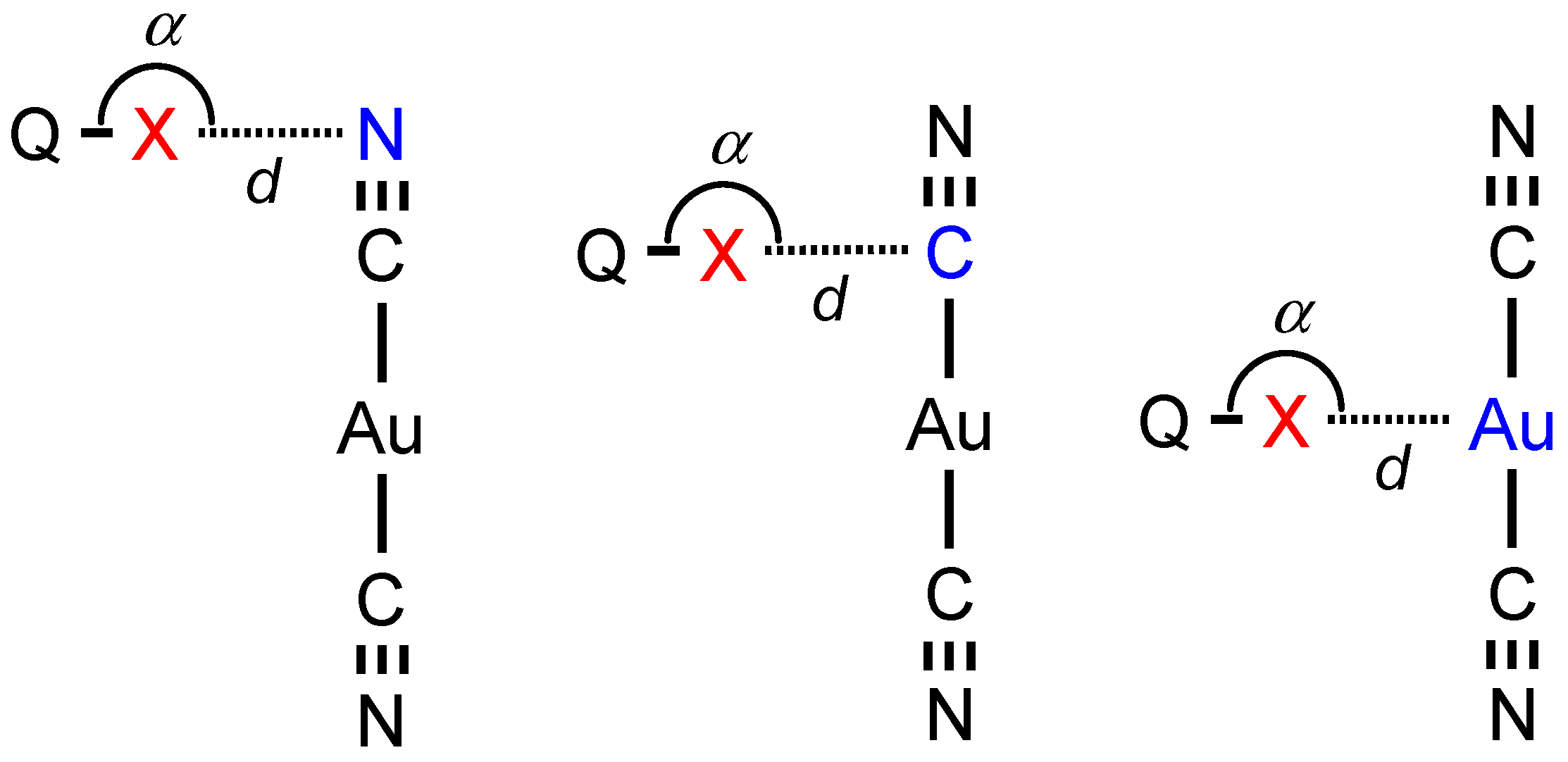
| № | Code | Contact | Distance, Å | Nc * | ∠E, ° | ∠Nu, ° |
|---|---|---|---|---|---|---|
| 1 | XEDDIW [44] | C1–I1⋯N22≡C21 | 2.846(6) | 0.81 | 177.0(2) | 175.4(7) |
| C7–I2⋯N24≡C23 | 2.960(5) | 0.84 | 174.7(2) | 167.2(6) | ||
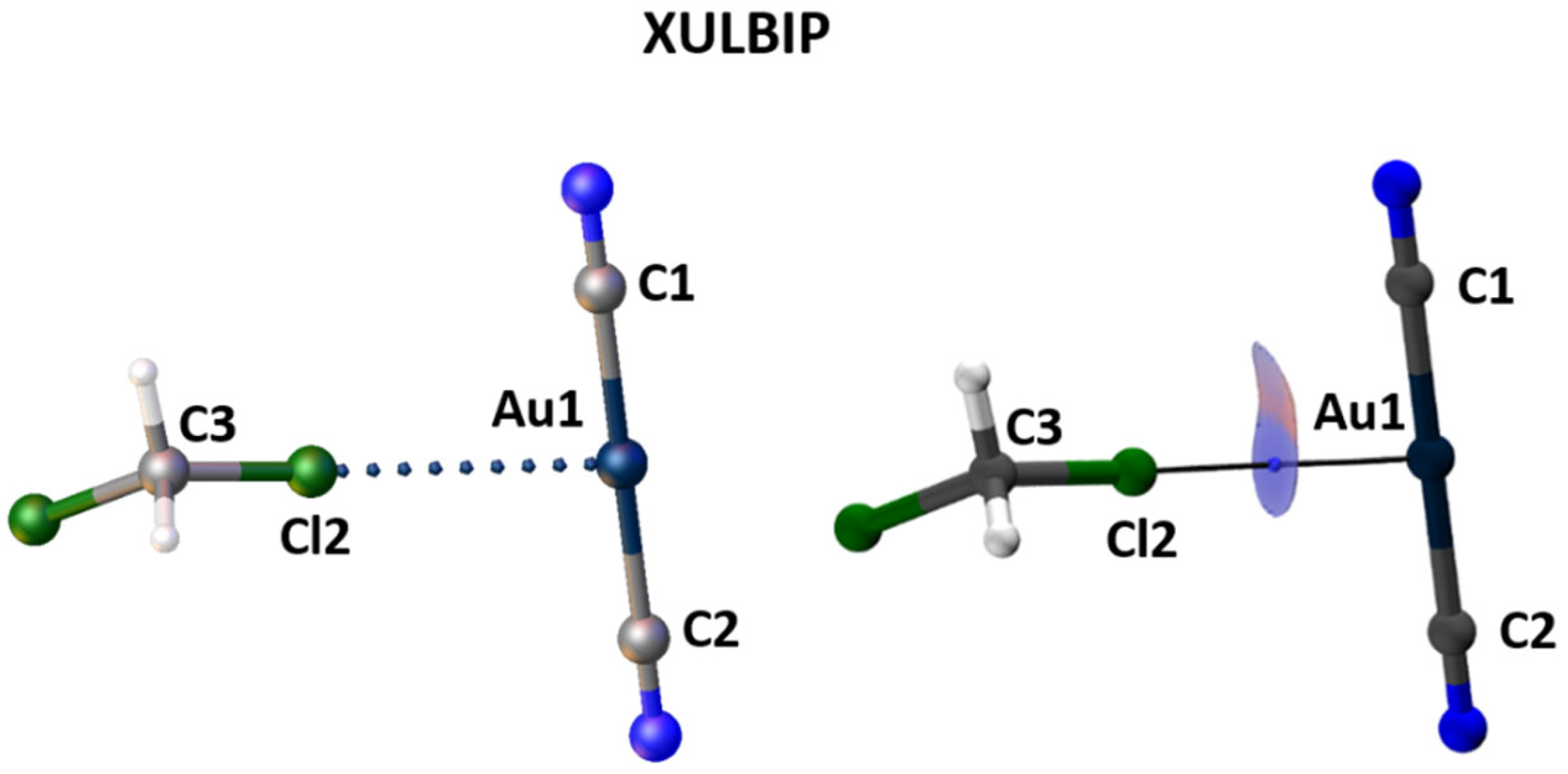
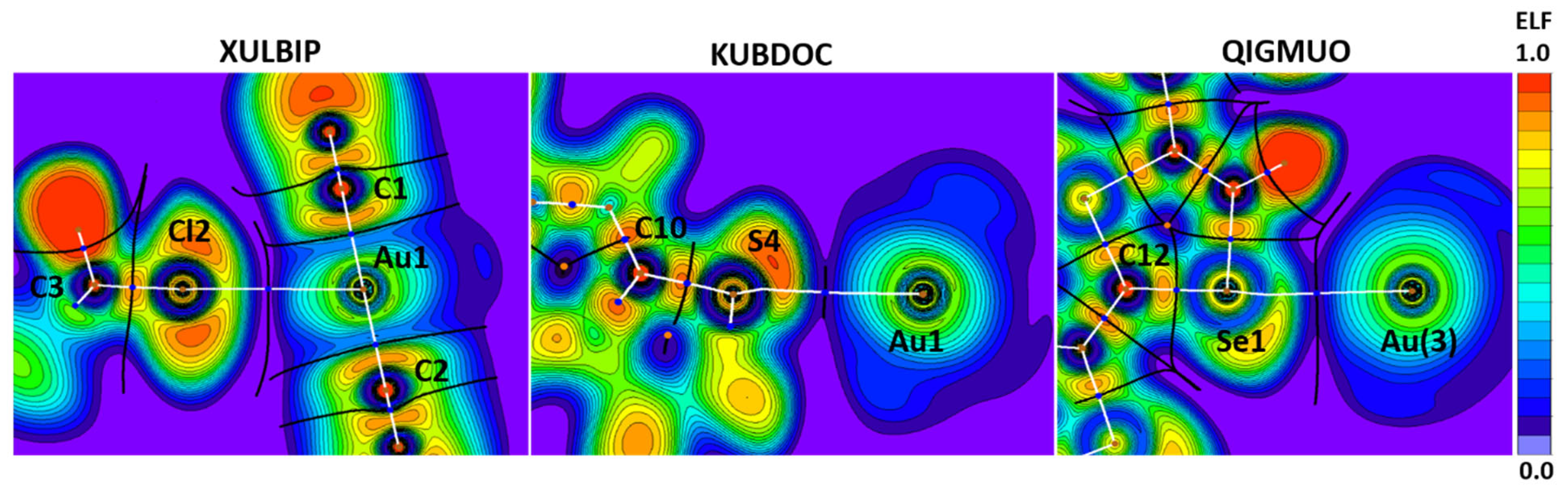
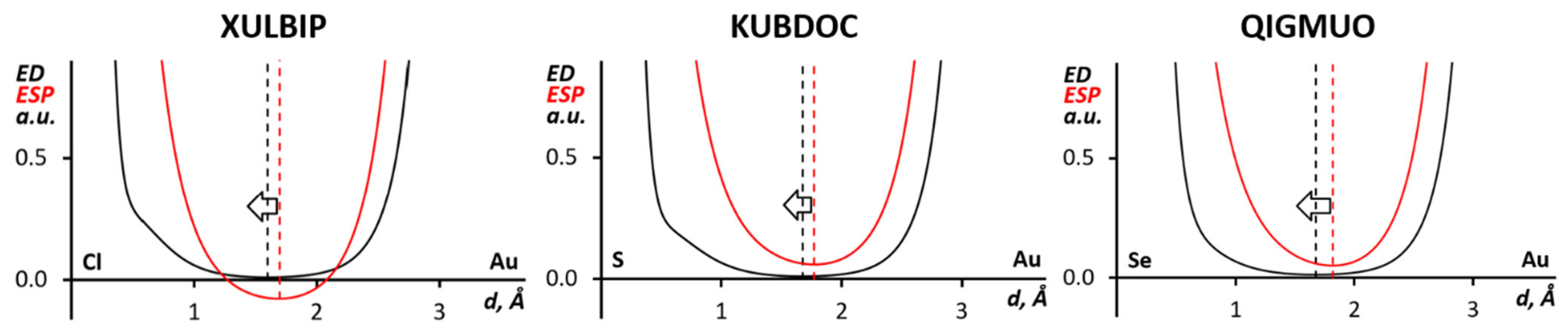
| 2 | XULBIP [45] | C3–Cl2⋯Au1–C1/C2 | 3.381(4) | 0.99 | 175.0(5) | 77.84(17)/102.56(17) |
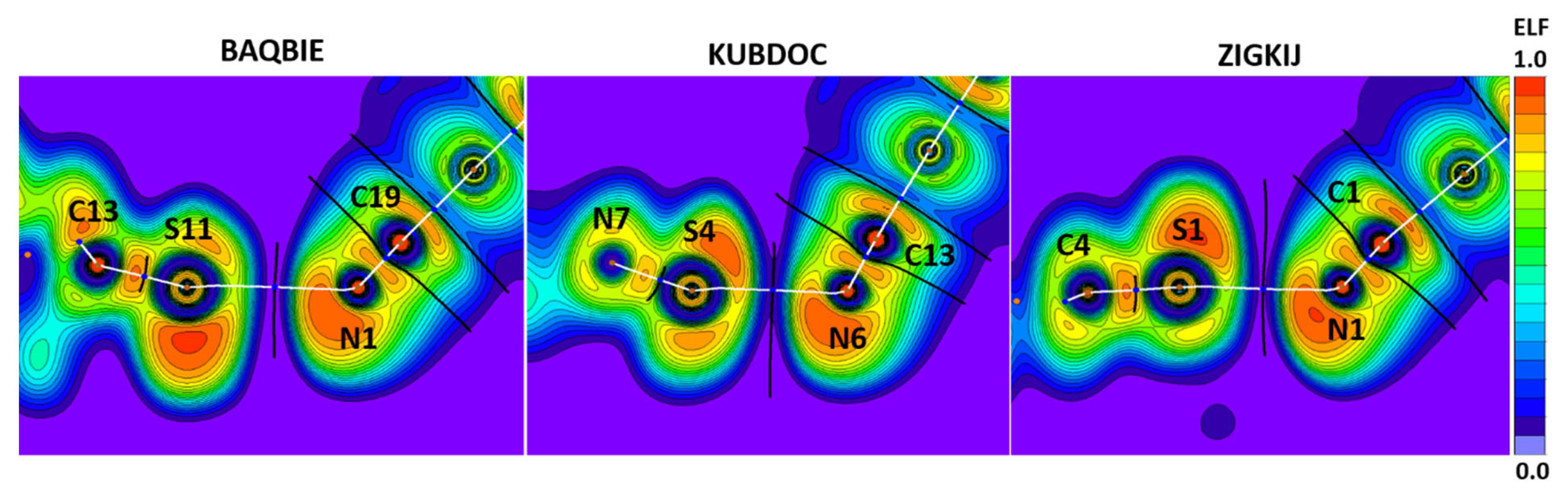
| 3 | BAQBIE [87] | C13–S11⋯N1≡C19 | 3.217(13) | 0.96 | 165.6(5) | 133.3(12) |
| C16–C15⋯N1≡C19 | 3.2125(7) | 0.99 | 167.317(7) | 116.698(18) | ||
| 4 | CITPEC [88] | C(6)–S(5)⋯N(1)≡C(24) | 3.299(9) | 0.98 | 153.3(3) | 112.6(6) |
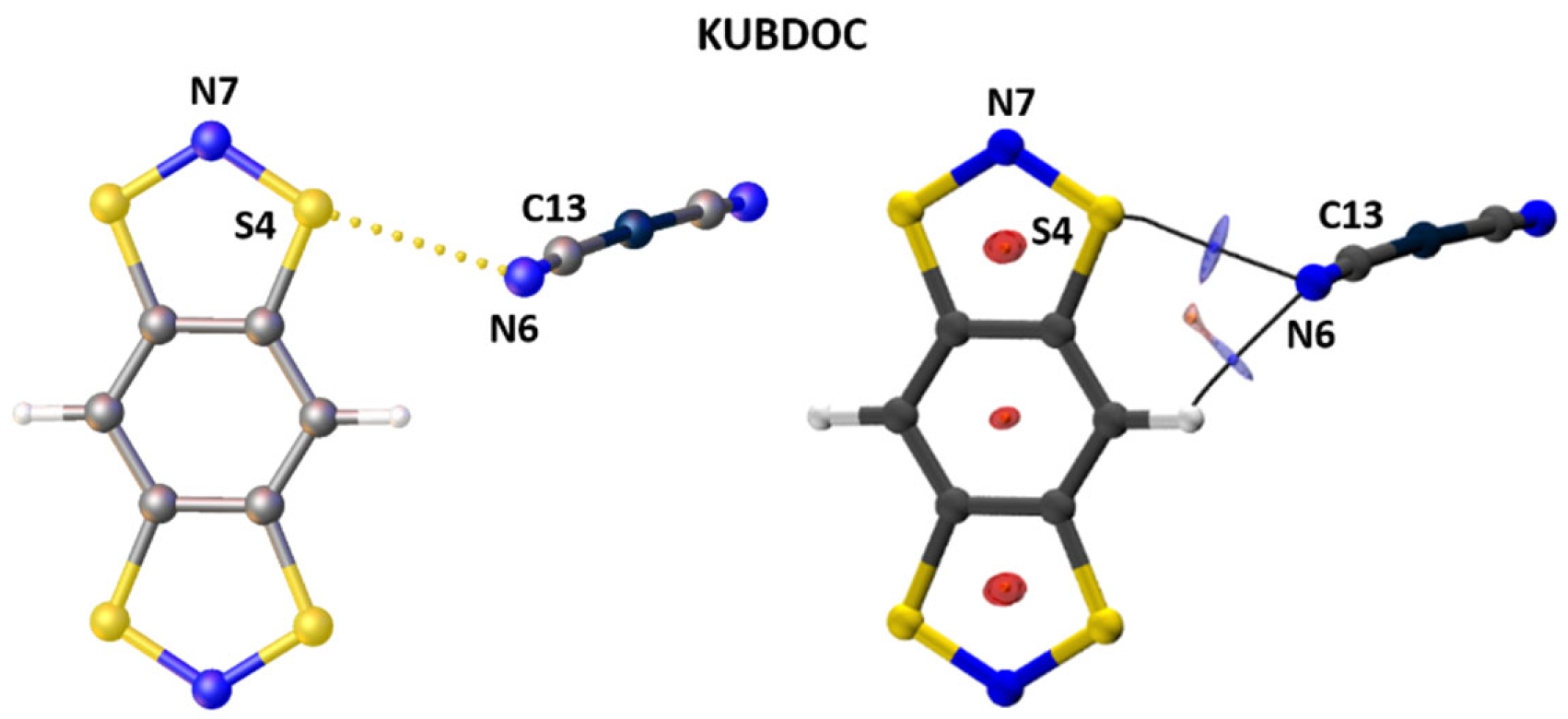
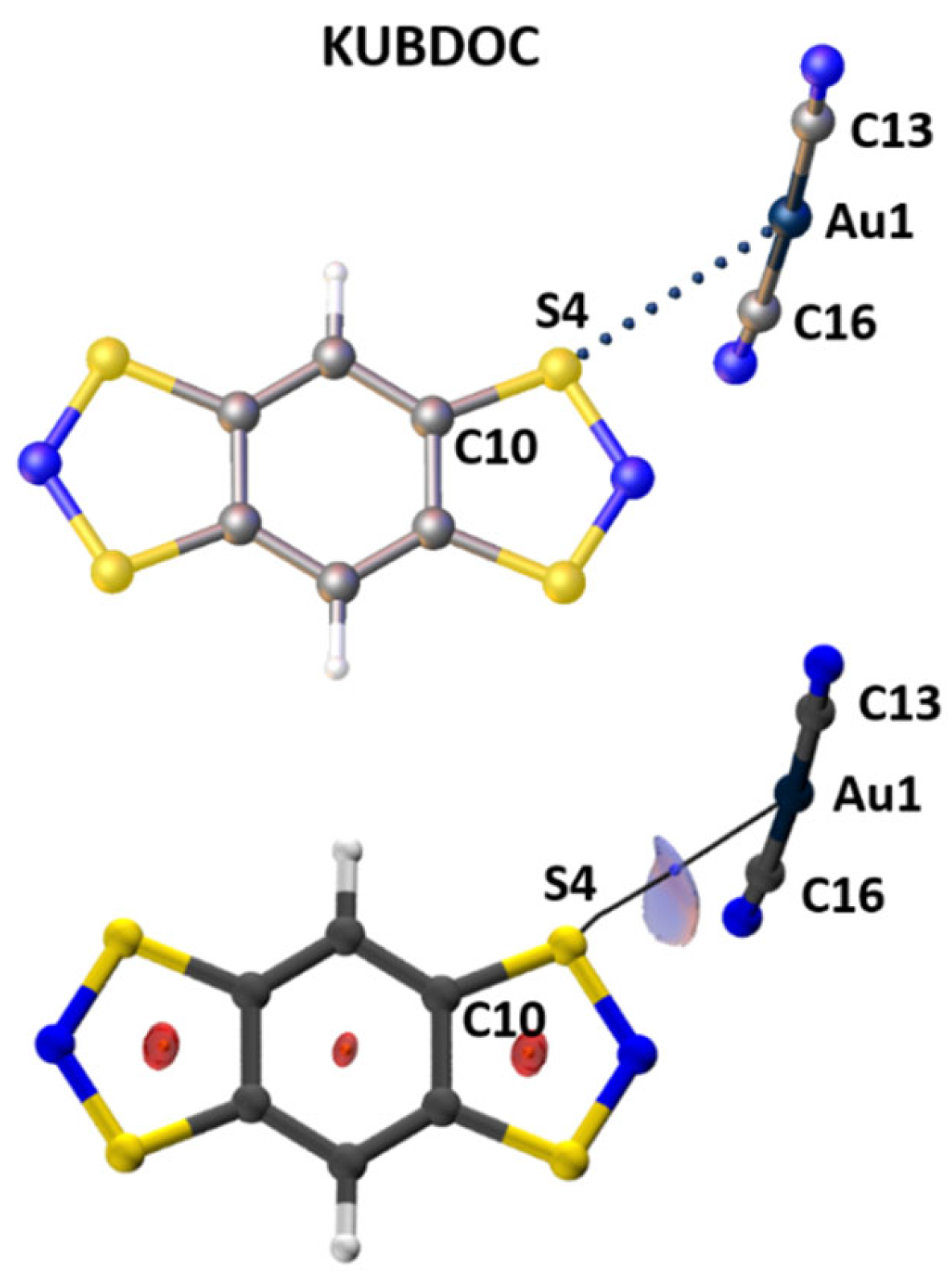
| 5 | KUBDOC [47] | N7–S4⋯N6≡C13 | 2.975(5) | 0.89 | 159.06(19) | 118.8(3) |
| C10–S4⋯Au1–C16/C13 | 3.4459(16) | 0.99 | 167.24(15) | 105.69(14)/72.19(14) | ||
| 6 | SUHDAB [89] | C6–S6⋯N2≡C13 | 3.258(11) | 0.97 | 172.0(3) | 125.0(8) |
| 7 | SUHDEF [89] | C18–S12⋯N3≡C25 | 3.22(2) | 0.96 | 170.7(7) | 127.7(16) |
| 8 | SUHDIJ [89] | C6–S6⋯N4≡C26 | 3.268(17) | 0.98 | 169.9(4) | 125.8(11) |
| 9 | TAYXOH [90] | C(1)–S(1)⋯N(1)≡C(13) | 3.184(9) | 0.95 | 166.8(3) | 155.5(8) |
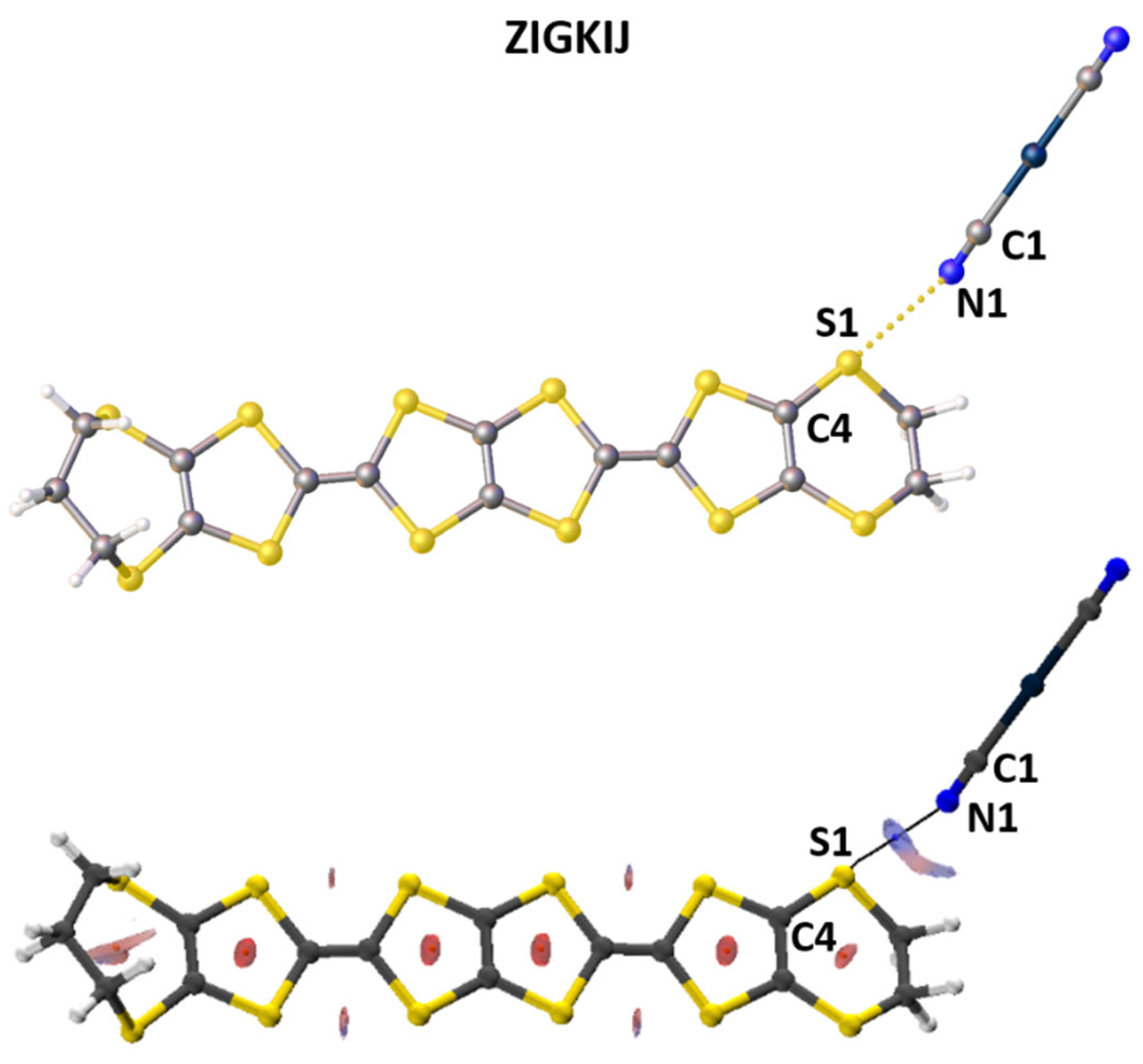
| 10 | ZIGKIJ [91] | C4–S1⋯N1≡C1 | 3.04(4) | 0.91 | 174.3(13) | 133(6) |
| C3–C2⋯N1≡C1 | 3.17(6) | 0.95 | 155(3) | 142(4) | ||
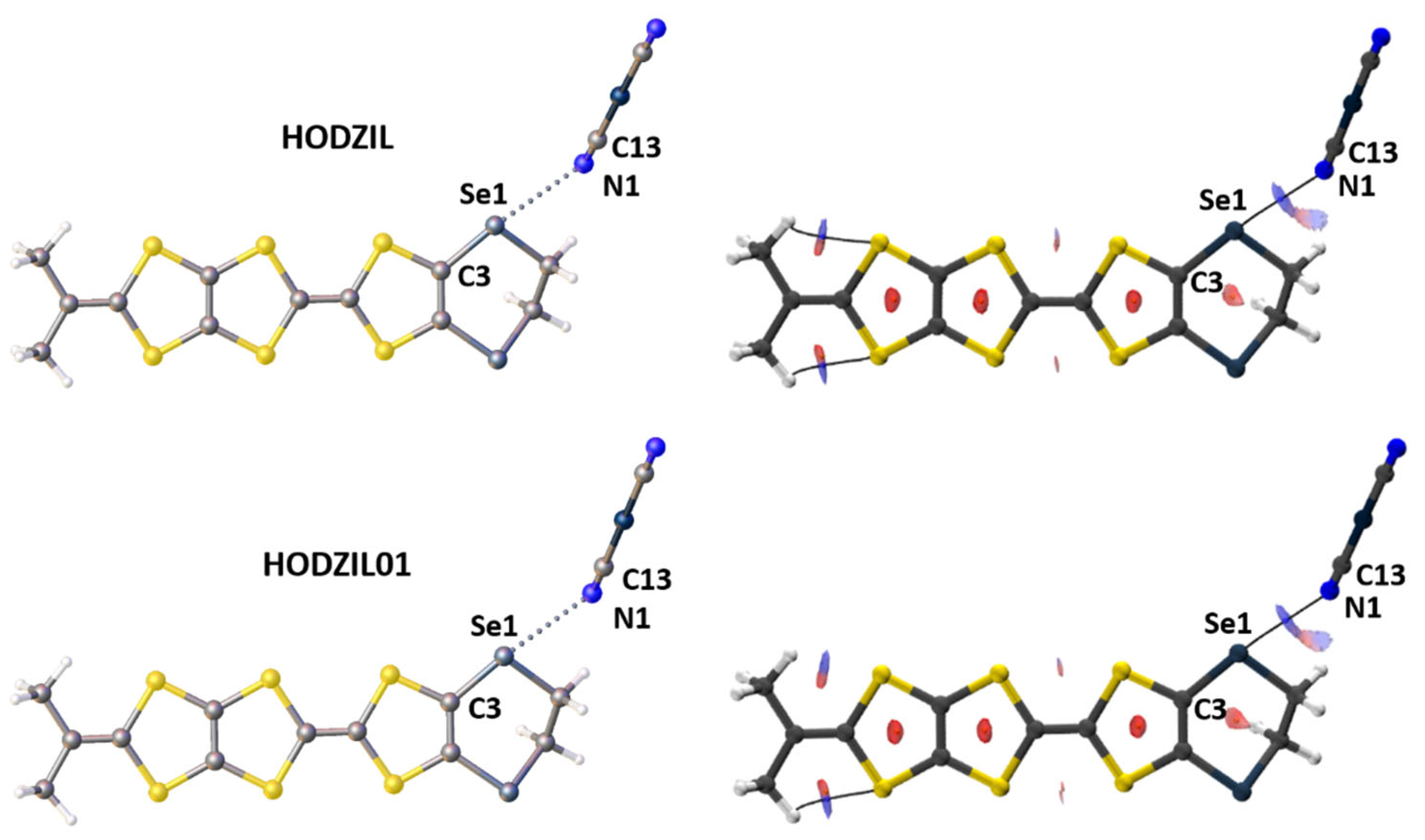
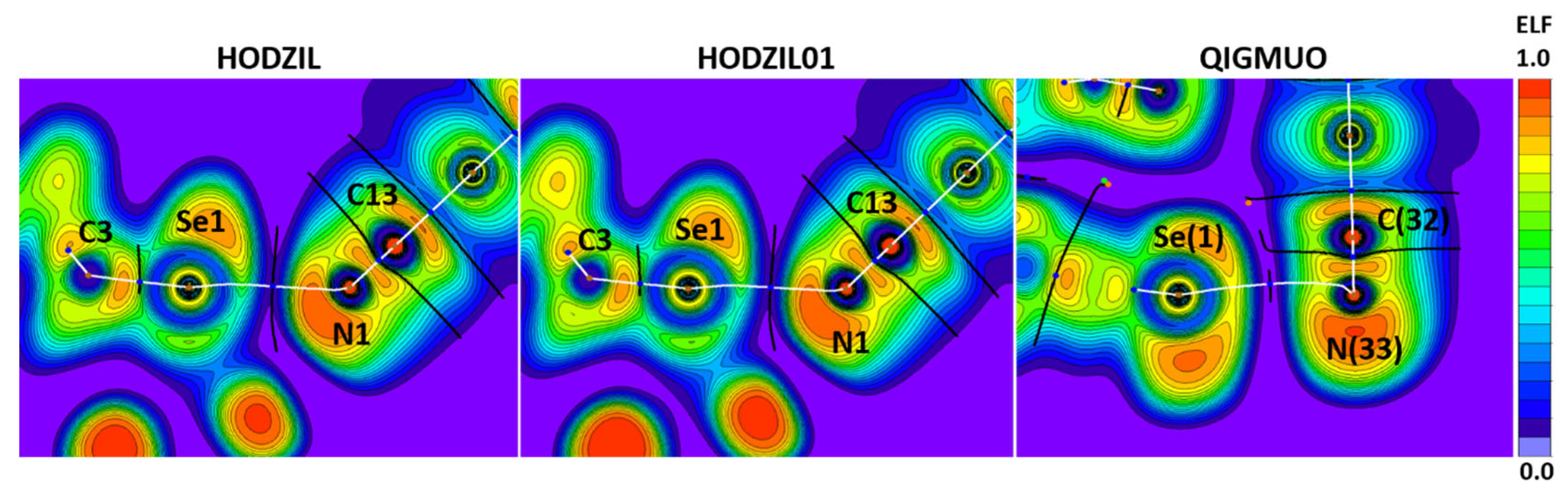
| 11 | HODZIL [48] | C3–Se1⋯N1≡C13 | 2.995(7) | 0.87 | 168.88(16) | 137.0(4) |
| C2–C1⋯N1≡C13 | 3.214(8) | 0.99 | 172.8(3) | 154.9(4) | ||
| 12 | HODZIL01 [48] | C3–Se1⋯N1≡C13 | 2.959(4) | 0.86 | 169.33(13) | 136.0(3) |
| C2–C1⋯N1≡C13 | 3.177(5) | 0.98 | 171.2(2) | 155.6(3) | ||
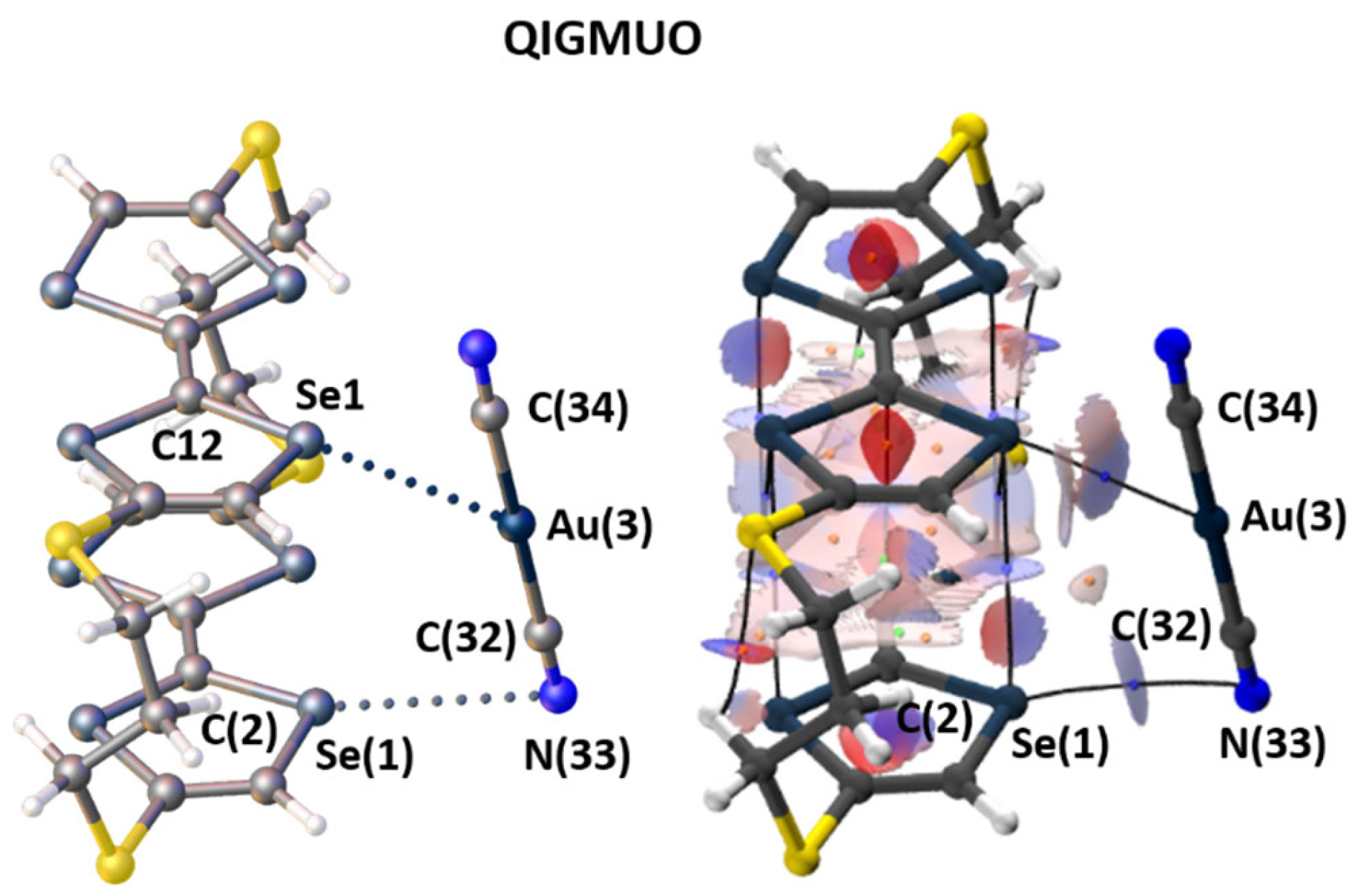
| 13 | QIGMUO [92] | C(2)–Se(1)⋯N(33)≡C(32) | 3.42(3) | 0.99 | 159.4(9) | 89(2) |
| C12–Se1⋯Au(3)–C(32)/C(34) | 3.450(3) | 0.97 | 178.9(6) | 80.9(7)/99.0(7) | ||
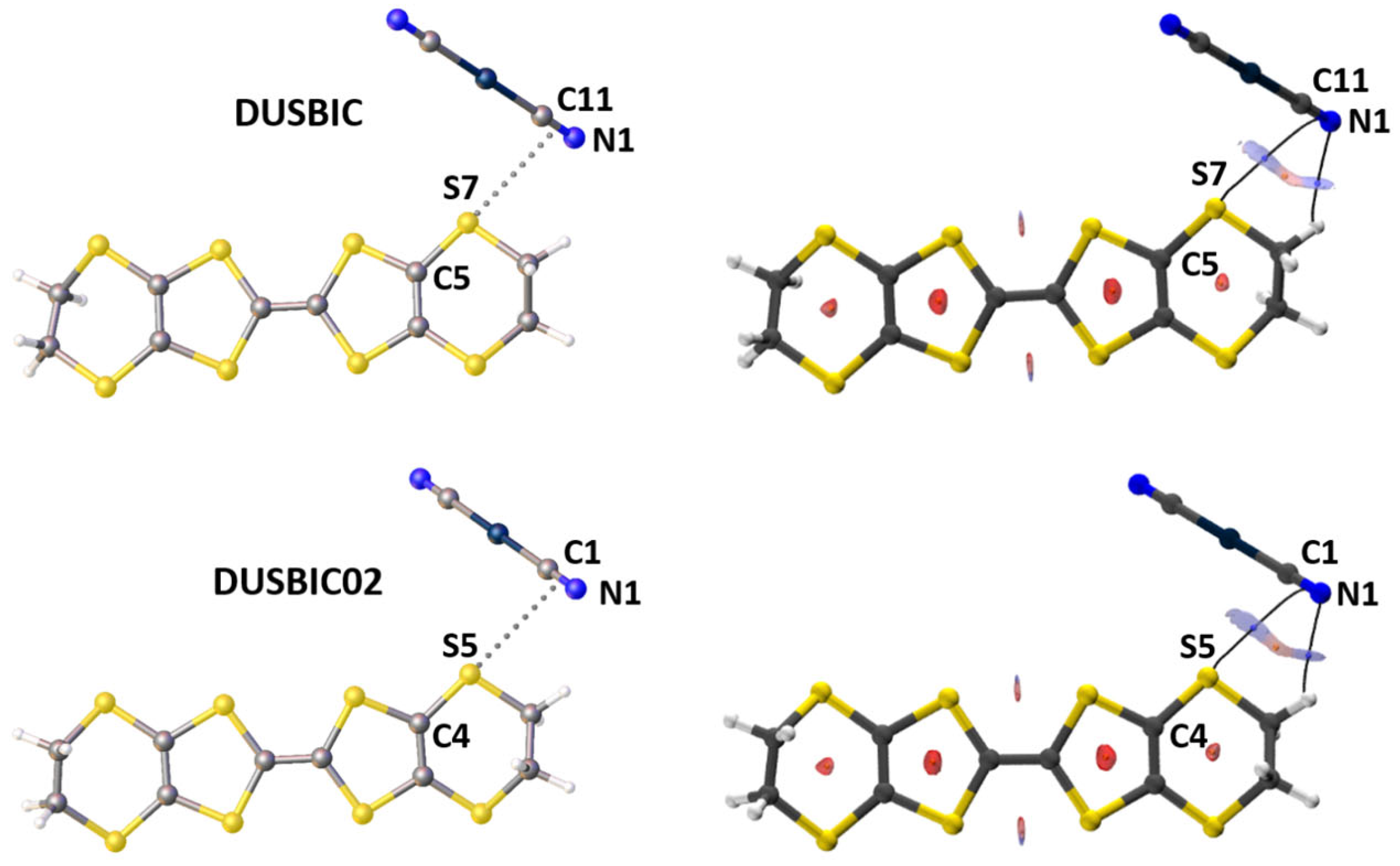
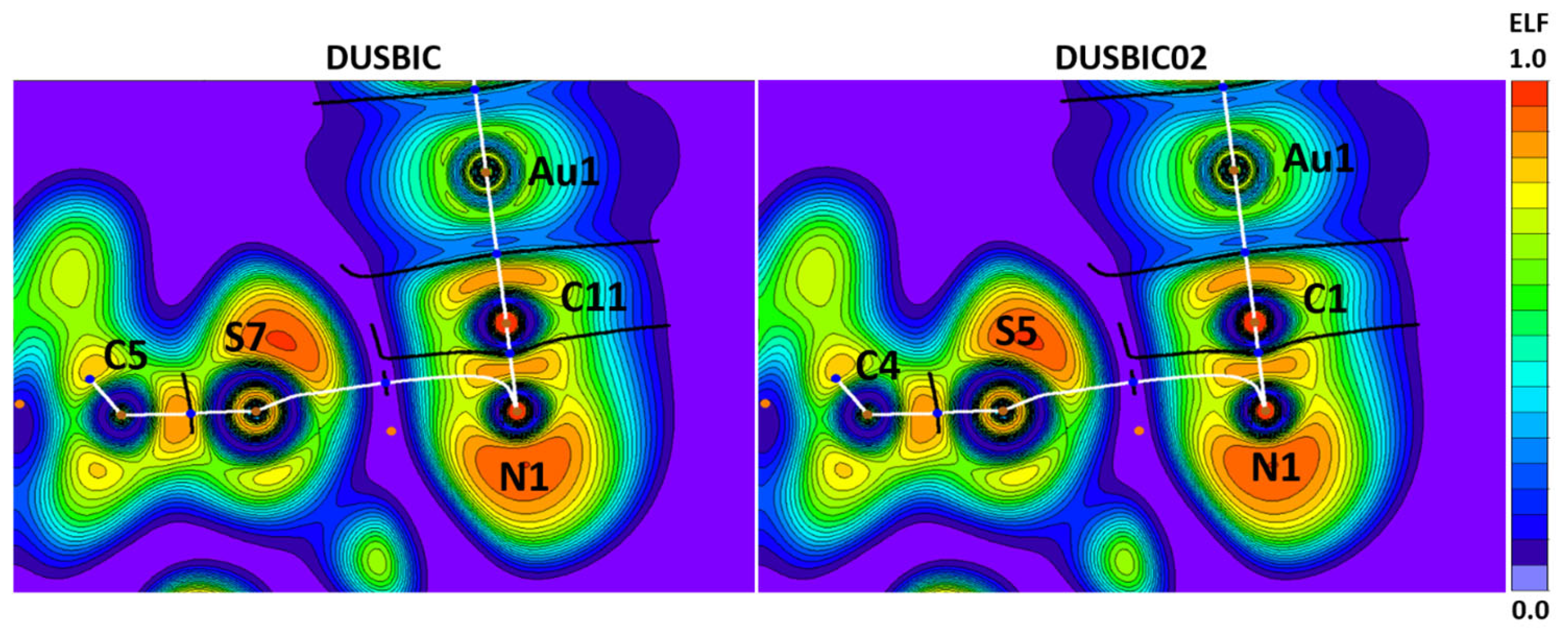
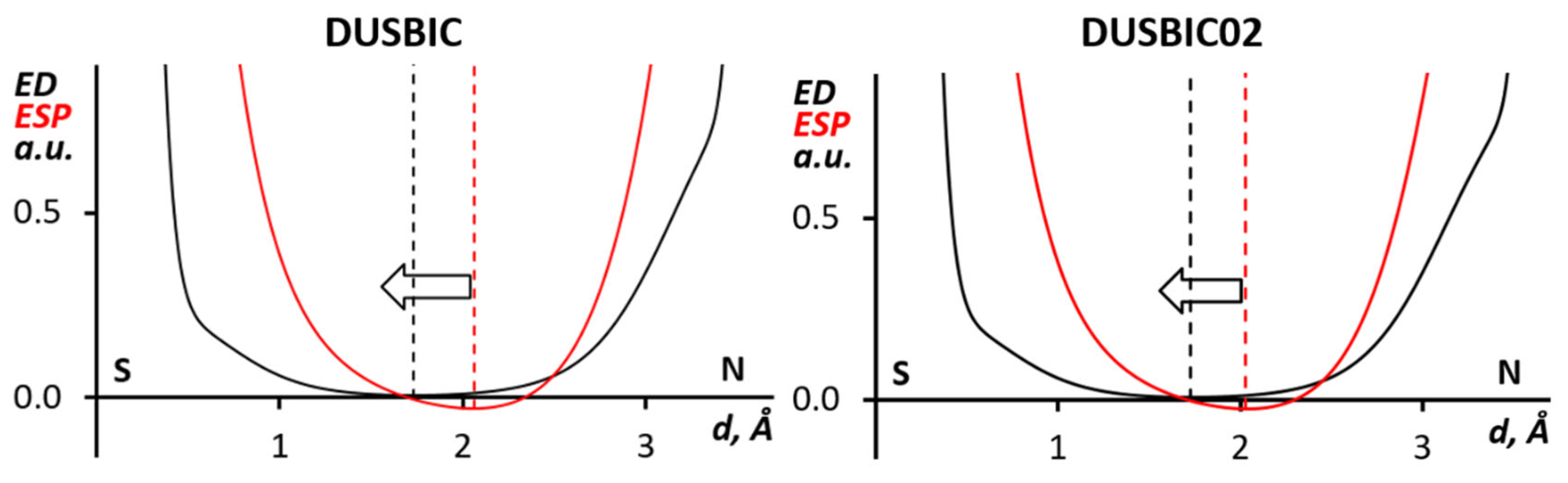
| 14 | DUSBIC [93] | C5–S7⋯π-C11≡N1/Au1 | 3.4378(9) | 0.98 | 161.327(11) | 77.70(4)/101.77(4) |
| 15 | DUSBIC02 [94] | C4–S5⋯π-C1≡N1/Au1 | 3.417(11) | 0.98 | 161.7(4) | 79.0(8)/101.4(4) |
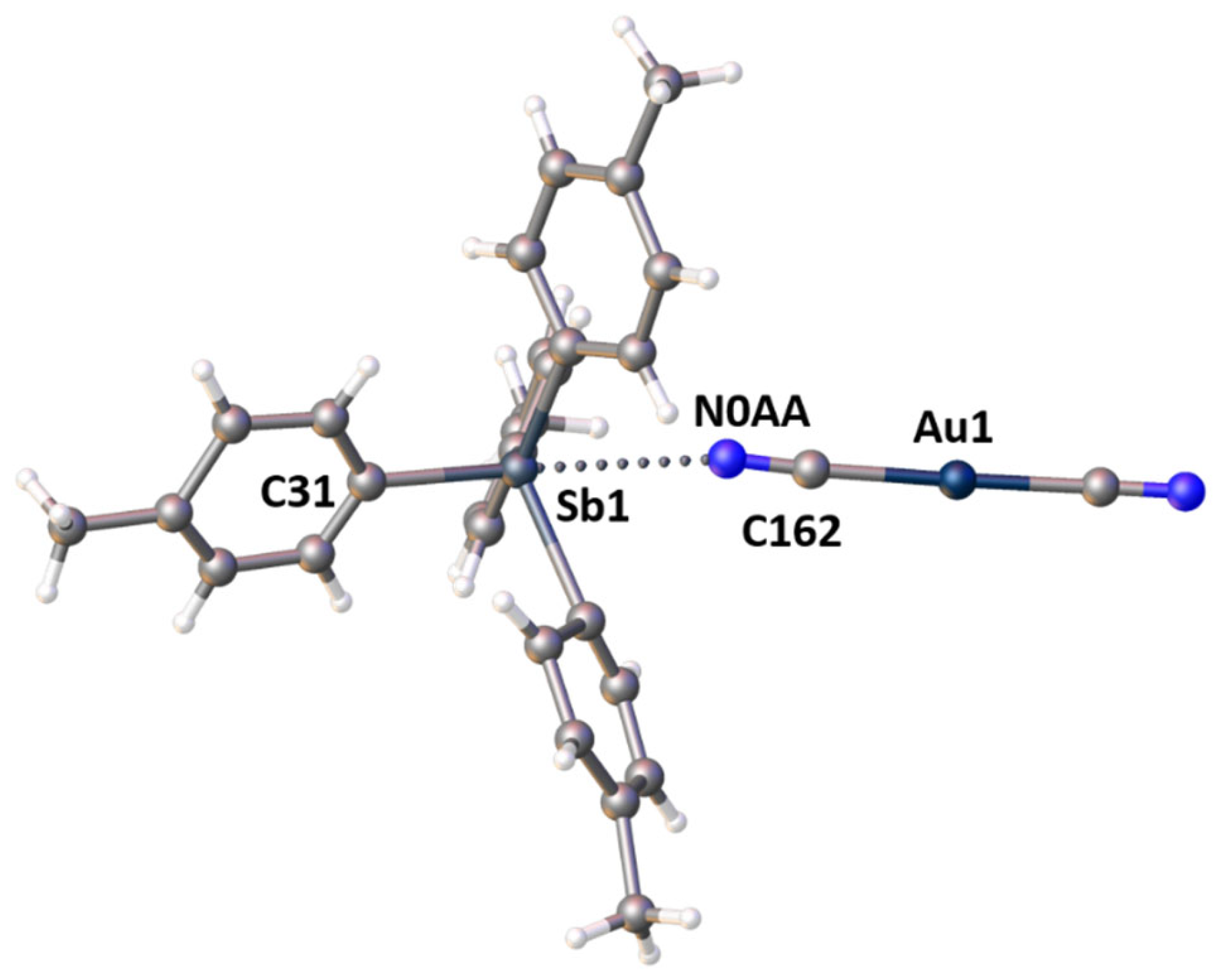
| 16 | CUCNIA [95] | C61–Sb2⋯N4≡C164 | 2.88(4) | 0.8 | 175.6(11) | 169(4) |
| C61–Sb3⋯N6≡C166 | 2.86(4) | 0.79 | 175.3(12) | 173(3) | ||
| C131–Sb4⋯N7≡C167 | 2.98(9) | 0.83 | 174.7(12) | 173(3) | ||
| C31–Sb1⋯N0AA≡C162 | 2.91(4) | 0.81 | 175.9(11) | 168(3) | ||
| 17 | CECLAB [33] | C13–C16⋯N1≡C1 | 3.238(10) | 0.99 | 169.9(4) | 109.8(5) |
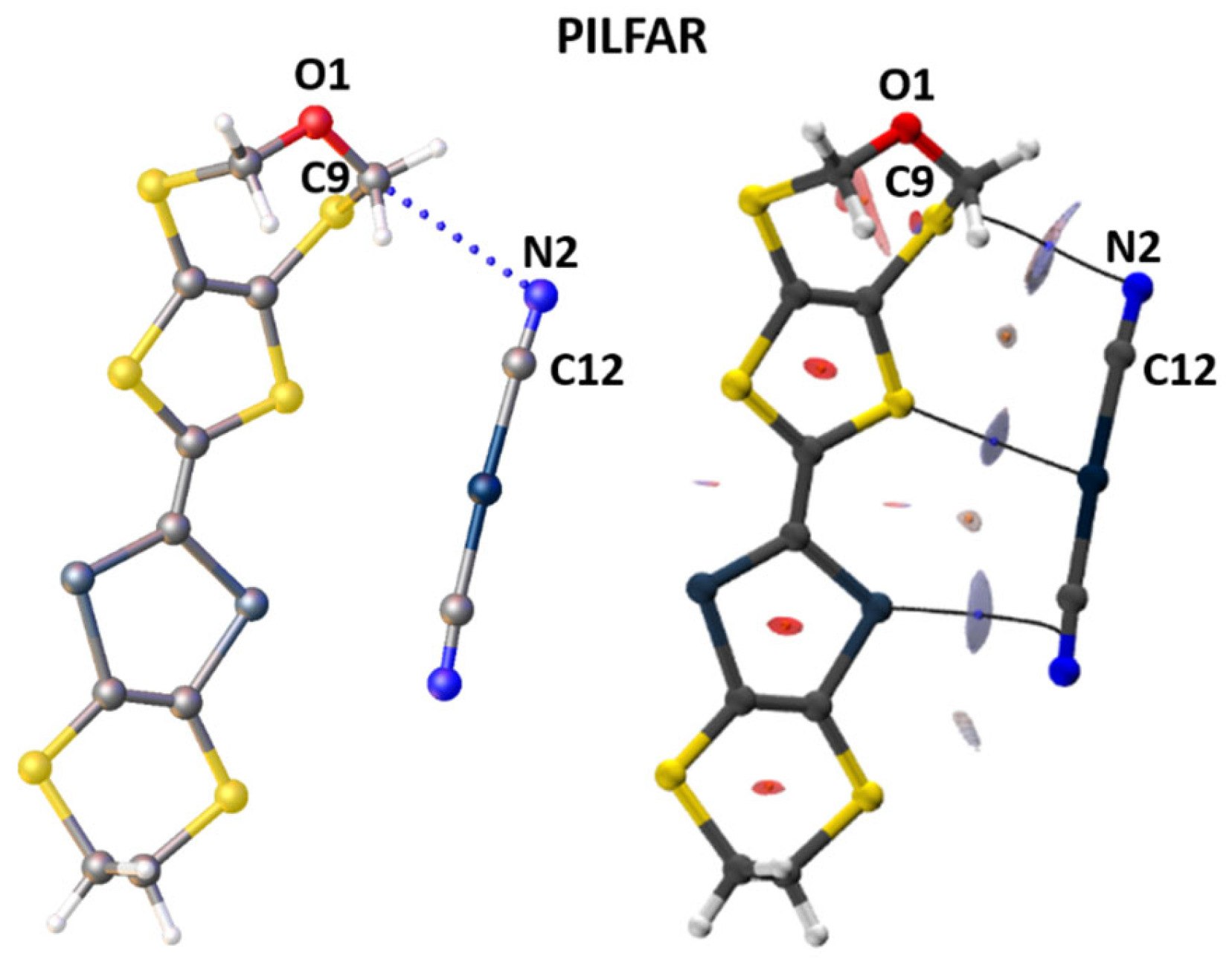
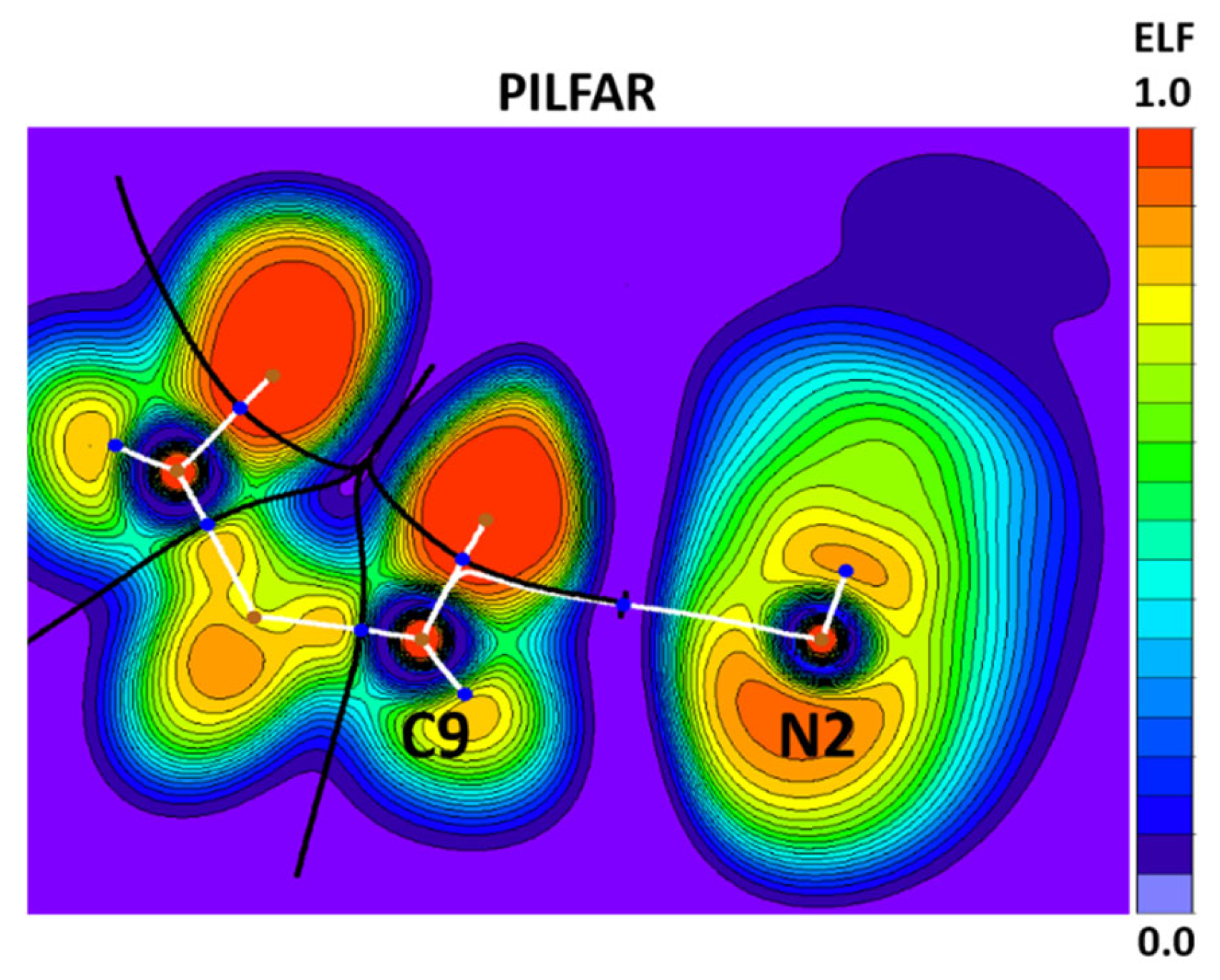
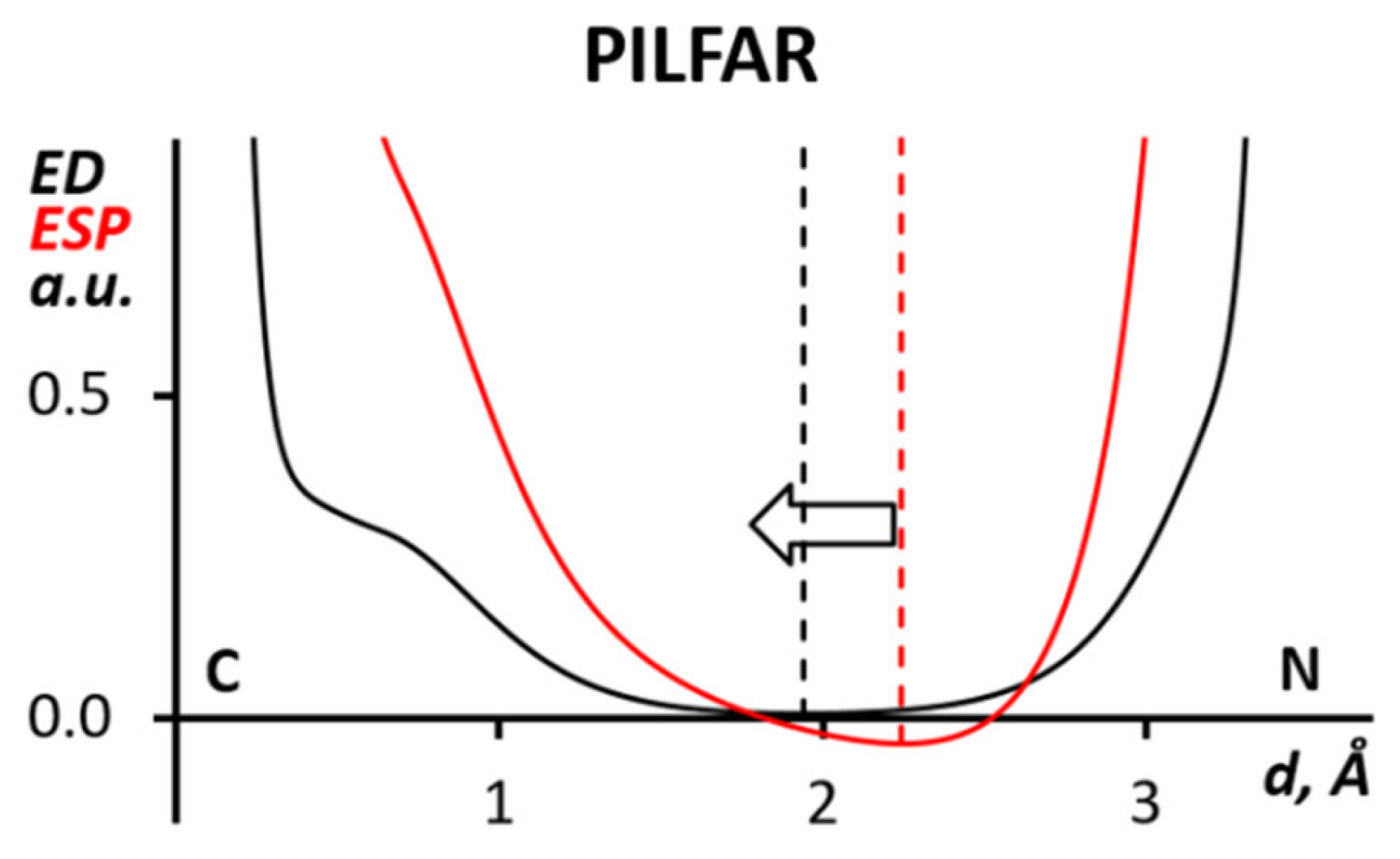
| 18 | PILFAR [96] | O1–C9⋯N2≡C12 | 3.19(6) | 0.98 | 160(2) | 106(3) |
| 19 | WEJZOA [97] | O1–C14⋯N1≡C1 | 3.22(3) | 0.99 | 159.7(12) | 117.5(15) |
| Structure | Bond | Sign(λ2)ρ(r) | ∇2ρ(r) | G(r) | V(r) | Hb |
|---|---|---|---|---|---|---|
| XEDDIW | C1–I1⋯N22 | −0.0256 | 0.0663 | 0.0174 | −0.0182 | −0.0008 |
| C7–I2⋯N24 | −0.0206 | 0.0555 | 0.0137 | −0.0135 | 0.0002 | |
| BAQBIE | C13–S11⋯N1 | −0.0084 | 0.0277 | 0.0056 | −0.0043 | 0.0013 |
| KUBDOC | N7–S4⋯N6 | −0.0143 | 0.0412 | 0.0090 | −0.0077 | 0.0013 |
| ZIGKIJ | C1–S1⋯N1 | −0.0117 | 0.0384 | 0.0081 | −0.0065 | 0.0016 |
| HODZIL | C3–Se1⋯N1 | −0.0143 | 0.0433 | 0.0096 | −0.0083 | 0.0013 |
| HODZIL01 | C3–Se1⋯N1 | −0.0153 | 0.0461 | 0.0102 | −0.0090 | 0.0012 |
| QIGMUO | C12–Se1⋯N33 | −0.0071 | 0.0228 | 0.0045 | −0.0033 | 0.0012 |
| PILFAR | O1–C9⋯N2≡C12 | −0.0064 | 0.0184 | 0.0036 | −0.0027 | 0.0009 |
| DUSBIC | C4–S5⋯π-C1≡N1 | −0.0069 | 0.0225 | 0.0044 | −0.0031 | 0.0013 |
| DUSBIC02 | C5–S7⋯π-C11≡N1 | −0.0069 | 0.0227 | 0.0044 | −0.0032 | 0.0012 |
| XULBIP | C3–Cl2⋯Au1 | −0.0096 | 0.0306 | 0.0063 | −0.0049 | 0.0014 |
| KUBDOC | C10–S4⋯Au1 | −0.0106 | 0.0265 | 0.0057 | −0.0048 | 0.0009 |
| QIGMUO | C7–Se1⋯Au3 | −0.0114 | 0.0271 | 0.0060 | −0.0052 | 0.0008 |
| Cluster | Charge Transfer | ENBO, kcal/mol |
|---|---|---|
| XULBIP | LP(Au1) → σ*(Cl2–C3) | 1.21 |
| KUBDOC | LP(Au1) → σ*(S4–C10) | 1.00 |
| QIGMUO | LP(Au3) → σ*(Se1–C12) | 2.55 |
| Structure | Bond | σ-Hole Donor | EBSSE, kcal/mol |
|---|---|---|---|
| XEDDIW | C1–I1⋯N22 | neutral | −14.15 |
| C7–I2⋯N24 | neutral | −15.84 | |
| XULBIP | C3–Cl2⋯Au1 | neutral | −1.48 |
| BAQBIE | C13–S11⋯N1 | cationic | −43.23 |
| KUBDOC | N7–S4⋯N6 | cationic | −69.31 |
| ZIGKIJ | C1–S1⋯N1 | cationic | −49.84 |
| HODZIL | C3–Se1⋯N1 | cationic | −53.62 |
| HODZIL01 | C3–Se1⋯N1 | cationic | −53.75 |
| QIGMUO | C12–Se1⋯N33 | cationic | −62.99 |
| C7–Se1⋯Au3 | cationic | ||
| PILFAR | O1–C9⋯N2≡C12 | cationic | −68.26 |
| DUSBIC | C4–S5⋯π-C1≡N1 | cationic | −54.67 |
| DUSBIC02 | C5–S7⋯π-C11≡N1 | cationic | −54.63 |
| KUBDOC | C10–S4⋯Au1 | cationic | −59.45 |
Disclaimer/Publisher’s Note: The statements, opinions and data contained in all publications are solely those of the individual author(s) and contributor(s) and not of MDPI and/or the editor(s). MDPI and/or the editor(s) disclaim responsibility for any injury to people or property resulting from any ideas, methods, instructions or products referred to in the content. |
© 2026 by the authors. Licensee MDPI, Basel, Switzerland. This article is an open access article distributed under the terms and conditions of the Creative Commons Attribution (CC BY) license.
Share and Cite
Aliyarova, I.S.; Ivanov, D.M.; Tupikina, E.Y. Isolated Dicyanoaurate(I) as a Polycentered σ-Hole Interaction Acceptor: A Combined Crystallographic and Theoretical Survey. Chemistry 2026, 8, 91. https://doi.org/10.3390/chemistry8070091
Aliyarova IS, Ivanov DM, Tupikina EY. Isolated Dicyanoaurate(I) as a Polycentered σ-Hole Interaction Acceptor: A Combined Crystallographic and Theoretical Survey. Chemistry. 2026; 8(7):91. https://doi.org/10.3390/chemistry8070091
Chicago/Turabian StyleAliyarova, Irina S., Daniil M. Ivanov, and Elena Yu. Tupikina. 2026. "Isolated Dicyanoaurate(I) as a Polycentered σ-Hole Interaction Acceptor: A Combined Crystallographic and Theoretical Survey" Chemistry 8, no. 7: 91. https://doi.org/10.3390/chemistry8070091
APA StyleAliyarova, I. S., Ivanov, D. M., & Tupikina, E. Y. (2026). Isolated Dicyanoaurate(I) as a Polycentered σ-Hole Interaction Acceptor: A Combined Crystallographic and Theoretical Survey. Chemistry, 8(7), 91. https://doi.org/10.3390/chemistry8070091