Article

7-Aminopyrazolo[1,5-d][1,2,4]triazin-4(5H)-ones: Synthesis and Growth-Regulating Activity in Chlorella vulgaris


by
Ekaterina E. Khramtsova
1,*,
Anastasia D. Novokshonova
1,2,
Maksim V. Dmitriev
1 and
Pavel V. Khramtsov
1,3
1
Department of Chemistry, Perm State University, ul. Bukireva, 15, 614990 Perm, Russia
2
Institute of Ecology and Genetics of Microorganisms, Perm Federal Research Center, The Ural Branch of Russian Academy of Sciences, ul. Goleva, 13, 614081 Perm, Russia
3
Department of Biology, Perm State University, ul. Bukireva, 15, 614990 Perm, Russia
*
Author to whom correspondence should be addressed.
Chemistry 2026, 8(7), 90; https://doi.org/10.3390/chemistry8070090
Submission received: 2 June 2026 / Revised: 23 June 2026 / Accepted: 25 June 2026 / Published: 1 July 2026
(This article belongs to the Section Molecular Organics)

Abstract

A series of 7-aminopyrazolo[1,5-d][1,2,4]triazin-4(5H)-ones was synthesized via a cascade condensation of methyl aroylpyruvates with 1,3-diaminoguanidine hydrochloride. The scope and limitations of this approach were investigated. Methyl mesitoylpyruvate bearing a sterically hindered mesityl substituent diverted the reaction pathway, affording a 1,2,4-triazine derivative. Diethyl 2,4,6-trioxoheptanedioate resulted in an unexpected pyrazolo[1,5-d][1,2,4]triazepine scaffold. All synthesized compounds were evaluated for growth-regulating activity using the green microalga Chlorella vulgaris as a model organism. 7-Amino-2-(4-methoxyphenyl)pyrazolo[1,5-d][1,2,4]triazin-4(5H)-one has shown the best results in the initial microplate screening, showing increased cell density at 10 μmol/L. However, subsequent validation in 50 mL flask cultures revealed no significant effect on biomass accumulation, photosynthetic pigment content, carbohydrate levels, or neutral lipid production compared to the negative control. Only a modest increase in protein content was observed at the concentration of 100 μmol/L.

1. Introduction

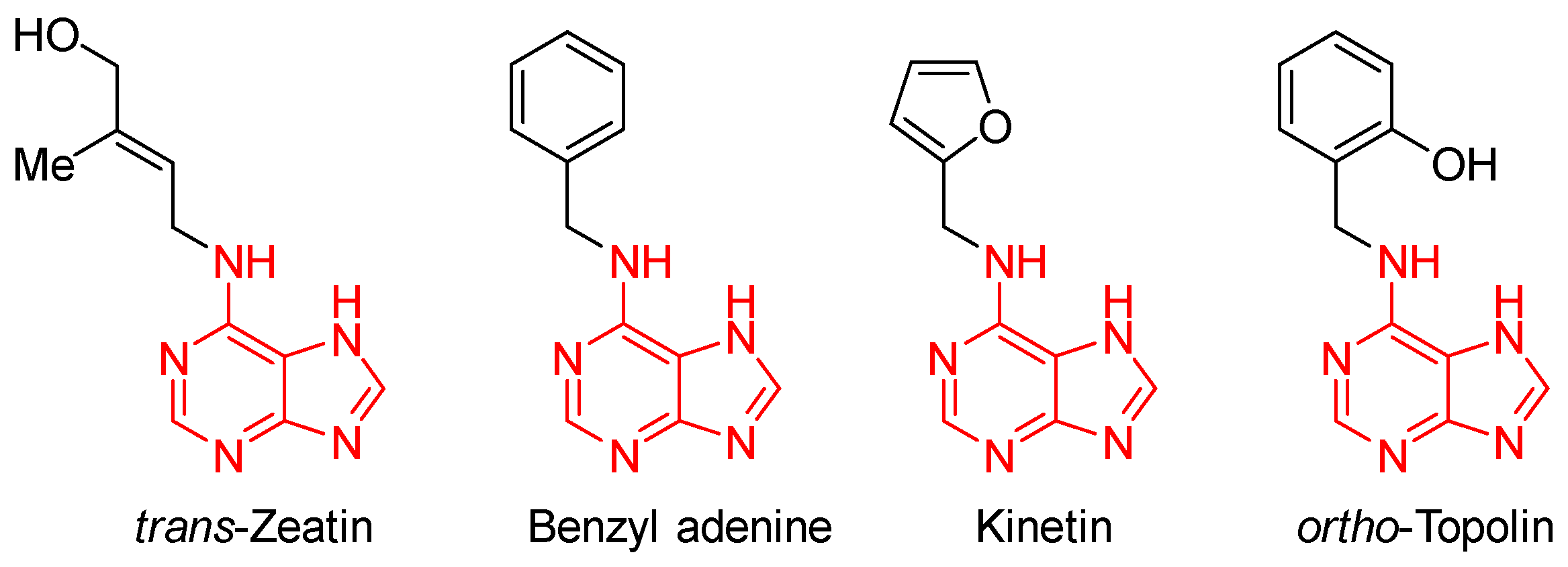
The search for new plant growth regulators remains a central challenge in agrochemistry [1]. Among natural plant growth regulators, cytokinins—a class of purine-derived phytohormones—are paramount in governing crucial physiological processes such as cell division, shoot growth and signal exchange between different parts and organs of plants [2]. The structural core of cytokinins is the adenine (6-aminopurine) scaffold (Figure 1) [2,3].
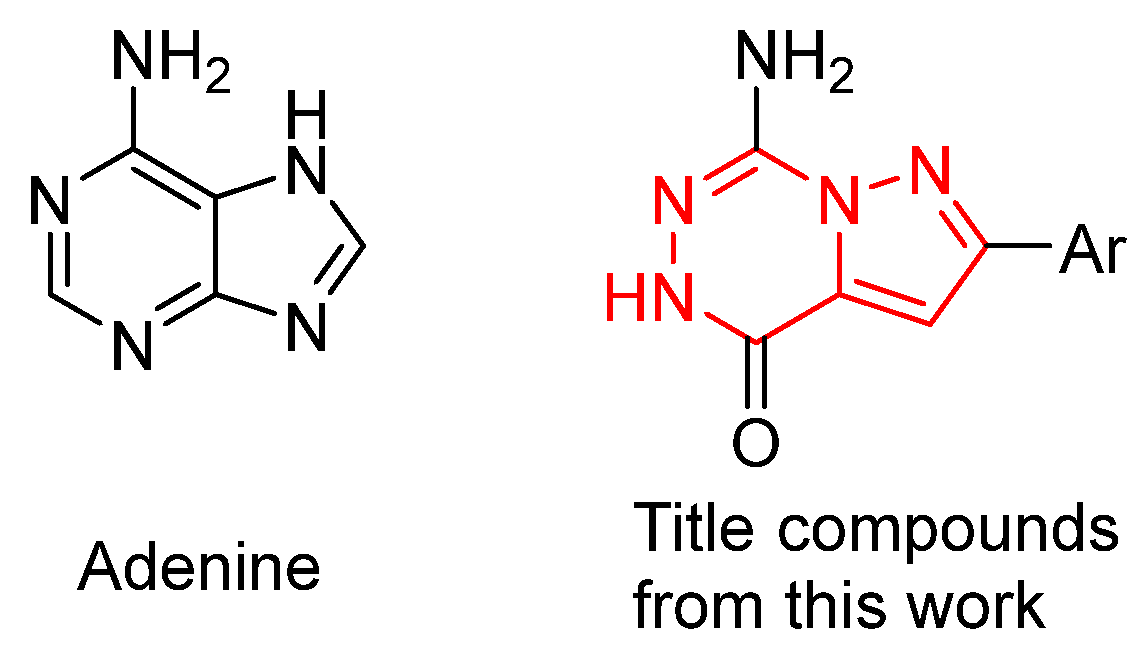
In recent decades, the strategy of bioisosteric replacement has proven highly fruitful in agrochemical discovery [4,5,6]. Within this context, 7-aminopyrazolo[1,5-d][1,2,4]triazines are prominent adenine mimetics (Figure 2). Thus, compounds based on this structure can be expected to show cytokinin-like activity.
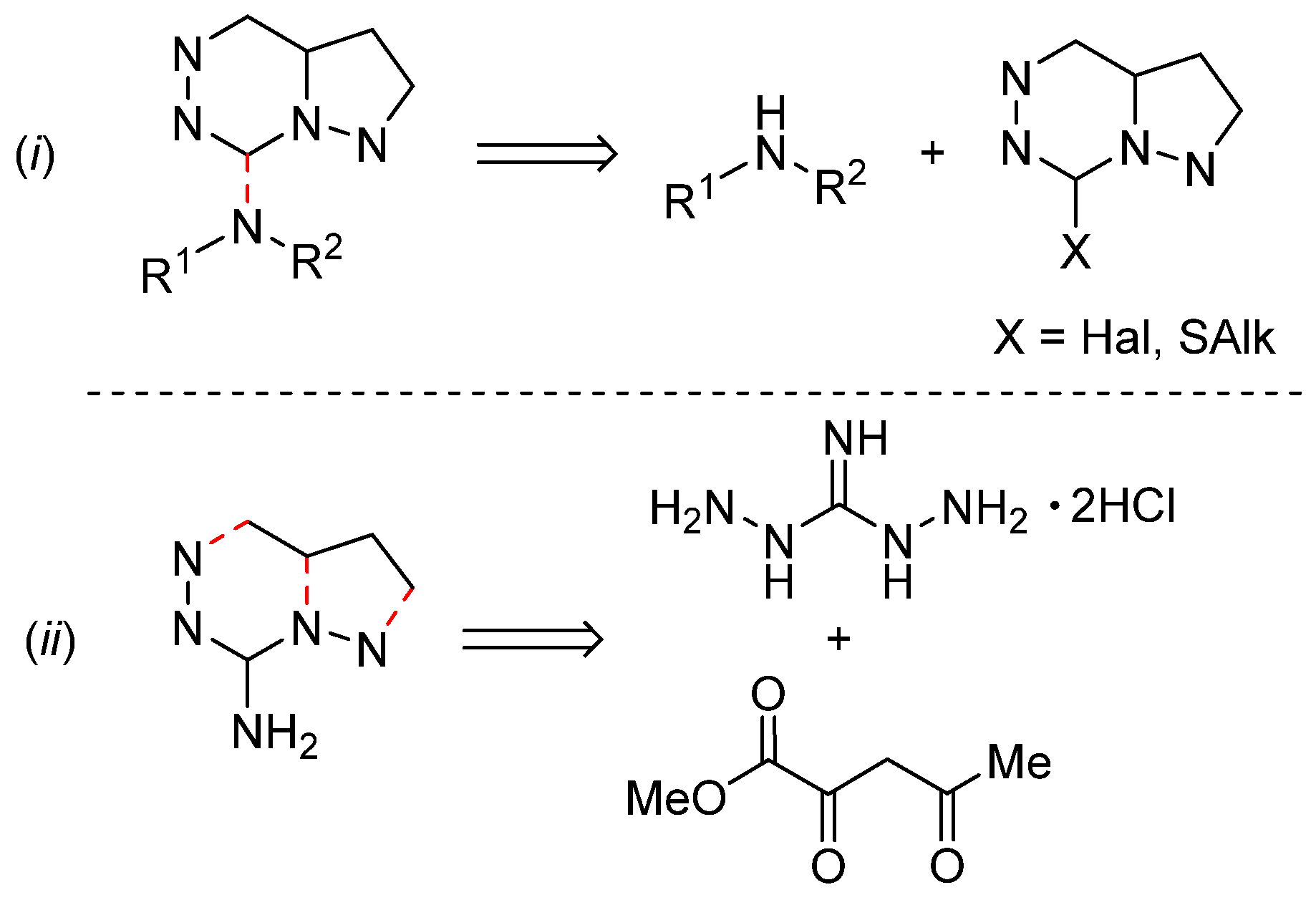
Current synthetic strategies for 7-aminopyrazolo[1,5-d][1,2,4]triazines can be divided into two principal approaches (for the mini-review on the approaches to the pyrazolo[1,5-d][1,2,4]triazine core, see publication [7]). The first one involves nucleophilic substitution reactions, utilizing either a halogen [8,9,10,11,12,13] or an alkylthio group [14,15,16] as a leaving group (Equation (i), Scheme 1). The second approach is based on a condensation reaction of acetylpyruvate with 1,3-diaminoguanidine dihydrochloride [17] (Equation (ii), Scheme 1).
The nucleophilic substitution approaches (Equation (i), Scheme 1) require prefunctionalized heterocyclic cores, the synthesis of which often involves multiple steps and harsh conditions, limiting the overall atom economy and sustainability of the process. The cascade condensation reported in [17] (Equation (ii), Scheme 1) is highly attractive from the perspective of step-economy, and assembles the target heterocycle from simple acyclic precursors. Yet, despite its potential, this cascade condensation remains virtually unexplored. To the best of our knowledge, the scope of this reaction has been limited to a single example with methyl acetylpyruvate [17], and the potential of using various acylpyruvates in this cascade has not been systematically investigated. This represents a significant missed opportunity for the rapid and diverse synthesis of 7-aminopyrazolo[1,5-d][1,2,4]triazines.
The development of a versatile and efficient synthetic protocol based on this cascade condensation [17] (Equation (ii), Scheme 1) would provide a valuable library of novel compounds for biological screening. Given the structural similarity of the target 7-aminopyrazolo[1,5-d][1,2,4]triazine scaffold to adenine, such a library holds considerable promise for the discovery of new compounds with cytokinin-like activity. The green microalga Chlorella vulgaris serves as an excellent model organism for evaluating such activity, as its growth parameters are sensitive to phytohormones and their analogues, allowing for a rapid and informative assessment of biological effects [18,19,20,21,22].
The present study reports the development of a synthetic method to 7-amino-2-arylpyrazolo[1,5-d][1,2,4]triazin-4(5H)-ones via the cascade condensation of various aroylpyruvates with 1,3-diaminoguanidine hydrochloride. The synthesized compounds were evaluated for the growth-regulating activity on the microalga C. vulgaris, focusing on key physiological parameters such as biomass accumulation, chlorophyll and carotenoid content, and lipid production, to identify potential new leads with cytokinin-like properties.

2. Materials and Methods

2.1. Synthetic Methods and Analytic Data of Compounds

2.1.1. General Information

1H and 13C NMR spectra (Supplementary Materials) were acquired on a Bruker Avance III 400 HD spectrometer (Bruker BioSpin AG, Faellanden, Switzerland) (at 400 and 100 MHz, respectively) in DMSO-d6, using solvent residual signals (in 13C NMR, 39.51 ppm; in 1H NMR, 2.50 ppm) as internal standards. IR spectra were recorded on a Perkin–Elmer Spectrum Two spectrometer (PerkinElmer Inc., Waltham, MA, USA) from mulls in mineral oil. Melting points were measured on a Mettler Toledo MP70 apparatus (Mettler-Toledo (MTADA), Schwerzenbach, Switzerland). Elemental analyses were carried out on a Vario MICRO Cube analyzer (Elementar Analysensysteme GmbH, Langenselbold, Germany). The unit cell parameters and the X-ray diffraction intensities were measured on an Xcalibur Ruby diffractometer (Agilent Technologies, Wroclaw, Poland). The empirical absorption correction was introduced by multi-scan method using SCALE3 ABSPACK algorithm [23]. Using the Olex2 [24], the structures were solved with the SHELXT [25] program and refined by the full-matrix least-squares method in the anisotropic approximation for all non-hydrogen atoms with the SHELXL program [26]. Hydrogen atoms bound to carbon were positioned geometrically and refined using a riding model. Hydrogen atoms of NH, NH2, and OH groups were refined independently with isotropic displacement parameters.
Methyl aroylpyruvates 1a–i were prepared by the Claisen condensation of diethyl oxalate with acetophenones in the presence of MeONa [27,28,29,30]. Diethyl 2,4,6-trioxoheptanedioate (1j) was prepared by the Claisen condensation of two equivalents of diethyl oxalate with acetone in the presence of EtONa [30,31]. All other solvents and reagents were purchased from commercial vendors and were used as received.

2.1.2. Synthesis of Compounds 2a–h

General procedure to compounds 2a–h. A suspension of the corresponding methyl aroylpyruvate 1a–h (0.48 mmol) and 1,3-diaminoguanidine hydrochloride (0.48 mmol, 60 mg) in EtOH (5 mL) was stirred at 90 °C for 24 h. Then, the mixture was cooled to ambient temperature. The resulting precipitate was filtered off and recrystallized from EtOH (3–10 mL) to afford the corresponding compound 2a–h.
7-Amino-2-phenylpyrazolo[1,5-d][1,2,4]triazin-4(5H)-one (2a). Yield: 30% (33 mg); pale yellow solid; mp 320 °C (decomp., EtOH). 1H NMR (400 MHz, DMSO-d6): δ = 11.48 (s, 1H, NH), 8.09–8.06 (m, 2HAr), 7.62 (s, 1H, C3H), 7.52–7.48 (m, 2HAr), 7.46–7.41 (m, 1HAr), 6.66 (s, 2H, NH2) ppm. 13C NMR (100 MHz, DMSO-d6): δ = 153.3 (C4), 153.0 (C2), 139.5 (C7), 135.6 (C3a), 131.2 (CAr), 129.3 (CAr), 129.0 (2CAr), 126.3 (2CAr), 103.0 (C3) ppm. IR (mineral oil): 3454, 3268, 3152 (N–H), 1656 (C=O) cm−1. Anal. Calcd (%) for C11H9N5O: C 58.14; H 3.99; N 30.82. Found: C 58.35; H 3.82; N 30.59. Crystal structure of compound 2a was deposited at the Cambridge Crystallographic Data Centre with the deposition number CCDC 2554056.
7-Amino-2-(4-methylphenyl)pyrazolo[1,5-d][1,2,4]triazin-4(5H)-one (2b). Yield: 35% (41 mg); pale yellow solid; mp 318 °C (decomp., EtOH). 1H NMR (400 MHz, DMSO-d6): δ = 11.46 (s, 1H, NH), 7.96–7.94 (m, 2HAr), 7.56 (s, 1H, C3H), 7.31–7.29 (m, 2HAr), 6.63 (s, 2H, NH2), 2.36 (s, 3H, Me) ppm. 13C NMR (100 MHz, DMSO-d6): δ = 153.4 (C4), 152.9 (C2), 139.4 (C7), 138.8 (CAr), 135.5 (C3a), 129.3 (2CAr), 128.3 (CAr), 126.2 (2CAr), 102.6 (C3), 20.8 (Me) ppm. IR (mineral oil): 3445, 3262, 3168 (N–H), 1651 (C=O) cm−1. Anal. Calcd (%) for C12H11N5O: C 59.74; H 3.60; N 29.03. Found: C 59.51; H 3.62; N 28.88.
7-Amino-2-(4-methoxyphenyl)pyrazolo[1,5-d][1,2,4]triazin-4(5H)-one (2c). Yield: 39% (48 mg); pale yellow solid; mp 264 °C (decomp., EtOH). 1H NMR (400 MHz, DMSO-d6): δ = 11.45 (s, 1H, NH), 8.02–7.99 (m, 2HAr), 7.53 (s, 1H, C3H), 7.07–7.04 (m, 2HAr), 6.62 (s, 2H, NH2), 3.82 (s, 3H, Me) ppm. 13C NMR (100 MHz, DMSO-d6): δ = 160.1 (CAr), 153.3 (C4), 152.9 (C2), 139.4 (C7), 135.4 (C3a), 127.7 (2CAr), 123.6 (CAr), 114.2 (2CAr), 102.3 (C3), 55.2 (Me) ppm. IR (mineral oil): 3443, 3265, 3168 (N–H), 1633 (C=O) cm−1. Anal. Calcd (%) for C12H11N5O2: C 56.03; H 4.31; N 27.22. Found: C 56.27; H 4.12; N 26.98.
7-Amino-2-(4-chlorophenyl)pyrazolo[1,5-d][1,2,4]triazin-4(5H)-one (2d). Yield: 35% (44 mg); pale yellow solid; mp 331 °C (decomp., EtOH). 1H NMR (400 MHz, DMSO-d6): δ = 11.49 (s, 1H, NH), 8.11–8.09 (m, 2HAr), 7.65 (s, 1H, C3H), 7.58–7.56 (m, 2HAr), 6.68 (s, 2H, NH2) ppm. 13C NMR (100 MHz, DMSO-d6): δ = 152.9 (C4), 152.2 (C2), 139.4 (C7), 135.7 (C3a), 133.9 (CAr), 130.1 (CAr), 129.0 (2CAr), 128.1 (2CAr), 103.2 (C3) ppm. IR (mineral oil): 3427, 3225, 3178 (N–H), 1662 (C=O) cm−1. Anal. Calcd (%) for C11H8ClN5O: C 50.49; H 3.08; N 26.76. Found: C 50.73; H 3.14; N 26.91.
7-Amino-2-(3-methoxyphenyl)pyrazolo[1,5-d][1,2,4]triazin-4(5H)-one (2e). Yield: 31% (38 mg); pale yellow solid; mp 268 °C (decomp., EtOH). 1H NMR (400 MHz, DMSO-d6): δ = 11.47 (s, 1H, NH), 7.68–7.64 (m, 3H, C3H + 2HAr), 7.43–7.39 (m, 1HAr), 7.03–7.00 (m, 1HAr), 6.67 (s, 2H, NH2), 3.85 (s, 3H, Me) ppm. 13C NMR (100 MHz, DMSO-d6): δ = 159.7 (CAr), 153.2 (C4), 153.0 (C2), 139.5 (C7), 135.5 (2C, C3a + CAr), 130.0 (CAr), 118.7 (CAr), 115.1 (CAr), 111.6 (CAr), 103.3 (C3), 55.3 (Me) ppm. IR (mineral oil): 3436, 3380, 3176 (N–H), 1645 (C=O) cm−1. Anal. Calcd (%) for C12H11N5O2: C 56.03; H 4.31; N 27.22. Found: C 56.36; H 3.92; N 27.28.
7-Amino-2-(4-ethoxyphenyl)pyrazolo[1,5-d][1,2,4]triazin-4(5H)-one (2f). Yield: 35% (46 mg); pale yellow solid; mp 258 °C (decomp., EtOH). 1H NMR (400 MHz, DMSO-d6): δ = 11.44 (s, 1H, NH), 7.99–7.97 (m, 2HAr), 7.52 (s, 1H, C3H), 7.04–7.02 (m, 2HAr), 6.61 (s, 2H, NH2), 4.09 (q, J 7.0 Hz, 2H, CH2), 1.35 (t, J 7.0 Hz, 3H, Me) ppm. 13C NMR (100 MHz, DMSO-d6): δ = 159.5 (CAr), 153.3 (C4), 153.0 (C2), 139.5 (C7), 135.5 (C3a), 127.8 (2CAr), 123.5 (CAr), 114.7 (2CAr), 102.4 (C3), 63.5 (CH2), 14.6 (Me) ppm. IR (mineral oil): 3432, 3282, 3157 (N–H), 1630 (C=O) cm−1. Anal. Calcd (%) for C13H13N5O2: C 57.56; H 4.83; N 25.82. Found: C 57.73; H 4.80 N 25.98.
7-Amino-2-(thiophen-2-yl)pyrazolo[1,5-d][1,2,4]triazin-4(5H)-one (2g). Yield: 18% (20 mg); pale yellow solid; mp 315 °C (decomp., EtOH). 1H NMR (400 MHz, DMSO-d6): δ = 11.50 (s, 1H, NH), 7.78–7.77 (m, 1HAr), 7.66–7.65 (m, 1HAr), 7.52 (s, 1H, C3H), 7.20–7.17 (m, 1HAr), 6.57 (s, 2H, NH2) ppm. 13C NMR (100 MHz, DMSO-d6): δ = 152.7 (C4), 149.0 (C2), 139.2 (C7), 135.6 (C3a), 133.7 (CAr), 127.9 (CAr), 127.5 (CAr), 127.4 (CAr), 102.7 (C3) ppm. IR (mineral oil): 3455, 3265, 3155 (N–H), 1645 (C=O) cm−1. Anal. Calcd (%) for C9H7N5OS: C 46.34; H 3.03; N 30.03. Found: C 46.00; H 3.11; N 29.98.
7-Amino-2-(4-cyanophenyl)pyrazolo[1,5-d][1,2,4]triazin-4(5H)-one (2h). Yield: 33% (40 mg); pale yellow solid; mp 320 °C (decomp., EtOH). 1H NMR (400 MHz, DMSO-d6): δ = 11.54 (s, 1H, NH), 8.29–8.26 (m, 2HAr), 7.99–7.97 (m, 2HAr), 7.79 (s, 1H, C3H), 6.74 (s, 2H, NH2) ppm. 13C NMR (100 MHz, DMSO-d6): δ = 152.8 (C4), 151.4 (C2), 139.2 (C7), 135.8 (C3a), 135.5 (CAr), 132.8 (2CAr), 126.9 (2CAr), 118.5 (CN), 111.5 (CAr), 103.9 (C3) ppm. IR (mineral oil): 3439, 3245, 3120 (N–H), 2241 (C≡N), 1675 (C=O) cm−1. Anal. Calcd (%) for C12H8N6O: C 57.14; H 3.20; N 33.32. Found: C 56.89; H 3.10; N 32.98.
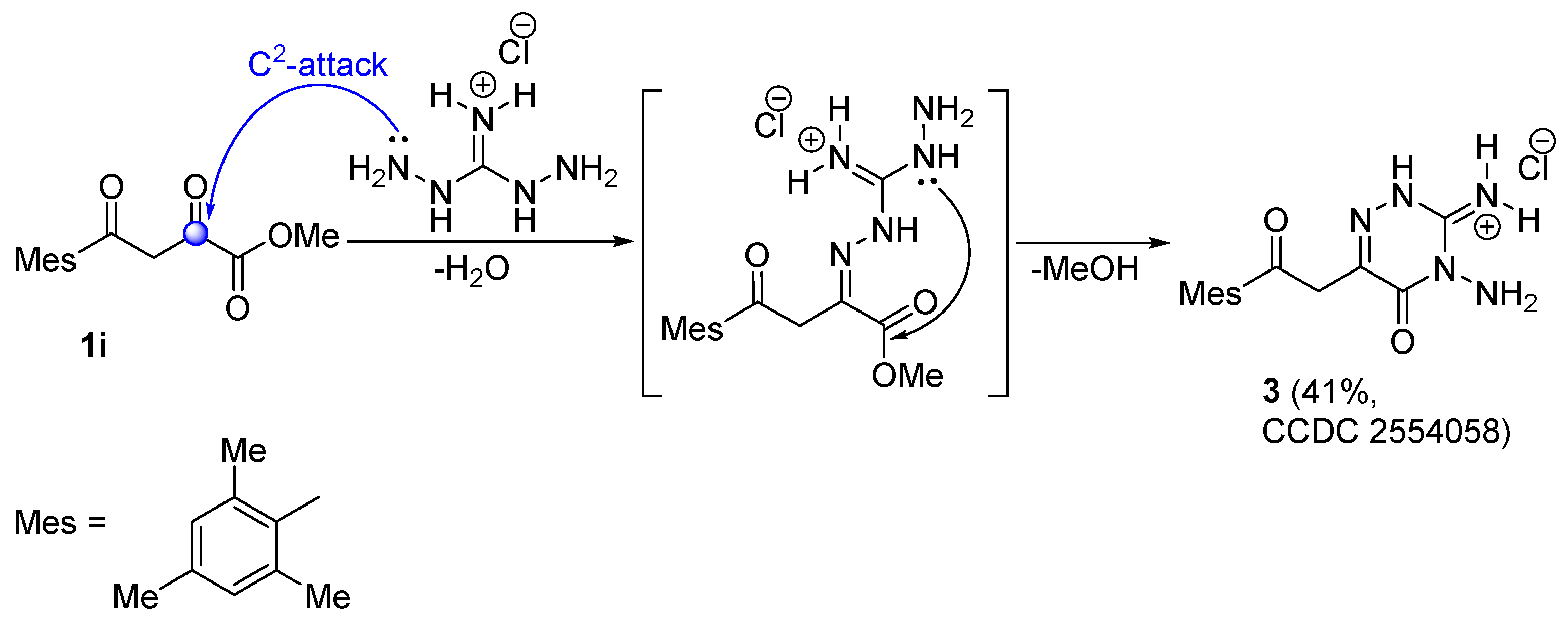
4-Amino-6-(2-mesityl-2-oxoethyl)-5-oxo-4,5-dihydro-1,2,4-triazin-3(2H)-iminium chloride (3). A suspension of methyl mesitoylpyruvate (1i) (0.48 mmol, 119 mg) and 1,3-diaminoguanidine hydrochloride (0.48 mmol, 60 mg) in EtOH (5 mL) was stirred at 90 °C for 24 h. Then, the mixture was cooled to ambient temperature. The resulting precipitate was filtered off and recrystallized from EtOH (5 mL) to afford compound 3. Yield: 41% (64 mg); pale yellow solid; mp 228 °C (decomp., EtOH). 1H NMR (400 MHz, DMSO-d6): δ = 9.08 (s, 2H, NH2), 6.91 (s, 2HAr), 5.80 (br.s, 3H, NH + NH2), 4.14 (s, 2H, CH2), 2.25–2.23 (m, 9H, 3Me) ppm. 13C NMR (100 MHz, DMSO-d6): δ = 204.4 (COAr), 153.1 (C5), 152.4 (C3), 143.9 (C6), 138.4 (CAr), 138.0 (CAr), 132.5 (2CAr), 128.2 (2CAr), 45.9 (CH2), 20.5 (Me), 18.5 (2C, 2Me) ppm. IR (mineral oil): 3539, 3324, 3162 (N–H), 1703, 1665 (C=O) cm−1. Anal. Calcd (%) for C14H18ClN5O2: C 51.93; H 5.60; N 21.63. Found: C 52.22; H 5.47; N 21.67. Crystal structure of compound 3 was deposited at the Cambridge Crystallographic Data Centre with the deposition number CCDC 2554058.
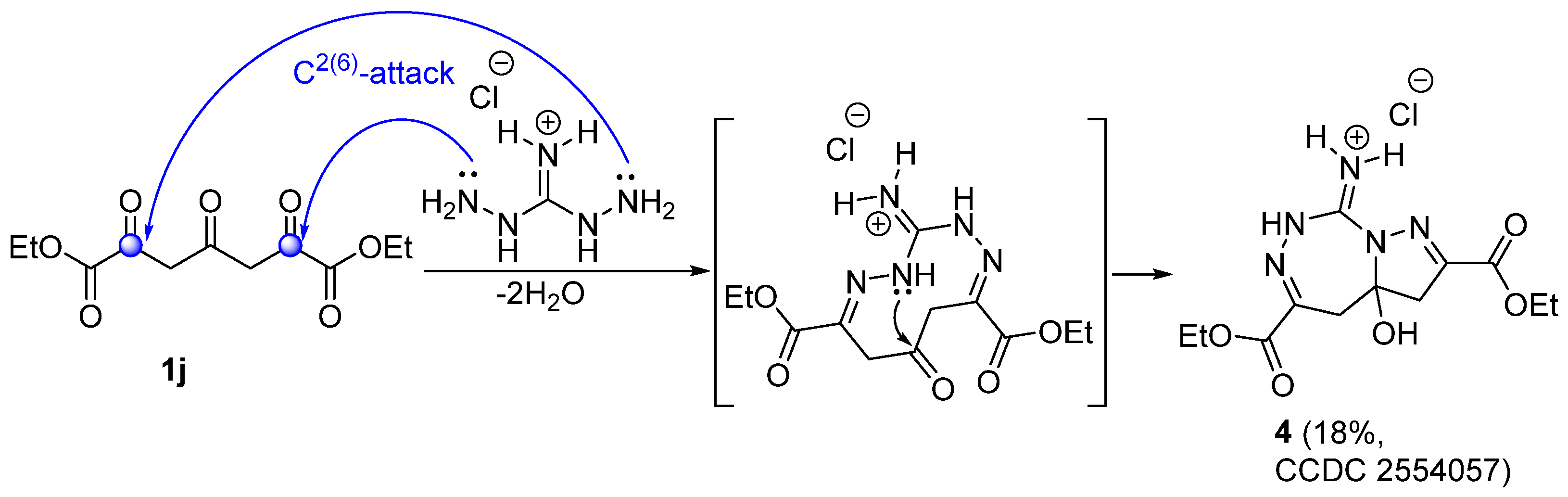
2,5-Bis(ethoxycarbonyl)-3a-hydroxy-3,3a,4,7-tetrahydro-8H-pyrazolo[1,5-d][1,2,4]triazepin-8-iminium chloride (4). A suspension of diethyl 2,4,6-trioxoheptanedioate 1j (0.48 mmol, 124 mg) and 1,3-diaminoguanidine hydrochloride (0.48 mmol, 60 mg) in EtOH (5 mL) was stirred at 90 °C for 24 h. Then, the mixture was cooled to ambient temperature. The resulting precipitate was filtered off and recrystallized from EtOH (3 mL) to afford compound 4. Yield: 18% (30 mg); pale yellow solid; mp 181 °C (decomp., EtOH). 1H NMR (400 MHz, DMSO-d6): δ = 12.61 (br.s, 1H, NH), 8.95 (s, 2H, NH2), 8.14 (s, 1H, OH), 4.38–4.31 (m, 2H, CH2Me), 4.24 (q, J 6.8 Hz, 2H, CH2Me), 3.74 (d, J 16.6 Hz, 1H, C3H2), 3.67 (d, J 19.6 Hz, 1H, C4H2), 3.43 (d, J 19.6 Hz, 1H, C4H2), 3.09 (d, J 16.6 Hz, 1H, C3H2), 1.30 (t, J 7.0 Hz, 3H, Me), 1.27 (t, J 7.0 Hz, 3H, Me) ppm. 13C NMR (100 MHz, DMSO-d6): δ = 164.0 (CO), 160.1 (CO), 153.6 (C8), 151.4 (C2), 145.3 (C5), 92.2 (C3a), 62.6 (CH2Me), 62.3 (CH2Me), 48.4 (C3), 40.2 (C4), 14.5 (2C, 2Me) ppm. IR (mineral oil): 3361, 3237, 3122 (N–H), 1750, 1722, 1678 (C=O) cm−1. Anal. Calcd (%) for C12H18ClN5O5: C 41.45; H 5.22; N 20.14. Found: C 41.63; H 5.38; N 20.18. Crystal structure of compound 4 was deposited at the Cambridge Crystallographic Data Centre with the deposition number CCDC 2554057.

2.2. Biology

Screening of test compounds was conducted in 96-well microplates, followed by validation of the most promising candidates in 50 mL Erlenmeyer flasks. C. vulgaris strain IMBR-19 (The A.O. Kovalevsky Institute of Biology of the Southern Seas, RAS, Sevastopol, Russia) served as the test object. Experimental procedures were based on our previously established protocols [30,32].

3. Results and Discussion

3.1. Chemistry

To achieve the target 7-aminopyrazolo[1,5-d][1,2,4]triazin-4(5H)-ones 2, we examined the reaction of substituted methyl aroylpyruvates 1a–i with 1,3-diaminoguanidine hydrochloride. As a result, we found that the reaction pathway and the structure of the final product were dependent on the aryl substituent in aroylpyruvate 1.
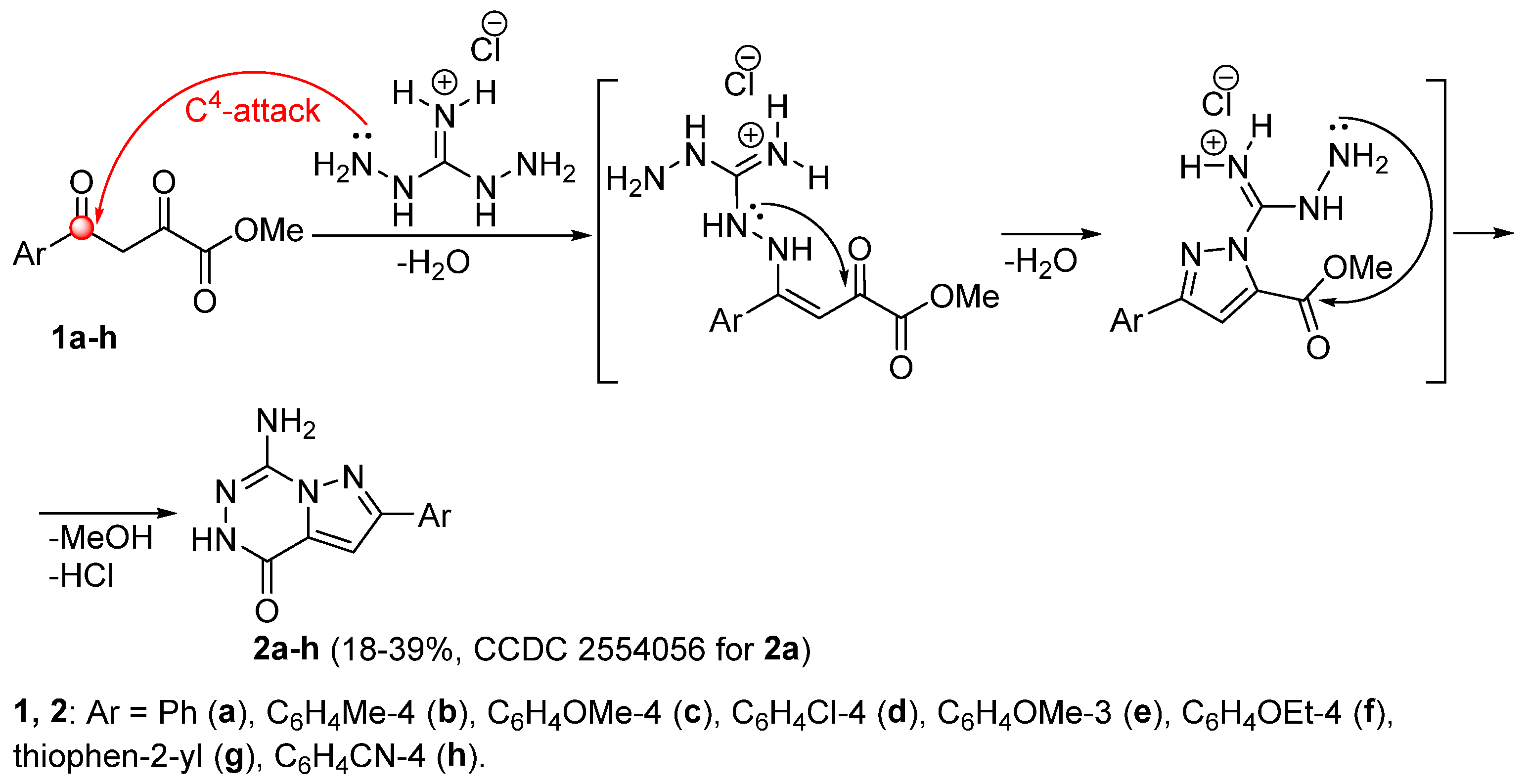
For the majority of methyl aroylpyruvates 1a–h, the reaction proceeded as anticipated, yielding the desired 7-aminopyrazolo[1,5-d][1,2,4]triazin-4(5H)-ones 2a–h (Scheme 2). A notable exception to this general reactivity was observed with methyl mesitoylpyruvate 1i, which contains a sterically hindered mesityl substituent. Under the same reaction conditions, mesitoylpyruvate 1i afforded 1,2,4-triazine 3 (Scheme 3). We suppose that this divergence in reactivity could be caused by an alteration of the direction of the initial nucleophilic attack of 1,3-diaminoguanidine hydrochloride on aroylpyruvates 1a–i. Specifically, in the reaction with aroylpyruvates 1a–h, the initial nucleophilic attack of the terminal NH2 group of 1,3-diaminoguanidine hydrochloride [33] is directed at the C4=O carbonyl group (Scheme 2), which initiates the cascade leading to pyrazolotriazines 2a–h. In the case of mesitoylpyruvate 1i, the C4=O carbonyl group is sterically shielded for the nucleophile by two ortho-methyl substituents, which shifts the initial nucleophilic attack of the terminal NH2 group of 1,3-diaminoguanidine hydrochloride to the C2=O carbonyl group (Scheme 3), which initiates the cyclization to triazine 3.
Furthermore, to explore the limits of this methodology, we extended the study to include a bis-pyruvate entity—diethyl 2,4,6-trioxoheptanedioate 1j. Under the same reaction conditions as for compounds 1a–i, the reaction of bis-pyruvate 1j with 1,3-diaminoguanidine hydrochloride followed a different pathway, leading to the formation of an unexpected bicyclic system, pyrazolo[1,5-d][1,2,4]triazepine 4 (Scheme 4). We suppose that in this case, as in the case of mesitoylpyruvate 1i, the initial nucleophilic attack of the terminal NH2 group of 1,3-diaminoguanidine hydrochloride is directed at the C2=O carbonyl group (Scheme 4), which initiates the cascade leading to pyrazolo[1,5-d][1,2,4]triazepine 4. Possibly, such reactivity of bis-pyruvate 1j could be attributed to electronic effects influencing the C4=O carbonyl group, making it less attractive for the attack of the nucleophile.
In summary, the cascade condensation of aroylpyruvates 1 with 1,3-diaminoguanidine hydrochloride provides a straightforward, one-pot access to a library of 7-aminopyrazolo[1,5-d][1,2,4]triazin-4(5H)-ones 2. However, the reaction is not universally applicable to all substrates. The structure of the final product is critically dependent on the substituents in the aryl ring of the starting aroylpyruvate 1.

3.2. Biology

The biotechnological potential of ten synthesized heterocyclic derivatives was assessed by analyzing their effects on C. vulgaris cultures (Table 1) according to the protocol we developed earlier [30,32]. In brief, compound stock solutions were prepared in DMSO and added to cultures at final concentrations ranging from 0.1 to 100 μmol/L. Cultures were grown in 96-well plates, with 1% DMSO serving as a negative control and 2 g/L glucose as a positive control. After five days of culture growth, C. vulgaris cell concentrations were determined by measuring optical density at 750 nm (OD750). Compounds were considered active if they increased OD750 relative to the negative control (defined as an OD750 greater than the mean of the negative control plus three standard deviations) at at least one concentration tested.
Next, to investigate its biological activity in more detail, compound 2c was further studied for its effects on cell concentration, as well as the content of pigments, proteins, polysaccharides, and neutral lipids (Table 2). For these experiments, the selected compound 2c was added to C. vulgaris cultures at concentrations ranging from 0.1 to 100 μmol/L. Cultures were grown in 50 mL flasks, and after five days of cultivation, samples were analyzed using standard biochemical methods with minor modifications.
Interestingly, despite its promising performance in microplate-based screenings, the tested compound did not exhibit a statistically significant effect on cell concentration in flask cultures when compared to the negative control (Table 2). This discrepancy between the microplate and flask culture systems may be explained by differences in mixing dynamics and oxygen availability, which could influence the presence or concentration of specific signaling or regulatory molecules [34] that serve as targets for the tested compound. Additionally, no effects were observed on content of key metabolites, except for slight (13%) growth of protein concentration at 100 μmol/L.

4. Conclusions

In this study, we investigated a one-pot cascade condensation of methyl aroylpyruvates with 1,3-diaminoguanidine hydrochloride, providing access to a library of 7-aminopyrazolo[1,5-d][1,2,4]triazin-4(5H)-ones 2a–h. The method is operationally simple, uses ethanol as a solvent, and assembles the adenine-mimetic heterocyclic core from readily available acyclic precursors in 18–39% yield.
However, the reaction outcome is critically dependent on the nature of the substituent in the aroylpyruvate. While most substrates followed the expected pathway (initial nucleophilic attack at the C4=O carbonyl group), two notable deviations were observed. First, methyl mesitoylpyruvate 1i bearing a sterically hindered mesityl group shifted the initial attack to the C2=O carbonyl group, leading to a 1,2,4-triazine derivative 3 instead of the expected pyrazolotriazine. Second, the bis-pyruvate 1j (diethyl 2,4,6-trioxoheptanedioate) underwent an alternative cyclization to form an unexpected pyrazolo[1,5-d][1,2,4]triazepine scaffold 4. These findings delineate both the scope and the limitations of the methodology, providing valuable guidance for future synthetic applications.
All synthesized compounds were evaluated for cytokinin-like growth-regulating activity using the green microalga C. vulgaris as a model system. Compound 2c has shown the best results in the initial microplate screening, showing increased cell density at 10 μmol/L. Nevertheless, when subjected to more detailed flask-based validation, compound 2c did not produce statistically significant effects on biomass accumulation, chlorophyll and carotenoid content, carbohydrate levels, or neutral lipid production compared to the negative control. The only observed effect was a modest (13%) increase in protein content at the highest tested concentration (100 μmol/L).

5. Patents

The method for preparing products 2 has been patented [35].

Supplementary Materials

The following supporting information can be downloaded at: https://www.mdpi.com/article/10.3390/chemistry8070090/s1, The following are available online, Figure S1: Molecular structure of compound 2a showing 30% probability amplitude displacement ellipsoids (CCDC 2554056); Figure S2: Molecular structure of compound 3 showing 30% probability amplitude displacement ellipsoids (CCDC 2554058); Figure S3: Molecular structure of compound 4 showing 30% probability amplitude displacement ellipsoids (CCDC 2554057); Table S1: Crystal data and structure refinement for compounds 2a, 3, and 4.

Author Contributions

Conceptualization, E.E.K. and P.V.K.; investigation, E.E.K. (chemistry), M.V.D. (X-ray), A.D.N. and P.V.K. (biology); writing—original draft preparation, E.E.K., P.V.K., M.V.D. and A.D.N.; writing—review and editing, E.E.K., P.V.K., A.D.N. and M.V.D.; supervision, E.E.K. and P.V.K.; project administration, E.E.K. and P.V.K. All authors have read and agreed to the published version of the manuscript.

Funding

This work was supported by the Ministry of Science and Higher Education of the Russian Federation (FSNF-2025-0013).

Institutional Review Board Statement

Not applicable.

Informed Consent Statement

Not applicable.

Data Availability Statement

The presented data are available in this article.

Acknowledgments

During the preparation of this manuscript, the authors used DeepSeek [deepseek.com, version available as of May 2026] for the purposes of language refinement and grammar checking. The authors have reviewed and edited the output and take full responsibility for the content of this publication.

Conflicts of Interest

The authors declare no conflicts of interest.

References

  1. Khan, S.U.; Nawaz, T.; Alam, O.; Khan, D.; Fahad, S.; Saud, S.; Lu, K. Quinoline: A novel solution for next-generation pesticides, herbicides, and fertilizers. Appl. Biochem. Biotechnol. 2025, 197, 2097–2119. [Google Scholar] [CrossRef] [Scilit] [PubMed]
  2. Myakushina, Y.A.; Kolachevskaya, O.O.; Sinkevich, I.A.; Romanov, G.A. Interaction of Cytokinin and Sugar Signaling. Russ. J. Plant Physiol. 2025, 72, 66. [Google Scholar] [CrossRef] [Scilit]
  3. Pekárová, B.; Szmitkowska, A.; Houser, J.; Wimmerova, M.; Hejátko, J. Cytokinin and ethylene signaling. In Plant Structural Biology: Hormonal Regulations; Hejátko, J., Hakoshima, T., Eds.; Springer International Publishing AG, part of Springer Nature: Basel, Switzerland, 2018; Chapter 10; pp. 165–200. [Google Scholar] [CrossRef] [Scilit]
  4. Cao, X.; Yang, H.; Liu, C.; Zhang, R.; Maienfisch, P.; Xu, X. Bioisosterism and Scaffold Hopping in Modern Nematicide Research. J. Agric. Food Chem. 2022, 70, 11042–11055. [Google Scholar] [CrossRef] [Scilit] [PubMed]
  5. Maienfisch, P.; Lamberth, C. Introduction to Recent Highlights in Bioisosteric Replacements and Scaffold Hopping in Crop Protection Research. J. Agric. Food Chem. 2023, 71, 18169–18170. [Google Scholar] [CrossRef] [Scilit] [PubMed]
  6. Nan, X.; Wang, K.; Sun, X.; Hu, Z.; Sun, R. Scaffold Hopping from Dehydrozingerone: Design, Synthesis, and Antifungal Activity of Phenoxyltrifluoromethylpyridines. Int. J. Mol. Sci. 2025, 26, 5345. [Google Scholar] [CrossRef] [Scilit] [PubMed]
  7. Kobelev, A.I.; Stepanova, E.E.; Dmitriev, M.V.; Maslivets, A.N. A simple method for the synthesis of pyrazolo[1,5-d][1,2,4]triazines via the reaction of tetracarbonyl compounds with thiocarbonohydrazide. Chem. Heterocycl. Comp. 2019, 55, 897–901. [Google Scholar] [CrossRef] [Scilit]
  8. Xu, X.; Tian, L.; Sheng, X.; Li, L.; Deng, Y.; Liao, Z.; Ding, L.; Li, S.; Yang, X.; Qu, L. Selenium-Containing Compound as Well as Application and Preparation Method Thereof. China Patent CN121181541A, 23 December 2025. [Google Scholar] [PubMed]
  9. Sheng, X.J.; Li, L.E.; Xu, X.B.; Tian, L.Y.; Ding, L.; Zhou, H.; Qu, Q.; Wang, M.; Peng, L.; Li, S.Q. Nitrogen-Containing Heterocyclic Compound as Well as Application and Preparation Method Thereof. China Patent CN121181542A, 23 December 2025. [Google Scholar] [PubMed]
  10. Oehlrich, D.; Van Gool, M.; Van Opdenbosch, N.; Lamkanfi, M.; Llàveria Cros, J.; Martinez Viturro, C.; Van Rompaey, D. Pyrazolo[1,5-d][1,2,4]triazine-5(4H)-acetamides as Inhibitors of the NLRP3 Inflammasome Pathway. WO Patent WO2021209552A1, 21 October 2021. [Google Scholar]
  11. Zhang, X.Y.; Alam, R.; Barraza, S.; Bejcek, L.; Gilbert, B.; Gong, H.; Handoko, H.; Hosseyni, S.; Huarte, E.; Jeon, W.; et al. Inhibitors of NLRP3. WO Patent WO2023028534A1, 2 March 2023. [Google Scholar] [CrossRef] [Scilit] [PubMed]
  12. Liang, C.; Li, S.; Tang, W.; Tang, X. NLRP3 Inflammasome Inhibitors. WO Patent WO2023186020A1, 5 October 2023. [Google Scholar] [CrossRef] [Scilit] [PubMed]
  13. Mammoliti, O.; Jerhaoui, S.; Perez Benito, L.; Jacoby, E.; Cañellas Roman, S. Pyrrolo[1,2-d][1,2,4]triazines and pyrazolo[1,5-d][1,2,4]triazines as NLRP3 Inhibitors. WO Patent WO2024160691A1, 8 August 2024. [Google Scholar]
  14. Li, L.; Wu, F. NLRP3 Inflammasome Inhibitor and Use Thereof. EP Patent EP4613749A1, 10 September 2025. [Google Scholar] [PubMed]
  15. Zhang, X.; Alam, R.; Bejcek, L.; Gilbert, B.B.; Hosseyni, S.; Huarte, E.; Li, J.; Liu, Y.; Niederer, K.; Parker, E.N.; et al. Inhibitors of NLRP3. WO Patent WO2023159148A2, 24 August 2023. [Google Scholar] [CrossRef] [Scilit] [PubMed]
  16. Ao, W.; Li, Y.; Wang, H.; Zhu, W.; Wu, J.; Zhang, Y. Pyridazine Fused Aryl Ring Compound and Use Thereof. WO Patent WO2024140704A1, 4 July 2024. [Google Scholar] [PubMed]
  17. Bierowska-Charytonowicz, D.; Konieczny, M. Search for new aminoguanidine derivatives with immunosuppressive and cytostatic properties. I. Reactions of amino-, nitroamino- and diaminoguanidine with acetylpyruvic acid ethyl ester. Arch. Immunol. Ther. Exp. 1976, 24, 871–881. [Google Scholar]
  18. Novokshonova, A.; Khramtsov, P.; Rayev, M. Application of Chlorella vulgaris Cultures in Biotechnology and Food Industry. Perm Fed. Res. Cent. J. 2023, 2023, 32–42. [Google Scholar] [CrossRef] [Scilit] [PubMed]
  19. Stirk, W.A.; van Staden, J.; Novák, O.; Doležal, K.; Strnad, M.; Dobrev, P.I.; Sipos, G.; Ördög, V.; Balint, P. Changes in endogenous cytokinin concentrations in Chlorella (Chlorophyceae) in relation to light and the cell cycle. J. Phycol. 2011, 47, 291–301. [Google Scholar] [CrossRef] [Scilit] [PubMed]
  20. Ramphal, K.; Lewis, A.; Trzaskalski, N.A.; Kisiala, A.; Morrison, E.N.; Narine, S.S.; Emery, R.J.N. Phytohormonal impacts on fatty acid profiles in Chlorella vulgaris Beijerinck: Endogenous identification and exogenous application of cytokinins and abscisic acid. J. Appl. Phycol. 2023, 35, 2205–2218. [Google Scholar] [CrossRef] [Scilit]
  21. Xie, Z.; Ma, S.; Cao, Y.; Peng, S.; Zhang, X.; Kong, W. Effects of six phytohormones on the growth behavior and cellular biochemical components of Chlorella vulgaris 31. J. Appl. Phycol. 2023, 35, 1589–1602. [Google Scholar] [CrossRef] [Scilit]
  22. Bajguz, A.; Piotrowska-Niczyporuk, A. Interactive effect of brassinosteroids and cytokinins on growth, chlorophyll, monosaccharide and protein content in the green alga Chlorella vulgaris (Trebouxiophyceae). Plant Physiol. Biochem. 2014, 80, 176–183. [Google Scholar] [CrossRef] [Scilit] [PubMed]
  23. CrysAlisPro; Version 1.171.42.74a; Rigaku Oxford Diffraction: Wroclaw, Poland, 2022.
  24. Dolomanov, O.V.; Bourhis, L.J.; Gildea, R.J.; Howard, J.A.K.; Puschmann, H. OLEX2: A complete structure solution, refinement and analysis program. J. Appl. Cryst. 2009, 42, 339–341. [Google Scholar] [CrossRef] [Scilit]
  25. Sheldrick, G.M. SHELXT–Integrated space-group and crystal-structure determination. Acta Crystallogr. Sect. A Found. Adv. 2015, 71, 3–8. [Google Scholar] [CrossRef] [Scilit] [PubMed]
  26. Sheldrick, G.M. Crystal structure refinement with SHELXL. Acta Crystallogr. Sect. C Struct. Chem. 2015, 71, 3–8. [Google Scholar] [CrossRef] [Scilit] [PubMed]
  27. Maurin, C.; Bailly, F.; Cotelle, P. Improved preparation and structural investigation of 4-aryl-4-oxo-2-hydroxy-2-butenoic acids and methyl esters. Tetrahedron 2004, 60, 6479–6486. [Google Scholar] [CrossRef] [Scilit]
  28. Dmitriev, M.V.; Khramtsova, E.E.; Apuskin, D.Y.; Andreev, A.I.; Kovalenko, I.I.; Mashevskaya, I.V.; Maslivets, A.N. Synthesis and Anti-Inflammatory Activity of (Z)-4-(2-(3-Oxopiperazin-2-ylidene)acetyl)benzoic Acid. Molbank 2024, 2024, M1772. [Google Scholar] [CrossRef] [Scilit]
  29. Beyer, C.; Claisen, L. Ueber die Einführung von Säureradicalen in Ketone. Ber. Dtsch. Chem. Ges. 1887, 20, 2178–2188. [Google Scholar] [CrossRef] [Scilit]
  30. Novokshonova, A.D.; Khramtsov, P.V.; Dmitriev, M.V.; Khramtsova, E.E. Acylpyruvates and Their Heterocyclic Derivatives as Growth Regulators in Chlorella vulgaris. BioTech 2025, 14, 90. [Google Scholar] [CrossRef] [Scilit] [PubMed]
  31. Riegel, E.R.; Zwilgmeyer, F. Chelidonic acid. Org. Synth. 1937, 17, 40. [Google Scholar] [CrossRef] [Scilit]
  32. Novokshonova, A.D.; Khramtsov, P.V.; Khramtsova, E.E. Angular 6/6/5/6-Annelated Pyrrolidine-2,3-Diones: Growth-Regulating Activity in Chlorella vulgaris. Chemistry 2025, 7, 102. [Google Scholar] [CrossRef] [Scilit]
  33. Kohúteková, S.; Matulková, I.; Zábranský, M.; Martín, J.L.; Císařová, I.; Gyepes, R.; Němec, P.; Gryl, M.; Seidler, T.; Němec, I. New group of inorganic salts of 1,3-diaminoguanidinium(1+) cation—Crystal structures, vibrational spectra, linear and nonlinear optical properties. J. Solid State Chem. 2023, 327, 124288. [Google Scholar] [CrossRef] [Scilit]
  34. Banti, V.; Giuntoli, B.; Gonzali, S.; Loreti, E.; Magneschi, L.; Novi, G.; Paparelli, E.; Parlanti, S.; Pucciariello, C.; Santaniello, A.; et al. Low Oxygen Response Mechanisms in Green Organisms. Int. J. Mol. Sci. 2013, 14, 4734–4761. [Google Scholar] [CrossRef] [Scilit] [PubMed]
  35. Maslivets, A.N.; Khramtsova, E.E.; Khramtsov, P.V.; Novokshonova, A.D. Method for Producing 7-amino-2-arylpyrazolo[1,5-d][1,2,4]triazin-4(5H)-Ones Exhibiting Growth-Regulating Activity for Microalgae Culture Chlorella vulgaris. Russia Patent RU2857540C1, 3 March 2026. [Google Scholar]
Figure 1. Structures of selected cytokinins (adenine scaffold is shown in red).
Chemistry 08 00090 g001
Figure 2. Structures of adenine and the title compounds (pyrazolo[1,5-d][1,2,4]triazine core) are shown in red.
Chemistry 08 00090 g002
Scheme 1. Approaches to 7-aminopyrazolo[1,5-d][1,2,4]triazines (formed bonds are shown in red).
Chemistry 08 00090 sch001
Scheme 2. Reaction of methyl aroylpyruvates 1a–h with 1,3-diaminoguanidine hydrochloride. Reaction conditions: ethanol, 90 °C, 24 h.
Chemistry 08 00090 sch002
Scheme 3. Reaction of methyl mesitoylpyruvate 1i with 1,3-diaminoguanidine hydrochloride. Reaction conditions: ethanol, 90 °C, 24 h.
Chemistry 08 00090 sch003
Scheme 4. Reaction of diethyl 2,4,6-trioxoheptanedioate 1j with 1,3-diaminoguanidine hydrochloride. Reaction conditions: ethanol, 90 °C, 24 h.
Chemistry 08 00090 sch004
Table 1. The difference in algae cell concentration between cultures containing the compounds 2a–h,3,4 and the negative control cultures (1% of DMSO).
CompoundStructureDifference 1 in Algae Cell Concentration Between Cultures Containing Test Compounds and Control Cultures
Concentration of Compounds in Culture Medium
100 μmol/L10 μmol/L1 μmol/L0.1 μmol/L
2aChemistry 08 00090 i00120 2−23−9−23
2bChemistry 08 00090 i00210−19−28−31
2cChemistry 08 00090 i00335−8−3−11
2dChemistry 08 00090 i004171−7−16
2eChemistry 08 00090 i0055−15−14−28
2fChemistry 08 00090 i0062913119
2gChemistry 08 00090 i007−75−66−15−21
2hChemistry 08 00090 i008−32−26−27−34
3Chemistry 08 00090 i009−8−3−20−8
4Chemistry 08 00090 i010−35−23−25−15
1 Expressed as a percentage of the negative control cultures. 2 Bold indicates conditions that result in cell concentrations exceeding the established threshold (mean of control plus three standard deviations).
Table 2. The effect of compound 2c on growth and accumulation of metabolites in C. vulgaris cells.
Concentration of 2cConcentration of Cells, 106 cell/mLChlorophyll a and b, μg/107 CellsCarotenoids, μg/107 CellsCarbohydrates, μg/106 CellsProtein, μg/106 CellsNeutral Lipids, F580/106 Cells
100 μmol/L22.56 ± 4.11 32.475 ± 0.2470.194 ± 0.0351.74 ± 0.1200.488 ± 0.050 4468.3 ± 86.3
10 μmol/L22.88 ± 0.362.515 ± 0.0770.194 ± 0.0121.82 ± 0.2190.433 ± 0.065272.6 ± 30.0
1 μmol/L23.28 ± 0.712.229 ± 0.1040.185 ± 0.0191.70 ± 0.2030.389 ± 0.050431.0 ± 60.9
0.1 μmol/L21.22 ± 1.812.303 ± 0.2160.174 ± 0.0101.84 ± 0.1610.421 ± 0.093270.2 ± 25.5
Negative control 121.53 ± 0.492.485 ± 0.1170.187 ± 0.0171.99 ± 0.1220.431 ± 0.054415.8 ± 75.4
Positive control 268.003.253 ± 0.0020.095 ± 0.0174.62 ± 0.0400.627 ± 0.006550.8 ± 23.4
1 Culture medium with 1% of DMSO. 2 Culture medium with 1% of DMSO and 2 g/L of glucose. 3 Mean ± standard deviation, N = 3. 4 Bold indicates difference from negative control identified by nested ANOVA (p value less than 0.05).
Disclaimer/Publisher’s Note: The statements, opinions and data contained in all publications are solely those of the individual author(s) and contributor(s) and not of MDPI and/or the editor(s). MDPI and/or the editor(s) disclaim responsibility for any injury to people or property resulting from any ideas, methods, instructions or products referred to in the content.