Article

Study on the Catalytic Performance of Porous Cu/Cu2O Synthesized by One-Step Solvothermal Method for Thermal Decomposition of Ammonium Perchlorate

School of Materials and Energy, Yunnan University, Kunming 650091, China
*
Author to whom correspondence should be addressed.
These authors contributed equally to this work.
Chemistry 2026, 8(2), 18; https://doi.org/10.3390/chemistry8020018
Submission received: 30 December 2025 / Revised: 27 January 2026 / Accepted: 4 February 2026 / Published: 6 February 2026
(This article belongs to the Section Catalysis)

Abstract

Porous Cu/Cu2O catalytic materials with a unique pore structure were successfully synthesized via a one-step solvothermal method using Cu-MOF-74 as the intermediate, followed by induced collapse and oxidation. The structural properties and catalytic performance of the as-prepared Cu/Cu2O materials in the thermal decomposition of ammonium perchlorate (AP) were systematically investigated by X-ray diffraction (XRD), scanning electron microscopy (SEM), transmission electron microscopy (TEM), X-ray photoelectron spectroscopy (XPS), Brunauer–Emmett–Teller (BET) surface area analysis, and thermogravimetry–differential scanning calorimetry (TG-DSC) combined with in situ thermogravimetry–mass spectrometry (TG-MS). The results show that the specific surface area of the Cu/Cu2O material is 46.6697 m2/g, and the average pore diameter is 9.4608 nm. Owing to the synergistic effect of Cu0/Cu+ dual sites on promoting electron transfer during AP thermal decomposition, the Cu/Cu2O catalyst exhibits excellent catalytic activity. Specifically, at a heating rate of 20 °C/min, the addition of 2 wt% Cu/Cu2O reduces the high-temperature decomposition temperature of AP from 473.1 °C to 321.1 °C (a decrease of 151.0 °C), lowers the thermal decomposition activation energy from 296.63 kJ/mol to 253.21 kJ/mol (a reduction of 43.42 kJ/mol), and increases the heat release by 617.8 J/g compared to pure AP. TG-MS analysis revealed that Cu/Cu2O accelerates the decomposition of AP by adsorbing and activating NH3 and HClO4 generated in the low-temperature decomposition stage, facilitating the formation of reactive intermediates such as ClOₓ and promoting the oxidation of nitrogen-containing species. This study demonstrates that the porous Cu/Cu2O material synthesized by the one-step solvothermal method is a promising catalyst for enhancing the thermal decomposition performance of AP in solid propellants.

1. Introduction

Composite solid propellants (CSPs) serve as the solid power source for modern rockets and missiles. Among them, the most common oxidizer is ammonium perchlorate (AP), which typically accounts for more than 60% of the propellant mass [1,2]. Therefore, there is a close relationship between the thermal decomposition of AP and the combustion of the propellant—that is, reducing the decomposition temperature of AP can shorten the ignition delay time of solid propellants [3,4]. Thus, optimizing the thermal decomposition behavior of AP has become a research hotspot [5,6,7].
The mainstream methods for optimizing the thermal decomposition of AP are generally divided into two categories: one is to improve propellant performance by refining AP, but this process involves explosion risks [8,9]. Therefore, a more common method is to add catalytic materials to improve the thermal decomposition of AP [10,11]. Copper (Cu) as a transition metal and its oxides exhibit excellent catalytic performance in the thermal decomposition of AP [12,13]. For example, Li et al. prepared Cu/GO nanocomposites with different morphologies for AP catalysis, reducing its high-temperature decomposition temperature to 343.7 °C [14]. Due to the easy variation in the Cu+ valence state, Cu2O can promote electron transfer, simplify the high-temperature decomposition process of AP, and thus accelerate its thermal decomposition [15]. For instance, Gao et al. synthesized MXene/Cu2O nanocomposites for catalyzing the thermal decomposition of AP, lowering its high-temperature decomposition temperature to 341.5 °C [16]. In addition, copper-based solid catalytic materials have gained favor in the catalytic field due to their low cost, high tunability, and the ease with which hydrated copper ions form Lewis acid sites after dehydration [17,18].
However, the full exertion of their catalytic performance largely depends on the synthesis methods used, which directly affect the final morphology, pore structure, and exposure degree of active sites of the materials [19]. Currently, traditional synthesis methods for copper-based AP decomposition catalysts, including co-precipitation, impregnation, and hydrothermal/solvothermal methods, are still widely adopted due to their simplicity of operation and scalability [20]. The co-precipitation method allows for easy regulation of macroscopic composition but usually produces materials with a wide particle size distribution and low porosity, leading to reduced accessibility of active sites and hindrance of mass transfer in gas release reactions [21]. The impregnation method facilitates the loading of active components but often causes metal agglomeration, thereby reducing exposed sites, inducing pore blockage, and hindering the key reactant diffusion and electron transfer processes in AP catalysis. Hydrothermal/solvothermal methods (including traditional and template-assisted advanced types) offer better morphology control compared to co-precipitation; however, they generally struggle to achieve precise hierarchical pore engineering, often resulting in irregular or collapsed structures that impair pore connectivity and gas release efficiency. Compared to the basic composition control of co-precipitation, solvothermal methods have made progress in morphology control but are still insufficient to simultaneously achieve hierarchical porosity and stable valence state distribution [22].
Therefore, it is imperative to develop new synthesis strategies that can overcome the limitations of traditional methods. This recognition has brought the correlation between the morphological structure and performance of catalytic materials into focus.
For example, catalytic materials with spherical, rod-like, porous structures, etc., differ in specific surface area and the number of exposed active sites, thereby affecting catalytic behavior [23,24]. In recent years, porous materials have attracted much attention due to their high specific surface area and abundant exposed active sites [25,26]. Among them, metal–organic frameworks (MOFs), as a type of porous structure with high specific surface area and high porosity, show potential in gas adsorption, separation, and heterogeneous catalysis [27].
Compared with traditional porous materials (such as zeolites, activated carbon, or mesoporous silica materials), MOFs have many important advantages [28,29]. Researchers can precisely regulate the pore size, pore shape, and framework topology by selecting different metals and organic ligands, thereby achieving control over a wide range of pore sizes from micropores to mesopores. Meanwhile, the highly uniform distribution of metals can effectively avoid the agglomeration of active sites, ensuring their high dispersion and accessibility. In addition, organic ligands are easy for post-synthetic modification, facilitating the introduction of specific functional groups to regulate the surface acidity, basicity, or hydrophilicity/hydrophobicity. The compositional diversity of MOFs also offers a rich combination of metal-ligand, including polynuclear metal clusters and heteroatom doping [30]. These characteristics collectively endow MOFs with high specific surface area and porosity, making them ideal precursors for preparing high-performance nanocatalysts [31,32].
Under certain conditions, the carbon skeleton of MOFs will collapse, forming the corresponding metal oxide phase while retaining part of the MOFs’ structural framework [33]. In addition, the decomposition of ligands releases energy, inducing the formation of oxygen vacancies, which is consistent with the goal of catalyzing the thermal decomposition of AP [34,35].
Although MOFs have been widely used as precursors to prepare metal/metal oxide composite catalysts, traditional methods usually require multi-step high-temperature pyrolysis or additional reduction/oxidation treatments. This not only increases the process complexity but may also lead to agglomeration of active sites or structural collapse, limiting the further improvement of catalytic performance. In this context, this work innovatively proposes a simple one-pot synthesis strategy. During the conventional hydrothermal synthesis of Cu-MOFs, by extending the heating time and appropriately increasing the temperature of the traditional micro-carbon synthesis method, the redox reaction of metal ions within the MOF framework is promoted, forming a porous structure, and loading copper and its oxides onto the residual carbon skeleton. This method does not require additional post-treatment steps, while effectively retaining the high specific surface area and structural characteristics of MOFs, significantly improving the catalytic accessibility and stability of the materials. In this study, a series of Cu/Cu2O@C composites were systematically prepared, and their catalytic performance in the thermal decomposition of ammonium perchlorate (AP) was investigated in detail, revealing the intrinsic correlation between structure and performance.

2. Experiment

2.1. Materials

Copper(II) nitrate trihydrate (Cu(NO3)2·3H2O, AR, Sinopharm Chemical Reagent Co., Ltd., Shanghai, China), 2,5-dihydroxyterephthalic acid (≥98%, Shanghai Aladdin Biochemical Technology Co., Ltd., Shanghai, China), N,N-dimethylformamide (DMF, AR, Chengdu Kelong Chemical Co., Ltd., Sichuan, China), ammonium perchlorate (AP, AR, Sinopharm Chemical Reagent Co., Ltd., Shanghai, China), copper powder (Sinopharm Chemical Reagent Co., Ltd., Shanghai, China), anhydrous ethanol (AR, Sinopharm Chemical Reagent Co., Ltd., Shanghai, China), copper oxide powder(AR, Sinopharm Chemical Reagent Co., Ltd., Shanghai, China), and cuprous oxide powder (AR, Sinopharm Chemical Reagent Co., Ltd., Shanghai, China).

2.2. Preparation of Porous Cu/Cu2O Catalytic Material

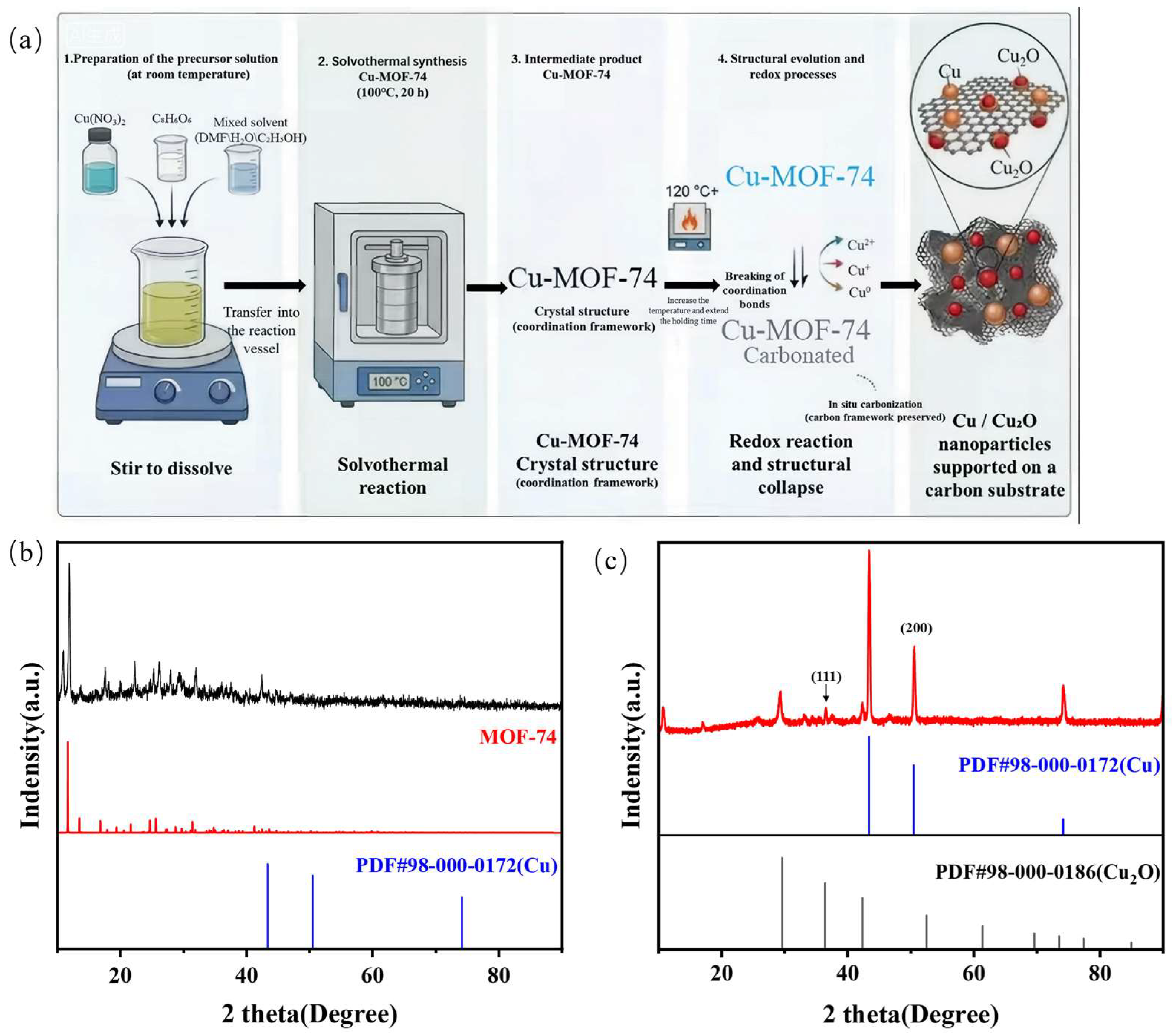
The target sample was prepared via a one-step solvothermal method, as illustrated in Figure 1a: Weigh 1.192 g of copper nitrate and 0.442 g of 2,5-dihydroxyterephthalic acid, dissolve them in a mixed solution of 47 mL DMF and 3.8 mL deionized water, and stir magnetically at room temperature for 20 min, during which 3 mL of anhydrous ethanol is slowly added dropwise. After the solids are fully dissolved and the solution turns yellowish-green, transfer it to a polytetrafluoroethylene (PTFE) autoclave and heat in an oven at 120 °C for 20 h. Upon completion of heating, perform solid–liquid separation using a centrifuge (TG16, Shanghai Lu Xiangyi Centrifuge Instrument Co., Ltd., Shanghai, China), wash the sample multiple times with DMF and anhydrous ethanol. The solid product was then placed in a vacuum dryer (DZF-6030B/6050B, Shanghai YIHENG Technical Co., Ltd., Shanghai, China) at 60 °C for 12 h to dry, and finally the Cu/Cu2O sample was obtained.
Under the same procedure, the solvothermal temperature was reduced to 100 °C to synthesize Cu-MOF-74.

2.3. Characterization

The phase analysis of the samples was conducted using powder X-ray diffraction (XRD) (DX-2700BH, Rigaku, Japan). The morphological characteristics of the samples were analyzed using scanning electron microscopy (SEM, FEI Nova NanoSEM 450, purchased from FEI, Hillsboro, OR, USA) and transmission electron microscopy (TEM, JEM-2100, purchased from JEOL, Tokyo, Japan), while the elemental composition was determined using energy-dispersive X-ray spectroscopy (EDS). The elemental types of the samples were analyzed via X-ray photoelectron spectroscopy (XPS, ESCALAB 250Xi, purchased from Thermo Fisher Scientific, Waltham, MA, USA). The pore size distribution and specific surface area were measured using BET surface area analysis (NOVA4400E, purchased from Quantachrome Instruments, Boynton Beach, FL, USA). In situ thermogravimetry–mass spectrometry (TG-MS, T200, purchased from Thermo Fisher Scientific, Waltham, MA, USA) was employed to track the gaseous products during the decomposition of AP.

2.4. Performance Testing

For catalytic performance evaluation, the TG-DSC results obtained from a microcomputer differential thermal analyzer (HCT-3, purchased from Beijing Henven Scientific Instruments, Beijing, China) were analyzed. The Cu/Cu2O catalytic material and AP were mixed at a mass ratio of 2:98 and ground uniformly in an agate mortar to prepare the catalytic performance test sample. Following the instrument requirements, a certain amount of the mixed sample was weighed into an alumina crucible and placed in the microcomputer differential thermal analyzer. Under a nitrogen atmosphere, the sample was heated from room temperature to 500 °C at different heating rates to obtain the TG-DSC results.

3. Results and Analysis

3.1. Characterization of Cu/Cu2O

Figure 1a illustrates the synthesis process of Cu-MOF-74 and the principle of the preparation process of Cu/Cu2O samples. Through a series of regulations of heating temperatures, under the original process parameters for synthesizing Cu-MOF-74, the Cu/Cu2O sample was successfully obtained when the temperature was increased to 120 °C. For this result, we believe that after the temperature was raised to 120 °C, the carbon skeleton collapsed, and at the same time, the copper ions underwent redox reactions, eventually forming the Cu/Cu2O sample supported on the carbon structure. Figure 1b shows the XRD pattern of the synthesized sample under the condition of 100 °C. Characteristic diffraction peaks of MOF-74 can be observed in the diffraction spectrum, and the overall peak positions are in high agreement with the previously reported MOF-74 materials and Cu-MOF-74 powder XRD standard patterns, thereby confirming the successful construction of the MOF-74 framework in the product of this work. It should be noted that the diffraction peaks in Figure 1b are generally weak and exhibit a certain degree of broadening, a phenomenon commonly observed in the Cu-MOF-74 system. This is typically attributed to the formation of a defect-rich framework structure due to the nanostructural characteristics of the material during the activation and solvent removal processes. Similar peak broadening and intensity reduction have been widely reported in Cu-MOF-74 and other M-MOF-74 analogs. Furthermore, no obvious characteristic diffraction peaks of metallic copper Cu(0) were observed at 100 °C, indicating that copper has not undergone significant reduction to form metallic copper nanoparticles under these conditions.
When the reaction temperature was increased to 120 °C, the XRD pattern of the sample (Figure 1c) underwent significant changes, indicating that the system experienced a noticeable structural transformation. By comparing and analyzing with the standard diffraction cards for Cu (PDF#98-000-0172) and Cu2O (PDF#98-000-0186) [36], the major diffraction peaks of the sample can be attributed to the face-centered cubic structure of metallic copper (fcc-Cu) and the cubic crystal system of Cu2O, respectively, thus confirming the formation of a Cu/Cu2O composite in the system. Specifically, the diffraction peaks at 2θ ≈ 43.3°, 50.4°, and 74.1° correspond to the (111), (200), and (220) planes of fcc-Cu, while the diffraction peaks at approximately 29.5°, 36.4°, 42.3°, 61.3°, and 73.5° are the characteristic peaks of the cubic Cu2O (cuprite structure) [37].
This structural evolution process of Cu/Cu2O composite phases derived from MOFs is typically attributed to a temperature-promoted redox reaction: during the decomposition and reconstruction of the Cu-containing MOF, organic ligands or their thermal decomposition products can act as reducing agents to partially reduce copper ions to metallic copper, while under the influence of the reaction atmosphere and local oxygen activity, some copper species further form the Cu2O phase. Additionally, no significant peak shifts were observed in the XRD pattern, and the diffraction peaks were relatively sharp (i.e., the peak full width at half maximum was not significantly broadened), indicating that the resulting Cu/Cu2O phase has a relatively good crystallinity.
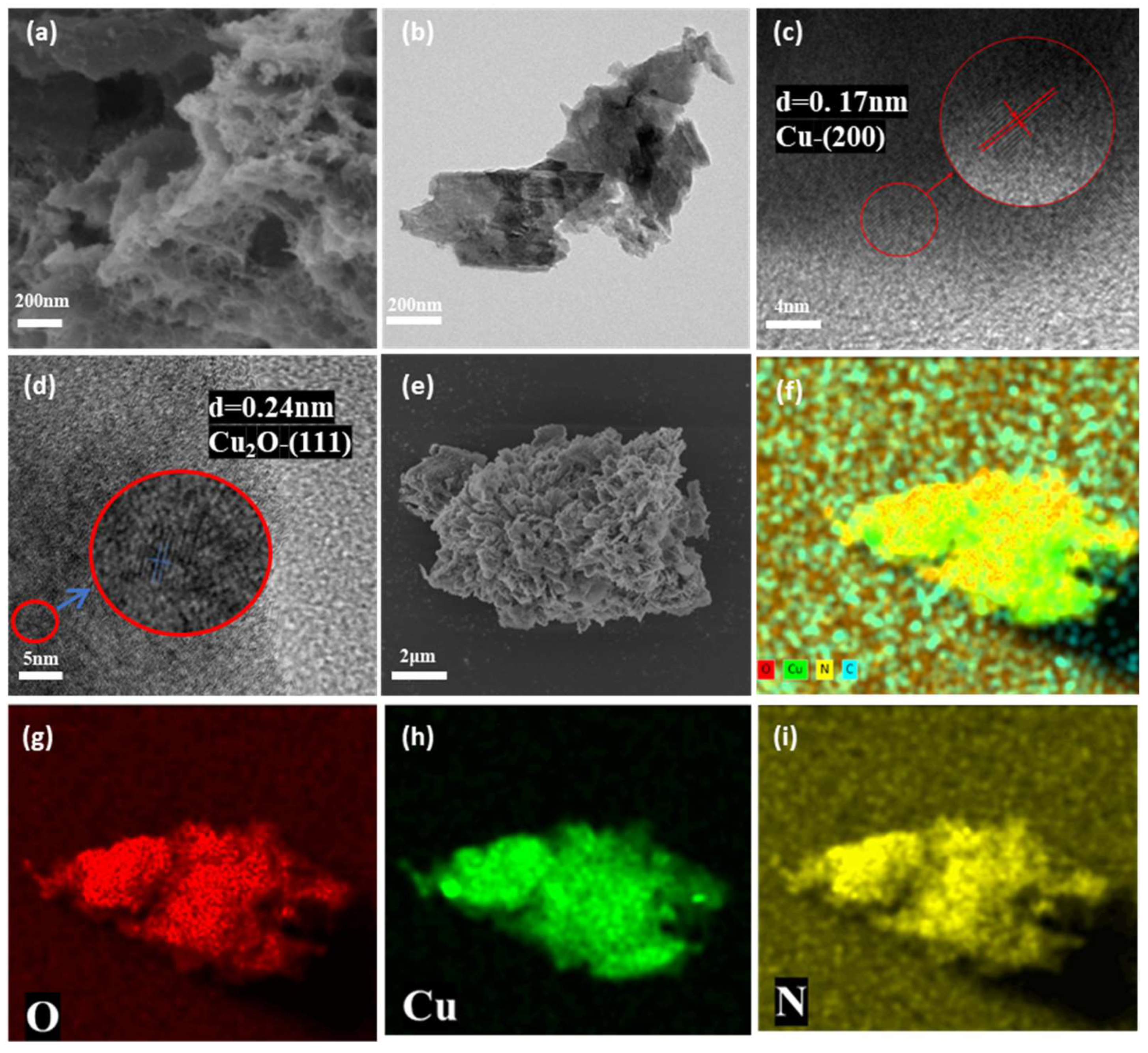
The specific morphology and structure of the Cu/Cu2O sample were observed using scanning electron microscopy (SEM), as shown in Figure 2. From Figure 2a, it can be seen that the Cu/Cu2O sample exhibits a porous structure. Combined with Figure 2e, it is evident that this porous structure is formed by the accumulation of numerous particles, creating layered pore walls. This is based on the initially formed Cu-MOF-74, which undergoes carbon skeleton collapse during gradual heating. In this process, the confinement effect of the skeleton weakens, promoting the agglomeration of copper ions and the simultaneous formation of Cu/Cu2O. The TEM image of the sample in Figure 2b also reveals a porous structure formed by particle accumulation.
Figure 2c,d show partial HRTEM images of the sample. Within this region, two sets of interplanar spacings can be measured. In Figure 2c, the interplanar spacing is 0.17 nm, corresponding to the (200) crystal plane of Cu, while in Figure 2d, the interplanar spacing is 0.24 nm, corresponding to the (111) crystal plane of Cu2O, which aligns with the XRD test results in Figure 1c. From the energy-dispersive X-ray spectroscopy (EDS) area scan in Figure 2f–i the elemental distribution of the Cu/Cu2O sample can be observed. The sample contains four elements: O, Cu, N, and C. The C element primarily serves as the skeleton part of the sample, while the other three elements are uniformly distributed within it.
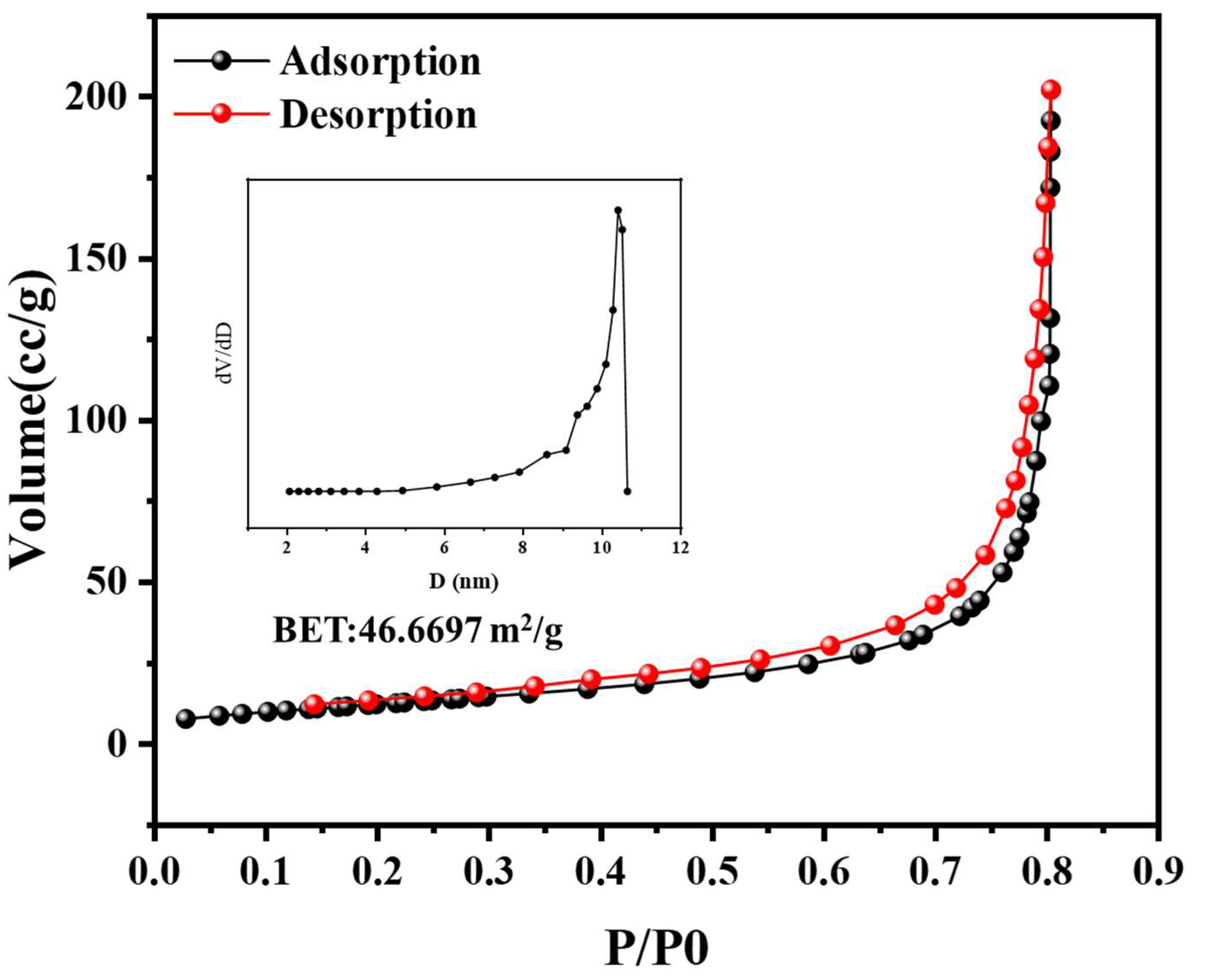
The specific surface area and pore size of the Cu/Cu2O samples were analyzed by N2 adsorption/desorption isotherms, and the pore size distribution was determined using the Barrett-Joyner-Halenda (BJH) method (Figure 3). The N2 adsorption/desorption curves exhibited a Type IV isotherm with an H3-type hysteresis loop, indicating a mesoporous structure. The specific surface area was measured at 46.6697 m2/g, while the BJH pore size analysis revealed an average pore diameter of 9.4608 nm. The large specific surface area and mesoporous structure provide abundant catalytic sites for the catalytic material.

3.2. Catalytic Effect of Cu/Cu2O on AP

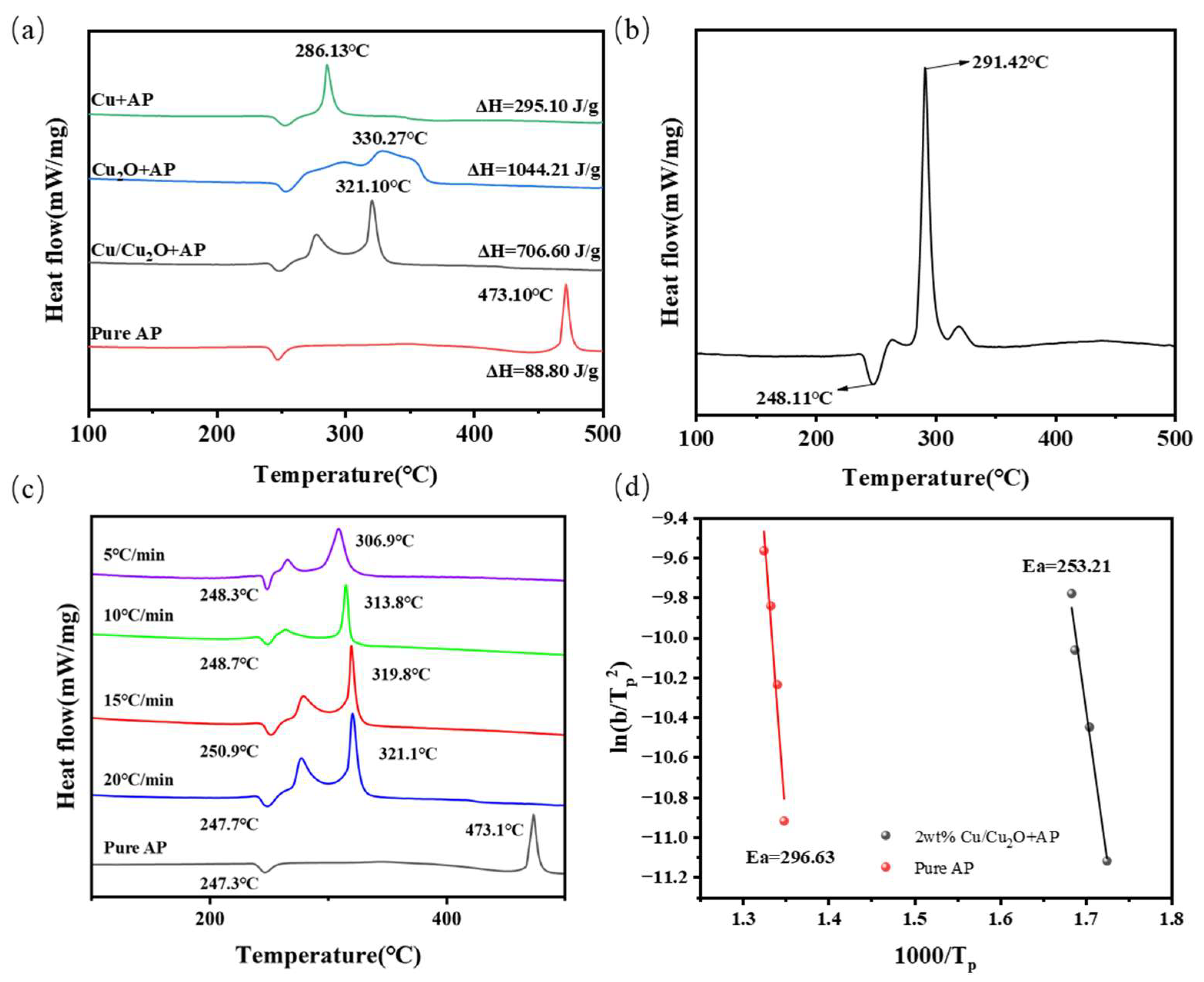
Figure 4 shows the test results of the thermal decomposition of AP under different conditions. The mass of the sample for each test is 10mg, and the same sample is tested twice under the same conditions. Figure 4a shows the DSC curves and corresponding heat release of 2 wt% Cu/Cu2O+AP, 2 wt% Cu2O+AP, and 2 wt% Cu +AP at a heating rate of 20 °C/min. It can be observed that the decomposition process of pure AP during heating has three stages: the crystal form transformation stage at 247.3 °C, the low-temperature decomposition stage (LTD) at 300–400 °C, and the high-temperature decomposition stage (HTD) at 473.1 °C [38]. After adding 2%wt of catalytic materials, it was found that AP exhibited no significant changes during the crystal transformation stage, but both the LTD and HTD peaks were substantially reduced, with the HTD peak decreasing from 473.1 °C, proving that the addition of catalytic materials promoted the reduction in AP’s thermal decomposition temperature. Specifically, pure Cu powder, Cu2O, and Cu/Cu2O catalytic materials reduced the high-temperature decomposition temperature of AP to 286.13 °C, 330.27 °C, and 321.1 °C, respectively, while the heat release increased by 206.3 J/g, 955.4 J/g, and 617.8 J/g compared to pure AP. It indicates that in the thermal decomposition of AP, the Cu/Cu2O composite catalyst, due to its porous structure and the synergistic effect between Cu and Cu2O, has a lower decomposition temperature while possessing a larger heat release. Figure 4b presents the TG curves of 2 wt% Cu/Cu2O+AP at different heating rates, showing that AP undergoes two rapid weight losses around 300 °C, corresponding to the LTD and HTD stages, respectively. Figure 4b shows the DSC curve of the mixture of the Cu-MOF-74 sample prepared with 2 wt% and AP, heated from room temperature to 500 °C at a heating rate of 20 °C/min. It can be seen that the high-temperature decomposition temperature of AP under this condition is 291.42 °C. Figure 4c reveals that, as seen in Figure 4a, with increasing heating rates, the HTD peak of the mixed sample shifts toward higher temperatures.
Table 1 shows the comparison of the thermal decomposition performance of pure AP and AP mixed samples after adding pure Cu/pure Cu2O/Cu/Cu2O samples/Cu-MOF-74 samples with 2% mass fraction, TPT is the crystal form transition temperature, THTD is the high-temperature decomposition temperature, and ΔH is the heat release. The activation energy (Ea) of AP’s thermal decomposition can be calculated using the Kissinger equation [39].
ln b T P 2 = E a R T P + ln AR E a
k = Aexp ( E a R T P )
In Equation (1), b represents the heating rate (K/min), Tp denotes the high-temperature decomposition temperature, R is the ideal gas constant, and A stands for the pre-exponential factor (1/s).
As shown in Figure 4d, the thermal decomposition reactions of pure AP and 2 wt% Cu/Cu2O+AP exhibit a good linear relationship under different heating rates. By plotting ln(β/TP2) as the vertical axis and 1000/TP as the horizontal axis, the fitted curve is obtained, and the activation energy can be determined from its slope. The Ea of pure AP is 296.63 kJ/mol, which decreases to 253.21 kJ/mol for 2 wt% Cu/Cu2O+AP, a reduction of 43.42 kJ/mol, confirming the superior catalytic kinetics of Cu/Cu2O on the thermal decomposition of AP.
Table 2 shows the performance comparison results of some studies on AP thermal decomposition catalysis.

3.3. Analysis of the Catalytic Mechanism of Cu/Cu2O in AP

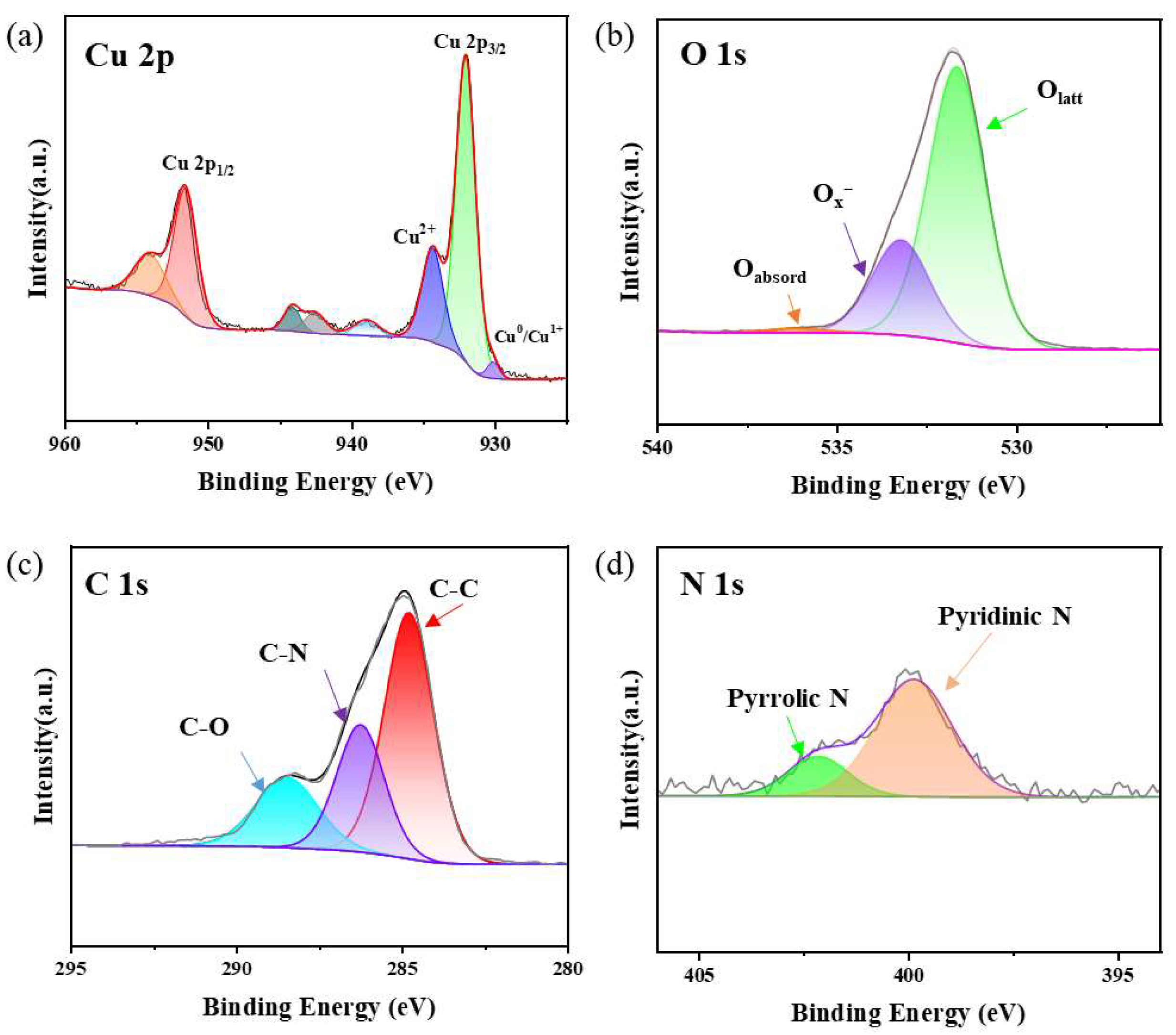
In Figure 5a, the Cu 2p spectrum shows two strong main peaks: Cu 2p3/2 (933 eV) and Cu 2p1/2 (approximately 954 eV), corresponding to the characteristic electronic transitions of copper. By comparing the positions of the main peaks with the standard spectrum, it can be known that: the Cu 2p3/2 peak around 933.6 eV corresponds to Cu0; the slightly shifted peak around 932.8 eV corresponds to Cu+ [46]. The satellite peaks appearing in the spectrum around 940-945 eV and 960 eV indicate the possible presence of a very small amount of Cu2+ [47], which may come from the residual of some copper ions that were not completely reduced during the reaction or the slight oxidation of the sample surface. This verifies the existence of Cu0 and Cu+ in the sample, which is consistent with the phase results of Cu (#98-000-0172) and Cu2O (#98-000-0186) in XRD. The O 1s spectrum can be deconvoluted into three peaks: lattice oxygen (Olatt, 531.5 eV), attributed to Cu-O covalent bonds, defective oxygen (Ox, 533.5 eV) originates from the absence of oxygen atoms in the crystal lattice. The presence of oxygen vacancies creates surface active sites, enhancing the adsorption and activation capacity for AP and adsorbed oxygen (Oabsord, 536 eV), resulting from the adsorption of oxygen by metal ions. Figure 5c displays the C 1s spectrum, with peaks at 284.8 eV, 286.2 eV, and 288.4 eV corresponding to C-C, C-N, and C-O bonds, respectively. Figure 5d shows the N 1s spectrum, with peaks at 399.8 eV and 402.1 eV assigned to pyridinic N and pyrrolic N, respectively.
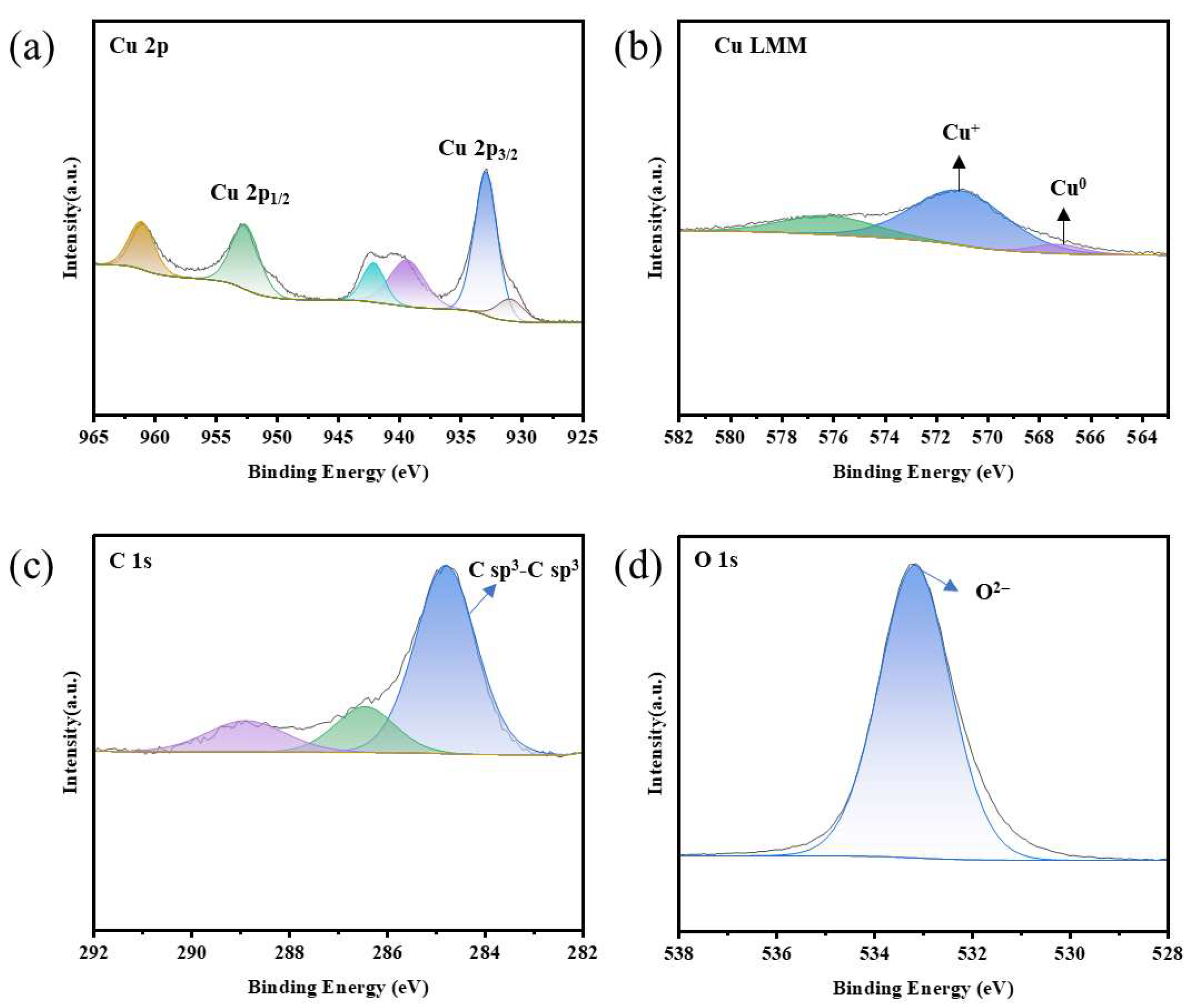
In Figure 6a, two characteristic peaks of Cu 2p3/2 and Cu 2p1/2 can be observed, along with several oscillation peaks. Figure 6b is the Auger electron spectroscopy (LMM) spectrum of Cu, where the peak near 570 eV is the peak of Cu+, and the peak at 567 eV is the peak of Cu0. Figure 6c is the spectrum of C 1s after heating, and it can be found that the proportion of the main peak of C 1s is larger compared to that before combustion. Figure 6d is the O 1s spectrum, and it can be observed that O2− exists after combustion and accounts for a very large proportion, which proves that the electron transfer process occurs during combustion.
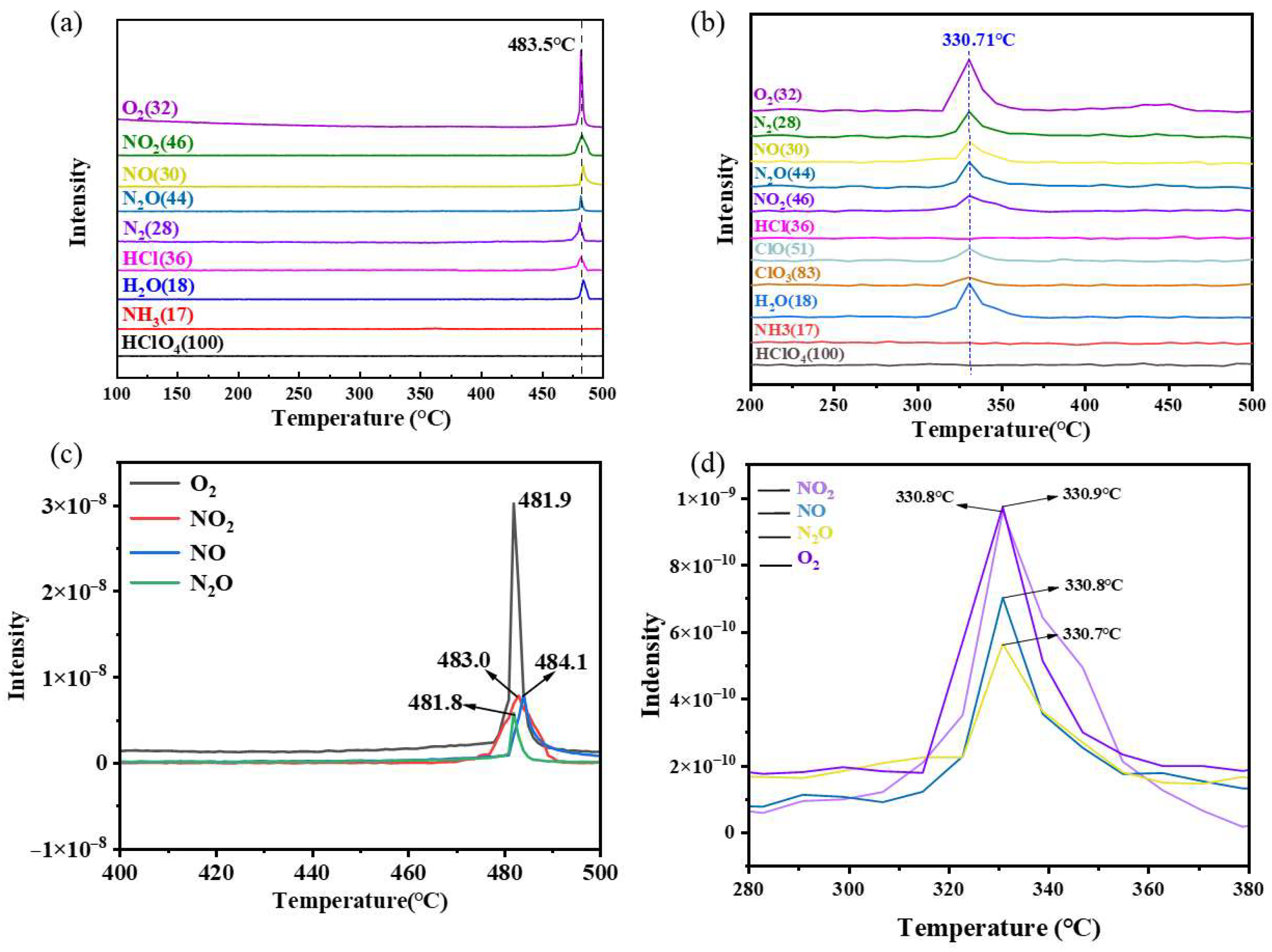
To elucidate the regulatory mechanism of Cu/Cu2O on the thermal decomposition pathway of AP, in situ thermogravimetry–mass spectrometry (TG-MS) was employed for analysis under consistent testing conditions with catalytic performance evaluation (N2 atmosphere, heating rate of 20 °C/min, temperature range of 25–500 °C). The results are shown in Figure 6. Figure 7a,c correspond to the characteristic gaseous products of pure AP thermal decomposition, while Figure 7b,d depict the product evolution patterns of the 2%wt Cu/Cu2O mixed system with AP.
From the thermal decomposition results of pure AP, no significant gaseous product signals were observed during the crystalline phase transition stage, with only the structural rearrangement of AP from orthorhombic to cubic systems occurring. In the low-temperature decomposition (LTD) stage, only weak H2O signals were detected in the mass spectrum, with no characteristic peaks of core products such as NH3 or HClO4 observed (Figure 7c). This is because, during the LTD stage, This is because the AP in the LTD phase first undergoes an electron transfer reaction. The generated NH3 remains adsorbed on the AP surface due to its strong adsorption affinity, while the unstable HClO4 partially decomposes but fails to produce detectable signals due to low intermediate concentrations. In the high-temperature decomposition (HTD) stage, the products include nitrogen-containing species (NO, N2O, NO2, and N2), with NO and N2O intensity peaks appearing at 483.5 °C (Figure 7c, left), indicating vigorous ammonia oxidation reactions where adsorbed NH3 is oxidized by O2 generated from HClO4 decomposition. Chlorine-containing products (HCl and trace ClO) arise from incomplete HClO4 decomposition, while oxygen-containing products (O2 and H2O) mainly originate as byproducts of HClO4 decomposition and ammonia oxidation reactions.
The test results of the mixed sample with 2%wt Cu/Cu2O reveal that the intensity peaks of all gaseous products shift from 483.5 °C (pure AP) to around 330 °C (Figure 7b,d), consistent with the DSC curve trend where the HTD temperature decreases from 473.1 °C to 321.1 °C. In the Cu/Cu2O+AP system, weak NH3 signals are detected below 300 °C, rapidly converting to NO and N2O with increasing temperature (Figure 7b), without NH3 signal accumulation. This suggests that Cu/Cu2O surfaces adsorb and activate NH3 while promoting O2 and NH3 conversion, eliminating NH3 adsorption inhibition during the LTD stage and bringing the product release processes of LTD and HTD closer. Comparing Figure 6a,b, distinct ClO and ClO3 signals are detected in the Cu/Cu2O + AP system, while HCl signal intensity decreases relative to pure AP. This indicates that Cu/Cu2O provides electron transfer channels for ClO4, facilitating HClO4 decomposition into highly reactive ClOx (ClO, ClO3) intermediates. Furthermore, ClOx participates in NH3 oxidation reactions, collectively driving the overall catalytic process.
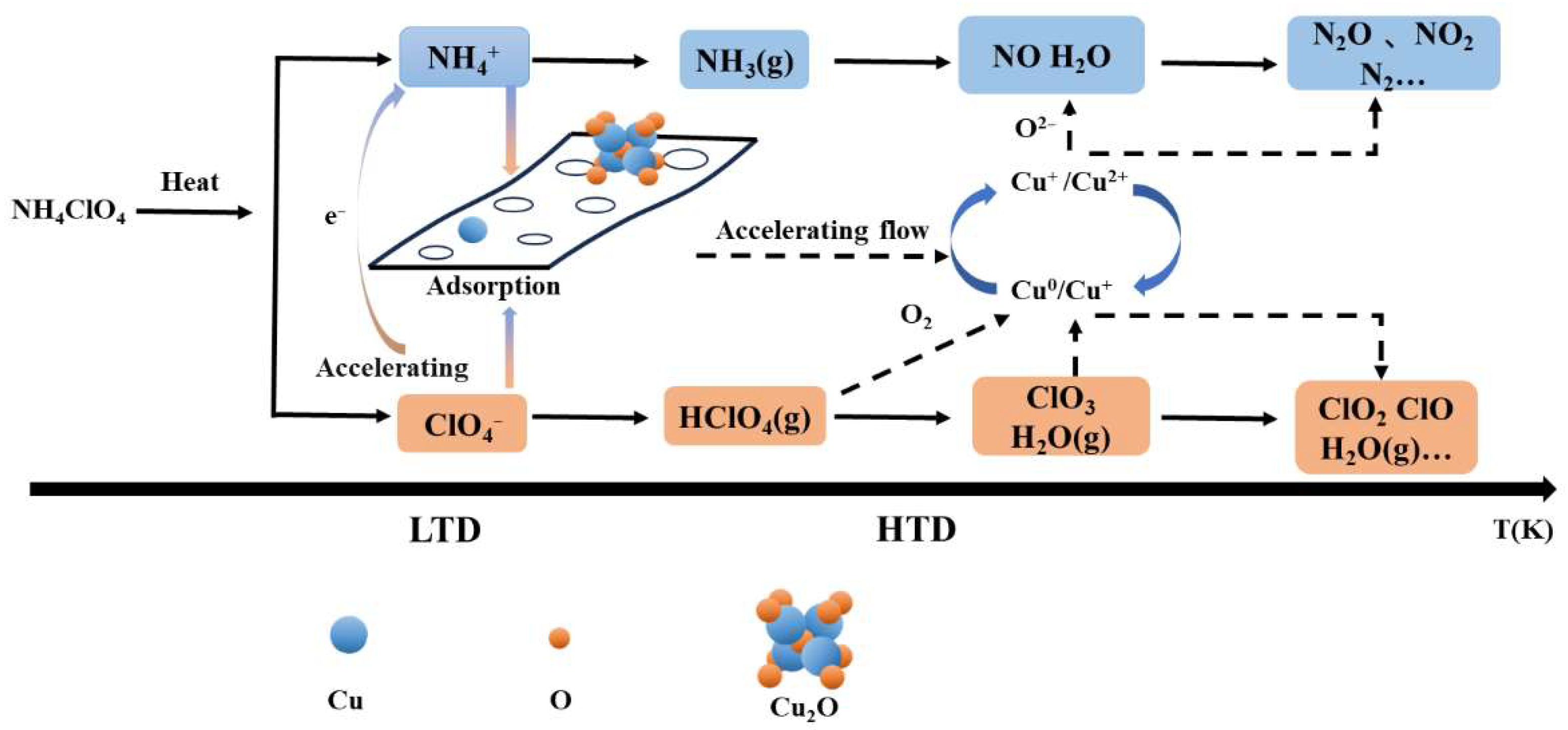
The thermal decomposition mechanism of AP is not yet fully understood and involves complex multiphase reactions. The mainstream view holds that the electron transfer mechanism is a crucial step in this process. Pure AP decomposes during the LTD stage, where electrons transfer from ClO4 to NH4+, generating HClO4 and NH3. The generated HClO4 and NH3 first adsorb on the surface of AP crystals, thereby inhibiting the decomposition of AP. As the temperature continues to rise, HClO4 and NH3 absorb energy and desorb, allowing the decomposition of AP to proceed, ultimately producing NO2, NO, H2O, etc.
The catalytic mechanism of added catalytic materials on the thermal decomposition of AP is shown in Figure 8. When Cu/Cu2O is added to AP as a catalytic material, it will adsorb the HClO4 and NH3 generated in the LTD stage on the catalyst surface, thereby eliminating the self-inhibition process caused by product accumulation in the LTD stage of pure AP. Cu has unfilled d orbitals, which is conducive to electron transfer and promotes redox reactions between adsorbed species.
On the catalyst surface, the adsorbed HClO4 is directionally activated under the synergistic effect of Cu0/Cu+, avoiding the unstable HCl generation pathway. Under the dual-site electron regulation, the activated HClO4 undergoes stepwise cleavage, generating highly active chlorine-containing intermediates such as ClOₓ and Cl, and releasing reactive oxygen species. At the same time, NH3 is further oxidized by the reactive oxygen species enriched on the catalyst surface, converting into nitrogen-containing products such as NO2, NO, N2O, and N2. TG-MS results show that compared with the pure AP system, the production of NO2 in the Cu/Cu2O catalytic system is significantly increased, indicating that the catalyst promotes the conversion pathway of NH3 to higher oxidation states.
Cu+ + ClO4 → Cu0 + ClO40
Cu0 + NH4+ → Cu+ + NH40
The O2 released during the decomposition process further provides a rich source of reactive oxygen for surface reactions, accelerating electron transfer and desorption of gas-phase products. At the same time, H+ combines with lattice oxygen in the catalyst to form H2O, promoting the overall reaction equilibrium to shift towards the product direction. This series of surface processes significantly reduces the activation energy of AP decomposition, not only improving the reaction efficiency in the low-temperature stage but also promoting the early triggering of the high-temperature decomposition stage, thereby comprehensively enhancing the thermal decomposition performance of AP.

4. Conclusions

In this study, a metal–organic framework (Cu-MOF-74) was used as an intermediate to prepare Cu/Cu2O catalytic materials with a certain porous structure via a one-step solvothermal method, and these materials were applied to enhance the thermal decomposition performance of ammonium perchlorate (AP). The composition of the sample, which was determined to be Cu and Cu2O, was confirmed by comparing the X-ray diffraction results with the standard cards. The porous structure of the sample was observed through SEM and TEM, and the large specific surface area and nanoscale average pore size of the sample were studied by the BET method. Furthermore, the valence states of the sample before and after combustion were investigated via XPS testing, and the information on the gas products after combustion was obtained in combination with in situ mass spectrometry testing. After adding the sample, the thermal decomposition test of AP was carried out using a micro-differential thermal balance. At the same heating rate, the high-temperature decomposition temperature of the mixed sample was 150.0 °C lower than that of pure AP, and the activation energy was reduced by 43.42 kJ/mol, indicating that it has a good catalytic effect. The excellent catalytic performance of the Cu/Cu2O material is attributed to its porous structure, which provides abundant active sites for catalyzing the thermal decomposition of AP. In addition, the synergistic effect between Cu and Cu2O provides dual-site adsorption for the thermal decomposition of AP, significantly promoting electron transfer.

Author Contributions

Conceptualization, B.Y. and X.X.; investigation, B.Y. and X.Y.; writing- original draft, B.Y. and X.Y.; writing—review & editing, Y.Y. and M.L.; supervision, X.X. and Y.Y.; verification, B.Y. and X.Y.; methodology, Y.Y. and M.L.; data collation, B.Y. and X.Y.; funding acquisition, X.X. All authors have read and agreed to the published version of the manuscript.

Funding

This research was supported by the following projects: the Undergraduate Innovation Training Program of Yunnan University (20251010) and the Science and Technology Plan Project of Zhejiang Province (2022R52009), as well as the “Scientific Research Fund of Yunnan Provincial Department of Education” and the “Graduate Student Research Innovation Fund of Yunnan University” (KC-24249102).

Data Availability Statement

The original contributions presented in this study are included in the article. Further inquiries can be directed to the corresponding author(s).

Conflicts of Interest

The authors declare no conflict of interest.

References

  1. Chaturvedi, S.; Dave, P.N. Solid propellants: AP/HTPB composite propellants. Arab. J. Chem. 2019, 12, 2061–2068. [Google Scholar] [CrossRef]
  2. Suresh Babu, K.V.; Kanaka Raju, P.; Thomas, C.R.; Syed Hamed, A.; Ninan, K.N. Studies on composite solid propellant with tri-modal ammonium perchlorate containing an ultrafine fraction. Def. Technol. 2017, 13, 239–245. [Google Scholar] [CrossRef]
  3. Hua, C.; Yin, S.; Zhang, Z.; Liu, J.; Chen, X.; Ye, B.; Wang, J.; An, C. Core-shell oxygen-fuel composites for enhanced propellant ignition and combustion. Fuel 2025, 396, 135338. [Google Scholar] [CrossRef]
  4. Yuan, J.; Liu, J.; Zhou, Y.; Zhang, Y.; Cen, K. Thermal decomposition and combustion characteristics of Al/AP/HTPB propellant. J. Therm. Anal. Calorim. 2020, 143, 3935–3944. [Google Scholar] [CrossRef]
  5. Mallick, L.; Kumar, S.; Chowdhury, A. Thermal decomposition of ammonium perchlorate—A TGA–FTIR–MS study: Part I. Thermochim. Acta 2015, 610, 57–68. [Google Scholar] [CrossRef]
  6. Boldyrev, V.V. Thermal decomposition of ammonium perchlorate. Thermochim. Acta 2006, 443, 1–36. [Google Scholar] [CrossRef]
  7. Zhu, Y.-L.; Huang, H.; Ren, H.; Jiao, Q.-J. Kinetics of Thermal Decomposition of Ammonium Perchlorate by TG/DSC-MS-FTIR. J. Energetic Mater. 2013, 32, 16–26. [Google Scholar] [CrossRef]
  8. Ma, Z.; Pang, A.; Li, W.; Qi, Y.; Zhang, L. Preparation and characterization of ultra-fine ammonium perchlorate crystals using a microfluidic system combined with ultrasonication. Chem. Eng. J. 2021, 405, 126516. [Google Scholar] [CrossRef]
  9. Smith-Papin, N.; Do, C.; Phister, M.; Giri, G.; Kalman, J. Crystallization-Based Modification of Ammonium Perchlorate Heat Release. Cryst. Growth Des. 2024, 24, 7588–7596. [Google Scholar] [CrossRef] [PubMed]
  10. Lin, H.; Zhang, Q.; Liu, H.; Shen, S.; Guo, Z.; Jin, B.; Peng, R. Understanding the synergistically enhanced thermocatalytic decomposition of ammonium perchlorate using cobalt nanoparticle-embedded nitrogen-doped graphitized carbon. Mater. Adv. 2023, 4, 2332–2339. [Google Scholar] [CrossRef]
  11. Zou, J.; Zhou, R.; Qin, Y.; Zeng, J.; Ma, S.; Zhou, T.; Duan, K.; Liu, J. Catalytic thermal decomposition of ammonium perchlorate and enhanced ignition and combustion performance of HTPB composite propellant based on synergistic effect of AP@CuCr2O4/CNTs. Fuel 2026, 406, 136926. [Google Scholar] [CrossRef]
  12. Ji, H.; Tang, X.; Fu, L.; Li, J.; Zheng, Z.; Ding, C.; Zhang, Y.; Huang, C. Study on the Catalytic Effect of Nano Copper Oxide with Different Particle Sizes on the Thermal Decomposition of Ammonium Perchlorate. Catalysts 2025, 15, 882. [Google Scholar] [CrossRef]
  13. Fu, S.; Liang, J.; Li, B.; Yang, Y.; Yang, C.; Wu, H.; He, J.; Guo, J.; Wang, C.; Chen, X.; et al. Thermal decomposition catalytic properties of ammonium perchlorate with three new energetic complexes on the basis of metal centre regulation. J. Solid State Chem. 2025, 348, 125376. [Google Scholar] [CrossRef]
  14. Li, S.; Niu, Z.; Jiao, Y.; Jin, P.; Yang, D.; Bai, C.; Liu, J.; Li, G.; Luo, Y. Preparation of different morphology Cu/GO nanocomposites and their catalytic performance for thermal decomposition of ammonium perchlorate. RSC Adv. 2022, 12, 22806–22814. [Google Scholar] [CrossRef]
  15. Chandrababu, P.; Thankarajan, J.; Sukumaran Nair, V.; Raghavan, R. Decomposition of ammonium perchlorate: Exploring catalytic activity of nanocomposites based on nano Cu/Cu2O dispersed on graphitic carbon nitride. Thermochim. Acta 2020, 691, 178720. [Google Scholar] [CrossRef]
  16. Zhao, H.; Lv, J.; Sang, J.; Zhu, L.; Zheng, P.; Andrew, G.L.; Tan, L. A Facile Method to Construct MXene/CuO Nanocomposite with Enhanced Catalytic Activity of CuO on Thermal Decomposition of Ammonium Perchlorate. Materials 2018, 11, 2457. [Google Scholar] [CrossRef]
  17. Zou, J.; Qin, Y.; Wang, Y.; Zhang, X.; Duan, K.; Li, F.; Liu, J. Catalytic thermal decomposition of ammonium perchlorate based on synergistic effect of CuCr2O4/CNTs composite particles prepared by ball milling. Thermochim. Acta 2025, 751, 180086. [Google Scholar] [CrossRef]
  18. Li, R.; Lin, Y.; Zhu, J.; Wang, Z.; Zeng, K.; Wang, J.; Pei, C.; Xie, R.; Ma, Y. Synthesis of Cu-MOF-derived complex copper–chromium oxides and their catalytic study on the thermal decomposition of ammonium perchlorate. J. Solid State Chem. 2024, 336, 124764. [Google Scholar] [CrossRef]
  19. Sivadas, D.L.; Thomas, D.; Haseena, M.S.; Jayalatha, T.; Rekha Krishnan, G.; Jacob, S.; Rajeev, R. Insight into the catalytic thermal decomposition mechanism of ammonium perchlorate. J. Therm. Anal. Calorim. 2019, 138, 1–10. [Google Scholar] [CrossRef]
  20. Elbasuney, S.; Yehia, M. Thermal decomposition of ammonium perchlorate catalyzed with CuO nanoparticles. Def. Technol. 2019, 15, 868–874. [Google Scholar] [CrossRef]
  21. Hosseini, S.G.; Abazari, R. A facile one-step route for production of CuO, NiO, and CuO–NiO nanoparticles and comparison of their catalytic activity for ammonium perchlorate decomposition. RSC Adv. 2015, 5, 96777–96784. [Google Scholar] [CrossRef]
  22. Song, Y.; Ma, S. Pore engineering in metal–organic frameworks and covalent organic frameworks: Strategies and applications. Chem. Sci. 2025, 16, 11740–11767. [Google Scholar] [CrossRef] [PubMed]
  23. Ma, D.; Li, X.; Wang, X.; Luo, Y. Research development on graphitic carbon nitride and enhanced catalytic activity on ammonium perchlorate. RSC Adv. 2021, 11, 5729–5740. [Google Scholar] [CrossRef]
  24. Chen, J.; He, S.; Liu, Y.; Qiao, Z.; Huang, B.; Li, X.; Hao, Q.; Huang, H.; Yang, G. Highly active catalysts based on 3D hierarchically ordered porous carbon with entrapped Fe2O3 nanoparticles for the thermal decomposition of ammonium perchlorate. Appl. Surf. Sci. 2021, 538, 148148. [Google Scholar] [CrossRef]
  25. Chen, Y.-Z.; Zhang, R.; Jiao, L.; Jiang, H.-L. Metal–organic framework-derived porous materials for catalysis. Coord. Chem. Rev. 2018, 362, 1–23. [Google Scholar] [CrossRef]
  26. Huang, C.; Liu, Q.; Fan, W.; Qiu, X. Boron nitride encapsulated copper nanoparticles: A facile one-step synthesis and their effect on thermal decomposition of ammonium perchlorate. Sci. Rep. 2015, 5, 16736. [Google Scholar] [CrossRef]
  27. Baumann, A.E.; Burns, D.A.; Liu, B.; Thoi, V.S. Metal-organic framework functionalization and design strategies for advanced electrochemical energy storage devices. Commun. Chem. 2019, 2, 86. [Google Scholar] [CrossRef]
  28. Jiao, L.; Seow, J.Y.R.; Skinner, W.S.; Wang, Z.U.; Jiang, H.-L. Metal–organic frameworks: Structures and functional applications. Mater. Today 2019, 27, 43–68. [Google Scholar] [CrossRef]
  29. Wang, Y.-M.; Lin, J.-T.; Ning, G.-H.; Li, D. Recent advances in metal–organic frameworks for catalysing organic transformation. Chem. Commun. 2025, 61, 7563–7572. [Google Scholar] [CrossRef]
  30. Wang, S.; Ye, B.; An, C.; Wang, J.; Li, Q. Synergistic effects between Cu metal–organic framework (Cu-MOF) and carbon nanomaterials for the catalyzation of the thermal decomposition of ammonium perchlorate (AP). J. Mater. Sci. 2018, 54, 4928–4941. [Google Scholar] [CrossRef]
  31. Ye, B.Y.; Feng, C.H.; Zhao, F.Q.; An, C.W.; Wang, J.Y. 2D metal-organic frameworks endow ammonium perchlorate with enhanced thermal effect. Def. Technol. 2023, 20, 103–110. [Google Scholar] [CrossRef]
  32. Feng, H.; Liu, X.; Li, Y.; Ma, X.; Yan, Q.; Zhao, F. Novel powder catalysts of ferrocene-based metal-organic framework and their catalytic performance for thermal decomposition of ammonium perchlorate. Powder Technol. 2022, 397, 117035. [Google Scholar] [CrossRef]
  33. Powell, J.A.; Yang, Y.; Zhou, H.-C. Design, analysis, and application of metal–organic framework derived carbons. Inorg. Chem. Front. 2025, 12, 2194–2209. [Google Scholar] [CrossRef]
  34. Cheng, W.-C.; Chen, J.-M.; Deng, L.; Huang, H.-S.; Zhang, J.-G.; Zhang, T.-L.; Li, Z.-M. High-efficiency catalysis of nitrogen-rich metal-organic frameworks and their derivatives for the thermal decomposition of ammonium perchlorate. Energetic Mater. Front. 2023, 4, 37–43. [Google Scholar] [CrossRef]
  35. Juibari, N.M.; Tarighi, S. Metal–organic framework-derived nanocomposite metal-oxides with enhanced catalytic performance in thermal decomposition of ammonium perchlorate. J. Alloys Compd. 2020, 832, 154837. [Google Scholar] [CrossRef]
  36. Ortega-Amaya, R.; Matsumoto, Y.; Pérez-Guzmán, M.A.; Ortega-López, M. In situ synthesis of Cu2O and Cu nanoparticles during the thermal reduction of copper foil-supported graphene oxide. J. Nanoparticle Res. 2015, 17, 397. [Google Scholar] [CrossRef]
  37. Guo, D.; Wang, L.; Du, Y.; Ma, Z.; Shen, L. Preparation of octahedral Cu2O nanoparticles by a green route. Mater. Lett. 2015, 160, 541–543. [Google Scholar] [CrossRef]
  38. Ye, B.; Deng, W.; Cheng, Y.; An, C.; Wang, J. Preparation of MXene-type C-TiO2 nanocatalysts for enhancing the combustion performance of AP/HTPB propellants. J. Alloys Compd. 2024, 995, 174795. [Google Scholar] [CrossRef]
  39. Tseng, J.-M.; Lin, Y.-F. Evaluation of a tert-Butyl Peroxybenzoate Runaway Reaction by Five Kinetic Models. Ind. Eng. Chem. Res. 2011, 50, 4783–4787. [Google Scholar] [CrossRef]
  40. Tzvetkov, G.; Spassov, T.; Tsvetkov, M.; Rangelova, V. Mesoporous cauliflower-like CuO/Cu(OH)2 hierarchical structures as an excellent catalyst for ammonium perchlorate thermal decomposition. Mater. Lett. 2021, 291, 129534. [Google Scholar] [CrossRef]
  41. Huang, T.; Hao, W.; Jin, B.; Zhang, J.; Guo, J.; Luo, L.; Zhang, Q.; Peng, R. Novel energetic coordination compound [Cu(AT)4]Cl2 for catalytic thermal decomposition of ammonium perchlorate. J. Solid State Chem. 2021, 304, 122622. [Google Scholar] [CrossRef]
  42. Li, H.; Cai, Q.; Li, H.; Zeng, S.; Shi, S.; Xu, W.; Wang, R.; Luo, C.; Liu, Y. Synthesis of different morphology nano-CuO and its effect on the thermal decomposition of ammonium perchlorate. Ceram. Int. 2025, 51, 20433–20443. [Google Scholar] [CrossRef]
  43. Hu, Y.; Yang, S.; Tao, B.; Liu, X.; Lin, K.; Yang, Y.; Fan, R.; Xia, D.; Hao, D. Catalytic decomposition of ammonium perchlorate on hollow mesoporous CuO microspheres. Vacuum 2019, 159, 105–111. [Google Scholar] [CrossRef]
  44. Fertassi, M.A.; Alali, K.T.; Liu, Q.; Li, R.; Liu, P.; Liu, J.; Liu, L.; Wang, J. Catalytic effect of CuO nanoplates, a graphene (G)/CuO nanocomposite and an Al/G/CuO composite on the thermal decomposition of ammonium perchlorate. RSC Adv. 2016, 6, 74155–74161. [Google Scholar] [CrossRef]
  45. Akbi, H.; Rafai, S.; Mekki, A.; Touidjine, S.; Fertassi, M.; Kadri, D.E. When Copper Oxide meets graphene oxide: A core-shell structure via an intermittent spray coating route for a highly efficient ammonium perchlorate thermal decomposition. J. Organomet. Chem. 2022, 957, 122159. [Google Scholar] [CrossRef]
  46. Zhang, X.; Wang, X.; Gao, J.; Li, J.; Liang, X.; Shou, Q. Preparation of Ag-Cu-MOF-74 and its bromine adsorption in simulated saline water. Chem. Eng. Process. Process Intensif. 2024, 204, 109949. [Google Scholar] [CrossRef]
  47. Chen, T.; Du, P.; Jiang, W.; Liu, J.; Hao, G.; Gao, H.; Xiao, L.; Ke, X.; Zhao, F.; Xuan, C. A facile one-pot solvothermal synthesis of CoFe2O4/RGO and its excellent catalytic activity on thermal decomposition of ammonium perchlorate. RSC Adv. 2016, 6, 83838–83847. [Google Scholar] [CrossRef]
Figure 1. (a) Mechanism diagram of sample synthesis and preparation, (b) XRD pattern of the sample heated at 100 °C, (c) XRD pattern of the sample heated at 120 °C.
Chemistry 08 00018 g001
Figure 2. (a,e) SEM images of the samples, (b) TEM image of the sample, (c,d) HRTEM images of the samples, (fi) EDS scanning image of the sample.
Chemistry 08 00018 g002
Figure 3. Nitrogen adsorption–desorption curves of the Cu/Cu2O sample, with the inset showing the BJH pore size distribution.
Chemistry 08 00018 g003
Figure 4. (a) DSC curves of 2 wt% Cu+AP, 2 wt% Cu2O+AP, 2 wt% sample+AP, and pure AP at a heating rate of 20 °C/min; (b) 2 wt% Cu-MOF-74 sample+AP; (c) DSC curves of 2 wt% Cu/Cu2O+AP mixed samples at different heating rates and pure AP at a heating rate of 20 °C/min; (d) Fitting curves of ln(β/Tₚ2) and 1000/Tₚ for 2 wt% Cu/Cu2O+AP.
Chemistry 08 00018 g004
Figure 5. XPS spectrum of Cu/Cu2O sample before combustion: (a) Cu 2p XPS spectrum; (b) O 1s XPS spectrum; (c) C 1s XPS spectrum; (d) N 1s XPS spectrum.
Chemistry 08 00018 g005
Figure 6. XPS spectrum of Cu/Cu2O samples after heating to 400 °C: (a) Cu 2p XPS spectrum; (b) Cu LMM XPS spectrum; (c) C 1s XPS spectrum; (d) O 1s XPS spectrum.
Chemistry 08 00018 g006
Figure 7. (a,c) In situ mass spectra of pure AP; (b,d) In situ mass spectra of Cu/Cu2O + AP.
Chemistry 08 00018 g007
Figure 8. Catalytic mechanism diagram of Cu/Cu2O acting on the thermal decomposition of AP.
Chemistry 08 00018 g008
Table 1. Comparison of DSC parameters for the catalytic decomposition of AP with pure Cu, pure Cu2O, Cu/Cu2O sample and Cu-MOF-74 sample.
SamplesTPT
(°C)
THTD
(°C)
ΔH
(J·g−1)
2% Cu + AP286.13295.10
2% Cu2O + AP330.271044.21
2% Cu/Cu2O + AP321.10707.60
2% Cu-MOF-74 + AP291.42379.18
AP247.3473.1088.80
Table 2. Comparison of catalytic activities of various copper-based metal catalytic materials on ammonium perchlorate.
MaterialsM
%
β
°C/min
HDT Peak (°C)Decrease in HDT Peak (°C)Ref.
Pure APAP+
Sample
CuO/Cu(OH)23-42332796[40]
[Cu(AT)]Cl2210431.8358.873[41]
CuO1.510453.02325.51127.51[42]
CuO-HM5-435.2329.5105.7[43]
Al/G/CuO1.810432315117[44]
AP@CuO@GO/Al-10438337 101[45]
Cu/Cu2O220473.1321.1151.0This work
Note: M, β, and HDT in the table represent the mixing ratio of the catalyst, the heating rate of the DSC test, and the high-temperature decomposition temperature, respectively.
Disclaimer/Publisher’s Note: The statements, opinions and data contained in all publications are solely those of the individual author(s) and contributor(s) and not of MDPI and/or the editor(s). MDPI and/or the editor(s) disclaim responsibility for any injury to people or property resulting from any ideas, methods, instructions or products referred to in the content.