
Article

Synthesis, In Vitro Cytotoxicity Evaluation and GSK-3β Binding Study of Some Indole–Triazole-Linked Pyrazolone Derivatives

1
Department of Pharmaceutical Chemistry, KLE College of Pharmacy, Rajajinagar, Bengaluru 560010, Karnataka, India
2
KLE Academy of Higher Education and Research, Belagavi 590010, Karnataka, India
3
Department of Pharmaceutical Chemistry, NITTE College of Pharmaceutical Sciences, Nitte-Deemed to Be University, Bengaluru 560064, Karnataka, India
4
Department of Pharmaceutical Chemistry, K.B Institute of Pharmaceutical Education and Research, Kadi Sarva Vishvavidyalaya, Gandhinagar 382023, Gujarat, India
5
Molecular, Structural and Translational Virology Research Group, Department of Microbiology, Immunology and Transplantation, Rega Institute for Medical Research, KU Leuven, Herestraat 49, Box 1049, 3000 Leuven, Belgium
6
Institute of Bioinformatics and Biotechnology, Electronic City, Phase 1, Bengaluru 560100, Karnataka, India
*
Author to whom correspondence should be addressed.
Chemistry 2026, 8(2), 17; https://doi.org/10.3390/chemistry8020017
Submission received: 11 December 2025 / Revised: 12 January 2026 / Accepted: 16 January 2026 / Published: 31 January 2026
(This article belongs to the Section Medicinal Chemistry)

Abstract

Glycogen synthase kinase-3 beta (GSK-3β) is a multifunctional serine/threonine kinase mediating multiple cellular functions, such as differentiation, apoptosis, and cell proliferation. Because of their ability to alter carcinogenic pathways, GSK-3β inhibitors are being explored for the development of anticancer molecules. In the present study, we synthesized and evaluated the cytotoxic properties of a series of twenty indole–triazole-linked pyrazolone derivatives, 10AaEd. All derivatives were characterized by FTIR, 1H/13C NMR, and high-resolution mass spectrometry (HRMS) methods. All compounds and standards, sunitinib and 5-Fluorouracil (5-FU), were screened against four adherent cell lines, including pancreatic adenocarcinoma (Capan-1), colorectal carcinoma (HCT-116), glioblastoma(LN229), and lung carcinoma (NCI-4460), and four non-adherent cell lines, including acute myeloid leukemia (HL-60), chronic myeloid leukemia (K562), T lymphoblast (MOLT4), and non-Hodgkin lymphoma (Z138). Among the screened derivatives, molecule 10Aa showed cytotoxicity against MOLT 4, Z138, and HL60 with CC50 values of 14.45 μM, 15.34 μM, and 17.56 μM, respectively. GSK-3β kinase inhibition was evaluated with the 10Aa, which is capable of inhibiting GSK-3β in a dose-dependent manner. Additionally, molecular docking was performed to estimate the correlation between invitro data and GSK-3β binding affinity. The outcomes of the invitro experiments demonstrated strong concordance with the insilico data. The discovery yielded compounds 10Aa and 10Cd, which can be modified to create effective anticancer agents that target GSK-3β.

1. Introduction

Cancer is a major global challenge, affecting individuals across all segments of society. It significantly contributes to global morbidity and mortality. The National Cancer Registry Programme (NCRP), India, has reported approximately 1.46 million cancer cases in 2022, with nearly 395,400 deaths [1]. Among different types of cancer, breast cancer leads the list with an estimated 98,300 deaths, while cervical, colorectal, and lung cancer accounted for approximately 79,900, 41,000, and 75,000 deaths, respectively, in 2022 across India [2]. These statistics are scary and need immediate attention. The existing anticancer regime is not only toxic but also costly to afford for the common human being. Hence, there is an unmet need for an effective lead that can be translated into a clinical drug to treat cancer.
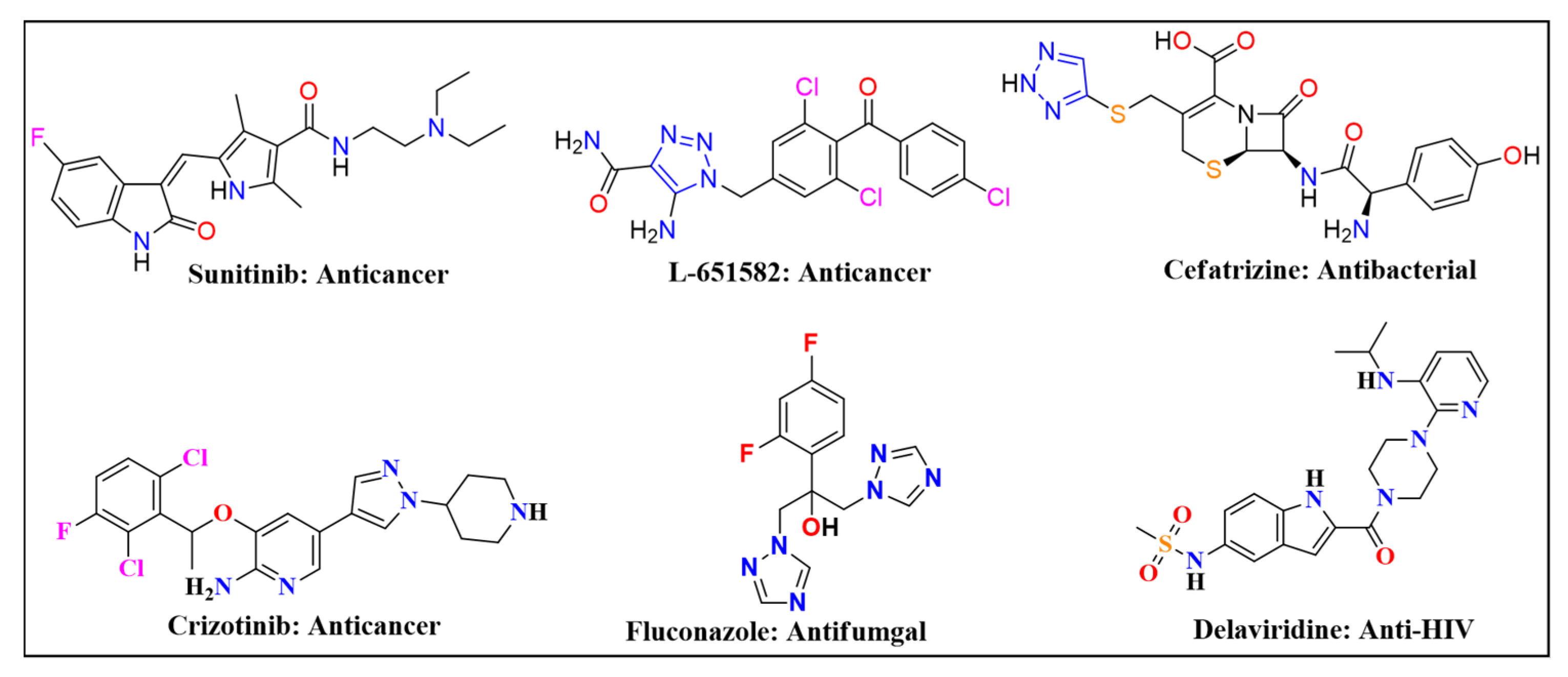
In this context, the development of small nitrogen-containing heterocyclic scaffolds, such as indole and triazole hybrids, can be promising in cancer research. The nitrogen-containing heterocyclic compounds are an integral part of medicinal chemistry by virtue of low toxicity, efficient receptor binding in biological systems, and improved aqueous solubility [3]. The literature reports indole as a synthetically versatile scaffold with promising activities against cancer, human immunodeficiency virus (HIV), tuberculosis, hypertension, diabetes, and microbial infections [4]. Bajad et al. had reviewed indole as a promising scaffold for the discovery and development of potential anti-tubercular agents targeting cell-wall synthesis and membrane depolarization in mycobacterial cells [5]. Hasan et al. have reviewed indole derivatives as a potential anticancer lead acting via kinase inhibition, apoptosis, DNA intercalation, and disruption of cell signaling pathways [6]. The antidiabetic property of indole-linked thiazolidine-2,4-dione inhibiting α-glucosidase was reported by Hu et al. [7] and Mo et al. [8]. Recently, Madarakhandi et al. have reported some hydrazide-2-oxindole derivatives as potent GSK-3β kinase inhibitors against cancer [9]. Likewise, indole [10], pyrazole [11], and triazole [12] show remarkable binding capabilities with receptors and enzymes in biological systems and elicit promising pharmacological responses against microbes, free radicals, inflammatory responses, cancer, and viruses. Sucheta et al. [13] reviewed the multifaceted biological potential of pyrazole scaffolds, while Mallisetty et al., in a separate study, reported the pyrazole-linked 1,2,4-triazole hybrid as a topoisomerase-IIa inhibitor and evaluated its antibacterial and anticancer properties against Staphylococcus aureus and MCF7 cell lines, respectively [14]. Further, the study by Glomb et al. [15], Li et al. [16], and Matta et al. [17] underscores the biological significance of pyrazole- and triazole-based scaffolds. Figure 1 depicts some clinically used indole, pyrazole, and 1,2,3-triazole hybrids.
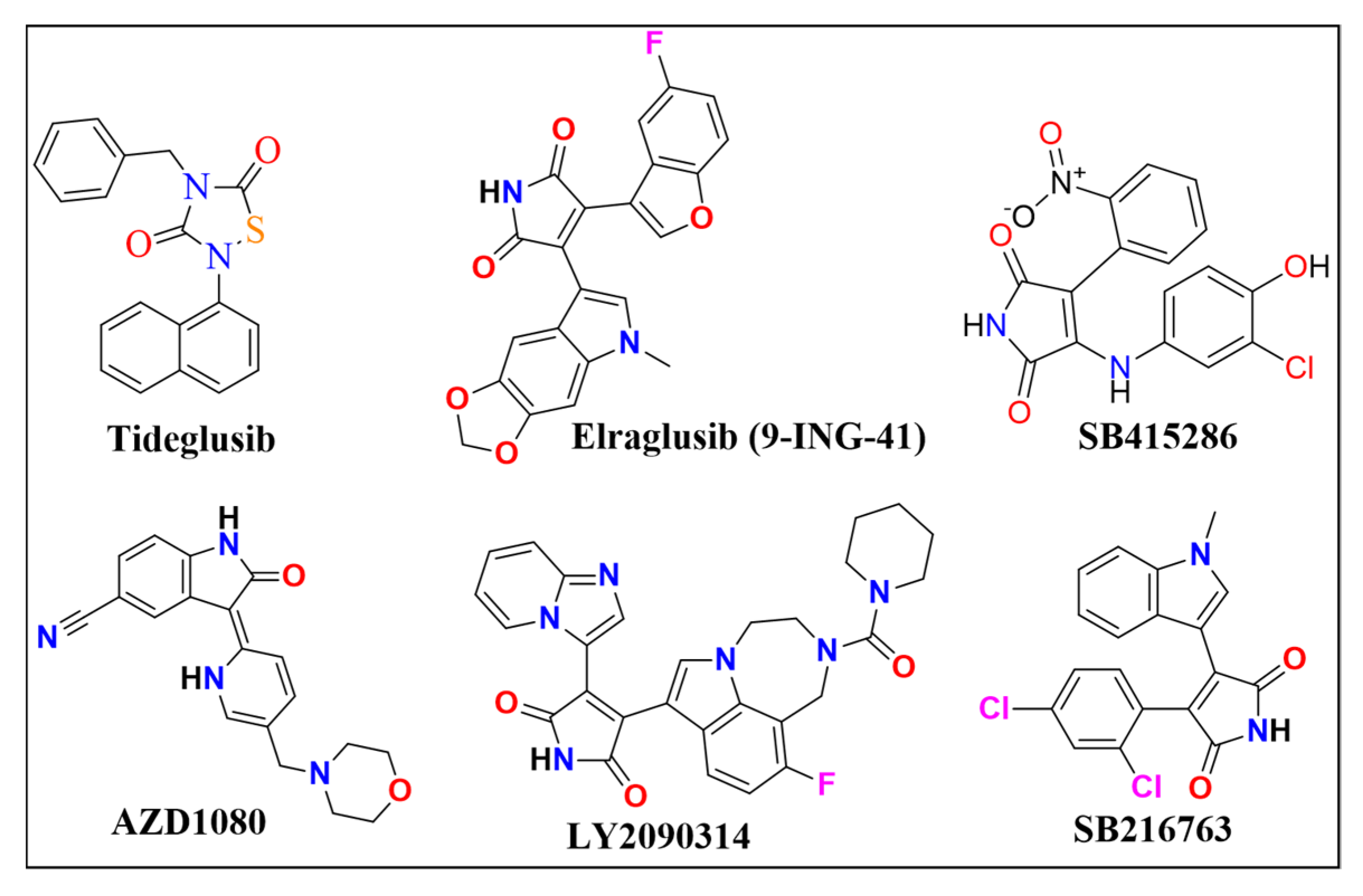
Glycogen synthase kinase-3 beta (GSK-3β) is a multifunctional serine/threonine kinase involved in several cellular functions, such as differentiation, apoptosis, and proliferation [18]. GSK-3β plays dual roles in cancer, depending on the tumor types and biochemical pathways involved. It not only suppresses tumors by blocking β-catenin in the Wnt pathway but also promotes the growth of new tumors by promoting survival signaling mediated by NF-κB and epithelial-to-mesenchymal transition [19]. GSK-3β is a possible therapeutic target because it has been shown to exhibit aberrant activation in malignancies such as glioblastoma, colorectal, and pancreatic tumors. Because of GSK-3β’s ability to alter several carcinogenic pathways, its inhibitors are being researched for anticancer treatment [20]. Considering the diverse pharmacological relevance of the indole, pyrazole, and triazole nuclei, along with the significance of GSK-3β inhibition in cancer research, we synthesized and evaluated the cytotoxicity of a series of twenty indole–triazole-linked pyrazolone derivatives in the present study. The indole-substituted triazoles were synthesized via a Cu(I)-catalyzed click reaction between indole-substituted alkynes and benzyl azides in the presence of CuSO4·5H2O and sodium ascorbate. Subsequently, substituted pyrazolones bearing an active methylene (-CH2) group were condensed with the triazole-linked 3-formyl indole derivatives in methanol using piperidine as a base catalyst to get 10AaEd [21,22,23,24,25]. Furthermore, the molecular docking of compound 10Aa was carried out against GSK-3β (PDB ID: 1Q41) to elucidate its receptor binding affinity. Figure 2 illustrates selected nitrogen-containing GSK-3β inhibitors that are clinically approved or currently under investigation.

2. Materials and Methods

2.1. Chemicals and Reagents

Spectrochem Pvt. Ltd., Bengaluru, India and BLD Pharma Hyderabad provided all chemicals and reagents. On pre-coated silica gel plates 60 F254 (Merck, Darmstadt, Germany), the progress of the reaction was monitored. A digital melting point instrument (5067/2, DBK, Mumbai, India) was used to measure melting points (m.p), which were then presented uncorrected. The 1H and 13C nuclear magnetic resonance (NMR) spectra were acquired on 400 Mega Hertz (MHz) Avance-III NMR spectrometer (Bruker, MA, USA) in deuterated dimethyl sulfoxide (DMSO-d6, 99.8%, Eurisotop, Saint-Aubin, France). The peaks’ positions (Chemical shift, J) were reported in hertz (Hz). A Fourier transform infra-red (FTIR, JASCO 460+, Tokyo, Japan) spectrophotometer was used to get FT-IR spectra. SynaptG2 QTOF high-resolution mass spectrometer (HRMS, Waters, MA, USA) was used to determine the molecular weight (M.W) of compounds 10AaEd by the electrospray ionization (ESI) method. Intermediate 1-(prop-2-yn-1-yl)-1H-indole-3-carbaldehyde (3) [21], aryl azides (5ae) [22], 1-((1-(4-substituted-benzyl)-1H-1,2,3-triazol-4-yl)methyl)-1H-indole-3-carbaldehyde (6ae) [23] and 1-substituted-3-methyl-1H-pyrazol-5(4H)-one (9ad) [24,25] were obtained as per literature. Compounds 1 (98%, BLD Pharm, Hyderabad, India), 2 (80%, Spectrochem, Mumbai, India), 4 (97%, BLD Pharm, Hyderabad, India), 7 (98%, SD Fine Chemical Limited, Mumbai, India), and 8ad (95%, BLD Pharm, Hyderabad, India) were procured commercially.

2.2. General Procedure for Synthesis of 4-((1-((1-Benzyl-1H-1,2,3-triazol-4-yl)methyl)-1H-indol-3-yl)methylene)-3-methyl-1H-pyrazol-5(4H)-one (10AaEd)

An equimolar quantity of different 1-((1-(4-substituted-benzyl)-1H-1,2,3-triazol-4-yl) methyl)-1H-indole-3-carbaldehyde (6ae) and 1-substituted-3-methyl-1H-pyrazol-5 (4H)-one (9ad) were refluxed using a catalytic amount of piperidine (98%, SD Fine Chemical Limited, Mumbai, India) in methanol (99.5%, Loba Chemie, Mumbai, India) to get respective4-((1-((1-benzyl-1H-1,2,3-triazol-4-yl)methyl)-1H-indol-3-yl)methylene)-3-met-hyl-1H-pyrazol-5 (4H)-one (10AaEd). Recrystallized the precipitated product from appropriate solvents.

2.2.1. 4-((1-((1-Benzyl-1H-1,2,3-triazol-4-yl)methyl)-1H-indol-3-yl)methylene)-3-methyl-1H-pyrazol-5(4H)-one (10Aa)

Yellow crystals, m.p: 244.0–245.1 °C, % yield: 73, IR (KBr)ν: 3145, 3121, 1670, 1585 cm−1. 1H-NMR (DMSO-d6, 400 MHZ): δ = 11.07 (1H, s, -NH), 9.78 (1H, s), 8.26 (1H, s, ar-H), 8.11–8.09 (1H, d J = 6.8Hz, ar-H), 7.90 (1H, s, ar-H), 7.74–7.72 (1H, d J = 7.6Hz, ar-H), 7.34–7.26 (7H, m, ar-H), 5.62 (2H, s, -N-CH2), 5.55 (2H, s, -N-CH2), 2.23 (3H, s, -CH3). 13C-NMR (DMSO-d6, 100 MHZ): δ = 13.43, 31.15, 42.39, 53.31, 111.88, 112.05, 119.21, 119.73, 122.65, 123.83, 124.55, 128.33, 128.62, 128.62, 129.24, 129.24, 134.90, 136.31, 136.57, 139.45, 142.81, 150.00, 166.70. M.F: C23H20N6O, HRMS m/z (ESI): [M + H]+397.1753 (397.4445).

2.2.2. 4-((1-((1-Benzyl-1H-1,2,3-triazol-4-yl)methyl)-1H-indol-3-yl)methylene)-3-methyl-1-phenyl-1H-pyrazol-5(4H)-one, (10Ab)

Orange crystals, m.p: 205.7–206.5 °C, % yield: 68, IR (KBr)ν: 3126, 3080, 1671, 1600, 1469 cm−1. 1H-NMR (DMSO-d6, 400 MHZ): δ = 9.97 (1H, s), 8.02–8.00 (2H, d J = 10.0 Hz, ar-H), 7.91–7.89 (1H, m, ar-H), 7.83 (1H, s, ar-H), 7.65–7.63 (1H, m, ar-H), 7.47–7.43 (2H, t J = 17.6 Hz, ar-H), 7.40–7.33 (6H, m, ar-H), 7.23–7.19 (3H, m, ar-H), 5.60 (2H, s, -N-CH2), 5.47 (2H, s, -N-CH2), 2.45 (3H, s, -CH3). 13C-NMR (DMSO-d6, 100 MHZ): δ = 13.48, 31.16, 42.39, 53.33, 112.12, 112.31, 118.60, 118.60, 119.17, 119.41, 123.10, 124.20, 124.59, 124.59, 128.36,128.36, 128.64, 129.26, 129.26, 129.26, 134.90, 136.30, 136.72, 137.08, 139.24, 140.69, 142.72, 151.53, 163.21. M.F: C29H24N6O, HRMS m/z (ESI): [M + H]+ 473.2061 (473.5405).

2.2.3. 4-((1-((1-Benzyl-1H-1,2,3-triazol-4-yl)methyl)-1H-indol-3-yl)methylene)-3-methyl-1-(p-tolyl)-1H-pyrazol-5(4H)-one, (10Ac)

Yellow powder, m.p: 228.6–229.1 °C, % yield: 71, IR (KBr) ν: 3100, 3064, 1668, 1602, 1469 cm−1. 1H-NMR (DMSO-d6, 400 MHZ): δ = 9.97 (1H, s), 7.91–7.85 (3H, m, ar-H), 7.82 (1H, s, ar-H), 7.64–7.62 (1H, m, ar-H), 7.54 (1H, s, ar-H), 7.40–7.34 (6H, m, ar-H), 7.26–7.21 (3H, m, ar-H), 5.60 (2H, s, -N-CH2), 5.47 (2H, s, -N-CH2), 2.44 (3H, s, -CH3), 2.39 (3H, s, -CH3). 13C-NMR (DMSO-d6, 100 MHZ): δ = 13.45, 20.96, 31.15, 42.53, 53.33, 112.12, 112.31, 118.60, 118.60, 119.17, 119.41, 123.10, 124.20, 124.59, 124.59, 128.36,128.36, 128.64, 129.26, 129.26, 129.26, 134.90, 136.30, 136.72, 137.08, 139.24, 140.69, 142.72, 151.53, 163.21. M.F: C30H26N6O, HRMS m/z (ESI): [M + H]+ 487.2153 (487.5670).

2.2.4. 4-((1-((1-Benzyl-1H-1,2,3-triazol-4-yl)methyl)-1H-indol-3-yl)methylene)-3-methyl-1-(4-nitrophenyl)-1H-pyrazol-5(4H)-one, (10Ad)

Green powder, m.p: 242.6–244.1 °C, % yield: 78, IR (KBr)ν: 3110, 3052, 1681, 1469, 1351 cm−1. 1H-NMR (DMSO-d6, 400 MHZ): δ = 9.91 (1H, s), 8.33 (4H, s, ar-H), 7.91–7.87 (2H, m, ar-H), 7.67–7.65 (1H, m, ar-H), 7.41–7.35 (6H, m, ar-H), 7.25–7.23 (2H, m, ar-H), 5.63 (2H, s, -N-CH2), 5.50 (2H, s, -N-CH2), 2.47 (3H, s, -CH3). 13C-NMR (DMSO-d6, 100 MHZ): δ = 13.15, 31.15, 42.65, 53.35, 112.45, 112.45, 117.62, 117.62, 117.89, 123.39, 124.62, 124.62, 125.51, 125.51, 128.39, 128.39, 128.39, 128.66, 129.30, 129.30, 129.30, 129.30, 136.81, 138.34, 142.61, 153.75. M.F: C29H23N7O3, HRMS m/z (ESI): [M + H]+518.1940 (518.5380).

2.2.5. 4-((1-((1-(4-Chlorobenzyl)-1H-1,2,3-triazol-4-yl)methyl)-1H-indol-3-yl)methylene)-3-methyl-1H-pyrazol-5(4H)-one, (10Ba)

Orange powder, m.p: 260.1–261.5 °C, % yield: 63, IR (KBr)ν: 3118, 2980, 1670, 1578 cm−1. 1H-NMR (DMSO-d6, 400 MHZ): δ = 11.06 (1H, s, -NH), 9.81 (1H, s), 8.29 (1H, s, ar-H), 8.13–8.11 (1H, d J = 8.8Hz, ar-H), 7.89 (1H, s, ar-H), 7.76–7.74 (1H, d J = 8.8Hz, ar-H), 7.43–7.41 (2H, d J = 8.4Hz, ar-H), 7.35–7.30 (4H, m, ar-H), 5.65 (2H, s, -N-CH2), 5.58 (2H, s, -N-CH2), 2.25 (3H, s, -CH3). 13C-NMR (DMSO-d6, 100 MHZ): δ = 13.43, 31.15, 42.36, 52.52, 111.89, 112.03, 119.22, 119.73, 122.66, 123.85, 124.65, 129.15, 129.15,129.15, 130.31, 130.31, 130.31,133.35, 134.91, 136.59, 139.41, 142.82, 150.01, 166.71.M.F: C23H19ClN6O, HRMS m/z (ESI): [M + H]+431.1393 (431.8896).

2.2.6. 4-((1-((1-(4-Chlorobenzyl)-1H-1,2,3-triazol-4-yl)methyl)-1H-indol-3-yl)methylene)-3-methyl-1-phenyl-1H-pyrazol-5(4H)-one, (10Bb)

Orange crystals, m.p: 203.2–204.1 °C, % yield: 70, IR (KBr)ν: 3104, 3068, 1675, 1597, 1437 cm−1. 1H-NMR (DMSO-d6, 400 MHZ): δ = 9.97 (1H, s), 8.01–7.99 (2H, d J = 8.8 Hz, ar-H), 7.91–7.89 (1H, m, ar-H), 7.83 (1H, s, ar-H), 7.63–7.61 (1H, m, ar-H), 7.48–7.44 (2H, t J = 16.0 Hz, ar-H), 7.39–7.37 (3H, m, ar-H), 7.33–7.30 (2H, m, ar-H), 7.23–7.20 (1H, t J = 15.8 Hz, ar-H), 7.17–7.15 (2H, d J = 8.4 Hz, ar-H), 5.60 (2H, s, -N-CH2), 5.44 (2H, s, -N-CH2), 2.45 (3H, s, -CH3). 13C-NMR (DMSO-d6, 100 MHZ): δ = 13.48, 31.15, 42.51, 52.53, 112.12, 112.30, 118.62, 118.62, 119.18, 119.41, 123.10, 124.21, 124.60, 124.66, 129.21, 129.21,129.21, 129.26, 130.32, 130.32,130.32, 133.35, 136.28, 136.73, 137.07, 139.23, 140.66, 142.76, 151.52, 163.21. M.F: C29H23ClN6O, HRMS m/z (ESI): [M] 506.1718 (506.9855).

2.2.7. 4-((1-((1-(4-Chlorobenzyl)-1H-1,2,3-triazol-4-yl)methyl)-1H-indol-3-yl)methylene)-3-methyl-1-(p-tolyl)-1H-pyrazol-5(4H)-one, (10Bc)

Orange crystals, m.p: 216.3–217.1 °C, % yield: 74, IR (KBr)ν: 3108, 3055, 1668, 1600, 1469 cm−1. 1H-NMR (DMSO-d6, 400 MHZ): δ = 9.97 (1H, s), 7.91–7.82 (4H, m, ar-H), 7.63–7.61 (1H, m, ar-H), 7.39–7.36 (3H, m, ar-H), 7.32–7.29 (2H, m, ar-H), 7.26–7.24 (2H, m, ar-H), 7.17–7.15 (2H, d J = 8.0 Hz, ar-H), 5.60 (2H, s, -N-CH2), 5.44 (2H, s, -N-CH2), 2.44 (3H, s, -CH3), 2.39 (3H, s, -CH3). 13C-NMR (DMSO-d6, 100 MHZ): δ = 13.45, 20.96, 31.15, 42.48, 52.52, 112.08, 112.28, 118.66, 118.66, 119.32, 119.40, 123.07, 124.18, 124.68, 129.21, 129.21, 129.21, 129.28, 129.65, 129.65, 130.30, 130.30, 133.34, 133.65, 135.29, 136.72, 136.89, 140.58, 142.76, 151.24, 163.00. M.F: C30H25ClN6O, HRMS m/z (ESI): [M] 521.1871 (521.0121).

2.2.8. 4-((1-((1-(4-Chlorobenzyl)-1H-1,2,3-triazol-4-yl)methyl)-1H-indol-3-yl)methylene)-3-methyl-1-(4-nitrophenyl)-1H-pyrazol-5(4H)-one, (10Bd)

Green powder, m.p: 251.3–252.9 °C, % yield: 68, IR (KBr)ν: 3130, 1672, 1590, 1321 cm−1. 1H-NMR (DMSO-d6, 400 MHZ): δ = 9.91 (1H, s), 8.35 (4H, s, ar-H), 7.92–7.87 (1H, m, ar-H), 7.66–7.63 (1H, m, ar-H), 7.42–7.40 (3H, m, ar-H), 7.34–7.32 (3H, m, ar-H), 7.19–7.17 (2H, d J = 8.4 Hz, ar-H), 5.63 (2H, s, -N-CH2), 5.47 (2H, s, -N-CH2), 2.47 (3H, s, -CH3). 13C-NMR (DMSO-d6, 100 MHZ): δ = 13.62, 42.64, 52.52, 112.46, 112.46, 117.60, 117.95, 119.54, 123.29, 124.33, 124.70, 125.52, 129.21, 129.21, 129.21, 129.21, 129.21, 130.36, 130.36, 130.36, 130.36, 133.34, 135.28, 136.83, 141.20, 142.70, 144.36, 148.27, 159.33. M.F: C29H22ClN7O3, HRMS m/z (ESI): [M + H]+ 552.1574 (552.9831).

2.2.9. 3-Methyl-4-((1-((1-(4-methylbenzyl)-1H-1,2,3-triazol-4-yl)methyl)-1H-indol-3-yl)methylene)-1H-pyrazol-5(4H)-one, (10Ca)

Yellow crystals, m.p: 237.8–239.2 °C, % yield: 67, IR (KBr)ν: 3111, 3040, 1671, 1585, 1468 cm−1. 1H-NMR (DMSO-d6, 400 MHZ): δ = 11.06 (1H, s, -NH), 9.82 (1H, s), 8.22 (1H, s, ar-H), 8.13–8.11 (1H, m, ar-H), 7.89 (1H, s, ar-H), 7.77–7.74 (1H, m, ar-H), 7.35–7.29 (2H, m, ar-H), 7.20–7.18 (4H, m, ar-H), 5.64 (2H, s, -N-CH2), 5.51 (2H, s, -N-CH2), 2.27 (3H, s, -CH3), 2.25 (3H, s, -CH3). 13C-NMR (DMSO-d6, 100 MHZ): δ = 13.43, 21.13, 31.35, 53.13, 111.87, 119.26, 119.79, 122.65, 123.84, 124.35, 128.41, 128.41, 128.41, 129.15, 129.77, 129.77, 129.77, 133.28, 134.97, 136.64, 138.09, 139.46, 142.78, 150.01. M.F: C24H22N6O, HRMS m/z (ESI): [M + H]+ 411.1936 (411.4711).

2.2.10. 3-Methyl-4-((1-((1-(4-methylbenzyl)-1H-1,2,3-triazol-4-yl)methyl)-1H-indol-3-yl)methylene)-1-phenyl-1H-pyrazol-5(4H)-one, (10Cb)

Yellow powder, m.p: 204.8–206.1 °C, % yield: 60, IR (KBr)ν: 3114, 3061, 1671, 1597, 1488 cm−1. 1H-NMR (DMSO-d6, 400 MHZ): δ = 9.96 (1H, s), 8.02–7.99 (2H, d J = 9.6 Hz, ar-H), 7.91–7.88 (1H, m, ar-H), 7.83 (1H, s, ar-H), 7.65–7.63 (1H, m, ar-H), 7.47–7.43 (2H, t J = 16.0 Hz, ar-H), 7.39–7.36 (2H, m, ar-H), 7.34 (1H, s, ar-H), 7.23–7.19 (2H, t J = 15.4 Hz, ar-H), 7.16–7.11 (3H, m, ar-H), 5.59 (2H, s, -N-CH2), 5.42 (2H, s, -N-CH2), 2.45 (3H, s, -CH3), 2.33 (3H, s, -CH3). 13C-NMR (DMSO-d6,100 MHZ): δ = 13.48, 21.11, 31.15, 42.51, 53.13, 112.11, 112.31, 118.61, 118.61, 119.17, 119.41, 123.10, 124.20, 124.43, 124.59, 128,40, 128.40, 129.26, 129.26,129.26, 129.76, 129.76,129.76, 133.27, 136.75, 137.09, 138.00, 139.24, 140.68, 142.68, 151.53. M.F: C30H26N6O, HRMS m/z (ESI): [M + H]+ 487.2221 (487.5670).

2.2.11. 3-Methyl-4-((1-((1-(4-methylbenzyl)-1H-1,2,3-triazol-4-yl)methyl)-1H-indol-3-yl)methylene)-1-(p-tolyl)-1H-pyrazol-5(4H)-one, (10Cc)

Yellow powder, m.p: 228.9–230.1 °C, % yield: 62, IR (KBr)ν: 3108, 3061, 1669, 1600, 1469 cm−1. 1H-NMR (DMSO-d6, 400 MHZ): δ = 9.96 (1H, s), 7.90–7.82 (4H, m, ar-H), 7.65–7.63 (1H, m, ar-H), 7.38–7.33 (4H, m, ar-H), 7.24 (3H, s, ar-H), 7.17–7.11 (4H, m, ar-H), 5.59 (2H, s, -N-CH2), 5.42 (2H, s, -N-CH2), 2.44 (3H, s, -CH3), 2.39 (3H, s, -CH3), 2.33 (3H, s, -CH3). 13C-NMR (DMSO-d6, 100 MHZ): δ = 13.44, 21.10, 21.10, 31.15, 53.13, 112.42, 118.04, 118.04, 118.65, 118.65, 119.31, 119.39, 123.04, 124.43, 128.39, 128.39, 128.39, 129.27, 129.65, 129.65, 129.76, 129.76, 129.76, 133.27, 133.62, 134.10, 136.88, 137.99, 140.60, 142.69, 151.25. M.F: C31H28N6O, HRMS m/z (ESI): [M + H]+ 501.2451 (501.5936).

2.2.12. 3-Methyl-4-((1-((1-(4-methylbenzyl)-1H-1,2,3-triazol-4-yl)methyl)-1H-indol-3-yl)methylene)-1-(4-nitrophenyl)-1H-pyrazol-5(4H)-one, (10Cd)

Yellow powder, m.p: 266.4–268.1 °C, % yield: 69, IR (KBr)ν: 3119, 1670, 1590, 1468, 1324 cm−1. 1H-NMR (DMSO-d6, 400 MHZ): δ = 9.90 (1H, s), 8.35 (4H, s, ar-H), 7.91–7.87 (2H, m, ar-H), 7.67–7.65 (1H, m, ar-H), 7.41–7.38 (3H, m, ar-H), 7.17–7.13 (4H, m, ar-H), 5.61 (2H, s, -N-CH2), 5.45 (2H, s, -N-CH2), 2.47 (3H, s, -CH3), 2.34 (3H, s, -CH3). 13C-NMR (DMSO-d6, 100 MHZ): δ = 13.63, 21.13, 53.13, 112.51, 112.51, 117.62, 117.62, 117.90, 119.56, 123.30, 124.44, 124.44, 125.54, 125.54, 128.45, 128.45, 128.45, 129.75, 129.75, 129.75, 129.75, 133.31, 136.85, 138.40, 142.59, 143.09, 149.32, 149.32, 151.47, 153.75. M.F: C30H25N7O3, HRMS m/z (ESI): [M + H]+ 532.2106 (532.5646).

2.2.13. 4-((1-((1-(4-Methoxybenzyl)-1H-1,2,3-triazol-4-yl)methyl)-1H-indol-3-yl)methylene)-3-methyl-1H-pyrazol-5(4H)-one, (10Da)

Orange crystals, m.p: 223.8–225.1 °C, % yield: 64, IR (KBr)ν: 3132, 2947, 1678, 1590 cm−1. 1H-NMR (DMSO-d6, 400 MHZ): δ = 9.87 (1H, s), 8.59 (1H, s, ar-H), 7.88–7.86 (1H, d J = 8.8Hz, ar-H), 7.89 (1H, s, ar-H), 7.63–7.61 (1H, d J = 8.8Hz, ar-H), 7.37–7.33 (3H, m, ar-H), 7.20–7.18 (2H, d J = 8.8Hz, ar-H), 5.57 (2H, s, -N-CH2), 5.41 (2H, s, -N-CH2), 3.81 (3H, s, -OCH3), 2.34 (3H, s, -CH3). 13C-NMR (DMSO-d6, 100 MHZ): δ = 13.43, 31.15, 42.38, 52.88, 55.58, 111.87, 112.06, 114.59, 114.59, 119.21, 119.73, 122.64, 123.84, 124.16, 128.20, 129.14, 130.05, 130.05, 134.90, 136.57, 139.45, 142.77, 150.01, 159.59, 166.70. M.F: C24H22N6O2, HRMS m/z (ESI): [M + H]+ 427.1900 (427.4705).

2.2.14. 4-((1-((1-(4-Methoxybenzyl)-1H-1,2,3-triazol-4-yl)methyl)-1H-indol-3-yl)methylene)-3-methyl-1-phenyl-1H-pyrazol-5(4H)-one, (10Db)

Yellow powder, m.p: 201.1–202.3 °C, % yield: 66, IR (KBr)ν: 3110, 3064, 1670, 1595, 1438 cm−1. 1H-NMR (DMSO-d6, 400 MHZ): δ = 9.95 (1H, s), 8.02–8.00 (2H, d J = 9.6 Hz, ar-H), 7.91–7.88 (1H, m, ar-H), 7.83 (1H, s, ar-H), 7.65–7.63 (1H, m, ar-H), 7.47–7.43 (2H, t J = 16.0 Hz, ar-H), 7.39–7.36 (2H, m, ar-H), 7.33 (1H, s, ar-H), 7.23–7.17 (3H, m, ar-H), 6.87–6.85 (2H, d J = 8.8 Hz, ar-H), 5.58 (2H, s, -N-CH2), 5.40 (2H, s, -N-CH2), 3.78 (3H, s, -OCH3), 2.45 (3H, s, -CH3). 13C-NMR (DMSO-d6, 100 MHZ): δ = 13.47, 31.15, 42.52, 52.89, 55.54, 112.11, 112.31, 114.57, 114.57, 114.57, 118.57, 118.57, 119.17, 119.40, 123.09, 124.23, 123.57, 128.18, 129.26, 129.26, 130.06, 130.06, 130.06, 136.72, 137.06, 139.25, 140.68, 142.67, 151.52, 159.58, 163.21. M.F: C30H26N6O2, HRMS m/z (ESI): [M + H]+503.2213 (503.5664).

2.2.15. 4-((1-((1-(4-Methoxybenzyl)-1H-1,2,3-triazol-4-yl)methyl)-1H-indol-3-yl)methylene)-3-methyl-1-(p-tolyl)-1H-pyrazol-5(4H)-one, (10Dc)

Yellow powder, m.p: 224.6–226.1 °C, % yield: 65, IR (KBr)ν: 3107, 3055, 1670, 1602, 1469 cm−1.1H-NMR (DMSO-d6, 400 MHZ): δ = 9.96 (1H, s), 7.89–7.86 (3H, m, ar-H), 7.82 (1H, s, ar-H), 7.65–7.63 (1H, m, ar-H), 7.38–7.36 (2H, s, ar-H), 7.32 (1H, s, ar-H), 7.26–7.24 (2H, m, ar-H), 7.19–7.17 (2H, d J = 8.4 Hz, ar-H), 6.87–6.85 (2H, d J = 8.8 Hz, ar-H), 5.58 (2H, s, -N-CH2), 5.40 (2H, s, -N-CH2), 3.79 (3H, s, -OCH3), 2.44 (3H, s, -CH3), 2.39 (3H, s, -CH3). 13C-NMR (DMSO-d6, 100 MHZ): δ = 13,45, 20.96, 31.15, 42.50, 52.89, 55.54, 112.07, 112.30, 114.57, 114.57, 118.59, 118.59, 119.31, 119.38, 123.05, 124.14, 124.22, 128.18, 129.27, 129.65, 129.65, 130.06, 130.06, 130.06, 133.61, 136.71, 136.92, 140.61, 142.69, 151.25, 159.58, 162.99. M.F: C31H28N6O2, HRMS m/z (ESI): [M + H]+ 517.2357 (517.5930).

2.2.16. 4-((1-((1-(4-Methoxybenzyl)-1H-1,2,3-triazol-4-yl)methyl)-1H-indol-3-yl)methylene)-3-methyl-1-(4-nitrophenyl)-1H-pyrazol-5(4H)-one, (10Dd)

Yellow powder, m.p: 223.8–225.2 °C, % yield: 67, IR (KBr)ν: 3145, 3105, 1685, 1591, 1320 cm−1. 1H-NMR (DMSO-d6, 400 MHZ): δ = 9.90 (1H, s), 8.33 (4H, s, ar-H), 7.91–7.87 (2H, m, ar-H), 7.68–7.65 (1H, m, ar-H), 7.41–7.37 (3H, m, ar-H), 7.21–7.19 (2H, d J = 8.4 Hz, ar-H), 6.89–6.86 (2H, d J = 8.8 Hz, ar-H), 5.61 (2H, s, -N-CH2), 5.43 (2H, s, -N-CH2), 3.79 (3H, s, -OCH3), 2.47 (3H, s, -CH3). 13C-NMR (DMSO-d6, 100 MHZ): δ = 13.58, 31.15, 42.61, 52.91, 55.54, 112.44, 114.56, 114.56, 117.58, 117.58, 117.86, 119.50, 123.37, 124.28, 124.46, 125.49, 128.16, 129.26, 130.09, 130.09, 130.09, 136.80, 138.28, 141.30, 142.55, 142.95, 144.35, 153.04, 153.73, 159.58, 163.97. M.F: C30H26N7O4, HRMS m/z (ESI): [M + H]+ 548.2011 (548.5640).

2.2.17. 3-Methyl-4-((1-((1-(4-nitrobenzyl)-1H-1,2,3-triazol-4-yl)methyl)-1H-indol-3-yl)methylene)-1H-pyrazol-5(4H)-one, (10Ea)

Yellow powder, m.p: 279.7–280.9 °C, % yield: 65, IR (KBr)ν: 3172, 3118, 1666, 1440, 1348 cm−1. 1H-NMR (DMSO-d6, 400 MHZ): δ = 11.08 (1H, s, -NH), 9.79 (1H, s), 8.33 (1H, s, ar-H), 8.21–8.18 (2H, d J = 8.8Hz, ar-H), 8.12–8.10 (1H, d J = 8.8Hz, ar-H), 7.90 (1H, s, ar-H), 7.75–7.73 (1H, d J = 8.8Hz, ar-H), 7.51–7.49 (2H, d J = 8.8Hz, ar-H), 7.35–7.32 (2H, m, ar-H), 5.74 (2H, s, -N-CH2), 5.65 (2H, s, -N-CH2), 2.23 (3H, s, -CH3). 13C-NMR (DMSO-d6, 100 MHZ): δ =13.43, 31.15, 42.35, 52.44, 111.90, 112.03, 119.23, 119.75, 122.67, 123.87, 124.36, 124.36, 125.01, 129.15, 129.49, 129.49, 134.91, 136.59, 139.40, 142.96, 143.70, 147.71, 150.02, 166.71. M.F: C23H19N7O3, HRMS m/z (ESI): [M + H]+ 442.1632 (442.4421).

2.2.18. 3-Methyl-4-((1-((1-(4-nitrobenzyl)-1H-1,2,3-triazol-4-yl)methyl)-1H-indol-3-yl)methylene)-1-phenyl-1H-pyrazol-5(4H)-one, (10Eb)

Orange crystals, m.p: 232.6–234.7 °C, % yield: 65, IR (KBr)ν: 3107, 3073, 1664, 1595, 1334 cm−1. 1H-NMR (DMSO-d6, 400 MHZ): δ = 9.97 (1H, s), 8.20–8.17 (2H, d J = 13.6 Hz, ar-H), 8.00–7.97 (2H, d J = 9.6 Hz, ar-H), 7.92–7.90 (1H, m, ar-H), 7.83 (1H, s, ar-H), 7.62–7.60 (1H, m, ar-H), 7.47–7.43 (3H, t J = 16.0 Hz, ar-H), 7.40–7.35 (4H, m, ar-H), 7.23–7.19 (1H, t J = 16.0 Hz, ar-H), 5.63 (2H, s, -N-CH2), 5.58 (2H, s, -N-CH2), 2.45 (3H, s, -CH3). 13C-NMR (DMSO-d6, 100 MHZ): δ =13.48, 31.15, 42.33, 52.44, 112.14, 112.30, 118.60, 118.60, 119.21, 119.43, 123.12, 124.24, 124.35, 124.35, 124.59, 125.05, 129.25, 129.25, 129.48, 129.48,136.74, 137.08, 139.21, 140.66, 140.66, 142.89, 143.69, 146.79, 147.68, 151.53, 163.22. M.F: C29H23N7O3, HRMS m/z (ESI): [M + H]+ 518.1981 (518.5380).

2.2.19. 3-Methyl-4-((1-((1-(4-nitrobenzyl)-1H-1,2,3-triazol-4-yl)methyl)-1H-indol-3-yl)methylene)-1-(p-tolyl)-1H-pyrazol-5(4H)-one, (10Ec)

Orange crystals, m.p: 208.3–209.5 °C, % yield: 60, IR (KBr)ν: 3146, 3110, 1671, 1467, 1351 cm−1. 1H-NMR (DMSO-d6, 400 MHZ): δ = 9.98 (1H, s), 8.20–8.18 (2H, d J = 8.8 Hz, ar-H), 7.92–7.90 (1H, m, ar-H), 7.85–7.82 (3H, m, ar-H), 7.62–7.60 (1H, m, ar-H), 7.43 (1H, s, ar-H), 7.40–7.36 (4H, m, ar-H), 7.26–7.24 (2H, d J = 8.0 Hz, ar-H), 5.63 (2H, s, -N-CH2), 5.58 (2H, s, -N-CH2), 2.44 (3H, s, -CH3), 2.39 (3H, s, -CH3). 13C-NMR (DMSO-d6, 100 MHZ): δ =13.44, 20.95, 31.15, 42.48, 52.44, 112.10, 112.27, 118.62, 118.62, 119.35, 119.40, 123.08, 124.20, 124.20, 124.35, 125.06, 129.28, 129.28, 129.46, 129.46, 129.46, 129.63, 133.64, 136.73, 136.88, 140.56, 142.89, 143.68, 147.68, 151.25, 163.00. M.F: C30H25N7O3, HRMS m/z (ESI): [M + H]+ 532.2106 (532.5646).

2.2.20. 3-Methyl-4-((1-((1-(4-nitrobenzyl)-1H-1,2,3-triazol-4-yl)methyl)-1H-indol-3-yl)methylene)-1-(4-nitrophenyl)-1H-pyrazol-5(4H)-one, (10Ed)

Orange powder, m.p: 279.8–281.2 °C, % yield: 60, IR (KBr)ν: 3136, 3112, 1682, 1589 cm−1. 1H-NMR (DMSO-d6, 400 MHZ): δ = 9.83 (1H, s), 8.39 (1H, s, ar-H), 8.32–8.25 (4H, m, ar-H), 8.19–8.13 (4H, m, ar-H), 7.82–7.79 (1H, d J = 8.8 Hz, ar-H), 7.50–7.48 (2H, d J = 8.8 Hz, ar-H), 7.41–7.35 (2H, m, ar-H), 5.76 (2H, s, -N-CH2), 5.74 (2H, s, -N-CH2), 2.43 (3H, s, -CH3). 13C-NMR (DMSO-d6, 100 MHZ): δ = 13.61, 42.62, 52.43, 112.48, 117.54, 117.93, 119.55, 123.33, 124.36, 124.36, 124.36, 125.11, 125.48, 125.48, 129.30, 129.30, 129.30, 129.49, 129.49, 136.85, 138.29, 141.29, 142.83, 142.94, 143.75, 144.36, 147.67, 153.69, 163.96.

2.3. Biological Investigations

2.3.1. Cancer Cell Lines

The American Type Culture Collection (ATCC, Manassas, VA, USA) provided the human cancer cell lines Capan-1, HCT-116, NCI-H460, LN-229, HL-60, K-562, MOLT4, and Z-138. All cell lines were stored in accordance with the suppliers’ instructions. Gibco (Gibco Life Technologies, Merelbeke, Belgium) provided the culture media, which were supplemented with 10% fetal bovine serum (HyClone, Cytiva, Marlborough, MA, USA). The reference and test molecules were dissolved in DMSO (99.5%, Sigma, Hoeilaart, Belgium) to a concentration of 100 micromolar (µM).

2.3.2. Cytotoxicity Assays

Adherent cells were seeded at densities between 500 and 1500 cells/well in 384-well plates (Greiner Bio-One, Vilvoorde, Belgium). After 24 h of incubation, cells were exposed to seven varying concentrations of the test compounds (100–0.006 µM). The untreated cells served as negative controls. Suspension cell lines (non-adherent) were placed at densities between 2500 and 5000 cells/well in 384-well culture plates with the test compounds of the same concentration (100 to 0.006 µM). All cell lines were incubated for 72 h with test compounds and were subsequently assessed using the Cell Titer 96® AQueous One Solution Cell Proliferation Assay (MTS) reagent (Promega, Leiden, Netherlands) following the supplier’s guidelines. The absorbance was recorded at 490 nanometers (nm) with a SpectraMaxPlus 384 (Molecular Devices, San Jose, CA, USA), and optical density (OD) was measured to determine the 50% cytotoxic concentration (CC50) of test compounds. All experiments were performed in triplicate [26], Table 2.

2.3.3. GSK-3β Inhibition Assay

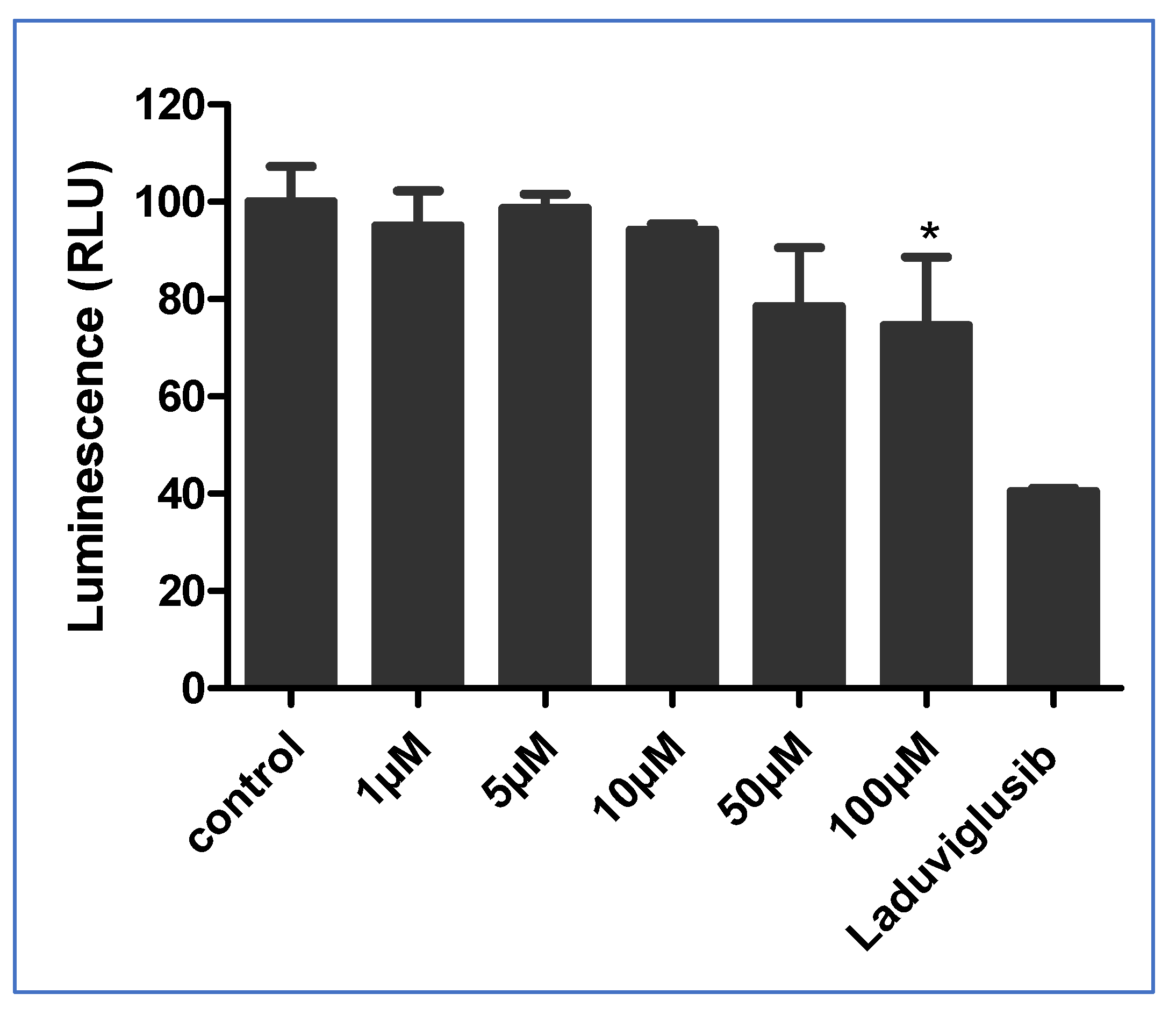
This assay was performed using the GSK-3β Kinase Enzyme System (Promega V1991, Madison, WI, USA) and ADP-Glo Kinase Assay (Promega V6930, Madison, USA) kits. A reaction mix was prepared using 1X reaction buffer, 50 µM ATP, 50 µM DTT, 1 µg/µL GSK3β substrate, and 0.5 ng/µL GSK3β enzyme with increasing concentrations of 10Aa drug dissolved in DMSO. A reaction mix containing DMSO served as the vehicle control, and 12 nM Laduviglusib (MedChemExpress, New Jersey, USA), a GSK-3β inhibitor, was used as a positive control for the experiment. This reaction mix was incubated for 60 min at room temperature. Following incubation, 5 µL of ADP-Glo Reagent was added and incubated additionally for 40 min at room temperature. Following this, 10 µL of kinase detection reagent was added, and the mixture was incubated for 30 min at room temperature. Luminescence was measured using a microplate reader with an integration time of 0.5 s [9] (Figure 3).

2.3.4. InSilico Study [27,28,29]

Drug-Likeness and InSilico Absorption, Distribution, Metabolism, Excretion, and Toxicity (ADMET) Prediction
The physicochemical and pharmacokinetic parameters, such as molecular weight, hydrogen-bond donors (HBD), hydrogen-bond acceptors (HBA), lipophilicity (Log P), solubility, and compliance with Lipinski’s rule of five (RO5), along with bioavailability, gastrointestinal (GI) absorption, and toxicity profiles of the synthesized derivatives 10Aa-Ed, were predicted using Swiss-ADME (version-23, University of Lausanne and the SIB Swiss Institute of Bioinformatics, Switzerland) [27]. The blood–brain barrier (BBB) permeability and unbound fraction were also evaluated, together with CYP1A2 substrate binding affinity and half-lives. Toxicity indicators, including overall safety and skin sensitization potential, were predicted and summarized in Table 3 and in the Supplementary (S80–S99).
Protein Preparation
The crystal structure of the protein was retrieved from the PDB and prepared by removing co-crystallized ligands, buffer ions, and non-essential water molecules. The catalytic or structural waters known to mediate conserved H-bonding with the reference ligand were retained with the structures. Missing side-chain atoms were rebuilt and locally optimized. The polar hydrogens were added, and receptor protonation was set for pH 7.4. Gasteiger charges were assigned for docking compatibility [28,29].
Docking Protocol
The ligand molecules 10AaEd and bioacetoxime were sketched using Chem Draw-Version 20.1 and subjected to energy minimization in Chem3D (v20.0, PerkinElmer Inc., Waltham, MA, USA). Molecular docking was performed utilizing PyRx v.0.8 software (Source Forge, San Diego, CA, USA; AutoDockVina engine). The binding orientations and interaction profiles were analyzed in BIOVIA Discovery Studio Visualizer 2021 (Dassault Systèmes Biovia Corp., San Diego, CA, USA). The docking protocol was validated by re-docking with native ligands into their specific binding sites, with an acceptance criterion of RMSD ≤ 2.0 Å. The MM-GBSA binding free-energy computations were carried out on snapshots taken from molecular dynamics trajectories utilizing the g_mmpbsa package (a GROMACS-compatible version of MM-PBSA/MM-GBSA) to obtain refined ΔG_bind estimates. The pharmacokinetic and drug-likeness evaluations were conducted through Swiss-ADME (Swiss Institute of Bioinformatics, Lausanne, Switzerland) and pkCSM (Bioinformatics & Computational Biology Biosig Lab, The University of Queensland, Brisbane, Australia), facilitating the prediction of physicochemical characteristics, ADMET profiles, and overall drug-likeness potential (Figures 4–7, Table 4).
MM-GBSA Binding Free Energy Calculations
Refined binding free energies (ΔG_bind) were calculated using the MM-GBSA method implemented in Schrödinger Prime (release 2023-1, Schrodinger, Mangaluru, India). Snapshots from the MD trajectories were used to derive ligand-protein binding free-energy estimates. Calculations were performed on 200 snapshots per replica (last 40 ns, stride = 0.2 ns) using the VSGB 2.1 solvation model, with ligand- and receptor-reparametrized partial charges consistent with CHARMM36 mapping. Results were reported as mean ± SD. MM-PBSA calculations were performed on snapshots extracted every 0.2 ns from the last 40 ns of each replica (≥200 frames/replica), using a Poisson-Boltzmann polar solvation term and a SASA-based non-polar term. For each complex, the per-frame ΔG_bind(t) traces and the time-averaged ΔG_bind ± SD across replicas convergence were checked via block-averaging (Table 5).

3. Results and Discussion

3.1. Chemistry

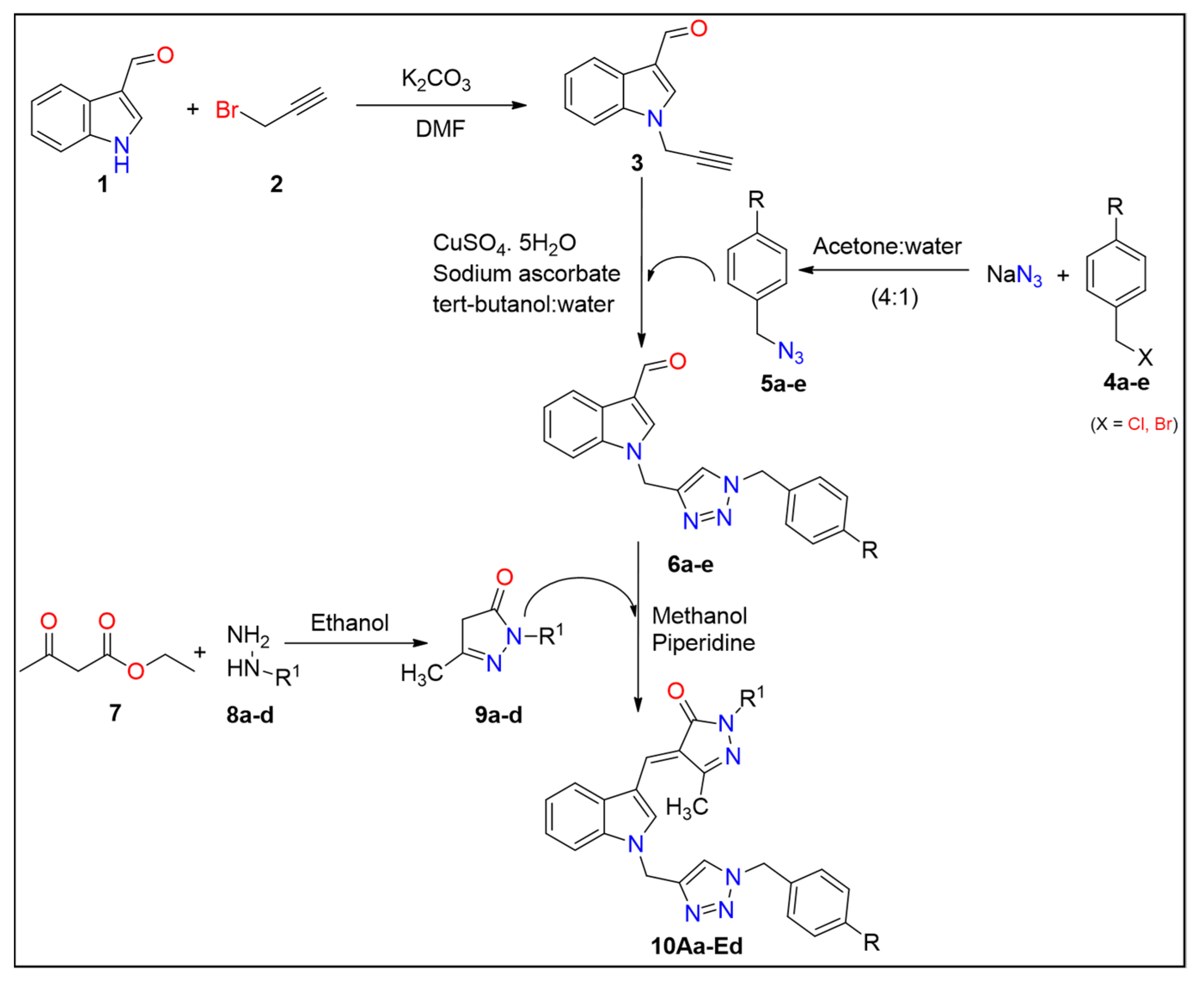
The compound 2-(3-formyl-1H-indol-1-yl)acetonitrile (3) was synthesized by reacting 3-formylindole (1) with propargyl bromide (2) in dimethylformamide (DMF, 99%, SD Fine Chemical, Bengaluru, India) using potassium carbonate (100%, SD Fine Chemical, Bengaluru, India) as a base. The respective intermediates 1-((1-aralkyl-1H-1,2,3-triazol-4-yl)methyl)-1H-indole-3-carbaldehyde (6ad) were subsequently obtainedvia a click reaction between 2-(3-formyl-1H-indol-1-yl)acetonitrile (3) and various aralkylazides (5ad). Separately, 5-methyl-2-substituted or unsubstituted-2,4-dihydro-3H-pyrazol-3-ones (9ae) were prepared by condensing ethyl acetoacetate (7) with hydrazine or arylhydrazines (8ad) in ethanol (100%, Bio Liqua Research, Bengaluru, India). Finally, the target molecles, 4-((1-((1-aralkyl-1H-1,2,3-triazol-4-yl)methyl)-1H-indol-3-yl)methylene)-5-methyl-2-aryl-2,4-dihydro-3H-pyrazol-3-ones (10AaEd),were synthesized by coupling indole-3-carbaldehyde derivatives (6) with pyrazol-3-one derivatives (9) in methanol, using piperidine as a catalytic (Scheme 1, Table 1).
All the compounds were confirmed for their structure using FTIR, 1H/13C NMR, and HRMS data. The FT-IR spectra of compounds 10AaEd displayed characteristic absorption bands. The indole -NH stretching vibrations were observed in the region of 3172–3100 cm−1, while signals corresponding to aromatic and aliphatic -CH groups appeared between 3121 and 2947 cm−1. A strong absorption due to carbonyl (>C=O) stretching was evident in the range of 1685 and 1664 cm−1. In the 1H-NMR spectra, the -NH proton resonances were detected at 11.08–11.06 δparts per million (ppm). Aromatic protons resonated between 8.35 and 6.85 δ ppm, whereas the -N-CH2 protons appeared in the 5.76–5.40 δ ppm region. Signals for methoxy (-OCH3) groups were found at 3.81–3.78 δ ppm, and methyl (-CH3) protons resonated between 2.47 and 2.23 δ ppm. In the 13C-NMR spectra, the carbonyl carbons resonated between 166.71 and 163.00 ppm, while aromatic carbons were distributed across 159.59–111.87 δ ppm. The methoxy carbon appeared at 55.58–55.54 δ ppm, and the -N-CH2 methylene carbons were observed between 53.33 and 31.15 δ ppm. Methyl carbons (-CH3) resonated in the 21.00–13.15 δ ppm range. Finally, the mass spectrometric values (m/z) of all compounds closely matched their calculated molecular weights, confirming the synthesized structures.

3.2. Biology

3.2.1. Cytotoxicity Evaluation

The cytotoxic activities of compounds 10AaEd were assessed across a panel of eight cancer cell lines (adherent and non-adherent types). The adherent cell lines included pancreatic adenocarcinoma (Capan-1), colorectal carcinoma (HCT-116), glioblastoma (LN229), and lung carcinoma (NCI-H460), while the non-adherent group consisted ofmyeloid leukemia (HL-60), chronic myeloid leukemia (K562), T-lymphoblasts (MOLT4), and non-Hodgkin lymphoma (Z138) cells. Sunitinib and 5-Fluorouracil (5-FU) were employed as standard reference drugs. Compound 10Cd exhibited notable cytotoxic activity against glioblastoma (LN226) cells (CC50: 13 µM), which is comparable to Sunitinib (CC50: 12 µM, BLD Pharm, Hyderabad, India) but less potent than 5-Fluorouracil (CC50: 7 µM, Sun Pharmaceuticals, Baroda, India). Among the tested cell lines, LN226glioblastoma cells showed increased sensitivity to 10Bd, 10Cd, and 10Dd. In addition, compound 10Aa demonstrated cytotoxic effects across multiple cell lines, including Capan-1, NCI-H460, MOLT4, HL-60, and Z138 (CC50: 14 to 34 µM). Based on these findings, molecule 10Aa was identified as moderately active against six different cell lines. All experiments were performed in triplicate (Table 2).

3.2.2. Assessment of GSK-3βinhibition by Compound 10Aa

GSK-3β kinase inhibition was evaluated using a luminescence-based kinase assay with the 10Aa. Increasing concentrations of 10Aa produced a dose-dependent reduction in GSK-3β kinase activity, indicating that 10Aa is capable of inhibiting GSK-3β, with 100 µM 10Aa showing a significant 25% inhibition (Figure 3). This dose-dependent inhibition further supports the binding affinity of 10Aa toward GSK-3β.

3.2.3. InSilico Study

Drug Likeness and ADMET Prediction

In silico ADMET evaluation indicated that the synthesized compounds possess acceptable drug-like physicochemical properties. Molecular weights ranged from 396.44 to 562.54 Da, with hydrogen bond acceptors (HBA, 4–8), hydrogen bond donors (HBD, 0–1), and rotatable bonds (5–8) largely within acceptable limits. The calculated LogP values (1.99–5.00) suggest moderate to high lipophilicity, supporting membrane permeability, while ESOL-predicted aqueous solubility (LogS −4.18 to −6.62) indicates low to moderate solubility, typical of hetero-aromatic scaffolds. Compounds from the 10A and 10C series showed blood–brain barrier (BBB) permeability. Skin permeability (log Kp −5.60 to −7.18) values indicated moderate transdermal penetration. Drug-likeness assessment using Lipinski, Ghose, Veber, Egan, and Muegge filters revealed minimal violations across the series, suggesting favorable oral bioavailability. All compounds were predicted to act as P-glycoprotein (P-gp) inhibitors and to exhibit high plasma protein binding. Compounds 10Ab, 10Ac, 10Ba, 10Ba, 10Bc, 10Cb, 10Cc, 10Db, and 10Dc were identified as CYP1A2 substrates, indicating potential phase-I metabolic clearance via this enzyme. The predicted short half-life (<3 h) suggests moderate systemic clearance. Overall, the ADMET analysis confirms that the majority of the compounds exhibit excellent drug-likeness, high oral absorption, acceptable metabolic behavior, and promising safety characteristics (Table 3).
Table 3. Predicted physicochemical, pharmacokinetic, and toxicity profile of 10AaEd.
CompoundsMWHBARBHBDLogPLogS
(ESOL)
LogKpBBBLVGVVVEVMVBA
10Aa396.444512.82−4.18−6.78Yes000000.55
10Ab472.544604.22−5.72−6.01Yes010000.55
10Ac486.574604.44−6.02−5.84Yes020000.55
10Ad517.546703.42−5.78−6.41Yes120000.55
10Ba430.894513.3−4.77−6.55No000000.55
10Bb506.994604.67−6.31−5.78Yes220010.17
10Bc521.014605.0−6.62−5.60No220010.17
10Bd551.986704.02−6.38−6.17No120000.55
10Ca410.474513.09−4.48−6.61Yes000000.55
10Cb486.574604.55−6.09−6.23Yes120000.55
10Cc500.594604.80−6.32−5.67Yes220010.17
10Cd531.566703.83−6.09−6.32No120000.55
10Da426.475812.76−4.25−6.98No000000.55
10Db502.575704.18−5.80−6.21No120000.55
10Dc516.595704.56−6.10−6.04No120000.55
10Dd547.567803.49−5.87−6.61No220000.17
10Ea441.446611.99−4.24−7.18No010000.55
10Eb517.546703.5−5.78−6.41No120000.55
10Ec531.566703.71−6.02−5.84No020000.55
10Ed562.548802.6−5.85−6.81No221110.17
MW: molecular weight, HBA: hydrogen bond acceptor(s), RB: rotatable bonds, HBD: number of hydrogen bond donor(s). LogP: log of octanol/water partition coefficient, LogS: aqueous solubility, LogKp: skin permeability partition coefficient, BBB: blood–brain barrier, LV: Lipinski violation(s), GV: Ghose violation(s), VV: Veber violation(s), EV: Egan violation(s), MV: Muegge violation(s), BA: bioavailability.
Molecular Docking Analysis
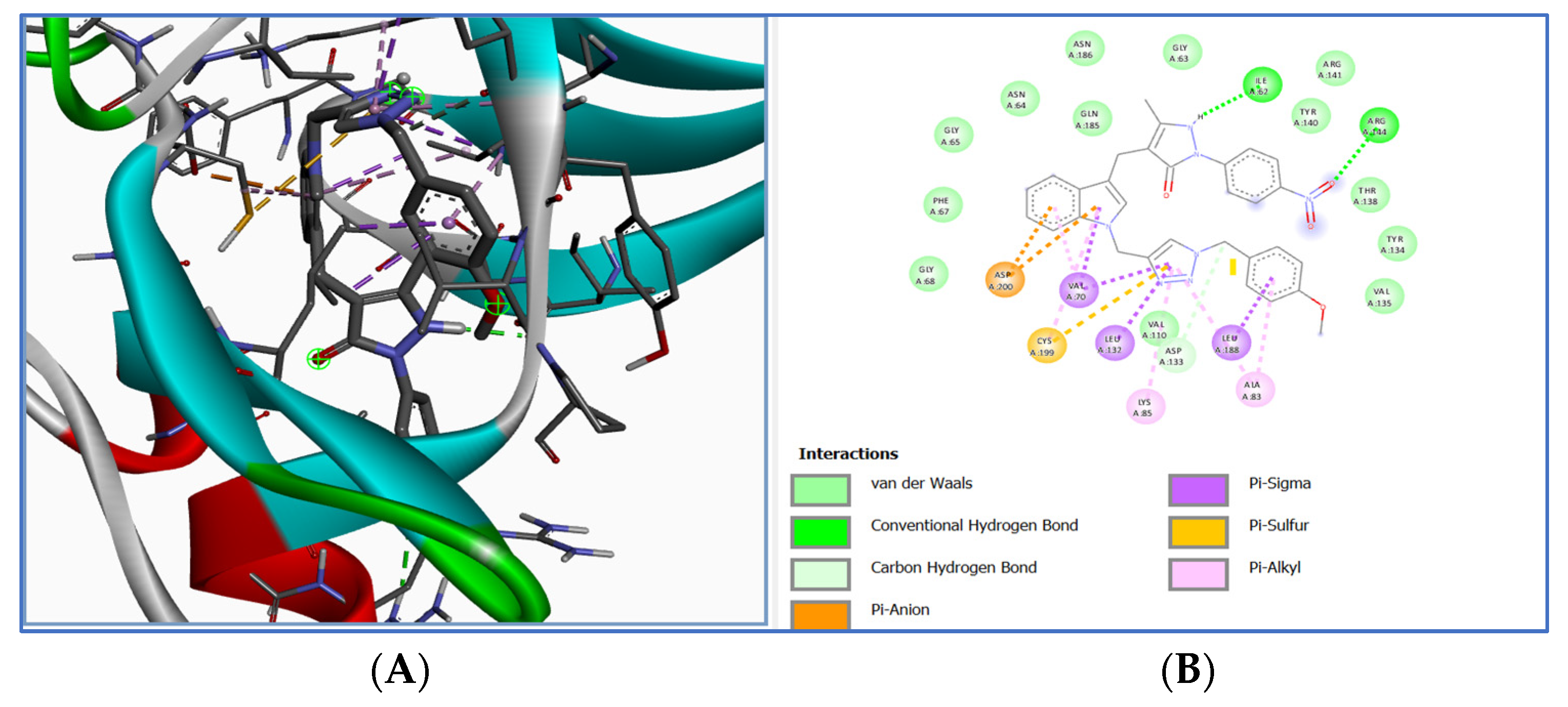
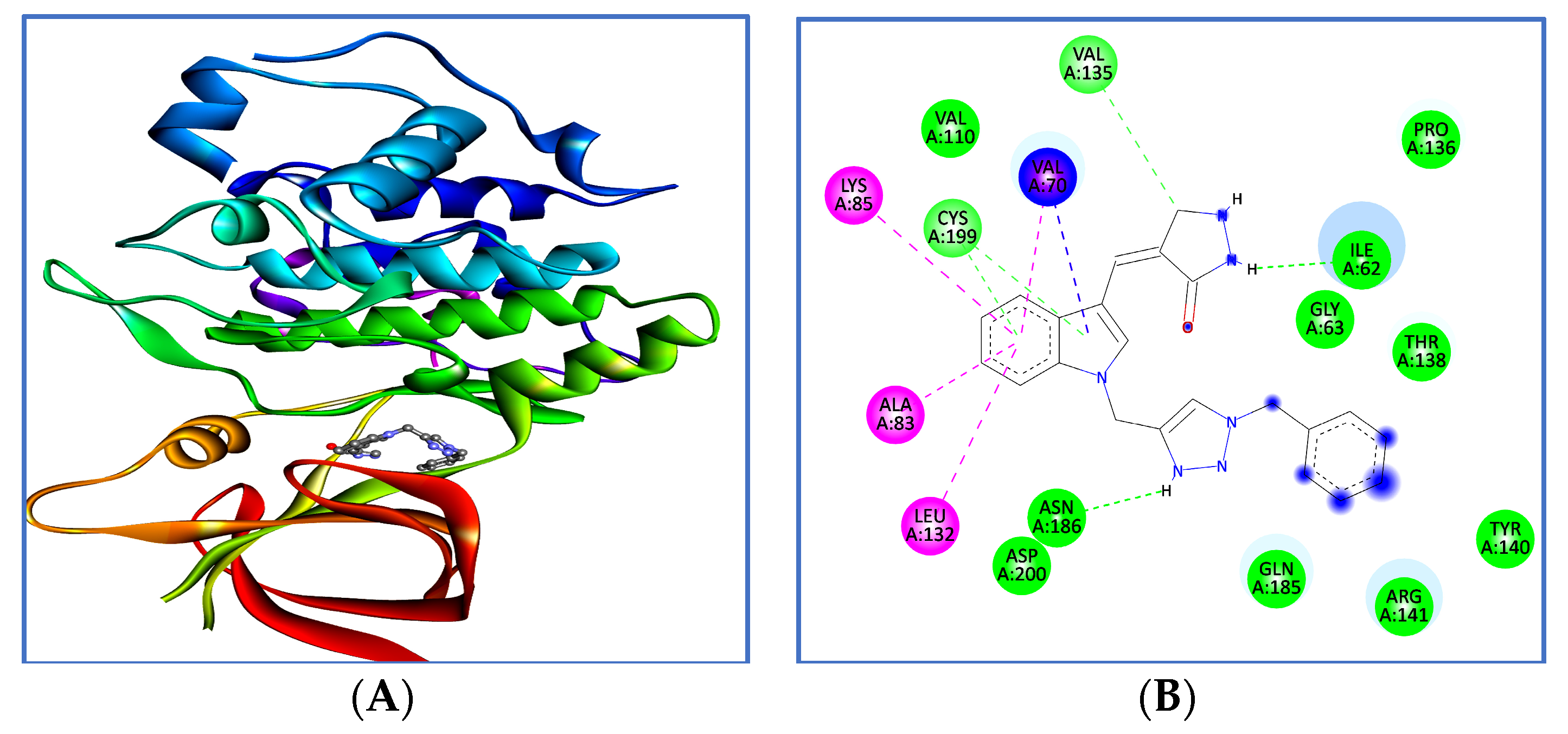
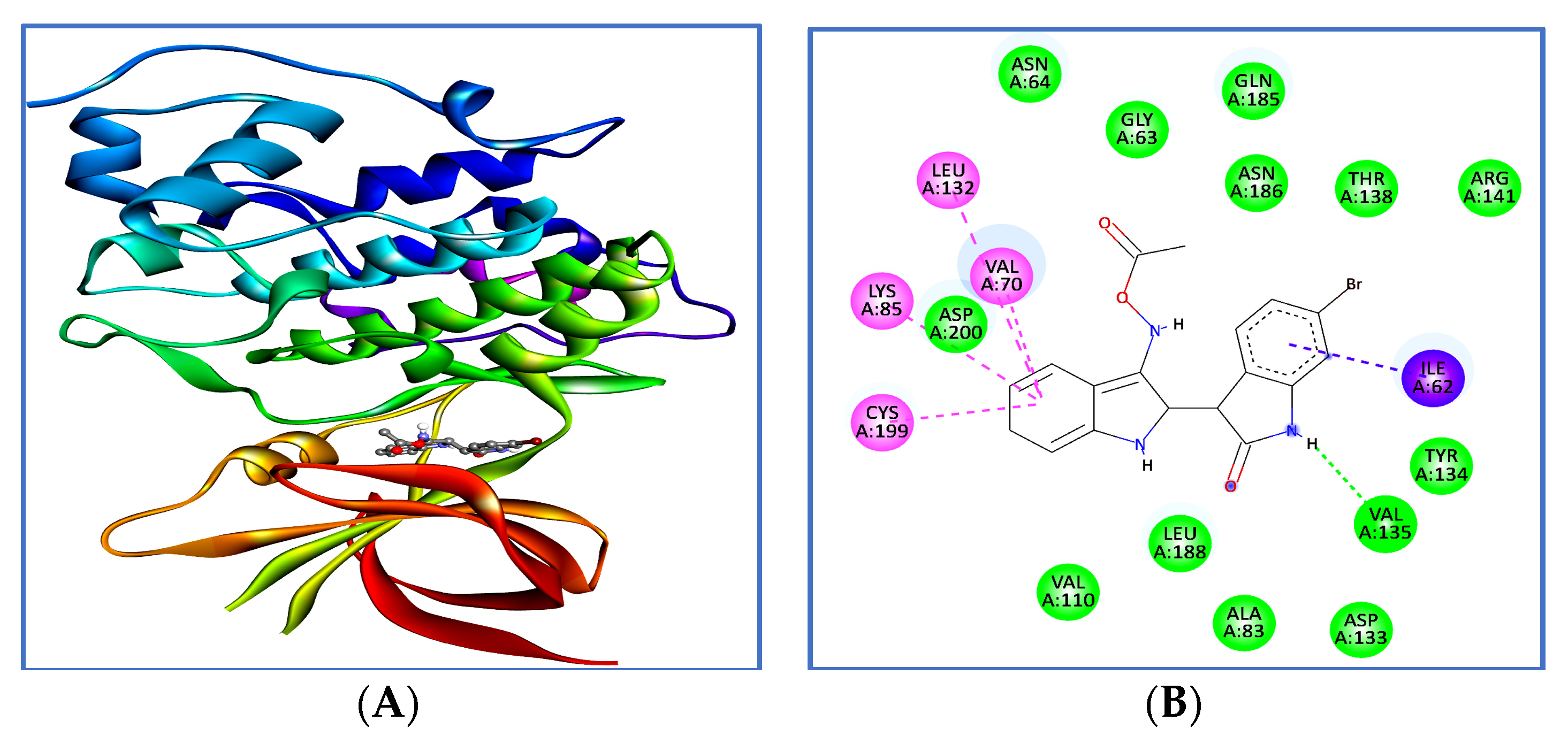
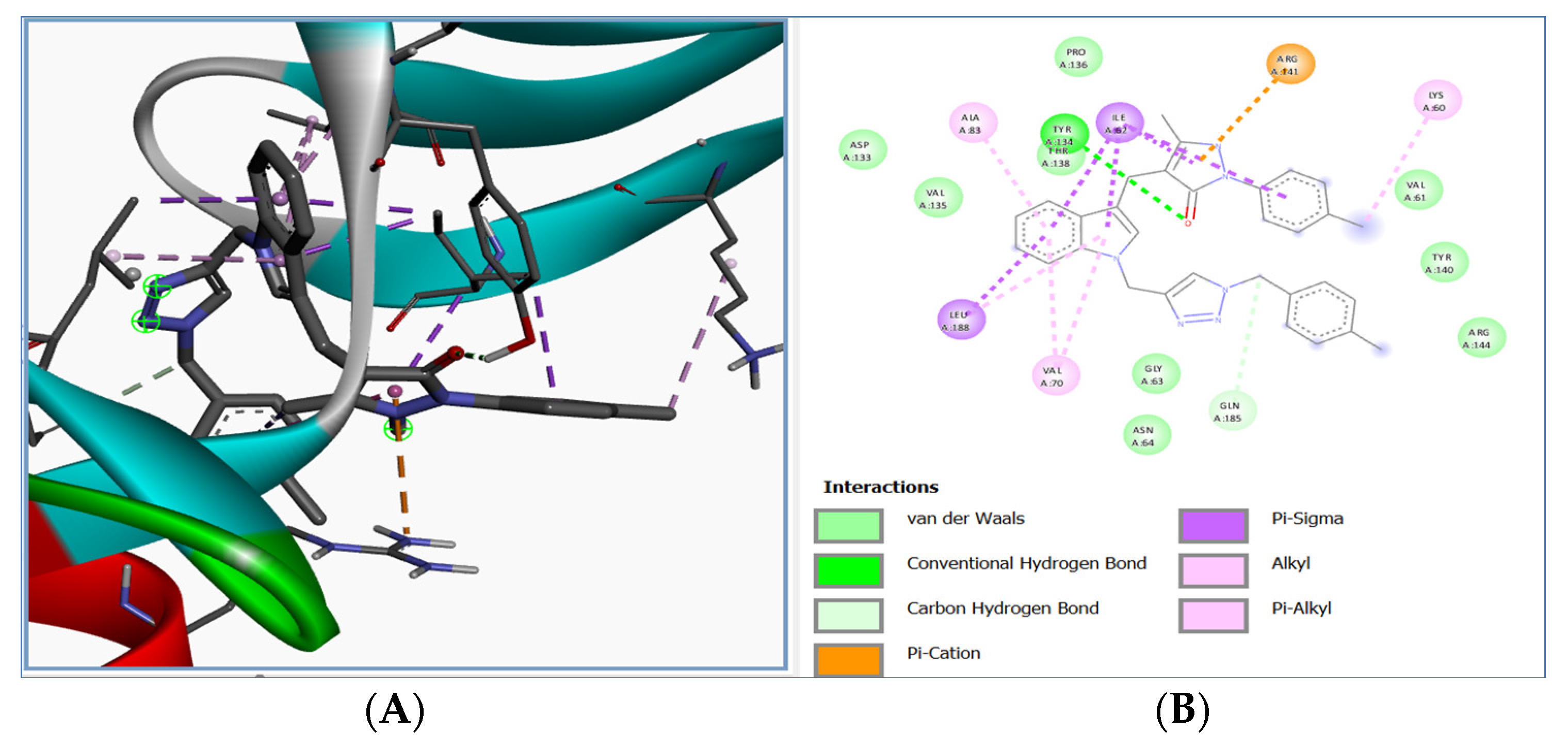
The information derived from the molecular docking analysis, detailed in Table 4 and graphically represented in Figure 4 and Figure 5, indicated that molecules spanning from 10Aa10Ed exhibited substantial binding affinities towards GSK-3β (identified by PDB ID: 1Q41). Despite the observation of intermediate-level interactions with compounds 10Ac and 10Da, compounds 10Cc, 10Dd, and 10Bd displayed the most pronounced binding energies, quantified as −11.7 kcal/mol, −11.2 kcal/mol, and −11.1 kcal/mol, respectively. The binding affinity of the reference ligand bioacetoxime, as shown in Figure 6, is −8.6 kcal/mol, which is lower than the binding strength of Molecule 10Dc, which is −10.7 kcal/mol. In short, these findings lend credence to the notion that the chosen molecules improved interactions with the designated protein, implying that they ought to continue to be developed into molecular dynamics models and possibly confirmed through laboratory testing. Figure 7 illustrates the binding mode of 10Cc, demonstrating its extensive penetration into the ATP-binding site of GSK-3β and the generation of several contacts that enhance stability. A typical hydrogen bond in the hinge region secures the ligand, and numerous van der Waals interactions with amino acids such as VAL, ALA, and GLY reinforce the pocket fit. An additional π-cation interaction enhances electrostatic compatibility, while the aromatic components interact with hydrophobic residues like ILE, VAL, and LEU through π-σ and π-alkyl interactions. These combined interactions lead to a stable and energetically favorable binding arrangement. Figure 4 shows that compound 10Dd also takes on a very stable orientation when bound to ATP. A multitude of van der Waals interactions involving GLY, VAL, ALA, and ASN contribute to the close-knit hydrophobic arrangement, and the ligand forms essential hydrogen bonds, securing its location in proximity to the flexible joint area. The binding of ASP133 to π-anion, ILE, LEU, and VAL, coupled with π-alkyl and π-σ activities, fosters greater stabilization. Additionally, the π-sulfur interaction reinforces the binding at the functionally important site. These interactions reveal that 10Dd forms a robust connection with GSK-3β, suggesting its capacity for broad biological effects. Furthermore, the docking score for the compound 10Aa reached −10.6 kcal/mol. The indole fragment interacted with Val70, Ala83, Lys85, Leu132, and Cys199, whereas the pyrazole segment of 10Aa produced a hydrogen bond with Ile62. In addition, the triazolyl ring created hydrogen bonds with Asn186 and Val135, showing the positive agreement between the in vitro and in silico results of 10Aa (Figure 5), along with the stabilization of the ligand-protein complex by multiple van der Waals interactions involving Gly63, Asn64, Val119, Tyr134, Tyr140, Arg141, Val135, Val135, Pro136, Thr138, and Gln185 residues, making it an attractive candidate for future studies.
MM-GBSA Binding Free Energy Analysis
The synthetic compounds exhibit varied degrees of binding stability within the target protein, as indicated by the wide range of MM-GBSA binding free energy (ΔG_bind) values, which range from −25.05 to −41.98 kcal/mol. The most favorable binding energies were observed in 10Cc (−41.98 kcal/mol), 10Ec (−41.05 kcal/mol), 10Db (−37.14 kcal/mol), and 10Dd (−40.70 kcal/mol). These molecules were found to form strong and thermodynamically stable ligand-protein complexes, as shown in Table 2. The binding energies were mainly contributed to by van der Waals interactions (ΔG_vdw, −38 to −52 kcal/mol) and lipophilic interactions (ΔG_Lipo, −16 to −22 kcal/mol), indicating that hydrophobic contacts were crucial in stabilizing these ligands within the active site. Electrostatic (coulombic) contributions were also considerable for numerous high-affinity compounds, particularly 10Ab, 10Db, 10Bd, 10Ca, and 10Eb, indicating further stabilization through charged or polar contacts. On the other hand, the solvation energy (ΔG_solvGB) had a negative impact on the total binding in all compounds because of the anticipated desolvation penalties when the ligand entered the hydrophobic pocket. While hydrogen bonds and covalent bonds did play a role in binding, they were not the main factors and did vary across molecules. The docking results were supported by the MM-GBSA findings, which showed that compounds 10Cc, 10Db, 10Ec, and 10Dd were the most promising. These compounds exhibited strong binding affinity and stability within the protein active site, as well as highly favorable van der Waals, lipophilic, and electrostatic interactions (Table 5). Therefore, these compounds were identified as promising leads for further biological evaluation.
Correlation Between Docking and MM-GBSA Results
The predicted ligand–protein interactions were found to be reliable, as evidenced by the strong agreement between the molecular docking scores and the MM-GBSA binding free energy values. In the MM-GBSA analysis, compounds with better docking scores, especially 10Cc, 10Bd, 10Bd,10Dd, 10Ed, and 10Ec, confirmed their great thermodynamic stability at the active site by showing very favorable ΔG_bind values. The fact that the structural properties that lead to high docking scores, like hydrophobic contact, van der Waals packing, and polar interactions, are faithfully reflected in the free energy decomposition is supported by this consistency. The association was further supported by the fact that molecules with moderate docking scores also showed lower MM-GBSA energies. Generally, the consistent patterns observed in the two computational approaches support the reliability of the binding predictions and further solidify the selection of these top-ranked compounds as potential leads for additional biological investigation.

4. Conclusions

In this study, twenty compounds were synthesized and characterized using various spectral techniques. Their cytotoxic effects were assessed against a variety of cancer cell lines, including pancreas, lung, blood, colon, and brain. The cytotoxicity data indicate that compound 10Aa exhibits greater sensitivity toward hematological cancer cell lines, including Molt-4, Z138, and HL-60, whereas the brain cancer cell line LN226 was more susceptible to compound 10Cd. Increasing concentrations of 10Aa produced a dose-dependent reduction in GSK-3β kinase activity, indicating that 10Aa was capable of inhibiting GSK-3β. Additionally, the higher docking score and significant stability in the MD simulation indicate that the synthesized compounds acted via GSK-3β inhibition. Further, mechanism-based investigation is required to determine the pharmacological potential of 10Aa as a therapeutic candidate.

Supplementary Materials

The following supporting information can be downloaded at https://www.mdpi.com/article/10.3390/chemistry8020017/s1, Figures S1–S79: Spectra of FTIR, 1H/13C NMR and HRMS; Figures S80–S99: Details of Swiss ADME.

Author Contributions

Conceptualization, S.S.K.; methodology, A.M., N.T. and F.R.; software, N.T. and V.B.H.; validation, N.T. and V.B.H.; formal analysis, B.M. and G.S.; investigation, S.K., F.R. and D.S.; resources, S.S.K.; data curation, S.S.K., B.C. and S.K.; writing—original draft preparation, A.M. and S.K.; writing—review and editing, S.S.K. and S.K.; visualization, G.S. and B.M.; supervision, S.S.K. and B.C.; project administration, S.S.K. All authors have read and agreed to the published version of the manuscript.

Funding

This research received no external funding.

Data Availability Statement

All data are incorporated in the manuscript/Supplementary Materials. Further inquiries can be directed to the corresponding authors.

Conflicts of Interest

The authors declare no conflicts of interest.

Abbreviations

The following abbreviations are used in this manuscript:
µMMicro-Molar
ADMETAbsorption, Distribution, Metabolism, Excretion
ALAAlanine
ASN Asparagine
ASP Aspartic acid
ATCCAmerican Type Culture Collection
ATPAdenosine Triphosphate
BBBBlood–Brain Barrier
CCCytotoxic Concentration
CDCl3Deuterated Chloroform
DMFDimethyl Formamide
DMSO-d6Deuterated Dimethyl Sulfoxide
DNADeoxyribonucleic Acid
FTIRFourier Transform Infra-Red
GI Gastrointestinal
GLYGlycine
GSKGlycogen Synthase Kinase
HBAHydrogen Bond Acceptor
HBDHydrogen Bond Donor
HIVHuman Immunodeficiency Virus
HRMSHigh Resolution Mass Spectra
ICInhibitory Concentration
ILEIsoleucine
LEULeucine
m.pMelting Point
M.WMolecular Weight
MD Molecular Dynamics
MHzMega Hertz
MM-GBSAMolecular Mechanism-General Born Surface Area
NCRPNational Cancer Registry Program
nmNano Meter
NMRNuclear Magnetic Resonance
NTNot Tested
ODOptical Density
PDBProtein Data Bank
P-gpP-Glycoprotein
ppmPart Per Million
RO5Rule of Five
SDStandard Deviation
USA United States of America
VALValine

References

  1. Sathishkumar, K.; Chaturvedi, M.; Das, P.; Stephen, S.; Mathur, P. Cancer incidence estimates for 2022 & projection for 2025: Result from National Cancer Registry Programme, India. Indian J. Med. Res. 2022, 156, 598–607. [Google Scholar] [CrossRef]
  2. Kulothungan, V.; Sathishkumar, K.; Leburu, S.; Ramamoorthy, T.; Stephen, S.; Basavarajappa, D.; Tomy, N.; Mohan, R.; Menon, G.R.; Mathur, P. Burden of cancers in India-estimates of cancer crude incidence, YLLs, YLDs and DALYs for 2021 and 2025 based on National Cancer Registry Program. BMC Cancer 2022, 22, 527. [Google Scholar] [CrossRef]
  3. Kumar, A.; Singh, A.K.; Singh, H.; Vijayan, V.; Kumar, D.; Naik, J.; Thareja, S.; Yadav, J.P.; Pathak, P.; Grishina, M.; et al. Nitrogen containing heterocycles as anticancer agents: A medicinal chemistry perspective. Pharmaceuticals 2023, 16, 299. [Google Scholar] [CrossRef]
  4. Kumari, A.; Singh, R.K. Medicinal chemistry of indole derivatives: Current to future therapeutic prospectives. Bioorg. Chem. 2019, 89, 103021. [Google Scholar] [CrossRef]
  5. Bajad, N.G.; Singh, S.K.; Singh, S.K.; Singh, T.D.; Singh, M. Indole: A promising scaffold for the discovery and development of potential anti-tubercular agents. Curr. Res. Pharmacol. Drug Discov. 2022, 3, 100119. [Google Scholar] [CrossRef]
  6. Janeiro, A.M.; Marques, C.S. Biological profile of synthetic and natural indole derivatives: Paving new paths in cancer treatment. Drugs Drug Candidates 2024, 3, 488–511. [Google Scholar] [CrossRef]
  7. Hu, C.; Liang, B.; Sun, J.; Li, J.; Xiong, Z.; Wang, S.H.; Xuetao, X. Synthesis and biological evaluation of indolederivatives containing thiazolidine-2,4-dione as α-glucosidase inhibitors with antidiabetic activity. Eur. J. Med. Chem. 2024, 264, 115957. [Google Scholar] [CrossRef] [PubMed]
  8. Mo, X.; Rao, D.P.; Kaur, K.; Hassan, R.; Abdel-Samea, A.S.; Farhan, S.M.; Bräse, S.; Hashem, H. Indole derivatives: A versatile scaffold in modern drug discovery-An updated review on their multifaceted therapeutic applications (2020–2024). Molecules 2024, 29, 4770. [Google Scholar] [CrossRef] [PubMed]
  9. Madarakhandi, A.; Kumar, S.; Terayia, N.; Schols, D.; Vastrad, S.J.; Shyamjith, P.; Choudhary, B.; Rai, A.; Karki, S.S. Design, synthesis and anticancer evaluation of novel hydrazide-2-oxindole analogues as GSK-3-beta kinase inhibitors. RSC Adv. 2025, 15, 24650. [Google Scholar] [CrossRef]
  10. Daga, P.R.; Patel, R.Y.; Doerksen, R.J. Template-based protein modeling: Recent methodological advances. Curr. Top. Med. Chem. 2010, 10, 84–94. [Google Scholar] [CrossRef] [PubMed]
  11. Ansari, A.; Ali, A.; Asifa, M.; Shamsuzzaman. Review: Biologically active pyrazole derivatives. New J. Chem. 2017, 41, 16–41. [Google Scholar] [CrossRef]
  12. Xu, Z.; Zhao, S.J.; Liu, Y. 1,2,3-Triazole-containing hybrids as potential anticancer agents: Current developments, action mechanisms and structure-activity relationships. Eur. J. Med. Chem. 2019, 183, 111700. [Google Scholar] [CrossRef] [PubMed]
  13. Singh, S.; Tehlan, S.; Verma, P.K. Pyrazole Scaffolds having promising pharmacological potential: A review. Mini Rev. Med. Chem. 2023, 23, 2142–2166. [Google Scholar] [CrossRef] [PubMed]
  14. Mallisetty, N.M.; Ganipisetti, H.; Majhi, D.; Sirisilla, R.; Kumar, P.V.N. Synthesis and biological activity evaluation of pyrazole-1,2,4-triazole hybrids: A computer-aided docking studies. Curr. Drug Discov. Technol. 2023, 20, e251122211263. [Google Scholar] [CrossRef] [PubMed]
  15. Glomb, T.; Minta, J.; Nowosadko, M.; Radzikowska, J.; Świątek, P. Search for new compounds with anti-inflammatory activity among 1,2,4-triazole derivatives. Molecules 2024, 29, 6036. [Google Scholar] [CrossRef]
  16. Li, Y.S.; Tian, H.; Zhao, D.S.; Hu, D.K.; Liu, X.Y.; Jin, H.W.; Song, G.P.; Cui, Z.N. Synthesis and bioactivity of pyrazole and triazole derivatives as potential PDE4 inhibitors. Bioorg. Med. Chem. Lett. 2016, 26, 3632–3635. [Google Scholar] [CrossRef]
  17. Matta, R.; Pochampally, J.; Dhoddi, B.N.; Bhookya, S.; Bitla, S.; Akkiraju, A.G. Synthesis, antimicrobial and antioxidant activity of triazole, pyrazole containing thiazole derivatives and molecular docking studies on COVID-19. BMC Chem. 2023, 17, 61. [Google Scholar] [CrossRef]
  18. Luo, J. Glycogen synthase kinase 3beta (GSK3beta) in tumorigenesis and cancer chemotherapy. Cancer Lett. 2009, 273, 194–200. [Google Scholar] [CrossRef]
  19. McCubrey, J.A.; Steelman, L.S.; Bertrand, F.E.; Davis, N.M.; Abrams, S.L.; Montalto, G.; D’Assoro, A.B.; Libra, M.; Nicoletti, F.; Maestro, R.; et al. Multifaceted roles of GSK-3 and Wnt/β-catenin in hematopoiesis and leukemogenesis: Opportunities for therapeutic intervention. Leukemia 2014, 28, 15–33. [Google Scholar] [CrossRef]
  20. Beurel, E.; Grieco, S.F.; Jope, R.S. Glycogen synthase kinase-3 (GSK3): Regulation, actions, and diseases. Pharmacol. Ther. 2015, 148, 114–131. [Google Scholar] [CrossRef]
  21. Ponnam, D.; Arigari, N.K.; Kalvagunta, V.N.S.S.; Jonnala, K.K.; Singh, S.; Meena, A.; Misra, P.; Luqman, S. Synthesis of non-toxic anticancer active forskolin-indole-triazole conjugates along with their in-silico succinate dehydrogenase inhibition studies. J. Heterocycl. Chem. 2021, 58, 2090–2101. [Google Scholar] [CrossRef]
  22. Hong, L.; Lin, W.; Zhang, F.; Liu, R.; Zhou, X. Ln[N(SiMe3)2]3-catalyzed cycloaddition of terminal alkynes to azides leading to 1,5-disubstituted 1,2,3-triazoles: New mechanistic features. Chem. Commun. 2013, 49, 5589. [Google Scholar] [CrossRef]
  23. Yadav, M.; Lal, K.; Kumar, A.; Kumar, A.; Kumar, D. Indole-chalcone linked 1,2,3-triazole hybrids: Facile synthesis, antimicrobial evaluation and docking studies as potential antimicrobial agents. J. Mol. Struct. 2022, 1261, 132867. [Google Scholar] [CrossRef]
  24. Jing, L.; Wang, L.; Zhao, Y.; Tan, R.; Xing, X.; Liu, T.; Huang, W.; Luo, Y.; Li, Z. Synthesis, crystal structure and evaluation of cancer inhibitory activity of 4-[indol-3-yl-Methylene]-1H-pyrazol-5(4H)-one derivatives. J. Chem. Res. 2012, 36, 691–696. [Google Scholar] [CrossRef]
  25. Sun, B.; Liu, K.; Han, J.; Zhao, L.-Y.; Su, X.; Lin, B.; Zhao, D.-M.; Cheng, M.-S. Design, synthesis, and biological evaluation of amide imidazole derivatives as novel metabolic enzyme CYP26A1 inhibitors. Bioorg. Med. Chem. 2015, 23, 6763–6773. [Google Scholar] [CrossRef] [PubMed]
  26. de Walle, T.V.; Theppawong, A.; Grootaert, C.; Jonghe, S.D.; Persoons, L.; Daelemans, D.; Hecke, K.V.; Camp, J.V.; D’hooghe, M. Synthesis and cytotoxic evaluation of monocarbonylcurcuminoids and their pyrazoline derivatives. Monatsh. Chem. 2019, 150, 2045–2051. [Google Scholar] [CrossRef]
  27. Available online: https://www.swissadme.ch (accessed on 30 July 2025).
  28. Yevale, D.; Teraiya, N.; Lalwani, T.; Dalasaniya, M.; Patel, S.K.; Dixit, N.; Sangani, C.B.; Mulukuri, N.V.L.S.; Huang, T.; Duan, Y.; et al. Discovery of new pyrazole-4-carboxamide analogues as potential anticancer agents targeting dual aurora kinase A and B. Eur. J. Med. Chem. 2024, 280, 116917. [Google Scholar] [CrossRef]
  29. Teraiya, N.; Karki, S.S.; Chauhan, A. Synthesis, anticancer evaluation, and molecular docking of hexahydroquinoline derivatives as Mcl-1 Inhibitors and apoptosis inducers. Anticancer Agents Med. Chem. 2022, 22, 2142–2155. [Google Scholar] [CrossRef]
Figure 1. Clinically used indole, pyrazole, and 1,2,3-triazole derivatives.
Chemistry 08 00017 g001
Figure 2. Structures of potential GSK-3β inhibitors.
Chemistry 08 00017 g002
Scheme 1. Synthesis of 10AaEd.
Chemistry 08 00017 sch001
Figure 3. Kinase assay with 10Aa depicting dose-dependent decrease in the inhibition of GSK-3β. Laduviglusib was used as a positive control for this assay as it is a known GSK-3β inhibitor. Data are presented as mean ± SDM. Significance was plotted based on p values and denoted as * (p-value ≤ 0.05).
Chemistry 08 00017 g003
Figure 4. Binding interactions of compound 10Dd with GSK-3β (PDB ID: 1Q41). (A) 3D image (B) 2D image; show hydrogen bonding, van der Waals contacts, and π-based interactions that collectively support the stable accommodation of 10Dd in the active site.
Chemistry 08 00017 g004
Figure 5. Docking interaction of 10Aa with GSK-3β(PDB ID: 1Q41). (A) 3D image (B) 2D image; green line indicates-H-bond, light green represented as van der Waals force; and lipophilic contact denoted by pink arrow.
Chemistry 08 00017 g005
Figure 6. Docking interaction of bioacetoxime with GSK-3β(PDB ID: 1Q41). (A) 3D image (B) 2D image; green line indicates- H-bond, light green represented as van der Waals force; and lipophilic contact denoted by pink arrow.
Chemistry 08 00017 g006
Figure 7. Docking interactions of compound 10Cc with GSK-3β (PDB ID: 1Q41). (A) 3D image (B) 2D image; interaction map illustrates hydrogen bonds, van der Waals contacts, and key π-interactions stabilizing the ligand within the ATP-binding pocket.
Chemistry 08 00017 g007
Table 1. Details of the compounds 10AaEd.
CodeRR’CodeRR’CodeRR’
10AaHH10BdCl4-NO2-C6H410DcOCH34-CH3-C6H4
10AbHC6H510CaCH3H10DdOCH34-NO2-C6H4
10AcH4-CH3-C6H410CbCH3C6H510EaNO2H
10AdH4-NO2-C6H410CcCH34-CH3-C6H410EbNO2C6H5
10BaClH10CdCH34-NO2-C6H410EcNO24-CH3-C6H4
10BbClC6H510DaOCH3H10EdNO24-NO2-C6H4
10BcCl4-CH3-C6H410DbOCH3C6H5
Table 2. The cytotoxic activity of compounds 10AaEd at a concentration of 50 µM against Capan-1, HCT-116, LN229, NCI-H460, MOLT-4, HL-60, K562, and Z138 cell lines.
CompoundCapan-1HCT-116LN229NCI-H460Molt-4HL-60K562Z138
Adherent Cells (CC50)Suspension Cells (CC50)
10Aa23.87 ± 6.98>50>5034.06 ± 22.4314.45 ± 1.4617.56 ± 7.04>5015.34 ± 0.72
10Ab>50>50>50>50>50>50>50>50
10Ac>50>50>50>50>50>50>50>50
10Ad>50>50>50>50>50>50>50>50
10Ba>50>50>50>50>50>50>50>50
10Bb>50>50>50>50>50>50>50>50
10Bc>50>50>50>50>50>50>50>50
10Bd>50>5035.78 ± 17.81>50>50>50>50>50
10Ca>50>50>50>50>50>50>50>50
10Cb>50>50>50>50>50>50>50>50
10Cc>50>50>50>50>50>50>50>50
10Cd>50>5013.41 ± 1.75>50>50>50>50>50
10Da>50>50>50>50>50>50>50>50
10Db>50>50>50>50>50>50>50>50
10Dc>50>50>50>50>50>50>50>50
10Dd>50>5041.22 ± 6.65>50>50>50>50>50
10Ea>50>50>50>50>50>50>50>50
10Eb>50>50>50>50>50>50>50>50
10Ec>50>50>50>50>50>50>50>50
10Ed>50>50>50>50>50>50>50>50
Sunitinib
(100 µM)
1.5 ± 0.014.25 ± 0.7111.80 ± 1.418.85 ± 3.04NT5.00 ± 1.278.4 ± 2.128.15 ± 1.49
5-Fluorouracil
(100 µM)
2.7 ± 0.012.3 ± 0.717.35 ± 0.355.0 ± 1.70NT5.90 ± 0.9912.90 ± 0.427.85 ± 0.71
Note: All data are expressed as mean ± standard deviations (SD) from three independent experiments. CC50: 50% cytotoxic concentration.
Table 4. Docking scores of 10AaEd against the target protein, highlighting top binding molecules.
CompoundsBinding
Affinity
rmsd/ubrmsd/lbCompoundsBinding Affinityrmsd/ubrmsd/lb
10Aa−10.66.4373.80810Cc−11.78.5181.639
10Ab−10.46.6732.49610Cd−09.99.6422.876
10Ac−10.76.3492.25810Da−10.79.3942.712
10Ad−09.66.5683.91110Db−09.62.0421.370
10Ba−10.36.8173.42110Dc−10.79.3942.712
10Bb−10.66.4822.68210Dd−11.24.6042.928
10Bc−10.07.9113.33910Ea−10.43.7292.422
10Bd−11.18.9264.48010Eb−10.35.2052.570
10Ca−10.65.2142.57510Ec−09.79.8433.199
10Cb−10.46.5901.64110Ed−10.48.2263.539
rmsd/ub-root mean square deviation upper bound; rmsd/lb-root mean square deviation lower bound.
Table 5. MM-GBSA binding free energy (ΔG_bind) and energy decomposition parameters for compounds 10AaEd against the target protein.
CompoundsΔG BindΔG Bind CoulombΔG Bind CovalentΔG Bind HbondΔG Bind LipoΔG Bind solvGB∆G Bind vdw
10Aa−30.92−04.8503.77−2.94−18.5334.92−40.52
10Ab−35.98−13.6102.18−2.28−16.7337.22−46.72
10Ac−37.20−06.2500.82−2.08−18.2538.89−46.27
10Ad−30.87−17.9405.33−3.15−18.3845.90−38.69
10Ba−27.08−08.9311.23−1.01−18.4743.29−49.60
10Bb−25.38−02.0804.31−2.27−19.1244.28−47.18
10Bc−29.31−11.0204.77−2.44−16.2538.30−40.12
10Bd−41.55−19.7408.64−2.24−16.8039.0935.09
10Ca−26.66−12.5703.83−3.39−20.2758.92−50.59
10Cb−29.50−10.2602.59−2.56−21.1346.78−42.46
10Cc−41.98−11.4003.92−0.83−20.3146.78−49.59
10Cd−27.92−13.9503.13−3.28−20.8452.96−43.57
10Da−32.18−11.7903.35−2.56−22.4248.62−44.91
10Db−38.70−13.2206.34−1.02−19.7240.35−49.09
10Dc−26.13−08.5607.66−0.98−19.1946.62−47.28
10Dd−40.73−09.6304.25−0.98−19.2943.92−50.71
10Ea−25.05−06.6610.39−0.98−16.9644.93−52.09
10Eb−28.37−11.1606.46−2.68−20.2546.23−44.73
10Ec−39.0500.5304.10−1.21−17.1128.99−51.73
10Ed−40.23−03.8203.58−2.66−20.2839.87−47.93
ΔG Bind—binding free energy; ΔG Bind coulomb—change in Gibbs free energy of binding that is specially attributed to electrostatic interactions (coulomb interactions) between a ligand and a protein or receptor; ΔG Bind covalent—binding free energy of covalent bond; ΔG Bind Hbond—binding free energy of hydrogen bonds; ΔG Bind Lipo—lipophilic contribution to the overall binding free energy of a ligand–protein complex; ΔG Bind solvGB—binding free energy of solvation; ΔG Bind vdw—van der Waals force contribution to the overall binding free energy of a ligand–protein complexes.
Disclaimer/Publisher’s Note: The statements, opinions and data contained in all publications are solely those of the individual author(s) and contributor(s) and not of MDPI and/or the editor(s). MDPI and/or the editor(s) disclaim responsibility for any injury to people or property resulting from any ideas, methods, instructions or products referred to in the content.