Review

Thermo-Catalytic Carbon Dioxide Hydrogenation to Ethanol

1
Beijing National Laboratory for Molecular Sciences, CAS Laboratory of Colloid and Interface and Thermodynamics, CAS Research/Education Center for Excellence in Molecular Sciences, Center for Carbon Neutral Chemistry, Institute of Chemistry, Chinese Academy of Sciences, Beijing 100190, China
2
Department of Chemical Engineering, The University of Manchester, Manchester M13 9PL, UK
3
College of Chemical Engineering and Materials Science, Tianjin University of Science and Technology, Tianjin 300457, China
4
School of Chemical Science, University of Chinese Academy of Sciences, Beijing 100049, China
*
Authors to whom correspondence should be addressed.
Chemistry 2026, 8(2), 14; https://doi.org/10.3390/chemistry8020014
Submission received: 5 December 2025 / Revised: 30 December 2025 / Accepted: 8 January 2026 / Published: 28 January 2026

Abstract

The catalytic hydrogenation of carbon dioxide (CO2) represents a transformative approach for reducing greenhouse gas emissions while producing sustainable fuels and chemicals, with ethanol being particularly promising due to its compatibility with existing energy infrastructure. Despite significant progress in converting CO2 to C1 products (e.g., methane, methanol), selective synthesis of C2+ compounds like ethanol remains challenging because of competing reaction pathways and byproduct formation. Recent advances in thermo-catalytic CO2 hydrogenation have explored diverse catalyst systems including noble metals (Rh, Pd, Au, Ir, Pt) and non-noble metals (Co, Cu, Fe), supported on zeolites, metal oxides, perovskites, silica, metal–organic frameworks, and carbon-based materials. These studies reveal that catalytic performance hinges on the synergistic effects of multimetallic sites, tailored support properties and controlled reaction micro-environments to optimize CO2 activation, controlled hydrogenation and C−C coupling. Mechanistic insights highlight the critical balance between CO2 reduction steps and selective C−C bond formation, supported by thermodynamic analysis, advanced characterization techniques and theoretical calculations. However, challenges persist, such as low ethanol yields and undesired byproducts, necessitating innovative catalyst designs and optimized reactor configurations. Future efforts must integrate computational modeling, in situ/operando studies, and renewable hydrogen sources to advance scalable and economically viable processes. This review consolidates key findings, proposes potential reaction mechanisms, and outlines strategies for designing high-efficiency catalysts, ultimately providing reference for industrial application of CO2-to-ethanol technologies.

1. Introduction

During past decades, fossil energy sources have been widely utilized to boost economic development with the rapid advancement of industrialization. In this situation, massive carbon dioxide (CO2) emissions caused by the extreme use of fossil energy sources have resulted in serious environmental issues such as global warming, sea level rise, ecological unbalance, and so on. These environmental problems significantly influence human health and societal advancement. According to climate reports, global monthly average CO2 concentration in November 2024 increased to 423.64 ppm in just one year along with the high growth rate of 3.23 ppm per year. Moreover, the Earth’s global average surface temperature in December 2024 was 1.55 °C above the average for the pre-industrial comparison period of 1880–1920, caused by billions of tons of CO2 emissions every year [1]. Consequently, it is urgent and necessary to reduce CO2 emissions through effective strategies for abatement of the environmental problems mentioned above.
Currently, there is a widely used strategy to reduce CO2 emissions and limit CO2 concentration through the CO2 capture and storage (CCS) by absorption and sequestration [2,3,4,5]. Nevertheless, from a future perspective, this method is not suitable to relieve extensive CO2 emissions and lacks economic feasibility. As an abundant, cheap, and renewable natural C1 resource, CO2 could be transformed into various valuable chemicals via chemical methods to form a sustainable carbon loop. The conversion of CO2 can be broadly categorized into CO2 fixation and CO2 reduction. CO2 fixation involves its reaction with nucleophilic electron donors to produce carbonates [6], amides [7], and other compounds [8,9,10]. Alternatively, CO2 can be reduced to carbon-containing energy carriers including carbon monoxide (CO) [11], hydrocarbons [12], and alcohols [13,14], and valued products like carboxylic acids through hydrogenation processes [15,16]. The utilization of CO2 by reduction strategy is widely considered as an effective and economic way to reduce CO2 emissions and relieve the relevant environmental problems. Based on the concept of green chemistry and economic value, the CO2 reduction has become a hopeful and hot area of research and exhibited the potential for various industrial applications.
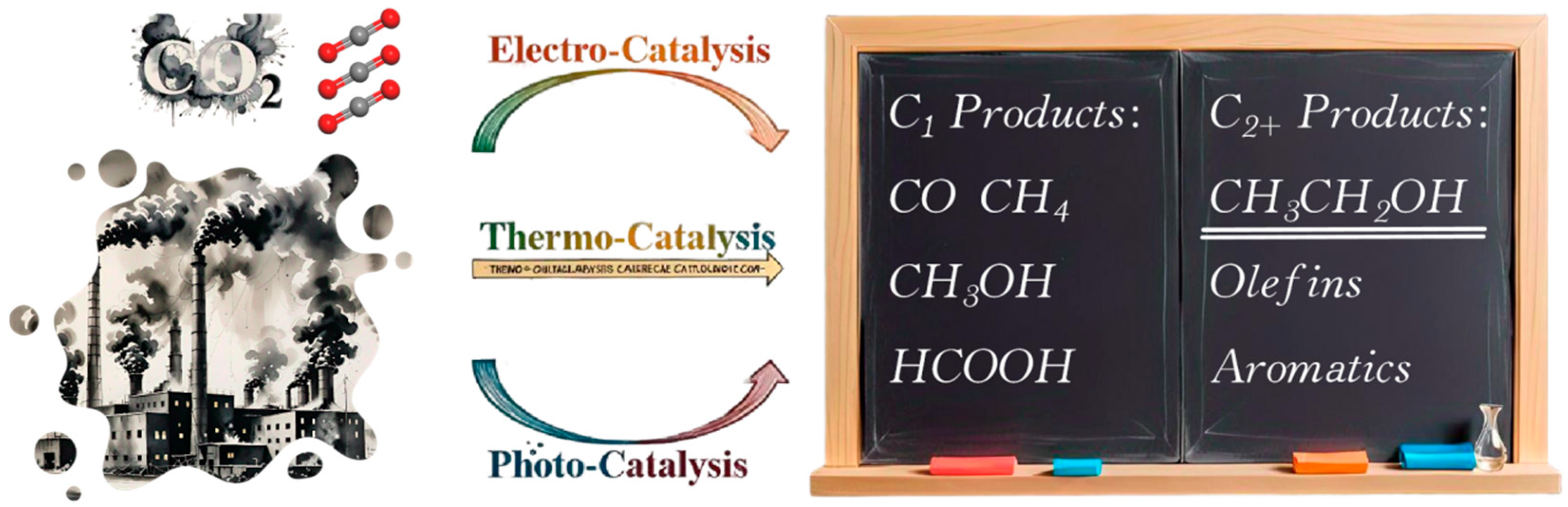
In the CO2 molecule, each C=O has a bond length of 116.3 pm, and the oxidation state of the central carbon atom is +4, representing the highest oxidation state. The standard Gibbs free energy of formation (ΔGf) is –396 kJ mol−1, indicating a high degree of chemical stability and resistance to activation. Due to the inertness of CO2 and its high thermodynamic energy barrier, CO2 reduction is confronted with challenges, especially low reaction conversion rates [17,18]. Nonetheless, considerable achievements have been made in converting CO2 into C1 products as well as C2+ products. Compared with C1 products, C2+ products are confronted with more challenges to synthesize as a result of the high C−C coupling barrier and competition among multiple products [19,20]. Among these value-added C2+ products, ethanol (EtOH), has been widely used as a solvent, disinfectant, fuel additive and starting reagent for chemical products [21]. In addition, H2 production from ethanol was also reported [22]. The traditional methods for production of ethanol mainly include ethylene hydration and natural biomass fermentation [23,24]. However, potent acid is frequently introduced into the ethanol synthesis process through ethylene hydration, which may affect the conversion rate equilibrium and lead to equipment corrosion. Normally, natural biomass fermentation is relatively expensive. Compared with these technologies, ethanol synthesis through the CO2 hydrogenation process has demonstrated considerable potential to satisfy increasing production requirements [25,26]. As shown in Figure 1, catalytic methods of CO2 hydrogenation to ethanol predominantly consist of photo-catalysis, electro-catalysis, and thermal-catalysis. Although light energy and electrical energy are considered clean energy sources, photo-catalysis and electro-catalysis still face challenges, respectively, such as limited efficiency and difficulty in large scale applications [25,27,28]. With advantages like excellent selectivity, rapid reaction rates, and well-established technology, thermal-catalytic processes provide promising prospects in CO2 hydrogenation to ethanol.
In addition to overcoming the chemical inertness of CO2, promoting the C−C coupling process has been considered as a crucial factor in CO2 hydrogenation to ethanol. Recent advancements have been focusing on the catalyst design for catalytic CO2 hydrogenation to ethanol, which have made a considerable contribution to improved CO2 activation and the C−C coupling process [26,29,30,31]. Noble metals (such as Rh, Pt, and Au) and cheap metals (such as Fe, Cu, and Co) have been widely used in catalyst design for improvement of catalytic activity [32,33]. For example, the Rh-based and Fe-based catalysts have demonstrated effectiveness in boosting the C−C connection process and ethanol production [34,35]. Despite high activity, the selectivity and stability of the catalysts still face critical challenges for the development of effective catalysts to accelerate CO2 hydrogenation to ethanol. Because of byproducts caused by competing reaction pathways, high selectivity toward ethanol is difficult to achieve [36]. Additionally, deactivation of a catalyst caused by phase segregation, coke formation and other reasons indicates the importance of catalyst stability during prolonged operation or industrial application. Thus, it is significant to deeply understand reaction mechanisms and further optimize catalyst design to address these challenges.
Currently, many reviews have summarized and discussed the research progress on thermal catalytic CO2 hydrogenation to higher alcohols, along with prospects for future development and catalyst design [37,38,39,40,41]. Although ethanol is included among the product spectra, a dedicated review focusing on catalytic systems for CO2 hydrogenation to yield ethanol as the primary product remains necessary. In recent years, several reviews on ethanol synthesis by CO2 hydrogenation have been published, covering different aspects such as metal-active centers [26,29], mechanistic insights [30], conversion approaches [25], heterogeneous catalyst supports [42,43] and continuous-flow reactor [31]. Because of the rapid progress in this field, many more important papers have been published very recently. A summary of this topic to cover these new achievements from more comprehensive perspectives is highly desirable. Herein, this review aims to offer a comprehensive perspective that bridges catalyst design, reactor matching, and mechanistic understanding in CO2 hydrogenation to ethanol by summarizing and analyzing the recent critical advancements of the thermo-catalytic CO2 hydrogenation to ethanol. In addition, this review also provides reference and outlook for the design of more efficient and multifunctional catalysts for this reaction.

2. Homogeneous Catalytic Hydrogenation of CO2 to Ethanol

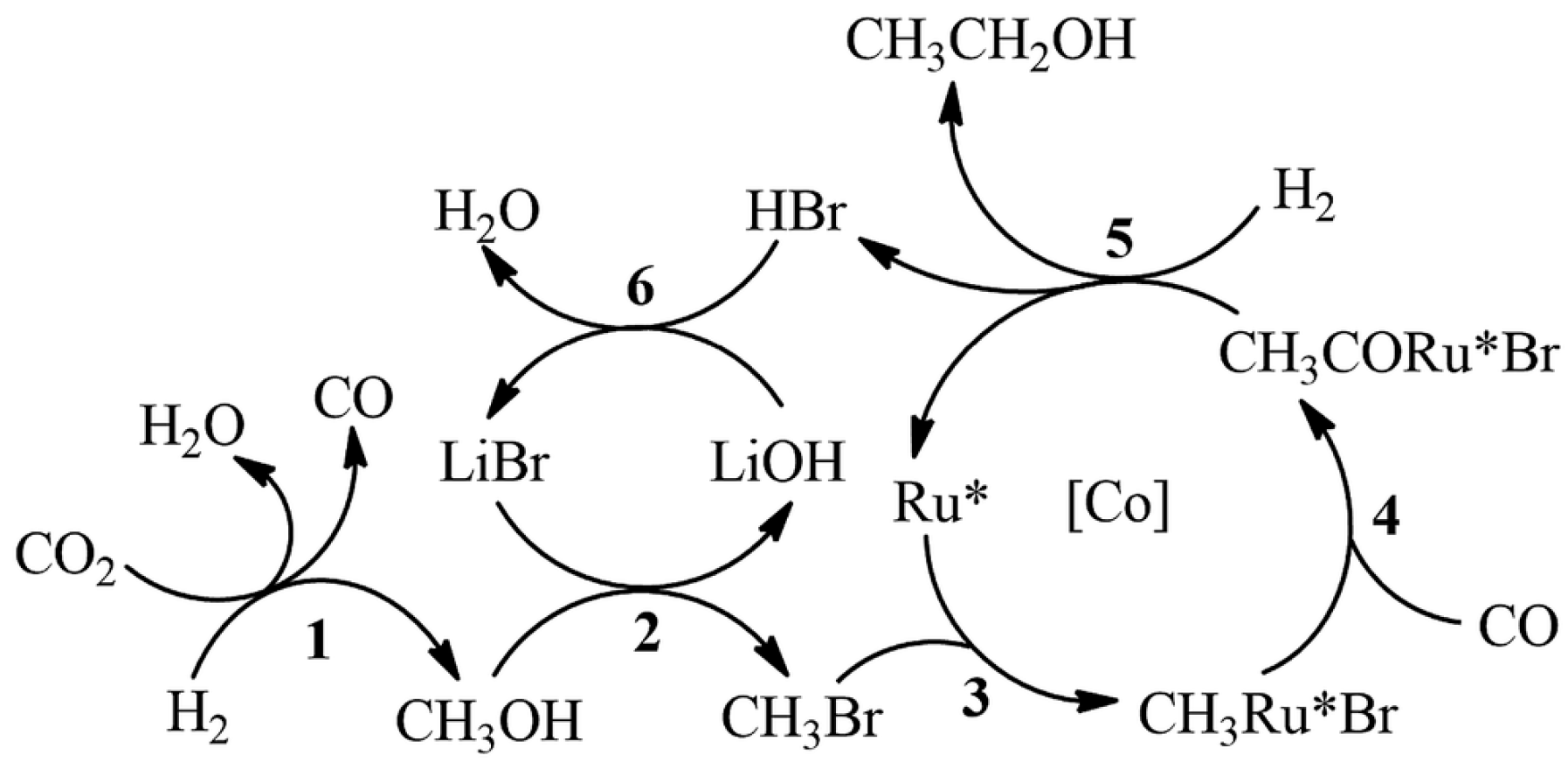
Homogeneous catalysis is known for its higher catalytic efficiency compared to heterogeneous catalysis, especially at lower temperatures. Homogeneous catalysts have been widely utilized in CO hydrogenation to mixed alcohols (C1~C3) or selective ethanol production via methanol homologation with CO and H2 [44,45,46,47]. However, the reports of homogeneously catalytic CO2 hydrogenation to EtOH, which are from several research groups, are limited to date. In 1994, Watanabe et al. proposed a homogeneous catalytic system for the production of ethanol through CO2 hydrogenation employing Ru-Co bimetallic catalyst [48]. The observed ethanol yields up to 10 C-mmol could be achieved using Ru3(CO)12-KI and Co2(CO)8 as co-catalyst in N-methyl-2-pyrrolidone (NMP) under 200 °C and 118 bar (H2/CO2 = 5, 15 h) with methanol as the major by-product. In addition, the synergistic effect has demonstrated that Ru complex stabilizes the Co complex to form Ru-Co metal clusters, which is crucial for enhancing ethanol selectivity. Ethanol yield increased to 32% with the bimetallic catalyst addition, while replacing the Ru complex with the Co complex alone resulted in no methanol homologation or CO2 hydrogenation. This work highlights the importance of bimetallic synergy in tuning catalytic performance for CO2 conversion to higher alcohols. Similarly, in 2016, Qian and Han et al. reported the Ru3(CO)12-Co4(CO)12 homogeneous catalyst with high ethanol selectivity up to 87.5% under 200 °C and 6 MPa [49]. The importance of bis(triphenylphosphoranylidene)ammonium chloride (PNNCl) and lithium bromide (LiBr) as the co-catalyst and promoter on product selectivity has been investigated and emphasized. As shown in Figure 2, the role of Co-species was to promote the C−C coupling process and produce intermediate (CH3CORu*Br), then the bromide-promoted Ru catalyst further catalyzed the hydrogenation of this intermediate to ethanol. The PNNCl interacted with Ru active centers to improve the electron density of Ru, promoting the formation of intermediate (CH3Ru*Br and CH3CORu*Br) and the subsequent hydrogenation step to form ethanol.
In addition to bimetallic catalysts, a mono-metallic catalyst with a single metal active site has been investigated. Zhu et al. demonstrated the controllable conversion of CO2 using three non-metallic gold clusters (Au9, Au11, and Au36), each selectively producing distinct target products: methane on Au9 (~90% selectivity), ethanol on Au11 (>80% selectivity), and formic acid on Au36 (>80% selectivity) [50]. Density functional theory (DFT) calculations reveal the molecular-level mechanisms of CO2 reaction with H2 on these clusters, governed by their distinct binding capabilities and electronic structures. The structural characteristics of these clusters enable a precise correlation between atomic configuration and catalytic performance, thereby offering molecular-level insights into the divergent reaction pathways of CO2 hydrogenation over these non-metallic Au catalysts. The good properties of non-metallic gold clusters underscore their significance in catalytic applications, paving the way for a new class of highly efficient metal catalysts for challenging chemical reactions.
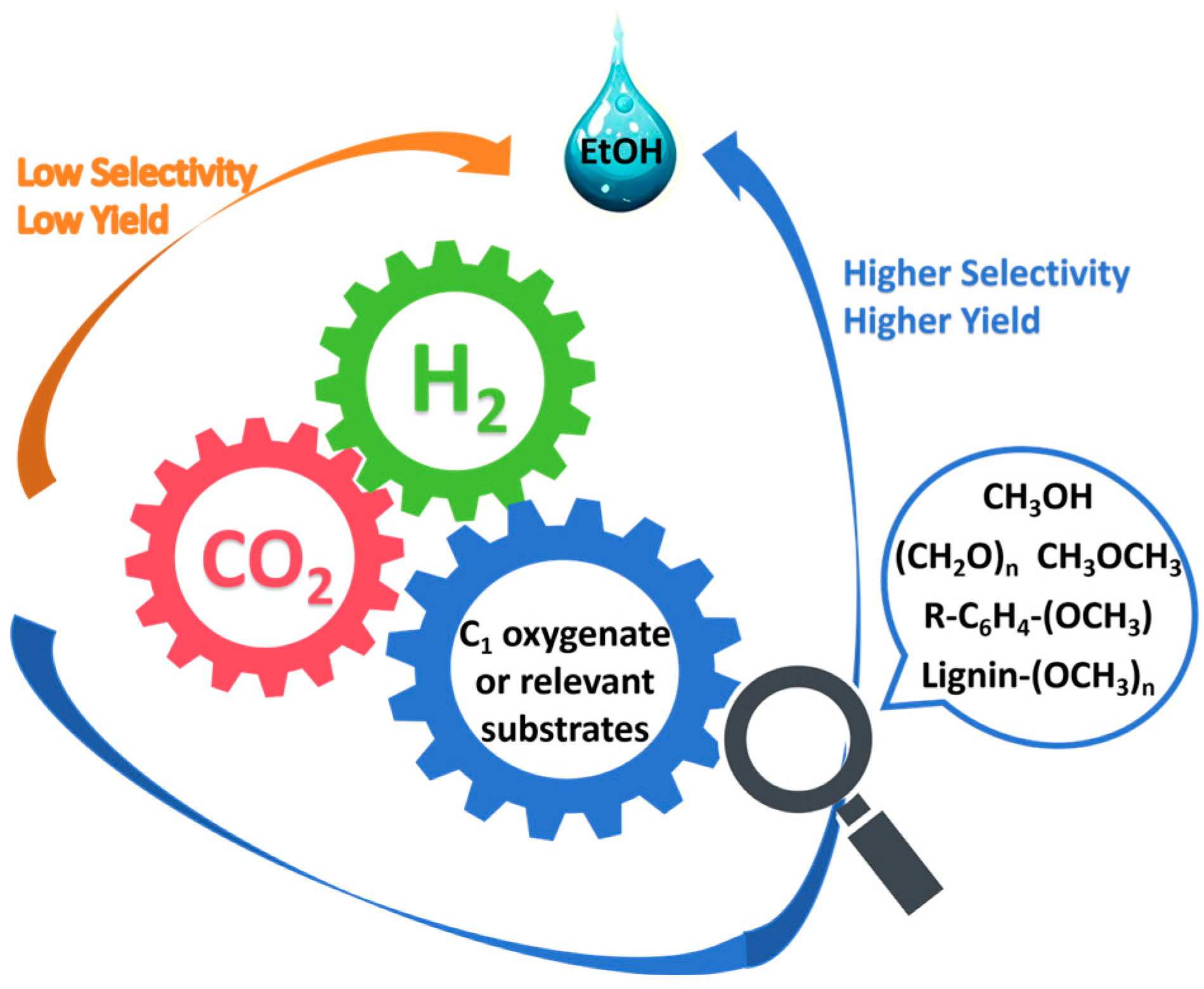
The introduction of C1 oxygenates or relevant substrates in the reaction of CO2 and H2 represents an innovative approach to improve catalytic activity and ethanol selectivity in homogeneous systems (Figure 3). As early as 1998, Sasaki et al. reported the technique of the homologation of CH3OH using CO2 to produce C2H5OH with Ru3(CO)12 and Co2(CO)8 bimetallic catalyst in the molecular ratio of 1:2 [51]. Two distinct mechanistic pathways were proposed for methanol homologation with CO2 and H2, including the CO2 insertion route and the CO insertion route. Initial CO formation was observed, followed by its gradual decline concurrent with rising ethanol yields. This inverse correlation demonstrates that methanol homologation proceeds predominantly via in situ-generated CO derived from a reverse water–gas shift (RWGS) reaction. Moreover, the reaction efficiency was critically modulated by the Lewis acidity of cation in the alkali metal iodides. The reaction results showed that ethanol productivity with promoters of different cations followed the sequence: Cs+ < Rb+ < K+ < Na+ < Li+, directly correlating with the enhanced Lewis acidity of the cations. In 2016, Qian and Han et al. reported a highly effective bimetallic [RuCl2(CO)3]2/Co4(CO)12-LiI system employing MeOH as the substrate and N-ethyl-2-pyrrolidone (NEP) as the solvent for ethanol synthesis under mild conditions [52]. The reaction proceeded efficiently at 160 °C, significantly lower than previously reported temperatures. Notably, the Ru-based TOF for ethanol reached 7.5 h−1, with a 65.0 C-mol% selectivity in total products. In 2019, Qian and Han et al. reported the mono-metallic Ru3(CO)12 catalytic system with initial formation of ethanol at 120 °C among the lowest temperatures reported [53]. Except CO2 and H2, methanol was used as a substrate with LiCl and LiI as co-catalysts in the ionic liquid, 1-butyl-3-methylimidazolium chloride ([bmim]Cl). Especially, it is the first report that ionic liquid was introduced as a reaction medium into CO2 hydrogenation for the production of ethanol. The role of the ionic liquid solvent in mono-metallic catalysis has been demonstrated by a series of control experiments.
In 2017, Qian and Han et al. proposed this strategy by developing a Ru-Co bimetallic catalyst system with paraformaldehyde as a substrate and LiI as a promoter in 1,3-dimethyl-2-imidazolidinone (DMI), achieving 50.9 C-mol% ethanol selectivity under mild conditions (3 MPa CO2, 5 MPa H2, 180 °C, 9 h) [54]. This study identified a three-step methanol homologation pathway: (i) Ru-Co-catalyzed hydrogenation of paraformaldehyde to methanol, (ii) Ru-driven RWGS reaction, and (iii) Ru-Co-mediated C−C coupling to convert methanol into ethanol. Notably, the rapid consumption of methanol correlated with ethanol production, suggesting kinetic coupling between intermediate formation and final product synthesis. After that, advances in ethanol synthesis have expanded the range of organic substrates capable of reacting with CO2 and H2 under catalytic conditions, improving both feasibility and selectivity. Notably, aromatic ethers and aliphatic dimethyl ether (DME) have been explored as key substrates. Qian and Han et al. achieved a breakthrough using a Ru(PPh3)3Cl2/CoI2-LiI catalytic system in DMI solvent, converting CO2, H2, and DME into ethanol with 71.7 C-mol% selectivity under mild conditions [55]. The proposed mechanism involves the following: (i) Li+-mediated DME activation to form CH3Co* intermediates, (ii) in situ CO generation via Ru-catalyzed RWGS, and (iii) CO insertion into activated DME to yield acetaldehyde, followed by Ru-driven hydrogenation to ethanol. Qian and Han et al. further extended their investigation to ethanol synthesis using aryl methyl ethers and lignins as substrate in CO2/H2 mixtures [56]. The Ru-Co-LiI-triphos/DMI system effectively catalyzed the reaction, where the LiI was proved essential and no ethanol was formed in its absence. The proposed mechanism involves (i) ether bond cleavage to generate CH3I, (ii) Ru-catalyzed RWGS to produce CO, and (iii) reductive carbonylation to ethanol. The Ru-Co bimetallic catalyst was crucial for accelerating this process. Notably, propanol formation suggested the system’s potential for alcohol homologation. These findings highlight co-catalysts’ critical role in governing ethanol selectivity and yield. The Ru-Co synergy is particularly effective: Ru stabilizes Co centers while separately driving CO2 hydrogenation to methanol, and Co mediates methanol homologation via a redox cycle [54,55,56].
In summary, these studies demonstrate that alcohol homologation plays a pivotal role in selective ethanol synthesis through CO2 hydrogenation and provides a robust pathway for sustainable ethanol production from CO2. In addition to the effectiveness of substrate addition, these processes typically highlight the importance of noble metal active centers (e.g., Ru, Au) and alkali metal halide promoters (e.g., KI, LiBr, LiI). The combination of well-defined catalytic sites with optimized reaction conditions enables efficient chain propagation, while the use of liquid-phase reaction systems under mild conditions enhances ethanol formation efficiency.

3. Heterogeneous Catalytic Hydrogenation of CO2 to Ethanol

Currently, CO2 hydrogenation to ethanol primarily employs two reactor configurations: slurry-bed and fixed-bed systems [57]. Different from homogeneous catalytic hydrogenation of CO2 to ethanol, heterogeneous catalytic hydrogenation of CO2 to ethanol could use both the slurry-bed and fixed-bed reactors. Slurry-bed reactors provide superior temperature control, lower pressure requirements, and the capability for continuous catalyst replacement during operation [58]. Nevertheless, these systems present their own challenges, including stringent slurry stability requirements and complex product separation processes. In contrast, fixed-bed reactors offer operational simplicity and efficient catalyst-product separation, typically operating at 2–5 MPa pressures. However, their application is constrained by thermal management challenges, because the highly exothermic nature of CO2 hydrogenation often causes temperature gradients and localized hot spots that accelerate catalyst deactivation [30,42]. Reactor optimization represents a critical pathway toward industrial-scale CO2-to-ethanol production. Current research efforts focus on addressing key limitations, including (i) discontinuous operation in fixed-bed systems, (ii) product separation challenges in slurry reactors, and (iii) bed remixing phenomena. Through systematic investigation of these operational parameters and reactor designs, the scientific community is paving the way for more efficient and scalable CO2 hydrogenation processes. Continued advancements in reaction engineering are expected to yield optimized reactor configurations that combine the advantages of both systems while mitigating their respective limitations.
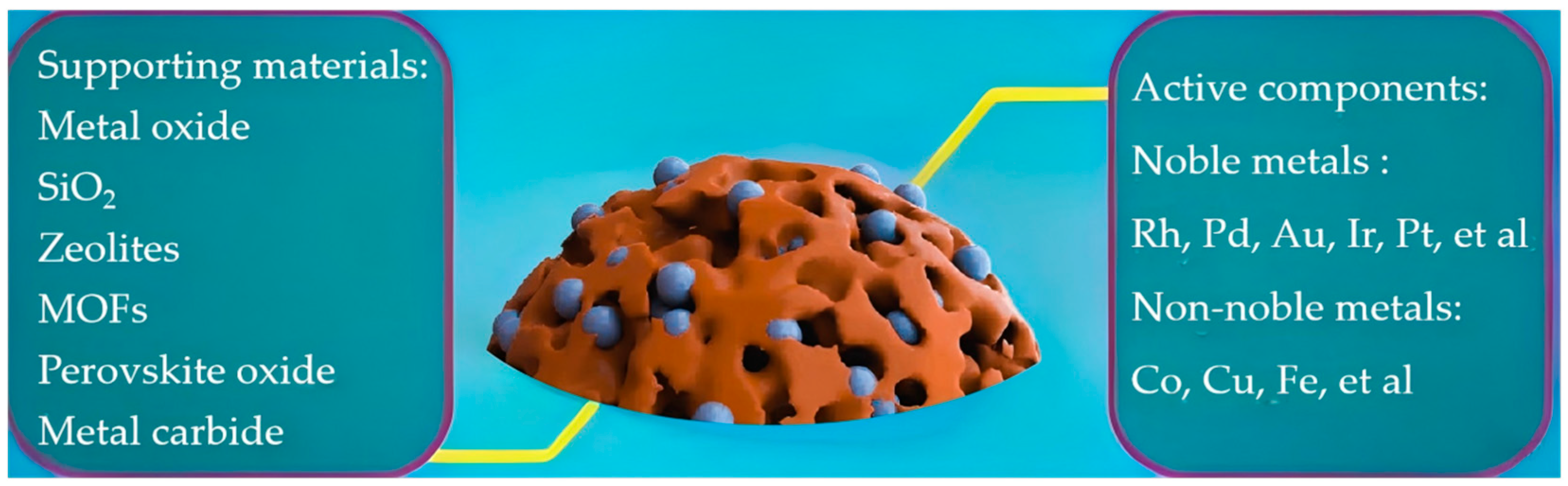
Another difference between homogeneous and heterogeneous catalysts is that heterogeneous catalysts mostly consist of metal active sites and supporting materials [43]. As shown in Figure 4, current catalytic systems for CO2 hydrogenation primarily utilize various support materials, including metal oxides, zeolites, chalcogenides, metal-organic frameworks, and metal carbides. The strategic selection of both support materials and active components plays a crucial role in enhancing catalytic performance. This optimization not only improves reaction efficiency but also directs the reaction pathway toward desired products through synergistic interactions between the support matrix and active catalytic species [59,60]. Various types of supported catalysts used for ethanol production by CO2 hydrogenation via different reactors were summarized, respectively.

3.1. Metal Oxide-Supported Catalysts

Metal oxide-supported catalysts demonstrate great versatility in redox reactions owing to their tunable acid-base properties and abundant surface defects. The hydroxyl groups present on metal oxide surfaces serve as anchoring sites for metal atoms, facilitating CO2 adsorption and activation through optimized electronic interactions [61,62]. The catalytic performance is intrinsically linked to the coordination environment and electron transfer properties of the metal centers, which are strongly influenced by their spatial distribution and the chemical nature of supports. The thermal stability of metal oxide supports under high-temperature conditions represents a critical advantage, while metal–support interactions significantly enhance catalytic performance [63,64,65]. Commonly employed supports including ZnO, TiO2, and Al2O3 exhibit unique functionalities in CO2 hydrogenation to ethanol [66,67]. During reaction conditions, these systems dynamically form oxide–metal interfaces that serve dual functions: (i) promoting CO2 reduction and (ii) facilitating selective C−C coupling while suppressing undesired C1 byproduct formation. This interfacial synergy between metal nanoparticles and reducible oxide supports creates active sites that govern both reactant activation and product distribution.

3.1.1. Slurry-Bed Reactor

In a pioneering work, Bi and Huang et al. developed an innovative Au/α-TiO2 catalytic system for CO2-to-ethanol conversion in slurry-bed reactors, marking the first successful implementation of gold-based catalysts for this transformation [68]. This work revealed remarkable catalytic synergy between gold nanocrystals (Au NCs) and the anatase TiO2 support, achieving ethanol selectivity (>99%) coupled with remarkable operational stability. The research further highlighted the critical influence of solvent selection in batch reactor systems, particularly for Au NC-catalyzed reactions. Through systematic evaluation of various solvents including N-methyl-2-pyrrolidone (NMP), cyclohexane, tetrahydrofuran (THF), and water, dimethylformamide (DMF) emerged as the optimal medium. DMF demonstrated superior performance in enhancing CO2 solubility and facilitating productive interactions between dissolved CO2 and catalytic active sites. These solvent effects were found to be determinant factors in achieving the observed high catalytic efficiency. Palladium (Pd) exhibits robust catalytic performance for CO2 hydrogenation reactions. In a significant advancement, Huang et al. engineered a highly efficient PdCu/TiO2 catalyst system that achieves selective CO2-to-ethanol conversion at 200 °C [69]. The optimized catalyst exhibited satisfactory performance, delivering 92.0% ethanol selectivity through six consecutive reaction cycles. The outstanding catalytic performance originates from synergistic Pd-Cu interactions that promote surface oxide reduction, thereby enhancing ethanol selectivity. Mechanistic studies revealed a reaction pathway involving key intermediates including formate, CO•, and CH3• species. Kinetic analysis identified the hydrogenation of CO• to HCO• as the rate-determining step in the ethanol formation pathway.
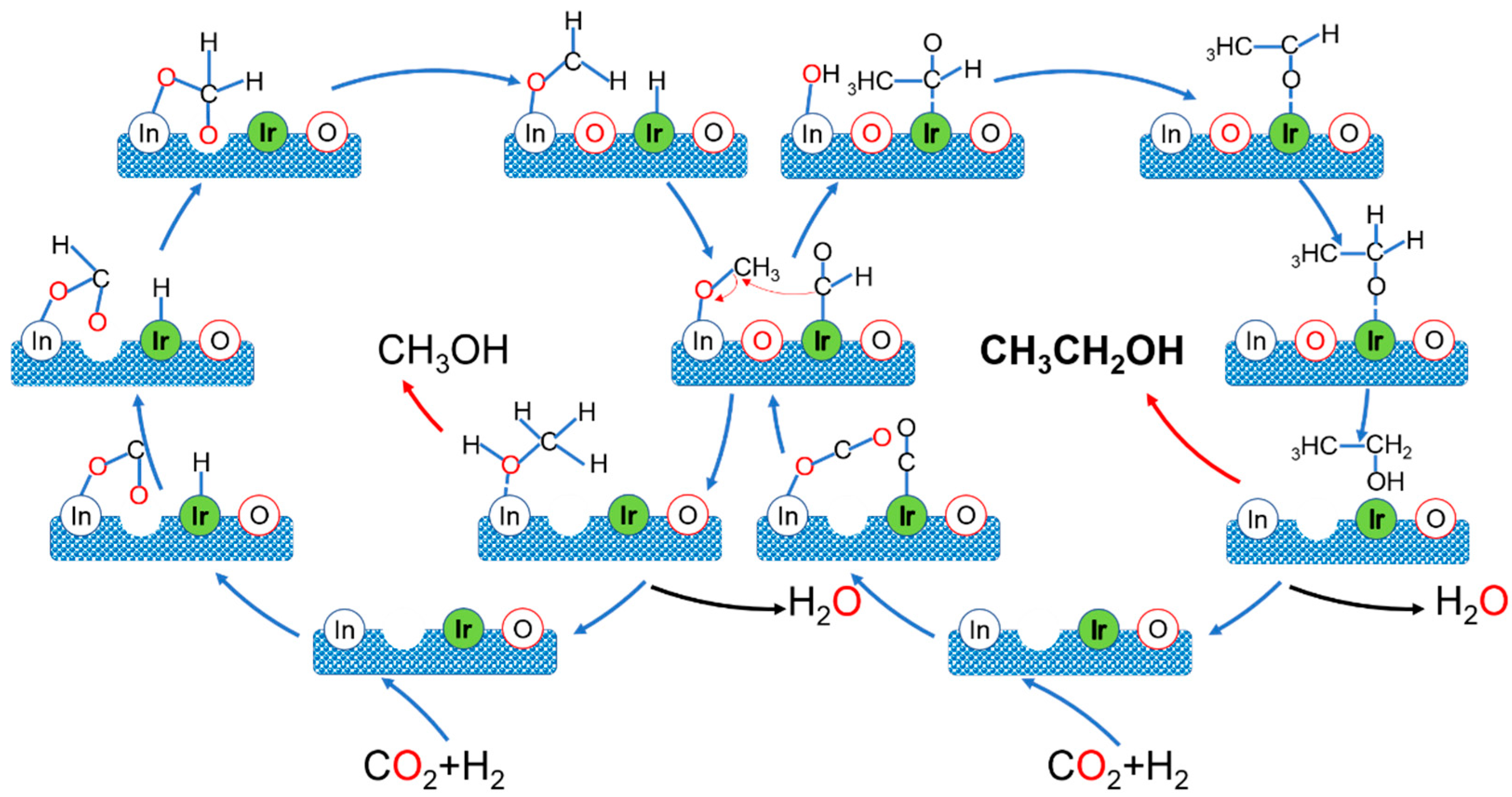
In addition to TiO2, based on the established effectiveness of In2O3 for CO2 hydrogenation to methanol and the unique methanol carbonylation activity of Ir-based single-atom catalysts, Ma and Huang et al. developed an innovative Ir1/In2O3 single-atom catalyst with high ethanol selectivity of 99.7% [70]. As illustrated in Figure 5, the atomic dispersion of Ir atoms on the In2O3 surface created localized Lewis acid-base pairs with oxygen vacancies, which synergistically reduced the activation barrier for CO2 dissociation to CO• by 42% compared to pure In2O3, enhanced CO2 adsorption and activation efficiency, and provided optimal spatial configuration for CH3O•/CO• C−C coupling. Notably, the study revealed a critical structure–activity relationship: while isolated Ir atoms promoted selective C−C coupling, larger Ir0 nanoparticles caused excessive hydrogen enrichment that drove over-reduction to C1 species (CH4 and methanol). Through precise control of Ir loading (optimized at 0.8 wt%), the team achieved a 73% improvement in C2+ selectivity compared to conventional Ir nanoparticle systems, demonstrating the importance of single-atom dispersion for efficient CO2-to-ethanol conversion. In addition, Benedict Lo and Yung et al. presented the Ir1-Px/In2O3 catalyst with impressive ethanol yield of 3.33 mmol g−1 h−1 and a TOF of 914 h−1 at 180 °C and 1.0 MPa [71]. Through integrated in situ characterization and theoretical modeling, they demonstrated that the Ir1-Px ensembles dramatically enhance the hydrogenation process via three synergistic functions: (1) the isolated Ir atom serves as the active center for CO2 activation and selective C−C coupling, while (2) the surrounding phosphorus domains exhibit good hydrogen dissociation capability. These three coordinated steps—CO2 activation, hydrogen dissociation, and C−C coupling—constitute the critical pathway for efficient ethanol formation. This atomic-level understanding of the Ir-P cooperation establishes a new design paradigm for precisely engineering catalytic micro-environments, where spatially organized functional components can collectively optimize complex reaction networks. The demonstrated ability to tailor distinct yet complementary chemical functionalities at the nanoscale opens transformative possibilities for developing advanced catalysts targeting multi-step transformations in sustainable chemistry.
Qian and Han et al. demonstrated that methanol homologation plays a crucial role in ethanol production through heterogeneous CO2 hydrogenation using a Pt/Co3O4 catalyst system [72]. Their study revealed that a 1 wt% Pt loading achieved optimal performance, yielding 88.1% ethanol selectivity under carefully controlled reaction conditions (220 °C, 80 bar, H2/CO2 = 3) in DMI solvent with water as a cosolvent. Isotopic tracer studies employing 13C labeling provided direct evidence for methanol as the pivotal reaction intermediate. The proposed mechanism involves water-mediated protonation of methanol to generate reactive methyl species (CH3*), which subsequently undergo CO insertion to form acetyl intermediates (CH3CO*). These intermediates are then hydrogenated at the Pt-Co3O4 interface to produce ethanol. This finding collectively underscores the significance of methanol homologation pathways in CO2-to-ethanol conversion across both homogeneous and heterogeneous catalytic systems, where the combination of well-defined chain propagation mechanisms, uniform active sites, and optimized reaction conditions enables selective ethanol formation. Zhong and Ding et al. further prepared Pt-loaded Co3O4 catalysts and investigated the influence of Pt on the properties of catalysts for CO2 hydrogenation [73]. Under optimized reaction conditions (240 °C and 3.2 MPa), the reduced 1 wt.% Pt-Co3O4 catalyst exhibited a significant ethanol yield of 0.265 mmol g−1 h−1, whereas the Pt-free Co3O4 catalyst showed negligible activity. Advanced characterization techniques confirmed that Pt incorporation promotes the dynamic regeneration of surface oxygen vacancies, which are crucial for maintaining catalytic activity over multiple reaction cycles.
In addition to the aforementioned single metal oxides, composite metal oxides have recently emerged as promising catalyst materials for CO2 hydrogenation to ethanol. As a representative catalytic system, Rh1/CeTiOx has exhibited excellent performance reported by Liu et al. [74,75]. The outstanding performance of Rh1/CeTiOx containing near-quantitative ethanol selectivity (≥99.1%), outstanding turnover frequency (493.1 h−1) and remarkable long-term stability originates from synergistic effects between Ti doping and atomic Rh dispersion. The introduction of LiI as a homogeneous promoter remarkably enhances CO2 conversion, ethanol selectivity and overall productivity. When combined with the Rh1/CeTiOx single-atom catalyst, this system achieves a good ethanol yield of 223.1 mmol g−1 h−1. The methanol solvent plays a dual role as both reaction medium and methyl source, while the Ti-doped CeO2 support ensures persistent stability (>200 h operation). Notably, this catalytic platform demonstrates remarkable versatility, extending to higher alcohol synthesis (C2–C4) when using ethanol or propanol solvents, with yields maintaining >150 mmol g−1 h−1.

3.1.2. Continuous Flow Reactor

Rhodium nanoparticles supported on oxide materials have emerged as important catalysts for CO2 hydrogenation to ethanol. Gong et al. revealed the critical function of surface hydroxyl groups in enhancing the performance of Rh-based catalysts when supported on TiO2 nanorods (NRs) [64]. The optimized RhFeLi/TiO2 NR catalyst system demonstrates significantly improved catalytic activity (≈15% conversion) and ethanol selectivity (32%) for CO2 hydrogenation. These enhancements originate from the synergistic combination of highly dispersed Rh species and the abundant hydroxyl groups present on the TiO2 NR support. Mechanistic investigations establish that the hydroxyl groups serve dual functions including stabilizing key formate intermediates and facilitating methanol protonation to generate reactive *CHx species. The reaction pathway proceeds through subsequent insertion of CO (derived from the reverse water–gas shift reaction) into CHx to form CH3CO* intermediates, which ultimately undergo hydrogenation to produce ethanol.
Llorca et al. pioneered the application of single-atom catalysts dispersed on inorganic oxide supports for CO2 hydrogenation to value-added products [76]. Their results demonstrate high ethanol selectivity and yield when employing Pd single atoms anchored on Fe3O4 at optimal reaction temperatures of 250–300 °C. Notably, elevated temperatures induced progressive aggregation of Pd single atoms into nanoparticles, which exhibited significantly reduced ethanol formation activity. Comparative studies with alternative oxide supports revealed a unique interaction between Pd single atoms and the Fe3O4 support, suggesting the formation of a distinctive catalytic architecture that facilitates C−C coupling. These findings represent a substantial advancement in catalytic science, offering both a novel catalyst formulation for ethanol production and an important new example of supported single-atom catalysis in action. Liu et al. elucidated the reaction pathway for CO2 hydrogenation over a Pd2/CeO2 catalyst, combining experimental studies with density functional theory (DFT) calculations to determine the energetics of ethanol, methanol, and CO formation [77]. Their results revealed that the Pd dimer plays a decisive role in ethanol production by stabilizing a unique Pd2-O4 structure, which serves as the active site. In this system, CO2 undergoes direct dissociation on Pd2/CeO2 to form CO, a process favored by its relatively low activation barrier. The resulting CO is further hydrogenated to C1 intermediates (*CHx), initiating a competitive pathway between methane formation and alcohol synthesis. DFT calculations demonstrated that *CH3 preferentially couples with *CO to form a *CH3CO intermediate, which subsequently undergoes selective hydrogenation to ethanol (CH3CH2OH) with high efficiency. This work highlights the critical role of bimetallic Pd sites in steering the reaction toward C−C coupling while suppressing undesired methane formation. In recent years cerium oxide has been widely applied in effective catalysts for CO2 hydrogenation. For example, Xiao et al. systematically investigated catalytic performance of Cu/CeO2-x catalysts for CO2 hydrogenative coupling, with 5% CO2 conversion and 95% ethanol selectivity under optimized conditions (30 atm and 240 °C) [78]. Additionally, Mao et al. developed a series of Fe-promoted Rh/CeO2 catalysts through controlled variation in impregnation sequences, systematically investigating their performance for selective ethanol synthesis. The Fe/Rh/CeO2 catalyst exhibited good catalytic performance with 19.8% ethanol selectivity and outstanding one-pass ethanol productivity of 25.3 mmol gRh−1 h−1at 10.8% CO2 conversion [79].
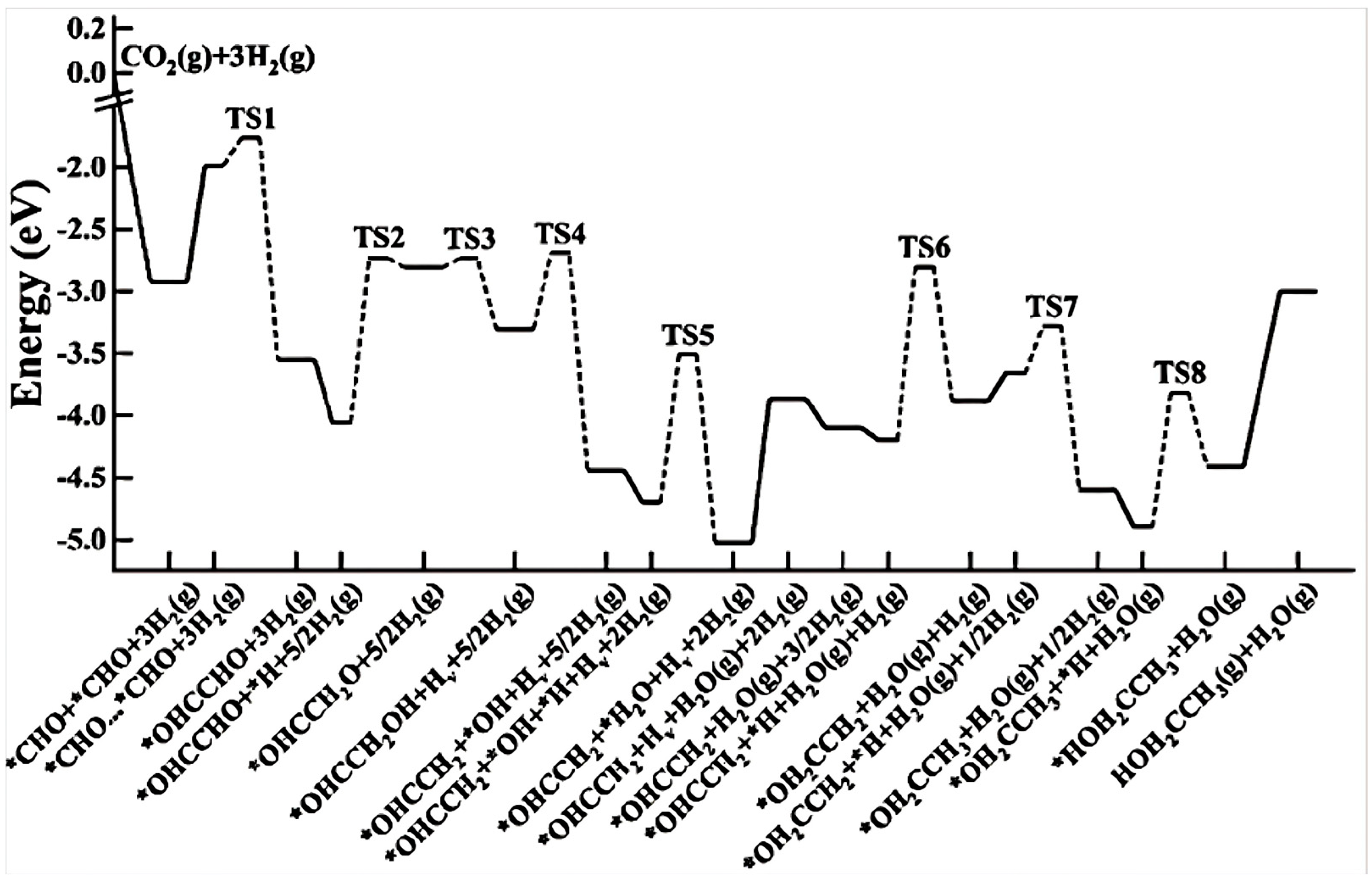
Non-noble metal catalysts based on metal oxide have also made progress. Liu and Rodriguez et al. observed the reaction mechanism towards the ethanol synthesis from CO2 hydrogenation with Cs/Cu/ZnO(0001) catalyst [80]. They performed DFT calculations and kinetic Monte Carlo (KMC) simulation to identify the possible intermediate for ethanol synthesis (Figure 6). It was observed that the Cs/Cu/ZnO(0001) catalyst greatly enhances the CO2 activation to CO and CO hydrogenation pathways. The hydrogenation of CO to CHO* towards ethanol synthesis is an important step. The CHO* intermediate undergoes C−C coupling and forms the important species which lead to ethanol as the final product: CHO* → OHCCHO* → OHCCH2O* → HOCH2CHO* → CH2CH2O* → CH3CH2O* → CH3CH2OH. Toyao et al. developed a novel K-Fe-Cu-Zn/ZrO2 (KFeCuZn/ZrO2) catalyst that achieves good performance in CO2 hydrogenation [81]. Under optimized reaction conditions (360 °C, 4 MPa and 12 L gcat−1h−1), the catalyst demonstrates a remarkable ethanol space-time yield (STYEtOH) of 5.4 mmol gcat−1h−1 and the critical synergistic roles of each catalyst component have been elucidated.
Yadav et al. evaluated three distinct support materials (Al2O3, MgO-MgAl2O4, and MgO) to optimize the distribution of active Co0/Coδ+ sites for ethanol synthesis [82]. Comprehensive characterization combined with catalytic testing demonstrated that the support composition critically influenced the nature of active cobalt species. While Al2O3 preferentially stabilized Coδ+ sites and MgO favored Co0 formation, the mixed MgO-MgAl2O4 support uniquely enabled the coexistence of both Co0 and Coδ+ phases. Moderate-temperature reduction at 400 °C produced a homogeneous distribution of adjacent Co0/Coδ+ sites, with the 20 mol% Co/MgO-MgAl2O4 catalyst exhibiting optimal performance (17.1% ethanol selectivity). The proposed reaction mechanism involves sequential CO2 reduction to CO through a formate (HCOO*) intermediate, followed by hydrogenation to CHx* species. The preferential ethanol formation was attributed to both kinetic (lower activation barrier) and thermodynamic (greater stability) advantages over competing pathways.
In short, metal oxide supports play multiple crucial roles in catalytic processes. In addition to stabilizing the metal active sites, the metal oxide supports could participate in a catalytic process (like Ir1-In2O3) and regulate the state of metal active centers via redox processes (like Co@MgO-MgAl2O4). These synergistic interactions between these metal active centers and oxide supports contribute significantly to enhanced catalytic performance. According to the literature, such catalysts usually displayed better catalytic performance in a slurry-bed reactor than a continuous flow reactor. However, the introduction of a solvent leading to separation costs still limits their industrial application in the slurry-bed reactor. Additionally, except for the utilization of multi metal active centers, diversification of composite metal oxide supports is another trend in the development of metal oxide-supported catalysts.

3.2. SiO2-Supported Catalysts

SiO2 support offers distinct advantages in catalytic applications, particularly their great structural stability. In certain cases, the metal–silicon interfacial bonding enables the catalysts to maintain catalytic performance even under extreme reaction conditions, while simultaneously helping to create active sites [42,43]. The resulting catalysts usually demonstrate remarkable durability [83,84,85,86,87,88]. The continuous flow reactor is mostly applied in CO2 hydrogenation to ethanol catalyzed by SiO2-supported catalysts.
Gascon et al. developed a KFeRh/SiO2 polymetallic catalyst for CO2 hydrogenation to ethanol, where each component played distinct roles: Fe promoted the RWGS reaction, K stabilized non-dissociated CO to form CHxO intermediates, while Rh facilitated CO methanation [86]. This synergistic combination effectively balanced CHx and CHxO generation rates, significantly improving alcohol selectivity and yield. In another approach, Liu et al. designed a CoGa1.0Al1.0O4/SiO2 catalyst with spinel structure (AB2O4), achieving 20.1% ethanol selectivity [87]. The partial reduction of cobalt to Co0 created active Coδ+-Co0 interfaces that enhanced CO2/CO activation and promoted C−C coupling between CHx• and CO• intermediates. The incorporation of Al2O3 and Ga2O3 improved cobalt dispersion and stability through strong metal-oxide interactions. Tan et al. demonstrated that Cu/SiO2 catalysts could achieve 40.0% initial ethanol selectivity by first converting CO2 to CO via RWGS, followed by CO hydrogenation [88]. Their study revealed that smaller Cu nanoparticles and higher Cu+/(Cu+ + Cu0) ratios were crucial for optimizing ethanol selectivity and catalyst stability, highlighting the importance of copper valence state and particle size in the reaction mechanism.
Different from metal oxides, the advantage of SiO2 relies on its stability rather than redox properties. Thus, SiO2 plays a significant role in stabilizing active centers during the reaction process, rather than directly participating in the reaction. The lack of intrinsic activity in CO2 activation and C−C coupling limits the role of SiO2 as a sole support in design of the catalysts for thermo-catalytic CO2 hydrogenation to ethanol.

3.3. Zeolite-Supported Catalysts

Zeolites (also known as molecular sieve) possess excellent porosity and adsorption characteristics, coupled with highly polarized surface Lewis acid/base sites, making them ideal catalyst supports for various applications. These properties contribute to the superior catalytic performance observed in molecular sieve-supported systems for CO2 hydrogenation to ethanol [43,89].

3.3.1. Slurry-Bed Reactor

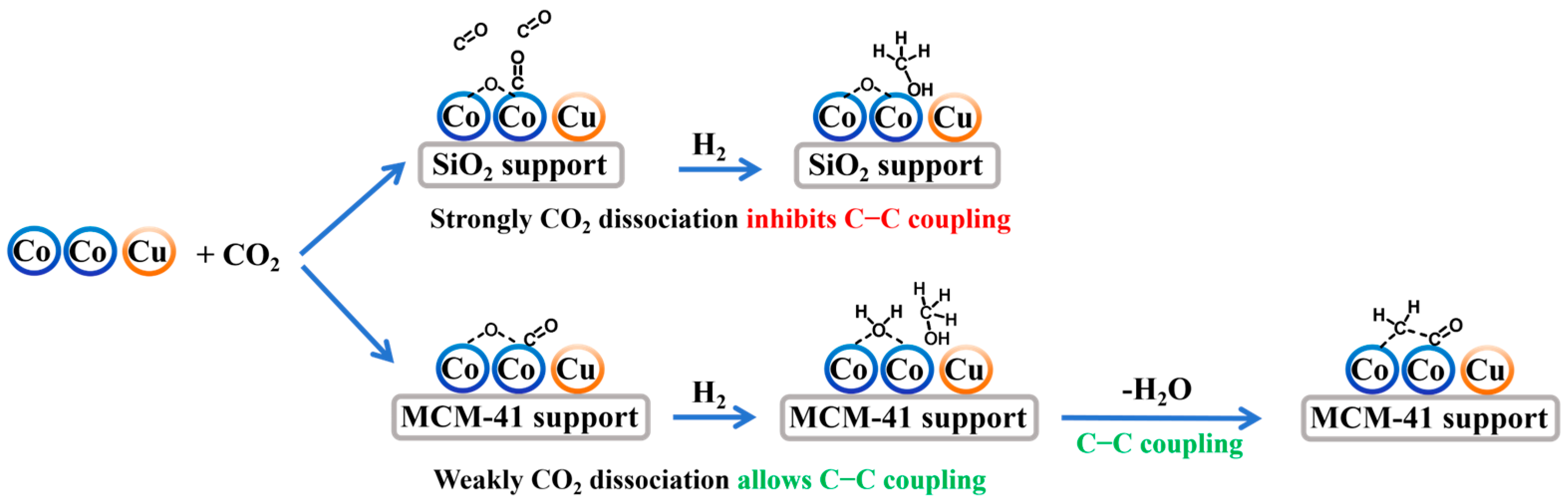
Gong et al. systematically investigated how CO2 dissociation behavior on CoCu surfaces influences product selectivity by engineering different metal–support interactions through silica supports with varying structures [90]. When supported on ordered mesoporous MCM-41 zeolite, the CoCu catalyst demonstrates good performance with 85.3% ethanol selectivity and a space-time yield of 0.229 mmol/(gmetal·h). In striking contrast, the same active components supported on amorphous silica show markedly reduced ethanol selectivity (28.8%). This dramatic difference originates from support-dependent variations in CO2 dissociation intensity (Figure 7). The oxygen species generated during CO2 dissociation competitively occupy the cobalt hollow sites on the catalyst surface, which are the very sites responsible for adsorbing essential C1 intermediates. The C1 intermediates may take part in subsequent C−C coupling reactions. These findings highlight how precise control of metal–support interactions through tailored support materials can fundamentally alter reaction pathways and product distributions in CO2 hydrogenation processes.

3.3.2. Continuous Flow Reactor

Ding et al. developed a Cu@Na-Beta catalyst that achieved a remarkable ethanol yield of 14% with near 100% selectivity in organic products at 300 °C [91]. The unique structural properties of Beta molecular sieves, featuring a disordered heterogenous framework with both tetragonal and rhombohedral crystal systems, enable effective synergy with copper nanoparticles. This architecture precisely confines CO2 adsorption sites and prevents their over-reduction. The reaction mechanism involves partial reduction in CO2 to CO, which undergoes hydrogenation at Cu active sites to form CH3• intermediates. Subsequent reaction of these intermediates with remaining CO2 molecules generates CH3COO• species, selectively driving ethanol formation while suppressing byproducts like methanol, formic acid, and acetic acid.
Encapsulation of active metals within zeolite crystals effectively prevents metal sintering and poisoning, thereby enhancing catalyst stability [92]. Xiao et al. demonstrated this principle through their RhMn@S-1 catalyst, where RhMn nanoparticles confined within zeolite crystals created reactive Mn-O-Rhδ+ species that promoted C−C coupling and C2 oxide formation [93]. The zeolite shell effectively inhibited metal sintering, enabling 88.3% ethanol selectivity in syngas conversion. The overall reaction pathway involves initial CO2 reduction to CO via the RWGS reaction, followed by C−C coupling to form ethanol. Wang and Kang et al. demonstrated a breakthrough Na-promoted Rh catalyst confined within silicalite-1 zeolite (Na-Rh@S-1), achieving 24% ethanol selectivity at 10% CO2 conversion, with a remarkable space-time yield of 72 mmol gRh−1 h−1 [94]. Unlike conventional impregnated catalysts that rapidly deactivate, the zeolite-confined Na-Rh@S-1 maintains stable performance for over 100 h due to the protective confinement effect of the S-1 framework. Advanced characterization demonstrates that the silicalite-1 framework not only prevents Rh nanoparticle sintering but also creates tailored pore environments that favor ethanol formation.
As a porous material, zeolite could serve as good support for metal active sites due to its unique porosity and high stability. Although there are various types of zeolites, currently only a few classical structures have been used for the design of catalysts for ethanol synthesis from CO2 hydrogenation, such as MCM-41, Beta, S-1, etc. Other types of zeolites also have great potential for development of catalysts for CO2 hydrogenation to ethanol. For example, it is a hopeful trend to improve the selectivity of EtOH and other C2+ alcohols by adjusting the pore size of the zeolites.

3.4. Metal–Organic Framework (MOF)-Supported Catalysts

Metal–organic frameworks (MOFs) have emerged as a transformative catalytic platform for CO2 hydrogenation, leveraging their great structural and chemical properties such as ultrahigh surface areas, precisely tunable pore architectures, and abundant coordinatively unsaturated metal sites. The unique architecture of MOFs enables effective encapsulation of metal nanoparticles within carbon matrices, significantly enhancing their resistance to agglomeration while improving thermal stability under reaction conditions. These framework materials further provide multifunctional active sites through their metal nodes, which can simultaneously serve as both Lewis and Brønsted acid centers. Such dual functionality critically enables CO2 activation and stabilizes key reaction intermediates through tailored host–guest interactions [95]. The strong metal–support interactions of MOF systems allow precise spatial organization of multiple catalytic centers, with the organic ligand environment offering unparalleled opportunities for systematic catalyst engineering through rational structural modifications [96,97]. Furthermore, the intrinsic pore confinement effects in MOFs not only optimize the spatial distribution of active sites but also dramatically improve their operational stability through physical isolation and electronic stabilization effects [96,97,98,99,100,101].

3.4.1. Slurry-Bed Reactor

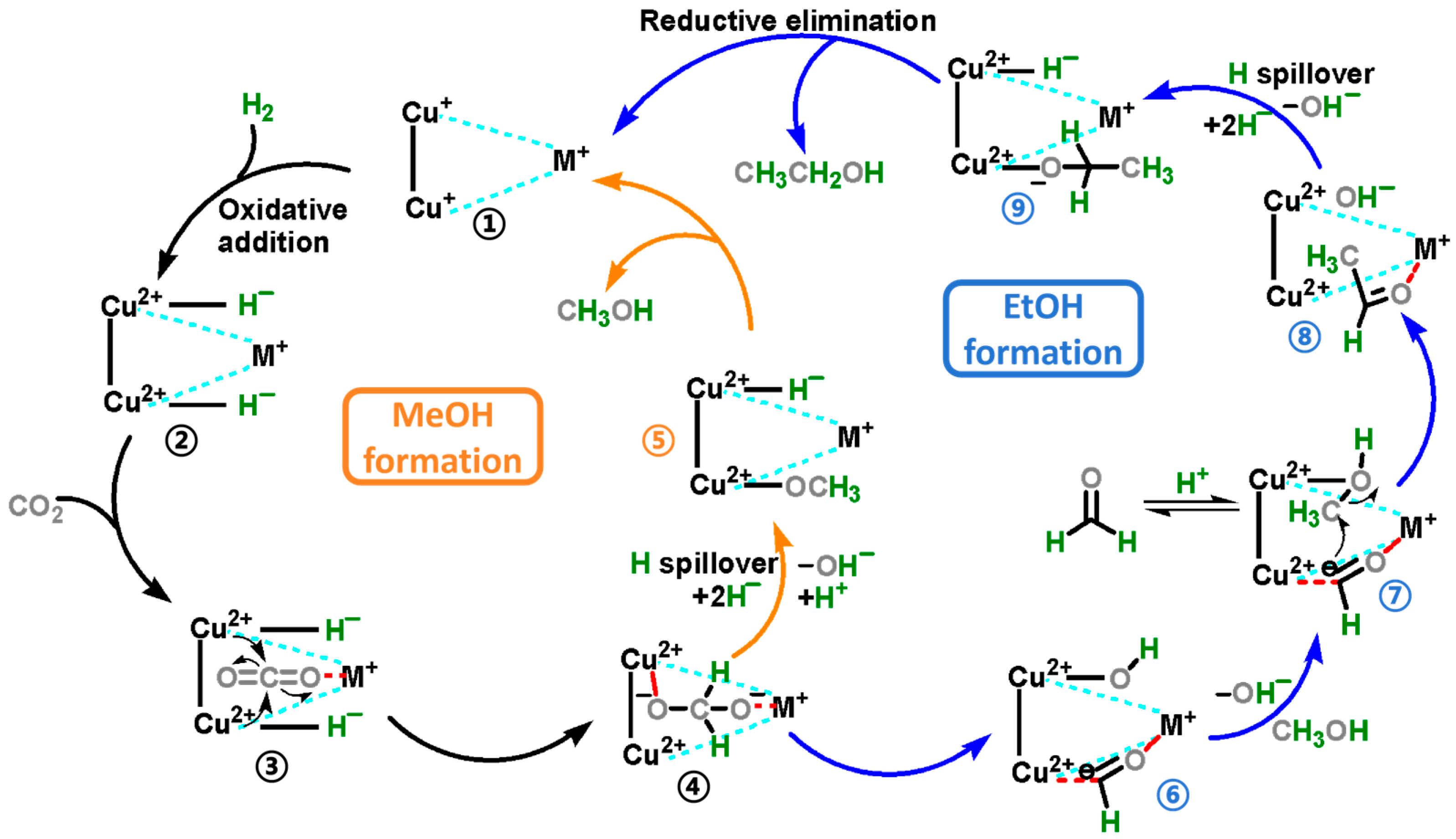
Wang et al. presented a novel catalytic system featuring cooperative Cu(I) sites anchored on Zr12 clusters within a metal–organic framework (MOF) for the highly selective hydrogenation of CO2 to ethanol [102]. The catalytic process is facilitated by alkali cation promotion, where spatially adjacent Cu(I) centers on the Zr12 nodes synergistically activate hydrogen through bimetallic oxidative addition and subsequently mediate efficient C−C coupling as shown in Figure 8. The Cs+-modified MOF catalyst demonstrates excellent performance, achieving >99% ethanol selectivity with a remarkable turnover number (TON) of 4080 (based on total Cu content) under supercritical CO2 conditions (30 MPa CO2, 5 MPa H2, 85 °C) over 10 h. Even under milder conditions (2 MPa CO2/H2 [1:3], 100 °C), the system maintains significant activity with a TON of 490.
In another innovative approach, Wang et al. developed a MOF-supported Cu/Ti bifunctional catalyst that enabled tandem catalytic conversion of CO2 to both ethanol and ethylene [99]. The Cu+ centers selectively catalyzed CO2 hydrogenation to ethanol, while the incorporated Ti sites subsequently mediated ethanol dehydration to ethylene. This elegant design capitalizes on the three-dimensional MOF architecture to spatially organize distinct catalytic functions, enabling efficient cascade reactions within a single material. Such multifunctional MOF-based systems represent a major research direction in advanced catalyst design, offering new opportunities for controlling complex reaction networks in CO2 utilization.
MOF derivatives could also be applied in efficient catalysts for CO2 hydrogenation to ethanol. Liu et al. for the first time reported demonstration of phosphorus-substituted atomically dispersed Rh-N4 sites (Rh-N3P1) for dramatically altering CO2 hydrogenation selectivity [103]. The engineered Rh-N3P1 derived from pyrolysis of Rh/ZIF-8 induces a remarkable product shift from near-exclusive methanol production (91.3%) to dominant ethanol formation (81.8%), while achieving a good TOF of 420.7 h−1 and 69% enhancement in CO2 conversion.

3.4.2. Continuous Flow Reactor

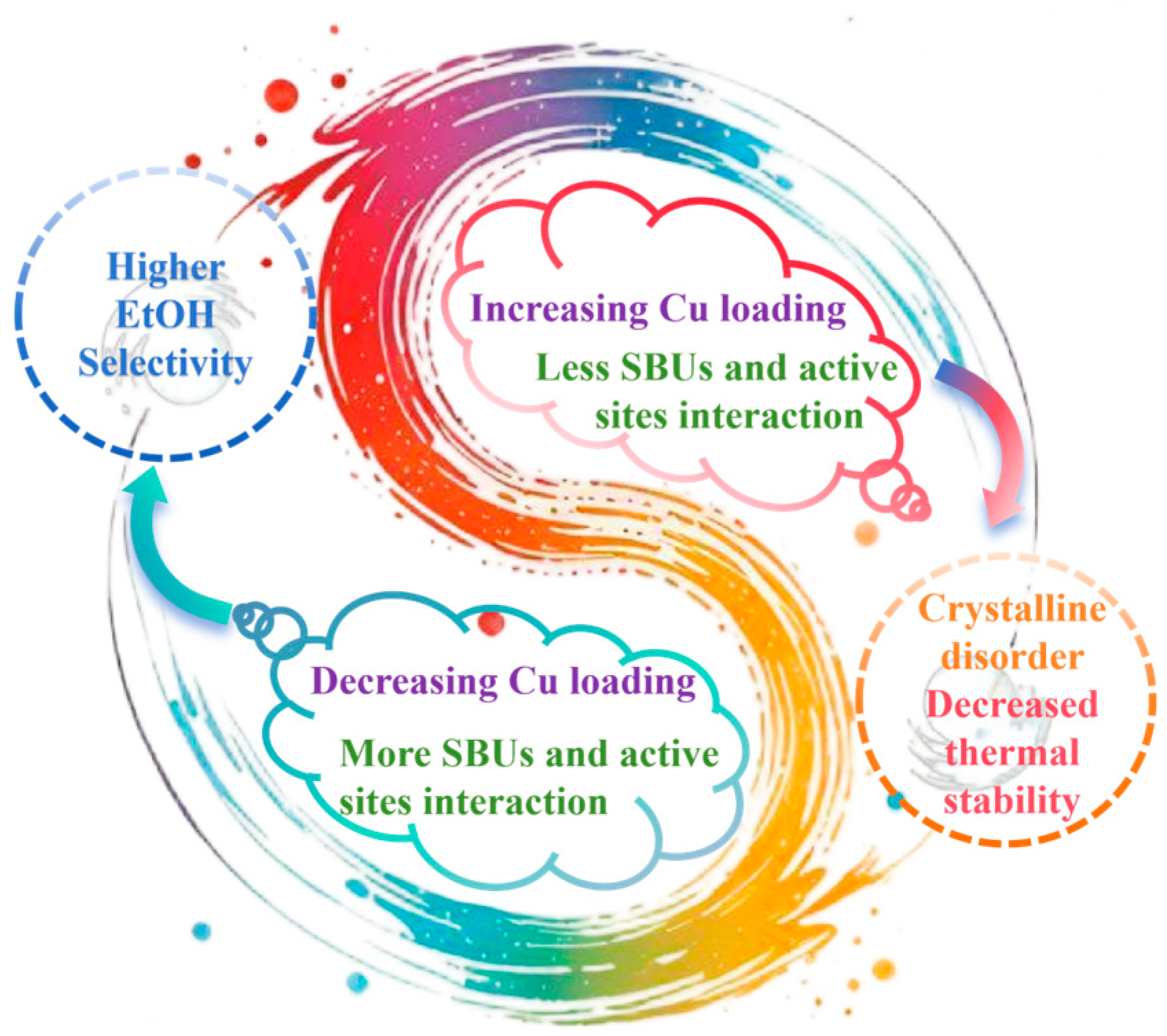
Assaf and Gomes et al. explored UiO-67 metal–organic frameworks as supports for copper catalysts (Cu/UiO-67) in CO2 hydrogenation [104]. The study systematically examined how copper loading variations (5–60 wt%) affected both the catalyst’s physicochemical properties and ethanol production efficiency under mild reaction conditions (Figure 9). Comprehensive characterization demonstrated a dual role of copper content: while increasing the density of catalytically active sites, it simultaneously modified the catalyst’s structural integrity. Optimal performance required careful balance of the copper loading. The excessive copper loading (beyond 20 wt%) compromised the crystalline framework by weakening coordination between secondary building units (SBUs) and active sites, whereas lower loadings preserved structural stability. The 20 wt% of Cu in the Cu/UiO-67 catalyst achieved maximum ethanol productivity, while the catalyst with 5 wt% Cu demonstrated superior ethanol selectivity and enhanced long-term stability. These highlighted the intricate interplay between metal loading, structural preservation, and catalytic function in MOF-supported systems.
Typically, Qiu et al. demonstrate a breakthrough approach combining non-thermal plasma (NTP) activation with a tailored Cu(I)-MOF catalyst (Cu(I)-HKUST-17.5), achieving efficient CO2 conversion (41.2%) and remarkable ethanol selectivity (62.9%) under ambient conditions [105]. Control experiments demonstrated that Cu(I) sites play a pivotal role in facilitating C−C coupling and enabling ethanol formation. Through detailed DRIFTS analysis, a previously unreported synergistic catalytic mechanism has been identified involving the dynamic interplay between non-thermal plasma and both Cu(I) and Cu(II) active sites on the catalyst surface.
Due to ultrahigh surface areas, tunable pore architectures and abundant coordinatively unsaturated metal sites, MOFs could effectively stabilize and functionalize the metal active sites. As mentioned above, some classic MOFs have been used in catalyzing CO2 hydrogenation to ethanol, such as UIO-67, ZIF-8, HKUST, etc. Notably, Zr12-bpdc-CuCs exhibits excellent catalytic performance with EtOH selectivity of 99% and STYEtOH of 87.9 mmol gcat.−1 h−1 under comparable mild conditions (100 °C and 2 MPa) [102]. Although the thermal stability of most MOFs is limited compared with zeolites and SiO2, the customizable ligands with multiple coordination structures still bring great potential to the application of MOFs in designing catalysts for thermo-catalytic CO2 hydrogenation to ethanol. In addition, development of catalysts based on MOF derivatives is also a hopeful trend in thermo-catalytic CO2 hydrogenation to ethanol, because of its diverse metal active sites and stability.

3.5. Perovskite Oxides-Supported Catalysts

Perovskite oxides have emerged as highly versatile catalytic materials owing to their tunable compositions and unique structural properties that enable precise control over oxygen vacancy formation. Due to these characteristics, perovskite oxides represent a promising class of catalytic materials for CO2 hydrogenation reactions. Catalytic test of perovskite oxides-supported catalysts always employs a continuous flow reactor.
In a key development, Liu et al. developed a Co-incorporated La4Ga2O9 catalyst that demonstrated good activity for CO2 hydrogenation to ethanol [106]. The reaction proceeds through a dual-path mechanism where CO2 first undergoes RWGS on the La4Ga2O9 support, followed by conversion of the resulting CO to CHx and CHxO intermediates through dissociation and hydrogenation processes mediated by cobalt species in varying oxidation states. The dynamic evolution of the Co0/Co2+ ratio during the reaction was found to critically influence ethanol production. The increasing reaction time leaded to an elevated Co0/Co2+ ratio and consequently diminished ethanol yields, due to disrupted intermediate formation kinetics. Another promising perovskite system, Sr1-xKxFeO3 (x = 0–0.6) perovskite catalysts reported by Guo and Liu et al., combines cost-effectiveness with remarkable structural stability and chemical flexibility [107]. The potassium-doped system exhibited enhanced catalytic performance through two key mechanisms: (1) promotion of the RWGS reaction and (2) facilitation of Fe2C5 phase formation during the Fischer–Tropsch synthesis (FTS) process. The unique structural evolution of these perovskites under reaction conditions, progressing from SrFeO3 to Sr2Fe2O5 and ultimately to SrO/Fe mixtures, creates an active interface that synergistically promotes ethanol formation from CO2. The potassium modification was particularly effective in optimizing both the redox properties and phase composition of the catalyst, leading to improved selectivity for ethanol production. Although there are a few reports on this type of catalyst, its selectivity still needs to be improved. It still has good potential for development, considering the peculiar structural characteristics of perovskite oxides.

3.6. Metal Carbide Catalysts

Transition metal carbides have emerged as highly promising catalytic materials due to their good hardness, high melting points, and superior corrosion resistance. These properties enable their effective utilization as supports for active metals in hydrogen transfer reactions, while also positioning them as potential substitutes for precious metal catalysts. The unique attributes of metal carbides—including their strong interactions with active metals and tunable surface properties—present exciting opportunities for developing advanced bifunctional catalysts. Current research highlights their catalytic performance in CO2 hydrogenation to ethanol through several key mechanisms: (1) optimized H2 and CO2 activation via tailored metal–carrier interactions, (2) enhanced C−C coupling efficiency through precisely coordinated active sites, and (3) improved reaction kinetics in ethanol formation pathways. Future development efforts should focus on strengthening carrier–active center interactions while designing more economical catalyst systems, with the ultimate goal of achieving both higher efficiency and greater stability in CO2 conversion processes. These advancements will be crucial for realizing the full potential of carbide-based catalysts in sustainable ethanol production from CO2. The main type of reactor used for CO2 hydrogenation catalyzed by metal carbides is slurry-bed reactor.
CO2 activation has been investigated earlier on metal carbides, especially on Mo2C [108]. Wu and Xiao et al. developed an innovative CoMoCx catalyst system using ionic liquid precursors, where careful optimization of carbonization temperatures allowed precise control over Co/Mo loading ratios and electron transfer properties, achieving remarkable ethanol selectivity of 97.4% [109]. The catalytic performance stems from synergistic interactions between Co, Mo2C, and Co6Mo6C6 phases, which collectively enhance H2 and CO2 activation while facilitating the formation of formate and formyl intermediates crucial for ethanol synthesis.
In another significant advancement, Huang and Ma et al. engineered a bifunctional catalyst by immobilizing Rh and K atoms on β-Mo2C nanowires, creating a system capable of sequential CO2 conversion through methanol to ethanol [110]. This architecture leverages proficiency of β-Mo2C in CO2-to-methanol conversion while Rh centers drive subsequent methanol hydrocarbonylation to ethanol, with potassium additives strategically moderating H2 activation rates to maintain optimal reaction balance. Recent developments in two-dimensional carbide materials have further expanded these possibilities, as demonstrated by Gao et al. who designed layered β-Mo2C structures with enhanced mass transport properties. Unlike conventional materials with limited CO2 adsorption capacity, these 2D-M2C carbides exhibit superior CO2 capture and activation capabilities, making them particularly effective for CO2 conversion processes.

3.7. Other Catalysts

In recent years, significant progress has been made in the design and application of composite multifunctional catalysts, driven by the need for superior catalytic activity, selectivity, and stability in complex chemical processes [111,112,113,114,115,116,117]. Representatively, Sun and Wang et al. reported a systematic investigation of Na-promoted Co2C catalysts supported on various materials (Al2O3, ZnO, AC, TiO2, SiO2, and Si3N4) which revealed significant support-dependent catalytic behaviors for CO2 hydrogenation [111]. The SiO2- and Si3N4-supported catalysts demonstrated superior performance, achieving 18% CO2 conversion with 62% ethanol selectivity in the alcohol product distribution at 250 °C, while other supports predominantly yielded methane. Wu and Tsubaki et al. presented a novel catalytic system featuring a strategically designed carbon buffer layer that precisely modulates the electronic properties of ternary ZnOx-Fe5C2-Fe3O4 composites [114]. This architecture establishes a dual electron-transfer pathway (ZnOx → Fe species and carbon-mediated transfer) that optimally tunes the adsorption strength of *CO intermediates at the catalytic interface. The tailored electronic environment promotes efficient C−C coupling between *CHx and *CO species, selectively driving ethanol formation. The carbon buffer layer’s unique electron-regulation capability enables a record ethanol yield of 366.6 gEtOH kgcat−1 h−1 under reaction conditions incorporating 10 vol% CO co-feeding. Liu et al. demonstrated a novel grinding synthesis method to precisely anchor cobalt sites on silicalite-1 (S-1) zeolite through controlled formation of Si-O-Co chemical bonds [115]. By grafting cobalt atoms onto isolated surface silanols, they established strong metal–support interactions that stabilize a unique Co0-CoOx dual-site configuration during reduction, preventing complete conversion to metallic Co0. The S-1-supported catalyst with 5 wt.% Co loading exhibits preferable performance, achieving 27% ethanol selectivity STY of 0.83 mmolethanol gcat−1 h−1 at 250 °C and 2 MPa pressure. In a word, the composite materials that combine the advantages of various components make up for the shortcomings of previous single components and exhibit better catalytic activity. This design and synthesis strategy of composite catalysts with multiple functions provides reference and direction for the design and development of efficient catalysts for thermo-catalytic CO2 hydrogenation to ethanol.
Except for oxides and zeolites, Rh has also been applied to other catalysts combining with other supports. Gao et al. developed an atomically precise rhodium single-cluster catalyst supported on carbon nitride (RhSC/CN) for efficient CO2 hydrogenation to ethanol [118]. The RhSC/CN catalyst, featuring an average Rh-Rh coordination number of 2.06, demonstrates remarkable performance with TOFRh of 595.2 h−1, ethanol selectivity of 95.3% and STYEtOH of 17.5 mmol gcat−1 h−1 under optimized reaction conditions (240 °C and 5.0 MPa). Advanced characterization techniques combined with DFT calculations reveal the underlying reaction mechanism. The synergistic interplay between Rh-Rh and Rh-N sites enhances CO2 adsorption and activation. The unique electronic structure facilitates asymmetric C−C coupling between CH3* and CO* intermediates to form CH3CO*. This coupling pathway is responsible for the observed high ethanol selectivity. The atomic-level control of Rh cluster geometry and coordination environment enables simultaneous optimization of both CO2 reactivity and ethanol selectivity. Tan et al. report a Rh-Fe bimetallic catalyst with precisely controlled nanoscale alloy sites that achieves 49.1% ethanol selectivity (among hydrocarbon and oxygenate products, excluding CO) under mild conditions (3.0 MPa, 200 °C) with low metal loading [119]. Mechanistic investigations reveal the alloy-Specific Pathway. Ethanol production proceeds through a HCOO* intermediate pathway, where C−C coupling occurs via CO insertion at Rh-Fe alloy sites with optimal cluster geometry. Key intermediates CH2* and CO* are stabilized at the alloy interface, with their coupling forming CH2CO* as the critical ethanol precursor. The Rh-Fe electronic interaction lowers the energy barrier for CH2CO* formation by 1.8 eV compared to monometallic Rh sites, as confirmed by DFT calculations. This electronic synergy is cluster-size dependent, with ~1 nm alloy clusters showing maximum activity. In contrast to the productive alloy sites, isolated Rh single sites with geminal-dicarbonyl CO* configurations preferentially yield methane and methanol byproducts, demonstrating how atomic-scale structural variations dictate product distributions. Despite bringing good catalytic performance, the use of noble metals (Rh, Ru, Pd, Au, etc.) increases the cost of catalysts and to some extent limits their industrial applications. The future studies should pay more attention to the research and development of efficient non-noble metal catalysts for thermo-catalytic CO2 hydrogenation to ethanol.

4. Effect of Process Variables on the CO2 Hydrogenation to Ethanol

The comprehensive analysis of thermo-catalytic CO2-to-ethanol conversion reveals several important trends in the field. The majority of studies employ reaction temperatures between 100 and 300 °C, with operating pressures typically ranging from 2 to 6 MPa. While some catalyst systems have achieved ethanol selectivities exceeding 90%, optimal performance requires careful balancing of both high selectivity and substantial CO2 conversion rates. Table 1 provides a comprehensive summary of catalytic systems, reaction conditions and catalytic performance reported in the recent literature for CO2 hydrogenation to ethanol. The data reveal that significant progress has been made in enhancing ethanol selectivity through advanced catalyst design and optimized reaction conditions, particularly in slurry-bed reactor systems operating at elevated pressures. However, two critical challenges persist: (1) the overall CO2 conversion efficiency remains suboptimal, and (2) the corresponding ethanol yields continue to fall below commercially viable levels. These limitations underscore the need for further development of catalytic materials and process engineering approaches to improve both conversion efficiency and product yield simultaneously.

4.1. Effect of Reaction Temperature

The hydrogenation of CO2 to ethanol is fundamentally an exothermic process, thermodynamically favoring lower reaction temperatures. However, this must be balanced against the kinetic requirements of the endothermic CO2 activation step, where higher temperatures promote the crucial conversion to CO intermediates [26,30,31]. This temperature-dependent duality creates an optimization challenge—the ideal operating condition must simultaneously maximize ethanol yield and selectivity while maintaining sufficient catalyst activity.
As indicated by the data compiled in Table 1, catalyst systems employing slurry-bed reactor exhibit a lower temperature window of 100–250 °C than that catalyst systems using continuous flow reactor with a temperature window of 190–360 °C. This could be attributed to the consideration of stability of solvents and catalysts and provide reference for catalyst design and suitable catalytic test optimization. Within these two ranges, researchers achieve the necessary compromise between thermodynamic driving forces and kinetic barriers, enabling efficient CO2 activation while still favoring ethanol formation through subsequent exothermic steps [70,76,120,121]. The predominance of this temperature regime across diverse catalyst systems suggests it represents a fundamental balance point for the competing reaction pathways in CO2-to-ethanol conversion.

4.2. Effect of H2:CO2 Ratio and Pressure

The H2/CO2 ratio represents a critical parameter in CO2 hydrogenation to ethanol, directly influencing both reaction pathways and product distribution [26,30,31]. An excess of hydrogen, while thermodynamically favorable for CO2 reduction, promotes undesirable over-hydrogenation of CO to light alkanes following the initial conversion step. This competing pathway necessitates careful optimization of the hydrocarbon ratio to balance CO2 conversion efficiency against ethanol selectivity. As summarized in Table 1, current research exhibits different H2/CO2 molar ratio between homogeneous and heterogeneous catalytic systems. Most heterogeneous catalysts have identified an optimal H2/CO2 molar ratio of approximately 3:1, while more proportion of CO2 has been used in homogeneous catalytic systems. The ratio is required to provide sufficient hydrogen for effective CO2 activation while minimizing methane and other alkane byproducts through excessive CO hydrogenation [50,106]. The prevalence of this ratio across diverse catalyst formulations suggests it represents a fundamental compromise between the competing thermodynamic and kinetic requirements of the complex reaction network involved in ethanol synthesis from CO2.
The hydrogenation of CO2 to ethanol involves a net reduction in gas volume, making the reaction pressure a crucial parameter that significantly influences both thermodynamic equilibrium and kinetic rates. While elevated pressures generally enhance CO2 conversion by shifting the equilibrium toward products, this beneficial effect becomes progressively less pronounced beyond a certain threshold pressure. Furthermore, the relationship between pressure and ethanol production efficiency exhibits a plateau effect, where additional pressure increases yield diminishing returns [50]. From an industrial perspective, higher operating pressures necessitate more robust reactor materials and construction, leading to substantially increased capital expenditures. Consequently, identifying an optimal pressure range represents a critical balance between achieving sufficient CO2 conversion and maintaining cost-effective process economics. This optimization must simultaneously consider reaction thermodynamics, product selectivity, and practical engineering constraints to develop commercially viable ethanol synthesis processes from CO2.

4.3. Effect of Reaction Time

The duration of reaction time plays a critical role in determining the product distribution during CO2 hydrogenation to ethanol [30]. While extended reaction periods generally favor more complete conversion, excessively prolonged durations can lead to undesirable secondary hydrogenation of ethanol into higher alcohols (C3–C4) or even reverse conversion to methanol through equilibrium-driven processes. Conversely, insufficient reaction time results in incomplete conversion and suboptimal ethanol yields. This temporal dependence creates a characteristic maximum in ethanol production at intermediate reaction times, necessitating careful optimization to achieve peak ethanol concentration in the product stream. The optimal timeframe must balance competing factors: allowing sufficient duration for CO2 activation and C−C coupling while minimizing subsequent transformations of the desired ethanol product [109,112,122]. This optimization becomes particularly crucial when considering the trade-off between reaction completeness and product selectivity in continuous flow systems.

4.4. Effect of Solvent

The choice of solvent in CO2 hydrogenation to ethanol plays a pivotal role in directing reaction pathways and product selectivity [30,123]. While solvent effects have been explored in only a limited number of studies, emerging evidence reveals their significant influence on catalytic performance. Certain solvents have been shown to actively suppress ethanol formation, instead promoting the generation of higher alcohols through alternative reaction channels. Conversely, other solvents function as effective molecular mediators, facilitating the transport and precise positioning of reactant molecules at specific active metal sites. This dual functionality of solvents—as both reaction pathway modulators and molecular transporters—highlights their underappreciated importance in controlling the complex network of surface reactions involved in CO2 hydrogenation. The solvent’s ability to modify local reactant concentrations at catalytic interfaces and stabilize key intermediates ultimately determines the dominant product distribution, making solvent selection a critical parameter alongside more conventional catalyst design considerations.

4.5. Effect of Promoter

Promoters play a pivotal role in CO2 hydrogenation to ethanol by modulating reaction intermediates, thereby critically influencing the efficiency, selectivity, and mechanistic pathways of ethanol formation [124,125,126]. Liu and Rodriguez et al. demonstrated the dual functionality of cesium (Cs) as both a promoter and active site for C−C coupling through combined DFT and kinetic Monte Carlo (KMC) simulations [80]. Their work revealed that Cs stabilizes oxygen-anchored intermediates (*CO2, *CHO, *HCOOH, *CH2O) via strong ionic-like O-Cs bonds at the Cu-Cs-ZnO interface, effectively lowering the energy barrier for C−C coupling. This stabilization preferentially directs the reaction pathway through *CHO-initiated coupling, generating key C2 intermediates (*OHCCH2O, *OHCCH2OH, *OHCCH2, *OH2CCH2, and *OH2CCH3) essential for ethanol synthesis. Importantly, Cs maintains an optimal balance by enhancing *CHyO intermediate stability (crucial precursors for C−C coupling) while preventing excessive adsorption of *CHx or *C species that could hinder ethanol formation. The KMC simulations quantitatively confirmed that Cs promotes the exothermic coupling of two *CHO species, contrasting sharply with the energetically unfavorable pathway observed in its absence.
Complementing these findings, Liu and Hong et al. elucidated the mechanistic role of potassium (K) promoters in the CO-mediated insertion pathway [127]. Their studies identified two key promoter functions: (1) maintaining an optimal equilibrium between non-dissociative (*CO) and dissociative (*CHx) species to ensure sufficient feedstock for CHx-CO coupling, and (2) precisely regulating hydrogenation capacity to prevent premature *CHx hydrogenation while still facilitating the final hydrogenation of *CHxCO/*CHxCHO to ethanol. This delicate balance was shown to be strongly K-loading dependent: low K content (0.1K-CMZF) favored excessive CO dissociation and hydrogenation, leading to CH4 and C2+ alkane formation; moderate loading (4.6K-CMZF) optimized the *CO/*CHx ratio, enhancing C2+ alcohol selectivity; while excessive K (17.6K-CMZF) over-stabilized *CO, limiting *CHx availability and shifting selectivity toward alkenes. These collective insights demonstrate how rational promoter design can steer complex reaction networks toward desired products by simultaneously controlling intermediate stability, hydrogenation kinetics, and C−C coupling efficiency.

4.6. Effect of Water

Water inevitably forms as a byproduct during CO2 hydrogenation and exerts complex, often contradictory effects on catalytic systems. While excessive water can reduce target product yields and deactivate hydrophilic catalysts, controlled water management can enhance reaction performance [128]. Liu et al. observed that water-induced aggregation of Pd dimer sites during CO2 hydrogenation decreased ethanol selectivity while increasing byproducts [129]. To address this, they developed a hydrophobic nanoreactor (Pd2Ce@Si16) derived from modified Pd2/CeO2, which stabilizes diatomic Pd sites through in situ water concentration that modulates the reaction microenvironment. This design maintained stable CO2 conversion and catalyst performance over 60 h of continuous operation.
Conversely, studies demonstrate water’s beneficial roles in certain systems [130,131,132,133]. Gomes et al. investigated enhanced reaction parameters for selective ethanol production using copper catalysts, focusing on water vapor introduction and copper oxidation state control [131]. Their experimental results demonstrate that water vapor plays a pivotal role in maintaining an optimal balance between Cu0 and Cu+ species during the reaction. At 200 °C and atmospheric pressure, the presence of water vapor could preserve oxidized copper species that would otherwise fully reduce under dry conditions, and creates active sites favoring C−C coupling over single-carbon product formation, which enhanced ethanol productivity by 80-fold compared to anhydrous systems.
Rodriguez et al. elucidate the surface chemistry of CO2 hydrogenation on a Pt/CeOx/TiO2(110) multifunctional catalyst [132]. This system exhibits superior CO2 activation capability compared to conventional Cu-ZnO catalysts, achieving 21% ethanol selectivity alongside methanol as the primary product. The catalytic performance stems from the unique Pt-CeOx-TiO2 interface, where AP-XPS and DFT reveal the coexistence of redox-active Ti4+/Ti3+, Ce3+, and mixed-valence Pt0/Pt+ states as the active ensemble. Introducing water vapor dramatically enhances ethanol selectivity to 38% by accelerating the initial CO2 hydrogenation step, increasing surface coverage of C1 intermediates (CH3O*, HCOO*, CHx*) and facilitating C−C coupling through optimized *CHx/*CO spatial distribution.
These findings reveal water’s context-dependent behavior—while it can deactivate certain catalysts through metal leaching or sintering, optimal water concentrations can improve selectivity by modifying reaction pathways and stabilizing key intermediates. The development of water-tolerant catalysts (e.g., hydrophobic nanoreactors) and precise water management strategies represents an important direction for advancing CO2 hydrogenation technologies.
Table 1. Summary of the reported data for the CO2 hydrogenation to ethanol catalyzed by different catalysts.
CatalystReactor
Type
Reaction ConditionsEthanol
Selectivity
CO2
Conversion/%
STYEtOHEthanol
Yield
TONTOF
/h1
Ref.
T/°CP/MPaSolventH2/CO2
HomogeneousCo2(CO)8-Ru3(CO)12-KISlurry-bed20011.8NMP5:1---32%--[48]
Ru3(CO)12-Co4(CO)12-PPNCl-LiBr2009DMI6:3--29.5
C-mmol L−1 h−1
---[49]
Au111203H2O3:1>80%-----[50]
[Ru(CO)3Cl2]2-Co4(CO)12-LiI1608NEP6:265 C-mol%----7.5[52]
Ru3(CO)12-LiI/LiCl1609[BmIm]Cl6:351.5 C-mol%---36.8-[53]
Ru(acac)3-CoBr2-LiI1808DMI5:350.9 C-mol%----17.9[54]
Ru(PPh3)3Cl2/CoI2-LiI1808.5DMI4:471.7 C-mol%-132.5
C-mmol L−1 h−1
---[55]
[RuCl2(CO)3]2-Co2(CO)8-LiI-triphos1908DMI5:340.3%---145-[56]
HeterogeneousAu/α-TiO2Slurry-bed2006DMF4.5:1.5>99%-942.8
mmol gAu−1 h−1
---[68]
Pd2Cu NPs/P252003.2H2O2.4:0.892%----359.0[69]
Ir1-In2O32006H2O5:199.7%----481[70]
Ir1-Px/In2O31801H2O3:198.5%-3.33
mmol gcat−1 h−1
--914[71]
Pt/Co3O42208DMI6:255%22.42.52
mmol g−1 h−1
---[72]
1-Pt-Co3O4-2502403.2H2O3:187.9%-0.265
mmol g−1 h−1
---[73]
Rh1/CeTiOx2503H2O3:1≈99.1%6.3---493.1[74]
Rh1/CeTiOx-LiI2503MeOH3:1>99%-223.1
mmol g−1 h−1
---[75]
CoCu-MCM-412004H2O3:185.3%-0.229
mmol gMetal−1 h−1
---[90]
Zr12-bpdc-CuCs1002THF3:199%9687.9
mmol gcat.−1 h−1
-490-[102]
Rh-N3P12503H2O3:181.8%4.9---420.7[103]
CoMoCx1802DMF3:197.4%-0.528
mmol gcat.−1 h−1
---[109]
K0.2Rh0.2/β-Mo2C15061,4 dioxane-72.1%-33.7
μmol g−1 h−1
---[110]
RhFeLi/TiO2 NRContinuous flow2503-3:132%15.01.65
mmol gcat.−1 h−1
---[64]
NaCuFeZn3605-3:174% (in total alcohol)28.392.7
mg gcat.−1 h−1
---[66]
Rh0.25Cu/TiO22605-3:11.7%6.2558
mg gRh−1 h−1
---[67]
Pd/Fe3O43000.1-4:197.5%0.3413
mmol EtOH gPd−1 h−1
---[76]
Pd2/CeO22403-3:199.2%9.245.6
gEtOH gPd−1 h−1
--211.7[77]
Cu/CeO2-x2403-3:195%5---3.97[78]
Fe/Rh/CeO22503-3:119.8%10.825.3
mmol gRh−1 h−1
---[79]
KFeCuZn/ZrO23604-3:116.5%52.55.4
mmol gcat.−1 h−1
---[81]
Co@MgO-MgAl2O43004-3:117.9%25.0104.1
mmol g−1 h−1
---[82]
KFeRh/SiO22505-3:115.9%18.421.4
mL g−1 h−1
---[86]
CoGa1.0Al1.0O4/SiO22703-6:220.1%5.00.3
mmol g−1 h−1
---[87]
Cu@Na-Beta3002.1-3:169.5%7.9398
mg g−1 h−1
14%--[91]
Na-Rh@S-12505-3:124%1072
mmol gRh−1 h−1
---[94]
Cu/UiO-672600.1-3:16.5%4.00.127
mmol g−1 h−1
---[104]
Cu(I)-HKUST-17.5 (NTP-assisted)350.1-3:162.9%41.2----[105]
Co/La4Ga2O92703.5-3:134.7%4.6----[106]
Na–Co/SiO22505-3:162.81%18.82----[111]
2%Na-Co/SiO23105-3:152.8% (in total alcohol)53.21.1
mmol g−1 h−1
---[112]
2%Na-Fe@C/5%KCuZnAl3205-3:135%39.2-12.4%--[113]
Na-ZnFe@C3205-3:120.3%38.4~158.1
g kgcat−1 h−1
---[114]
5Co/S-12502-3:127%13.90.83
mmol gRh−1 h−1
---[115]
FeCuGaZn-0.753405-3:123.1%2688.9
mg gcat−1 h−1
---[116]
4%Cs/25%Cu-25%Zn-50%Fe200-3002-3:178.8%175
mmol gcat−1 h−1
---[117]
RhSC/CN2405-3:195.3%9.317.5
mmol gcat−1 h−1
--595.2[118]
1%RhFeK/TiO2-DP2003-3:133.4%8.640.6
mmol gRh−1 h−1
---[119]
MoOx/Rh/TiO21804-3:14.5%-----[121]
3K-CuCo-12003-3:138.8%4.90.61
mmol g−1 h−1
---[124]
2Na-CoMnO2403-3:118.89%54.311.27
mmol g−1 h−1
---[125]
K(1.6)/FeCuAl3305-3:128.7%41.2603
gAcHkgcat−1 h−1
---[126]
1Pd2Ce@Si162503-3:198.7%5.911.6
mmol gRh−1 h−1
---[129]
Cu1900.1-1:184%~0.1~2
μmol gcat−1 h−1
---[130]
CuO2000.1-1:1
(H2O:CO2)
--0.78
μmol gcat−1 h−1
---[131]
Pt/CeOx/TiO2(110)2775-9:121%-----[132]
Ru/In2O3-ZrO22250.6-3:1~70%1130
mg gRh−1 h−1
0.7%--[133]
Note: The “-“ indicates that some parameters are not available in the literature or cannot be obtained indirectly.

5. Mechanistic Aspects of Ethanol Synthesis via CO2 Hydrogenation

The direct catalytic hydrogenation of CO2 to ethanol presents a technologically promising but fundamentally challenging transformation, constrained by both the inherent thermodynamic stability of CO2 and the kinetic complexity of parallel reactions that compete with selective C−C bond formation (Reactions 1–6). Fundamental thermodynamic parameters, including standard Gibbs free energy change (ΔG298K), reaction enthalpy (ΔH298K), and equilibrium constants (K298K) of the parallel reactions provide essential guidance for rational catalyst design. The reaction network demonstrates that production of ethanol mainly follows two methods: (i) direct CO2 hydrogenation and (ii) formation of CO and subsequent CO hydrogenation to ethanol.
(1)
CO2 hydrogenation to ethanol
2 C O 2 ( g ) + 6 H 2 ( g ) C H 3 C H 2 O H ( l ) + 3 H 2 O ( g ) ; Δ H = 173.70   K J   m o l 1
(2)
CO hydrogenation to ethanol
2 C O ( g ) + 4 H 2 ( g ) C H 3 C H 2 O H ( l ) + H 2 O ( g ) ; Δ H = 61.20   K J   m o l 1
(3)
RWGS reaction
C O 2 ( g ) + H 2 ( g ) C O ( g ) + H 2 O ( g ) ; Δ H = 41.12   K J   m o l 1
(4)
CO2 hydrogenation to methanol
C O 2 ( g ) + 3 H 2 ( g ) C H 3 O H ( l ) + H 2 O ( g ) ; Δ H = 49.43   K J   m o l 1
(5)
CO2 hydrogenation to methane
C O 2 ( g ) + 4 H 2 ( g ) C H 4 ( g ) + 2 H 2 O ( g ) ; Δ H = 165.10   K J   m o l 1
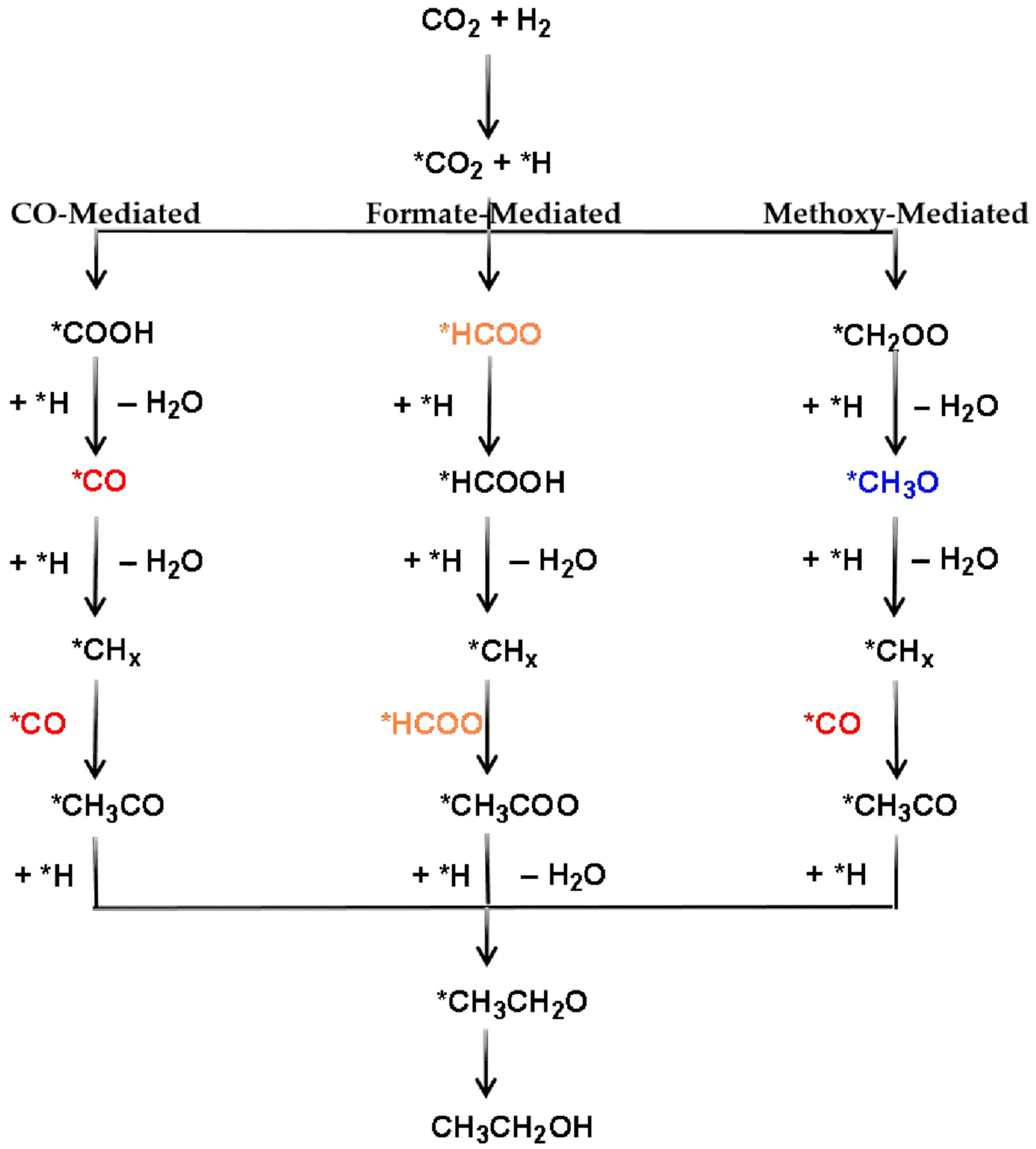
While the reaction mechanisms for CO2 hydrogenation to C1 products (such as methane and methanol) have been extensively studied and well-characterized in the literature, the pathway for ethanol formation remains significantly less understood and subject to ongoing debate [134,135,136]. This knowledge gap primarily stems from the complex interplay of multiple surface-bound intermediates that coexist at varying concentrations during the reaction. Current mechanistic understanding, derived from existing experimental and theoretical studies, reveals three predominant pathways that have been proposed for ethanol synthesis from CO2 hydrogenation, each with distinct intermediate species and rate-determining steps (Figure 10). The mechanistic uncertainty arises from several factors, including (1) the dynamic nature of surface species under reaction conditions, (2) competing parallel reaction pathways, and (3) the sensitivity of product distribution to catalyst composition and reaction parameters. These challenges have hindered the establishment of a unified mechanistic framework, necessitating further systematic investigations to resolve the remaining controversies in this important catalytic transformation. Three approaches identified based on available studies were discussed below.

5.1. CO-Mediated Mechanism

The CO-mediated pathway has emerged as the most widely accepted mechanism for ethanol synthesis from CO2 hydrogenation. This mechanism initiates with the RWGS reaction converting CO2 to CO, followed by sequential hydrogenation of CO to form *CHx surface species. The critical C−C bond formation occurs through CO insertion into these adsorbed *CHx intermediates, generating *CHxCO species that undergo further hydrogenation to form the key ethoxy (*CH3CH2O) intermediate, which ultimately yields ethanol. Li et al. provided experimental evidence for this pathway using a Cu-CoGaOx catalyst system, demonstrating that CO produced via RWGS inserts into CHx species adsorbed on the CoGaOx surface to form *CH3CH2O intermediates [137]. The historical foundation for this mechanism dates back to a pioneering work reported by Okabe et al. in 1996, where in situ FTIR spectroscopy directly detected CO species adsorbed on Rh surfaces during ethanol formation, while gas-phase analysis concurrently revealed substantial CO in the reactor effluent [138]. Further mechanistic insights were provided by Liu and Hong et al. through in situ DRIFTS studies of Cs-CuFeZn catalysts, which identified adsorbed acetaldehyde and ethoxy intermediates following CO and CxHy formation via RWGS [139]. Their complementary methanol steam reforming experiments conclusively demonstrated that methanol decomposition primarily produced CO2 rather than serving as an ethanol precursor, confirming that CH3 species originate from direct CO dissociation rather than methanol dehydrogenation. Zhao et al. comprehensively investigated CoCu bimetallic catalysts and revealed that controlled surface segregation plays a pivotal role in steering CO2 hydrogenation toward ethanol production [140]. Density functional theory (DFT) calculations demonstrate that CO2 first undergoes activation via the RWGS pathway to generate CO intermediates on the catalyst surface and indicates the importance of CO generation and dissociation to form CHx. These collective findings establish the CO insertion mechanism as the predominant pathway for ethanol synthesis across diverse catalyst systems, while highlighting the critical role of RWGS-derived CO in facilitating C−C bond formation.

5.2. Methoxy-Mediated Mechanism

The methoxy-mediated pathway for CO2 hydrogenation to ethanol involves the initial formation of *CH3O intermediates, a critical step first demonstrated by He et al. using Pt/Co3O4 catalysts [72]. Their experimental evidence revealed that water plays a dual role: it not only participates in protonating methanol to form reactive *CH3OH/*CH3O species but also facilitates their dissociation into *CH3, *OH, and *H surface intermediates. These *CH3 moieties subsequently undergo C−C coupling with CO (derived from CO2 via RWGS) to yield *CH3CO, which is further hydrogenated to ethanol. This mechanism gains support from Ding et al.’s work on Cu@Na-Beta catalysts, where in situ studies confirmed the hydrogenation of CO2 to *CH3OH and *CH3O, followed by their decomposition into *CH3 via two distinct routes: (*CH3O → *CH3 + *O) and (*CH3OH → *CH3 + *OH) [91]. DFT calculations further validated two plausible ethanol formation pathways: (i) direct C−C coupling between *CO2 and *CH3, or (ii) C−C coupling between *CO2 and *CH3O intermediates, both culminating in *CH3CH2OH through hydrogenation (e.g., *CO2 + *CH3 + 2H2 → *CH3CH2OH + *OH). Notably, analogous mechanisms have been observed in Rh-based systems, where *CHx species (analogous to *CH3) are identified as key intermediates for C−C coupling. A recent study on Pd/CeO2 catalysts also highlights the critical role of *CHxOH dissociation and *CHx-*CO coupling, reinforcing the universality of methoxy-derived pathways in C2 oxygenate synthesis [129].

5.3. Formate-Mediated Mechanism

The formate-mediated pathway for CO2 hydrogenation to ethanol involves a distinct sequence of surface reactions, beginning with CO2 activation and initial hydrogenation to form adsorbed formate (*HCOO) species. Subsequent hydrogenation converts *HCOO to *CHx intermediates, which then undergo C−C coupling with additional *HCOO to initiate ethanol synthesis. While this mechanism has been less extensively studied compared to other pathways, several key investigations have provided experimental and theoretical validation. Xiao et al. demonstrated this route using cobalt-based catalysts (CoAlOx and Co0.52Ni0.48AlOx), where operando FTIR spectroscopy directly detected the coexistence of critical *CHx and *HCOO intermediates [120,122]. Their work revealed that *CHx insertion into *HCOO forms acetate (*CH3COO), which is then hydrogenated to yield ethanol. Notably, the origin of acetate species could possibly be produced through oxidation of aldehyde intermediate with lattice oxygen of oxide supports, such as Co/Al2O3 and Co/CeO2 [141]. Moreover, the accumulation of non-reactive acetate on active metal oxide support is one of the reasons for catalyst deactivation. Complementary theoretical insights were provided by Liu and Rodriguez et al. through combined DFT calculations and kinetic Monte Carlo (KMC) simulations of Cu/Cs/ZnO catalysts [80]. Their analysis identified that cesium promotion facilitates formic acid dissociation into *CHO via the formate pathway, with *CHO serving as the primary precursor for C−C coupling. This process generates *OHCCHO as the key intermediate for ethanol formation. Together, these studies establish the formate pathway as a viable mechanism for selective ethanol production, particularly highlighting the importance of promoter effects (e.g., Cs) in modulating intermediate stability and reaction kinetics.
Although catalytic hydrogenation of CO2 to ethanol occurs through three distinct mechanistic pathways, they all share the common feature of generating reactive *CHx species as crucial building blocks for C−C bond formation. These pathways may initiate through different intermediates such as *CO, *HCOO or *CH3O. Thus, there are two key steps in the reaction mechanism, including efficient CO2 hydrogenation to generate *CHx species and efficient C−C coupling through different pathways to form ethanol. High-selective synthesis of ethanol requires controlled hydrogenation of CO2 to desired intermediates and the ability to stabilize them before C−C coupling to form ethanol. There are many kinds of catalysts that may accelerate the formation of ethanol from CO2 and H2. The catalysts have diverse structures and various abilities to form and stabilize these intermediates, leading to totally different mechanistic pathways. Currently, it is very difficult to render clear and systematic correlations between the reaction mechanisms and the catalyst structures. However, for a certain catalyst the structure–activity relationship can be characterized in a definite manner. For example, in the catalyst Rh-N3P1, the donation of electron from P atom to Rh center helps to weaken the C-O bond in CH3OH*, facilitating its cleavage to generate CH3* species and enabling its coupling with CO* [103]. In the 5Co/S-1 catalyst the strong metal–support interactions originating from the Si-O-Co bonds stabilize the coexistence of Co0 and CoO sites, where Co0 site facilitates the formation of CHx* species, which further couples with the HCOO* species stabilized by CoO sites [115].
While substantial progress has been made in elucidating these reaction networks, the complete mechanistic picture remains incomplete due to the inherent complexity of competing surface reactions and the dynamic nature of intermediate species. This mechanistic understanding represents a critical knowledge gap that must be addressed to advance CO2-to-ethanol conversion technologies. Future breakthroughs in this field will likely emerge from synergistic advances in three key areas: (1) precise control of catalyst active sites, (2) detailed characterization of surface intermediates under operando conditions, and (3) rational design of multifunctional catalysts capable of steering reaction pathways toward selective ethanol formation. The interplay between these factors ultimately determines the efficiency and selectivity of CO2 conversion, underscoring the importance of fundamental mechanistic studies for developing practical CO2 utilization technologies. Although excellent performance of ethanol synthesis from CO2 hydrogenation can be attained by various transition metal catalysts, the catalysts that can elegantly regulate such reaction process usually involve noble metals. The deeper understanding of the reaction mechanism may favor the development of cheaper metal catalysts, but it is still a challenge at the present stage.

6. Conclusions and Future Directions

CO2 hydrogenation represents a promising route for converting CO2 into ethanol, though the technology remains less mature compared to established processes for C1 products like methane (via methanation) or methanol (via methanol synthesis). This review examines recent advances in catalyst development for selective CO2-to-ethanol conversion, where the primary scientific challenge lies in effectively integrating catalytic sites for both CO2 reduction and subsequent C−C coupling. Molecular catalysis in homogeneous systems demonstrate how the interplay between metal centers, ligands, solvents, and promoters can achieve good ethanol selectivity and activity under mild conditions through alcohol homologation mechanisms that combine RWGS, methanol synthesis, and chain growth steps. While these liquid-phase approaches show promise, they face practical limitations in catalyst recovery, continuous operation and the separation cost of products compared to fixed bed systems. However, there have been many successful cases of homogeneous catalysis in industry, including production of some commercial bulk chemicals such as acetic acid by methanol carbonylation as well as aldehyde by olefin hydroformylation. If the recycling and reuse of the homogeneous catalysts can be realized by tailoring the catalyst nature, the solvent properties and the separation techniques, the potential of homogeneously catalyzed ethanol production from CO2 and H2 could also be shown in future.
Batch reactors have proven particularly effective for heterogeneous CO2 hydrogenation, offering precise control over reaction environments and enabling strategic use of solvents like water to enhance ethanol formation—with selectivity reaching 90%, significantly outperforming conventional flow systems. However, the inherent batch operation and economical cost pose challenges for industrial-scale implementation. Parallel advancements in reactor engineering are equally vital, particularly in developing continuous processing systems to overcome the limitations of batch operations. Three particularly promising directions include (i) membrane-integrated flow reactors enabling simultaneous reaction and product separation, (ii) plasma-assisted catalytic systems that enhance energy efficiency through non-thermal activation, and (iii) hybrid photo-electro-catalytic configurations that combine renewable energy inputs with catalytic conversion.
Catalyst development has focused on both noble metals (Ru, Rh, Au, Ir, Pd) and 3d transition metals (Cu, Co, Fe, Mo), with Rh-based systems showing good early results in both CO2 and syngas conversion to ethanol due to their unique ability to balance hydrogenation and C−C coupling. While noble metals provide superior selectivity, their cost drives research into more economical alternatives, where alkali metal promoters have shown particular promise in enhancing C2+ product formation by modulating hydrogenation activity. Various supports (oxides, zeolites, MOFs, etc.) have been applied in heterogeneous catalysts to enhance the stability of metal active sites and achieve good catalytic activity. The emerging field of tandem catalysis offers particularly exciting opportunities for CO2-to-ethanol conversion, though significant research is still needed to optimize catalyst design, reaction sequences, and process conditions.
While significant advances have been made in CO2 hydrogenation, fundamental challenges remain in elucidating precise structure–activity correlations. Key unanswered questions remain regarding promoter mechanisms and support effects, whose resolution could unlock substantial improvements in catalytic efficiency. These knowledge gaps underscore the critical need for advanced in situ and operando characterization methods—including diffuse reflectance infrared Fourier transform spectroscopy (DRIFTS), X-ray absorption spectroscopy (XAS), and ambient-pressure X-ray photoelectron spectroscopy (AP-XPS)—to probe active site evolution under realistic reaction conditions. This field is undergoing a paradigm shift through the incorporation of artificial intelligence and machine learning. These computational approaches provide transformative capabilities across four key areas: (1) rapid screening of catalyst formulations, (2) predictive modeling of catalytic performance, (3) accelerated optimization of reaction parameters, and (4) cost-efficient virtual experimentation through digital twins [142,143,144,145,146]. While no commercial processes yet exist, the rapid progress in fundamental understanding and catalyst innovation suggests CO2 hydrogenation to ethanol may become a practical carbon utilization technology in future.
This comprehensive review systematically compares homogeneous and heterogeneous catalytic pathways for CO2 hydrogenation to ethanol, highlighting their distinct advantages and limitations. Homogeneous systems excel in molecular-level control, operating under milder conditions (typically <200 °C), while achieving good selectivity through precisely engineered metal–ligand–solvent interactions. In contrast, heterogeneous catalysis, despite requiring more severe conditions (often 200–300 °C), offers practical advantages including straightforward catalyst separation and better scalability, though typically at the cost of reduced selectivity (usually 30–70% ethanol) due to competing side reactions. The fundamental kinetic differences are striking: homogeneous catalysis relies on discrete molecular active sites with tailored ligand and solvent environments, while heterogeneous systems depend on complex surface phenomena involving metal–support interactions and promoter effects. Reactor configurations further differentiate these approaches, with slurry-bed reactors dominating homogeneous systems for optimal solvent effects and residence time control, while continuous-flow designs prevail in heterogeneous catalysis for industrial feasibility.
The development of next-generation catalysts for CO2 hydrogenation to ethanol necessitates innovative multifunctional catalyst designs capable of simultaneously overcoming three fundamental challenges: (1) efficient CO2 molecular activation, (2) selective hydrogenation control, and (3) precise C−C coupling regulation. Current research is advancing several promising design strategies: first, hybrid bimetallic systems that strategically combine cost-effective 3d transition metals (Cu, Co, Fe, etc.) with selective noble metals (Ru, Rh, Pd, Ir, etc.) to harness their complementary catalytic properties. Second, sophisticated support engineering approaches that exploit strong metal–support interactions and controlled oxygen vacancy generation to modulate electronic structures and intermediate stabilization. Third, precisely engineered nanoconfinement architectures that create tailored reaction microenvironments through spatial control of active sites and reactant diffusion pathways. These integrated design principles collectively enable the atomic-level engineering of catalytic systems for the complex reaction network required for selective ethanol production from CO2 hydrogenation. Future industrial catalysts must prioritize simplicity in fabrication, economic viability, long-term durability, and manufacturability at scale, all of which should be integrated within environmentally friendly processes.

Author Contributions

X.M. wrote the manuscript. Y.W., J.L., H.W., C.Y., J.G. and Z.Z. helped to collect the information and took part in the discussion. Q.Q. and B.H. conceived and revised the manuscript. All authors have read and agreed to the published version of the manuscript.

Funding

This research was funded by the National Key Research and Development Program of China (2024YFE0206500), Center for Carbon Neutral Chemistry, ICCAS (CCNC-202501), the National Science Foundation of China (22033009, 22072156, 22073104, 22121002).

Data Availability Statement

No new data were created or analyzed in this study. Data sharing is not applicable to this article.

Conflicts of Interest

The authors declare no conflicts of interest.

References

  1. Trends in Globally-Averaged CO2 Determined from NOAA Global Monitoring Laboratory Measurements. Available online: https://gml.noaa.gov/ccgg/trends/global.html?doi=10.15138/9n0h-zh07 (accessed on 5 September 2025).
  2. Bui, M.; Adjiman, C.S.; Bardow, A.; Anthony, E.J.; Boston, A.; Brown, S.; Fennell, P.S.; Fuss, S.; Galindo, A.; Hackett, L.A.; et al. Carbon capture and storage (CCS): The way forward. Energy Environ. Sci. 2018, 11, 1062–1176. [Google Scholar] [CrossRef]
  3. Zhang, X.G.; Abdul Raman, A.A.; Jewaratnam, J.; Buthiyappan, A. Sustainable carbon dioxide capture, storage, and utilization: Review of current status and future direction. Int. J. Environ. Sci. Technol. 2025, 22, 6125–6160. [Google Scholar] [CrossRef]
  4. Yasemi, S.; Khalili, Y.; Sanati, A.; Bagheri, M. Carbon capture and storage: Application in the oil and gas industry. Sustainability 2023, 15, 14486. [Google Scholar] [CrossRef]
  5. Yu, X.; Catanescu, C.O.; Bird, R.E.; Satagopan, S.; Baum, Z.J.; Lotti Diaz, L.M.; Zhou, Q.Q.A. Trends in research and development for CO2 capture and sequestration. ACS Omega 2023, 8, 11643–11664. [Google Scholar] [CrossRef]
  6. Martín, C.; Fiorani, G.; Kleij, A.W. Recent advances in the catalytic preparation of cyclic organic carbonates. ACS Catal. 2015, 5, 1353–1370. [Google Scholar] [CrossRef]
  7. Tlili, A.; Blondiaux, E.; Frogneux, X.; Cantat, T. Reductive functionalization of CO2 with amines: An entry to formamide, formamidine and methylamine derivatives. Green Chem. 2015, 17, 157–168. [Google Scholar] [CrossRef]
  8. Li, Y.Y.; Zhang, J.; Chen, X.L. Microbial conversion of CO2 to organic compounds. Energy Environ. Sci. 2024, 17, 7017–7034. [Google Scholar] [CrossRef]
  9. Chen, P.R.; Xia, P.F. Carbon recycling with synthetic CO2 fixation pathways. Curr. Opin. Biotech. 2024, 85, 103023. [Google Scholar] [CrossRef]
  10. Chakraborty, D.; Modak, A.; Bhaumik, A. Sustainable strategies for fixation of CO2 into valuable chemicals catalyzed by functionalized porous materials. ChemCatChem 2025, 17, e00807. [Google Scholar] [CrossRef]
  11. Liu, Z.H.; Qian, J.; Zhang, G.Y.; Zhang, B.; He, Y. Electrochemical CO2-to-CO conversion: A comprehensive review of recent developments and emerging trends. Sep. Purif. Technol. 2024, 330, 125177. [Google Scholar] [CrossRef]
  12. Santos, M.F.; Alcantara, M.L.; Nascimento, C.A.O.; Bassani, G.S.; Alves, R.M.B. Recent advances in the use of ionic liquids in the CO2 conversion to CO and C2+ hydrocarbons. Clean Techn. Environ. Policy 2024, 26, 11–29. [Google Scholar] [CrossRef]
  13. Sheng, Y.; Polynski, M.V.; Eswaran, M.K.; Zhang, B.K.; Lim, A.M.H.; Zhang, L.L.; Jiang, J.W.; Liu, W.; Kozlov, S.M. A review of mechanistic insights into CO2 reduction to higher alcohols for rational catalyst design. Appl. Catal. B Environ. 2024, 343, 123550. [Google Scholar] [CrossRef]
  14. Kostyniuk, A.; Likozar, B. State-of-the-art advancements in the thermocatalytic conversion of CO2 into ethanol and higher alcohols: Recent progress in catalyst development and reaction mechanisms. Chem. Eng. J. 2025, 503, 158467. [Google Scholar] [CrossRef]
  15. Zhang, Y.R.; Song, H.T.; Wang, Y.; Song, Y.; Ren, F.; Jiang, Q.Q.; Qian, Q.L.; Han, B.X. Rational design of catalysts for hydrocarboxylation with CO2 to afford C2+ carboxylic acids. Catal. Sci. Technol. 2025, 15, 3487–3501. [Google Scholar] [CrossRef]
  16. Zhang, X.F.; Huang, W.H.; Yu, L.; García-Melchor, M.; Wang, D.S.; Zhi, L.J.; Zhang, H.B. Enabling heterogeneous catalysis to achieve carbon neutrality: Directional catalytic conversion of CO2 into carboxylic acids. Carbon Energy 2024, 6, e362. [Google Scholar] [CrossRef]
  17. Dang, H.T.; Guan, B.; Chen, J.Y.; Ma, Z.R.; Chen, Y.J.; Zhang, J.H.; Guo, Z.L.; Chen, L.; Hu, J.Q.; Yi, C.; et al. Research status, challenges, and future prospects of carbon dioxide reduction technology. Energy Fuels 2024, 38, 4836–4880. [Google Scholar] [CrossRef]
  18. Chen, L.; Zhang, C.B.; Jiao, X.C. Recent advances of in situ insights into CO2 reduction toward fuels. ChemCatChem 2025, 17, e202401388. [Google Scholar] [CrossRef]
  19. Fors, S.A.; Malapit, C.A. Homogeneous catalysis for the conversion of CO2, CO, CH3OH, and CH4 to C2+ Chemicals via C−C Bond Formation. ACS Catal. 2023, 13, 4231–4249. [Google Scholar] [CrossRef]
  20. Gao, P.; Zhang, L.N.; Li, S.G.; Zhou, Z.X.; Sun, Y.H. Novel heterogeneous catalysts for CO2 hydrogenation to liquid fuels. ACS Cent. Sci. 2020, 6, 1657–1670. [Google Scholar] [CrossRef]
  21. Balat, M.; Balat, H. Recent trends in global production and utilization of bio-ethanol fuel. Appl. Energ. 2009, 86, 2273–2282. [Google Scholar] [CrossRef]
  22. Barthos, R.; Széchenyi, A.; Solymosi, F. Efficient H2 production from ethanol over Mo2C/C nanotube catalyst. Catal. Lett. 2008, 120, 161–165. [Google Scholar] [CrossRef]
  23. Kumar, S.; Singh, N.; Prasad, R. Anhydrous ethanol: A renewable source of energy. Renew. Sust. Energ. Rew. 2010, 14, 1830–1844. [Google Scholar] [CrossRef]
  24. Mussatto, S.I.; Dragone, G.; Guimarães, P.M.R.; Silva, J.P.A.; Carneiro, L.M.; Roberto, I.C.; Vicente, A.; Domingues, L.; Teixeira, J.A. Technological trends, global market, and challenges of bio-ethanol production. Biotechnol. Adv. 2010, 28, 817–830. [Google Scholar] [CrossRef] [PubMed]
  25. Ahmed, A.T.; Sekac, T.; Altalbawy, F.M.A.; Al-Hetty, H.R.A.K.; Ramachandran, T.; Chahar, M.; Chohan, J.S.; Singh, K.; Abosaoda, M.K.; Abbas, J.M. Recent developments in catalytic CO2-to-ethanol conversion technologies. ChemistrySelect 2025, 10, e202404724. [Google Scholar] [CrossRef]
  26. Li, X.P.; Ke, J.C.; Li, R.; Li, P.; Ma, Q.X.; Zhao, T.S. Research progress of hydrogenation of carbon dioxide to ethanol. Chem. Eng. Sci. 2023, 282, 119226. [Google Scholar] [CrossRef]
  27. Gao, J.J.; Shiong, S.C.S.; Liu, Y. Reduction of CO2 to chemicals and fuels: Thermocatalysis versus electrocatalysis. Chem. Eng. J. 2023, 472, 145033. [Google Scholar] [CrossRef]
  28. Han, G.H.; Bang, J.B.; Park, G.; Choe, S.; Jang, Y.J.; Jang, H.W.; Kim, S.Y.; Ahn, S.H. Recent advances in electrochemical, photochemical, and photoelectrochemical reduction of CO2 to C2+ Products. Small 2023, 19, 2205765. [Google Scholar] [CrossRef]
  29. Ait El Fakir, A.; Du, P.F.; Yang, B.; MD Dostagir, N.H.; Fischer, J.W.A.; Anzai, A.; Shimizu, K.; Toyao, T. A review on catalytic ethanol synthesis via hydrogenation of carbon dioxide. ChemSusChem 2025, 18, e202500188. [Google Scholar] [CrossRef]
  30. Ali, S.S.; Ali, S.S.; Tabassum, N. A review on CO2 hydrogenation to ethanol: Reaction mechanism and experimental studies. J. Environ. Chem. Eng. 2022, 10, 106962. [Google Scholar] [CrossRef]
  31. Bo, F.; Zhao, H.B.; Li, X.G.; Tan, L. Recent advances in thermal catalytic hydrogenation of carbon dioxide to ethanol. Sci. China Chem. 2025. [Google Scholar] [CrossRef]
  32. Guo, L.S.; Sun, J.; Ge, Q.J.; Tsubaki, N. Recent advances in direct catalytic hydrogenation of carbon dioxide to valuable C2+ hydrocarbons. J. Mater. Chem. A 2018, 6, 23244–23262. [Google Scholar] [CrossRef]
  33. Zhang, Q.; Wang, S.; Dong, M.; Wang, J.G.; Fan, W.B. Recent advances in CO2 hydrogenation to higher alcohols. Sci. China Chem. 2025, 68, 2310–2321. [Google Scholar] [CrossRef]
  34. Haider, M.; Gogate, M.; Davis, R. Fe-promotion of supported Rh catalysts for direct conversion of syngas to ethanol. J. Catal. 2009, 261, 9–16. [Google Scholar] [CrossRef]
  35. Tran, C.C.; Kaliaguine, S. Rhodium-doped iron oxides promoted by sodium for highly selective hydrogenation of CO2 to ethanol and C2+ hydrocarbons. Chem. Eng. J. 2024, 496, 153636. [Google Scholar] [CrossRef]
  36. He, Y.M.; Müller, F.H.; Palkovits, R.; Zeng, F.; Mebrahtu, C. Tandem catalysis for CO2 conversion to higher alcohols: A review. Appl. Catal. B Environ. Energy 2024, 345, 123663. [Google Scholar] [CrossRef]
  37. Latsiou, A.I.; Charisiou, N.D.; Frontistis, Z.; Bansode, A.; Goula, M.A. CO2 hydrogenation for the production of higher alcohols: Trends in catalyst developments, challenges and opportunities. Catal. Today 2023, 420, 114179. [Google Scholar] [CrossRef]
  38. Zeng, F.; Mebrahtu, C.; Xi, X.Y.; Liao, L.F.; Ren, J.; Xie, J.X.; Heeres, H.J.; Palkovits, R. Catalysts design for higher alcohols synthesis by CO2 hydrogenation: Trends and future perspectives. Appl. Catal. B Environ. 2021, 291, 120073. [Google Scholar] [CrossRef]
  39. Xu, D.; Wang, Y.Q.; Ding, M.Y.; Hong, X.L.; Liu, G.L.; Tsang, S.C.E. Advances in higher alcohol synthesis from CO2 hydrogenation. Chem 2021, 7, 849–881. [Google Scholar] [CrossRef]
  40. Zhang, S.N.; Wu, Z.X.; Liu, X.F.; Hua, K.M.; Shao, Z.L.; Wei, B.Y.; Huang, C.J.; Wang, H.; Sun, Y.H. A short review of recent advances in direct CO2 hydrogenation to alcohols. Top. Catal. 2021, 64, 371–394. [Google Scholar] [CrossRef]
  41. Liu, S.L.; He, Y.M.; Fu, W.J.; Chen, J.; Ren, J.; Liao, L.F.; Sun, R.Y.; Tang, Z.C.; Mebrahtu, C.; Zeng, F. Hetero-site cobalt catalysts for higher alcohols synthesis by CO2 hydrogenation: A review. J. CO2 Util. 2023, 67, 102322. [Google Scholar] [CrossRef]
  42. Mao, Y.Z.; Zha, F.; Tian, H.F.; Tang, X.H.; Chang, Y.; Guo, X.J. Progress in the thermo-catalytic hydrogenation of CO2 to ethanol. J. Fuel Chem. Technol. 2023, 51, 1514–1528. [Google Scholar] [CrossRef]
  43. Zhang, J.Y.; Zeng, F.; Fan, X.L.; Chen, H.H. Review on the pivotal role of interfacial sites in multicomponent catalysts for promoting selective COx hydrogenation to ethanol. ChemCatChem 2025, 17, e01092. [Google Scholar] [CrossRef]
  44. Chen, Y.Z.; Liu, D.H. Reductive carbonylation of methanol for ethanol production in Rh-Ru-dppp-methyl iodide catalytic system under mild conditions—The effect of lithium salts and catalyst composition. Fuel Process. Technol. 2018, 171, 301–307. [Google Scholar] [CrossRef]
  45. Blank, J.H.; Hembre, R.; Ponasik, J.; Cole-Hamilton, D.J. Alternative pathways in the ruthenium catalysed hydrogenation of CO to alcohols. Catal. Sci. Technol. 2014, 4, 218–223. [Google Scholar] [CrossRef]
  46. Blank, J.H.; Hembre, R.; Ponasik, J.; Cole-Hamilton, D.J. A tertiary phosphonium salt as a promoter for the hydrogenation of CO. ChemCatChem 2013, 5, 1075–1078. [Google Scholar] [CrossRef]
  47. Warren, B.K.; Dombek, B.D. Ethanol from H2 and CO via homogeneous ruthenium catalysis. J. Catal. 1983, 79, 334–347. [Google Scholar] [CrossRef]
  48. Tominaga, K.I.; Sasaki, Y.; Saito, M.; Hagihara, K.; Watanabe, T. Homogeneous Ru-Co bimetallic catalysis in CO2 hydrogenation: The formation of ethanol. J. Mol. Catal. 1994, 89, 51–55. [Google Scholar] [CrossRef]
  49. Cui, M.; Qian, Q.L.; He, Z.H.; Zhang, Z.F.; Ma, J.; Wu, T.B.; Yang, G.Y.; Han, B.X. Bromide promoted hydrogenation of CO2 to higher alcohols using Ru–Co homogeneous catalyst. Chem. Sci. 2016, 7, 5200–5205. [Google Scholar] [CrossRef]
  50. Yang, D.; Pei, W.; Zhou, S.; Zhao, J.J.; Ding, W.P.; Zhu, Y. Controllable conversion of CO2 on non-metallic gold clusters. Angew. Chem. Int. Ed. 2020, 59, 1919–1924. [Google Scholar] [CrossRef]
  51. Tominaga, K.; Sasaki, Y.; Watanabe, T.; Saito, M. Methanol homologation using carbon dioxide catalyzed by ruthenium-cobalt bimetallic complex system. Stud. Surf. Sci. Catal. 1998, 114, 495–498. [Google Scholar]
  52. Wang, Y.; Zhang, J.J.; Qian, Q.L.; Bediako, B.B.A.; Cui, M.; Yang, G.Y.; Yan, J.; Han, B.X. Efficient synthesis of ethanol by methanol homologation using CO2 at lower temperature. Green Chem. 2019, 21, 589–596. [Google Scholar] [CrossRef]
  53. Bediako, B.B.A.; Qian, Q.L.; Zhang, J.J.; Wang, Y.; Shen, X.J.; Shi, J.B.; Cui, M.; Yang, G.Y.; Wang, Z.; Tong, S.R.; et al. Ru-Catalyzed methanol homologation with CO2 and H2 in an ionic liquid. Green Chem. 2019, 21, 4152–4158. [Google Scholar] [CrossRef]
  54. Zhang, J.J.; Qian, Q.L.; Cui, M.; Chen, C.J.; Liu, S.S.; Han, B.X. Synthesis of ethanol from paraformaldehyde, CO2 and H2. Green Chem. 2017, 19, 4396–4401. [Google Scholar] [CrossRef]
  55. Qian, Q.L.; Cui, M.; Zhang, J.J.; Xiang, J.F.; Song, J.L.; Yang, G.Y.; Han, B.X. Synthesis of ethanolviaa reaction of dimethyl ether with CO2 and H2. Green Chem. 2018, 20, 206–213. [Google Scholar] [CrossRef]
  56. Zhang, J.J.; Qian, Q.L.; Wang, Y.; Asare Bediako, B.B.; Yan, J.; Han, B.X. Synthesis of ethanol from aryl methyl ether/lignin, CO2 and H2. Chem. Sci. 2019, 10, 10640–10646. [Google Scholar] [CrossRef]
  57. Fan, W.K.; Tahir, M. Recent developments in photothermal reactors with understanding on the role of light/heat for CO2 hydrogenation to fuels: A review. Chem. Eng. J. 2022, 427, 131617. [Google Scholar] [CrossRef]
  58. Suryawanshi, P.L.; Gumfekar, S.P.; Bhanvase, B.A.; Sonawane, S.H.; Pimplapure, M.S. A review on microreactors: Reactor fabrication, design, and cutting-edge applications. Chem. Eng. Sci. 2018, 189, 431–448. [Google Scholar] [CrossRef]
  59. Wang, G.S. Study on Structural Construction and Reaction Mechanism of Catalyst for CO2 Hydrogenation to Ethanol; Tianjin University: Tianjin, China, 2019. [Google Scholar]
  60. Zhang, J.W.; Sewell, C.; Huang, H.W.; Lin, Z.Q. Closing the anthropogenic chemical carbon cycle toward a sustainable future via CO2 valorization. Adv. Energy. Mater. 2021, 11, 2102767. [Google Scholar] [CrossRef]
  61. Regaladovera, C.; Manavi, N.; Zhou, Z. Mechanistic understanding of support effect on the activity and selectivity of indium oxide catalysts for CO2 hydrogenation. Chem. Eng. J. 2021, 426, 131767. [Google Scholar] [CrossRef]
  62. Zhang, M.H.; Yao, R.; Jiang, H.X.; Li, G.M.; Chen, Y.F. Insights into the mechanism of acetic acid hydrogenation to ethanol on Cu (111) surface. Appl. Surf. Sci. 2017, 412, 342–349. [Google Scholar] [CrossRef]
  63. Hu, S.L.; Li, W. Sabatier principle of metal-support interaction for design of ultrastable metal nanocatalysts. Science 2021, 374, 1360–1365. [Google Scholar] [CrossRef]
  64. Yang, C.S.; Mu, R.T.; Wang, G.S.; Song, J.M.; Tian, H.; Zhao, Z.J.; Gong, J.L. Hydroxyl-mediated ethanol selectivity of CO2 hydrogenation. Chem. Sci. 2019, 10, 3161–3167. [Google Scholar] [CrossRef] [PubMed]
  65. Tong, X.M.; Han, S.M. Research progress on the effect of supported metal nano-catalysts on catalytic reaction performance. Yunnan Chem. Technol. 2021, 48, 12–13. [Google Scholar]
  66. Liu, Y.Q.; Ma, Y.L.; Pu, X.; Han, X.; Ye, L.; Kong, L.T.; Li, J.B.; Zhang, J.; Xu, H.T.; Qin, X.L.; et al. Influence of supports in CuFe-based catalysts for hydrogenation of CO2 to ethanol. Fuel 2025, 395, 135192. [Google Scholar] [CrossRef]
  67. Zhang, W.Y.; Zhang, J.Y.; Kou, Z.L.; Zeng, F.; Chen, H.H. Importance of metal intimacy in tuning CO2 hydrogenation selectivity over Cu-exchanged TiO2 supported Rh catalysts via enhanced CO intermediate interaction. Catal. Sci. Technol. 2025, 15, 6805–6816. [Google Scholar] [CrossRef]
  68. Wang, D.; Bi, Q.Y.; Yin, G.H.; Zhao, W.L.; Huang, F.Q.; Xie, X.M.; Jiang, M.H. Direct synthesis of ethanol via CO2 hydrogenation using supported gold catalysts. Chem. Commun. 2016, 52, 14226–14229. [Google Scholar] [CrossRef]
  69. Bai, S.; Shao, Q.; Wang, P.; Dai, Q.; Wang, X.; Huang, X. Highly active and selective hydrogenation of CO2 to ethanol by ordered Pd–Cu nanoparticles. J. Am. Chem. Soc. 2017, 139, 6827–6830. [Google Scholar] [CrossRef]
  70. Ye, X.; Yang, C.Y.; Pan, X.L.; Ma, J.G.; Zhang, Y.R.; Ren, Y.J.; Liu, X.Y.; Li, L.; Huang, Y.Q. Highly selective hydrogenation of CO2 to ethanol via designed bifunctional Ir1-In2O3 single-atom catalyst. J. Am. Chem. Soc. 2020, 142, 19001–19005. [Google Scholar] [CrossRef]
  71. Liu, L.Y.; Liu, J.J.; Li, G.C.; Shi, X.W.; Yin, J.; Zheng, S.R.; Yung, K.F.; Yang, H.B.; Benedict Lo, T.W. Exceptional CO2 hydrogenation to ethanol via precise single-atom Ir deposition on functional P islands. Angew. Chem. Int. Ed. 2025, 64, e202422744. [Google Scholar] [CrossRef]
  72. He, Z.H.; Qian, Q.L.; Ma, J.; Meng, Q.L.; Zhou, H.C.; Song, J.L.; Liu, Z.M.; Han, B.X. Water-Enhanced Synthesis of Higher Alcohols from CO2 Hydrogenation over a Pt/Co3O4 Catalyst under Milder Conditions. Angew. Chem. Int. Ed. 2016, 55, 737–741. [Google Scholar] [CrossRef]
  73. Huang, Y.K.; Guo, M.H.; Wu, L.; Ding, J.; Zhong, Q. CO2 hydrogenation to ethanol over Pt-Co3O4 catalysts: Effects of Pt promoter. J. Environ. Sci. 2025, 157, 524–533. [Google Scholar] [CrossRef] [PubMed]
  74. Zheng, K.; Li, Y.F.; Liu, B.; Jiang, F.; Xu, Y.B.; Liu, X.H. Ti-doped CeO2 stabilized single-atom rhodium catalyst for selective and stable CO2 hydrogenation to ethanol. Angew. Chem. Int. Ed. 2022, 61, e202210991. [Google Scholar] [CrossRef] [PubMed]
  75. Zheng, K.; Li, Y.F.; He, H.H.; Liu, B.; Xu, Y.B.; Liu, X.H. Lithium iodide promoted CO2 hydrogenation towards ethanol via biphasic lewis-acid-base pairs synergistic catalysis. J. Catal. 2024, 440, 115832. [Google Scholar] [CrossRef]
  76. Caparros, F.; Soler, L.; Rossell, M.; Angurell, I.; Piccolo, L.; Rossell, O.; Llorca, J. Remarkable carbon dioxide hydrogenation to ethanol on a palladium/iron oxide single-atom catalyst. ChemCatChem 2018, 10, 2365–2369. [Google Scholar] [CrossRef]
  77. Lou, Y.; Jiang, F.; Zhu, W.; Wang, L.; Yao, T.; Wang, S.; Yang, B.; Yang, B.; Zhu, Y.; Liu, X. CeO2 supported Pd dimers boosting CO2 hydrogenation to ethanol. Appl. Catal. B Environ. 2021, 291, 120122. [Google Scholar] [CrossRef]
  78. Herrero, J.; He, P.L.; Yang, F.; Weng, J.P.; LiBretto, N.J.; Mainardi, D.S.; Miller, J.T.; Wu, Y.; Xiao, Y. Synergy of Cu(I) and oxygen vacancies in CO2 hydrogenative coupling to ethanol on Cu/CeO2−x catalysts. Nano Res. 2025, 18, 94907518. [Google Scholar] [CrossRef]
  79. Yu, J.; Xu, R.; Guo, Y.; Mao, D.S.; Meng, T.; Zheng, X.; Mao, H.F. Stepwise Fe introduction tailors Rh-CeO2 active sites for selective CO2 hydrogenation to ethanol. Fuel Process. Technol. 2025, 278, 108347. [Google Scholar] [CrossRef]
  80. Wang, X.; Ramírez, P.J.; Liao, W.; Rodriguez, J.A.; Liu, P. Cesium-induced active sites for C−C coupling and ethanol synthesis from CO2 hydrogenation on Cu/ZnO ( 000 1 - ) surfaces. J. Am. Chem. Soc. 2021, 143, 13103–13112. [Google Scholar] [CrossRef]
  81. Du, P.F.; Ait El Fakir, A.; Zhao, S.R.; Dostagir, N.H.M.D.; Pan, H.L.; Ting, K.W.; Mine, S.; Qian, Y.C.; Shimizu, K.; Toyao, T. Ethanol synthesis via catalytic CO2 hydrogenation over multi-elemental KFeCuZn/ZrO2 catalyst. Chem. Sci. 2024, 15, 15925–15934. [Google Scholar] [CrossRef]
  82. Das, S.; Yadav, G.D. Tailored design of novel Co0-Coδ+ dual phase nanoparticles for selective CO2 hydrogenation to ethanol. J. Environ. Sci. 2025, 149, 598–615. [Google Scholar] [CrossRef]
  83. Kusama, H.; Okabe, K.; Sayama, K.; Arakawa, H. Ethanol synthesis by catalytic hydrogenation of CO2 over Rh-Fe/SiO2 catalysts. Energy 1997, 22, 343–348. [Google Scholar] [CrossRef]
  84. Liu, Q.Y.; Fan, W. Recent advances in the synthesis of mesoporous zeolites by post-synthetic method, supramolecular self-assembly and mesopore generation agent. Chem. J. Chin. Univ. 2021, 42, 60–73. [Google Scholar]
  85. Shawabkeh, R.; Faqir, N.; Rawajfeh, K.; Hussien, I.A.; Hamza, A. Adsorption of CO2 on Cu/SiO2 nano-catalyst: Experimental and theoretical study. Appl. Surf. Sci. 2022, 586, 152726. [Google Scholar] [CrossRef]
  86. Goryachev, A.; Pustovarenko, A.; Shetrk, G.; Alhajri, N.S.; Jamal, A.; Albuali, M.; Koppen, L.; Khan, S.; Russkikb, A.; Ramirez, A.; et al. A multi-parametric catalyst screening for CO2 hydrogenation to ethanol. ChemCatChem 2021, 13, 3324–3332. [Google Scholar] [CrossRef]
  87. An, K.; Zhang, S.; Wang, H.; Li, N.Y.; Zhang, Z.Y.; Liu, Y. Co0-Coδ+ active pairs tailored by Ga-Al-O spinel for CO2-to-ethanol synthesis. Chem. Eng. J. 2022, 433, 134606. [Google Scholar] [CrossRef]
  88. Li, X.L.; Yang, G.H.; Zhang, M.; Gao, X.F.; Xie, H.J.; Bai, Y.X.; Wu, Y.Q.; Pan, J.X.; Tan, Y.S. Insight into the correlation between Cu species evolution and ethanol selectivity in the direct ethanol synthesis from CO hydrogenation. ChemCatChem 2019, 11, 1123–1130. [Google Scholar] [CrossRef]
  89. Pujadó, P.R.; Rabó, J.A.; Antos, G.J.; Gembicki, S.A. Industrial catalytic applications of molecular sieves. Catal. Today 1992, 13, 113–141. [Google Scholar] [CrossRef]
  90. Wang, Z.Y.; Yang, C.S.; Li, X.H.; Song, X.W.; Pei, C.L.; Zhao, Z.J.; Gong, J.L. The role of CO2 dissociation in CO2 hydrogenation to ethanol on CoCu/silica catalysts. Nano Res. 2023, 16, 6128–6133. [Google Scholar] [CrossRef]
  91. Ding, L.P.; Shi, T.T.; Gu, J.; Cui, Y.; Zhang, Z.Y.; Yang, C.J.; Chen, T.; Lin, M.; Wang, P.; Xue, N.H.; et al. CO2 hydrogenation to ethanol over Cu@Na-Beta. Chem 2020, 6, 2673–2689. [Google Scholar] [CrossRef]
  92. Chen, Y.; Zhu, X.X.; Wang, X.P.; Su, Y.P. A reliable protocol for fast and facile constructing multi-hollow silicalite-1 and encapsulating metal nanoparticles within the hierarchical zeolite. Chem. Eng. J. 2021, 419, 129641. [Google Scholar] [CrossRef]
  93. Wang, C.T.; Zhang, J.; Qin, G.Q.; Wang, L.; Zuidema, E.; Yang, Q.; Dang, S.H.; Yang, C.G.; Xiao, J.P.; Meng, X.J.; et al. Direct conversion of syngas to ethanol within zeolite crystals. Chem 2020, 6, 646–657. [Google Scholar] [CrossRef]
  94. Zhang, F.Y.; Zhou, W.; Xiong, X.W.; Wang, Y.H.; Cheng, K.; Kang, J.C.; Zhang, Q.H.; Wang, Y. Selective hydrogenation of CO2 to ethanol over sodium-modified rhodium nanoparticles embedded in zeolite silicalite-1. J. Phys. Chem. C 2021, 125, 24429–24439. [Google Scholar] [CrossRef]
  95. Zhang, Q.; Wang, S.; Dong, M.; Fan, W.B. CO2 hydrogenation on metal-organic frameworks-based catalysts: A mini review. Front. Chem. 2022, 10, 956223. [Google Scholar] [CrossRef] [PubMed]
  96. Qin, Z.; Li, H.; Yang, X.F.; Chen, L.Y.; Li, Y.W.; Shen, K. Heterogenizing homogeneous cocatalysts by well-designed hollow MOF-based nanoreactors for efficient and size-selective CO2 fixation. Appl. Catal. B Environ. 2022, 307, 121163. [Google Scholar] [CrossRef]
  97. Lu, X.F.; Liu, Y.; He, Y.R.; Kuhn, A.N.; Shih, P.C.; Sun, C.J.; Wen, X.D.; Shi, C.; Yang, H. Cobalt-based nonprecious metal catalysts derived from metal-organic frameworks for high-rate hydrogenation of carbon dioxide. ACS Appl. Mater. Inter. 2019, 11, 27717–27726. [Google Scholar] [CrossRef]
  98. Gutterod, E.; Lazzarini, A.; Fjermestad, T.; Kaur, G.; Manzoli, M.; Bordiga, S.; Svelle, S.; Lillerud, K.P.; Skulason, E.; Øien, S.; et al. Hydrogenation of CO2 to methanol by Pt nanoparticles encapsulated in UiO-67: Deciphering the role of the metalorganic framework. J. Am. Chem. Soc. 2020, 142, 999–1009. [Google Scholar] [CrossRef]
  99. Zeng, L.; Cao, Y.; Li, Z.; Dai, Y.; Wang, Y.; An, B.; Zhang, J.; Li, H.; Zhou, Y.; Lin, W. Multiple cuprous centers supported on a titanium-based metal–organic framework catalyze CO2 hydrogenation to ethylene. ACS Catal. 2021, 11, 11696–11705. [Google Scholar] [CrossRef]
  100. Choe, K.; Zheng, F.; Wang, H.; Yuan, Y.; Zhao, W.; Xue, G.; Qiu, X.; Ri, M.; Shi, X.; Wang, Y.; et al. Fast and selective semihydrogenation of alkynes by palladium nanoparticles sandwiched in metal–organic frameworks. Angew. Chem. Int. Ed. 2020, 59, 3650–3657. [Google Scholar] [CrossRef]
  101. Fan, Y.; Zhang, J.; Shen, Y.; Zheng, B.; Zhang, W.N.; Huo, F.W. Emerging porous nanosheets: From fundamental synthesis to promising applications. Nano Res. 2021, 14, 1–28. [Google Scholar] [CrossRef]
  102. An, B.; Li, Z.; Song, Y.; Zhang, J.Z.; Zeng, L.Z.; Wang, C.; Lin, W.B. Cooperative copper centres in a metal-organic framework for selective conversion of CO2 to ethanol. Nat. Catal. 2019, 2, 709–717. [Google Scholar] [CrossRef]
  103. Zheng, K.; Li, Y.F.; Liu, B.; Chen, J.; Xu, Y.B.; Li, Z.J.; Liu, X.H. Phosphorus-substituted atomically dispersed Rh-N3P1 sites for efficient promotion in CO2 hydrogenation towards ethanol production. Appl. Catal. B Environ. Energy 2024, 346, 123730. [Google Scholar] [CrossRef]
  104. De Paula, L.N.R.; Gomes, J.F.; Assaf, J.M. Impact of the copper load on the performance of Cu/UiO-67 in CO2 hydrogenation to ethanol at atmospheric pressure. Catal. Today 2025, 444, 115014. [Google Scholar] [CrossRef]
  105. Zou, N.; Chen, J.; Qiu, T.; Zheng, Y. Direct hydrogenation of CO2 to ethanol at ambient conditions using Cu(I)-MOF in a dielectric barrier discharge plasma reactor. J. Mater. Chem. A 2023, 11, 10766–10775. [Google Scholar] [CrossRef]
  106. An, K.; Zhang, S.R.; Wang, J.M.; Liu, Q.; Zhang, Z.Y.; Liu, Y. A highly selective catalyst of Co/La4Ga2O9 for CO2 hydrogenation to ethanol. J. Energy. Chem. 2021, 56, 486–495. [Google Scholar] [CrossRef]
  107. Hou, Y.H.; Wang, X.Y.; Chen, M.; Gao, X.Y.; Liu, Y.Z.; Guo, Q.J. Sr1−xKxFeO3 perovskite catalysts with enhanced RWGS reactivity for CO2 hydrogenation to light olefins. Atmosphere 2022, 13, 760. [Google Scholar] [CrossRef]
  108. Bugyi, L.; Oszkó, A.; Solymosi, F. Spectroscopic study on the formation of CO2 on K-promoted Mo2C/Mo (100) surface. Surf. Sci. 2000, 461, 177−190. [Google Scholar] [CrossRef]
  109. Zhang, H.Y.; Han, H.; Xiao, L.F.; Wu, W. Highly selective synthesis of ethanol via CO2 hydrogenation over CoMoCx catalysts. ChemCatChem 2021, 13, 3333–3339. [Google Scholar] [CrossRef]
  110. Ye, X.; Ma, J.G.; Yu, W.G.; Pan, X.L.; Yang, C.Y.; Wang, C.; Liu, Q.G.; Huang, Y.Q. Construction of bifunctional single-atom catalysts on the optimized β-Mo2C surface for highly selective hydrogenation of CO2 into ethanol. J. Energy Chem. 2022, 67, 184–192. [Google Scholar] [CrossRef]
  111. Zhang, S.N.; Liu, X.F.; Shao, Z.L.; Wang, H.; Sun, Y.H. Direct CO2 hydrogenation to ethanol over supported Co2C catalysts: Studies on support effects and mechanism. J. Catal. 2020, 382, 86–96. [Google Scholar] [CrossRef]
  112. Zhang, S.N.; Wu, Z.X.; Liu, X.F.; Shao, Z.L.; Xia, L.; Zhong, L.S.; Wang, H.; Sun, Y.H. Tuning the interaction between Na and Co2C to promote selective CO2 hydrogenation to ethanol. Appl. Catal. B Environ. 2021, 293, 120207. [Google Scholar] [CrossRef]
  113. Wang, Y.; Wang, K.Z.; Zhang, B.Z.; Peng, X.B.; Gao, X.H.; Yang, G.H.; Hu, H.; Wu, M.B.; Tsubaki, N. Direct conversion of CO2 to ethanol boosted by intimacy-sensitive multifunctional catalysts. ACS Catal. 2021, 11, 11742–11753. [Google Scholar] [CrossRef]
  114. Wang, Y.; Wang, W.H.; He, R.S.; Li, M.; Zhang, J.Q.; Cao, F.L.; Liu, J.X.; Lin, S.Y.; Gao, X.H.; Yang, G.H.; et al. Carbon-based electron buffer layer on ZnOx-Fe5C2-Fe3O4 boosts ethanol synthesis from CO2 hydrogenation. Angew. Chem. Int. Ed. 2023, 62, e202311786. [Google Scholar] [CrossRef] [PubMed]
  115. Ding, X.C.; Fu, J.Y.; Lyu, Y.C.; Ma, L.S.; Xu, Y.K.; Liu, X.M. Active sites of the cobalt catalysts controlled by surface silanols of silicalite-1 in CO2 hydrogenation to ethanol. Chem. Eng. J. 2024, 494, 152923. [Google Scholar] [CrossRef]
  116. Ma, Y.L.; Liu, Y.Q.; Huang, Z.Y.; Han, X.; Ye, L.; Qin, X.L.; Xu, H.T.; Kong, L.T.; Li, J.B.; Zhang, J.; et al. Ga modulation of C1 intermediates at Cu-FeOx interfaces for efficient CO2 hydrogenation to ethanol. Sep. Purif. Technol. 2025, 364, 132583. [Google Scholar] [CrossRef]
  117. Kostyniuk, A.; Likozar, B. High-yield ethanol production via thermocatalytic CO2 hydrogenation over Cs/CuZnFe catalyst in a continuous flow reactor. Chem. Eng. J. 2025, 520, 166135. [Google Scholar] [CrossRef]
  118. Wang, H.; Gong, C.F.; Xin, X.; Li, S.G.; Zhang, J.; Ye, B.H.; Bu, X.N.; Li, J.; Gao, P. Construction of single-cluster rhodium catalyst for efficient CO2 hydrogenation to ethanol. Angew. Chem. Int. Ed. 2025, 64, e202516545. [Google Scholar] [CrossRef]
  119. Chen, Y.; Zhou, D.W.; Chang, Y.L.; Xu, Y.Z.; Lin, H.Q.; Wu, L.Z.; Tang, Y.; Dai, C.Y.; Li, X.G.; Guo, L.S.; et al. Rh-based bimetallic alloys: Unraveling the synergistic catalysis in CO2 hydrogenation to ethanol. ACS Catal. 2025, 15, 10068–10081. [Google Scholar] [CrossRef]
  120. Wang, L.X.; Wang, L.; Zhang, J.; Liu, X.L.; Wang, H.; Zhang, W.; Yang, Q.; Ma, J.Y.; Dong, X.; Yoo, S.J.; et al. Selective hydrogenation of CO2 to ethanol over cobalt catalysts. Angew. Chem. Int. Ed. 2018, 57, 6104–6108. [Google Scholar] [CrossRef]
  121. Wei, Z.H.; Kamiya, Y.S.; Ding, B.H.; Sato, T.; Hayashi, T.; Miura, H.; Shishido, T. Design of supported metal/metal oxide catalysts for low-temperature ethanol production by CO2 hydrogenation. Appl. Catal. A Gen. 2025, 708, 120586. [Google Scholar] [CrossRef]
  122. Wang, L.X.; He, S.X.; Wang, L.; Lei, Y.; Meng, X.J.; Xiao, F.S. Cobalt–nickel catalysts for selective hydrogenation of carbon dioxide into ethanol. ACS Catal. 2019, 9, 11335–11340. [Google Scholar] [CrossRef]
  123. Fu, W.J.; Tang, Z.C.; Liu, S.L.; He, Y.M.; Sun, R.Y.; Mebrahtu, C.; Zeng, F. Thermodynamic analysis of CO2 hydrogenation to ethanol: Solvent effects. ChemistrySelect 2023, 8, e202203385. [Google Scholar] [CrossRef]
  124. Zhang, Y.P.; Fan, G.L.; Zheng, L.R.; Li, F. Synergistic surface−interface catalysis in potassium-loaded Cu/CoOx catalysts to boost ethanol production from CO2 hydrogenation. ACS Appl. Mater. Interfaces 2025, 17, 13747–13761. [Google Scholar] [CrossRef] [PubMed]
  125. Li, X.P.; Wang, H.C.; Ma, Q.X.; Ke, J.C.; Jiang, X.Y.; Zhu, C.X.; Zhao, L.L.; Zhang, A.; Chen, H.; Deng, Y.; et al. Na promotes selective hydrogenation of CO2 to ethanol over CoMnO catalysts. Appl. Catal. B Environ. Energy 2026, 382, 125998. [Google Scholar] [CrossRef]
  126. Xiang, W.J.; Yasuda, S.H.; Tonooka, M.; Yang, W.; Tsukamoto, K.; Liu, G.B.; Yang, G.H.; Gao, W.Z.; Tsubaki, N. Potassium-driven pathway modulation in CO2 hydrogenation: Tuning ethanol and liquid fuels synthesis over FeCuAl catalysts. Appl. Catal. B Environ. Energy 2025, 369, 125157. [Google Scholar] [CrossRef]
  127. Xu, D.; Ding, M.; Hong, X.; Liu, G. Mechanistic aspects of the role of K promotion on Cu–Fe-based catalysts for higher alcohol synthesis from CO2 hydrogenation. ACS Catal. 2020, 10, 14516–14526. [Google Scholar] [CrossRef]
  128. Arena, F.; Barbera, K.; Italiano, G.; Bonura, G.; Spadaro, L.; Frusteri, F. Synthesis, characterization and activity pattern of Cu-ZnO/ZrO2 catalysts in the hydrogenation of carbon dioxide to methanol. J. Catal. 2007, 249, 185–194. [Google Scholar] [CrossRef]
  129. Chen, J.; Zha, Y.J.; Liu, B.; Li, Y.F.; Xu, Y.B.; Liu, X.H. Rationally designed water enriched nano reactor for stable CO2 hydrogenation with near 100% ethanol selectivity over diatomic palladium active sites. ACS Catal. 2023, 13, 7110–7121. [Google Scholar] [CrossRef]
  130. Da Silva, A.H.M.; Vieira, L.H.; Santanta, C.S.; Koper, M.T.M.; Assaf, E.M.; Assaf, J.M.; Gomes, J.F. Ethanol formation from CO2 hydrogenation at atmospheric pressure using Cu catalysts: Water as a key component. Appl. Catal. B Environ. 2023, 324, 122221. [Google Scholar] [CrossRef]
  131. Caldeira, A.C.R.; Alves, H.O.; Da Silva, A.H.M.; Gomes, J.F. Influence of water steam and copper oxidation state on the CO2 hydrogenation to ethanol over copper catalysts. Catal. Today 2025, 443, 114971. [Google Scholar] [CrossRef]
  132. Graciani, J.; Grinter, D.C.; Ramírez, P.J.; Palomino, R.M.; Xu, F.; Waluyo, I.; Stacchiola, D.; Sanz, J.F.; Senanayake, S.D.; Rodriguez, J.A. Conversion of CO2 to methanol and ethanol on Pt/CeOx/TiO2(110): Enabling role of water in C−C bond formation. ACS Catal. 2022, 12, 15097–15109. [Google Scholar] [CrossRef]
  133. Zhou, C.S.; Aitbekova, A.; Liccardo, G.; Oh, J.; Stone, M.L.; McShane, E.J.; Werghi, B.; Nathan, S.; Song, C.Y.; Ciston, J.; et al. Steam-assisted selective CO2 hydrogenation to ethanol over Ru-In catalysts. Angew. Chem. Int. Ed. 2024, 63, e202406761. [Google Scholar] [CrossRef] [PubMed]
  134. Araújo, T.P.; Mitchell, S.; Pérez-Ramírez, J. Design principles of catalytic materials for CO2 hydrogenation to methanol. Adv. Mater. 2024, 36, 2409322. [Google Scholar] [CrossRef] [PubMed]
  135. Kattel, S.; Liu, P.; Chen, J.G. Tuning selectivity of CO2 hydrogenation reactions at the metal/oxide interface. J. Am. Chem. Soc. 2017, 139, 9739–9754. [Google Scholar] [CrossRef] [PubMed]
  136. Fan, T.; Liu, H.L.; Shao, S.X.; Gong, Y.J.; Li, G.D.; Tang, Z.Y. Cobalt catalysts enable selective hydrogenation of CO2 toward diverse products: Recent progress and perspective. J. Phys. Chem. Lett. 2021, 12, 10486–10496. [Google Scholar] [CrossRef]
  137. Zhang, G.; Fan, G.; Zheng, L.; Li, F. Ga-promoted CuCo-based catalysts for efficient CO2 hydrogenation to ethanol: The key synergistic role of Cu-CoGaOx interfacial sites. ACS Appl. Mater. Interfaces 2022, 14, 35569–35580. [Google Scholar] [CrossRef]
  138. Kusama, H.; Okabe, K.; Sayama, K.; Arakawa, H. CO2 hydrogenation to ethanol over promoted Rh/SiO2 catalysts. Catal. Today 1996, 28, 261. [Google Scholar] [CrossRef]
  139. Xu, D.; Ding, M.; Hong, X.; Liu, G.; Tsang, S.C.E. Selective C2+ alcohol synthesis from direct CO2 hydrogenation over a Cs-promoted Cu-Fe-Zn catalyst. ACS Catal. 2020, 10, 5250–5260. [Google Scholar] [CrossRef]
  140. Liu, S.H.; Yang, C.S.; Zha, S.J.; Sharapa, D.; Studt, F.; Zhao, Z.J.; Gong, J.L. Moderate surface segregation promotes selective ethanol production in CO2 hydrogenation reaction over CoCu catalysts. Angew.Chem. Int. Ed. 2022, 61, e202109027. [Google Scholar] [CrossRef]
  141. Ferencz, Z.; Erdőhelyi, A.; Baán, K.; Oszkó, A.; Óvári, L.; Kónya, Z.; Papp, C.; Steinrück, H.-P.; Kiss, J. Effects of support and Rh additive on Co-based catalysts in the ethanol steam reforming reaction. ACS Catal. 2014, 4, 1205–1218. [Google Scholar] [CrossRef]
  142. Toyao, T.; Maeno, Z.; Takakusagi, S.; Kamachi, T.; Takigawa, I.; Shimizu, K. Machine learning for catalysis informatics: Recent applications and prospects. ACS Catal. 2020, 10, 2260–2297. [Google Scholar] [CrossRef]
  143. Kitchin, J.R. Machine learning in catalysis. Nat. Catal. 2018, 1, 230–232. [Google Scholar] [CrossRef]
  144. Mine, S.; Takao, M.; Yamaguchi, T.; Toyao, T.; Maeno, Z.; Hakim Siddiki, S.M.A.; Takakusagi, S.; Shimizu, K.; Takigawa, I. Analysis of updated literature data up to 2019 on the oxidative coupling of methane using an extrapolative machine-learning method to identify novel catalysts. ChemCatChem 2021, 13, 3636–3655. [Google Scholar] [CrossRef]
  145. Suvarna, M.; Zou, T.S.; Chong, S.H.; Ge, Y.Z.; Martín, A.J.; Pérez-Ramírez, J. Active learning streamlines development of high performance catalysts for higher alcohol synthesis. Nat. Commun. 2024, 15, 5844. [Google Scholar] [CrossRef]
  146. Zhong, M.; Tran, K.; Min, Y.; Wang, C.; Wang, Z.; Dinh, C.T.; De Luna, P.; Yu, Z.; Rasouli, A.S.; Brodersen, P.; et al. Accelerated discovery of CO2 electrocatalysts using active machine learning. Nature 2020, 581, 178–183. [Google Scholar] [CrossRef]
Figure 1. Methods and products of CO2 reduction.
Chemistry 08 00014 g001
Figure 2. Proposed mechanism of C2+OH synthesis from CO2 hydrogenation catalyzed by the Ru3(CO)12-Co4(CO)12 catalytic system [49].
Chemistry 08 00014 g002
Figure 3. Introduction of C1 oxygenates or relevant substrates may enhance the rate and selectivity of ethanol by homogeneously catalyzed CO2 hydrogenation.
Chemistry 08 00014 g003
Figure 4. Schematic diagram of heterogeneous catalysts for selective CO2 hydrogenation to ethanol.
Chemistry 08 00014 g004
Figure 5. A proposed catalytic mechanism of CO2 hydrogenation to ethanol on the Ir1-In2O3 catalyst [70].
Chemistry 08 00014 g005
Figure 6. Potential energy diagram for ethanol synthesis on the Cs/Cu/ZnO (0001) catalyst [80].
Chemistry 08 00014 g006
Figure 7. Tailored design of CoCu-based catalysts for selective CO2 hydrogenation to ethanol.
Chemistry 08 00014 g007
Figure 8. Proposed mechanism of methanol and ethanol synthesis from CO2 hydrogenation over Zr12-bpdc-Cu catalysts.
Chemistry 08 00014 g008
Figure 9. Schematic diagram of the CO2 hydrogenation to ethanol catalyzed by Cu/UIO-67.
Chemistry 08 00014 g009
Figure 10. Three possible reaction pathways for CO2 hydrogenation to ethanol.
Chemistry 08 00014 g010
Disclaimer/Publisher’s Note: The statements, opinions and data contained in all publications are solely those of the individual author(s) and contributor(s) and not of MDPI and/or the editor(s). MDPI and/or the editor(s) disclaim responsibility for any injury to people or property resulting from any ideas, methods, instructions or products referred to in the content.