
Article

Methylene Blue Photodegradation onto TiO2 Thin Films Sensitized with Curcumin: DFT and Experimental Study

1
Grupo de Investigación en Fotoquímica y Fotobiología, Facultad de Ciencias Básicas, Universidad del Atlántico, Puerto Colombia 081007, Colombia
2
Programa de Ingeniería Química, Facultad de Ingeniería, Universidad de La Salle, Bogotá 111711, Colombia
3
Departamento de Química Inorgánica, Facultad de Química y Farmacia, CEUC, CIEN-UC, Pontificia Universidad Católica de Chile, Avenida Vicuña Mackenna 4860, Santiago 7820436, Chile
4
Instituto de Ciencias Aplicadas, Facultad de Ingeniería, Universidad Autónoma de Chile, Avenida Pedro de Valdivia 425, Santiago 7500912, Chile
*
Author to whom correspondence should be addressed.
Chemistry 2025, 7(6), 177; https://doi.org/10.3390/chemistry7060177
Submission received: 15 October 2025 / Revised: 2 November 2025 / Accepted: 5 November 2025 / Published: 6 November 2025

Abstract

Titanium dioxide (TiO2) thin films sensitized with curcumin were fabricated to investigate the influence of sensitization on their spectroscopic, optical, and photocatalytic properties. TiO2 films were prepared using different curcumin concentrations and characterized by FTIR, UV–Vis, and diffuse reflectance spectroscopy (DRS). The adsorption kinetics of curcumin on TiO2 were analyzed, and the photocatalytic performance was evaluated through methylene blue (MB) photodegradation under visible-light irradiation. FTIR spectra confirmed the successful anchoring of curcumin onto the TiO2 surface, while optical characterization revealed a significant enhancement in visible-light absorption. The band gap decreased from 3.2 eV (pure TiO2) to 1.8 eV (curcumin-sensitized TiO2). Furthermore, the curcumin adsorption onto semiconductor data fitted the pseudo-second-order kinetic model, yielding a maximum adsorption capacity of 12.0 mg·g−1. Density Functional Theory (DFT) calculations indicated that ligand-to-metal charge transfer (LMCT) transitions are responsible for the improved visible-light response. Photocatalytic tests demonstrated that all curcumin-sensitized TiO2 films were active under visible irradiation, confirming curcumin as an effective natural sensitizer for enhancing TiO2-based photocatalytic coatings.

1. Introduction

Around the world, water reserves that are useable for animal and human consumption, as well as for use in irrigation systems and plantations, constitute only 2% of total reserves. The importance of conserving this resource and the need to decontaminate various bodies of water are among the major challenges of this century. Nowadays, water bodies (e.g., lakes, rivers, seas) suffer constant pollution from mining, pharmaceutical, textile, and petrochemical industries [1,2]. Fast fashion and mass production of clothing have made the textile industry one of the most polluting on the planet. The production, dyeing, and finishing processes of fabrics generate a large amount of toxic waste, which is mostly discharged into rivers, lakes, and oceans [3,4]. The textile industry is one of the main sources of environmental pollution in water bodies due to the discharge of chemical waste generated during its production processes. This industry is estimated to be responsible for 20% of global water pollution. Furthermore, textile production contributes significantly to the generation of microplastics. During the washing of synthetic materials, microplastic fibers are released into water bodies, accumulating in oceans and entering the food chain, generating a risk to human health and biodiversity [5]. It is estimated that the annual industrial production of dye compounds is around 700,000 tons [6]. Methylene blue (MB) is an environmentally persistent, toxic, carcinogenic, and mutagenic dye. Despite its risks, MB is one of the synthetic dyes that is employed as a dye for many applications (e.g., dyeing silk, wool, cotton, and paper) [7]. Different strategies have been employed to remove MB from water: (i) physical methods, such as adsorption using biochar, activated carbon, and chitosan membranes [8]; (ii) non-photochemical methods, like ozonation [9] and Fenton systems [10]; (iii) photochemical methods, like UV light-assisted oxidation [11] and heterogeneous photocatalysis (HP) [12]. Among these techniques, HP has become a field of research of great interest because of its potential to solve various environmental and energy problems. This technology is based on the ability of a semiconductor to generate reactive oxygen species (ROS) under appropriate electromagnetic irradiation. These ROS react with contaminants, turning them into smaller and less harmful molecules. Different materials have been employed as photocatalysts (e.g., ZnO [13], TiO2 [14], ZrO2 [15], CdS [16], Cu2O [17], WO3 [18]). Among these, TiO2 is one of the most researched semiconductors in the area. However, despite its physical and chemical properties, TiO2 has two main drawbacks: (i) fast carrier recombination rate and (ii) high band gap value [19]. To solve these issues, different strategies have been employed: (i) doping process [20], (ii) composites [21], (iii) surface plasmon enhanced resonance [22], (iv) heterostructures [23], (v) heterogeneous Z-scheme [24], (vi) quantum dots [25], (vii) natural [26] and synthetic sensitization [27]. Among these strategies, sensitization has demonstrated its potential due to the possibility of activating the photocatalytic system in the visible range of the electromagnetic spectrum.
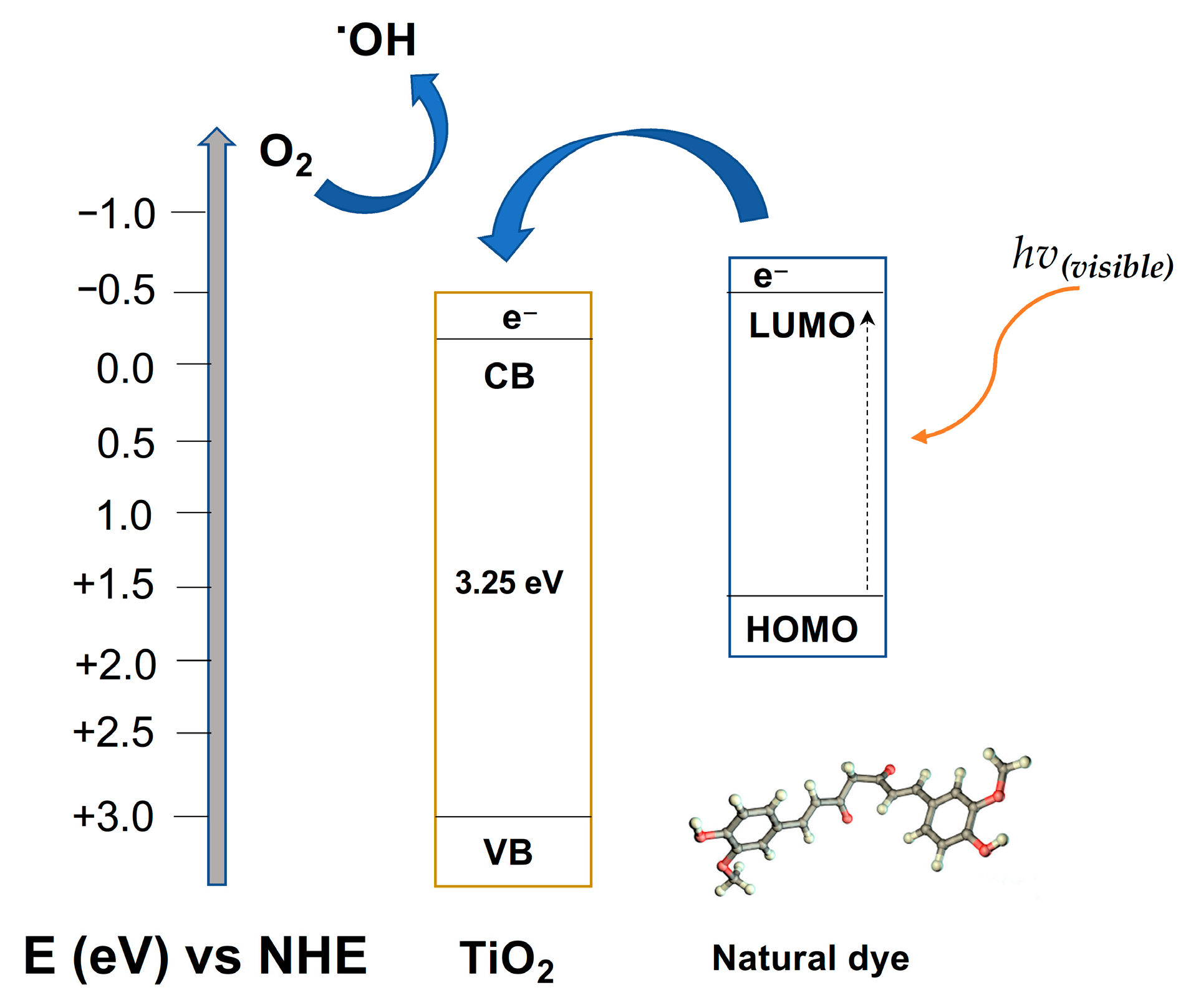
Figure 1 illustrates the sensitization mechanism for photocatalytic applications. Under visible-light irradiation, the process proceeds as follows: (i) An electron in the sensitizer (S) is photoexcited from the highest occupied molecular orbital (HOMO) to the lowest unoccupied molecular orbital (LUMO), yielding the excited state S* (Equation (1)). (ii) This electron is subsequently injected from S* into the TiO2 conduction band, oxidizing the sensitizer to S+ (Equation (2)). This electron transfer is thermodynamically favorable, as the LUMO energy level of the sensitizer aligns favorably with the TiO2 conduction band potential. For instance, LUMO levels of certain natural dyes range from −0.5 V to −0.4 V vs. NHE [28], which are more negative than the TiO2 conduction band potential (−0.3 V vs. NHE at acidic pH) [29]. (iii) The injected electron then reduces adsorbed O2 on the TiO2 surface to form superoxide radicals (O2•−) (Equation (3)). (iv) These radicals further react with water to generate additional reactive oxygen species (ROS), thereby initiating the conventional photocatalytic degradation pathway (Equations (4) and (5)) [30,31].
T i O 2 / S + h v v i s i b l e T i O 2 / S
T i O 2 / S T i O 2 ( e c b ) / S +
T i O 2 e c b + O 2 ( a d ) T i O 2 + O 2 ( a d )
O 2 ( a d ) + H 2 O O H ( a d ) + O H ( a d ) + O 2 ( a d )
O H ( a d ) + M B ( a d ) O H a d M B ( a d ) M B a d + + O H ( a d )
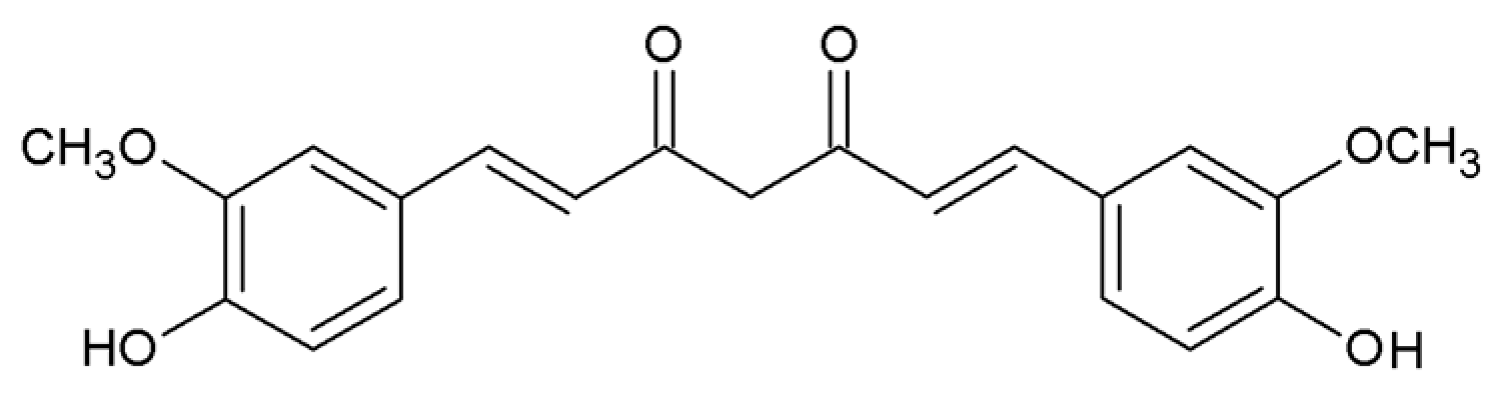
Synthetic sensitizers offer advantages such as chemical and physical stability and higher harvesting efficiency of visible radiation. However, natural dyes are nontoxic and inexpensive, becoming a renewable alternative to synthetic sensitizers. In recent years, different natural products have been employed as semiconductor sensitizers (e.g., anthocyanins [32], chlorophyll [33], carotenoid and betalains [34]). Curcuminoids are a group of naturally occurring phenolic compounds that belong to the diferuloylmethane family. They are known to be primarily responsible for the medicinal properties and yellow-orange color of turmeric (Curcuma longa), a spice widely used in gastronomy and traditional medicine. Curcumin has a characteristic structure based on a diarylheptane skeleton, composed of two aromatic rings connected by a seven-carbon chain with ketone and/or enol functional groups. Curcumin (1,7-bis [4-hydroxy-3-methoxy-phenyl]-1,6-heptadiene-3,5-dione) is the most abundant polyphenol present in the dietary spice turmeric and is obtained from the dried rhizomes of the perennial herb Curcuma longa Linn, of the ginger family [35]. Scheme 1 shows the chemical structure of curcumin.
Curcumin and its derivatives have been studied for health applications (anti-inflammatory, antioxidant, and anti-angiogenic properties [36]) and energy applications (sensitizers for DSSCs and photocatalytic systems [37]). The use of curcumin and its derivatives in technological applications has become important for developing alternative clean energy sources (e.g., PV systems). Zárate et al. reported the study of natural curcumin as a sensitizer for DSSCs [38].
Currently, bioprospecting studies play a crucial role in developing sustainable processes and efficiently utilizing natural resources. Incorporating value-added natural products into technological applications represents one of the key strategies for establishing renewable processes and fulfilling the principles of the circular economy [39,40]. Despite its potential, the sensitization process of TiO2 using curcumin has not been studied deeply. In this work, we study the sensitization of TiO2 thin films for the photodegradation of MB under visible irradiation.

2. Materials and Methods

2.1. Thin Film Fabrication and Sensitization

The fabricated TiO2 thin films employed the Doctor Blade technique and Degussa P-25 (Merck 99.5%, St. Louis, MO, USA) as Titanium source; we employed isopropyl alcohol (Merck ≥ 99.8%, St. Louis, MO, USA) as the solvent and PEG-1000 (Merck 99%, St. Louis, MO, USA) as the tenso-active. The coatings were sintered at 450 °C for 1 h [41]. The sensitization process was carried out by immersion of the thin films in a curcumin (Merck ≥ 99.8%, St. Louis, MO, USA) isopropyl solution (Sigma-Aldrich, St. Louis, MO, USA) (250, 500 and 1000 mg L−1) for 6 h. After that the sensitized thin films were dried at 40 °C for 2 h.

2.2. Kinetic of Sensitization

To determine the time required to reach the equilibrium state between adsorption and desorption of the sensitizer on the surface of TiO2 films. Experiments were carried out in which the TiO2 thin films were immersed into curcumin solution (10 ppm) and stirred for 2 h at room temperature. During the experiments, absorbance of the curcumin solution was measured every 5 min. We determined the adsorption capacity (qt) according to:
q t = ( C o C t V ) m ,
where Co is the initial MB concentration and Ct is the MB concentration at every time. V is volume of the solution and m is the catalyst load. We applied models to study kinetic behavior of sensitization process.

2.3. Thin Films Characterization

The optical properties of the materials obtained were characterized by diffuse reflectance spectroscopy (DRS) analysis using a Perkin Elmer Lambda 4 spectrophotometer (Waltham, MA, USA) equipped with an integration sphere. The materials were also characterized by Fourier transform infrared spectroscopy (FT-IR) techniques using a Nicolet Summer FT-IR spectrophotometer (Waltham, MA, USA) in the region of 4000–500 cm−1.

2.4. Photocatalytic Test

Before irradiation, adsorption–desorption equilibrium of methylene blue onto TiO2 thin films was achieved by stirring the system under darkness for 2 h. The experiments were carried out in a batch-type reactor, using 17 W LED tape as a visible radiation source. The photodegradation test began after the adsorption–desorption equilibrium was reached. Finally, the reaction advance was determined by spectrophotometry. The total irradiation time was 60 min.

2.5. DFT Study

All geometry optimizations were performed using the B3LYP functional with the 6-311+G(2d,p) basis set, as implemented in the Gaussian 09 software package [42]. Grimme’s D3 dispersion correction was incorporated to account for noncovalent interactions, providing adjustments to the total energy, energy gradients, and vibrational frequencies. Frequency calculations were subsequently carried out at the same theoretical level for all compounds to generate IR spectra and verify that the optimized structures correspond to minima on the potential energy surface (i.e., no imaginary frequencies). These calculations involved diagonalization of the Hessian matrix, yielding the system’s eigenfrequencies and eigenvectors, which describe the harmonic vibrational modes of the molecular atoms [43,44]. The optimized geometries were retained without further refinement for all subsequent property calculations. To simulate the experimentally observed electronic transitions (UV–Vis spectra), time-dependent density functional theory (TDDFT) was employed at the CAM-B3LYP/6-311+G(2d,p) level, considering the lowest 200 excited states and computing their energies and oscillator strengths. Solvent effects (water) were modeled using the conductor-like polarizable continuum model (CPCM).

3. Results and Discussions

3.1. UV-Vis Characterization

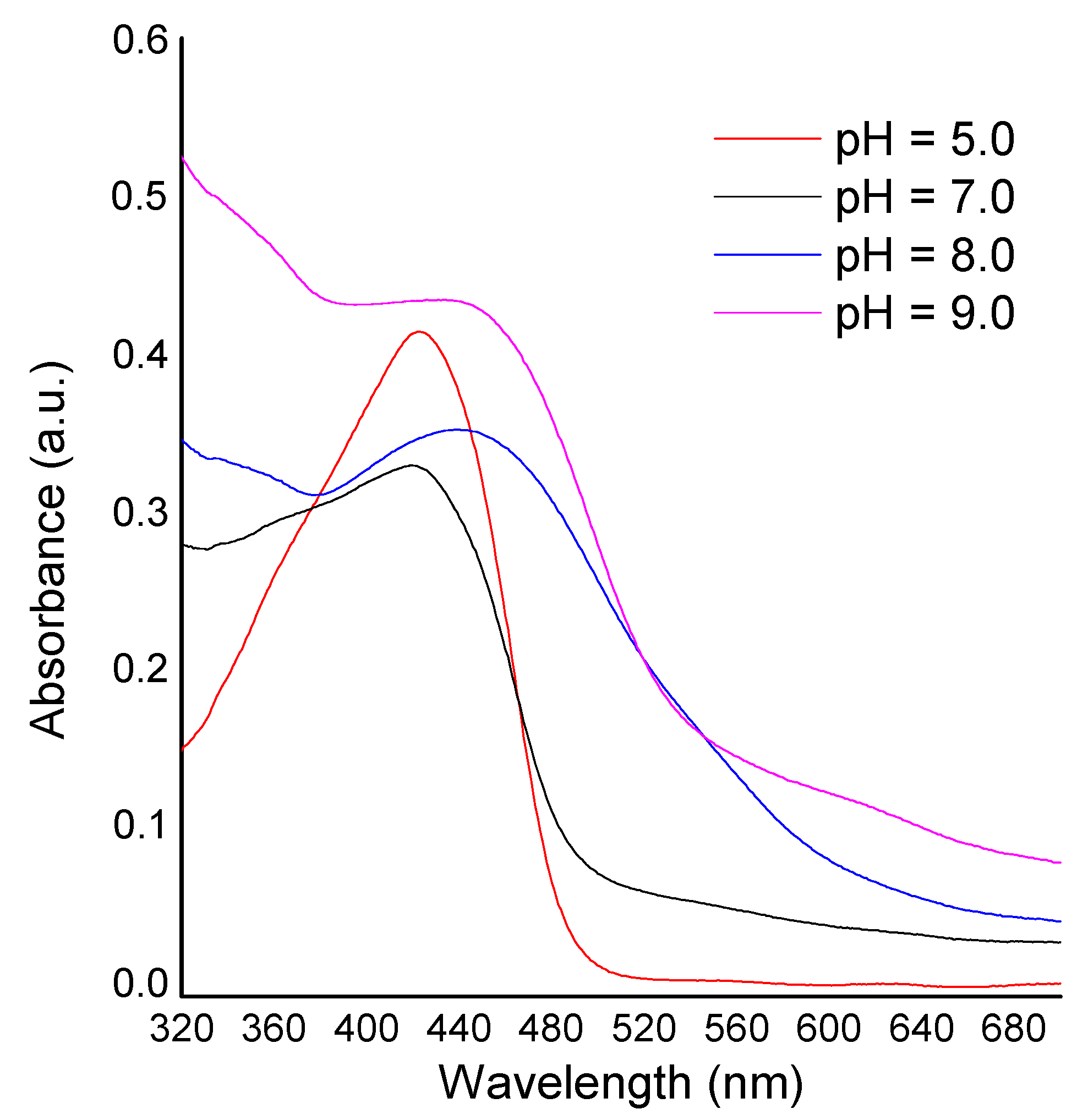
Curcumin was used as a sensitizer for the TiO2 surface. As a first step, a study of the effect of pH on the absorption properties of curcumin in an aqueous medium was carried out. Figure 2 shows the UV–Vis spectra of curcumin solutions (10 ppm) at different pH values (5, 7, 8, 9). The absorption spectra show a wide band in the visible region with a maximum absorption at 428 nm (π-π* transitions), attributed to the aromatic rings present in curcumin. The maximum absorption at 420–430 nm in the visible region of the electromagnetic spectrum is the commonly reported wavelength for the quantification of this compound [45]. This maximum wavelength (λmax) corresponds to curcumin at pH = 5.0 and 7.0. In this range, the color of the solution did not change significantly; this result indicates that the sensitizer is stable in this pH range (5.0–7.0), which is in agreement with the report by Pourreza [46]. However, the λmax value change significantly to curcumin at pH 8.0 (λmax = 495 nm) and pH 9.0 (λmax = 396 nm). For curcumin solutions at pH > 8.0, a bathochromic shift is observed (Figure 2) from 420 nm to 440 nm. This effect is accompanied by an alteration in the color of solution from yellow (to curcumin solution at pH 7.0) to deep orange (to curcumin solution at pH 9.0). This result is in agreement with previous reports [47].
Figure 2 shows a small shift in the absorption band when the pH is increased from 5.0 to 9.0; a change of approximately 9.0 nanometers is observed. This shift may be due to the deprotonation of curcumin at basic pH. Lee et al. reported that at pH < 10, curcumin is found in its protonated form (H4A+) [48]:
Chemistry 07 00177 i001
In solutions with pH values in the range of 1.0–7.0, curcumin is in neutral form (H3A):
Chemistry 07 00177 i002
For higher pH values, the following equilibria are proposed with deprotonated curcumin:
Chemistry 07 00177 i003
Depending on the pH, curcumin can lose up to three protons, generating three conjugate bases (H2A, HA2−, A3−). To ensure that curcumin does not exhibit a negative charge density, and taking into account that the reported isoelectric point for TiO2 is 6.2, a pH of 7.0 was chosen for carrying out the sensitization process of the TiO2 films.

3.2. Spectroscopic Characterization

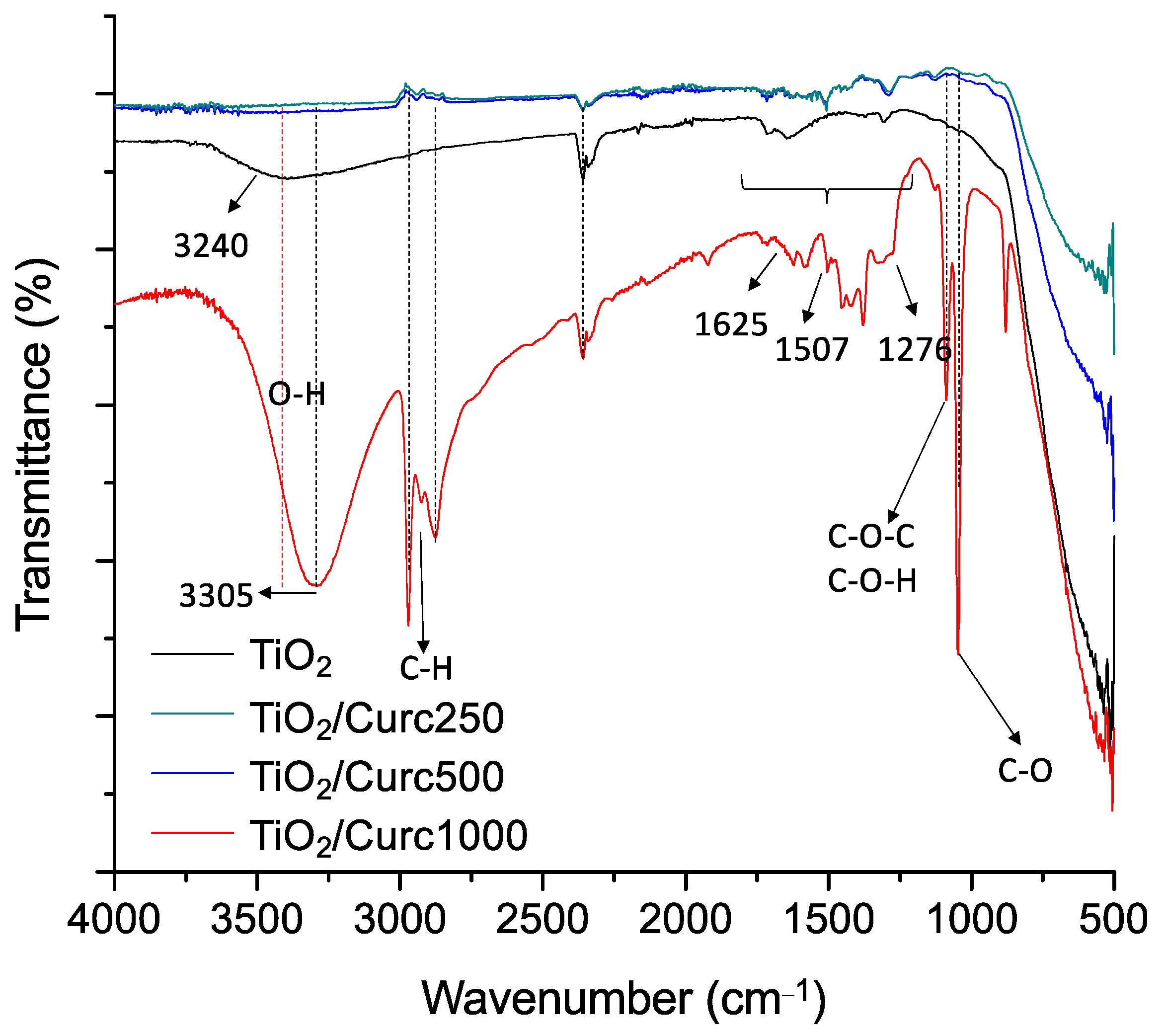
Figure 3 shows the FTIR spectra of the materials fabricated in this work. For TiO2 films, a broad band is observed in the region of 3200–3700 cm−1, with a maximum absorption at 3240 cm−1. This band is associated with the presence of hydroxyl groups on the surface of the TiO2 films and is assigned to the formation of hydrogen bonds with water molecules or –OH groups on the TiO2 surface. A band around 1600–1700 cm−1 is typical of the deformation vibration of water adsorbed on the surface of TiO2, confirming the interaction with ambient humidity. An intense band is observed in the ~400–800 cm−1 region, characteristic of Ti–O–Ti bond vibrations [49].
For curcumin-sensitized TiO2 films, some of the signals presented by TiO2 films and those corresponding to curcumin adsorbed on the surface are observed. In the region between 3000 and 3500 cm−1, the band corresponding to the hydroxyl groups present in curcumin is observed. This band intensifies and has a shift compared to the unmodified TiO2 band. The intensification occurs due to the increase in the amount of hydroxyl groups of the curcumin molecules adsorbed on the surface of TiO2. The maximum absorption is located at 3035 cm−1. This shift is due to the interaction between TiO2 molecules and curcumin molecules. Furthermore, the presence of curcumin introduces new bands associated with aromatic C–H around 1625 cm−1 with a C=O (ketone) and C=C (aromatic) vibrations [50]. In the ~1500 cm−1 region, the vibration of the aromatic rings is evident, and in the ~1275 cm−1 region, the C–O vibration of the phenol group [51]. Around ~980–800 cm−1 the bands represent the C–H vibrations outside the plane of the aromatic rings. Comparing the FTIR spectra as a function of the concentration of the solution used for the sensitization process, Figure 3 shows a significant change in the intensity and displacement of some bands, suggesting an interaction between the functional groups of curcumin and the TiO2 surface, indicating that the TiO2 sensitization process was effective.

3.3. Optical Characterization

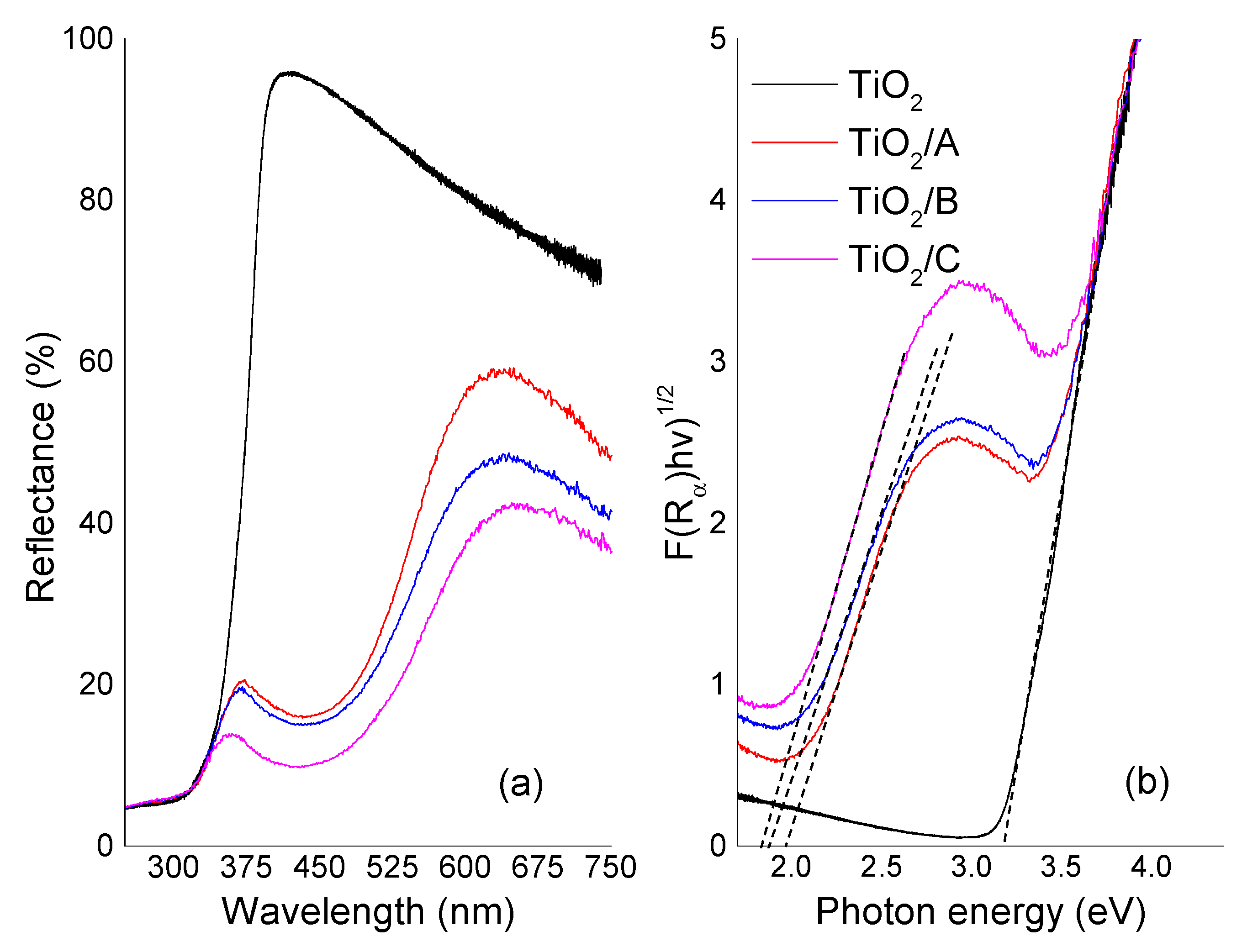
Figure 4a shows the reflectance spectra of the TiO2 films sensitized with curcumin for using different concentration solutions. Figure 3 shows that the TiO2 films do not present any type of photo-response in the visible range of the electromagnetic spectrum. This result is due to the high band gap value of TiO2 [52]. To the sensitized TiO2 samples, Figure 4a shows the appearance of a second band between 550 and 750 nm. This sign indicates that the sensitization process was satisfactory. This band is assigned to the electron π → π* transitions of the conjugate double bonds of the sensitizer’s molecular structure. The interaction of TiO2–curcumin occurs by sensitization and photocatalytic system (semiconductor/dye) is photo-active at visible region of electromagnetic spectrum. The peak reflectance around 600–650 nm could be related to this interaction. The new band in the visible region indicates a charge transfer between curcumin and TiO2, typical in sensitized semiconductor systems such as TiO2 [30]. The interaction between TiO2/curcumin is of the hydrogen bridge type and a could also present bidentate or mono-dentate complexation between the hydroxyl groups of curcumin and titanium on the surface of the semiconductor [53].
The energy value of Band gap for all the manufactured samples was determined from the Kubelka Munk (KM) equation [54]. From the KM function it is possible to obtain an equation analogous to the Tauc function according to
( F R α h v ) 1 / 2 = A ( h v E g ) ,
where F ( R α ) represents the Remission Function of KM, hv is the photon energy A is proportionality constant, and Eg represents the band gap of the material. Figure 4b shows band gap calculation from materials fabricated in this work. The bare TiO2 films shows the typical energy band gap value 3.2 eV Figure 4b [55]. For all curcumin-sensitized materials, a transition to high energy values (3.2 eV) is observed. This signal corresponds to the electron transition of the TiO2 semiconductor. Furthermore, photo-excitation energy values at lower energy values were obtained. This signal corresponds to the electron transitions of the sensitizer. The lowest photo-excitation was 1.8 eV for TiO2 sensitized with curcumin using a solution of 1000 ppm. After the sensitization process, the semiconductor conserves its band gap value. Following sensitization, the TiO2 retains its intrinsic band gap, but the [TiO2/dye] composite exhibits an effectively reduced band gap, enabling visible-light-driven photocatalysis. This enhanced activity stems from the dye’s visible-light absorption on the TiO2 surface, coupled with the semiconductor’s facilitation of charge separation. Overall, dye sensitization represents a synergistic process that integrates the dye’s visible-light harvesting with TiO2-assisted charge separation to achieve efficient photocatalysis in the visible region.

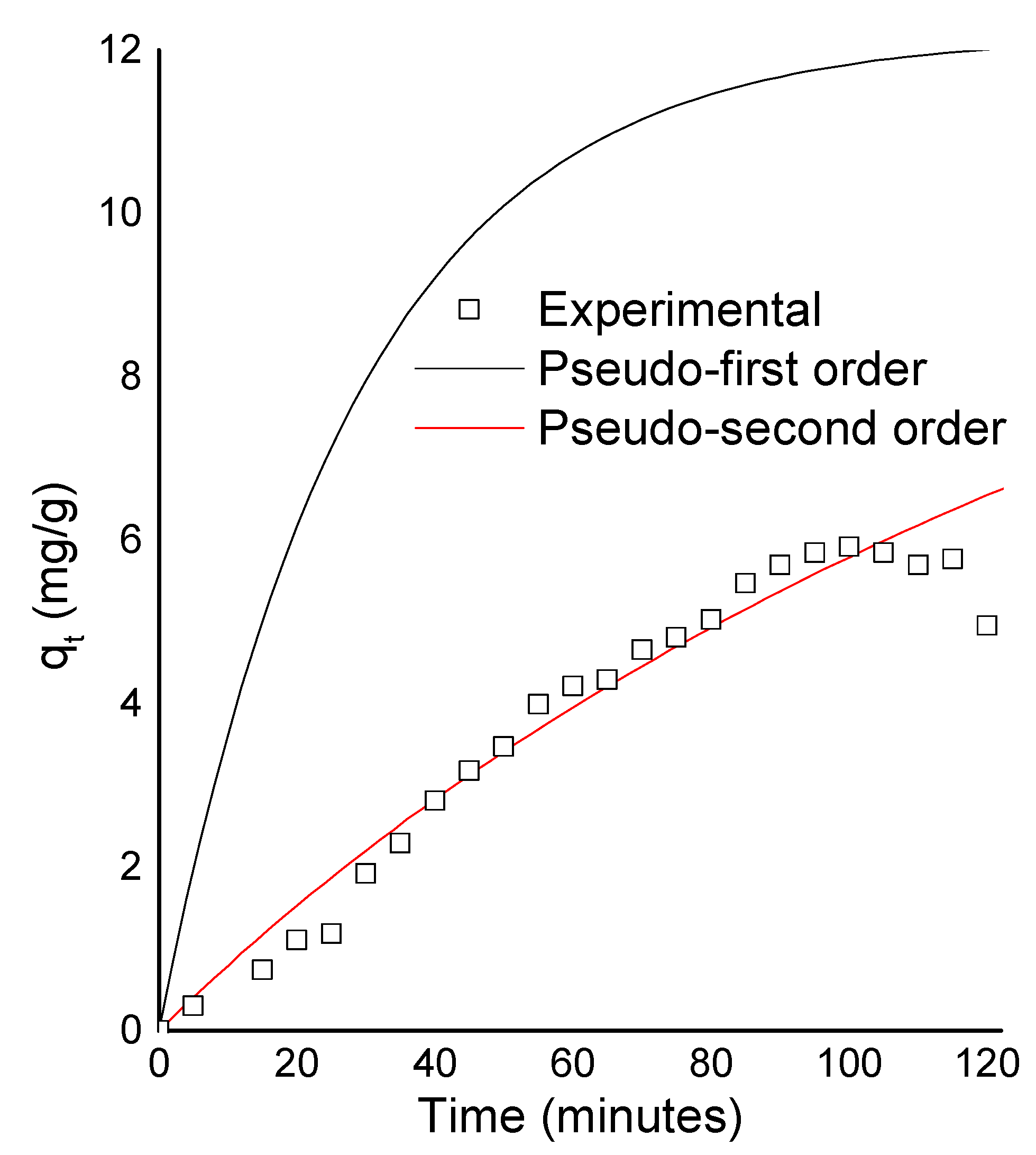
3.4. Kinetic Sensitization

The kinetic results of the sensitization process show that qt increases rapidly reaching equilibrium after approximately 100 min (see Figure 5), with a maximum adsorption capacity (qe) of about 12.0 mg of curcumin per gram of adsorbent. Various metal oxides have been employed for dye removal through adsorption processes. For instance, Song et al. reported a maximum adsorption capacity qt = 8.4 mg of dye per gram of NiO to removal of Brilliant Red X-3B from aqueous solution [56]. Abdullah et al., reported a qe = 22.2 mg/g to remove Methylene Blue from water onto MnO2 nanoparticles [57]. Noreen et al. reported a qe = 57.5 mg dye/g to removal Methylene Blue from water onto ZnO nanoparticles [58]. According to linear regression correlation coefficient (R2) the pseudo-second-order model was suitable to describe kinetic results (see Table 1).
The dye adsorption onto semiconductor surfaces depends on the chemical functional groups present on the adsorbent. Several authors have suggested that the metal ions in semiconductors can complete their coordination spheres by complexing with water molecules in the medium, thereby facilitating protonation–deprotonation reactions that generate hydroxyl (–OH) groups on the surface. These surface hydroxyl groups, which possess negative charge density, enhance the adsorption of cationic dyes onto the semiconductor surface [59]. The results suggest that electrostatic interactions primarily govern the interaction between the semiconductor and curcumin, rather than a simple diffusion-controlled mechanism. Mousavi et al. this model was appropriate to describe the kinetic results of the methylene orange adsorption onto Mn2O3 nanoparticles [60]. Similarly, Delafroz et al. found that the kinetic data for the removal of malachite green from aqueous solution using β-MnO2 nanoparticles were best fitted by the pseudo-second-order model [61]. Vallejo et al. also demonstrated that this model accurately described the adsorption of methylene blue onto ZnO and TiO2 surfaces [62].

3.5. Photocatalytic Study

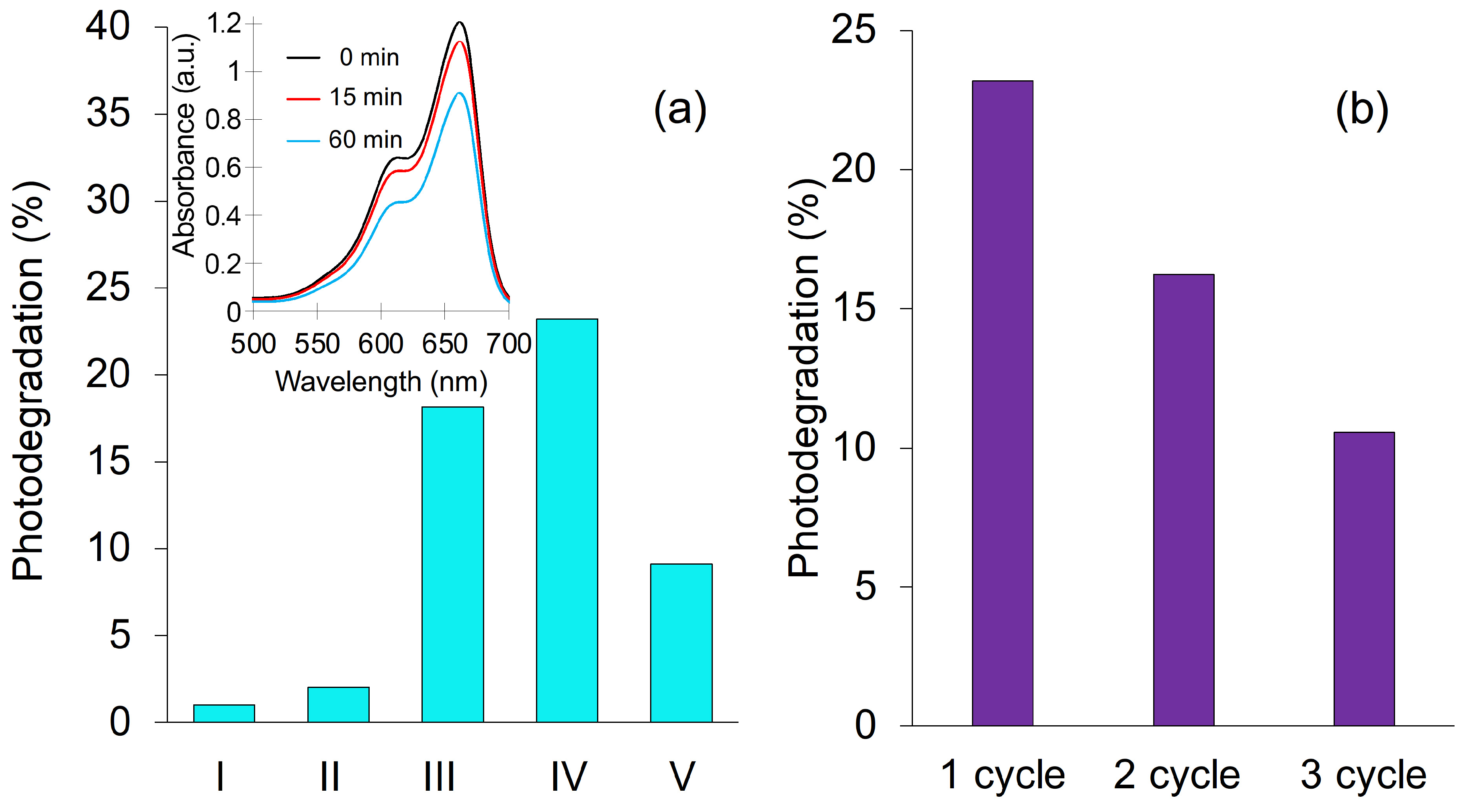
The MB degradation tests were performed under visible-light irradiation. Figure 6 presents the variation in MB concentration over time for the different experimental conditions. As shown in Figure 6a, MB remained stable for 60 min under visible irradiation, exhibiting no photobleaching under visible irradiation. Likewise, the non-sensitized TiO2 films showed no photocatalytic activity under visible light (Figure 6b), as expected, since TiO2 is primarily photoactive under ultraviolet irradiation due to its relatively large band gap. In contrast, the curcumin-sensitized TiO2 films exhibited clear photocatalytic activity under visible-light irradiation. The incorporation of curcumin enabled photon absorption in the visible range, promoting charge carrier generation and, subsequently, the formation of reactive oxygen species according to Equations (1)–(5). The results shown in Figure 6a,b corroborate the FTIR results (Figure 3) and diffuse reflectance (Figure 4) analyses, confirming that the sensitization process was successful and effectively enhanced the visible-light response of the photocatalytic system.
Among the sensitized samples, the best photodegradation efficiencies were achieved for TiO2 films sensitized with 250 ppm (18%) and 500 ppm (23%) curcumin solutions. In contrast, the most concentrated solution (1000 ppm) showed the lowest photodegradation efficiency (9%), possibly due to the formation of sensitizer aggregates on the TiO2 surface that hinder photon absorption and charge transfer. Under the experimental conditions employed, the optimal sensitization parameters corresponded to a curcumin concentration of 500 ppm. These findings are significant as they demonstrate that curcumin can effectively act as a natural sensitizer for TiO2 thin films, enabling photocatalytic activity under visible-light irradiation and opening new possibilities for heterogeneous photocatalysis applications using renewable materials.
To evaluate the stability of the fabricated thin films, three consecutive photodegradation cycles were conducted using the same TiO2/curc500 films. The results, illustrated in Figure 6b, demonstrate a progressive decline in photocatalytic performance across cycles. Specifically, after the second cycle, the photodegradation efficiency decreased by approximately 30%, and following the third cycle, it further diminished by about 46% relative to the initial run. This reduction can be ascribed to the operative reaction mechanism: after electron injection from the sensitizer’s LUMO to the semiconductor’s conduction band (Equation (2)), the oxidized sensitizer cannot be efficiently regenerated without an electron donor in the medium. For comparison, in dye-sensitized solar cells, the I/I3 redox couple regenerates the sensitizer, thereby closing the photovoltaic cycle. Analogously, sacrificial agents are routinely used to promote sensitizer regeneration and enhance photocatalytic hydrogen production [63,64].
In our case, the sensitizer could be regenerated by the following reaction:
S + + 2 H 2 O S + O H ( a d ) + H 3 O +
Although hydroxyl radicals can be generated via Equation (8), this process is kinetically slower than the sensitizer oxidation reaction (Equation (2)). The resulting decline in photocatalytic efficiency after the first cycle can thus be attributed to this disparity in reaction rates. Specifically, during the initial catalytic cycle, a portion of the sensitizer undergoes irreversible oxidation (Equation (2)), but the compensatory reaction (Equation (8)) is insufficiently rapid to achieve complete sensitizer regeneration, leading to its gradual depletion.

3.6. Mollecular Modelling

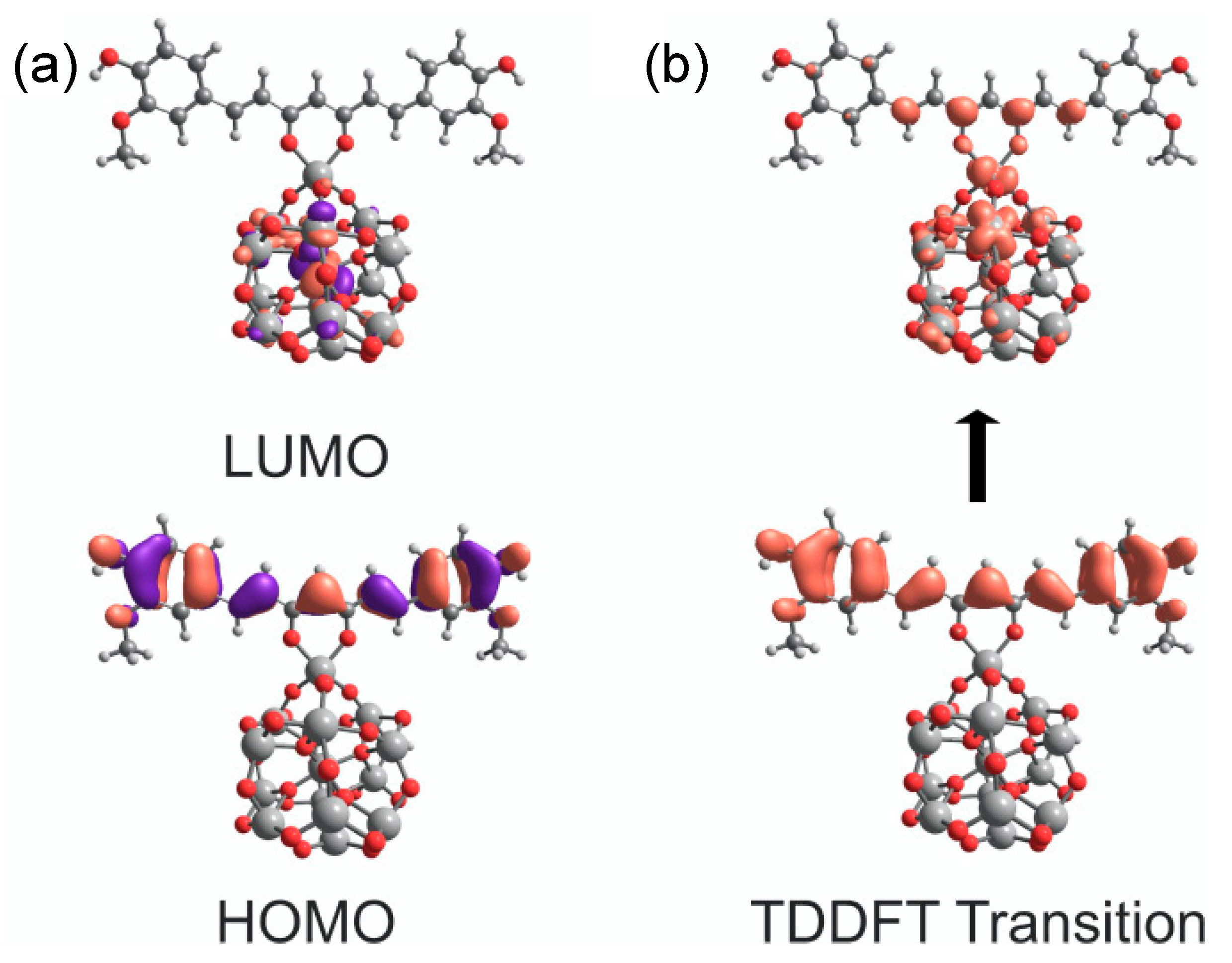
The experimental results demonstrate that curcumin effectively sensitizes TiO2, enhancing its photocatalytic response under visible-light irradiation. To gain deeper insight into the sensitization mechanism and the role of curcumin in facilitating charge transfer, a DFT molecular model consisting of a TiO2 nanoparticle and a single curcumin molecule was developed. The simulations indicate that sensitization occurs when curcumin, in its diketone form, coordinates to a surface Ti atom. Analysis of the frontier molecular orbitals, see Figure 7a, revealed a pronounced spatial separation between the highest occupied molecular orbital (HOMO), primarily localized on the curcumin molecule, and the lowest unoccupied molecular orbital (LUMO), localized on the TiO2 nanoparticle. This electronic distribution suggests an efficient charge transfer pathway from the dye to the semiconductor. To further evaluate this behavior, time-dependent DFT (TDDFT) calculations were performed on the curcumin-anchored system. The resulting electron density difference map (EDDM), see Figure 7b, confirms that the electronic transition corresponding to the working wavelength is a ligand-to-metal charge transfer (LMCT) process. This transition provides theoretical support for the enhanced photocatalytic activity observed experimentally in the curcumin-sensitized TiO2 films.

4. Conclusions

In this work, the photochemical properties of TiO2 thin films sensitized with curcumin were systematically investigated. Spectroscopic and optical analyses confirmed the successful sensitization of TiO2, leading to a significant reduction in the energy band gap from 3.2 eV (bare TiO2) to 1.8 eV for the curcumin-sensitized TiO2 thin films. The pseudo-second-order kinetic model was suitable to describe the kinetic results, the qe was 12 mg·g−1 and a k2 was 4.3 × 10⁻³ g·mg−1·min−1. Photocatalytic experiments revealed that only the sensitized TiO2 thin films exhibited activity under visible-light irradiation. The highest methylene blue (MB) photodegradation efficiency was achieved with films sensitized using 500 ppm curcumin solutions, reaching 23% after 1 h of visible-light irradiation, thereby confirming the synergistic effect of the sensitization process. However, photocatalytic performance declined after three cycles, which can be attributed to the disparity in reaction rates between sensitizer oxidation and regeneration.
Density Functional Theory (DFT) calculations provided theoretical support for the experimental observations, showing that sensitization induces a ligand-to-metal charge transfer (LMCT) transition. This transition facilitates electron injection from curcumin into the TiO2 conduction band, thereby enhancing the photocatalytic performance of the system under visible-light conditions.
Special attention should be directed toward the integration of natural products into technological applications to develop renewable and sustainable processes for water purification.

Author Contributions

Conceptualization, C.D.-U. and W.V.; methodology, M.M., F.D., C.D.-U., W.V., C.Q., E.S. and X.Z.; validation, M.M. and F.D.; formal analysis, M.M., F.D., C.D.-U., W.V., C.Q., E.S. and X.Z.; investigation, M.M., F.D., C.D.-U., W.V., C.Q., E.S. and X.Z.; resources, C.D.-U., W.V., C.Q., E.S. and X.Z.; data curation, M.M., C.D.-U., W.V., E.S. and X.Z.; Visualization, M.M., F.D., C.D.-U., W.V., C.Q., E.S. and X.Z.; writing—original draft preparation, M.M., F.D., C.D.-U., W.V., C.Q., E.S. and X.Z.; writing—review and editing, M.M., F.D., C.D.-U., W.V., C.Q., E.S. and X.Z.; supervision, C.D.-U. and W.V.; project administration, C.D.-U., W.V., C.Q., E.S. and X.Z.; funding acquisition, C.D.-U., W.V., C.Q., E.S. and X.Z. All authors have read and agreed to the published version of the manuscript.

Funding

The APC of this publication was supported by Universidad del Atlántico. This work was supported by ANID/FONDAP/1523A0006. FONDECYT 1241917 and 1231194. This material is based upon work supported by the Air Force Office of Scientific Research under award number FA8655-25-1-8759. This work was supported by Sistema Nacional de Regalías CODE PROJECT 2024000100089.

Institutional Review Board Statement

Not applicable.

Informed Consent Statement

Not applicable.

Data Availability Statement

Data is contained within the article.

Acknowledgments

W.V. and C.D.-U. thank to Universidad del Atlántico and Sistema Nacional de Regalías.

Conflicts of Interest

The authors declare no conflicts of interest.

References

  1. Strokal, M.; Bai, Z.; Franssen, W.; Hofstra, N.; Koelmans, A.A.; Ludwig, F.; Ma, L.; van Puijenbroek, P.; Spanier, J.E.; Vermeulen, L.C.; et al. Urbanization: An increasing source of multiple pollutants to rivers in the 21st century. NPJ Urban Sustain. 2021, 1, 24. [Google Scholar] [CrossRef]
  2. du Plessis, A. Persistent degradation: Global water quality challenges and required actions. One Earth 2022, 5, 129–131. [Google Scholar] [CrossRef]
  3. Niinimäki, K.; Peters, G.; Dahlbo, H.; Perry, P.; Rissanen, T.; Gwilt, A. The environmental price of fast fashion. Nat. Rev. Earth Environ. 2020, 1, 189–200. [Google Scholar] [CrossRef]
  4. Panhwar, A.; Sattar Jatoi, A.; Ali Mazari, S.; Kandhro, A.; Rashid, U.; Qaisar, S. Water resources contamination and health hazards by textile industry effluent and glance at treatment techniques: A review. Waste Manag. Bull. 2024, 1, 158–163. [Google Scholar] [CrossRef]
  5. Gambino, I.; Terzaghi, E.; Baldini, E.; Bergna, G.; Palmisano, G.; Di Guardo, A. Microcontaminants and microplastics in water from the textile sector: A review and a database of physicochemical properties, use in the textile process, and ecotoxicity data for detected chemicals. Environ. Sci. Process. Impacts 2025, 27, 297–319. [Google Scholar] [CrossRef] [PubMed]
  6. Katheresan, V.; Kansedo, J.; Lau, S.Y. Efficiency of various recent wastewater dye removal methods: A review. J. Environ. Chem. Eng. 2018, 6, 4676–4697. [Google Scholar] [CrossRef]
  7. Khan, I.; Saeed, K.; Zekker, I.; Zhang, B.; Hendi, A.H.; Ahmad, A.; Ahmad, S.; Zada, N.; Ahmad, H.; Shah, L.A.; et al. Review on Methylene Blue: Its Properties, Uses, Toxicity and Photodegradation. Water 2022, 14, 242. [Google Scholar] [CrossRef]
  8. Oladoye, P.O.; Ajiboye, T.O.; Omotola, E.O.; Oyewola, O.J. Methylene blue dye: Toxicity and potential elimination technology from wastewater. Results Eng. 2022, 16, 100678. [Google Scholar] [CrossRef]
  9. Al jibouri, A.K.H.; Wu, J.; Upreti, S.R. Continuous ozonation of methylene blue in water. J. Water Process Eng. 2015, 8, 142–150. [Google Scholar] [CrossRef]
  10. Rivera, F.L.; Recio, F.J.; Palomares, F.J.; Sánchez-Marcos, J.; Menéndez, N.; Mazarío, E.; Herrasti, P. Fenton-like degradation enhancement of methylene blue dye with magnetic heating induction. J. Electroanal. Chem. 2020, 879, 114773. [Google Scholar] [CrossRef]
  11. Ali, M.A.; Maafa, I.M.; Qudsieh, I.Y. Photodegradation of Methylene Blue Using a UV/H2O2 Irradiation System. Water 2024, 16, 453. [Google Scholar] [CrossRef]
  12. Vallejo, W.; Rueda, A.; Díaz-Uribe, C.; Grande, C.; Quintana, P. Photocatalytic activity of graphene oxide–TiO2 thin films sensitized by natural dyes extracted from Bactris guineensis. R. Soc. Open Sci. 2019, 6, 181824. [Google Scholar] [CrossRef]
  13. Vallejo, W.; Cantillo, A.; Díaz-Uribe, C. Improvement of the photocatalytic activity of ZnO thin films doped with manganese. Heliyon 2023, 9, e20809. [Google Scholar] [CrossRef]
  14. Anucha, C.B.; Altin, I.; Bacaksiz, E.; Stathopoulos, V.N. Titanium dioxide (TiO2)-based photocatalyst materials activity enhancement for contaminants of emerging concern (CECs) degradation: In the light of modification strategies. Chem. Eng. J. Adv. 2022, 10, 100262. [Google Scholar] [CrossRef]
  15. Diaz-Uribe, C.; Florez, J.; Vallejo, W.; Duran, F.; Puello, E.; Roa, V.; Schott, E.; Zarate, X. Removal and photocatalytic degradation of methylene blue on ZrO2 thin films modified with Anderson-Polioxometalates (Cr3+, Co3+, Cu2+): An experimental and theoretical study. J. Photochem. Photobiol. A Chem. 2024, 454, 115689. [Google Scholar] [CrossRef]
  16. Qutub, N.; Singh, P.; Sabir, S.; Sagadevan, S.; Oh, W.C. Enhanced photocatalytic degradation of Acid Blue dye using CdS/TiO2 nanocomposite. Sci. Rep. 2022, 12, 5759. [Google Scholar] [CrossRef] [PubMed]
  17. Lin, R.; Chen, H.; Cui, T.; Zhang, Z.; Zhou, Q.; Nan, L.; Cheong, W.C.; Schröck, L.; Ramm, V.; Ding, Q.; et al. Optimization of p-Type Cu2O Nanocube Photocatalysts Based on Electronic Effects. ACS Catal. 2023, 13, 11352–11361. [Google Scholar] [CrossRef]
  18. Samuel, O.; Othman, M.H.D.; Kamaludin, R.; Sinsamphanh, O.; Abdullah, H.; Puteh, M.H.; Kurniawan, T.A. WO3–based photocatalysts: A review on synthesis, performance enhancement and photocatalytic memory for environmental applications. Ceram. Int. 2022, 48, 5845–5875. [Google Scholar] [CrossRef]
  19. Qian, R.; Zong, H.; Schneider, J.; Zhou, G.; Zhao, T.; Li, Y.; Yang, J.; Bahnemann, D.W.; Pan, J.H. Charge carrier trapping, recombination and transfer during TiO2 photocatalysis: An overview. Catal. Today 2019, 335, 78–90. [Google Scholar] [CrossRef]
  20. Fu, J.; Liang, F.; Zhong, W.; Kuang, T.; Yin, Z.; Li, Y.; Huang, Z.; Liu, H.; Ma, D. Enhanced catalytic degradation activity through quenching introduces Pd doping in TiO2 derived from NH2-MIL-125(Ti). Environ. Res. 2025, 285, 122387. [Google Scholar] [CrossRef] [PubMed]
  21. Diaz-Uribe, C.; Duran, F.; Vallejo, W.; Puello, E.; Zarate, X.; Schott, E. Photocatalytic study of TiO2 thin films modified with Anderson-type polyoxometalates (Cr, Co and Ni): Experimental and DFT study. Polyhedron 2023, 231, 116253. [Google Scholar] [CrossRef]
  22. Shuang, S.; Lv, R.; Xie, Z.; Zhang, Z. Surface Plasmon Enhanced Photocatalysis of Au/Pt-decorated TiO2 Nanopillar Arrays. Sci. Rep. 2016, 6, 26670. [Google Scholar] [CrossRef] [PubMed]
  23. Quiñones, C.; Posada, M.; Hormiga, A.; Peña, J.; Diaz-Uribe, C.; Vallejo, W.; Muñoz-Acevedo, A.; Roa, V.; Schott, E.; Zarate, X. Antimicrobial Activity against Fusarium oxysporum f. sp. dianthi of TiO2/ZnO Thin Films under UV Irradiation: Experimental and Theoretical Study. ACS Omega 2024, 9, 31546–31555. [Google Scholar] [CrossRef]
  24. Jaihindh, D.; Lin, Y.-F.; Tseng, L.-H.; Krisbiantoro, P.A.; Wu, K.C.; Shukla, K.; Sone, M.; Chang, T.; Chen, C.-Y. Heterogeneous Z-scheme CuO/ZnO aerogel photocatalyst for photocatalytic degradation of organic dye. J. Taiwan Inst. Chem. Eng. 2025, 175, 106281. [Google Scholar] [CrossRef]
  25. Sun, P.; Xing, Z.; Li, Z.; Zhou, W. Recent advances in quantum dots photocatalysts. Chem. Eng. J. 2023, 458, 141399. [Google Scholar] [CrossRef]
  26. Díaz-Uribe, C.; Vallejo, W.; Campos, K.; Solano, W.; Andrade, J.; Muñoz-Acevedo, A.; Schott, E.; Zarate, X. Improvement of the photocatalytic activity of TiO2 using Colombian Caribbean species (Syzygium cumini) as natural sensitizers: Experimental and theoretical studies. Dye Pigment 2018, 150, 370–376. [Google Scholar] [CrossRef]
  27. Sułek, A.; Pucelik, B.; Kuncewicz, J.; Dubin, G.; Dąbrowski, J.M. Sensitization of TiO2 by halogenated porphyrin derivatives for visible light biomedical and environmental photocatalysis. Catal. Today 2019, 335, 538–549. [Google Scholar] [CrossRef]
  28. Zyoud, A.; Dwikat, M.; Al-Shakhshir, S.; Ateeq, S.; Shteiwi, J.; Zu’Bi, A.; Helal, M.H.S.; Campet, G.; Park, D.; Kwon, H.; et al. Natural dye-sensitized ZnO nano-particles as photo-catalysts in complete degradation of E. coli bacteria and their organic content. J. Photochem. Photobiol. A Chem. 2016, 328, 207–216. [Google Scholar] [CrossRef]
  29. Xiong, Z.; Zhao, X.S. Titanate@TiO2 core–shell nanobelts with an enhanced photocatalytic activity. J. Mater. Chem. A 2013, 1, 7738–7744. [Google Scholar] [CrossRef]
  30. Gonuguntla, S.; Kamesh, R.; Pal, U.; Chatterjee, D. Dye sensitization of TiO2 relevant to photocatalytic hydrogen generation: Current research trends and prospects. J. Photochem. Photobiol. C Photochem. Rev. 2023, 57, 100621. [Google Scholar] [CrossRef]
  31. Diaz-Uribe, C.; Vallejo, W.; Romero, E.; Villareal, M.; Padilla, M.; Hazbun, N.; Muñoz-Acevedo, A.; Schott, E.; Zarate, X. TiO2 thin films sensitization with natural dyes extracted from Bactris guineensis for photocatalytic applications: Experimental and DFT study. J. Saudi Chem. Soc. 2020, 24, 407–416. [Google Scholar] [CrossRef]
  32. Diaz-Uribe, C.; Vallejo, W.; Camargo, G.; Muñoz-Acevedo, A.; Quiñones, C.; Schott, E.; Zarate, X. Potential use of an anthocyanin-rich extract from berries of Vaccinium meridionale Swartz as sensitizer for TiO2 thin films—An experimental and theoretical study. J. Photochem. Photobiol. A Chem. 2019, 384, 112050. [Google Scholar] [CrossRef]
  33. Diaz-Uribe, C.; Duran, F.; Arcon, A.; Vallejo, W.; Salazar, J.; Schott, E.; Zarate, X. Cyanobacterial pigment adsorbed on TiO2 thin films. Colloids Surf. A Physicochem. Eng. Asp. 2024, 688, 133594. [Google Scholar] [CrossRef]
  34. Hug, H.; Bader, M.; Mair, P.; Glatzel, T. Biophotovoltaics: Natural pigments in dye-sensitized solar cells. Appl. Energy 2014, 115, 216–225. [Google Scholar] [CrossRef]
  35. Slaček, G.; Kotnik, P.; Osmić, A.; Postružnik, V.; Knez, Ž.; Finšgar, M.; Knez Marevci, M. The Extraction Process, Separation, and Identification of Curcuminoids from Turmeric Curcuma longa. Foods 2023, 12, 4000. [Google Scholar] [CrossRef]
  36. Fu, Y.S.; Chen, T.H.; Weng, L.; Huang, L.; Lai, D.; Weng, C.F. Pharmacological properties and underlying mechanisms of curcumin and prospects in medicinal potential. Biomed. Pharmacother. 2021, 141, 111888. [Google Scholar] [CrossRef] [PubMed]
  37. Sinha, D.; De, D.; Ayaz, A. Performance and stability analysis of curcumin dye as a photo sensitizer used in nanostructured ZnO based DSSC. Spectrochim. Acta Part A Mol. Biomol. Spectrosc. 2018, 193, 467–474. [Google Scholar] [CrossRef] [PubMed]
  38. Zarate, X.; González, P.I.; Caramori, S.; Benazzi, E.; Barra, T.; Arrue, L.; Wu, Y.; Díaz-Uribe, C.; Vallejo, W.; Schott, E. Experimental and DFT study of natural curcumin derived dyes as n-type sensitizers. Sol. Energy 2021, 225, 305–315. [Google Scholar] [CrossRef]
  39. Vuong, P.; Chong, S.; Kaur, P. The little things that matter: How bioprospecting microbial biodiversity can build towards the realization of United Nations Sustainable Development Goals. NPJ Biodivers. 2022, 1, 4. [Google Scholar] [CrossRef] [PubMed]
  40. Ji, S.; Tian, S.; Guan, P.; Jin, X.H. Biomass-derived semiconductors for renewable energy technologies. Chem. Commun. 2025, 61, 7356–7367. [Google Scholar] [CrossRef]
  41. Kontos, A.I.; Kontos, A.G.; Tsoukleris, D.S.; Bernard, M.-C.; Spyrellis, N.; Falaras, P. Nanostructured TiO2 films for DSSCS prepared by combining doctor-blade and sol–gel techniques. J. Mater. Process. Technol. 2008, 196, 243–248. [Google Scholar] [CrossRef]
  42. Frisch, M.J.; Trucks, G.W.; Schlegel, H.B.; Scuseria, G.E.; Robb, M.A.; Cheeseman, J.R.; Scalmani, G.; Barone, V.; Petersson, G.A.; Nakatsuji, H.; et al. Gaussian 09, Revision A.02; Gaussian, Inc.: Wallingford, CT, USA, 2016. [Google Scholar]
  43. Wilson, E.B.; Decius, J.C.; Cross, P.C. Molecular Vibrations: The Theory of Infrared and Raman Vibrational Spectra; Dover Publications: New York, NY, USA, 1980; Volume first, ISBN 9780486639413. [Google Scholar]
  44. Wilson, E.B.; Decius, J.C.; Cross, P.C.; Sundheim, B.R. Molecular Vibrations: The Theory of Infrared and Raman Vibrational Spectra. J. Electrochem. Soc. 1955, 102, 235Ca. [Google Scholar] [CrossRef]
  45. Hazra, K.; Kumar, R.; Sarkar, B.K.; Chowdary, Y.A.; Devgan, M.; Ramaiah, M. International Journal of Pharmacognosy; Taylor: Abingdon, UK, 2015; pp. 127–130. [Google Scholar]
  46. Pourreza, N.; Golmohammadi, H. Application of curcumin nanoparticles in a lab-on-paper device as a simple and green pH probe. Talanta 2015, 131, 136–141. [Google Scholar] [CrossRef]
  47. Wulandari, A.; Sunarti, T.C.; Fahma, F.; Enomae, T. The potential of bioactives as biosensors for detection of pH. IOP Conf. Ser. Earth Environ. Sci. 2020, 460, 012034. [Google Scholar] [CrossRef]
  48. Lee, W.-H.; Loo, C.-Y.; Bebawy, M.; Luk, F.; Mason, R.; Rohanizadeh, R. Curcumin and its derivatives: Their application in neuropharmacology and neuroscience in the 21st century. Curr. Neuropharmacol. 2013, 11, 338–378. [Google Scholar] [CrossRef] [PubMed]
  49. Saravanan, S.; Dubey, R.S. Optical and morphological studies of TiO2 nanoparticles prepared by sol–gel method. Mater. Today Proc. 2021, 47, 1811–1814. [Google Scholar] [CrossRef]
  50. Ismail, E.H.; Sabry, D.Y.; Mahdy, H.; Khalil, M.M.H. Synthesis and Characterization of some Ternary Metal Complexes of Curcumin with 1,10-phenanthroline and their Anticancer Applications. J. Sci. Res. 2014, 6, 509–519. [Google Scholar] [CrossRef]
  51. Yallapu, M.M.; Jaggi, M.; Chauhan, S.C. β-Cyclodextrin-curcumin self-assembly enhances curcumin delivery in prostate cancer cells. Colloids Surf. B Biointerfaces 2010, 79, 113–125. [Google Scholar] [CrossRef] [PubMed]
  52. Han, E.; Vijayarangamuthu, K.; Youn, J.; Park, Y.K.; Jung, S.C.; Jeon, K.J. Degussa P25 TiO2 modified with H2O2 under microwave treatment to enhance photocatalytic properties. Catal. Today 2018, 303, 305–312. [Google Scholar] [CrossRef]
  53. Thomas, A.G.; Syres, K.L. Adsorption of organic molecules on rutile TiO2 and anatase TiO2 single crystal surfaces. Chem. Soc. Rev. 2012, 41, 4207–4217. [Google Scholar] [CrossRef]
  54. Viezbicke, B.D.; Patel, S.; Davis, B.E.; Birnie, D.P. Evaluation of the Tauc method for optical absorption edge determination: ZnO thin films as a model system. Phys. Status Solidi 2015, 252, 1700–1710. [Google Scholar] [CrossRef]
  55. Yang, L.; Ying, J.; Liu, Z.; He, G.; Xu, L.; Liu, M.; Xu, X.; Chen, G.; Guan, M. Synthesis of core/shell cobalt-doped rutile TiO2 nanorods for MB degradation under visible light. RSC Adv. 2025, 15, 10144–10149. [Google Scholar] [CrossRef] [PubMed]
  56. Song, Z.; Chen, L.; Hu, J.; Richards, R. NiO(111) nanosheets as efficient and recyclable adsorbents for dye pollutant removal fromwastewater. Nanotechnology 2009, 20, 275707. [Google Scholar] [CrossRef]
  57. Abdullah, T.A.; Rasheed, R.T.; Juzsakova, T.; Al-Jammal, N.; Mallah, M.A.; Cuong, L.P.; Salman, A.D.; Domokos, E.; Ali, Z.; Cretescu, I. Preparation and characterization of MnO2-based nanoparticles at different annealing temperatures and their application in dye removal from water. Int. J. Environ. Sci. Technol. 2021, 18, 1499–1512. [Google Scholar] [CrossRef]
  58. Noreen, S.; Ismail, S.; Ibrahim, S.M.; Kusuma, H.S.; Nazir, A.; Yaseen, M.; Khan, M.I.; Iqbal, M. ZnO, CuO and Fe2O3green synthesis for the adsorptive removal of direct golden yellow dye adsorption: Kinetics, equilibrium and thermodynamics studies. Z. Phys. Chem. 2021, 235, 1055–1075. [Google Scholar] [CrossRef]
  59. Hosny, N.M.; Gomaa, I.; Elmahgary, M.G. Adsorption of polluted dyes from water by transition metal oxides: A review. Appl. Surf. Sci. Adv. 2023, 15, 100395. [Google Scholar] [CrossRef]
  60. Mousavi, S.H.; Yaghoobi, M.; Asjadi, F. Highly efficient adsorption of congo red and methyl orange dyes using mesoporous α-Mn2O3 nanoparticles synthesized with Pyracantha angustofolia fruit extract. Sci. Rep. 2024, 14, 18505. [Google Scholar] [CrossRef]
  61. Delafroz, S.; Adhami, F. The adsorption of Reactive Black 5 by nanowire-synthesized nano-manganese dioxide and nano-manganese oxyhydroxide in a natural nanoclay substrate: An adsorption kinetics and isotherm study. Desalin. Water Treat. 2019, 147, 373–384. [Google Scholar] [CrossRef]
  62. Vallejo, W.; Diaz-Uribe, C.E.; Duran, F. Kinetic and Thermodynamic Study of Methylene Blue Adsorption on TiO2 and ZnO Thin Films. Materials 2023, 16, 4434. [Google Scholar] [CrossRef]
  63. Chowdhury, P.; Malekshoar, G.; Ray, A.K.; Bauer, M. Dye-Sensitized Photocatalytic Water Splitting and Sacrificial Hydrogen Generation: Current Status and Future Prospects. Inorganics 2017, 5, 34. [Google Scholar] [CrossRef]
  64. Zhang, T.; Lu, S. Sacrificial agents for photocatalytic hydrogen production: Effects, cost, and development. Chem Catal. 2022, 2, 1502–1505. [Google Scholar] [CrossRef]
Figure 1. Schematic diagram of the energy levels in TiO2/sensitizer thin films, illustrating the mechanism for reactive oxygen species (ROS) generation under visible-light irradiation.
Chemistry 07 00177 g001
Scheme 1. Chemical structure of curcumin.
Chemistry 07 00177 sch001
Figure 2. UV-Vis spectra of curcumin in aqueous medium at different pH values.
Chemistry 07 00177 g002
Figure 3. FTIR spectra of thin films fabricated in this work.
Chemistry 07 00177 g003
Figure 4. (a) Reflectance spectrum at different concentrations of curcumin (A = Curc250; B = Curc500; C = Curc1000. (b) Kubelka Munk function for diffuse reflectance data. (Inside figure the value of the band gap is indicated by the dotted line).
Chemistry 07 00177 g004
Figure 5. Kinetic results of curcumin sensitization of TiO2 thin films.
Chemistry 07 00177 g005
Figure 6. (a) Results of AM photodegradation under visible irradiation under different experimental conditions: (I) MB without catalyst, (II) MB in presence of TiO2 films, (III) MB on TiO2/curc250 thin films, (IV) MB on TiO2/curc500 thin films, (V) MB on TiO2/curc1000 thin films. Inside figure: the MB concentration dependence on visible time irradiation on TiO2/curc500 thin films. (b) Recycling test for photocatalytic degradation of MB onto TiO2/curc500 thin films.
Chemistry 07 00177 g006
Figure 7. (a) Frontier molecular orbitals of the curcumin/TiO2 system and (b) EDDM results for the calculated transition.
Chemistry 07 00177 g007
Table 1. Mathematical description of adsorption kinetic models employed to fitting data.
ModelParameters *
Pseudo-first orderqe (mg g)
12.2
k1 (min−1)
3.53 × 10⁻²
R2
0.954
Pseudo-Second orderqe (mg g)
12.0
k1 (min−1)
4.3 × 10⁻³
R2
0.977
* Data obtained from results shown in Figure 5.
Disclaimer/Publisher’s Note: The statements, opinions and data contained in all publications are solely those of the individual author(s) and contributor(s) and not of MDPI and/or the editor(s). MDPI and/or the editor(s) disclaim responsibility for any injury to people or property resulting from any ideas, methods, instructions or products referred to in the content.