


Titanium Dioxide-Based Nanoparticles to Enhance Radiation Therapy for Cancer: A Literature Review


Abstract
1. Introduction
2. Materials and Methods
3. Radiation Dose Enhancement Effect of TiO2 NPs
3.1. Unconjugated TiO2 NPs In Vitro Studies
3.2. Conjugated TiO2 NPs In Vitro Studies
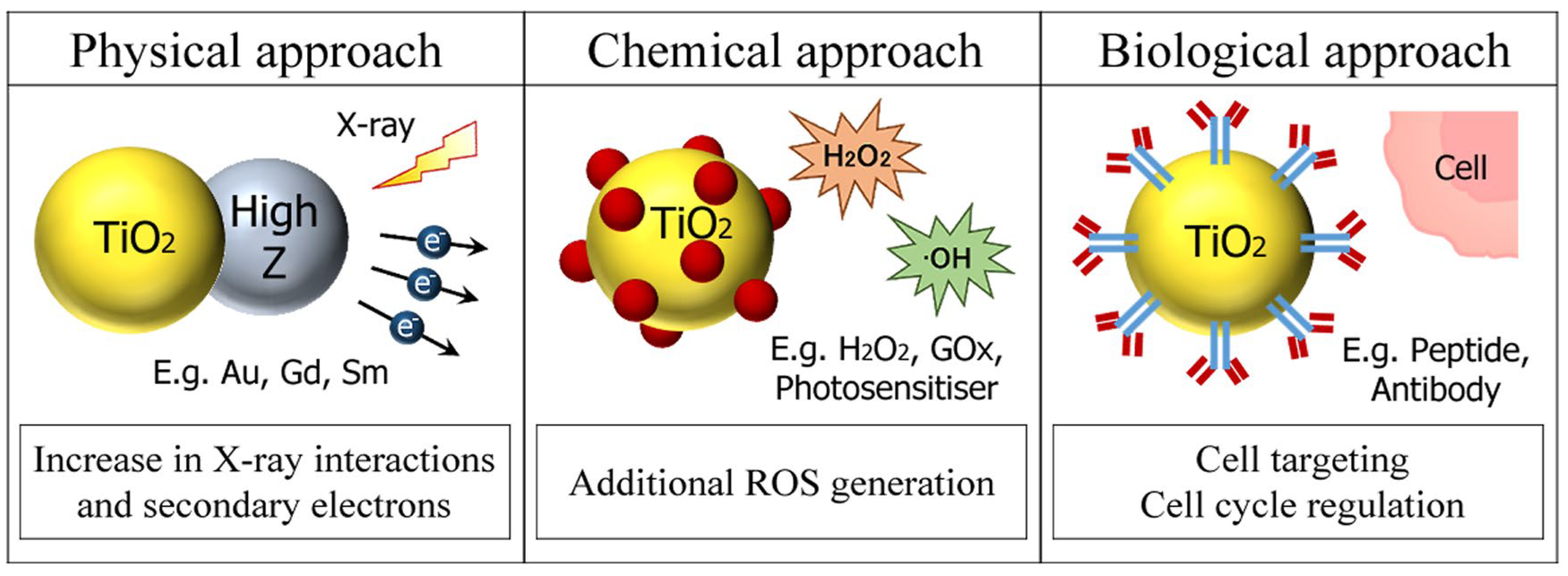
3.2.1. Dose Enhancement by Physical Approaches
3.2.2. Dose Enhancement by Chemical Approaches
3.2.3. Dose Enhancement by Biological Approaches
3.3. Dose Enhancement Effect on Normal Cells
3.4. In Vivo Studies
4. ROS Generation by TiO2 NPs Exposed to X-rays
5. Contrast Enhancement in CT Images
6. Challenges and Future Perspectives
7. Conclusions
Author Contributions
Funding
Data Availability Statement
Conflicts of Interest
References
- Global Burden of Disease 2019 Cancer Collaboration; Kocarnik, J.M.; Compton, K.; Dean, F.E.; Fu, W.; Gaw, B.L.; Harvey, J.D.; Henrikson, H.J.; Lu, D.; Pennini, A.; et al. Cancer incidence, mortality, years of life lost, years lived with disability, and disability-adjusted life years for 29 cancer groups from 2010 to 2019: A systematic analysis for the global burden of disease study 2019. JAMA Oncol. 2022, 8, 420–444. [Google Scholar] [CrossRef] [Scilit] [PubMed]
- Abdel-Wahab, M.; Gondhowiardjo, S.S.; Rosa, A.A.; Lievens, Y.; El-Haj, N.; Rubio, J.A.P.; Ben Prajogi, G.; Helgadottir, H.; Zubizarreta, E.; Meghzifene, A.; et al. Global radiotherapy: Current status and future directions-white paper. JCO Glob. Oncol. 2021, 7, 827–842. [Google Scholar] [CrossRef] [Scilit] [PubMed]
- Baskar, R.; Lee, K.A.; Yeo, R.; Yeoh, K.W. Cancer and radiation therapy: Current advances and future directions. Int. J. Med. Sci. 2012, 9, 193–199. [Google Scholar] [CrossRef] [Scilit] [PubMed]
- Riley, P.A. Free radicals in biology: Oxidative stress and the effects of ionizing radiation. Int. J. Radiat. Biol. 1994, 65, 27–33. [Google Scholar] [CrossRef] [Scilit] [PubMed]
- Wang, J.S.; Wang, H.J.; Qian, H.L. Biological effects of radiation on cancer cells. Mil. Med. Res. 2018, 5, 20. [Google Scholar] [CrossRef] [Scilit] [PubMed]
- Howard, D.; Sebastian, S.; Le, Q.V.; Thierry, B.; Kempson, I. Chemical mechanisms of nanoparticle radiosensitization and radioprotection: A review of structure-function relationships influencing reactive oxygen species. Int. J. Mol. Sci. 2020, 21, 579. [Google Scholar] [CrossRef] [Scilit] [PubMed]
- Perillo, B.; Di Donato, M.; Pezone, A.; Di Zazzo, E.; Giovannelli, P.; Galasso, G.; Castoria, G.; Migliaccio, A. ROS in cancer therapy: The bright side of the moon. Exp. Mol. Med. 2020, 52, 192–203. [Google Scholar] [CrossRef] [Scilit] [PubMed]
- Gibbons, J.P. Khan’s the Physics of Radiation Therapy, 6th ed.; Wolters Kluwer Health: Philadelphia, PA, USA, 2019. [Google Scholar]
- Souchek, J.J.; Baine, M.J.; Lin, C.; Rachagani, S.; Gupta, S.; Kaur, S.; Lester, K.; Zheng, D.; Chen, S.; Smith, L.; et al. Unbiased analysis of pancreatic cancer radiation resistance reveals cholesterol biosynthesis as a novel target for radiosensitisation. Br. J. Cancer 2014, 111, 1139–1149. [Google Scholar] [CrossRef] [Scilit] [PubMed]
- Han, X.; Xu, K.; Taratula, O.; Farsad, K. Applications of nanoparticles in biomedical imaging. Nanoscale 2019, 11, 799–819. [Google Scholar] [CrossRef] [Scilit] [PubMed]
- Dong, Y.C.; Hajfathalian, M.; Maidment, P.S.N.; Hsu, J.C.; Naha, P.C.; Si-Mohamed, S.; Breuilly, M.; Kim, J.; Chhour, P.; Douek, P.; et al. Effect of gold nanoparticle size on their properties as contrast agents for computed tomography. Sci. Rep. 2019, 9, 14912. [Google Scholar] [CrossRef] [Scilit] [PubMed]
- Hainfeld, J.F.; Slatkin, D.N.; Smilowitz, H.M. The use of gold nanoparticles to enhance radiotherapy in mice. Phys. Med. Biol. 2004, 49, N309–N315. [Google Scholar] [CrossRef] [Scilit] [PubMed]
- Chen, Y.; Yang, J.; Fu, S.; Wu, J. Gold nanoparticles as radiosensitizers in cancer radiotherapy. Int. J. Nanomed. 2020, 15, 9407–9430. [Google Scholar] [CrossRef] [Scilit] [PubMed]
- Gao, Q.; Zhang, J.; Gao, J.; Zhang, Z.; Zhu, H.; Wang, D. Gold nanoparticles in cancer theranostics. Front. Bioeng. Biotechnol. 2021, 9, 647905. [Google Scholar] [CrossRef] [Scilit] [PubMed]
- Jain, S.; Hirst, D.G.; O’Sullivan, J.M. Gold nanoparticles as novel agents for cancer therapy. Br. J. Radiol. 2012, 85, 101–113. [Google Scholar] [CrossRef] [Scilit] [PubMed]
- Çeşmeli, S.; Biray Avci, C. Application of titanium dioxide (TiO2) nanoparticles in cancer therapies. J. Drug Target. 2019, 27, 762–766. [Google Scholar] [CrossRef] [Scilit] [PubMed]
- Ziental, D.; Czarczynska-Goslinska, B.; Mlynarczyk, D.T.; Glowacka-Sobotta, A.; Stanisz, B.; Goslinski, T.; Sobotta, L. Titanium dioxide nanoparticles: Prospects and applications in medicine. Nanomaterials 2020, 10, 387. [Google Scholar] [CrossRef] [Scilit]
- Lagopati, N.; Evangelou, K.; Falaras, P.; Tsilibary, E.-P.C.; Vasileiou, P.V.S.; Havaki, S.; Angelopoulou, A.; Pavlatou, E.A.; Gorgoulis, V.G. Nanomedicine: Photo-activated nanostructured titanium dioxide, as a promising anticancer agent. Pharmacol. Ther. 2021, 222, 107795. [Google Scholar] [CrossRef] [Scilit] [PubMed]
- Sargazi, S.; Er, S.; Gelen, S.S.; Rahdar, A.; Bilal, M.; Arshad, R.; Ajalli, N.; Khan, M.F.A.; Pandey, S. Application of titanium dioxide nanoparticles in photothermal and photodynamic therapy of cancer: An updated and comprehensive review. J. Drug Deliv. Sci. Technol. 2022, 75, 103605. [Google Scholar] [CrossRef] [Scilit]
- Hasanzadeh Kafshgari, M.; Goldmann, W.H. Insights into theranostic properties of titanium dioxide for nanomedicine. Nanomicro. Lett. 2020, 12, 22. [Google Scholar] [CrossRef] [Scilit] [PubMed]
- Tamura, K.; Ohko, Y.; Kawamura, H.; Yoshikawa, H.; Tatsuma, T.; Fujishima, A.; Mizuki, J. X-ray induced photoelectrochemistry on TiO2. Electrochimica Acta 2007, 52, 6938–6942. [Google Scholar] [CrossRef] [Scilit]
- Hubbell, J.H.; Seltzer, S.M. Tables of X-ray Mass Attenuation Coefficients (Version 1.4); National Institute of Standards and Technology: Gaithersburg, MD, USA, 1995. Available online: http://physics.nist.gov/xaamdi (accessed on 28 February 2023).
- Cheng, K.; Sano, M.; Jenkins, C.H.; Zhang, G.; Vernekohl, D.; Zhao, W.; Wei, C.; Zhang, Y.; Zhang, Z.; Liu, Y.; et al. Synergistically enhancing the therapeutic effect of radiation therapy with radiation activatable and reactive oxygen species-releasing nanostructures. ACS Nano 2018, 12, 4946–4958. [Google Scholar] [CrossRef] [Scilit] [PubMed]
- Akasaka, H.; Mukumoto, N.; Nakayama, M.; Wang, T.; Yada, R.; Shimizu, Y.; Inubushi, S.; Kyotani, K.; Okumura, K.; Miyamoto, M.; et al. Investigation of the potential of using TiO2 nanoparticles as a contrast agent in computed tomography and magnetic resonance imaging. Appl. Nanosci. 2020, 10, 3143–3148. [Google Scholar] [CrossRef] [Scilit]
- Bakhshizadeh, M.; Mohajeri, S.A.; Esmaily, H.; Aledavood, S.A.; Tabrizi, F.V.; Seifi, M.; Hadizadeh, F.; Sazgarnia, A. Utilizing photosensitizing and radiosensitizing properties of TiO2-based mitoxantrone imprinted nanopolymer in fibrosarcoma and melanoma cells. Photodiagnosis Photodyn. Ther. 2019, 25, 472–479. [Google Scholar] [CrossRef] [Scilit] [PubMed]
- Gerken, L.R.H.; Gogos, A.; Starsich, F.H.L.; David, H.; Gerdes, M.E.; Schiefer, H.; Psoroulas, S.; Meer, D.; Plasswilm, L.; Weber, D.C.; et al. Catalytic activity imperative for nanoparticle dose enhancement in photon and proton therapy. Nat. Commun. 2022, 13, 3248. [Google Scholar] [CrossRef] [Scilit] [PubMed]
- Gerken, L.R.; Neuer, A.L.; Gschwend, P.M.; Keevend, K.; Gogos, A.; Anthis, A.H.; Aengenheister, L.; Pratsinis, S.E.; Plasswilm, L.; Herrmann, I.K. Scalable synthesis of ultrasmall metal oxide radio-enhancers outperforming gold. Chem. Mater. 2021, 33, 3098–3112. [Google Scholar] [CrossRef] [Scilit]
- Mirjolet, C.; Papa, A.-L.; Créhange, G.; Raguin, O.; Seignez, C.; Paul, C.; Truc, G.; Maingon, P.; Millot, N. The radiosensitization effect of titanate nanotubes as a new tool in radiation therapy for glioblastoma: A proof-of-concept. Radiother. Oncol. 2013, 108, 136–142. [Google Scholar] [CrossRef] [Scilit] [PubMed]
- Morita, K.; Nishimura, Y.; Nakamura, S.; Arai, Y.; Numako, C.; Sato, K.; Nakayama, M.; Akasaka, H.; Sasaki, R.; Ogino, C.; et al. Titanium oxide nano-radiosensitizers for hydrogen peroxide delivery into cancer cells. Colloids Surf. B Biointerfaces 2021, 198, 111451. [Google Scholar] [CrossRef] [Scilit] [PubMed]
- Nakayama, M.; Smith, C.L.; Feltis, B.N.; Piva, T.J.; Tabatabaie, F.; Harty, P.D.; Gagliardi, F.M.; Platts, K.; Otto, S.; Blencowe, A.; et al. Samarium doped titanium dioxide nanoparticles as theranostic agents in radiation therapy. Phys. Med. 2020, 75, 69–76. [Google Scholar] [CrossRef] [Scilit] [PubMed]
- Ouyang, Z.; Liu, B.; Yasmin-Karim, S.; Sajo, E.; Ngwa, W. Nanoparticle-aided external beam radiotherapy leveraging the Čerenkov effect. Phys. Med. 2016, 32, 944–947. [Google Scholar] [CrossRef] [Scilit] [PubMed]
- Pan, W.; Cui, B.; Gao, P.; Ge, Y.; Li, N.; Tang, B. A cancer cell membrane-camouflaged nanoreactor for enhanced radiotherapy against cancer metastasis. Chem. Commun. 2020, 56, 547–550. [Google Scholar] [CrossRef] [Scilit] [PubMed]
- Rezaei-Tavirani, M.; Dolat, E.; Hasanzadeh, H.; Seyyedi, S.; Semnani, V.; Sobhi, S. TiO2 Nanoparticle as a sensitizer drug in radiotherapy: In vitro study. Iran. J. Cancer Prev. 2013, 6, 37–44. [Google Scholar]
- Su, W.; Wang, H.; Wang, T.; Li, X.; Tang, Z.; Zhao, S.; Zhang, M.; Li, D.; Jiang, X.; Gong, T.; et al. Auger electrons constructed active sites on nanocatalysts for catalytic internal radiotherapy. Adv. Sci. 2020, 7, 1903585. [Google Scholar] [CrossRef] [Scilit]
- Youkhana, E.Q.; Feltis, B.; Blencowe, A.; Geso, M. Titanium dioxide nanoparticles as radiosensitisers: An in vitro and phantom-based study. Int. J. Med. Sci. 2017, 14, 602–614. [Google Scholar] [CrossRef] [Scilit] [PubMed]
- Alban, L.; Monteiro, W.F.; Diz, F.M.; Miranda, G.M.; Scheid, C.M.; Zotti, E.R.; Morrone, F.B.; Ligabue, R. New quercetin-coated titanate nanotubes and their radiosensitization effect on human bladder cancer. Mater. Sci. Eng. C Mater. Biol. Appl. 2020, 110, 110662. [Google Scholar] [CrossRef] [Scilit] [PubMed]
- Gao, K.; Tu, W.; Yu, X.; Ahmad, F.; Zhang, X.; Wu, W.; An, X.; Chen, X.; Li, W. W-doped TiO2 nanoparticles with strong absorption in the NIR-II window for photoacoustic/CT dual-modal imaging and synergistic thermoradiotherapy of tumors. Theranostics 2019, 9, 5214–5226. [Google Scholar] [CrossRef] [Scilit] [PubMed]
- Hassan, M.; Nakayama, M.; Salah, M.; Akasaka, H.; Kubota, H.; Nakahana, M.; Tagawa, T.; Morita, K.; Nakaoka, A.; Ishihara, T.; et al. A comparative assessment of mechanisms and effectiveness of radiosensitization by titanium peroxide and gold nanoparticles. Nanomaterials 2020, 10, 1125. [Google Scholar] [CrossRef] [Scilit] [PubMed]
- Nakayama, M.; Sasaki, R.; Ogino, C.; Tanaka, T.; Morita, K.; Umetsu, M.; Ohara, S.; Tan, Z.; Nishimura, Y.; Akasaka, H.; et al. Titanium peroxide nanoparticles enhanced cytotoxic effects of X-ray irradiation against pancreatic cancer model through reactive oxygen species generation in vitro and in vivo. Radiat. Oncol. 2016, 11, 91. [Google Scholar] [CrossRef] [Scilit] [PubMed]
- Pan, W.; Gong, S.; Wang, J.; Yu, L.; Chen, Y.; Li, N.; Tang, B. A nuclear-targeted titanium dioxide radiosensitizer for cell cycle regulation and enhanced radiotherapy. Chem. Commun. 2019, 55, 8182–8185. [Google Scholar] [CrossRef] [Scilit] [PubMed]
- Tekin, V.; Aweda, T.; Guldu, O.K.; Muftuler, F.Z.B.; Bartels, J.; Lapi, S.E.; Unak, P. A novel anti-angiogenic radio/photo sensitizer for prostate cancer imaging and therapy: 89Zr-Pt@TiO2-SPHINX, synthesis and in vitro evaluation. Nucl. Med. Biol. 2021, 94–95, 20–31. [Google Scholar] [CrossRef] [Scilit] [PubMed]
- Townley, H.E.; Rapa, E.; Wakefield, G.; Dobson, P.J. Nanoparticle augmented radiation treatment decreases cancer cell proliferation. Nanomedicine 2012, 8, 526–536. [Google Scholar] [CrossRef] [Scilit] [PubMed]
- Yang, C.-C.; Sun, Y.-J.; Chung, P.-H.; Chen, W.-Y.; Swieszkowski, W.; Tian, W.; Lin, F.-H. Development of Ce-doped TiO2 activated by X-ray irradiation for alternative cancer treatment. Ceram. Int. 2017, 43, 12675–12683. [Google Scholar] [CrossRef] [Scilit]
- Wang, Y.; Sauvat, A.; Lacrouts, C.; Lebeau, J.; Grall, R.; Hullo, M.; Nesslany, F.; Chevillard, S. TiO2 nanomaterials non-controlled contamination could be hazardous for normal cells located in the field of radiotherapy. Int. J. Mol. Sci. 2020, 21, 940. [Google Scholar] [CrossRef] [Scilit]
- Townley, H.E.; Kim, J.; Dobson, P.J. In vivo demonstration of enhanced radiotherapy using rare earth doped titania nanoparticles. Nanoscale 2012, 4, 5043–5050. [Google Scholar] [CrossRef] [Scilit] [PubMed]
- Nakayama, M.; Akasaka, H.; Miyazaki, E.; Goto, Y.; Oki, Y.; Kawate, Y.; Morita, K.; Sasaki, R. Image contrast assessment of metal-based nanoparticles as applications for image-guided radiation therapy. Phys. Imaging Radiat. Oncol. 2021, 20, 94–97. [Google Scholar] [CrossRef] [Scilit] [PubMed]
- Smith, L.; Kuncic, Z.; Ostrikov, K.; Kumar, S. Nanoparticles in cancer imaging and therapy. J. Nanomater. 2012, 2012, 891318. [Google Scholar] [CrossRef] [Scilit]

| Study [Ref] | Particle Size (nm) | Cell Line | Assay | Radiation Energy | NPs Concentration | Surface Modification/ Other | Enhancement Ratio |
|---|---|---|---|---|---|---|---|
| Akasaka et al. [24] | 50 | MIAPaCa-2 | Clonogenic | 150 kVp | 100 µg/mL | N/A | 2.63 @ 8 Gy |
| Bakhshizadeh et al. [25] | 62.8 | DFW, HT1080 | MTT | 6 MV | 1.33 µg/mL | Methacrylic acid (MAA), Nanopolymer | 1.10 @ 1 Gy (DFW) 0.85 @ 1 Gy (HT1080) |
| Cheng et al. [23] | 50.6 | SUM159 | CellTiter-Blue | 320 kVp | 5 µg/mL | Polyethylene glycol (PEG) | 1.14 @ 10 Gy |
| Gerken et al. [26] | 5.2 | HT1080 | CellTiter-Glo | 150 kVp, 6 MV | 80, 160, 320 µg/mL | Flame spray pyrolysis synthesis | 2.65 @ 8 Gy (320 µg/mL, 150 kVp) 2.30 @ 8 Gy (320 µg/mL, 6 MV) |
| Gerken et al. [27] | 5.3 | HT1080, HeLa | CellTiter-Glo | 150 kVp | 1 mg/mL | Flame spray pyrolysis synthesis | 1.77 @ 8 Gy (HT1080) 0.61 @ 8 Gy (HeLa) |
| Mirjolet et al. [28] | 10 | SNB-19, U87MG | Clonogenic | Medical LINAC (Possibly 6 MV) | 1 µg/mL | Nanotube-shaped | 2.25 @ 5 Gy (SNB-19) 1.35 @ 10 Gy (U87MG) |
| Morita et al. [29] | 50 | BxPC3 | Clonogenic | 80 kVp | 1 mg/mL | Polyacrylic acid (PAA) | 1.70 @ 5 Gy |
| Nakayama et al. [30] | 12.7 | A549, DU145 | Clonogenic | 6 MV | 200 µg/mL | Aminopropyl trimethoxysilane (APTS), Polyethylene glycol (PEG) | 1.18 @ 6 Gy (A549, APTS) 1.24 @ 6 Gy (A549, PEG) 1.20 @ 6 Gy (DU145, APTS) 1.16 @ 6 Gy (DU145, PEG) |
| Ouyang et al. [31] | 5 | A549 | Clonogenic | 6 MV | 0.5 µg/g | N/A | 1.34 @ 2 Gy |
| Pan et al. [32] | 24 | B16-F10, 4T1-Luc | Clonogenic | Medical LINAC (Possibly 6 MV) | 100 µg/mL | Cancer cell membrane | 1.49 @ 4 Gy (B16-F10) 1.32 @ 4 Gy (4T1-Luc) |
| Rezaei-Tavirani et al. [33] | N/A | MCF-7, MKN-45 | MTT | 60Co (1.173, 1.332 MeV γ) | 30 µg/mL | Anatase, Rutile TiO2 | 2.73 @ 2 Gy (MCF-7, Anatase) 0.87 @ 2 Gy (MCF-7, Rutile) 1.60 @ 2 Gy (MKN-45, Anatase) 0.58 @ 2 Gy (MKN-45, Rutile) |
| Su et al. [34] | 11.78 | SW1990 | Clonogenic | 125I (internal radiation source, 35.5 keV γ) | 144 µg/mL | Oleic acid | 2.07 @ 7.5 µCi |
| Youkhana et al. [35] | 30 | HaCaT, DU145 | Clonogenic | 80 kVp, 6 MV | 4 mM | Aminopropyl trimethoxysilane (APTS) | 8.00 @ 8 Gy (HaCaT, 80 kVp) 2.22 @ 8 Gy (HaCaT, 6 MV) 13.50 @ 8 Gy (DU145, 80 kVp) 1.90 @ 8 Gy (DU145, 6 MV) |
| Study [Ref] | Conjugated Material | Surface Modification | Particle Size (nm) | Cell Line | Assay | Radiation Energy | NPs Concentration | Enhancement Ratio |
|---|---|---|---|---|---|---|---|---|
| Alban et al. [36] | Sodium (Na), Zinc (Zn) | Quercetin, Nanotube-shaped | 9–12 | T24 | Clonogenic | 60Co (1.173, 1.332 MeV γ) | 25 µg/mL | 1.75 @ 5 Gy (Na) 2.86 @ 5 Gy (Zn) |
| Bakhshizadeh et al. [25] | Mitoxantrone (MX) | Methacrylic acid (MAA), Nanopolymer | 62.8 | DFW, HT1080 | MTT | 6 MV | 1.33 µg/mL | 6.11 @ 1 Gy (DFW) 1.23 @ 1 Gy (HT1080) |
| Cheng et al. [23] | Gold (Au) | Polyethylene glycol (PEG) | 70.1 | SUM159 | CellTiter-Blue | 320 kVp | 5 µg/mL | 2.20 @ 10 Gy |
| Gao et al. [37] | Tungsten (W) | Polyethylene glycol (PEG) | 9.1 | 4T1 | Clonogenic | N/A | 100 µg/mL | 2.47 @ 8 Gy |
| Hassan et al. [38] | Hydrogen peroxide (H2O2) | Polyacrylic acid (PAA) | 50 | MIAPaCa-2 | Clonogenic | 150 kVp | 400 µg/mL | 4.58 @ 5 Gy |
| Morita et al. [29] | Hydrogen peroxide (H2O2) | Polyacrylic acid (PAA) | 50 | BxPC3 | Clonogenic | 80 kVp | 1 mg/mL | 35.5 @ 5 Gy |
| Nakayama et al. [39] | Hydrogen peroxide (H2O2) | Polyacrylic acid (PAA) | 70 | MIAPaCa-2 | Clonogenic | 150 kVp | 0.15% w/v | 3.40 @ 5 Gy |
| Nakayama et al. [30] | Samarium (Sm) | Aminopropyl trimethoxysilane (APTS), Polyethylene glycol (PEG) | 12.7 | A549, DU145 | Clonogenic | 6 MV | 200 µg/mL | 1.48 @ 6 Gy (A549, APTS) 1.54 @ 6 Gy (A549, PEG) 1.42 @ 6 Gy (DU145, APTS) 1.46 @ 6 Gy (DU145, PEG) |
| Pan et al. [32] | Manganese dioxide (MnO2) | Glucose oxidase (GOx), Cancer cell membrane | 46 | B16-F10, 4T1-Luc | Clonogenic | LINAC (Possibly 6 MV) | 100 µg/mL | 16.23 @ 4 Gy (B16-F10) 18.85 @ 4 Gy (4T1-Luc) |
| Pan et al. [40] | SN-38, TAT peptide | RGD peptide, Mesoporous-shaped | 45 | 4T1-Luc | Clonogenic | 6 MV | 100 µg/mL | 5.09 @ 4 Gy |
| Tekin et al. [41] | Platinum (Pt), Zirconium (Zr) | SPHINX | 46.3 | PC3, LNCaP, RWPE-1 | WST | 6 MV + Light | 10 µg/mL | 2.09 @ 5 Gy (PC3) 2.29 @ 5 Gy (LNCaP) 1.10 @ 5 Gy (RWPE-1) |
| Townley et al. [42] | Gadolinium (Gd), Erbium (Er), Europium (Eu) | Silica | 60 | MCF7, RH30 | Trypan blue | 250 kVp | 225 nM | 1.60 @ 3 Gy (MCF7, 10%Gd1%Er1%Eu) 2.94 @ 3 Gy (RH30, 10%Gd1%Er1%Eu) |
| Yang et al. [43] | Cerium (Ce) | N/A | 15 | A549 | WST | 80 kVp | 10 mg | 1.18 @ 0.13 Gy * |
| Study [Ref] | Conjugation/ Modification | Particle Size (nm) | Animal | Cell Line | Radiation Energy | Radiation Dose | NPs (Ti) Conc. | NPs Injection | Observation Period | Results |
|---|---|---|---|---|---|---|---|---|---|---|
| Cheng et al. [23] | Au/PEG | 70.1 | Mice | SUM159 | 320 kVp | 10 Gy | 4 mg/kg | 100 µL, intravenous | 37, 81 days | The tumour size treated with Au-TiO2 NPs + X-rays was fourfold smaller than that with X-rays alone. The median survival significantly increased. |
| Gao et al. [37] | W/PEG | 9.1 | Mice | 4T1 | N/A | 4 Gy | 3 mg/mL | 200 µL, intravenous | 14 days | The tumour growth rate of the group treated with W-doped TiO2 NPs + X-rays was lower than that of the X-rays alone group. |
| Hassan et al. [38] | H2O2/PAA | 50 | Mice | MIAPaCa-2 | 150 kVp | 5 Gy | 1.5 mg/mL | 100 µL, intratumoral | 55 days | H2O2-modified TiO2 NPs + X-rays showed significantly higher tumour growth inhibition compared with that of X-rays alone. |
| Nakayama et al. [39] | H2O2/PAA | 70 | Mice | MIAPaCa-2 | 150 kVp | 5 Gy | 8.7% w/v | 150 µL, intratumoral | 43 days | The tumour volume treated with H2O2-modified TiO2 NPs + X-rays was 35.4% of that with X-rays alone. |
| Pan et al. [32] | MnO2/GOx, Cell membrane | 46 | Mice | B16-F10, 4T1-Luc | LINAC (Possibly 6 MV) | 4 Gy | 1.2 mg/mL | 150 µL, intravenous | 40 days | The survival rate of the TiO2@MnO2-GOx@C + X-rays group was significantly prolonged compared to other groups. |
| Pan et al. [40] | SN-38, TAT/ RGD peptide | 45 | Mice | 4T1-Luc | 6 MV | 6 Gy | 60 mg/kg | 150 µL, intravenous | 21 days | Mesoporous TiO2(SN-38)-TAT-RGD NPs + X-rays greatly suppressed tumour growth. |
| Su et al. [34] | Oleic acid, 125I | 11.78 | Mice | SW1990 | 125I (internal radiation source, 35.5 keV γ) | 600 µCi | 144 µg/mL | 10 µL, intratumoral | 20, 60 days | The relative tumour volume treated with 125I-TiO2 NPs was 54.21% of that with 125I. The survival rate was significantly improved with 125I-TiO2 NPs. |
| Townley et al. [45] | Gd, Eu, Er/ Silica | 65 | Mice | A549 | 200 kVp | 2 Gy × 5, 2.5 Gy × 10 + 2 Gy × 3 | 0.05, 1, 5 mg/mL | 50 µL, intratumoral (days 0, 13, 20) | 22 days | The tumours treated with 5%Gd-1%Eu-1%Er TiO2 NPs + X-rays were about half the size of those treated with X-rays alone. |
| Yang et al. [43] | Ce | 15 | Mice | A549 | 80 kVp | N/A (Multi-fraction) | N/A | N/A | 10 days | The tumour size treated with Ce-doped TiO2 NPs + X-rays decreased significantly to 9.65% of the initial size. |
| Study [Ref] | Nanoparticles | ROS Probes | Cells | Measurements | ROS Increase in NPs + X-rays |
|---|---|---|---|---|---|
| Bakhshizadeh et al. [25] | MX-imprinted TiO2 NPs (Nanopolymers) | Terephthalic acid | No cells | Spectrofluorometer | Increase |
| Cheng et al. [23] | Gold-composed TiO2 NPs | DPBF, DCFDA | SUM159 | Flow cytometry | Insignificant increase in TiO2 NPs, Significant increase in Au-TiO2 NPs |
| Gerken et al. [26] | TiO2 NPs | H2DCFDA | No cells | Microplate reader | Increase |
| Hassan et al. [38] | H2O2-modified TiO2 NPs | APF, DHE, c-H2DCFDA | MIAPaCa-2 | Microplate reader, Microscope | Significant increase |
| Mirjolet et al. [28] | Titanate nanotubes | DCFDA | SNB-19, U87MG | Flow cytometry | No increase |
| Nakayama et al. [30] | Samarium-doped TiO2 NPs | DCFDA | A549, DU145 | Microplate reader | Insignificant increase in TiO2 NPs, Significant increase in Sm-TiO2 NPs |
| Nakayama et al. [39] | H2O2-modified TiO2 NPs | APF, c-H2DCFDA, HE | MIAPaCa-2 | Microplate reader, Flow cytometry | No increase in TiO2 NPs Significant increase in H2O2-TiO2 NPs |
| Pan et al. [32] | MnO2/GOx-decorated TiO2 NPs | DCFDA | B16-F10, 4T1-Luc | Microscope | Increase |
| Pan et al. [40] | Mesoporous TiO2 NPs | DBZTC, DCFDA | No cells | Spectrofluorometer | Possibly increase (No data are available for X-rays alone) |
| Su et al. [34] | 125I-labelled TiO2 NPs | HPF | SW1990 | Microscope | Significant increase (NPs + γ-rays of 125I) |
| Townley et al. [42] | Rare earth element-doped TiO2 NPs | Coumarin hydroxylation, c-H2DCFDA | RH30 | N/A | No increase in TiO2 NPs Significant increase in doped TiO2 NPs |
| Yang et al. [43] | Cerium-doped TiO2 NPs | DCFDA | A549 | Microplate reader | Significant increase in Ce-TiO2 NPs |
| Youkhana et al. [35] | TiO2 NPs | DCFDA | No cells | Microplate reader | Significant increase |
Disclaimer/Publisher’s Note: The statements, opinions and data contained in all publications are solely those of the individual author(s) and contributor(s) and not of MDPI and/or the editor(s). MDPI and/or the editor(s) disclaim responsibility for any injury to people or property resulting from any ideas, methods, instructions or products referred to in the content. |
© 2024 by the authors. Licensee MDPI, Basel, Switzerland. This article is an open access article distributed under the terms and conditions of the Creative Commons Attribution (CC BY) license (https://creativecommons.org/licenses/by/4.0/).
Share and Cite
Nakayama, M.; Akasaka, H.; Sasaki, R.; Geso, M. Titanium Dioxide-Based Nanoparticles to Enhance Radiation Therapy for Cancer: A Literature Review. J. Nanotheranostics 2024, 5, 60-74. https://doi.org/10.3390/jnt5020004
Nakayama M, Akasaka H, Sasaki R, Geso M. Titanium Dioxide-Based Nanoparticles to Enhance Radiation Therapy for Cancer: A Literature Review. Journal of Nanotheranostics. 2024; 5(2):60-74. https://doi.org/10.3390/jnt5020004
Chicago/Turabian StyleNakayama, Masao, Hiroaki Akasaka, Ryohei Sasaki, and Moshi Geso. 2024. "Titanium Dioxide-Based Nanoparticles to Enhance Radiation Therapy for Cancer: A Literature Review" Journal of Nanotheranostics 5, no. 2: 60-74. https://doi.org/10.3390/jnt5020004
APA StyleNakayama, M., Akasaka, H., Sasaki, R., & Geso, M. (2024). Titanium Dioxide-Based Nanoparticles to Enhance Radiation Therapy for Cancer: A Literature Review. Journal of Nanotheranostics, 5(2), 60-74. https://doi.org/10.3390/jnt5020004

