1. Introduction
A significant leap in wireless communication technology is represented by 5G mobile networks, which are characterized by higher data speeds, lower latency, increased capacity, and support for a vast array of connected devices compared to previous generations. Various industries are expected to be revolutionized, and innovative applications such as augmented reality (AR), virtual reality (VR), autonomous vehicles, remote healthcare, and smart cities are anticipated to be enabled by this transformative technology.
Several advantages are offered by 5G, including enhanced mobile broadband, ultra-reliable low latency communication, massive machine-type communication, network slicing, beamforming, multiple-input multiple-output (MIMO), and spectrum flexibility. NOMA has been recognized as an innovative multiple access scheme that improves both SE and EE in 5G networks and beyond.
The role of NOMA in 5G networks is highlighted by its ability to enhance SE, support massive connectivity, and improve overall network capacity. Multiple Access (OFDMA)t over traditional multiple access techniques, such as Orthogonal Frequency Division Multiple Access (OFDMA), is represented by NOMA through the non-orthogonal sharing of time-frequency resources among multiple users. In addition to improvements in spectral and energy efficiencies, support for diverse traffic types, massive connectivity, interference management, and enhanced user fairness are facilitated by NOMA.
EE is regarded as a vital factor in modern wireless networks due to increasing concerns about environmental sustainability and the need to extend the battery life of mobile devices. Meanwhile, the role of SE in determining the network’s ability to accommodate a large number of users and devices simultaneously is emphasized.
The effect of bandwidth on spectral and energy efficiencies for NOMA and OMA is studied in this work. A better understanding of how NOMA can enhance EE and SE in 5G networks is contributed by the findings of this research.
Recently, AI techniques have been widely adopted in wireless communications to address such challenges. ML models, including DL, DT, KNN, and LR, have demonstrated strong capabilities in modelling complex systems, predicting network behaviour, and optimizing performance metrics. These techniques enable data-driven analysis, reducing computational complexity while maintaining high accuracy.
In this paper, we investigate the performance of NOMA and OMA in terms of EE and SE under varying bandwidth conditions. Furthermore, we integrate AI-based models to analyze and predict system performance, providing deeper insights into the behaviour of both access schemes. The main contributions of this work are summarized as follows:
A comprehensive comparative analysis of NOMA and OMA in terms of EE and SE under different bandwidth scenarios.
Development of an AI-driven framework using DL, DT, KNN, and LR models for performance prediction.
Quantitative evaluation demonstrating the superiority of NOMA over OMA in both efficiency metrics.
Validation of AI model accuracy and effectiveness in wireless communication performance analysis.
The results show that NOMA consistently outperforms OMA, while AI techniques provide reliable and efficient tools for modelling and optimization. This study highlights the potential of combining advanced multiple access schemes with intelligent data-driven approaches for future wireless networks.
The remaining part of this article is summarized as follows: Part 2 presents a literature review, Part 3 describes NOMA and OMA, Part 4 presents the materials and methods, Part 5 presents the results, Part 6 presents the computational complexity of ML models, and Part 7 presents the conclusion.
2. Literature Review
Selvam and Kumar in Ref. [
1] presented energy and spectrum efficiency of NOMA and OFDMA techniques with respect to the variation in system bandwidth. Chandra and Borugadda in Ref. [
2] investigated the efficacy of NOMA and evaluated the average sum rate of users and the average EE. Saraswat and Singh in Ref. [
3] studied the rate optimization techniques in the literature survey when the Power Domain-NOMA scheme is joint with MIMO. (Magalhães et al. in Ref. [
4] investigated the EE of NOMA and joint transmission (JT)-coordinated multipoint (CoMP) NOMA. Cetinkaya and Arslan in Ref. [
5] investigated the SE and EE tradeoff in downlink NOMA with the consideration of quality of service (QoS) requirements.
Table 1 summarizes the previous contributions and highlights the pros and cons of each. Hamedoon et al. in Ref. [
6] proposed a Reconfigurable Intelligent Surface (RIS)-assisted downlink NOMA for Internet of Things (IoT) network, where the challenge of optimizing power allocation, RIS phase shifts, and EE was addressed. Salih et al. in Ref. [
7] employed simulation data and practical analyses to assess multiple access approaches and their underlying technologies. It focused on the two systems’ performance metrics in real-world circumstances.
There is a lack of studies employing ML tools to study SE and EE of NOMA and OMA. This work provides an intuitive ML addition to SE and EE for NOMA.
The proposed approach differs from existing AI-based resource allocation and NOMA optimization methods by focusing on the prediction and classification of EE and SE for both OMA and NOMA systems using supervised learning models such as LR, DT, KNN, and Deep DL. Unlike many existing studies that rely on computationally intensive optimization techniques or deep reinforcement learning for power allocation and user pairing, the proposed framework learns EE–SE behaviour directly from simulation-generated datasets under varying network conditions. This significantly reduces computational complexity while maintaining high prediction accuracy, making the approach more suitable for real-time and embedded 5G/IoT environments. Additionally, the framework provides a direct comparative analysis between OMA and NOMA using multiple evaluation metrics, including confusion matrices, AUC, precision, recall, and F-measure, offering improved interpretability and practical insight compared with many optimization-focused approaches in the literature.
3. Background
3.1. Non-Orthogonal Multiple Access (NOMA)
NOMA [
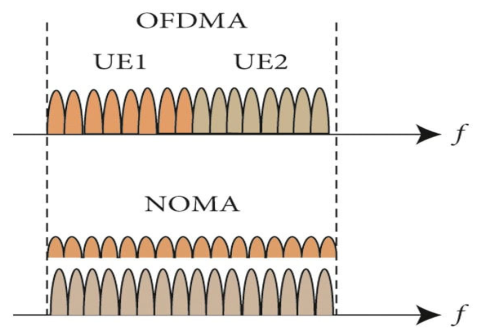
8] is recognized as a multiple access technique employed in wireless communication systems to enhance SE and accommodate multiple users simultaneously within the same frequency resources. Unlike traditional OMA schemes, where orthogonal resources are allocated to each user, NOMA enables the sharing of the same resources by multiple users non-orthogonally through power domain exploitation, as illustrated in
Figure 1.
NOMA is operated in the power domain, allowing data transmission by multiple users simultaneously over the same time interval using different power levels. The distinction between users is made based on the power levels allocated to their signals. A summary of the different aspects of NOMA and OMA is presented in
Table 2.
Users in the NOMA system are grouped according to their channel conditions and QoS requirements. Higher transmission power is allocated to users with weaker channel conditions, while users with stronger channel conditions receive lower power levels and employ successive interference cancellation (SIC) to decode the superimposed signals efficiently [
9].
Superposition coding is employed at the transmitter in NOMA, where signals of multiple users are linearly combined and transmitted over the same resource block. At the receiver, SIC is utilized to separate and decode individual user signals [
10].
SE is improved by NOMA through the sharing of the same resources among multiple users, thereby increasing the overall throughput of the communication system [
11].
Interference among users is mitigated in NOMA by applying user-specific power levels and interference cancellation techniques, allowing users with weaker channels to decode their data by eliminating interference from stronger users [
12].
NOMA is regarded as a promising technology for various applications, including downlink and uplink communications in cellular networks, machine-to-machine (M2M) communications, and the IoT. However, challenges are presented when implementing NOMA in practical systems, as it requires advanced power allocation algorithms, effective user grouping strategies, robust interference cancellation techniques, and its performance is influenced by specific network conditions [
13,
14,
15,
16].
3.2. Categories of NOMA
NOMA can be categorized into various types, each employing a distinct approach to resource allocation and user grouping, tailored to address specific network scenarios and requirements.
- (1)
POWER-DOMAIN NOMA
This is considered the most basic form of NOMA, in which different power levels are assigned to users to share the same time-frequency resources non-orthogonally. At the transmitter, signals from multiple users are combined through superposition coding, while at the receiver, individual user signals are extracted and decoded using SIC [
17].
- (2)
CODE-DOMAIN NOMA
In code-domain NOMA, users are distinguished by the assignment of unique spreading codes, enabling simultaneous transmission. At the receiver, user signals are extracted based on these codes. Increased flexibility in user allocation and coding is offered by this approach [
17].
- (3)
SPARSE CODE MULTIPLE ACCESS (SCMA)
SCMA is recognized as a specialized form of code-domain NOMA, where multidimensional constellations and sparse codebooks are employed to facilitate simultaneous user transmissions. This technique is particularly suited for massive machine-type communication (mMTC) scenarios in 5G and beyond [
18].
- (4)
PATTERN DIVISION MULTIPLE ACCESS (PDMA)
PDMA is classified as a code-domain NOMA variant in which users are differentiated through distinct resource allocation patterns. Specific patterns are assigned to each user, enabling simultaneous access. This approach is particularly efficient in scenarios where resource allocation follows predefined patterns [
19].
- (5)
HYBRID NOMA (H-NOMA)
Hybrid NOMA (H-NOMA) is formed by merging elements of NOMA with OMA. Users are grouped into NOMA clusters, where NOMA is applied, and orthogonal resources are assigned to each cluster. A balance between the SE of NOMA and the simplicity of OMA is struck by H-NOMA, making it well-suited for practical deployments [
20].
- (6)
INTEGRATED NOMA and OMA
NOMA and OMA are integrated simultaneously but operated independently, offering flexibility and adaptability in resource allocation. Dynamic switching between NOMA and OMA can be performed based on users’ channel conditions and traffic needs. Efficient resource utilization is enabled by this approach while maintaining fairness and QoS.
- (7)
SPATIAL NOMA (S-NOMA)
The principles of NOMA are extended to the spatial domain in multi-antenna communication systems by S-NOMA. Users are distinguished based on their spatial channels, allowing them to share the same time-frequency resources. Spatial multiplexing and beamforming techniques are employed for user separation [
21].
3.3. Energy Efficiency and Spectral Efficiency in NOMA
- (1)
ENERGY EFFICIENCY
EE [
22,
23] is defined as the ratio of useful communication throughput to energy consumption and is regarded as a critical metric in wireless communication systems, especially in 5G networks. EE is enhanced by NOMA in several ways, primarily by enabling multiple users to share the same time-frequency resources. The core idea behind NOMA is to group users with varying channel conditions and service needs. Through the allocation of more power and resources to users with poorer channel conditions, throughput is increased for all users while transmission durations are reduced, resulting in lower energy consumption per bit.
SIC at the receiver is also leveraged by NOMA to reduce interference between users. This mitigation of interference reduces the need for high-power transmissions, thereby conserving energy.
Additionally, adaptive power allocation strategies are employed by NOMA to dynamically adjust transmission power levels based on channel conditions, user needs, and QoS requirements. This optimization minimizes energy wastage while maximizing system performance.
Finally, the use of power-domain and code-domain multiplexing in NOMA further improves EE by enabling the simultaneous transmission and decoding of data from multiple users.
- (2)
SPECTRAL EFFICIENCY
SE [
22] refers to a communication system’s ability to transmit data effectively within a given bandwidth. In the context of NOMA, SE is used to measure how efficiently the available spectrum is utilized to deliver data to multiple users simultaneously, typically expressed in bits per second per Hertz (bps/Hz).
SE is enhanced by NOMA through the ability to enable multiple users to share the same time-frequency resources using non-orthogonal power levels and codes. SE is improved in several ways:
The diversity of user channel conditions is leveraged by NOMA, grouping users with different signal-to-noise ratios (SNRs) or QoS requirements. Users with better channel conditions can be served at higher data rates, while those with poorer conditions still receive lower but meaningful data rates.
SIC is employed at the receiver by NOMA to mitigate interference between users, reducing spectral overlap.
Additionally, both power and code domains are utilized simultaneously by NOMA, with superposition coding and SIC being employed to improve efficiency. Finally, resources such as power, subcarriers, and code sequences are dynamically allocated based on user needs and channel conditions.
3.4. Energy Efficiency vs. Spectral Efficiency
The total power consumption at the transmitter side (Base Station—BS) can be expressed as the sum of the power used by the information signal and the power consumed by the circuits, see Equation (1) [
24,
25].
where
Poverall is the total power consumption at the transmitter,
PBS is the total available power at the
BS, and
Pstatic is the power consumed by the circuitry.
EE is the sum rate over the total consumed power of the base-station, as shown in Equation (2) [
22].
where
EE is energy efficiency measured in bits/joule,
Cn is the capacity of NOMA,
SE is the
SE measured in bps/Hz, and
BW is the system bandwidth.
The SE is calculated using Equation (3).
Shannon’s theory does not account for the power consumption of the circuit when examining the relationship between EE and SE. In other words, higher SE typically leads to lower EE.
But, when the circuit power is considered, the EE increases when SE decreases and vice versa. When Poverall is fixed, the relationship between EE and SE is linear with a positive slope of Cn/Poverall, where an increment in SE results in an increment in EE.
And the SE and EE are given in Equation (4) based on throughput.
The capacity is the summation of
TH, as shown in Equation (5).
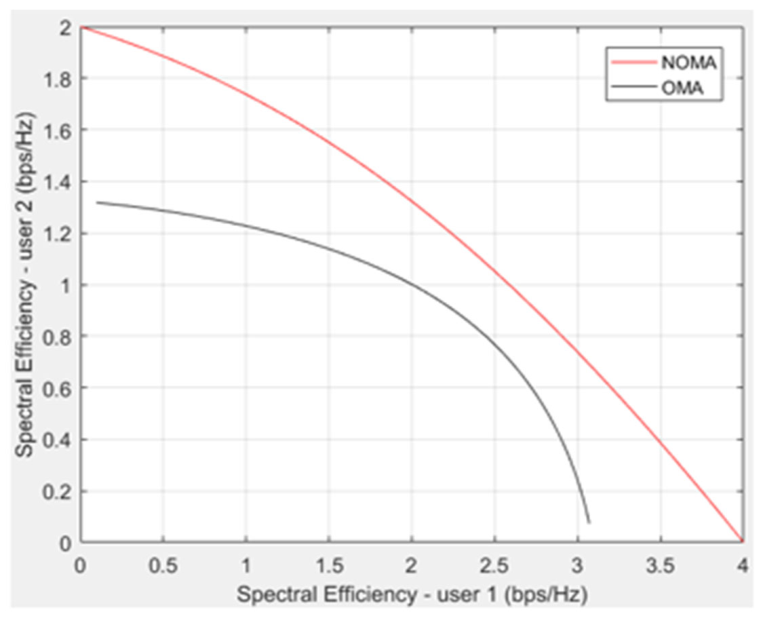
Considering a scenario with two users at equal distances from the BS, where the SNR for both of them = 15 dB and the bandwidth-splitting factor and power-splitting factor range from 0 to 1, NOMA achieves higher rate pairs than OMA, except where the rates are equal to the user capacities (corners points), as represented in
Figure 2, which shows the boundaries of the achievable rate regions of users 1 and 2 for NOMA and OMA in the case of downlink.
Table 3 summarizes the required parameters for simulation.
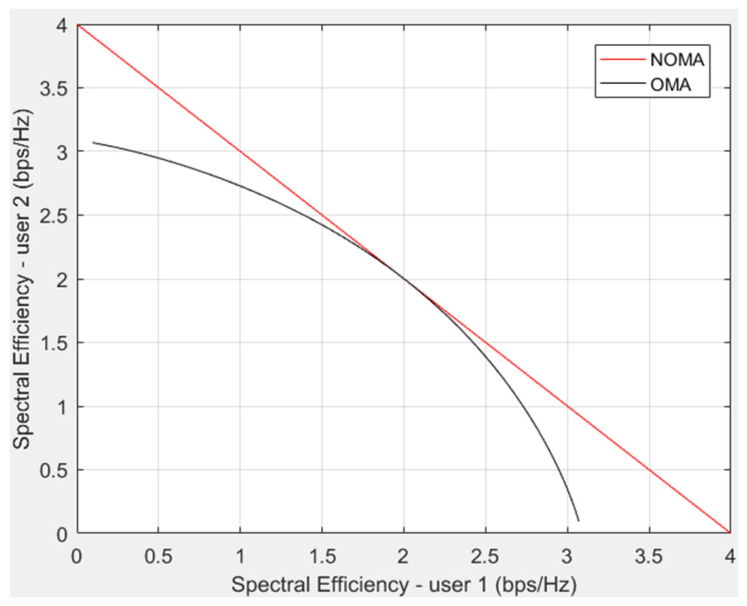
Considering the case where the two users are at different distances from the BS, with an SNR = 15 dB for user 1 and 3 dB for user 2,
Figure 3 shows that NOMA achieves better performance in terms of EE even when the SNR of user 2 is low.
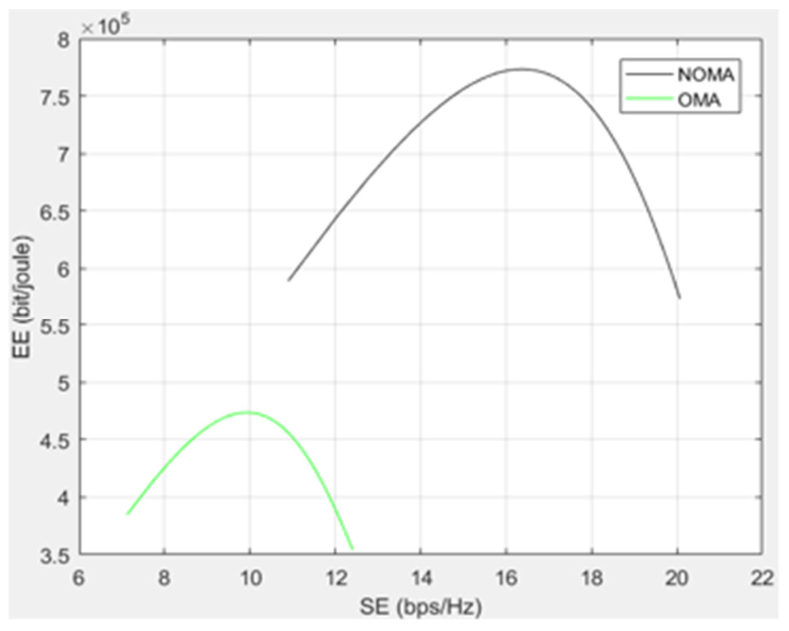
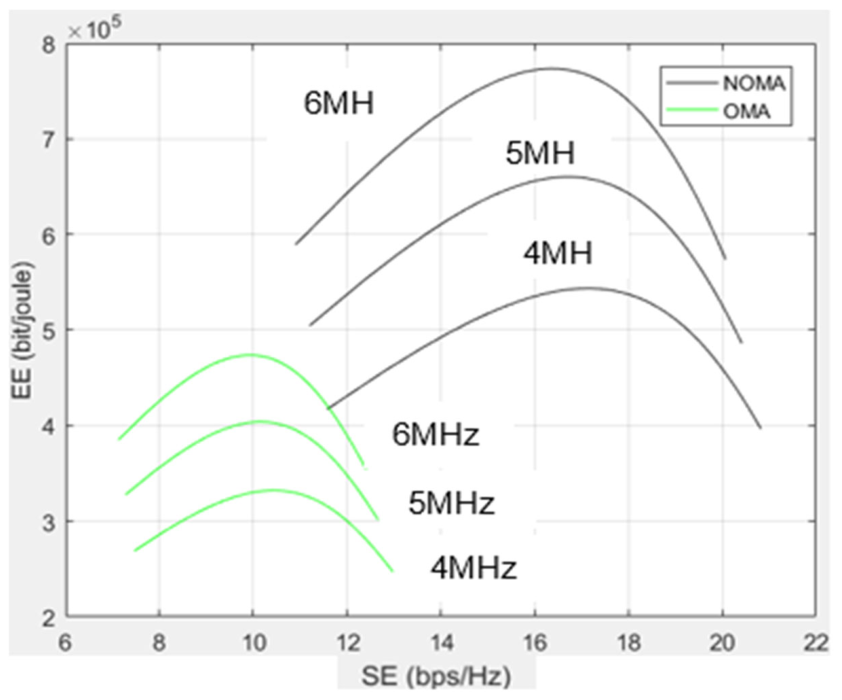
Consider a system with a bandwidth of 6 MHz, where the channel gains for user 1 and user 2 are −100 dB and −150 dB, respectively, the noise density per hertz is −150 dBW/Hz, and Pstatic at the BS is 110 W. NOMA then achieves higher EE and SE than OMA, as shown in
Figure 4.
Changing the system bandwidth to 5 MHz and then 4 MHz, while maintaining the same conditions,
Figure 5 shows that NOMA achieves better EE and SE with the change in bandwidth. When the bandwidth is 4 MHz, NOMA achieves higher EE and SE than OMA when the bandwidth is 6 MHz.
3.5. Discussion and Analysis
EE refers to the amount of energy required to transmit a certain amount of data, while SE refers to how efficiently data is transmitted over a given bandwidth. Therefore, the effects of varying bandwidth on EE and SE are analyzed by understanding how these parameters interplay in different communication systems.
- (1)
Bandwidth and Spectral Efficiency
An increase in bandwidth generally leads to higher SE. The more bandwidth that is available, the more data can be transmitted simultaneously, thus increasing the rate at which information is transmitted per unit of bandwidth. However, SE does not increase linearly with the bandwidth. A limit exists to how much information can be reliably transmitted within a given bandwidth due to factors such as noise, interference, and channel conditions.
- (2)
Bandwidth and Energy Efficiency
EE in communication systems is influenced by several factors, including hardware components, modulation techniques, and transmission protocols.
EE can potentially be increased by increasing bandwidth under certain conditions. For instance, if higher bandwidth allows for the use of more efficient modulation schemes or protocols, the energy required to transmit a given amount of data can be reduced. However, an increase in bandwidth often leads to higher power consumption, particularly in wireless systems, where more power is required to cover larger bandwidths or longer distances.
- (3)
Trade-offs and Optimization
A trade-off is often present between SE and EE. Techniques that improve SE, such as the use of higher-order modulation or more sophisticated coding schemes, may also lead to an increase in energy consumption.
Optimization is required to balance these conflicting objectives. For instance, adaptive modulation and coding techniques can be used to dynamically adjust modulation schemes and coding rates based on channel conditions, achieving a balance between spectral and EE. Different optimization strategies may be needed for different communication scenarios. In scenarios where energy consumption is a critical concern (e.g., battery-powered devices), EE may be prioritized over SE.
- (4)
Impact of Technology and Innovation
Technological advancements, such as the development of more energy-efficient hardware components, improved signal processing algorithms, and better spectrum management techniques, can have a significant impact on the relationship between bandwidth, EE, and SE. For example, the introduction of technologies like cognitive radio and dynamic spectrum sharing can lead to improvements in SE by enabling more efficient use of available bandwidth while minimizing interference and energy consumption.
- (5)
Application-Specific Considerations
The impact of varying bandwidth on EE and SE can vary depending on the specific application and requirements. For example, in broadband wireless access systems, an increase in bandwidth may lead to higher data rates and improved user experience, but energy consumption and interference may also increase.
Different aspects may be prioritized by different applications. For instance, in IoT applications, EE is often considered more critical than raw data rate, while in high-speed data transmission applications like video streaming, SE may be prioritized.
3.6. Role of NOMA in IoT Networks
The rapid expansion of the IoT has led to an unprecedented increase in the number of connected devices, requiring efficient multiple access techniques to support massive connectivity, low latency, and EE. Traditional OMA schemes (e.g., TDMA, FDMA) allocate orthogonal resources to users, limiting scalability. In contrast, NOMA enables multiple users to share the same time-frequency resources, thereby significantly improving SE and connectivity density.
In NOMA, multiple IoT devices share the same time-frequency resources by superimposing their signals in the power domain. The transmitted signal can be expressed in Equation (6):
where
and
are the allocated power and transmitted signal of the
-th IoT device, respectively, and
is the number of users.
At the receiver side, SIC is applied to decode the signals sequentially. The achievable data rate for the
-th user is given by Equation (7):
where
is bandwidth,
is channel gain, and
is noise power.
This formulation highlights the key advantage of NOMA in the case of simultaneous multi-user transmission, which is critical for IoT environments with massive connectivity requirements [
26].
IoT networks are characterized by massive machine-type communication (mMTC), where billions of devices attempt to access the network. Conventional OMA schemes allocate exclusive resources, leading to limited scalability, high access delay, and increased signalling overhead. NOMA addresses these issues by enabling grant-free uplink transmission that reduces latency, concurrent transmission of multiple devices, and efficient handling of bursty IoT traffic. Studies show that NOMA can support significantly higher device density compared to OMA, making it a key point for large-scale IoT deployments [
27].
SE is a fundamental performance metric in IoT systems. In OMA, SE is constrained due to orthogonal resource allocation. In contrast, NOMA achieves higher SE by overlapping users in the same resource block. The sum rate of a NOMA system is expressed in Equation (8):
This allows NOMA to outperform OMA, particularly in heterogeneous channel conditions where users experience different path losses [
26,
28].
EE is critical for battery-powered IoT devices. NOMA improves EE through adaptive power allocation strategies, reduced retransmissions due to improved decoding, and joint optimization of power and rate. The EE can be defined in Equation (9):
NOMA-based IoT systems demonstrate superior EE compared to OMA, particularly in low-power and wide-area IoT scenarios [
27].
Latency is a key requirement for applications such as industrial IoT and smart healthcare. NOMA reduces latency by allowing simultaneous transmissions, eliminating scheduling delays (grant-free access), and supporting short-packet communications. NOMA enables QoS differentiation by assigning higher power levels to delay-sensitive or weak-channel devices [
28].
IoT networks consist of devices with diverse channel conditions and service requirements. NOMA enhances fairness by allocating higher power to users with poor channel conditions, ensuring minimum rate guarantees, and supporting heterogeneous QoS constraints. This makes NOMA particularly suitable for edge IoT devices and cell-edge users, improving overall network fairness [
26].
Table 4 summarizes the characteristics of NOMA and OMA with respect to IoT.
Although NOMA outperforms OMA in most metrics, it introduces higher computational complexity due to SIC and requires accurate channel state information (CSI) [
29].
Despite its advantages, several challenges remain, such as SIC complexity and error propagation, optimal user clustering and power allocation, CSI acquisition in dynamic IoT environments, and security and privacy concerns.
Future research directions include AI-driven NOMA optimization, integration with blockchain for secure IoT, hybrid NOMA–OMA schemes, and NOMA in 6G-enabled IoT networks.
3.7. Leveraging AI and ML in Communication Technologies
AI has revolutionized the communication sector by enhancing efficiency, personalization, and engagement across various platforms. AI technologies, such as machine learning, enable organizations to automate routine interactions and analyze vast amounts of data for insights. It played a significant role in enhancing phishing detection [
30], signal detection [
31], and others.
Machine learning (ML) plays a crucial role in enhancing the performance and efficiency of multiple access schemes such as NOMA and OMA. In OMA systems, ML algorithms optimize resource allocation, user scheduling, and interference management by analyzing network data, leading to improved SE and user fairness. Conversely, in NOMA systems, ML techniques facilitate intelligent user pairing, power allocation, and interference mitigation by leveraging real-time channel state information and user behaviour predictions. The integration of ML across multiple access paradigms enables adaptive, self-optimizing networks that can dynamically respond to varying traffic loads and channel conditions. This synergy significantly boosts network capacity, reduces latency, and enhances overall QoS, supporting the evolving demands of 5G and beyond wireless communication systems.
Our work focuses on analyzing data from both NOMA and OMA systems to evaluate their efficiency and performance. By applying machine learning techniques, we aim to identify patterns and relationships within the data that can help predict how well these systems perform under various conditions. This approach enables a data-driven assessment of their capabilities, providing insights into their strengths and limitations. Ultimately, our goal is to develop predictive models that can assist in optimizing the deployment and operation of NOMA and OMA in future wireless networks, ensuring improved efficiency, reliability, and QoS.
4. Materials and Methods
4.1. Preprocessing
Real-world measurements and experimental testbeds do exist for evaluating the EE and SE of NOMA compared to OMA. For example, Software-Defined Radio (SDR) Testbeds, which are multiple academic and industry institutions, have successfully implemented real-time downlink NOMA-OFDM testbeds using National Instruments USRP hardware (manufactured by Matt Ettus, CA, USA) and LabVIEW/GNURadio software (LabVIEW 2026 Q1/GNU Radio v3.10.9.2). Because it is not easy to obtain such a dataset, we aim in this work to imitate a real-world scenario by considering most of the affecting factors and all possible arrangements of factors to generate NOMA and OMA datasets of around 150,000 records each, including all possible combinations of mobility, fading, interference, distance, BW, power received, power transmitted, etc., which are all represented in equations within this work.
To prepare the dataset for analysis, the EE, SE, and Noise attributes were discretized into nominal categories. Numerical values were mapped to two classes based on specific thresholds, ensuring a balanced dataset. The thresholds applied were 2.81618 × 10⁻¹² for SE, 2.33407 × 10⁻¹⁴ for EE, and 5.9948425031894 × 10⁻¹³ for Noise. Class A represents values less than or equal to the threshold, while Class B represents values greater than the threshold.
The thresholds used to define EE and SE classes are important because they determine class separability, dataset balance, and ML performance. In the proposed framework, the thresholds were selected based on the statistical distribution of the generated data and the operational characteristics of OMA and NOMA systems to distinguish between efficient and inefficient network conditions, and to avoid trivial class separation or severe class imbalance.
Additionally, distance values were scaled down to reduce computational complexity and facilitate fair comparisons. Each distance was divided by 1,000,000 to achieve this scaling.
The dataset was also examined for duplicate entries; however, no duplicates were found, indicating the data is free from this form of noise. For model evaluation, a 10-fold cross-validation approach was employed for both training and testing phases.
4.2. Machine Learning Tools
- (1)
Logistic Regression (LR)
LR is a statistical method used for modelling the relationship between a categorical dependent variable and one or more independent variables. It is a supervised machine learning method [
32]. It estimates the probability of a particular outcome by applying a logistic function to the predictor variables. Typically, LR analyzes how a categorical outcome is influenced by continuous or categorical independent variables, converting the dependent variable into probability scores to facilitate interpretation and prediction. There are many types of LR, such as ordinal, binary, binomial, and multinomial [
33].
Let us have input features, as shown in the matrix in Equation (10):
and the binary predicted feature is
C in Equation (11):
We apply the multilinear function to the input features
F. The linear combination z is given by Equation (12):
where fi is the
observation of F,
is the weight vector, and b is the bias or intercept term. This can be compactly expressed as the dot product of the weight vector and the feature vector, plus the bias, as shown in Equation (13):
LR then applies the sigmoid function
to transform z into a probability between 0 and 1, which can be used to predict classification attribute
C, as shown in Equation (14).
- (2)
K-Nearest Neighbours (KNN)
The K-nearest neighbours (KNN) algorithm, a fundamental technique in supervised learning, is based on similarity measures derived from real-valued distance metrics [
34]. It classifies data points by examining the labels of their nearest neighbours, making it a straightforward and effective method for various pattern recognition tasks. As a nonparametric approach, KNN does not require a prior training phase, making it well-suited to small datasets. Recent research has focused on improving its scalability and performance in high-dimensional spaces and streaming data environments. Additionally, various optimization strategies are being developed to enhance the efficiency of KNN for real-time applications.
Given a training dataset TD and a new data point p, the process involves estimating the similarity between p and each data point in TD. The first step is to select the K members of TD that are most similar to
p. Subsequently,
p is assigned the same class as the most frequently occurring class among these K selected data points. We estimate the similarity of data points using the Euclidean distance between them. For n dimensions, the Euclidean distance between points A and B with coordinates (
a1,
a2,…,
an) and (
b1,
b2, …,
bn) is given in Equation (15):
- (3)
Deep Learning (DL)
It comprises multiple layers of interconnected nodes (neurons) and is a subset of artificial neural networks (ANNs) [
35]. DL, a dynamic branch of machine learning inspired by the structure and function of the human brain, has become a transformative force, demonstrating exceptional capabilities across a wide range of fields [
36]. It employs neural networks with multiple layers that automatically extract hierarchical features from data, leading to significant advances in image recognition, speech processing, and natural language understanding. Its capacity to model complex patterns has enabled it to achieve state-of-the-art results in areas such as healthcare and autonomous systems. Recent research efforts are focusing on developing lightweight models optimized for edge devices and real-time applications. Additionally, integrating DL with other AI techniques continues to expand its versatility and robustness.
Overall, DL refers to machine learning techniques based on deep neural network architectures with multiple layers. These methods generally outperform shallow machine learning approaches, especially when dealing with large-scale, high-dimensional data [
37,
38].
- (4)
Decision Tree (DT)
DTs are renowned for their inherent interpretability, making them valuable across various domains where understanding the decision-making process is essential [
39]. Unlike many other machine learning algorithms that function as black-box models, DTs provide transparency by representing decisions as a sequence of simple, intuitive rules. Each node in a DT corresponds to a specific feature and a decision threshold, and the path from the root to a leaf node illustrates a series of decisions based on feature values. This straightforward structure enables stakeholders to easily understand how the model reaches its predictions.
As intuitive, tree-structured classifiers, DTs split data according to feature thresholds, offering both clear interpretability and rapid decision-making. They are extensively used in fields requiring explainability, such as finance and healthcare. Recent advancements include ensemble methods like Random Forests and Gradient Boosting, which enhance accuracy and mitigate overfitting. Additionally, hybrid models that integrate DTs with DL techniques are emerging, aiming to combine the interpretability of DTs with the strengths of DL approaches.
Information gain was used by many researchers to represent the amount of information acquired during a certain decision and to decide about the best split in DTs [
40,
41].
In this work, information gain is used to determine which attributes will be selected for splitting. The entropies of all the attributes are calculated, and the one with the least entropy is selected for the split.
Entropy (
E) is a metric used to quantify the impurity within a given attribute, reflecting the level of randomness present in the data. In the context of DTs, the primary objective is to reduce the entropy of the dataset of N classes by partitioning it into more homogeneous, or pure, subsets. As entropy measures impurity, decreasing its value corresponds to increasing the purity of the data, thereby enhancing the effectiveness of the DT’s classification. Pi is the probability of class i, as shown in Equation (16)
Information gain (IG) for a training dataset TD with respect to an attribute a is defined as the difference between the entropy of the entire dataset and the conditional entropy of the dataset given the attribute. Mathematically, it is expressed as shown in Equation (17)
where
H(
TD) denotes the entropy of the entire training dataset, while
H(
TD|
a) refers to the conditional entropy of the dataset given the attribute a, which is one of the features within the training data.
4.3. Proposed Model
The current study addresses a binary classification problem to determine whether a given input example corresponds to high-quality SE or EE.
The problem was formulated as a binary classification task rather than a regression problem to simplify the prediction process and enable clearer performance evaluation of EE and SE levels under varying 5G network conditions. And so, the ML models can more effectively identify network states that satisfy predefined performance thresholds, which is highly relevant for practical wireless communication applications. In addition, binary classification reduces computational complexity and sensitivity to small fluctuations in continuous EE and SE values, which is suitable for comparing OMA and NOMA systems, where the objective is to determine whether the network performance meets desired efficiency criteria rather than predicting exact numerical values.
The primary goal is to develop an intelligent framework capable of analyzing the properties of NOMA and OMA techniques to identify the most optimal approach.
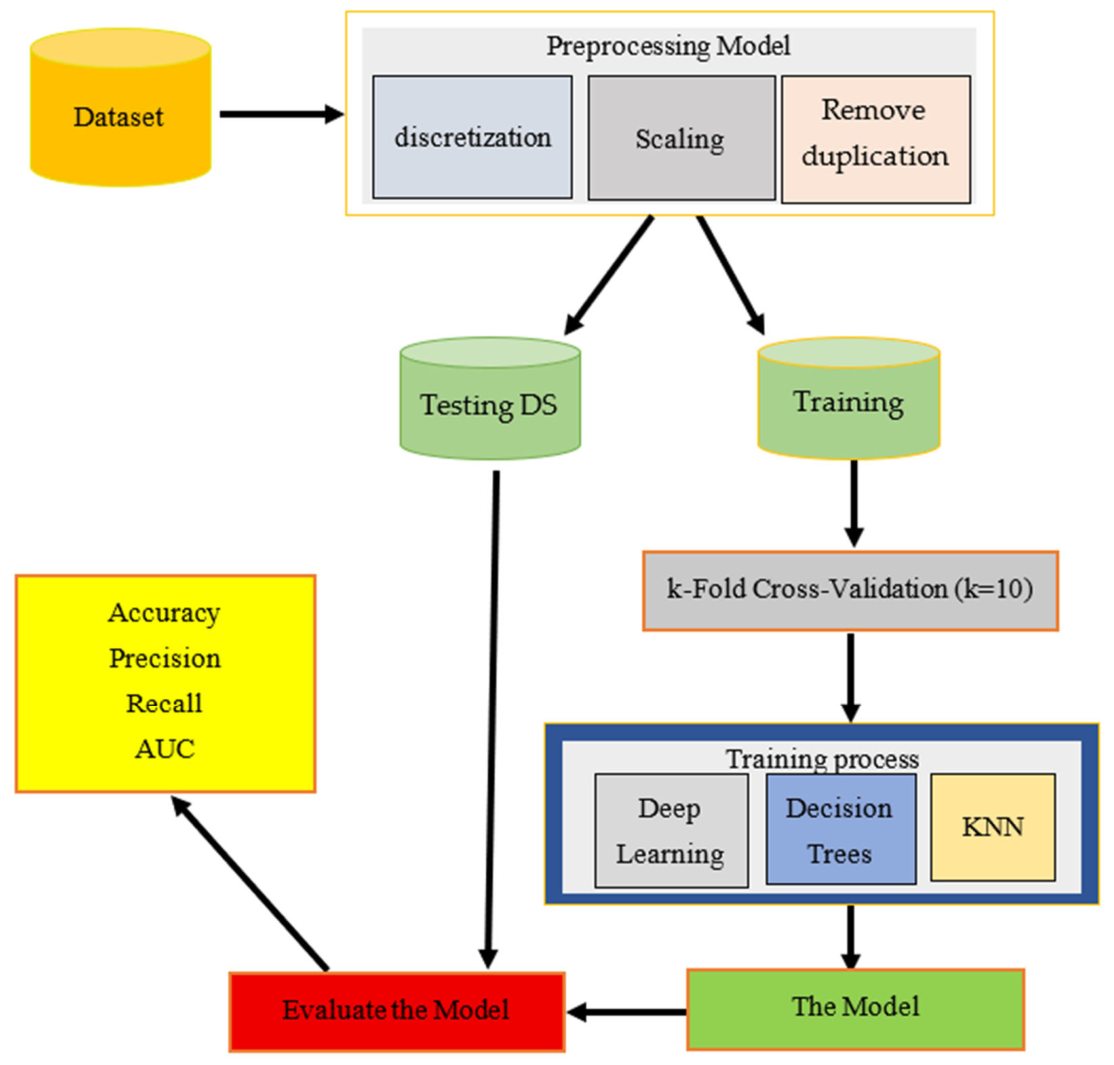
Following data preparation, the model was trained on the processed dataset and evaluated using several performance metrics, including accuracy, Area Under the Curve (AUC), precision, and recall. The methodology is summarized in
Figure 6 and Algorithm 1.
The hyperparameters of the ML models were optimized through iterative experimentation and cross-validation to achieve the best balance between accuracy, generalization, and computational complexity. For KNN, multiple values of
were tested, and the optimal value was selected based on minimum classification error and stable validation performance. In the DT model, parameters such as maximum tree depth (10), minimum leaf samples, etc., were adjusted to reduce overfitting while preserving classification capability. For the DL model, the number of hidden layers (3 layers), neurons (32), Batch Size (32), optimizer (Adam), and number of epochs (100) were systematically tuned using validation datasets. For the KNN model, K was selected to be 5. The final hyperparameter settings were selected based on the highest validation accuracy and consistent performance across testing metrics such as AUC, precision, recall, and F-measure.
| Algorithm 1: AI-modelling of OMA/NOMA simulated dataset |
Input: The simulated datasets: NOMA. OMA, the merger of both
Output: Trained models Modeli, and the evaluation measures E
Notations: D: the dataset, X: the discretized vector, Z: The dataset after duplicate removal
W: the scaled vector, D’: the final dataset after cleaning, P: predicted value
Let D = (xi, yi), i = 1 to N, be the raw dataset, where xi ∈ m are feature vectors, and yi ∈ {0,1} are labels.
Xi = Discretize(xi), ∀i = 1,…,N
Zi = {(Xi, yi)|(Xi, yi) unique in the entire dataset after discretization}
Wi = Scale(c), for i = 1 to N where c is scaling parameter
D’ = {(Wi, yi)}, for i = 1 to N
for each classifier Cj where j ∈ {DT, DL, LR}
for each dataset D’k ⊂ D’
Modelj=Train(D’k, Cj)
for each model Modeli
Pi = Cj(Wi), ∀i in validation/test set
Calculate Accuracy(Pi), AUC(Pi), Precision(Pi), Recall(Pi) |
5. Results and Discussion
The following sections present results obtained after applying several AI tools on NOMA and OMA with respect to SE and EE using the parameters in
Section 4.3.
5.1. OMA and NOMA Results with Respect to SE
The following subsection presents results obtained after applying several AI tools on OMA and NOMA with respect to SE.
Table 5 represents the accuracy, AUC, precision, recall, and F-measure of SE for OMA data.
Table 6 presents the accuracy, AUC, precision, recall, and F-measure of SE for NOMA data.
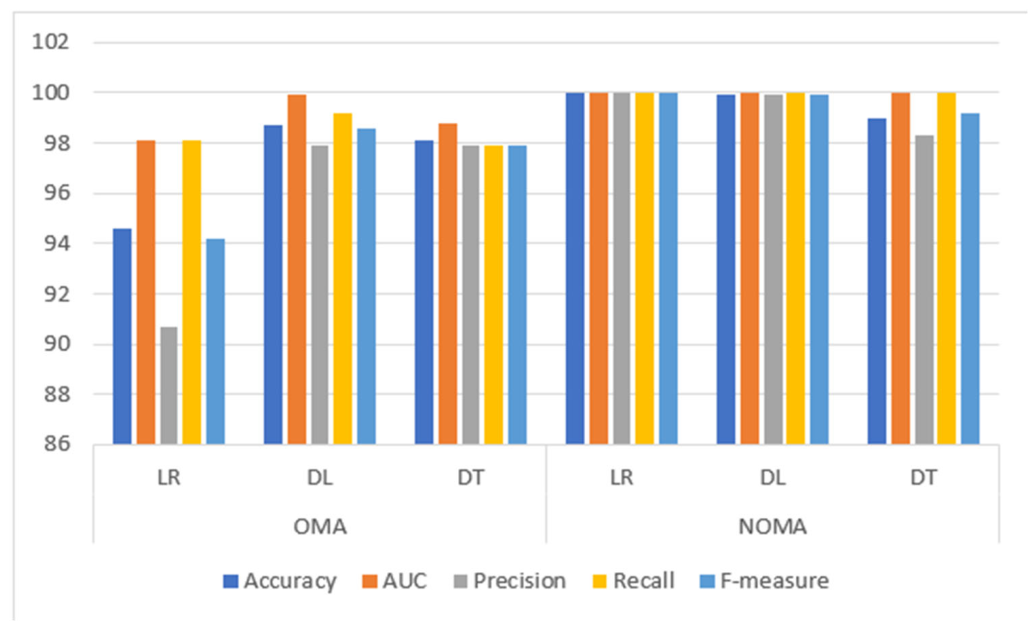
Figure 7 shows the visual representation of accuracy, AUC, precision, recall, and F-measure of SE for NOMA and OMA data.
The performance of the classification models for predicting SE was evaluated using several standard metrics, including accuracy, area under the receiver operating characteristic curve (AUC), precision, recall, and F-measure. Three learning models—LR, DL, and DT—were applied to both OMA and NOMA datasets to assess their ability to classify SE levels under varying network parameters.
Overall, the results indicate that the models achieved consistently better performance metrics when trained on the NOMA dataset compared with the OMA dataset. In terms of accuracy, the NOMA data produced higher classification accuracy across all three models. This suggests that the relationship between the input parameters (distance to the BS, bandwidth, residual power, and noise density) and SE values is more predictable in NOMA systems. Since OMA allocates orthogonal resources to users, the resulting SE values exhibit less variability, allowing LR, DL, and DT models to learn less clearing decision boundaries.
The AUC values also show better performance for NOMA, which indicates that the models have stronger discriminative ability to distinguish between different SE classes. In the case of NOMA, the absence of intra-cell interference leads to a more stable mapping between system parameters and SE outcomes, which improves the separability of the classes in the feature space. Conversely, in OMA systems, orthogonal resource allocation eliminates intra-cell interference and avoids the need for power-domain multiplexing and SIC, resulting in more stable and linearly separable data distributions.
A similar trend is observed in the precision metric. The precision values for NOMA are generally higher across LR, DL, and DT models, indicating that when the classifier predicts a certain SE class, the prediction is more likely to be correct.
The recall results also produce NOMA-based datasets. Higher recall indicates that the models successfully identify a larger proportion of the true SE instances. In NOMA systems, the SE values follow relatively smooth and monotonic behaviour with respect to SNR and channel conditions, enabling the models to detect the correct class labels more reliably. In contrast, the SE distribution in NOMA is influenced by interference cancellation performance and user power allocation factors, which increases variability and makes it easier for the model to correctly capture all relevant instances.
The F-measure, which balances precision and recall, further confirms the overall advantage of NOMA in the classification task. The higher F-measure values obtained for NOMA indicate a more balanced and reliable classification performance across all models. Although DL models generally achieve slightly better performance than LR and DT due to their ability to capture complex nonlinear relationships, the relative improvement remains more pronounced for NOMA datasets.
One of the primary reasons for these results is the structural complexity of OMA systems. While NOMA theoretically improves SE by allowing multiple users to share the same resource block, it also introduces additional dependencies related to power allocation, user channel disparity, and SIC. This leads to clearer statistical patterns in the dataset, enabling ML models, particularly LR, DL, and DT, to learn the underlying relationships more effectively. As a result, higher accuracy, AUC, precision, recall, and F-measure values are observed for the NOMA dataset compared with the OMA dataset.
The high accuracy achieved by LR is due to the structured and deterministic nature of the simulated EE and SE datasets for OMA and NOMA systems. Since the data were generated using well-defined mathematical relationships among parameters such as bandwidth, SNR, channel gain, distance, residual power, etc., the resulting classes exhibit strong separability, particularly after discretization. This effect is more pronounced in OMA systems due to the absence of intra-cell interference, which produces more stable and predictable SE patterns. Additionally, the use of independent training/testing datasets, cross-validation, confusion matrices, AUC, precision, recall, and F-measure confirms that the model generalizes effectively rather than memorizing the data. Therefore, the near-perfect accuracy reflects the controlled simulation environment, clear feature–target relationships, and the suitability of LR for linearly separable datasets rather than overfitting.
5.2. OMA and NOMA Results with Respect to EE
The following subsection presents results obtained after applying several AI tools on OMA and NOMA with respect to EE.
Table 7 represents the accuracy, AUC, precision, recall, and F-measure of EE for OMA data.
Table 8 presents the accuracy, AUC, precision, recall, and F-measure of EE for NOMA data.
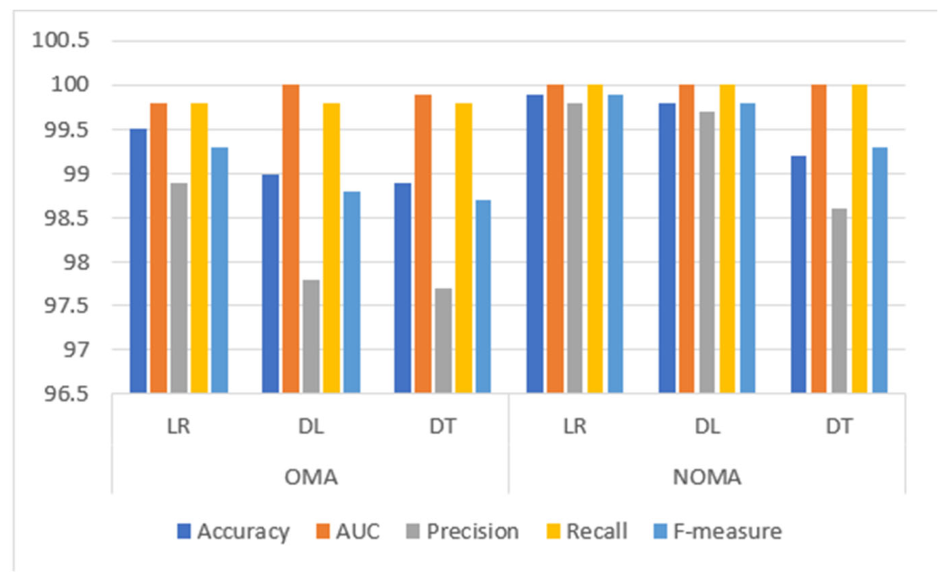
Figure 8 shows the visual representation of accuracy, AUC, precision, recall, and F-measure of EE for NOMA and OMA data.
The classification performance of the ML models for predicting EE was evaluated using several standard metrics, including accuracy, AUC, precision, recall, and F-measure. Three machine learning techniques, LR, DL, and DT, were applied to both OMA and NOMA datasets to analyze their ability to classify EE levels under varying network conditions.
The results show that the models trained on the NOMA dataset consistently achieved higher performance across all evaluation metrics compared with those trained on the OMA dataset. In terms of accuracy, the models produced better classification accuracy for the NOMA dataset across all three algorithms. This indicates that the ML models were able to learn the relationship between system parameters and EE more effectively in the NOMA scenario. In the NOMA system, the resource allocation is non-orthogonal, and interference among users is minimized, leading to more stable and predictable EE values. Consequently, the input features, such as distance to the BS, bandwidth, residual node power, and noise density, exhibit clearer relationships with EE outcomes, enabling the classifiers to distinguish between EE classes more accurately.
The AUC values also demonstrate better performance for NOMA-based EE classification. Higher AUC values indicate a stronger ability of the model to distinguish between high and low EE classes. The relatively simpler transmission structure in NOMA results in a more separable feature space, allowing LR, DL, and DT models to generate more reliable decision boundaries. In contrast, OMA systems introduce additional variability in EE values due to power-domain multiplexing and SIC mechanisms. These factors lead to more complex nonlinear interactions between the input features and EE outcomes, which reduces class separability and slightly lowers the AUC performance.
The precision metric also treats the NOMA dataset across all models. Higher precision values imply that when the classifier predicts a certain EE class, the prediction is more likely to be correct. The structured nature of NOMA resource allocation produces more consistent EE patterns, reducing the likelihood of false positive predictions.
Similarly, recall values are better for the NOMA dataset, indicating that the classifiers successfully identify a greater proportion of the actual EE instances. In NOMA systems, the energy consumption and achievable throughput follow relatively smooth trends with respect to network parameters, allowing the models to capture the underlying patterns more effectively, which introduces stability in the EE values, making it easier for the ML models to correctly identify all relevant EE instances.
The F-measure, which combines precision and recall, further confirms the overall advantage of NOMA in the classification task. Higher F-measure values for NOMA indicate that the classifiers achieve a better balance between correctly identifying EE classes and minimizing false predictions. Although the DL model generally achieves slightly better overall performance than LR and DT due to its capability to capture nonlinear relationships, the relative improvement remains more noticeable for the NOMA dataset.
The current framework assumes ideal conditions and does not consider practical factors such as imperfect SIC, channel estimation errors, and user mobility, which could reduce the EE and SE performance of both OMA and NOMA systems. Imperfect SIC introduces residual interference in NOMA, while channel estimation errors affect accurate power allocation and decoding, leading to more complex and overlapping EE and SE patterns. User mobility increases channel variability and network dynamics, making prediction more challenging for AI models. As a result, classification metrics such as accuracy, precision, recall, and AUC would likely decrease, particularly for NOMA systems due to their higher sensitivity to interference and CSI inaccuracies.
NOMA achieves better classification metrics than OMA in EE prediction because of the structural simplicity and stability of NOMA energy consumption patterns. In OMA systems, each user occupies orthogonal resources, and the energy consumption model is relatively straightforward, depending mainly on transmission power, channel conditions, and bandwidth, which creates more irregular EE distributions and increases the overlap between EE classes in the dataset. As a result, ML models face greater difficulty in distinguishing between EE levels in OMA scenarios, which leads to slightly lower accuracy, AUC, precision, recall, and F-measure values compared with NOMA.
5.3. SE Confusion Matrices for OMA and NOMA
The following subsection presents the confusion matrix results obtained after applying several AI tools on OMA and NOMA with respect to SE.
Table 9 presents the LR confusion matrix of SE for OMA, while
Table 10 presents the LR confusion matrix of SE for NOMA.
The confusion matrix obtained from the LR model indicates that the NOMA dataset achieves a zero number of incorrect classifications compared with the OMA dataset, as reflected by the values along the off-diagonal. This demonstrates that the LR model predicts SE levels more accurately for NOMA systems. In contrast, the confusion matrix for OMA shows a greater number of misclassified instances, represented by higher off-diagonal values. The higher performance of NOMA can be attributed to its non-orthogonal resource allocation mechanism, which eliminates intra-cell interference and produces more stable and predictable SE patterns. Consequently, the relationship between the input features and SE values becomes more linearly separable, allowing the LR model to establish clearer decision boundaries. Conversely, OMA introduces additional nonlinear dependencies due to power-domain multiplexing and SIC, resulting in overlapping SE distributions that increase the likelihood of misclassification. As a result, the LR classifier achieves better overall performance for NOMA compared with OMA in SE prediction.
Table 11 presents the DL confusion matrix of SE in the case of OMA, while
Table 12 presents the DL confusion matrix of SE in the case of NOMA.
The confusion matrices obtained from the DL model for SE classification indicate that the NOMA dataset achieves a lower number of incorrectly classified instances compared with the OMA dataset. This is reflected by the stronger concentration of values along the off-diagonal of the OMA confusion matrix, which represents incorrect predictions. In contrast, the OMA confusion matrix contains a larger number of off-diagonal elements, indicating a higher rate of misclassification between SE classes. The better performance of NOMA can be justified by its non-orthogonal resource allocation mechanism, where users transmit over separate time or frequency resources without intra-cell interference. This results in more stable and predictable SE patterns that the DL model can effectively capture. On the other hand, OMA introduces additional complexity due to power-domain multiplexing and SIC, which creates nonlinear relationships and overlapping feature distributions in the dataset. These factors make it more difficult for the DL model to accurately distinguish between SE classes, leading to slightly lower classification performance than NOMA.
Table 13 presents the DT confusion matrix of SE in the case of OMA, while
Table 14 presents the DL confusion matrix of SE in the case of NOMA.
The confusion matrices obtained using the DT model show that the NOMA dataset achieves a lower number of incorrect classifications than the OMA dataset, as indicated by the values along the off-diagonal. In contrast, the OMA confusion matrix exhibits more off-diagonal elements, representing a higher rate of misclassification between SE classes. This improved performance for NOMA can be recognized as its non-orthogonal resource allocation, which eliminates intra-cell interference and results in more stable and predictable SE patterns. Consequently, the DT model can generate clearer decision rules for NOMA data. In comparison, the additional complexity introduced by power-domain multiplexing and SIC in OMA leads to more overlapping SE distributions, making accurate classification more challenging for the DT model.
5.4. EE Confusion Matrices for OMA and NOMA
The following subsection presents the confusion matrix results obtained after applying several AI tools on OMA and NOMA with respect to EE.
Table 15 presents the LR confusion matrix of EE in the case of OMA, while
Table 16 presents the LR confusion matrix of EE in the case of NOMA.
Table 17 presents the DL confusion matrix of EE in the case of OMA, while
Table 18 presents the DL confusion matrix of EE in the case of NOMA.
Table 19 presents the DT confusion matrix of EE in the case of OMA, while
Table 20 presents the DT confusion matrix of EE in the case of NOMA.
The confusion matrices obtained using LR, DL, and DT models for EE classification show that the NOMA dataset consistently produces better correct classification rates than the OMA dataset. In the NOMA confusion matrices, a few samples are concentrated along the off-diagonal, indicating a few inaccurate predictions of EE classes. In contrast, the OMA confusion matrices contain more off-diagonal elements, reflecting higher misclassification among EE classes. This pattern is observed across all three models, although the DL model generally achieves the best classification performance due to its stronger capability to capture nonlinear relationships.
The lower performance of OMA can be explained by its orthogonal resource allocation, where users transmit on separate time or frequency resources, which results in less stable and distinguishable EE patterns, which are difficult for machine learning models to learn and classify. Conversely, NOMA relies on power-domain multiplexing and SIC, where multiple users share the same resource block. This introduces fewer interference interactions and reduces the complexity of the EE distribution, leading to less overlap between classes and a higher probability of classification. Consequently, LR, DL, and DT models achieve better EE classification performance for NOMA compared with OMA.
5.5. Worst-Case Scenario
When applying the worst-case scenario (distance of 100 m away from the BS), the following comparisons were made between DL and KNN of the measurements of accuracy, kappa, precision, and recall. In this experiment, we consider the feature values of each NOMA/OMA class to represent how well the system predicts NOMA/OMA cases and which NOMA/OMA prediction is preferred, as shown in
Table 21.
Table 22 presents the DL confusion matrix of NOMA/OMA, while
Table 23 presents the KNN confusion matrix of NOMA/OMA.
The results show that the models trained on the NOMA/OMA dataset to predict the preferred scheme (NOMA/OMA), which is strongly correlated with the input variables, consistently achieve higher performance across all evaluation metrics, with an advantage for DL. Going deeper, we can notice from the confusion matrices obtained using DL and KNN models that the NOMA prediction consistently produces better results than the OMA prediction. In the DL-NOMA prediction, none of the samples indicate inaccurate predictions. In contrast, the DL-OMA prediction contains nine elements, reflecting misclassification. This pattern is observed for the other KNN model, where 16 of the samples indicate inaccurate predictions for OMA and 9 samples indicate inaccurate predictions for NOMA. Results indicate that the DL model achieved the best classification performance due to its high capability to capture nonlinear relationships.
6. Computational Complexity
The computational complexity of the proposed EE–SE prediction framework depends on both the dataset size and the employed ML model. The dataset generated 300,000 records obtained from exhaustive combinations of distance, bandwidth, residual power, and noise density parameters, etc., resulting in linear dataset generation complexity . Among the evaluated models, LR exhibits the lowest computational complexity with , while DT achieves moderate complexity of . KNN introduces high inference complexity due to distance calculations with all training samples. In contrast, the DT model exhibits the highest computational cost because of multilayer forward and backward propagation operations, approximately . Although DL requires significantly greater computational resources, it provides improved capability for modelling the nonlinear EE–SE characteristics of NOMA systems. Where
is the total number of generated samples;
is the number of input features;
is the number of neural network layers;
is optimization iterations;
is the average number of neurons.
The computational complexity of the proposed AI models is generally suitable for real-time and embedded 5G/IoT systems, depending on the selected model and deployment requirements. Lightweight models such as LR and DT are highly appropriate for real-time applications due to their low inference complexity, limited memory usage, and fast execution, making them suitable for edge devices and IoT nodes. In contrast, KNN is less efficient for large-scale real-time deployment because its prediction complexity increases with dataset size. DL provides superior capability for modelling the nonlinear EE and SE characteristics of NOMA systems, but requires higher computational resources and memory. Nevertheless, DL can still be implemented in practical 5G environments using edge computing, hardware accelerators, and optimization techniques such as pruning and quantization. Overall, the proposed framework demonstrates practical feasibility for real-time 5G/IoT applications, particularly when lightweight AI models are used or DL architectures are optimized for embedded deployment.
The computational complexity of the proposed algorithm using the generated EE–SE dataset depends on both the dataset generation stage and the ML processing stage. Let
= number of output classes;
= number of training epochs (100 for DL);
= number of neurons in layer .
For the proposed EE–SE framework, the dataset is generated by sweeping all simulation parameters: Distance: 100 values, Bandwidth: 3 values, Residual power: 10 values, Noise density: 50 values.
The total dataset size for SE or EE is: , then .
The training complexity of LR is , assuming , , then , .
The DT training complexity is approximately . Substituting values:
, leads to .
KNN has negligible training complexity because it stores the dataset directly -> , prediction complexity is high = = , leads to .
For a DL network with training complexity of
, assuming
,
,
, leads to
=
Table 24 summarizes the complexity of previous models.