
CID: A Compact Deep Learning Framework for Intrusion Detection Based on Binary Greylag Goose Optimization


Abstract
1. Introduction
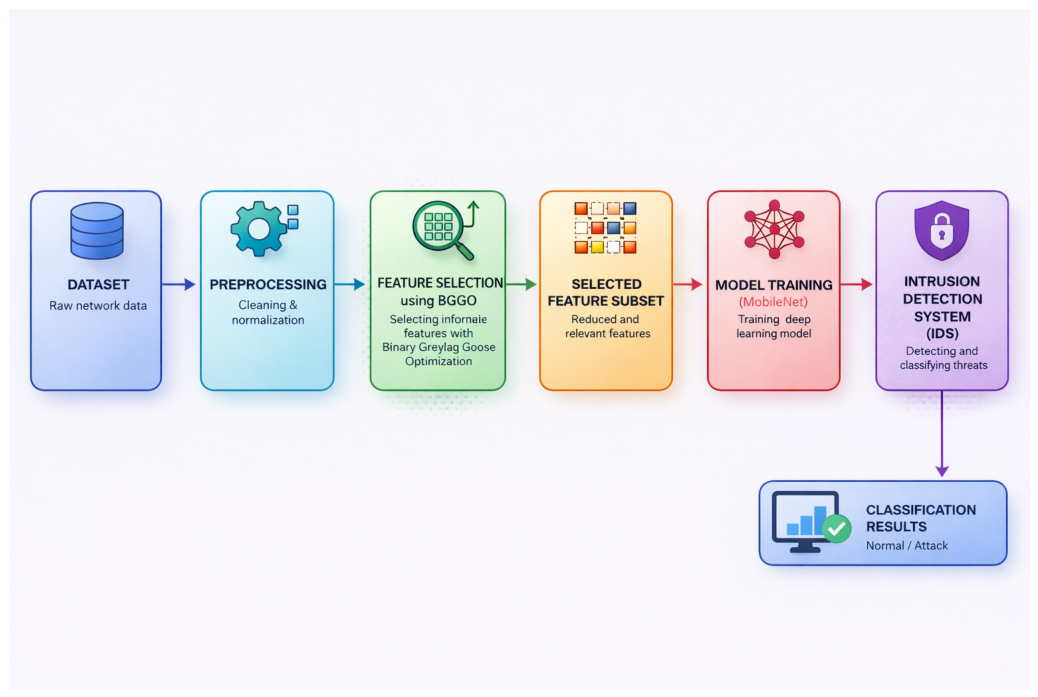
- A computationally efficient light deep learning-based intrusion detection framework, CID has been proposed that achieves high detection performance while significantly reducing model complexity. By combining CNN-based feature evaluation with MobileNet v1-based classification, the proposed system reduces inference cost without sacrificing accuracy.
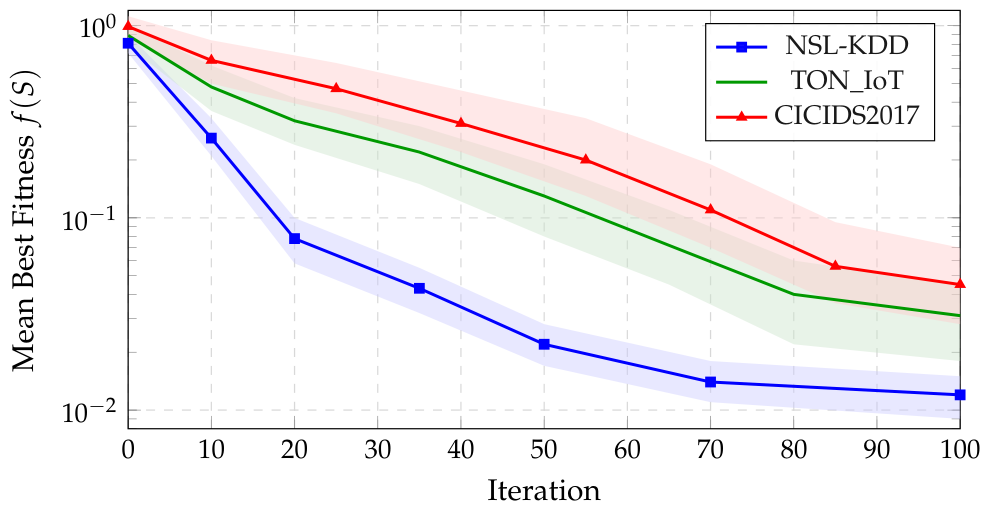
- A lightweight Binary Greylag Goose Optimization has been used that effectively reduces feature dimensionality while preserving discriminative information. Compared to conventional feature selection methods, BGGO identifies a compact subset of features that improves classification performance and reduces training time.
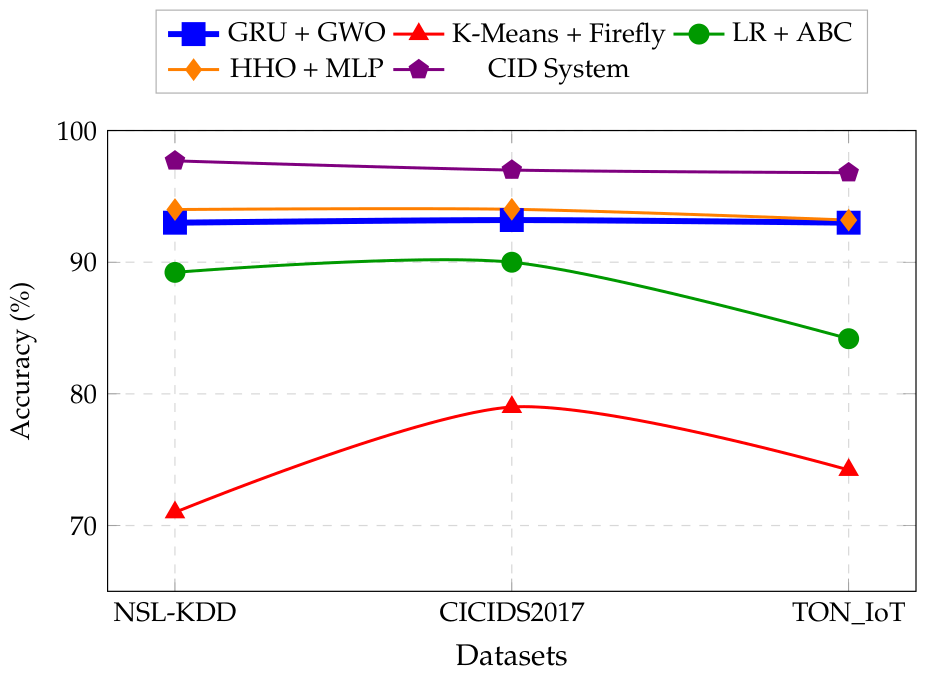
- The proposed CID framework shows high capability to generalize across multiple benchmark datasets, namely, NSL-KDD, CICIDS2017, and TON_IoT, indicating robustness to varying traffic distributions and attack types.
- Experimental results show that the proposed approach achieves high detection accuracy and low false alarm rates while significantly lowering computational overhead.
2. Related Work
2.1. Intrusion Detection Techniques
2.2. Intrusion Detection Using Metaheuristic Optimization Techniques
3. Background Techniques
3.1. Binary Greylag Goose Optimization
3.2. MobileNet v1
3.2.1. Depthwise Convolution
3.2.2. Pointwise Convolution
4. Proposed Technique
4.1. Problem Definition
4.2. Classification Framework
4.2.1. Label Encoding
4.2.2. Output Activation and Loss Function
- N = Number of samples in the dataset or batch.
- = True label for sample i, where .
- = Predicted probability for sample i from the model.
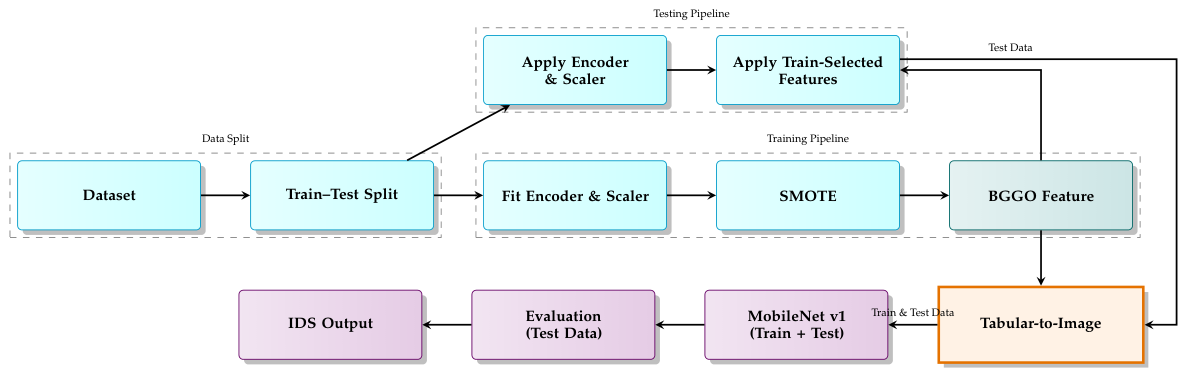
4.3. Tabular Data into Image Data Conversion in MobileNet v1
- Padding to Form a Square Image:The selected tabular features, which form a 1D vector [f1, f2, …, fn], need to be arranged into a square or rectangular grid. Since MobileNet v1 operates on grids, the most common approach is to find the smallest square that can accommodate all n features. This means determining an image_height and image_width such that . If n is not a perfect square, zero-padding is applied. New dummy features with a value of 0 are added to the 1D feature vector until its length becomes a perfect square. This ensures the features can be reshaped into a symmetric square grid.
- Reshaping into a Grayscale Image:Once the feature vector has been padded to a square length n’, it is reshaped into a 2D matrix of dimensions sqrt(n’) × sqrt(n’). This 2D matrix represents a single-channel image. The values in this single-channel image are the scaled feature values from the original tabular data. Darker or lighter pixels correspond to smaller or larger feature values after normalization. The image shape at this stage is typically .
- Resizing to MobileNet v1’s Expected Input Dimensions:The grayscale image created in the previous step is then resized. MobileNet v1 model converts the input image sizes to 128 × 128. This resizing is performed using bilinear interpolation while attempting to preserve the spatial relationships of the features within the image. The image shape remains (num_samples, MobileNet_H, MobileNet_W, 1).
- Channel Duplication to Form Three Channels:MobileNet v1 typically expects three input channels. Since the image is currently one channel, this single channel is duplicated three times. This effectively transforms the image from (num_samples, H, W, 1) to (num_samples, H, W, 3).
4.4. Methodology
| Algorithm 1 Feature selection using Binary Greylag Goose Optimization (BGGO) |
|
5. Performance Analysis and Comparison
5.1. Assumptions
5.2. Dataset
5.3. Evaluation Metrics
- Precision: Precision can be calculated using Equation (11):where counts the true positives and counts the false positives.
- Recall: Recall can be calculated using Equation (12):where indicates the number of false negatives.
- Accuracy: Accuracy can be calculated using Equation (13):where refers to the number of true negatives.
- F1 Score: F1 score is calculated using Equation (14):
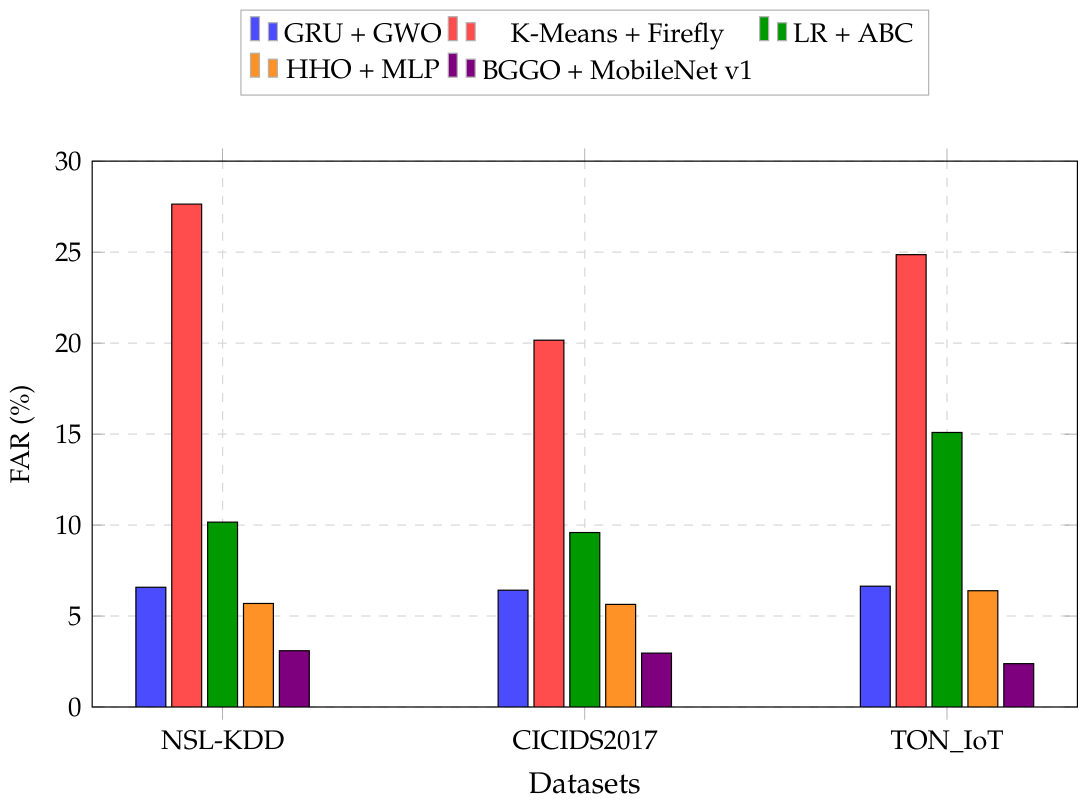
- False Alarm Rate (FAR): FAR evaluates the likelihood of misclassification of benign samples as malicious. It is determined using Equation (15):
5.4. Results and Discussion
6. Conclusions and Future Work
Author Contributions
Funding
Data Availability Statement
Acknowledgments
Conflicts of Interest
References
- Chowdhury, R.; Sen, S.; Goswami, A.; Purkait, S.; Saha, B. An implementation of bi-phase network intrusion detection system by using real-time traffic analysis. Expert Syst. Appl. 2023, 224, 119831. [Google Scholar] [CrossRef] [Scilit]
- FBI Internet Crime Complaint Center (IC3). 2024 Internet Crime Report. 2024. Available online: https://www.ic3.gov/AnnualReport/Reports/2024_IC3Report.pdf (accessed on 28 May 2026).
- Abdullah, M.; Nawaz, M.M.; Saleem, B.; Zahra, M.; Ashfaq, E.b.; Muhammad, Z. Evolution Cybercrime—Key Trends, Cybersecurity Threats, and Mitigation Strategies from Historical Data. Analytics 2025, 4, 25. [Google Scholar] [CrossRef] [Scilit]
- Farhan, M.; Waheed Ud Din, H.; Ullah, S.; Hussain, M.S.; Khan, M.A.; Mazhar, T.; Khattak, U.F.; Jaghdam, I.H. Network-based intrusion detection using deep learning technique. Sci. Rep. 2025, 15, 25550. [Google Scholar] [CrossRef] [Scilit] [PubMed]
- Shyaa, M.A.; Ibrahim, N.F.; Zainol, Z.B.; Abdullah, R.; Anbar, M.; Alzubaidi, L. IGPC-MSOS: A Knowledge-Preserving Transfer Learning Framework with Dynamic Mode-Switching for Handling Concept Drift in Network Intrusion Detection Systems. Knowl.-Based Syst. 2026, 337, 115361. [Google Scholar] [CrossRef] [Scilit]
- Diro, A.A.; Chilamkurti, N. Distributed attack detection scheme using deep learning approach for Internet of Things. Future Gener. Comput. Syst. 2018, 82, 761–768. [Google Scholar] [CrossRef] [Scilit]
- Pawana, I.W.A.J.; Abella, V.; Lastre, J.K.; Ko, Y.; You, I. Enhancing Roaming Security in Cloud-Native 5G Core Network through Deep Learning-Based Intrusion Detection System. Comput. Model. Eng. Sci. 2025, 145, 2733. [Google Scholar] [CrossRef] [Scilit]
- Huang, A.; Yan, J.; Fan, X.; Zhou, H. Multi-Scenario Cloud–Edge Collaborative DDoS Detection in LLM-Enabled AIoT. IEEE Trans. Netw. Sci. Eng. 2025, 13, 3790–3809. [Google Scholar] [CrossRef] [Scilit]
- Wakili, A.; Bakkali, S. ZeroDefense: An adaptive hybrid fusion-based intrusion detection system for zero-day threat detection in IoT networks. J. Electron. Sci. Technol. 2026, 24, 100345. [Google Scholar] [CrossRef] [Scilit]
- Ahmim, A.; Maazouzi, F.; Ahmim, M.; Namane, S.; Dhaou, I.B. Distributed denial of service attack detection for the Internet of Things using hybrid deep learning model. IEEE Access 2023, 11, 119862–119875. [Google Scholar] [CrossRef] [Scilit]
- Wang, Y.; Qin, G.; Zou, M.; Liang, Y.; Wang, G.; Wang, K.; Feng, Y.; Zhang, Z. A lightweight intrusion detection system for internet of vehicles based on transfer learning and MobileNetV2 with hyper-parameter optimization. Multimed. Tools Appl. 2024, 83, 22347–22369. [Google Scholar] [CrossRef] [Scilit]
- Wang, B.; Yu, L.; Zhang, B. AL-MobileNet: A novel model for 2D gesture recognition in intelligent cockpit based on multi-modal data. Artif. Intell. Rev. 2024, 57, 282. [Google Scholar] [CrossRef] [Scilit]
- Huang, K.; Xian, R.; Xian, M.; Wang, H.; Ni, L. A comprehensive intrusion detection method for the internet of vehicles based on federated learning architecture. Comput. Secur. 2024, 147, 104067. [Google Scholar] [CrossRef] [Scilit]
- Grandhi, A.; Singh, S.K. Interrelated dynamic biased feature selection and classification model using enhanced gorilla troops optimizer for intrusion detection. Alex. Eng. J. 2025, 114, 312–330. [Google Scholar] [CrossRef] [Scilit]
- Vinod, D.; Prasad, M. Enhancing Network Security: A Novel Intrusion Detection System Utilizing Dual-Optimization Techniques for Feature Selection and Classification. Comput. Netw. 2026, 277, 112021. [Google Scholar] [CrossRef] [Scilit]
- Jayasankar, T.; Kiruba Buri, R.; Maheswaravenkatesh, P. Intrusion detection system using metaheuristic fireworks optimization based feature selection with deep learning on Internet of Things environment. J. Forecast. 2024, 43, 415–428. [Google Scholar] [CrossRef] [Scilit]
- Li, J.; Othman, M.S.; Ying, X.; Hassan, D.S.; Chen, H.; Yusuf, L.M. Adaptive NetFlow IIoT Intrusion Detection With Deep Transfer Learning, Genetic Optimization, and Ensemble Methods for Network Management. IEEE Trans. Netw. Serv. Manag. 2025, 23, 681–698. [Google Scholar] [CrossRef] [Scilit]
- El-Kenawy, E.S.M.; Khodadadi, N.; Mirjalili, S.; Abdelhamid, A.A.; Eid, M.M.; Ibrahim, A. Greylag goose optimization: Nature-inspired optimization algorithm. Expert Syst. Appl. 2024, 238, 122147. [Google Scholar] [CrossRef] [Scilit]
- Ghasemi, M.; kadkhoda Mohammadi, S.; Zare, M.; Mirjalili, S.; Gil, M.; Hemmati, R. A new firefly algorithm with improved global exploration and convergence with application to engineering optimization. Decis. Anal. J. 2022, 5, 100125. [Google Scholar] [CrossRef] [Scilit]
- Katipoğlu, O.M.; Mohammadi, B.; Keblouti, M. Bee-inspired insights: Unleashing the potential of artificial bee colony optimized hybrid neural networks for enhanced groundwater level time series prediction. Environ. Monit. Assess. 2024, 196, 724. [Google Scholar] [CrossRef] [Scilit] [PubMed]
- Elsaid, S.A.; Shehab, E.; Mattar, A.M.; Azar, A.T.; Hameed, I.A. Hybrid intrusion detection models based on GWO optimized deep learning. Discov. Appl. Sci. 2024, 6, 531. [Google Scholar] [CrossRef] [Scilit]
- Alzaqebah, A.; Aljarah, I.; Al-Kadi, O. A hierarchical intrusion detection system based on extreme learning machine and nature-inspired optimization. Comput. Secur. 2023, 124, 102957. [Google Scholar] [CrossRef] [Scilit]
- Saravanan, S.; Kumar, R.S.; Balakumar, P.; Prabaharan, N. Optimal power harvesting under partial shading: Binary Greylag Goose optimization for reconfiguration and Machine learning-Based fault diagnosis in solar PV arrays. Energy Convers. Manag. 2025, 333, 119808. [Google Scholar] [CrossRef] [Scilit]
- Elkenawy, E.S.M.; Alhussan, A.A.; Khafaga, D.S.; Tarek, Z.; Elshewey, A.M. Greylag goose optimization and multilayer perceptron for enhancing lung cancer classification. Sci. Rep. 2024, 14, 23784. [Google Scholar] [CrossRef] [Scilit] [PubMed]
- Khosrowshahi, H.N.; Aghdasi, H.S.; Salehpour, P. A refined Greylag Goose optimization method for effective IoT service allocation in edge computing systems. Sci. Rep. 2025, 15, 15729. [Google Scholar] [CrossRef] [Scilit] [PubMed]
- Wang, L.; Yao, Y.; Yang, Y.; Zang, Z.; Zhang, X.; Zhang, Y.; Yu, Z. Novel Greylag Goose Optimization Algorithm with Evolutionary Game Theory (EGGO). Biomimetics 2025, 10, 545. [Google Scholar] [CrossRef] [Scilit] [PubMed]
- Ghorbal, A.B.; Grine, A.; Eid, M.M.; El-Kenawy, E.S.M. Greylag Goose Optimization and Deep Learning-Based Electrohysterogram Signal Analysis for Preterm Birth Risk Prediction. Comput. Model. Eng. Sci. (CMES) 2025, 144, 2001–2028. [Google Scholar] [CrossRef] [Scilit]
- Samunnisa, K.; Kumar, G.S.V.; Madhavi, K. Intrusion detection system in distributed cloud computing: Hybrid clustering and classification methods. Meas. Sens. 2023, 25, 100612. [Google Scholar] [CrossRef] [Scilit]
- Al-Omari, M.; Rawashdeh, M.; Qutaishat, F.; Alshira’H, M.; Ababneh, N. An intelligent tree-based intrusion detection model for cyber security. J. Netw. Syst. Manag. 2021, 29, 20. [Google Scholar] [CrossRef] [Scilit]
- Thockchom, N.; Singh, M.M.; Nandi, U. A novel ensemble learning-based model for network intrusion detection. Complex Intell. Syst. 2023, 9, 5693–5714. [Google Scholar] [CrossRef] [Scilit]
- Sarkar, A.; Sharma, H.S.; Singh, M.M. A supervised machine learning-based solution for efficient network intrusion detection using ensemble learning based on hyperparameter optimization. Int. J. Inf. Technol. 2023, 15, 423–434. [Google Scholar] [CrossRef] [Scilit]
- Sedhuramalingam, K.; Saravanakumar, N. A novel optimal deep learning approach for designing intrusion detection system in wireless sensor networks. Egypt. Inform. J. 2024, 27, 100522. [Google Scholar] [CrossRef] [Scilit]
- Ghadami, R. An intrusion detection system in the Internet of Things with deep learning and an improved arithmetic optimization algorithm (AOA) and sine cosine algorithm (SCA). Sci. Rep. 2025, 15, 38156. [Google Scholar] [CrossRef] [Scilit] [PubMed]
- Zhou, S.; Liu, C.; Ye, D.; Zhu, T.; Zhou, W.; Yu, P.S. Adversarial attacks and defenses in deep learning: From a perspective of cybersecurity. ACM Comput. Surv. 2022, 55, 1–39. [Google Scholar] [CrossRef] [Scilit]
- Guo, R.; Chen, Q.; Liu, H.; Wang, W. Adversarial robustness enhancement for deep learning-based soft sensors: An adversarial training strategy using historical gradients and domain adaptation. Sensors 2024, 24, 3909. [Google Scholar] [CrossRef] [Scilit] [PubMed]
- Che, L.; Wu, C.; Hou, Y. Large Language Model Text Adversarial Defense Method Based on Disturbance Detection and Error Correction. Electronics 2025, 14, 2267. [Google Scholar] [CrossRef] [Scilit]
- Guo, R.; Li, A.; Liu, H. An Adversarial Attack Detection Method Based on Bidirectional Consistency Discrimination for Deep Learning-Based Soft Sensors. In Proceedings of the 2025 CAA Symposium on Fault Detection, Supervision, and Safety for Technical Processes (SAFEPROCESS); IEEE: Piscataway, NJ, USA, 2025; pp. 1–6. [Google Scholar] [CrossRef] [Scilit]
- Nasir, M.H.; Khan, S.A.; Khan, M.M.; Fatima, M. Swarm intelligence inspired intrusion detection systems-a systematic literature review. Comput. Netw. 2022, 205, 108708. [Google Scholar] [CrossRef] [Scilit]
- Reddy, D.K.K.; Nayak, J.; Behera, H.; Shanmuganathan, V.; Viriyasitavat, W.; Dhiman, G. A systematic literature review on swarm intelligence based intrusion detection system: Past, present and future. Arch. Comput. Methods Eng. 2024, 31, 2717–2784. [Google Scholar] [CrossRef] [Scilit]
- Donkol, A.A.E.B.; Hafez, A.G.; Hussein, A.I.; Mabrook, M.M. Optimization of intrusion detection using likely point PSO and enhanced LSTM-RNN hybrid technique in communication networks. IEEE Access 2023, 11, 9469–9482. [Google Scholar] [CrossRef] [Scilit]
- Kolukisa, B.; Dedeturk, B.K.; Hacilar, H.; Gungor, V.C. An efficient network intrusion detection approach based on logistic regression model and parallel artificial bee colony algorithm. Comput. Stand. Interfaces 2024, 89, 103808. [Google Scholar] [CrossRef] [Scilit]
- Srivastava, A.; Sinha, D. PSO-ACO-based bi-phase lightweight intrusion detection system combined with GA optimized ensemble classifiers. Clust. Comput. 2024, 27, 14835–14890. [Google Scholar] [CrossRef] [Scilit]
- Bakro, M.; Kumar, R.R.; Husain, M.; Ashraf, Z.; Ali, A.; Yaqoob, S.I.; Ahmed, M.N.; Parveen, N. Building a cloud-IDS by hybrid bio-inspired feature selection algorithms along with random forest model. IEEE Access 2024, 12, 8846–8874. [Google Scholar] [CrossRef] [Scilit]
- Kaur, A.; Pal, S.K.; Singh, A.P. Hybridization of K-means and firefly algorithm for intrusion detection system. Int. J. Syst. Assur. Eng. Manag. 2018, 9, 901–910. [Google Scholar] [CrossRef] [Scilit]
- Alazab, M.; Khurma, R.A.; Castillo, P.A.; Abu-Salih, B.; Martín, A.; Camacho, D. An effective networks intrusion detection approach based on hybrid Harris Hawks and multi-layer perceptron. Egypt. Inform. J. 2024, 25, 100423. [Google Scholar] [CrossRef] [Scilit]
- Yesodha, K.; Krishnamurthy, M.; Selvi, M.; Kannan, A. Intrusion detection system extended CNN and artificial bee colony optimization in wireless sensor networks. Peer-to-Peer Netw. Appl. 2024, 17, 1237–1262. [Google Scholar] [CrossRef] [Scilit]
- Karthikeyan, M.; Brindha, R.; Vianny, M.M.; Vaitheeshwaran, V.; Bachute, M.; Mishra, S.; Dash, B.B. Integration of metaheuristic based feature selection with ensemble representation learning models for privacy aware cyberattack detection in IoT environments. Sci. Rep. 2025, 15, 22887. [Google Scholar] [CrossRef] [Scilit] [PubMed]
- Chen, Y.; Guo, Y.; Gao, Y.; Liu, B. A novel lightweight deep learning framework using enhanced pelican optimization for efficient cyberattack detection in the Internet of Things environments. J. Eng. Appl. Sci. 2025, 72, 69. [Google Scholar] [CrossRef] [Scilit]
- Al-Shurbaji, T.; Anbar, M.; Manickam, S.; Al-Amiedy, T.A.; Mukhaini, G.A.; Hashim, H.; Farsi, M.; Atlam, E.S. BoT-EnsIDS: Approach for detecting IoT Botnet attacks leveraging bio-inspired based ensemble feature selection and hybrid deep learning model. Alex. Eng. J. 2025, 129, 744–767. [Google Scholar] [CrossRef] [Scilit]
- Jabeur, N. FireBoost: A new Bio-Inspired Approach for Feature selection based on Firefly Algorithm and Optimized XGBoost. Intell. Syst. Appl. 2025, 29, 200613. [Google Scholar] [CrossRef] [Scilit]
- Dharmalingam, M.; Subramaniam, K.; M, A.; Nandhagopal, N. Diverse attack detection in IoT using hybrid deep convolutional with capsule auto encoder for intrusion detection model. J. Parallel Distrib. Comput. 2025, 208, 105190. [Google Scholar] [CrossRef] [Scilit]
- Misrak, S.F.; Melaku, H.M. Lightweight intrusion detection system for IoT with improved feature engineering and advanced dynamic quantization. Discov. Internet Things 2025, 5, 97. [Google Scholar] [CrossRef] [Scilit]
- Sun, Y.; Wang, Z. Intrusion detection in IoT and wireless networks using image-based neural network classification. Appl. Soft Comput. 2025, 177, 113236. [Google Scholar] [CrossRef] [Scilit]
- Sharma, K.P.; Nagpal, T.; Vora, T.; Yadav, A.; Abdullah, M.I.; Jayaprakash, B.; Kashyap, A.; Sridevi, G.; Bhowmik, A.; Bukate, B.B. Interpretable intrusion detection for IoT environments using a self-attention-based explainable AI framework. Sci. Rep. 2025, 15, 39937. [Google Scholar] [CrossRef] [Scilit] [PubMed]
- Rezvan, M.R.; Sorkhi, A.G.; Pirgazi, J.; Kallehbasti, M.M.P. AdvanceSplice: Integrating N-gram one-hot encoding and ensemble modeling for enhanced accuracy. Biomed. Signal Process. Control 2024, 92, 106017. [Google Scholar] [CrossRef] [Scilit]
- Kim, Y.S.; Kim, M.K.; Fu, N.; Liu, J.; Wang, J.; Srebric, J. Investigating the impact of data normalization methods on predicting electricity consumption in a building using different artificial neural network models. Sustain. Cities Soc. 2025, 118, 105570. [Google Scholar] [CrossRef] [Scilit]
- Elreedy, D.; Atiya, A.F. A comprehensive analysis of synthetic minority oversampling technique (SMOTE) for handling class imbalance. Inf. Sci. 2019, 505, 32–64. [Google Scholar] [CrossRef] [Scilit]
- Alrayes, F.S.; Zakariah, M.; Amin, S.U.; Khan, Z.I.; Alqurni, J.S. CNN Channel Attention Intrusion Detection System Using NSL-KDD Dataset. Comput. Mater. Contin. 2024, 79, 4319–4347. [Google Scholar] [CrossRef] [Scilit]
- Sharafaldin, I.; Lashkari, A.H.; Ghorbani, A.A. Toward generating a new intrusion detection dataset and intrusion traffic characterization. In International Conference on Information Systems Security and Privacy; SciTePress (Science and Technology Publications): Setúbal, Portugal, 2018; Volume 1, pp. 108–116. [Google Scholar] [CrossRef] [Scilit]
- Alsaedi, A.; Moustafa, N.; Tari, Z.; Mahmood, A.; Anwar, A. TON_IoT telemetry dataset: A new generation dataset of IoT and IIoT for data-driven intrusion detection systems. IEEE Access 2020, 8, 165130–165150. [Google Scholar] [CrossRef] [Scilit]



| Paper | Model and Dataset | Merits | Demerits |
|---|---|---|---|
| Al-Omari et al. 2021 [29] | Model: decision trees. Dataset: UNSW-NB15. | Attacks detected: generic, exploits, analysis, shellcode, DoS, reconnaissance, worms, backdoors, fuzzers. | Deep or complex tree structures require significant computational resources. Static decision tree models have limited adaptability to evolving threats. |
| Samunnisa et al. 2023 [28] | Model: K-means, GMM, RF, SVM, KNN and SVM. Dataset: NSL-KDD and KDDcup99. | Attacks detected: DoS, probing, U2R and R2L have been detected. | Large hybrid model is computationally heavy and old datasets are considered. |
| Thockchom et al. 2023 [30] | Model: ensemble model: decision tree and Logistic Regression, Gaussian naive Bayes. Dataset: CIC-IDS2017, KDD Cup 1999 and UNSW-NB15. | Attacks detected: reconnaissance, brute force FTP attack, worms, web attack, DoS attack, backdoors, shellcode, DoS, generic, U2R, brute force SSH attack, fuzzers, analysis, R2L, probing, heartbleed attack, DDoS, infiltration, exploit and botnet. | Combining multiple models in an ensemble increases computational complexity. |
| Sarkar et al. 2023 [31] | Model: ensemble technique: decision trees, additional trees, Random Forests, naive Bayes, SVM and MLP, Logistic Regression, gradient boosting, K-Nearest Neighbors. Dataset: KDD Cup99 and NSL-KDD. | Attacks detected: R2L, DoS, U2R and probing have been detected. | The cascaded meta-specialist classifier and ensemble structure require additional computational resources. The datasets used here are popular but may not fully represent modern attack patterns. |
| Ghadami et al. 2025 [33] | Model: parallel convolutional neural network and long short-term memory. Dataset: NSL-KDD, UNSW-NB15 | Attacks detected: DoS, probing, U2R, R2L, generic, exploits, analysis, shellcode, DoS, reconnaissance, worms, backdoors, fuzzers. | It requires high computational resources. |
| Reference | Key Features | Merits | Demerits |
|---|---|---|---|
| Elsaid et al. 2024 [21] | Combines GRU/LSTM deep neural networks with Grey Wolf Optimization for adaptive feature tuning and detection. Dataset: NSL-KDD. | U2R, R2L, DoS and probing attacks have been detected. | Although feature selection reduces dimensionality, integrating GWO with large deep learning models like GRU or LSTM introduces computational complexity during the training phase. |
| Alzaqebah et al. 2023 [22] | Harris Hawk Optimization with an extreme learning machine has been used. Dataset: UNSW-NB15. | Shellcode, backdoors, worms, fuzzers, reconnaissance, generic, exploit, DoS and analysis attacks have been detected. | UNSW-NB15 is a strong benchmark dataset, but it may not fully capture modern attack variations. So, it requires testing on newer datasets. |
| Kolukisa et al. 2024 [41] | Logistic Regression and Artificial Bee Colony Optimization have been used. Dataset: UNSW-NB15 and NSL-KDD. | Attacks such as probing, shellcode, reconnaissance, DoS, fuzzers, worms, R2L, backdoors, generic, exploit, U2R, and analysis have been detected. | The Artificial Bee Colony algorithm, especially in a parallel implementation, may require significant computational resources. |
| Srivastava et al. 2024 [42] | PSO, GA, Ant Colony Optimization and XGBoost have been used. Datasets: NSL-KDD, CSE-CIC-IDS2018 and UNSW-NB15. | Attacks such as probing, shellcode, reconnaissance, DoS, fuzzers, worms, R2L, backdoors, generic, U2R, exploit and analysis have been detected. | Use of multiple metaheuristic algorithms increases processing time. |
| Donkol et al. 2023 [40] | PSO and enhanced LSTM have been used. Datasets: CSE-CIC-IDS2018, CICIDS2017, UNSW-NB15, and BOT. | Attacks such as web attack, heartbleed, reconnaissance, brute force SSH, generic, fuzzers, botnet, backdoors, infiltration, worms, analysis, DDoS, exploit, brute force FTP, DoS, and shellcode have been detected. | LSTM-based models require substantial computational resources, making them less ideal for low-power devices. |
| Bakro et al. 2024 [43] | Grasshopper Optimization Algorithm, Genetic Algorithm, and Random Forest have been used. Datasets: CIC Bell DNS EXF 2021, UNSW-NB15, CIC-DDoS2019. | Analysis, DoS, exploit, backdoors, generic, DNS exfiltration, reconnaissance, DDoS, worms, fuzzers and shellcode attacks have been detected. | Computational overhead due to dual optimization and RF training. |
| Yesodha et al. 2024 [46] | Artificial Bee Colony Optimization, fuzzy temporal rules, and CNN have been used. Dataset: NSL-KDD. | U2R, R2L, DoS and probing attacks have been detected. | The FT-ABC-CNN model may perform well on specific datasets or attack types but could struggle to generalize to new, unseen attacks or different WSN configurations without retraining or fine-tuning. |
| Kaur et al. 2018 [44] | Uses Firefly Optimization for feature selection. K-Means is used for anomaly detection. Dataset: NSL-KDD. | U2R, R2L, DoS and probing attacks have been detected. | The Firefly Algorithm’s performance relies on parameters like light intensity, attractiveness, and absorption coefficient; improper tuning may cause poor convergence. K-Means assumes that clusters are the same size and shape, which may not be true for real network traffic distributions. This makes clustering and detection less accurate. |
| Reference | Method Type | Classification Model | Datasets Used | Accuracy (%) | Feature Selection Mechanism | Lightweight Design |
|---|---|---|---|---|---|---|
| Vinod et al. 2026 [15] | Deep Learning | Elman Neural Network | UNSW-NB15 | 96.38% | Archimedes Optimization Algorithm and Fennec Fox Optimization Algorithm | – |
| Karthikeyan et al. 2025 [47] | Deep Learning | Ensemble of Bidirectional Gated Recurrent Unit, Wasserstein Auto Encoder, and Deep Belief Network | CICIDS-2017 and NSLKDD | 99.14% | Adaptive Harris Hawk Optimization | Yes |
| Chen et al. 2025 [48] | Deep Learning | CNN | Bot-IoT, NSL-KDD, and CICIDS2018 | 97.8% | Enhanced Pelican Optimization Algorithm | Yes |
| Al-Shurbaji et al. 2025 [49] | Deep Learning | Generative Adversarial Network, Hybrid CNN-LSTM | BoT-IoT | 97% | Particle Swarm Optimization and Gorilla Troops Optimizer | Yes |
| Nafaa Jabeur 2025 [50] | Machine Learning | XGBoost | METABRIC and KDD datasets | 81% | Firefly Algorithm | – |
| Dharmalingam et al. 2025 [51] | Deep Learning | Convolutional and Auto Encoder | DS2OS and BoT-IoT datasets | 97% | Adaptive Eagle Cat Optimization | Yes |
| Farhan et al. 2025 [4] | Deep Learning | Deep Neural Network | UNSW-NB15 | 97.93% | Extra Tree Classifier | – |
| Misrak et al. [52] | Deep Learning | DNN-BiLSTMQ | CIC-IDS2017 and CIC-IoT2023 | 99.73% | RAL-MIFS | Yes |
| Sun et al. [53] | Deep Learning | LeNet | NSL-KDD and CICIoV2024 | 94.93% | XGBoost | Yes |
| Sharma et al. [54] | Deep Learning | DNN | BoT-IoT, N-BaIoT, UNSW-NB15 | 98.9% | LFG | Yes |
| Dataset | Attack Category | Original Labels |
|---|---|---|
| NSL-KDD | DoS | smurf, apache2, udpstorm, land, processtable, teardrop, back, mailbomb, pod, neptune |
| Probe | nmap, satan, portsweep, ipsweep, saint, mscan | |
| R2L | snmpguess, warezmaster, imap, xlock, guess_passwd, httptunnel, spy, multihop, phf, ftp_write, xsnoop, named, sendmail, warezclient, snmpgetattack | |
| U2R | rootkit, perl, sqlattack, buffer_overflow, ps, loadmodule | |
| TON_IoT | DoS | dos |
| DDoS | ddos | |
| Access/Auth | mitm, password | |
| Malware | ransomware, backdoor | |
| Web/Injection | injection, xss | |
| Probe | scanning | |
| CICIDS2017 | DoS | DoS slowloris, Heartbleed, DoS Hulk, DoS Slowhttptest, DoS GoldenEye |
| DDoS | DDoS | |
| Infiltration | Infiltration | |
| Brute Force | FTP-Patator, SSH-Patator | |
| Probe/Scanning | PortScan, Bot | |
| Web Attack | Web Attack–Sql Injection, Web Attack–Brute Force, Web Attack–XSS |
| Symbol | Description |
|---|---|
| Dataset containing m features | |
| m | Total number of features in the dataset |
| P | Population size |
| Maximum number of iterations | |
| Binary position vector of the ith goose in | |
| Velocity vector of the ith goose at iteration l | |
| Current best feature subset | |
| Fitness value of the ith solution | |
| Trade-off parameter between classification error and feature reduction | |
| Random coefficients used for velocity update | |
| Sigmoid transfer function for the jth dimension | |
| Number of selected features in solution |
| Dataset | Original Features | Selected Features | Reduction (%) |
|---|---|---|---|
| NSL-KDD | 41 | 26 | 36.6 |
| CICIDS2017 | 78 | 35 | 55.1 |
| TON_IoT | 42 | 28 | 33.3 |
| Dataset | Model | Precision (%) | Recall (%) | F1-Score (%) | Accuracy (%) |
|---|---|---|---|---|---|
| NSL-KDD | SVM | 94.32 | 93.68 | 93.99 | 94.00 |
| KNN | 91.82 | 91.18 | 91.47 | 91.50 | |
| LSTM | 93.44 | 92.96 | 93.17 | 93.20 | |
| CNN | 92.54 | 92.66 | 92.58 | 92.60 | |
| TabNet | 85.92 | 85.42 | 85.64 | 85.67 | |
| MLP | 94.46 | 93.94 | 94.11 | 94.20 | |
| MobileNet v1 | 96.34 | 96.06 | 96.17 | 96.20 | |
| CID System | 97.61 | 97.60 | 97.60 | 97.30 | |
| CICIDS2017 | SVM | 92.78 | 92.22 | 92.47 | 92.50 |
| KNN | 91.88 | 91.32 | 91.57 | 91.60 | |
| LSTM | 94.48 | 93.92 | 94.16 | 94.20 | |
| CNN | 94.16 | 93.84 | 93.96 | 94.00 | |
| TabNet | 85.22 | 84.78 | 84.96 | 85.00 | |
| MLP | 94.32 | 93.88 | 94.09 | 94.10 | |
| MobileNet v1 | 95.66 | 94.94 | 95.26 | 95.30 | |
| CID System | 94.90 | 96.63 | 95.76 | 96.89 | |
| TON_IoT | SVM | 94.88 | 94.52 | 94.66 | 94.70 |
| KNN | 94.22 | 93.78 | 93.96 | 94.00 | |
| LSTM | 95.28 | 94.72 | 94.96 | 95.00 | |
| CNN | 93.52 | 93.88 | 93.67 | 93.70 | |
| TabNet | 84.96 | 84.28 | 84.58 | 84.62 | |
| MLP | 93.54 | 92.86 | 93.07 | 93.20 | |
| MobileNet v1 | 95.96 | 95.64 | 95.76 | 95.80 | |
| CID System | 99.43 | 95.99 | 97.67 | 96.30 |
| Dataset | Mean Accuracy (%) | Std. Dev. | Variance |
|---|---|---|---|
| NSL-KDD | 97.30 | 0.22 | 0.048 |
| CICIDS2017 | 96.89 | 0.27 | 0.073 |
| TON_IoT | 96.30 | 0.24 | 0.058 |
| (a) NSL-KDD | ||
| Pred. Attack | Pred. Normal | |
| Actual Attack | 12,239 | 301 |
| Actual Normal | 300 | 9410 |
| (b) CICIDS2017 | ||
| Pred. Attack | Pred. Normal | |
| Actual Attack | 48,675 | 1696 |
| Actual Normal | 2614 | 85,556 |
| (c) TON_IoT | ||
| Pred. Attack | Pred. Normal | |
| Actual Attack | 15,577 | 650 |
| Actual Normal | 90 | 3683 |
| Technique | Model | Accuracy (%) |
|---|---|---|
| [21] | GRU + GWO | 93.00 |
| [44] | K-Means + Firefly | 71.00 |
| [41] | Logistic Regression + ABC | 89.23 |
| [45] | Harris Hawks + MLP | 94.00 |
| CID system | BGGO + MobileNet v1 | 97.30 |
| Paper | Model | Accuracy (%) |
|---|---|---|
| [21] | GRU + GWO | 93.20 |
| [44] | K-Means + Firefly | 79.00 |
| [41] | Logistic Regression + ABC | 90.00 |
| [45] | Harris Hawks + MLP | 94.02 |
| CID system | BGGO + MobileNet v1 | 96.89 |
| Paper | Model | Accuracy (%) |
|---|---|---|
| [21] | GRU + GWO | 93.00 |
| [44] | K-Means + Firefly | 74.22 |
| [41] | Logistic Regression + ABC | 84.19 |
| [45] | Harris Hawks + MLP | 93.2 |
| CID system | BGGO + MobileNet v1 | 96.30 |
| Dataset | Attack Type | DoS Labels | Probe/Scanning Labels | DoS (%) | DDoS (%) | Probe (%) |
|---|---|---|---|---|---|---|
| NSL-KDD | DoS, Probe | smurf, apache2, udpstorm, land, processtable, teardrop, back, mailbomb, pod, neptune | nmap, satan, portsweep, ipsweep, saint, mscan | 97.42 | – | 97.18 |
| CICIDS2017 | DoS, DDoS, Probe | Heartbleed, DoS slowloris, DoS Hulk, DoS Slowhttptest, DoS GoldenEye | PortScan, Bot | 96.95 | 97.08 | 96.63 |
| TON_IoT | DoS, DDoS, Probe | dos | scanning | 96.41 | 96.56 | 95.94 |
| Dataset | FAR (%) |
|---|---|
| NSL-KDD | 3.09 |
| CICIDS2017 | 2.96 |
| TON_IoT | 2.38 |
| Dataset | Comparison | t-Value | Critical t-Value | p-Value |
|---|---|---|---|---|
| NSL-KDD | CID vs GRU + GWO | 17.84 | 2.7764 | < |
| CID vs Harris Hawks + MLP | 11.62 | 2.7764 | < | |
| CICIDS2017 | CID vs GRU + GWO | 13.47 | 2.7764 | < |
| CID vs Harris Hawks + MLP | 9.28 | 2.7764 | 0.0007 | |
| TON_IoT | CID vs GRU + GWO | 15.91 | 2.7764 | < |
| CID vs Harris Hawks + MLP | 10.84 | 2.7764 | 0.0004 |
Disclaimer/Publisher’s Note: The statements, opinions and data contained in all publications are solely those of the individual author(s) and contributor(s) and not of MDPI and/or the editor(s). MDPI and/or the editor(s) disclaim responsibility for any injury to people or property resulting from any ideas, methods, instructions or products referred to in the content. |
© 2026 by the authors. Licensee MDPI, Basel, Switzerland. This article is an open access article distributed under the terms and conditions of the Creative Commons Attribution (CC BY) license.
Share and Cite
Das, S.; Majumder, A.; Roy, S. CID: A Compact Deep Learning Framework for Intrusion Detection Based on Binary Greylag Goose Optimization. IoT 2026, 7, 49. https://doi.org/10.3390/iot7030049
Das S, Majumder A, Roy S. CID: A Compact Deep Learning Framework for Intrusion Detection Based on Binary Greylag Goose Optimization. IoT. 2026; 7(3):49. https://doi.org/10.3390/iot7030049
Chicago/Turabian StyleDas, Sudeshna, Abhishek Majumder, and Sudipta Roy. 2026. "CID: A Compact Deep Learning Framework for Intrusion Detection Based on Binary Greylag Goose Optimization" IoT 7, no. 3: 49. https://doi.org/10.3390/iot7030049
APA StyleDas, S., Majumder, A., & Roy, S. (2026). CID: A Compact Deep Learning Framework for Intrusion Detection Based on Binary Greylag Goose Optimization. IoT, 7(3), 49. https://doi.org/10.3390/iot7030049