1. Introduction
In the early development of nuclear and quantum physics, the possibility of electron–proton (e–p) compact states involving electrons and protons was occasionally discussed. In 1920, Ernest Rutherford speculated that a neutral nuclear constituent might consist of a proton and an electron bound considerably short distances [
1]. Following the experimental discovery of the neutron in 1932, this hypothesis was examined and subsequently abandoned on fundamental grounds related to spin, statistics, beta decay, and the uncertainty principle [
2]. The neutron is now understood to be a composite hadron with no electron content. This historical episode is mentioned solely to illustrate that short-distance e–p dynamics were explored in early quantum theory; it does not imply physical continuity between compact e–p configurations and the neutron, whose hadronic nature is firmly established.
Within relativistic quantum mechanics, the Dirac equation for a point-like Coulomb potential admits formal mathematical solutions that do not correspond to physical eigenstates, because the associated wave functions cannot be normalized. As a result, the notion of compact electron–proton compact states were set aside in mainstream atomic physics [
3].
Interest in this question re-emerged sporadically in the later study [
4,
5], which highlights formal relativistic energy scales but does not establish the existence of hypothetical bound states, motivated by the observation that at distances comparable to the proton charge radius, the Coulomb potential must be replaced by a finite-size nuclear potential, such as the Smith–Johnson or Nix forms commonly used in relativistic Hartree–Fock calculations of heavy atoms [
6,
7]. These studies highlighted the appearance of formally deep energy scales in relativistic treatments, sometimes referred to as “deep Dirac levels” (DDLs). However, such approaches did not establish the existence of physically acceptable hypothetical bound states, nor did they address stability in a fully self-consistent manner.
It is now commonly recognized that a single-particle Dirac equation is insufficient to describe e–p dynamics at femtometer scales. At such distances, a proper treatment requires a relativistic two-body formulation incorporating quantum electrodynamics and proton structure effects. Stanley Brodsky argued that the Dirac equation in single-particle form is inadequate at these distances, and instead advocated a two-body QED treatment using Bethe–Salpeter-type approaches [
8]. John Spence and James Vary implemented a two-body relativistic framework and reported indications of a bound solution [
9], but did not pursue a definitive conclusion, in part due to the technical complexity of the required calculations.
The complication of the problem is therefore twofold: (a) there is no experimentally confirmed signature of compact e–p hypothetical bound states, and (b) a complete two-body QED (quantum electrodynamics) plus QCD (quantum chromodynamics) calculation at femtometer scales remains technically challenging and model-dependent. The present paper, does not considers a full two-body QED, or QED plus QCD solution, nor does claim to replace or approximate such a treatment. Instead, the study addresses a logically prior and more limited question: whether basic relativistic kinematics, finite-size nuclear potentials, and stability requirements forbid the existence of a compact stationary e–p configuration. To this end, here, an approximate but physically constrained framework is employed based on
the relativistic virial-stability condition,
the de Broglie standing-wave condition for a relativistic electron, requiring that the orbital circumference accommodates an integer number of de Broglie wavelengths, , and
the requirement of negative total binding energy.
This framework is not intended to establish the existence, formation probability, or lifetime of such a configuration, but rather to examine whether relativistic kinematics and stability constraints alone preclude it; it provides an internally consistent estimate of the characteristic radius, binding energy, and hyperfine scale of a hypothetical compact state, without invoking the Dirac spectrum as a source of physical eigenvalues.
A tightly bound e–p configuration cannot form spontaneously from the static Coulomb field alone, since the maximum electrostatic energy available at the radii of a few femtometers is about 0.5 MeV. Formation would therefore require an external energy input, analogous in scale to processes such as electron capture (p + e− → n + νe), which requires an energy threshold of 0.782 MeV.
In
Section 3, the conditions for relativistic virial stability of a compact e–p esystem are analysed and the resulting energy scales are derived. The role of the Dirac equation in
Section 2 is discussed only as historical motivation; the quantitative results of this paper do not rely on Dirac eigenvalues or on the existence of physical deeply bound Dirac states.
Given the absence of a tractable first-principles two-body QED solution at femtometer scales, it is meaningful to raise the more limited question of whether relativistic kinematics and stability conditions alone forbid such configurations.
2. Dirac Equation Effort
Reference [
5] applied the Dirac equation to explore whether tightly bound e–p statesmay exist. The Dirac spectrum for a Coulomb potential contains two mathematical branches:
with total energy levels according to Sommerfeld–Dirac approach [
10,
11,
12]:
where
j =
ℓ +
s,
s = ± 1/2 is a spin,
ℓ =
k − 1 is the orbital momentum,
m denotes the electron mass,
=
e2/
c = 1/137 represents a fine structure constant,
e denotes the elementary electric charge,
c is the speed of light,
is the reduced Planck constant,
nr = 0,1,2,3,…, and
k = 1,2,3,…
Motivation from finite-size regularization of the Dirac–Coulomb problem is as follows. For a point-like Coulomb field, the Dirac equation admits the known physical branch that produces ordinary hydrogenic eigenstates, while the formally “deep” branch does not yield an acceptable bound-state solution. References [
4,
5] emphasize that this conclusion can be actually altered if the proton is treated as an extended charge distribution, which regularizes the short-distance behavior of the central field. The proposed strategy is to solve the Dirac equation inside a finite-radius proton model and outside in the Coulomb region, and to impose continuity of the Dirac radial spinor components at the matching radius. This program was suggested as a possible route to restoring mathematical acceptability of deep solutions, but it has not been successfully demonstrated in a definitive two-body bound-state calculation. In the present paper, these historical considerations serve only as motivation; no Dirac deep-branch eigenvalues are used, but instead a separate virial-inspired energy-balance consistency test is applied.
Attempts to obtain compact bound-state solutions directly from the single-particle Dirac equation with finite-size nuclear potentials did not yield stable, square-integrable states. This outcome is consistent with the general viewpoint emphasized by Brodsky, namely that relativistic e–p hypothetical bound states at short distances require a full two-body quantum-field treatment rather than a single-particle Dirac equation [
13]. The appropriate framework is a two-body QED bound-state equation, such as the Bethe–Salpeter formulation [
8].
John Spence and James Vary implemented a relativistic two-body QED framework and reported indications of a deeply bound solution [
9]. However, the treatment assumed a point-like proton and did not incorporate proton structure or higher-order field-theoretic effects. Authors did not pursue the solution further due to its computational complexity.
The present study proceeds using a different approach. The remainder of this paper employs a relativistic virial-theorem framework incorporating relativistic kinematics, finite-size nuclear potentials, and stability conditions, without invoking Equations (1) and (2) for quantitative predictions.
Since a complete two-body quantum-field-theoretical treatment of the e–p system—including relativistic dynamics, proton structure, and radiative effects—remains mathematically complex and model-dependent, the present study addresses a different and logically prior question.
Specifically, the paper examines whether relativistic kinematics, finite-size nuclear potentials, and basic stability requirements forbid the existence of a compact stationary electron–proton configuration. This is done using a virial-theorem-motivated relativistic consistency framework, which provides a necessary (though not sufficient) diagnostic test, independent of detailed QED dynamics.
3. Simple Argument for Small Hydrogen
Let us examine whether a compact stationary e–p configuration is kinematically and energetically forbidden once relativistic motion, finite-size effects, and basic stability conditions are imposed. The analysis does not derive a hypothetical bound state from QED or from the Dirac equation, but instead applies a relativistic virial consistency condition to explore whether such configurations are excluded on general grounds.
Because an electron confined to femtometer scales is necessarily highly relativistic (with the Lorentz factor
γe ≳ 100), nonrelativistic hydrogenic expressions are inapplicable. Let us therefore consider a phenomenological energy-balance framework in which the total interaction energy is expressed schematically as the sum of dominant contributions:
where each term is evaluated only as an order-of-magnitude contribution at radii
r ≈ 1–5 fm, a regime where relativistic motion and finite-size effects dominate. The term
V(Spin.B)(
r) takes opposite sign for aligned and anti-aligned spin configurations.
3.1. Effective Coulomb Potential Veff
An entirely Coulomb interaction VC = −Ke2/r (with K a constant) does not yield a compact femtometer-scale solution in the present analysis.
The following expression earlier considered in exploratory treatments of compact e–p configurations [
14,
15],
is adopted here, with
the mass of electron. It is worth to emphasize that
Veff is introduced as a phenomenological short-range effective interaction and is not intended as a literal modification of the Coulomb interaction in vacuum. By construction,
Veff(
r) smoothly approaches the standard Coulomb form for
r ≥ 10
3 fm, so ordinary hydrogenic physics at atomic length scales is unaffected. In the present virial-consistency diagnostic, the role of
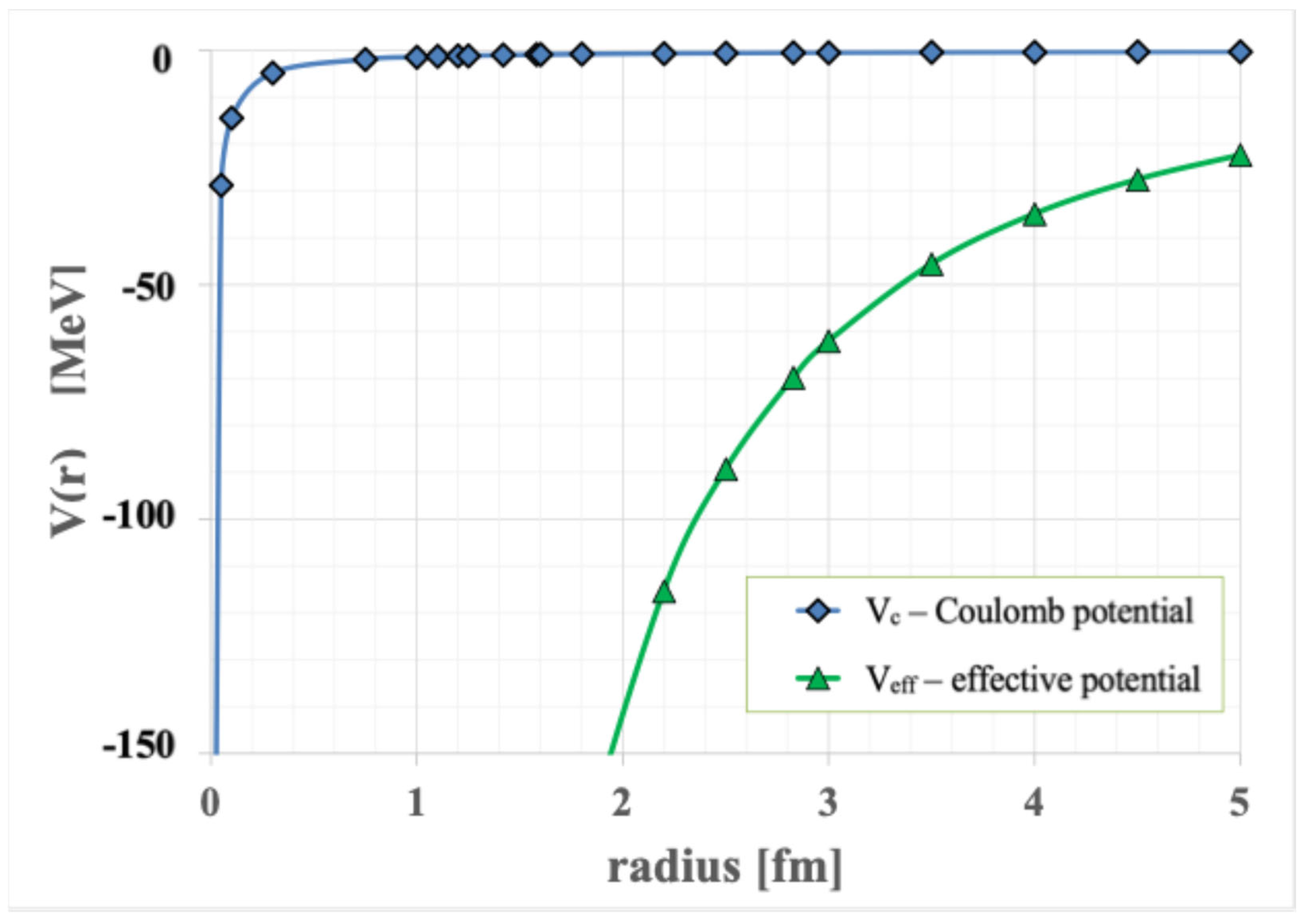
Veff is to parameterize the additional short-range attraction required to balance the rapidly increasing relativistic kinetic-energy scale at femtometer radii. The implied enhancement relative to the point-Coulomb term at
r approximately a few fm within the adopted ansatz should therefore be interpreted as an effective strength (i.e., a constraint on any microscopic mechanism) rather than as a first-principles prediction of a new fundamental force.
To emphasize is that Veff (3) is not an interaction potential in the quantum–mechanical sense and is not used as a Hamiltonian operator defining eigenstates. Instead, the definition (3) is used only as an energy-dependent diagnostic ansatz, parametrizing a possible relativistic energy-balance for a charged particle in a strong static scalar potential, and used here only to test whether the virial-inspired matching procedure admits a stationary radius.
Reference [
14] obtains a Schrödinger-like second-order equation by algebraic reduction of the Dirac equation in a static scalar Coulomb potential
φ(
r). This reduces to
VC(r) = −eφ(r) when
E mec2,
|eφ(r)| <<
mec2. In the relativistic regime, this transforms to Equation (3). It is woth to stress again that
Veff serves as a phenomenological consistency test of whether ultra-relativistic kinematics combined with a central-field energy-balance ansatz may yield femtometer-scale solutions within the procedure used below.
Figure 1 compares
VC(
r) and
Veff(
r).
3.2. Spin–Magnetic Interaction V(Spin.B)
At radii of a few femtometers, the proton magnetic field is approximated here by its leading dipole term. This is used only to estimate the characteristic spin-dependent energy scale associated with proton magnetization. The spin–magnetic contribution is parametrized as
where
is electron dipole operator,
Bp is magnetic field of proton,
ge = 2.00232 is the electron g-factor, and
is the Bohr magneton. The vector
denotes Pauli spin matrices acting on the electron spin, related to the spin operator by
s =
The factor 1/
γe is introduced as a phenomenological Lorentz-scaling ansatz appropriate for an ultra-relativistic electron in the proton rest frame. The spin-magnetic congtribution changes sign depending on the relative orientation of the electron spin and the proton magnetic field, leading to a splitting between aligned and anti-aligned configurations.
The proton magnetic field is modeled as a dipole:
where
is the permeability of free space,
is the magnetic moment of proton and
is the nuclear magneton, with
the proton mass. At
r ≈ 2.84 fm, this gives
Bp ≈ 1.2 × 10
11 T.
3.3. Spin–Orbit Interaction VSO (Order of Magnitude)
For a central vector potential
VC(
r), the Foldy–Wouthuysen expansion of the Dirac equation yields the familiar spin–orbit coupling in the weak-filed regime [
16]:
where the Thomas factor is already included in the Dirac-based reduction.
At femtometer radii and ultra-relativistic electron energies, a consistent evaluation of spin–orbit effects requires a QED treatment including finite-size proton structure. In the present phenomenological framework, therefore Equation (6) is used just as a dimensional guide and a simple suppression estimate is applied by replacing
me ⟶
γe me, which leads to
VSO ≈ 1
/γe2. For
γe ≈ 100–150, this scaling implies that
VSO is parametrically small compared to both the diagnostic term
Veff and the spin–magnetic scale estimated in
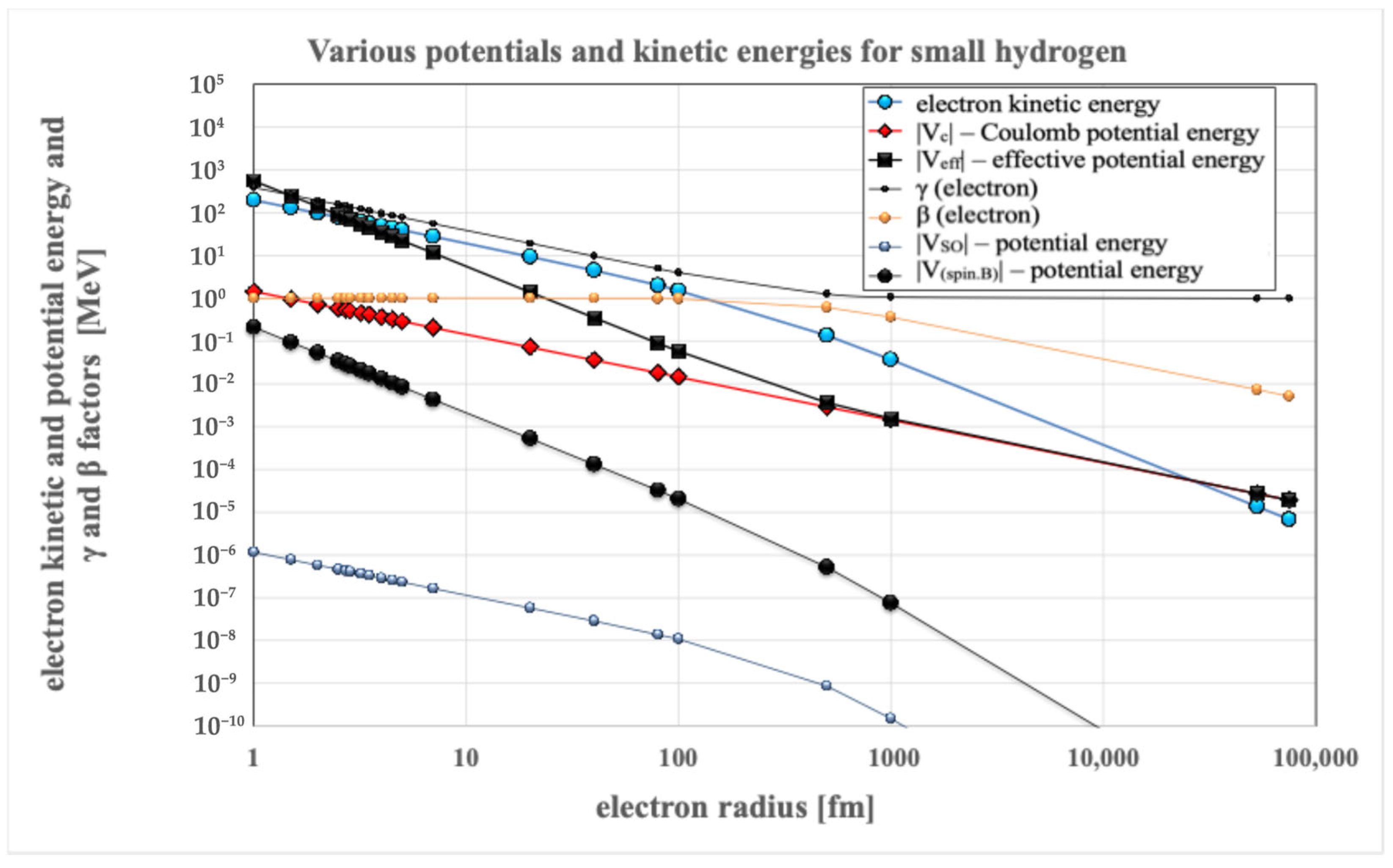
Section 2 As illustrated in
Figure 2, the hierarchy of magnitude is |
Veff | >> |
V(Spin.B)| >> |
VSO|.It is worth to stress again that these terms are not components of a Hamiltonian, and no spectroscopic interpretation (for example, “fine structure”) is implied. These features are quoted just to indicate the relative size of phenomenological spin-dependent energy contributions at femtometer radii within the limitations of the present framework.
4. Virial-Inspired Consistency Condition
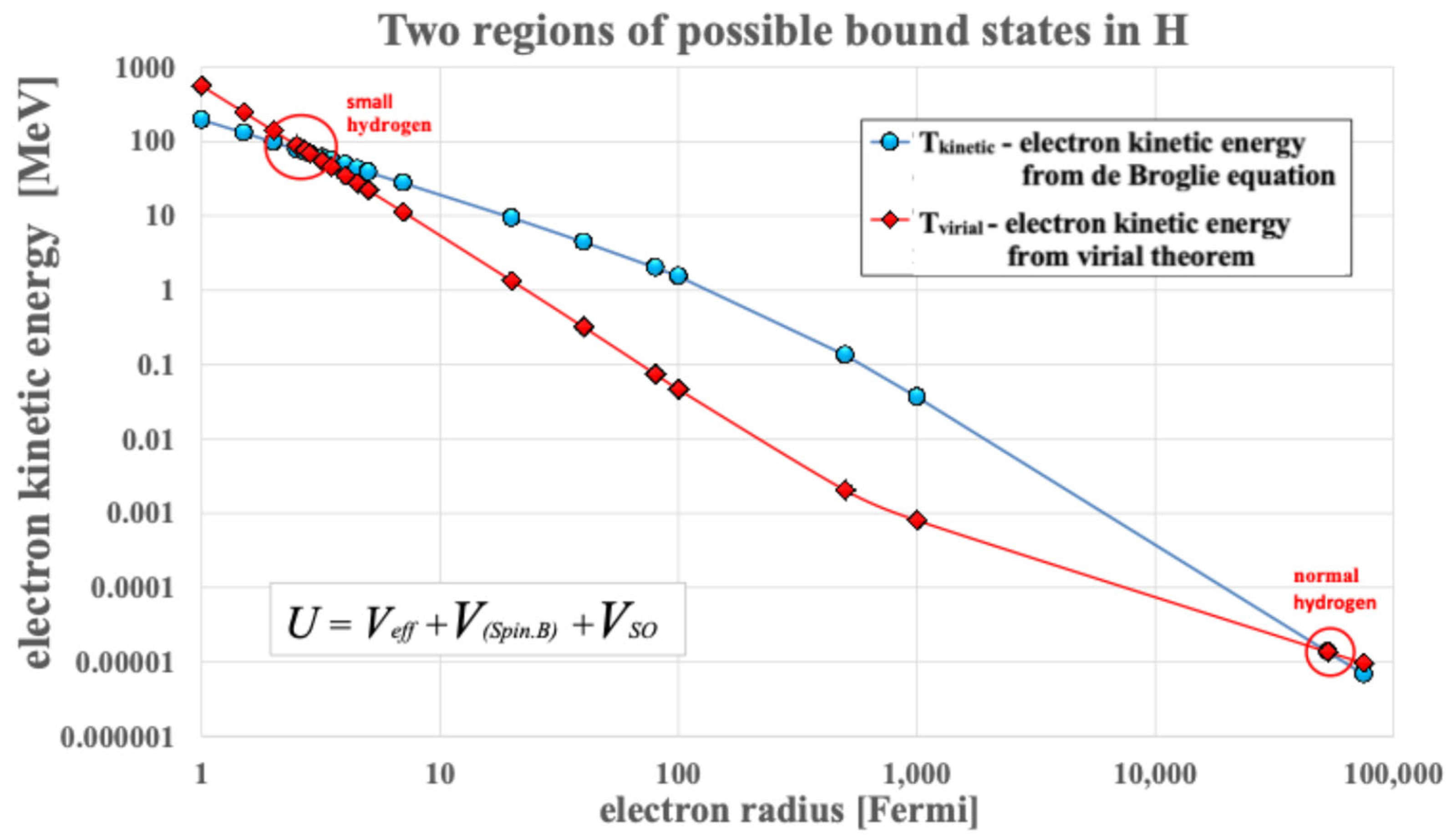
Here, a virial-inspired local scaling test is applied: two radius-dependent energy scales, Tkinetic(r) and Tvirial(r), are applied and a candidate consistency radius rc is defined by the matching condition Tkinetic(rc) = Tvirial(rc). This matching procedure is used only as a diagnostic for whether the adopted energy-balance ansatz admits self-consistent femtometer-scale radii under ultra-relativistic kinematics.
4.1. Electron Kinetic-Energy Scale Tkinetic(r)
Following de Broglie’s standing-wave picture, a relation between momentum and radius is introduced by writing 2πr = nλ, p(r) = h/λ = n/r, where n = 1, 2,… labels the number of de Broglie wavelengths fitting around a circular orbit, with h the Planck constant. This relation is used here only as a phenomenological momentum–radius parametrization that sets the kinematic scale at a given radius.
The corresponding relativistic kinetic-energy scale is
For the ultra-relativistic regime γe >> 1, one may equivalently write Tkinetic(r) = (γe − 1) mec2.
4.2. Virial-Inspired Energy Scale Tvirial(r)
Writing
U(r) = Σ Ui(r) with local scaling
Ui(
r) ∝
rki,
is used [
16,
17,
18,
19]. Examples are as follows.
For a Coulomb term U1 = VC = −KZe2/r, the exponent is k = −1. Within the phenomenological relativistic virial parametrization of Equation (11), this gives Tvirial ⟶ −(½)VC as γe⟶1, and Tvirial ⟶ −VC for γe ⟶ ∞.
For a term U(r) = 1/r2, k = −2, giving Tvirial ⟶ −2U as γe ⟶ ∞.
For present model, U(r) = Veff (r) + V(Spin.B) (r)+ VSO(r),
The factor 3 reflects the local 1/r3 scaling of the magnetic-dipole and spin–orbit terms.
4.3. Local Matching Condition (Method A)
Let us define a candidate consistency radius
rc by the matching condition
As an additional diagnostic, the total energy-balance functional Etot(r)=Tkinetic(r) + U(r) is defined and Etot(rc) < 0 is required, which is the ordinary energetic condition for a bound configuration.
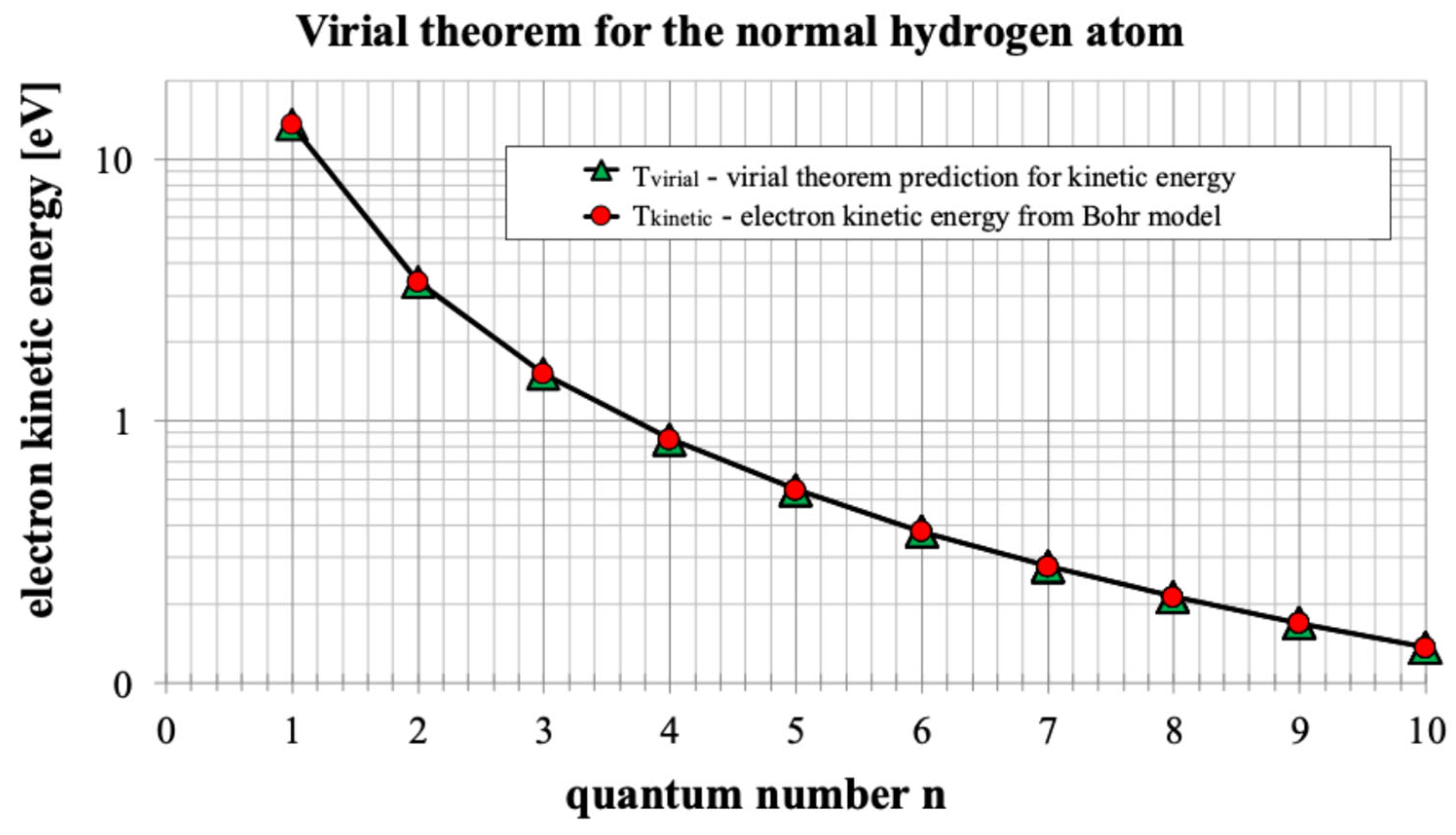
Figure 3 illustrates this matching condition for ordinary hydrogen within a Bohr-model parametrization.
Tkinetic is evaluated from Equation (10) and
Tvirial from Equation (11).
4.4. Local Stationary Proxy (Method B: Cross-Check)
As a cross-check, let us evaluate the derivative-based local stationarity proxy [
17] (see
Appendix A):
where p is the magnitude of the momentum, r is the radial coordinate and U(r) depends only on scalar r. The angular brackets <…> denote the average over one period.
For a circular relativistic parameterization, Equation (11) becomes
Here U(r) = Veff + V(Spin.B) +VSO. Solving Equation (12) yields radii that provide an internal consistency check of the matching solution obtained from Equation (A8).
5. Results
If a compact e–p configuration exists in nature, it must correspond to a dynamically stable (or metastable) bound state. The present analysis does not address formation or lifetime; it only identifies candidate stationary radii within a virial-inspired energy-balance test.
5.1. Coulomb Potential VC
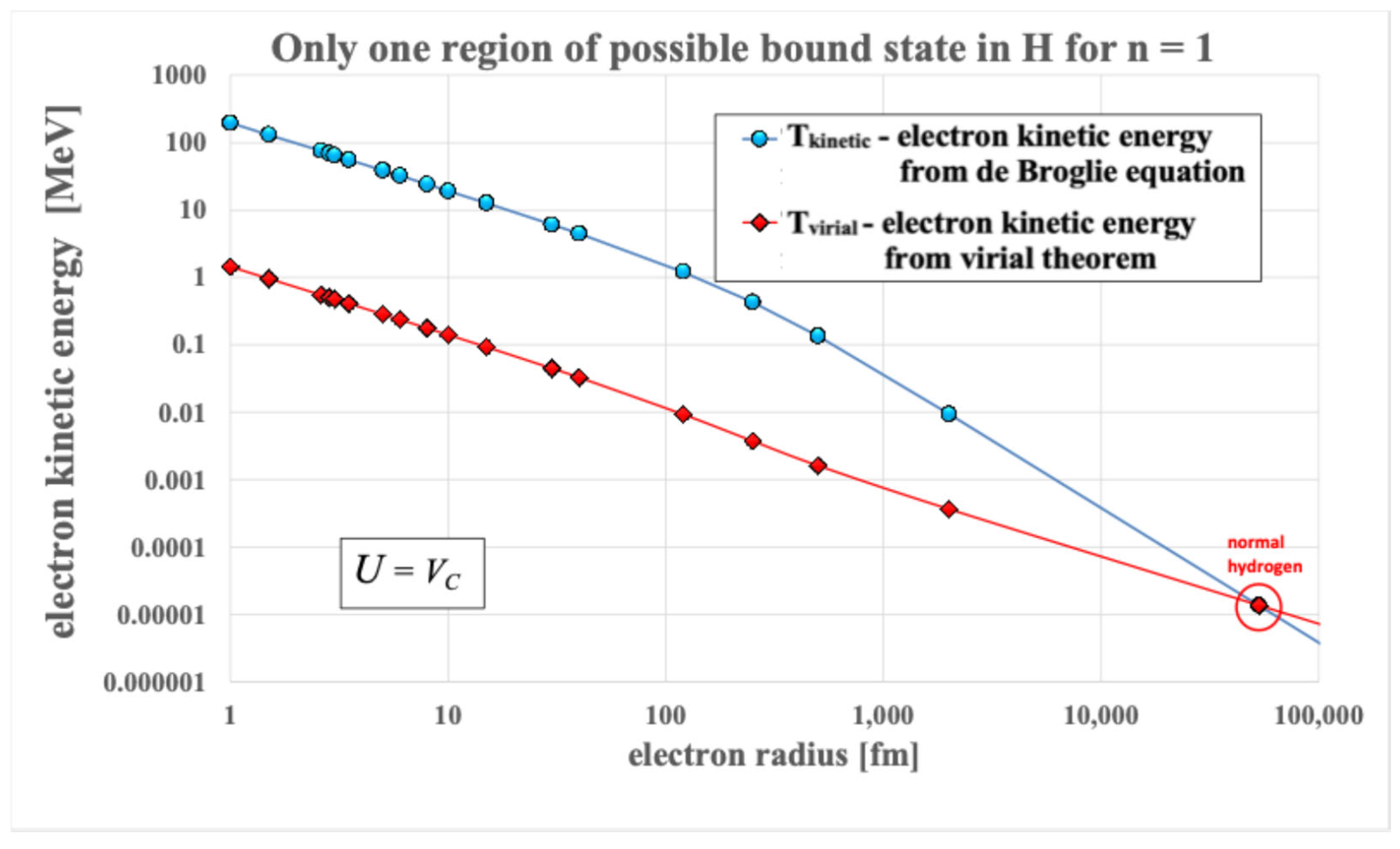
Applying the virial-consistency procedure to the entirely Coulomb potential
VC = −KZe2/
r recovers the ordinary hydrogen solution at the Bohr radius, but no additional femtometer-scale solution is found. Finite-size Coulomb forms (Smith–Johnson, Nix forms [
4,
5]) do not change this conclusion (
Figure 4).
5.2. Effective Potential Veff
Introducing the semi-relativistic effective potential
Veff (3) yields a compact femtometer-scale matching radius near
r ≈ 2.8 fm.
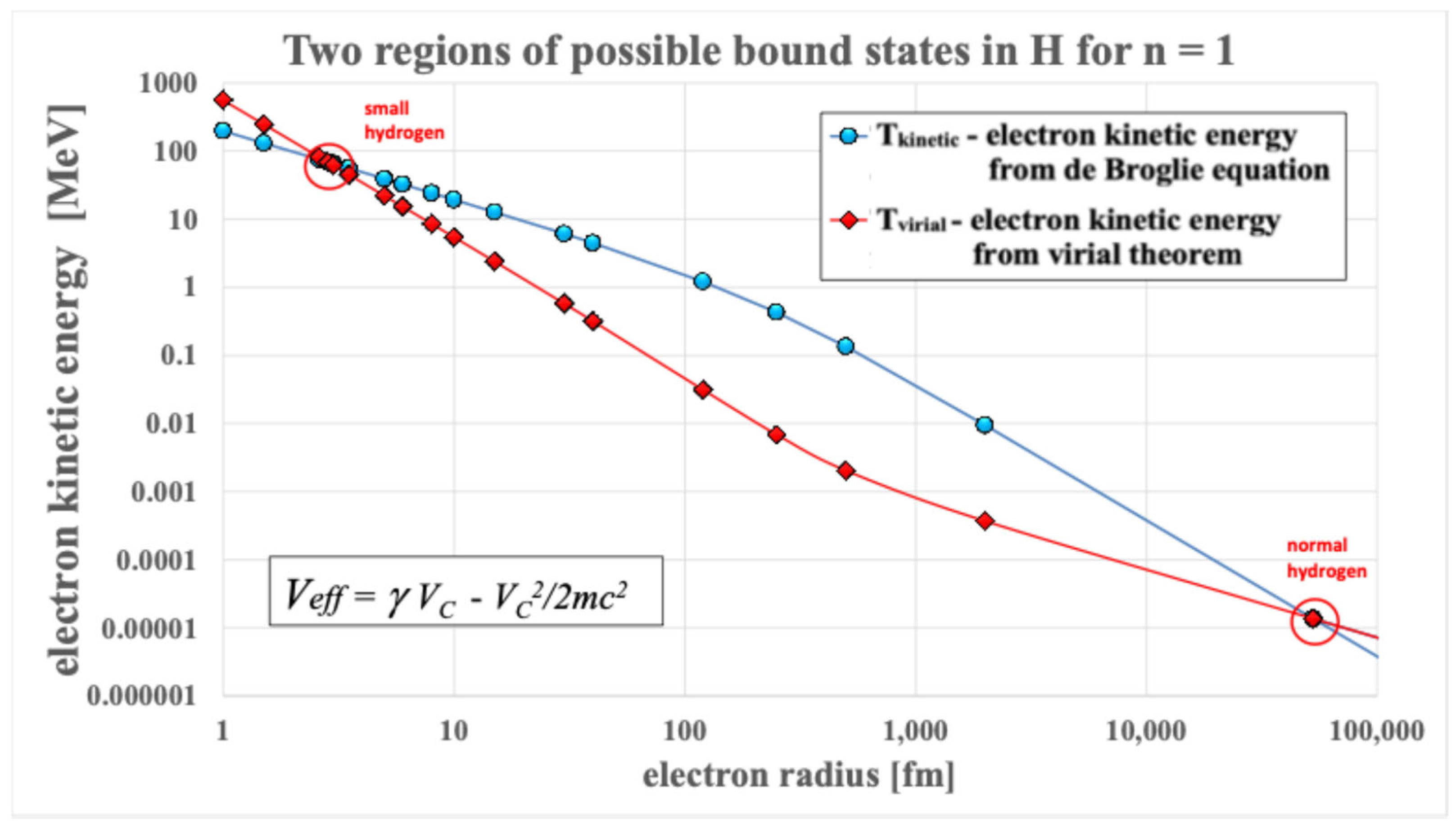
Figure 5 shows two radii at which the matching condition is satisfied: one at the Bohr scale (ordinary hydrogen) and a second at
r ≈ 2.84 fm.
Table 1 lists the corresponding quantities. The total energy-balance functional
Etot = Tkinetic + U becomes negative at this radius, indicating a negative-energy configuration within the adopted ansatz. The entries with
n = 2 illustrate robustness with respect to the de Broglie parametrization; in the following, the
n = 1 case is considered. The quantity
EBE in
Table 1 is defined here only as an energy-balance deficit:
EBE =
Tkinetic −
|U|.
5.3. Combined Potential U = Veff + V(Spin.B) + VSO
The virial-stability analysis is applied using the full effective potential
U = Veff + V(Spin.B) + VSO. Unless otherwise stated, all figures in this section correspond to the spin-aligned configurateion (+V
(Spin.B)).
Figure 6 compares
Tkinetic(
r) and
Tvirial(
r) evaluated from Equations (10)–(12). Two radii satisfy the matching condition
Tkinetic(r) = Tvirial(
r): one corresponding to ordinary hydrogen and a second corresponding to a compact femtometer-scale radius. Thus, adding the spin–magnetic term does not significantly shift the compact matching radius.
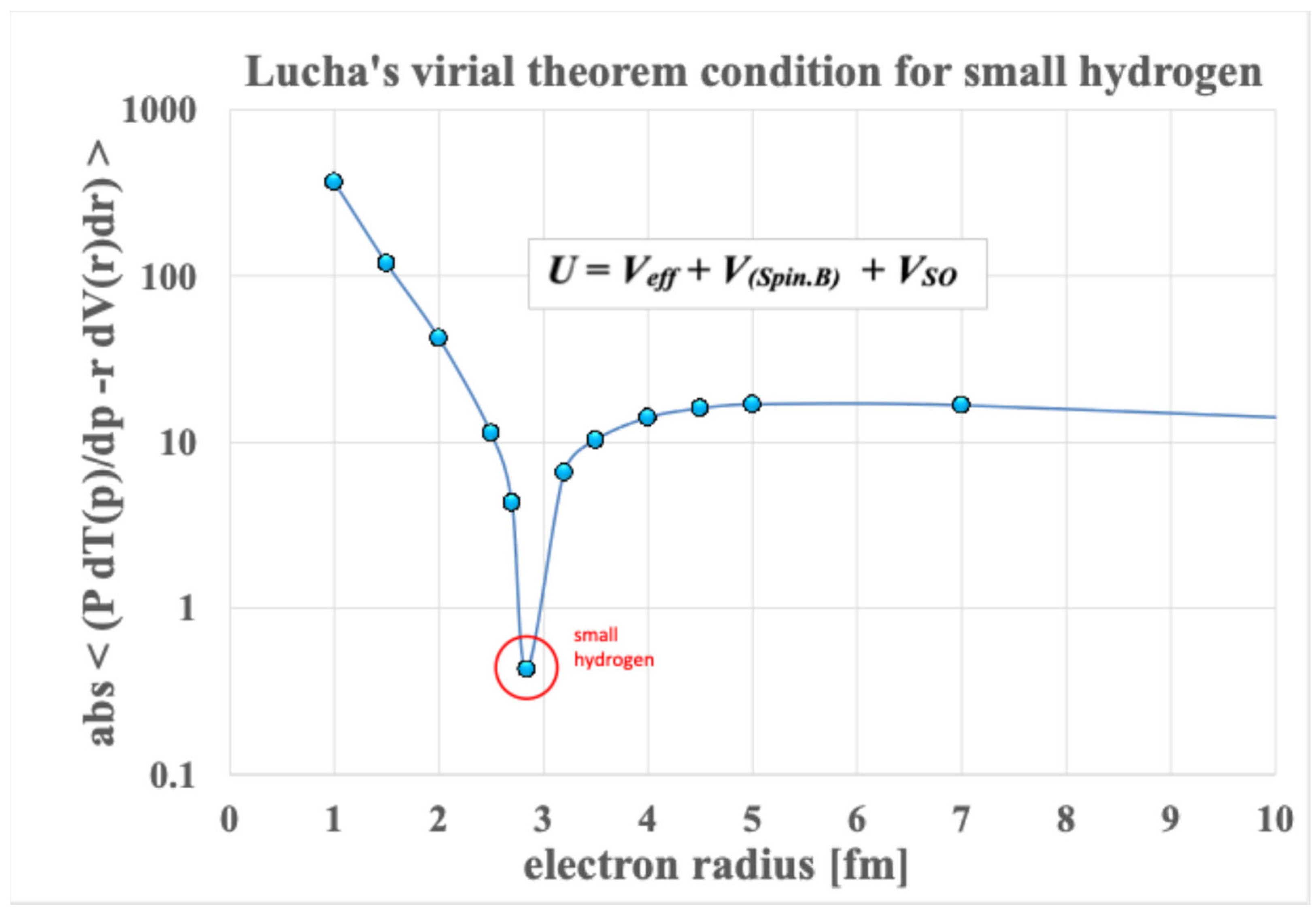
To check internal consistency, the derivative-based stationarity proxy (Method B, Equation (12)) is applied.
Figure 7 exhibits a sharp minimum at
r ≈ 2.84 fm. The dip is narrow (full width at half maximum, FWHM, of about 0.5 fm), reflecting a sharply defined extremum of the chosen diagnostic function within this procedure. This width should not be interpreted as a physical localization length or a dynamical stability measure.
Table 2 lists characteristic quantities associated with the compact e-p solution obtained within the phenomenological model.
Ecentral is defined as the energy scale obtained using the effective potential
Veff alone, which gives
EBE ≈ −260 keV (
Table 1). When the full potential
U = Veff ±
V(Spin.B) + VSO is included, two stationary solutions are obtained, with energy-balance deficits of approximately ࢤ204 keV and ࢤ308 keV (
Table 2). This corresponds to a characteristic spin-dependent splitting of approximately 100 keV. The spin–magnetic term introduces a local contribution of magnitude |
V(Spin.B)| ≈ 25 keV at the compact consistency radius (
Table 2). Within the present virial-consistency framework, however, this term shifts the stationary solution in opposite directions for the two spin orientations, thereby producing this approximately 100 keV splitting. These values should be interpreted as indicative energy scales within the adopted phenomenological framework.
The interpretation is as follows.
Within the adopted energy-balance ansatz, Veff sets the dominant central energy scale (about 260 keV).
The spin–magnetic contribution leads to two stationary solutions, corresponding to a characteristic splitting of order ΔEspin ≈ 100 keV.
The spin–orbit term VSO is suppressed by (1/γe)2 and contributes only |VSO|≈ 10−7 MeV, negligible for binding.
The associated mass scale inferred within the model lies below mp + me and below the neutron mass. No claim is made regarding dynamical stability, decay channels, or formation probability.
Earlier models (i.e., early DDL-based work) suggested binding energies of order 0.5 MeV and a possible connection to the Galactic 511 keV line. In the present analysis, the characteristic energy scales lie in the range of 200–310 keV, centered near 260 keV, and therefore are not consistent with such an interpretation.
For comparison, the hyperfine splitting of ordinary hydrogen is 5.879 × 10⁻⁶ eV (the 21 cm line), reflecting the much weaker magnetic field and nonrelativistic kinematics at atomic length scales.
Table 3 summarizes typical parameters of small and ordinary hydrogen. As
Table 3 shows, mass
M(pe
-) lies below
mp +
me and below
mn.
One may speculate that analogous consistency arguments could be explored for other nuclei, although no such analysis is attempted here and no conclusions regarding multi-nucleon systems are drawn.
The author does not claim to establish the existence of small hydrogen as a physical particle, nor to replace a full two-body QED treatment. It is just shown that within a virial-consistency diagnostic incorporating relativistic kinematics and finite-size effects, a compact femtometer-scale stationary e–p configuration is not obviously inconsistent energetically. Its existence is therefore an empirical question.
6. Heisenberg Uncertainty Principle
The spatial confinement of an electron to femtometer scales (Δx ≲ 2–3 fm) implies a momentum uncertainty Δp ≳ ℏ/(2Δx) ≈ 100–200 MeV/c. Such momenta correspond to electron Lorentz factors γₑ ≈ 100–150, placing the system firmly in the ultra-relativistic regime. This is consistent with the relativistic assumptions employed throughout the virial analysis.
Within the phenomenological framework adopted here, these large kinetic-energy scales are compared against the characteristic energy scales associated with the diagnostic central-field terms introduced in
Section 2. The uncertainty principle therefore does not, by itself, rule out compact stationary electron–proton configurations; rather, it emphasizes that any such configuration—if dynamically realizable—must lie far beyond the nonrelativistic Coulomb regime and requires ultra-relativistic dynamics.
A definitive assessment of whether such relativistic confinement can occur in a real two-body system requires a full quantum-field-theoretic treatment incorporating QED effects and proton structure. The present study does not attempt such a derivation, but instead addresses the more limited question of whether the uncertainty principle alone constitutes a fundamental obstruction to femtometer-scale electron–proton configurations within this diagnostic energy-balance approach.
7. Interactions of Small Hydrogen
Because small hydrogen is electrically neutral and extremely compact (r ≈ 3 fm), its electromagnetic scattering cross-section in matter is expected to be exceptionally small. At astrophysically relevant velocities, its kinetic energy per atom is typically only tens to hundreds of keV (for example, about 105 keV at 4500 km/s), insufficient to ionize the bound electron or cause nuclear disruption. Thus, if such objects exist, they would be expected to deposit very little energy per unit length in ordinary matter and to interact weakly through electromagnetic processes, with gravity dominating their large-scale dynamics.
At thermal energies, however, the absence of a large Coulomb barrier may allow small hydrogen to be captured by positively charged nuclei. The cross-section for such capture is not presently known and believed to depend on short-range QED and nuclear structure. At collision energies comparable to or exceeding the binding energy, the atom may be ionized; at GeV-scale energies, it would behave similarly to a neutron in initiating hadronic cascades.
These considerations are qualitative and do not constitute a prediction of interaction rates or abundances.
8. Can Small Hydrogen Atoms Be Detected?
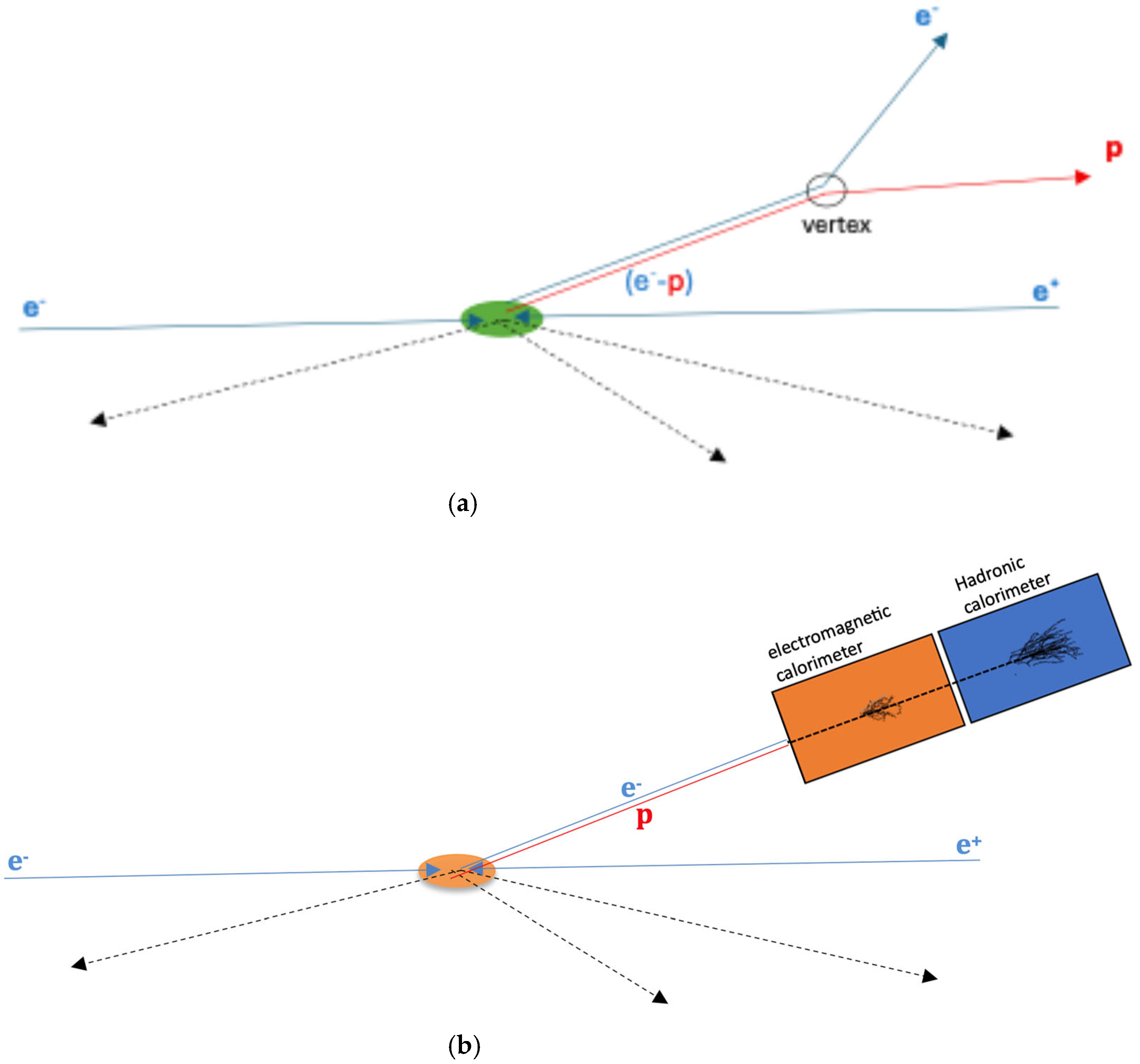
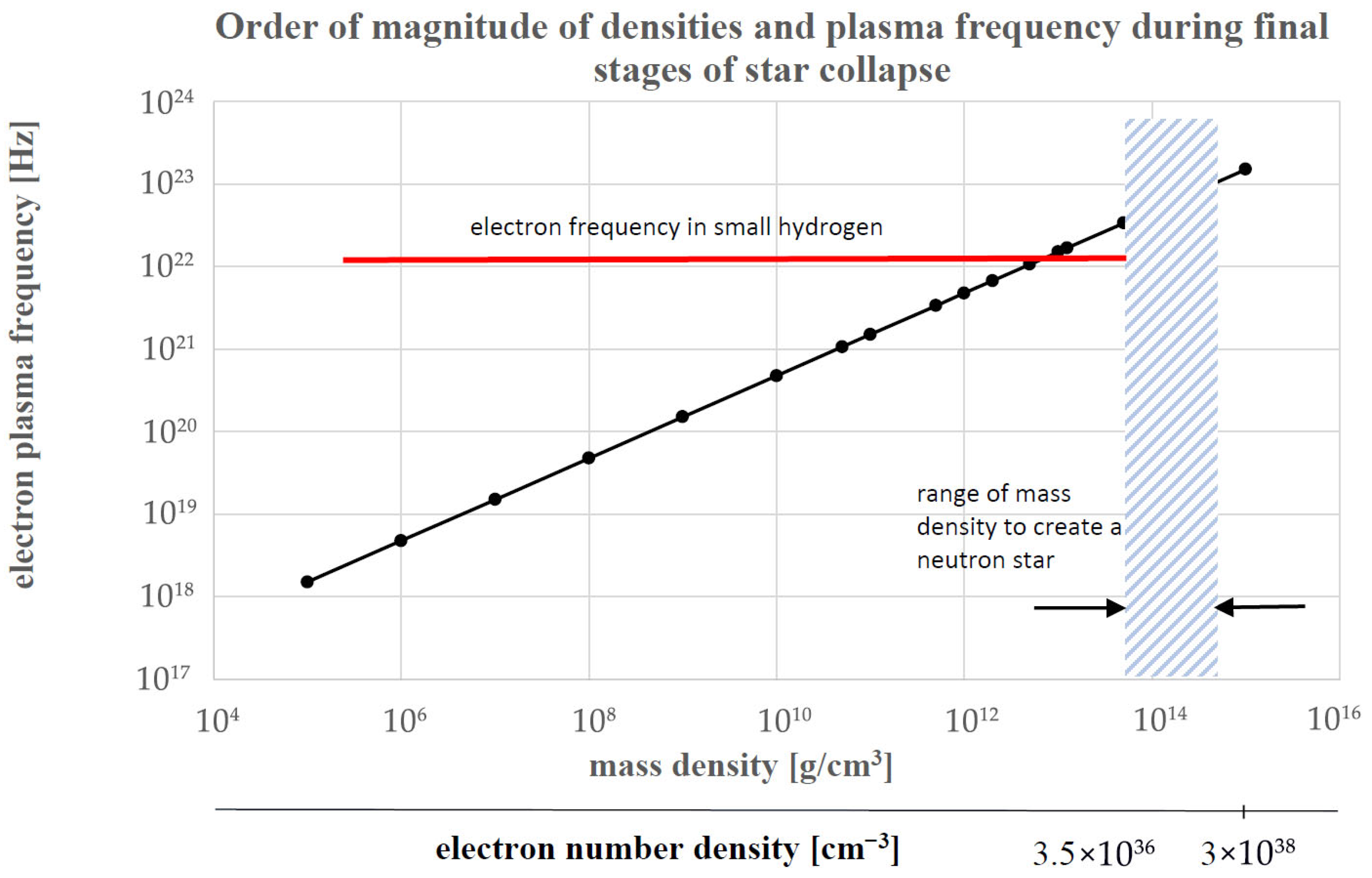
Formation of a compact e–p configuration at femtometer scales would require (i) a matched relative velocity between the proton and electron and (ii) an electron de Broglie wavelength comparable to a few femtometers. Such conditions are expected only in environments involving ultra-relativistic charged particles (for example, the early Universe, relativistic plasmas, strong shocks, or compact-object magnetospheres), although a quantitative formation rate is not known.
If such objects to exist today, laboratory searches may to rely on their interactions with nuclei. Because the configuration is electrically neutral and highly compact, it actually may penetrate atomic electron clouds and approach nuclei without experiencing the large long-range Coulomb barrier characteristic of charged projectiles. Whether this leads to appreciable capture or nuclear effects is uncertain and would depend on short-range QED dynamics and nuclear structure.
For certain targets (for instance, boron), one may speculate that capture of a compact e–p configuration could alter nuclear stability and produce identifiable secondary products (for example, α-emission). At present, however, no established experimental signature or confirmed detection exists, and the relevant cross sections and branching ratios remain unknown.
Additionally, if a nucleus were to bind such a compact e–p configuration in a persistent way, the outer electronic structure could resemble that of an atom with effective charge (Z−1), suggesting a possible spectroscopic search strategy.
9. Astrophysics Implications
If compact neutral e–p configurations exist in nature, the phenomenological energy scales inferred in
Section 2,
Section 3 and
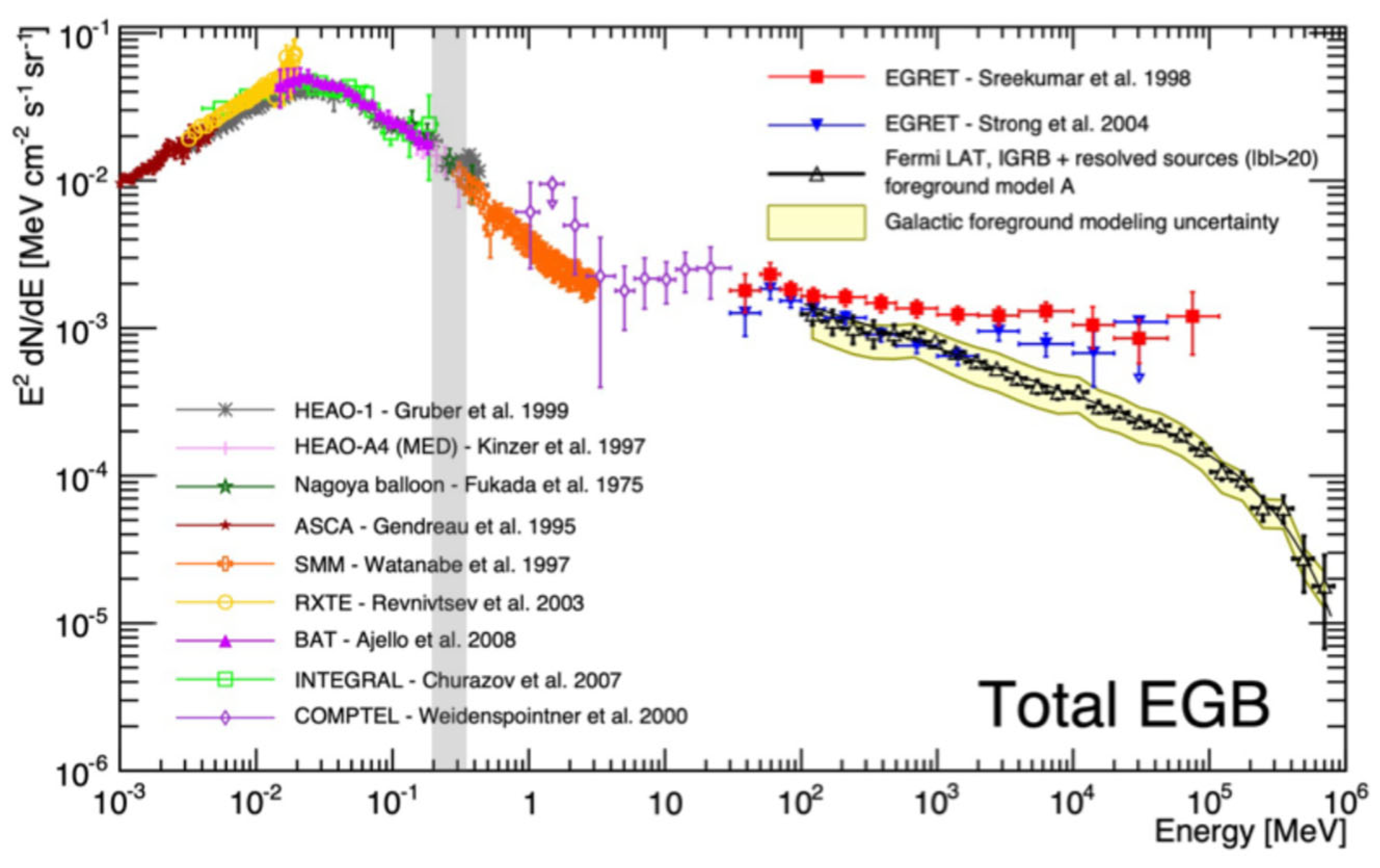
Section 4 suggest that electromagnetic emission or absorption features—if any radiative channels exist—would plausibly fall in the 100–400 keV range. In particular, the characteristic spin-dependent scale is of order
ΔEspin ≈ 100 keV, while the central energy-balance deficit associated with the compact matching solution is of about 260 keV.
No confirmed astrophysical feature has been identified with such a hypothetical signal, and the present work does not predict an actual transition rate, branching ratio, or line strength. The main observational implication is therefore limited to a suggested search window: sensitive measurements in the about 100–400 keV range, with good control of instrumental backgrounds, could constrain or exclude narrow excesses associated with any compact neutral e–p component, if to exist and radiate.
9.1. Galactic Rotation Curves and Cosmic Time Evolution
It is worth to emphasize that the following discussion is qualitative and is not intended as an explanation of galaxy rotation curves, nor as an alternative to nonbaryonic dark matter. The purpose is only to note that if a weakly interacting baryonic component were produced predominantly in energetic stellar environments, its abundance could increase with cosmic time.
In this context, it is of interest that Ref. [
20] reports that massive star-forming disk galaxies at redshifts
z ≈ 0.6–2.6 appear largely baryon-dominated within their observed radii, with rotation curves that decline at large radius, whereas many present-day (
z ≈ 0) galaxies exhibit extended nearly flat rotation curves commonly interpreted in terms of dark-matter halos. This phenomenology does not uniquely favor any particular explanation, but it illustrates that the “dark component” inferred in galaxies is not trivially constant in appearance across cosmic time and environments.
Likewise, systems such as NGC 1277 have been discussed as cases with comparatively little evidence for dark matter within the optical radius [
21]. Whether such diversity reflects baryonic feedback, halo contraction/expansion, selection effects, or other physics remains an active topic. In the present paper, this point is mentioned only to highlight that galaxy-scale phenomenology is complex, and therefore, any proposed compact baryonic component—if it existed—would require attentive modeling rather than simplistic claims.
9.2. Early-Universe Constraints (BBN)
If compact e-p configurations were produced in the early Universe with non-negligible abundance, they would be constrained by Big Bang nucleosynthesis (BBN), since BBN successfully accounts for the observed light-element abundances at approximately the percent level. Any scenario in which such objects form before or during BBN must therefore be strongly limited in abundance (at most at about the 1% level as an approximate benchmark [
22], depending on how the objects participate in nuclear reaction networks).
A quantitative treatment of formation channels and BBN reaction impacts is beyond the scope of this phenomenological study; BBN provides a strong consistency constraint that any early-Universe production scenario would need to satisfy.
9.3. Cluster Collisions (Bullet Cluster)
The Bullet Cluster provides a known testbed for dark-matter phenomenology, in particular the apparent separation between the X-ray-emitting intracluster gas and the gravitational lensing mass [
23,
24].
If compact neutral e–p configurations exist, their rest mass would be approximately
M(pe
-) ≈ 938.6 MeV/c
2, and for a typical cluster collision speed of about 1310 km/s, the kinetic energy of such an object is
T = ½
mv2 ≈ 10 keV. This energy is an order of magnitude lower than the 200-300 keV binding energy inferred from the virtual analysis discussed in
Section 2,
Section 3 and
Section 4, so such collisions are unlikely to ionize the compact e-p system or produce any radiative signature. In that case, the component passes through the hot gas with no necessary radiative signature, while remaining detectable through gravity (lensing)—qualitatively similar to the collisionless behavior inferred in cluster mergers.
9.4. Possible Connection to INTEGRAL MeV Lines
Many γ-ray lines seen by INTEGRAL/SPI instrument in approximately the MeV range are commonly attributed to activation and neutron-capture processes in spacecraft and detector materials. The INTEGRAL Collaboration has emphasized that reproducing the full richness and relative strengths of instrumental background lines is challenging in Monte-Carlo simulations, reflecting the complexity of activation processes and surrounding material [
25].
This motivates the general value of future instruments optimized for low activation (minimal surrounding mass, low-activation materials, and an orbit far from strong activation environments) when searching for weak narrow features. In the present context, the point is not that INTEGRAL instrument observed any small-hydrogen feature, but that high-resolution directional search, low-background instrumentation would be the appropriate way to constrain narrow spectral features in about the 100–400 keV band if one wishes to test the energy scales suggested by the present paper.
The astrophysical remarks above are included only as qualitative context and as potential sources of constraints; they do not constitute evidence for compact e-p configurations, and do not replace the need for laboratory tests and a full two-body QED/QFT (quantum field theory) treatment.
10. Conclusions
In this study, a relativistic, virial-inspired energy-balance analysis was used to test whether an electron confined to femtometer radii can remain self-consistent at the level of relativistic energy balance in an e–p system. Within the adopted phenomenological ansatz—including finite-size regularization and approximate spin-dependent contributions—the procedure yields a compact stationary radius at the few-femtometer scale. While this does not establish a physical bound state, it shows that relativistic kinematics and simple stationarity constraints do not, by themselves, exclude such a compact configuration within the assumptions of the model.
Within this framework, the dominant central energy scale associated with the compact solution is of about 260 keV, while spin-dependent contributions introduce a characteristic scale of about 100 keV. As soon as these values are not obtained from a two-body Hamiltonian eigenvalue problem or a first-principles QED bound-state calculation, they should be interpreted as indicative energy scales emerging from the consistency analysis, rather than as predictions of spectroscopic levels or transition energies.
The present study is intended as a consistency diagnostic rather than a microscopic theory. Determining whether such configurations exist in nature—and, if so, their formation probability, lifetime, decay channels, and dynamical stability—ultimately requires a full two-body treatment incorporating QED dynamics and proton structure.
If compact neutral e–p configurations exist and possess radiative or interaction channels, the keV-scale energies identified here motivate targeted laboratory and astrophysical searches in approximately the 200–310 keV range.
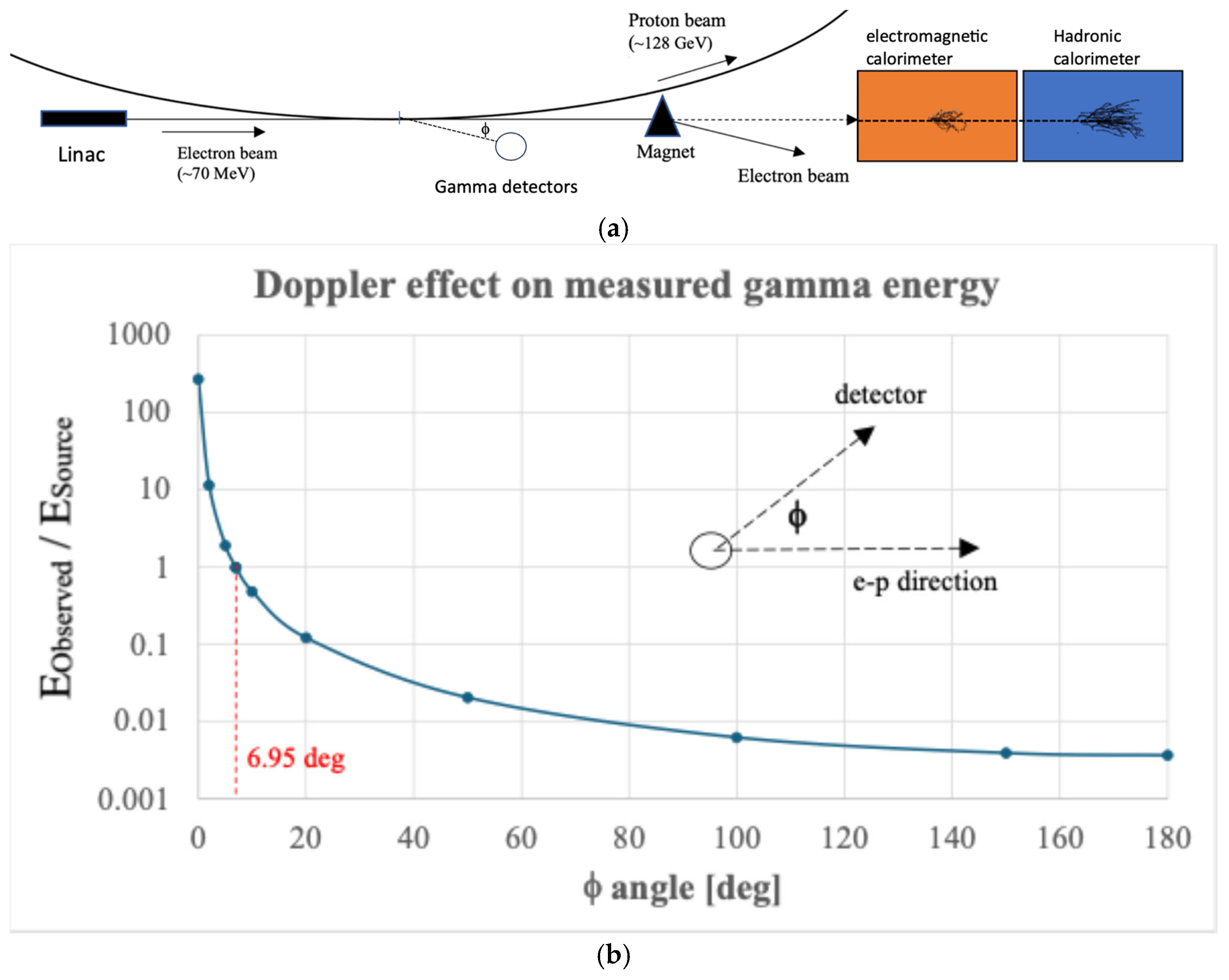
Appendix B outlines illustrative experimental strategies that could constrain or test this possibility.