1. Introduction
The mapping of the nuclear phase diagram and the study of the behaviour of nuclear matter under extreme conditions of density and temperature remain active areas of research. Relativistic heavy-ion collisions offer the possibility of investigating the nuclear matter under these extreme conditions. The matter produced in these collisions undergoes complex dynamics and can be studied in greater detail through the collective characteristics of the produced systems. In such collisions, a multitude of particles are produced, whose properties, such as energy and momentum, offer valuable insights into the system’s properties and evolution. Among these, strange hadrons serve as highly appropriate probe to investigate the dynamics of high-energy collisions. The enhancement of strange hadrons has been proposed as a signal of quark–gluon plasma (QGP) formation [
1,
2].
Different regions of the QCD phase diagram can be accessed through nuclear collisions at different energies. The various results from the RHIC-BES energy domain can reveal the change in the behaviour of the system produced in heavy-ion collisions in order to locate the collision energy range where the onset of deconfinement happens. Over the years, strangeness has proven to be an essential tool to study the properties of the matter produced in relativistic nuclear collisions and has revealed a number of intriguing results [
3]. In recent years, results from the HADES experiment provide complementary information from heavy-ion collisions at a few GeV [
4,
5]. STAR experiment data obtained in Au+Au collisions at the nucleon–nucleon center-of-mass energy
showed that strange particles participate in the collective behaviour of the system and hadronic interactions dominate in the fireball at this energy [
6]. The phenomenological parametrizations of strange hadron yields as a function of collision energy and number of participants, along with predictions from different transport models, are given in Ref. [
7] for heavy-ion collisions around threshold energies. The present results indicate a beam energy region below
for further investigation of the deconfinement phase transition [
8].
In this paper, the centrality dependence of the mean transverse momentum
of
produced in Au+Au collisions at RHIC-BES energies is investigated. The data were collected with the STAR experiment, one of the main experiments at RHIC [
9,
10]. Here, we investigate the behaviour of strange hadrons with respect to the transverse collective flow over a wide energy range (7.7–39 GeV). This phenomenon measured at kinetic freeze-out is crucial in the understanding of the dynamics of a heavy-ion collision because the transverse collective flow is entirely generated in the collision and develops throughout the entire evolution of the system [
11,
12].
Another possible signal of QGP creation was proposed by Léon Van Hove, suggesting that a plateau-like behaviour in the dependence of
as a function of particle multiplicity may indicate a first-order phase transition from hadronic matter to QGP [
13]. It is considered that the particle multiplicity is a measure of the entropy, while
reflects the combined effects of temperature and collective transverse expansion. Therefore,
should increase with the collision energy when the early-stage matter is either in an entirely confined or in an entirely deconfined phase, and it remains approximately constant when the matter is in a mixed phase [
13,
14]. The energy dependence of the inverse slope parameter of
produced at midrapidity in Au+Au or Pb+Pb collisions measured at AGS, SPS and RHIC energies has shown a plateau structure in the SPS energy range [
14,
15]. In this paper, we analyzed the dependence of the mean transverse momentum of strange hadrons produced in Au+Au collisions at
7.7–39 GeV on the average number of participating nucleons,
, based on the earlier results obtained in Au+Au, Cu+Cu and Pb+Pb collisions which showed that the charged particle multiplicity produced in these collisions depends on
[
16,
17,
18,
19].
Moreover, to explore how multi-strange hadrons interact within the medium and to enhance our interpretation of the data, the obtained -meson results were compared to existing data from RHIC, SPS, and LHC—the latter two accelerators providing the data from Pb+Pb collisions. This comparative approach considers improving the understanding of systems generated in relativistic heavy-ion collisions, offering a more precise view of nuclear matter behaviour under extreme conditions.
2. Study Details
This paper presents a study of the mean transverse momentum
of strange hadrons produced in relativistic nuclear collisions. The mean transverse momentum is obtained from the
spectra of produced particles in Au+Au collisions at midrapidity from the Beam Energy Scan (RHIC-BES) programme at RHIC.
,
,
, and
spectra were fitted using an exponential function:
while the
,
,
, and
spectra were fitted with a Boltzmann function:
where
is the rapidity,
is the transverse mass,
is the rest mass of the particle, and
,
and
are the fit parameters. The fit range for
,
,
and
was
, and for
,
and
it was
at all energies, with
c the speed of light.
The mean transverse momentum of the strange particles was obtained by integrating the whole range of
spectra as follows [
20,
21]:
where the functions from Equations (1) and (2) were used to calculate the integrals of
.
As the energy increases, the contribution of soft and hard processes in the particle production varies, therefore the study of the particle production dependence with respect both to the number of participant nucleons,
, and to the number of binary collisions,
, is essential. It is considered that particle production scales with
when there is an intense rescattering phase in the fireball and soft processes dominate. These soft hadrons, which decouple from the collision zone in the late hadronic freeze-out stage of the evolution, can provide information about the fireball dynamics and thermalization degree of the system. Experimental results from SPS confirmed such an
scaling for the charged particle multiplicity produced in Pb+Pb collisions [
16,
17,
18]. When relativistic nuclear collisions are modelled as a superposition of binary nucleon–nucleon collisions, hard processes dominate over the soft particle production, and a scaling with
is expected. Results from higher RHIC energies and from LHC show that there is quite a large contribution of hard processes to particle production [
22,
23,
24,
25], while at SPS energies no significant scaling with
was observed, indicating that the contribution from hard processes to charged particle production is quite small at this energy range [
26].
The HADES experiment
and
yields obtained in Au+Au collisions at
have been parametrized by a power-law dependence on
,
with a power-law exponent
[
4]. The same behaviour was observed by the STAR Collaboration in Au+Au collisions at
for
,
and
hadron production with similar values within errors of the power-law scaling parameter both for
and midrapidity yields [
6]. This common scaling of the strange hadrons with
was interpreted as indicating similar production mechanisms for these particles. As the beam energy increases, at RHIC-BES energies, the
parameter was found to decrease with collision energy and almost to saturate at the RHIC top energy [
6]. The observed behaviour of the power-law exponent
, from values significantly exceeding unity (
1.35–1.45 at HADES and STAR FXT energies to a near-linear dependence (
) at higher RHIC energies, may indicate a change in strangeness production: from hadronic rescatterings in a baryon-stopped medium to partonic production in the hot and dense medium created at higher beam energies.
As the data show that dependence is appropriate to describe the strange particle production in heavy-ion collisions at the RHIC-BES energy range, we considered a similar dependence to describe the dependence of the mean transverse momentum of these particles. The dependence of on can be parametrized using a power law, analogous to particle yields, since both observables are driven by the same initial-state conditions and reflect the system’s response to increasing energy density and pressure gradients with centrality.
Therefore, the
dependence on the collision centrality can be expressed as a function of the number of participant nucleons considering a power-law function as follows [
27,
28]:
where
is a normalization coefficient and
is the exponent parameter. While the power-law
dependence of strange hadron yields reflects the particle production mechanisms, the analogous
dependence of
is related to the dynamical evolution of the system, providing insights on how the initial compression and subsequent expansion due to the pressure gradients are converted into collective transverse flow. In more central collisions, the increased number of participants leads to a higher energy density within the system, which generates stronger pressure gradients due to the enhanced rescatterings between the fireball constituents. Therefore, a more intense collective flow develops during the system expansion.
Although both particle production mechanisms and system expansion are driven by the collision centrality (), the parameter is sensitive to the inelastic interaction rate, while the parameter is sensitive to the generated pressure and the collective expansion of the medium.
In the present study, the degree of the flattening of
for strange mesons and baryons produced in Au+Au collisions at
7.7–39 GeV is characterized with respect to participant number,
. The
parameter dependence on the particle species and collision energy is studied. A similar study was performed for bulk particles (
,
,
and
) produced in Au+Au and Pb+Pb collisions in a wide energy range [
27,
28] showing that such an approach is suitable to describe the
dependence of the mean transverse momentum.
This study can help to improve the understanding of the particle production of strange particles and their dynamics in this energy domain and can be relevant for the future experiments at FAIR and NICA [
29,
30].
3. Results
Since the mean transverse momentum of produced particles is obtained by integrating over the particle spectra, it is dominated by the properties of hadronic spectra in the relatively low range. These distributions are essential physical observables in relativistic heavy-ion collision studies and provide information on hot nuclear matter properties such as thermalization and transverse collective flow generated by system expansion in both partonic and hadronic stages. Therefore, it is of interest to analyze as a function of in order to study the system’s evolution and correlate with the collective behaviour developed by the produced particles. This approach allows us to see how varies with the centrality of the collision, taking into consideration each particle species. In more central collisions, a system that is denser and hotter is formed, leading to stronger radial flow, and thus the values are expected to be higher than for smaller systems produced in peripheral collisions.
Strange hadrons are considered to be suitable probes to investigate the created medium, as they are not present in the initial state and are produced during the collision. They freeze out earlier than non-strange particles, giving access to early-time dynamics [
31].
The dependence of the mean transverse momentum as a function of the number of participants
is presented for a wide range of beam energies (
and
). Based on the
spectra, the mean transverse momentum was obtained using Equation (3), for all centrality classes provided by the STAR Collaboration data from Refs. [
8,
32,
33].
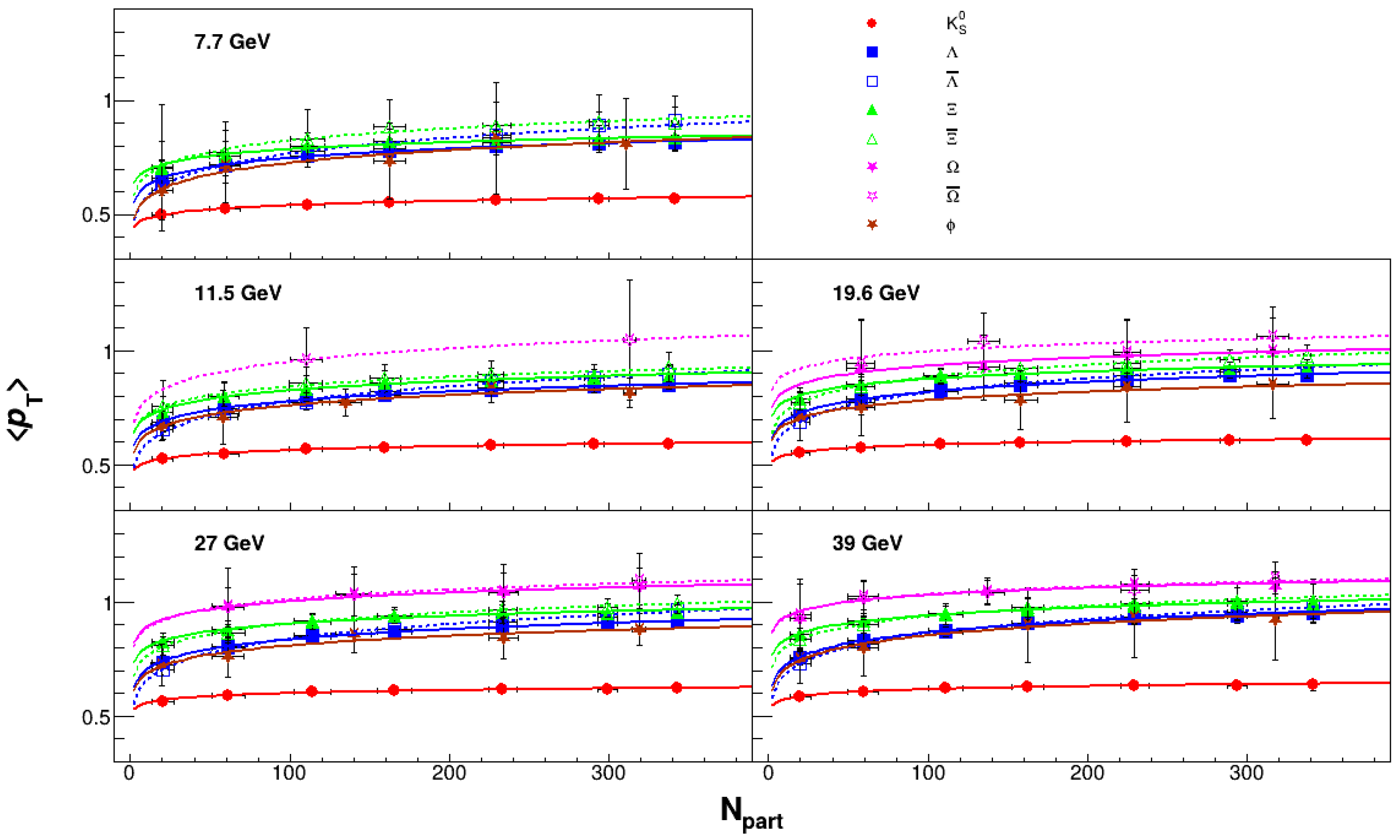
Figure 1 shows that
increases with
for all energies, consistent with stronger collective flow in central collisions. This shows a gradual development of the transverse collective motion as the overlapping region increases. In peripheral collisions, a smaller system is created, leading to a weaker collective flow and lower
values. The fireball has a shorter lifetime, and the particles do not have enough time to develop a collective flow that would significantly affect their transverse momentum spectra.
Distinct centrality dependence of the mean transverse momentum of strange particles has been observed [
34], providing evidence of the influence of the collective flow that is more significant as the interacting region size increases.
It can be observed that
increases with the particle mass for all RHIC-BES energies and all centralities. This is due to the development of the transverse collective flow generated in the hydrodynamic expansion of the fireball. For
, the increase is less significant than for particles with greater mass. This implies that the contribution of transverse collective flow scales with particle mass; thus,
hadrons show a weaker centrality dependence [
35].
Particles and antiparticles have similar spectral characteristics at midrapidity. Therefore, they possess a similar within errors, as they interact similarly inside the fireball and acquire the same collective flow velocity, confirming that the behaviour of identical particles under nuclear forces is charge-independent.
In the RHIC-BES energy range, values show slight increase as the energy rises.
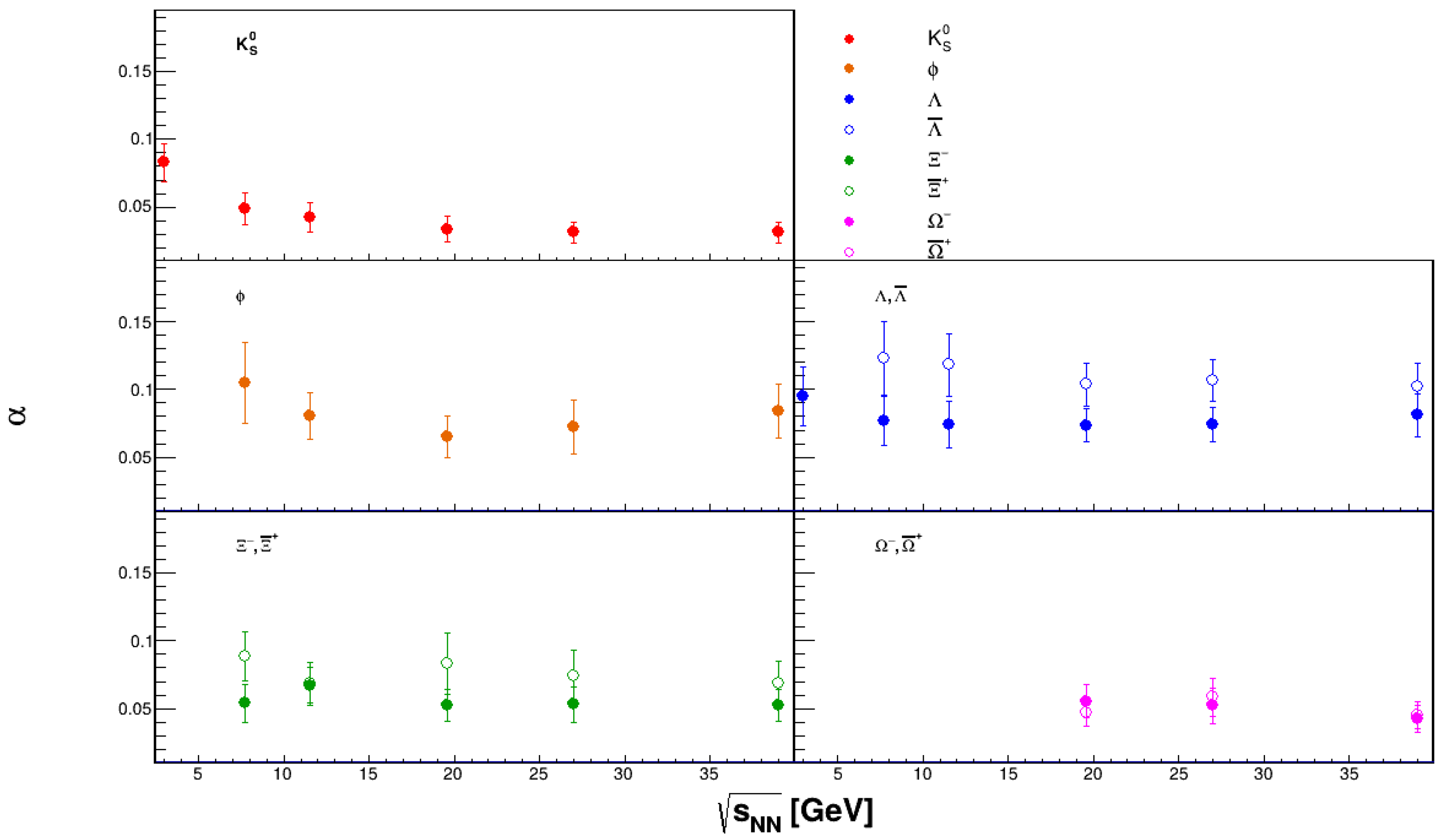
Figure 2 summarizes the collision energy dependency of the power-law exponent parameter
for the strange hadrons obtained from the power-law fit (4) and presented in
Table 1. The
parameter values for
and
decrease from
towards
, while for higher RHIC-BES energies, those values tend to saturate.
The
baryon
values are smaller than those of
baryons over the entire energy range studied. The strongest difference between the two values is for the 7.7–11.5 GeV energy interval. These results can indicate that hadronic processes, such as baryon–antibaryon annihilations due to the baryon-rich environment, influence the final hadron production for the RHIC-BES lower energy region [
8]. The energy dependence of various particle ratios showed a maximum at
, indicating a maximum net-baryon density around this collision energy [
36,
37]. Therefore, the annihilation processes have an impact on the slope of
spectra for
and
baryons, resulting in differences in the
dependence of
for these baryons. A similar behaviour was observed in Ref. [
27] in the case of
parameter values for
and
produced in Au+Au collisions at RHIC-BES energies [
36], indicating the impact of annihilation processes on antibaryon production due to a higher baryon density in the collision fireball in heavy-ion collisions at lower beam energies.
The and data points measured by the STAR experiment in Au+Au collisions at were included for comparison with the RHIC-BES results. The larger coefficients at this lower energy suggest that the mean transverse momentum scales more strongly with the number of participants than at higher collision energies, indicating a more efficient transverse expansion driven by the intense pressure of compressed baryonic matter.
For all RHIC-BES energies, a similar difference between () and () can also be observed; however, this gap between the baryon and antibaryon values is smaller compared to the - comparison. Due to low statistics, the and spectra at are measured for a 0–60% centrality, while for , the and spectra are for a 0–10% and a 10–60% centrality. Therefore, the parameter for and was extracted only for the 19.6–39 GeV energy range.
For the higher RHIC-BES energies (19.6–39 GeV), the parameter values for all strange hadron species, including the and hadrons, seem to be constant with energy within errors.
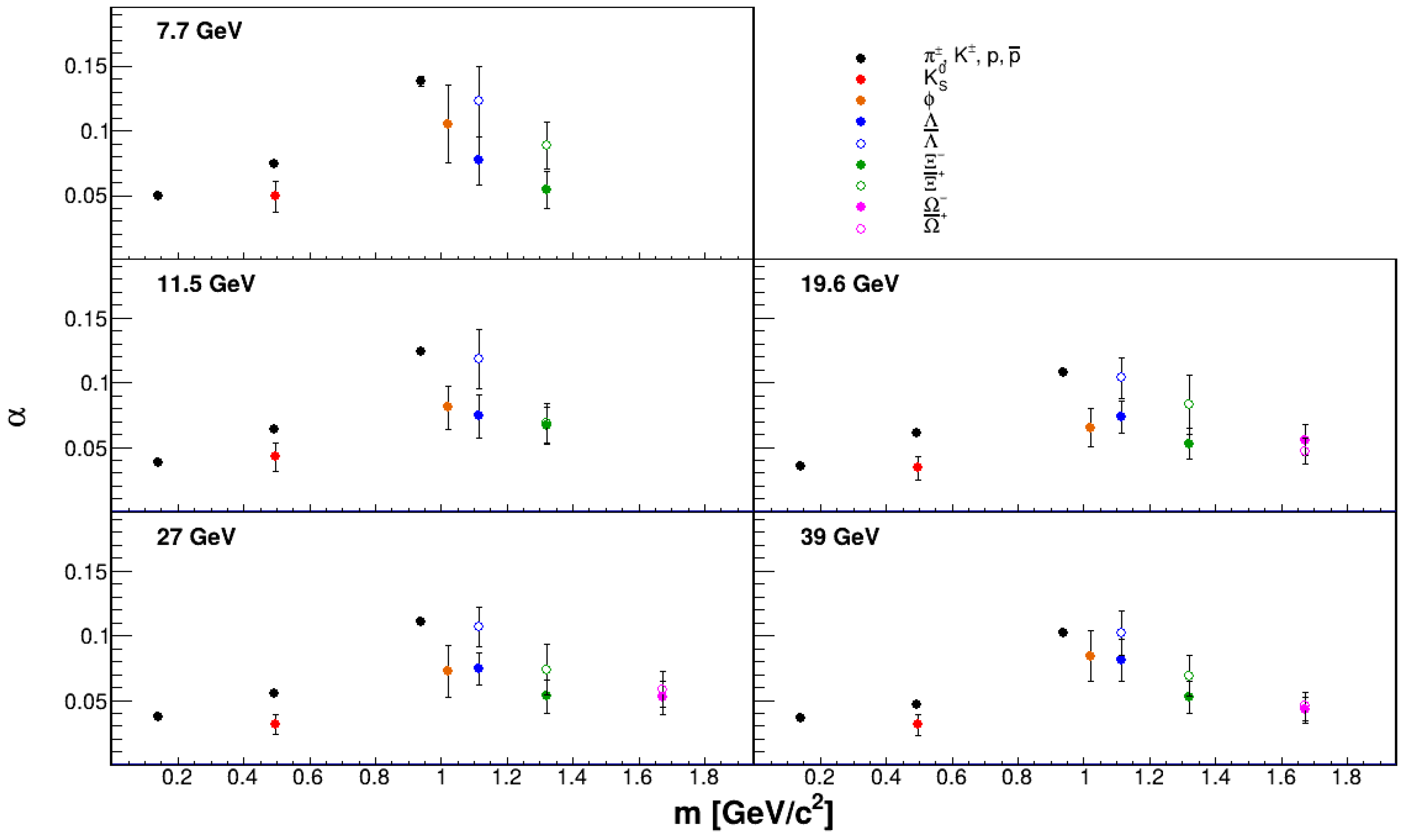
The mass dependence of the
parameter is presented in
Figure 3. The
parameter values for strange hadrons are compared to the values of the
parameter for
,
,
and
taken from Ref. [
27]. For all RHIC-BES energies, the
parameter increases with the particle mass from
to
and
, and then starts to decrease for
and strange baryons and antibaryons. In a hydrodynamic expansion, the produced particles are moving in the fireball with a common collective flow velocity. The heavier particles (
/
) receive a larger boost in momentum from this collective flow compared to lighter particles (
). Therefore, in more central collisions, the
of protons grows faster with
than that of
, leading to a higher power-law exponent. The decrease in the
parameter for the
-meson and strange baryons may indicate that these particles interact less in the fireball due to their smaller interaction cross-section. Therefore, they acquire less radial flow in the system evolution, leading to a weaker dependence of their
on
.
The degree of flattening in the dependence on the can be related to the parameter value: a smaller value of the parameter is correlated to a higher degree of flattening of the distribution, implying a reduced sensitivity of to centrality. The smallest value for the parameter among strange hadrons is for / hadrons, indicating the largest degree of flattening in the case of these particles.
To compare the results presented in Ref. [
27] with the present study, in
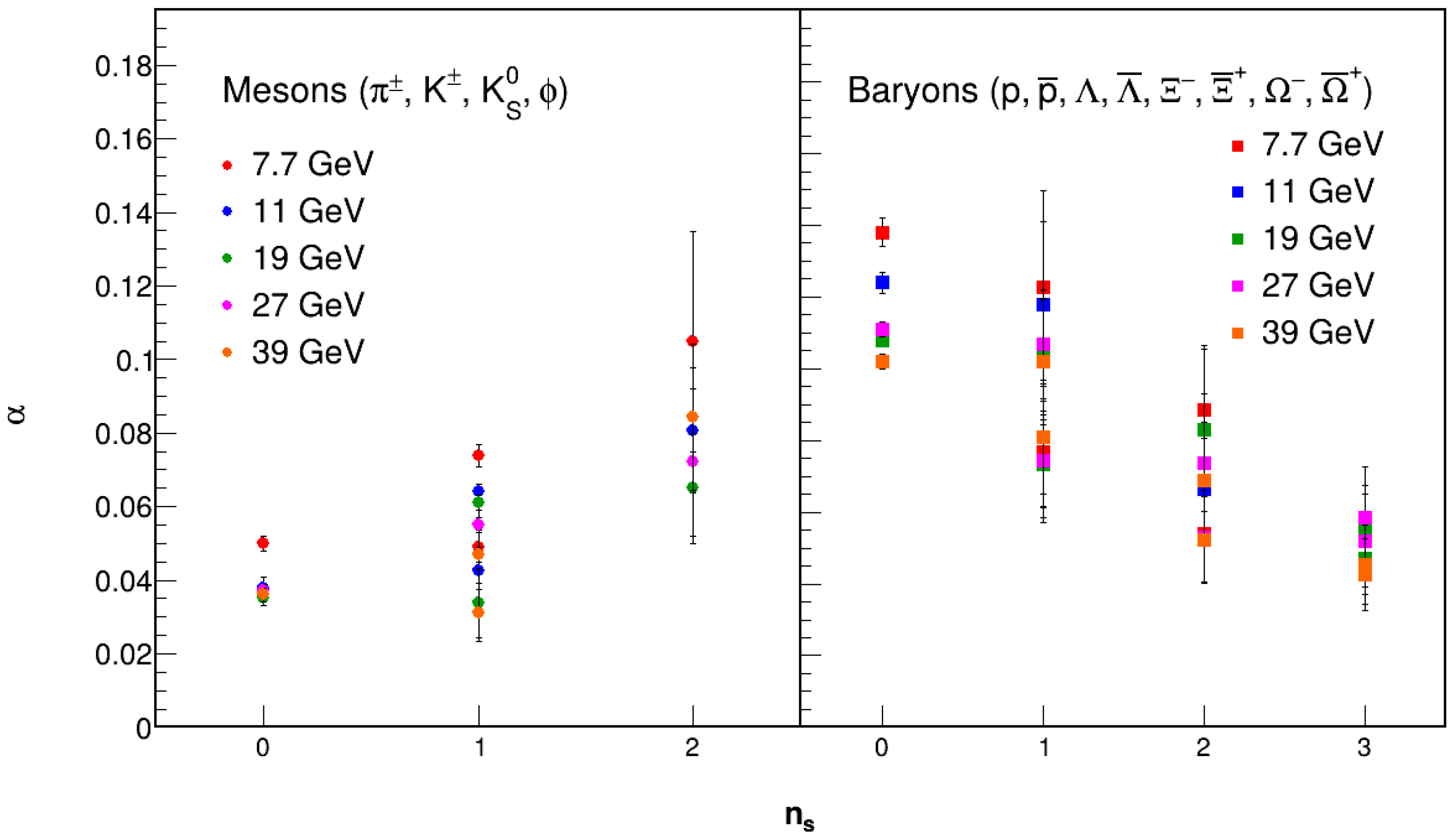
Figure 4, the parameter
is presented as a function of the number
of constituent strange quarks in the studied hadrons. For mesons, the
parameter increases with the number of strange quarks, while for baryons, the
parameter decreases as
increases. This behaviour may indicate a competition between mass-dependent hydrodynamics and flavour-dependent decoupling during the fireball’s expansion. For mesons, the increase in
from
to
-mesons shows that the particle mass is the dominant factor in acquiring radial flow. The higher mass of
compensates for its smaller interaction cross-section to produce a larger radial flow boost than the lighter kaons.
For the baryons (where the mass differences are not so large), the strangeness content becomes significant; as the number of strange quarks increases, the particle reduced hadronic cross-sections lead to a possible sequential freeze-out, causing them to decouple earlier from the fireball and resulting in a decrease in with
When comparing the -meson and p coefficients, even though the -meson is heavier than the proton, its smaller coefficient suggests that its smaller hadronic cross-section causes it to decouple from the system earlier.
A similar behaviour was observed for the mass dependence of the inverse slopes of the transverse mass spectra of particles produced in Pb+Pb collisions at
(the inverse slopes of the
and
baryons fall below the linear trend observed for the
,
and
points) [
38] and was interpreted as due to an early freeze-out of multi-strange hadrons [
39]. Also, the blast-wave (BW) studies for Pb+Pb collisions at SPS energies have shown that strange hadrons decouple from the produced system earlier than the bulk hadrons at a higher freeze-out temperature and have a smaller transverse collective flow velocity [
38,
40]. A similar BW study, performed on the non-strange and strange particles
spectra obtained in Au+Au collisions at RHIC-BES energies, has also shown that the
,
,
and
behaviour in the created fireball is similar, indicating a double kinetic freeze-out scenario due to the separate decoupling of bulk and multi-strange particles [
12]. The power-law parameter
behaviour provides support for a double kinetic freeze-out scenario. While the bulk particles remain coupled to the expanding medium through the late-stage hadronic rescattering stage, the
,
and
hadrons decouple prematurely. Consequently, their
does not grow as strongly with centrality, and their scaling parameter start to decrease compared to the protons.
Multi-strange hadrons such as
-mesons and
-hyperons are significant probes of the QGP–hadronic matter phase transition [
41,
42]. Earlier studies [
39,
43,
44] have suggested that
-mesons have a relatively small hadronic interaction cross-section than ordinary hadrons. Therefore, these particles carry information about the early stages of the system’s evolution since they are mostly unaffected by later hadronic rescatterings. However, the nuclear matter produced in heavy-ion collisions at different beam energies and centralities has different size and geometry, as well as various evolution times of possible partonic and hadronic stages.
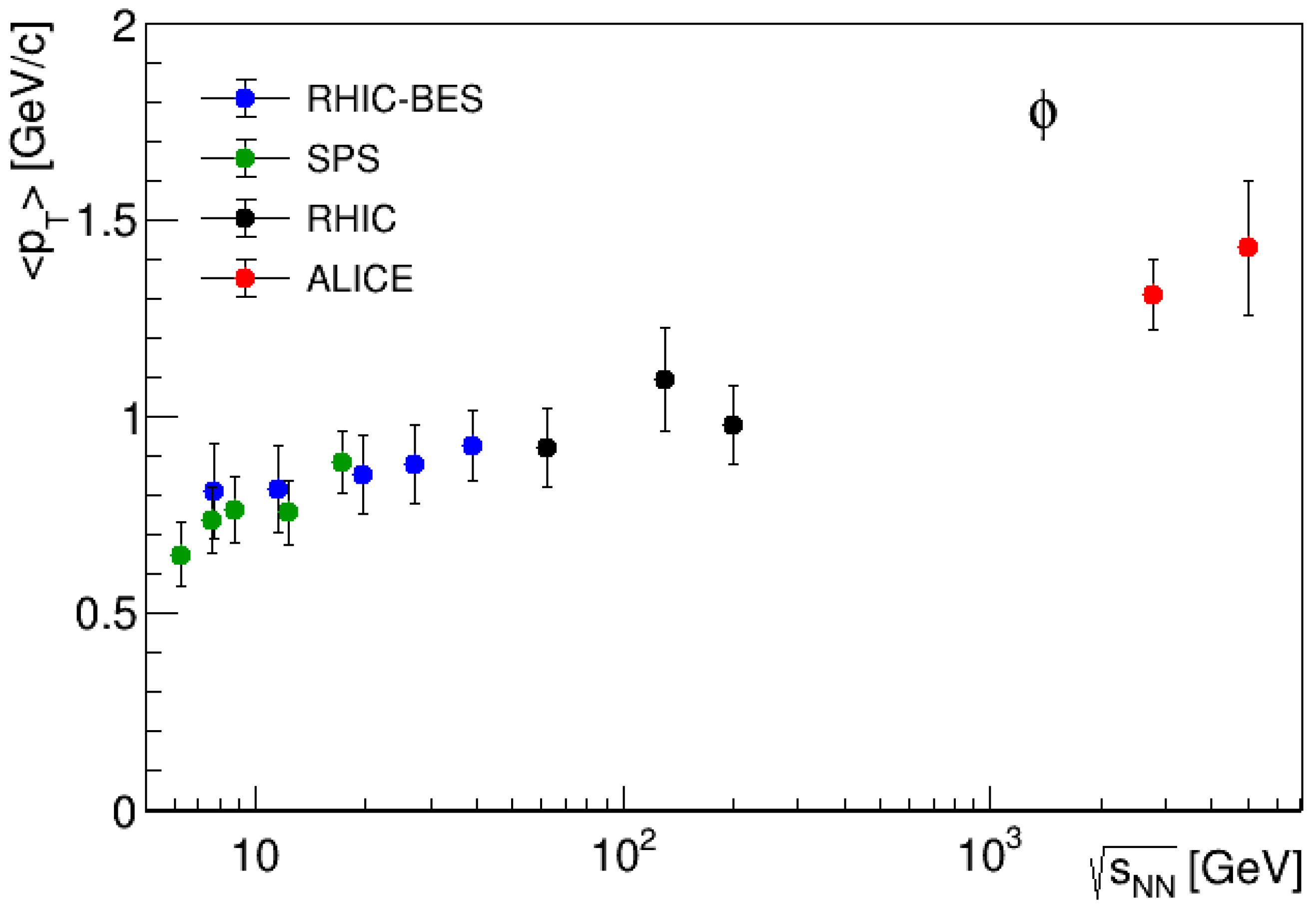
Figure 5 shows the collision energy dependence of the mean transverse momentum of
-mesons produced at midrapidity (
) in most central Au+Au collisions at
7.7–39 GeV Additionally, for comparison,
measured in central Pb+Pb collisions at
6.3–17.3 GeV at SPS [
45], in central Au+Au collisions at
and
at RHIC [
46] and in central Pb+Pb collisions at
and
[
47,
48] was added. The SPS results are consistent with the RHIC-BES results from this study. It can be seen that the
slowly increases with energy from RHIC-BES and SPS energies up to the highest RHIC energy. The LHC data show an increase of about 25% in
compared to RHIC top energy. The
values are larger for higher energy collisions, indicating increasing radial flow with beam energy.
In Ref. [
49], it is considered that
generation has two main sources: the partonic interactions in the early stages of the collision and the fireball expansion in both partonic and hadronic stages. Therefore, the stronger increase from top RHIC energy to LHC energies may point to an interplay between the increased role of partonic degrees of freedom in the fireball and a stronger system expansion and, correspondingly, a significant increased collective radial flow.
The HBT radii scale linearly with the charged pseudorapidity density
[
50,
51], and therefore the
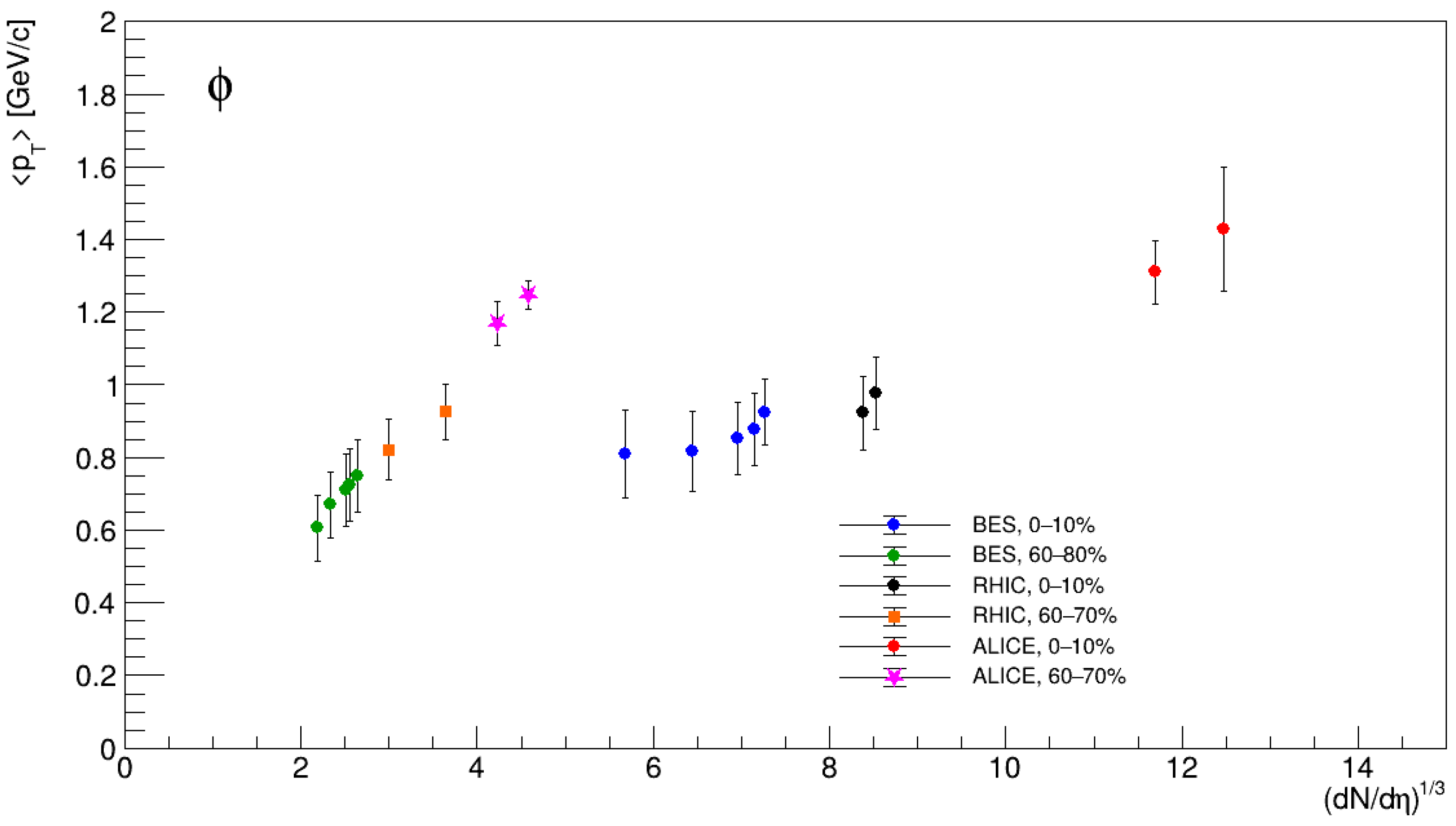
variable can be used as a measure for the system radius in heavy-ion collisions. The system size dependence of the
mesons
produced in central and peripheral Au+Au and Pb+Pb collisions is presented in
Figure 6. If one considers that the strength of rescatterings is related to the distance travelled by the produced particles in the system, then
increases with system volume. The data presented in
Figure 6 shows two distinct trends: one for central (0–20% centrality for Au+Au collisions at
, 0–10% centrality for RHIC-BES data, Pb+Pb collisions at
, and 0–5% centrality for Au+Au collisions at
and Pb+Pb collisions at
) and another for peripheral collisions (60–80% centrality for RHIC-BES data and 60–70% centrality for RHIC and LHC data). The different trend observed in peripheral heavy-ion collisions could be due to the stronger radial pressure gradients created in a shorter lived, smaller volume fireball [
52].
Due to its smaller interaction cross-section, the -meson decouples early and does not follow the full dynamical evolution of the system. At the same time, in central collisions the system size increases strongly with energy. Therefore, the increase in with system size is slower. In peripheral collisions, the -mesons also considered to decouple early from the system, but in this case the increase in the system radius with energy is weaker, which leads to a different trend in the behaviour of with system size. In addition, in peripheral collisions, the uncertainties and systematic effects become essential and may influence the results and trends obtained.
In Ref. [
13], the onset of deconfinement is associated with a plateau-like saturation of
as a function of multiplicity, reflecting the change in the nuclear matter equation of state (EoS). Such a plateau-like behaviour was observed for the RHIC-BES energy range in the
,
,
and
mass dependences on the
in Ref. [
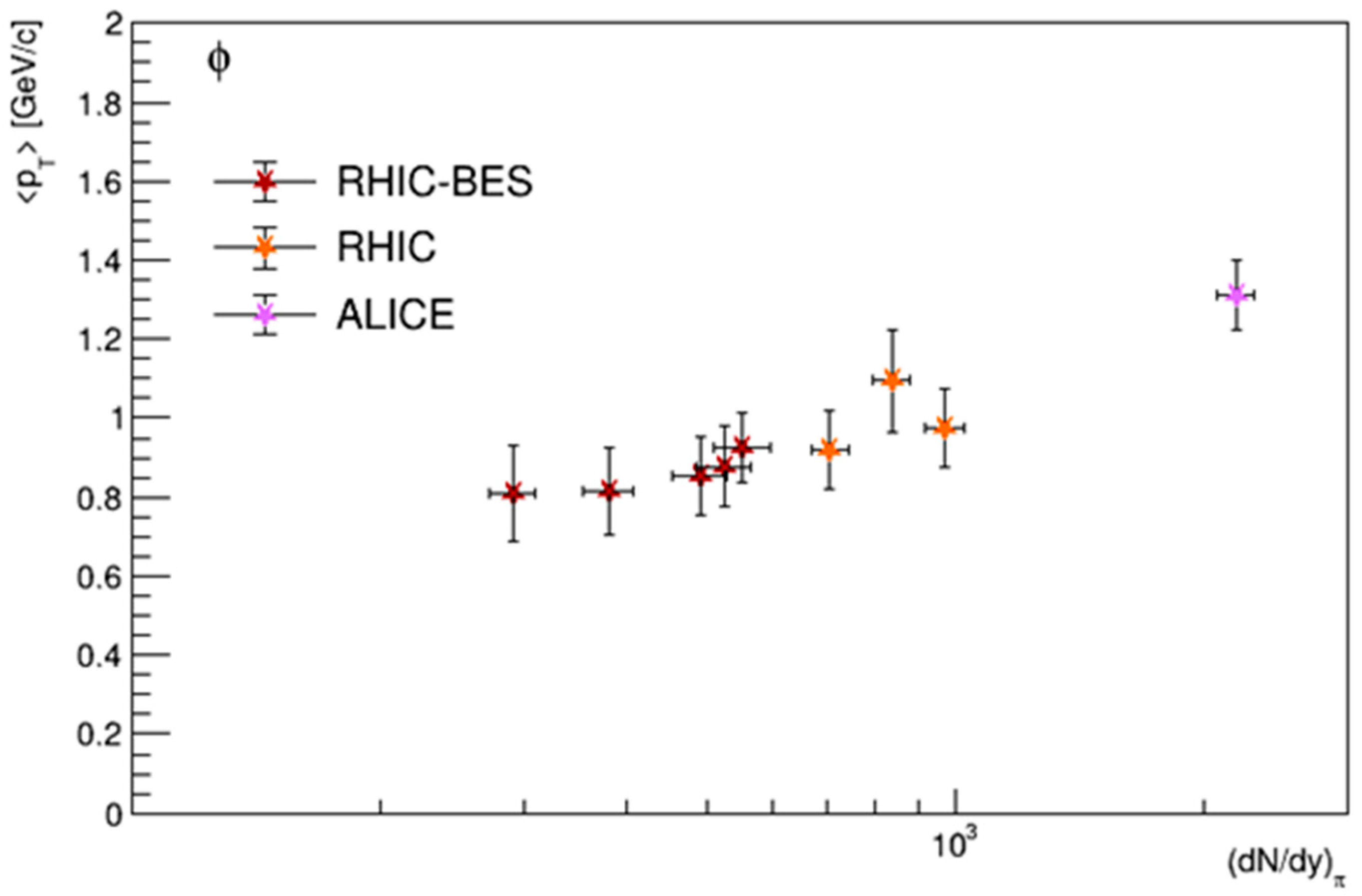
36]. Since the pions are the most abundant particles in relativistic nuclear collisions due to their low mass, their rapidity density serves as an indicator of the generated entropy. Therefore, to also consider the
produced in the collision, the pion rapidity density is calculated as
The charged-pion densities were taken from Refs. [
36,
53,
54]. The mean transverse momentum of
-mesons as a function of the
rapidity density is shown in
Figure 7. It can be seen that there is a change in the behaviour of mean transverse momentum between the first two lower RHIC-BES energies and
; after
, there is a continuous increase with pion rapidity density up to the LHC
energy. The first two points, corresponding to the 7.7–11.5 GeV energy range, suggest a possible plateau-like behaviour that may indicate the onset of deconfinement at these energies.
4. Discussion
The dependence of
on the charged-particle multiplicity,
, can reveal particle production mechanisms. The increase in
with
in
(
) collisions at various energies [
55,
56,
57] was explained as due to a hadronization process which contains colour reconnections [
58]. The LHC data from pPb collisions cannot be described by a binary collision superposition of pp data, but the collective flow and initial state effects need to be taken into account. In Pb+Pb collisions at LHC energies, a weaker multiplicity dependence is observed and the data are not well enough described by most event generators [
59]. At lower beam energies, the particle production is described by a combination of soft and hard processes, with an increased contribution from soft processes as the energy decreases [
16,
17,
26].
In the present study, the participant number dependence of the mean transverse momentum of strange hadrons produced in Au+Au collisions at RHIC-BES energies was studied using a simple power-law function. A similar study performed in Refs. [
27,
28] for
,
,
and
produced in Au+Au and Pb+Pb collisions in a wide energy range showed that the
coefficient is identical for the
and
produced in Pb+Pb collisions at
, indicating that u, d and s quarks behave the same in the highly thermalized QGP produced in these collisions and there are similar production mechanisms for pions and kaons.
As observed from
Table 1 and
Figure 2 and
Figure 3, the
parameter for strange hadrons shows dependences on both the particle species and collision energy. The
parameter increases with mass for bulk particles (
,
,
and
) produced in Au+Au collisions at RHIC-BES energies, while for
mesons and strange baryons and antibaryons, it decreases with mass. These results can indicate different shapes in the
dependences and, consequently, for
spectra. A smaller value of the
parameter indicates a flatter dependence and, consequently, a weaker dependence of
on the participant number.
and
baryons, which have smaller hadronic cross-sections, likely decouple earlier, resulting in weaker collective flow and a flatter
dependence [
38,
40]. Therefore, their mean transverse momentum may exhibit a weaker dependence on the participant number.
The different values of the
parameter for the strange particles and antiparticles are most probably caused by the varying contributions of different mechanisms of production of particles and antiparticles. There is an interplay between particle–antiparticle pair production, which increases with the increasing collision energy and the associated production of strange baryons with kaons through nucleon–nucleon interactions [
28]. The yields of the anti-hyperons (
,
,
) and
-meson produced in Au+Au collisions at RHIC-BES increase rapidly with increasing energy [
8]. The STAR experiment results have shown that the
and
yields increase with energy from
to
and then remain almost constant up to energies around
. In addition, the absorption of antibaryons due to annihilation in a baryon-rich environment influence the yields and, consequently, the
parameter values.
The
parameter values for strange hadrons decrease with energy for the two lower RHIC-BES energies, while for the 19.6–39 GeV energy range, no energy dependence is obtained. These results are qualitatively consistent with other RHIC-BES observables, which indicate that, at the two lower RHIC-BES energies, the system behaves as a hadron gas, while at higher RHIC-BES energies, deconfined matter can be produced [
60,
61,
62].
AMPT-generated data were analyzed and compared to experimental data in order to determine how string melting influences particle production and the transverse collective flow observed in nuclear collisions. The AMPT model is a hybrid model for simulating heavy-ion collisions, which includes the initial conditions, partonic interactions, hadronization, and hadronic interactions [
63]. There are two versions of the AMPT model: the default version which focuses on the hadronic interactions and the string-melting (SM) mode which assumes a partonic, deconfined phase and is better suited for heavy-ion collisions where a quark–gluon plasma is expected to form [
64].
The initial conditions, describing the spatial and momentum distributions of minijet partons along with string excitations, are generated from the HIJING model [
65]. The simulation of parton scatterings and parton transport is performed by Zhang’s parton cascade (ZPC) model [
66]. In the default version of the AMPT, the minijet partons in the parton cascade recombine with their parent strings to form hadrons via Lund string fragmentation [
67], while in the string melting mode, the excited strings are converted to partons and a quark coalescence model is used to describe parton hadronization. Consequently, the evolution of the produced hadrons is governed by a relativistic transport model [
68]. For the present study, we used the following parameter values: the QCD coupling constant
and the screening mass
, corresponding to a parton scattering cross-section of
. The centrality selection was obtained based on impact parameter distribution.
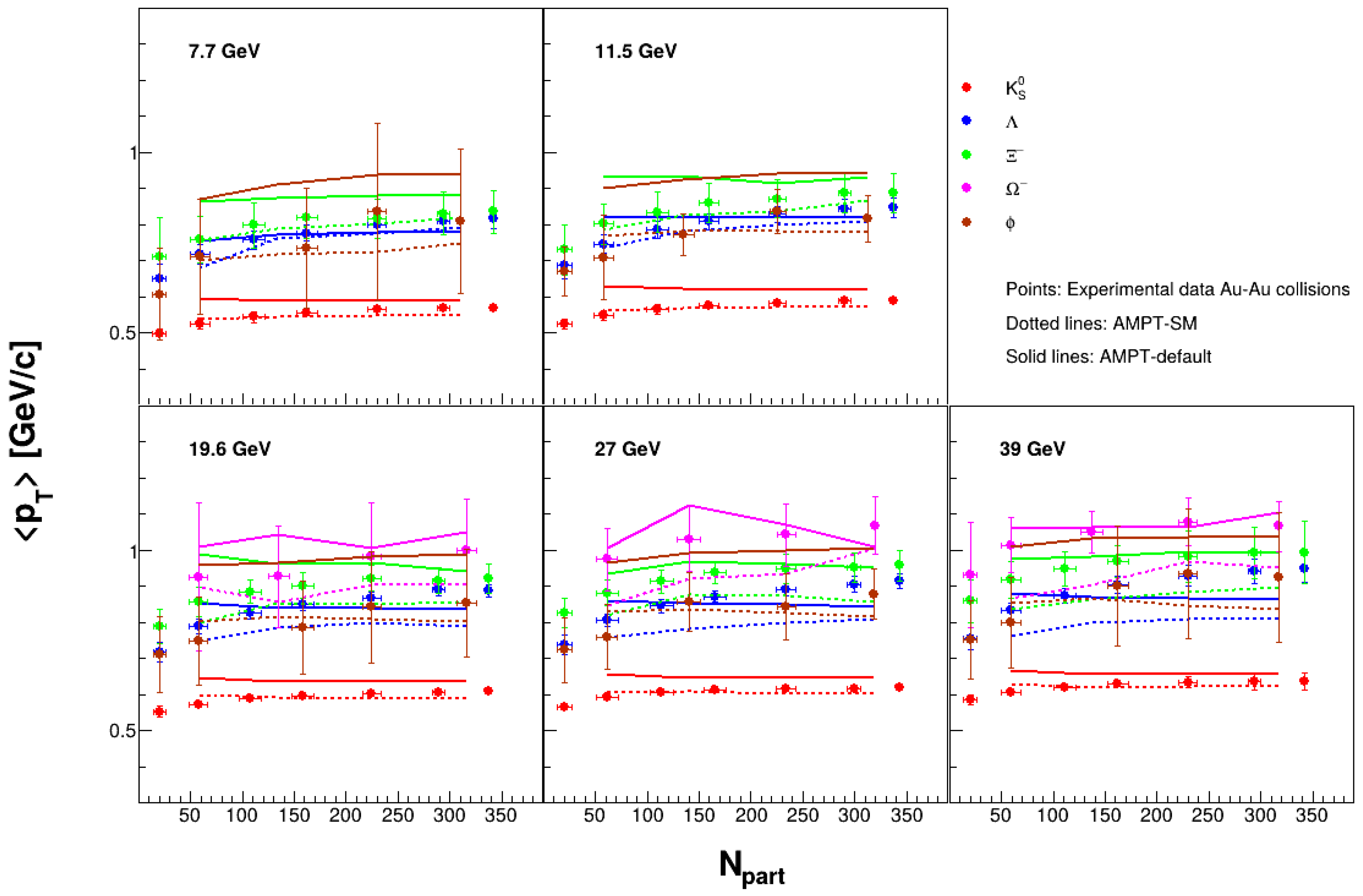
Figure 8 shows the comparison of the
,
,
,
and
experimental results with the AMPT code (default and string-melting versions). The
and
AMPT-SM results better describe the data for all analyzed energies, while the AMPT-default results are larger compared to the data. In the case of
baryons, the AMPT-default results describe better the data within errors, while the SM version underpredicts the data, especially in the 19.6–39 GeV range. For
baryons, the lower energies are described better by the SM version, while for the higher RHIC-BES energies, the default version results are closer to the data. For
baryons, the comparison was made in the 19.6–39 GeV energy range due to incomplete centrality coverage for
and
, and it is observed that the default version describes better the
results. These results suggest that there looks to be a change in the underlying strange quark dynamics in the produced matter during Au+Au collisions in the RHIC-BES energy range.
The centrality dependence of the simulated mean transverse momentum was studied using Equation (4), and the extracted
parameter values are presented in
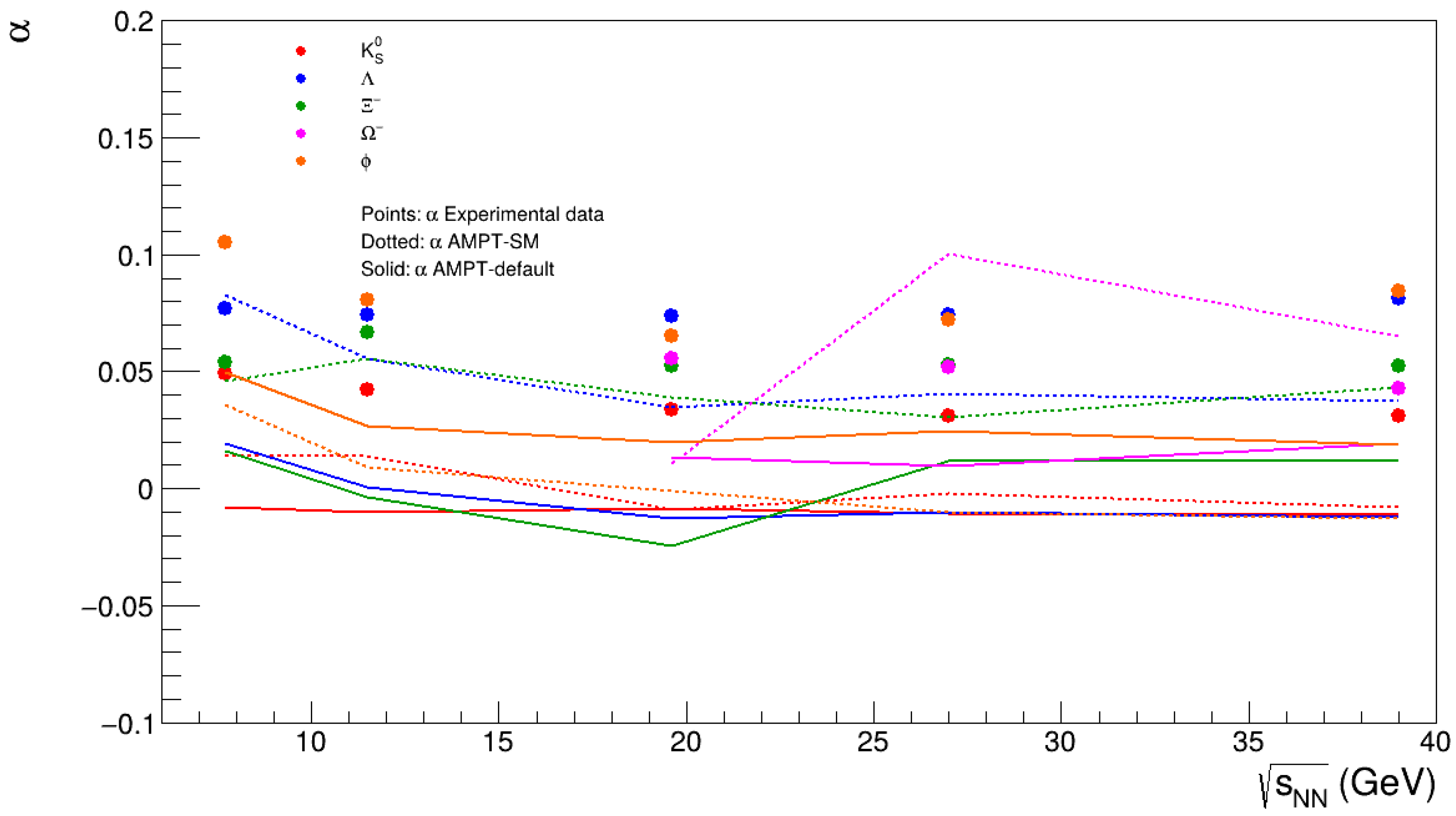
Figure 9. For
,
,
, and
, the AMPT-SM
values are larger than the default version AMPT α values; however, both AMPT model versions underestimate the
parameter values obtained based on the experimental data. In
Figure 8, a weaker centrality dependence of the mean transverse momentum is observed in the simulated data, which determines much smaller values of the
parameter. Therefore, we observe that neither the default nor the SM model found to consistently describe the energy dependence of the
parameter.
5. Conclusions
In summary, the study of the mean transverse momentum of particles produced in relativistic nuclear collisions provides insights into the properties and dynamics of the system created.
The mean transverse momentum of strange hadrons produced in Au+Au collisions at RHIC-BES energies , and as a function of was presented.
In the studied Au+Au collisions, for each strange particle species, the results showed that the mean transverse momentum values are higher in central collisions than in peripheral ones, suggesting a gradual development of the radial flow with increasing system volume.
Additionally, the mean transverse momentum, , increases with increasing mass of the particles for all energies considered in this study. This supports the interpretation that the increase in transverse momentum scales with particle mass, due to the influence of the collective flow. Particles with a smaller mass are less influenced by this flow compared to particles with a larger mass. A slight increase in mean transverse momentum with increased energy in the RHIC-BES energy range was observed.
In this study, the energy dependence on the power-law exponent parameter of strange hadrons indicates that for the two mesons considered in this study, and , decreases from towards , after which the values remain approximately constant for higher energies. Moreover, for the two lower RHIC-BES energies, the values are smaller for and baryons compared to their corresponding antiparticle values. This discrepancy is less significant for and baryons. Starting from , the values for all particles considered show a weaker energy dependence.
For each energy considered, the parameter as a function of particle mass was shown. Alongside the strange hadrons considered throughout this study, this analysis included , , and . The parameter values are linked to the degree of flattening of . Smaller values indicate a weaker dependence of on . It was observed that the parameter shows an increasing trend with particle mass from up to the and mass, beyond which, for heavier particles, it starts to decrease.
The energy dependence of the of -meson was studied over a wide range of energy (using data from RHIC-BES, RHIC, SPS and LHC). increases gradually with energy, while a more significant increase is seen in the LHC data compared to the highest RHIC energy. The centrality and system size dependence of was shown. Two distinct trends were observed: one for central collisions, where the system radius grows rapidly with energy, but the increase in remains slow due to the early decoupling of -meson, and another for peripheral collisions, where a smaller, shorter-lived fireball is formed, leading to a steeper increase in values. These two distinct trends highlight the influence of the system size and medium lifetime on the development of collective flow which contributes to the values.
The dependence of of -mesons on the rapidity density, considered as a measure of the produced entropy, showed a possible plateau-like shape in the 7.7–11.5 GeV energy range, which can suggest the appearance of a mixed phase during a first-order QCD phase transition at these energies.
The comparison between the experimental data and the AMPT model calculations showed that , of strange mesons is better described by the AMPT string-melting version, while this version underestimates the strange baryons . The AMPT default version provides a better overall description of the strange baryon , but it overestimates the centrality dependence of and -mesons. Furthermore, it was observed that the parameter obtained from AMPT generated data fails to reproduce the energy dependence of the power-law exponent observed in the experimental results.