1. Introduction
The Sitnikov problem is a special and highly symmetric case of the restricted three-body problem in which two equal-mass primaries move in circular or elliptic orbits about their common center of mass, while an infinitesimal body oscillates along the line perpendicular to their orbital plane and passing through the center of mass. Owing to this geometric constraint, the motion of the third body is effectively one-dimensional, yet the system exhibits a rich variety of dynamical behaviors and has become a fundamental model for studying vertical motions in gravitational systems since its introduction by Kirill Sitnikov in 1960 [
1]. The classical formulation and its analytical structure are discussed in detail in the standard monograph by Victor Szebehely [
2] and in the book of Karl Stumpff [
3], where the solution is expressed in terms of Jacobi elliptic functions.
Over the years, the Sitnikov problem has been investigated from several perspectives. Regular and chaotic motions near commensurability were analyzed in Ref. [
4], while the phase-space structure and surfaces of section were studied in Ref. [
5]. Subharmonic solutions were obtained by in Ref. [
6], and the stability of vertical motion in the circular
N-body Sitnikov problem was examined by in Ref. [
7]. The structure of the basins of attraction for different numerical methods was explored in Ref. [
8], and periodic solutions of the nonlinear Sitnikov problem were studied in Ref. [
9]. The stability of symmetric periodic motions in the elliptic Sitnikov configuration was rigorously proved in Ref. [
10], while approximate symmetric periodic solutions were recently constructed in Refs. [
11,
12]. Extensions to more complex configurations include central configurations with axial symmetry [
13] and curved or generalized Sitnikov models [
14,
15].
In addition to entirely gravitational models, non-gravitational effects have been incorporated into restricted three-body dynamics. In particular, radiation pressure has been introduced in the circular restricted three-body problem through the mass-reduction factor [
16]. This approach was later extended to the concentric and photo-gravitational Sitnikov configurations [
16,
17,
18]. Radiative effects are especially relevant in the dynamics of small bodies, dust particles, and high area-to-mass-ratio spacecraft, for which the effective gravitational attraction is reduced by the incident radiation.
Another essential radiative phenomenon is the albedo effect, defined as the fraction of the incident radiation reflected by a celestial body [
19]. The reflected component produces an additional perturbation that depends on the optical properties of the reflecting surface and modifies the effective potential experienced by the infinitesimal body. In realistic celestial environments, such effects may influence orbit evolution, confinement of motion, and time-of-flight characteristics.
The qualitative analysis of nonlinear dynamical systems using phase-space methods, Poincare maps, and stability theory has been widely applied in different physical contexts, including Lorenz-type systems, delayed-feedback stabilization, chemotaxis–fluid models, and nonlinear wave equations [
20,
21,
22,
23,
24]. These studies highlight the importance of invariant structures, bounded motion, and periodic dynamics, which also form the methodological basis of the present investigation.
Further developments in celestial mechanics include models of gravitational potentials with tidal deformation [
25] and the analysis of stable orbits in multi-body configurations with variable eccentricity [
26], which demonstrate the continuing interest in modified gravitational environments.
Motivated by these studies, the present study investigates the circular Sitnikov problem under the combined influence of radiation pressure and albedo. The radiative emission from one primary and the reflected radiation from the other are incorporated into the effective potential through radiation and reflectivity parameters. This formulation makes it possible to study the vertical motion from an energetic point of view using the Jacobi integral and to determine how the radiative effects modify the admissible region, the oscillation period, and the phase-space structure.
In the current paper, is shown that, although the geometrical form of the phase trajectories remains equivalent to that of the classical circular Sitnikov problem after a suitable normalization of time, the radiative effects produce measurable quantitative changes. In particular, those effects modify the observable time scale of the motion, restrict the energetically admissible region, and introduce a radiation-dominated threshold for the existence of bounded vertical oscillations.
The paper is organized as follows. In
Section 2, the mathematical model and the equation of motion are derived.
Section 3 is devoted to the analysis of the admissible region using the Jacobi integral. The equilibrium point and its linear stability are discussed in
Section 4. In
Section 5, the phase-space structure is examined by means of first-return maps. The main conclusions and possible extensions of the present paper are summarized in the final
Section 6.
2. Model Description and Equation of Motion
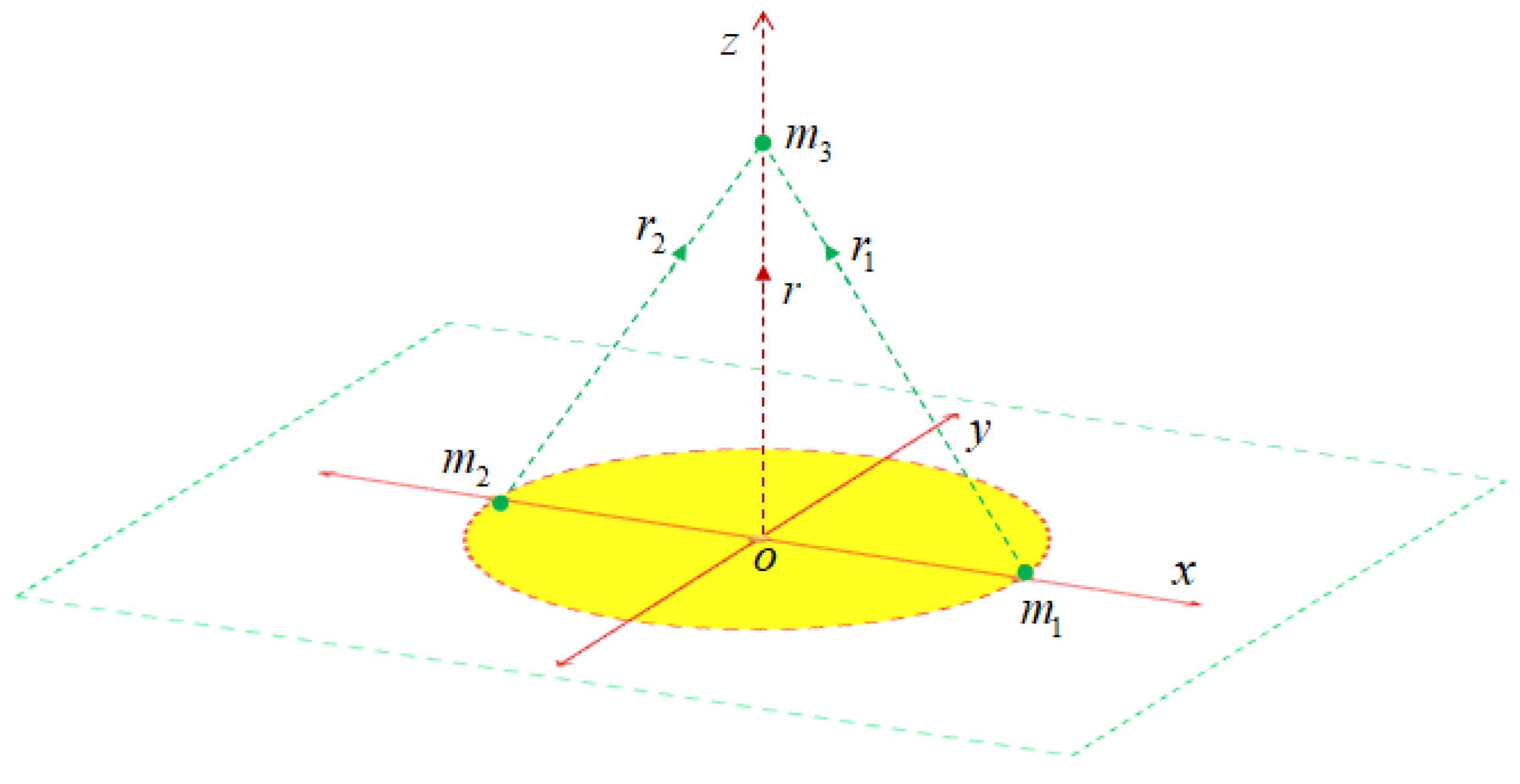
Consider a system (
Figure 1) consisting of two primaries, denoted by
and
, each of equal masses
and
, respectively, aligned along a straight line. These primaries move in circular orbit about their common center of mass. Within this configuration, an infinitesimal mass
with mass
is present, whose motion is constrained to the
z-axis, which is perpendicular to the plane of motion of the primaries and passes through the system’s center of mass,
O. Consequently, the motion of
is effectively one-dimensional and orthogonal to the orbital plane of the primaries. The primaries are equidistant from the center of mass, with distances given by
, where
denotes the dimensionless separation between
and
. Additionally, the first primary,
, is assumed to emit radiation, whereas the second primary,
, is considered a non-black-body reflector, redirecting the radiation from
into space.
Using the methodology of Ref. [
16], the equations of motion of infinitesimal mass
in the three-dimensional space are given by
where the dot on top denotes the time (
t) derivative and the potential function
with
where
,
, and
denote the first-order partial derivatives of the potential function (
4) with respect to the spatial coordinates.
The relation between
and
parameters is given by [
16]
Here,
is the mass parameter,
is the radiation (mass-reduction) factor associated with the emitting primary and represents the ratio of the radiation-pressure force to the gravitational attraction (the albedo parameter), and
is the reflectivity (luminosity) parameter that measures the fraction of the incident radiation reflected by the second primary.
In the Sitnikov three-body problem,
,
[
2] and
; hence,
The potential function (
4) the case under consideration is reduced to
where
represents the classical potential function in the Sitnikov three-body problem,
is the perturbed potential due to the radiation effect of the first primary, and
is the perturbation in the potential function due to the consideration of the reflected property of the second primary, defined as:
Consequently, the equation of motion of infinitesimal mass along the
z-axis is given by
which is the required equation of motion of infinitesimal
oscillating along the
z-axis.
It is worth noting that, by introducing the normalized time
, Equation (
6) transforms to
which coincides with the classical vertical equation of the circular Sitnikov problem [
1]. This shows that radiation pressure and albedo do not modify the geometrical structure of the phase trajectories, but act as a scaling factor of the physical time.
Nevertheless, in the original dimensional time, the parameters and have direct dynamical and physical significance. In particular, the parameters determine the oscillation period, the effective potential in the Jacobi integral, and the energetic threshold for the existence of bounded vertical motion. Therefore, the influence of the parameters cannot be removed when the problem is interpreted in terms of observable quantities.
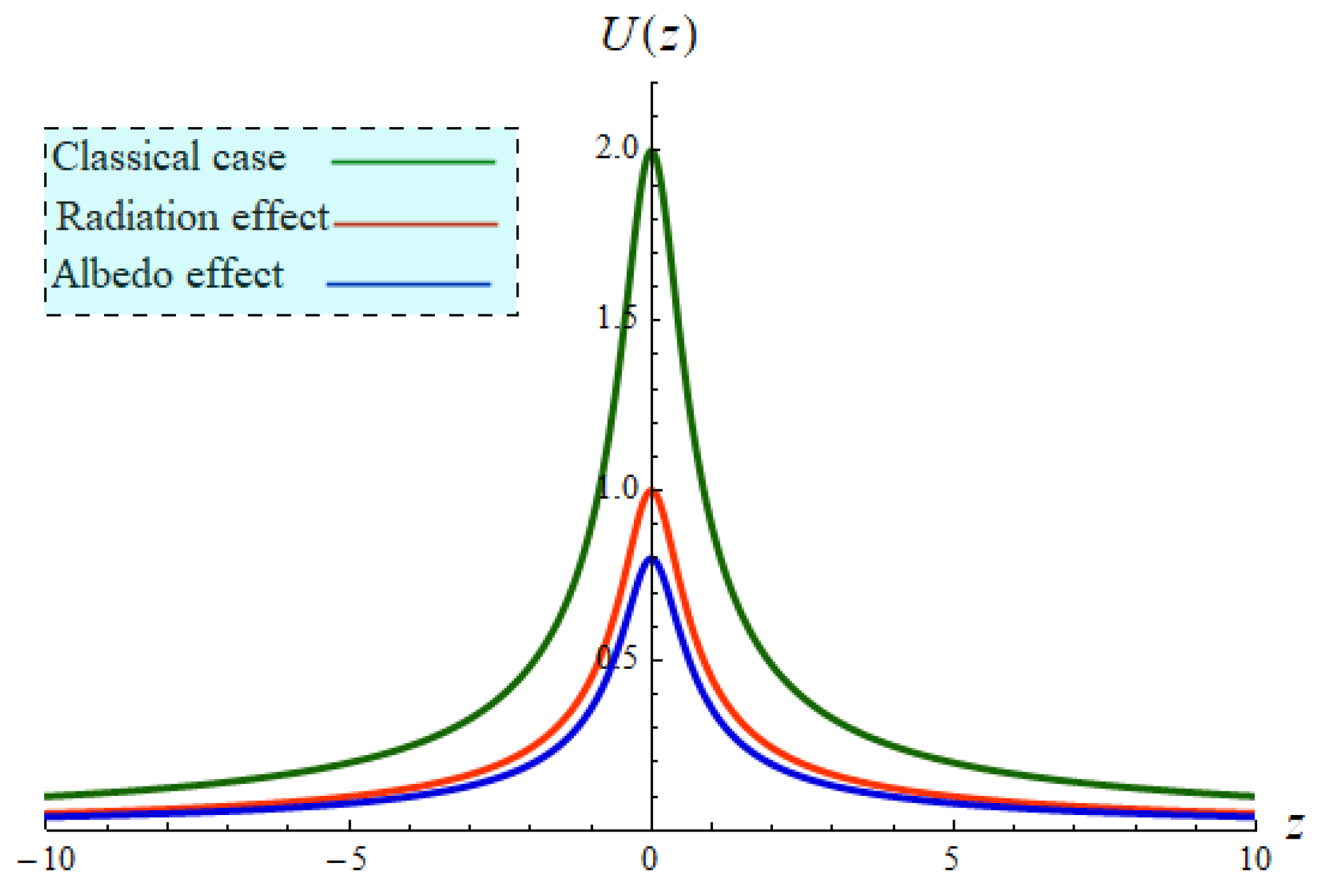
Figure 2 illustrates the variation of the potential function
(
5) shown as a function of the coordinate
z, which represents the vertical displacement of the infinitesimal body from the orbital plane of the two primaries in the Sitnikov three-body problem under the following three scenarios.
Classical case. In the absence of any non-gravitational effects, the potential function exhibits the highest peak at . This corresponds to the strongest gravitational attraction when the third body crosses the orbital plane. The steepness and height of the potential indicate a stronger restoring force, implying more energetic oscillations about the plane.
Radiation effect. When radiation pressure from the luminous primaries is included, the effective gravitational attraction decreases. This reduction causes the potential well to become shallower and broader. Consequently, the radiation case is located below the classical case, showing that the equilibrium potential energy is lower and the restoring force is weaker. This leads to a reduction in the amplitude and frequency of oscillations.
Albedo effect. The albedo effect considers the reflection of radiation by the small body, which introduces an additional repulsive component. This further reduces the effective potential compared to the radiation-only case. Hence, the case with albedo effect exhibits the lowest peak among the three cases, demonstrating the combined diminishing influence of both radiation pressure and reflection on the system’s potential.
Overall, as additional radiative effects are incorporated, the potential well becomes progressively shallower and less steep, indicating a weaker gravitational confinement of the infinitesimal particle along the z-axis.
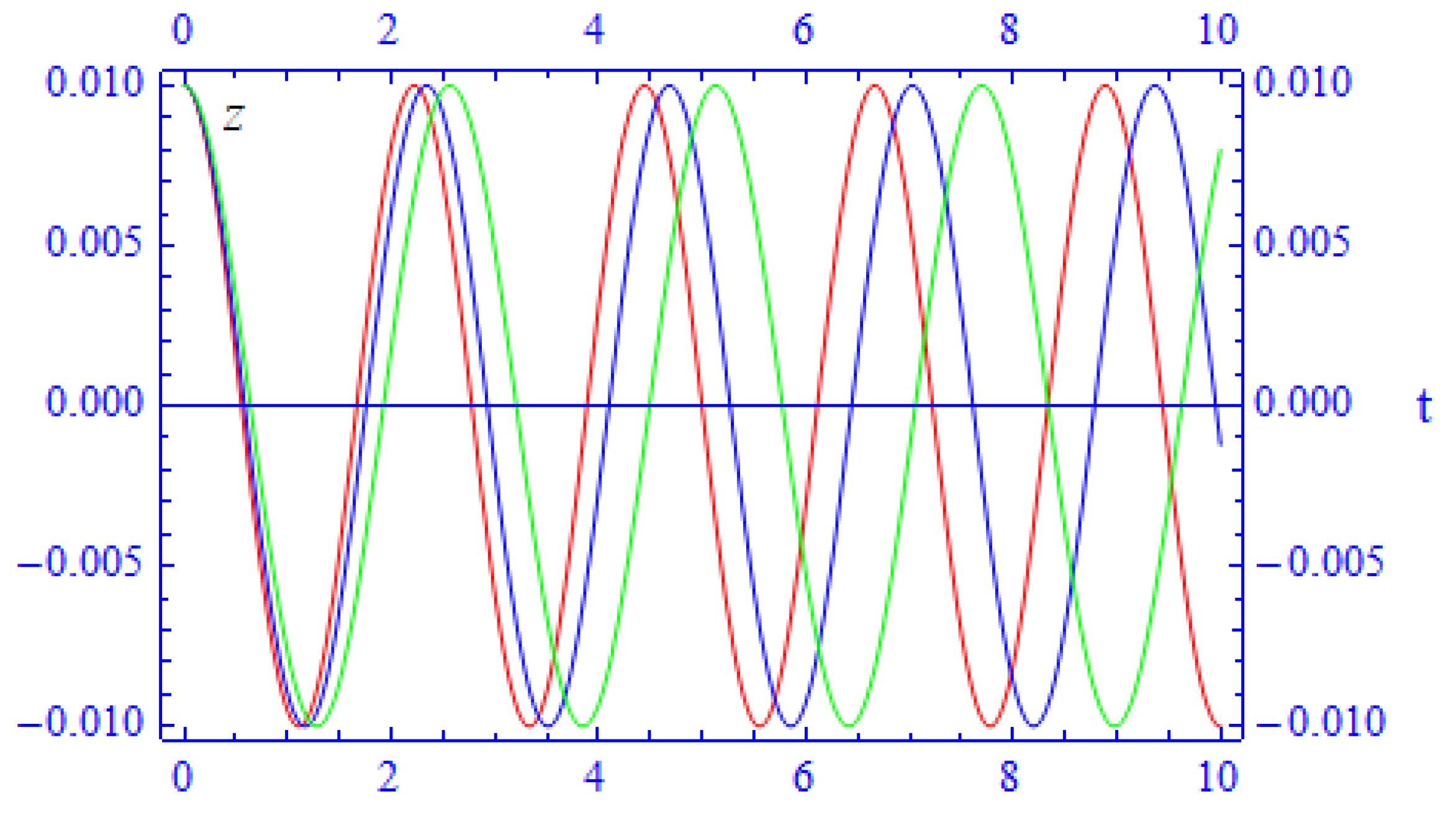
Figure 3 depicts the Sitnikov motion of the infinitesimal mass
for different values of the albedo factor
, showing the system’s dynamical response to increasing reflective effects. The classical Sitnikov problem without any albedo influence (
, red curve) shows that the oscillations of
along the
z-axis are relatively large and symmetric. The cases with albedo effect but no radiation effect (
and
, blue curve) and with both effects included (
and
, green curve) show that as the albedo parameter increases, the amplitude of oscillation decreases, indicating that the reflective radiation pressure tends to dampen or constrain the motion of the infinitesimal particle. Physically, this means that higher albedo surfaces, those reflecting more solar energy, impose an additional outward radiation pressure that somewhat counteracts gravitational attraction, leading to a reduced oscillatory range. Consequently,
Figure 3 demonstrates that the albedo effect stabilizes the motion of
by diminishing the extent of its vertical excursions.
Time Period of One Complete Oscillation
Assume the initial conditions
and
in Equation (
6), integrate the latter with respect to
t, and then calculate the total period of motion for one complete oscillation as
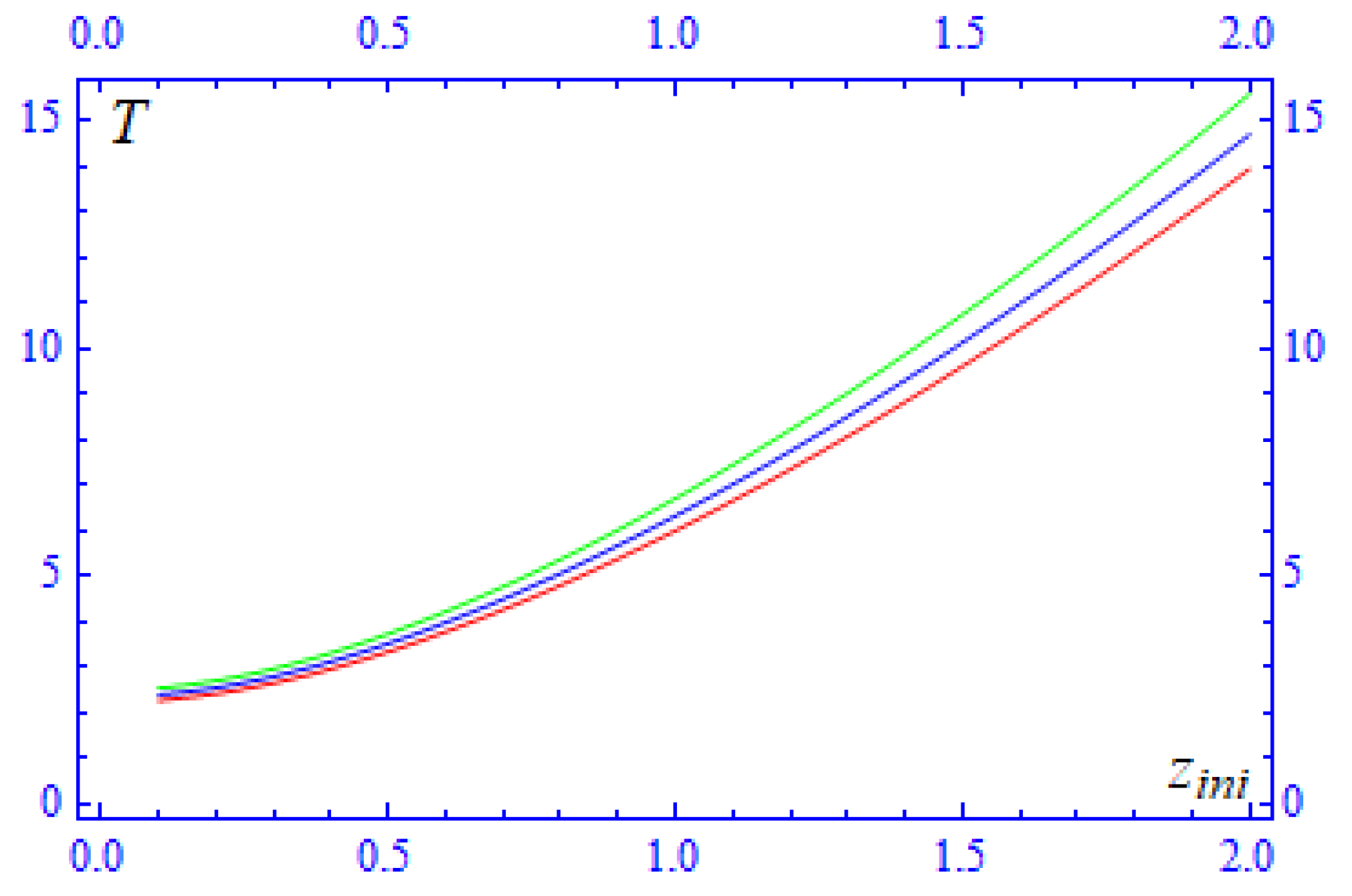
Figure 4 depicts the variation in the oscillation period of the infinitesimal mass
in the Sitnikov problem for different values of the albedo factor
. The results obtained indicate that the introduction of these perturbative effects leads to an increase in the oscillation period of the infinitesimal mass.
3. Admissible Region for Vertical Motion
The admissible region for vertical motion of the infinitesimal mass is determined using the Jacobi integral. For the Sitnikov configuration, the Jacobi constant
C is given by
where
is the effective potential modified by radiation and albedo effects, as defined in Equation (
5). For pure vertical motion
, motion is possible only when the kinetic energy is non-negative, which leads to the inequality
The inequality (
9) defines the energetically accessible region of motion along the
z-axis. In what follows, we analyze how this region depends on the albedo parameter
, the reflectivity parameter
, and the Jacobi constant
C.
3.1. Effect of the Albedo Parameter
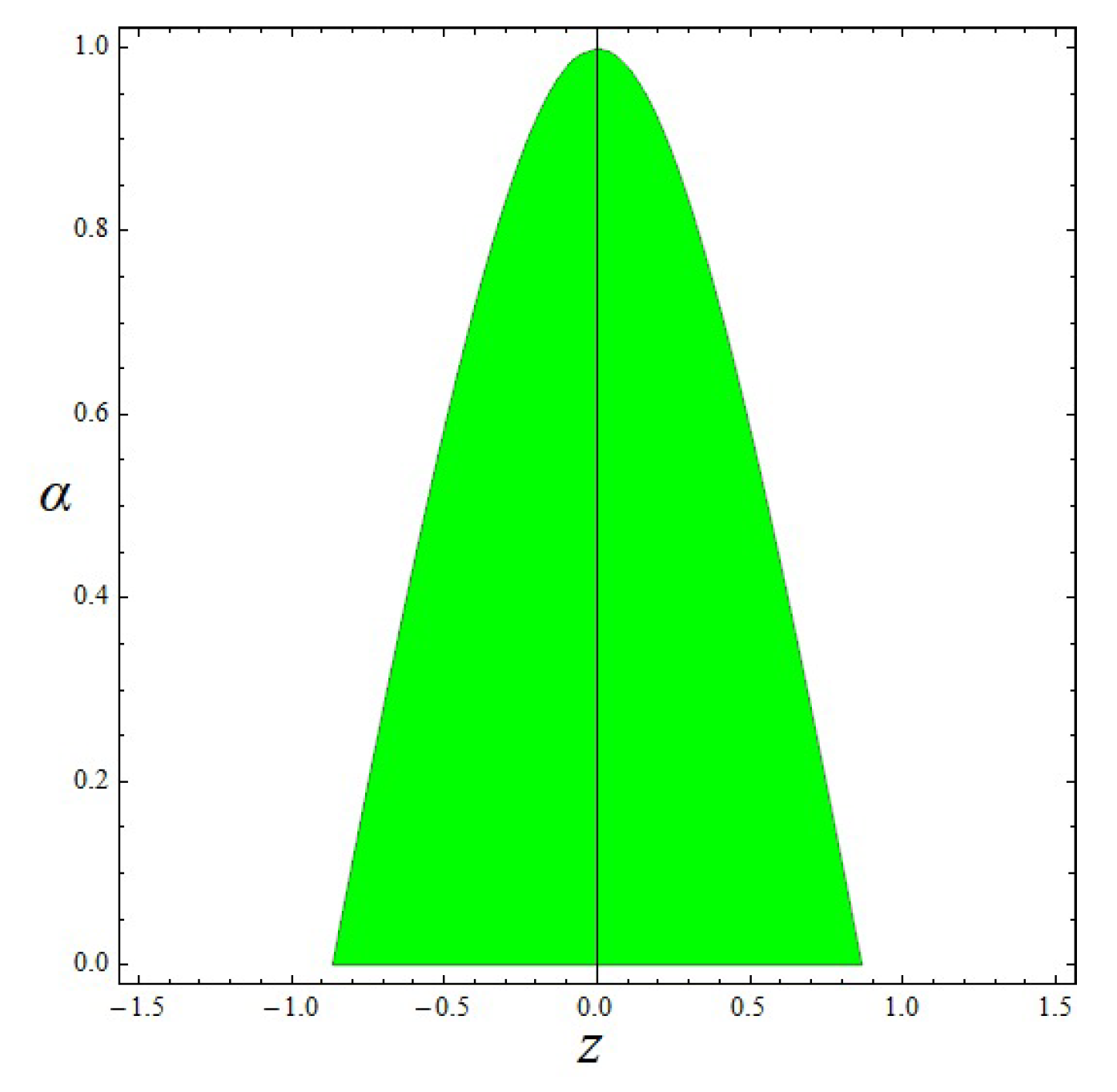
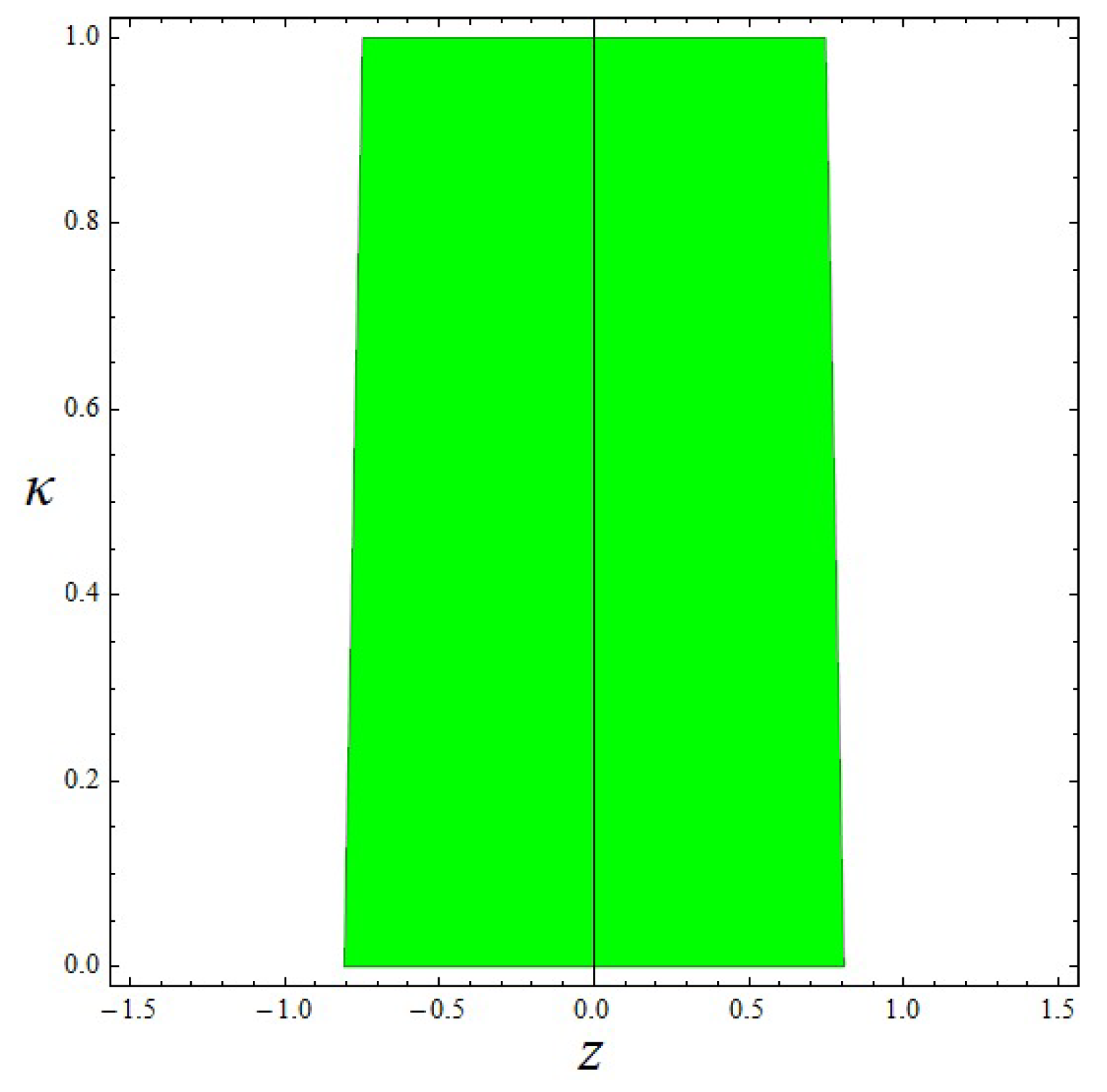
Figure 5 illustrates the region of vertical motion as a function of the albedo parameter
for fixed values
and
. The shaded area represents the set of admissible configurations satisfying
. The region is symmetric about
, reflecting the linear dependence of the effective potential on
through the factor
.
As increases, the admissible region shrinks steadily and eventually vanishes near a critical value of . This behavior indicates that increasing albedo enhances the radiative contribution opposing gravity, thereby weakening the effective restoring force along the vertical direction. Beyond the critical albedo, the effective potential is no longer sufficient to sustain vertical oscillations, and the motion becomes energetically forbidden. Physically, this demonstrates that albedo plays a dominant role in regulating the existence of vertical Sitnikov motion.
3.2. Effect of the Reflectivity Parameter
To isolate the influence of the reflectivity parameter,
Figure 6 shows the region of motion plotted against
for fixed
and
. In contrast to the strong sensitivity observed with respect to
, the admissible region remains nearly uniform over the considered range of
, with only minor variations at the boundaries.
This behavior follows from the feature that appears in the effective potential only through the product . For small and moderate values of , variations in introduce only relatively weak corrections to the net radiative effect. Consequently, the gravitational contribution remains dominant, and the condition for admissible motion is satisfied almost uniformly. This result highlights that plays a secondary role compared to in shaping the region of vertical motion.
3.3. Effect of the Jacobi Constant C
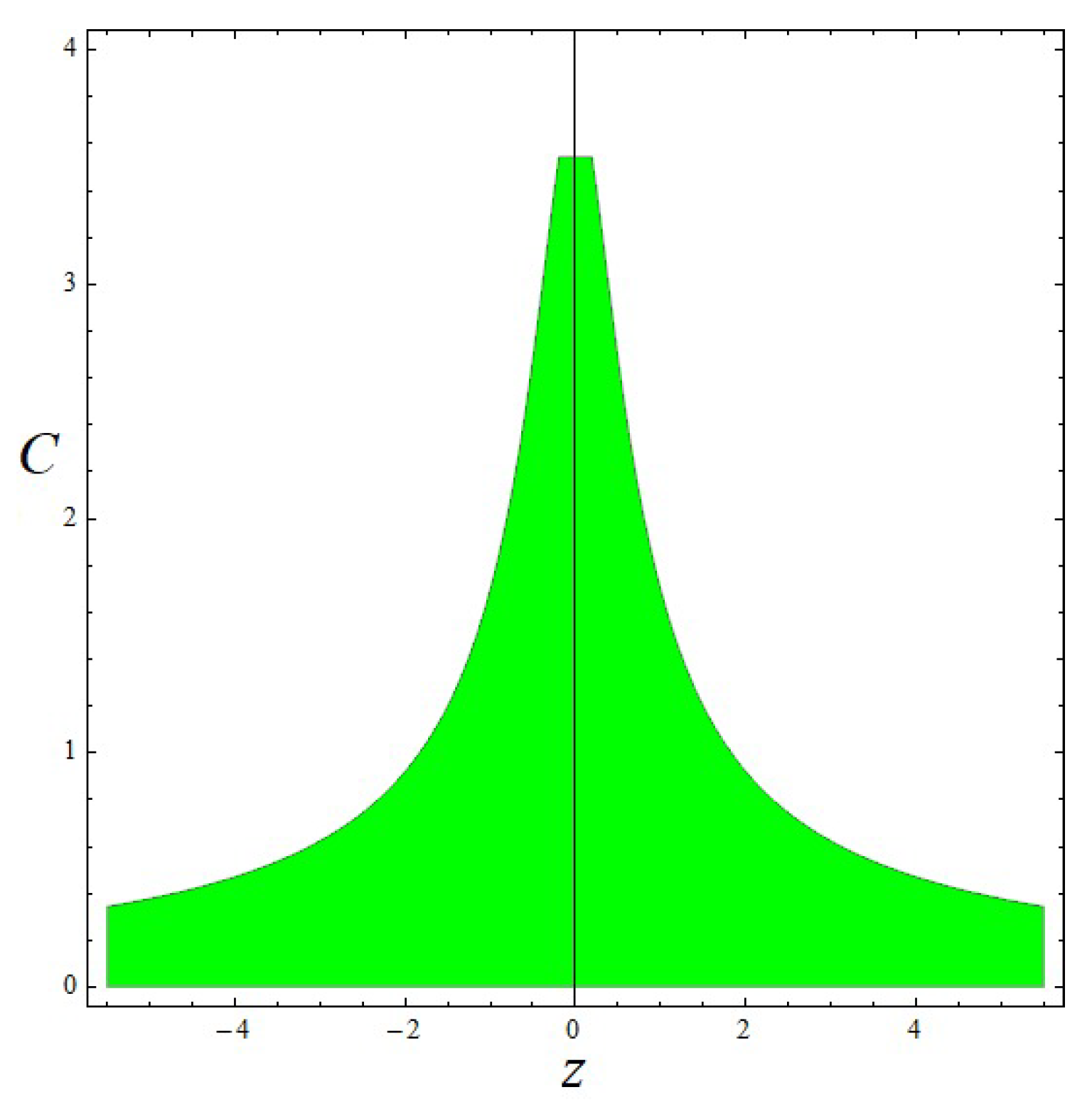
The dependence of the admissible region on the Jacobi constant is shown in
Figure 7 for fixed values
and
. The shaded region again corresponds to the inequality
. The region narrows rapidly as
C increases, forming a sharp peak near the critical value of the Jacobi constant.
This behavior reflects the energy-like nature of C. Larger values of C reduce the available kinetic energy, thereby restricting the range of allowed motion. As C approaches its critical upper limit, only a narrow band of configurations remains accessible, and beyond this limit, vertical motion becomes impossible. Conversely, smaller values of C allow wider vertical excursions despite the presence of radiation and albedo effects.
From the analysis performed, one concludes that the albedo parameter is the primary controlling factor for the existence of vertical motion, while the reflectivity parameter has a comparatively mild influence. The Jacobi constant C governs the overall energetic accessibility of motion, with higher values strongly constraining the admissible region. Altogether, the results obtained provide a distinct energetic interpretation of how radiative and albedo effects modify the classical Sitnikov dynamics.
5. First Return Map
The first return map, or Poincare map, is a helpful tool for visualizing the phase-space structure of dynamical systems by reducing continuous motion to a discrete representation [
27]. In the present study, the motion of the infinitesimal mass is confined to the vertical direction, and the phase space is therefore two-dimensional, described by the variables
.
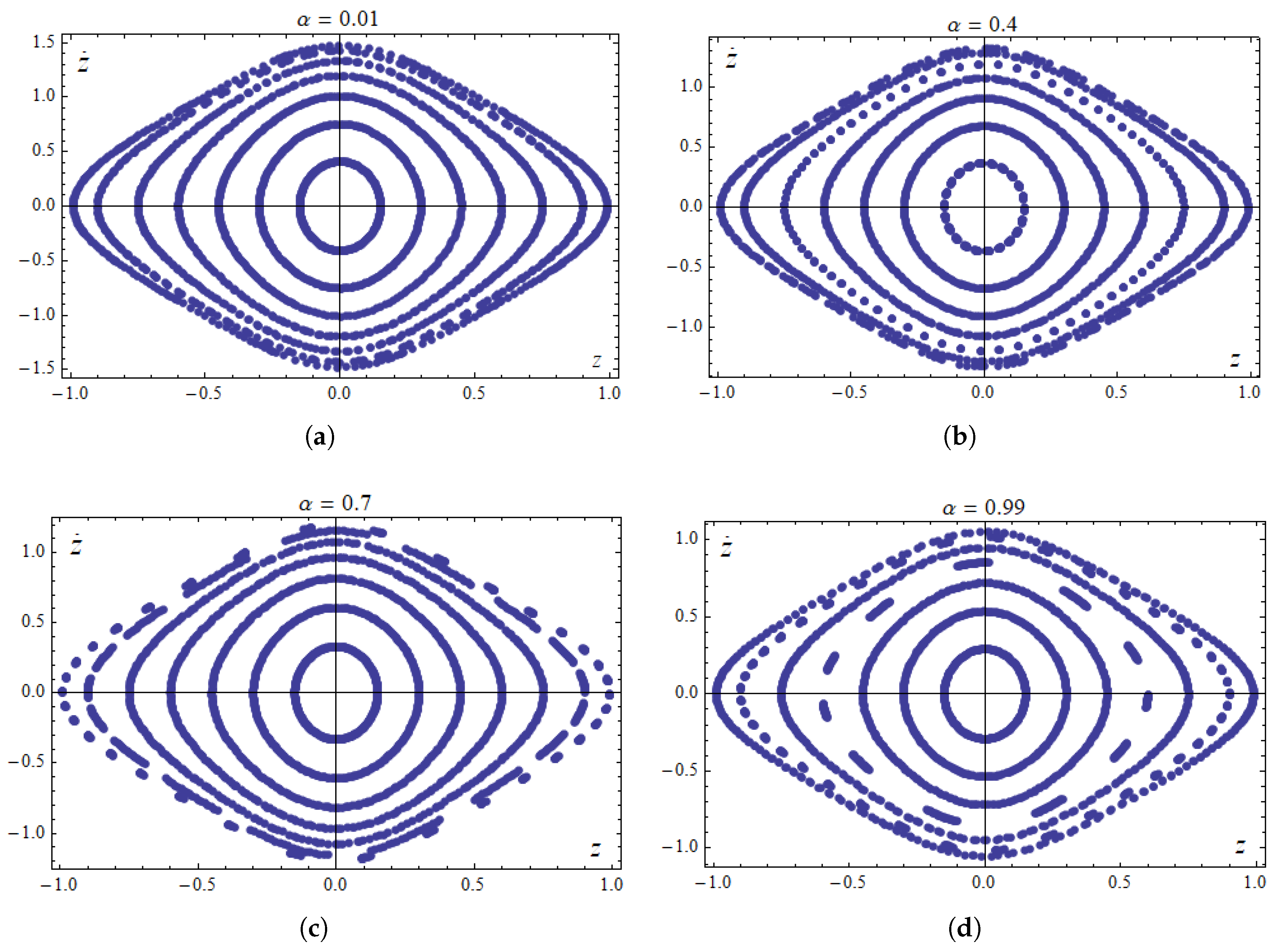
To construct the first return maps shown in
Figure 8, the nonlinear equation of motion along the
z-axis is numerically integrated for fixed values of the parameters. Successive intersections of the trajectory with a prescribed section in phase space are recorded, yielding a discrete set of points in the
plane. These points represent the evolution of the system over many oscillation cycles and provide insight into the qualitative nature of the motion.
Figure 8 presents first return maps in the
plane for different values of the albedo parameter
, while the remaining parameters are kept fixed. Each panel corresponds to a distinct value of
, allowing a direct comparison of the phase-space structure as radiative effects are increased. For smaller values of
(
Figure 8a), the return map consists of a smooth, closed curve. This structure is characteristic of regular periodic motion and indicates that the infinitesimal mass oscillates in a stable and bounded manner about the equilibrium point at
. The closed curve represents an invariant set in phase space, consistent with the conservation of the Jacobi integral. As the albedo parameter increases (
Figure 8b,c), the return maps retain their organized structure but exhibit a noticeable contraction toward the origin. This contraction reflects the reduction in oscillation amplitude caused by the weakening of the effective gravitational restoring force due to radiation and albedo effects. Although the curves appear thicker or more densely populated, this feature does not indicate instability or chaotic behavior. Instead, it arises from nonlinear effects and from non-uniform numerical sampling associated with longer oscillation periods. For the largest value of
considered (
Figure 8d), the return map remains confined to a bounded region and continues to form a well-defined invariant curve. The absence of scattered points or area-filling structures confirms that the motion remains regular and predictable. This behavior is consistent with the one-degree-of-freedom conservative nature of the vertical Sitnikov problem, which does not permit chaotic dynamics.
The collection of return maps in
Figure 8 demonstrates that increasing albedo does not alter the qualitative character of the vertical motion. Instead, albedo acts primarily as a quantitative modifier, reducing the accessible phase-space region and slowing the oscillations while preserving regularity. These observations are in complete agreement with the linear stability analysis, the Jacobi integral constraints, and the numerical solutions of the nonlinear equation of motion. Thus,
Figure 8 provides distinct visual confirmation that the vertical Sitnikov motion under radiation and albedo effects remains bounded, stable, and non-chaotic over the range of parameters examined.
6. Conclusions
In the present study, the circular Sitnikov problem has been extended to include the combined influence of radiation pressure and albedo arising from the reflective properties of one of the primaries. The resulting formulation preserves the symmetry of the classical configuration while introducing a physically meaningful modification of the effective gravitational interaction acting on the infinitesimal body.
The vertical equation of motion shows that the radiative parameters enter through a single factor that rescales the physical time. Consequently, the geometrical structure of the phase trajectories remains identical to that of the classical Sitnikov problem when expressed in a normalized time variable. However, in the physical time relevant for celestial–mechanical applications, this factor produces measurable dynamical effects. In particular, the oscillation period increases with the strength of radiation and albedo, providing a direct quantitative relation between radiative properties and the time scale of vertical motion.
The Jacobi integral formulation demonstrates that the radiative parameters also modify the effective potential and therefore the energetically admissible region of motion. The albedo parameter plays the dominant role in restricting the accessible range of vertical oscillations, while the reflectivity parameter introduces a secondary correction through its coupling with the radiation factor. The condition defines a radiation-dominated threshold beyond which bounded vertical motion is no longer possible. This constraint has no counterpart in the classical purely gravitational problem and provides a clear physical criterion for the existence of oscillatory motion.
The equilibrium analysis shows that the origin remains the only vertical equilibrium point and that it is linearly stable for all physically admissible values of the parameters. Radiation and albedo reduce the effective restoring force and lower the oscillation frequency, but they do not alter the conservative nature of the motion. The first return maps confirm that the trajectories lie on invariant curves and remain regular and bounded. Their progressive contraction with increasing radiative effects reflects, in physical terms, the reduction in the accessible oscillation amplitude rather than the emergence of new dynamical regimes.
Although the model is formulated in an idealized Sitnikov configuration, the results have direct implications for real systems in which radiative forces are non-negligible. The explicit dependence of the oscillation period on the radiation and reflectivity parameters provides a practical estimate of the time of flight for vertical excursions of high area-to-mass ratio spacecraft, solar sails, dust particles, and comparably small debris in strongly illuminated environments. The radiation-dominated threshold gives a practical design constraint for ensuring long-term bounded motion or, alternatively, for enabling low-energy escape and transfer strategies. In this sense, the present analysis connects the qualitative theory of nonlinear dynamical systems with physically observable quantities relevant to trajectory design and orbit prediction.
Overall, the inclusion of radiation pressure and albedo does not generate new phase-space structures in the vertical Sitnikov problem; rather, it produces a systematic and measurable modification of the physical time scale, the effective potential, and the energetically admissible domain of motion. These results provide a coherent dynamical and physical interpretation of radiative effects in this classical model and can serve as a basis for future investigations involving elliptic primaries, non-conservative perturbations, or higher-dimensional configurations, where genuinely new qualitative behaviors are expected to arise.
The model presented is based on point-mass primaries and therefore represents an idealized gravitational field. A natural extension would be to consider non-uniform mass distributions by introducing, for example, zonal harmonic terms or oblate/spheroidal primaries. In such a formulation the effective potential no longer depends solely on the distance from the center of mass, and the vertical motion does not reduce to a one-degree-of-freedom system. The equilibrium position could be shifted, the oscillation frequency then becomes amplitude-dependent, and new dynamical features such as resonances, bifurcations, or asymmetric phase-space structures may arise. These effects are expected to play an significant role in the vicinity of irregular bodies such as asteroids, contact-binary systems, and rapidly rotating planets, where the combined action of non-spherical gravity and radiative forces may lead to genuinely new dynamical regimes.