Next Article in Journal
Modeling the Fall of the Inca Empire: A Lotka–Volterra Approach to the Spanish Conquest
Previous Article in Journal
Electron Scattering Properties in Dense Quantum Plasma of Neon
 
 
Due to scheduled maintenance work on our servers, there may be short service disruptions on this website between 11:00 and 12:00 CEST on March 28th.
Article

Mechanisms in Droplet Impact on Rough Surfaces with Spontaneously Varying Viscosity


1
Coal Mining Branch, China Coal Research Institute, Beijing 100013, China
2
CCTEG (China Coal Technology and Engineering Group) Coal Mining Research Institute, Beijing 100013, China
3
State Key Laboratory of Intelligent Coal Mining and Strata Control, Beijing 100013, China
4
School of Energy and Mining Engineering, China University of Mining and Technology (Beijing), Beijing 100083, China
*
Author to whom correspondence should be addressed.
Submission received: 13 October 2025 / Revised: 15 November 2025 / Accepted: 21 November 2025 / Published: 13 January 2026
(This article belongs to the Section Classical Physics)

Abstract

Polyurea, a novel spray-applied composite polymer, is of high application importance for rapid roadway support in coal mines. The current study investigates the dynamic process and mechanisms governing the impact and spreading of polyurea droplets on rough surfaces through experimental and theoretical approaches. The key novelty lies in revealing how spontaneously varying viscosity couples with surface microstructure to produce novel scaling laws distinct from classical Newtonian behavior. The droplet impact and wetting process can be divided into three stages. In the pinning stage, droplet behavior is dominated by kinetic energy, leading to inertia-driven spreading in which the contact line radius increases quite slowly with time. In the penetration stage, the apparent three-phase contact line (TPCL) is pinned by surface microstructures, while the real TPCL evolves with time following a temporal scaling law t3/2. In the spreading stage, surface roughness becomes decisive. On low-roughness substrates, limited pinning allows the real and apparent TPCLs to spread synchronously, with TPCL evolution governed by surface tension and viscous forces, following a t1/8 scaling law. As roughness increases, pinning effects strengthen, causing divergence: the real TPCL is driven by surface tension and viscous dissipation between microstructures, whereas the apparent TPCL is additionally influenced by pinning and reaction-induced viscosity, scaling as t1/24. This t1/24 scaling for the apparent contact line on relatively high-roughness surfaces represents a significant deviation from established scaling relations. Experiments on rock-like substrates confirm these mechanisms for polyurea droplets. These findings provide theoretical and engineering guidance for optimizing spray-coating parameters in coal mines, with the goal of improving coating uniformity and interfacial adhesion.

1. Introduction

With rising standards for coal mine safety, the use of novel materials for roadway support has gained increasing attention [1,2]. Compared with traditional metal mesh, thin spray-on liners (TSLs) conform more effectively to irregular rock surfaces and provide early load-bearing support. Unlike shotcrete, TSLs are quite flexible, hard, and exhibit high enough tensile strength [3]. Initially developed for sealing and anti-weathering, TSLs are now recognized for their support capability based on extensive research and field practice [4,5,6,7].
The performance of polyurea coatings on coal surfaces is strongly influenced by droplet impact dynamics on rough substrates, which determine spreading and adhesion mechanisms. Droplet impact is common in industrial processes such as spray painting [8], protective coatings [9], and pharmaceutical atomization [10]. Research dates back to Arthur Worthington’s classic study of 1876 [11]. Owing to the diversity of droplet behavior and the complexity of associated dynamics, it remains an extensively studied phenomenon [12,13,14]. Earlier studies have shown that inertial, viscous, and capillary forces critically shape droplet dynamics [15,16,17]. The Weber number (We) and Reynolds number (Re) are commonly used to characterize their interplay during droplet spreading [18,19], helping to explain processes such as splashing [20], jetting [21], and interfacial instabilities [22,23]. Substrate wettability [24] also plays a decisive role: on hydrophilic surfaces, droplets spread rapidly under inertia until reaching a maximum radius, with the contact line evolving by a 1/2 power law [18,25]. On hydrophobic surfaces, contact line pinning dominates, and droplets flatten as height decreases [26,27].
Ideal smooth surfaces described by the Young equation [28] rarely occur in practice. In 1936, Robert Wenzel introduced the roughness factor, defined as the ratio of the actual to projected surface area, showing that roughness amplifies intrinsic wettability [29]. Andrew Cassie and S. Baxter [30] extended this model to heterogeneous surfaces composed of different materials. Recently, Edward Bormashenko [31] categorized wetting on rough curved substrates into “Wenzel-like” and “Cassie-like” regimes. In coal mines, roadway surfaces exhibit high roughness due to fractures, protrusions, depressions, and dust, all of which affect droplet spreading and curing. While prior studies emphasized the macroscopic mechanical properties of polyurea and spray efficiency, investigations of spreading dynamics on rough substrates remain limited.
While the spreading of Newtonian droplets on smooth surfaces often follows a firmly-established temporal t1/2 power law in the inertial regime [18,25], the dynamics become significantly more complex for non-Newtonian fluids, especially those undergoing curing or comparably rapid viscosity changes. For most studies, non-Newtonian droplets—such as shear-thinning, shear-thickening, or viscoelastic fluids—remain fully liquid during impact, and their behavior is governed by reversible elastic stresses that modify spreading and recoil dynamics [32,33]. In contrast, reactive droplets such as polyurea undergo chemical curing, during which viscosity increases rapidly and eventually leads to solidification. This introduces an intrinsic reaction timescale that can arrest contact-line motion once curing competes with spreading [34]. Studies on viscoelastic droplets have revealed deviations from Newtonian scaling due to elastic energy storage and dissipation. Similarly, for curing fluids, the temporal increase in viscosity can fundamentally alter the spreading dynamics. This study establishes novel scaling exponents (the temporal t3/2 for penetration, the temporal t1/8 and t1/24 for spreading) that distinctly differ from classical Newtonian predictions. We attribute these unique scalings to the complex interplay between surface roughness, pinning effects, and our key innovation: the incorporation of spontaneous, reaction-induced viscosity growth throughout the impact process.
Droplet spreading is central to coating quality, being influenced by velocity, viscosity, surface tension, substrate roughness, and curing kinetics. In this study, polyurea was selected to investigate droplet spreading during free fall on substrates of varying roughness and drop height. High-speed imaging and microscopic analysis were employed to examine spreading morphology, contact line evolution, and microstructural effects. The interplay among surface roughness, droplet dynamics, and curing was further analyzed. A theoretical model was developed to identify scaling laws for contact line motion under different substrate conditions. The results provide mechanistic insight and engineering guidance for optimizing polyurea spray-coating parameters in coal mines to enhance coating uniformity and adhesion.

2. Materials and Methods

2.1. Surface and Liquids

The reactive liquid polyurea (JHSW8601) was purchased from POLYSV Co., Ltd. (Qingdao, China). This material is synthesized via the reaction of isocyanates (component A) with amine compounds (component B). The initial gel time is approximately 30 s, and full curing occurs within about 1 min. The homogeneity tests and the rheological characterization of components A and B, including the viscosity-time evolution obtained via the tip-retraction method, were reported in our previous study [34]. The uniformity of the mixed polyurea components, critical for consistent reaction kinetics, was verified beyond film casting. Contact angle measurements on multiple cast films showed a variation in less than 2%, indicating consistent surface chemistry. Furthermore, tensile tests on these films yielded a narrow distribution of Young’s modulus (coefficient of variation below 5%), confirming the homogeneity of the cross-linked polymer network resulting from effective mixing.
To investigate and validate the dynamic mechanisms of viscosity-varying droplets impacting rough surfaces, two types of substrates were prepared: micro-pillar-arrayed surfaces and rock-like surfaces.
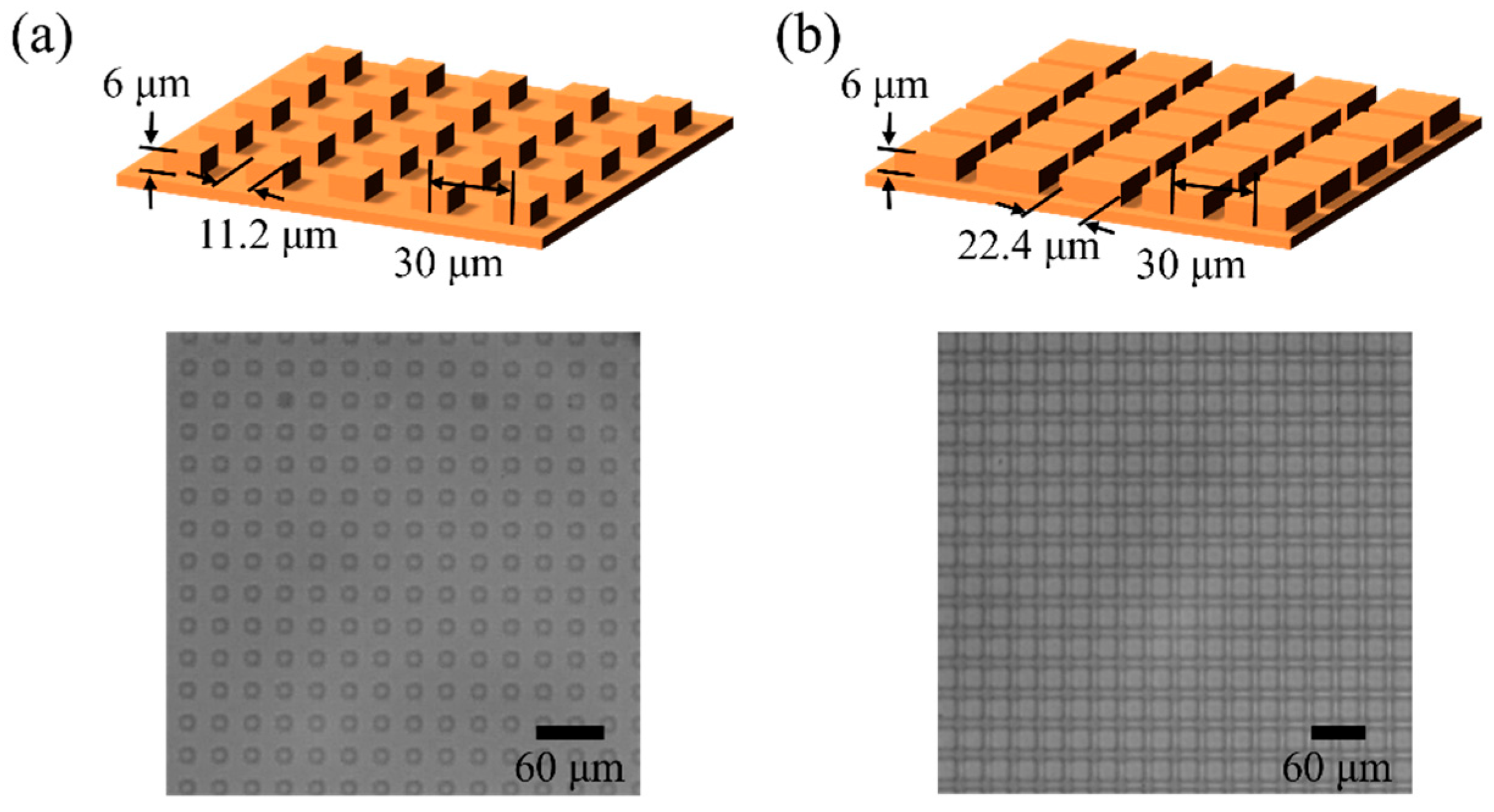
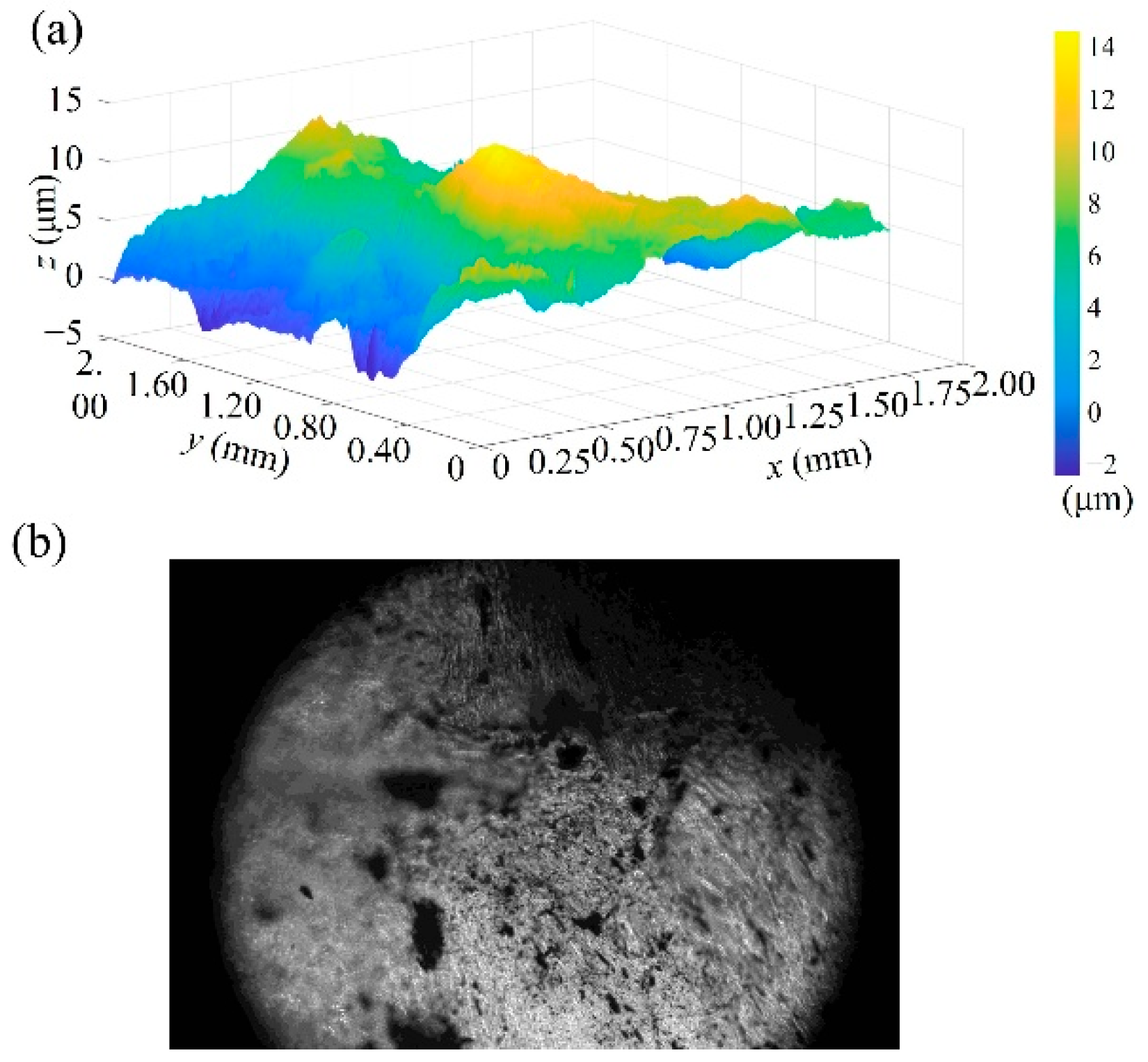
The micro-pillar-arrayed substrates were fabricated using a template molding technique. Silicon templates containing micro-square holes were prepared via deep reactive ion etching (RIE) with a single-mask layout. Polydimethylsiloxane (PDMS, Sylgard 184, Dow Corning Corporation, Midland, MI, USA) was mixed with its curing agent at a 10:1 weight ratio and stirred thoroughly. The mixture was degassed in a vacuum autoclave to remove air bubbles, poured into the silicon mold, and spin-coated at 800 rpm for 5 min. The coated mold was then cured in an oven at 60 °C for 3 h [35]. After demolding, the resulting PDMS micro-pillar surfaces were characterized using an optical microscope (ICX41M, Olympus Corporation, Tokyo, Japan), as shown in Figure 1a,b. Two micro-pillar configurations were designed: loose and packed. In both configurations, the pillar height h was 6 μm, and the center-to-center spacing l between adjacent pillars was 30 μm. The pillar side lengths w were 11.2 μm and 22.4 μm for the loose and packed configurations, respectively. The corresponding average surface roughness factors (ratio of real to apparent surface area) were 1.3 and 1.6. Rock-like substrates were also prepared by template molding. Coal blocks collected from the Mengcun County (China) coal mine served as natural molds. The surface structures of these templates were measured using a step profiler (Dektak XT, Bruker Corporation, Billerica, MA, USA), as shown in Figure 2a. After PDMS casting and demolding, the resulting rock-like surfaces (Figure 2b) exhibited protrusion heights of approximately 6 μm and an average surface roughness factor of 3.4.

2.2. Droplet Generation and Impact Experiment

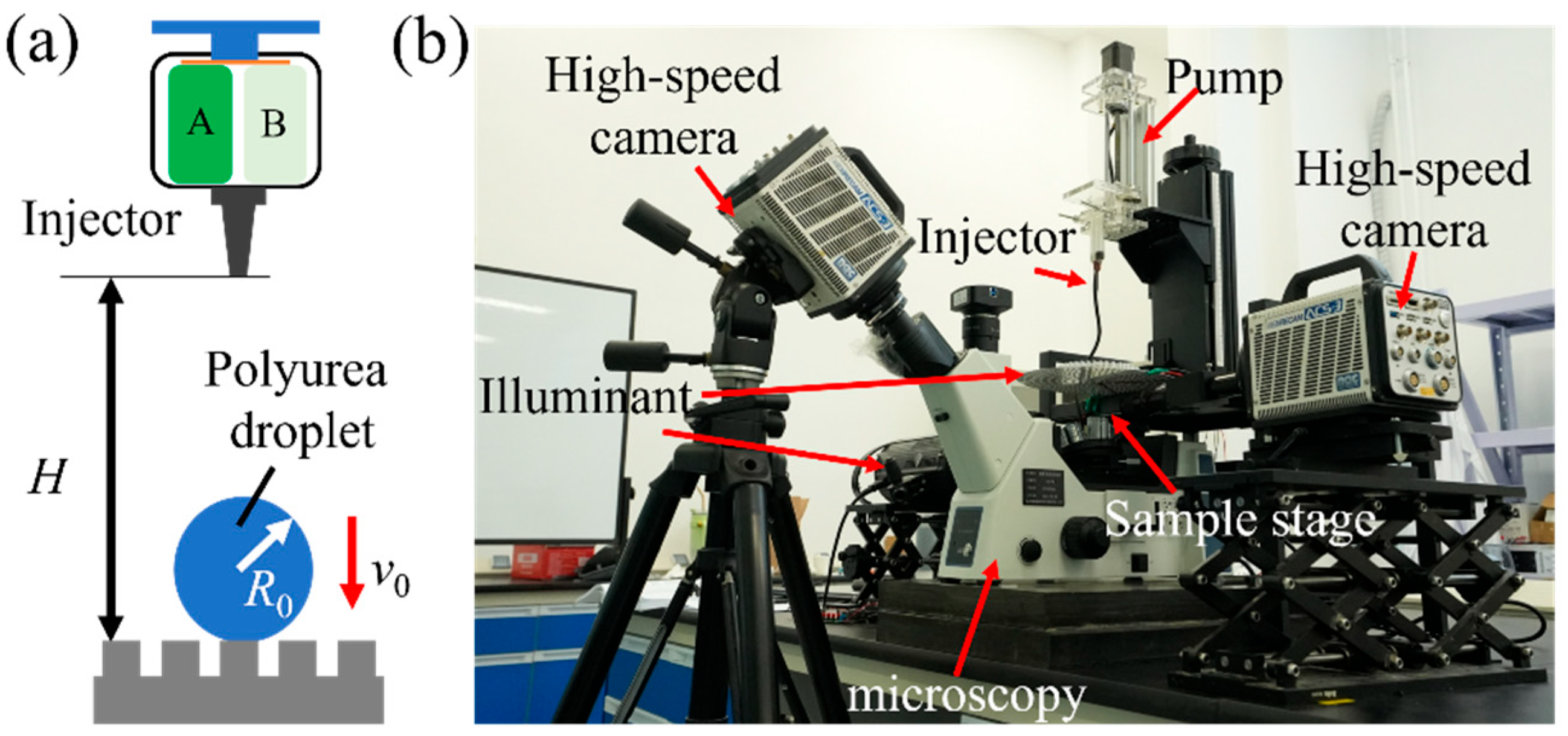
The experimental setup for droplet impact is shown in Figure 3. All experiments were performed at 25 °C and 50% relative humidity. The system consists of a micro-injection pump, syringe, mixing needle, illumination source, and high-speed camera. Components A and B were mixed in situ using the micro-injection pump and needle to generate polyurea droplets, which were then released to freely fall onto the prepared rough substrates.
After detachment from the needle tip, droplets fell under gravity. Their impact and spreading processes were recorded using a high-speed digital camera (Memrecam ACS-3, nac Image Technology Inc, Tokyo, Japan) at 1000 fps with an exposure time of 1/33,000 s. Illumination was provided by a side-mounted light source. Two free-fall heights were used: 128 mm and 200 mm. To evaluate the uniformity of the mixing process, polyurea films were cast using the same setup. Contact angle measurements and tensile tests were subsequently performed on these films.

2.3. Experimental Findings

The surface tension and density of polyurea were measured as 0.022 N/m and 1054 kg/m3, respectively, with negligible differences before and after curing [34]. Immediately after mixing, the initial viscosity of the droplets was 1.31 Pa·s. The surface tensions of the solid (PDMS)–air and solid (PDMS)–liquid (polyurea) interfaces were 0.025 N/m and 0.027 N/m, respectively. In the experiments, droplets with an initial radius of 1 mm were released from heights of 128 mm and 200 mm, reaching impact velocities of 1.6 m/s and 2.0 m/s, respectively. The corresponding We were calculated as 122.6 and 191.6.
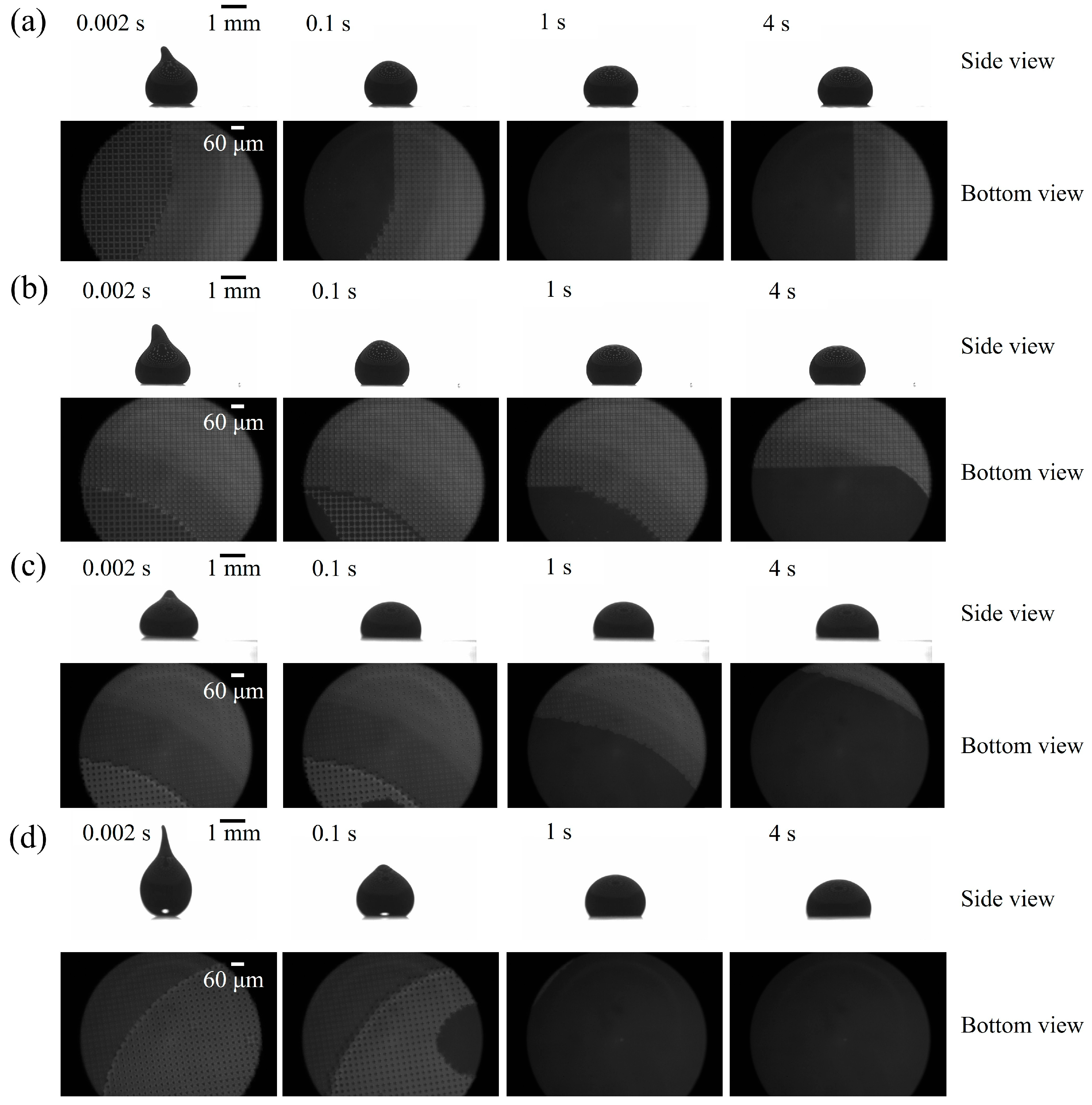
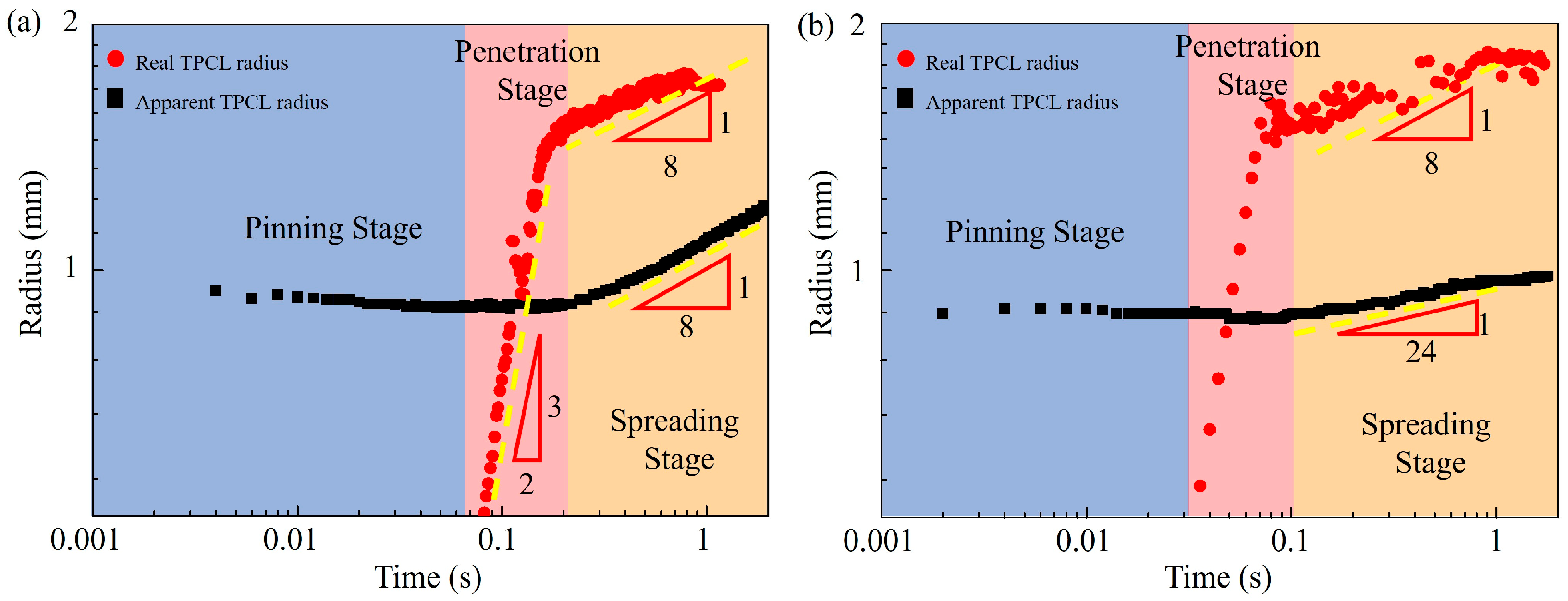
Figure 4 presents the time variation in both the apparent and real radii of the three-phase contact line (TPCL) over time after droplets impacted the loose and packed micro-pillar surfaces from a height of 128 mm. The droplets were assumed to fall under gravity without significant influence from air viscosity. Given the chemical stability of polyurea in air and on PDMS, droplets were modeled as accelerating continuously under gravity before impact. It is worth noting that the packed micro-pillar arrays can significantly increase the probability of pinning in the real TPCL, leading to uncertainties in the experimental measurement of the contact line radius. The plots in Figure 4 illustrate the three dynamic stages of the TPCL: pinning, penetration, and spreading. Representative morphologies for each stage are shown in Figure 5a–d.
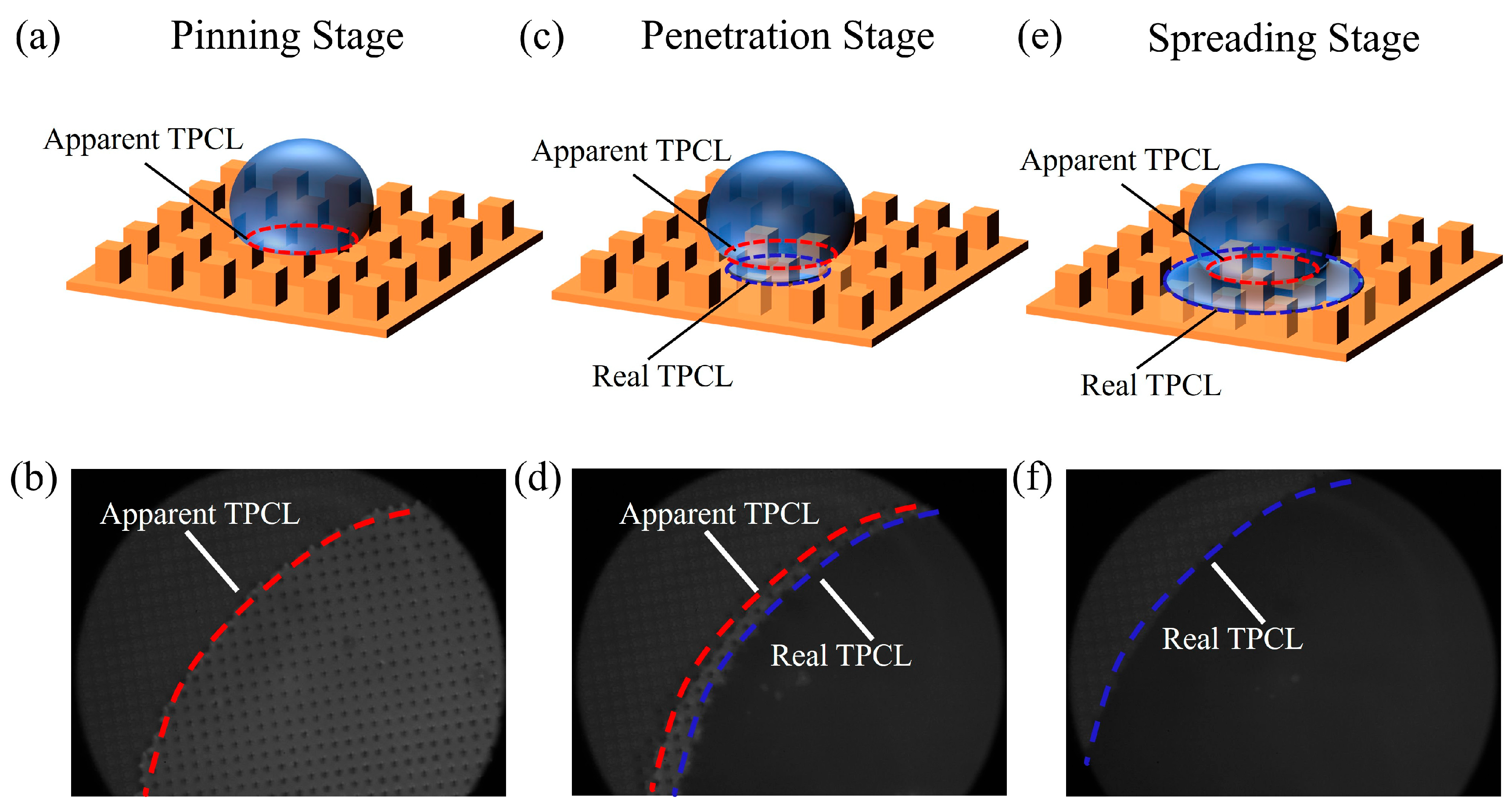
Features in the different dynamic stages are shown in Figure 6. During the pinning stage, the droplet exhibits a pointed tip at the apex rather than a spherical cap (Figure 5a). As time progresses, this apex retracts quite rapidly and the droplet assumes a symmetric dome-like profile. This retraction reflects the synergistic dynamics of internal stress release, viscoelastic relaxation, and redistribution of surface tension within the droplet shortly enough after impact. Both viscous flow and surface tension contribute to the retraction of the apex [34]. The apparent contact line ceases to advance once its radius reaches a critical value. At this stage, part of the droplet’s kinetic energy is converted into internal energy through viscous dissipation, which is concentrated primarily in the contact region. The characteristic timescale of the pinning stage is approximately 10−3 s. Upon entering the penetration stage, the apparent solid–liquid interface becomes unstable, and liquid polyurea infiltrates the microstructures of the micropillar array. The radius of the real contact line Rr evolves with time according to a t3/2 scaling law, i.e., Rr~t3/2. In the subsequent spreading stage, the scaling law for the real TPCL radius remains unchanged, whereas the apparent TPCL radius exhibits different behavior depending on the surface geometry. On packed micropillar substrates, the apparent TPCL follows a t1/8 scaling law, while on loose configurations it evolves more slowly, following a t1/24 law.

3. Result and Discussion

3.1. Liquid Penetration

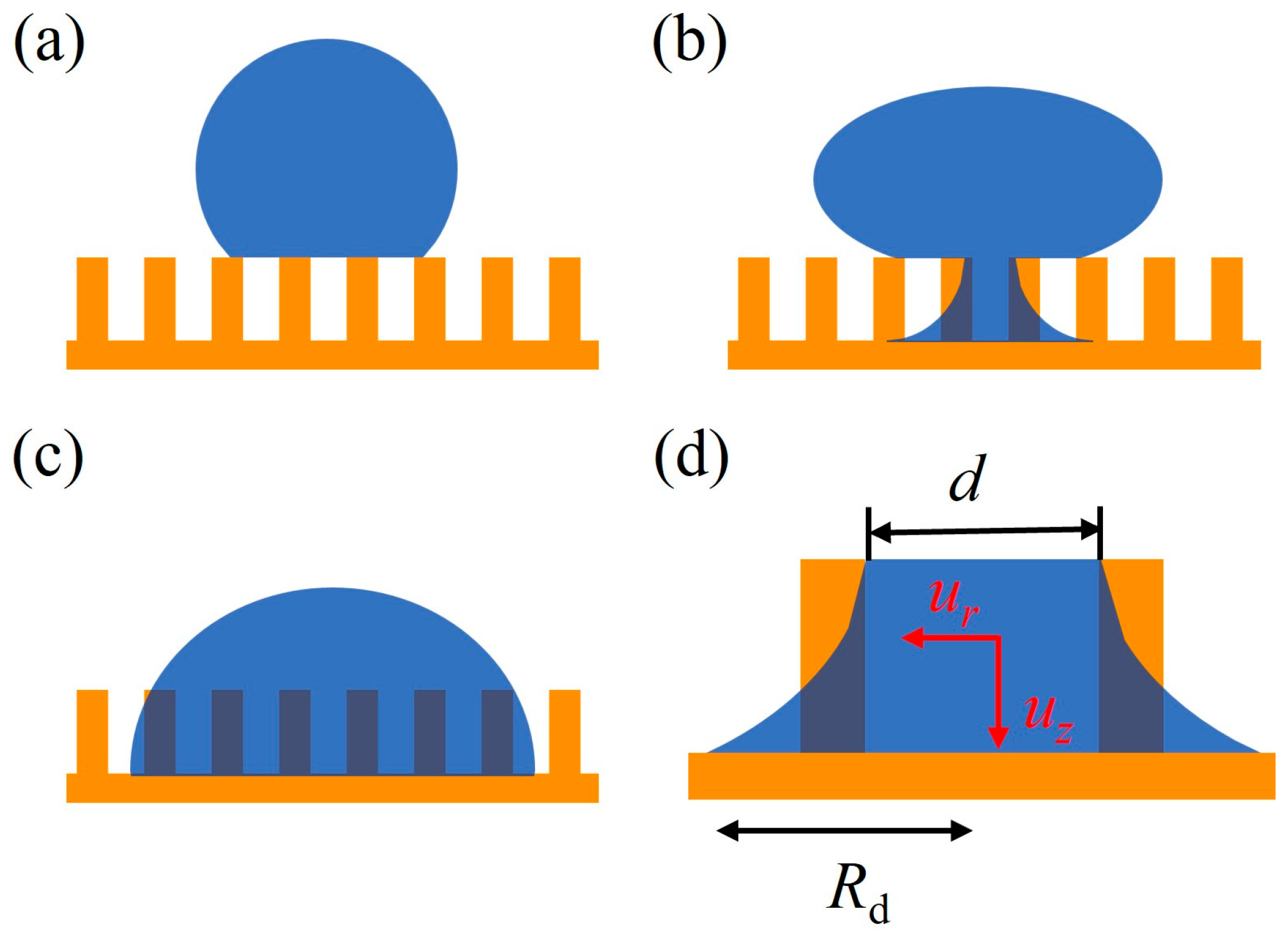
During the pinning stage, the competition between inertial and viscous forces of the droplet leads to oscillations on the micropillar surface [34], while the TPCL remains pinned at the micropillar edges (Figure 6a). As the internal flow velocity of the droplet decreases, the TPCL begins to advance. Unlike smooth substrates, the micropillars on rough surfaces penetrate into the droplet, allowing liquid to infiltrate the inter-pillar gaps and wet the pillar bases. This process causes a transition from a Cassie-like to a Wenzel-like state, manifested by the rapid spreading of liquid between micropillars (penetration stage in Figure 4 and Figure 7). Assuming axisymmetric flow conditions between micropillars, the liquid flow behavior during this stage can be described by the Navier–Stokes equations:
u r t + u r u r r + u z u r z = p ρ r + η ρ r r r u r r u r r 2 + 2 u r z 2 ,
where ur, uz, ρ, η, and p denote radial velocity, vertical velocity, liquid density, viscosity, and pressure, respectively. To derive the scaling law for the real contact line radius Rd during penetration, we proceed with the following key assumptions: (i) axisymmetric flow between micropillars, (ii) negligible air drag, and (iii) characteristic velocity ur~dRd/dt, characteristic time tc~R0/(dRd/dt) and droplet height H~R0. Non-dimensional form of Equation (1) can be written as
ρ d 2 t c η u ¯ r t ¯ + ρ u c d η u ¯ r u ¯ r r ¯ + ρ u c d η d H u ¯ z u ¯ r z ¯ = ρ u c d η p ¯ r ¯ + r ¯ r ¯ r ¯ u ¯ r r ¯ u ¯ r r ¯ 2 + d 2 H 2 2 u ¯ r z ¯ 2
where the bar marks the dimensionless form of the variable and d denotes the micro-pillar spacing. Considering the condition R0 >> d (inter-pillar spacing), Equation (2) yields
ρ d η d R d d t u ¯ r u ¯ r r ¯ + p ¯ r ¯ = r ¯ r ¯ r ¯ u ¯ r r ¯ u ¯ r r ¯ 2 .
During the polymerization of polymeric materials, numerous long-chain structures are generated [36]. These long-chain structures tend to adsorb onto solid surfaces, forming an adsorbed layer. The presence of this layer creates a viscosity gradient in the vicinity of the micropillars. Given that the characteristic thickness of the adsorbed layer ranges from 3 to 15 nm [36,37], which is significantly smaller than the spacing between micropillars (about 10 μm), the influence of the adsorbed layer near the micropillars can be reasonably simplified by applying a no-slip boundary condition. Therefore, the flow between micro-pillars can be simplified as Poiseuille’s flow. Integrating Equation (3) with respect to r, one finds
ρ R ˙ d d η u ¯ r u ¯ r + p ¯ = u ¯ r r ¯ + u ¯ r r ¯ ,
where the dot on top denotes the time derivative.
For Poiseuille’s flow [38], applying radial homogenization (∂ur/∂r~(dRd/dt)/d), and using the pressure scaling p~ρ (dRd/dt)2, one obtains the relation linking the driving force to viscous dissipation:
R ˙ d ~ η ρ d .
The viscosity η evolves with curing time. This reaction-induced viscosity growth follows η~η0ϕ0 (kt)1/2 (with subscript 0 denoting the initial viscosity of the droplet at the start of the reaction, ϕ0 the initial concentrations of component A, and k the curing reaction rate constant), a scaling supported by our prior rheological measurements on the same polyurea system under quiescent conditions [34]. Substituting this into Equation (5) and solving for Rd gives the scaling law for the penetration stage:
R d = C 1 η 0 ϕ 0 k ρ d t 3 / 2 ,
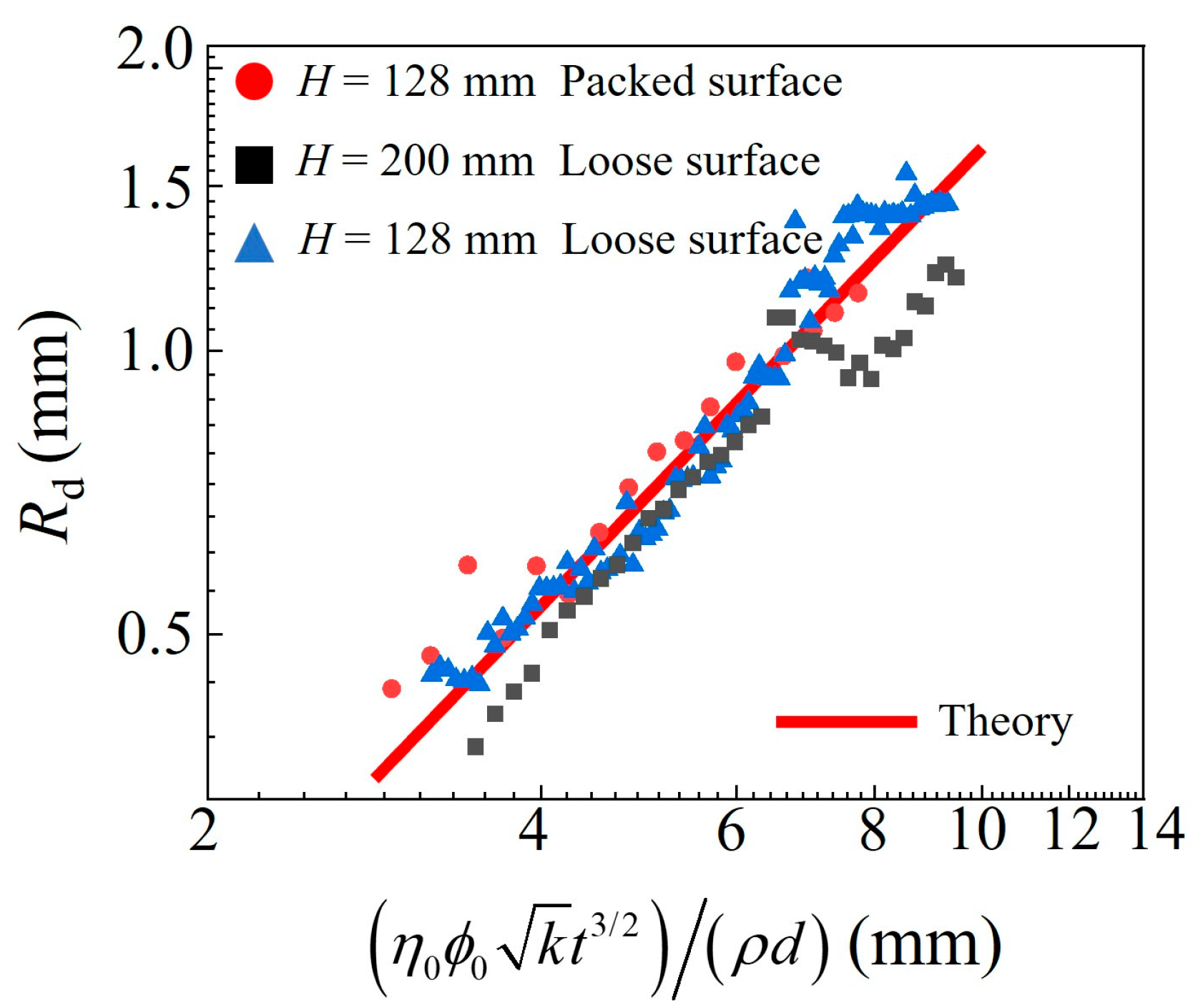
where the fitting constant C1 is 0.145. Figure 8 shows the normalization of the experimental data using Equation (6).

3.2. Spreading of Real and Apparent TPCLs

In the spreading stage, the dynamics of both the real and apparent TPCLs significantly depends on surface roughness. At relatively low roughness, this dependence effect on the flow field and liquid–air interface is negligible. The viscous dissipation rate [39] can be expressed as ϕη~η[dRd/(Hmdt)]2Rd2Hm, where Hm is the average height of the droplet. Considering the droplet volume V0~Rd2Hm, the viscous dissipation rate can be further expressed as ϕη~η(dRd/dt)2Rd4V0−1. The change in system free energy [40] can be represented as dEf~(γSPγSA)dRd2, where γSA, γSP, θ0 represent the solid–air surface tension, solid–liquid surface tension, and equilibrium contact angle, respectively. The Onsager variational principle derives the governing dynamics by minimizing the combined rate of free-energy change and dissipation [41,42]. According to the Onsager variational principle:
d E / d t + ϕ v c = 0 ,
where E, ϕ, and vc denote the free energy, dissipation rate, and characteristic velocity, respectively. For comparably low roughness, the change in radius of the real TPCL over time can be expressed as [34]
R d ~ Δ γ V 0 η 0 φ 0 2 k 1 4 φ 0 2 k t 1 8 ,
where ∆γ = γSPγSA and V0 denotes the initial volume of the droplet. When the roughness of surface is low enough, it can be assumed that the apparent contact line radius Ru is not affected by micro-pillar pinning. Thus, for comparably low-roughness surfaces, apparent and real contact line radii evolve synchronously, i.e., Ru~Rd~t1/8.
When the specific surface area of the substrate increases further, the pinning effect of micropillars on the liquid–gas interface becomes non-negligible. The viscous dissipation caused by the motion of the real contact line between micropillars is mainly concentrated within the inter-pillar regions [43]. The roughness of the substrate ψ and the volume of liquid volume Vd between micro-pillar can be expressed as d2/l2 and Rd2h, respectively, where l denotes the center-to-center spacing between adjacent pillars. Accordingly, the viscous dissipation rate during the motion of the real contact line can be expressed as ϕ~ψη[dRd/(hdt)]2πVd. Considering substrate roughness, the change in free energy can be written as dEhf~(Ra2/d2)(γPA/Rd)πhddRd, where γPA is the surface tension at the liquid–gas interface, and Ra is the contact line radius at the moment of droplet pinning. According to Equation (8), the time-dependent radius of the real TPCL is given by
R d = C 2 l 2 R a 2 γ PA h 2 d 3 η 0 ϕ 0 k 4 t 1 / 8 ,
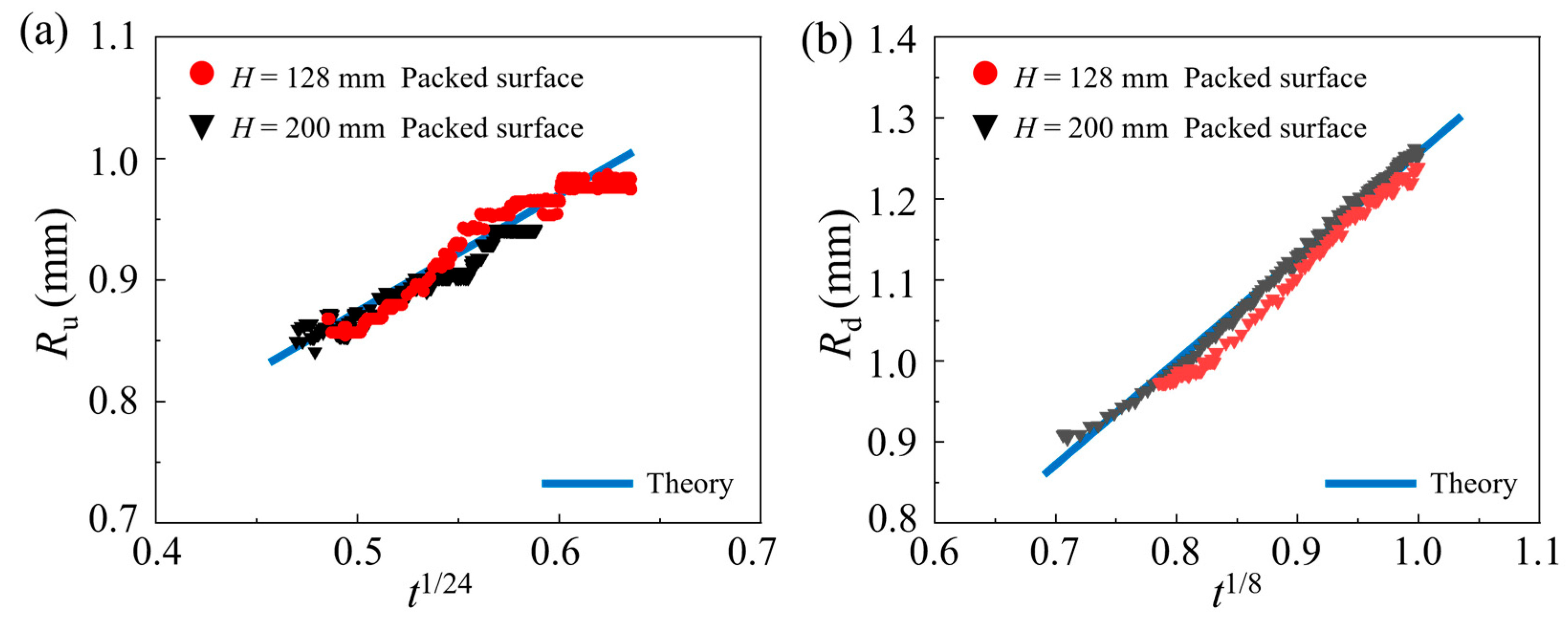
where the fitting constant C2 = 1.7. During the motion of the apparent contact line on the micropillar surface, the dominant dissipation mechanism shifts from viscous dissipation to contact line pinning. The energy dissipation rate due to pinning by the substrate micropillars can be expressed as [37] ϕa~Ruκ(dRu/dt), where the spring constant of the line κ = [2Ru π γPAθ02]/[l ln(d/w)]. The attenuation of the system’s free energy during this motion depends on the change in wetted area of the micropillar surface, expressed as dEr~(Ra2/d2)γPA(Rd/Ru)πhdRu. Applying the Onsager variational principle and considering Equation (9), the evolution of the apparent contact line radius is described as
R u = C 3 l 2 R a 2 γ PA h 3 d 3 η 0 ϕ 0 k 4 R a 2 h l ln l / w d 2 θ 0 2 3 t 1 / 24
where the fitting constant C3 = 1.2. The experimental and theoretical comparisons are presented in Figure 9a,b.

3.3. Droplet Impact on the Rock-like Surface

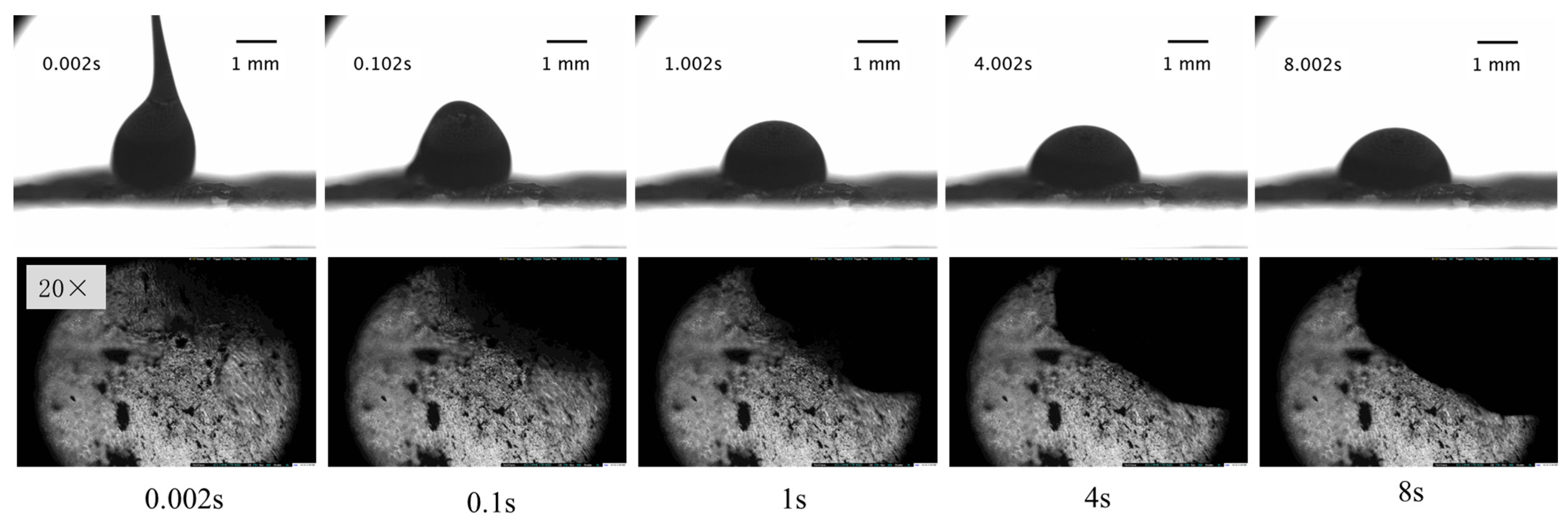
To verify the spreading behavior of polyurea droplets on actual coal substrates, the regular micropillar arrays used so far were replaced with real coal samples. Polyurea droplets were released from a height of 128 mm onto the coal surface, and the evolution of droplet morphology and contact line radius was recorded.
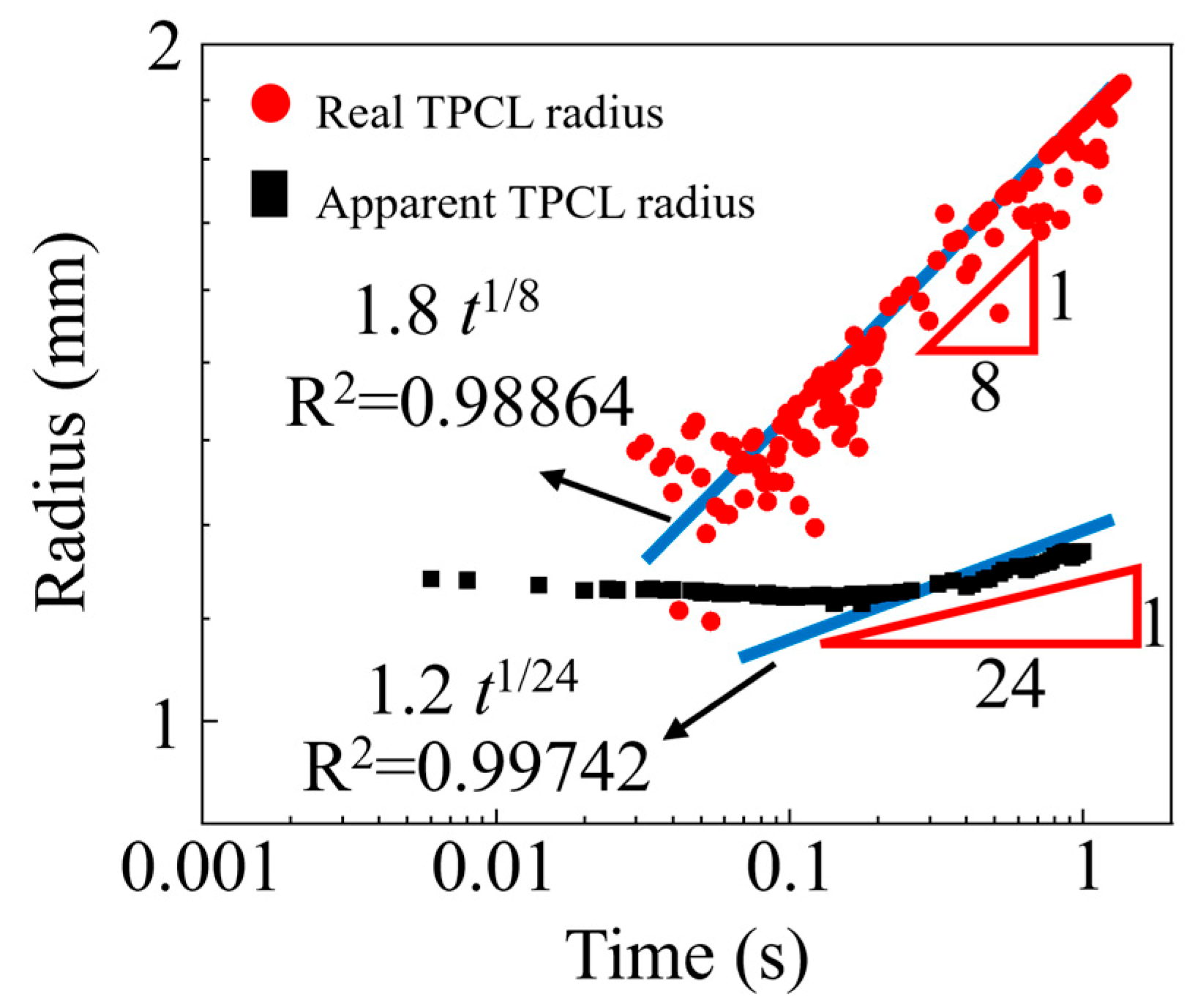
Figure 10 presents the time-resolved morphology of polyurea droplets during impact and spreading on the coal surface. Unlike the well-defined Cassie-to-Wenzel transition observed on micropillar substrates, the transition is not distinctly visible on rock-like surfaces due to their irregular microstructures. These features destabilize the liquid–air interface, yet the apparent TPCL remains pinned during the initial pinning stage (Figure 11). In the spreading stage, as on high-roughness micropillar surfaces, the real TPCL advances more rapidly than the apparent TPCL.
Figure 11 shows the time evolution of the contact line radius of a polyurea droplet on the rock-like surface. The scaling behavior is consistent with that observed on densely packed micropillar substrates. The real TPCL radius evolves according to a t1/8 law, reflecting the combined effects of surface tension and viscous dissipation within the microstructures. By contrast, the apparent TPCL radius follows a t1/24 law, indicating that its motion is resisted by pinning. These findings confirm that the mechanisms established for micropillar surfaces can also explain droplet impact dynamics on coal-like surfaces.

4. Conclusions

Compared with smooth surfaces, polyurea droplets impacting rough surfaces undergo a transition from a “Cassie-like” state to a “Wenzel-like” state during the penetration stage. In this stage, the apparent TPCL is pinned by surface microstructures, while liquid infiltrates the inter-pillar gaps and accumulates at their bases, forming the real TPCL. The spreading of the real TPCL is jointly driven by inertial forces and reaction-induced viscosity, with its radius evolving according to a t3/2 scaling law. In the subsequent spreading stage, the role of surface roughness becomes pronounced. At relatively low roughness, the pinning effect of microstructures on the liquid–gas interface is negligible, and the real and apparent TPCLs advance synchronously. The motion of TPCLs is governed by surface tension and viscous forces, with the TPCL radius following a t1/8 scaling law. As roughness increases, however, pinning effects become significant, resulting in distinct dynamics between the real and apparent TPCLs. The real TPCL spreads under the combined influence of surface tension and viscous dissipation within the microstructures, whereas the apparent TPCL motion is additionally governed by contact line pinning and reaction-induced viscosity. In this case, the apparent TPCL radius follows a t1/24 scaling law. It is worth to emphasize that since the solidification timescale of polyurea droplets is on the order of seconds, the scaling laws derived from fluid models become inapplicable when the spreading time exceeds 1 s, because the liquid near the contact line solidifies and gradually ceases to move.
The distinction between the t1/8 and t1/24 behaviors arises from whether microstructural pinning governs the contact-line motion. At relatively low roughness, pinning becomes negligible and the real and apparent TPCLs both advance under a capillary-viscous balance, producing the classical t1/8 scaling. At higher roughness, however, strong enough pinning imposes an additional resistance on the apparent TPCL. While the real TPCL continues to spread through capillary-driven infiltration within the microstructures, the apparent TPCL must also overcome pinning and reaction-induced viscosity, resulting in the much slower t1/24 evolution.
Experiments conducted on rock-like surfaces confirm that the mechanisms described also apply to polyurea droplet impact and spreading on actual coal substrates. Alltogether, these findings provide a mechanistic framework for understanding reactive droplet dynamics on rough surfaces, while also raising open questions regarding the broader physics of reactive droplet impact. In practical terms, the measured difference between the radii of real and apparent TPCLs (about 2 mm versus about 1.2 mm) suggests that smaller droplets combined with a wider spray cone angle can achieve efficient coverage while reducing material consumption. Moreover, finer and more uniformly distributed droplets effectively suppress multiple penetration points, thereby lowering the risk of air entrapment and improving coating adhesion and durability on coal-like substrates. Future theoretical work may focus on extending the present framework to droplet spreading on inclined rough surfaces, which represents a more realistic condition for coating and dust-suppression applications in mining environments.

Author Contributions

Conceptualization, J.Y.; methodology, J.Y. and S.C.; software, J.Y.; validation, J.Y.; formal analysis, J.Y. and S.C.; investigation, J.Y. and S.C.; resources, J.Y.; data curation, J.Y. and S.C.; writing—original draft preparation, J.Y.; writing—review and editing, J.Y. and S.C.; visualization, S.C. and S.L.; supervision, S.L.; project administration, S.L.; funding acquisition, J.Y. All authors have read and agreed to the published version of the manuscript.

Funding

This research was funded by the CCTEG (China Coal Technology and Engineering Group) Coal Mining Research Institute (grant KCYJY-2024-MS-02).

Data Availability Statement

Data will be made available upon reasonable request.

Conflicts of Interest

The authors declare no conflicts of interest.

References

  1. Tang, Y.; Tang, B.; Cheng, H. New prefabricated support structure for TBM tunneling in complex strata of coal mines: Engineering practice. Coal Sci. Technol. 2024, 52, 68–75. (In Chinese) [Google Scholar] [CrossRef]
  2. Plessis, M.D.; Malan, D.F. Investigating the use of polymer-modified cementitious thin spray-on liners as stope face support. Int. J. Rock Mech. Min. Sci. 2021, 142, 104728. [Google Scholar] [CrossRef]
  3. Roache, B.; Jardine, J.; Sainsbury, B. Thin spray liners for face support at Kanmantoo. In Underground Operators Conference 2023: Conference Proceedings; Australasian Institute of Mining & Metallurgy (AusIMM): Carlton, Australia, 2023; pp. 176–187. Available online: https://www.researchgate.net/publication/369655009_Thin_spray_liners_for_face_support_at_Kanmantoo (accessed on 16 November 2025).
  4. Kang, H.; Jiang, P.; Song, D. Drilling and anchoring integrated intelligent rapid excavation complete equipment. J. Intell. Mine 2023, 4, 9–14. (In Chinese) [Google Scholar] [CrossRef]
  5. Kang, H.; Jiang, P.; Wang, Z.; Zhang, X.; Liu, C.; Luo, C.; Wei, Y.; Guo, J.; Chen, Z.; Wang, R.; et al. Coal roadway rapid driving technology and equipment with integrated drilling and anchoring and its application. Chin. J. Coal Soc. 2024, 49, 131–151. (In Chinese) [Google Scholar] [CrossRef]
  6. Kolapo, P.; Onifade, M.; Said, K.O.; Amwaama, M.; Aladejare, A.E.; Lawal, A.I.; Akinseye, P.O. On the application of the novel thin spray-on liner (TSL): A progress report in mining operations. Geotech. Geol. Engin. 2021, 39, 5445–5477. [Google Scholar] [CrossRef]
  7. Bernard, E.S. Fibre reinforced sprayed concrete for ground support. Tunnell. Undergr. Space Technol. 2020, 14, 103302. [Google Scholar] [CrossRef]
  8. Yang, J.; Xue, B.; Zhou, Y.; Qin, M.; Wang, W.; Cao, Y. Spray-painted hydrogel coating for marine antifouling. Adv. Mater. Technol. 2021, 6, 2000911. [Google Scholar] [CrossRef]
  9. Yang, H.; Yu, B.; Song, P.; Maluk, C.; Wang, H. Surface-coating engineering for flame retardant flexible polyurethane foams: A critical review. Composites B Engin. 2019, 176, 107185. [Google Scholar] [CrossRef]
  10. Guastella, A.J.; Boulton, K.A.; Whitehouse, A.J.O.; Song, Y.J.; Thapa, R.; Gregory, S.G.; Pokorski, I.; Granich, J.; Demayo, M.M.; Ambarchi, Z. The effect of oxytocin nasal spray on social interaction in young children with autism: A randomized clinical trial. Mol. Psychiatry 2023, 28, 834–842. [Google Scholar] [CrossRef]
  11. Worthington, A.M. On the forms assumed by drops of liquids falling vertically on a horizontal plate. Proc. R. Soc. Lond. 1876, 25, 261–272. [Google Scholar] [CrossRef]
  12. Zheng, J.; Fang, R.; Xu, Z.; Lv, T.; Li, D.; Vorobyev, A. Impact dynamics of water droplets on oil-covered dielectrowetting substrate: Effects of oil film thickness and surface wettability. Appl. Surf. Sci. 2024, 659, 159886. [Google Scholar] [CrossRef]
  13. Han, X.; Li, J.; Tang, X.; Li, W.; Zhao, H.; Yang, L.; Wang, L. Droplet bouncing: Fundamentals, regulations, and applications. Small 2022, 18, 2200277. [Google Scholar] [CrossRef]
  14. Islamova, A.G.; Kropotova, S.S.; Shlegel, N.E.; Strizhak, P.A. The collisions of droplets and particles at the different initial temperatures. Int. J. Heat Mass Transf. 2022, 196, 123301. [Google Scholar] [CrossRef]
  15. Mitchell, B.R.; Klewicki, J.C.; Korkolis, Y.P.; Kinsey, B.L. The transient force profile of low-speed droplet impact: Measurements and model. J. Fluid Mech. 2019, 867, 300–322. [Google Scholar] [CrossRef]
  16. Ramírez-Soto, O.; Sanjay, V.; Lohse, D.; Pham, J.T.; Vollmer, D. Lifting a sessile oil drop from a superamphiphobic surface with an impacting one. Sci. Adv. 2020, 6, eaba4330. [Google Scholar] [CrossRef] [PubMed]
  17. Soto, D.; De Lariviere, A.B.; Boutillon, X.; Clanet, C.; Quéré, D. The force of impacting rain. Soft Matter 2014, 10, 4929–4934. [Google Scholar] [CrossRef]
  18. Antonini, C.; Amirfazli, A.; Marengo, M. Drop impact and wettability: From hydrophilic to superhydrophobic surfaces. Phys. Fluids 2012, 24, 102104. [Google Scholar] [CrossRef]
  19. Range, K.; Feuillebois, F. Influence of surface roughness on liquid drop impact. J. Colloid Interface Sci. 1998, 203, 16–30. [Google Scholar] [CrossRef]
  20. Martini, P.; Albertini, S.; Laimer, F.; Meyer, M.; Gatchell, M.; Echt, O.; Zappa, F.; Scheier, P. Splashing of large helium nanodroplets upon surface collisions. Phys. Rev. Lett. 2021, 127, 263401. [Google Scholar] [CrossRef]
  21. Castillo-Orozco, E.; Davanlou, A.; Choudhury, P.K.; Kumar, R. Droplet impact on deep liquid pools: Rayleigh jet to formation of secondary droplets. Phys. Rev. E 2015, 92, 053022. [Google Scholar] [CrossRef]
  22. Huang, X.; Wan, K.T.; Taslim, M.E. Axisymmetric rim instability of water droplet impact on a super-hydrophobic surface. Phys. Fluids 2018, 30, 094101. [Google Scholar] [CrossRef]
  23. Mohammad Karim, A. Experimental dynamics of Newtonian and non-Newtonian droplets impacting liquid surface with different rheology. Phys. Fluids 2020, 32, 043102. [Google Scholar] [CrossRef]
  24. Gennes, P.-G.; Brochard-Wyart, F.; Quéré, D. Capillarity and Wetting Phenomena: Drops, Bubbles, Pearls, Waves; Springer Science+Business Media: New York, NY, USA, 2004. [Google Scholar] [CrossRef]
  25. Rioboo, R.; Marengo, M.; Tropea, C. Time evolution of liquid drop impact onto solid, dry surfaces. Exp. Fluids 2002, 33, 112–124. [Google Scholar] [CrossRef]
  26. Engel, O.G. Waterdrop collisions with solid surfaces. J. Res. Natl. Bur. Stand. 1955, 54, 281–298. [Google Scholar] [CrossRef]
  27. Kim, H.-Y.; Feng, Z.C.; Chun, J.-H. Instability of a liquid jet emerging from a droplet upon collision with a solid surface. Phys. Fluids 2000, 12, 531–541. [Google Scholar] [CrossRef]
  28. Young, T. An essay on the cohesion of fluids. Philos. Trans. R. Soc. Lond. 1832, 1, 171–172. [Google Scholar] [CrossRef]
  29. Wenzel, R.N. Resistance of solid surfaces to wetting by water. Ind. Engin. Chem. 1936, 28, 988–994. [Google Scholar] [CrossRef]
  30. Cassie, A.B.D.; Baxter, S. Wettability of porous surfaces. Trans. Faraday Soc. 1944, 40, 546–551. [Google Scholar] [CrossRef]
  31. Bormashenko, E. Wetting of flat and rough curved surfaces. J. Phys. Chem. C 2009, 113, 17275–17277. [Google Scholar] [CrossRef]
  32. Izbassarov, D.; Muradoglu, M. Effects of viscoelasticity on drop impact and spreading on a solid surface. Phys. Rev. Fluids 2016, 1, 023302. [Google Scholar] [CrossRef]
  33. Wang, Y.; Do-Quang, M.; Amberg, G. Impact of viscoelastic droplets. J. Non-Newtonian Fluid Mech. 2017, 243, 38–46. [Google Scholar] [CrossRef]
  34. Cao, S.; Yang, J.; Yuan, G. Effects of reaction-induced viscosity variation on droplet impact dynamics. Phys. Fluids 2025, 37, 072131. [Google Scholar] [CrossRef]
  35. Shi, Z.; Zhang, Z.; Huang, W.; Zeng, H.; Mandić, V.; Hu, X.; Zhao, L.; Zhang, X. Spontaneous adsorption-induced salvinia-like micropillars with high adhesion. Langmuir 2021, 37, 6728–6735. [Google Scholar] [CrossRef] [PubMed]
  36. Xu, Y.; Nadykto, A.B.; Yu, F.; Herb, J.; Wang, W. Interaction between common organic acids and trace nucleation species in the Earth’s atmosphere. J. Phys. Chem. A 2010, 114, 387–396. [Google Scholar] [CrossRef] [PubMed]
  37. Smeeth, M.; Spikes, H.A.; Gunsel, S. The formation of viscous surface films by polymer solutions: Boundary or elastohydrodynamic lubrication? Tribol. Trans. 1996, 39, 720–725. [Google Scholar] [CrossRef]
  38. De Gennes, P.G. Wetting: Statics and dynamics. Rev. Mod. Phys. 1985, 57, 827–863. [Google Scholar] [CrossRef]
  39. Man, X.; Doi, M. Ring to mountain transition in deposition pattern of drying droplets. Phys. Rev. Lett. 2016, 116, 066101. [Google Scholar] [CrossRef]
  40. Bonn, D.; Eggers, J.; Indekeu, J.; Meunier, J.; Rolley, E. Wetting and spreading. Rev. Mod. Phys. 2009, 81, 739–805. [Google Scholar] [CrossRef]
  41. Doi, M. Onsager’s variational principle in soft matter. J. Phys. Condens. Matter. 2011, 23, 284118. [Google Scholar] [CrossRef]
  42. Quian, T.; Sheng, P.; Wang, X.-P. Generalized Navier boundary condition for the moving contact line. Commun. Math. Sci. 2003, 1, 333–341. [Google Scholar] [CrossRef]
  43. Semprebon, C.; Forsberg, P.; Priest, C.; Brinkmann, M. Pinning and wicking in regular pillar arrays. Soft Matter 2014, 10, 5739–5748. [Google Scholar] [CrossRef]
Figure 1. Structure of micro-pillar-arrayed surfaces: loose (a) and packed (b) configurations.
Physics 08 00006 g001
Figure 2. Structure of rock-like surfaces: (a) surface profile measured via step profiler and (b) bottom-view image of demolded rock-like structure.
Physics 08 00006 g002
Figure 3. Droplet impact test bench. (a) Schematic diagram of the experimental setup. After the components A and B are mixed in a injector to form droplets, the droplets impact onto the rough surface (H—falling height; R0—initial radius; v0—impact velocity). (b) Photograph of the polyurea droplet impact device.
Physics 08 00006 g003
Figure 4. Evolution of the apparent (Ru, black squares) and real (Rd, red circles) three-phase contact line (TPCL) radii during droplet impact on (a) loose and (b) packed micro-pillar arrays (fall height of 128 mm). The dashed yellow lines indicate the corresponding scaling laws governing the contact line evolution in each stage (for example, Rd~t3/2 in penetration stage) defined by the ratios of the shown values of legs of triangles (3/2 for Rd in penetration stage).
Physics 08 00006 g004
Figure 5. Droplet shape evolution. Morphologies of droplets (initial radius 1 mm) impacting packed (a,b) and loose (c,d) surfaces from heights of 128 mm (a,c) and 200 mm (b,d).
Physics 08 00006 g005
Figure 6. Three stages of droplet impact on micro-pillar-arrayed surfaces: schematic diagrams of pinning (a), penetration (c), and spreading (e) stages and their bottom-view images (b, d and f, respectively) showing positions of apparent (dashed red line) and real (dashed blue line) TPCLs.
Physics 08 00006 g006
Figure 7. Liquid penetration. Droplet transition from Cassie-like (a) to Wenzel-like (c) states induced by micropillar penetration (b), with. (d) symbol description.
Physics 08 00006 g007
Figure 8. Real TPCL radius plotted against t3/2. The theory is given Equation (6).
Physics 08 00006 g008
Figure 9. Spreading on packed micropillar surface during the spreading stage. (a) The apparent TPCL radius (Ru) follows a t1/24 scaling, dominated by pinning dissipation. (b) The real TPCL radius (Rd) follows a t1/8 scaling, governed by viscous dissipation within the microstructures. Solid lines represent theoretical predictions by Equations (10) and (9), respectively, demonstrating satisfactory agreement with experimental data.
Physics 08 00006 g009
Figure 10. Spreading process of polyurea droplets impacting the coal surface.
Physics 08 00006 g010
Figure 11. Spreading law of reactive droplets impacting the coal surface. The blue lines show the fits by the functional depenednces indicated and defined by the ratios of the shown values of legs of triangles. R2 represents the measure of goodness of the fits.
Physics 08 00006 g011
Disclaimer/Publisher’s Note: The statements, opinions and data contained in all publications are solely those of the individual author(s) and contributor(s) and not of MDPI and/or the editor(s). MDPI and/or the editor(s) disclaim responsibility for any injury to people or property resulting from any ideas, methods, instructions or products referred to in the content.