Article

Kicked Fluxonium with a Quantum Strange Attractor


by
Alexei D. Chepelianskii
1 and
Dima L. Shepelyansky
2,*
1
Laboratoire de Physique des Solides (LPS), Université Paris-Sud, Centre National de la Recherche Scientifique (CNRS), UMR 8502, F-91405 Orsay, France
2
Laboratoire de Physique Théorique, Université de Toulouse, Centre National de la Recherche Scientifique (CNRS), Toulouse, France
*
Author to whom correspondence should be addressed.
Physics 2026, 8(1), 22; https://doi.org/10.3390/physics8010022

Submission received: 21 December 2025 / Revised: 20 January 2026 / Accepted: 29 January 2026 / Published: 16 February 2026
(This article belongs to the Section Quantum Mechanics and Quantum Systems)

Abstract

The quantum dissipative time evolution of a fluxonium under a pulsed field (kicks) is studied numerically and analytically. In the classical limit, the system dynamics is converged to a strange chaotic attractor. The quantum properties of this system are studied using the density matrix within the framework of the Lindblad equation. In the case of dissipative quantum evolution, the steady-state density matrix is converged to a quantum strange attractor that is similar to the classical one. It is shown that depending on the dissipation strength, there is a regime when the eigenstates of the density matrix are localized at a strong or moderate dissipation. At weak dissipation, the eigenstates are argued to be delocalized, which is linked to the Ehrenfest explosion of the quantum wave packet. This phenomenon is related to the Lyapunov exponent and Ehrenfest time for the quantum strange attractor. Possible experimental realizations of this quantum strange attractor with fluxonium are discussed.

1. Introduction

The fluxonium was invented in Ref. [1] as a single Cooper-pair circuit free from charge offsets. Recently, very long coherence times and extremely high fidelity have been realized with fluxonium qubits (see, e.g., [2,3,4,5,6,7]). The roadmap for the development of a high-performance fluxonium quantum processor is advanced in Ref. [8]. That is, progress in superconducting fluxoniom systems allows for precise control over these quantum circuits.
The Hamiltonian of fluxonium, written in standard notations [1], reads
H ^ = 4 E C N ^ 2 + E L φ ^ 2 / 2 E J cos ( φ ^ 2 π Φ ext / Φ 0 ) ,
where the reduced charge on the junction capacitance is described by N ^ = Q ^ / 2 e with conjugated flux φ ^ = 2 e Φ ^ / and charge energy E C (in units of 2e), the Josephson energy is E J , shunted by a large inductance L, Φ ext is external flux and Φ 0 is a flux quantum. Here, e denortes elementary charge and ℏ is the reduced Planck constant. There is a standard operator commutator relation [ φ ^ , N ^ ] = i . Typical experimental parameters are E L 0.5 GHz, E J 9 GHz, and E C 2.5 GHz [1] with certain variations in other experiments [2,3,4,5,6,7]. A general introduction to the physics of superconducting qubits can be found in Refs. [9,10].
In this paper, we introduce and study the kicked fluxonium model described by the time-dependent Hamiltonian
H ^ = 4 E C N ^ 2 + E L φ ^ 2 / 2 J cos ( φ ^ 2 π Φ ext / Φ 0 ) m δ ( t m T )
where m δ ( t m T ) is a train of periodic Dirac δ -functions followed by a period T and producing kicks of fluxonium, J = E J δ t is the kick amplitude which in a case of pulse is determined by a finite pulse duration δ t . Between kicks, the time evolution is described by a quantum oscillator with frequency Ω = 2 2 E C E L , = 1 with effective momentum p and coordinate x for an effective Hamiltonian, Thus, the system represents a kicked harmonic oscillator, which in dimensionless units is described by the rescaled fluxonium Hamiltonian
H f ^ = ( p ^ 2 + ω 0 2 x ^ 2 ) / 2 K cos ( q x ^ ) m δ ( t m T ) ,
where K / describes the number of kick quanta excited by a kick from the oscillator ground state. In the following, in Equation (3), we place the oscillator frequancy ω 0 = 1 , T = 2 π / R = π / 2 is the dimensionless time interval between kicks (we consider the case with four kicks per oscillator period). At q = 1 in physical units of Hamiltonian (2), we have K / = J , since = 1 in Equation (2). In the absence of kicks at K = 0 , the Hamiltonian H f ^ is reduced to the standard Hamiltonian of the quantum harmonic oscillator H 0 ^ = ( p ^ 2 + x ^ 2 ) / 2 , [ p ^ , x ^ ] = i . The mass and frequency of oscillator ω 0 = Ω are normalized to unity so that in these units ℏ is dimensionless and q is also dimensionless. A transition between the case with q to a case with q = 1 is given by the transformation: q x , q p x , p , eff q 2 , K / K / eff = K / ( q 2 ) . In a classical system, the case at q 1 can be transferred to the case at q = 1 by the transformation K q 2 K cl , q x , q p x , p . For the typical experimental values E L 0.5 GHz, E J 9 GHz and E C 2.5 GHz [1], one has Ω = 2 2 E C E L 3 GHz and with a kick duration δ t 0.1 × 2 π / Ω , one obtains K = J = E J δ t 2 . For an experimental value E J 27 GHz, one has K 6 being close to the numerical parameters with a quantum strange attractor studied below.
Actually, the system of a classical kicked harmonic oscillator (3) has been introduced and studied in Refs. [11,12]. It is also known as a Zaslavsky web map [13]. The Hamiltonian dynamics (3) depends only on two dimensionless parameters: the classical chaos parameter K, which determines the kick strength, leading to hard chaos at high values, and the ratio of the period of kicks to the oscillator period 2 π being T / 2 π = 1 / R (we take here q = 1 ). For R = 3 , 4 , and 6 , the separatrix web covers the whole phase space plane ( x , p ) , which corresponds to a known geometric result of covering plane by triangles, squares, and hexagons. For these R values, even at quite small K, there is a chaotic separatrix layer of width proportional to K [11,12,13]. For other integer R values, the separatrix web cannot cover the whole plane without gaps and the properties of chaotic layers at small K are more complex. In contrast, for high K, for example, K = 7 , there is a formation of hard chaos without visible stability islands with a diffusive energy growth E = ( p 2 + x 2 ) / 2 q 2 K 2 t / 2 , where time t is measured in number of kicks and · denotes the averaging over classical trajectories. The generic properties of dynamical Hamiltonian chaos are described in Refs. [14,15,16].
The quantum studies of Hamiltonian (3) were reported by different groups (see, e.g., [17,18,19,20,21,22,23,24] at q = 1 ). For M = 4 , the quantum dynamics (3) is reduced to the kicked Harper model studied in Refs. [25,26], as discussed in Ref. [17], and there is no quantum dynamical localization. This is drastically different from the case of the kicked rotator model obtained from the quantization of the Chirikov standard map, where the classical diffusion is suppressed by quantum interference effects, leading to the dynamical localization similar to the Anderson localization in disordered solids (see, e.g., [27,28,29] and the references therein for studies of the kicked rotator model). This kicked rotator model had been realized with cold atoms in a kicked optical lattice [30], where kicks were realized by short pulses of a finite duration.
For numerical studies of the quantum kicked harmonic oscillator, a number of interesting results have being obtained with localization and delocalization at small and high kick strength values of K / for R = 5 and irrational R [17,21]. The experimental realization of a quantum system (3) with an ion trap was proposed in Ref. [19], with an analysis of the sensitivity and fidelity at small perturbations. However, all previous studies of the quantum system (3) were conducted in the regime of quantum unitary evolution. In contrast, for superconducting qubits and fluxonium, the dissipative effects play a crucial role that leads us to studies of quantum evolution (3) in the presence of dissipation present for the kicked fluxonium.
The dissipative quantum evolution of oscillator systems is well described in the frame of the Lindblad equation for the density matrix ρ ( t ) [31,32,33]. In the presence of dissipation with rate γ , a classical chaotic dynamics in many cases converges to a strange attractor, or chaotic attractor, with a fractal structure on smaller and smaller scales (see, e.g., [15,16]). Early studies of quantum strange attractor were reported in Refs. [34,35] for the quantum Chirikov standard map with dissipation. It was shown that a fractal structure is washed out on scales below the Planck constant ℏ. However, the properties of the density matrix in this regime were not investigated in detail. The same model was studied in Ref. [36] in the frame of quantum trajectories [37,38,39].
The results in Ref. [36], obtained for dissipative quantum chaos, indicated the existence of transition from Ehrenfest wave packet collapse to explosion. In the absence of dissipation, the Ehrenfest theorem [40] (see English translation in Ref. [41]) ensures that a compact wave packet follows a classical trajectory during a certain Ehrenfest time t E . However, for systems with dynamical chaos, classical trajectories diverge rapidly due to exponential instability of motion, so that the Ehrenfest time is logarithmically short t E | ln | / Λ compared to a case of integrable dynamics where t E 1 / is polynomially large at small values of the Planck constant (see, e.g., [27,42]). Here, Λ is the Lyapunov exponent, which characterizes the exponential instability of classical chaotic dynamics. For unitary time evolution in the regime of quantum chaos (at γ = 0 ), the illustrations of the Ehrenfest explosion of the quantum wave packet can be found, for instance, in Refs. [42,43,44].
In the presence of dissipation and quantum chaos, the results obtained with the quantum trajectories description show that the wave packet collapsed when the dissipative time t γ = 1 / γ is shorter than the Ehrenfest time t E [36]:
t γ = 1 / γ < t E | ln | / Λ ( collapse ) ,
t γ = 1 / γ > t E | ln | / Λ ( explosion ) .
This result was obtained with quantum trajectories, and it is important to understand its manifestation in the framework of the density matrix described by the Lindblad equation, which provides a complete description of the dissipative quantum evolution, which, as we show in this paper, converges to a quantum strange attractor for the dissipative quantum system based on the Hamiltonian (3). In this paper, we describe the properties of the density matrix in this regime. We also argue that the quantum strange attractor of this system can be realized with kicked fluxonium or ion traps. In this paper, we consider only the case with R = 4 .
The paper is organized as follows. Section 2 describes the model and numerical computation methods of the Lindblad evolution, the results are presented in Section 3, and the discussion is given in Section 4.

2. Model Description

For classical dynamics, the time evolution between kicks is described by the equations of the dissipative harmonic oscillator:
d p / d t + 2 γ p + ω 0 2 x = 0 , d x / d t = p ,
where ω 0 = 1 is the frequency of the free oscillator from Equation (3). The equations are linear and their exact solution [45] gives an exact map of the variable values ( x , p ) at the begining of time between kicks T to their values x ˜ , p ˜ after period T = 2 π / R = π / 2 , which reads:
x ˜ = a exp ( π γ / 2 ) cos ( π ω / 2 + α ) ,
p ˜ = a ω exp ( π γ / 2 ) sin ( π ω / 2 + α ) ,
a = x 2 + ( p + γ x ) 2 / ω 2 ,
tan α = ( p + γ x ) / ( ω x ) , ω = 1 γ 2 .
In the absence of dissipation, the free dynamics simply rotates ( x , p ) values on an angle π / 2 on a circle in the phase plane. The kick after free propagation on time T gives the final value ( x ¯ , p ¯ ) after one period of full evolution:
p ¯ = p ˜ K q sin q x ˜ , x ¯ = x ˜ .
Thus, Equations (7)–(11) describe the full classical dynamics on one time period with free propagation and kicks. The iterations of these equations give dynamical evolution on many periods measured by the integer time t / T , given by the number of kicks.
In the presence of dissipation, the quantum evolution of the Hamiltonian H f ^ (3) is described by the Lindblad equation for the density matrix ρ :
ρ ^ t = i [ H ^ , ρ ^ ] + 2 γ a ^ ρ ^ a ^ + a ^ + a ^ ρ ^ / 2 ρ ^ a ^ + a ^ / 2 ,
where a ^ and a ^ + are the oscillator creation and annihilation operators and γ is the dissipation rate corresponding to those of the classical dissipative dynamics (6). During the propagation between kicks in the oscillator eigenbasis one has:
ρ n m t = i ω 0 ( m n ) ρ n m + 2 γ ( n + 1 ) ( m + 1 ) ρ n + 1 , m + 1   ( n + m ) ρ n , m / 2 .
Rewriting this equation in the interaction representation frame, we have:
ρ ( t ) = ρ ˜ ( t ) e i ω 0 ( m n ) t , ρ ˜ n m t = 2 γ ( n + 1 ) ( m + 1 ) ρ ˜ n + 1 , m + 1   ( n + m ) ρ ˜ n , m / 2 .
Recall that we used dimensionless units of Hamiltonian (3) with ω 0 = 1 . An efficient integration of the propagator is performed for each independent k indexed sub-block ρ ˜ n , n + k (n being an integer in the basis).
During the kick, the density matrix is changed to:
ρ ^ exp i K / cos q x ^ ρ ^ exp i K / cos q x ^ .
The effect of the kick is computed in the oscillator eigenbasis ψ n ( x ) = e x 2 / 2 H n ( x / ) / [ π 1 / 4 2 n n ! ] using the matrix elements (see [46]):
cos q x ψ n ( x ) ψ n + m ( x ) d x = 1 + ( 1 ) m 2 2 m / 2 n ! ( m + n ) ! m / 2 q m e q 2 / 4 L n m ( q 2 / 2 ) ,
where H n and L n m are Hermite and Laguerre polynomials, respectively.
We adapted the numerical integration code developed in Ref. [47] to perform numerical simulations of the Lindblad equation for the kicked fluxonium. Thus, we integrated Equation (14) over the time interval T between kicks using the Dormand–Prince Runge–Kutta method. Equation (16) does not explicitly depend on time, and the evolution can be precomputed at the beginning of the simulation as a linear operator acting on the density matrix. To avoid storing a large N 2 × N 2 supermatrix (N is the number of oscillator states in the simulation), we notice that Equation (14) only couples states along diagonal lines of the density matrix, taking advantage of this observation brings the storage/time requirement for the pre-computation to N 3 operations. The kick matrices are also pre-computed and the time cost for both kick and free-propagation scales as N 3 . We used up to N = 2000 oscillator eigenstates in our numerical simulations, up to N L = 4 × 10 6 components of the density matrix.
Through the construction of Equations (13)–(16), the density matrix operator ρ ˜ , or density matrix, is Hermitian. Thus, due to the standard norm of ρ , its eigenvalues λ i are real, in the range 0 λ i 1 with the trace Tr [ ρ ˜ ] = i λ i = 1 .
As an initial quantum state, we usually take a coherent oscillator state with a minimal size located at a certain x , p position. The classical and quantum evolution converge to the same steady-state strange attractor. The classical density distribution in the phase space is obtained with 4 × 10 6 trajectories. In this study, we consider the Lindblad evolution [31,32,33] only for the case of the zero temperature reservoir.

3. Results

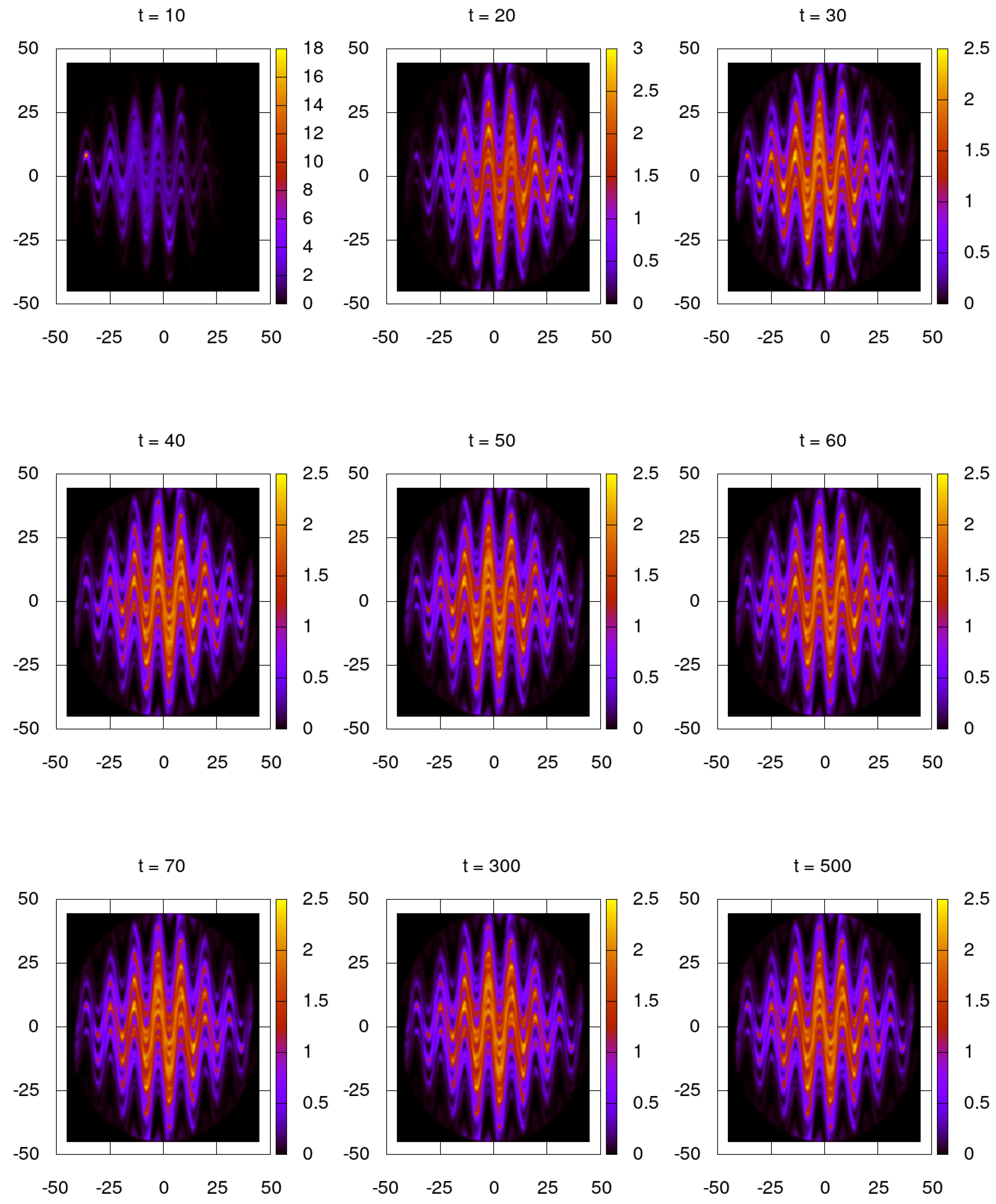
To characterize the quantum time evolution, from the density matrix, we construct ρ ( t ) at time moment of t the Husimi function, which is obtained from the Wigner function by a smoothing over the ℏ scale, as described, for instance, in Refs. [43,48]. The time evolution of the Husimi function is shown in Figure 1 for the regime of dissipative quantum chaos at the classical chaos parameter K = 6.4 and dissipation γ = 0.05 . The data show that the steady-state distribution is reached approximately after 40 kicks. This steady-state of quantum attractor is practically independent of the initial state, so it represents a global attractor steady-state.
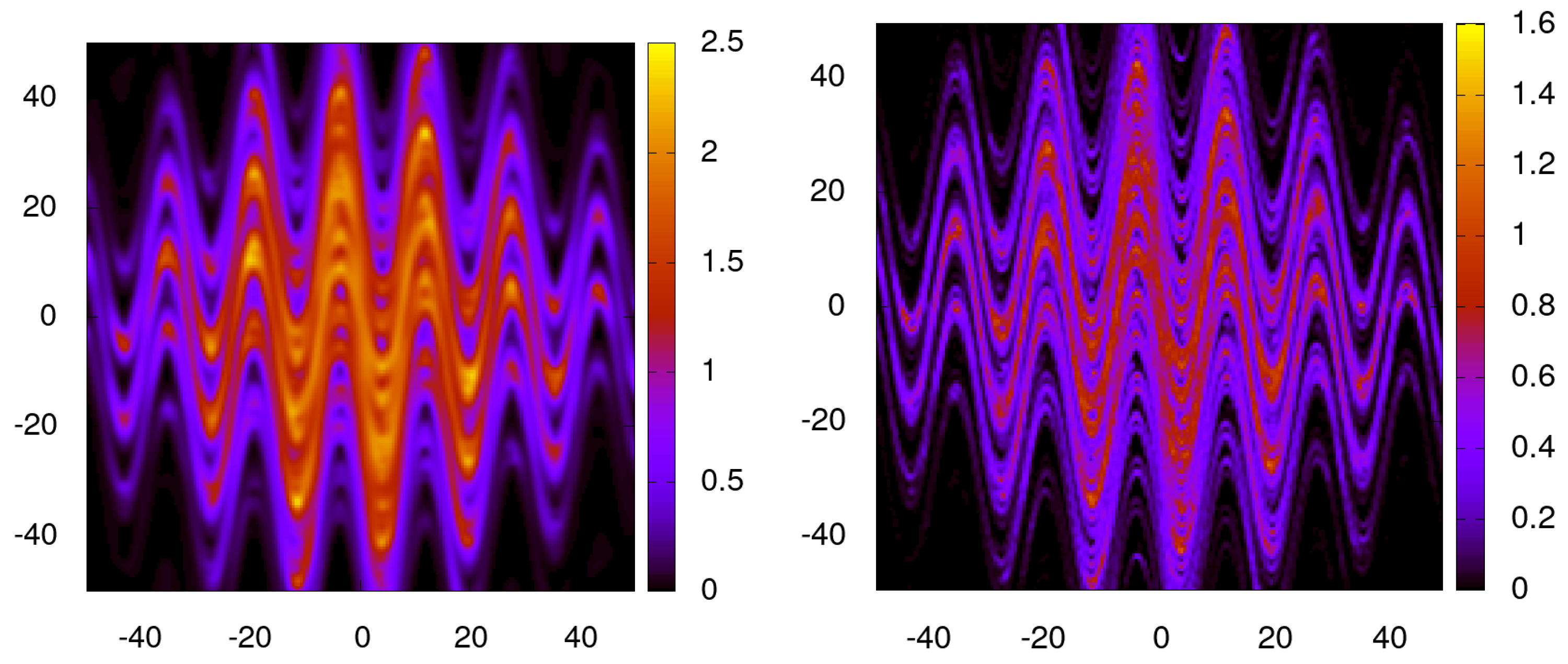
The quantum steady-state of the Husimi function is shown for t = 1000 in Figure 2 (top). The corresponding classical distribution in the phase space ( x , p ) is shown in Figure 2 (bottom). The comparison of two cases shows that the dissipative quantum distribution is quite close to the classical one.
The classical case corresponds to a strange chaotic attractor for which the fractal information dimension can be estimated as d 1 = 2 γ / Λ [15,16]. Here, the Lyapunov exponent is approximately Λ ln ( K cl / 2 ) 1 (as for the Chirikov standard map [14]). Thus, we have d 1 1.95 for the case of Figure 2 at K cl = 6.4 , γ = 0.05 . The diffusion growth of the system energy E p 2 q 2 K 2 t / 2 is stopped by dissipation at time t γ 1 / γ , which gives the distribution width in momentum p (and coordinate x) being Δ p q K / 2 γ 50 and being close to the distribution width p ± 50 obtained numerically in Figure 2 at the corresponding parameters. We did not present a detailed discussion of the classical dissipative dynamics since the properties of strange chaotic attractors had been studied deeply for many system, as reported in Refs. [15,16] and since our main aim is the analysis of the quantum properties of the density matrix evolution given by the Lindblad Equations (12)–(15).
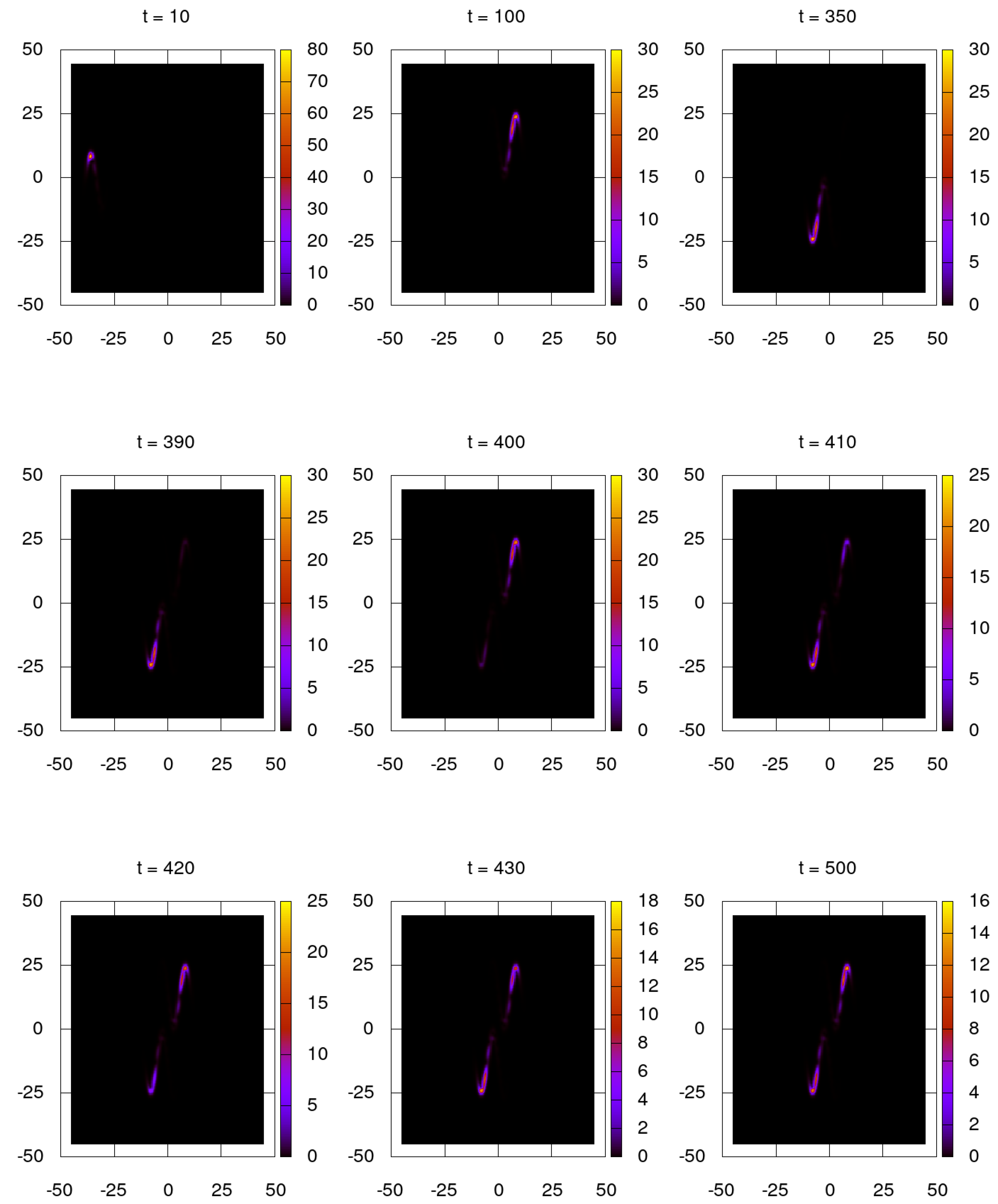
To analyze the properties of the density matrix ρ ^ ( t ) , we computed its eigenvectors with eigenvalues 0 λ i 1 at time moments t ( ρ ^ ( t ) χ i ( t ) = λ i ( t ) χ i ( t ) ) . A typical example of a Husimi function time evolution of eigenvector χ i at maximal λ i is shown in Figure 3. The main feature of such an eigenstate of ρ ( t ) is its localization, or collapse, in the phase space ( x , p ) . Other eigenstates also have a similar localized structure. With time, the localized wave packet splits on two packets located at symmetric positions of the maximum at ( x m , p m ) and ( x m , p m ) . This can be viewed as a formation of Schrödinger cat eigenstates of density matrix (for results of cat states, see, e.g., Ref. [49] and the references therein). This symmetry corresponds to the symmetry of the system Hamiltonian (3). The steady-state distribution of χ i is formed at relatively large times t cat 420 . This time is significantly larger than the relaxation time t γ 1 / γ 20 at which the global steady-state is reached for ρ ^ ( t ) in Figure 1. Let us also note the cat structure of eigenstates of the steady-state density matrix in Figure 3, but that at the same time, the whole density matrix has a broad structure without localization (see Figure 1 and Figure 2). Thus, obseving the cat type of eigenstates of the density matrix requires specific experiemntal methods, which can be rather nontrivial.
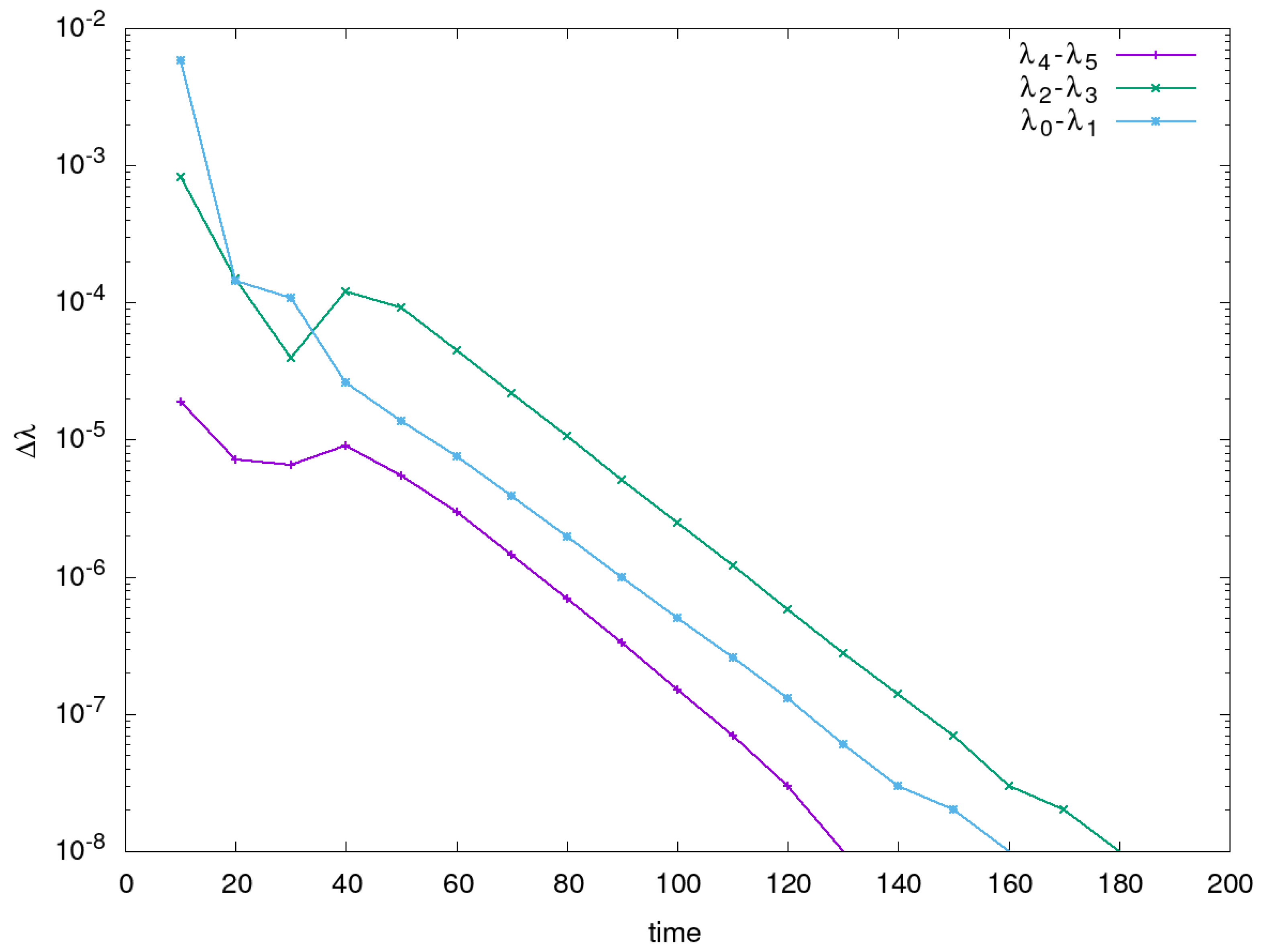
The reason for the large value of t cat t γ becomes evident from the results presented in Figure 4. Indeed, this data show that with time, there appears a strong quasi-degeneracy between the pairs of eigenvalues of the density matrix. Thus, the initial asymmetric eigenstates of density function ρ ^ ( t ) relax to the symmetric ones at large times t. This relaxation is slow due to quasi-degeneracy of cat eigenstates. The symmetry of the eigenstates correspond to the Hamiltonian symmetry x x preserved in the presence of dissipation.
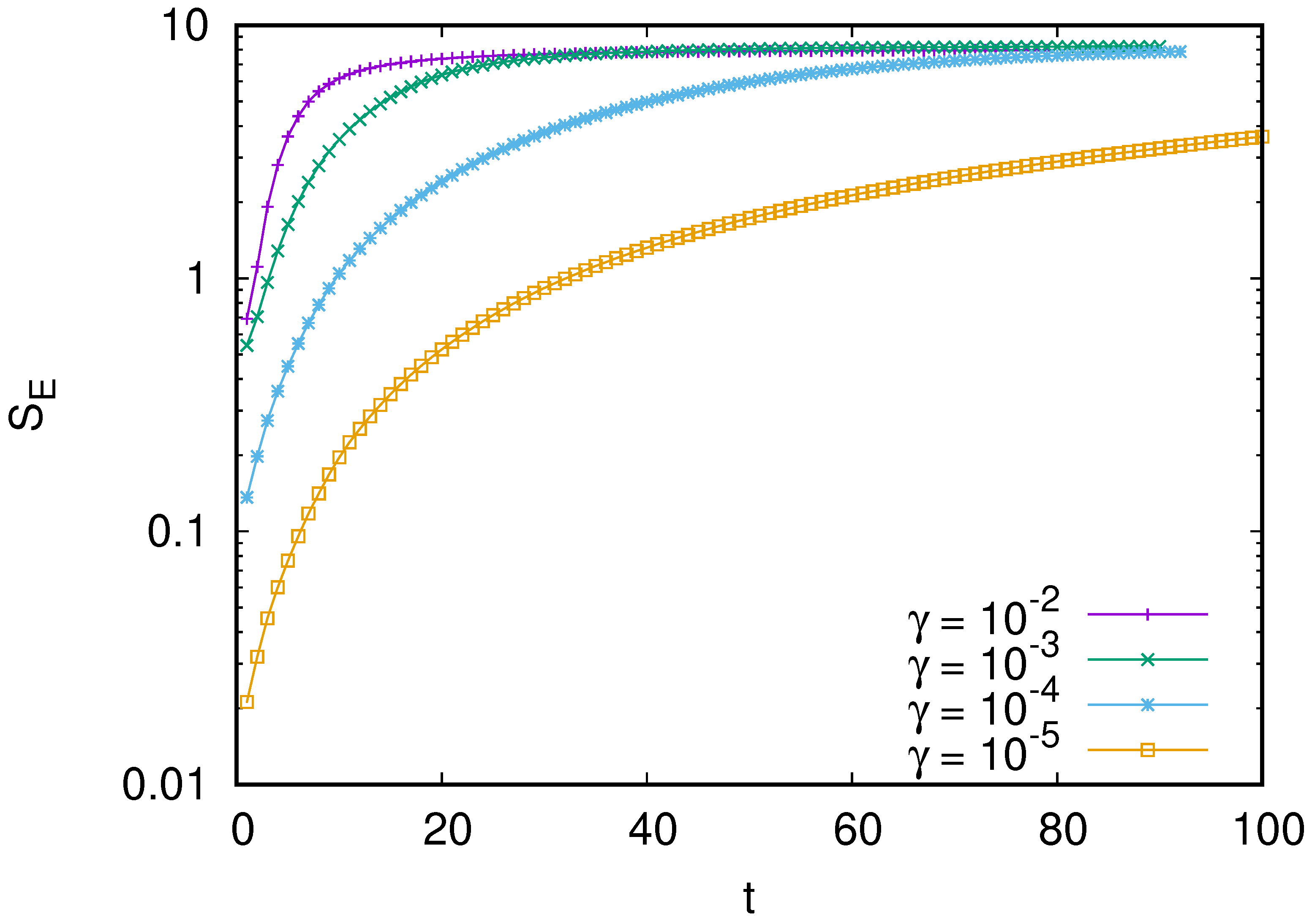
We also characterize the density matrix ρ ^ ( t ) by its entropy of entanglement given by S E ( t ) = T r [ ρ ^ ( t ) ln ρ ^ ( t ) ] = i λ i ln λ i [50,51]. The dependence of S E ( t ) on time t is shown in Figure 5. Here, the initial state is unitary with S E = 0 at t = 0 , and at small times, the entropy of entanglement S E ( t ) is small at small γ . The initial state at t = 0 is the same as in Figure 1 (see caption). Due to this, at small times S E is smaller at smaller γ values, but at large times due to chaos ρ ( t ) spreads over all available system basis at N = 2000 , reaching maximal possible S E values.
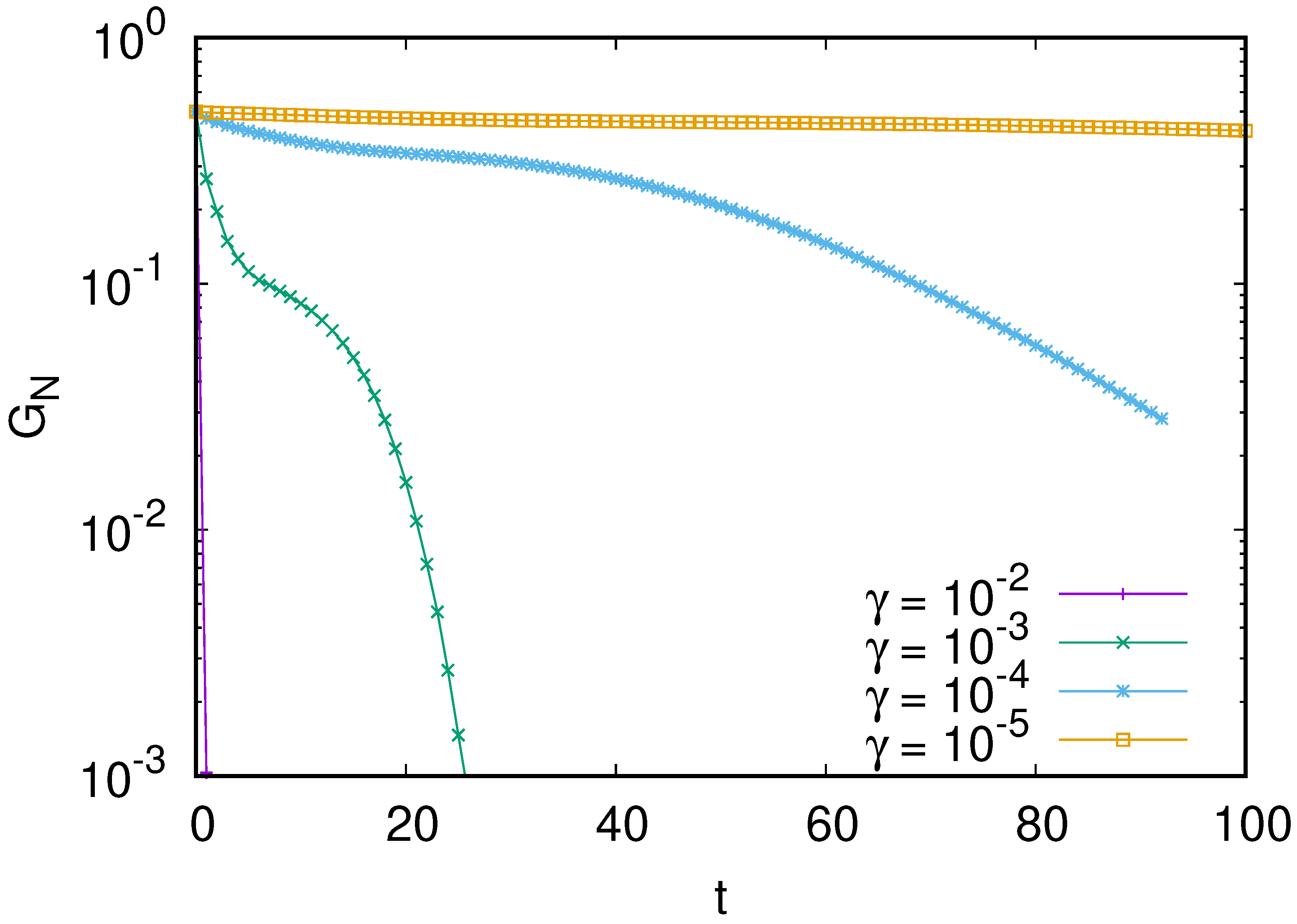
However, it should be noted that large values of S E do not imply that the system is really quantum. The time evolution of entanglement characteristics in this system can be followed using the quantum negativity G N , whose properties are discussed in detail, for instance, in Refs. [50,52,53,54]; G N is computed via a partial transpose T g of the density matrix with respect to a subsystem. For this computation of G N , we introduce an additional spin half degree of freedom and start with an initial pure state | ψ 0 = | α 0 , + | α 0 , / 2 entangling spin and opposite momenta. Here, | α 0 is a coherent oscillator state, the arrows denote up and down spins, and in the simulations, we take α 0 = 9 + 4 i (other initial values are giving a similar result). Since we started with an entanged spin-momentum state the negativity for the density matrix of the total oscillator and spin system is 1 / 2 ; however, the netativity will drop as | ± α 0 mix due to the chaotic kicked-fluxonium dynamics. We assume that the spin is perfectly conserved during time evolution and the Lindblad operator L equation for the enlarged spin-plus-oscillator system is the same as Equation (12). Following this procedure, with a virtual spin half noted as | α , | β , the transformations lead to the expression for G N :
| g 0 α + | g 1 β 2 ρ 1 2 | g 0 g 0 | | α α | + | g 0 g 1 | | α β | + | g 1 g 0 | | β α | + | g 1 g 1 | | β β | L 1 2 | g 0 g 0 | L ( | α α | ) + | g 0 g 1 | L ( | α β | ) + | g 1 g 0 | L ( | β α | ) + | g 1 g 1 | L ( | | ) T g ρ T g = def 1 2 | g 0 g 0 | L ( | α α | ) t + | g 0 g 1 | L ( | α β | ) t + | g 1 g 0 | L ( | β α | ) t + | g 1 g 1 | L ( | β β | ) t , G N ( t ) = λ n ( ρ T g ) < 0 λ n ( ρ T g ) .
The dependence G N ( t ) on time t is presented in Figure 6. The results show that quantum negativity drops very rapidly with time, reaching almost zero for γ = 0.01 , 10 3 . For smaller values of γ = 10 4 , 10 5   G N ( t ) has finite values since the time scale shown in Figure 6 is small compared to the dissipative time t γ = 1 / γ . These results show that the quantum negativity becomes almost zero for times t > t γ . Thus, the quantum features of evolution are washed out for times t > t γ . At such scales, the quantum Lindblad evolution is similar to a classical wave packet evolution in the presence of dissipation and classical noise, whose amplitude corresponds to the amplitude of quantum dissipative fluctuations.
The obtained results show that at moderate dissipation γ , the eigenstates of the density matrix ρ ^ ( t ) are localized in the steady-state regime. We argue that this dissipative localization is linked to a wave packet localization with quantum trajectories discussed in Ref. [36]. In the absence of dissipation, there is the Ehrenfest explosion of a wave packet and its Husimi function due to exponential instability of classical dynamics. For unitary evolution, this phenomenon had been well illustrated and discussed (see, e.g., [42,43,44]). It is clear that this explosion also remains in a case of weak dissipation. Indeed, there is a significant growth of entanglement entropy S E at weak dissipation γ 0.01 , as it is shown in Figure 5. However, at such small γ values, one needs to use a numerically large computational basis to study eigensates of ρ ^ ( t ) in the steady-state regime with many thousands of excited oscillator states. Due to this complication, it was not possible to obtain eigensates of ρ ^ ( t ) at such small γ .

4. Discussion

Here, we have presented a study of the properties of the density matrix in the regime of dissipative quantum chaos. We find that at strong or moderate dissipation, the density matrix in the steady-state regime describes a quantum strange attractor. In the phase space above the scale of the Planck constant, its structure reproduces those of the classical strange attractor well. We show that in this regime, the eigenstates of the density matrix are localized in the phase space. This localization is argued to reflect the quantum wave packet localization obtained in the frame of quantum trajectories discussed in Ref. [36]. It is found that in this regime, the entropy of entanglement S E grows with time, reaching its maximal value related to a size of strange attractor in the phase space. At the same time, the quantum negativity G N drops rapidly with time to zero in this regime. Due to numerical restrictions, we did not present the regime of weak dissipation, where we expect to have the Ehrenfest explosion or delocalization of eigenstates of density matrix since this regime requires long integration times and a large numerical basis. At the same time, for unitary evolution at γ = 0 , the Ehrenfest explosion of wave packets is well established (see, e.g., [42,43,44]) and we expect that at weak dissipation, for quantum chaos, the eigenstates of the density matrix become delocalized.
Even if the density matrix eigenstates are localized at strong or moderate dissipation, the whole density matrix well reproduces the structure of the classical strange attractor. Specific experimental methods should be developed to detect the localized structure of the density matrix eigenstates in this strange attractor regime. We hope that a significant experimental progress with the fluxonium studies [2,3,4,5,6,7] will allow for experimentally investigating the quantum strange attractor of fluxonium.

Author Contributions

All authors equally contributed to this work. All authors have read and agreed to the published version of the manuscript.

Funding

The authors acknowledge support from the grants ANR France project OCTAVES (ANR-21-CE47-0007), NANOX N° ANR-17-EURE-0009 in the framework of the Programme Investissements d’Avenir (project MTDINA), MARS (ANR-20-CE92-0041) and EXHYP (INP Emergence 2022). This research received no other external funding.

Data Availability Statement

The data presented in this study are available on request from the corresponding author due to big amount of data.

Acknowledgments

We thank partners of OCTAVES project for useful discussions.

Conflicts of Interest

The authors declare no conflict of interests.

References

  1. Manucharyan, V.E.; Koch, J.; Glazman, L.I.; Devoret, M.H. Fluxonium: Single Cooper-pair circuit free of charge offsets. Science 2009, 326, 113–116. [Google Scholar] [CrossRef]
  2. Hazard, T.M.; Gyenis, A.; DiPaolo, A.; Asfaw, A.T.; Lyon, S.A.; Blais, A.; Houck, A.A. Nanowire superinductance fluxonium qubit. Phys. Rev. Lett. 2019, 122, 010504. [Google Scholar] [CrossRef] [PubMed]
  3. Nguyen, L.B.; Lin, Y.-H.; Somoroff, A.; Mencia, R.; Grabon, N.; Manucharyan, V.E. High-coherence fluxonium qubit. Phys. Rev. X 2019, 9, 041041. [Google Scholar] [CrossRef]
  4. Bao, F.; Deng, H.; Ding, D.; Gao, R.; Gao, X.; Huang, C.; Jiang, X.; Ku, H.-S.; Li, Z.; Ma, X.; et al. Fluxonium: An alternative qubit platform for high-fidelity operations. Phys. Rev. Lett. 2022, 129, 010502. [Google Scholar] [CrossRef] [PubMed]
  5. Somoroff, A.; Ficheux, Q.; Mencia, R.A.; Xiong, H.; Kuzmin, R.; Manucharyan, V.E. Millisecond coherence in a superconducting qubit. Phys. Rev. Lett. 2023, 130, 267001. [Google Scholar] [CrossRef]
  6. Mencia, R.A.; Lin, W.J.; Cho, H.; Vavilov, M.G.; Manucharyan, V.E. Integer fluxonium qubit. PRX Quantum 2024, 5, 040318. [Google Scholar] [CrossRef]
  7. Strickl, W.M.; Elfeky, B.H.; Baker, L.; Maiani, A.; Lee, J.; Levy, I.; Issokson, J.; Vrajitoarea, A.; Shabani, J. Gatemonium: A voltage-tunable fluxonium. PRX Quantum 2025, 6, 010326. [Google Scholar] [CrossRef]
  8. Nguyen, L.B.; Koolstra, G.; Kim, Y.; Morvan, A.; Chistolini, T.; Singh, S.; Nesterov, K.N.; Junger, C.; Chen, L.; Pedramrazi, Z.; et al. Blueprint for a High-performance fluxonium quantum processor. PRX Quantum 2022, 3, 037001. [Google Scholar] [CrossRef]
  9. Makhlin, Y.; Schon, G.; Shnirman, A. Quantum-state engineering with Josephson-junction devices. Rev. Mod. Phys. 2001, 73, 357–400. [Google Scholar] [CrossRef]
  10. Wendin, G. Quantum information processing with superconducting circuits: A review. Rep. Prog. Phys. 2017, 80, 106001. [Google Scholar] [CrossRef]
  11. Zaslavskii, G.M.; Zakharov, M.Y.; Sagdeev, R.Z.; Usikov, D.A.; Chernikov, A.A. Stochastic web and diffusion of particles in magnetic field. Zh. Exp. Teor. Fiz. 1986, 91, 500–516, English translation Sov. Phys. JETP 1986, 64, 294–303. Available online: http://jetp.ras.ru/cgi-bin/e/index/e/64/2/p294?a=list (accessed on 27 January 2026).
  12. Chernikov, A.A.; Sagdeev, R.Z.; Usikov, D.A.; Zakharov, A.Y.; Zaslavsky, G.M. Minimal chaos and stochastic web. Nature 1987, 326, 559–563. [Google Scholar] [CrossRef]
  13. Zaslavsky, G. Zaslavsky web map. Scholarpedia 2007, 2, 3369. [Google Scholar] [CrossRef]
  14. Chirikov, B.V. A universal instability of many-dimensional oscillator systems. Phys. Rep. 1979, 52, 263–379. [Google Scholar] [CrossRef]
  15. Lichtenberg, A.; Lieberman, M. Regular and Chaotic Dynamics; Springer Science+Business Media New York: New York, NY, USA, 1992. [Google Scholar] [CrossRef]
  16. Ott, E. Chaos in Dynamical Systems; Cambridge University Press: Cambridge, UK, 2002. [Google Scholar] [CrossRef]
  17. Shepelyansky, D.; Sire, C. Quantum evolution in a dynamical quasi-crystal. Europhys. Lett. (EPL) 1992, 20, 95–100. [Google Scholar] [CrossRef]
  18. Dana, I. Quantum suppression of diffusion on stochastic web. Phys. Rev. Lett. 1994, 73, 1609–1612. [Google Scholar] [CrossRef]
  19. Gardiner, S.A.; Cirac, J.I.; Zoller, P. Quantum chaos in an ion trap: The delta-kicked harmonic oscillator. Phys. Rev. Lett. 1997, 79, 4790–4793. [Google Scholar] [CrossRef]
  20. Hu, B.; Li, B.; Liu, J.; Zhou, J.-L. Squeezed state dynamics of kicked quantum systems. Phys. Rev. E 1998, 58, 1743–1756. [Google Scholar] [CrossRef]
  21. Kells, G.A.; Twamley, J.; Heffernan, D.M. Dynamical properies od the delta-kicked harmonic oscillator. Phys. Rev. E 2004, 79, 015203(R). [Google Scholar] [CrossRef]
  22. Carvalho, A.R.R.; Buchleitner, A. Web-assisted tunneling in the kicked harmonic oscillator. Phys. Rev. Lett. 2004, 93, 204101. [Google Scholar] [CrossRef]
  23. Billam, T.P.; Gardiner, S.A. Quantum resonances in an atom-optical δ-kicked harmonic oscillator. Phys. Rev. A 2009, 80, 023414. [Google Scholar] [CrossRef]
  24. Varikuti, N.D.; Sahu, A.; Lakshminarayan, A.; Madhok, V. Probing dynamical sensitivity of a non-Kolmogotov–Arnold–Moser system through out-of-time-order correlators. Phys. Rev. E 2024, 109, 014209. [Google Scholar] [CrossRef]
  25. Lima, R.; Shepelyansky, D. Fast delocalization in a model of quantum kicked rotator. Phys. Rev. Lett. 1991, 67, 1377–1380. [Google Scholar] [CrossRef] [PubMed]
  26. Artuso, R. Kicked Harper mode. Scholarpedia 2011, 6, 10462. [Google Scholar] [CrossRef]
  27. Chirikov, B.V.; Izrailev, F.M.; Shepelyansky, D.L. Quantum chaos: Localization vs. ergodicity. Phys. D 1988, 33, 77–88. [Google Scholar] [CrossRef]
  28. Chirikov, B.; Shepelyansky, D. Chirikov standard map. Scholarpedia 2008, 3, 2550. [Google Scholar] [CrossRef]
  29. Fishman, S. Anderson localization and quantum chaos maps. Scholarpedia 2010, 5, 9816. [Google Scholar] [CrossRef]
  30. Moore, F.L.; Robinson, J.C.; Bharucha, C.F.; Sundaram, B.; Raizen, M.G. Atom optics realization of the quantum Δ-kicked rotor. Phys. Rev. Lett. 1995, 75, 4598–4601. [Google Scholar] [CrossRef]
  31. Gorini, V.; Kossakowski, A.; Sudarshan, E.C.G. Completely positive dynamical semigroups of N-level systems. J. Math. Phys. 1976, 17, 821–825. [Google Scholar] [CrossRef]
  32. Lindblad, G. On the generators of quantum dynamical semigroups. Commun. Math. Phys. 1976, 48, 119–130. [Google Scholar] [CrossRef]
  33. Weiss, U. Quantum Dissipative Systems; World Scieentific: Singapore, 2021. [Google Scholar] [CrossRef]
  34. Dittrich, T.; Graham, R. Quantum effects in the steady state of the dissipative standard map. Europhys. Lett. (EPL) 1987, 4, 263–268. [Google Scholar] [CrossRef]
  35. Dittrich, T.; Graham, R. Effects of weak dissipation on the long-time behaviour of the quantized standard map. Europhys. Lett. (EPL) 1988, 7, 287–291. [Google Scholar] [CrossRef]
  36. Carlo, G.G.; Benenti, G.; Shepelyansky, D.L. Dissipative quantum chaos: Transition from wave packet collapse to explosion. Phys. Rev. Lett. 2005, 95, 164101. [Google Scholar] [CrossRef] [PubMed]
  37. Carmichael, H.J. Quantum trajectory theory for cascaded open systems. Phys. Rev. Lett. 1993, 70, 2273–2276. [Google Scholar] [CrossRef] [PubMed]
  38. Brun, T.A.; Percival, I.C.; Schack, R. Quantum chaos in open systems: A quantum state diffusion analysis. J. Phys. A Math. Gen. 1996, 29, 2077–2090. [Google Scholar] [CrossRef]
  39. Brun, T.A. A simple model of quantum trajectories. Am. J. Phys. 2002, 70, 719–737. [Google Scholar] [CrossRef]
  40. Ehrenfest, P. Bemerkung über die angenaherte Gultigkeit der klassischen Mechanik innerhalb der Quantenmechanik. Z. Phys. 1927, 45, 455–457. [Google Scholar] [CrossRef]
  41. Ehrenfest, P. Remark on the Approximate Validity of Classical Mechanics within Quantum Mechanics. Available online: https://www.neo-classical-physics.info/electromagnetism.html (accessed on 27 January 2026).
  42. Shepelyansky, D. Ehrenfest time and chaos. Scholarpedia 2020, 15, 55031. [Google Scholar] [CrossRef]
  43. Frahm, K.M.; Fleckinger, R.; Shepelyansky, D.L. Quantum chaos and random matrix theory for fidelity decay in quantum computations with static imperfections. Eur. Phys. J. D 2004, 29, 139–155. [Google Scholar] [CrossRef]
  44. Frahm, K.M.; Shepelyansky, D.L. Diffusion and localization for the Chirikov typical map. Phys. Rev. E 2009, 80, 016210. [Google Scholar] [CrossRef]
  45. Landau, L.D.; Lifshitz, E.M. Mechanics; Elsvier Butterworth–Heinemann/Elsevier Ltd.: Oxford, UK, 1976. [Google Scholar] [CrossRef]
  46. Prudnikov, A.P.; Brychkov, Y.A.; Marichev, O.I. Integrals and Series. Volume 3: More Special Functions; Gordon and Breach Science Publishers: Amsterdam, The Netherlands, 1986; see point 2.20.16 (22). [Google Scholar]
  47. Chepelianskii, A.D.; Shepelyansky, D.L. Quantum synchronization and entanglement of dissipative qubits coupled to a resonator. Entropy 2024, 26, 415. [Google Scholar] [CrossRef]
  48. Chang, S.J.; Shi, K.-J. Evolution and exact eigenstates of a resonant quantum system. Phys. Rev. A 1986, 34, 7–22. [Google Scholar] [CrossRef]
  49. Reglade, U.; Bocquet, A.; Gautier, R.; Cohen, J.; Marquet, A.; Albertinale, E.; Pankratova, N.; Hallen, M.; Rautschke, F.; Sellem, L.-A.; et al. Quantum control of a cat qubit with bit-flip times exceeding ten seconds. Nature 2024, 629, 778–783. [Google Scholar] [CrossRef]
  50. Nielsen, M.A.; Chuang, I.L. Quantum Computation and Quantum Information; Cambridge University Press: New York, USA, 2010. [Google Scholar] [CrossRef]
  51. Eisert, J.; Cramer, M.; Plenio, M.B. Area laws for the entanglement entropy. Rev. Mod. Phys. 2010, 82, 277–306. [Google Scholar] [CrossRef]
  52. Vidal, G.; Werner, R.F. Computable measure of entanglement. Phys. Rev. A 2002, 65, 032314. [Google Scholar] [CrossRef]
  53. Bengtsson, I.; Zyczkowski, K. Geometry of Quantum States: An Introduction to Quantum Entanglement; Cambridge University Press: Cambridge, UK, 2017. [Google Scholar] [CrossRef]
  54. Plenio, M.B. The logarithmic negativity: A full entanglement monotone that is not convex. Phys. Rev. Lett. 2005, 95, 000503. [Google Scholar] [CrossRef]
Figure 1. Time evolution of the Husimi function (shown at different time moments t) in the phase plane ( x , p ) , = ω = 1 , k = K / = 40 , q = 0.4 , γ = 0.05 , N = 2000 ( eff = q 2 , thus the classical chaos parameter rescaled to the case q = 1 is K cl = K q 2 = 6.4 ); here, t gives a number of kicks; R = 4 . The initial state at t = 0 is a minimal coherent state located at x = 10 , p = 1 ; color bars show the Husimi function multiplied by factor 10 3 . See text for details.
Physics 08 00022 g001
Figure 2. Left: quantum Husimi function at the steady-state at t = 10 3 with the parameters and notations as in Figure 1; Right: classical density distribution obtained with 4 × 10 6 trajectories. All parameters as in Figure 1.
Physics 08 00022 g002
Figure 3. Collapse of the density matrix eigenstate at the maximal eigenvalue λ i ; Husimi function of eigenstate is shown at time moments t, color shows its values increased by a factor × 10 3 . System parameters as in Figure 1.
Physics 08 00022 g003
Figure 4. Splitting Δ λ of the largest eigenvalues λ i of the density matrix ρ ( t ) at different moments of time t (given here in number of kicks); three quasi-degenerate pairs of largest eigenvalues are shown: λ 0 λ 1 , λ 2 λ 3 , λ 4 λ 5 . System parameters as in Figure 1.
Physics 08 00022 g004
Figure 5. Entropy of entanglement S E versus time t, for system parameters K = 8 , = q = 1 , and for the values of γ as indicated.
Physics 08 00022 g005
Figure 6. Dependence of quantum negativity G N on time t for system parameters K = 8 , = q = 1 , and for values of γ as indicated.
Physics 08 00022 g006
Disclaimer/Publisher’s Note: The statements, opinions and data contained in all publications are solely those of the individual author(s) and contributor(s) and not of MDPI and/or the editor(s). MDPI and/or the editor(s) disclaim responsibility for any injury to people or property resulting from any ideas, methods, instructions or products referred to in the content.