Abstract
Over the past thirty years, the focus in singular optics has been on structured beams carrying orbital angular momentum (OAM) for diverse applications in science and technology. However, as practice has shown, the OAM-free structured Gaussian beams with several degrees of freedom are no worse than the OAM beams, especially when propagating through turbulent flows. In this paper, we partially fillthis gap by theoretically and experimentally mapping cyclic changes in vortex-free states (including OAM) as a phase portrait of the beam evolution in an astigmatic optical system. We show that those cyclic variations in the beam parameters are accompanied by the accumulation of the geometric Berry phase, which is an additional degree of freedom. We find also that the geometric phase of cyclic changes in the intensity ellipse shape does not depend on the radial numbers of the Laguerre–Gaussian mode with zero topological charge and is always set by changing the shape of the Gaussian beam. The Stokes parameter formalism was developed to map the beam states’ evolution onto a Poincaré sphere based on physically measurable second-order intensity moments. Theory and experiment are found to be in a good enough agreement.
1. Introduction
The problem of revealing the hidden geometry inherent in the fundamental symmetries of vortex beams carrying orbital angular momentum (OAM) has become a priority object of close attention over the past few years [1,2,3,4,5,6,7]. Although it seemed that only beams with axial symmetry, such as Laguerre–Gaussian (LG) beams or Bessel–Gaussian beams, can possess the OAM, even a minimal breaking of axial symmetry leads to completely unexpected results [8]. Indeed, as early as 1992, Steven van Enk and Gerard Nienhuis [9] theoretically predicted the occurrence of the OAM in fundamental Gaussian beams passing through two thin cylindrical lenses. If the first lens just violates the axial symmetry of the beam, whereas the second injects the OAM into the broken elliptical beam due to the appearance of the so-called cross-phase in the wavefront [10]. In 1993, van Enk predicted [11] the possibility of accumulation of the geometric Berry phase [12] with cyclic variation in the elliptic beam parameters. The proposal of controlling the OAM in deformed Gaussian beams was used in the study [13] experimentally demonstrating the possibilities of this approach. A more detailed treatment of shaping and transforming the OAM in asymmetric Gaussian beams was given in Ref. [14] studied wide range of vortex modes accompanying the elliptical deformation of a vortex-free beam.
However, special geometric approaches were required for revealing hidden symmetries of both vortex and vortex-free beams. van Enk also pointed out [11] the geometry of the four-dimensional (4D) phase space for vortex beams to be isomorphic to the Poincaré sphere. Experiments of Padgett and Courtiel’s [15] with transformations of the simplest perturbed LG beam and mapping the transformation states onto the Poincaré sphere actually predicted the possibility of using the SU(2) symmetry of the Poincaré sphere analog for a new geometry of vortex beams. Girish Agarwal [16] theoretically justified this approach and proposed the use of SU(N) symmetries for higher-order LG vortex beams. These theoretical predictions were experimentally confirmed [17] by direct measurement of the geometric phase resulting from the evolution of the Laguerre–Gaussian mode (with radial index and topological charge ) through the astigmatic optical system, followed by mapping its states onto the Poincaré sphere. The OAM mode was controlled by cyclically changing the parameters of four cylindrical lenses and two Dove prisms. As a result, the beam traced a two-triangular shape on the sphere, which transformed into two adjacent spherical triangles with cyclic variation in the corresponding parameters of the optical modes. Gabriel Calvo [18] considered the problem from another point, namely by connecting the Wigner transform of higher-order LG modes in an astigmatic optical system with a mapping onto the SU(2) orbital Poincaré sphere. It was shown that cyclic transformations of parameters that cause mappings onto a sphere in the form of a spherical triangle are accompanied by the accumulation of a geometric phase equal to , where is the solid angle outlined by the beam trajectories, while the phase sign “±” depends on the bypass direction of the trajectory contour. Tatiana Alieva and Martin Bastiaans [19] coupled cyclic transformations of vortex beams in 4D phase space with mapping the beams onto an SU(2) sphere and accumulation of the geometric phase. Based on these considerations, the two authors of the present paper [20] mapped cyclic transformations of structured vortex LG beams onto the orbital Poincaré sphere in the form of complex spatial trajectories with self-intersections. It worth to be noted that a somewhat earlier, Yije Shen and colleagues [21] employing the technique of creation operators, also mapped multidimensional structured beams onto the SU(2) sphere. The technique of direct measurement of the orbital Stokes parameters developed by in Ref. [22] providing possibility for continuously mapping the structured vortex beam transformations in an experimental setup onto an SU(2) sphere. Summarizing, to emphasize is that the main focus is on the control of higher-order vector vortex structured beams. Some of key properties, topological structure, and applications of the structured beams have been studied in detail and reflected in numerous papers (see, e.g., [3,23,24] and references therein).
However, the question still remained unanswered, namely how to map the vortex-free structured beams with cyclic changes in the intensity patterns and the orientation of these patterns? The technique of mapping cannot be applied to the vortex OAM beams. That is the problem that is addressed in the current paper. Inherently the key point of the vortex beams concept involves converting the OAM beam of the original mode into a mode (or modes) with opposite OAM signs during transformation by astigmatic elements (or any other way). If the original beam is devoid of the OAM and its transformation does not imply the appearance of an orbital angular momentum, then employing the existing approaches of beam analysis is not suitable [21]. Meantime, structured vortex-free beams contain quite a number of eigenmodes devoid of the OAM and carry over a considerable number of degrees of freedom. The use of the OAM-free beams in various functional systems and nodes of modern photonics is at an advantage compared to structured OAM beams, in particular when the beams propagate through turbulent flows [25]. The approach considered here is based on an analogy of evolving the polarization ellipse in polarization optics. It is known that transformations of the beam structure by astigmatic elements are described in the framework of the 4D matrices of second-order intensity moments [26], the submatrices of which are characterized by quadratic geometric forms. In particular, the 2D submatrix of physically observed elements is characterized by intensity ellipses. It is these intensity ellipses of structured vortex-free beams that are the subjects of the current study. In this paper, we map cyclic changes theoretically and experimentally in the laser beams, such as the LG beam with zero topological charge (including the fundamental Gaussian beam), which do not transfer the OAM, onto the SU(2) sphere (an analog of the Poincaré sphere), and to estimate the geometric phases accompanying these cyclic changes in the beam parameters. It is worth to be noted that the present study of cyclic transformations of elliptical beam states can be instructive in analyzing the process of femtosecond laser ablation of the surface [27], where the initial axial beam symmetry is partially broken. In such approach, it is worthy to emphasize an analogy between quantum squeezed states and the classical squeezing of a structured Gaussian beam by astigmatic transformation, which has been theoretically and experimentally discussed in detail in a recent paper [28]. Supported by experiment, such an analogy allows photons of a squeezed astigmatic structured beam (for example, mode with radial number n) to be employed to shape entangled quantum states in quantum optics and technology.
2. Theoretical Backgrounds and Computer Simulation
2.1. Fundamental Gaussian Beam
Let us first consider the most simple case of Gaussian beam propagation through an optical system containing only one relatively thin cylindrical lens. The basic principles of such a beam were treated in the pioneering study by Jacques Arnaud and Herwig Kogelnik [29], which we follow here. If the Gaussian beam with a Rayleigh length of passes through a relatively thin cylindrical lens with a focal length f, the axes of which are directed at an angle with respect to the laboratory coordinate system , the beam’s complex amplitude at the distance z after the lens reads
where k is a wavenumber, and represent complex parameters of the beam, and
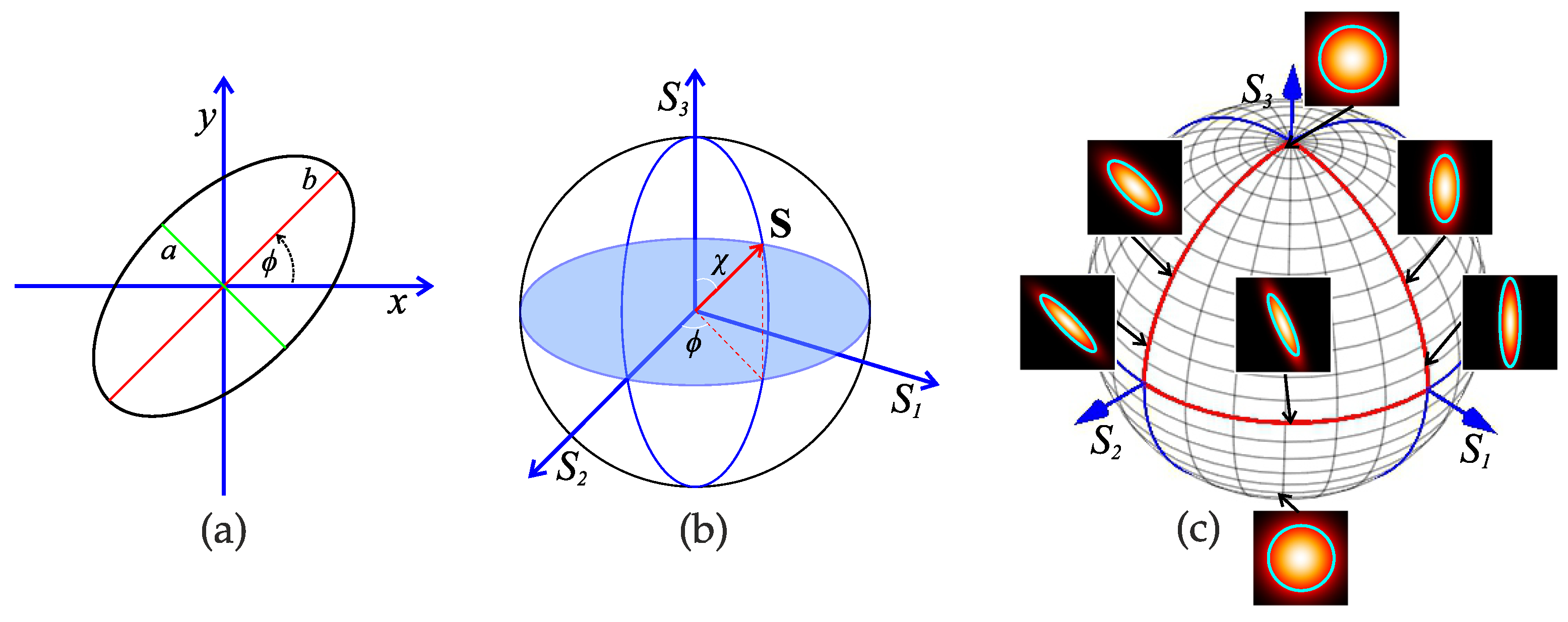
The parameters , and control the orientation of the major ellipse axis and the position of the astigmatic Gaussian beam along the z-axis (see Figure 1a). It is convenient to use dimensionless coordinates , , , with the beam waist radius, and parameters ,
where and f is the focal length of the cylindrical lens. After the the beam passes lens, the beam experiences simple astigmatism, which changes the beam section scale along the lens axes. An elliptical deformation of the beam shape occurs. In this case, the directions of the elliptic intensity pattern follow the lens for any length of the beam path [26]. However, the OAM beam does not occur after the first cylindrical lens since the first cylindrical lens does not insert the cross phase associated with the complex parameter . To form the phase, the beam needs to pass through the second lens [9]. The beam intensity distribution after the lens is
where is radial angle, and denote the beam parameters in polar coordinates dependent on the beam radii and only. The exponents in Equation (4) define the intensity ellipse oriented at an angle with respect to the laboratory coordinates (Figure 1a).
Figure 1.
(a) The intensity ellipse parameters against the background of the intensity pattern. (b) An analog of the Poincaré sphere and the Stokes vector (12). (c) Evolving the shape and orientation of intensity ellipses along the two main meridians and the equator with experimental intensity patterns.
The physically measurable parameters of the Gaussian beam are the second-order intensity moments of the 2D submatrix [26]
where stands for a total beam intensity. The elements of the submatrix are the standard deviations of the intensity distribution in the Z-plane with a straightforward interpretation. Namely: , normalized to the total beam intensity , defines the squared beam diameter ; accordingly, the element sets the y-diameter ; and is responsible for the -beam diameter. The submatrix is characterized by the intensity ellipse
The angle of inclination of the ellipse major axis is found as
and the ellipticity as the ratio of the semi-axes
Substituting the intensity distribution (4) in Equation (5), one obtains the submatrix elements for the astigmatic Gaussian beam:
The integrals [30]
are used in the calculations, where is a modified Bessel function of the first kind order.
2.2. Stokes Parameters of the Intensity Ellipse
Since this study involves mapping the set of intensity ellipse states onto the SU(2) sphere generated by beam transformations in a 4D sphere [11], it is instructive to adhere to the technique of mapping the set of polarization states of paraxial beams onto the Poincarè sphere [31]. In the case under consideration, it is convenient to write the Stokes parameters in the form
The invariant of the mapping is the radius S of the sphere: . Comparing Equations (7)–(9), one can we see that all the Stokes parameters are defined in terms of the physically measurable intensity moments. The azimuthal angle sets the motion along the parallels, and the polar angle sets the motion along the meridians. Also, note that the third parameter being specified by the ellipticity can be obtained directly from the ratio (8) of the semi-axes:
The three Stokes parameters (12) form a unit Stokes vector (see Figure 1b), the end point of which outlines the state-evolving trajectory of the beam free from OAM. Figure 1c depicts the intensity pattern transformations along the two main meridians and the equator during beam propagation in an optical system. The axially symmetric states of the beam are displayed at the poles. The beam field at the north pole differs from the one at the south pole by , which does not affect its mapping. A phase jump occurs when crossing the equator. Unlike the polarizing Poincarè sphere, there is no elliptical circulation direction in the case under consideration. But what is essential is that the cyclic changes in the system parameters cause its eigenstates to move along the closed contour on the SU(2) sphere. That is, one comes to an unexpected phenomenon that occurs when a system moves in a curved space, which is called the geometric Berry phase.
2.3. Structured Laguerre–Gaussian Beams with Zero Topological Charge
In general, passing through a cylindrical lens (a simple astigmatism), the initial OAM-free beam becomes a structured one, since it contains a set of its eigen Hermite–Gaussian modes with different amplitudes. However, it does not acquire additional OAM. To find the elements of the intensity moments (5) and to specify the parameters of the intensity ellipse (6), one can use complex calculations presented, for example, in our paper [32]. Nevertheless, those calculations can be significantly simplified if one recalls that experiment deals with the matrix elements of , , and . However, it is commonly known [33] that LG beams change their radii during propagation according to the relation . It is exactly this factor that the radii of the LG beams differ from those of the fundamental Gaussian beam. Note here that the sizes of the beam radii do not affect the shape of the intensity ellipse, including its inclination angle , but only change the sizes of the ellipse semiaxes, leaving the ellipticity tanχ unchanged. In other words, the comparably large-scale transformations of the beam do not affect mapping its states on the sphere.
2.4. Geometric Berry Phase
The geometric phase is a universal phenomenon of naturebeen observed in various processes of wave physics and carrying a variety of internal degrees of freedom. This phenomenon is observed when considering the evolution of a physical system in a curved space due to the so-called “parallel transfer” of the state vector along a closed trajectory. Forty years ago, Michael Berry showed [12] that an additional quantum phase occurs with a slow (adiabatic) change in the parameter of the Hamiltonian in such a way that if at the initial moment of time the system is in its eigenstate , while with a slow cyclic change in the parameter of the Hamiltonian, the system travels along a closed trajectory C in the parametric space to the state , and this translation of the eigenstate is accompanied by accumulating the wave function phase
where is a gradient vector in the parametric space . It is noteworthy that the phase depends solely on the geometric path C; that is why it is called the geometric Berry phase. One of the most striking manifestations of the geometric phase in optics is the so-called Pancharatnam–Berry phase [33], which occurs during a cyclic change in the polarization states of a light beam. In this case, a closed trajectory is outlined on the Poincarè sphere of a unit radius, which pulls together the solid angle . The angle is equal to the area of the spherical shape S framed by the contour. The parallel transfer of the vector of the states along the contour on the SU(2) sphere of unit radius is accompanied by a geometric phase equal to half the solid angle: . The ability to translate the beam states along the meridians and parallels of the sphere (geodesics) is ensured with the independence between the and angles. If the azimuthal angle is set only by the inclination of the cylindrical lens axes, then the polar angle depends only on the position of the observation plane Z, accompanied by a synchronous change in the size of the beam radii in the intensity ellipse (4)
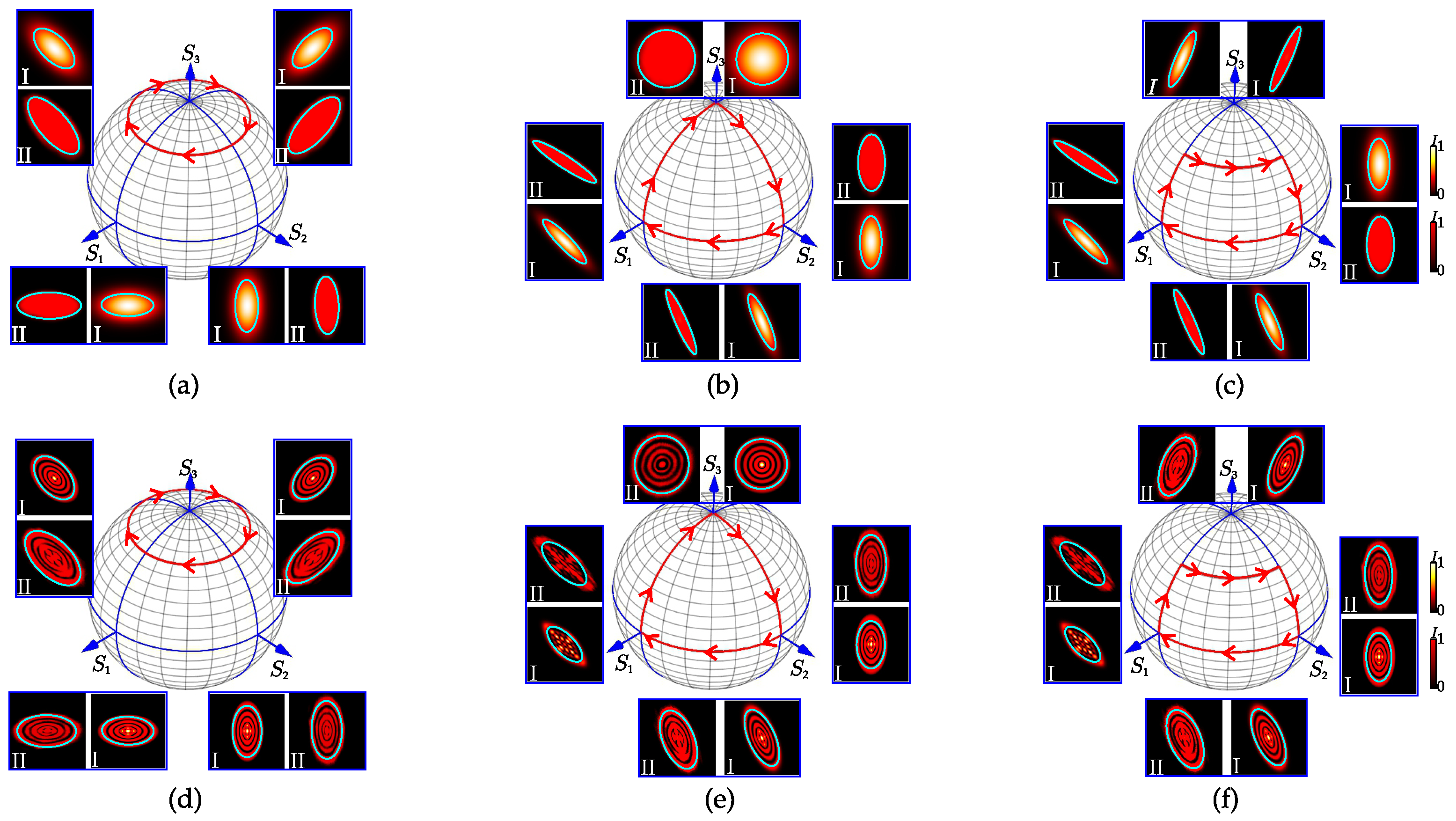
where and are the astigmatic beams’ radii over the x- and y-axes along the z-axis. Thus, the intensity ellipse traversal along a closed contour on the sphere is provided by elementary rotations of the cylindrical lens and displacement of the observation plane. Recall that all beam parameters and variables are normalized and are dimensionless. Figure 2 shows six examples of outlining elemantary spherical forms of a spherical segment (Figure 2a,d), a polar spherical triangle (Figure 2b,e), and a spherical rectangle (Figure 2c,f) by cyclical changes in the shape of the intensity ellipse Figure 2a–c of a fundamental Gaussian beam and Figure 2d–f of the beam mode.
Figure 2.
Experimental maps of (a–c) a Gaussian beam and (d–f) an Laguerre–Gaussian beam with zero topological charge and radial number in the form of (a,d) a spherical segment, (b,e) a polar spherical triangle and (c,f) a spherical rectangle. The beam intensity patterns labelled “I” represent theoretical calculations and those labelled “II” represent experimental data.
To specify the geometric phase of elementary spherical shapes in Figure 2, one can use quite a simple geometric technique [34]. To this end, let us first find the area of a spherical segment on a sphere with radius equal to , where h is the height of the segment. The area of a polar spherical triangle is equal to of the area of a segment with height . The area of a spherical rectangle is equal to the difference between the area of the segment of the upper hemisphere and the segment of height (). Thus, the geometric Berry phases read
where and set the positions of the lower and upper parallels of the segments, respectively (see Figure 2).
As has been seen just above, the geometric phase of cyclic changes in the intensity ellipse shape does not depend on the radial numbers of the LG beams and is always set by changing the shape of the Gaussian beam. It i worth noting that when constructing contours on the sphere (Figure 2), the displacements (forward and backward) of the observation plane along the z axis of the beam were used, which leads to the accumulation of the dynamic phase. However, in the parameter space, this dynamic phase disappears and does not affect the final result. Another thing is to exclude this phase in the experiment, as is performed when observing, for example, the Pancharatnam–Berry phase [35]. In the case under consideration. such a complex experimental system leads to a significant complication of both the theoretical and experimental base, although the final result to be the same, which is beyond the scope of the current study.
It is worth noting that such comparably simple calculation of the geometric phase is inherent only in some physical systems, among which one can find mechanical cases such as the geometric phase associated with the rotation of the Earth or the optical case with simple astigmatism, where the movement of the system can be represented by movement along geodesics (for example, along parallels and meridians). In a more general case, for example, for mapping the motion of a structured vortex LG beam [20] or a beam with general astigmatism, where complex trajectories with self-intersections arise, special methods of symplectic geometry or functional analysis [36] need to be used; see, e.g., reviews [37,38] and references therein.
3. Experiment
The main point of the experimental research is to map cyclic changes in the intensity ellipse, based on measuring the intensity moments of the Gaussian and LG beams, what makes it possible to calculate the control angles and , as well as the Stokes parameters. The technique of measuring second-order intensity moments is described in detail in our earlier papers (see, e.g., [20]) and is based on ISO (International Organization for Standartization) recommendations [39].
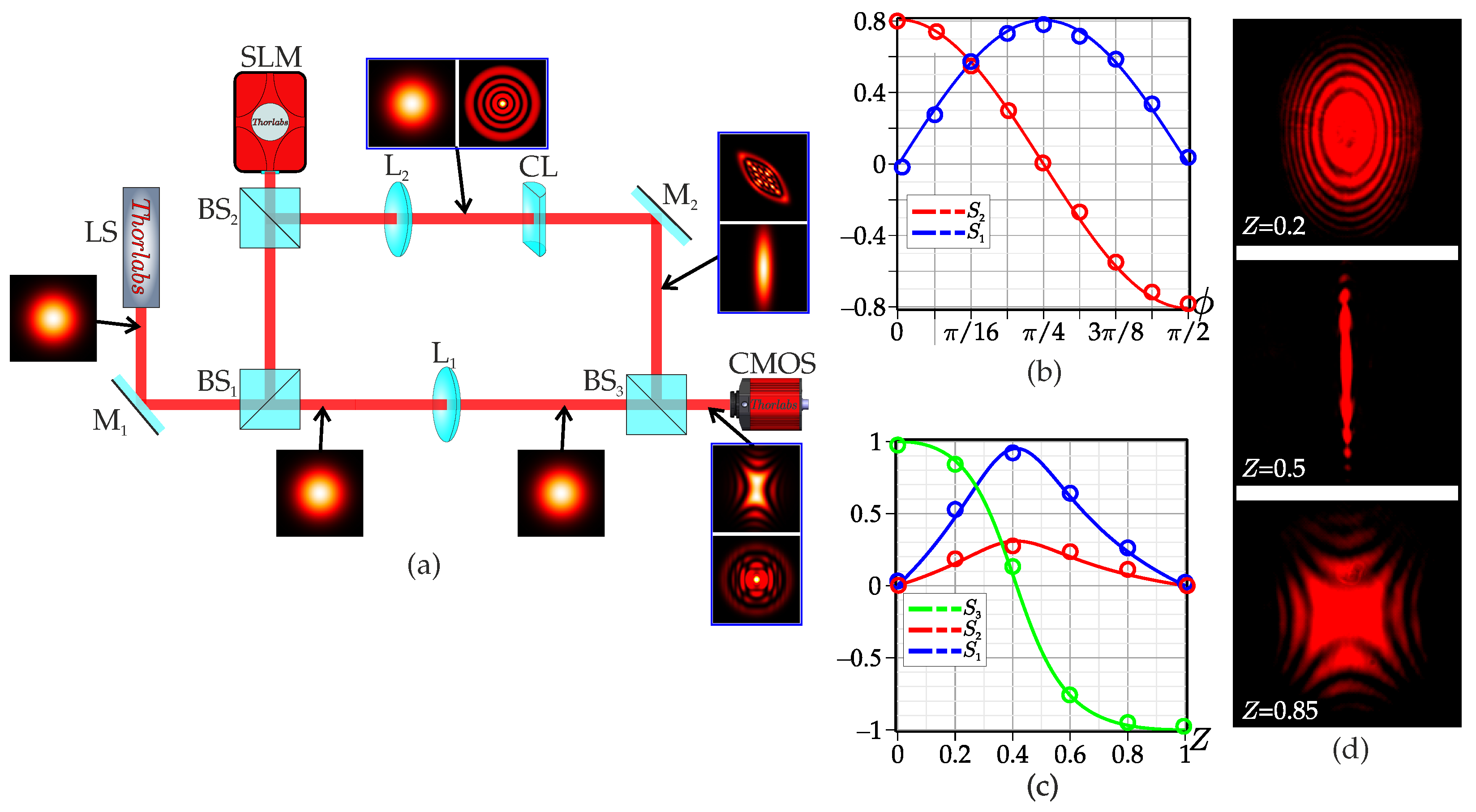
The measurements of the intensity moments, as well as the computer processing of the beam intensity patterns, were performed using the experimental setup, Schematically presented in Figure 3a. A He–Ne laser (with the wave length nm) provided the input beam, which was divided by the beam splitter BS1 into the two arms of a Mach–Zehnder interferometer. In the first arm, the beam was converted either into a fundamental Gaussian mode or into LG beams with zero topological charge by means of a spatial light modulator SLM (Thorlabs EXULUS-4K1/M). The modulated beam was subsequently focused by the spherical lens L1 onto the input plane of the cylindrical lens CL cm), producing a spot with a diameter corresponding to the Rayleigh length m).
Figure 3.
(a) Schema of the experimental setup: LS—He-Ne laser with nm, SLM—spatial light modulator, BS1–3—beam splitters, M1,2—mirrors, L1,2—spherical lenses, CL—cylindrical lens, CMOS—photodetector. (b) The dependence of the Stokes parameters and on the angle of rotation of the cylindrical lens in the plane . (c) The dependence of the parameters on the position of the observation plane . Solid curves represent theoretical claculations and circles are experimental data. (d) Interference patterns of an elliptical Gaussian beam in the region in front of and behind the geometric focus.
Special attention was paid to the choice of a turntable where the cylindrical lens was fixed. Actually, the CL lens performed two functions. The lens rotation ensured the rotation of the elliptical spot without changing its ellipticity. The shift in the lens along the beam axis ensured a change in the ellipticity of the spot without changing the ellipse orientation (with simple astigmatism). These two conditions are met by a 6D turntable type Thorlabs “MAX603D”-3D displacements and 3D rotations of degree of freedom. The accuracy of the lens orientation angle setting was at least . The accuracy of setting the position along the beam axis was no more than 1 mm. After passing through the cylindrical lens, the beam was recombined with the reference beam from the second arm and directed onto the input pupil of a Michrome 20 CMOS (complementary metal–oxide–semiconductor) photodetector, where the interference pattern was recorded. In total, the reproducibility of the intensity ellipse parameters during lens rotations and shifts was about .
The measurements were carried out by computer processing of intensity patterns taken in various planes of the beam after the cylindrical lens. To calculate , , and , the expression (5) was used, where instead of the intensity pattern , an array of points obtained by computer processing of the intensity pattern was used, and integration was replaced by summation. The first three parameters were calculated as
Equations (8) and (12) were used to determine the ellipticity parameter . The results obtained made it possible to construct intensity ellipses and trajectories on the Poincaré sphere in Figure 2. The inclination angle of the intensity ellipse was calculated using Equation (7). The comparison of theoretical and experimental results is illustrated in Figure 3b,c for the Stokes parameters. The experimental points spread relative to theoretical curves does not exceed 5%, which indicates a suitable agreement between theory and experiment. Of particular interest was the displacement of the physical focusing plane in the elliptical beam after the cylindrical lens relative to its geometric focus. It was in this plane that the angular position of the intensity ellipse on the equator of the SU(2) sphere was measured when the axes of the cylindrical lens were rotated in Figure 2.
The interference patterns in Figure 3d show the change in elliptical intensity fringes to hyperbolic ones, which indicates a change in the sign of the wavefront curvature after physical focus of the cylindrical lens. Such an intriguing pattern of changing the shape of the interference fringes is associated with transforming the wavefront shape after the cylindrical lens. Indeed, after a cylindrical lens, two different wavefront shapes are formed in the x- and y-directions of the CL lens. In the y-direction, a wave is formed with a convex groove shaped with the spherical lens L2, since the CL lens does not change the original shape of the wavefront in this direction. In contrast, a cylindrical CL lens forms a wave with a concave groove shape in the x-direction if the beam is observed in the plane before the focus of the CL lens. A wavefront in the form of orthogonal concave and convex grooves is associated with the hyperbolic shape of interference fringes in the observation plane in Figure 3d. After the focal plane of the CL lens, the concave groove transforms into a convex one. A complex wave formed by two convex grooves, but with different curvature after the focal plane of the CL lens, is associated with the elliptical shape of the interference fringes in the observation plane in Figure 3d.
4. Conclusions
Propagating through a cylindrical lens, a fundamental Gaussian beam experiences elliptical deformation in such a way that the beam field changes the shape of the ellipse, but at the distance of the double focus, the ellipse turns into a circle. The orientation of the ellipse follows the orientation of the cylindrical lens axes. Moreover, if the Gaussian beam does not have the OAM before passing the lens, then the cylindrical lens does not introduce the OAM into it, i.e., the beam remains free from the orbital angular momentum. These features indicate a simple astigmatic transformation. An explicit form of elliptical deformation characterizes the intensity ellipse, the shape of which is specified by physically measurable elements of the second-order intensity moment tensor. Moreover, all types of higher-order Gaussian beams possess this property. We have taken these comparably simple considerations as the basis for mapping the states of vortex-free beams onto an SU(2) sphere. We were able to construct a formalism of Stokes parameters for such vortex-free beams based on an analogy with the Stokes polarization parameters for both fundamental Gaussian beams and higher-order LG beams with zero topological charges. It was found that the rotations of the intensity ellipse axes for any vortex-free LG beams depend only on the orientation of the cylindrical lens axes and do not depend on the displacement of the observation plane along the beam axis. However, this displacement just changes the ellipticity of the intensity ellipse. Using these two elementary movements, we mapped the cyclic changes in the states of the fundamental Gaussian beam and the LG beam with the zero topological charge and radial number onto the Poincarè sphere in the form of elementary contours bounding the area of a spherical segment, a polar spherical triangle and a spherical rectangle. The straightforward conditions of spherical geometry made it possible to estimate the geometric phases of the beams acquired during cyclic changes in their states. A technique for measuring Stokes parameters for cyclic changes in the states of vortex-free beams has also been developed. A comparison of theory and experiment showed their considerably good agreement.
Author Contributions
Conceptualization, A.V. and M.B.; methodology, A.V.; software, M.B.; validation, Y.A. and M.B.; formal analysis, M.B.; investigation, M.B. and A.V.; writing—original draft preparation, A.V.; writing—review and editing, A.V.; visualization, M.B.; supervision, A.V.; funding acquisition, M.B. All authors have read and agreed to the published version of the manuscript.
Funding
This work was supported by the Russian Science Foundation grant no. 24-22-00278.
Data Availability Statement
Data are contained within the article.
Acknowledgments
We are grateful to Server Khalilov for providing the experimental results.
Conflicts of Interest
The authors declare no conflicts of interest.
References
- Shen, Y. Rays, waves, SU(2) symmetry and geometry: Toolkits for structured light. J. Opt. 2021, 23, 124004. [Google Scholar] [CrossRef]
- Dennis, M.R.; Alonso, M.A. Swings and roundabouts: Optical Poincaré spheres for polarization and Gaussian beams. Phil. Trans. R. Soc. A Math. Phys. Engin. Sci. 2017, 375, 20150441. [Google Scholar] [CrossRef]
- Kotlyar, V.V.; Kovalev, A.A.; Porfirev, A.P. Vortex Laser Beams; CRC Press/Taylor & Francis Group, LLC: Boca Raton, FL, USA, 2019; Available online: https://books.google.ch/books/about/Vortex_Laser_Beams.html?id=VkUPEAAAQBAJ (accessed on 27 October 2025).
- Wan, L.; Zhao, D. Controllable rotating Gaussian Schell-model beams. Opt. Lett. 2019, 44, 735–738. [Google Scholar] [CrossRef] [PubMed]
- Shen, Y.; Wang, X.; Xie, Z.; Min, C.; Fu, X.; Liu, Q.; Gong, M.; Yuan, X. Optical vortices 30 years on: OAM manipulation from topological charge to multiple singularities. Light Sci. Appl. 2019, 8, 90. [Google Scholar] [CrossRef]
- He, C.; Shen, Y.; Forbes, A. Towards higher-dimensional structured light. Light Sci. Appl. 2022, 11, 205. [Google Scholar] [CrossRef]
- Shen, Y.; Wang, H.; Fan, S. Free-space topological optical textures: Tutorial. Adv. Opt. Photonics 2025, 17, 295–374. [Google Scholar] [CrossRef]
- Chen, Y.F.; Tung, J.C.; Tuan, P.H.; Huang, K.F. Symmetry breaking induced geometric surfaces with topological curves in quantum and classical dynamics of the SU(2) coupled oscillators. Ann. d. Phys. 2017, 529, 1600253. [Google Scholar] [CrossRef]
- Van Enk, S.J.; Nienhuis, G. Eigenfunction description of laser beams and orbital angular momentum of light. Opt. Commun. 1992, 94, 147–158. [Google Scholar] [CrossRef]
- Zhang, Z.; Li, G.; Liu, Y.; Wang, H.; Hoenders, B.J.; Liang, C.; Cai1, Y.; Zeng, J. Robust measurement of orbital angular momentum of a partially coherent vortex beam under amplitude and phase perturbations. Opto-Electron. Sci. 2024, 3, 240001. [Google Scholar] [CrossRef]
- Van Enk, S.J. Geometric phase, transformations of Gaussian light beams and angular momentum transfer. Opt. Commun. 1993, 102, 59–64. [Google Scholar] [CrossRef]
- Berry, M.V. Quantal phase factors accompanying adiabatic changes. Proc. R. Soc. A Math. Phys. Engin. Sci. 1984, 392, 45–57. [Google Scholar]
- Courtial, J.; Dholakia, K.; Allen, L.; Padgett, M.J. Gaussian beams with very high orbital angular momentum. Opt. Commun. 1997, 144, 210–213. [Google Scholar] [CrossRef]
- Kotlyar, V.V.; Kovalev, A.A.; Porfirev, A.P. Astigmatic laser beams with a large orbital angular momentum. Opt. Express 2018, 26, 141–156. [Google Scholar] [CrossRef]
- Padgett, M.J.; Courtial, J. Poincaré-sphere equivalent for light beams containing orbital angular momentum. Opt. Lett. 1999, 24, 430–432. [Google Scholar] [CrossRef]
- Agarwal, G.S. SU(2) structure of the Poincaré sphere for light beams with orbital angular momentum. J. Opt. Soc. Am. A 1999, 16, 2914–2916. [Google Scholar] [CrossRef]
- Galvez, E.J.; Crawford, P.R.; Sztul, H.I.; Pysher, M.J.; Haglin, P.J.; Williams, R.E. Geometric phase associated with mode transformations of optical beams bearing orbital angular momentum. Phys. Rev. Lett. 2003, 90, 203901. [Google Scholar] [CrossRef] [PubMed]
- Calvo, G.F. Wigner representation and geometric transformations of optical orbital angular momentum spatial modes. Opt. Lett. 2005, 30, 1207–1209. [Google Scholar] [CrossRef]
- Alieva, T.; Bastiaans, M.J. Dynamic and geometric phase accumulation by Gaussian-type modes in first-order optical systems. Opt. Lett. 2008, 33, 1659–1661. [Google Scholar] [CrossRef]
- Volyar, A.; Bretsko, M. Mapping structured Laguerre–Gaussian beam states onto the orbital Poincaré sphere in the form of controllable spatial trajectories. J. Opt. Soc. Am. A 2024, 41, 1648–1655. [Google Scholar] [CrossRef]
- Shen, Y.; Wang, Z.; Fu, X.; Naidoo, D.; Forbes, A. SU(2) Poincaré sphere: A generalized representation for multidimensional structured light. Phys. Rev. A 2020, 102, 031501(R). [Google Scholar] [CrossRef]
- Volyar, A.; Bretsko, M.; Khalilov, S.; Akimova, Y. Self-healing and self-matching effects in astigmatic structured beams as a basis for measuring orbital Stokes parameters. Appl. Opt. 2025, 64, 3241–3249. [Google Scholar] [CrossRef] [PubMed]
- Wu, S.-D.; Chew, K.-H.; Chen, R.-P. Effect of twisting phases on linear–circular polarization and spin–orbital angular momentum conversions in tightly focused vector and scalar beams. Photonics 2023, 10, 151. [Google Scholar] [CrossRef]
- Liu, B.; Huang, Y.; Liu, C.; Wu, S.-D.; Chew, K.-H.; Chen, R.-P. Influence of high-order twisting phases on polarization states and optical angular momentum of a vector light field. Photonics 2023, 10, 1099. [Google Scholar] [CrossRef]
- Cox, M.A.; Maqondo, L.; Kara, R.; Milione, G.; Cheng, L.; Forbes, A. The resilience of Hermite– and Laguerre–Gaussian modes in turbulence. J. Lightwave Technol. 2019, 37, 3911–3917. [Google Scholar] [CrossRef]
- Nemes, G.; Siegman, A.E. Measurement of all ten second-order moments of an astigmatic beam by the use of rotating simple astigmatic (anamorphic) optics. J. Opt. Soc. Am. A 1994, 11, 2257–2264. [Google Scholar] [CrossRef]
- Syubaev, S.; Mitsai, E.; Porfirev, A.; Khonina, S.; Kudryashov, S.; Katkus, T.; Juodkazis, S.; Gurevich, E.L.; Kuchmizhak, A. Silicon microprotrusions with tailored chirality enabled by direct femtosecond laser ablation. Opt. Lett. 2020, 45, 3050–3053. [Google Scholar] [CrossRef] [PubMed]
- Wang, Z.; Zhan, Z.; Vetlugin, A.N.; Ou, J.-Y.; Liu, Q.; Shen, Y.; Fu, X. Structured light analogy of quantum squeezed states. Light Sci. Appl. 2024, 13, 297. [Google Scholar] [CrossRef]
- Arnaud, J.A.; Kogelnik, H. Gaussian light beams with general astigmatism. Appl. Opt. 1969, 8, 1687–1693. [Google Scholar] [CrossRef]
- Gradshteyn, I.S.; Ryzhik, I.M. Table of Integrals, Series, and Products; Academic Press/Elsevier Inc.: San Diego, CA, USA, 2007. [Google Scholar] [CrossRef]
- Born, M.; Wolf, E. Principles of Optics; Cambridge University Press: Cambridge, UK, 1999. [Google Scholar] [CrossRef]
- Volyar, A.; Abramochkin, E.; Bretsko, M.; Akimova, Y. Engineering orbital angular momentum in structured beams in general astigmatic systems via symplectic matrix approach. Photonics 2024, 11, 191. [Google Scholar] [CrossRef]
- Phillips, R.L.; Andrews, L.C. Spot size and divergence for Laguerre–Gaussian beams of any order. Appl. Opt. 1983, 22, 643–644. [Google Scholar] [CrossRef]
- Ventzel, M.K. Spherical Trigonometry; Izdat. Geodez. Kartograf. Lit. [Pub. Geodet. Cartograph. Lit.]: Moscow, USSR, 1948; (In Russian). Available online: https://libarch.nmu.org.ua//handle/GenofondUA/79899 (accessed on 27 October 2025).
- Cohen, E.; Larocque, H.; Bouchard, F.; Nejadsattari, F.; Gefen, Y.; Karimi, E. Geometric phase from Aharonov–Bohm to Pancharatnam–Berry and beyond. Nat. Rev. Phys. 2019, 1, 437–449. [Google Scholar] [CrossRef]
- Viña, A. Hamiltonian symplectomorphisms and the Berry phase. J. Geom. Phys. 2001, 40, 26–46. [Google Scholar] [CrossRef]
- Cisowski, C.; Götte, J.B.; Franke-Arnold, S. Geometric phases of light: Insights from fibre bundle theory. Rev. Mod. Phys. 2022, 94, 031001. [Google Scholar] [CrossRef]
- Zwanziger, J.W.; Koenig, M.; Pines, A. Berry’s phase. Annu. Rev. Phys. Chem. 1990, 41, 601–646. [Google Scholar] [CrossRef]
- ISO 11146-2. Lasers and Laser-Related Equipment—Test Methods for Laser Beam Widths, Divergence Angles and Beam Propagation Ratios—Part 2: General Astigmatic Beams; International Organization for Standardization: Geneva, Switzerland, 2005; Available online: https://cdn.standards.iteh.ai/samples/33626/bc0e48b8420b43e3b146febc6378e7a5/ISO-11146-2-2005.pdf (accessed on 27 October 2025).
Disclaimer/Publisher’s Note: The statements, opinions and data contained in all publications are solely those of the individual author(s) and contributor(s) and not of MDPI and/or the editor(s). MDPI and/or the editor(s) disclaim responsibility for any injury to people or property resulting from any ideas, methods, instructions or products referred to in the content. |
© 2025 by the authors. Licensee MDPI, Basel, Switzerland. This article is an open access article distributed under the terms and conditions of the Creative Commons Attribution (CC BY) license (https://creativecommons.org/licenses/by/4.0/).