Hunting for Dwarf Galaxies Hosting the Formation and Coalescence of Compact Binaries


Abstract
1. Introduction
2. Numerical Method
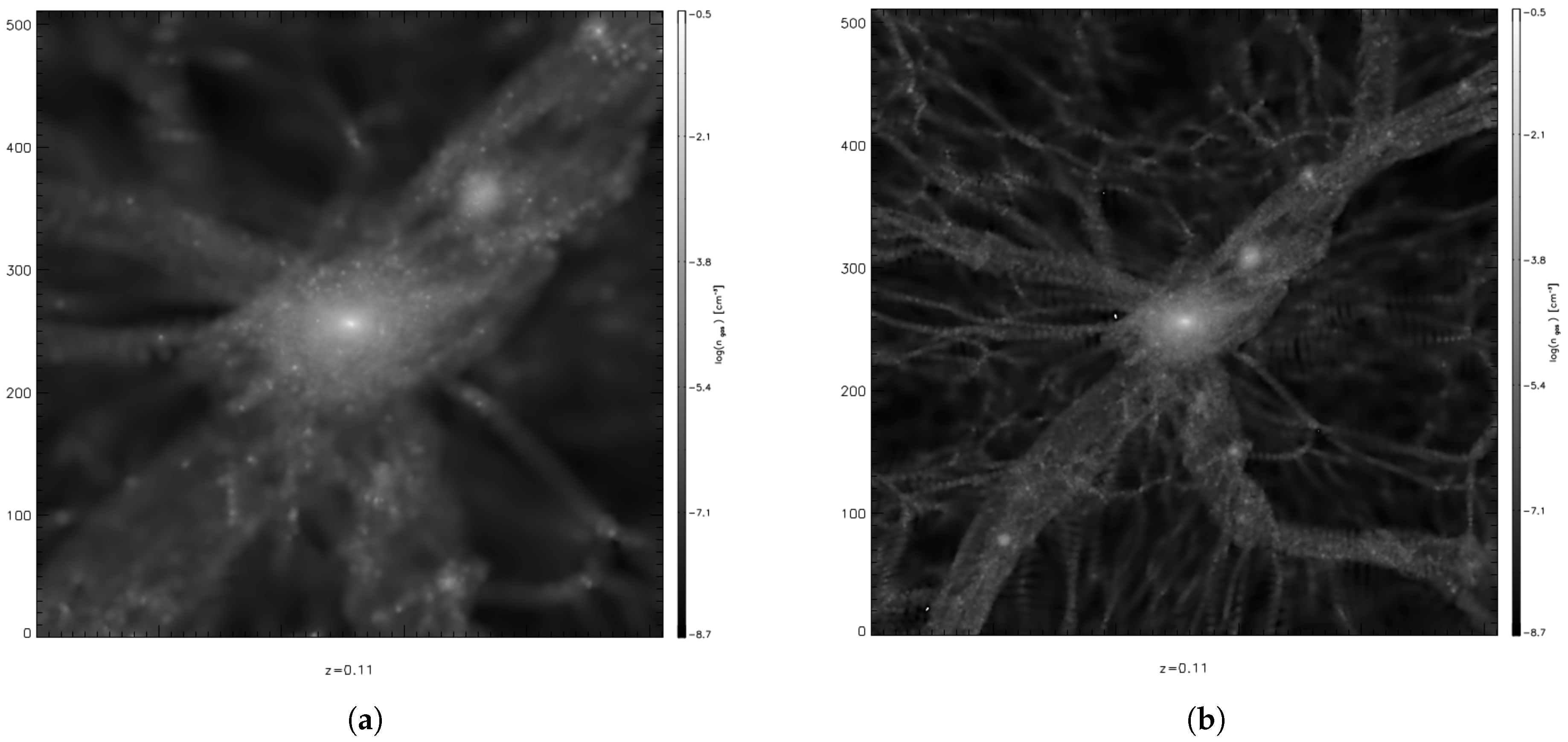
2.1. Galaxy Formation with GAMESH
2.1.1. DM Halos
2.1.2. Galaxies with Stars and Metals
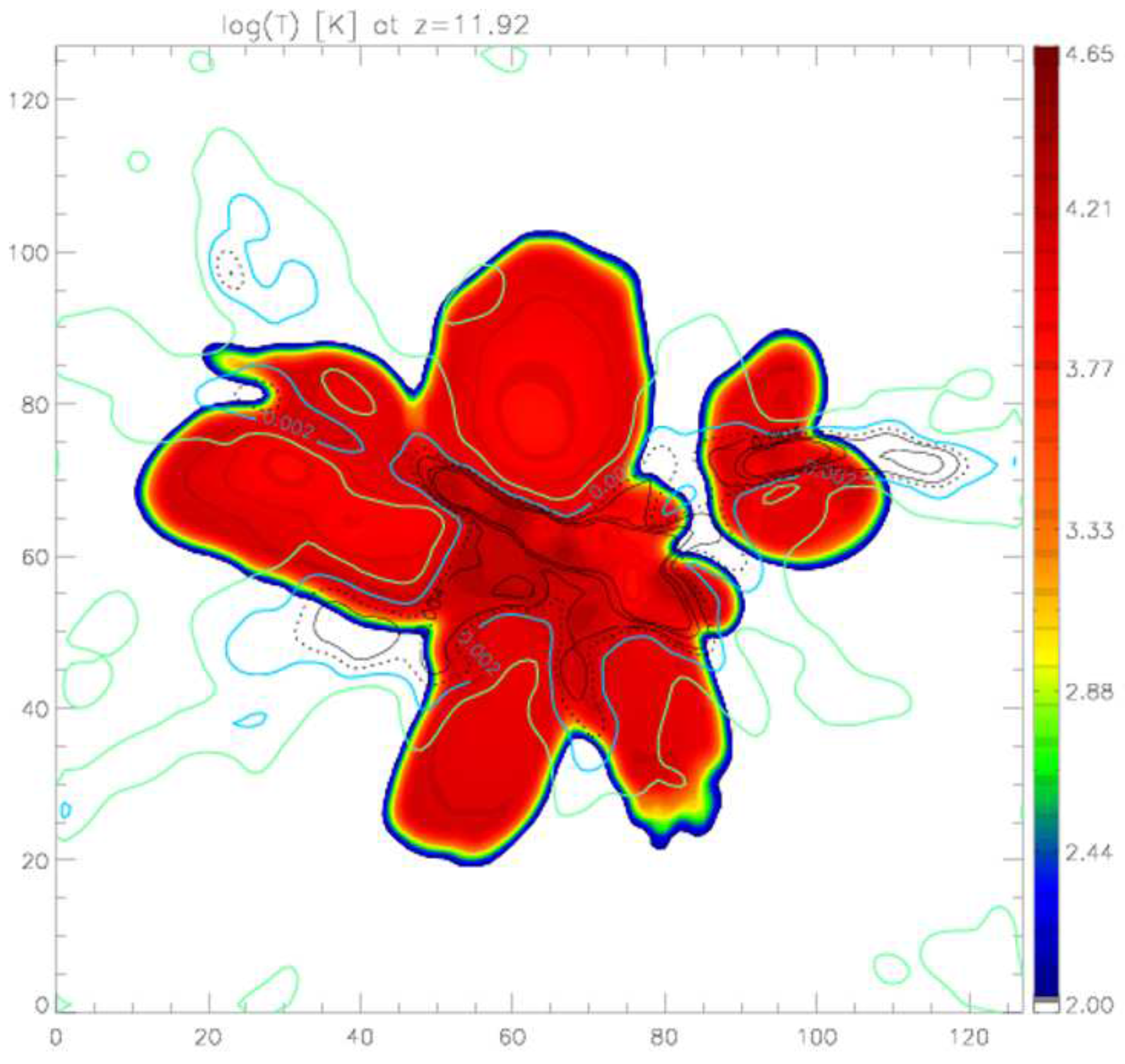
2.1.3. Radiative Feedback on Star Formation
2.2. Stellar Binaries
- a Kroupa Initial Mass Function (IMF, Kroupa [79]) regulates the distribution of the primary stellar mass, , in a suitable mass range, while the secondary star has a mass generated according to a flat distribution for the mass ratio with ;
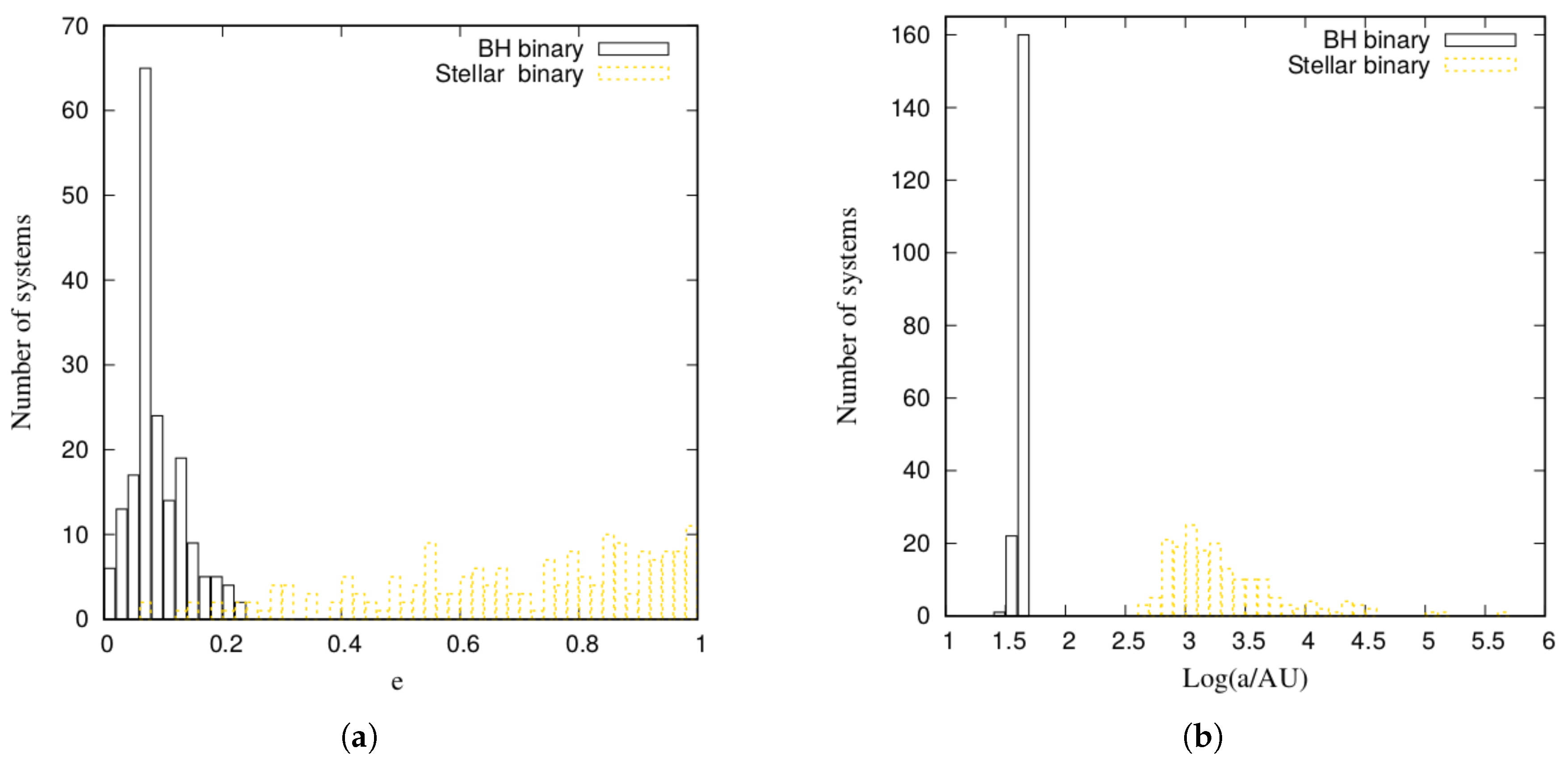
- the initial semi-major axis (a) has a flat distribution in log(a) (see Portegies Zwart and Verbunt [8]), ranging from (Roche lobe contact) up to ;
- the eccentricity e of the binary is sampled from a thermal distribution in the interval [80].
2.3. Formation and Coalescence Sites
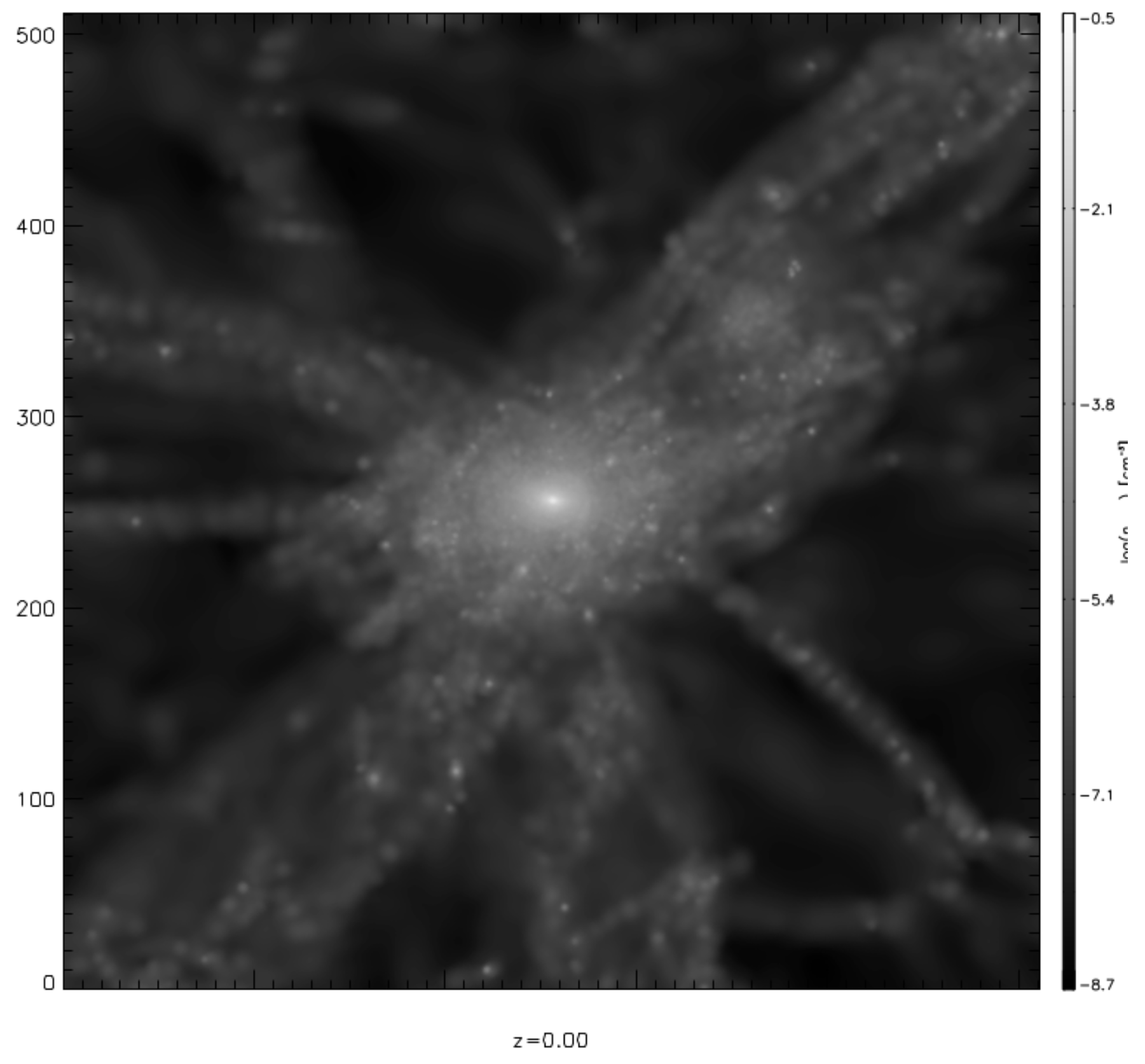
- GAMESH correlates the temporal evolution of binary systems living in galaxies with the large scale process of structure formation, down to .
- Our approach is particularly effective for small dwarf galaxies, because of the many feedback processes accounted for, which strongly impact the evolution of small objects.
- The algorithm described above is sufficiently general to follow both the gravitational and the electromagnetic emission from all the sampled binaries systems, not necessarily the ones evolving into BHBH, BHNS and NSNS compact binaries. Their electromagnetic emission during the stellar evolution phases, in particular, can be additionally modeled with great details thanks to the rich set of information provided by the BPS on stellar radii, surface temperature, evolutionary status, and efficiency of mass transfer exchange. For example, by adopting SeBa, it is possible to track all the stellar stages during the binary evolution: from their proto-stellar phase to their X-rays pulsar or radio pulsar phases, if the components evolve into a neutron stars. This information is also provided as function of time for each system so that the radiative properties of the binary population can be modeled consistently with the galaxy formation process. In this way also the sources accounted for in the radiative scenario are significantly improved.
- As star forming galaxies are populated by the statistical principle of random sampling, the method requires convergence tests. An example of this validation procedure is provided in Marassi et al. [50], Appendixes B and C.
3. Results and Model Predictions
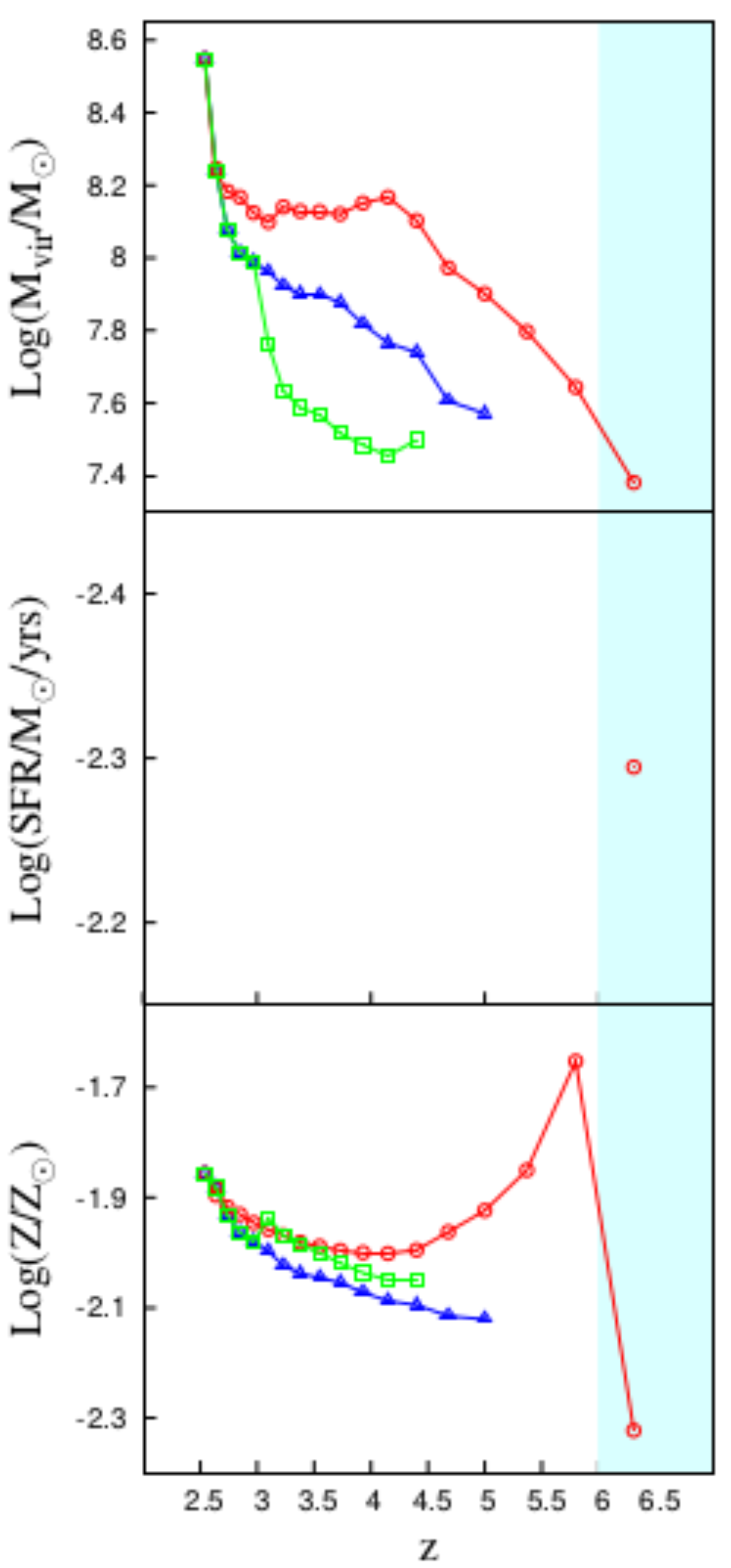
3.1. Evolution of Birth and Coalescence Hosts
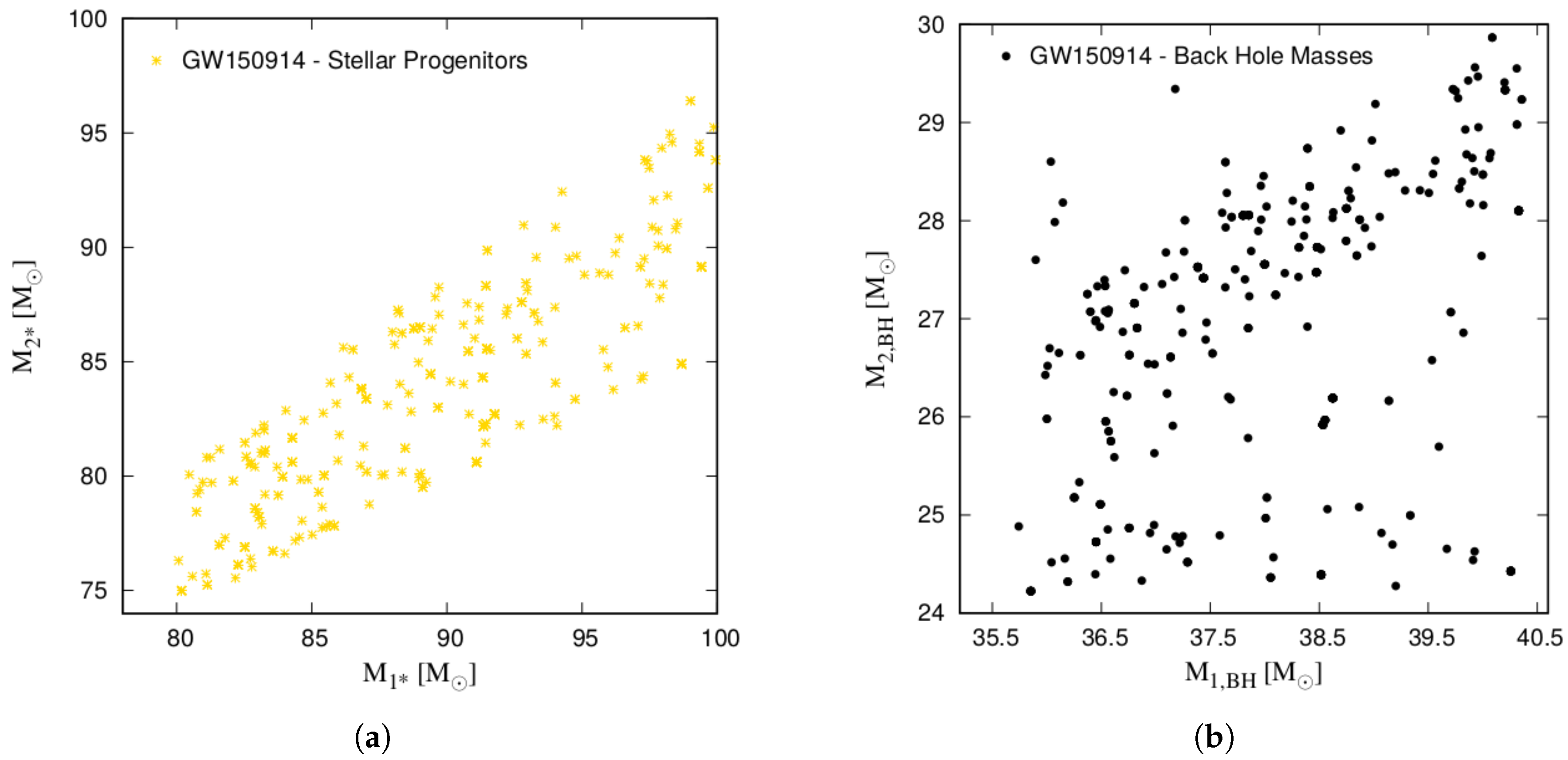
3.2. Evolution of Stellar Binaries
4. Conclusions
- GAMESH includes a rich set of feedback processes capable to constraint the high redshift evolution of small dwarf galaxies, fragile to mechanical, chemical and radiative feedback;
- thanks to the data-constrained nature of our model, GAMESH is capable to match a large set of properties of the central MW-like galaxy and naturally reproduces the scaling relations observed in the local redshift universe;
- by coupling the galaxy evolution with a large database of binary systems evolving in compact objects, GAMESH predicts the galaxy hosts in which coalescence events occurs;
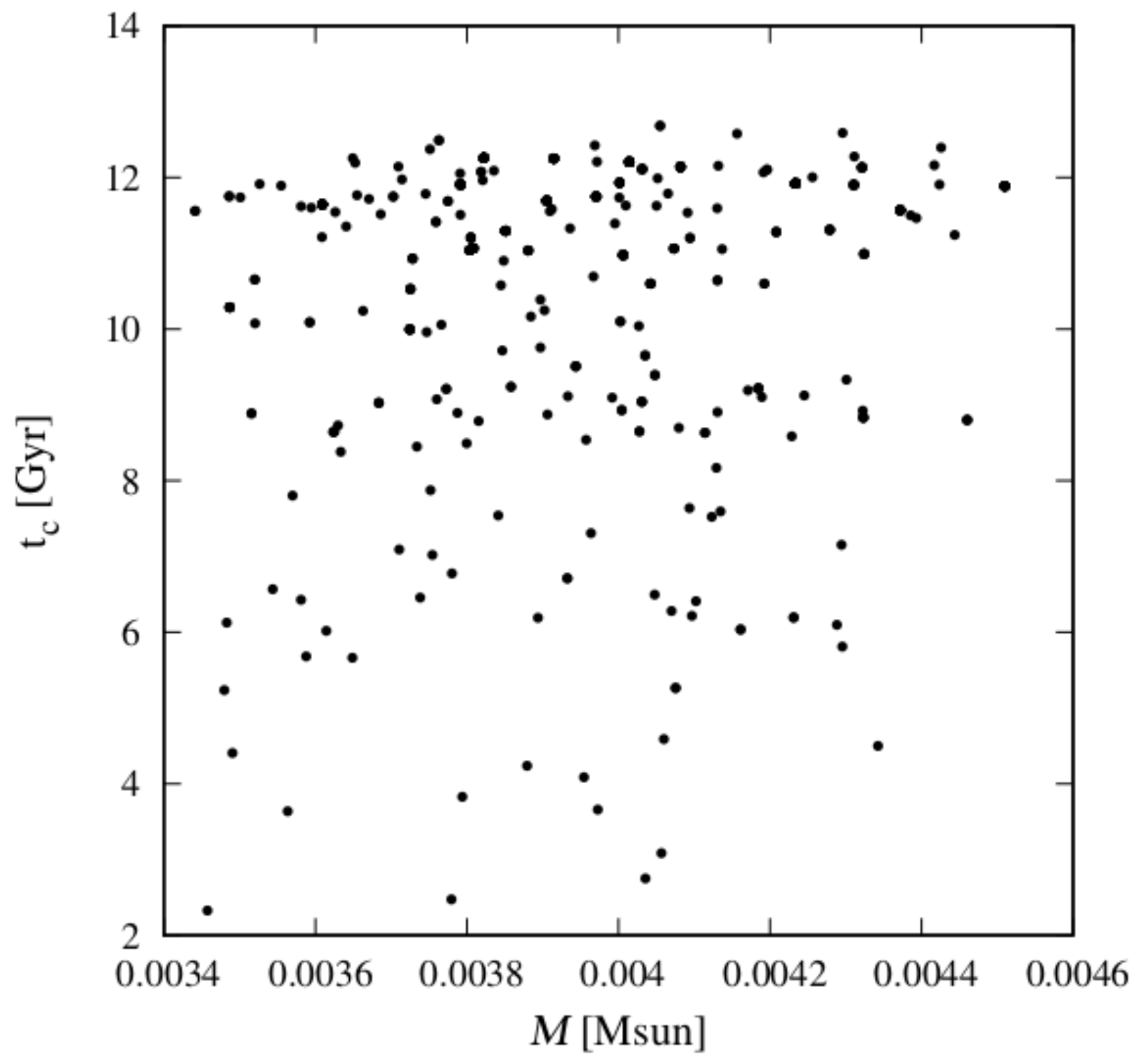
- by focusing on the binaries generating GW150914-like signals in dwarfs galaxies, we have shown that complex cosmic histories can connect birth and coalescence hosts. While the masses of the BHBH binaries depend on the gas metallicity of the birth dwarfs and the dynamical evolution of the stellar progenitors, the coalescence time selects the coalescence hosts and mainly depends on the initial value of the BHBH semi-major axes.
Funding
Acknowledgments
Conflicts of Interest
References
- Abbott, B.P.; Abbott, R.; Abbott, T.D.; Abernathy, M.R.; Acernese, F.; Ackley, K.; Adams, C.; Adams, T.; Addesso, P.; Adhikari, R.X.; et al. Binary Black Hole Mergers in the First Advanced LIGO Observing Run. Phys. Rev. X 2016, 6, 041015. [Google Scholar] [CrossRef]
- Abbott, B.P.; Abbott, R.; Abbott, T.D.; Abernathy, M.R.; Acernese, F.; Ackley, K.; Adams, C.; Adams, T.; Addesso, P.; Adhikari, R.X.; et al. Observation of Gravitational Waves from a Binary Black Hole Merger. Phys. Rev. Lett. 2016, 116, 061102. [Google Scholar] [CrossRef] [PubMed]
- Abbott, B.P.; Abbott, R.; Abbott, T.D.; Abernathy, M.R.; Acernese, F.; Ackley, K.; Adams, C.; Adams, T.; Addesso, P.; Adhikari, R.X.; et al. GW151226: Observation of Gravitational Waves from a 22-Solar-Mass Binary Black Hole Coalescence. Phys. Rev. Lett. 2016, 116, 241103. [Google Scholar] [CrossRef] [PubMed]
- Abbott, B.P.; Abbott, R.; Abbott, T.D.; Abernathy, M.R.; Acernese, F.; Ackley, K.; Adams, C.; Adams, T.; Addesso, P.; Adhikari, R.X.; et al. Astrophysical Implications of the Binary Black-hole Merger GW150914. Astrophys. J. Lett. 2016, 818, L22. [Google Scholar] [CrossRef]
- The LIGO Scientific Collaboration; The Virgo Collaboration; Abbott, B.P.; Abbott, R.; Abbott, T.D.; Abraham, S.; Acernese, F.; Ackley, K.; Adams, C.; Adhikari, R.X.; et al. GWTC-1: A Gravitational-Wave Transient Catalog of Compact Binary Mergers Observed by LIGO and Virgo during the First and Second Observing Runs. arXiv 2018, arXiv:1811.12907. reprinted in Phys. Rev. X 2019, 9, 031040. [Google Scholar] [CrossRef]
- KAGRA Collaboration; LIGO Scientific Collaboration; Virgo Collaboration. Prospects for observing and localizing gravitational-wave transients with Advanced LIGO, Advanced Virgo and KAGRA. Living Rev. Relativ. 2018, 21, 3. [Google Scholar] [CrossRef]
- O’Shaughnessy, R.; Bellovary, J.M.; Brooks, A.; Shen, S.; Governato, F.; Christensen, C.R. The effects of host galaxy properties on merging compact binaries detectable by LIGO. Mon. Not. Roy. Astron. Soc. 2017, 464, 2831–2839. [Google Scholar] [CrossRef]
- Portegies Zwart, S.F.; Verbunt, F. Population synthesis of high-mass binaries. Astron. Astrophys. 1996, 309, 179–196. [Google Scholar]
- Dominik, M.; Belczynski, K.; Fryer, C.; Holz, D.E.; Berti, E.; Bulik, T.; Mandel, I.; O’Shaughnessy, R. Double Compact Objects. II. Cosmological Merger Rates. Astrophys. J. 2013, 779, 72. [Google Scholar] [CrossRef]
- Belczynski, K.; Holz, D.E.; Bulik, T.; O’Shaughnessy, R. The first gravitational-wave source from the isolated evolution of two stars in the 40–100 solar mass range. Nature 2016, 534, 512–515. [Google Scholar] [CrossRef]
- Mandel, I.; de Mink, S.E. Merging binary black holes formed through chemically homogeneous evolution in short-period stellar binaries. Mon. Not. Roy. Astron. Soc. 2016, 458, 2634–2647. [Google Scholar] [CrossRef]
- Spera, M.; Mapelli, M. Very massive stars, pair-instability supernovae and intermediate-mass black holes with the sevn code. Mon. Not. Roy. Astron. Soc. 2017, 470, 4739–4749. [Google Scholar] [CrossRef]
- Giacobbo, N.; Mapelli, M.; Spera, M. Merging black hole binaries: The effects of progenitor’s metallicity, mass-loss rate and Eddington factor. Mon. Not. Roy. Astron. Soc. 2018, 474, 2959–2974. [Google Scholar] [CrossRef]
- Postnov, K.; Kuranov, A. Black hole spins in coalescing binary black holes. Mon. Not. Roy. Astron. Soc. 2019, 483, 3288–3306. [Google Scholar] [CrossRef]
- Portegies Zwart, S.F.; McMillan, S. Black hole mergers in the universe. Astrophys. J. 2000, 528, L17. [Google Scholar] [CrossRef]
- O’Leary, R.M.; Rasio, F.A.; Fregeau, J.M.; Ivanova, N.; O’Shaughnessy, R.W. Binary mergers and growth of black holes in dense star clusters. Astrophys. J. 2006, 637, 937–951. [Google Scholar] [CrossRef]
- Sadowski, A.; Belczynski, K.; Bulik, T.; Ivanova, N.; Rasio, F.A.; O’Shaughnessy, R.W. The Total Merger Rate of Compact Object Binaries in the Local Universe. Astrophys. J. 2008, 676, 1162. [Google Scholar] [CrossRef]
- Ziosi, B.M.; Mapelli, M.; Branchesi, M.; Tormen, G. Dynamics of stellar black holes in young star clusters with different metallicities—II. Black hole–black hole binaries. Mon. Not. Roy. Astron. Soc. 2014, 441, 3703–3717. [Google Scholar] [CrossRef]
- Mapelli, M. Massive black hole binaries from runaway collisions: The impact of metallicity. Mon. Not. Roy. Astron. Soc. 2016, 459, 3432–3446. [Google Scholar] [CrossRef]
- Antonini, F.; Rasio, F.A. Merging black hole binaries in galactic nuclei: Implications for advanced-LIGO detections. Astrophys. J. 2016, 831, 187. [Google Scholar] [CrossRef]
- Carr, B.; Kuhnel, F.; Sandstad, M. Primordial Black Holes as Dark Matter. Phys. Rev. 2016, D94, 083504. [Google Scholar] [CrossRef]
- Somerville, R.S.; Popping, G.; Trager, S.C. Star formation in semi-analytic galaxy formation models with multiphase gas. Mon. Not. Roy. Astron. Soc. 2015, 453, 4337–4367. [Google Scholar] [CrossRef]
- Henriques, B.M.B.; White, S.D.M.; Thomas, P.A.; Angulo, R.; Guo, Q.; Lemson, G.; Springel, V.; Overzier, R. Galaxy formation in the Planck cosmology—I. Matching the observed evolution of star formation rates, colours and stellar masses. Mon. Not. Roy. Astron. Soc. 2015, 451, 2663–2680. [Google Scholar] [CrossRef]
- Graziani, L.; Salvadori, S.; Schneider, R.; Kawata, D.; de Bennassuti, M.; Maselli, A. Galaxy formation with radiative and chemical feedback. Mon. Not. Roy. Astron. Soc. 2015, 449, 3137–3148. [Google Scholar] [CrossRef][Green Version]
- Graziani, L.; de Bennassuti, M.; Schneider, R.; Kawata, D.; Salvadori, S. The history of the dark and luminous side of Milky Way-like progenitors. Mon. Not. Roy. Astron. Soc. 2017, 469, 1101–1116. [Google Scholar] [CrossRef]
- Abbott, B.P.; Abbott, R.; Abbott, T.D.; Abernathy, M.R.; Acernese, F.; Ackley, K.; Adams, C.; Adams, T.; Addesso, P.; Adhikari, R.X.; et al. Localization and broadband follow-up of the gravitational-wave transient GW150914. Astrophys. J. 2016, 826, L13. [Google Scholar] [CrossRef]
- Perna, R.; Lazzati, D.; Farr, W. Limits on Electromagnetic Counterparts of Gravitational-wave-detected Binary Black Hole Mergers. Astrophys. J. 2019, 875, 49. [Google Scholar] [CrossRef]
- Brocato, E.; Branchesi, M.; Cappellaro, E.; Covino, S.; Grado, A.; Greco, G.; Limatola, L.; Stratta, G.; Yang, S.; Campana, S.; et al. GRAWITA: VLT Survey Telescope observations of the gravitational wave sources GW150914 and GW151226. Mon. Not. Roy. Astron. Soc. 2018, 474, 411–426. [Google Scholar] [CrossRef]
- Stratta, G.; Ciolfi, R.; Amati, L.; Bozzo, E.; Ghirlanda, G.; Maiorano, E.; Nicastro, L.; Rossi, A.; Vinciguerra, S.; Frontera, F.; et al. THESEUS: A key space mission concept for Multi-Messenger Astrophysics. Adv. Space Res. 2018, 62, 662–682. [Google Scholar] [CrossRef]
- Abbott, B.P.; Abbott, R.; Abbott, T.D.; Abraham, S.; Acernese, F.; Ackley, K.; Adams, C.; Adhikari, R.X.; Adya, V.; Affeldt, C.; et al. Binary Black Hole Population Properties Inferred from the First and Second Observing Runs of Advanced LIGO and Advanced Virgo. arXiv 2018, arXiv:1811.12940. [Google Scholar] [CrossRef]
- Mapelli, M.; Giacobbo, N.; Ripamonti, E.; Spera, M. The cosmic merger rate of stellar black hole binaries from the Illustris simulation. Mon. Not. Roy. Astron. Soc. 2017, 472, 2422–2435. [Google Scholar] [CrossRef]
- Vogelsberger, M.; Genel, S.; Springel, V.; Torrey, P.; Sijacki, D.; Xu, D.; Snyder, G.; Nelson, D.; Hernquist, L. Introducing the Illustris Project: Simulating the coevolution of dark and visible matter in the Universe. Mon. Not. Roy. Astron. Soc. 2014, 444, 1518–1547. [Google Scholar] [CrossRef]
- Artale, M.C.; Mapelli, M.; Giacobbo, N.; Sabha, N.B.; Spera, M.; Santoliquido, F.; Bressan, A. Host galaxies of merging compact objects: Mass, star formation rate, metallicity and colours. Mon. Not. Roy. Astron. Soc. 2019. [Google Scholar] [CrossRef]
- Lamberts, A.; Garrison-Kimmel, S.; Hopkins, P.F.; Quataert, E.; Bullock, J.S.; Faucher-Giguère, C.A.; Wetzel, A.; Kereš, D.; Drango, K.; Sanderson, R.E. Predicting the binary black hole population of the Milky Way with cosmological simulations. Mon. Not. Roy. Astron. Soc. 2018, 480, 2704–2718. [Google Scholar] [CrossRef]
- Hopkins, P.F.; Kereš, D.; Oñorbe, J.; Faucher-Giguère, C.A.; Quataert, E.; Murray, N.; Bullock, J.S. Galaxies on FIRE (Feedback In Realistic Environments): Stellar feedback explains cosmologically inefficient star formation. Mon. Not. Roy. Astron. Soc. 2014, 445, 581–603. [Google Scholar] [CrossRef]
- Wetzel, A.R.; Hopkins, P.F.; Kim, J.h.; Faucher-Giguère, C.A.; Kereš, D.; Quataert, E. Reconciling Dwarf Galaxies with ΛCDM Cosmology: Simulating a Realistic Population of Satellites around a Milky Way-mass Galaxy. Astrophys. J. Lett. 2016, 827, L23. [Google Scholar] [CrossRef]
- Schaye, J.; Crain, R.A.; Bower, R.G.; Furlong, M.; Schaller, M.; Theuns, T.; Dalla Vecchia, C.; Frenk, C.S.; McCarthy, I.G.; Helly, J.C.; et al. The EAGLE project: Simulating the evolution and assembly of galaxies and their environments. Mon. Not. Roy. Astron. Soc. 2015, 446, 521–554. [Google Scholar] [CrossRef]
- Pillepich, A.; Springel, V.; Nelson, D.; Genel, S.; Naiman, J.; Pakmor, R.; Hernquist, L.; Torrey, P.; Vogelsberger, M.; Weinberger, R.; et al. Simulating galaxy formation with the IllustrisTNG model. Mon. Not. Roy. Astron. Soc. 2018, 473, 4077–4106. [Google Scholar] [CrossRef]
- Norman, M.L.; Chen, P.; Wise, J.H.; Xu, H. Fully Coupled Simulation of Cosmic Reionization. III. Stochastic Early Reionization by the Smallest Galaxies. Astrophys. J. 2018, 867, 27. [Google Scholar] [CrossRef]
- Rosdahl, J.; Katz, H.; Blaizot, J.; Kimm, T.; Michel-Dansac, L.; Garel, T.; Haehnelt, M.; Ocvirk, P.; Teyssier, R. The SPHINX cosmological simulations of the first billion years: The impact of binary stars on reionization. Mon. Not. Roy. Astron. Soc. 2018, 479, 994–1016. [Google Scholar] [CrossRef]
- Schneider, R.; Ferrara, A.; Salvaterra, R.; Omukai, K.; Bromm, V. Low-mass relics of early star formation. Nature 2003, 422, 869–871. [Google Scholar] [CrossRef] [PubMed]
- Graziani, L.; Maselli, A.; Ciardi, B. CRASH3: Cosmological radiative transfer through metals. Mon. Not. Roy. Astron. Soc. 2013, 431, 722–740. [Google Scholar] [CrossRef][Green Version]
- Graziani, L.; Ciardi, B.; Glatzle, M. X-ray ionization of the intergalactic medium by quasars. Mon. Not. Roy. Astron. Soc. 2018, 479, 4320–4335. [Google Scholar] [CrossRef]
- Ginolfi, M.; Graziani, L.; Schneider, R.; Marassi, S.; Valiante, R.; Dell’Agli, F.; Ventura, P.; Hunt, L.K. Where does galactic dust come from? Mon. Not. Roy. Astron. Soc. 2018, 473, 4538–4543. [Google Scholar] [CrossRef]
- Glatzle, M.; Ciardi, B.; Graziani, L. Radiative transfer of ionizing radiation through gas and dust: The stellar source case. Mon. Not. Roy. Astron. Soc. 2019, 482, 321–336. [Google Scholar] [CrossRef]
- Schneider, R.; Graziani, L.; Marassi, S.; Spera, M.; Mapelli, M.; Alparone, M.; de Bennassuti, M. The formation and coalescence sites of the first gravitational wave events. Mon. Not. Roy. Astron. Soc. 2017, 471, L105–L109. [Google Scholar] [CrossRef]
- Lamberts, A.; Garrison-Kimmel, S.; Clausen, D.R.; Hopkins, P.F. When and where did GW150914 form? Mon. Not. Roy. Astron. Soc. 2016, 463, L31–L35. [Google Scholar] [CrossRef]
- Elbert, O.D.; Bullock, J.S.; Kaplinghat, M. Counting black holes: The cosmic stellar remnant population and implications for LIGO. Mon. Not. Roy. Astron. Soc. 2018, 473, 1186–1194. [Google Scholar] [CrossRef]
- Belczynski, K.; Bulik, T.; Fryer, C.L.; Ruiter, A.; Valsecchi, F.; Vink, J.S.; Hurley, J.R. On the Maximum Mass of Stellar Black Holes. Astrophys. J. 2010, 714, 1217–1226. [Google Scholar] [CrossRef]
- Marassi, S.; Graziani, L.; Ginolfi, M.; Schneider, R.; Mapelli, M.; Spera, M.; Alparone, M. Evolution of dwarf galaxies hosting GW150914-like events. Mon. Not. Roy. Astron. Soc. 2019, 484, 3219–3232. [Google Scholar] [CrossRef]
- Cicone, C.; Bothwell, M.; Wagg, J.; Møller, P.; De Breuck, C.; Zhang, Z.; Martín, S.; Maiolino, R.; Severgnini, P.; Aravena, M.; et al. The final data release of ALLSMOG: A survey of CO in typical local low-M* star-forming galaxies. Astron. Astrophys. 2017, 604, A53. [Google Scholar] [CrossRef]
- Rémy-Ruyer, A.; Madden, S.C.; Galliano, F.; Lebouteiller, V.; Baes, M.; Bendo, G.J.; Boselli, A.; Ciesla, L.; Cormier, D.; Cooray, A.; et al. Linking dust emission to fundamental properties in galaxies: The low-metallicity picture. Astron. Astrophys. 2015, 582, A121. [Google Scholar] [CrossRef]
- Kawata, D.; Gibson, B.K. GCD+: A new chemodynamical approach to modelling supernovae and chemical enrichment in elliptical galaxies. Mon. Not. Roy. Astron. Soc. 2003, 340, 908–922. [Google Scholar] [CrossRef]
- Kawata, D.; Okamoto, T.; Gibson, B.K.; Barnes, D.J.; Cen, R. Calibrating an updated smoothed particle hydrodynamics scheme within gcd+. Mon. Not. Roy. Astron. Soc. 2013, 428, 1968–1979. [Google Scholar] [CrossRef]
- Hahn, O.; Abel, T. Multi-scale initial conditions for cosmological simulations. Mon. Not. Roy. Astron. Soc. 2011, 415, 2101–2121. [Google Scholar] [CrossRef]
- Planck Collaboration; Ade, P.A.R.; Aghanim, N.; Armitage-Caplan, C.; Arnaud, M.; Ashdown, M.; Atrio-Barandela, F.; Aumont, J.; Baccigalupi, C.; Banday, A.J.; et al. Planck 2013 results. XVI. Cosmological parameters. Astron. Astrophys. 2014, 571, A16. [Google Scholar] [CrossRef]
- Guo, Q.; White, S.; Li, C.; Boylan-Kolchin, M. How do galaxies populate dark matter haloes? Mon. Not. Roy. Astron. Soc. 2010, 404, 1111–1120. [Google Scholar] [CrossRef]
- Ibata, R.; Martin, N.F.; Irwin, M.; Chapman, S.; Ferguson, A.M.N.; Lewis, G.F.; McConnachie, A.W. The Haunted Halos of Andromeda and Triangulum: A Panorama of Galaxy Formation in Action. Astrophys. J. 2007, 671, 1591–1623. [Google Scholar] [CrossRef]
- Schneider, R.; Ferrara, A.; Natarajan, P.; Omukai, K. First Stars, Very Massive Black Holes, and Metals. Astrophys. J. 2002, 571, 30–39. [Google Scholar] [CrossRef]
- Schneider, R.; Omukai, K.; Inoue, A.K.; Ferrara, A. Fragmentation of star-forming clouds enriched with the first dust. Mon. Not. Roy. Astron. Soc. 2006, 369, 1437–1444. [Google Scholar] [CrossRef]
- Tinsley, B.M. Evolution of the Stars and Gas in Galaxies. Fundam. Cosm. Phys. 1980, 5, 287–388. [Google Scholar] [CrossRef]
- Kennicutt, R.C., Jr. Star Formation in Galaxies Along the Hubble Sequence. Annu. Rev. Astron. Astrophys. 1998, 36, 189–232. [Google Scholar] [CrossRef]
- McKee, C.F.; Ostriker, E.C. Theory of Star Formation. Annu. Rev. Astron. Astrophys. 2007, 45, 565–687. [Google Scholar] [CrossRef]
- Kennicutt, R.C.; Evans, N.J. Star Formation in the Milky Way and Nearby Galaxies. Annu. Rev. Astron. Astrophys. 2012, 50, 531–608. [Google Scholar] [CrossRef]
- Bland-Hawthorn, J.; Gerhard, O. The Galaxy in Context: Structural, Kinematic, and Integrated Properties. Annu. Rev. Astron. Astrophys. 2016, 54, 529–596. [Google Scholar] [CrossRef]
- Papovich, C.; Labbé, I.; Quadri, R.; Tilvi, V.; Behroozi, P.; Bell, E.F.; Glazebrook, K.; Spitler, L.; Straatman, C.M.S.; Tran, K.V.; et al. ZFOURGE/CANDELS: On the Evolution of M* Galaxy Progenitors from z = 3 to 0.5. Astrophys. J. 2015, 803, 26. [Google Scholar] [CrossRef]
- Hunt, L.; Magrini, L.; Galli, D.; Schneider, R.; Bianchi, S.; Maiolino, R.; Romano, D.; Tosi, M.; Valiante, R. Scaling relations of metallicity, stellar mass and star formation rate in metal-poor starbursts—I. A Fundamental Plane. Mon. Not. Roy. Astron. Soc. 2012, 427, 906. [Google Scholar] [CrossRef]
- Hunt, L.; Dayal, P.; Magrini, L.; Ferrara, A. Coevolution of metallicity and star formation in galaxies to z≃ 3.7—I. A Fundamental Plane. Mon. Not. Roy. Astron. Soc. 2016, 463, 2002. [Google Scholar] [CrossRef]
- Mannucci, F.; Cresci, G.; Maiolino, R.; Marconi, A.; Gnerucci, A. A fundamental relation between mass, star formation rate and metallicity in local and high-redshift galaxies. Mon. Not. Roy. Astron. Soc. 2010, 408, 2115. [Google Scholar] [CrossRef]
- Kennicutt, R.C.; Calzetti, D.; Aniano, G.; Appleton, P.; Armus, L.; Beirão, P.; Bolatto, A.D.; Brandl, B.; Crocker, A.; Croxall, K.; et al. KINGFISH—Key Insights on Nearby Galaxies: A Far-Infrared Survey with Herschel: Survey Description and Image Atlas. Publ. Astron. Soc. Pac. 2011, 123, 1347. [Google Scholar] [CrossRef]
- Bruzual A., G.; Charlot, S. Spectral evolution of stellar populations using isochrone synthesis. Astrophys. J. 1993, 405, 538–553. [Google Scholar] [CrossRef]
- Schaerer, D. On the properties of massive Population III stars and metal-free stellar populations. Astron. Astrophys. 2002, 382, 28–42. [Google Scholar] [CrossRef]
- Barkana, R.; Loeb, A. In the beginning: The first sources of light and the reionization of the universe. Phys. Rep. 2001, 349, 125–238. [Google Scholar] [CrossRef]
- Mapelli, M.; Zampieri, L.; Ripamonti, E.; Bressan, A. Dynamics of stellar black holes in young star clusters with different metallicities - I. Implications for X-ray binaries. Mon. Not. Roy. Astron. Soc. 2013, 429, 2298–2314. [Google Scholar] [CrossRef]
- Nelemans, G.; Yungelson, L.R.; Portegies Zwart, S.F. The gravitational wave signal from the Galactic disk population of binaries containing two compact objects. Astron. Astrophys. 2001, 375, 890–898. [Google Scholar] [CrossRef]
- Hurley, J.R.; Tout, C.A.; Pols, O.R. Evolution of binary stars and the effect of tides on binary populations. Mon. Not. Roy. Astron. Soc. 2002, 329, 897–928. [Google Scholar] [CrossRef]
- Vink, J.S.; de Koter, A.; Lamers, H.J.G.L.M. Mass-loss predictions for O and B stars as a function of metallicity. Astron. Astrophys. 2001, 369, 574–588. [Google Scholar] [CrossRef]
- Mapelli, M.; Colpi, M.; Zampieri, L. Low metallicity and ultra-luminous X-ray sources in the Cartwheel galaxy. Mon. Not. Roy. Astron. Soc. 2009, 395, L71–L75. [Google Scholar] [CrossRef]
- Kroupa, P. On the variation of the initial mass function. Mon. Not. Roy. Astron. Soc. 2001, 322, 231–246. [Google Scholar] [CrossRef]
- Heggie, D.C. Binary evolution in stellar dynamics. Mon. Not. Roy. Astron. Soc. 1975, 173, 729–787. [Google Scholar] [CrossRef]
- Spera, M.; Mapelli, M.; Giacobbo, N.; Trani, A.A.; Bressan, A.; Costa, G. Merging black hole binaries with the SEVN code. Mon. Not. Roy. Astron. Soc. 2019, 485, 889–907. [Google Scholar] [CrossRef]
- Postnov, K.A.; Yungelson, L.R. The Evolution of Compact Binary Star Systems. Living Rev. Relativ. 2014, 17, 3. [Google Scholar] [CrossRef] [PubMed]
- Woosley, S.E. Pulsational Pair-instability Supernovae. Astrophys. J. 2017, 836, 244. [Google Scholar] [CrossRef]


© 2019 by the author. Licensee MDPI, Basel, Switzerland. This article is an open access article distributed under the terms and conditions of the Creative Commons Attribution (CC BY) license (http://creativecommons.org/licenses/by/4.0/).
Share and Cite
Graziani, L. Hunting for Dwarf Galaxies Hosting the Formation and Coalescence of Compact Binaries. Physics 2019, 1, 412-429. https://doi.org/10.3390/physics1030030
Graziani L. Hunting for Dwarf Galaxies Hosting the Formation and Coalescence of Compact Binaries. Physics. 2019; 1(3):412-429. https://doi.org/10.3390/physics1030030
Chicago/Turabian StyleGraziani, Luca. 2019. "Hunting for Dwarf Galaxies Hosting the Formation and Coalescence of Compact Binaries" Physics 1, no. 3: 412-429. https://doi.org/10.3390/physics1030030
APA StyleGraziani, L. (2019). Hunting for Dwarf Galaxies Hosting the Formation and Coalescence of Compact Binaries. Physics, 1(3), 412-429. https://doi.org/10.3390/physics1030030