


Addressing the Cybersecurity Skills Shortage in Lithuania: Policy Insights from the United Kingdom
 , , and
Abstract
1. Introduction
2. Methodology
3. Cybersecurity Skills Landscape in the UK, EU, and Lithuania
3.1. The UK’s Context
3.1.1. Bridging the UK Cybersecurity Skills Gap
3.1.2. Role of Universities Addressing the Cybersecurity Skills Gap
- Expansion of NCSC-accredited apprenticeship and degree programmes (e.g., UWE Bristol, Gloucestershire College);
- Increased employer participation from large business organisations such as BAE Systems, Airbus, and BT;
- Integration of work-based learning within academic frameworks, which directly addresses employer skill requirements;
- Ongoing demand for certified cybersecurity professionals across public and private sectors.
3.2. The EU Context
3.3. Lithuania’s Context
4. Essential Skills for Cybersecurity Professionals
4.1. Technical Skills
4.2. Organisation-Related Skills
4.3. Soft Skills
4.4. Other Important Qualities
5. Strengthening Lithuania’s Cybersecurity Skills Ecosystem: Transferable Lessons from the United Kingdom
- (1)
- Structured professional career frameworks;
- (2)
- Institutionalised multi-stakeholder governance bodies;
- (3)
- National training quality assurance mechanisms; and
- (4)
- Integrated youth and education pipelines.
5.1. Structured Professional Career Frameworks with Recognised Titles and Certifications
- Mapping national labour market roles against ECSF and UK-based professional standards;
- Establishing voluntary—but formally recognized—professional designations supported by industry associations and HEIs;
- Linking these standards to public sector procurement and regulatory expectations, thereby encouraging employers to value structured competencies.
5.2. Governance Bodies Institutionalising Multi-Stakeholder Coordination
- Conduct regular skills needs assessments linked to national risk profiles and regulatory developments;
- Facilitate structured dialogue between SMEs and education providers to ensure training reflects operational realities;
- Coordinate funding priorities across EU and national programmes;
- Support the recognition of professional standards and training quality labels.
5.3. Training Quality Assurance Schemes Linked to National Benchmarks
- Defining competency benchmarks linked to ECSF roles and national regulatory requirements;
- Involving industry practitioners in accreditation and review panels;
- Providing incentives, such as eligibility for public funding or preferential recognition in procurement processes, for programmes that obtain the label.
5.4. Youth Pipeline and Talent Engagement Structures Integrated with Formal Education
- National cyber challenges and extracurricular clubs linked to universities and industry mentors;
- Scholarship schemes aligned with national workforce priorities;
- Clearly articulated school-to-university pathways connected to recognised professional standards.
5.5. Cross-Cutting Considerations: SMEs, Regulation, Economic Structure, and Inclusion
6. Discussion
6.1. What the UK Case Contributes—and What It Does Not
6.2. Aligning NIS2 Compliance with Workforce Policy
6.3. Quality Assurance and Signalling in Higher Education and CPD
6.4. SMEs and the Practicality of Multi-Role Talent
6.5. Early-Stage Pipeline and Inclusion as Capacity Multipliers
6.6. Skills Framework Architecture: ECSF as ‘Lingua Franca’
6.7. From Policy to Practice: Governance Options for Lithuania
- (1)
- Adopting ECSF as the organising vocabulary for roles and proficiency;
- (2)
- Institutionalizing a national certified-training/degree label linked to NIS2-relevant competencies;
- (3)
- Formalising governance to align ministries, HEIs, and industry;
- (4)
- Funding modular, work-based learning schemes for SMEs, and shared regional capabilities; and
- (5)
- Investing in school-to-work pathways with targeted inclusion measures.
6.8. Limitations and Future Work
7. Conclusions
Author Contributions
Funding
Institutional Review Board Statement
Informed Consent Statement
Data Availability Statement
Conflicts of Interest
Abbreviations
| ACE-CSR | Academic Centres of Excellence in Cyber Security Research |
| CAF | Cyber Assessment Framework |
| CISO | Chief Information Security Officer |
| CISP | Cyber security information sharing platform Connect Inform Share Protect |
| CYBERUK | Annual flagship UK government’s cyber security event |
| CyBOK | Cyber Security Body of Knowledge |
| DAP | Digital Acceleration Programme |
| ECSF | European Cybersecurity Skills Framework |
| ENISA | European Union Agency for Cybersecurity |
| EPSRC | Engineering and Physical Sciences Research Council |
| EU | European Union |
| GDPR | General Data Protection Regulation |
| HEI | Higher Education Institution |
| ICT | Information and Communication Technologies |
| LTCYBERCOM | Lithuanian Cyber Command |
| MoD | Ministry of National Defence |
| NATO | North Atlantic Treaty Organization |
| NCSC | National Cyber Security Centre |
| NIS2 | Network and Information Security Directive 2 |
| OSINT | Open-Source Intelligence |
| SME | Small and Medium-sized Enterprise |
| UK | United Kingdom |
| UWE | University of the West of England |
| UWTSD | University of Wales Trinity Saint David |
| VRI | Vulnerability Research Initiative |
References
- Odebade, A.T.; Benkhelifa, E. A comparative study of national cybersecurity strategies of ten nations. arXiv 2023, arXiv:2303.13938. [Google Scholar]
- ISC2. Global Cybersecurity Workforce. 2024. Available online: https://www.isc2.org/Insights/2024/10/ISC2-2024-Cybersecurity-Workforce-Study (accessed on 10 October 2025).
- Blažič, B.J. The cybersecurity labour shortage in Europe: Moving to a new concept for education and training. Technol. Soc. 2021, 67, 101769. [Google Scholar] [CrossRef]
- Bukauskas, L.; Brilingaitė, A.; Juozapavičius, A.; Lepaitė, D.; Ikamas, K.; Andrijauskaitė, R. Remapping cybersecurity competences in a small nation state. Heliyon 2023, 9, e12808. [Google Scholar] [CrossRef] [PubMed]
- European Commission. Flash Eurobarometer 547. In Cyberskills: Eurobarometer Report April–May 2023; European Commission: Brussels, Belgium, 2024; ISBN 978-92-68-19470-6. [Google Scholar] [CrossRef]
- Górka, M. Baltic States Cyber Security Policy: Development of digital capabilities in 2017–2022. Stos. Międzynarodowe Int. Relat. 2023, 3, 15. [Google Scholar] [CrossRef]
- NIS Directive 2. Available online: https://www.enisa.europa.eu/topics/state-of-cybersecurity-in-the-eu/cybersecurity-policies/nis-directive-2 (accessed on 29 December 2025).
- ENISA. Technical Implementation Guidance. Available online: https://www.enisa.europa.eu/sites/default/files/2025-06/ENISA_Technical_implementation_guidance_on_cybersecurity_risk_management_measures_version_1.0.pdf (accessed on 29 December 2025).
- OECD. Building a Skilled Cyber Security Workforce in Europe: Insights from France, Germany and Poland (OECD Skills Studies); OECD Publishing: Paris, France, 2024. [Google Scholar] [CrossRef]
- CyberHubs. Cybersecurity Skills Needs Analysis Report Lithuania. 2025. Available online: https://cyberhubs.eu/resource/cybersecurity-skills-needs-analysis-in-lithuania/ (accessed on 5 February 2026).
- Bartlett, L.; Vavrus, F. Comparative case study research. In Oxford Research Encyclopedia of Education; Oxford University Press: Oxford, UK, 2019. [Google Scholar]
- Shah, J.; Douglas, J.; Bollen, A.; Hasapopoulos, S.; Parmar, S.; Clarke, G.; Ipsos; Donaldson, S.; Perspective Economics. Cyber security Skills in the UK Labour Market and Cyber Security Sectoral Analysis 2025 Technical Report. Available online: https://assets.publishing.service.gov.uk/media/6893291f303b0dad411d4e50/Cyber_security_skills_in_the_UK_labour_market_2025_-_technical_report.pdf (accessed on 12 October 2025).
- Cyber Security Skills in the UK Labour Market 2024: Technical Report, 2024. Available online: https://www.gov.uk/government/publications/cyber-security-skills-in-the-uk-labour-market-2024/cyber-security-skills-in-the-uk-labour-market-2024 (accessed on 3 November 2025).
- The National Cyber Security Centre. Available online: https://www.ncsc.gov.uk/ (accessed on 29 December 2025).
- Kallonas, C.; Stavrou, E. Expanding the cybersecurity workforce: Challenges, current practices and future directions in attracting and cultivating multidisciplinary talent. In Proceedings of the IFIP World Conference on Information Security Education, Maribor, Slovenia, 21–23 May 2025; Springer Nature: Cham, Switzerland; pp. 18–30.
- National Cyber Strategy 2022. Pioneering a Cyber Future with the Whole of the UK. Available online: https://www.gov.uk/government/publications/national-cyber-strategy-2022 (accessed on 12 October 2025).
- The Cyber Security Body of Knowledge. Available online: https://www.cybok.org/ (accessed on 29 December 2025).
- CyberFirst. Available online: https://www.ncsc.gov.uk/cyberfirst/ (accessed on 29 December 2025).
- Academic Centres of Excellence in Cyber Security Research. Available online: https://www.ncsc.gov.uk/information/academic-centres-excellence-cyber-security-research (accessed on 10 October 2025).
- NCSC Assured Training. Available online: https://www.ncsc.gov.uk/information/certified-training (accessed on 29 December 2025).
- University of South Wales. Available online: https://www.southwales.ac.uk/cyber/ (accessed on 5 February 2026).
- National Cyber Security Centre. Industry 100. Available online: https://www.ncsc.gov.uk/section/industry-100/about (accessed on 29 December 2025).
- Cyber Essentials. Available online: https://www.ncsc.gov.uk/cyberessentials/overview (accessed on 29 December 2025).
- NCSC. Research Institutes. Available online: https://www.ncsc.gov.uk/information/research-institutes (accessed on 29 December 2025).
- Cyber Focus. Available online: https://www.lancaster.ac.uk/cybersecurity/cyber-focus/ (accessed on 28 December 2025).
- UWE Bristol Is Providing “Gold Standard” Cybersecurity Education. Available online: https://www.uwe.ac.uk/news/uwe-bristol-providing-gold-standard-cyber-security-education?utm_ (accessed on 29 December 2025).
- Apprenticeship in Computing (Computer Networks and Cybersecurity) (BSc Hons). Available online: https://www.uwtsd.ac.uk/programme-courses/undergraduate/computing/apprenticeship-computing-computer-networks-and (accessed on 27 December 2025).
- Bada, M.; Nurse, J.R. Developing cybersecurity education and awareness programmes for small-and medium-sized enterprises (SMEs). Inf. Comput. Secur. 2019, 27, 393–410. [Google Scholar] [CrossRef]
- CyberHubs. Available online: https://cyberhubs.eu/wp-content/uploads/2024/11/Summary-report_Cybersecurity-Skills-Needs-Analysis-1.pdf (accessed on 13 December 2025).
- Almeida, F. Comparative analysis of EU-based cybersecurity skills frameworks. Comput. Secur. 2025, 151, 104329. [Google Scholar] [CrossRef]
- Jacuch, A. Comparative analysis of cybersecurity strategies. European Union strategy and policies. Polish and selected countries strategies. Online J. Model. New Eur. 2021, 37, 102–120. [Google Scholar]
- Spidalieri, F. Meeting the growing demand for cybersecurity skills and talent in Europe. In European Cybersecurity in Context a Policy-Oriented Comparative Analysis, Proceedings of the European Liberal Forum, Brussels, Belgium, 24–25 September 2022; European Liberal Forum (ELF): Brussels, Belgium; pp. 9–19. Available online: https://liberalforum.eu/wp-content/uploads/2022/08/European-Cybersecurity-in-Context_ELF-Study_Techno-Politics.pdf (accessed on 5 February 2026).
- Spanou, D. The EU Cybersecurity Skills Academy: A silver bullet to address the cyber security skills gap in the European Union? Cyber Secur. Peer-Rev. J. 2024, 7, 229–236. [Google Scholar] [CrossRef]
- ISACA. State of Cybersecurity 2025. Available online: https://www.isaca.org/resources/reports/state-of-cybersecurity-2025 (accessed on 28 December 2025).
- Panko, M.; Šafár, L.; Mešťan, M. Small Firms, Big Threats: Cybersecurity Research and the Role of Public Policy in the SME Sector. Cent. Eur. J. Public Policy 2025, 19, 87. [Google Scholar] [CrossRef]
- Štitilis, D.; Pakutinskas, P.; Laurinaitis, M.; de Castel, I.M.V. A Model for the National Cyber Security Strategy. The Lithuanian Case. J. Secur. Sustain. Issues 2017, 6, 357. [Google Scholar] [CrossRef] [PubMed]
- Ministry of National Defence of the Republic of Lithuania. Lithuanian Cyber Defence Command. 2025. Available online: https://kam.lt/en/lithuanian-cyber-defence-command-opened/ (accessed on 29 December 2025).
- Ministry of National Defence of the Republic of Lithuania. National Coordination Center. 2025. Available online: https://kam.lt/en/national-coordination-center/ (accessed on 29 December 2025).
- Pedley, D.; Borges, T.; Bollen, A.; Shah, J.N.; Donaldson, S.; Furnell, S.; Crozier, D. Cyber Security Skills in the UK Labour Market 2020; Department for Digital, Culture, Media & Sport: London, UK, 2020. [Google Scholar]
- Cram, W.A.; Yuan, J. Out with the old, in with the new: Examining national cybersecurity strategy changes over time. J. Cyber Policy 2023, 8, 26–47. [Google Scholar] [CrossRef]
- NCC. Cybersecurity National Coordination Centre Lithuania (NCC). Ministry of National Defence. Available online: https://kam.lt/en/national-coordination-center/?utm_source=chatgpt.com (accessed on 15 January 2026).
- EC. Lithuania: National Platform. Digital Skills and Jobs Platform. European Commission (EC). Available online: https://digital-skills-jobs.europa.eu/en/european-interactive-map/lithuania (accessed on 15 January 2026).
- Trim, P.; Upton, D. Cyber Security Culture: Counteracting Cyber Threats Through Organizational Learning and Training; Routledge: London, UK, 2016. [Google Scholar]
- Dawson, J.; Thomson, R. The future cybersecurity workforce: Going beyond technical skills for successful cyber performance. Front. Psychol. 2018, 9, 744. [Google Scholar] [CrossRef] [PubMed]
- Ullah, F.; Ye, X.; Fatima, U.; Akhtar, Z.; Wu, Y.; Ahmad, H. What Skills Do Cyber Security Professionals Need? arXiv 2025, arXiv:2502.13658. [Google Scholar] [CrossRef]
- Rathod, P.; Polemi, N.; Lehto, M.; Kioskli, K.; Wessels, J.; Lugo, R. Leveraging the European Cybersecurity Skills Framework (ECSF) in EU Innovation Projects: Workforce Development Through Skilling, Upskilling, and Reskilling. In Proceedings of the IEEE Global Engineering Education Conference (EDUCON), Kos, Greece, 8–11 May 2024; IEEE Computer Society: Los Alamitos, CA, USA, 2024. [Google Scholar] [CrossRef]
- European Union. Directive (EU) 2022/2555 on Measures for a High Common Level of Cybersecurity Across the Union (NIS2 Directive). 2022. Available online: https://eur-lex.europa.eu/eli/dir/2022/2555/oj/eng (accessed on 9 December 2025).
- ENISA. NIS2 Directive: Cybersecurity Measures and Workforce Implications; ENISA: Attiki, Greece, 2023; Available online: https://digital-strategy.ec.europa.eu/en/policies/nis2-directive (accessed on 10 December 2025).
- UK Government. National Cyber Strategy 2022; HM Government: London, UK, 2022. Available online: https://www.gov.uk/government/publications/national-cyber-strategy-2022/national-cyber-security-strategy-2022 (accessed on 10 January 2026).
- UK Cyber Security Council. Professional Standards and Career Pathways in UK Cybersecurity. 2023. Available online: https://www.ukcybersecuritycouncil.org.uk/for-individuals/become-professionally-registered/professional-standards (accessed on 9 January 2026).
- ENISA. European Cybersecurity Skills Framework (ECSF); European Union Agency for Cybersecurity: Attiki, Greece, 2022; Available online: https://www.enisa.europa.eu/topics/skills-and-competences/skills-development/european-cybersecurity-skills-framework-ecsf (accessed on 9 December 2025).
- National Cyber Security Centre (NCSC). NCSC Assured Training; UK Government: London, UK, 2025. Available online: https://www.ncsc.gov.uk/information/certified-training (accessed on 5 February 2026).
- Smith, G. The intelligent solution: Automation, the skills shortage and cyber-security. Comput. Fraud Secur. 2018, 2018, 6–9. [Google Scholar] [CrossRef]
- Sundaramurthy, S.K.; Ravichandran, N.; Inaganti, A.C.; Muppalaneni, R. The future of enterprise automation: Integrating AI in cybersecurity, cloud operations, and workforce analytics. Artif. Intell. Mach. Learn. Rev. 2022, 3, 1–15. [Google Scholar]
- Addula, S.R.; Tyagi, A.K.; Naithani, K.; Kumari, S. Blockchain-empowered Internet of things (IoTs) platforms for automation in various sectors. Artif. Intell. Enabled Digit. Twin Smart Manuf. 2024, 443–477. [Google Scholar] [CrossRef]
- Oladimeji, S.; Egon, A.; Broklyn, P. Cybersecurity Workforce Development: Bridging the Skills Gap in The Age of Automation. 2024. Available online: https://ssrn.com/abstract=4904939 (accessed on 5 February 2026).
- NCSC. Cyber Assessment Framework 4.0. 2025. Available online: https://www.ncsc.gov.uk/files/NCSC-Cyber-Assessment-Framework-4.0.pdf (accessed on 29 December 2025).
- Vykopal, J.; Švábenský, V.; Lopez, M.T.; Čeleda, P. Cybersecurity Study Programs: What’s in a Name? In Proceedings of the 56th ACM Technical Symposium on Computer Science Education V. 1, Pittsburgh, PA, USA, 26 February–1 March 2025; ACM: New York, NY, USA; pp. 1169–1175. [CrossRef]
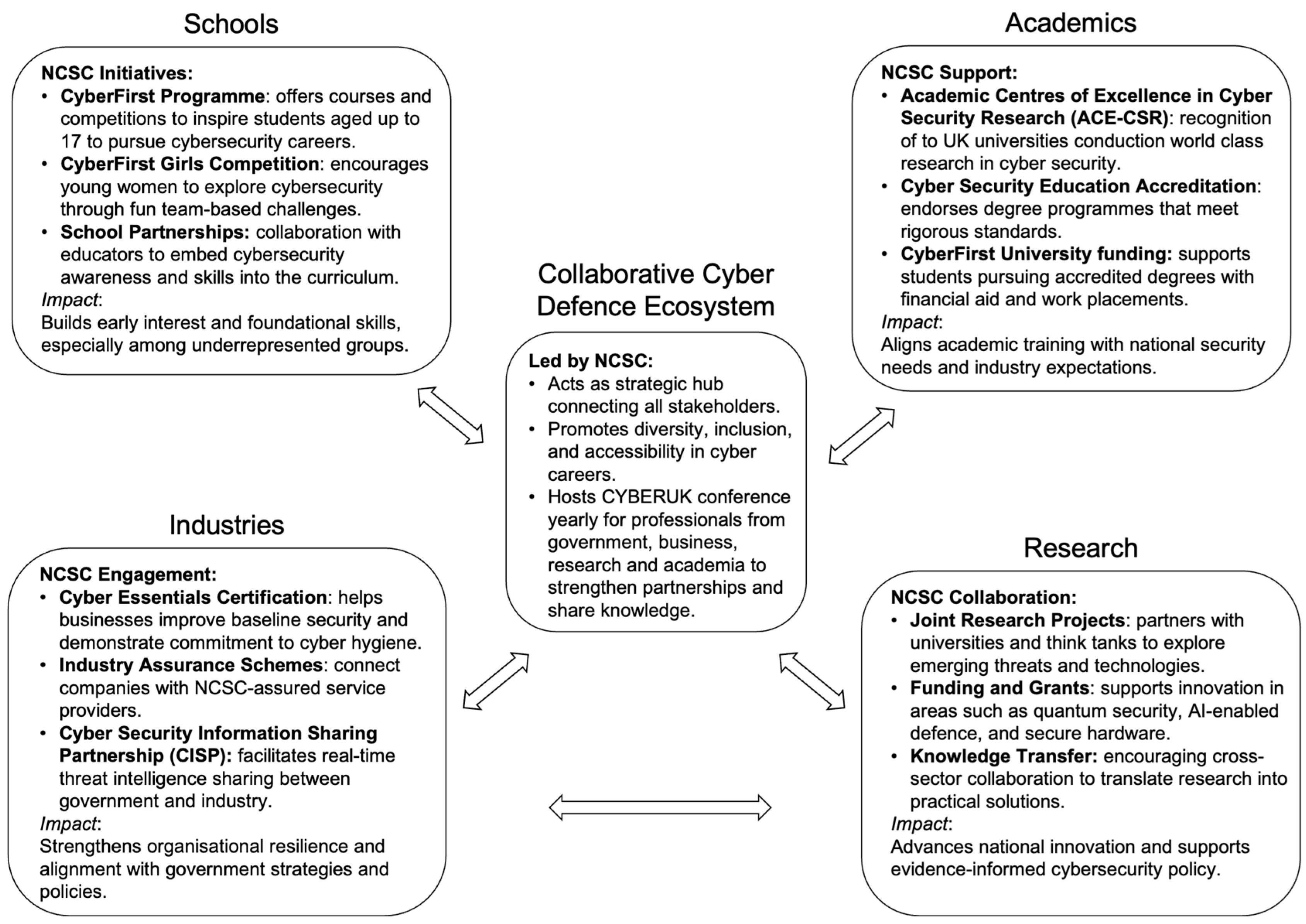


| Sectors | NCSC Initiatives | Impact |
|---|---|---|
| Schools | CyberFirst, Girls Competition | Early Engagement, Diversity |
| Academics | ACE-CSR, Certified Degrees | Quality Assurance, Research Excellence |
| Industries | Cyber Essentials, CISP | Business Resilience, Threat Sharing |
| Research | Institutes, Transfer projects | Innovation, Academia–Industry Fusion |
| Cyber Defence Ecosystem | CYBERUK Events & Conference | Coordination, Inclusion, & Dissemination |
| Cybersecurity Skill Area | Lithuania (%) | EU Average (%) |
|---|---|---|
| Incident Response | 68 | 51 |
| Cloud Security | 62 | 44 |
| Threat Intelligence | 55 | 39 |
| Policy & Compliance | 48 | 33 |
| Policy Dimension | UK Cybersecurity Skills Strategy [39,40] | European Network of Cybersecurity Skills Hubs (CyberHubs) [29] | Lithuanian CyberHubs National Strategy [10] | Lithuanian National Policies & Programmes [41,42] |
|---|---|---|---|---|
| Strategic Scope | Embedded in the National Cyber Strategy, covers the entire talent pipeline, addressing skills gap, professional excellence, and cyber hygiene across all sectors. | Collaborative network of 7 national cybersecurity skills hubs bringing talent gap, enhance professional training, & foster innovation. | Building highly skilled, adaptable cybersecurity workforce, integrating ENISA’s ECSF roles (e.g., CISO) | National Digital Decade roadmap sets broad digital skills goals; National Coordination Centre (NCC) coordinates cybersecurity ecosystem under EU competence frameworks. |
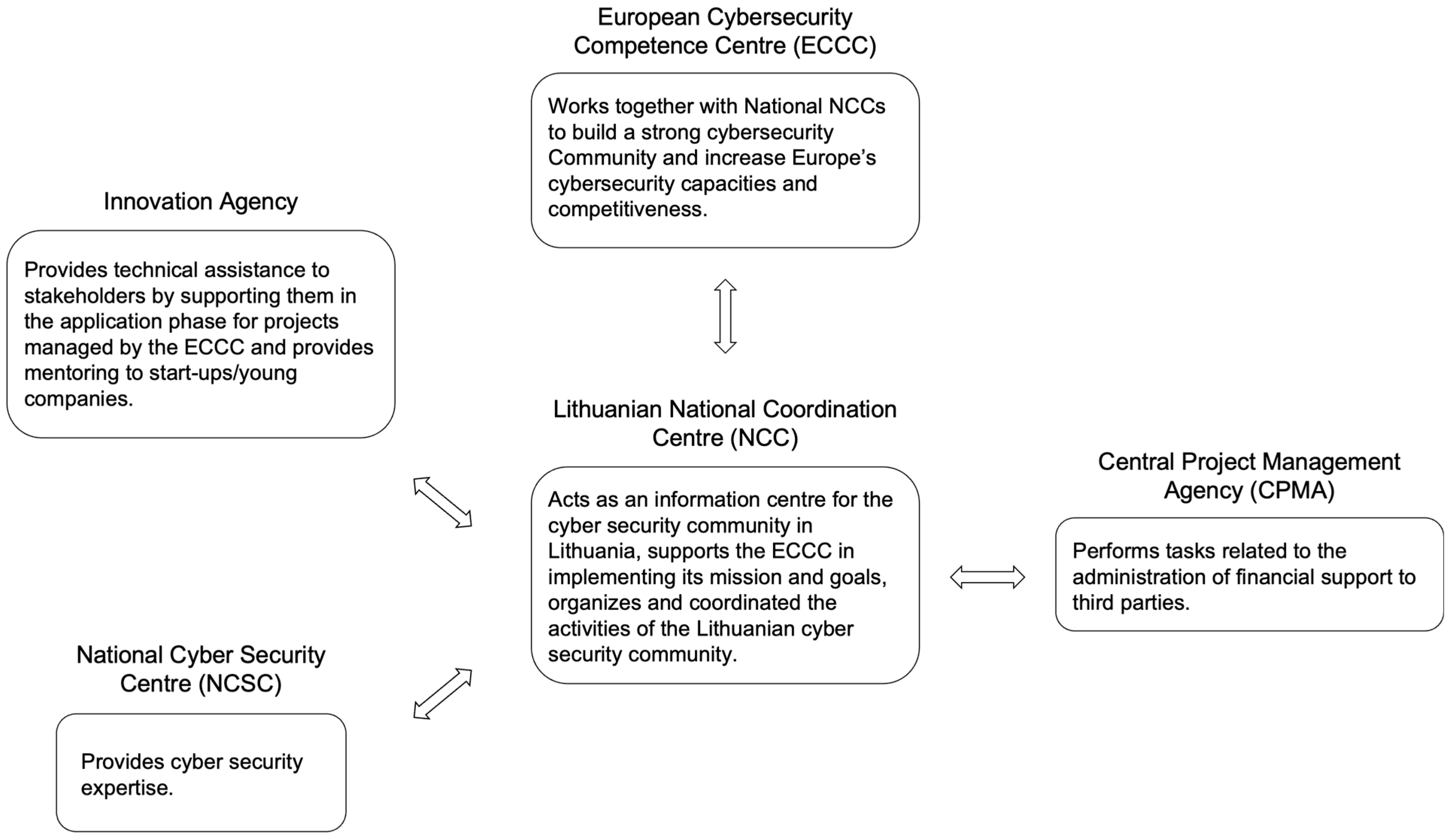
| Governance & Institutional Mechanisms | UK Cyber Security Council provides ongoing professional coordination; UK NCSC runs training assurance & partner programmes. | Project-based network with stakeholder coordination, establishing collaborative hubs nationwide. | Involves national stakeholders (industry, academia, public sector) & works with National Cybersecurity Centre (NCSC) to align strategy (local governance and action planning). | The Ministry of National Defence’s NCC, organizes and coordinates activities of the cybersecurity community with EU frameworks. Coordinates work with Innovation Agency Lithuania, NCSC, & Central Project Management Agency (CPMA) |
| Profession & Career Pathways | Comprehensive career frameworks with defined roles, competencies, & professional standards for cybersecurity careers. | Provides skills gap analyses & recommendations, but no formal career/professional registers. | Identify the need for versatile specialists (skill on at least 3 ENISA’s ECSF roles) & emphasises collaboration to tailor training. No formal unified career framework is yet available. | Current national policies do not yet provide detailed professional pathways; emphasis remains on ICT skills improvement and ecosystem coordination. |
| Education & Training Quality Assurance (QA) | UK’s NCSC Assured Training benchmarks training quality to ensure relevance to market and regulatory needs. | Recommends stronger coordination between education, industry & government but does not establish national QA schemes itself. | Calls for modernised training programmes & practical skills development with international certification opportunities but lacks national assurance mechanisms. | National education policies support general digital skills development but lack specific assurance frameworks for cybersecurity training quality as per industry requirements. |
| Labour Market & Industry Alignment | Focus on aligning skills with employer needs and labour market demand, bridging education outputs with workplace roles. Yet skills shortages & recruitment issues persist. | Include recommendations to involve industry and close skills gaps, but implementation mechanisms remain largely voluntary. | Highlights employer demand for diverse competencies (technical & non-technical), emphasising collaboration to improve training relevance. | National labour and digital policies acknowledge shortages in cybersecurity specialists and aim to integrate skills development programs, but actionable measures are emerging. |
| SME & Broader Workforce Focus | UK standards and frameworks assist SMEs in recognising skills and training requirements, improving hiring process and compliance readiness. | EU strategies recognise SME involvement but lack direct incentives or simplified tools targeted specifically at SME constraints. | Acknowledges SMEs’ needs implicitly via training & awareness actions but does not yet provide dedicated SME-oriented mechanisms. | National ecosystem initiatives support SMEs’ cybersecurity needs, but programmes are at an early stage of development. |
| EU Regulatory Alignment (e.g., NIS2/ENISA) | As post-Brexit (in 2020), the strategy does not directly address EU programs/regulations, but aligns with best practices and global standards, where NIS2 & ENISA principles might be indirectly addressed. | Explicitly designed for EU alignment with NIS2 & ENISA’s ECSF coordinated frameworks across Member States. | Explicitly integrates NIS2 & ENISA role expectations into competency gap analysis and training priorities. | National digital and cybersecurity policies are framed within EU Digital Decade and NIS2 regulatory frameworks, emphasizing compliance and ecosystem readiness. |
| Long-Term Continuity | Institutionalised bodies (Cyber Security Council, NCSC programmes) ensure continuous policy updates and implementation beyond project cycles. | Funded as a time-limited Erasmus+ project; long-term sustainability depends on national adoption beyond April 2027. | Needs national institutionalisation to ensure sustainability beyond the project timeframe; current strategy establishes foundations but not permanent structures. | National programmes such as NCC and Digital Decade commitments provide some continuity, but cybersecurity skills governance is still underdeveloped. |
| Level | Name | Description |
|---|---|---|
| 5 | Expert | Advises others, handles complex scenarios |
| 4 | Advanced | Operates independently in difficult situations |
| 3 | Intermediate | Requires occasional guidance |
| 2 | Basic | Needs frequent guidance |
| 1 | Awareness | Requires close supervision |
Disclaimer/Publisher’s Note: The statements, opinions and data contained in all publications are solely those of the individual author(s) and contributor(s) and not of MDPI and/or the editor(s). MDPI and/or the editor(s) disclaim responsibility for any injury to people or property resulting from any ideas, methods, instructions or products referred to in the content. |
© 2026 by the authors. Licensee MDPI, Basel, Switzerland. This article is an open access article distributed under the terms and conditions of the Creative Commons Attribution (CC BY) license.
Share and Cite
Campbell, C.; Jofre, S.; Sabaliauskaite, G.; Obonyo, C.; Haughton, O. Addressing the Cybersecurity Skills Shortage in Lithuania: Policy Insights from the United Kingdom. J. Cybersecur. Priv. 2026, 6, 29. https://doi.org/10.3390/jcp6010029
Campbell C, Jofre S, Sabaliauskaite G, Obonyo C, Haughton O. Addressing the Cybersecurity Skills Shortage in Lithuania: Policy Insights from the United Kingdom. Journal of Cybersecurity and Privacy. 2026; 6(1):29. https://doi.org/10.3390/jcp6010029
Chicago/Turabian StyleCampbell, Carlene, Sergio Jofre, Giedre Sabaliauskaite, Carolyne Obonyo, and Odayne Haughton. 2026. "Addressing the Cybersecurity Skills Shortage in Lithuania: Policy Insights from the United Kingdom" Journal of Cybersecurity and Privacy 6, no. 1: 29. https://doi.org/10.3390/jcp6010029
APA StyleCampbell, C., Jofre, S., Sabaliauskaite, G., Obonyo, C., & Haughton, O. (2026). Addressing the Cybersecurity Skills Shortage in Lithuania: Policy Insights from the United Kingdom. Journal of Cybersecurity and Privacy, 6(1), 29. https://doi.org/10.3390/jcp6010029