
Volcanic Hazard Assessment of a Monogenetic Volcanic Field with Sporadic and Limited Information: Deterministic Approach for Harrat Lunayyir, Saudi Arabia

 ,
,
Abstract
1. Introduction

2. Materials and Methods
3. Results
3.1. Field Observations
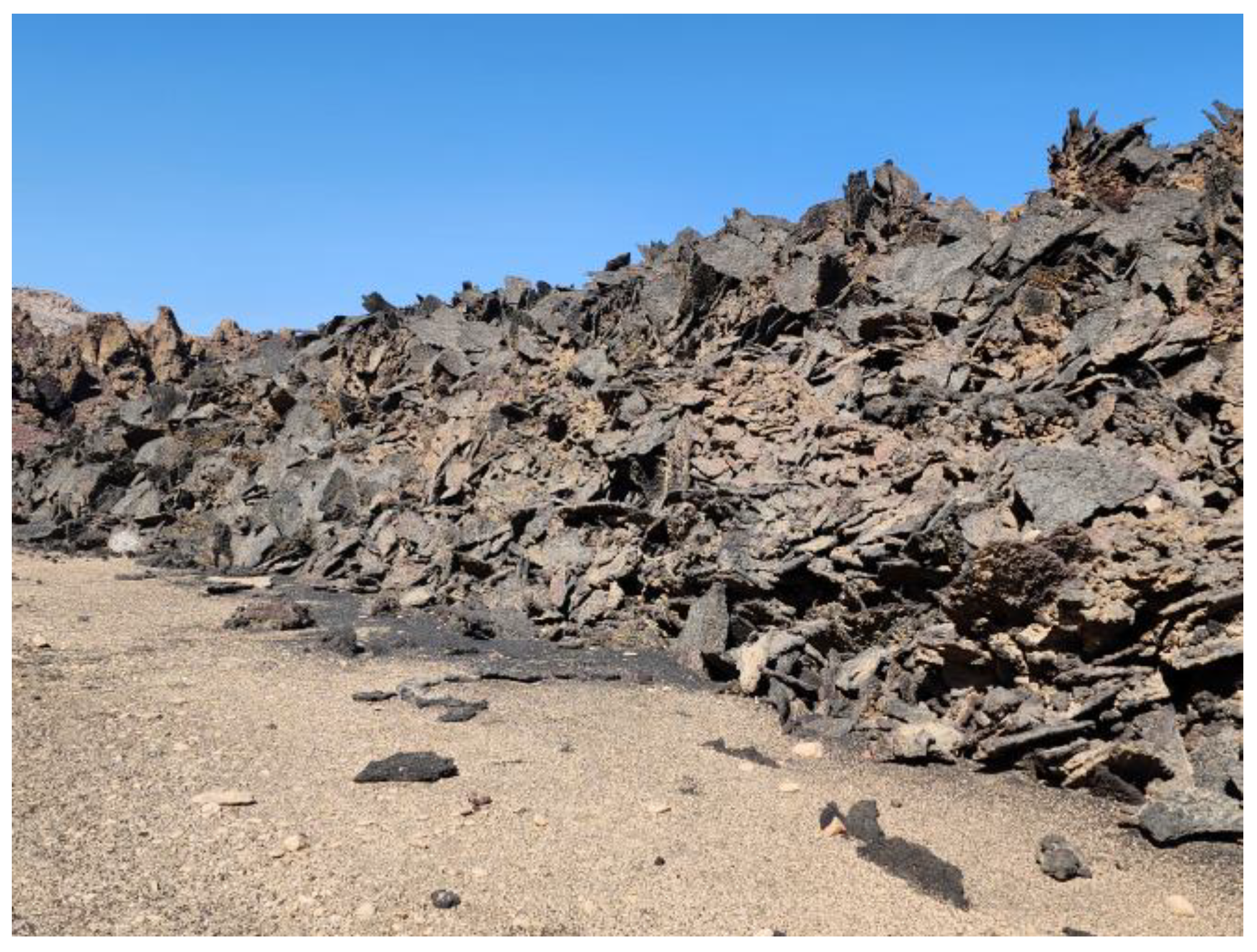
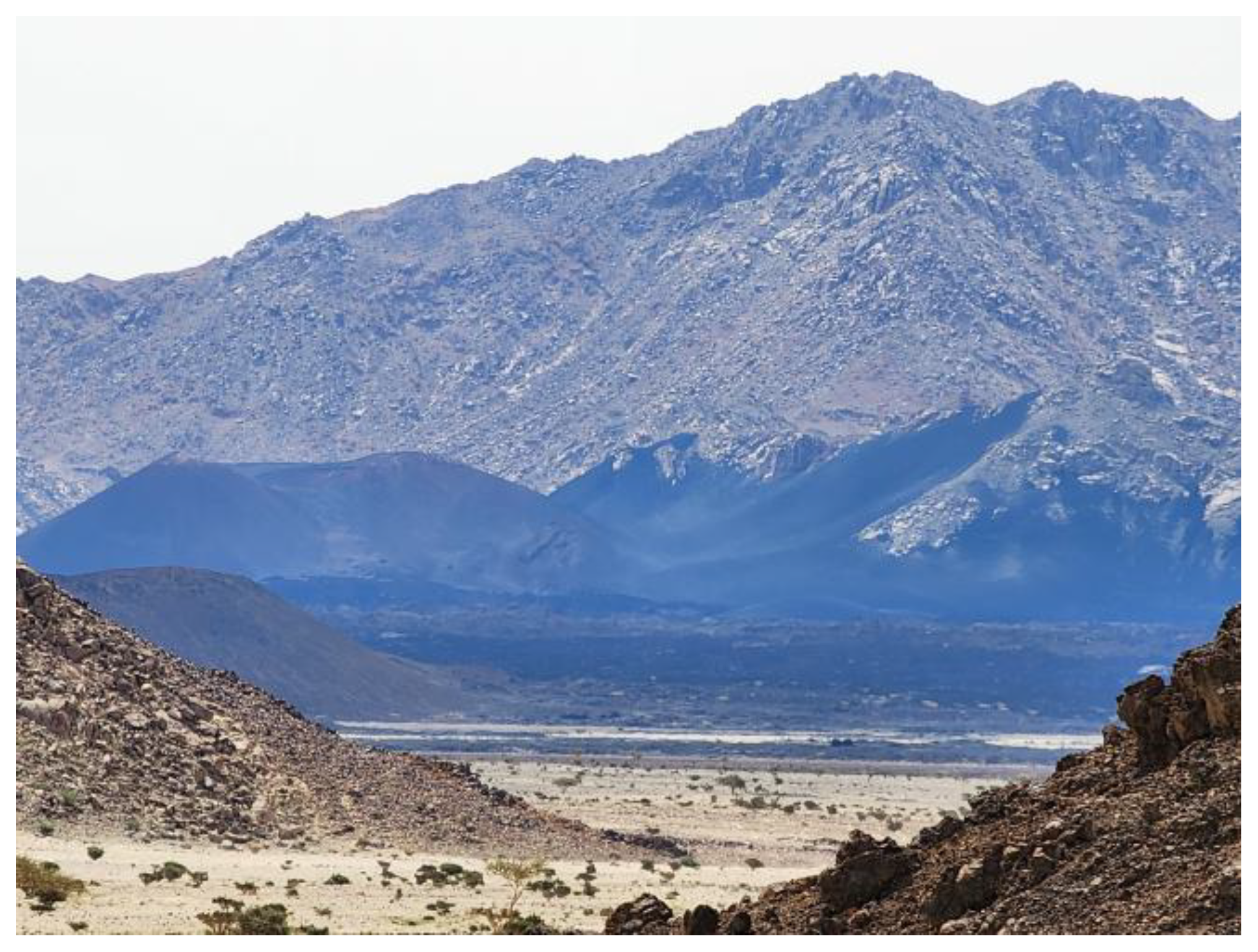
3.1.1. Spatter and Scoria Cones
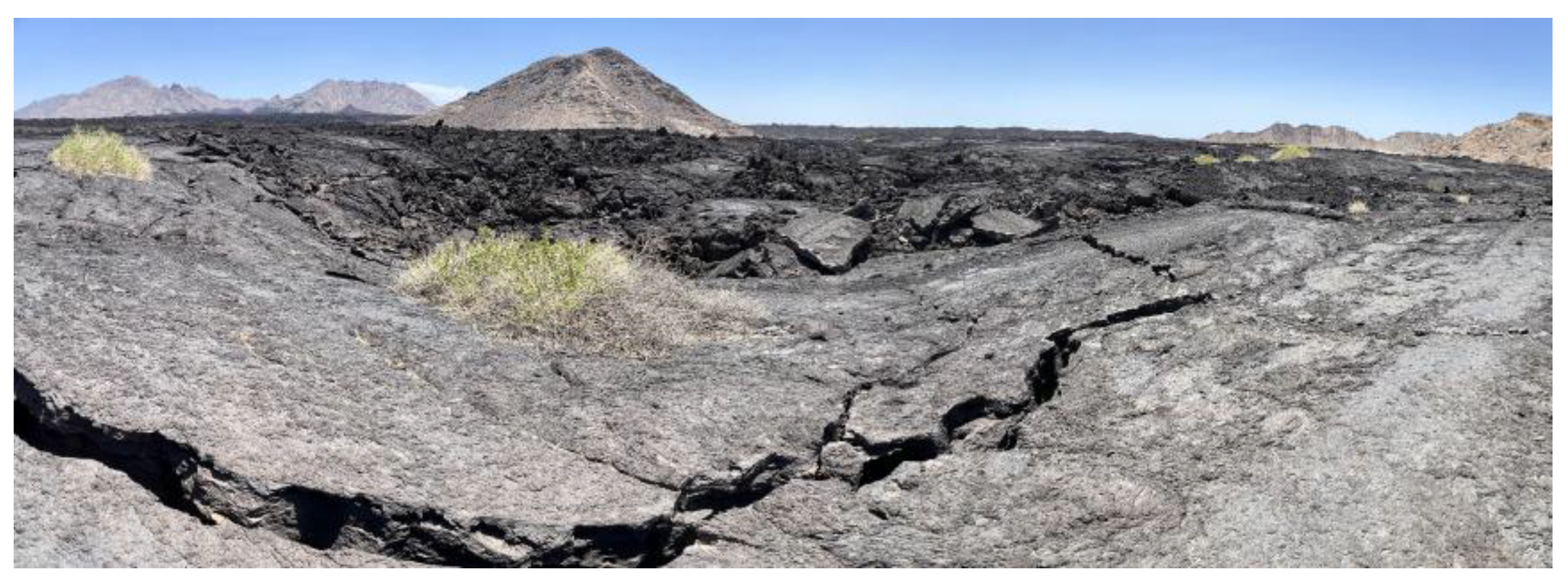
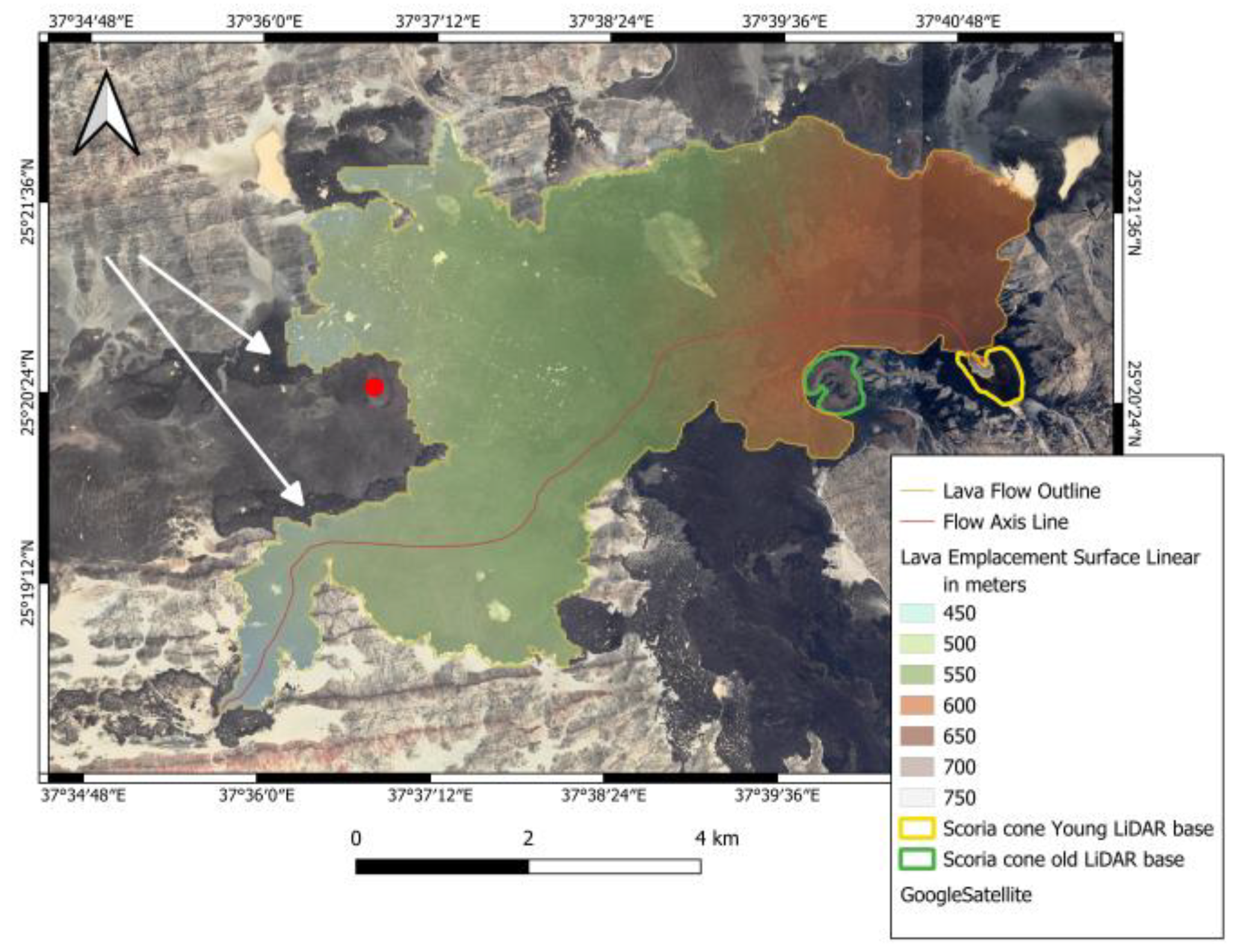
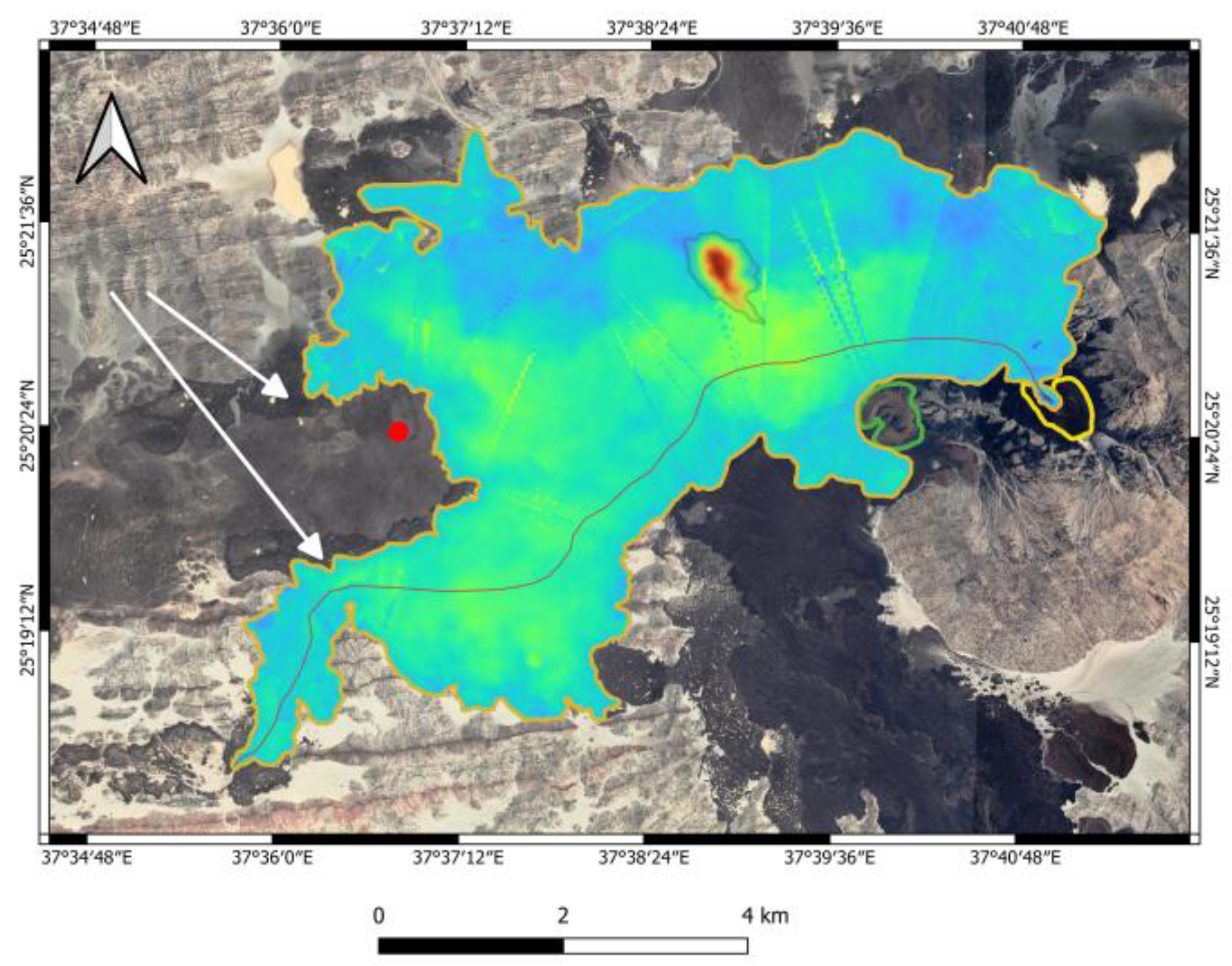
3.1.2. Lava Flows
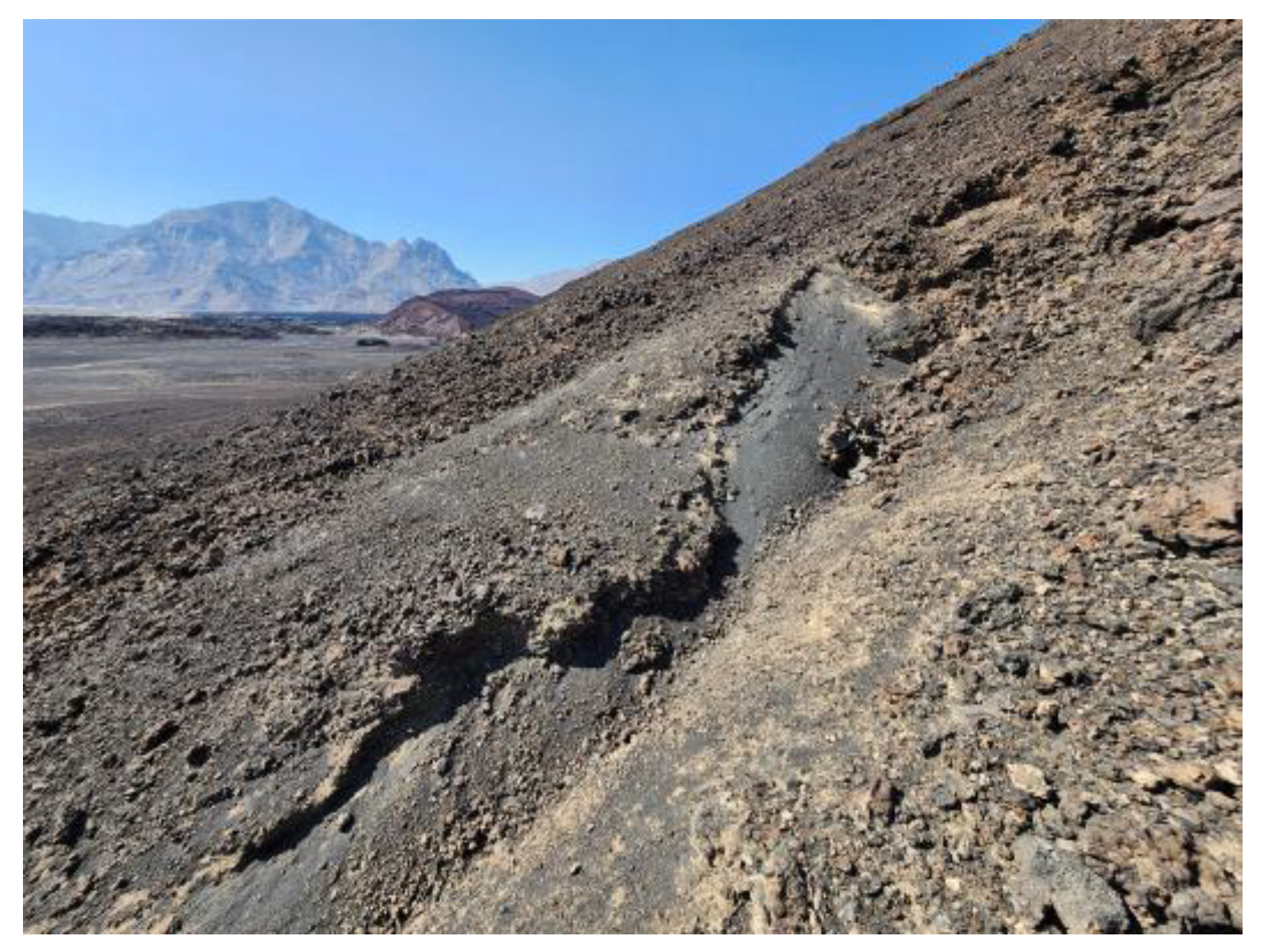
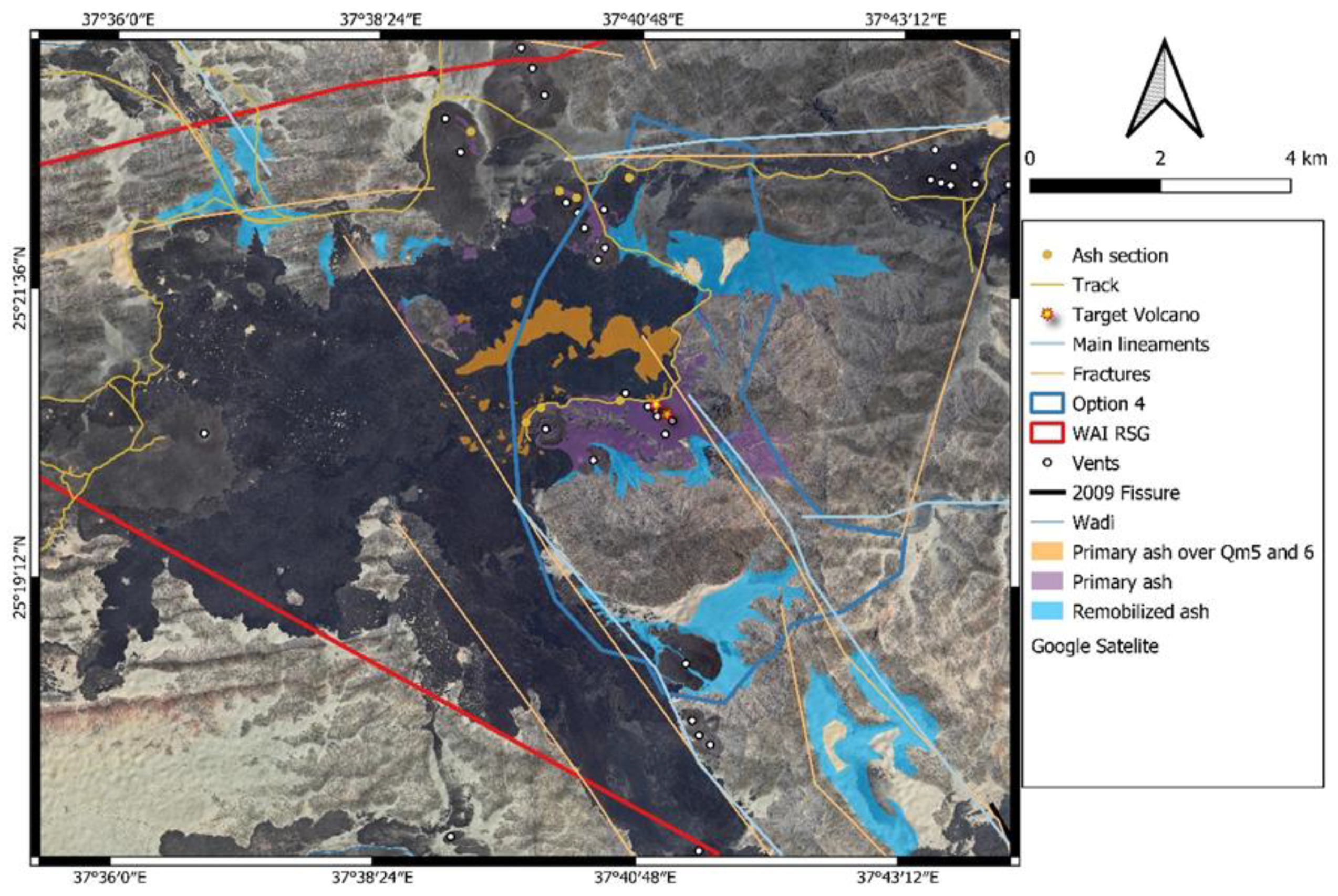
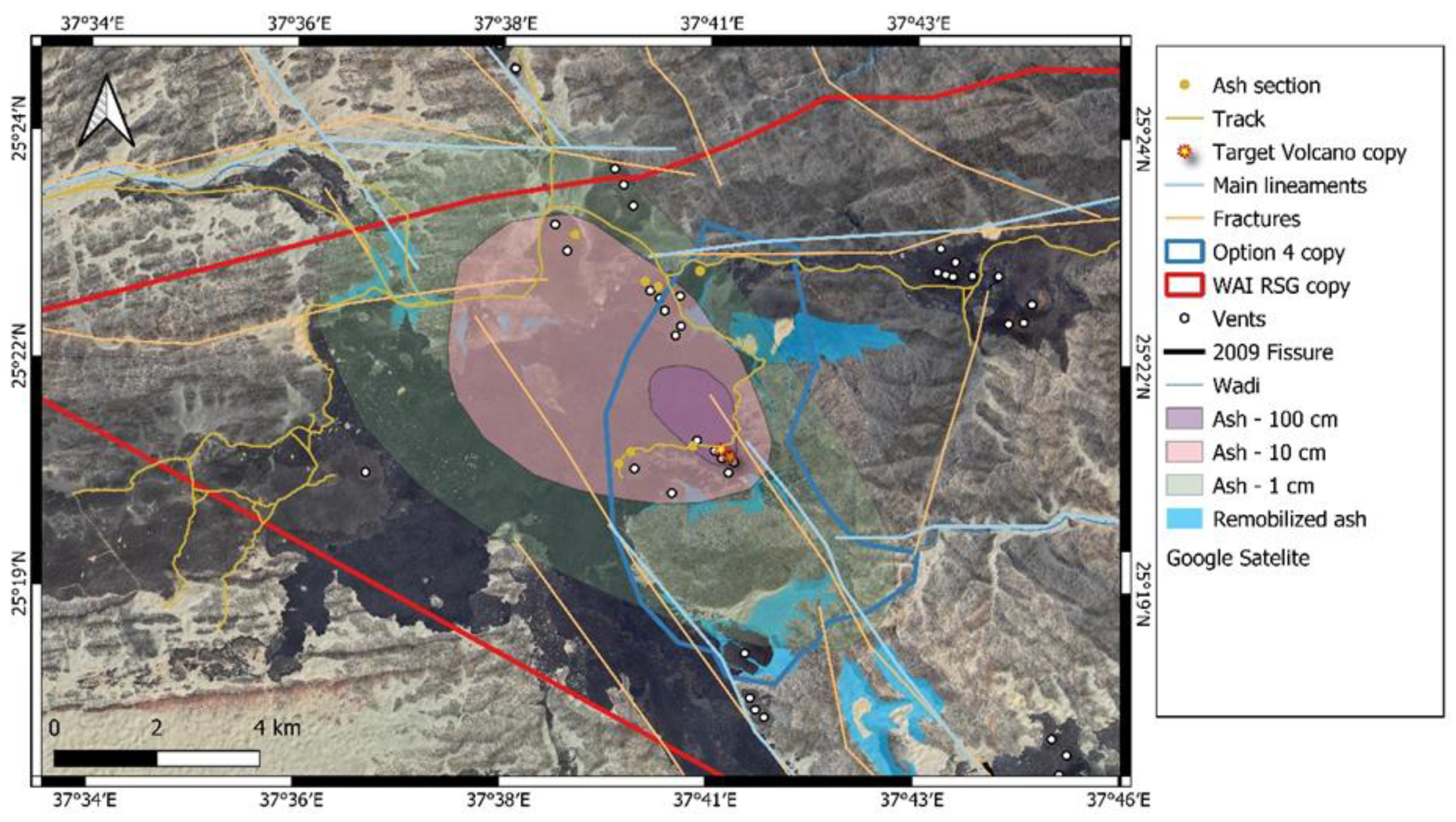
3.1.3. Ash Plains
3.2. Volcanic Hazard Types
- (1)
- Pāhoehoe lava flow outpouring;
- (2)
- Transitional lava flow outpouring;
- (3)
- Lava spatter cone formation and lava fountaining;
- (4)
- Scoria (cinder) cone birth and growth;
- (5)
- Ballistic impact;
- (6)
- Cone collapse and cone rafting;
- (7)
- Sub-Plinian explosive eruption and associated ash fall;
- (8)
- Volcanic degassing and vog formation.
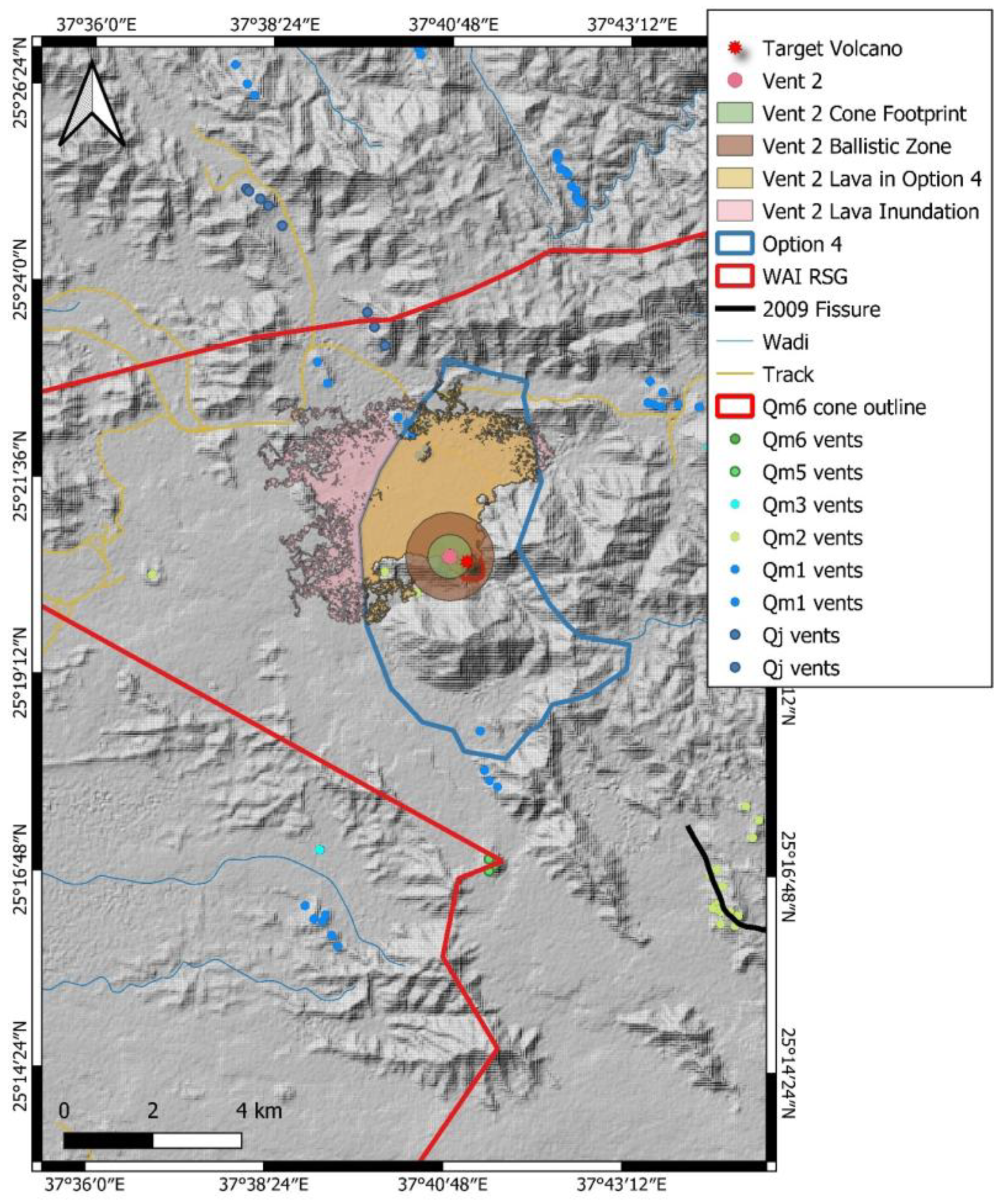
3.3. Eruption Scenario Simulations
3.4. Lava Flow Volume Estimate
3.5. Ash Fall Hazards

4. Discussion
5. Conclusions
Supplementary Materials
Author Contributions
Funding
Data Availability Statement
Acknowledgments
Conflicts of Interest
References
- Németh, K. Monogenetic volcanic fields: Origin, sedimentary record, and relationship with polygenetic volcanism. Spec. Pap. Geol. Soc. Am. 2010, 470, 43–66. [Google Scholar] [CrossRef]
- Smith, I.E.M.; Németh, K. Source to surface model of monogenetic volcanism: A critical review. In Geological Society Special Publication; Geological Society Publishing House: Bath, UK, 2017; Volume 446, pp. 1–28. [Google Scholar]
- Németh, K.; Kereszturi, G. Monogenetic volcanism: Personal views and discussion. Int. J. Earth Sci. 2015, 104, 2131–2146. [Google Scholar] [CrossRef]
- Kshirsagar, P.; Aviles, R.M.; de Puy y Alquiza, M.J.; Chako Tchamabe, B.; Dominguez, A.J.C. Case study of a cluster of simple and complex monogenetic volcanoes in the north-east part of the Michoacan–Guanajuato Volcanic Field, Central Mexico: Nomenclature implications. Geol. J. 2024, 59, 2750–2771. [Google Scholar] [CrossRef]
- Chako Tchamabe, B.; Youmen, D.; Owona, S.; Ohba, T.; Németh, K.; Ngapna, M.N.; Asaah, A.N.E.; Aka, F.T.; Tanyileke, G.; Hell, J.V. Eruptive history of the Barombi Mbo Maar, Cameroon volcanic line, Central Africa: Constraints from volcanic facies analysis. Cent. Eur. J. Geosci. 2013, 5, 480–496. [Google Scholar] [CrossRef]
- Le Corvec, N.; Bebbington, M.S.; Lindsay, J.M.; McGee, L.E. Age, distance, and geochemical evolution within a monogenetic volcanic field: Analyzing patterns in the Auckland Volcanic Field eruption sequence. Geochem. Geophys. Geosyst 2013, 14, 3648–3665. [Google Scholar] [CrossRef]
- Le Corvec, N.; Spörli, K.B.; Rowland, J.; Lindsay, J. Spatial distribution and alignments of volcanic centers: Clues to the formation of monogenetic volcanic fields. Earth-Sci. Rev. 2013, 124, 96–114. [Google Scholar] [CrossRef]
- Martí, J.; Ricci, J.; Planagumà, L.; Aguirre-Díaz, G.J. The Quaternary La Garrotxa volcanic field (NE of Iberia): A geochronological approach. Quat. Sci. Adv. 2025, 17, 100267. [Google Scholar] [CrossRef]
- Zimmerer, M.J. A temporal dissection of late Quaternary volcanism and related hazards within the Rio Grande rift and along the Jemez lineament of New Mexico, USA. Geosphere 2024, 20, 505–546. [Google Scholar] [CrossRef]
- Zarazúa-Carbajal, M.C.; Mendoza-Rosas, A.T.; Caballero-Jiménez, G.V.; Gómez-Vázquez, Á.; De la Cruz-Reyna, S. The spatiotemporal evolution of monogenetic scoria cones in the Paricutin-Tancítaro region, Mexico: Results from a Morpho-chronological analysis and its consequences on the distributed volcanic hazard. J. Volcanol. Geotherm. Res. 2024, 451, 108111. [Google Scholar] [CrossRef]
- Vilches, M.; Ureta, G.; Grosse, P.; Németh, K.; Aguilera, F.; Aguilera, M. Effusion rate estimation based on solidified lava flows: Implications for volcanic hazard assessment in the Negros de Aras monogenetic volcanic field, northern Chile. J. Volcanol. Geotherm. Res. 2022, 422, 107454. [Google Scholar] [CrossRef]
- Schmidt, C.; Laag, C.; Whitehead, M.; Profe, J.; Tongwa Aka, F.; Hasegawa, T.; Kereszturi, G. The complexities of assessing volcanic hazards along the Cameroon Volcanic Line using spatial distribution of monogenetic volcanoes. J. Volcanol. Geotherm. Res. 2022, 427, 107558. [Google Scholar] [CrossRef]
- Foote, A.; Németh, K.; Handley, H. The interplay between environmental and magmatic conditions in eruption style transitions within a fissure-aligned monogenetic volcanic system of Auckland, New Zealand. J. Volcanol. Geotherm. Res. 2022, 431, 107652. [Google Scholar] [CrossRef]
- Meliksetian, K.; Neill, I.; Barfod, D.N.; Milne, E.J.M.; Waters, E.C.; Navasardyan, G.; Grigoryan, E.; Olive, V.; Odling, N.; Karakhanian, A. Pleistocene—Holocene volcanism at the Karkar geothermal prospect, Armenia. Quat. Geochronol. 2021, 66, 101201. [Google Scholar] [CrossRef]
- Pedrazzi, D.; Kereszturi, G.; Lobo, A.; Geyer, A.; Calle, J. Geomorphology of the post-caldera monogenetic volcanoes at Deception Island, Antarctica—Implications for landform recognition and volcanic hazard assessment. J. Volcanol. Geotherm. Res. 2020, 402, 106986. [Google Scholar] [CrossRef]
- Ang, P.S.; Bebbington, M.S.; Lindsay, J.M.; Jenkins, S.F. From eruption scenarios to probabilistic volcanic hazard analysis: An example of the Auckland Volcanic Field, New Zealand. J. Volcanol. Geotherm. Res. 2020, 397, 106871. [Google Scholar] [CrossRef]
- Nieto-Torres, A.N.; Martin-Del-Pozzo, A.L. Spatio-temporal hazard assessment of a monogenetic volcanic field, near Mexico City. J. Volcanol. Geotherm. Res. 2019, 371, 46–58. [Google Scholar] [CrossRef]
- Marrero, J.M.; García, A.; Berrocoso, M.; Llinares, Á.; Rodríguez-Losada, A.; Ortiz, R. Strategies for the development of volcanic hazard maps in monogenetic volcanic fields: The example of la Palma (Canary Islands). J. Appl. Volcanol. 2019, 8, 6. [Google Scholar] [CrossRef]
- Osorio-Ocampo, S.; Macías-Vázquez, J.L.; Pola, A.; Cardona-Melchor, S.; Sosa-Ceballos, G.; Garduño-Monroy, V.H.; Layer, P.; García-Sánchez, L.; Perton, M.; Benowitz, J. The eruptive history of the Pátzcuaro Lake area in the Michoacán Guanajuato Volcanic Field, central México: Field mapping, C-14 and 40Ar/39Ar geochronology. J. Volcanol. Geotherm. Res. 2018, 358, 307–328. [Google Scholar] [CrossRef]
- Kereszturi, G.; Bebbington, M.; Németh, K. Forecasting transitions in monogenetic eruptions using the geologic record. Geology 2017, 45, 283–286. [Google Scholar] [CrossRef]
- Bebbington, M.S. Assessing spatio-temporal eruption forecasts in a monogenetic volcanic field. J. Volcanol. Geotherm. Res. 2013, 252, 14–28. [Google Scholar] [CrossRef]
- Cronin, S.J.; Neall, V.E. Impacts of volcanism on pre-European inhabitants of Taveuni, Fiji. Bull. Volcanol. 2000, 62, 199–213. [Google Scholar] [CrossRef]
- Filippi, L.D.; Mazzetto, S. Comparing AlUla and The Red Sea Saudi Arabia’s Giga Projects on Tourism towards a Sustainable Change in Destination Development. Sustainability 2024, 16, 2117. [Google Scholar] [CrossRef]
- Amal, M.O.T.; Sahide, A.; Bustami, M.R. Saudi arabia’s diversification strategy through the red sea project in facing the international petroleum competition. Jurisdictie J. Huk. Syariah 2024, 15, 380–411. [Google Scholar] [CrossRef]
- Robitzch, V.; Kattan, A.; Dunne, A.; Coker, D.J. Saudi Arabia Case Study: The Development of Saudi Arabia’s Red Sea Coastline: Challenges Facing Sustainable Resource Use; Springer Nature: Berlin/Heidelberg, Germany, 2023; pp. 73–93. [Google Scholar]
- Alyusuf, A. Sustainable tourism development in the red sea of the kingdom of Saudi Arabia: Threats and opportunities. In Proceedings of the International Conference on Tourism Research, Lisbon, Portugal, 20–21 May 2021; pp. 36–43. [Google Scholar]
- Németh, K.; Toni, M.; Sokolov, V.; Sowaigh, A.; Ashor, M.; Moqeem, F. Eruption Scenarios of a Monogenetic Volcanic Field Formed Within a Structurally Controlled Basement Terrain: Harrat Lunayyir, Saudi Arabia. In A Comprehensive Study of Volcanic Phenomena; Németh, K., Ed.; IntechOpen: Rijeka, Croatia, 2024. [Google Scholar]
- Németh, K.; Sowaigh, A.; Toni, M.; Sokolov, V.; Moqeem, F. Volcanic hazard assessment of northern Harrat Lunayyir, Kingdom of Saudi Arabia: Volume 5 of 5. In Saudi Geological Survey Project Contract Report; Saudi Geological Survey (SGS): Jeddah, Saudi Arabia, 2025; Volume 5, p. 68. [Google Scholar]
- Pallister, J.S.; McCausland, W.A.; Jónsson, S.; Lu, Z.; Zahran, H.M.; El Hadidy, S.; Aburukbah, A.; Stewart, I.C.F.; Lundgren, P.R.; White, R.A.; et al. Broad accommodation of rift-related extension recorded by dyke intrusion in Saudi Arabia. Nat. Geosci. 2010, 3, 705–712. [Google Scholar] [CrossRef]
- Mukhopadhyay, B.; Mogren, S.; Mukhopadhyay, M.; Dasgupta, S. Incipient status of dyke intrusion in top crust—Evidences from the Al-Ays 2009 earthquake swarm, Harrat Lunayyir, SW Saudi Arabia. Geomat. Nat. Hazards Risk 2013, 4, 30–48. [Google Scholar] [CrossRef]
- Zahran, H.M.; El-Hady, S.M. Seismic hazard assessment for Harrat Lunayyir—A lava field in western Saudi Arabia. Soil Dyn. Earthq. Eng. 2017, 100, 428–444. [Google Scholar] [CrossRef]
- Zahran, H.M.; El-Hady, S.M.; Abuelnaga, H.S. Aeromagnetic data over Harrat Lunayyir and surrounding areas, western Saudi Arabia. Arab. J. Geosci. 2017, 10, 63. [Google Scholar] [CrossRef]
- Al Shehri, A.; Gudmundsson, A. Thermal mapping of the 2009 dyke emplacement at Harrat Lunayyir, Saudi Arabia. Arab. J. Geosci. 2019, 12, 602. [Google Scholar] [CrossRef]
- Saibi, H.; Mogren, S.; Mukhopadhyay, M.; Ibrahim, E. Subsurface imaging of the Harrat Lunayyir 2007–2009 earthquake swarm zone, western Saudi Arabia, using potential field methods. J. Asian Earth Sci. 2019, 169, 79–92. [Google Scholar] [CrossRef]
- Mossoux, S.; Saey, M.; Bartolini, S.; Poppe, S.; Canters, F.; Kervyn, M. Q-LAVHA: A flexible GIS plugin to simulate lava flows. Comput. Geosci. 2016, 97, 98–109. [Google Scholar] [CrossRef]
- Becerril, L.; Larrea, P.; Salinas, S.; Mossoux, S.; Ferrés, D.; Widom, E.; Siebe, C.; Martí, J. The historical case of Paricutin volcano (Michoacán, Mexico): Challenges of simulating lava flows on a gentle slope during a long-lasting eruption. Nat. Hazards 2021, 107, 809–829. [Google Scholar] [CrossRef]
- Németh, K.; Moufti, M.R. Lava Flow Hazard and Its Implication in Geopark Development for the Active Harrat Khaybar Intracontinental Monogenetic Volcanic Field, Saudi Arabia. Land 2023, 12, 705. [Google Scholar] [CrossRef]
- Rodriguez-Gonzalez, A.; Aulinas, M.; Mossoux, S.; Perez-Torrado, F.J.; Fernandez-Turiel, J.L.; Moreno-Medina, C. Lava flow modelling of Pico de Bandama volcano (Gran Canaria, Canary Islands). Geogaceta 2019, 65, 19–22. [Google Scholar]
- Prieto-Torrell, C.; Rodriguez-Gonzalez, A.; Aulinas, M.; Fernandez-Turiel, J.L.; Cabrera, M.; Criado-Hernandez, C.; Perez-Torrado, F.J. Modelling and simulation of a lava flow affecting a shore platform: A case study of Montaña de Aguarijo eruption, El Hierro (Canary Islands, Spain). J. Maps 2021, 17, 502–511. [Google Scholar] [CrossRef]
- Ramayanti, S.; Achmad, A.R.; Jung, H.C.; Jo, M.J.; Kim, S.W.; Park, Y.C.; Lee, C.W. Measurement of surface deformation related to the December 2018 Mt. Etna eruption using time-series interferometry and magma modeling for hazard zone mapping. Geosci. J. 2022, 26, 749–765. [Google Scholar] [CrossRef]
- Martín-Raya, N.; Díaz-Pacheco, J.; López-Díez, A.; Dorta Antequera, P.; Cabrera, A. A lava flow simulation experience oriented to disaster risk reduction, early warning systems and response during the 2021 volcanic eruption in Cumbre Vieja, La Palma. Nat. Hazards 2023, 117, 3331–3351. [Google Scholar] [CrossRef]
- Chiba, T.; Kaneta, S.; Suzuki, Y. Red relief image map: New visualization method for three dimensional data. Int. Arch. Photogramm. Remote Sens. Spat. Inf. Sci. 2008, 37, 1071–1076. [Google Scholar]
- Chiba, T.; Kaneta, S.; Ohashi, M. Digital Terrain Representation Methods and Red Relief Image Map, a New Visualization Approach. In Proceedings of the International Cartographic Association, 29th International Cartographic Conference (ICC 2019), Tokyo, Japan, 15–20 July 2019; Volume 2. [Google Scholar] [CrossRef]
- Gałaś, A.; Lewińska, P.; Aguilar, R.; Nowak, Ł. Remote sensing data applied to the reconstruction of volcanic activity in the Valley of the Volcanoes, Central Volcanic Zone, Peru. J. Geodyn. 2023, 156, 101972. [Google Scholar] [CrossRef]
- Ulusoy, İ.; Diker, C.; Şen, E.; Aydın, E.; Akkaş, E.; Gümüş, E.; Çubukçu, H.E.; Erkut, V. Surface expressions of morphostructural features at Hasandağ stratovolcano on DEM datasets. Mediterr. Geosci. Rev. 2021, 3, 175–191. [Google Scholar] [CrossRef]
- Karátson, D.; Yepes, J.; Favalli, M.; Rodríguez-Peces, M.J.; Fornaciai, A. Reconstructing eroded paleovolcanoes on Gran Canaria, Canary Islands, using advanced geomorphometry. Geomorphology 2016, 253, 123–134. [Google Scholar] [CrossRef]
- Favalli, M.; Fornaciai, A. Visualization and comparison of DEM-derived parameters. Application to volcanic areas. Geomorphology 2017, 290, 69–84. [Google Scholar] [CrossRef]
- Özpolat, E.; Yildirim, C.; Görüm, T. The Quaternary landforms of the Büyük Menderes Graben System: The southern Menderes Massif, western Anatolia, Turkey. J. Maps 2020, 16, 405–419. [Google Scholar] [CrossRef]
- Giordano, G.; Cas, R.; Wright, J.V. Explosive Eruption Styles, Columns, and Pyroclastic Fallout Deposits. In Volcanology: Processes, Deposits, Geology and Resources; Cas, R., Giordano, G., Wright, J.V., Eds.; Springer International Publishing: Cham, Switzerland, 2024; pp. 519–691. [Google Scholar]
- Taddeucci, J.; Edmonds, M.; Houghton, B.; James, M.R.; Vergniolle, S. Chapter 27—Hawaiian and Strombolian Eruptions. In The Encyclopedia of Volcanoes, 2nd ed.; Sigurdsson, H., Ed.; Academic Press: Amsterdam, The Netherlands, 2015; pp. 485–503. [Google Scholar]
- Houghton, B.F.; Wilson, C.J.N.; Smith, I.E.M. Shallow-seated controls on styles of explosive basaltic volcanism: A case study from New Zealand. J. Volcanol. Geotherm. Res. 1999, 91, 97–120. [Google Scholar] [CrossRef]
- Houghton, B.F.; Gonnermann, H.M. Basaltic explosive volcanism: Constraints from deposits and models. Geochemistry 2008, 68, 117–140. [Google Scholar] [CrossRef]
- Németh, K.; Kereszturi, G. Monogenetic Basaltic Volcanoes: Genetic Classification, Growth, Geomorphology and Degradation. In Updates in Volcanology—New Advances in Understanding Volcanic Systems; Németh, K., Ed.; IntechOpen: London, UK, 2012. [Google Scholar]
- Cas, R.; Wright, J.V.; Giordano, G. Basaltic and Other Low-Viscosity Lavas. In Volcanology: Processes, Deposits, Geology and Resources; Cas, R., Giordano, G., Wright, J.V., Eds.; Springer International Publishing: Cham, Switzerland, 2024; pp. 229–309. [Google Scholar]
- Harris, A.; Latutrie, B.; Van Wyk de Vries, B.; Saubin, É.; Foucher, M.; Gurioli, L.; Zanella, E.; Médard, E.; Nauret, F. Emplacement of monogenetic lava flows on eroded terrain, Part II: The case of the Artière valley (Grave Noire, France). J. Volcanol. Geotherm. Res. 2023, 438, 107812. [Google Scholar] [CrossRef]
- Latutrie, B.; Harris, A.; Van Wyk de Vries, B.; Gurioli, L.; Médard, E. Emplacement of lava flows on eroded terrain, part I: The case of the Tiretaine valley (Chaîne des Puys, France). J. Volcanol. Geotherm. Res. 2023, 438, 107808. [Google Scholar] [CrossRef]
- Murcia, H.; Németh, K.; Moufti, M.R.; Lindsay, J.M.; El-Masry, N.; Cronin, S.J.; Qaddah, A.; Smith, I.E.M. Late Holocene lava flow morphotypes of northern Harrat Rahat, Kingdom of Saudi Arabia: Implications for the description of continental lava fields. J. Asian Earth Sci. 2014, 84, 131–145. [Google Scholar] [CrossRef]
- Brown, C.; Bryan, S.E.; Gust, D.A.; Dalton, H. Insights into the development of small-volume long lava flows: A case study of the Coalstoun Lakes Volcanic Field, southeast Queensland, Australia. J. Volcanol. Geotherm. Res. 2024, 451, 108115. [Google Scholar] [CrossRef]
- Self, S.; Keszthelyi, L.; Thordarson, T. The importance of pāhoehoe. Annu. Rev. Earth Planet. Sci. 1998, 26, 81–110. [Google Scholar] [CrossRef]
- Self, S.; Thordarson, T.; Keszthelyi, L. Emplacement of continental flood basalt lava flows. In Geophysical Monograph Series; American Geophysical Union: Washington, DC, USA, 1997; Volume 100, pp. 381–410. [Google Scholar]
- Pioli, L.; Erlund, E.; Johnson, E.; Cashman, K.; Wallace, P.; Rosi, M.; Delgado Granados, H. Explosive dynamics of violent Strombolian eruptions: The eruption of Parícutin Volcano 1943-1952 (Mexico). Earth Planet. Sci. Lett. 2008, 271, 359–368. [Google Scholar] [CrossRef]
- Foshag, W.F.; Gonzalez, R.J. Birth and development of Paricutin volcano. U.S. Geol. Surv. Bull. 1956, 965, 355–489. [Google Scholar]
- Walker, G.P.L. Explosive volcanic eruptions—A new classification scheme. Geol. Rundsch 1973, 62, 431–446. [Google Scholar] [CrossRef]
- Valentine, G.A.; Gregg, T.K.P. Continental basaltic volcanoes—Processes and problems. J. Volcanol. Geotherm. Res. 2008, 177, 857–873. [Google Scholar] [CrossRef]
- Larrea, P.; Salinas, S.; Widom, E.; Siebe, C.; Abbitt, R.J.F. Compositional and volumetric development of a monogenetic lava flow field: The historical case of Paricutin (Michoacán, Mexico). J. Volcanol. Geotherm. Res. 2017, 348, 36–48. [Google Scholar] [CrossRef]
- Cioni, R.; Pistolesi, M.; Rosi, M. Chapter 29—Plinian and Subplinian Eruptions. In The Encyclopedia of Volcanoes, 2nd ed.; Sigurdsson, H., Ed.; Academic Press: Amsterdam, The Netherlands, 2015; pp. 519–535. [Google Scholar]
- Nakada, S.; Nagai, M.; Kaneko, T.; Suzuki, Y.; Maeno, F. The outline of the 2011 eruption at Shinmoe-dake (Kirishima), Japan. Earth Planets Space 2013, 65, 475–488. [Google Scholar] [CrossRef]
- Camp, V.E.; Hooper, P.R.; Roobol, M.J.; White, D.L. The Madinah eruption, Saudi Arabia: Magma mixing and simultaneous extrusion of three basaltic chemical types. Bull. Volcanol. 1987, 49, 489–508. [Google Scholar] [CrossRef]
- Bebbington, M.S. Spatio-volumetric hazard estimation in the Auckland volcanic field. Bull. Volcanol. 2015, 77, 39. [Google Scholar] [CrossRef]
- Hayes, J.L.; Wilson, T.M.; Deligne, N.I.; Lindsay, J.M.; Leonard, G.S.; Tsang, S.W.R.; Fitzgerald, R.H. Developing a suite of multi-hazard volcanic eruption scenarios using an interdisciplinary approach. J. Volcanol. Geotherm. Res. 2020, 392, 106763. [Google Scholar] [CrossRef]
- Hopkins, J.L.; Smid, E.R.; Eccles, J.D.; Hayes, J.L.; Hayward, B.W.; McGee, L.E.; van Wijk, K.; Wilson, T.M.; Cronin, S.J.; Leonard, G.S.; et al. Auckland Volcanic Field magmatism, volcanism, and hazard: A review. N. Z. J. Geol. Geophys. 2021, 64, 213–234. [Google Scholar] [CrossRef]
- Valentine, G.A.; Perry, F.V. Volcanic risk assessment at Yucca Mountain, NV, USA: Integration of geophysics, geology and modeling. In Volcanic and Tectonic Hazard Assessment for Nuclear Facilities; Cambridge University Press: Cambridge, UK, 2009; pp. 452–480. [Google Scholar]
- Wetmore, P.H.; Hughes, S.S.; Connor, L.J.; Caplinger, M.L. Spatial distribution of eruptive centers about the Idaho National Laboratory. In Volcanic and Tectonic Hazard Assessment for Nuclear Facilities; Cambridge University Press: Cambridge, UK, 2009; pp. 385–405. [Google Scholar][Green Version]
- Gallant, E.; Cole, L.; Connor, C.; Donovan, A.; Molisee, D.; Morin, J.; Walshe, R.; Wetmore, P. Modelling eruptive event sources in distributed volcanic fields. Volcanica 2021, 4, 325–343. [Google Scholar] [CrossRef]
- Sugden, P.; Meliksetian, K.; Savov, I.P.; Barfod, D.; Wilson, M.; Connor, C.; Navasardyan, G.; Grigoryan, E.; Manucharyan, D. Post-collisional shift from polygenetic to monogenetic volcanism revealed by new 40Ar/39Ar ages in the southern Lesser Caucasus (Armenia). J. Volcanol. Geotherm. Res. 2021, 412, 107192. [Google Scholar] [CrossRef]
- Connor, L.J.; Connor, C.B.; Meliksetian, K.; Savov, I. Probabilistic approach to modeling lava flow inundation: A lava flow hazard assessment for a nuclear facility in Armenia. J. Appl. Volcanol. 2012, 1, 3. [Google Scholar] [CrossRef]
- Duncan, R.A.; Al-Amri, A.M. Timing and composition of volcanic activity at Harrat Lunayyir, western Saudi Arabia. J. Volcanol. Geotherm. Res. 2013, 260, 103–116. [Google Scholar] [CrossRef]





| Chain of Volcanic Hazards/Cascading Hazards If an Eruption Starts | Likelihood Ranking | Estimated Duration |
|---|---|---|
| Fissure opening–Lava fountaining–Pāhoehoe lava outpour–Transitional flow field development–Inflation/deflation zone development–Scoria cone edifice growth–Ballistic bombardments–Small-scale rafting–Lava outpour repetition–Sub-Plinian/violent Strombolian explosive event with moderate ash dispersal–Cone regrowth–Slight lateral fissure shifting–Major paroxysmal sub-Plinian explosive event–Major ash dispersal–Longitudinal fissure rupture–Additional vent formations through the entire length of the fissure–Paired eruptions and compound volcanic edifice formation–Major rafting and collapse events | LOW | DAYS to YEARS |
| Fissure opening–Lava fountaining–Pāhoehoe lava outpour–Transitional flow field development–Inflation/deflation zone development–Scoria cone edifice growth–Ballistic bombardments–Small-scale rafting–Lava outpour repetition–Sub-Plinian/violent Strombolian explosive event with moderate ash dispersal–Cone regrowth–Slight lateral fissure shifting | MODERATE | DAYS to MONTH |
| Fissure opening–Lava fountaining–Pāhoehoe lava outpour–Transitional Flow field development–Inflation/deflation zone development–Scoria cone edifice growth–Ballistic bombardments–Small-scale rafting | HIGH | DAYS to MONTH |
| Fissure opening–Lava fountaining–Pāhoehoe lava outpour–Transitional Flow field development–Inflation/deflation zone development | CERTAIN | DAYS to WEEKS |
| Category 1 (Likelihood/Expectation During Lifetime of Project) | Category 2 (Likelihood/Expectation During Lifetime of Project) | Category 3 (Likelihood/Expectation During Lifetime of Project) | |
|---|---|---|---|
| Example/s | Ash fall/dispersion in distal areas, well beyond the geometrical footprint of the base of the volcano, typically over the distance where the ash fall thickness falls below 1 cm (in Lunayyir over 5 km from source). | Lava inundation of medial to distal regions from volcanic eruption site(s), likely about 3 km from the vent to the longest runout distance, in the Lunayyir case, about 30 km. | Complex eruption scenario of proximal regions where volcanic edifice grows (within the typical footprint of a volcanic edifice, commonly within 3 km from the vent), proximal lava outpouring occurs, and heavy ash fall can be accompanied by volcanic edifice instability (rafting and collapse). |
| Severity/Impact | (x) Manageable | (x) Manageable | (x) Unmanageable, built environment suffers irreparable and unrecoverable damage |
| Mitigation Through Design | 1—Design buildings and roofs to support 1–2 m of ash accumulation. 2—Design accessibility and escape routes to exit the hazard zone. | 1—Install detection systems and monitoring services that alert all people in the development vicinity to prepare for evacuation. (Warning signs before any risk to humans can be potentially ensured.) 2—Design escape routes. 3—Accept potential loss of assets and design to limit asset loss as much as possible. | Mitigation should focus on quick evacuation, minimizing delays in complete access, and the rapid removal of valuable items from the premises. This latter process must be pre-designed to achieve maximum efficiency of the rescue operation. |
| Information | Ash zonation modeling | Lava flow modeling | Model scenario of events |
| Volcanic Hazard | Low Risk | Moderate Risk | High Risk |
|---|---|---|---|
| Areas may experience ashfall that is 1 cm or less thick. | Lava flow zones beyond vent areas. | Potential vent zones are identified by analyzing the combination of structural elements, vent alignments, and age constraints. | |
| Pāhoehoe lava flow | Use fire-resistant materials and avoid flammable items. Ensure the building design does not encourage accidental lava diversion; avoid holes, tunnels, or underground chambers. | Use fire-resistant exterior materials, minimize the use of materials prone to accidental ignition and capable of transferring fire into the building, and design clear escape routes with procedures to ensure evacuation within 24 h. | Use fire-resistant materials in construction. Strengthen the building frame to endure mechanical pressure and include a survival chamber stocked with at least 24 h of supplies for the typical number of occupants. |
| Transitional lava flow | Ensure the exterior is structurally sound and mostly perpendicular, capable of resisting lava flow and withstanding pressure from up to 2 m of lava, even with some overhang. | Use durable, sloped exterior materials to divert incoming lava. Design a complex outer structure to split a lava flow for cooling and to form a natural barrier. Build stone fences to slow lava and spread it into smaller, more manageable areas. | Construct a durable, insulated structure with a sealed environment and life support systems—including gas and air filters, as well as a water supply for the expected number of occupants—so that they can endure at least 24 h if trapped. Incorporate helipads or elevated, lava-safe landing zones for rescue within the first 24 h. |
| Lava spatter eruption | All relevant precautions for lava flows are deemed suitable for handling lava spattering events. | Ensure the building includes shelters that withstand heat and protect against incoming debris weighing several kilograms, impacting at speeds of several tens of meters per second. | Design buildings with simple geometry to minimize spatter buildup and secondary flow inside the structure. |
| Scoria cone formation and growth | In low-risk zones, the likelihood of scoria cone formation is very low, and no preventive measures are recommended aside from being prepared to handle possible ashfall. | Scoria cones could form in this area, which is completely overgrown by pre-existing buildings and structures; during the cone’s growth stage, in its vicinity, follow ashfall safety measures. | Scoria cone formation is anticipated in this area, so all recommendations regarding roof reinforcement are relevant, potentially providing time to delay complete evacuation and to rescue material before the cone completely engulfs the built environment. |
| Ballistic impact | In areas marked as low risk on the map, the risk of ballistic impact is minimal. | In regions with moderate risk, the likelihood of ballistic impact is low; it is advisable to use reinforced roof structures that may include elastic components capable of absorbing impact energy and reducing the likelihood of fracturing. | Ballistic impacts are likely in the red zone due to the vent locations. Buildings here must have reinforced walls and windows capable of withstanding 100 kg projectiles moving at up to 100 m/s. |
| Scoria cone collapse and rafting | No specific measures are needed. | No specific measures are needed; an adaptive mitigation strategy has been implemented. | In this area, proximity to scoria cones and major lava outflow sites poses a moderate-to-high risk of cone collapse. It is advisable to build structures in areas where cone collapse and direct proximal lava inundation are expected, on a continuous, reinforced foundation designed to move as a unit in the event of a nearby gravity-induced collapse, helping the structure stay intact and be transported atop the collapsing material along the lava flow surface. |
| Sub-Plinian to violent Strombolian eruption style | In these areas, a sub-Plinian eruption may cause fine ash fallout. Air filters and air conditioning systems should be ready to handle this, and facilities must be prepared for quick cleaning and disposal of fine ash. | Sub-Plinian eruptions are likely to occur in this zone, with moderate ash accumulation expected. Facilities must have real-time ash cleanup plans and accessible tools. Roofs should be able to support up to 10 cm of ash in the long term when ash accumulation is rapid and continuous removal is hindered. | There is a high likelihood that this intense phase of explosive volcanic activity will occur once an eruption begins. This area may experience significant ash fall; therefore, the original roof structures of buildings planned should be designed to support approximately 50 cm of ash buildup, with maximum levels potentially reaching up to 2 m within 1 km of the source. Building designs must ensure that controlled roof collapse does not endanger human life, while also maintaining the building’s functionality and keeping external access points available for emergency response. |
| Volcanic degassing, vog formation | This area is away from the lava field, and vog levels depend on wind conditions. Buildings should have personal air filter kits available in case of high gas concentrations. | The risk of vog exposure is considered moderate to high. Intense vog formation is expected in areas where lava collects, such as depression or behind physical barriers. | There is a high risk of vog, which can be particularly dangerous near vents and lava flows. All visitors are required to carry their own personal dust and respiratory filter equipment during visitation, to be ready for the highest-hazard scenario. Permanent visitor centers and buildings (hotels and service buildings) must have such gear ready for deployment in the event of a nearby eruption. |
Disclaimer/Publisher’s Note: The statements, opinions and data contained in all publications are solely those of the individual author(s) and contributor(s) and not of MDPI and/or the editor(s). MDPI and/or the editor(s) disclaim responsibility for any injury to people or property resulting from any ideas, methods, instructions or products referred to in the content. |
© 2026 by the authors. Licensee MDPI, Basel, Switzerland. This article is an open access article distributed under the terms and conditions of the Creative Commons Attribution (CC BY) license.
Share and Cite
Németh, K.; Sowaigh, A.; Ashor, M.; Toni, M.; Sokolov, V. Volcanic Hazard Assessment of a Monogenetic Volcanic Field with Sporadic and Limited Information: Deterministic Approach for Harrat Lunayyir, Saudi Arabia. GeoHazards 2026, 7, 33. https://doi.org/10.3390/geohazards7010033
Németh K, Sowaigh A, Ashor M, Toni M, Sokolov V. Volcanic Hazard Assessment of a Monogenetic Volcanic Field with Sporadic and Limited Information: Deterministic Approach for Harrat Lunayyir, Saudi Arabia. GeoHazards. 2026; 7(1):33. https://doi.org/10.3390/geohazards7010033
Chicago/Turabian StyleNémeth, Károly, Abdulrahman Sowaigh, Mahmoud Ashor, Mostafa Toni, and Vladimir Sokolov. 2026. "Volcanic Hazard Assessment of a Monogenetic Volcanic Field with Sporadic and Limited Information: Deterministic Approach for Harrat Lunayyir, Saudi Arabia" GeoHazards 7, no. 1: 33. https://doi.org/10.3390/geohazards7010033
APA StyleNémeth, K., Sowaigh, A., Ashor, M., Toni, M., & Sokolov, V. (2026). Volcanic Hazard Assessment of a Monogenetic Volcanic Field with Sporadic and Limited Information: Deterministic Approach for Harrat Lunayyir, Saudi Arabia. GeoHazards, 7(1), 33. https://doi.org/10.3390/geohazards7010033