


Abstract
The Upper Mono Basin Valley (UMBV) in Togo faces recurrent flooding hazards. This study assesses spatial flood susceptibility using an integrated approach combining Geographic Information Systems (GISs), Multi-Criteria Decision Making (MCDM), and the Analytic Hierarchy Process (AHP). Eight factors were weighted according to their influence: accumulation flow, annual precipitation, soil permeability, land use/land cover, slope, elevation, distance from drainage networks, and drainage network density. With a consistency ratio of 0.052, the AHP method proved coherent and enabled the development of a normalized Flood Hazard Index (FHI). Results revealed accumulation flow (weight = 0.33), distance to drainage networks (0.18), and network density (0.16) as the most critical drivers, while precipitation and soil permeability are secondary. Spatial classification revealed heterogeneity: 55% (871,046 ha) of the UMBV has very low susceptibility, while 1% (10,034 ha) is highly vulnerable, mainly in Est-Mono, Ogou, Anié, Tchamba, and Tchaoudjo. In contrast, Blitta and Sotouboua show lower vulnerability due to higher altitudes. This reveals that the UMBV is relatively less prone to flooding. The comparison of data from 28 focus groups in 14 municipalities with the flood susceptibility map shows a strong concordance between local perceptions and the mapping (r = 0.805, p < 0.001). These findings highlight the need for differentiated territorial strategies integrating physical parameters, land use dynamics, and community risk perceptions to strengthen flood risk management in the UMBV.
1. Introduction
Flooding is a growing threat in West Africa [1,2], where the increase in extreme events linked to climate change, combined with rapid and often unplanned urbanization, is exacerbating the vulnerability of populations [3,4]. Indeed, the years 2010–2017 had the highest record of rainfall in West Africa [5]. Every year, thousands of people are affected by sudden or prolonged flooding, resulting in loss of life, forced displacement, and considerable damage to infrastructure and livelihoods [6]. For example, in West and Central Africa, 7.1 million people were affected by floods, with 1567 deaths, 4401 injuries, and 3.2 million internally displaced persons [7].
In Togo, hydroclimatic risks have caused significant human and material impacts in recent years. The period from May to June 2025 saw 8007 people affected by disasters, according to the National Civil Protection Agency [8]. Between July and September 2024, 6701 disaster victims were recorded, including 6016 directly affected by flooding. This period was also marked by seven deaths, highlighting the severity of the impacts. Material damage included 1222 damaged houses, six schools and one place of worship affected, as well as 24.75 hectares of devastated agricultural land, revealing increased vulnerability in exposed areas [8].
According to data from the EM-DAT database of the Center for Research on the Epidemiology of Disasters (CRED), several major flooding events were recorded in Togo between 1992 and 2012, notably in 2007, 2008, and 2010 [9]. These floods are generally triggered by intense torrential rainfall, soil saturation, sudden flash floods, and river overflows [10,11]. The MERF report (2010) indicates that 82,767 people were affected, with 21 deaths and 85 injuries recorded. The disasters also damaged 12,382 homes and destroyed 7744.24 hectares of agricultural land. The resulting economic losses were estimated at US$38 million, representing approximately 1.1% of the gross domestic product. Between 1925 and 1992, the country experienced 60 urban and rural floods, reflecting long-standing but persistent exposure to flooding [12]. These floods are mainly caused by runoff resulting from intense or prolonged rainfall, river overflows, and rising groundwater levels, exacerbated by deforestation and a lack of adequate infrastructure, such as drainage channels [13,14]. Moreover, rural areas suffer from a lack of spatial planning and appropriate decision-making tools, which further exposes local communities in these areas [15]. These floods vary depending on climatic conditions and the characteristics of watersheds [16,17]. This dynamic is particularly evident in the Mono basin, where the spatial distribution of rainfall, the topographical configuration, and the density of the drainage network strongly influence susceptibility to flooding [18].
Climate projections for the Mono River basin, one of Togo’s main river basins, revealed an increase in temperature and high variability in future precipitation, which is likely to increase average and maximum river flows and cause severe flooding [19,20]. The impacts are amplified by socio-economic insecurity and the low resilience of infrastructure [21]. These floods, exacerbated by seasonal rains and the proximity of livelihoods and habitats to the Mono River, cause agricultural losses and infrastructure destruction, further compromising the living conditions and economic development of local populations [22]. Despite community adaptation strategies in place, they often remain inadequate due to climate dynamics [21].
In the Upper Mono Basin Valley (UMBV), flooding is primarily driven by the gradual saturation of soils rather than by isolated episodes of intense rainfall [23]. According to Narouwa, [21], floods are perceived by more than 90% of local populations of UMBV as the most frequent climate risk in the UMBV, particularly in the municipalities of Tchamba, Tchaoudjo, Blitta, and Soutouboua. In 2022, the prefectures of Lacs, Est-Mono, and Sotouboua accounted for more than 98% of disasters related to major hydroclimatic hazards, with significant damage to homes, schools, health centres, and more than 500 km of rural roads affected in the UMBV [11]. These damages have prompted several studies on climate trends and flood risks in the Mono basin [1,13,18,23,24] However, flood susceptibility has not yet been comprehensively analysed, especially regarding hydrological, meteorological, geomorphological, and anthropogenic factors [25].
In light of this observation, this study mobilizes several approaches, including remote sensing, Geographic Information Systems (GISs), Multi-Criteria Decision Making (MCDM), and the Analytic Hierarchy Process (AHP), to produce a detailed and operational map of flood susceptibility in the UVMB. The objective is to identify flood hotspots in the Upper Mono Basin Valley (UMBV) to provide local stakeholders and decision-makers with a robust scientific basis for guiding land-use planning and adaptation strategies to reduce flood risks and the vulnerability of rural communities in the UMBV in Togo.
2. Methodology
2.1. Study Area
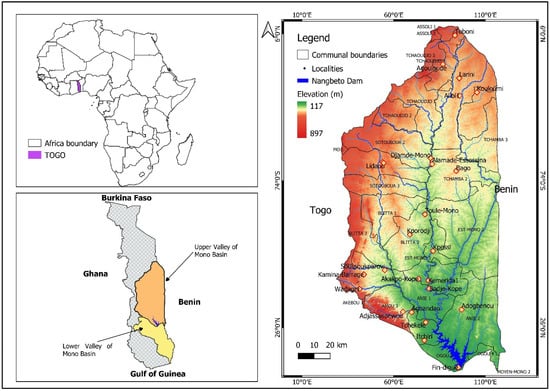
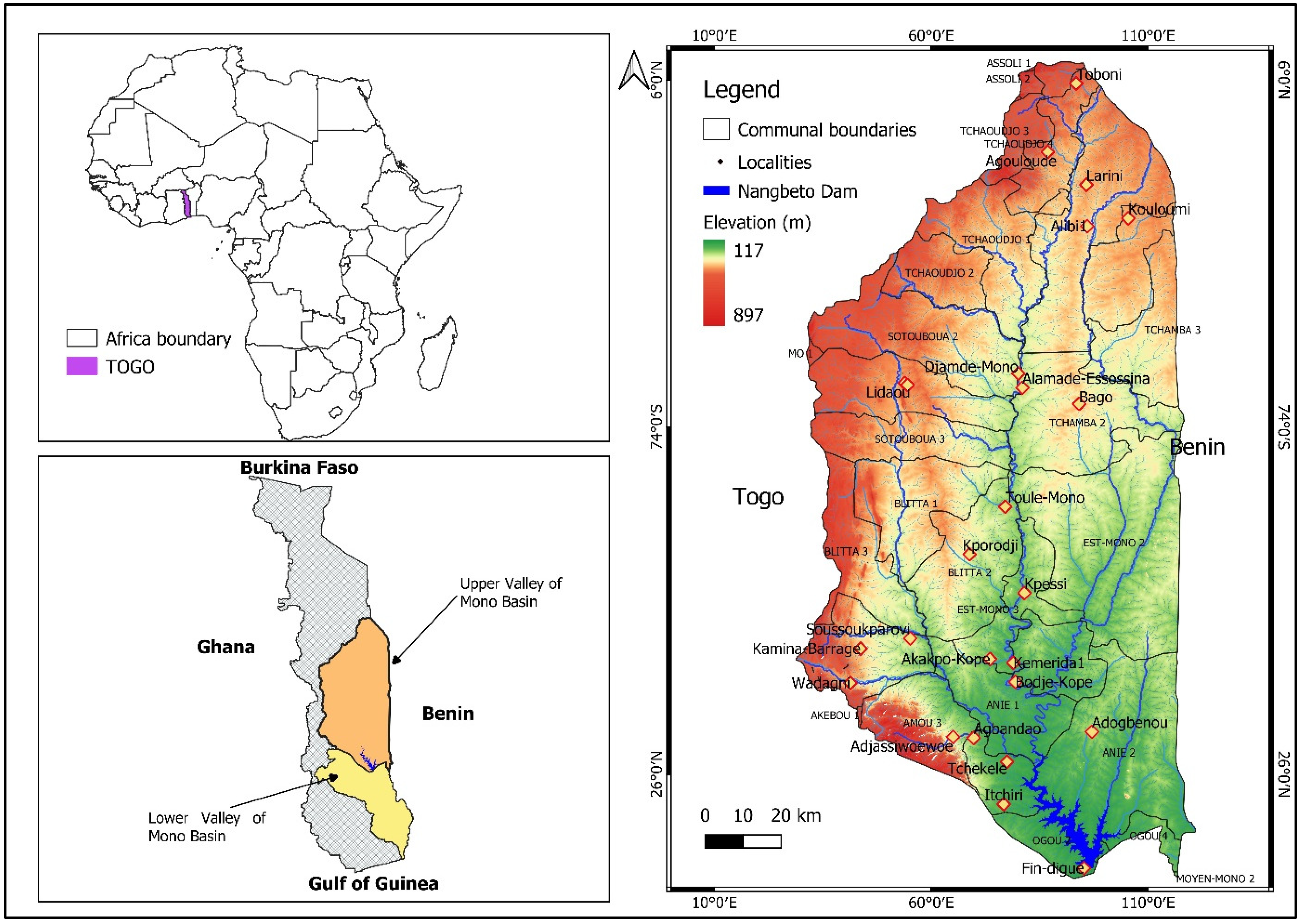
The Upper Mono Basin Valley is the part of the basin located entirely within Togo, between the Nangbéto dam and the prefecture of Tchaoudjo (Figure 1). It covers a total area of 15,801 km2, with a length of 216.2 km and an altitude ranging from 115 to 881 m. The climate of the UMBV is controlled by the interaction of two air masses whose influence varies throughout the year with the north–south movement of the Intertropical Convergence Zone (ITCZ) [26]. This feature determines the climate seasonality in the basin, which is currently characterized by a succession of droughts and floods due to intense short-term rainfall [23]. The redistribution of water on the continental surface is also greatly influenced by geomorphology and surface properties (soil and subsoil permeability, nature and density of vegetation, etc.) [23]. The population of the UMBV is estimated at 1,210,085 inhabitants according to the 5th General Population and Housing Census (RGPH 5).
Figure 1.
Location of the upper valley of the Mono basin in Togo.
2.2. Data Collection
The data used and their sources are summarized in Table 1. In addition, focus groups and interviews were conducted with municipal officials and the population of the UMBV to validate the results obtained by GISs and remote sensing processing.
Table 1.
Characteristics of the data used.
2.3. Spatial Assessment of Thematic Flood Maps
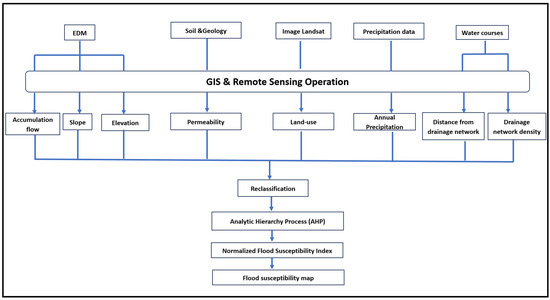
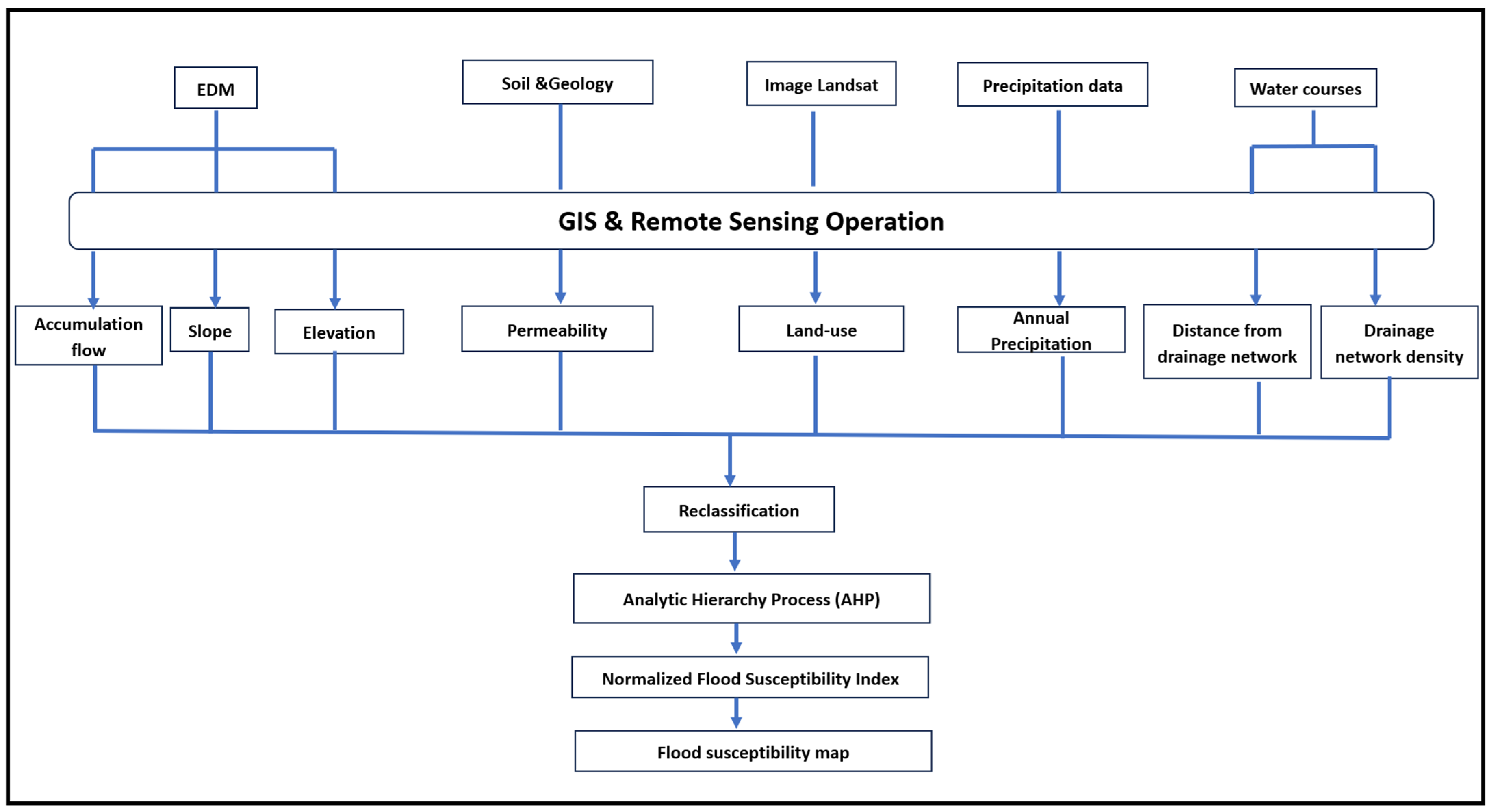
The layers of the eight (08) criteria (accumulation flow, slope, elevation, distance from the drainage network, hydrographic network density, land cover and land use, annual precipitation, and soil permeability) were developed using geospatial processing in a GIS environment, employing remote sensing techniques (Figure 2). These data were extracted from various spatial sources (Table 1) and resampled at the same resolution (10 m). The choice of these factors is based on an in-depth review of the scientific literature [27,28,29,30,31,32], which highlights their decisive influence in flood risk modelling, both in West Africa and worldwide and also because they represent the physical dimensions (topography, soil, hydrology) and anthropogenic aspects (land use) that determine water dynamics within a watershed. Their combination enables the construction of a robust multi-criteria analysis to identify the areas most vulnerable to flooding [33,34,35,36].
Figure 2.
Flowchart of the methodological approach.
AF (Accumulation flow): In identifying flood-prone areas, one of the elements frequently included in many previous studies is accumulation flow. This factor indicates the total amount of water flowing from upstream regions to a given point in the watershed [35]. High values of accumulation flow are associated with an increased probability of water accumulation and, therefore, higher vulnerability to flooding [13]. The UMBV, encompassing several watercourses with the Mono River as its principal axis, is a part of the Mono basin that is sometimes subject to floods, which hinder the lives of local populations as well as their livelihoods [21,37,38]. The UMBV therefore stands out as a hydrological space where the integration of the flow accumulation factor into flood susceptibility mapping is indispensable. This factor contributes directly to flood forecasting by highlighting the areas most sensitive to inundation phenomena.
E (Elevation): Reflects the altitude of the terrain, directly influencing the direction of runoff and the propensity of low-lying areas to accumulate runoff, thereby increasing their susceptibility to flooding. Elevation is a fundamental factor in flood risk [13,30]. Using digital terrain models (DTMs), slope values were calculated to produce a map illustrating the steepness of the terrain. The UMBV, with a length of 216.2 km presents an altitudinal gradient ranging from 115 to 881 m. This gradient constitutes a determining factor to be integrated into the spatialization of flood susceptibility, since the level of risk varies according to elevation. Elevation classes were defined based on the Natural Breaks (Jenks) classification method [39].
LULC (Land Use and Land Cover): Land Use and Land Cover patterns were mapped using Landsat 8 satellite imagery. A seven-band spectral composite was created, and a natural color composite using bands 4, 3, and 2 was selected to reflect land cover characteristics in true color. A supervised classification method was performed, providing information on how different types of land cover, human settlements, agriculture, sparse vegetation (shrub savannas and plantations), and forest (forest and wooded savannas) were classified. LULC influences the infiltration rate and surface runoff, and therefore the flood generation process. The type of vegetation and its coverage play a major role [13], as vegetation facilitates better infiltration of rainwater, thereby reducing the risk of flooding [13].
AP (Annual precipitation): Represents a key factor in runoff generation and is crucial in flood risk assessment [23]. Precipitation data covering twenty years was compiled and then aggregated into annual values. To capture spatial distribution, the interpolation method was used to illustrate the amount of annual rainfall from 2004 to 2024 in the study area. It should be specified that the period from 2004 to 2024 was chosen because it encompasses years marked by intense rainfall episodes and notable floods in the Upper Mono Basin Valley. In addition, this timeframe is sufficiently long to capture climate variability in the area, and at the time of conducting the study, the available rainfall data extended only up to 2024.
DD (Distance to drainage network): Helps identify areas close to watercourses, which are generally prone to flooding [30]. Areas close to rivers are generally more susceptible to flooding than those distant from waterways; however, the threshold distance depends on the characteristics of the river [28]. The threshold distance of 200 m was established as the zone most likely to incur maximum damage, based both on evidence from the literature [13,40] and on local socio-agricultural practices. In rural areas of Togo, the fertility of the major riverbeds encourages populations to cultivate directly within these flood-prone zones [41,42], thereby increasing their vulnerability.
Dd (Drainage network density): It reflects the territory’s capacity to drain surface water, influencing the concentration of flows. The drainage network density was obtained through a series of hydrological analyses. The DTM was pre-processed to correct imperfections, and flow direction and accumulation rasters were generated to model water movement. Thresholds were applied to define the channels, and were further converted into vector entities. The density of these drainage lines was calculated before producing the map reflecting the intensity of the drainage networks and their capacity to manage runoff [30].
S (Slope): It measures the steepness of the terrain, a determining factor in the speed of runoff and water accumulation. Slope is another factor influencing the occurrence of flood risk, as it controls runoff velocity and infiltration rates. As the slope decreases, runoff velocity also decreases, but surface runoff volume and flood susceptibility increase [25]. As the topography of the UMBV is not uniform, consideration of this factor is crucial. The slope factor scales were established based on the FAO Guidelines for Soil Description [43]. To obtain five classes, we adapted the FAO classification, which originally provides only three slope categories.
SP (Soil permeability): This factor provides information on soil permeability and retention capacity, which directly influence infiltration. Soil characteristics were assessed by importing soil data in shapefile format and dividing it according to the study boundaries. The soil layers represented by polygonal entities were classified according to the permeability of each soil type [30]. Soil permeability varies according to its nature, and the UMBV presents a diversity of soil types across its geographical extent. In this study, permeability was considered as a factor, since it determines the retention capacity and, consequently, the propensity of different areas within the UMBV to be exposed to flooding.
Flood susceptibility: The flood susceptibility map was generated by combining these different remote sensing data using a geographic information system (GIS) and following an AHP (Analytical Hierarchy Process) approach. The complete diagram shown in Figure 2 illustrates the different steps used to map flood susceptibility in the UMBV.
To enable integrated analysis and comparison between these various factors, all the eight thematic maps were reclassified into five standardized categories, ranking from very low to very high flood susceptibility. This reclassification process ensured consistency and enabled a comprehensive spatial analysis of flood susceptibility in the upper Mono Basin valley.
2.4. Analytic Hierarchy Process (AHP)
Due to the varying influence of factors in the genesis of floods, an AHP was used to estimate the relative weights assigned to each of the selected parameters. The AHP, as formalized by [44], is based on the development of a pairwise comparison matrix that allows the relative importance of criteria to be assessed according to their contribution to the phenomenon under study. This approach has been used successfully by many authors in the West African sub-region in the context of climate risk vulnerability analysis [1,37,38,45]. This assessment is carried out on a scale of 1 to 9, ranking from equivalent importance to absolute importance, according to expert judgments formulated during a dedicated working session (Table 2). This process allows to structure a consistent hierarchy of factors, which is a prerequisite for modelling the flood hazard index (FHI) and producing the susceptibility map in the UMBV.
Table 2.
Saaty’s weighted task importance scale.
After assigning scores, the values were normalized and weighted. Let (M = (Bij)) be the pairwise comparison matrix (Table 3). Each numerical value of M represents the relative importance of the ith parameter compared to the jth parameter.
Table 3.
Pairwise comparisons of the variables in the criteria matrix (AHP).
- If Bij > 1, then the ith parameter is more important than the jth parameter.
- If Bij < 1, then the ith parameter is less important than the jth parameter.
- If both parameters are equally important, then Bij = 1.
Furthermore, the mathematical values must satisfy the condition given in Equation (1):
After developing the comparison matrix and defining the weights of the factors, a consistency ratio (CR) was calculated according to Equation (2) proposed by [46]:
where CI is the consistency index, and RI is the random index, whose value depends on n, the number of criteria (factors). The value of the consistency index is obtained using Equation (3)
where λmax represents the largest eigenvalue of the matrix and n designates the number of parameters. The constant RI depends on n (Table 4). When CR < 0.1, the evaluation is considered consistent and reliable results can be expected from the AHP model.
Table 4.
AHP Consistency Index Values.
The flood hazard index (FHI) model proposed in this study takes eight factors into account. The flood hazard index for each pixel (FHIj) is calculated using the following equation:
where XjXj is the classification score of each class relative to layer jj, and WjWj represents the weight of layer jj. In addition, the flood hazard index (FHI) was normalized and divided into five (5) classes, namely: very low, low, moderate, high, and very high.
FHI = ∑WJ × XJ
- The maximum eigenvalue obtained is: λmax ≈ 8.52
- The consistency index is calculated as follows: CI = (8.52 − 8)/7 ≈ 0.074
- The corresponding random index (RI) is: RI = 1.41
- The consistency ratio is therefore: CR = 0.074/1.41 ≈ 0.052
As this result is below the threshold of 0.1, the matrix is considered consistent, which validates the expert judgments and authorizes the use of weightings in the hazard index model. To ensure the homogeneity of the units and spatial comparability between variables, all parameters used in calculating flood susceptibility were normalized beforehand. The final susceptibility map is the direct result of the weighted aggregation of normalized variables according to the following equation:
2.5. Classification of Flood Factors in the UMBV
Table 5 presents the eight (08) factors of susceptibility to flood risk, classified into five categories.
Table 5.
Classification of flood susceptibility factors.
2.6. Flood Susceptibility Map Validation
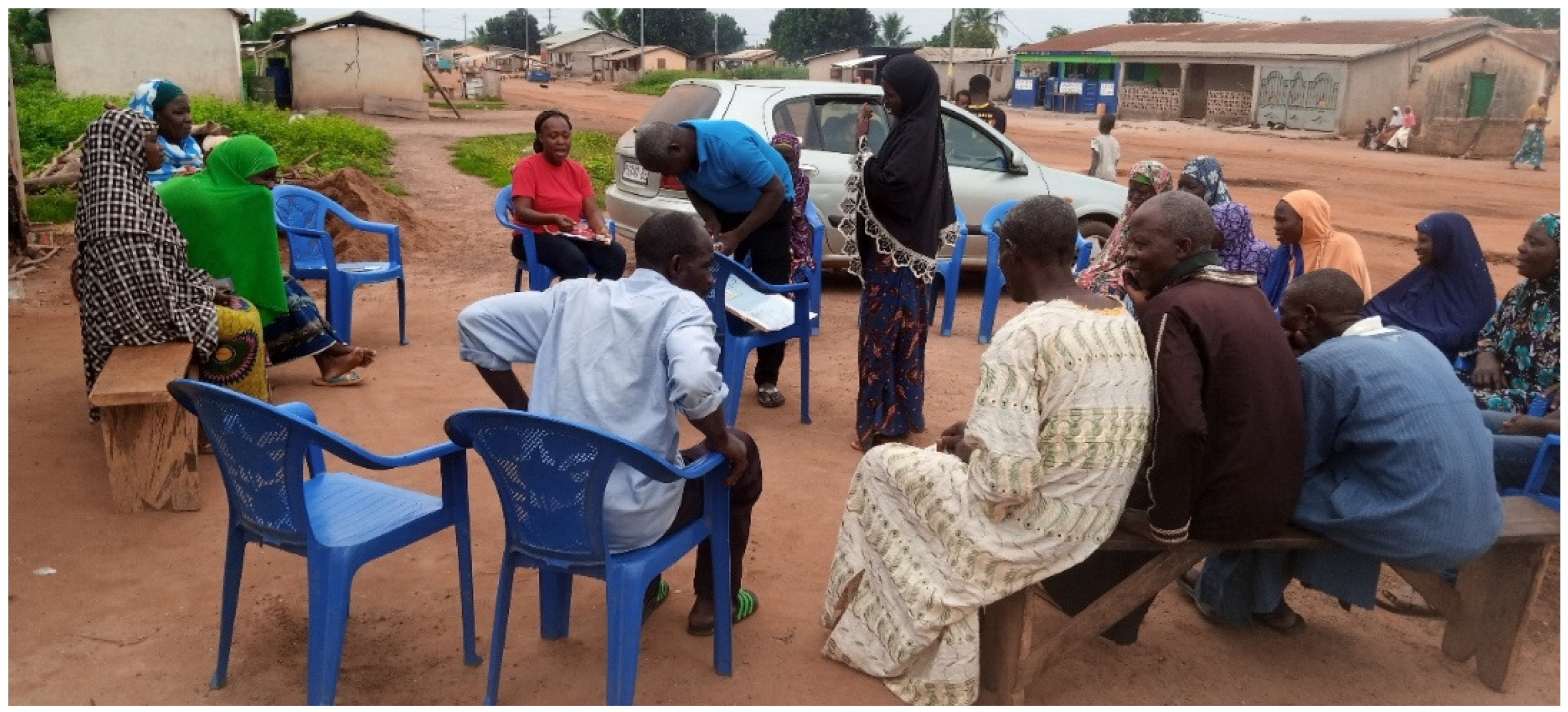
It is necessary to adopt a combined approach that confronts the results derived from flood susceptibility mapping with the empirical evidence reported by local populations. Indeed, communities possess a detailed knowledge of the historical occurrence of flood events and local dynamics. As emphasized by [47], the integration of local perceptions and knowledge constitutes an indispensable complement to quantitative approaches, in order to avoid the disconnect between scientific modeling and the vulnerability actually perceived by communities. In order to validate the territorial consistency of the flood susceptibility map, a field survey was conducted to collect empirical data from local populations. In order to ensure territorial representativeness covering all susceptibility classes (very low to very high), twenty-eight (28) localities (Figure 1) were selected in the study area. In each of these localities, focus groups (Figure 3) were organized, bringing together between 9 and 13 participants, in order to gather the community’s perception of the intensity of the flood hazard and its impact on livelihoods.
Figure 3.
Focus group with the local population in Kouloumi (Tchamba 2 municipality).
Participants are:
- Women and men aged at least 30 years, who had directly experienced the historical floods that occurred in Togo between 2007 and 2010;
- Elderly persons, possessing a broader historical memory and able to situate and compare the earliest flood events;
- Two municipal officials from the planning division;
- A resource person from the prefectural division of environment;
- A representative of a civil society organization involved in flood management in the study area.
Participants were asked to rate the perceived level of flooding on a scale of 1 to 5, where 1 corresponds to very low intensity and 5 to very high intensity. In addition, on-site field observations were carried out with respect to flooding, notably the watermarks left by floodwaters on built structures and trees, and signs of erosion to corroborate or contradict the accounts provided by local populations.
The purpose of this participatory approach is to compare local perceptions with the results of the AHP-GIS model, in a cross-checking process.
The data from the field surveys were encoded with an Excel spreadsheet and then subjected to statistical analysis in R version 4.4.2 software using Pearson’s correlation to assess the degree of association between community perceptions and mapped susceptibility levels. Furthermore, this data was integrated into ArcGIS version 10.8 software and superimposed on the flood susceptibility map, enabling the production of a spatial cross-reference map. This operation made it possible to visualize the correlation between areas identified as highly exposed by the population and those classified as high risk by the model, thereby reinforcing the territorial robustness of the diagnosis.
3. Results
3.1. Thematic Maps
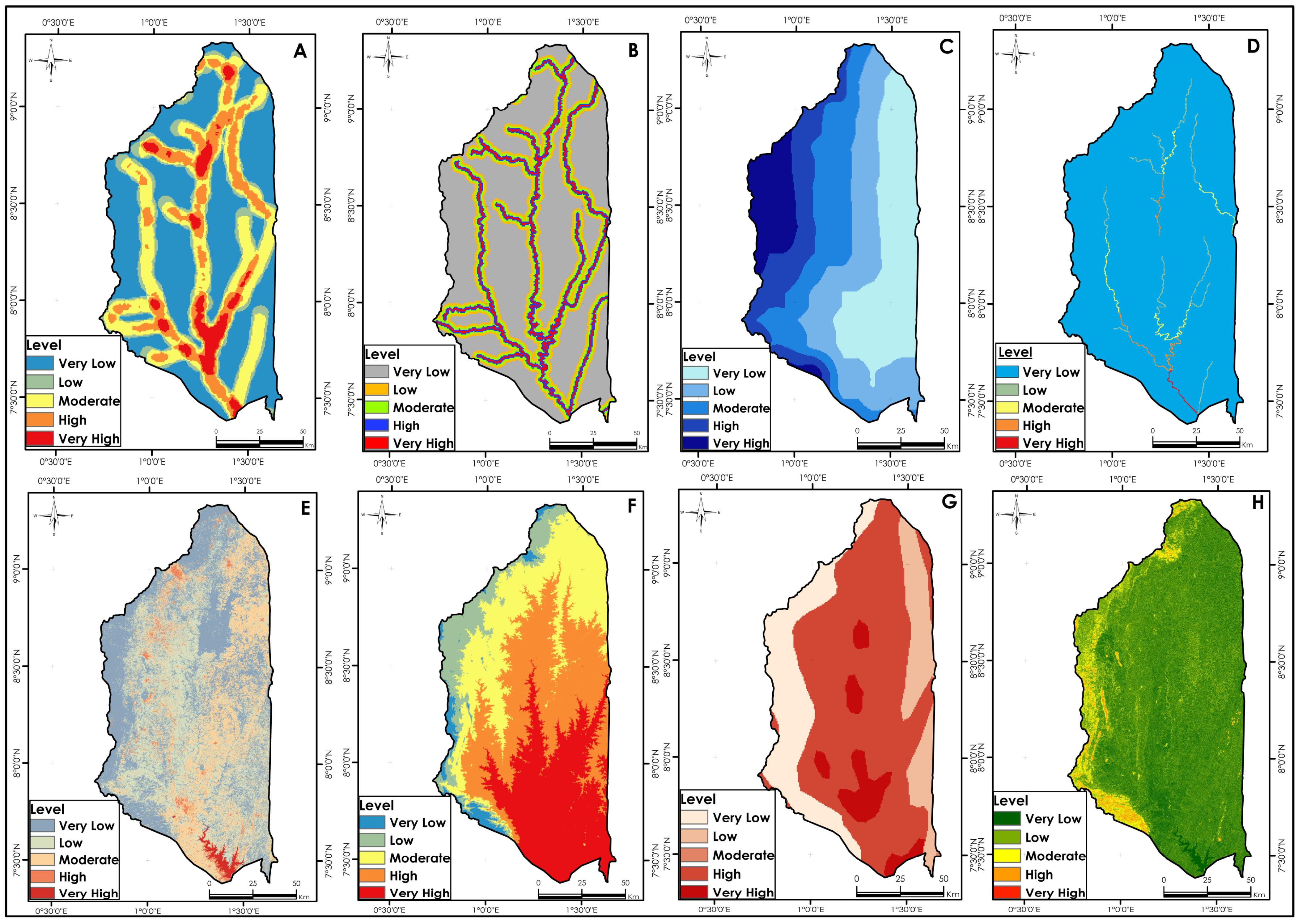
To enable detailed spatial analysis and consistent integration into the AHP multi-criteria model, each of the eight selected factors was represented in the form of a thematic map (Figure 4), developed from geospatial data processed in a GIS environment. The following thematic maps illustrate the spatial distribution of the following variables:
Figure 4.
Flood Susceptibility Factors in the UMBV (A) Accumulation flow (B) Distance from the drainage network (C) Annual precipitation (D) Drainage network density (E) Land use/land cover (F) Elevation (G) Soil (H) Slope.
Accumulation flow is a key hydrological indicator in flood risk modelling, reflecting the amount of water converging at a given point in the watershed. In the context of the UMBV, the accumulation flow map highlights a spatial hierarchy of water concentration areas, with very high levels located mainly near the drainage network. This implies that the localities of the UMBV, particularly human establishments such as dwellings, schools, health centres, fields, and markets located near watercourses, will be rapidly affected by floods, with severe impacts on the populations.
The distance from the drainage network. It identifies areas in proximity to watercourses, where vulnerability to flooding is amplified. Areas located less than 200 m from the main hydrographic network are highly susceptible due to their direct exposure to overflow and saturation of natural outlets. The predominance of areas located far from the drainage network in the UMBV (>2000 m) indicates limited exposure to river floods, although these spaces remain susceptible to internal runoff and water stagnation during heavy rainfall. The intermediate zones (500–2000 m) act as transitional areas, where relative proximity to watercourses increases the likelihood of water accumulation. The sectors closest to the drainage network (500–200 m), though minor in extent, appear to be very critical, as they concentrate flood and stagnation risks, particularly in low-lying areas or those with low soil permeability.
The drainage network density map, reclassified according to a flood susceptibility scale, identifies areas where the concentration of watercourses amplifies hydrological risk. Areas with very high drainage density, reflected in a highly ramified hydrographic network, are more susceptible due to the rapid convergence of flows towards outlets. These areas, often located on slopes or at confluences, are particularly sensitive to river flooding. Conversely, areas with low or very low density, generally on plateaus or on the margins of drainage axes, have moderate susceptibility but may be affected by waterlogging in the absence of secondary drainage. The areas where the drainage network is very dense are those around the Nangbeto dam in the southern part of the basin and along the Mono River towards the north. This highlights the impact of human activity on natural hydrological processes.
Elevation map highlights the spatial structure of the flood. The area is stratified into five altitude classes, ranging from 115 to 881 m above sea level (Table 5). Intermediate altitudes, between 235 and 415 m, dominate the area, representing nearly 59% of the total surface area. Low-lying areas (115–235 m) cover 28%, while higher altitudes (>415 m) are marginal (13%). The elevation map confirms this distribution, with low elevations concentrated in the northwest and high elevations in the southeast. This spatial configuration suggests that low-lying areas are prone to flooding and water stagnation. In the UMBV, the predominance of intermediate altitudes ensures relative hydrological stability, while extensive low-lying areas concentrated in the south remain particularly vulnerable to flooding and water stagnation.
The slope map is a key indicator in flood risk modelling in the UMBV. It reveals a differentiated spatial structure of slope degrees, with a predominance (60%) of gentle slopes (0–5°) in the central and northern areas, and steeper slopes in the southeastern sectors (Figure 4 and Table 5). This topographical configuration directly influences flow dynamics: low slopes favour water accumulation and stagnation, thus increasing vulnerability to flooding, while steep slopes accelerate runoff, reducing concentration time.
The Analysis of the LULC map reveals a predominance of natural formations, with 74% of the area covered by forest, wooded savannah, and sparse vegetation (shrub savannah and plantations). This configuration reflects the highly natural nature of the territory, which is favorable for hydrological regulation but potentially vulnerable to vegetation fires during dry periods. Agricultural areas account for 22% of the surface area, reflecting significant productive activity, although spatially contained. Human settlements, concentrated on 3% of the territory, constitute areas of high functional density, often exposed to hazards despite their small footprint. Finally, wetlands, limited to 1% of the surface area, appear to be residual, although they play a strategic role in water retention and flood control. This spatial structure of land use is a major determinant in the analysis of susceptibility to hydrological and climatic hazards.
The soil permeability map identifies areas where soil infiltration capacity directly influences the hydrological behavior of the territory. Plinthosols and Humic Nitisols (PT-NTeu), characterized by favorable permeability (>60 mm/h), cover 60% of the surface area. Lithic Leptosols (Lpli), with moderate permeability, represent 20%, while Haplic Lixisols (LXha), which are more restrictive, cover 13%. Haplic Vertisols and Nitisols (VRha-NTdy), with variable permeability, occupy 8%, and Gleyic Luvisols (LVgl), which are very poorly represented, total less than 1% (Table 5). The UMBV’s pedological structure is dominated by Plinthosols and Humic Nitisols (60%), whose high permeability supports infiltration and hydrological regulation. Lithic Leptosols and Haplic Lixisols present runoff and waterlogging constraints, while Vertisols and Nitisols (8%) combine agricultural potential with vulnerability to hydrological hazards. Gleyic Luvisols (<1%), though marginal, play a strategic role in water retention. Overall, this soil configuration demonstrates strong infiltration capacity, helping to reduce flood risks linked to waterlogging.
The precipitation map shows a moderately heterogeneous distribution of rainfall patterns in the study area. Areas receiving between 1100 and 1170 mm/year constitute the dominant class, covering 28% of the total area. They are followed by areas receiving between 1170 and 1220 mm/year (26%) and 1220–1275 mm/year (22%). Areas with higher rainfall, between 1275 and 1340 mm/year, represent 14%, while the wettest areas (>1340 mm/year) are marginal, totaling 10% (Table 5). This configuration highlights a UMBV’s rainfall regime that is generally conducive to hydrological regulation and agricultural development, while also revealing internal contrasts that shape the basin’s vulnerability to climatic hazards, notably floods and droughts. It further underscores that surplus areas exhibit heightened sensitivity to hydrological risks, thereby reinforcing the need for a differentiated and adaptive management of water resources to ensure sustainable territorial resilience.
3.2. Flood Susceptibility of the UMBV
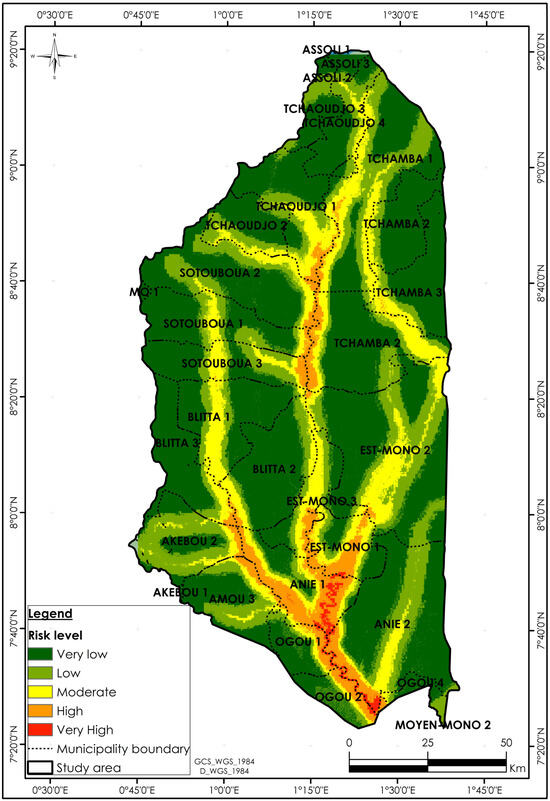
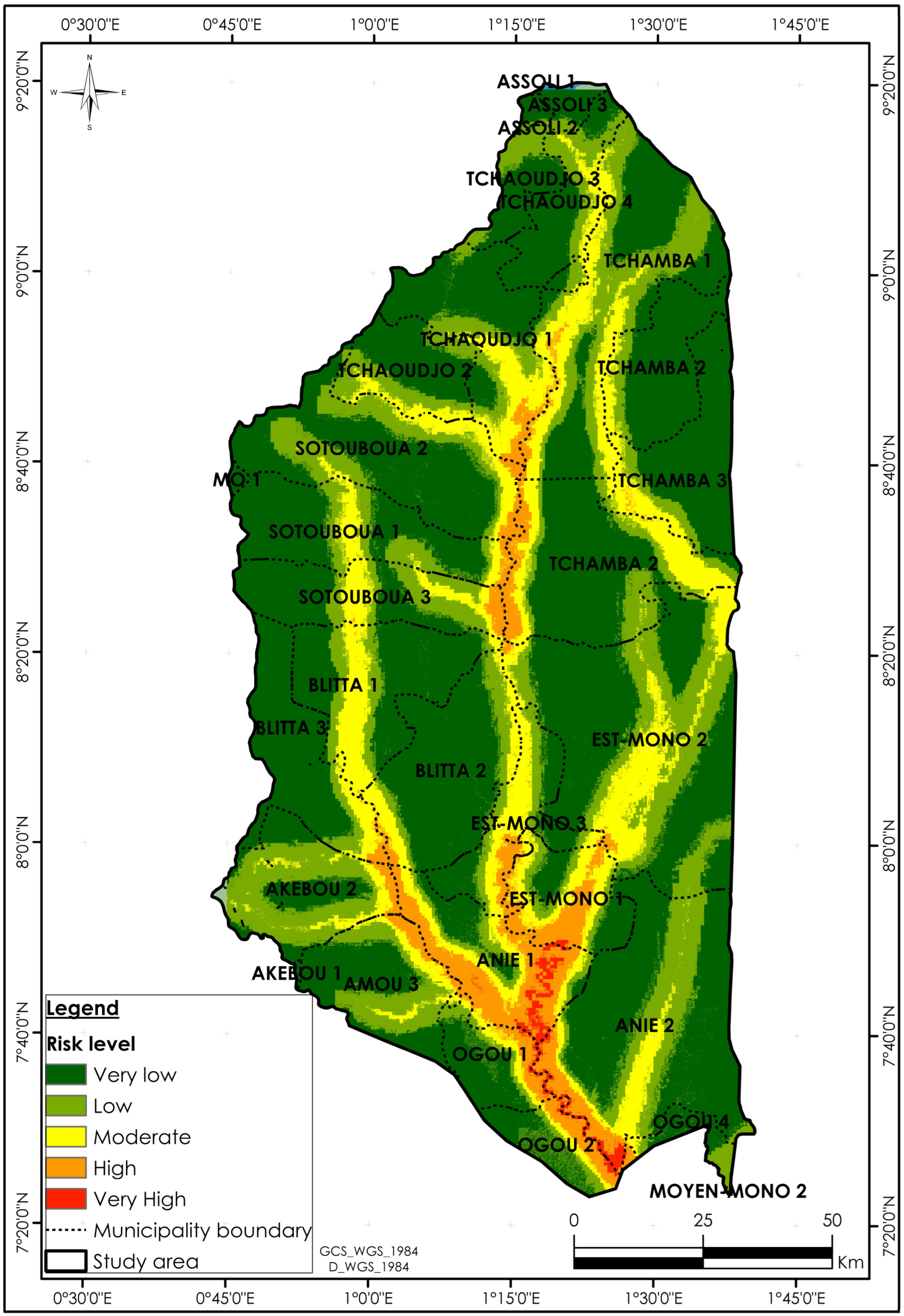
The UMBV flood susceptibility map (Figure 5) reveals a differentiated spatial distribution of susceptibility levels across municipalities. Municipalities such as Est-Mono 1, Est-Mono 3, Anié 1, Anié 2, Ogou 1, Ogou 2, Tchamba 2, and Tchaoudjo 1 have areas of high to very high susceptibility, particularly in areas close to the main river system and in topographical depressions. These areas are characterized by high accumulation of runoff and low drainage capacity, which increases their physical vulnerability.
Figure 5.
Susceptibility of the Upper Mono Basin Valley to floods.
In contrast, municipalities such as Blitta 1, Blitta 2, Blitta 3, East-Mono 2, Tchaoudjo 4, Tchaoudjo 3, Tchamba 1, and Tchamba 3, as well as a large portion of Sotouboua 1, Sotouboua 2, and Sotouboua 3, show low to moderate susceptibility, often correlated with higher altitudes, steeper slopes, or greater distance from drainage axes.
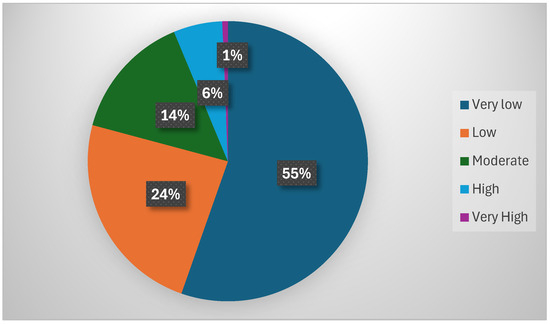
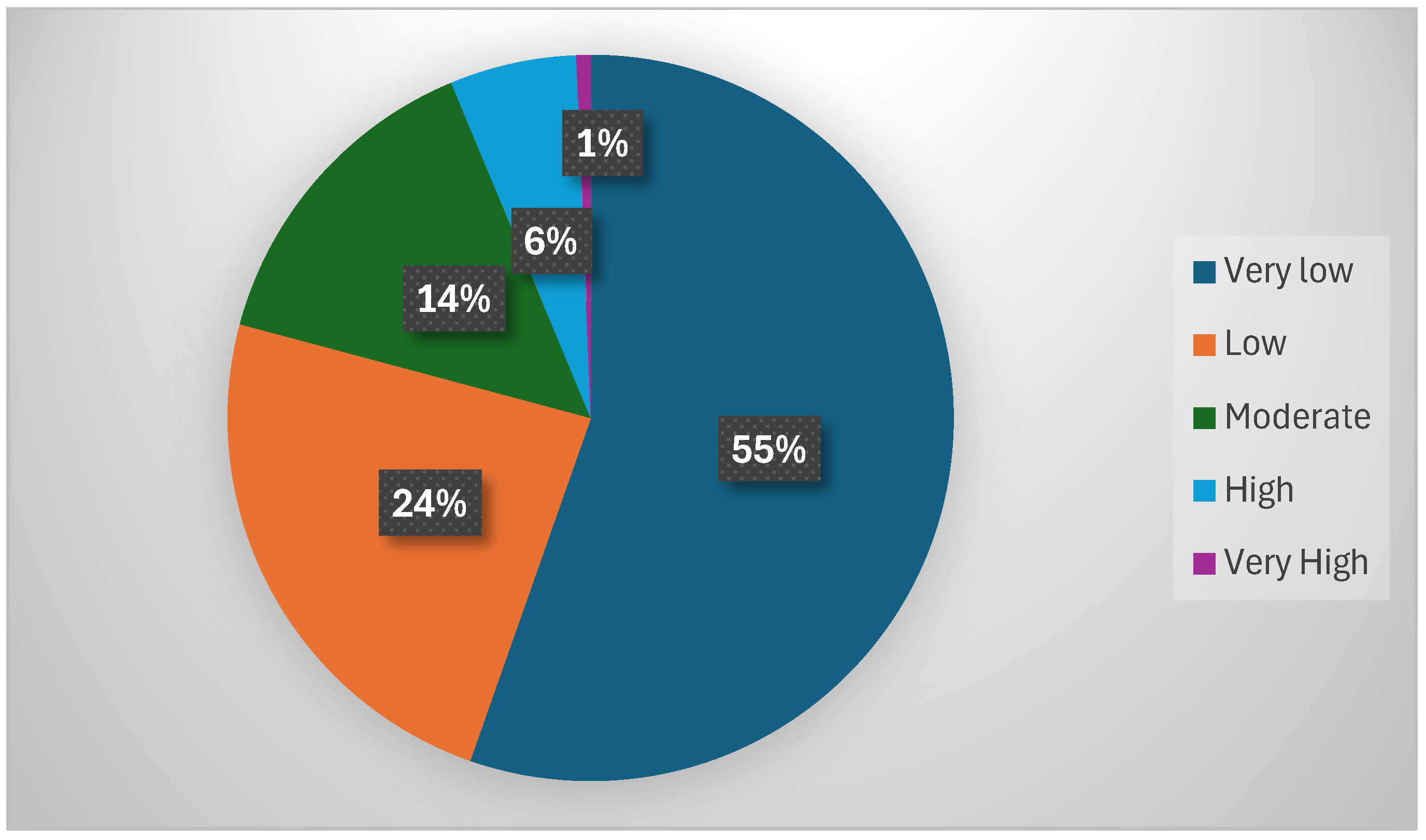
The flood susceptibility map for the UMBV generated from the weighted linear combination in Equation (5) incorporated the relative weights of the eight factors selected using the AHP model. The results reveal a predominance of areas with very low susceptibility, representing 55% (871,046 ha) of the total area. Areas with low and moderate susceptibility cover 24% (373,933 ha) and 14% (229,316 ha) of the study area, respectively. High-risk areas represent 6% (88,465 ha), while very high-risk areas account for only 1% (10,034 ha) of the territory, generally located in topographical depressions or in the immediate vicinity of the main hydrographic network (Figure 6).
Figure 6.
Level of susceptibility to flooding per area in the UMBV.
3.3. Territorial Coherence Between Flood Susceptibility Modeling and Local Hazard Perception
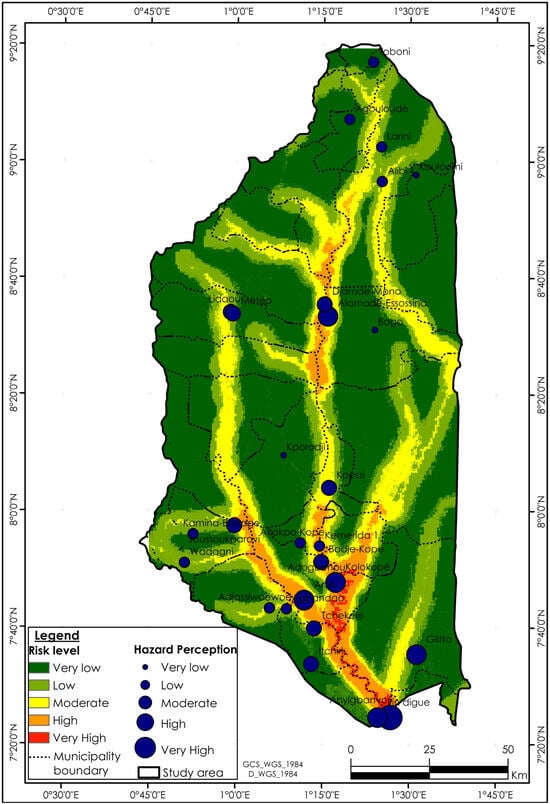
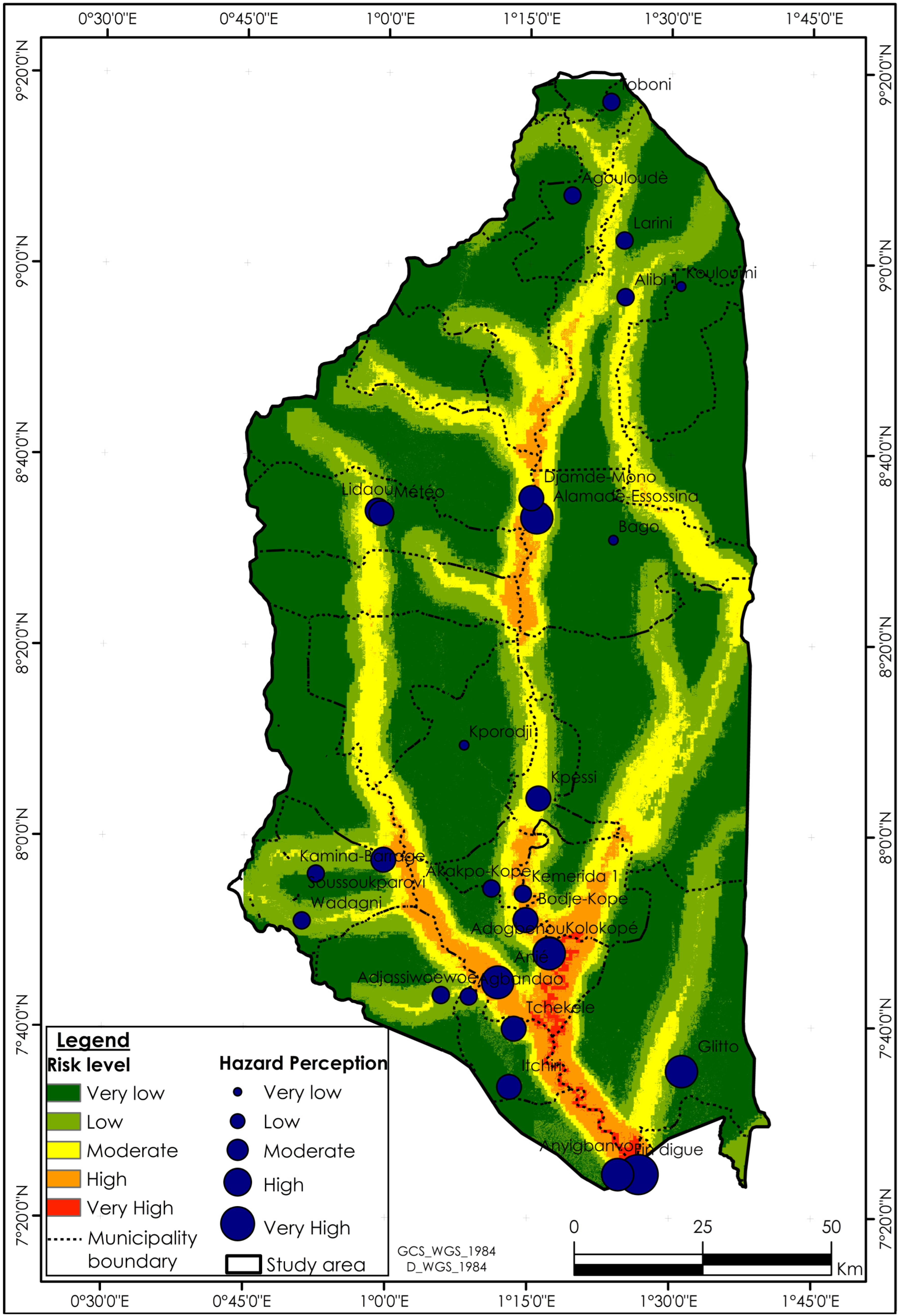
The map showing the intersection between technical susceptibility to flooding and local perception (Table 6 and Figure 7) of risk highlights a significant territorial consistency between areas modeled as highly exposed and social representations of danger.
Table 6.
Data used for crossing map and field data.
Figure 7.
Intersection of technical susceptibility to flooding and local perception of the impact of flooding.
The majority of areas identified as having high or very high susceptibility are also perceived by the population as high-risk areas, reflecting recurring experiences of flooding.
However, there are some isolated discrepancies. Certain areas with moderate or low susceptibility are subject to exaggerated risk perception, while others, despite being classified as high susceptibility, are underestimated by the population. These discrepancies reflect heterogeneous cognitive and memory dynamics, influenced by the frequency of events, the visibility of impacts, and the level of community information.
The correlation coefficient resulting from spatial modelling and field data is r=0.805; this value indicates that local perceptions are closely associated with modelled spatial variations. Furthermore, the p-value associated with this correlation is 0.000, confirming that the relationship is highly statistically significant. These results suggest a robust territorial consistency between the data from technical modelling and the realities perceived in the field.
4. Discussion
The spatial assessment of flood susceptibility in the UMBV was based on the integration of the AHP with GIS tools. This combined approach allowed for the weighting of eight (08) determining factors (accumulation flow, annual precipitation, soil permeability, land use, slope, distance to the drainage network, and density of the hydrographic network) according to their relative influence on the phenomenon studied. The detailed spatialization of the susceptible areas obtained demonstrates the robustness of the model, confirmed by a consistency ratio (CR = 0.052), validating the reliability of the expert judgments used.
This methodology, which has been extensively tested in the West African sub-region [1,13,30,42,47,48,49,50], stands out here for its complementary approach of cross with local perceptions of risk. The results obtained were compared with the perceptions of local populations, revealing a correlation coefficient of over 80% and statistical significance (p-value < 0.001). The integration of community perception into the flood risk assessment process is part of a participatory governance approach, highlighted by the studies of [31,51,52,53,54], who emphasize the strategic importance of local perceptions in the formulation of sustainable adaptation measures.
The results obtained reveal that accumulation flow is the predominant factor in the genesis of flooding within the UMBV, with a relative weight of 0.33. This ranking differs significantly from the one established by [13], where accumulation flow is among the least influential factors. This difference can be explained by the distinct nature of the flooding processes. In their study area, floods are mainly of rainfall origin, directly linked to the intensity of local precipitation. While in the UMBV, although rainfall plays a role, flooding is primarily a result of river dynamics, with upstream flows concentrating in downstream areas, amplifying territorial vulnerability. Indeed, since the study is conducted in the upstream zone, floods do not originate directly from precipitation, as the water flows toward the downstream areas. But this finding is consistent with the results reported by [29] in their research on assessment of flood hazard areas at a regional scale using an index-based approach and Analytical Hierarchy Process in the Rhodope-Evros region in Greece Where the weight assigned to flow accumulation is the same as in this study.
The distance to the drainage network (0.18) and the density of the hydrographic network (0.16) are two crucial parameters in the spatial analysis of flood vulnerability, as highlighted by the studies of [28], which confirm the structuring role of these parameters. However, precipitation (0.05) and soil texture (0.05) appear to be secondary factors in the context of UMBV. This ranking suggests that rainfall intensity alone cannot explain flood dynamics. It must be considered in relation to topographical characteristics and land use patterns. This link is particularly evident in the upstream areas of the watershed, where locally recorded precipitation flows downstream, thereby altering vulnerability levels depending on the morphology and land use. These findings are consistent with those of [32], who demonstrated in the Don River basin in Canada that precipitation is not a dominant factor in the development of flood risk maps. Their analysis, based on variable weighting scenarios, highlighted the primacy of parameters directly related to the hydrographic system, such as distance to the watercourse, slope, and network density, in structuring risk. These results contrast with the study of [30] on the Markudi basin in Nigeria, as well as that of [1] in Davao Oriental province in the Philippines, where rainfall is identified as the determining factor in flood hazard mapping due to the configuration of their study area, concluding that rainfall has a greater weight in the flood characterization process. Finally, soil permeability, ranked last in the study of [26], confirms its marginal role in flood hazard models, as also demonstrated by this study.
Areas with very low susceptibility account for 55% of the total surface area. Areas with low and moderate susceptibility cover 24% and 14% of the study area, respectively. High-risk areas account for 6%, while areas with very high-risk account for only 1% of the territory. This trend is consistent with the results obtained by [27] in Ouagadougou, Burkina Faso, where areas of very low susceptibility account for more than 25% of the territory, while areas of very high susceptibility remain below 8%.
The susceptibility map highlights significant spatial heterogeneity. The municipalities of Est-Mono 1, Est-Mono 3, Anié 1, Anié 2, Ogou 1, Ogou 2, Tchamba 2, and Tchaoudjo 1 have high to very high-risk areas, generally located in topographical depressions or in the immediate vicinity of the main river system. These results align with the findings of [55], reporting an alarming level of flood risk in the prefecture of Anié. They are also in agreement with the assessments of the National Civil Protection Agency [11,55], particularly in the context of the local disaster risk reduction action plan (2023–2027) and the in-depth assessment report on damage, losses, and post-flood reconstruction needs in 2022 in the prefectures of Lacs, Est-Mono, and Sotouboua. These spatial configurations reflect the increased vulnerability of the populations of these municipalities to flooding.
In contrast, the municipalities of Blitta 1, Blitta 2, Blitta 3, Est-Mono 2, Tchaoudjo 4, Tchaoudjo 3, Tchamba 1, and Tchamba 3, as well as most of the sectors of Sotouboua 1, Sotouboua 2, and Sotouboua 3, show low to moderate susceptibility. This lower exposure is correlated with higher altitudes and more effective drainage capacity. These results are consistent with those of [1], who highlighted that the lower part of the basin is significantly exposed to flooding, while the upper part has reduced vulnerability. This observed spatial heterogeneity, with contrasting vulnerability zones across municipalities, calls for differentiated territorial strategies adapted to hydroclimatic dynamics and social realities.
5. Conclusions
The spatial assessment of flood susceptibility in the Upper Mono Basin Valley, using an integrated approach including Geographic Information Systems (GISs), Multi-Criteria Decision Making (MCDM), and the Analytic Hierarchy Process (AHP) methods, revealed a satisfactory consistency ratio and was reinforced by a significant correlation with community perception. The results indicated that flow accumulation, distance to the drainage network, and hydrographic density are the dominant factors in flood occurrence, while precipitation and soil texture are of secondary importance in the UMBV context, respectively. Susceptibility mapping highlights significant spatial heterogeneity, with high-risk areas concentrated in the municipalities of Ogou, Anié, Est-Mono1, Tchamba2, and Tchaoudjo4, often located in topographic depressions or near the main hydrographic network. Conversely, the municipalities of Blitta, Sotouboua, and certain sections of Tchaoudjo and Tchamba showed moderate to low vulnerability, correlated with higher altitudes and better drainage capacity. These results provide a scientific and operational basis for implementing local strategies to reduce flood risks in the UMBV. The success of the integrated employed helps prioritize planning, strengthen early warning systems, and optimize resource allocation in the most exposed municipalities. Moreover, the high correspondence between local perceptions and the produced mapping reinforces the model’s legitimacy among territorial actors, thus facilitating its integration into municipal development plans and climate resilience policies at the sub-regional level. These results reinforce the need to integrate physical parameters, land use dynamics, and community perceptions to design sustainable adaptation measures and strengthen the resilience of populations to flooding.
Author Contributions
Conceptualization, E.N.P., A.K.D.H., K.K. (Kossi Komi) and K.A.; methodology, E.N.P., K.A., K.K. (Kossi Komi) and A.K.D.H.; formal analysis, E.N.P., A.K.D.H. and A.A.C.A.; investigation, E.N.P. and A.A.C.A.; data curation, E.N.P. and A.K.D.H.; writing—original draft preparation, E.N.P., K.A. and A.A.C.A.; writing—review and editing, E.N.P., K.A., A.K.D.H., A.A.C.A., K.K. (Kossi Komi), K.S.G. and K.K. (Kouami Kokou); supervision, K.K. (Kouami Kokou) and K.A.; funding acquisition, E.N.P., K.A., A.A.C.A., K.K. (Kossi Komi), K.S.G. and K.K. (Kouami Kokou) All authors have read and agreed to the published version of the manuscript.
Funding
This research received no external funding.
Data Availability Statement
The original contributions presented in this study are included in the article. Further inquiries can be directed to the corresponding author.
Acknowledgments
This research was conducted within the FLURIFLOOD project (Current and future risks of urban and rural flooding in West Africa). We are grateful to WASCAL, which, through the FLURIFLOOD project, financed the fieldwork for this study. We also acknowledge the EbA4UNgoals project, which provided complementary support.
Conflicts of Interest
The authors declare no conflicts of interest.
References
- Houngue, N.R.; Almoradie, A.D.S.; Thiam, S.; Komi, K.; Adounkpè, J.G.; Begedou, K.; Evers, M. Climate and Land-Use Change Impacts on Flood Hazards in the Mono River Catchment of Benin and Togo. Sustainability 2023, 15, 5862. [Google Scholar] [CrossRef] [Scilit]
- IPCC. Climate Change 2021—The Physical Science Basis: Working Group I Contribution to the Sixth Assessment Report of the Intergovernmental Panel on Climate Change [Internet], 1st ed.; Cambridge University Press: Cambridge, UK, 2023. [Google Scholar] [CrossRef] [Scilit]
- Ansah, E.W.; Amoadu, M.; Obeng, P.; Sarfo, J.O. Climate change, urban vulnerabilities and adaptation in Africa: A scoping review. Clim. Change 2024, 177, 71. [Google Scholar] [CrossRef] [Scilit]
- Fernandez, M.A.; Bucaram, S.J.; Renteria, W. Assessing local vulnerability to climate change in Ecuador. SpringerPlus 2015, 4, 738. [Google Scholar] [CrossRef] [Scilit] [PubMed]
- Descroix, L.; Guichard, F.; Grippa, M.; Lambert, L.A.; Panthou, G.; Mahé, G.; Gal, L.; Dardel, C.; Quantin, G.; Kergoat, L.; et al. Evolution of Surface Hydrology in the Sahelo-Sudanian Strip: An Updated Review. Water 2018, 10, 748. [Google Scholar] [CrossRef] [Scilit]
- Jonkman, S.N.; Curran, A.; Bouwer, L.M. Floods have become less deadly: An analysis of global flood fatalities 1975–2022. Nat. Hazards 2024, 120, 6327–6342. [Google Scholar] [CrossRef] [Scilit]
- OCHA. La Communauté Humanitaire Tire la Sonnette D’alarme sur L’impact des Inondations en Afrique de l’Ouest et Centrale: Plus de 700,000 Personnes Déjà Affectées Cette Année; OCHA: Geneva, Switzerland, 2024; pp. 1–2. [Google Scholar]
- ANPC. Bulletin Trimestriel N° 29: Juillet-Août-Septembre 2025, Informations-Prévention-Alerte aux Risques et Catastrophes. 2025. Available online: https://anpctogo.tg/wp-content/uploads/2025/07/Bulletin-N%C2%B029_JAS-2025_Version-relue_03062025.pdf (accessed on 12 November 2025).
- Kissi, A.E. Memoire Online—Flood Vulnerability Assessment of Donstream Area in Mono Basin in Yoto District, South-Eastern Togo—Abravi Essenam KISSI [Internet]. 2014. Available online: https://www.memoireonline.com/07/15/9219/m_Flood-vulnerability-assessment-of-donstream-area-in-Mono-basin-in-Yoto-district-south-eastern-Togo8.html (accessed on 26 June 2025).
- Merf Evaluation des Dommages, Pertes et Besoins de Reconstruction Post Catastrophes des Inondations de 2010 au Togo [Internet]; Ministère de l’Environnement et des Ressources Forestière: Lomé, Togo, 2010; p. 39. Available online: https://www.gfdrr.org/sites/default/files/publication/pda-2010-togo-fr.pdf (accessed on 17 November 2025).
- ANPC. Evaluation Approfondie des Dommages, Pertes et Besoins de Reconstruction Post Catastrophe Inondations 2022 dans Trois Préfectures du Togo: Lacs, Est-Mono et Sotouboua; ANPC: Atakpame, Togo, 2024; p. 48. [Google Scholar]
- Merf Strategie Nationale de Reduction des Risques de Catastrophes Naturelles 2013—2017 [Internet]; Ministère de l’Environnement et des Ressources Forestière: Lomé, Togo, 2013; p. 104. Available online: https://disasterlaw.ifrc.org/sites/default/files/media/disaster_law/2022-02/National%20Strategy%20for%20Disaster%20Risk%20reduction%202013-2017-French.pdf (accessed on 25 June 2025).
- Blakime, T.-H.; Komi, K.; Adjonou, K.; Hlovor, A.K.D.; Gbafa, K.S.; Oyedele, P.B.; Polorigni, B.; Kokou, K. Derivation of a GIS-Based Flood Hazard Map in Peri-Urban Areas of Greater Lomé, Togo (West Africa). Urban Sci. 2024, 8, 96. [Google Scholar] [CrossRef] [Scilit]
- Thiam, S.; Salas, E.A.L.; Hounguè, N.R.; Almoradie, A.D.S.; Verleysdonk, S.; Adounkpe, J.G.; Komi, K. Modelling Land Use and Land Cover in the Transboundary Mono River Catchment of Togo and Benin Using Markov Chain and Stakeholder’s Perspectives. Sustainability 2022, 14, 4160. [Google Scholar] [CrossRef] [Scilit]
- Badameli, P.A.; Kadouza, P. Vulnérabilités et stratégies des populations face aux inondations dans la région des Savanes au Nord-Togo. Rev. Can. Géograph. Trop. 2020, 7, 8–15. Available online: https://revuecangeotrop.ca/volume-7-numero-2/4937/ (accessed on 18 July 2025).
- Houteta, D.K.; Tall, M.; Nonki, R.M.; Patel, N.; Sylla, M.B.; Djaman, K.; Atchonouglo, K.; Hewitson, B. Flood frequency and amplitude analysis under changing climate scenarios in the Mono River Basin, West Africa. Sustain. Water Resour. Manag. 2025, 11, 47. [Google Scholar] [CrossRef] [Scilit]
- Meresa, H.; Tischbein, B.; Mekonnen, T. Climate change impact on extreme precipitation and peak flood magnitude and frequency: Observations from CMIP6 and hydrological models. Nat. Hazards 2022, 111, 2649–2679. [Google Scholar] [CrossRef] [Scilit]
- Amoussou, E.; Awoye, H.; Vodounon, H.S.T.; Obahoundje, S.; Camberlin, P.; Diedhiou, A.; Kouadio, K.; Mahé, G.; Houndénou, C.; Boko, M. Climate and Extreme Rainfall Events in the Mono River Basin (West Africa): Investigating Future Changes with Regional Climate Models. Water 2020, 12, 833. [Google Scholar] [CrossRef] [Scilit]
- Koubodana, D.H.; Tall, M.; Amoussou, E.; Mumtaz, M.; Atchonouglo, K. Trend Analysis of Hydroclimatic Historical Data and Future Scenarios of Climate Extreme Indices over Mono River Basin in West Africa. AJRD 2020, 8, 37–52. [Google Scholar] [CrossRef] [Scilit]
- Rameshwaran, P.; Bell, V.A.; Davies, H.N.; Kay, A.L. How might climate change affect river flows across West Africa? Clim. Change 2021, 169, 21. [Google Scholar] [CrossRef] [Scilit]
- Ndigridema, N.; Lamboni, P.; Magamana, E.; Bilouktime, B.; Atato, A.; Dourma, M.; Tozo, K.; Batawila, K.; Akpagana, K. Perception locale et stratégies d’adaptation face aux risques d’inondation, de sécheresse et de feux de végé-tation dans la partie septentrionale du bassin du Mono (Togo): Enjeux socio-économiques et environnementaux. Rev. Ecosystèmes Paysages 2025, 5, 1–20. [Google Scholar] [CrossRef] [Scilit]
- Koungbanane, D.; Lemou, F.; Djangbedja, M.; Totin, H.S.V. Impacts socio-économiques et environnementaux des risques d’inondation dans le bassin versant de l’Oti au Togo (Afrique de l’Ouest). VertigO—Rev. Électronique En Sci. Environ. 2023. Available online: http://journals.openedition.org/vertigo/40341 (accessed on 18 July 2025). [CrossRef] [Scilit]
- Amoussou, E.; Camberlin, P.; Totin Vodounon, S.H.; Tramblay, Y.; Houndenou, C.; Mahe, G.; Boko, M. Evolution des précipitations extrêmes dans le bassin versant du Mono (Bénin-Togo) en contexte de variabilité/changement. In Climat: Système & Interactions. 27ème Colloque de l’Association Internationale de Climatologie; Association Internationale de Climatologie: Dijon, France, 2014. [Google Scholar]
- Agnidé, L.; Batablinlè, L.; Célestin, M.; Hodabalo, K. Future Extremes Temperature: Trends and Changes Assessment over the Mono River Basin, Togo (West Africa). J. Water Resour. Prot. 2019, 11, 82–98. [Google Scholar] [CrossRef]
- Nie, W.; Tian, C.; Song, D.; Liu, X.; Wang, E. Disaster process and multisource information monitoring and warning method for rainfall-triggered landslide: A case study in the southeastern coastal area of China. Nat. Hazards 2025, 121, 2535–2564. [Google Scholar] [CrossRef] [Scilit]
- Lamboni, B.; Emmanuel, L.A.; Manirakiza, C.; Djibib, Z.M. Variability of Future Rainfall over the Mono River Basin of West-Africa. Am. J. Clim. Change 2019, 8, 137–155. [Google Scholar] [CrossRef]
- Cabrera, J.S.; Lee, H.S. Flood-Prone Area Assessment Using GIS-Based Multi-Criteria Analysis: A Case Study in Davao Oriental, Philippines. Water 2019, 11, 2203. [Google Scholar] [CrossRef] [Scilit]
- Kafando, H.; Ouedraogo, B.; Ojeh, V.N.; Millogo, A.M.D.; Sow, A. Flood Susceptibility Mapping Using the Geographic Information System and Analytic Hierarchy Process Technique: Case of Ouagadougou Municipality in Burkina Faso. J. Geogr. Nat. Disasters 2023, 13, 13. [Google Scholar]
- Kazakis, N.; Kougias, I.; Patsialis, T. Assessment of flood hazard areas at a regional scale using an index-based approach and Analytical Hierarchy Process: Application in Rhodope–Evros region, Greece. Sci. Total Environ. 2015, 538, 555–563. [Google Scholar] [CrossRef] [Scilit] [PubMed]
- Onuh, J.O.; Aho, M.I.; Akpen, G.D. A Multi-Criteria Approach to Flood Risk Assessment in Makurdi Using GIS and the Analytic Hierarchy Process. Int. J. Res. Sci. Innov. 2025, XII, 607–623. [Google Scholar] [CrossRef] [Scilit]
- Peter, I.T.; Abdulhamid, A.; Shabu, T.; Smah, A.C. Flood Risk Assessment in Urban Makurdi, Benue State, Nigeria. ASIO J. Humanit. Manag. Soc. Sci. Invent. 2020, 6, 7–17. [Google Scholar]
- Rincón, D.; Khan, U.T.; Armenakis, C. Flood Risk Mapping Using GIS and Multi-Criteria Analysis: A Greater Toronto Area Case Study. Geosciences 2018, 8, 275. [Google Scholar] [CrossRef] [Scilit]
- Kumar, N.; Jha, R. GIS-based Flood Risk Mapping: The Case Study of Kosi River Basin, Bihar, India. Eng. Technol. Appl. Sci. Res. 2023, 13, 9830–9836. [Google Scholar] [CrossRef] [Scilit]
- Kader, Z.; Islam, R.; Aziz, T.; Hossain, M.; Islam, R.; Miah, M.; Jaafar, W.Z.W. GIS and AHP-based flood susceptibility mapping: A case study of Bangladesh. Sustain. Water Resour. Manag. 2024, 10, 170. [Google Scholar] [CrossRef] [Scilit]
- Shrestha, S.; Dahal, D.; Poudel, B.; Banjara, M.; Kalra, A. Flood Susceptibility Analysis with Integrated Geographic Information System and Analytical Hierarchy Process: A Multi-Criteria Framework for Risk Assessment and Mitigation. Water 2025, 17, 937. [Google Scholar] [CrossRef] [Scilit]
- Kaya, C.M.; Derin, L. Parameters and methods used in flood susceptibility mapping: A review. J. Water Clim. Change 2023, 14, 1935–1960. [Google Scholar] [CrossRef] [Scilit]
- Amoussou, E. Variabilité Pluviométrique et Dynamique Hydro-Sédimentaire du Bassin Versant du Complexe Fluvio-Lagunaire Mono-Ahémé-Couffo (Afrique de l’ouest). Ph.D.Thesis, Université de Bourgogne, Dijon, France, 2010. Available online: https://theses.hal.science/tel-00493898 (accessed on 4 December 2025).
- Koubodana, H.D. Modeling the Impacts of Climate Change, Land Use Change and Dam Management on Water Resource in West Africa: Case of the Mono River Basin, TOGO-BENIN. Ph.D. Thesis, Université d’Abomey Calavi, Abomey-Calavi, Benin, 2020. [Google Scholar]
- Najibi, N.; Devineni, N.; Lu, M.; Perdigão, R.A.P. Coupled flow accumulation and atmospheric blocking govern flood duration. NPJ Clim. Atmos. Sci. 2019, 2, 19. [Google Scholar] [CrossRef] [Scilit]
- Nair, P.G.; Medhe, R.S.; Das, S.; Chatterjee, U.; Singh, D.; Singh, T.P.; Ghosh, A. GIS-based flood vulnerability mapping in a tropical river basin using analytical hierarchy process (AHP) and machine learning approach. Geocarto Int. 2025, 40, 2551261. [Google Scholar] [CrossRef] [Scilit]
- Graner, A.; Dzamah, A.-F.; Ahovi, K.D.; Tchangani, L.; Michel, I. A peri-urban market-gardening territory in transition in Togo’s Djagblé floodplain: Towards agro-ecological practices? Acta Hortic. 2022, 1356, 179–190. [Google Scholar] [CrossRef] [Scilit]
- Bossa, A.Y.; Hounkpè, J.; Yira, Y.; Serpantié, G.; Lidon, B.; Fusillier, J.L.; Sintondji, L.O.; Tondoh, J.E.; Diekkrüger, B. Managing New Risks of and Opportunities for the Agricultural Development of West-African Floodplains: Hydroclimatic Conditions and Implications for Rice Production. Climate 2020, 8, 11. [Google Scholar] [CrossRef] [Scilit]
- FAO. Guidelines for Soil Description [Internet]; Food and Agriculture Organization of the United Nations: Rome, Italy, 2006; Available online: https://www.scirp.org/reference/referencespapers?referenceid=3210655 (accessed on 13 January 2025).
- Saaty, T.L. Decision making with the analytic hierarchy process. Int. J. Serv. Sci. 2008, 1, 83–98. [Google Scholar] [CrossRef] [Scilit]
- Gui, R.; Song, W.; Lv, J.; Lu, Y.; Liu, H.; Feng, T.; Linghu, S. Digital Elevation Model-Driven River Channel Boundary Monitoring Using the Natural Breaks (Jenks) Method. Remote. Sens. 2025, 17, 1092. [Google Scholar] [CrossRef] [Scilit]
- Saaty, T.L.; Vargas, L.G. Inconsistency and rank preservation. J. Math. Psychol. 1984, 28, 205–214. [Google Scholar] [CrossRef] [Scilit]
- Rufat, S. Comment analyser la vulnérabilité aux inondations? Approches quantitatives, qualitatives, francophones et anglophones: Ann Géographie. Ann. Géograph. 2017, 715, 287–312. [Google Scholar] [CrossRef] [Scilit]
- Attiogbé, A.A.C.; Bessah, E.; Quansah, E.; Nehren, U.; Agodzo, S.K. Spatial analysis of drought vulnerability in cocoa agroforestry systems across the Ghana-Togo border. Geomat. Nat. Hazards Risk 2025, 16, 2467406. [Google Scholar] [CrossRef] [Scilit]
- Komi, K.; Amisigo, B.; Diekkrüger, B. Integrated Flood Risk Assessment of Rural Communities in the Oti River Basin, West Africa. Hydrology 2016, 3, 42. [Google Scholar] [CrossRef] [Scilit]
- Komi, K.; Neal, J.; Trigg, M.A.; Diekkrüger, B. Modelling of flood hazard extent in data sparse areas: A case study of the Oti River basin, West Africa. J. Hydrol. Reg. Stud. 2017, 10, 122–132. [Google Scholar] [CrossRef] [Scilit]
- Parkoo, E.N.; Thiam, S.; Adjonou, K.; Kokou, K.; Verleysdonk, S.; Adounkpe, J.G.; Villamor, G.B. Comparing Expert and Local Community Perspectives on Flood Management in the Lower Mono River Catchment, Togo and Benin. Water 2022, 14, 1536. [Google Scholar] [CrossRef] [Scilit]
- Parkoo, E.N.; Akognogbe, A.; Adjonou, K.; Blalogoe, P.; Adessou, K. Perception locale des évènements hydroclimatologiques et stratégies d’adaptation dans la commune d’Athieme de Benin. Pensées Genre Penser Autrem. 2023, 3, 54–71. [Google Scholar]
- De Longueville, F.; Ozer, P.; Gemenne, F.; Henry, S.; Mertz, O.; Nielsen, J.Ø. Comparing climate change perceptions and meteorological data in rural West Africa to improve the understanding of household decisions to migrate. Clim. Change 2020, 160, 123–141. [Google Scholar] [CrossRef] [Scilit]
- Lawson-Hetchely, T.G. Evaluation de la Vulnérabilité et de l’Adaptation au Changement Climatique des Populations de la Préfecture d’Anié au Togo. Master’s Thesis, Université de Lomé, Lomé, Togo, 2023. [Google Scholar]
- ANPC. Plan D’action Local De Reduction Des Risques De Catastrophes (2023–2027); ANPC: Atakpame, Togo, 2022; p. 28. [Google Scholar]

Disclaimer/Publisher’s Note: The statements, opinions and data contained in all publications are solely those of the individual author(s) and contributor(s) and not of MDPI and/or the editor(s). MDPI and/or the editor(s) disclaim responsibility for any injury to people or property resulting from any ideas, methods, instructions or products referred to in the content. |
© 2026 by the authors. Licensee MDPI, Basel, Switzerland. This article is an open access article distributed under the terms and conditions of the Creative Commons Attribution (CC BY) license.