


Abstract
The territory of the Republic of Armenia (RA) lies within the central Arabia–Eurasia collision zone and is characterized by rugged mountain landscapes, complex geology, active faulting, and seismicity. Armenia is highly vulnerable to seismic and landslide hazards, with more than 2504 active landslides mapped in the country. A significant landslide in the Tumanyan Community, Lori Marz, was activated in January 2018 and threatened critical infrastructure, including the railway linking Armenia to Georgia and the M6 interstate highway. The landslide’s activation was driven by groundwater, a nearby water reservoir leak, and adjacent infrastructure. Preliminary hazard analysis revealed that further movement of the landslide could dam the Debed River, leading to potentially catastrophic downstream impacts. In response, the Minister of Emergency Situations of RA requested urgent studies by the Institute of Geological Sciences of NAS RA. Surveys began on 22 January 2018, involving an interdisciplinary approach including geotechnical study, UAV-based digital mapping, and application of geophysical methods, such as MASW, microtremor recordings, GPR, and VES. The combination of these methods provided reliable information on the landslide’s geotechnical structure, identified the sliding plane, and allowed for numerical slope stability modeling, which confirmed the landslide’s unstable condition and susceptibility to reactivation from earthquakes or elevated groundwater. Based on this complex research, protective measures were developed and applied, including, in particular, horizontal drilling to dewater the sliding plane. These emergency measures stabilized the landslide, mitigating immediate threats to infrastructure and ensuring relative safety.
1. Introduction
People and infrastructure in Armenia are highly exposed to landslide hazards due to the country’s complex geological structure, steep mountainous relief, active tectonics, and intensive atmospheric precipitation [1]. Landslides represent one of the most dangerous geological processes, causing significant damage to settlements, transportation corridors, engineering structures, and agricultural lands. According to national landslide inventories, more than 2500 landslides were mapped across Armenia by 2005, and an updated national landslide catalogue published in 2019 includes about 3500 landslides, many of which directly threaten critical infrastructure [2,3].
In recent decades, water-induced landslides have become increasingly frequent, mainly due to climate-driven changes in precipitation patterns, intensive snowmelt, reservoir leakage, and anthropogenic impacts on slopes. Numerous studies published between 2020 and 2024 emphasize the dominant role of groundwater in landslide activation, particularly in mountainous and tectonically active regions. However, many of these studies focus either on remote sensing techniques, numerical modeling, or single geophysical methods without fully integrating multi-source geophysical data, engineering investigations, and emergency mitigation measures into a single operational framework [4].
The Tumanyan landslide, located in Lori Marz in northern Armenia, represents a critical case of a rapidly activated, water-triggered landslide threatening national-scale infrastructure. The landslide was unexpectedly activated on 7 January 2018 and caused the closure of the Yerevan–Tbilisi railway and the Vanadzor–Alaverdi highway. The event resulted in the burial of more than 35 vehicles, the death of five people, and serious economic and social consequences. Field investigations indicate that the landslide body had an approximate length of about 450 m, a width of 180–220 m, and an estimated sliding surface depth of up to 25–30 m. The total volume of displaced material is estimated to have exceeded several hundred thousand cubic meters, classifying it as a large and highly dangerous landslide.
Recent studies on landslides using geophysical methods (2020–2024) demonstrate the effectiveness of Multichannel Analysis of Surface Waves (MASW), electrical resistivity methods, microtremor analysis, and Ground-Penetrating Radar for detecting sliding surfaces and weak zones [5]. Nevertheless, most of these studies apply only one or two geophysical techniques and rarely integrate them with UAV-based mapping, borehole investigations, numerical stability modeling, and emergency engineering solutions in a unified workflow. As a result, the transition from scientific investigation to rapid decision making for risk reduction is often slow and inefficient, especially under emergency conditions.
The novelty of this study lies in the development and application of a closed-loop methodology that integrates UAV-based photogrammetry, multi-source geophysical investigations (MASW, H/V microtremor analysis, VES, and GPR), engineering–geological drilling, numerical slope stability modeling, and horizontal drainage as an emergency mitigation measure. This integrated approach allowed for rapid identification of the internal structure of the landslide body, precise delineation of the sliding surface, evaluation of slope stability under different hydrogeological and seismic scenarios, and timely implementation of effective stabilization measures.
The main objective of this study is to demonstrate how the rapid integration of modern geophysical methods with engineering–geological investigations and numerical modeling can provide a reliable scientific basis for emergency decision making and landslide risk reduction. The Tumanyan landslide case is presented as a reference model for managing water-induced landslides in geologically complex regions, particularly within the Eurasian collision zone and other tectonically active mountainous areas.
2. Geological Settings and Landslide Kinematics
The local geology comprises folded Jurassic to Cretaceous sedimentary, volcano–sedimentary, and volcanic units of the Mesozoic island arc of the Lesser Caucasus (Somkheto-Karabakh arc) [6,7]. These units are overlain by Early Pleistocene plateau basalts up to ~350 m thick [8], as well as Quaternary colluvial deposits that have accumulated on the steep slopes. In many cases, groundwater is found at the contacts between the Mesozoic bedrock and the overlying Quaternary deposits.
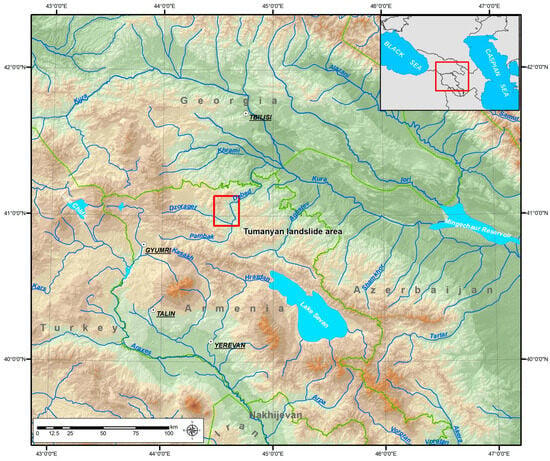
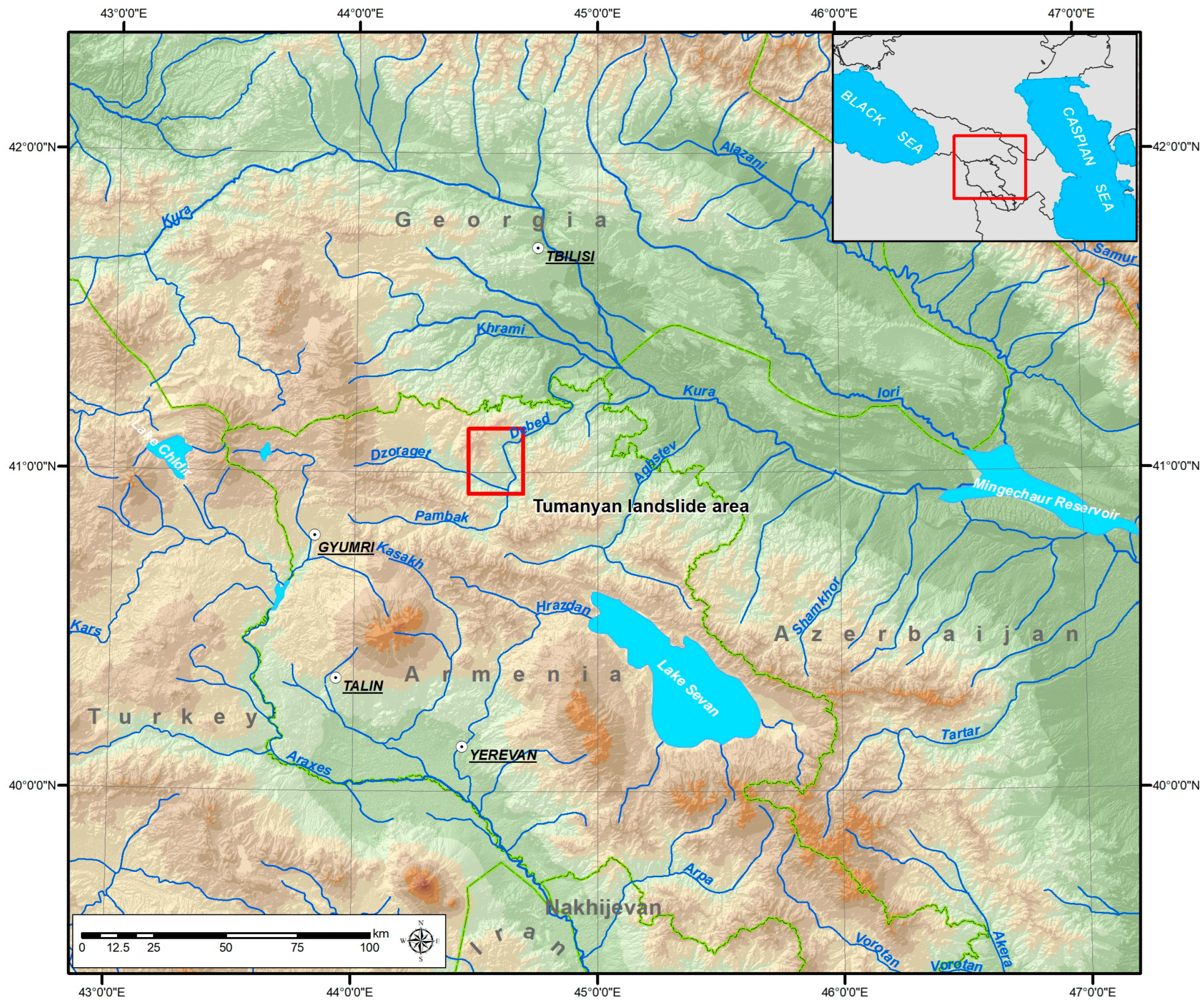
The Tumanyan landslide site is located on the left bank of the Debed River (Figure 1). Old aerial imagery from 1947 (archives of the Institute of Geological Sciences of NAS RA) shows washout gullies and deformations in the form of displaced soil masses, indicating past slope instability.
Figure 1.
The red rectangle shows the location of the Tumanyan landslide site.
According to local accounts, an abrupt activation of the landslide occurred in 1954 after a large quantity of drinking water leaked from a pipeline running across the basalt plateau on top of the slope, over-saturating the slope materials and leading to their dislocation. That event produced large cracks on the landslide surface and a viscous flow of mud and stones at the foot of the slope that completely covered the adjacent railway segment. For the same reason of anthropogenic over-saturation, a similar reactivation recurred in the spring of 1986. The over-moistened ground became unstable, producing a sharp acceleration of landslide processes and opening ground fissures on the slope again. The resulting shutter ridges (compression bulges), swells, and other deformations at the foot of the slope have been preserved to this day. The presence and infiltration of water into the slope were the causes of the abrupt landslide activations during these two episodes.
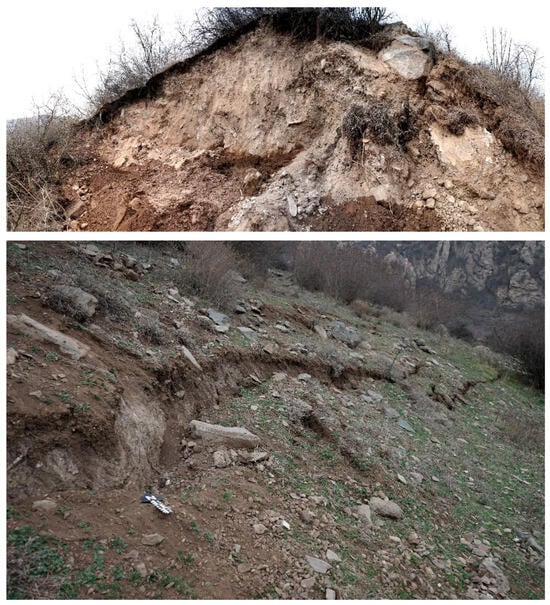
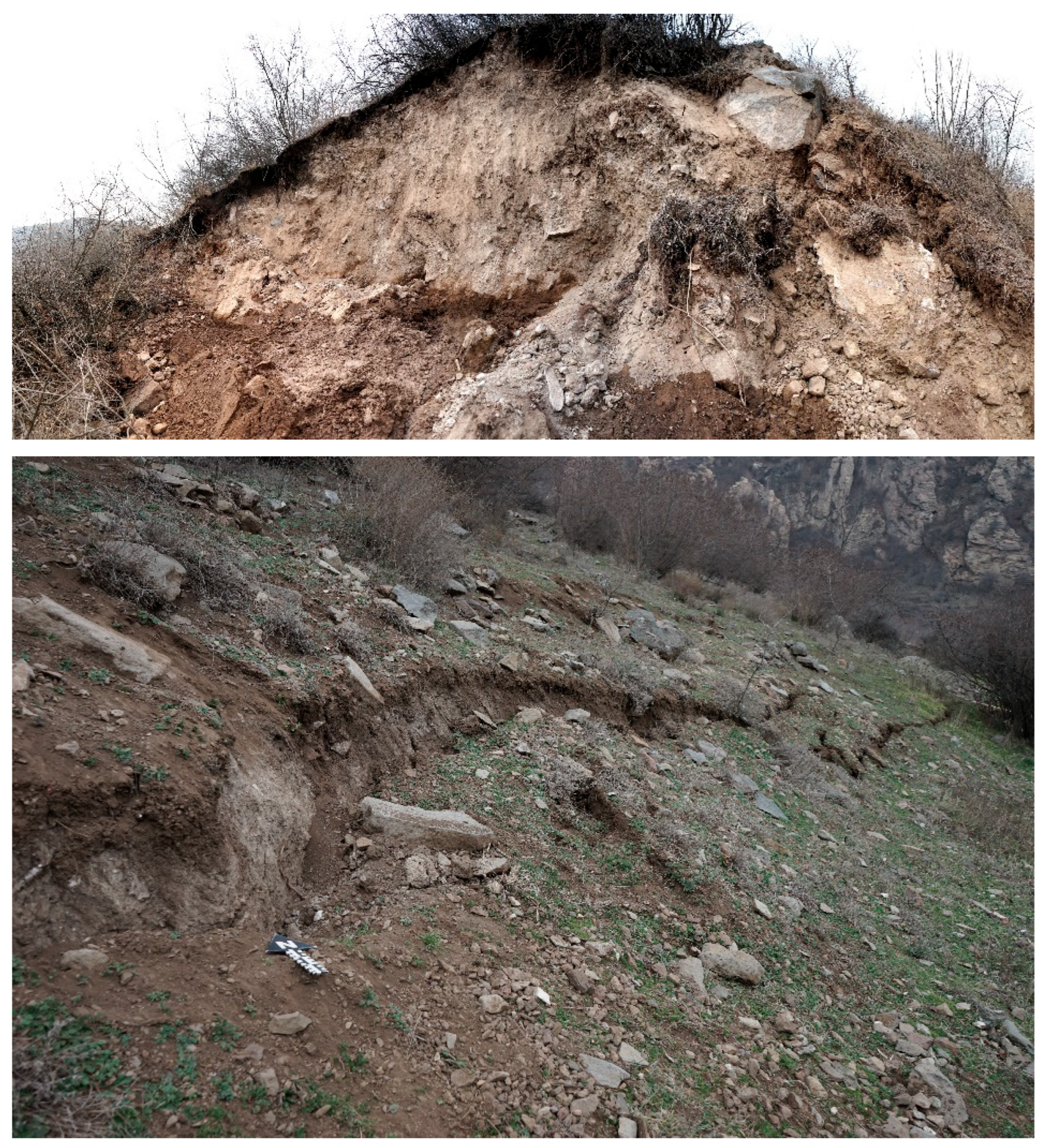
The next reactivation of the landslide, recorded by residents on 7 January 2018, was again triggered by a water leak from the pipeline supplying water to the Tumanyan community. The leak occurred from a small daily-regulation water reservoir (approximately 2 m × 3 m × 2 m in size) located upslope, and it lasted for more than one month, over-saturating the soils in the northern flank of the landslide body. This prolonged leak caused a sharp dislocation of the landslide mass, accompanied by the development of large ground cracks (Figure 2).
Figure 2.
Collapse of soils and cracks as a result of water saturation in the frontal part of the landslide in January 2018.
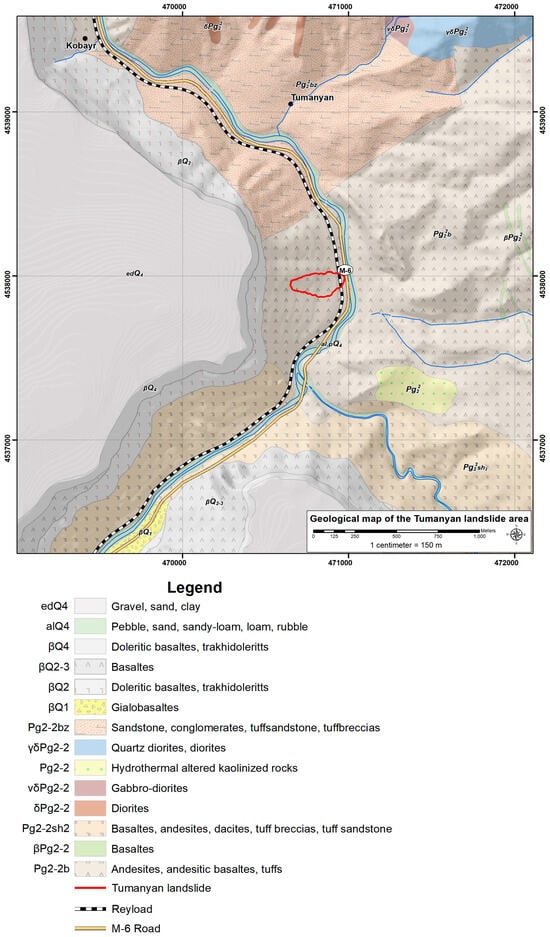
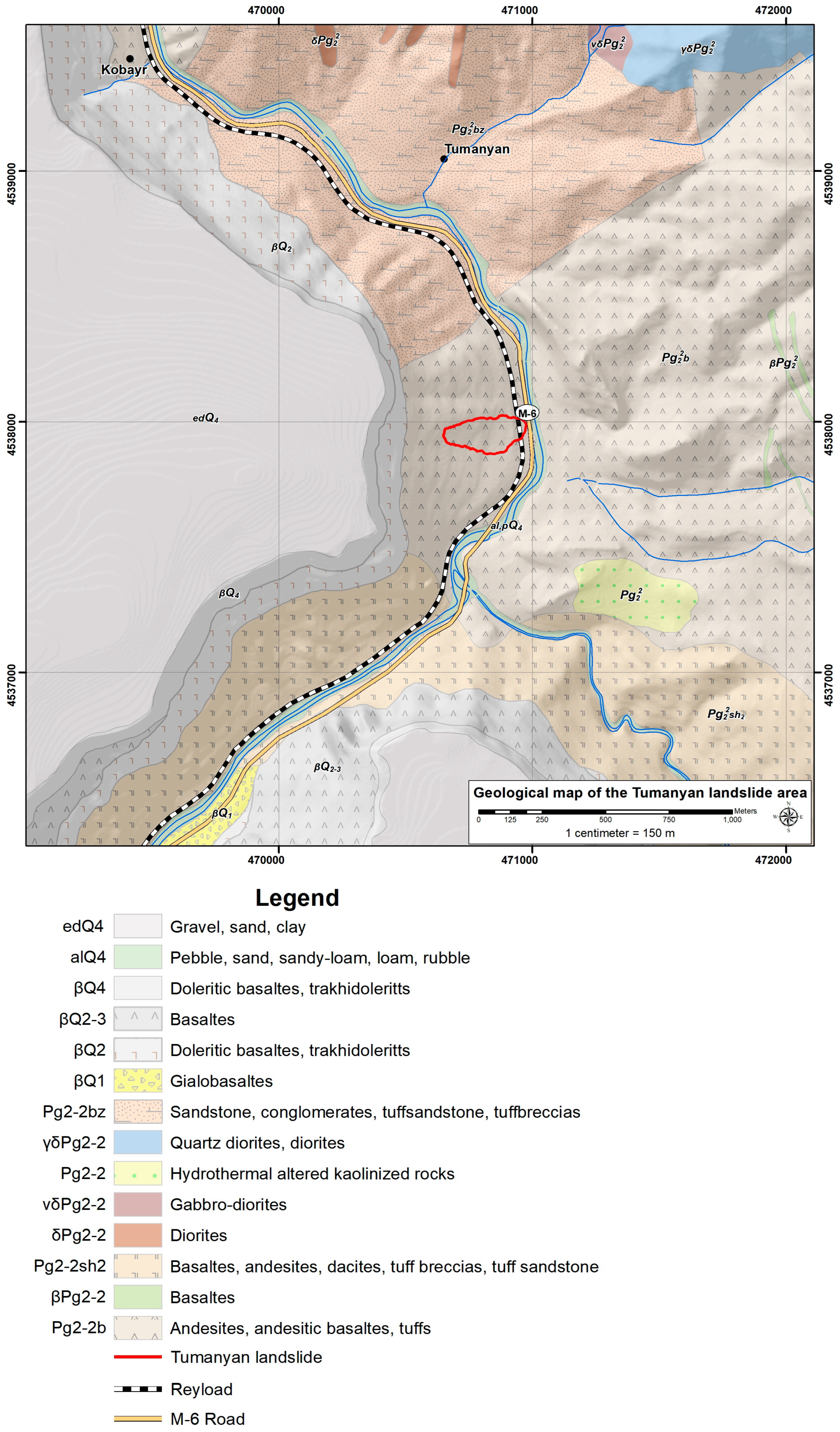
According to geological data, the slope is composed of Middle Eocene volcano–sedimentary rocks represented by tuffaceous sandstones, conglomerates, tuff sandstones, and quaternary basalt lava flows (Figure 3). Field survey data show that the undisturbed bedrock of the slope consists of Paleogene andesite–basalts, which, in places, have undergone hydrothermal alteration. These rocks are overlain by a flat-lying plateau of younger, gray dolerite basalts of Pliocene age, forming a unit about 300 m thick [9].
Figure 3.
Geological map of the Tumanyan landslide and adjacent areas.
3. Materials and Methods
An unmanned aerial vehicle (UAV) was used to carry out an aerial photogrammetric survey of the landslide area, producing a high-resolution (~10 cm) orthophoto of the terrain and a topographic map with 1 m contour intervals. The collected data were used to develop a three-dimensional model of the landslide body, clearly showing all elements of the landslide morphology—the main scarp, the landslide terrace, the foot (toe), and the deep cracks generated during activation. The resulting digital elevation model (DEM) allowed for the assessment of morphometric (quantitative) indicators of the landslide. According to these data, the vertical elevation drop between the landslide head and its foot is about 105 m. The landslide body terminates on the lower slope about 50 m above the Debed River’s erosional base level, and the vertical drop between the river level and the collapsed foot of the landslide is about 20 m. The landslide is ~335 m long and up to 140 m wide, with a total area of approximately 3.4 ha. A preliminary calculation estimates the landslide volume to be on the order of 400,000 m3.
These findings formed the basis for developing a detailed work plan for engineering–geological and geophysical studies. Two vertical boreholes were drilled for the investigation, reaching depths of 40 m and 21 m, respectively.
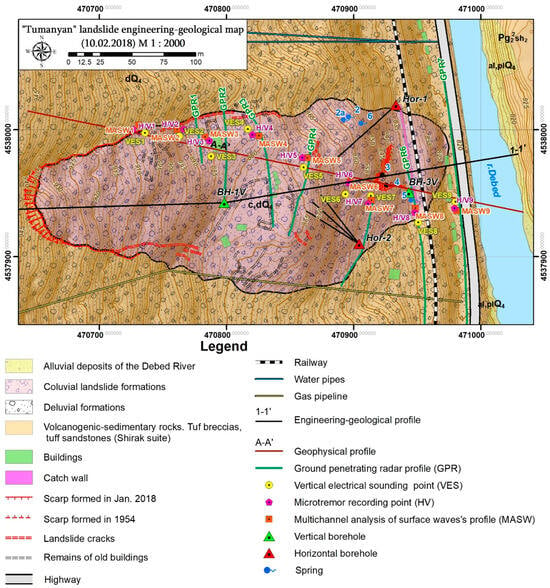
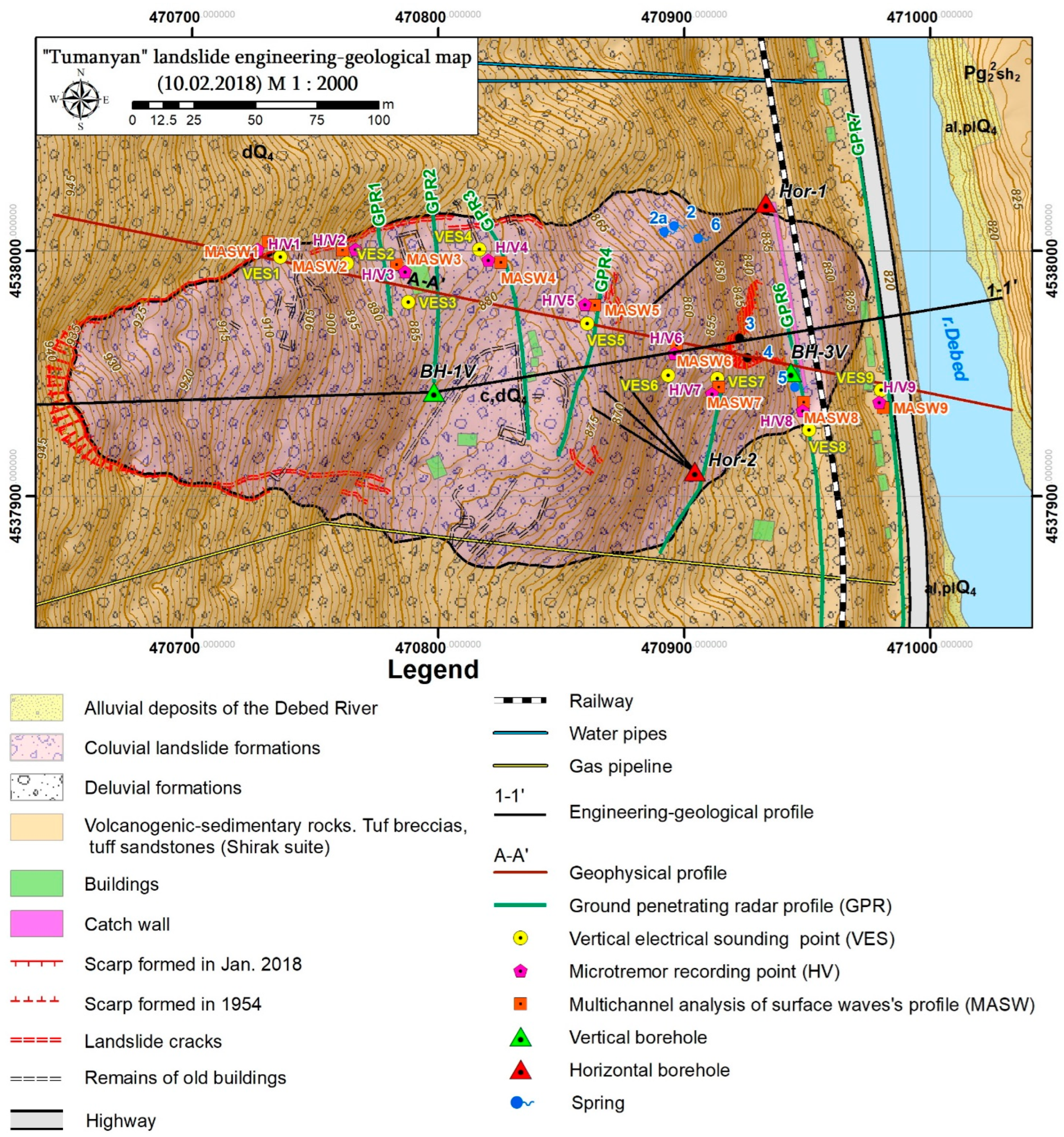
The complex of geophysical methods applied in the study included ambient vibration recording, seismic surface wave analysis, electrical resistivity, and radar scanning. The scope of work encompassed the following (Figure 4):
Figure 4.
Geological map of the landslide area showing locations of the investigations and boreholes.
- Microtremor (H/V) recordings at 9 measurement points on the landslide;
- Multichannel Analysis of Surface Waves (MASW) along 9 profiles;
- Vertical Electrical Soundings (VES) at 9 points;
- Ground-Penetrating Radar (GPR) surveys along a total of 900 m of profiles;
- Landslide slope stability calculations under different scenarios;
- Development of recommendations for landslide stabilization;
- Implementation of horizontal drainage to lower groundwater and improve landslide stability.
3.1. The Method of Multichannel Analysis of Surface Waves (MASW)
Multichannel Analysis of Surface Waves (MASW) is a seismic method used to determine the shear-wave velocity (Vs) structure of the subsurface by analyzing the dispersion characteristics of surface waves recorded with a multichannel geophone array [10]. In the MASW approach, surface-wave signals generated by an active seismic source are recorded simultaneously using multiple receivers, and their frequency–phase velocity relationship is extracted in the form of a dispersion curve.
The measured dispersion curve is then inverted to obtain a one-dimensional Vs profile, which represents the variation of shear-wave velocity with depth. Because Vs is strongly controlled by lithology, degree of weathering, fracturing, and water saturation, MASW provides reliable information on mechanical properties of near-surface materials and is widely used for geotechnical and landslide investigations.
In this study, MASW was applied to identify low-velocity zones related to weakened and water-saturated materials and to constrain the depth of the main sliding surface. The method was particularly useful for distinguishing between competent volcanic bedrock and overlying colluvial–diluvial deposits forming the landslide body.
According to standard MASW processing, phase velocity values are extracted from each recorded shot gather and combined into a dispersion image representing the relationship between frequency and phase velocity. A dispersion curve is then picked from this image and used as the input for inversion [11].
The inversion process aims to find a shear-wave velocity (Vs) profile whose theoretical dispersion curve best fits the experimentally derived one. This is achieved by minimizing the misfit between observed and modeled dispersion curves, commonly using least-squares or similar optimization criteria. The inversion does not automatically “create” a subsurface model but searches iteratively for the Vs structure that provides the best agreement with the measured dispersion data.
As a result of this procedure, a one-dimensional vertical profile of shear-wave velocity versus depth is obtained, which can be used to identify mechanical contrasts, weak zones, and potential sliding surfaces [7,8,10,12]
Multichannel seismic data were acquired using a linear array of 17 geophones with a natural frequency of 4.5 Hz connected to a multichannel seismic recorder. The geophones were deployed with an inter-receiver spacing of 5 m, and the minimum source–receiver offset was 1 m. An active seismic source (hammer/weight drop) was used to generate surface waves, and several shot gathers were recorded along each profile to ensure data repeatability and quality.
Data processing was performed using the Grilla software package (version 3.2, MoHo S.R.L., Venezia, Italy). Each recorded shot gather was transformed into a frequency–phase velocity (f–c) spectrum, from which the dispersion curve was picked. The picked dispersion curve was then inverted to obtain a one-dimensional shear-wave velocity profile.
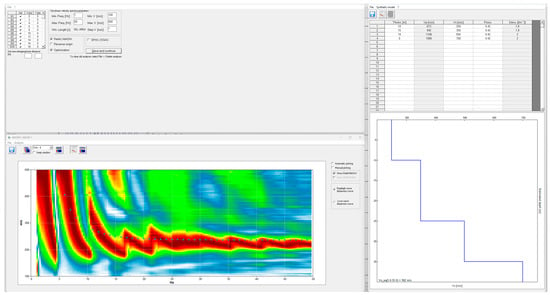
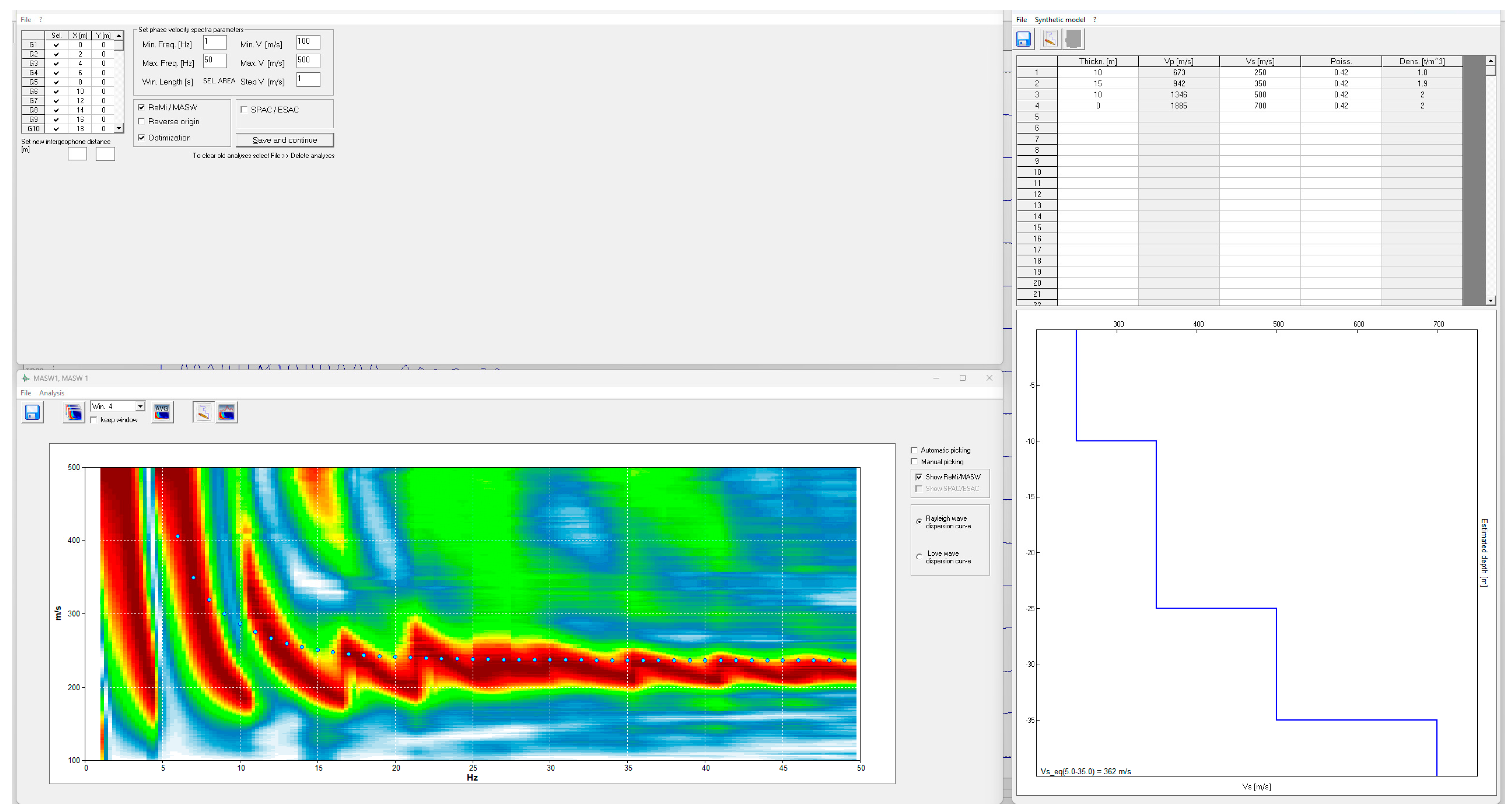
An example of the MASW data processing workflow is presented in Figure 5.
Figure 5.
Example of the MASW data processing workflow using the Grilla software package.
3.2. Microtremor Recording Method (H/V)
The H/V spectral ratio technique, commonly known as the Nakamura method, was applied to analyze ambient noise data and estimate the fundamental resonance frequency of the subsurface layers [13]. This method was first proposed by Nogoshi and Igarashi (1971) [14] who based their work on preliminary studies by Kanai and Tanaka [15].
An important condition in terms of the application of the H/V method is the availability of information about local engineering–geology conditions within the study area. This method is applied for the realization of seismic microzonation activities and the investigation of local soil conditions. The application of the H/V method requires careful analysis of both the amplitude and frequency of the H/V spectral ratio. In this study, particular attention was paid to the absolute amplitude of the H/V peak and the corresponding fundamental frequency, as these parameters are sensitive to changes in subsurface layering, stiffness contrasts, and water saturation [16].
The core of the Nakamura method is a calculation of the ratio of horizontal and vertical spectra of a microseism recorded using a three-component seismograph.
According to [13] the ratio between horizontal and vertical spectra derived from microtremor recordings can be used to reduce the influence of surface waves and emphasize the response of the subsurface structure. In this interpretation, the H/V spectral ratio is considered an approximation of the amplification of ground motion caused by impedance contrast between soft sediments and underlying bedrock.
In this conceptual framework, the ratio between horizontal and vertical spectra derived from a microseismic recording can be interpreted as being related to the ratio between the amplitude of S-waves recorded at the surface of a sedimentary layer and the S-wave velocity at the interface between sedimentary deposits and bedrock. However, this interpretation is still debated in the scientific community, and different studies [16] have shown that the physical meaning of the H/V curve may vary depending on geological conditions and noise sources.
The horizontal component was calculated using the root-mean-square method according to Equation (1):
H/V data were processed using the Grilla software package (MoHo S.R.L., Venezia, Italy). The software allows for calculation of horizontal-to-vertical spectral ratios, spectral smoothing, and peak identification. The methodological background of the H/V technique follows the approach proposed by [13] and further discussed in later studies, including the SESAME project (2004), which provided recommendations for reliable application of the H/V method.
As a result of H/V processing, a curve of the horizontal-to-vertical spectral ratio as a function of frequency is obtained. The main peaks of the H/V curve are commonly interpreted as indicators of resonance frequencies related to impedance contrasts between subsurface layers of different mechanical properties.
The reliable application of the H/V method requires strict data processing criteria. General guidelines for data selection, windowing, and spectral processing are provided by the SESAME project (2004). According to these recommendations, noise records must be stationary, free of transient disturbances, and processed using appropriate window lengths, smoothing parameters, and tapering functions.
In this study, microtremor records with a duration of 20 min were acquired at each measurement point. The signals were divided into time windows of 40 s, selected based on stationarity criteria. Spectral smoothing was performed using a Konno–Ohmachi window with bandwidth b = 40. The resulting H/V curves were analyzed to identify stable and significant frequency peaks [17].
Several studies have shown that under favorable geological conditions, the H/V method can also contribute to landslide investigations, including the identification of sliding surfaces and weak zones. In this study, the H/V results were therefore combined with MASW data to constrain the thickness of the unstable mass and to improve the interpretation of the geological cross-sections along the investigated profiles.
Under the geotechnical hypothesis of a one-dimensional unconsolidated layer overlying rigid bedrock, the fundamental resonance frequency f0 can be approximated by the quarter-wavelength relationship. In this simplified model, the relationship between the fundamental frequency f0 (Hz), shear-wave velocity Vs (m/s), and thickness of the soft layer h (m) is expressed as
f0 = Vs/4h
This relationship proves to be working credibly, especially in the case of striking contrasts among the upper and lower (bedrock) layers, as resonance peaks are treated most accurately [18,19].
3.3. Electrical Prospecting Work (VES)
In landslide studies, electrical resistivity is mainly used as an indirect indicator of lithological changes, degree of fracturing, water content, and pore-water salinity. Variations in resistivity are therefore particularly useful for identifying boundaries between dry and water-saturated zones, disturbed and intact materials, and unconsolidated deposits and bedrock.
In this study, the Vertical Electrical Sounding (VES) method with a Schlumberger-type array was not applied as a standalone exploration tool but in combination with MASW, H/V analysis, GPR data, and borehole information. The role of VES was to provide additional constraints on the subsurface resistivity structure, which was then jointly interpreted with seismic velocities and geological data. This integrated interpretation allowed for more reliable characterization of lithology, groundwater conditions, and the geometry of the landslide body.
The Vertical Electrical Sounding (VES) survey was performed using a four-electrode symmetric configuration (ABMN), commonly referred to as the Schlumberger array, which is widely described in classical geophysical literature. In this configuration, two outer electrodes (A and B) inject current into the ground, while two inner electrodes (M and N) measure the resulting potential difference [20].
By progressively increasing the spacing between the current electrodes A and B, the depth of investigation is increased, allowing for sampling of deeper layers of the subsurface. In this study, VES measurements were carried out with a maximum AB spacing of 320 m, following a standard Schlumberger expansion sequence. Soundings were conducted along profiles oriented perpendicular to the main axis of the landslide in order to better resolve lateral changes across the landslide body and its boundaries.
Electrical resistivity ρ in a heterogeneous medium is measured as an apparent electrical resistance ρk in Ohm-m measurement units.
The calculations of ρk were performed using the formula
where ΔU is a difference of potentials in volts, I is current intensity in amperes, and k is the AMNB spread factor. The measurements using the VES technique were carried out by means of the Russian-Federation-made CYCLE (TSYKL)-VPS digital electrical prospecting station.
3.4. Ground Penetrating Radar Survey (2D GPR)
The GPR survey was carried out using the SIR–3000 system (GSSI, Nashua, NH, USA). The method is based on the emission of short electromagnetic pulses and the recording of signals reflected from subsurface interfaces characterized by contrasts in electromagnetic properties [21].
The main physical parameters controlling the GPR response are the dielectric permittivity and the electrical conductivity of subsurface materials. Reflections are generated at boundaries where these properties change, including, for example, at contacts between dry and water-saturated soils, between different lithological units, or at the interface between unconsolidated deposits and bedrock.
The propagation velocity and attenuation of electromagnetic waves are not predefined input parameters but rather estimated from the recorded data by using, for example, hyperbola fitting or calibration with known depths. Wave velocity mainly depends on dielectric permittivity, while attenuation is controlled by electrical conductivity and water content.
In this study, GPR was used to identify internal layering, disturbed zones, and possible sliding surfaces within the landslide body, with particular attention to zones of increased water saturation, which strongly influence electromagnetic wave propagation.
In the first approximation, the propagation of electromagnetic waves is subject to the laws of geometrical optics. In the case of radar surveying, the main processes in a medium are represented by the reflection and diffraction of waves.
During a GPR survey, each transmitted electromagnetic pulse produces a reflected signal (radar trace) that records the travel time of the wave over a time window of a few tens of nanoseconds. These individual radar traces are displayed side by side along the profile to form a two-dimensional image of the subsurface, commonly called a radargram. This image represents the variation of reflected energy with depth and distance along the profile.
Basic principles of GPR acquisition and data display are described in detail in several introductory textbooks [22,23]. In this study, radargrams were interpreted to identify internal layering, disturbed zones, and possible sliding surfaces within the landslide body.
Field measurement results were processed using the Radan 6.5 software package [23].
4. Results
4.1. Results of Engineering–Geology Studies
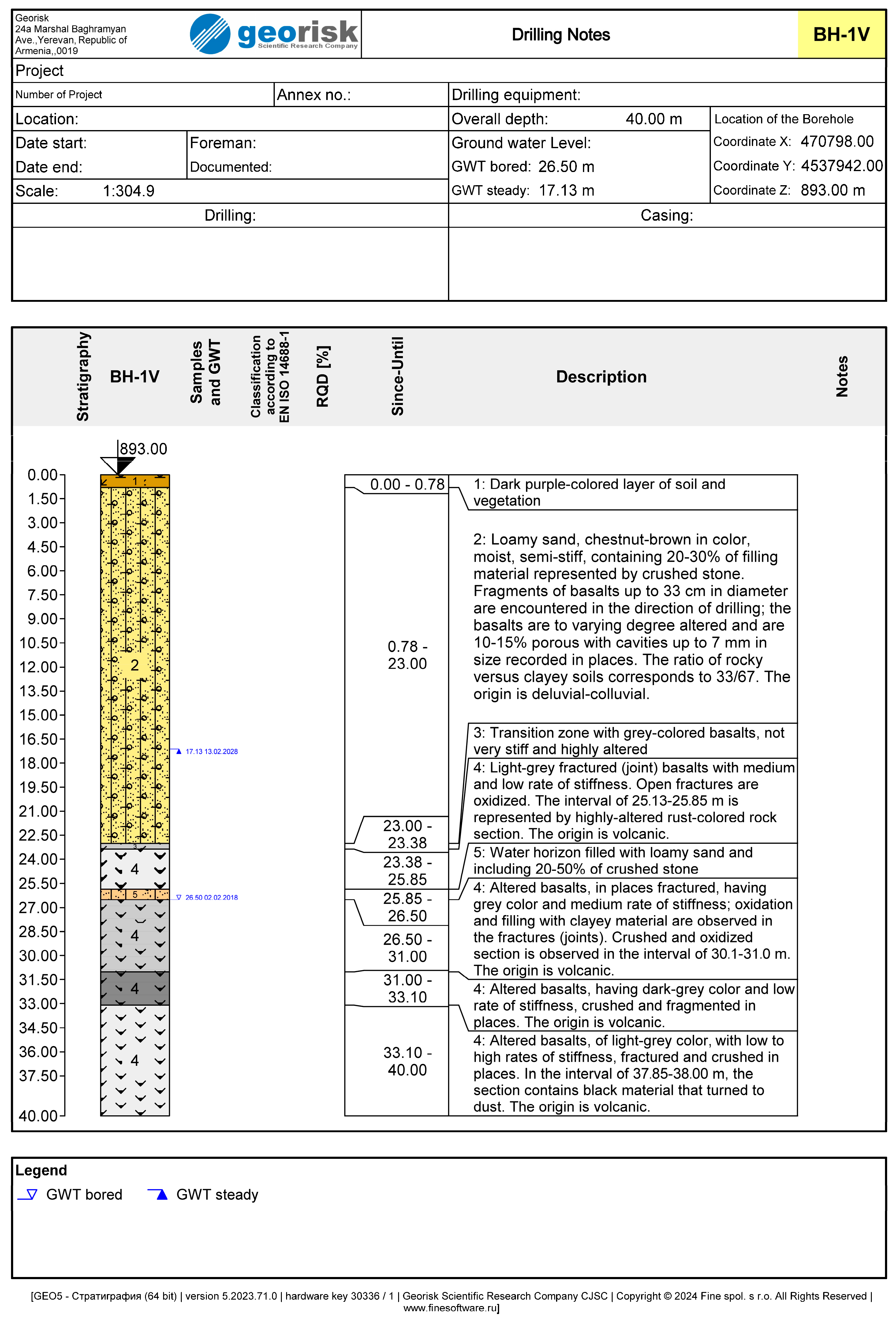
Lithology sections were plotted for the two vertical boreholes drilled in the landslide body area and are presented in Figure 3 and Figure 4.
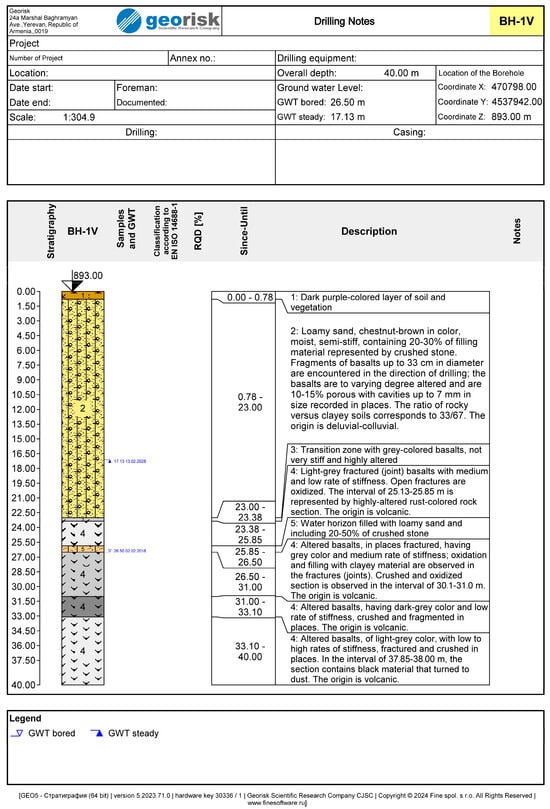
A visual study of the core recovered from Borehole 1 shows that the contact zone (sliding surface) is correlated with the water-bearing horizon that was recorded in the interval of 25.8–26.5 m and represented by about 0.7 m thick crushed rock composed of a mixture of detritus and gross. The study of the soil section revealed through drilling shows that the entire thickness of the landslide body in the investigated part is composed of basalt boulders (from small clasts up to 0.3 m in diameter), with strongly disturbed zones around the boulders locally filled with gravel and loam (Figure 6).
Figure 6.
Section and description of vertical borehole BH01.
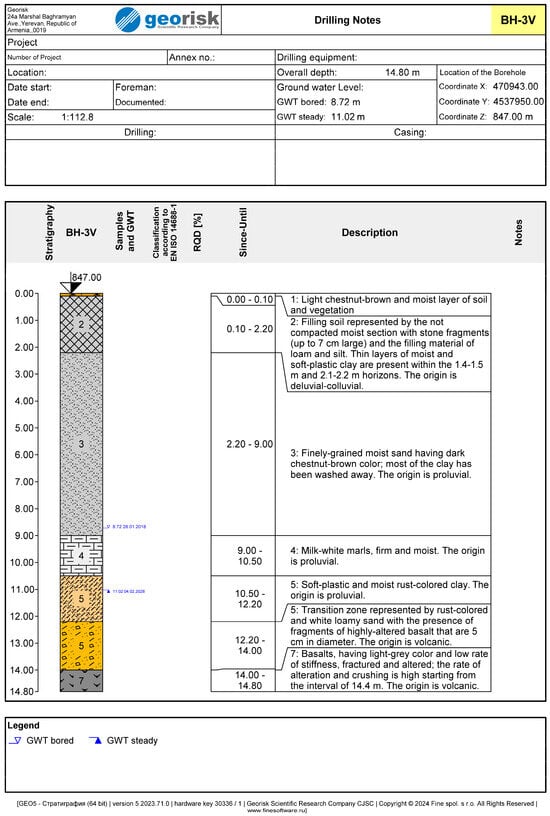
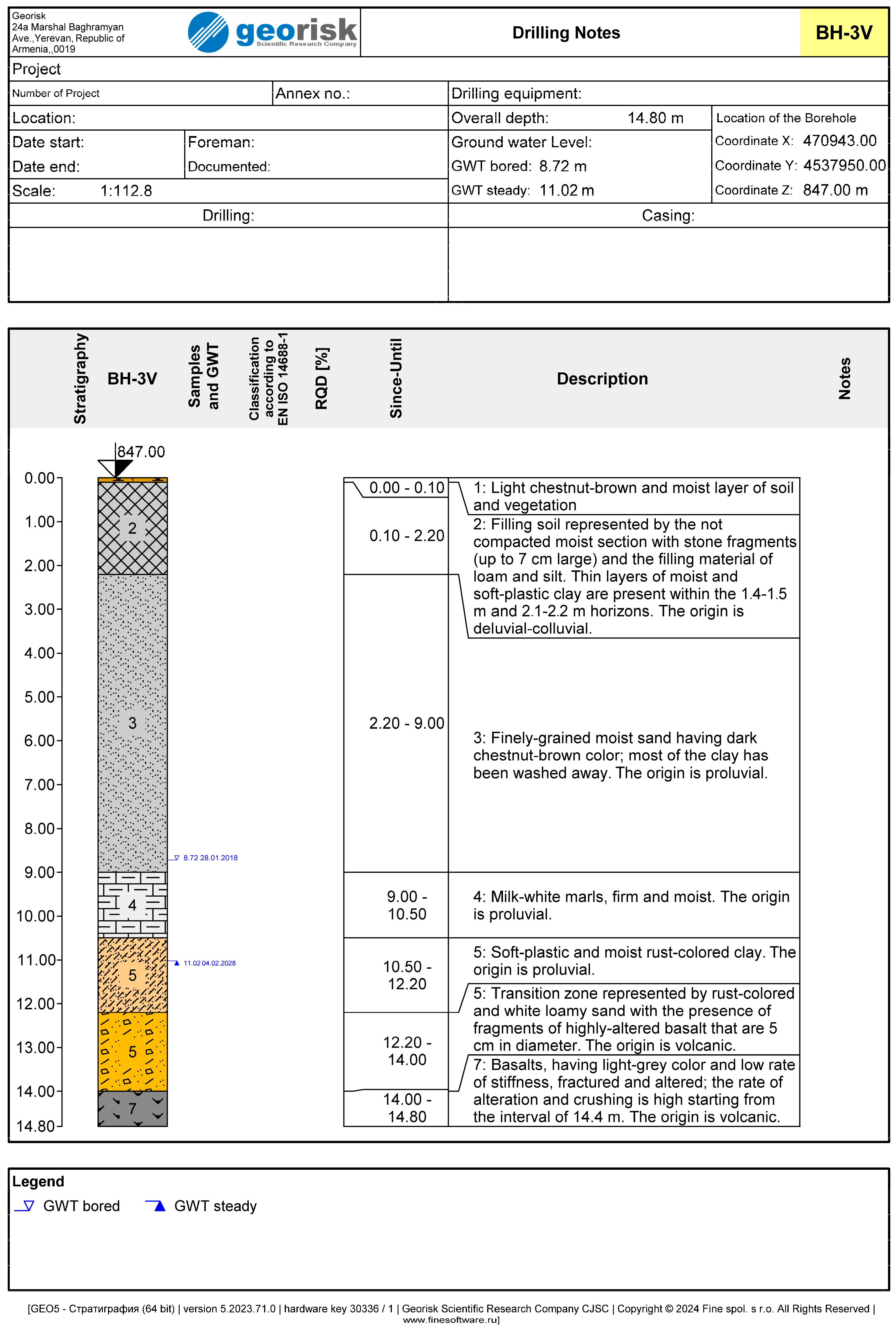
Fill-up soil of crushed stone with loam filling was recorded down to the depth of 2.2 m based on the data from Borehole BH-3V (Figure 7). In the interval of 2.2 m–12.2 m, the core was represented by hard-plastic and moist clays. The sliding plane is correlated with the transition zone that starts from a depth of 12.2 m and corresponds to the boundary interface of the clay layer with the altered bedrock. The water-bearing horizon was represented by crushed and weathered detritus and gross. In the course of drilling, groundwaters were encountered at a depth of 8.8 m, but later they settled lower, at about 10.9 m. As attested by the monitoring instrument currently installed in the borehole, the groundwater level has been stabilized at a depth of 11.2 m (as of 12 February 2018) (Figure 7).
Figure 7.
Section and description of vertical borehole BH03.
4.2. Results of the Geophysical Studies
4.2.1. Results of the Microtremor Recording Method (H/V)
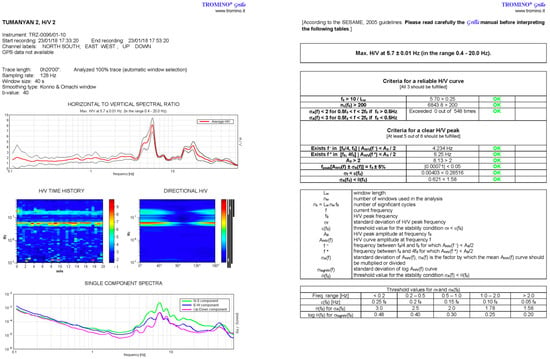
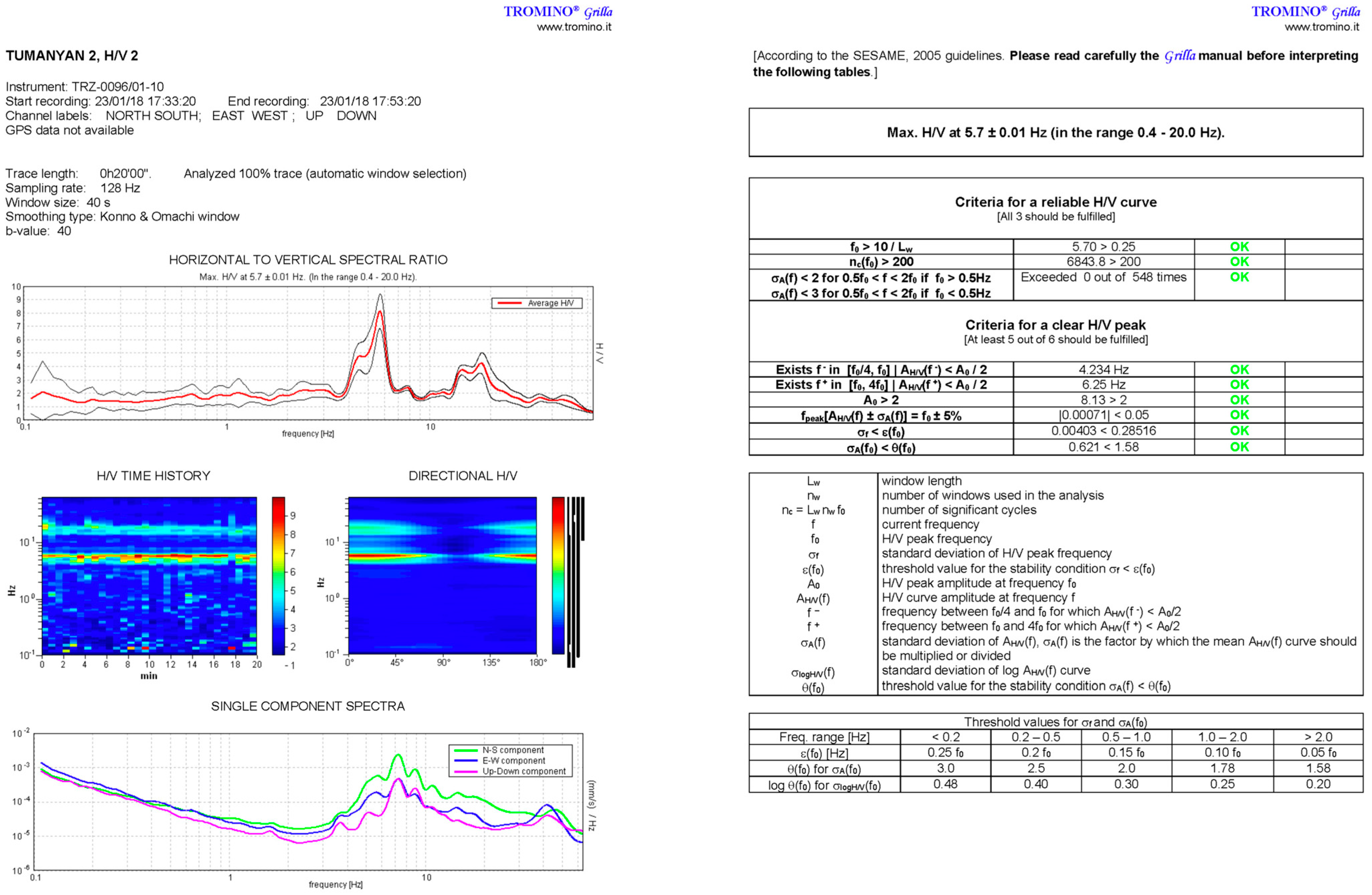
Microtremor measurements were carried out at nine points within the landslide area, and an H/V spectral ratio curve was obtained for each site. Figure 8 presents an example of an H/V recording at a single measurement point and the corresponding data processing results (example of H/V2 measurement point).
Figure 8.
Example of microtremor H/V recording and corresponding processing results at a single measurement point (H/V2).
Most of the H/V curves show one dominant and stable peak, which is interpreted as the fundamental resonance frequency of the soft deposits. However, in some cases, secondary or less stable peaks are also observed, reflecting local heterogeneity of subsurface conditions. The interpreted fundamental frequencies (f0) used for further analysis are summarized in Table 1.
Table 1.
Core data table of geophysical measurements.
4.2.2. Results of the Analysis of Surface Waves (MASW)
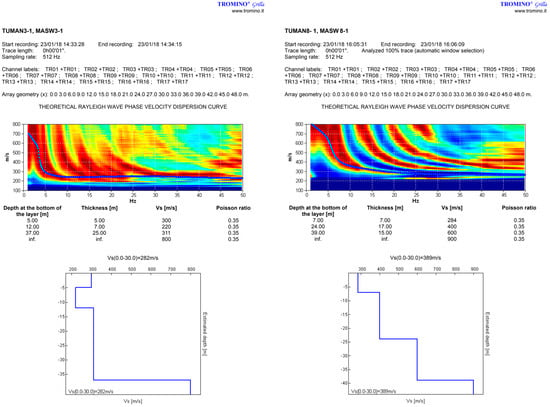
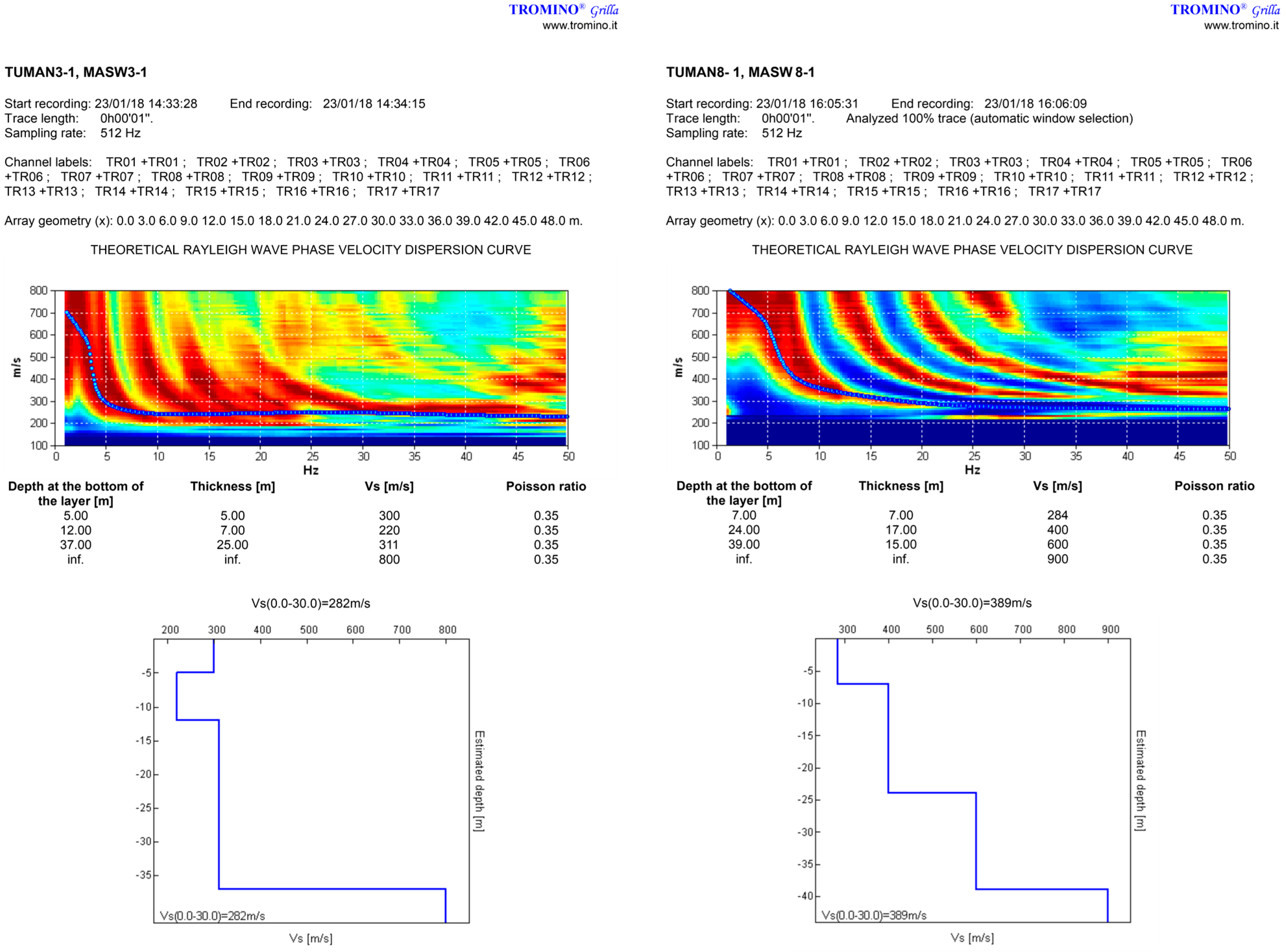
MASW surveys were carried out along nine profiles, providing shear-wave velocity (Vs) models for near-surface and deeper layers. Figure 9 illustrates the MASW processing steps and the corresponding shear-wave velocity results for two example profiles (for MASW3 and MASW8 profiles), while the interpreted Vs30 values and main velocity intervals are summarized in Table 1.
Figure 9.
MASW processing steps and the corresponding shear-wave velocity results for MASW3 and MASW8 profiles (the blue line shows the variation of shear-wave velocity (Vs) with depth).
4.3. Integrated Analysis of the Findings Provided Through the H/V and MASW Methods
Integrated analysis was carried out using microtremor recordings (H/V) and multi-channel analysis of seismic waves (MASW) methods.
The relationship between frequency, shear-wave velocity, and layer thickness is described by the quarter-wavelength model already introduced in Equation (2), which is here applied to the results obtained from MASW data.
Using respective data values of the frequencies and Vs average shear wave distribution velocities listed in Table 1 with Equation (4), the thickness and depth values are estimated for the corresponding layers:
H = VS/4f0
Hence, layer depths for Profile A–A′ are presented below (Table 2).
Table 2.
Values of layer depths for Profile A–A′.
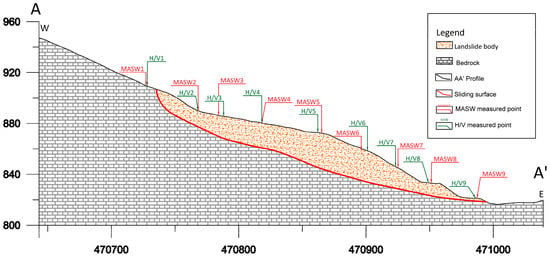
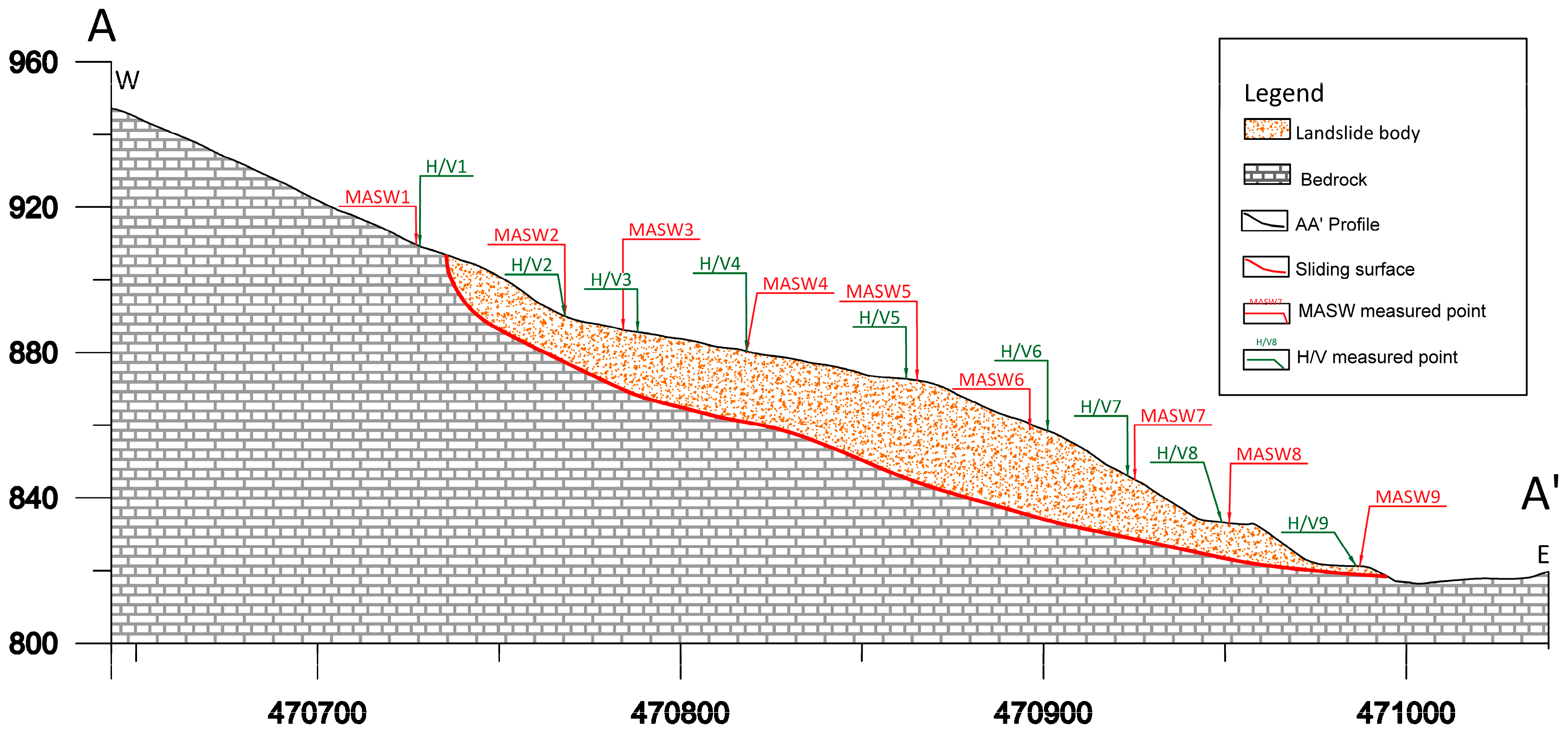
The section of the geophysical profile was plotted for the landslide by placing the values of layer depths (Table 2) along Geo-Morphological Profile A–A′ (Figure 10).
Figure 10.
Profile AA′ in the landslide area and the geophysical section plotted along this profile.
One (1) boundary that represents the potential sliding plane (failing surface) of the landslide was identified during the complex seismic prospecting work. The boundary is up to 28 m deep.
4.4. Results of the Electrical Prospecting Work
The survey using the VES method in the identified area was conducted along one profile with a total of nine measurement points, the locations of which are shown on the map (Figure 4).
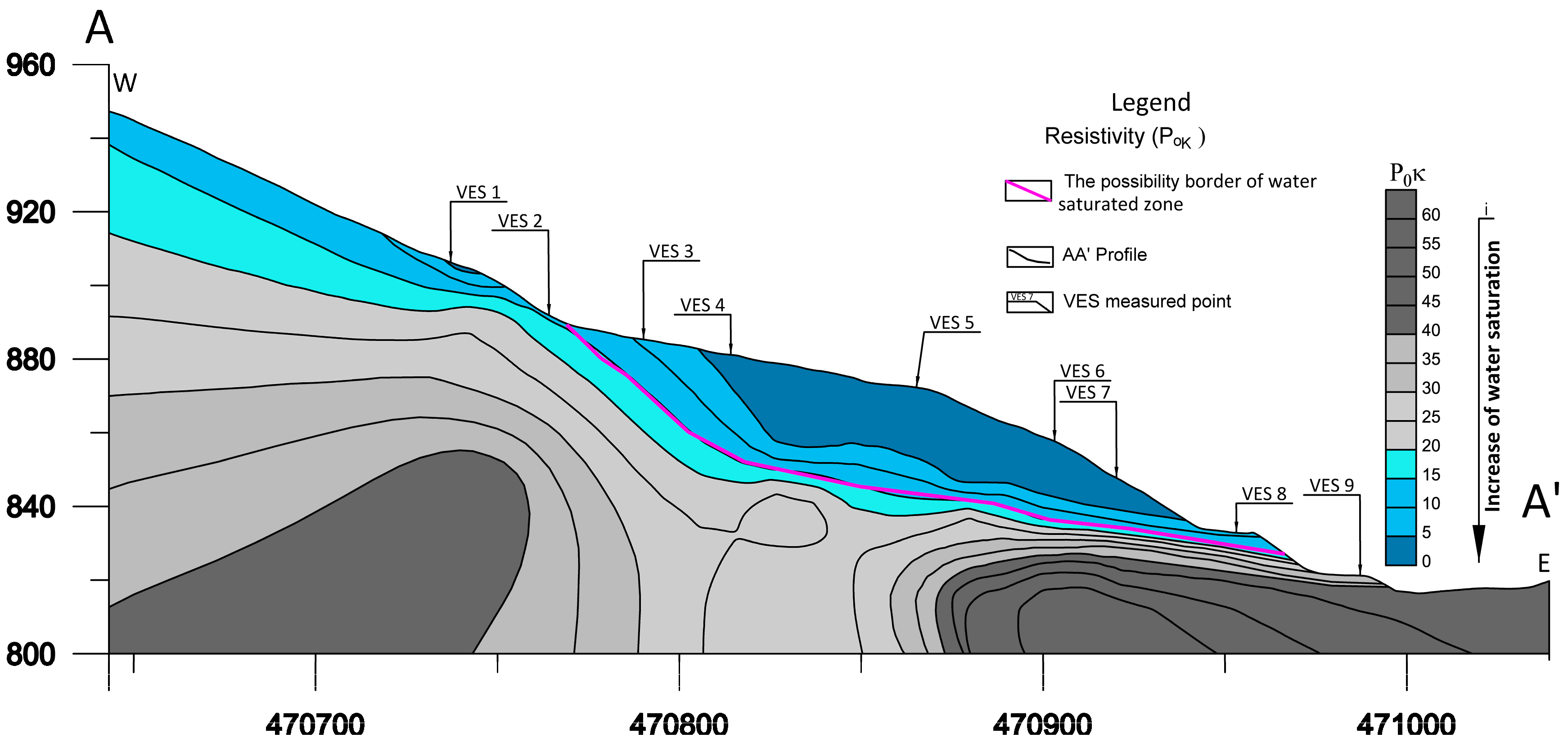
According to the results provided by the analysis and inversion of field data, geo-electrical boundaries were detected within the upper layers of the geological section, and characteristics of apparent resistivity were calculated for each identified geo-electrical horizon (Figure 11).
Figure 11.
Geo-electrical section plotted according to individual soundings.
The analysis of data produced through the application of the electrical prospecting method makes it clear that there are not any striking abrupt changes in the measured resistivity values. The detection of strikingly low values is mainly explained by the presence of a water-bearing horizon. Layers with low values of electrical resistivity along the entire section were identified to have depths up to 30 m (Figure 11). Low values are typical for degraded, crushed, and water-saturated structures.
4.5. Results of the Geo-Radar Survey (GPR)
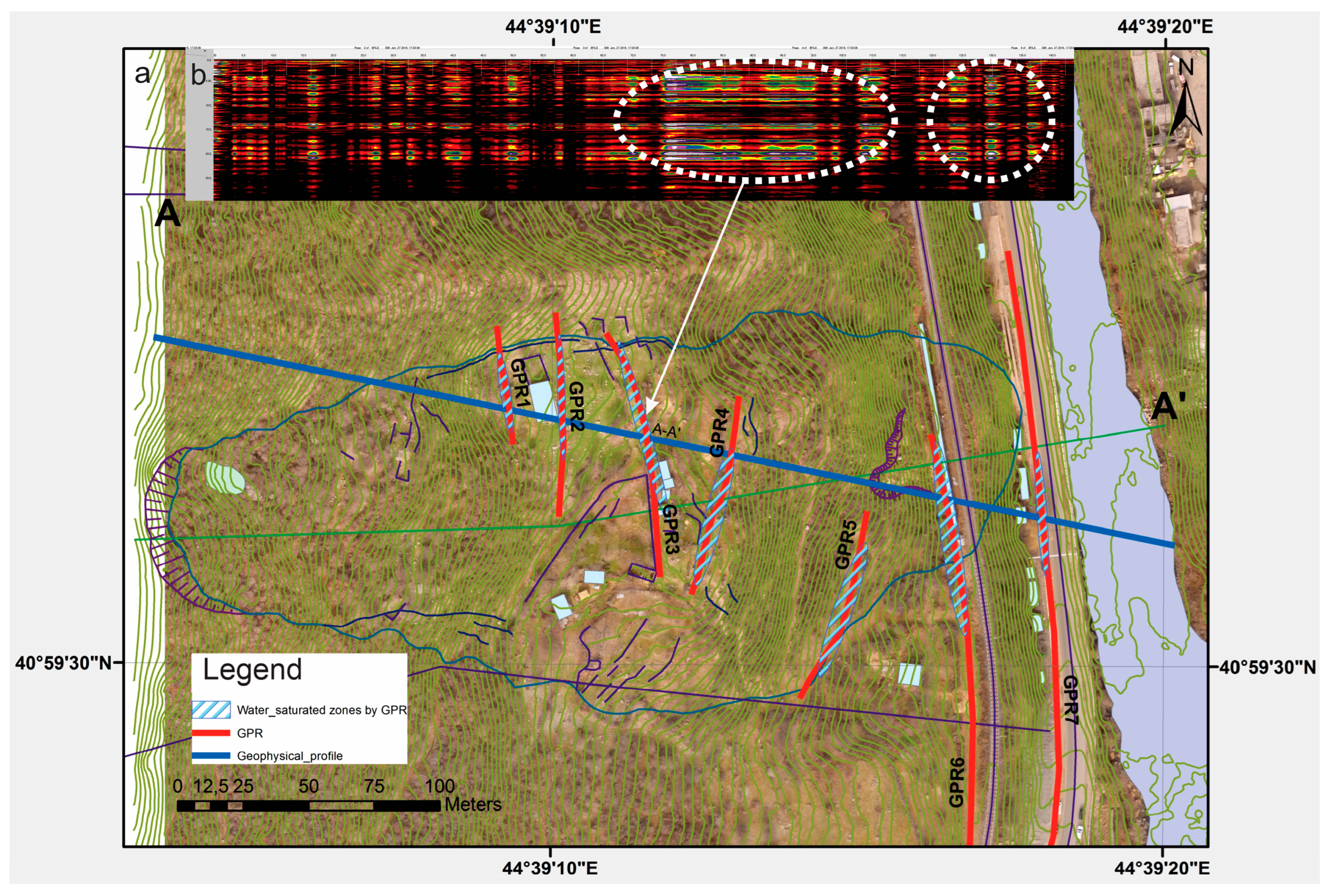
A geo-radar survey (GPR) within the landslide area was realized along profiles with a total length of 900 m; their locations are indicated in Figure 4. Radargrams generated as a result of the geo-radar survey were subjected to quantity and quality analysis. The color differentiation map highlights the areas where anomalous zones were identified and mapped, mainly related to water-saturated deposits, which also produce a strong ringing effect in the GPR data and correspond to very low apparent resistivity values obtained through VES (Figure 12).
Figure 12.
(a) Location of GPR profiles and water-saturated zones interpreted from GPR data on the landslide area; (b) representative radargram along profile GPR3, showing zones of strong signal attenuation and ringing effects related to water-saturated deposits (the white dashed circle shows the GPR anomalies identified in the along profile GPR3, A–A′ is the geophysical profile).
4.6. Hydrogeological Conditions
Leaks of water from the water line running in the upper section of the landslide slope appear to be the cause of periodical landslide activations; when considerable quantities of water penetrate the landslide mass in a state of unstable equilibrium, they mainly saturate it in its northern part, triggering momentary dislocation toward the foot area. However, the inflow of surface water during periods of heavy precipitation and snow melting that influence slope stability must be considered, as well. This water settles in gently sloping sites and depressions within the landslide and is capable of producing rather big accumulations and, infiltrating toward deeper horizons, disrupting the balanced state of the hazard-prone slope.
At the stage of landslide activation, the collapse of water-saturated soils in the landslide front area brought about the emergence of several springs that had been initially observed to produce water outflows of significant volume.
5. Geotechnical Interpretation of the Slip Surface
The identification of the slip surface represents the key result of this study, as it provides the basis for geotechnical interpretation and subsequent stability calculations. In this section, results obtained through different methods—MASW and H/V analysis (Figure 10), VES data (Figure 11), GPR interpretation, and borehole information from BH01 and BH03—are jointly analyzed to constrain the geometry of the failure surface within the landslide body.
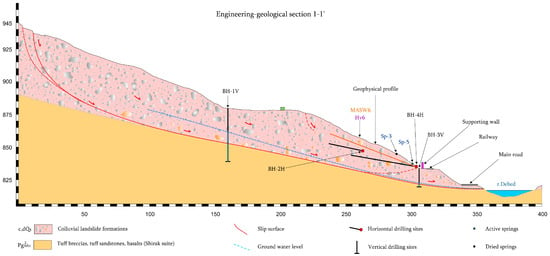
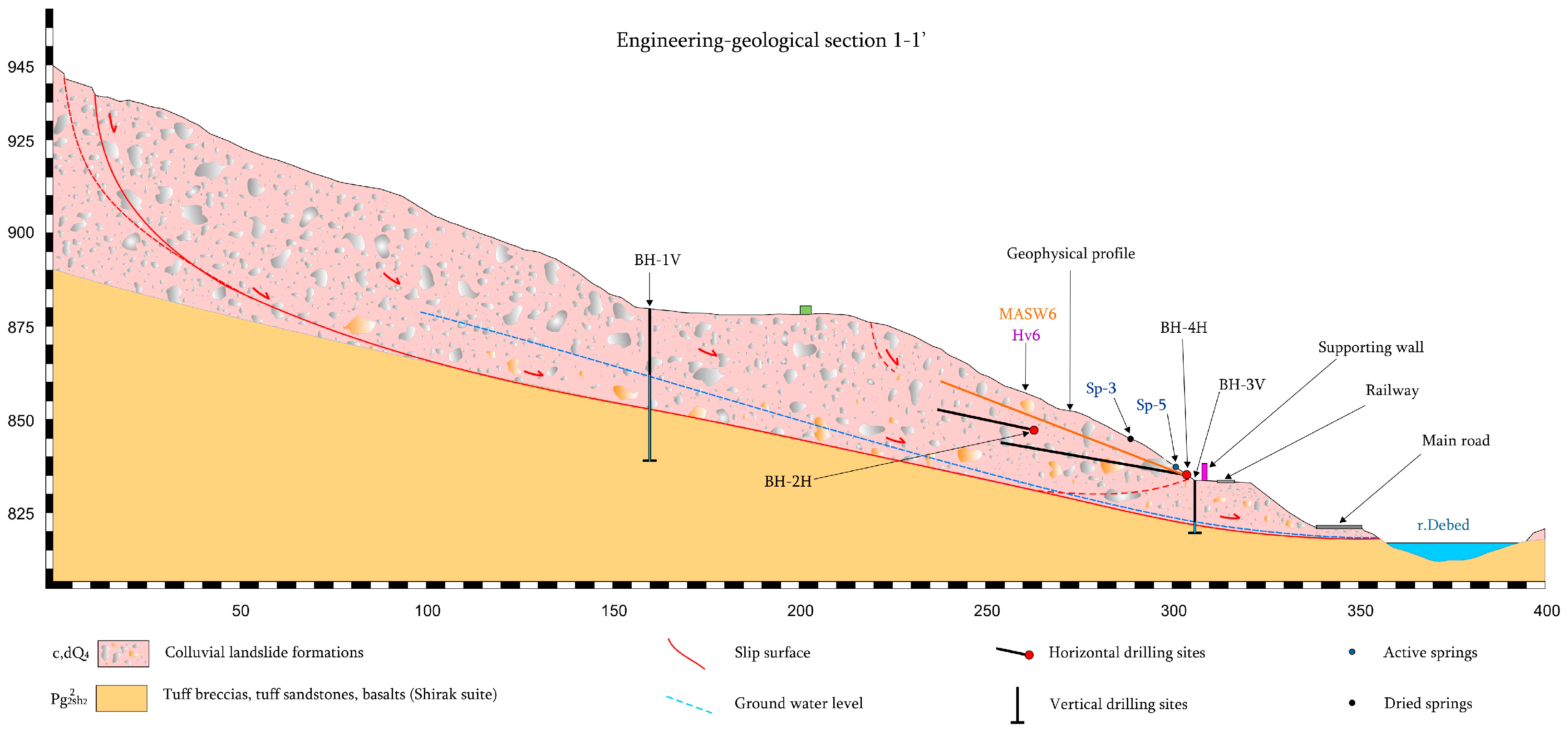
The longitudinal engineering–geological section 1–1′ (Figure 13) was constructed by integrating geophysical results, drilling data, and detailed field reconnaissance. The surface interpreted from MASW and H/V analysis (Figure 10) indicates a pronounced velocity contrast, which is interpreted as the boundary between disturbed landslide material and underlying stable bedrock. This surface shows a consistent depth increase from the upper part of the slope toward the central sector of the landslide.
Borehole data provide direct control for this interpretation. In boreholes BH01 and BH03, the depth to the failure plane is clearly identified by abrupt changes in lithology, degree of fracturing, and water content. These depths coincide well with the surface derived from MASW and H/V results, confirming the reliability of the geophysical interpretation.
The VES interpretation (Figure 11) identifies a low-resistivity layer related to water-saturated and disturbed materials overlying higher-resistivity bedrock. The boundary between these units corresponds closely to the surfaces defined by seismic methods and borehole data, further supporting the inferred geometry of the slip surface.
By integrating all available direct (boreholes) and indirect (MASW, H/V, VES, GPR) data, a final representative slip surface was defined (Figure 13). This surface is considered the best possible representation of the real geotechnical conditions in the subsoil based on the consistency among different datasets. It shows that the main water-saturated rupture surface reaches the railway zone but does not cross it, while the landslide foot extends down to the river erosion base without forming a distinct rupture surface, corresponding to an accumulation zone.
The thickness of the landslide body overlying stable bedrock varies along the section and reaches up to about 12 m in the central part of the landslide, as indicated by both drilling and geophysical data. This integrated slip-surface geometry is therefore adopted as the reference model for the subsequent stability calculations.
6. Landslide Slope Stability Calculation
Slope stability calculations for the studies of the landslide area located in the Tumanyan Community of the RA Lori Marz were realized for two scenarios:
- Landslide stability is unknown (Arc Calculation);
- The landslide is stable and an earthquake takes place (PGA = 0.13 g).
The calculations were made using the methods of Fellenius and Bishop with the input values of the horizontal seismic coefficient of soil (Kh), internal friction angle (φΙ°) specific cohesion (cI, kPa), and other parameters, eventually estimating the stability factor (Fs). Comparing the latter value against the international ranking table, landslide slope stability is estimated.
Peak seismic ground acceleration (PGA) values were applied to calculate the horizontal seismic coefficient (Kh) of the soil, as it represents the input parameter to implement stability calculation.
Thus, the parameters of internal friction angle (φΙ°) and specific cohesion (cI, kPa) are estimated using the borehole data, and the horizontal seismic coefficient of soil (Kh) is calculated based on the peak ground acceleration values (PGA).
6.1. Estimation of the Seismic Impact Coefficient (Kh)
The calculation of basement stability under a specific combination of loads is realized with consideration of the inertia forces. According to Earthquake Engineering—Design Norms, II-6.02-2006, the inertia force acting on the part of a not-rocky basement exposed to sliding must be determined through structural stability calculations assuming that the basement acceleration is equal to Equation (5)
where
a = Ak0k1g,
A is a theoretical (empirical) coefficient of seismic intensity indicating the relationship of the ground acceleration of the considered locality to the free vibration acceleration;
k0 is the theoretical coefficient of soil conditions;
k1 is the coefficient of the permissible damage rate;
g is the acceleration of gravity.
In the case of vertical seismic load estimation, the A coefficient is multiplied by a factor of 0.7.
As attested by the implemented geophysical studies, the peak ground surface acceleration value in the landslide area corresponds to 0.13 g. Therefore, A = 0.13. According Earthquake Engineering—Design Norms, II-6.02-2006 [24] basement soils within the studied site are, based on their seismic properties, assigned to Category III.
The k0 coefficient of soil conditions for Category III soils falling within Seismic Zones III equals 1.1.
Therefore, based on Earthquake Engineering—Design Norms, II-6.02-2006 [24] it is estimated that
- The product of Ak0 corresponds to 0.13 × 1.1 = 0.143;
- k1 = 0.4 based on Table 1.7 (Earthquake Engineering—Design Norms, II-6.02-2006).
The estimated (design) value of relative acceleration corresponds to
(a/g)hor = 0.143 × 0.4 = 0.0572 in the horizontal direction;
(a/g)ver= 0.7 × 0.572 = 0.04 in the vertical direction.
Thus, the value of PGA = 0.13 g was produced for the peak seismic ground acceleration (PGA), and it was applied when realizing stability calculations (PGA = 0.13 g, Kh = 0.05).
6.2. Scenario I—The Stability of the Landslide Is Not Known (The Landslide Arc Technique Was Applied to Landslide Slope Calculations in This Case (Arc Calculation))
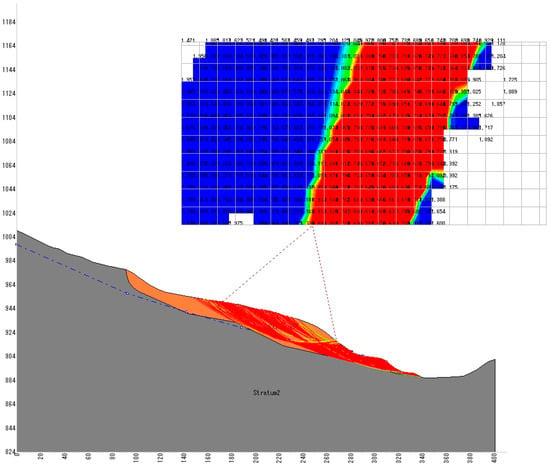
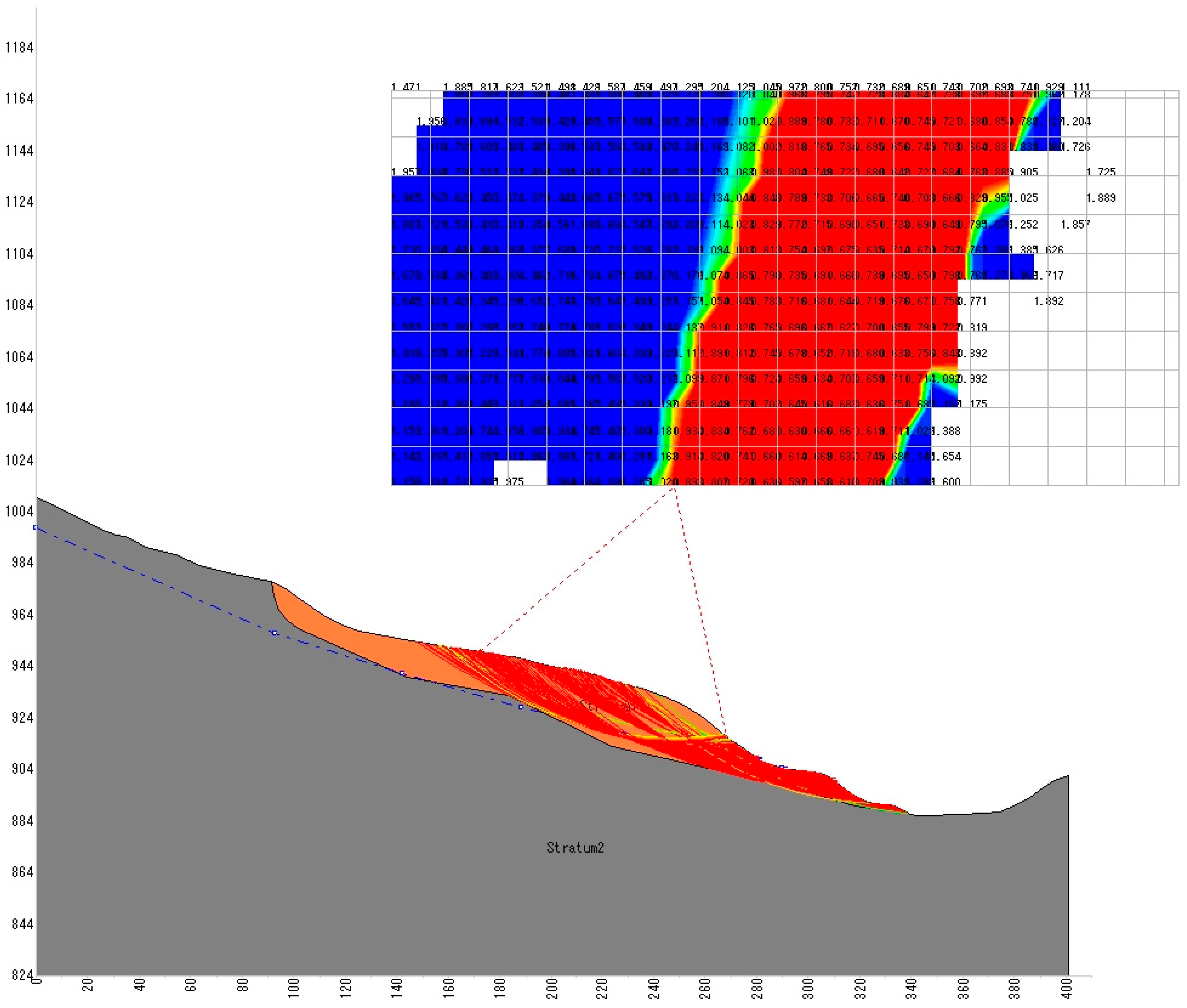
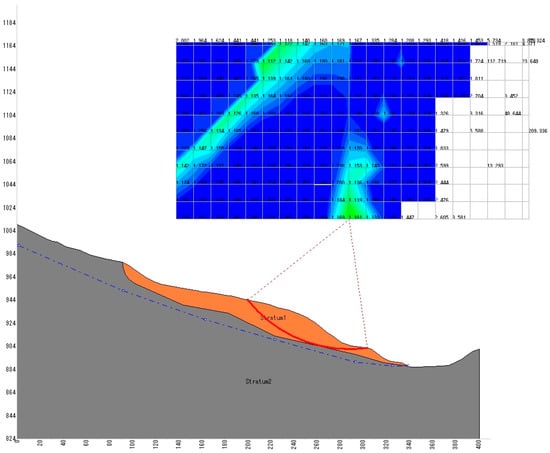
The calculations were realized for the cases of low and high-standing levels of groundwater. The results indicate that without an earthquake and with the availability of groundwater in the landslide body, the stability factor is estimated at Fs = 0.929. It is considered that in compliance with the international scale of the stability factor, the critical limit value is set at Fs = 1.0; hence, the estimated value (Fs = 0.929) attests to the unstable condition of the landslide. Most unstable sites of the landslide are identified with a red color (Figure 14).
Figure 14.
Landslide stability calculation using the arc technique in the case of groundwater availability in the landslide body (Arc Calculation).
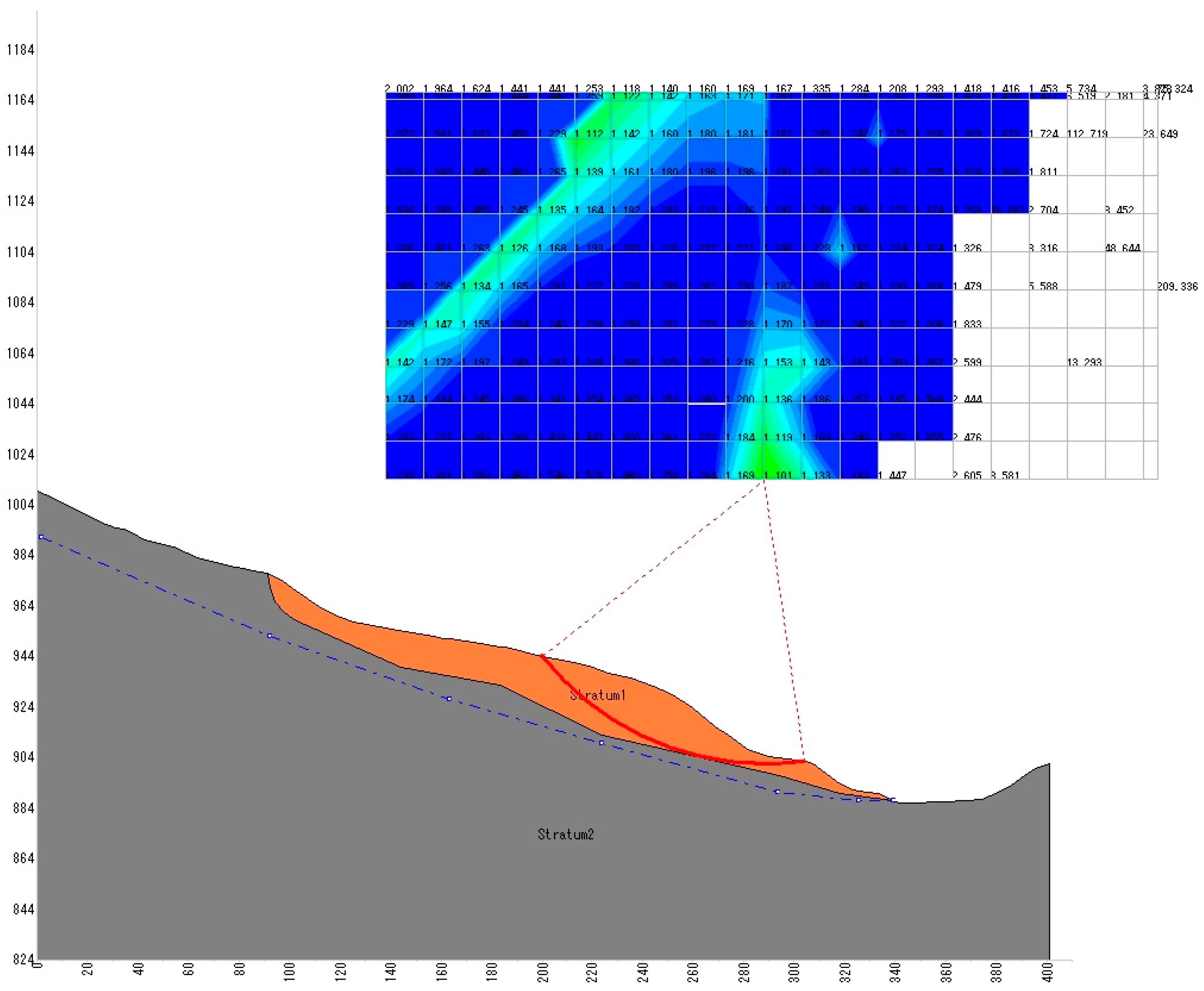
Therefore, in the case of a considerable drop in groundwater level (which has happened as a result of drainage drilling), the landslide stability factor corresponds to Fs = 1.101. This makes it possible to conclude that despite the currently stable condition of the landslide (Figure 15), the stability factor is nevertheless approaching its threshold value. It can be disrupted in the case of a rise in the groundwater level.
Figure 15.
Landslide stability calculation using the arc technique in the case of no groundwater present in the landslide body (Arc Calculation).
6.3. Scenario II—The Landslide Is Stable and an Earthquake Occurs (PGA = 0.13 g)
The Fellenius method. In case an earthquake occurs, the slope stability factor is estimated at 0.941 (Fs = 0.941) based on the calculations. It is considered that in compliance with the international stability factor scale, the critical limit value is set at Fs = 1.0; hence, the estimated value of Fs = 0.941 attests to actual instability. In other words, the landslide will be activated in case the horizontal seismic coefficient of soil (Kh) has a value of 0.05.
The Bishop method. In case an earthquake occurs, the slope stability factor is estimated at 0.940 (Fs = 0.940) based on the calculations. It is considered that in compliance with the international stability factor scale, the critical limit value is set at Fs = 1.0; hence, the estimated value of Fs = 0.940 attests to being unstable. Therefore, the landslide will be activated in case the horizontal seismic coefficient of soil (Kh) has a value of Kh = 0.05.
The calculations of landslide slope stability indicate that it is currently in a state of unstable equilibrium and, in case of earthquake and/or high level of groundwater, the landslide can be reactivated.
7. Discussion
The proposed integrated approach demonstrates how rapid acquisition and interpretation of multi-source data can support emergency decision making under real-time conditions.
Compared with many recent landslide studies (2020–2024) that rely mainly on remote sensing, numerical modeling, or a single geophysical method, this study highlights the advantage of combining UAV mapping, MASW, H/V analysis, VES, GPR, and drilling within a single operational workflow. This integration significantly reduces uncertainty in identifying the internal structure of the landslide and allows for faster transition from scientific analysis to engineering intervention.
A key strength of the proposed methodology is its applicability in cases where the residual landslide risk must be addressed and reduced within a very short timeframe insufficient to complete detailed geotechnical investigations (drilling, laboratory analyses on samples, etc.). The successful application of horizontal drainage in the Tumanyan landslide demonstrates how geophysical and engineering data can directly guide mitigation measures.
Post-intervention monitoring confirms that the drainage system significantly improved slope stability and effectively reduced the immediate risk to the railway and highway infrastructure.
At the same time, the approach has some limitations. The accuracy of geophysical interpretations depends on data quality, site accessibility, and the degree of geological complexity. In areas with very heterogeneous materials or strong anthropogenic disturbances, ambiguities in geophysical models may increase and require additional drilling for verification.
Despite these limitations, the closed-loop methodology proposed in this study—UAV mapping, multi-source geophysics, engineering verification, numerical modeling, and drainage intervention—can be transferred to other water-induced landslides, particularly in tectonically active and mountainous regions. It provides a practical framework for reducing landslide risk where rapid decisions are required to protect infrastructure and settlements.
8. Conclusions
This study demonstrates the effectiveness of an integrated geophysical and engineering–geological approach for investigating and mitigating a rapidly activated, water-triggered landslide threatening critical infrastructure in northern Armenia. Based on the obtained results, the following conclusions can be drawn:
- The Tumanyan landslide is a complex rotational landslide developed within heterogeneous diluvial–colluvial deposits overlying altered volcanic bedrock in which groundwater plays a decisive role in both activation and reactivation processes.
- The integrated use of MASW, H/V microtremor analysis, GPR, and VES, supported by borehole data and UAV-based photogrammetry, allowed for reliable reconstruction of the internal structure of the landslide body and precise delineation of the main sliding surface at depths reaching approximately 30 m.
- Zones of reduced shear-wave velocity and low electrical resistivity were identified and interpreted as water-saturated and mechanically weakened materials, which was independently confirmed by drilling and hydrogeological observations.
- Slope stability analyses showed that the landslide body was close to failure, with a high sensitivity to groundwater level rise and seismic loading, explaining its rapid activation under unfavorable hydrological conditions.
- On the basis of the integrated interpretation, horizontal drainage drilling was selected as the most effective emergency mitigation measure and successfully implemented to reduce pore-water pressure along the sliding surface.
- The Tumanyan case demonstrates that rapid integration of multi-source geophysical data with engineering–geological analysis provides a robust scientific basis for emergency decision making in landslide hazard management.
- The closed-loop methodology applied in this study—UAV mapping, multi-source geophysics, engineering verification, numerical modeling, and drainage intervention—is transferable to other mountainous and tectonically active regions where groundwater-controlled landslides threaten critical infrastructure, particularly under emergency conditions.
Author Contributions
Conceptualization, M.G., K.M. and E.S.; methodology, M.G., H.B. (Hayk Baghdasaryan), H.B. (Hektor Babayan), K.M. and E.S.; software, M.G., D.A., G.B., S.A. and E.S.; validation, M.G., H.B. (Hektor Babayan) and E.S.; formal analysis, M.G., D.A., H.I., H.B. (Hayk Baghdasaryan), G.B., S.A. and E.S.; investigation, M.G., D.A., H.I., G.B., S.A., K.M. and E.S.; resources, M.G., D.A., H.B. (Hektor Babayan), G.B. and S.A.; data curation, M.G.; writing—original draft preparation, M.G. and E.S.; writing—review and editing, M.G., H.I., H.B. (Hektor Babayan), K.M. and E.S.; visualization, M.G., H.B. (Hayk Baghdasaryan) and S.A.; supervision, M.G.; project administration, M.G.; funding acquisition, K.M. All authors have read and agreed to the published version of the manuscript.
Funding
This research was supported by the Rescue Service of the Ministry of Emergency Situations of Armenia, the work was carried out within the framework of Contract No. HMA-TSJB-AIN-18/2-1 concluded between the Ministry of Emergency Situations of the Republic of Armenia and the Institute of Geological Sciences of the National Academy of Sciences of the Republic of Armenia.
Data Availability Statement
The data presented in this study are available on request from the corresponding author. (The data presented in this study are derived from field geophysical and engineering-geological investigations (MASW, GPR, VES, microtremor recordings, borehole and drainage data) conducted under emergency response conditions for landslide risk mitigation near critical infrastructure. The raw datasets are large, heterogeneous, and partly subject to institutional and practical restrictions related to emergency management activities and infrastructure safety).
Acknowledgments
The research team extends its gratitude to Davit Tonoyan, Minister of Emergency Situations of Armenia (during 2017–2018), and Karapet Vardanyan, Adviser to the Prime Minister of Armenia (during 2010–2018), as well as the staff of the Rescue Service of the Ministry of Emergency Situations of Armenia, for their organizational help and support during research under critical conditions caused by the activation of the Tumanyan landslide. Special thanks to “GEORISK” Scientific Research Company for providing geophysical equipment and software for processing, as well as for financial support to publish this paper. We also acknowledge our colleagues from “NORGEO” LLC for performing the exploration drilling of the landslide body and subsequent horizontal drainage drilling. During the preparation of this manuscript, the authors used Generative AI tools for language editing and improvement of clarity, grammar, and style of the manuscript. The authors have reviewed and edited the output and take full responsibility for the content of this publication.
Conflicts of Interest
The authors declare no conflicts of interest.
References
- World Bank. Disaster Risk Reduction and Emergency Management in Armenia. 2009. Available online: https://www.preventionweb.net/files/12368_ReportArmeniaDisasterRiskReductiona.pdf (accessed on 3 February 2026).
- Japan International Cooperation Agency (JICA). Technical Reference on Landslides in Armenia “Landslides in Armenia”, Yerevan; Japan International Cooperation Agency (JICA): Tokyo, Japan, 2005; 80p. [Google Scholar]
- Matossian, A.; Baghdasaryan, H.; Avagyan, A.; Igityan, H.; Gevorgyan, M.; Havenith, H. A New Landslide Inventory for the Armenian Lesser Caucasus: Slope Failure Morphologies and Seismotectonic Influences on Large Landslides. Geosciences 2020, 10, 111. [Google Scholar] [CrossRef] [Scilit]
- Bianchini, S.; Raspini, F.; Ciampalini, A.; Lagomarsino, D.; Bianchi, M.; Bellotti, F.; Casagli, N. Mapping landslide phenomena in landlocked developing countries by means of satellite remote sensing data: The case of Dilijan (Armenia) area. Geomat. Nat. Hazards Risk 2016, 8, 225–241. [Google Scholar] [CrossRef] [Scilit]
- Danneels, G.; Bourdeau, C.; Torgoev, I.; Havenith, H.-B. Geophysical investigation and dynamic modeling of unstable slopes: Case-study of Kainama (Kyrgyzstan). Geophys. J. Int. 2008, 175, 17–34. [Google Scholar] [CrossRef] [Scilit]
- Galoyan, G.L.; Melkonyan, R.; Atayan, L.; Chung, S.; Khorenyan, R.; Lee, Y.; Amiraghyan, S. On the Petrology and Geochemistry of Jurassic Magmatics of the Somkheti Segment of the Somkheto-Karabagh Tectonic Zone (Northern Armenia); Proceedings NAS RA, Earth Sciences; 2018; Volume 71, pp. 3–27. Available online: https://arar.sci.am/dlibra/publication/132091/edition/119841/content (accessed on 3 February 2026).
- Park, C.B.; Miller, R.D.; Xia, J. Multichannel Analysis of Surface Waves (MASW). Geophysics 1999, 64, 800–808. [Google Scholar] [CrossRef] [Scilit]
- Xia, J.; Miller, R.D.; Park, C.B. Estimation of near-surface shear-wave velocity by inversion of Rayleigh waves. Geophysics 1999, 64, 691–700. [Google Scholar] [CrossRef] [Scilit]
- Sheth, H.; Meliksetian, K.; Gevorgyan, H.; Israyelyan, A.; Navasardyan, G. Intracanyon basalt lavas of the Debed River (northern Armenia), part of a Pliocene—Pleistocene continental flood basalt province in the South Caucasus. J. Volcanol. Geotherm. Res. 2015, 295, 1–15. [Google Scholar] [CrossRef] [Scilit]
- Park, C.B. Shear-Wave Velocity (Vs) Profiling by Surface Wave (MASW) Method. In Symposium on the Application of Geophysics to Engineering and Environmental Problems; EEGS: Boston, MA, USA, 2005. [Google Scholar]
- Bullen, K. An Introduction to the Theory of Seismology; Cambridge University Press: Cambridge, UK, 1963; 381p. [Google Scholar]
- Miller, R.; Xia, J.; Park, C.; Ivanov, J. Shear-wave velocity field from surface waves to detect anomalies in the subsurface. In Proceedings of the First International Conference on the Application of Geophysical Methodologies to Transportation Facilities and Infrastructure, St. Louis, MO, USA, 11–15 December 2000; Volume 4, pp. 8.1–8.10. [Google Scholar]
- Nakamura, Y. A method for dynamic characteristics estimation of subsurface layers using microtremor on the surface. Q. Rep. Railw. Tech. Res. Inst. 1988, 29, 18–27. [Google Scholar]
- Nogoshi, M.; Igarashi, T. On the amplitude characteristics of microtremor (Part 2). J. Seismol. Soc. Jpn. 1971, 24, 26–40. [Google Scholar]
- Kanai, K.; Tanaka, T. On Microtremor VIII. In Bulletin of the Earthquake Research Institute; University of Tokyo: Tokyo, Japan, 1961; Volume 39, pp. 97–114. [Google Scholar]
- Havenith, H.; Jongmans, D.; Faccioli, E.; Abdrakhmatov, K.; Bard, P.-Y. Site Effect Analysis around the Seismically Induced Ananevo Rockslide, Kyrgyzstan. Bull. Seismol. Soc. Am. 2002, 92, 3190–3209. [Google Scholar] [CrossRef] [Scilit]
- Meric, O.; Garambois, S.; Malet, J.-P.; Cadet, H.; Gueguen, P.; Jongmans, D. Seismic noise-based methods for soft-rock landslide characterization. Bull. Soc. Geol. Fr. 2007, 178, 137–148. [Google Scholar] [CrossRef] [Scilit]
- Bard, P. Microtremor measurements: A tool for site effect estimation. In The Effects of Surface Geology on Seismic Motion; Irikura, K., Kudo, K., Okada, H., Sasatani, T., Eds.; Balkema: Rotterdam, The Netherlands, 1999; Volume 3, pp. 1251–1279. [Google Scholar]
- Jongmans, D.; Garambois, S. Geophysical investigation of landslides: A review. Bull. Soc. Geol. Fr. 2007, 178, 101–112. [Google Scholar] [CrossRef] [Scilit]
- Khmelevskoy, V. Fundamentals of Geophysical Methods; Perm State University Press: Perm, Russia, 2010; 400p. [Google Scholar]
- Jol, H.M. Ground Penetrating Radar Theory and Applications; Elsevier: Amsterdam, The Netherlands, 2009. [Google Scholar]
- Annan, A.P. Ground Penetrating Radar; Sensors & Software Inc.: Mississauga, ON, Canada, 2005. [Google Scholar]
- Radan 6.6 Software, Version 6.6. The Most Advanced GPR Data Processing Software. The World leader in Subsurface Imaging. Geophysical Survey Systems, Inc.: Nashua, NH, USA, 2007. Available online: http://www.geophysical.com/software.html (accessed on 3 February 2026).
- Earthquake Engineering—Design Norms (RA Construction Norms II-6.02-2006); Urban Development Ministry of the Republic of Armenia: Yerevan, Armenia, 2006; 120p.

Disclaimer/Publisher’s Note: The statements, opinions and data contained in all publications are solely those of the individual author(s) and contributor(s) and not of MDPI and/or the editor(s). MDPI and/or the editor(s) disclaim responsibility for any injury to people or property resulting from any ideas, methods, instructions or products referred to in the content. |
© 2026 by the authors. Licensee MDPI, Basel, Switzerland. This article is an open access article distributed under the terms and conditions of the Creative Commons Attribution (CC BY) license.