
Article

Structural Effects of the Per-O-Acetylation Reaction on Calix[4]Resorcinarenes: New Perspectives

by
Karen Castellanos-Espitia
,
Alver Castillo-Aguirre
and
Mauricio Maldonado-Villamil
*
Departamento de Química, Facultad de Ciencias, Universidad Nacional de Colombia-Sede Bogotá, Carrera 30 No. 45-03, Bogotá 111321, Colombia
*
Author to whom correspondence should be addressed.
Reactions 2026, 7(2), 34; https://doi.org/10.3390/reactions7020034
Submission received: 19 March 2026 / Revised: 17 May 2026 / Accepted: 22 May 2026 / Published: 29 May 2026

Abstract

In the present article, tetra(nonyl)calix[4]resorcinarene, tetra(p-methoxyphenyl)calix[4]resorcinarene, and tetra(p-bromophenyl)calix[4]resorcinarene were synthesized by the cyclocondensation method in acid medium. In the case of tetra(nonyl)calix[4]resorcinarene, only the crown conformer was obtained, while in the case of tetra(p-methoxyphenyl)calix[4]resorcinarene and tetra(p-bromophenyl)calix[4]resorcinarene, a conformational mixture (crown and chair) was formed, separated, and purified via the recrystallization technique. Subsequently, the per-O-acetylation reaction of the pure conformers was carried out. According to the RP-HPLC and 1H-NMR results, the per-acetylation product of the crown conformer of tetra(nonyl)calix[4]resorcinarene retained its conformation, likewise the per-O-acetylation products of the chair conformer of tetra(p-methoxyphenyl)calix[4]resorcinarene and tetra(p-bromophenyl)calix[4]resorcinarene. On the other hand, the per-O-acetylation product of crown conformers of tetra(p-methoxyphenyl)calix[4]resorcinarene and tetra(p-bromophenyl)calix[4]resorcinarene gave rise to the formation of the boat conformer.

1. Introduction

At present, new trends in supramolecular chemistry are gaining more and more strength, mainly due to the high selectivity in different fields offered by molecules with these characteristics. Platforms such as host macrocycles have a folded structure that makes them ideal candidates to perform supramolecular functions such as catalysis, molecular and biomolecular recognition, sensing, self-assembly, and threading to give interpenetrated architectures [1].
An example of host macrocycles is calix[4]resorcinarenes, which are oligomeric macrocylic polyphenols containing four resorcinol units linked by methylene bridges. Calix[4]resorcinarenes are synthesized by cyclocondensation between resorcinol and an aldehyde in an acid medium and under reflux conditions. Their three-dimensional structure adopts various conformations, such as crown, chair, boat, diamond, and saddle, which expand the possibilities of interaction with a target species [2,3,4]. In most cases, when starting from aliphatic aldehydes, calix[4]resorcinarenes are obtained in crown conformation, but when the aldehyde is aromatic, mixtures of conformers are obtained, mainly crown and chair. Separating these kinds of mixtures requires implementing modern separation methods, such as solid-phase extraction in reverse phase (RP-SPE) assisted by RP-HPLC [5]. The functionalization of calix[4]resorcinarenes has made it possible to increase their selectivity and affinity with various types of analytes [6]. For example, functionalized calix[4]resorcinarenes have been applied in drug delivery [7], removal of contaminants from water [8,9], separation processes [10,11], chemosensors [12,13], supramolecular polymers [14], chemical separations [15], catalysis [16], antioxidants and therapeutic agents [17,18], etc.
Functional groups can be incorporated into the macrocyclic structure both by its lower edge (substituents on the methylene bridges) and by its upper edge (hydroxyl groups and carbon 2 of the resorcinol residue). The functionalization of the lower edge is conditioned to the reactive groups that originate from the starting aldehyde; therefore, the aldehyde tends to be derivatized before the cyclocondensation reaction [2]. On the other hand, the functionalization of the upper edge is a straightforward process [6], essentially due to the presence of
  • Four aromatic carbons activated by two adjacent hydroxyl groups, which allow aromatic electrophilic substitution reactions, incorporating electrophiles such as halogens [19], thiol group [20], sulfonyl [21], halomethyl [22], aminomethyl [23], among others.
  • Eight hydroxyl groups where nucleophilic substitution reactions can be carried out, adding other electrophilic species such as alkyl [24,25], acyl [26], halo-acyl groups [2], among others.
Among these functionalization reactions, acylation is notable because it significantly extends the resorcinarene cavity and has some advantages over other types of derivatizations, such as short reaction times and ease of purification of the products [27].
Continuing with the study of the reactivity of calix[4]resorcinarenes and their conformers, recent investigations have focused on their functional modification, supramolecular assembly, and catalytic or materials-related applications [28,29,30]. This work presents the synthesis of aliphatic calix[4]resorcinarene 1 and aromatic resorcinarene 2 as model substrates, as well as the separation of their conformers, where they were subsequently subjected to the reaction of per-O-acetylation. The results of these processes were analyzed from spectroscopic information.

2. Materials and Methods

2.1. General Experimental Information

The reagents and solvents were obtained from Merck (Darmstadt, Germany). A NicoletTM iS10 FT-IR spectrometer (Thermo Fisher Scientific, Waltham, MA, USA) with a Monolithic Zinc Selenide ATR accessory and absorption in cm−1 was used for recording the IR spectra. Nuclear magnetic resonance (1H-NMR and 13C-NMR) spectra were recorded on a BRUKER Avance 400 instrument (Bruker, Billerica, MA, USA) (400.131 MHz for 1H and 100.263 MHz for 13C), and chemical shifts are given in δ units (ppm). RP-HPLC analyses were performed using an Agilent 1200 liquid chromatograph (Agilent, Omaha, NE, USA). The elemental analysis for Carbon and Hydrogen was carried out using a Thermo Flash 2000 Elemental Analyzer (Thermo Fisher Scientific, Waltham, MA, USA).

2.2. General Procedure for the Synthesis of Calix[4]Resorcinarenes (13)

A resorcinol solution (20 mmol) and aldehyde (20 mmol) in ethanol:water (1:1) (40 mL) was added drop by drop to hydrochloric acid (4 mL) and was heated at reflux with constant stirring for 4 h. The crude reaction was cooled in an ice bath, and the precipitate formed was filtered and washed with a mixture of ethanol:water (1:1) and then with water to remove traces of acid. The filtrate was dried under vacuum and was characterized by means of IR and 1H-NMR. The separation of the conformers was carried out according to previously described procedures [31].
  • 2,8,14,20-tetranonylcalix[4]resorcinarene (1) was obtained as a yellow solid at a yield of 87%, Mp > 250 °C (decomposition). IR (ATR/cm−1): 3258 (O–H), 2925 (ArC–H), 2853 (aliphatic C–H), 1620 (ArC=C), 1294 (C–O); 1H NMR, DMSO-d6, δ (ppm): 0.83 (t, 12H, CH3), 1.20 (br. s., 56H, CH2), 1.96 (br. s., 8H, CH2), 4.21 (t, 4H, CH), 6.15 (s, 4H, ortho to OH), 7.07 (s, 4H, meta to OH), 8.88 (s, 8H, OH); 13C NMR, δ (ppm): 13.8, 22.1, 27.8, 28.8, 28.9, 29.2, 29.2, 29.3, 31.4, 34.2, 102.4, 123.0, 124.3, 151.7.
  • 2,8,14,20-tetra(4-methoxyphenyl)calix[4]resorcinarene (chair) (2a): cream white solid at a yield of 98%. Mp > 250 °C (decomposition). FT-IR (ATR/cm−1): 3362 (O-H), 1605 (ArH), 1113 (C-O); 1H NMR, DMSO-d6, δ (ppm): 3.59 (s, 12H, CH3), 5.42 (s, 4H, ArCH), 5.52 (s, 2H, ArH, ortho to OH), 6.07 (s, 2H, ArH, ortho to OH), 6.25 (s, 2H, ArH, meta to OH), 6.26 (s, 2H, ArH, meta to OH), 6.40 (8H, 4-MeO-ArH), 6.47 (8H, 4-MeO-ArH), 8.35 (s, 4OH, ArOH resorcinol residue), 8.43 (s, 4OH, ArOH resorcinol reside). 13C NMR, DMSO-d6, δ (ppm): 41.1, 54.4, 101.6, 112.2, 121.2, 129.6, 131.7, 136.2, 152.3, 156.4.
  • 2,8,14,20-tetra(4-methoxyphenyl)calix[4]resorcinarene (crown) (2b): light pink solid at a yield of 22%. Mp > 250 °C (decomposition). FT-IR (ATR/cm−1): 3389 (O-H), 3002 (ArH) 1607 (C=C), 2970 (CH3), 1113 (C-O); 1H NMR, DMSO-d6, δ (ppm): 3.70 (s, 12H, CH3), 5.58 (s, 4H, ArCH), 6.12 (s, 4H, ArH, ortho to OH), 6.49 (s, 4H, ArH, meta to OH), 6.53 (8H, 4-MeO-ArH), 6.60 (8H, 4-MeO-ArH), 8.49 (s, 8OH, ArOH resorcinol residue). 13C NMR, DMSO-d6, δ (ppm): 54.6, 56.0, 102.0, 112.5, 120.8, 129.4, 129.7, 137.7, 152.4, 156.5.
  • 2,8,14,20-tetra(4-bromol)calix[4]resorcinarene (chair) (3a): pink solid at a yield of 22%. Mp > 250 °C (decomposition). FT-IR (ATR/cm−1): 3415 (O-H), 3050 (ArH), 2970 (C-H), 1615 (C=C), 558 (C-Br); 1H NMR, DMSO-d6, δ (ppm): 5.50 (s, 4H, ArCH), 5.42 (s, 2H, ArH, ortho to OH), 6.16 (s, 2H, ArH, ortho to OH), 6.23 (s, 2H, ArH, meta to OH), 6.35 (s, 2H, ArH, meta to OH), 6.55 (8H, 4-Br-ArH), 7.12 (8H, 4-Br-ArH), 8.65 (s, 4OH, ArOH resorcinol reside), 8.76 (s, 4OH, ArOH resorcinol residue). 13C NMR, DMSO-d6, δ (ppm): 42.0, 102.2, 118.4, 120.6, 120.8, 129.4, 130.3, 131.5, 131.8, 144.1, 153.3, 153.4.
  • 2,8,14,20-tetra(4-bromophenyl)calix[4]resorcinarene (crown) (3b): light purple solid at a yield of 14%. Mp > 250 °C (decomposition). FT-IR (ATR/cm−1): 3370 (O-H), 3020 (ArH), 2950 (C-H), 1612 (C=C), 588 (C-Br); 1H NMR, DMSO-d6, δ (ppm): 5.60 (s, 4H, ArCH), 5.59 (s, 4H, ArH, ortho to OH), 6.24 (s, 4H, ArH, meta to OH), 6.57 (8H, 4-Br-ArH), 7.29 (8H, 4-Br-ArH), 8.75 (s, 8OH, ArOH resorcinol residue). 13C NMR, DMSO-d6, δ (ppm): 41.2, 102.5, 118.3, 120.3, 130.5, 130.9, 145.8, 153.7, 157.8.

2.3. Per-O-Acetylation of Resorcinarenes 13

The methodology was developed based on the work of Maldonado et al. [27]. A mixture was made between calix[4]resorcinarene (0.25 mmol), acetic anhydride (15 mL), and pyridine (300 µL). Subsequently, the reaction was heated at reflux for 5 h with magnetic stirring. After this time, the crude oil was cooled to room temperature, MeOH (15 mL) was added, and the mixture was left to rest until the next day. The crystals formed were washed with MeOH and dried at 40 °C for 4 h in an oven. In this way, the following was obtained:
  • 2,8,14,20-tetranonyl-pentacyclo[19.3.1.13;7.19;13.115;19]octacosa 1(25),3,5,7(28),9,11,13(27),15,17,19(26),21,23-dodecaen-4,6,10,12, 16,18,22,24 octacetyl (4): white solid at a yield of 81%. Mp > 250 °C (decomposition). FT-IR (ATR/cm1): 2923 y 2853 (CH aliphatic), 2110 y 1588 (ArH), 1760 (C=O), 1190 (C-O); 1H-NMR, CDCl3, δ (ppm): 0.87 (t, 12H, CH3), 1.23–1.28 (m, 56H, (CH2)8), 1.84–2.31 (m, 32H, CH2 and CH3CO), 4.14 (t, 4H, CH), 6.91 (s, 4H ortho to ArH), 7.26 (s, 4H meta to ArH). 13C-NMR, δ (ppm): 13.9, 20.8, 22.7, 27.8, 28.5, 28.9, 29.2, 29.3, 29.5, 31.6, 34.8, 112.4, 123.2, 124.7, 152.3, 169.2.
  • 2,8,14,20-tetra(4-methoxyphenyl)-pentacyclo[19.3.1.13;7.19;13.115;19]octacosa-1(25),3,5,7(28),9,11,13(27),15,17,19(26),21,23-dodecaen-4,6,10,12,16,18,22,24 octacetyl (chair) (5a): white solid at a yield of 78%. Mp > 250 °C (decomposition). FT-IR (ATR/cm1): 3059 (ArH), 2933 (CH), 1610 (ArH), 1769 (C=O), 1201 (C-O). 1H-NMR, CDCl3, δ (ppm): 2.01 and 2.06 (s, 24H, CCH3), 3.75 (s, 12H, OCH3), 5.43 (s, 4H, ArCH), 5.89 (s, 2H, ArCH, ortho to OAc), 6.22 (s, 2H, ArCH, ortho to OAc), 6.59 (sbroad, 16H, 4-MeO-ArH), 6.88 (s, 2H, ArH, meta to OAc), 7.12 (s, 2H, ArH, meta to OAc). 13C NMR, CDCl3, δ (ppm): 20.7, 20.8, 43.9, 55.0, 113.7, 116.8, 117.2, 129.5, 130.0, 131.1, 132.3, 132.6, 146.6, 147.0, 158.3, 168.4, 168.7.
  • 2,8,14,20-tetra(4-methoxyphenyl)-pentacyclo[19.3.1.13;7.19;13.115;19]octacosa-1(25),3,5,7(28),9,11,13(27),15,17,19(26),21,23-dodecaen-4,6,10,12,16,18,22,24 octacetyl (boat) (5b): white solid at a yield of 87%. Mp > 250 °C (decomposition). FT-IR (ATR/cm1): 3025 (ArH), 2933 (CH), 1608 (ArH), 1770 (C=O), 1205 (C-O)). 1H-NMR, CDCl3, δ (ppm): 2.01 and 2.09 (s, 24H, CCH3), 3.78 (s, 12H, OCH3), 5.31 (s, 4H, ArCH), 5.74 (s, 2H, ArCH, ortho to OAc), 6.02 (s, 2H, ArCH, ortho to OAc), 6.61 (sbroad, 16H, 4-MeO-ArH), 6.85 (s, 2H, ArH, meta to OAc), 7.18 (s, 2H, ArH, meta to OAc). 13C NMR, CDCl3, δ (ppm): 20.7, 20.9, 43.5, 55.2, 113.5, 116.5, 117.5, 129.6, 130.0, 131.3, 132.5, 132.6, 146.5, 146.9, 158.1, 168.2.
  • 2,8,14,20-tetra(4-bromophenyl)-pentacyclo[19.3.1.13;7.19;13.115;19]octacosa-1(25),3,5,7(28),9,11,13(27),15,17,19(26),21,23-dodecaen-4,6,10,12,16,18,22,24 octacetyl (chair) (6a): white solid at a yield of 96%. Mp > 250 °C (decomposition). FT-IR (ATR/cm1): 3028 (ArH), 2968 (CH), 1765 (C=O), 1585 (C=C), 587 (C-Br). 1H-NMR, CDCl3, δ (ppm): 2.05 and 2.10 (s, 24H, CCH3), 5.48 (s, 4H, ArCH), 5.93 (s, 2H, ArCH, ortho to OAc), 6.24 (s, 2H, ArCH, ortho to OAc), 6.61 (sbroad, 8H, 4-Br-ArH), 7.28 (sbroad, 8H, 4-MeO-ArH), 6.93 (s, 2H, ArH, meta to OAc), 7.28 (s, 2H, ArH, meta to OAc). 13C NMR, CDCl3, δ (ppm): 20.5, 20.7, 43.9, 117.6, 117.9, 121.1, 130.6, 131.4, 131.5, 131.7, 137.0, 146.9, 147.0, 165.2, 165.8. Elemental Anal. calcd. for (molecular formula, C68H52Br4O16): C = 56.53%, H = 3.63%; found: C, 57.01% and H, 3.98%.
  • 2,8,14,20-tetra(4-bromophenyl)-pentacyclo[19.3.1.13;7.19;13.115;19]octacosa-1(25),3,5,7(28),9,11,13(27),15,17,19(26),21,23-dodecaen-4,6,10,12,16,18,22,24 octacetyl (boat) (6b): white solid at a yield of 95%. Mp > 250 °C (decomposition). FT-IR (ATR/cm1): 3025 (ArH), 2968 (CH), 1757 (C=O), 1587 (C=C), 590 (C-Br). 1H-NMR, CDCl3, δ (ppm): 2.01 and 2.07 (s, 24H, CCH3), 5.36 (s, 4H, ArCH), 5.78 (s, 2H, ArCH, ortho to OAc), 6.04 (s, 2H, ArCH, ortho to OAc), 6.57 (sbroad, 8H, 4-MeO-ArH), 7.31 (sbroad, 8H, 4-MeO-ArH), 6.90 (s, 2H, ArH, meta to OAc), 7.15 (s, 2H, ArH, meta to OAc). 13C NMR, CDCl3, δ (ppm): 20.5, 20.6, 44.3, 116.7, 120.9, 128.8, 130.1, 131.4, 131.4, 132.0, 139.0, 147.2, 147.3, 168.0. Elemental Anal. calcd. for (molecular formula, C68H52Br4O16): C = 56.53%, H = 3.63%; found: C, 56.15% and H, 3.87%.

3. Results and Discussion

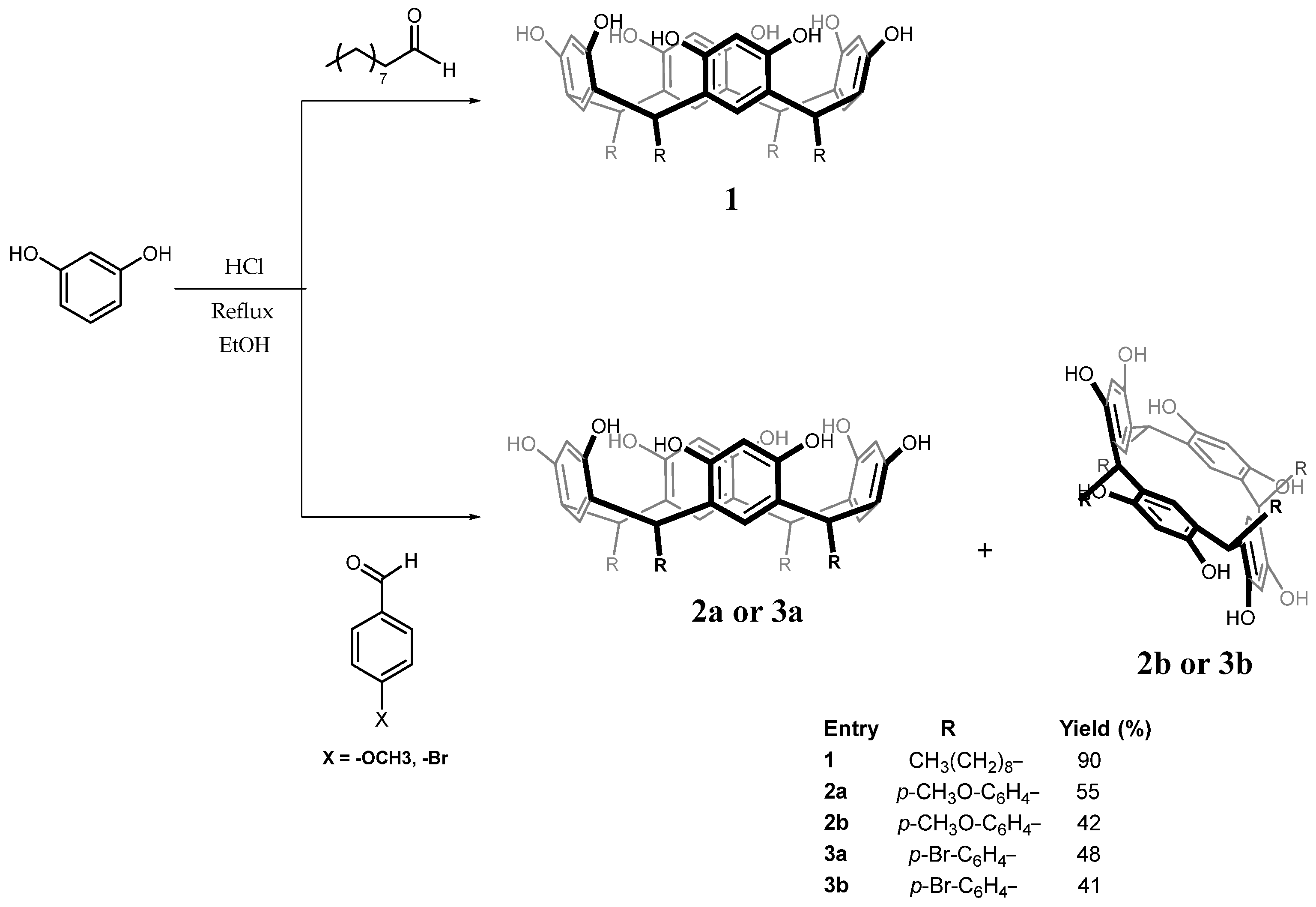
Scheme 1 represents the general procedure for the synthesis of the resorcinarenes used for the per-O-acetylation reaction. These macrocycles were obtained by the reaction between resorcinol and the respective aldehyde as described in the literature (Scheme 1) [23,31]. In this way, the synthesis of 2,8,14,20-tetranonylcalix[4]resorcinarene (1) was done by direct reaction between resorcinol and decanaldehyde, affording the desired product, which was characterized using spectral techniques, including FT-IR and NMR experiments, finding that our spectroscopic data agreed with those reported [23,31]. At this point, it is highlighted that the spectral pattern in 1H-NMR is characteristic of the highly symmetric crown conformation with all alkyl chains in the same position. This indicates that the synthesis produced only a conformational isomer and that when the product is dissolved in DMSO-d6, no conformational or configurational mixtures are exhibited.
On the other hand, the synthesis of aryl-resorcinarenes, tetra(4-methoxyphenyl)calix[4]resorcinarene (2), and tetra(4-bromophenyl)calix[4]resorcinarene (3) was done through the acid-catalyzed cyclocondensation of resorcinol with 4-methoxybenzaldehyde and 4-bromobenzaldehyde, respectively. TLC analysis of both reactions showed the formation of two products. The crude products, corresponding to the conformational mixture crown and chair, for each type, were separated according to previously described procedures [31]. These derivatives were characterized using spectral techniques, including FT-IR and NMR experiments. The conformers of 2 and 3 had been previously synthesized [31], and our spectroscopic data agreed with those reported. At this point, it is highlighted that the 1H-NMR spectrum of 2a displayed the characteristic signals for the aromatic hydrogen of the tetrasubstituted resorcinol unit at 5.52 and 6.07 ppm for the protons in the ortho position and the signals at 6.25 and 6.26 ppm for meta-protons. The signals at 8.35 and 8.43 ppm were assigned to two types of hydroxyl groups in the molecule; this pattern of signals is consistent with the chair conformer. Similarly, the signal pattern observed for 3a (Figures S1 and S3 in Supplementary Materials) is consistent with the chair conformation too. On the other hand, the 1H-NMR spectrum of conformer 2b displayed three characteristic signals at 6.12 ppm (ortho to hydroxyl group) and 6.49 ppm (meta to hydroxyl group) assigned to the tetrasubstituted resorcinol units, and a singlet signal for the hydroxyl group at 8.49 ppm. These signals indicate the existence of highly symmetric crown conformation in solution. The same characteristic signal pattern was also observed for the 1H-NMR spectrum of conformer 3b (Figures S2 and S4 in Supplementary Materials), confirming the crown formation.
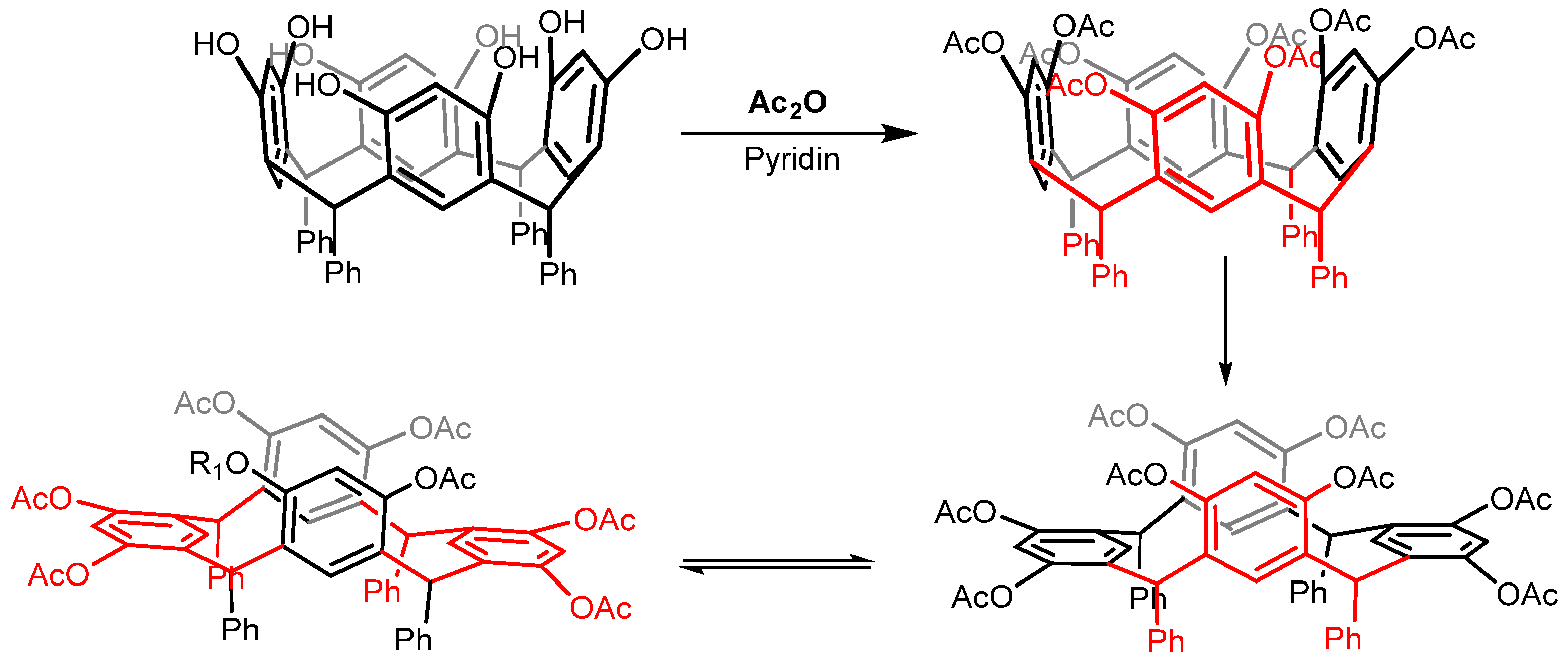
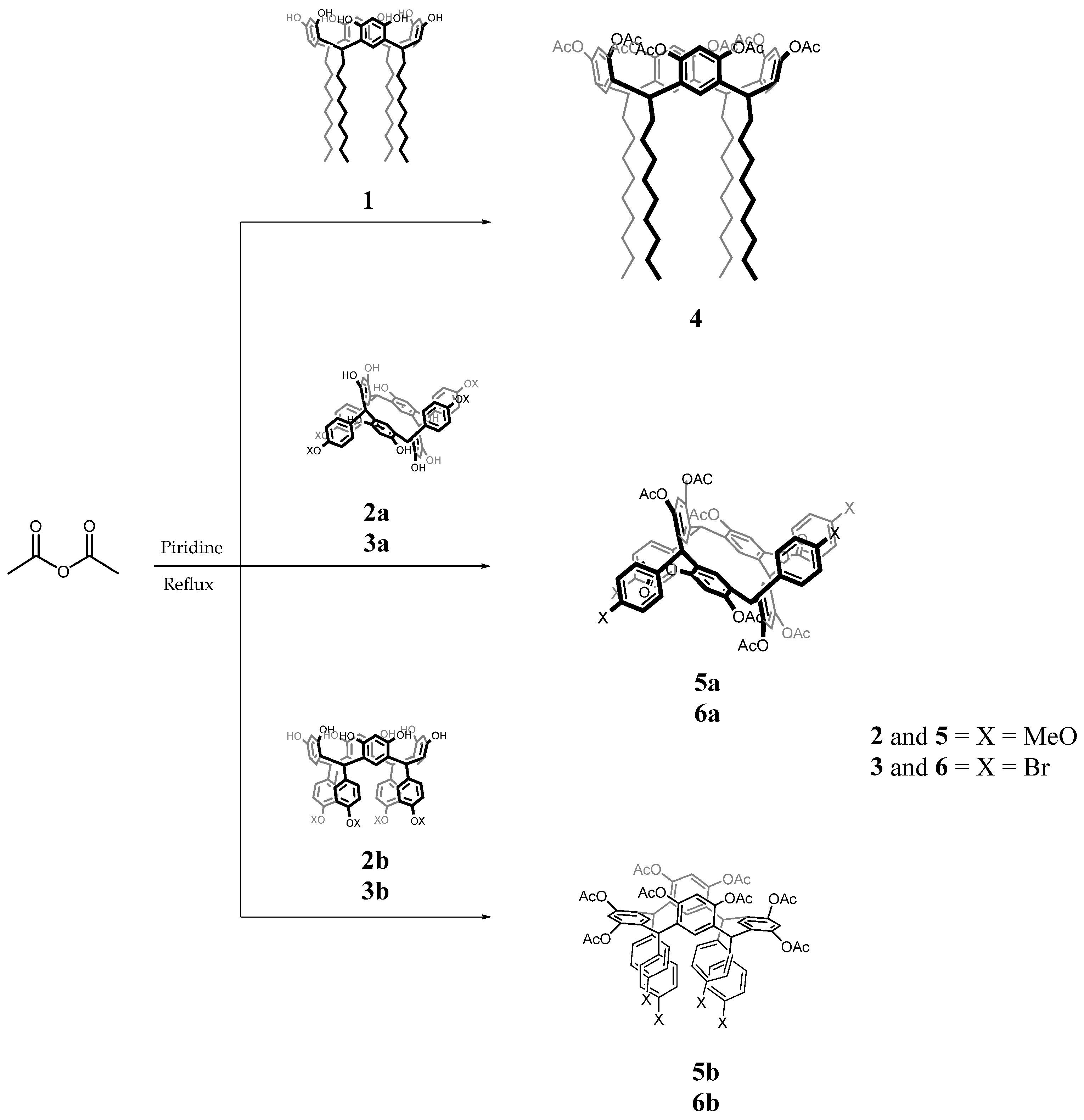
As was mentioned above, per-O-acetylation of resorcin[4]arenes 13 was done with acetic anhydride in pyridine according to the described procedures (Scheme 1) [23]. After carrying out each of the reactions, the obtained products were characterized using spectral techniques, including FT-IR, 1H-NMR, and 13C-NMR. For the per-O-acetylation of 1 (Scheme 2), the formation of O-acylated-tetra(nonyl)calix[4]resorcinarene (4) was analyzed, with the appearance of the characteristic carbonyl band at about 1760 cm−1 in the FT-IR spectrum, the obtention of compound 4 was also analyzed, with the presence of a new aliphatic protons signal at δ 2.31 ppm in 1H-NMR and a carbon signal of the carbonyl group at δ 169.2 ppm in the 13C-NMR spectrum, The retention of the conformation during the acetylation process is evidenced by the appearance of only two singlet multiplicity signals in the aromatic region at 6.91 and 7.26 ppm in the 1H-NMR spectra. These results confirm that during per-O-acetylation of 1, the conformation of the macrocycle 4 is retained.
To explore the per-O-acetylation process for aryl-resorcinarenes (Scheme 2), as mentioned above, conformers of resorcinarenes 2 and 3 were separated, and the acetylation reactions were performed individually with each conformer. In this way, the per-O-acetylation of 2a was carried out under the conditions described in the experimental part. After a few hours, the formation of a solid product was observed, but the reaction was allowed to continue until TLC showed that product 2a had disappeared from the mixture. In the same way, the per-O-acetylation reaction of conformer 3a was performed. The obtained products 5a and 6a were analyzed by RP-HPLC, FT-IR, and NMR spectroscopy.
Products 5a and 6a showed the characteristic pattern of the chair conformation, in which the most affected protons are those of the tetrasubstituted aromatic ring residues. Therefore, in the case of 5a, two singlet multiplicity signals were observed at 5.89 and 6.22 ppm for the protons ortho to the acetyl group, and another pair of singlet multiplicity signals at 6.88 and 7.12 ppm assigned to the protons meta to the acetyl group. For conformer 6a (Figure S5 in Supplementary Materials), a similar pattern of signals was found for the protons of the tetrasubstituted aromatic ring residues. The protons in the ortho position to the acetyl group displayed two singlet multiplicity signals at 5.93 and 6.24 ppm, while the protons in the meta position to the same group were observed at 6.93 and 7.09 ppm. Table 1 summarizes all the conformer signals in the 1H-NMR spectrum with their assignment. From this information, it was established that in the per-O-acetylation reactions of conformers 2a and 3a to obtain the products 5a and 6a, the conformation of the macrocyclic systems is retained.
The per-O-acetylation of crown conformers 2b and 3b was performed following the same methodology described, thus products 5b and 6b were obtained with high yields and with purity. The spectroscopic analysis of the products was carried out using the same techniques that have already been described; therefore, for example, for conformer 6b (Figures S6 and S9 in Supplementary Materials), it was found in the spectrum of 1H-NMR multiple signals that do not correspond to those of a highly symmetrical system such as the crown conformation. The tetrasubstituted aromatic ring residue showed two signals at 5.78 and 6.02 ppm for the protons in the ortho position to the acetyl group and another pair of signals at 6.90 and 7.15 ppm assigned to the protons in the meta position to the acetyl group. This signal pattern could be adjusted to a chair-type conformation; however, as shown in Table 1, there is no coincidence with the displacements observed for conformer 6a, which suggests that the conformation of 6b is not a chair conformation. This conclusion is also reached with the spectroscopic data of 5b, that is, in both cases, during the per-O-acetylation process of 2b or 3b, the conformation is not retained, and the conformation of 5b or 6b does not correspond to a chair-type conformation.
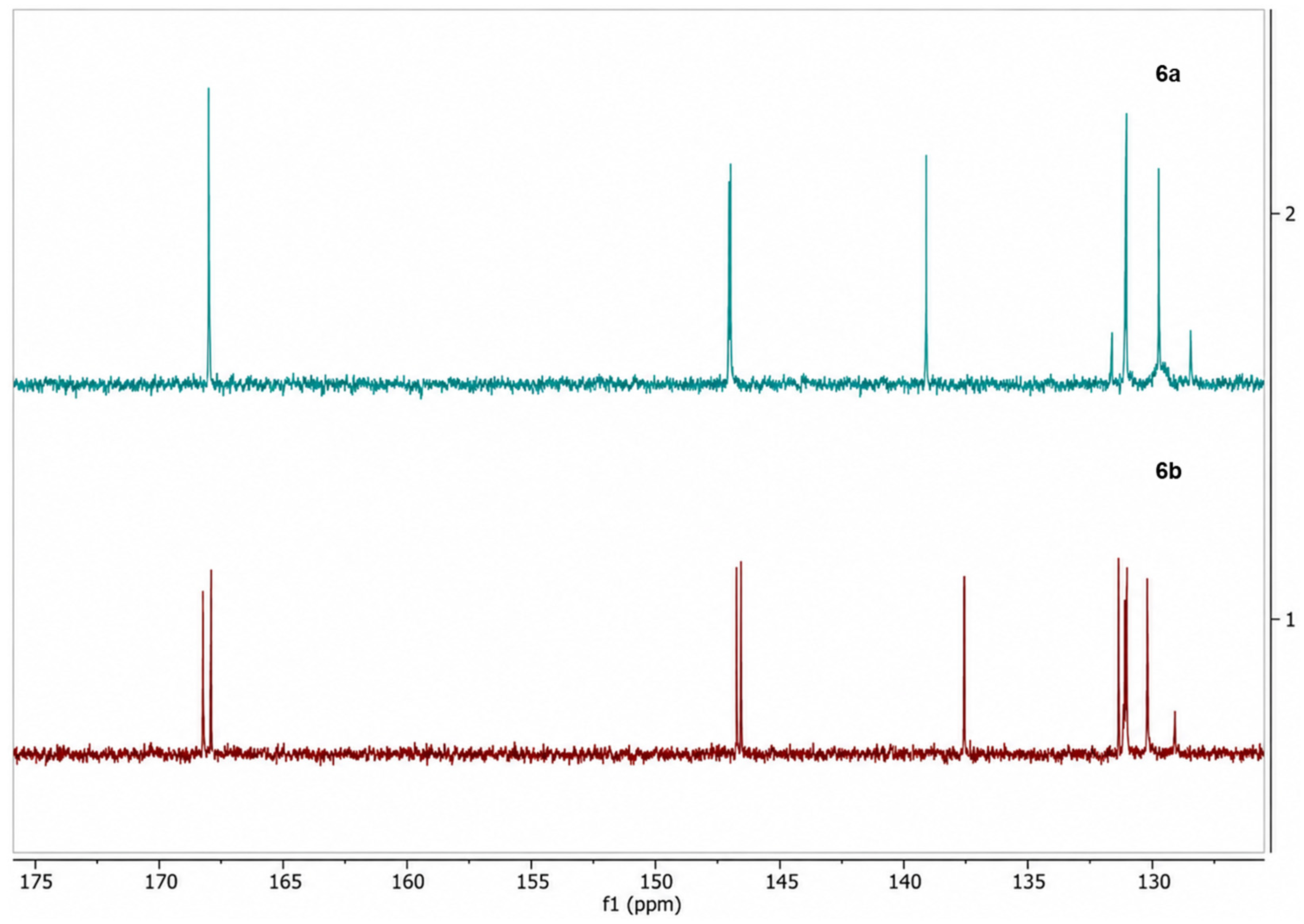
From the information obtained in the 13C-NMR spectra of 6a and 6b (Figure 1, Figures S7 and S8 in Supplementary Materials), differences are evident in the number of signals. In this regard, for example, the carbonyl signal for 6a shows two signals at 165.8 and 165.2, while for 6b only one signal is observed at 168.0 ppm, consistent with broader spectral trends shown in Figure 1. From these observations, this is further evidence that 5b and 6b do not present chair conformation.
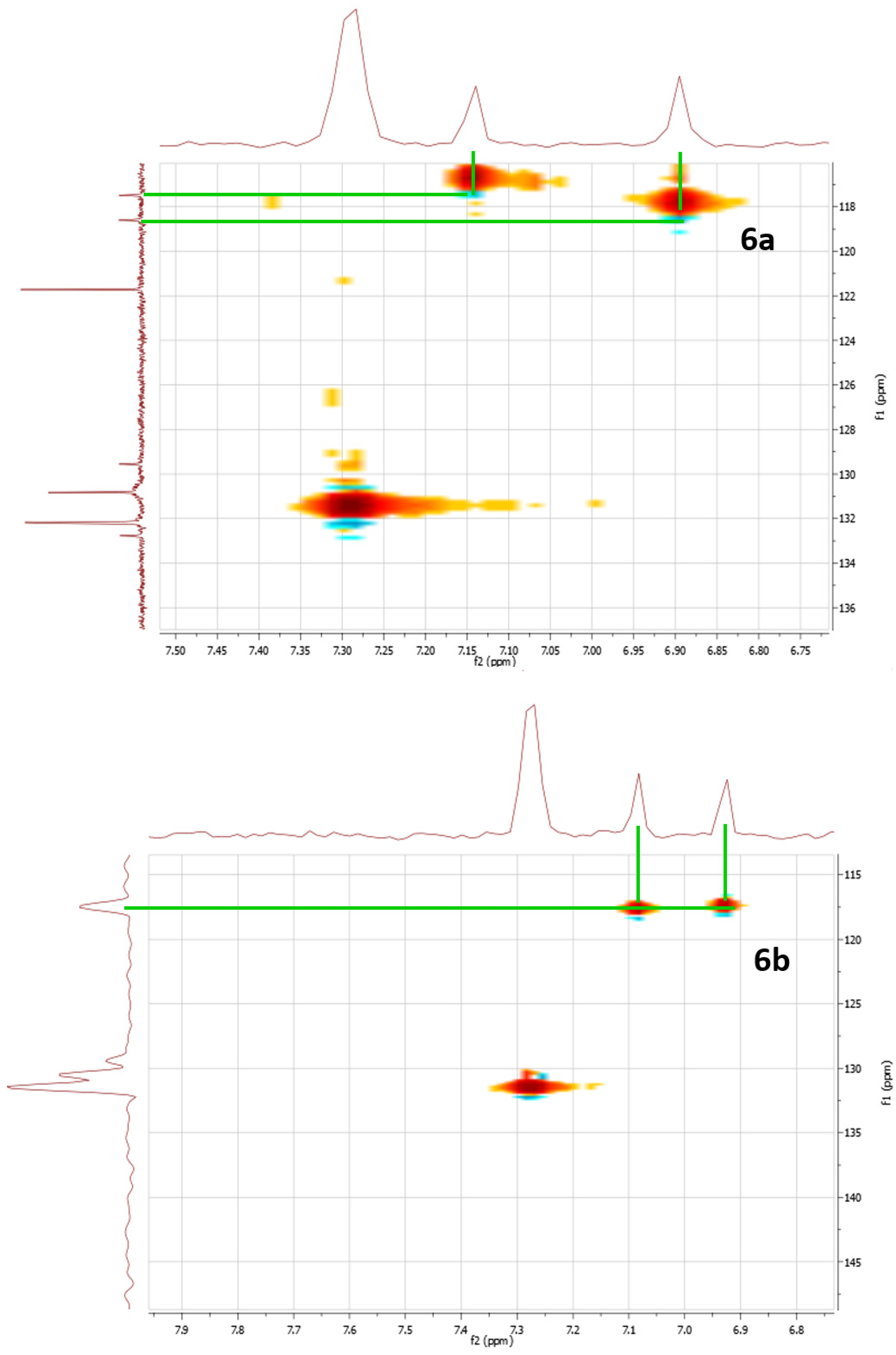
To confirm these results, the HSQC spectra of 6a and 6b (Figures S10 and S11 in Supplementary Materials) were obtained. In the spectrum (Figure 2), two main cross-signals are observed in the aromatic region (δ 1H ≈ 7.3–6.8 ppm; δ 13C ≈ 130–118 ppm). Each signal represents a single H–C correlation, characteristic of a rigid and well-defined environment. This spectral pattern is attributed to a chair conformation, in which the aromatic rings adopt a fixed arrangement, generating magnetically equivalent environments for the protons. In contrast, the spectrum in Figure 2 shows a partial duplication of the aromatic signals and a slight shift in the δ-values, compared to the chair conformation. A broad cross-correlation stands out, in which two non-equivalent protons (δ 1H 7.02 and 6.89 ppm) are entangled with a single aromatic carbon at δ 13C 114.7 ppm, which indicates an asymmetric structural environment. This pattern is associated with a boat-like conformation, in which the system’s symmetry is broken, generating distinct chemical environments for hydrogen nuclei sharing the same carbon center. The increase in the number and dispersion of observed signals suggests a more flexible system, possibly involved in dynamic processes or subject to significant conformational distortions compared to the chair-like system. These results observed for 6a and 6b were confirmed using the HMBC technique (Figures S12 and S13 in Supplementary Materials), as were the most representative connectivities of the two stereoisomers. Finally, the HPLC analysis results showed that the two conformers have different retention times: tr = 9.8 for 6a and tr = 10.0 for 6b.
Once it is established that the conformation of 5a and 6b is neither crown nor chair, the signal pattern corresponds to a boat-type conformation. This conformation is characterized by presenting two aromatic rings of the macrocycle facing each other and two flattened rings, as shown in Scheme 3. In this way, the 1H-NMR spectra of compounds 5b or 6b in the aromatic region exhibited two signals for resonances of aromatic protons of the tetrasubstituted resorcinol residue on the lower rim, one signal for hydrogens in the flattened rings, and another for the hydrogens in the opposite ring. Similarly, for the hydrogens in the upper rim, see Table 1. The formation of these conformers is attributed to the loss of hydrogen-bonding interactions at the upper rim, resulting from the acetylation of the hydroxyl groups. Furthermore, phenyl substituents on the lower rim of the macrocycle are free, and consequently, they can form additional interactions with the solvent, which governs the ability to form interactions between acetyl groups and the aromatic rings.

4. Conclusions

Tetra(nonyl)-, tetra(p-methoxyphenyl)-, and tetra(p-bromophenyl)calix[4]resorcinarenes were successfully synthesized through acid-catalyzed cyclocondensation between resorcinol and the corresponding aldehydes. The tetra(nonyl) derivative was obtained exclusively in the crown conformation, while the aryl-substituted derivatives produced mixtures of crown and chair conformers. These conformers were effectively separated by recrystallization, demonstrating that this technique is a practical and efficient method for isolating individual resorcinarene conformations. Per-O-acetylation reactions were carried out to investigate the stability of the different conformers under functionalization conditions. The chair conformers retained their original structure after acetylation, and the crown conformer of the tetra(nonyl)calix[4]resorcinarene derivative also maintained its conformation, indicating that the hydrogen-bond network and the steric environment of the alkyl substituents favor conformational stability during the acylation process. In contrast, the crown conformer of the tetra(p-bromophenyl)calix[4]resorcinarene derivative underwent conformational rearrangement during the per-O-acetylation reaction. The 1H-NMR spectral pattern of compound 6b displayed multiple aromatic signals inconsistent with a highly symmetrical crown or chair system, indicating the formation of a boat conformer. This conformational change can be attributed to the loss of hydrogen-bond interactions at the upper rim after acetylation of the hydroxyl groups, as well as to additional interactions between the aryl substituents and the solvent. These results highlight the key role of lower-rim substituents in modulating the conformational behavior and structural stability of calix[4]resorcinarenes, revealing that these macrocycles can behave as conformationally dynamic systems during functionalization processes.

Supplementary Materials

The following supporting information can be downloaded at: https://www.mdpi.com/article/10.3390/reactions7020034/s1, Figure S1. 1H NMR spectrum tetra(p-bromophenyl)calix[4]resorcinarene (product 3a crown); Figure S2. 1H NMR spectrum tetra(p-bromophenyl)calix[4]resorcinarene (product 3b chair); Figure S3. 13C NMR spectrum tetra(p-bromophenyl)calix[4]resorcinarene (product 3a crown); Figure S4. 13C NMR spectrum tetra(p-bromophenyl)calix[4]resorcinarene (product 3b chair); Figure S5. 1H NMR spectrum per-O-acetylation tetra(p-bromophenyl)calix[4]resorcinarene (product 6a chair); Figure S6. 1H NMR spectrum per-O-acetylation tetra(p-bromophenyl)calix[4]resorcinarene (product 6b boat); Figure S7. 13C NMR spectrum per-O-acetylation tetra(p-bromophenyl)calix[4]resorcinarene (product 6a chair); Figure S8. 13C NMR spectrum per-O-acetylation tetra(p-bromophenyl)calix[4]resorcinarene (product 6b boat); Figure S9. COSY spectrum (product 6b boat); Figure S10. HSQC spectrum (product 6a chair); Figure S11. HSQC spectrum (product 6b boat); Figure S12. HMBC spectrum (product 6a chair); Figure S13. HMBC spectrum (product 6b boat).

Author Contributions

Conceptualization, M.M.-V.; methodology, K.C.-E. and A.C.-A.; software, M.M.-V. and A.C.-A.; formal analysis, M.M.-V. and A.C.-A.; investigation, A.C.-A. and K.C.-E.; resources, M.M.-V.; data curation, A.C.-A. and K.C.-E.; writing—original draft preparation, K.C.-E. and A.C.-A.; writing—review and editing, M.M.-V.; supervision, M.M.-V.; project administration, M.M.-V. All authors have read and agreed to the published version of the manuscript authors contributed to the analysis of the results and the preparation of the manuscript.

Funding

This research received no external funding.

Data Availability Statement

The original contributions presented in this study are included in the article and Supplementary Materials. Further inquiries can be directed to the corresponding author.

Acknowledgments

We gratefully acknowledge the support for this paper by Universidad Nacional de Colombia-Sede Bogotá.

Conflicts of Interest

The authors declare no conflicts of interest.

References

  1. Gaeta, C.; Wang, D.X. New Macrocycles and Their Supramolecular Perspectives. Front. Chem. 2020, 8, 128. [Google Scholar] [CrossRef]
  2. Jain, V.K.; Kanaiya, P.H. Chemistry of calix[4]resorcinarenes. Russ. Chem. Rev. 2011, 80, 75–102. [Google Scholar] [CrossRef]
  3. Tero, T.; Nissinen, M. A perspective to resorcinarene crowns. Tetrahedron 2014, 70, 1111–1123. [Google Scholar] [CrossRef]
  4. McIldowie, M.J.; Mocerino, M.; Ogden, M.I. A brief review of Cn-symmetric calixarenes and resorcinarenes. Supramol. Chem. 2010, 22, 13–39. [Google Scholar] [CrossRef]
  5. Castillo-Aguirre, A.A.; Rivera-Monroy, Z.J.; Maldonado, M. Analysis by RP-HPLC and Purification by RP-SPE of the C-Tetra(p-hydroxyphenyl)resorcinolarene Crown and Chair Stereoisomers. J. Anal. Methods Chem. 2019, 2019, 2051282. [Google Scholar] [CrossRef]
  6. Gajjar, J.A.; Vekariya, R.H.; Parekh, H.M. Recent advances in upper rim functionalization of resorcin[4]arene derivatives: Synthesis and applications. Synth. Commun. 2020, 50, 2545–2571. [Google Scholar] [CrossRef]
  7. Ali, I.; Ali, A.; Guo, L.; Burki, S.; Rehman, J.U.; Fazal, M.; Ahmad, N.; Khan, S.; Toloza, C.A.T.; Shah, M.R. Synthesis of calix(4)resorcinarene-based amphiphilic macrocycle as an efficient nanocarrier for Amphotericin-B to enhance its oral bioavailability. Colloids Surf. B Biointerfaces 2024, 238, 113918. [Google Scholar] [CrossRef]
  8. Zhu, Y.-J.; Zhao, M.-K.; Rebek, J., Jr.; Yu, Y. Recent Advances in the Applications of Water-soluble Resorcinarene. ChemistryOpen 2022, 11, e202200026. [Google Scholar] [CrossRef]
  9. Jumina; Kurniawan, Y.S. Supramolecular Ion-Exchange Resins Based on Calixarene Derivatives for Pollutant Removal from Aquatic Environmental Samples. In Inorganic-Organic Composites for Water and Wastewater Treatment; Lichtfouse, E., Muthu, S.S., Khadir, A., Eds.; Environmental Footprints and Eco-Design of Products and Processes; Springer: Singapore, 2022; pp. 77–96. [Google Scholar] [CrossRef]
  10. Li, N.; Harrison, R.G.; Lamb, J.D. Application of Resorcinarene Derivatives in Chemical Separations. J. Incl. Phenom. Macrocycl. Chem. 2014, 78, 39–60. [Google Scholar] [CrossRef]
  11. Ito, H.; Nakayama, T.; Sherwood, M.; Miller, D.; Ueda, M. Characterization and Lithographic Application of Calix[4]resorcinarene Derivatives. Chem. Mater. 2008, 20, 341–352. [Google Scholar] [CrossRef]
  12. Shaban, A.; Eddaif, L.; Szabó, T. A Mini-Review on the Application of Chemically Modified Sensing Platforms for the Detection of Heavy Metal Ions in Water. Curr. Anal. Chem. 2023, 19, 199–219. [Google Scholar] [CrossRef]
  13. Huang, J.; Fang, Y.; Dehaen, W. Macrocyclic Arenes Functionalized with BODIPY: Rising Stars among Chemosensors and Smart Materials. Chemosensors 2020, 8, 51. [Google Scholar] [CrossRef]
  14. Wang, K.; Yan, K.; Liu, Q.; Wang, Z.; Hu, X.-Y. The Versatile Applications of Calix[4]resorcinarene-Based Cavitands. Molecules 2024, 29, 5854. [Google Scholar] [CrossRef]
  15. Matiz, C.; Castellanos, K.; Maldonado, M. Resorcinarene-Based Polymer Conjugated for Pharmaceutical Applications. Processes 2025, 13, 1325. [Google Scholar] [CrossRef]
  16. Kauerhof, D.; Niemeyer, J. Functionalized Macrocycles in Supramolecular Organocatalysis. ChemPlusChem 2020, 85, 889–899. [Google Scholar] [CrossRef]
  17. Lee, J.S.; Song, I.H.; Shinde, P.B.; Nimse, S.B. Macrocycles and Supramolecules as Antioxidants: Excellent Scaffolds for Development of Potential Therapeutic Agents. Antioxidants 2020, 9, 859. [Google Scholar] [CrossRef]
  18. Gangemi, C.M.A.; Pappalardo, A.; Trusso Sfrazzetto, G. Applications of Supramolecular Capsules Derived from Resorcin[4]arenes, Calix[n]arenes and Metallo-Ligands: From Biology to Catalysis. RSC Adv. 2015, 5, 51919–51933. [Google Scholar] [CrossRef]
  19. Twum, K.; Truong, K.-N.; Osei, F.B.; von Essen, C.; Nadimi, S.; Trant, J.F.; Rissanen, K.; Beyeh, N.K. Guest-Mediated Self-Assembly of Deprotonated 2-Bromoresorcinarenes. Cryst. Growth Des. 2023, 23, 1281–1287. [Google Scholar] [CrossRef]
  20. Nemat, S.J.; Tiefenbacher, K. Thioderivatives of Resorcin[4]Arene and Pyrogallol[4]Arene: Are Thiols Tolerated in the Self-Assembly Process? Org. Lett. 2021, 23, 6861–6865. [Google Scholar] [CrossRef]
  21. Sergeeva, T.Y.; Mukhitova, R.K.; Nizameev, I.R.; Kadirov, M.K.; Sapunova, A.S.; Voloshina, A.D.; Mukhametzyanov, T.A.; Ziganshina, A.Y.; Antipin, I.S. A Glucose-Responsive Polymer Nanocarrier Based on Sulfonated Resorcinarene for Controlled Insulin Delivery. ChemPlusChem 2019, 84, 1560–1566. [Google Scholar] [CrossRef] [PubMed]
  22. Loose, D.; Aniol, A.; Feigel, M.; Röhling, S.; Dyker, G. Mono- and Tri-Functionalization of Trimethylresorcin[4]Arenes. Eur. J. Org. Chem. 2020, 2020, 35–40. [Google Scholar] [CrossRef]
  23. Knyazeva, I.; Matveeva, V.; Khrizanforova, V.; Budnikova, Y.; Burilov, A. Novel thiophosphorylated calix[4]resorcinol Mannich bases and their electrochemical behavior in hydrogen evolution reaction. Mendeleev Commun. 2018, 28, 515–517. [Google Scholar] [CrossRef]
  24. Serkova, O.; Glushko, V.; Egorova, M.; Maslennikova, V. Microwave assisted alkylation of ortho-methyl-tetra-C-naphthyl-resorcinarene and its phosphorylated derivatives with haloalkanes and ethyl bromoacetate. Tetrahedron Lett. 2018, 59, 2586–2589. [Google Scholar] [CrossRef]
  25. Sharma, V.S.; Rathod, S.L.; Suthar, D.; Sharma, A.S.; Ganga, V.S.R.; Desai, V.; Dhaka, M.S.; Shrivastav, P.S. Resorcinarene-Appended Octa-Substituted Alkyl Arms: A New Strategy to Fabricate Supramolecular Materials for Application in Liquid Crystals and Solar Cells. New J. Chem. 2023, 47, 179–191. [Google Scholar] [CrossRef]
  26. Ngurah, B.I.G.M. Havy Metal Cations Adsorption by Cinnamoyl C-Methylcalix[4]Resorcinarene. J. Phys. Conf. Ser. 2020, 1503, 012026. [Google Scholar] [CrossRef]
  27. Velásquez-Silva, A.; Cortés, B.; Rivera-Monroy, Z.; Pérez-Redondo, A.; Maldonado, M. Crystal Structure and Dynamic NMR Studies of Octaacetyl-Tetra(Propyl)Calix[4]Resorcinarene. J. Mol. Struct. 2017, 1137, 380–386. [Google Scholar] [CrossRef]
  28. Yan, K.; Shi, Y.; Wang, Z.; Jiao, J.; Wang, K.; Hu, X.-Y. Shape-Selective Anion Recognition of Calix[4]resorcinarene-Based Receptors through C–H Hydrogen Bonding. Chin. J. Chem. 2025, 43, 1651–1656. [Google Scholar] [CrossRef]
  29. Urquijo, C.; Maldonado, M. Surface Modification of Poly(butyl methacrylate) with Sulfomethylated Resorcinarenes for the Selective Extraction of Dichromate Ion in Aqueous Media. Analytica 2025, 6, 24. [Google Scholar] [CrossRef]
  30. Mahmoudi Asl, A.; Karami, B.; Karimi, Z. Tungstic Acid-Functionalized Polycalix[4]resorcinarene as a Cavity-Containing Hyper-Branched Supramolecular and Recoverable Acidic Catalyst in 4H-Pyran Synthesis. RSC Adv. 2023, 13, 11064–11073. [Google Scholar] [CrossRef]
  31. Matiz, C.; Castillo-Aguirre, A.; Maldonado, M. Synthesis of C-Tetra(Aryl)Resorcin[4]Arenes Using Various Types of Catalysts under Solvent Free Conditions: A Comparative Study. Green Chem. Lett. Rev. 2024, 17, 2290847. [Google Scholar] [CrossRef]
Scheme 1. Synthesis of calix[4]resorcinarenes 13.
Reactions 07 00034 sch001
Scheme 2. Per-O-acetylation of calix[4]resorcinarenes 13.
Reactions 07 00034 sch002
Figure 1. Comparison of the NMR spectra of 6a and 6b in the aromatic region (100 MHZ, CDCl3, 25 °C).
Reactions 07 00034 g001
Figure 2. 1H–13C HSQC spectra of compounds 6a and 6b in the aromatic region (400 MHz, CDCl3, 25 °C).
Reactions 07 00034 g002
Scheme 3. Formation of boat conformation for 5b and 6b.
Reactions 07 00034 sch003
Table 1. 1H-NMR chemical shifts in conformers 5a, 5b, 6a, and 6b.
General StructureProton1H-NMR δ (ppm)
5a5b6a6b
Reactions 07 00034 i00112.01
2.06
2.05
2.09
2.10
2.05
2.01
2.07
25.435.315.485.36
35.89
6.22
5.74
6.02
5.93
6.24
5.78
6.04
46.88
7.12
6.85
7.18
6.93
7.09
6.90
7.15
56.596.616.616.57
66.596.617.287.31
Disclaimer/Publisher’s Note: The statements, opinions and data contained in all publications are solely those of the individual author(s) and contributor(s) and not of MDPI and/or the editor(s). MDPI and/or the editor(s) disclaim responsibility for any injury to people or property resulting from any ideas, methods, instructions or products referred to in the content.