
Article

Computational Investigation of Mechanism and Selectivity in (3+2) Cycloaddition Reactions Involving Azaoxyallyl Cations

1
School of Science, Tianjin Chengjian University, Tianjin 300384, China
2
Tianjin Key Laboratory of Organic Solar Cells and Photochemical Conversion, School of Chemistry & Chemical Engineering, Tianjin University of Technology, Tianjin 300384, China
*
Authors to whom correspondence should be addressed.
Reactions 2025, 6(4), 70; https://doi.org/10.3390/reactions6040070
Submission received: 30 October 2025 / Revised: 24 November 2025 / Accepted: 4 December 2025 / Published: 8 December 2025

Abstract

Azaoxyallyl cations, as novel and versatile three-atom components, have been widely utilized in cycloaddition reactions, with the competition between O- and N-cyclization pathways remaining a key research focus. This study investigates the mechanism and site selectivity of (3+2) cycloaddition between azaoxyallyl cations and 1,2-benzisoxazoles using density functional theory calculations. The results reveal a stepwise (3+2) addition to the C=N double bond, followed by base-assisted N-O bond cleavage and isoxazole ring-opening, leading to oxazoline (via O-cyclization) or imidazolone (via N-cyclization) derivatives. When unsubstituted 1,2-benzisoxazole is used as the substrate, O-cyclization dominates as a kinetically controlled process due to lower activation barriers, while N-cyclization, as a thermodynamically controlled process, is minor. The presence of a methyl group at the C(3) position in 1,2-benzisoxazoles completely blocks N-O bond cleavage, forcing exclusive (3+2) cycloaddition to yield less stable tricyclic products via N-cyclization rather than O-cyclization. These findings align with experimental observations and provide new mechanistic insights into the site selectivity of azaoxyallyl cation cycloadditions.

1. Introduction

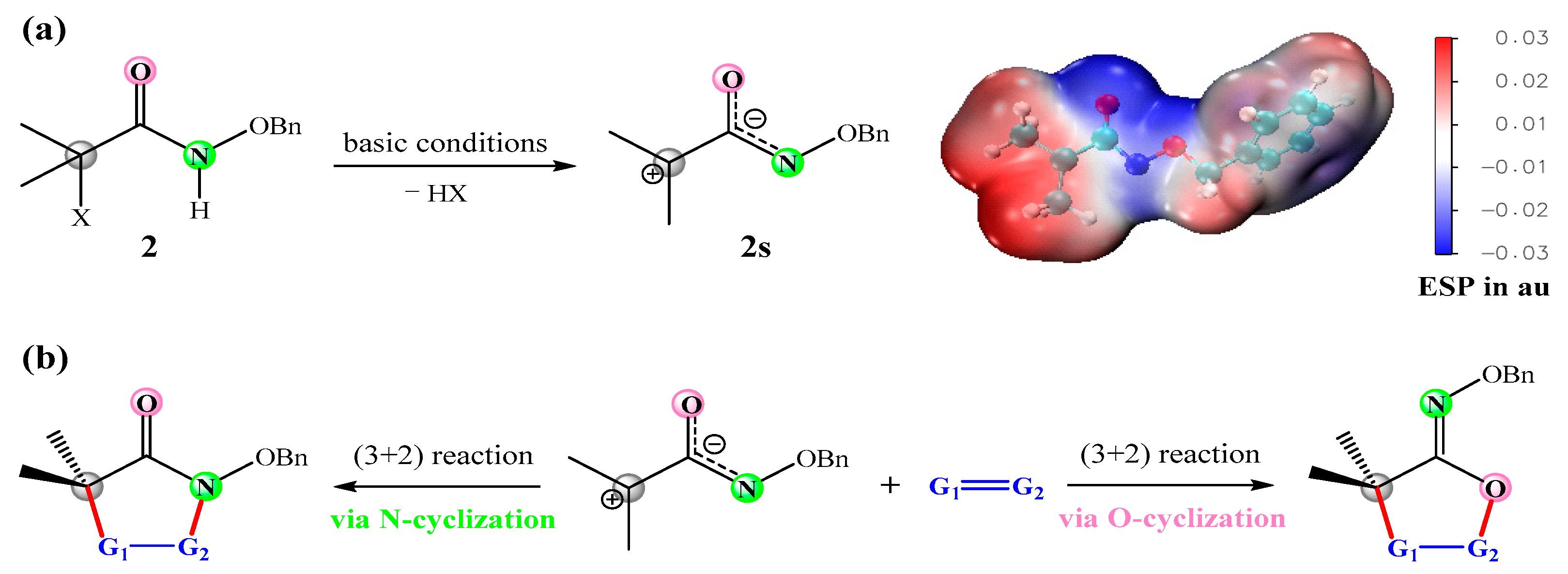
Azaoxyallyl cations, as versatile three-atom components, have been widely employed in cycloaddition reactions for constructing structurally diverse heterocycles [1,2]. These three-center synthons can undergo (3+m) (m = 1–4) cycloaddition reactions with various unsaturated systems [3,4,5,6], with (3+2) reactions involving C=C, C=O, and C=N double bonds being particularly well-documented [7,8,9,10]. These reactive intermediates are typically generated in situ through 1,3-elimination of α-halohydroxamates under basic conditions [11] (Scheme 1). The tertiary carbonium center serves as the electrophilic site, while either oxygen or nitrogen can act as the nucleophilic site. The molecular electrostatic potential map shows that the oxygen and nitrogen centers are both surrounded by regions of negative electrostatic potential, while the tertiary carbonium center is associated with positive electrostatic potential regions. This dual reactivity gives rise to two distinct cyclization pathways: (1) cycloaddition at the carbon and nitrogen sites (N-cyclization pathway) and (2) cycloaddition at the carbon and oxygen sites (O-cyclization pathway), ultimately leading to nitrogen- or oxygen-containing heterocycles, respectively. Consequently, understanding the competition between these two pathways and developing strategies for their selective control represent key challenges in azaoxyallyl cation chemistry [1,12].
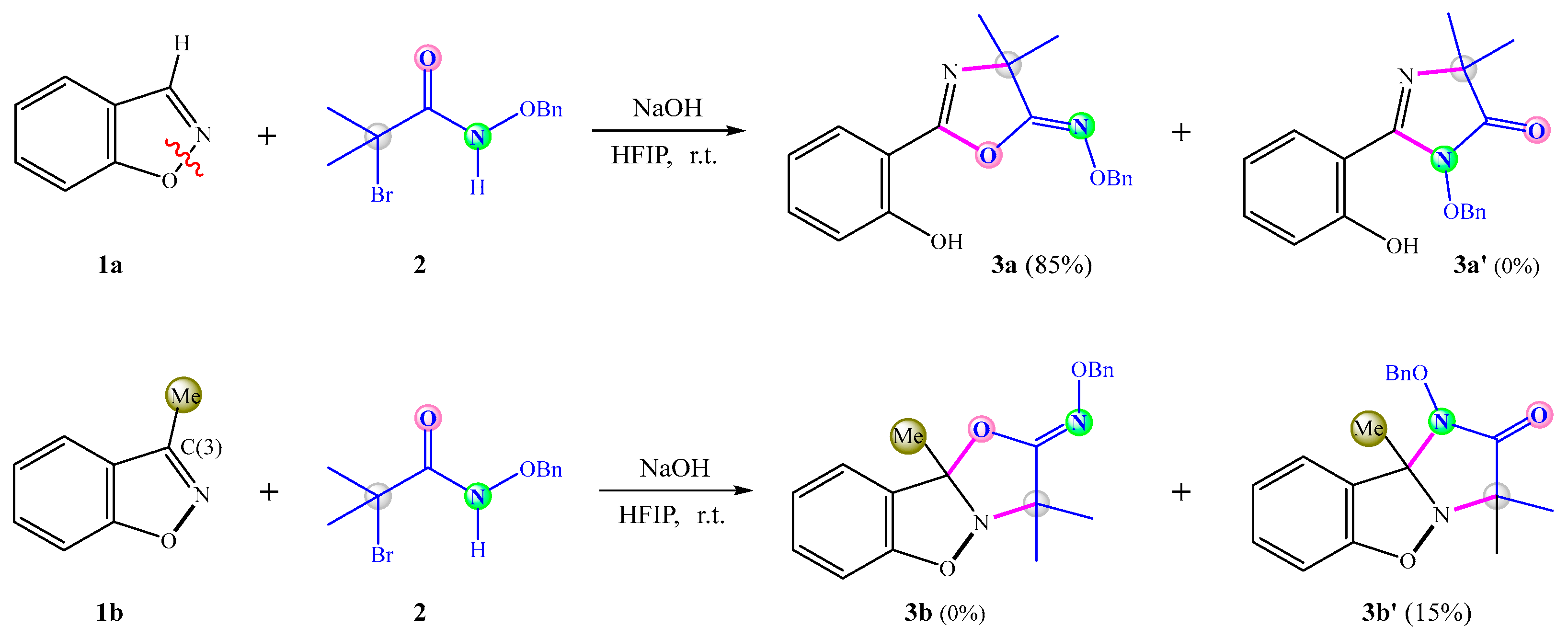
Feng’s group [13] reported a (3+2) cycloaddition/N-O bond cleavage reaction between 1,2-benzisoxazole 1a and α-bromohydroxamate 2 at room temperature, furnishing oxazoline derivative 3a in up to 85% yield under basic conditions in hexafluoro-2-propanol (HFIP), as shown in Scheme 2. The reaction selectively proceeded via O-cyclization, as no N-cyclized imidazolone derivative (3a’) was observed. However, when C(3)-methylated 1,2-benzisoxazole (1b) was used under identical conditions, only a (3+2) cycloaddition occurred without isoxazole ring opening, yielding a tricyclic product. Notably, the N-cyclized product (3b’) was exclusively observed. Despite the modest yield (15%), this outcome demonstrates that C(3) substitution in 1a can reverse the selectivity between N-cyclization and O-cyclization.
Despite significant progress in synthetic methodologies, theoretical investigations into the chemistry of azaoxyallyl cations remain relatively limited. While a few density functional theory (DFT) studies have examined their electronic structures and reaction pathways [14,15,16,17], our group has previously investigated the generation mechanism of azaoxyallyl cations from α-halohydroxamates in the presence of Na2CO3 and HFIP, as well as the selectivity of their (3+2) cycloaddition with carbonyl compounds [18]. Given the pivotal role of azaoxyallyl cations in heterocycle synthesis, this work employs DFT calculations to elucidate the reaction mechanism in Scheme 2, with a particular focus on the competition between N- and O-cyclization pathways and the influence of C(3) substitution. Additionally, this study offers insights into the cycloaddition mechanism of azaoxyallyl cations from an electronic structure perspective.

2. Computational Methods

All DFT calculations were performed using the Gaussian 16 program package [19]. Geometric optimizations were carried out using the M06 functional [20] and the 6-31G(d,p) basis set in 2-methyl-1-propanol solvent, with solvation effects treated by the default IEF-PCM solvation method [21] as implemented in Gaussian (HFIP solvent was unavailable in the program and thus replaced with a solvent of similar polarity). Frequency calculations under the conditions of 298.15 K and 1 atm were performed on optimized stationary points using the same methodology. Some suspected transition states were verified with the aid of intrinsic reaction coordinate (IRC) analysis [22,23] to confirm their connectivity.
To improve energy accuracy, single-point energy calculations were conducted on all optimized geometries using the M06 functional (plus Grimme’s D3 dispersion correction [24]) and the 6-311++G(2d,2p) basis set, with solvation effects treated identically to those in geometric optimizations. Gibbs free energies were corrected for low-frequency modes (≤100 cm−1) using Grimme’s quasi-RRHO method [25] to account for their entropic contributions. For changing the standard state of the reactant from 24.5 L/mol (in gas) to 1 mol/L (in solution), corrections of ±2.0 kcal/mol (±RTln24.5) were made for reaction steps involving two species to one species or one species to two species in Gibbs free-energy determinations [26]. Charge decomposition analysis [27] and electron localization function (ELF) analysis [28] were performed using Multiwfn (Version 3.8) [29,30]. Molecular graphics were generated using CYLview (Version 1.0b) [31] and Visual Molecular Dynamics (Version 1.9.4a55) [32].

3. Results and Discussion

3.1. Mechanism and N/O Selectivity for the 1a+2 Reaction

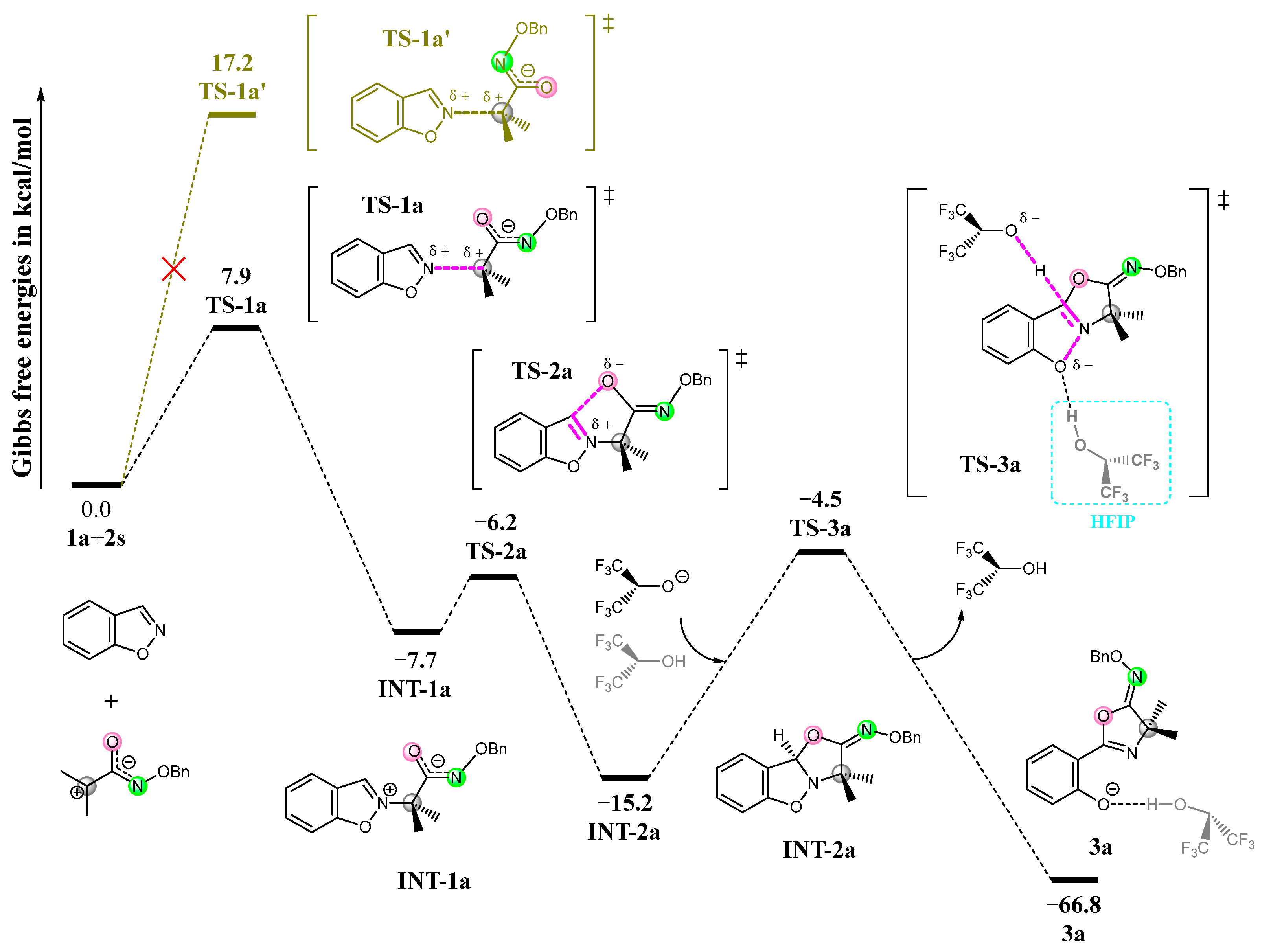
The azaoxyallyl cation 2s is initially generated in situ from α-bromohydroxamate 2, followed by the reaction with 1a. The proposed mechanism for the reaction between 1a and 2s leading to product 3a is illustrated in Figure 1. DFT calculations at the M06+D3/6-311++G(2d,2p)//M06/6-31G(d,p) level reveal that the (3+2) cycloaddition process proceeds through a stepwise pathway involving two distinct transition states. In the initial step, the nitrogen center of 1a acts as a nucleophile to attack the carbonium center of 2s via transition state TS-1a, forming the zwitterionic intermediate INT-1a. We have also located another transition state (TS-1a’) with a conformation different from TS-1a. However, its free-energy barrier is significantly higher than TS-1a, confirming TS-1a as the optimal transition state for the association of the two reactants. The subsequent step involves intramolecular C-O bond formation through transition state TS-2a, yielding the neutral tricyclic intermediate INT-2a. It should be noted that the transition state for the concerted (3+2) cycloaddition between 1a and 2s (leading to INT-2a) could not be located. This intermediate then undergoes N-O bond cleavage and ring-opening to afford product 3a. Our calculations suggest that HFIP can be deprotonated by NaOH to yield (CF3)2CHO, with the reaction HFIP + OH → (CF3)2CHO + H2O being thermodynamically favorable (ΔG = −24.8 kcal/mol). Notably, the deprotonation of the C(3) center by (CF3)2CHO and the isoxazole ring-opening via C-N bond cleavage occur in a concerted manner, as evidenced by transition state TS-3a. The resulting anionic oxygen center is stabilized by a hydrogen-bonding interaction with an HFIP solvent molecule, which facilitates this step.
The calculated free-energy profiles demonstrate that the (3+2) process exhibits a low free-energy barrier of 7.9 kcal/mol for TS-1a. The intermediate INT-2a is 15.2 kcal/mol more stable than the reactants and subsequently transforms into 3a with a free-energy barrier of 10.7 kcal/mol, culminating in an overall exothermic reaction with a total free-energy change of −66.8 kcal/mol.
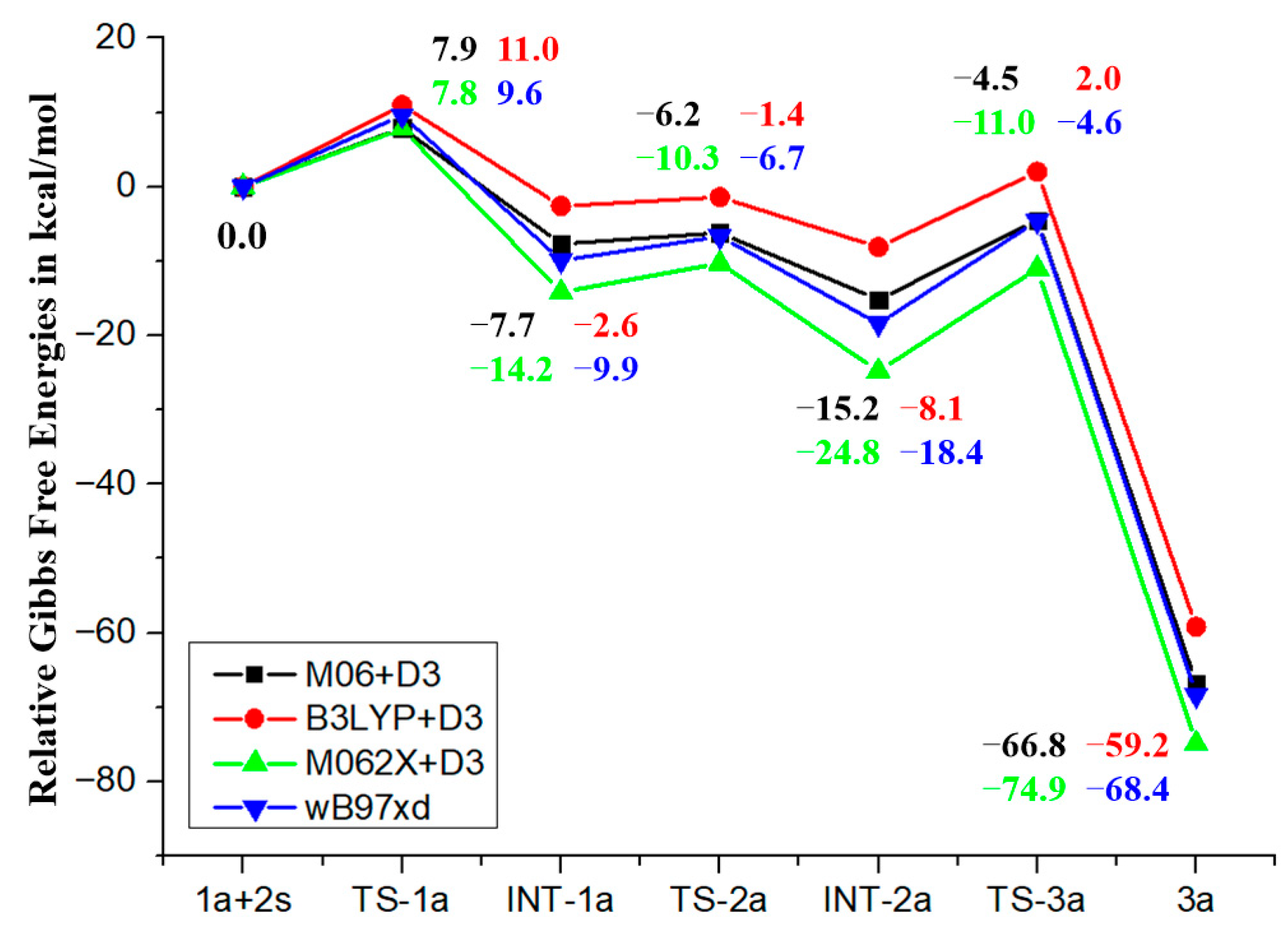
To evaluate the reliability of the computational level M06+D3/6-311++G(2d,2p)//M06/6-31G(d,p), we employed the same basis set combination as described above but utilized different commonly used functionals—B3LYP [33], M062X [20], and wB97XD [34]—to calculate the free-energy profiles for the formation of 3a from 1a and 2s. The free-energy curves obtained using B3LYP+D3//B3LYP+D3, M062X+D3//M062X, and wB97XD//wB97XD are compared with that obtained using the M06+D3//M06 method employed in this study, as depicted in Figure 2. It is evident that, compared to M06+D3//M06, the relative free energies calculated using B3LYP+D3//B3LYP+D3 and M062X+D3//M062X are overestimated and underestimated by 0–7 kcal/mol, respectively, whereas wB97XD yields results that are relatively close. Consequently, on the whole, the computational approach adopted in this study provides an average result among several commonly used functional methods.
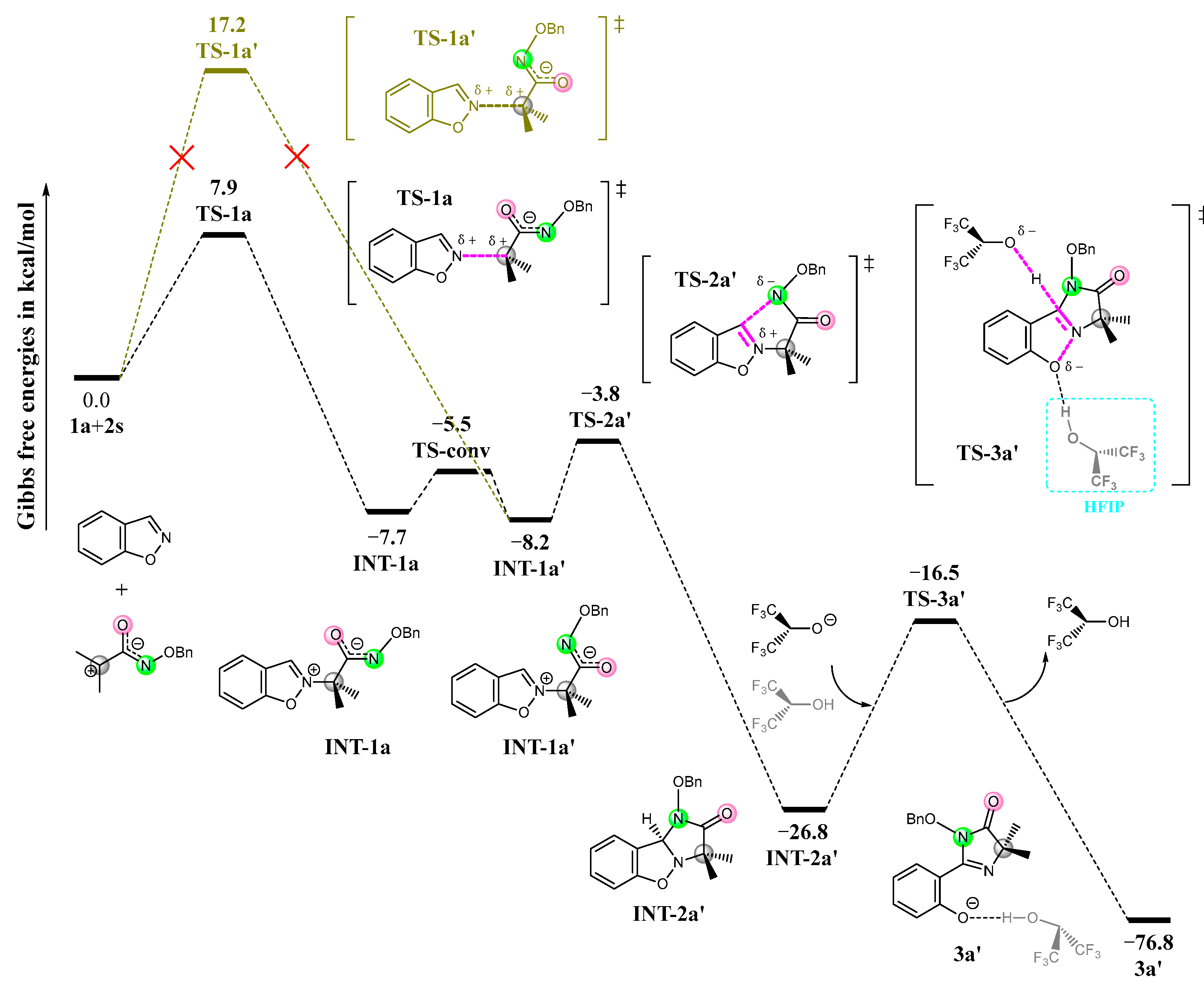
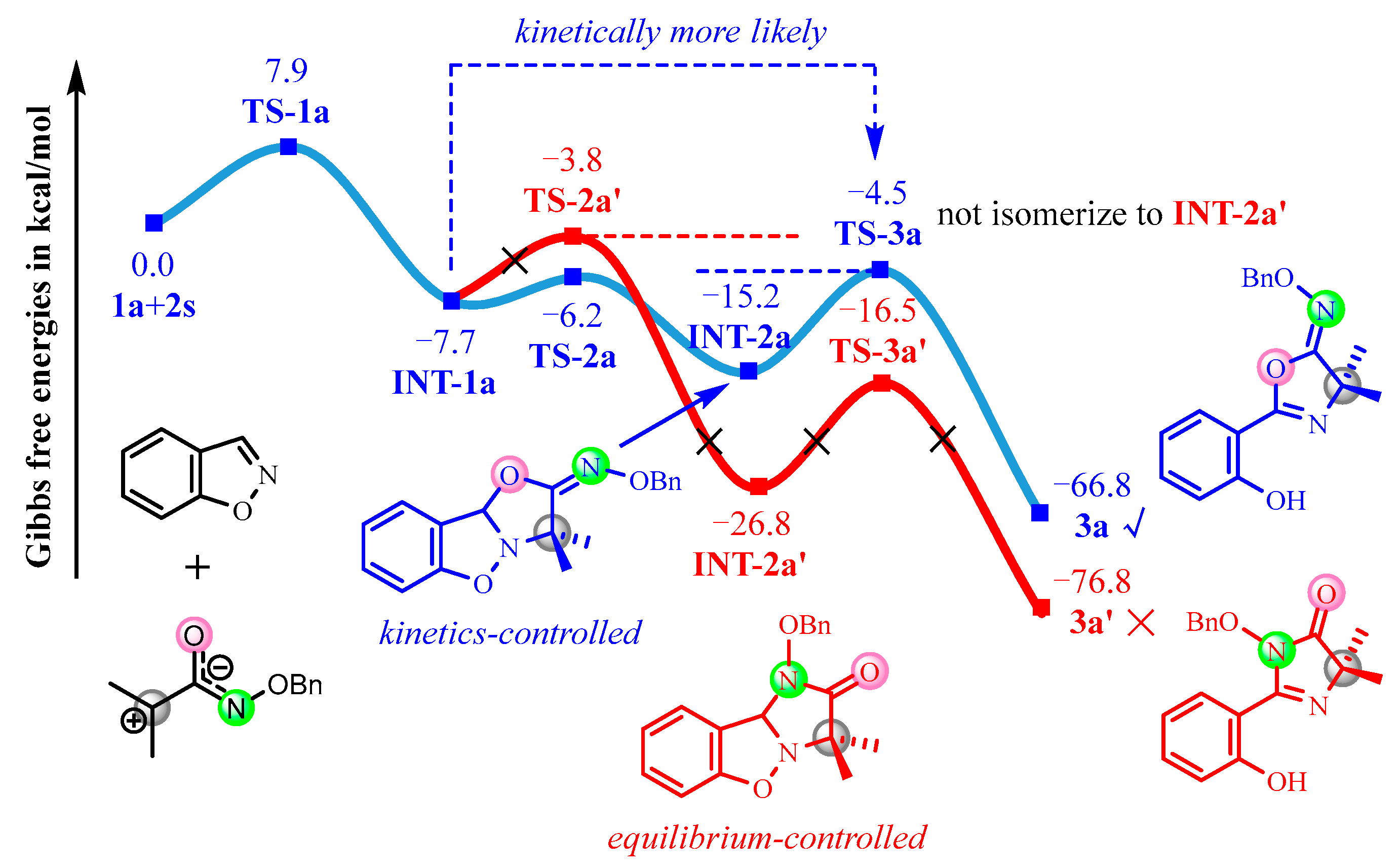
The reaction mechanism for the formation of product 3a’ from 1a and 2s is presented in Figure 3. It should be pointed out that the optimal transition state for the binding of 1a and 2s is TS-1a, and the resulting intermediate INT-1a serves as the precursor for C-O bond formation rather than C-N bond formation. This is because the nitrogen atom in INT-1a is positioned farther from the reaction center compared to the oxygen atom. We have also identified an alternative transition state (TS-1a’), which upon relaxation yields intermediate INT-1a’—the true precursor for C-N bond formation. However, TS-1a’ exhibits a significantly higher free-energy barrier of 17.2 kcal/mol, rendering it kinetically non-competitive with TS-1a. Consequently, the reaction between 1a and 2s proceeds exclusively via TS-1a, leading to the formation of INT-1a. Notably, INT-1a can undergo a conformational change through C-C bond rotation via transition state TS-conv, converting it into INT-1a’. Subsequent formation of the electron-neutral tricyclic intermediate INT-2a’ occurs through transition state TS-2a’. The final step involves a deprotonation-induced N-O bond cleavage/ring-opening process via transition state TS-3a’, which is analogous to TS-3a in Figure 1 and ultimately yields product 3a’.
The calculated free-energy profiles reveal that INT-1a’ is slightly more stable than INT-1a, with their interconversion involving a low free-energy barrier. The C-N bond formation via TS-2a’ requires a free-energy barrier of 4.4 kcal/mol to afford the highly stable intermediate INT-2a’. Finally, the N-O bond cleavage/ring-opening step must overcome a free-energy barrier of 10.3 kcal/mol to produce 3a’, culminating in an overall exothermic reaction with a total free-energy change of −76.8 kcal/mol.
The free-energy profiles for the formation of 3a and 3a’ are comparatively presented in Figure 4, providing a rationale for the preferred formation of 3a. It should be noted that INT-1a needs to convert to INT-1a’ via TS-conv before forming INT-2a’ via TS-2a’; however, we directly connect INT-1a to INT-2a’ via TS-2a’ in Figure 4 for simplicity. Intermediate INT-1a serves as the branch point between the two reaction pathways leading to 3a and 3a’. From a thermodynamic perspective, the formation of INT-2a’ is more favorable than that of INT-2a, as INT-2a’ is 11.6 kcal/mol more stable than its counterpart. However, from a kinetic standpoint, the formation of INT-2a is more favorable than that of INT-2a’, owing to the lower-lying transition state TS-2a (2.4 kcal/mol below TS-2a’). Intermediate INT-2a can follow two distinct pathways: (1) direct conversion to 3a via TS-3a, or (2) return to INT-1a via TS-2a followed by subsequent formation of 3a’ through TS-2a’ and TS-3a’. Based on the calculated transition state energetics, the production of 3a via TS-3a is kinetically favored, as the rearrangement of INT-2a to INT-2a’ requires overcoming the higher-lying TS-2a’ compared to TS-3a. Once 3a is formed, the reaction becomes irreversible (i.e., the barrier from 3a to TS-3a is 62.3 kcal/mol). Consequently, 3a and 3a’ emerge as the kinetically and thermodynamically controlled products, respectively, with the overall reaction between 1a and 2s being governed by kinetics at room temperature.
Notably, while the free-energy data exhibit certain deviations across different computational methods, the competitive relationship between 3a and 3a’ remains unaffected by the choice of method. For instance, the Gibbs free-energy changes (in kcal/mol) for the formation of 3a/3a’ are: −66.8/−76.8 (M06+D3//M06), −59.2/−70.4 (B3LYP+D3//B3LYP+D3), −74.9/−87.1 (M062X+D3//M062X), and −68.4/−81.0 (wB97DX//wB97DX). The relative Gibbs free energies of transition states TS-2a/TS-2a’ are: −6.2/−3.8 (M06+D3//M06), −1.4/2.0 (B3LYP+D3//B3LYP+D3), −10.3/−7.3 (M062X+D3//M062X), and −6.7/−4.4 (wB97DX//wB97DX). Regardless of the computational method employed, 3a and 3a’ are consistently identified as the kinetically and thermodynamically controlled products, respectively, confirming that the reaction is under kinetic control.

3.2. Mechanism and N/O Selectivity for the 1b+2 Reaction

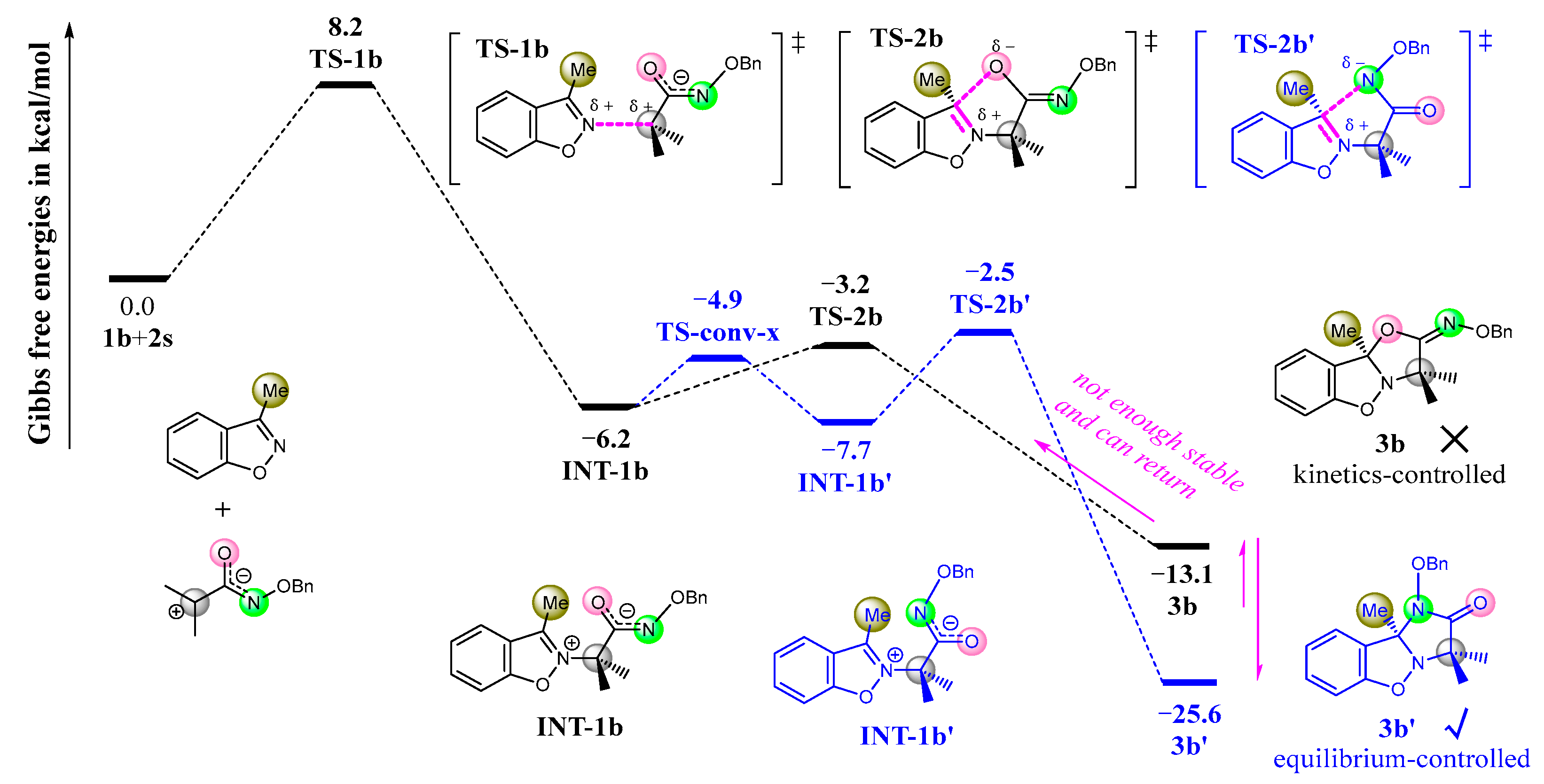
The located reaction pathways of 1b with 2s forming product 3b and 3b’ are comparatively shown in Figure 5. The first step is the nucleophilic addition of the nitrogen center of 1b onto the carbonium center of 2s via transition state TS-1b to afford intermediate INT-1b, which is the precursor of the C-O bond formation rather than the C-N bond formation. On one hand, INT-1b could overcome transition state TS-2b to produce 3b (O-cyclization). On the other hand, INT-1b could isomerize to INT-1b’ and then would produce 3b’ via TS-2b’ (N-cyclization). As TS-2b is lower-lying than TS-2b’ and 3b’ is much more stable than 3b, 3b and 3b’ are the kinetics- and thermodynamics-controlled products, respectively. Note that the tricyclic product 3b without ring opening is not stable enough and is able to return to INT-1b via TS-2b involving a free-energy barrier of only 9.9 kcal/mol. In contrast, the formation of 3b’ may be irreversible at a low temperature, since its return to INT-1b’ via TS-2b’ involves a relatively high barrier of 23.1 kcal/mol. In this situation, the selectivity should be governed by thermodynamics, and the formation of 3b’ is dominant.
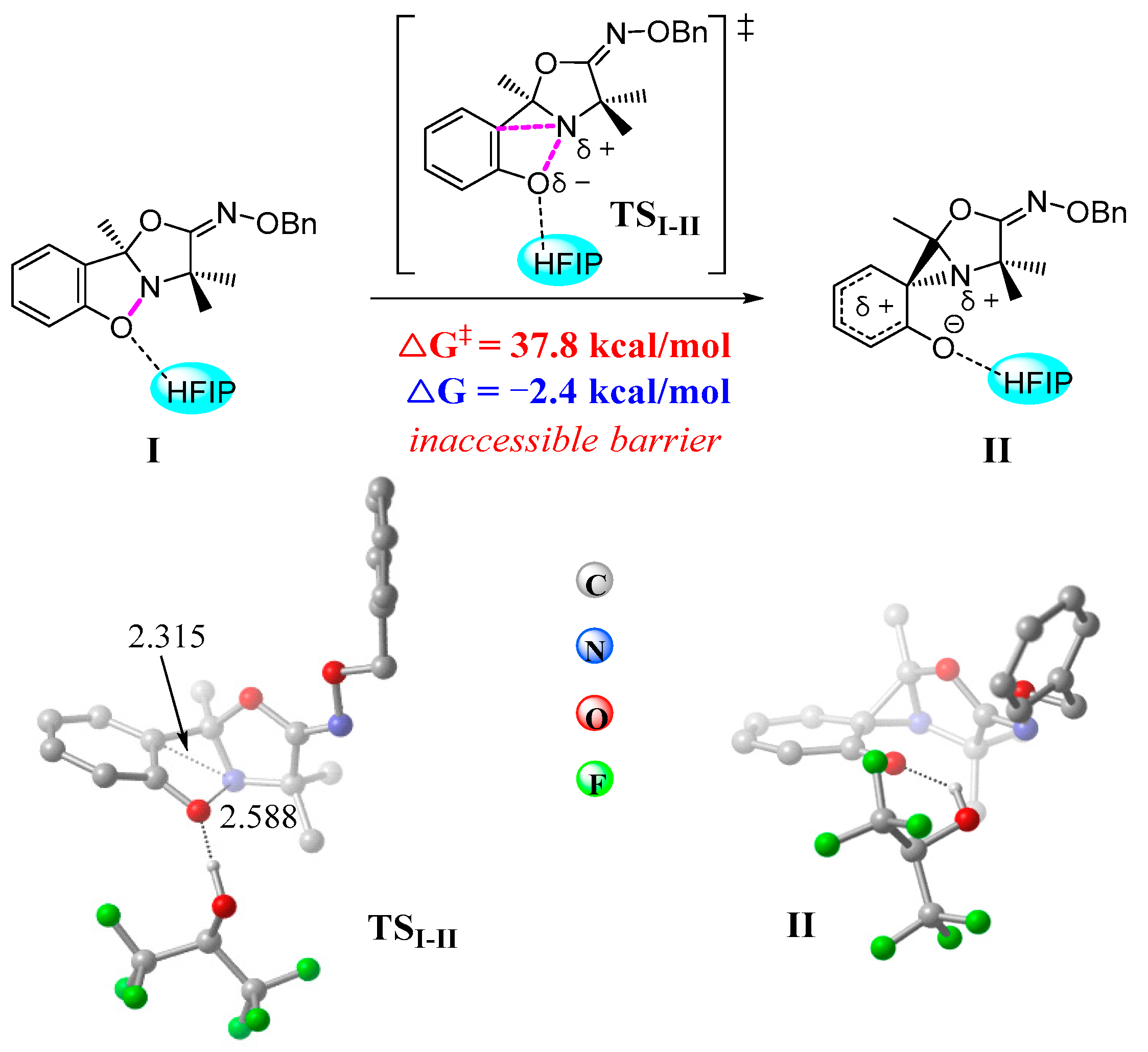
To understand how the absence of a proton at the C(3) position would freeze N-O bond cleavage, we investigated the isoxazole ring-opening mechanism without deprotonation assistance using the N-O bond cleavage process of 3b as a model system. The energetic parameters along with their transition state and intermediate are shown in Figure 6. Notably, this step requires overcoming a substantial activation barrier of 37.8 kcal/mol, leading to a three-membered ring intermediate with a zwitterionic configuration. These findings provide strong support for the observation that using substrate 1b exclusively results in a pure (3+2) cycloaddition reaction.
The different selectivity in the 1b reaction system from that in the 1a reaction system is caused by the methyl group on C(3). In the 1a reaction system, after the (3+2) cycloaddition process, the isoxazole ring could be opened with the help of the C(3) deprotonation, which finally produces the very stable product 3a and makes the overall reaction irreversible. In the 1b reaction system, the isoxazole ring in 3b could not be opened due to lack of a proton on C(3). Therefore, the 1a reaction system is governed by kinetics to deliver 3a as the major product, while the 1b reaction system is governed by thermodynamics to deliver 3b’ as the major product.

3.3. Electronic and Structural Analyses on (3+2) Cycloaddition of Azaoxyallyl Cations

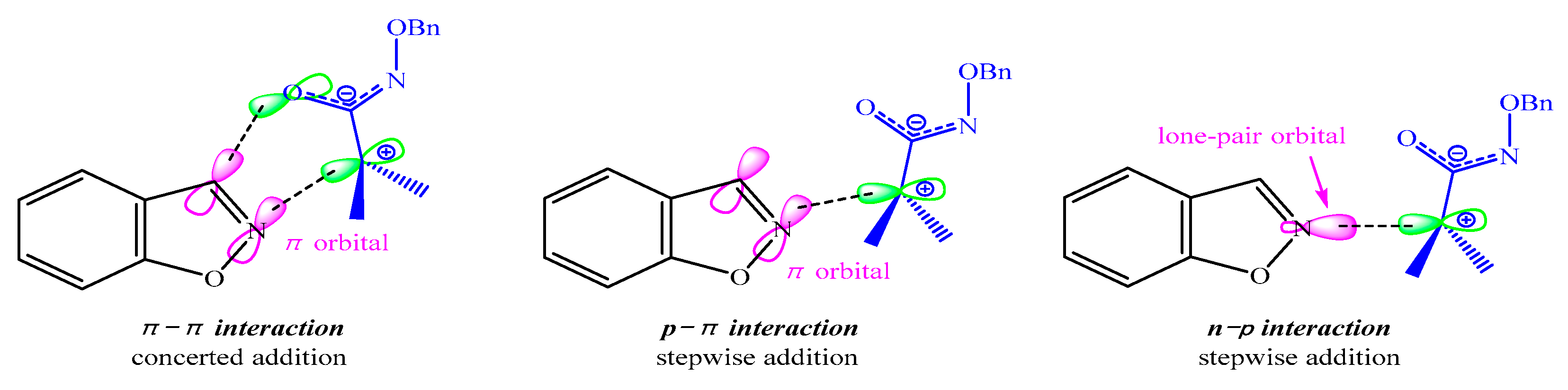
Theoretically, a (3+2) cycloaddition reaction between azaoxyallyl cation and 1,2-benzoisoxazole may exhibit three different mechanisms, as illustrated in Figure 7. The first is a concerted mechanism, while the latter two are stepwise mechanisms. In both stepwise pathways, the initial step involves the nitrogen center of the isoxazole ring coordinating to the carbonium center of azaoxyallyl cation. The distinction between these two stepwise mechanisms lies primarily in the orbital interactions, which are either p-π or n-p in nature.
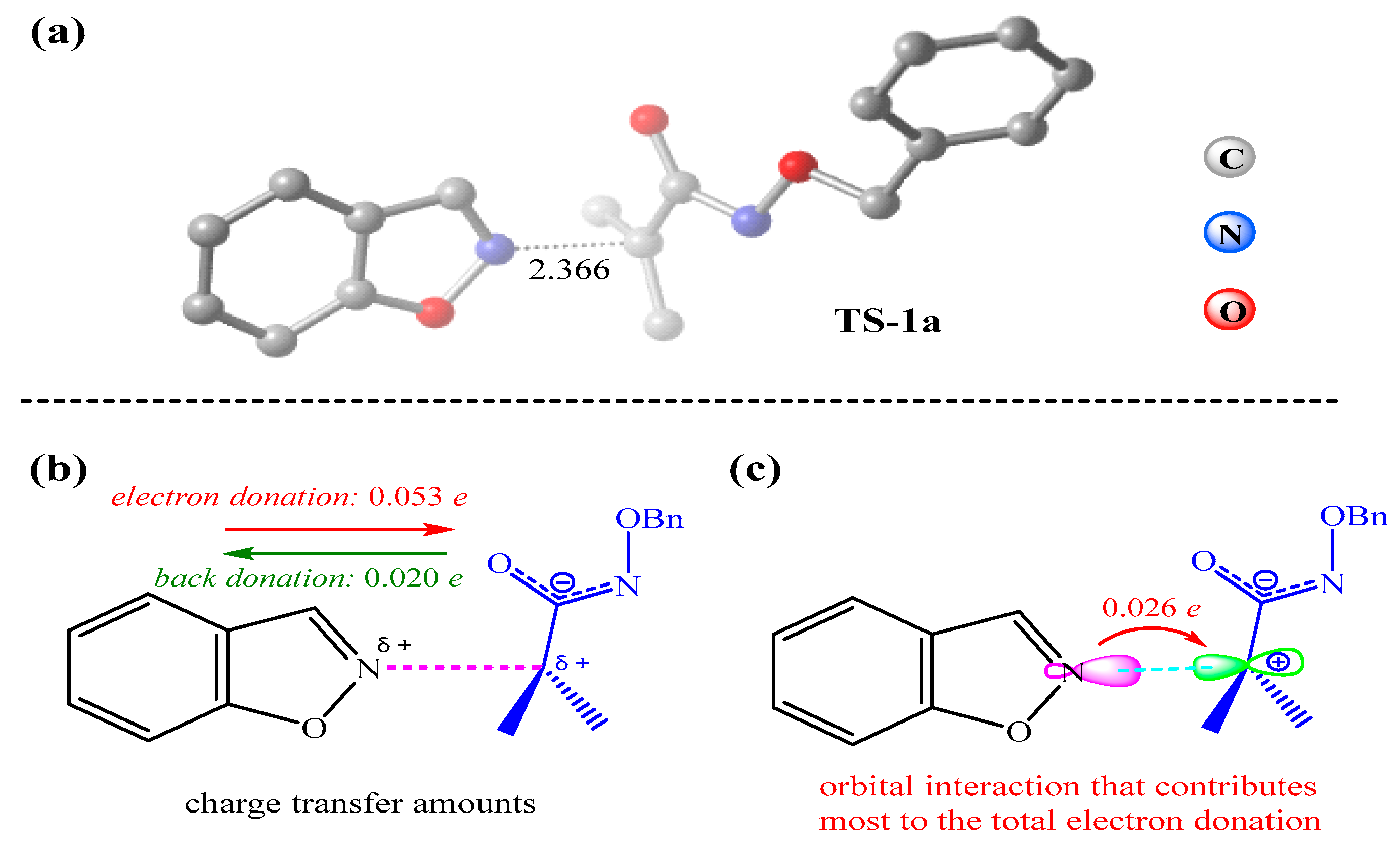
To confirm the actual mechanism, we conducted a series of structural and electronic analyses. Initially, we were unable to optimize any transition state for the concerted (3+2) pathway, suggesting that a stepwise mechanism is more plausible. Subsequently, we examined the geometric structure of TS-1a (Figure 8a), noting that the long C…N partial bond (2.366 Å) lies in the plane of the isoxazole ring, consistent with the directionality of the nitrogen lone pair. This observation implies that the orbital interaction is n-p rather than p-π, as the latter would result in the C…N bond lying outside the plane of the isoxazole ring.
To further investigate the electronic effects, we performed a charge decomposition analysis on TS-1a. The results indicate limited intermolecular electron transfer: the electron transfer from 1a to 2s is 0.053 e, while the reverse transfer is 0.020 e (Figure 8b). The dominant contribution to the electron transfer from 1a to 2s arises from the donation of the nitrogen lone pair orbital of 1a to the carbonium center of 2s, with an electron transfer of 0.026 e (Figure 8c).
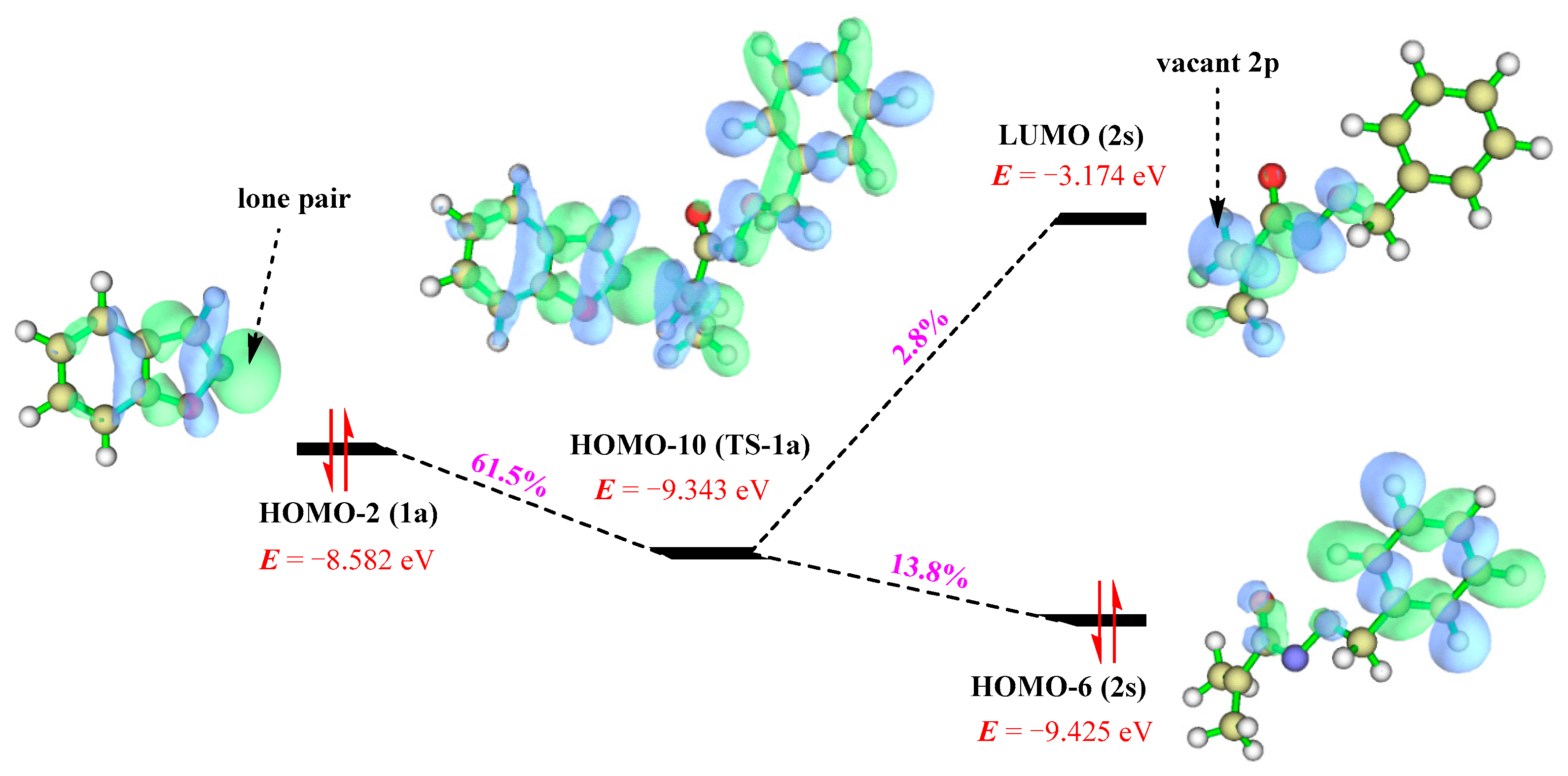
According to the charge decomposition analysis, the molecular orbital contributing most significantly to the 0.053 e charge transfer from 1a to 2s is the HOMO-10 of TS-1a (contributing 0.026 e). Consequently, we conducted fragment orbital analysis on the HOMO-10 to identify the specific orbital interactions between 1a and 2s that primarily govern the charge transfer process. The detailed results are presented in Figure 9. This analysis reveals that the key orbital interaction involves the HOMO-2 of 1a (primarily the nitrogen lone pair orbital) mixing with one occupied and one unoccupied orbital (primarily the vacant 2p orbital on the carbonium center) of 2s. Considering the charge transfer direction, the primary focus should be placed on the interaction between the nitrogen lone pair orbital of 1a and the vacant 2p orbital of 2s. This finding supports the mechanistic model depicted in Figure 8c.
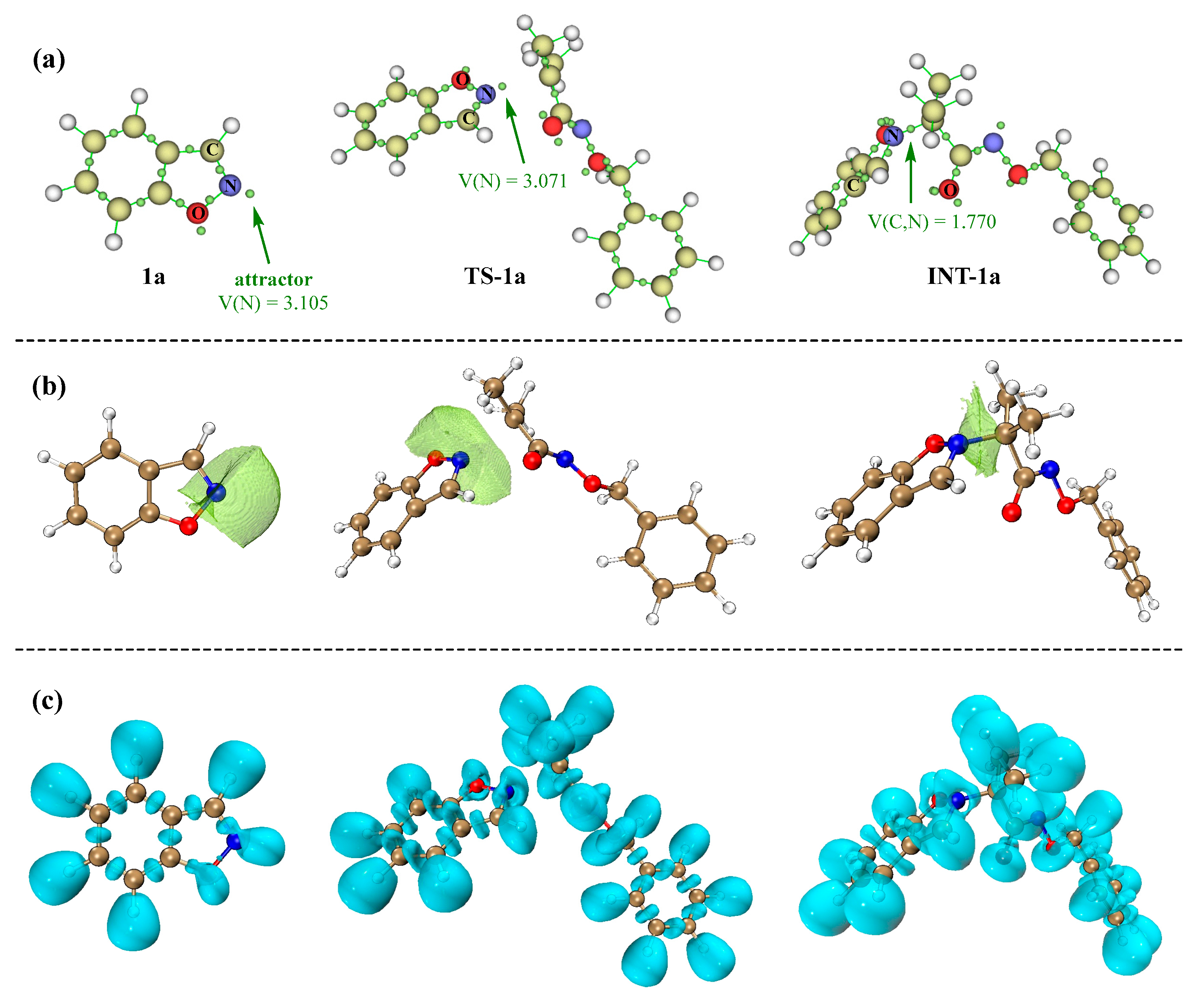
Finally, to further investigate the electronic features of the cycloaddition process, we conducted ELF analysis on 1a, TS-1a, and INT-1a. The key results are presented in Figure 10. Figure 10a shows the attractor positions for the three structures, with a focus on the lone pair electrons of the nitrogen atom and their evolution. In 1a, the attractor corresponding to the valence lone pair electrons of the nitrogen atom exhibits an integrated electron density of 3.105. In TS-1a, this attractor remains identifiable, with an integrated electron density of 3.071, while no attractor corresponding to the C-N bond is observed. In INT-1a, the attractor transforms into one associated with the C-N bond, featuring an integrated electron density of 1.770. Figure 10b displays the basins containing the attractor, further supporting that TS-1a retains the characteristics of the nitrogen lone pair electrons, whereas in INT-1a, the basin shifts to the C-N bond region. Figure 10c presents the ELF isosurfaces, revealing that only the ELF isosurface corresponding to the lone pair electrons is visible around the nitrogen atom in TS-1a, while the ELF isosurface associated with the C-N bond emerges in INT-1a. These results indicate that electron transfer plays a minor role in TS-1a, and the C-N bond formation is relatively weak, consistent with the conclusions drawn from the charge decomposition analysis.
Collectively, the interaction between 1a and 2s in TS-1a is primarily electrostatic in nature. The minor orbital interaction observed in TS-1a is attributable to n-p rather than p-π overlap.

4. Conclusions

This study systematically investigated the mechanism and O-cyclization/N-cyclization selectivity of (3+2) cycloaddition reactions between azaoxyallyl cations and 1,2-benzisoxazoles at the M06+D3/6-311++G(2d,2p)//M06/6-31G(d,p) computational level. The key findings are summarized as follows:
(1) The (3+2) cycloaddition between azaoxyallyl cations and the C=N double bond of 1,2-benzisoxazoles proceeds via a two-step mechanism, followed by base-assisted N-O bond cleavage and isoxazole ring-opening. This ultimately leads to the formation of either oxazoline derivatives (via O-cyclization) or imidazolone derivatives (via N-cyclization).
(2) When using unsubstituted 1,2-benzisoxazole as the substrate, the O-cyclization pathway exhibits kinetic control, while the N-cyclization pathway is thermodynamically controlled. Due to the lower activation barrier and irreversible nature of the O-cyclization pathway, the reaction is primarily governed by kinetic factors, resulting in oxazoline derivatives as the major products.
(3) Methyl substitution at C(3) in 1,2-benzisoxazoles prevents isoxazole ring opening due to the absence of a proton at C(3), resulting in a pure (3+2) cycloaddition pathway and formation of a less stable tricyclic product. Here, thermodynamic control dominates, favoring the N-cyclization pathway.
(4) Geometric and electronic structure analyses reveal that in the rate-determining transition state of the (3+2) cycloaddition, the interaction between azaoxyallyl cations and 1,2-benzisoxazoles is primarily electrostatic in nature. Limited charge transfer occurs mainly from the lone pair orbital of the nitrogen atom in 1,2-benzisoxazoles to the carbonium center of the azaoxyallyl cations.

Supplementary Materials

The following supporting information can be downloaded at: https://www.mdpi.com/article/10.3390/reactions6040070/s1, Table S1. Cartesian coordinates of the optimized stationary points involved in the pathway of 1a+2, determined at the M06/6-31G(d,p) level; Table S2. Cartesian coordinates of the optimized stationary points involved in the pathway of 1b+2, determined at the M06/6-31G(d,p) level; Table S3. Electronic energies (E in au), Gibbs free energies (G in au) and imaginary frequencies (IF in cm−1) determined at the M06/6-31G(d,p) level, and single-point energies (Esp in au) determined at the M06+D3/6-311++G(2d,2p) level; Table S4. Electronic energies (E in au), Gibbs free energies (G in au) and imaginary frequencies (IF in cm−1) determined at the M062X/6-31G(d,p) level, and single-point energies (Esp in au) determined at the M062X+D3/6-311++G(2d,2p) level; Table S5. Electronic energies (E in au), Gibbs free energies (G in au) and imaginary frequencies (IF in cm−1) determined at the B3LYP+D3/6-31G(d,p) level, and single-point energies (Esp in au) determined at the B3LYP+D3/6-311++G(2d,2p) level; Table S6. Electronic energies (E in au), Gibbs free energies (G in au) and imaginary frequencies (IF in cm−1) determined at the wB97XD/6-31G(d,p) level, and single-point energies (Esp in au) determined at the wB97XD/6-311++G(2d,2p) level.

Author Contributions

Conceptualization, W.Z. and G.L.; methodology, L.Z.; investigation, W.Z. and X.M. (Xiaosi Ma); writing—original draft preparation, W.Z. and L.Z.; writing—review and editing, G.L. and X.M. (Xiangtai Meng); supervision, G.L. and X.M. (Xiaosi Ma). All authors have read and agreed to the published version of the manuscript.

Funding

This work was supported by the National Natural Science Foundation of China (No. 22003045).

Data Availability Statement

Data are contained within the article and Supplementary Materials.

Conflicts of Interest

The authors declare no conflicts of interest.

References

  1. Xuan, J.; Cao, X.; Cheng, X. Advances in heterocycle synthesis via [3+m]-cycloaddition reactions involving an azaoxyallyl cation as the key intermediate. Chem. Commun. 2018, 54, 5154–5163. [Google Scholar] [CrossRef] [PubMed]
  2. Yue, G.; Liu, B. Research progress on [3 + n] (n ≥ 3) cycloaddition of 1,3-diploes. Chin. J. Org. Chem. 2020, 40, 3132–3153. [Google Scholar] [CrossRef]
  3. Kim, E.; Lee, C.Y.; Kim, S.G. HFIP-mediated decarboxylative [4 + 3]-annulation of azaoxyallyl cations with isatoic anhydride. Adv. Synth. Catal. 2020, 362, 3594–3603. [Google Scholar] [CrossRef]
  4. Kim, Y.; Kim, S.-G. Stereoselective [4+3]-cycloaddition of 2-amino-β-nitrostyrenes with azaoxyallyl cations to access functionalized 1,4-benzodiazepin-3-ones. Molecules 2024, 29, 1221. [Google Scholar] [CrossRef]
  5. Leng, H.-J.; Li, Q.-Z.; Xiang, P.; Qi, T.; Dai, Q.-S.; Jia, Z.-Q.; Gou, C.; Zhang, X.; Li, J.-L. Diastereoselective [3 + 1] cyclization reaction of oxindolyl azaoxyallyl cations with sulfur ylides: Assembly of 3,3’-Spiro[β-lactam]-oxindoles. Org. Lett. 2021, 23, 1451–1456. [Google Scholar] [CrossRef]
  6. Wang, G.; Wu, J.; Li, Y.; Huang, Z.; Zou, J.; He, Z.-L. Diastereoselective synthesis of pyrazolo [1,2-a] [1,2,4] triazine derivatives via cross-1,3-dipolar cyclizations of azaoxyallyl cations with N,N’-cyclic azomethine imines. Eur. J. Org. Chem. 2023, 26, e202300450. [Google Scholar] [CrossRef]
  7. Mondal, S.; Patel, M.; Biswas, A.; Hazra, S.; Saha, J. 1,1,1,3,3,3-Hexafluoroisopropanol-promoted synthesis of structurally diverse alkylidene-4-thiazolidinones/selenazolidinones involving an azaoxyallyl cation. Org. Lett. 2025, 27, 2715–2720. [Google Scholar] [CrossRef]
  8. Saha, J.; Singh, B.; Bera, T.; Singh, V.P.; Priyasha, P.; Das, D. Construction of spiropyrroloindolines by dearomative [3+2]-cycloaddition of indoles with oxindole-embedded azaoxyallyl-cations. Synlett 2023, 34, 465–470. [Google Scholar] [CrossRef]
  9. Biswas, S.; Duari, S.; Maity, S.; Roy, A.; Elsharif, A.M.; Biswas, S. (3 + 2) Cycloaddition of 2-alkoxynaphthalenes with azaoxyallyl cations: Access to benzo[e]indolones. Org. Biomol. Chem. 2022, 20, 8400–8404. [Google Scholar] [CrossRef]
  10. Ji, D.-Q.; Sun, J.-T. [3 + 2]-Cycloaddition of azaoxyallyl cations with hexahydro-1,3,5-triazines: Access to 4-imidazolidinones. Org. Lett. 2018, 20, 2745–2748. [Google Scholar] [CrossRef] [PubMed]
  11. El Bouakher, A.; Martel, A.; Comesse, S. α-Halogenoacetamides: Versatile and efficient tools for the synthesis of complex aza-heterocycles. Org. Biomol. Chem. 2019, 17, 8467–8485. [Google Scholar] [CrossRef] [PubMed]
  12. He, Y.; Pi, C.; Wu, Y.; Cui, X. Ring opening [3+2] cyclization of azaoxyallyl cations with benzo[d]isoxazoles: Efficient access to 2-hydroxyaryl-oxazolines. Chin. Chem. Lett. 2020, 31, 396–400. [Google Scholar] [CrossRef]
  13. Feng, J.; Zhao, M.; Lin, X. [3 + 2]-Cycloaddition of azaoxyallyl cations with 1,2-benzisoxazoles: A rapid entry to oxazolines. J. Org. Chem. 2019, 84, 9548–9560. [Google Scholar] [CrossRef]
  14. Mukherjee, A.; Ansari, A.J.; Rajagopala Reddy, S.; Kanti Das, G.; Singh, R. Mechanistic investigations for the formation of active hexafluoroisopropyl benzoates involving aza-oxyallyl cation and anthranils. Asian J. Org. Chem. 2020, 9, 2136–2143. [Google Scholar] [CrossRef]
  15. Villar, P.; Guillade, L.; González-Pérez, A.B.; de Lera, A.R. Computational studies on the formation of aza-oxypentadienyl intermediates from alkylidene oxaziridines and keteneimine oxides and their conversion to 1, 5-dihydropyrrolones. Int. J. Quantum Chem. 2019, 119, e25796. [Google Scholar] [CrossRef]
  16. Balde, B.; Force, G.; Marin, L.; Guillot, R.; Schulz, E.; Gandon, V.; Leboeuf, D. Synthesis of cyclopenta[b]piperazinones via an azaoxyallyl cation. Org. Lett. 2018, 20, 7405–7409. [Google Scholar] [CrossRef]
  17. DiPoto, M.C.; Hughes, R.P.; Wu, J. Dearomative indole (3 + 2) reactions with azaoxyallyl cations–new method for the synthesis of pyrroloindolines. J. Am. Chem. Soc. 2015, 137, 14861–14864. [Google Scholar] [CrossRef]
  18. Zhang, L.; Liu, Y.; Zhou, Y. A computational study on cycloaddition reactions between isatin azomethine imine and in situ generated azaoxyallyl cation. ChemistrySelect 2022, 7, e202104059. [Google Scholar] [CrossRef]
  19. Frisch, M.J.; Trucks, G.W.; Schlegel, H.B.; Scuseria, G.E.; Robb, M.A.; Cheeseman, J.R.; Scalmani, G.; Barone, V.; Petersson, G.A.; Nakatsuji, H.; et al. Gaussian 16, Revision, C.02; Gaussian, Inc.: Wallingford, CT, USA, 2016. [Google Scholar]
  20. Zhao, Y.; Truhlar, D.G. The M06 suite of density functionals for main group thermochemistry, thermochemical kinetics, noncovalent interactions, excited states, and transition elements: Two new functionals and systematic testing of four M06-class functionals and 12 other functionals. Theor. Chem. Acc. 2008, 120, 215–241. [Google Scholar]
  21. Scalmani, G.; Frisch, M.J. Continuous surface charge polarizable continuum models of solvation. I. General formalism. J. Chem. Phys. 2010, 132, 114110. [Google Scholar] [CrossRef] [PubMed]
  22. Fukui, K. The path of chemical reactions-the IRC approach. Acc. Chem. Res. 1981, 14, 363–368. [Google Scholar] [CrossRef]
  23. Hratchian, H.P.; Schlegel, H.B. Using Hessian updating to increase the efficiency of a Hessian based predictor-corrector reaction path following method. J. Chem. Theory Comput. 2005, 1, 61–69. [Google Scholar] [CrossRef]
  24. Grimme, S. Semiempirical GGA-type density functional constructed with a long-range dispersion correction. J. Comp. Chem. 2006, 27, 1787–1799. [Google Scholar] [CrossRef]
  25. Grimme, S. Supramolecular binding thermodynamics by dispersion-corrected density functional theory. Chem. Eur. J. 2012, 18, 9955–9964. [Google Scholar] [CrossRef]
  26. Zhou, W.; Zhang, L.; Liu, D.-Y.; Ma, X.; Zhang, J.; Kang, J. Comparison of phosphonium and sulfoxonium ylides in Ru(II)-catalyzed dehydrogenative annulations: A density functional theory study. Molecules 2025, 30, 1883. [Google Scholar] [CrossRef]
  27. Xiao, M.; Lu, T. Generalized charge decomposition analysis (GCDA) method. J. Adv. Phys. Chem. 2015, 4, 111–124. [Google Scholar] [CrossRef]
  28. Becke, A.D.; Edgecombe, K.E. A simple measure of electron localization in atomic and molecular systems. J. Chem. Phys. 1990, 92, 5397–5403. [Google Scholar] [CrossRef]
  29. Lu, T.; Chen, F. Multiwfn: A multifunctional wavefunction analyzer. J. Comput. Chem. 2012, 33, 580–592. [Google Scholar] [CrossRef] [PubMed]
  30. Lu, T. A comprehensive electron wavefunction analysis toolbox for chemists, Multiwfn. J. Chem. Phys. 2024, 161, 082503. [Google Scholar] [CrossRef]
  31. Legault, C.Y. CYLView, 1.0b; Universite de Sherbrooke: Quebec City, QC, Canada, 2009. [Google Scholar]
  32. Humphrey, W.; Dalke, A.; Schulten, K. VMD: Visual Molecular Dynamics, Version 1.9.4a55; University of Illinois Urbana-Champaign: Champaign, IL, USA, 2024. [Google Scholar]
  33. Becke, A.D. Density-functional thermochemistry. III. The role of exact exchange. J. Chem. Phys. 1993, 98, 5648–5652. [Google Scholar] [CrossRef]
  34. Chai, J.D.; Head-Gordon, M. Long-range corrected hybrid density functionals with damped atom-atom dispersion corrections. Phys. Chem. Chem. Phys. 2008, 10, 6615–6620. [Google Scholar] [CrossRef] [PubMed]
Scheme 1. (a) In situ generation and molecular electrostatic potential of azaoxyallyl cation; (b) Two (3+2) cycloaddition modes of azaoxyallyl cations.
Reactions 06 00070 sch001
Scheme 2. Key experimental findings of (3+2) cycloaddition reactions between 1,2-benzisoxazoles and azaoxyallyl cations.
Reactions 06 00070 sch002
Figure 1. Reaction mechanism and free-energy profiles (in kcal/mol) for the formation of 3a from 1a and 2s, determined at the M06+D3/6-311++G(2d,2p)//M06/6-31G(d,p) level.
Reactions 06 00070 g001
Figure 2. Gibbs free-energy profiles (in kcal/mol) calculated by different functional methods: M06+D3//M06 (black), B3LYP+D3//B3LYP+D3 (red), M062X+D3//M062X (green), and wB97XD//wB97XD (blue).
Reactions 06 00070 g002
Figure 3. Reaction mechanism and free-energy profiles (in kcal/mol) for the formation of 3a’ from 1a and 2s, determined at the M06+D3/6-311++G(2d,2p)//M06/6-31G(d,p) level.
Reactions 06 00070 g003
Figure 4. Comparative free-energy profiles (in kcal/mol) for the pathways leading to 3a and 3a’ from 1a and 2s.
Reactions 06 00070 g004
Figure 5. Reaction mechanisms and comparative free-energy profiles (in kcal/mol) for the production of 3b and 3b’ from 1b and 2s, determined at the M06+D3/6-311++G(2d,2p)//M06/6-31G(d,p) level.
Reactions 06 00070 g005
Figure 6. Mechanism, structures (hydrogen atoms are omitted for clarity) and energy parameters of N-O bond cleavage without deprotonation assistance.
Reactions 06 00070 g006
Figure 7. Possible mechanism models for (3+2) cycloaddition between azaoxyallyl cation and C=N double bond.
Reactions 06 00070 g007
Figure 8. Structural and energetic analyses of the first transition state in the (3+2) cycloaddition reaction: (a) Three-dimensional geometry of TS-1a (hydrogen atoms omitted for clarity); (b) Charge decomposition analysis highlighting electron transfer patterns; (c) Validated mechanism model.
Reactions 06 00070 g008
Figure 9. Fragment orbital analysis of the most contributing orbital to charge transfer in TS-1a.
Reactions 06 00070 g009
Figure 10. Results of ELF analysis for 1a, TS-1a, and INT-1a: (a) Positions of attractors; (b) ELF basins containing the specified attractor; (c) ELF 0.8 isosurfaces.
Reactions 06 00070 g010
Disclaimer/Publisher’s Note: The statements, opinions and data contained in all publications are solely those of the individual author(s) and contributor(s) and not of MDPI and/or the editor(s). MDPI and/or the editor(s) disclaim responsibility for any injury to people or property resulting from any ideas, methods, instructions or products referred to in the content.