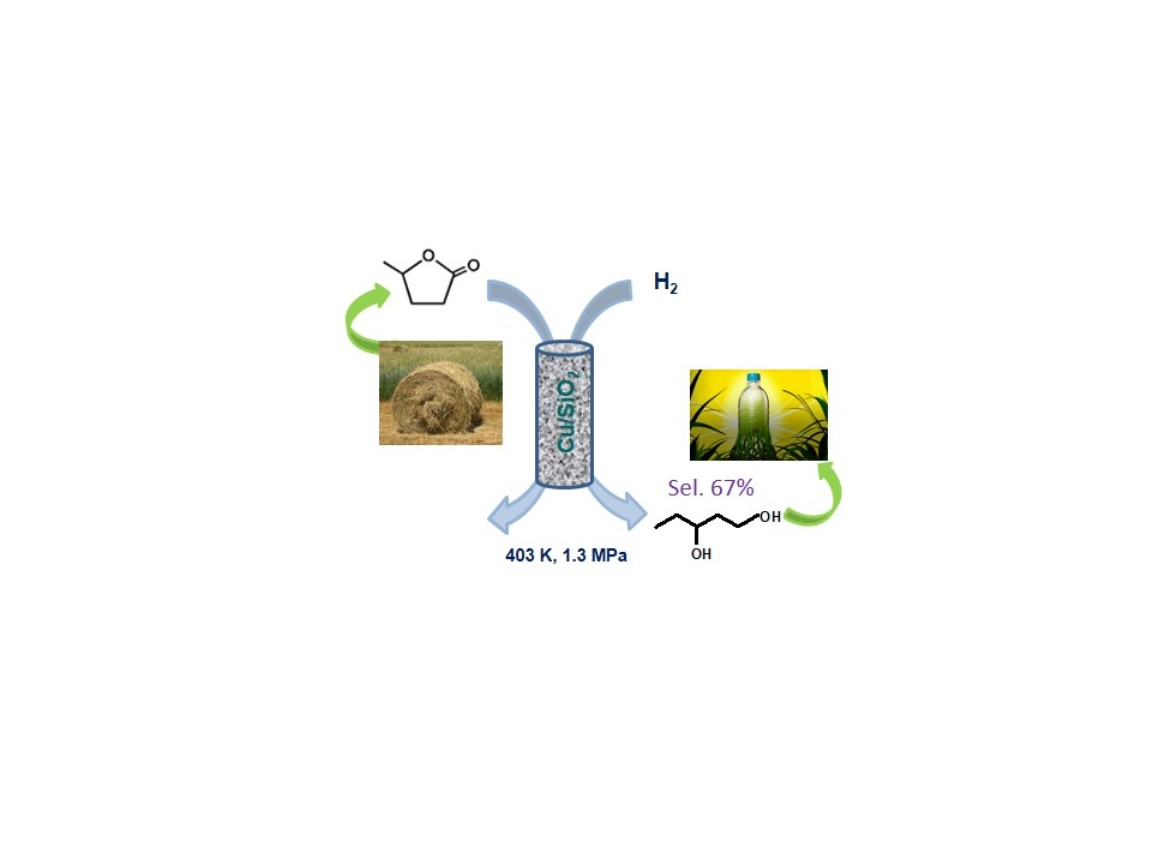
Heterogeneously Catalyzed γ-Valerolactone Hydrogenation into 1,4-Pentanediol in Milder Reaction Conditions

 ,
, 
 ,
, 
Abstract
Share and Cite
Simakova, I.; Demidova, Y.; Simonov, M.; Prikhod’ko, S.; Niphadkar, P.; Bokade, V.; Dhepe, P.; Murzin, D.Y. Heterogeneously Catalyzed γ-Valerolactone Hydrogenation into 1,4-Pentanediol in Milder Reaction Conditions. Reactions 2020, 1, 54-71. https://doi.org/10.3390/reactions1020006
Simakova I, Demidova Y, Simonov M, Prikhod’ko S, Niphadkar P, Bokade V, Dhepe P, Murzin DY. Heterogeneously Catalyzed γ-Valerolactone Hydrogenation into 1,4-Pentanediol in Milder Reaction Conditions. Reactions. 2020; 1(2):54-71. https://doi.org/10.3390/reactions1020006
Chicago/Turabian StyleSimakova, Irina, Yulia Demidova, Mikhail Simonov, Sergey Prikhod’ko, Prashant Niphadkar, Vijay Bokade, Paresh Dhepe, and Dmitry Yu. Murzin. 2020. "Heterogeneously Catalyzed γ-Valerolactone Hydrogenation into 1,4-Pentanediol in Milder Reaction Conditions" Reactions 1, no. 2: 54-71. https://doi.org/10.3390/reactions1020006
APA StyleSimakova, I., Demidova, Y., Simonov, M., Prikhod’ko, S., Niphadkar, P., Bokade, V., Dhepe, P., & Murzin, D. Y. (2020). Heterogeneously Catalyzed γ-Valerolactone Hydrogenation into 1,4-Pentanediol in Milder Reaction Conditions. Reactions, 1(2), 54-71. https://doi.org/10.3390/reactions1020006