1. Introduction
Brazil currently holds a prominent position in global agricultural production. However, the country’s agricultural model remains heavily dependent on pesticides. The use of these chemical products has become a growing concern and a subject of debate because of their adverse effects on food safety and the environment, making biologically based products an important alternative. In addition, studies have demonstrated the potential of using adjuvants in spray mixtures to mitigate the social and environmental impacts associated with agricultural spraying [
1,
2,
3].
In this context, bioinsecticides have become established as a key biotechnological and environmentally sustainable alternative [
4]. The United States Environmental Protection Agency (EPA) classifies these agents into three main groups: plant-incorporated protectants (PIPs), biochemical biopesticides, such as pheromones and plant extracts, and microbial biopesticides, which are based on bacteria, fungi, viruses, or microalgae [
4]. Microbial agents, particularly entomopathogenic bacteria such as
Bacillus thuringiensis (Bt) and species of the genera Pseudomonas, Burkholderia, and Streptomyces, act with high specificity against agricultural pests [
4,
5,
6].
Regarding adjuvants, Cunha et al. [
7] reported that these products are added to spray mixtures to enhance the biological efficacy of active ingredients. The addition of these inputs improves adhesion, reduces foaming, evaporation, and volatilization, enhances droplet dispersion, increases active ingredient absorption, and improves overall spray solution distribution. However, it is essential to determine the final effect of the adjuvant independently of the plant protection product composition [
8,
9,
10].
In general, the use of application technology in agricultural practices is not necessarily synonymous with efficiency. To ensure effective phytosanitary treatment, techniques must be used that promote uniform deposition of the active ingredient on the target, minimize spray drift losses, and ensure pathogen control [
11]. According to Belucci et al. [
12], the efficacy of phytosanitary products depends on the technology adopted and on application-time factors, such as temperature, relative humidity, wind speed, and nozzle type.
Spray nozzles play a central and decisive role because they regulate droplet spectrum and size, factors that directly affect deposition, leaf coverage, and the biological efficacy of crop protection products [
13]. In this regard, flat-fan nozzles are widely used in field applications of phytosanitary products because they produce a relatively uniform distribution across the application swath [
14].
Among the weather conditions that influence spray efficiency, wind speed intensity deserves particular attention. Under adverse conditions, this variable is responsible for carrying droplets away from the application targets. The literature recommends that most applications be performed at wind speeds between 0.83 and 2.78 m s
−1; however, precise studies on the influence of wind speed on the potential for these losses are limited by the inability to control this variable under field conditions. For this reason, research in this area should be conducted in wind tunnels that allow a specific wind speed and a predetermined flow pattern [
15,
16,
17,
18].
In this context, given that spray solution losses vary depending on adjuvant use and wind speed at the time of application, geostatistics can be used for mathematical modeling of the spatial distribution of these losses under field conditions. Moreover, once the spatial dependence model is established and fitted, it enables the generation of interpolated maps using the kriging technique, which illustrate the spatial distribution pattern of the variable under study [
19].
Therefore, considering the importance of understanding the interaction between adjuvants and bioinsecticides, this study aimed to investigate the effects of wind intensity and adjuvants in spray mixtures prepared with a Bacillus thuringiensis-based biological insecticide on spray deposition in a wind tunnel under laminar flow conditions.
2. Materials and Methods
The experiment was conducted under controlled conditions in a wind tunnel installed at the Agricultural Machinery Laboratory of the State University of Goiás, Central Campus, in Anápolis, Goiás, Brazil. The wind tunnel used was an open-circuit, blower-type system with a square test section measuring 0.60 m per side and 1.8 m in length, equipped with an access system for sample handling. The propulsion system consisted of an axial fan driven by a three-phase motor rated at 1.5 hp and a frequency inverter (PowerFlex 40 model, Allen-Bradley/Rockwell Automation, Milwaukee, WI, USA). Regarding the aerodynamic parameters, the airflow in the test section, after the settling chamber, was homogeneous, with a uniform velocity distribution, Reynolds numbers below 5 × 10
5, and a laminar, incompressible flow regime throughout the test section, as described by Lima et al. [
20].
The wind tunnel spray system was constructed with a cylindrical reservoir with a capacity of 5 L, in which the spray solution was stored and pressurized. An ADGA 02 flat-fan anti-drift nozzle (120° spray angle) was mounted in the upper part of the tunnel, i.e., at a height of 0.60 m and 0.15 m from the entrance of the test section. Pressurization was performed using a CO2-pressurized backpack sprayer (Herbicat) at 310.3 kPa, resulting in a flow rate of 0.81 L min−1. According to ASAE S572, the spray nozzle is classified as producing a predominantly fine-to-medium droplet spectrum, with an estimated volume median diameter between 100 and 250 µm, which may vary depending on operating conditions, such as working pressure and spray solution composition. The spray system was activated after airflow stabilization and was kept operating for 10 s.
During sample collection, relative humidity ranged from 33.8 to 54.6%, and air temperature ranged from 25.2 to 29.4 °C, measured using a portable digital thermo-hygro-anemometer (Instrutherm, model THAR-185), with readings taken at random time intervals throughout the application period.
2.1. Experimental Design
The experiment was conducted in a completely randomized design, arranged in a 5 × 4 × 4 factorial scheme, with three replications, totaling 240 experimental units. Treatments consisted of five horizontal distances in the wind direction relative to the spraying point (0.45, 0.75, 1.05, 1.35, and 1.65 m), four air velocities inside the wind tunnel (1, 2, 3, and 4 m s
−1), and four spray solution formulations (water + dye; bioinsecticide + dye; bioinsecticide + vegetable oil + dye; and bioinsecticide + surfactant + dye), as described in
Table 1.
2.2. Spray Solutions
For spray solution preparation, the biological insecticide Dipel
® (Sumitomo Chemical, São Paulo, SP, Brazil), formulated with
Bacillus thuringiensis var. kurstaki strain HD-1, was used. Depending on the treatment, the adjuvants Veget’Oil
® (Oxiquímica Agrociência Ltd., Jaboticabal, SP, Brazil), based on vegetable oil/fatty acid esters, and Break Thru
® (Evonik Nutrition & Care GmbH, Essen, Germany), classified as a nonionic organosilicone surfactant with surface tension-reducing capacity, were added to evaluate the influence of these formulations on spray characteristics, as shown in
Table 1.
The spray solutions were prepared on the day of use at 25 °C, following the manufacturers’ recommended product doses, and included the tracer dye Brilliant Blue (FD&C Blue No. 1) at a concentration of 3.2 g L
−1, according to a methodology adapted from Palladini et al. [
21].
2.3. Characterization of Spray Deposition in the Wind Tunnel
To determine spray deposition, the concentration of the tracer dye Brilliant Blue (FD&C Blue No. 1) was measured in the wash solution obtained from the collector strings distributed inside the wind tunnel. Spraying time per replication was 10 s, measured with a digital stopwatch, yielding an application volume of 0.135 L.
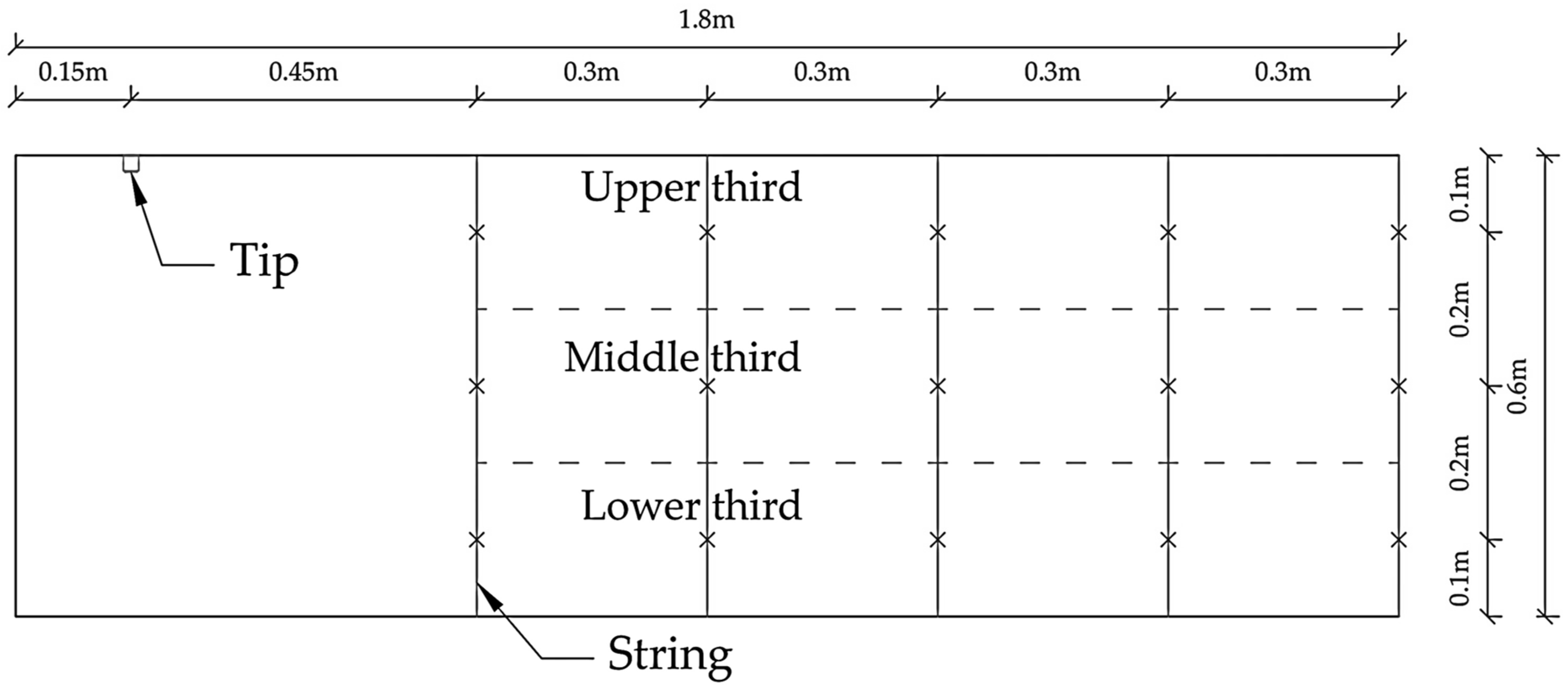
Wool collector strings measuring 2.0 mm in diameter and 0.60 m in length were used. These were positioned transversely to the airflow at distances of 0.45, 0.75, 1.05, 1.35, and 1.65 m from the spray nozzle and 0.30 m from the walls of the test section, following the methodology of Madureira et al. [
22].
After each trial, the artificial targets were divided into three equal sections (0.20 m each) and identified by their position relative to the tunnel floor as the lower, middle, or upper thirds. Subsequently, they were removed and placed in labeled plastic cups.
For tracer extraction, 30 mL of distilled water was added to each sample, followed by manual agitation for 30 s. The resulting solution was then used to quantify the tracer by absorbance at 630 nm with a spectrophotometer (Tecnal, model UV-5100, Piracicaba, SP, Brazil) for Brilliant Blue, according to the methodology described by Palladini et al. [
21].
To determine deposition on the targets, a calibration curve was established for the spectrophotometer using an electronic spreadsheet, based on solutions with dye concentrations ranging from 0.0001 to 0.090 g L
−1. This procedure generated Equation (1), with an R
2 of 99.98%.
where
C—spray solution concentration (g L−1); and
A—absorbance
Absorbance data were converted into concentration (g L
−1) according to Equation (1). Based on the initial concentration (g L
−1) and the sample dilution volume (30 mL), the equivalent volumes of the original solution retained in the lower, middle, and upper thirds were determined according to Equation (2). Absorbance data were converted into concentration (g L
−1) according to Equation (1), and based on the initial concentration (g L
−1) and the dilution volume of the samples (30 mL), the volumes retained in the lower, middle, and upper thirds were determined using Equation (2).
where
Ci is the initial concentration of the tracer solution in the spray mixture (mg L−1);
Vi is the volume retained by the target (mL);
Cf is the concentration detected by optical density (mg L−1); and
Vf is the dilution volume of the sample for each target (mL).
The mean values of the volumes deposited on each target were converted into deposition percentage as a function of the total sprayed volume, according to Equations (2) and (3). The mean deposition values for each target were converted into drift percentage, according to Equation (3), as a function of the total sprayed volume.
where
D is the deposition percentage;
vd is the volume of deposited spray; and
vp is the total volume sprayed during the trial.
2.4. Data Analysis
2.4.1. Classical Statistics
The data were subjected to Bartlett and Lilliefors tests to assess homogeneity of variances and normality of residuals, respectively. To meet these assumptions, a logarithmic transformation was applied when necessary. After verification, analysis of variance (ANOVA) was performed using the F-test at a 5% significance level. When significant, means were compared using Tukey’s test at the 5% significance level. To evaluate the effects of air velocity inside the wind tunnel and horizontal distance, regression analysis was performed, considering model significance and the highest coefficient of determination (R
2) to select the most appropriate equation. All statistical analyses were conducted using the R software [
23].
2.4.2. Geostatistical Analysis
Initially, descriptive statistics were performed to evaluate the dispersion and distribution of the data related to spray deposition as a function of air velocity and spray solution composition inside the test section of the wind tunnel. The following descriptive measures were estimated: mean, median, minimum and maximum values, standard deviation, kurtosis, skewness, and coefficient of variation.
To characterize spatial variability, geostatistical analysis was performed, with each treatment analyzed individually to identify spatial dependence using semivariograms. The selection of the mathematical model for the fitted semivariograms followed the criteria of the lowest residual sum of squares (RSS), the highest coefficient of determination (R
2), and the greatest degree of spatial dependence (DSD), as described by Monteiro et al. [
24]. Semivariogram models were fitted using GS+ software (Version 7). After confirming the spatial dependence of the studied variables, ordinary kriging interpolation was applied to estimate values at unsampled locations.
For this purpose, the length and height of the test section were considered as the x- and y-axes, respectively. For modeling, the volume of deposited spray solution was assigned to the midpoint of the lower, middle, and upper thirds, i.e., at 0.10, 0.30, and 0.50 m relative to the tunnel floor, and at horizontal distances of 0.45, 0.75, 1.05, 1.35, and 1.65 m, as illustrated in
Figure 1. The spray nozzle was positioned 0.15 m from the outlet of the settling chamber, a region characterized by laminar airflow, as described by Lima et al. [
20].
3. Results
The mean square values and their respective statistical significance for spray deposits in the upper, middle, and lower thirds are presented in
Table 2. The mean squares and their respective significance levels for drift deposition in the upper, middle, and lower thirds are presented in
Table 2. The results indicate that the treatments significantly influenced drift deposition in all evaluated sections of the sampling profile.
For the upper and middle thirds, significant individual effects of the evaluated factors were observed, indicating that both air velocity and spray solution type influenced the deposition recorded at these positions. These findings demonstrate that operational spraying conditions can alter droplet behavior during application.
In the lower third, in addition to the isolated effects of the studied factors, a significant interaction between air velocity and spray solution type was observed. This result indicates that the effect of spray solution composition on deposition depends on the air velocity during spraying. This result indicates that the effect of spray solution composition on drift deposition depends on the air velocity during spraying.
The occurrence of this interaction suggests that certain spray formulations may exhibit greater or lower susceptibility to drift under different wind conditions, reinforcing the importance of selecting appropriate formulations and environmental conditions during spray application.
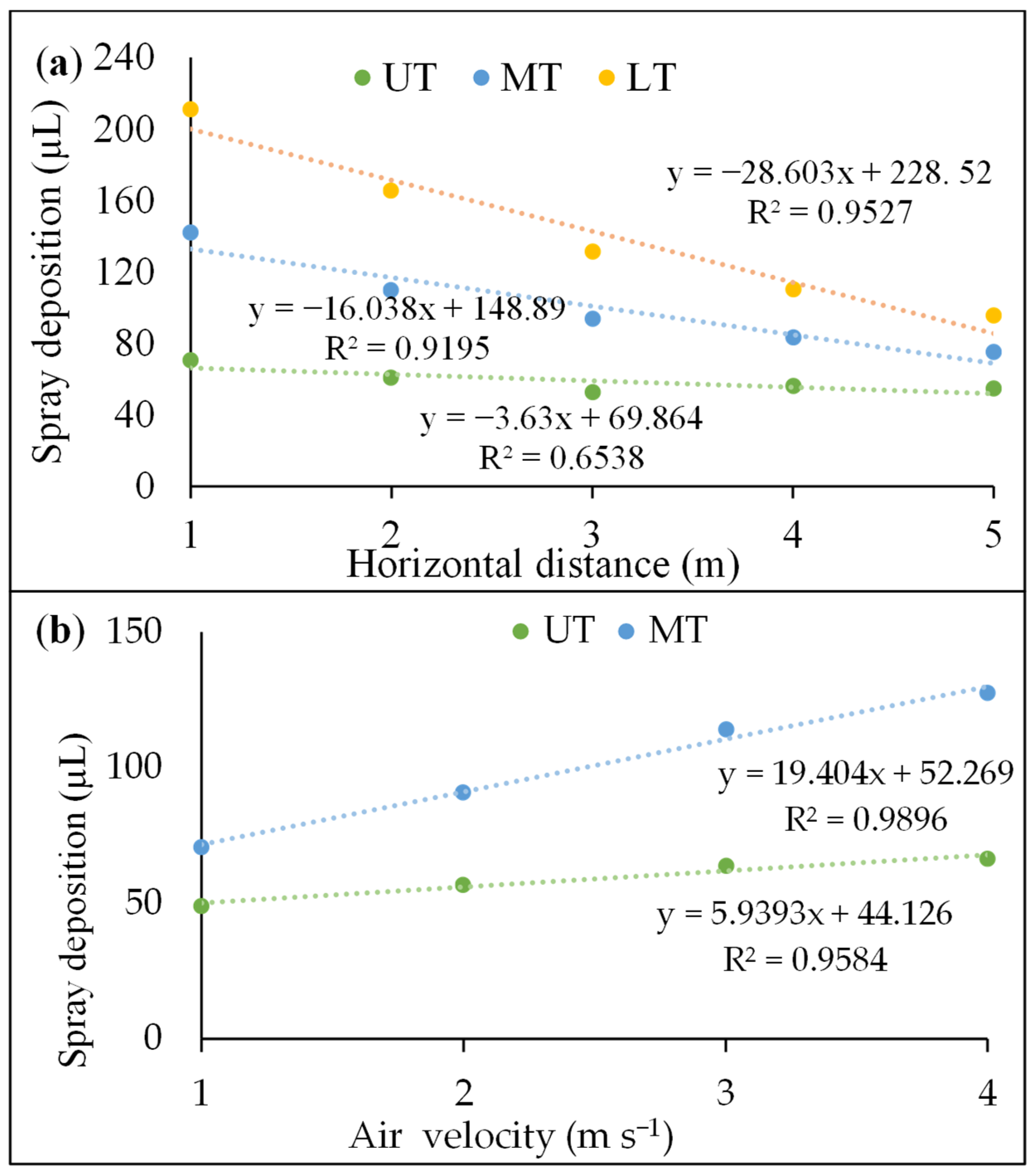
The volumes retained in the upper, middle, and lower thirds, expressed in µL, as a function of distance, are presented in
Figure 2a and as a function of air velocity in
Figure 2b. In
Figure 2a, it can be observed that the deposits retained on the targets, regardless of horizontal distance, were consistently higher in the lower third, followed by the middle and upper thirds.
According to Moreira Junior and Antuniassi [
25], this deposition pattern indicates that, although droplets are transported by the airflow, gravity has a stronger effect on larger-diameter droplets. Furthermore, an increase in the horizontal distance from the spraying point results in reduced deposition values, highlighting droplet dispersion along the trajectory and the consequent decrease in deposition on more distant collectors.
As illustrated in
Figure 2b, air velocity strongly influenced droplet transport. Thus, regardless of the evaluated third, the air velocity of 1 m s
−1 resulted in the lowest deposition on the collector targets, with values increasing as air velocity increased.
Across all simulated scenarios, target deposition tended to be higher in the middle third as air velocity increased, indicating greater deposition concentration in this region than in the upper and lower thirds.
Spray deposition in the upper and middle thirds showed significant changes compared with the application of water alone, as shown in
Table 3. In the upper third, the spray solution formulated with the biological insecticide and Veget’Oil
® showed the highest mean deposition; however, it did not differ statistically from the solution prepared with Dipel
® alone. In contrast, the solution containing the adjuvant Break Thru
® showed results statistically similar to those of the solution without the active ingredient.
For the middle third, the Dipel® solution resulted in the highest droplet deposition and differed significantly from the other spray formulations. As observed in the upper third, the combination of Dipel® + Break Thru® resulted in lower deposition retained on the targets.
Based on the analysis of mean deposition volumes on targets in the upper and middle thirds, no significant interaction between air velocity and spray solution type was observed. However, for targets positioned in the lower third of the wind tunnel test section, a statistically significant interaction at the 5% probability level was observed, as shown in
Table 2.
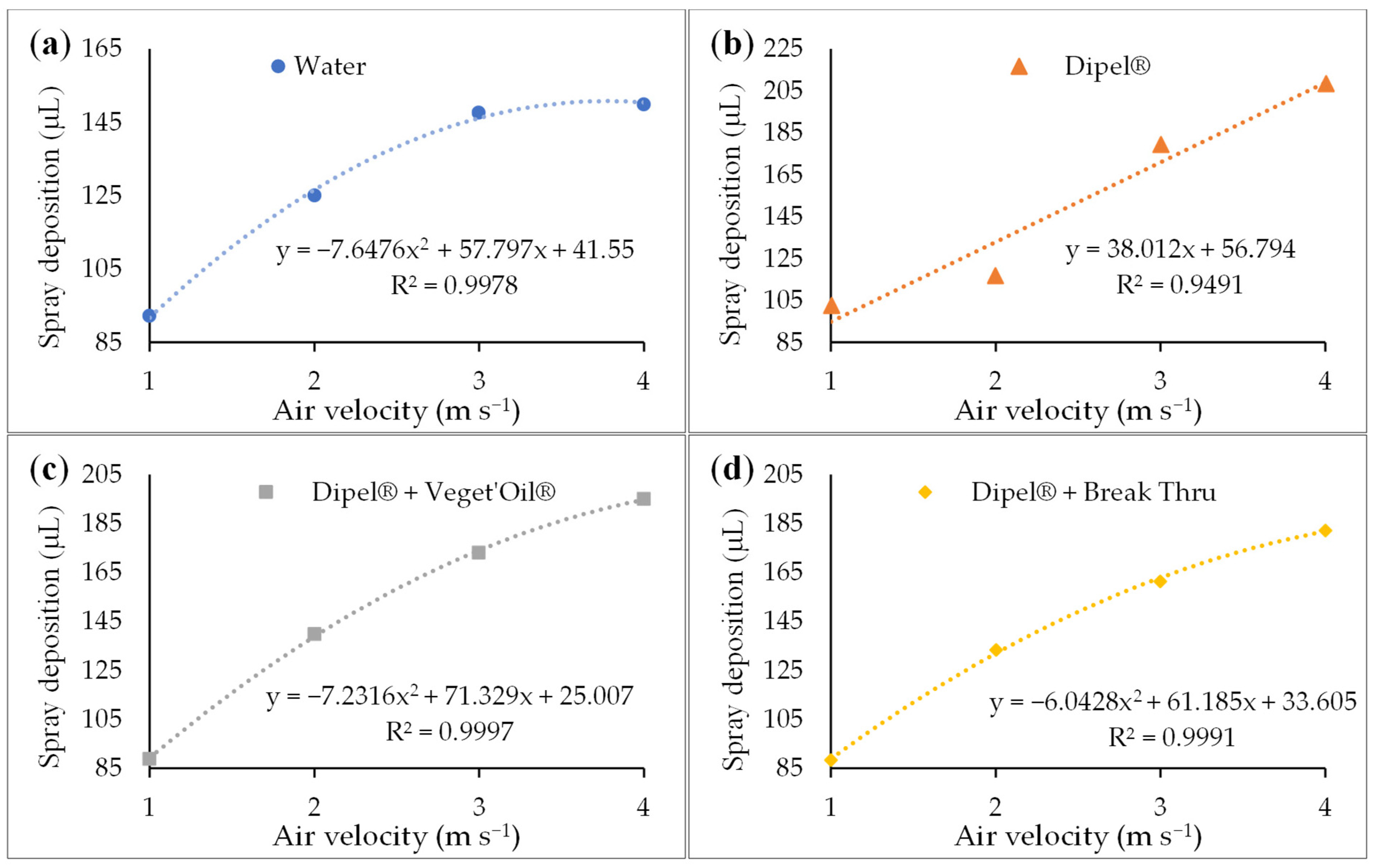
Spray deposition in the lower third increased with air velocity in all treatments, although distinct patterns were observed among the spray solutions, highlighting the significant interaction between the factors, as shown in
Table 4 and
Figure 3. The interaction between air velocity and spray solutions for deposition in the lower third is presented in
Table 4 and
Figure 3.
For water, a quadratic response was observed (
Figure 3a), with an initial increase in deposition followed by a tendency toward stabilization at higher air velocities. Because of its high surface tension and low viscosity, water produces a broader droplet spectrum, with a greater proportion of fine droplets. This behavior is confirmed by the data in
Table 4, in which water showed no significant increase between 3 and 4 m s
−1.
For Dipel
®, the relationship was linear (
Figure 3b), indicating that deposition increased proportionally with air velocity. The data in
Table 4 confirm this pattern, with a significant increase in deposition as air velocity increased, especially at the highest velocities, where Dipel
® showed the greatest values.
The addition of Veget’Oil
® significantly altered the system dynamics, resulting in a quadratic response with high deposition levels (
Figure 3c). The oil-based adjuvant reduces surface tension and increases viscosity, favoring the formation of larger and more stable droplets. This explains the marked increase in deposition between 1 and 3 m s
−1, as shown in
Table 4. At higher air velocities, the response tended to stabilize.
Similarly, Break Thru
® also showed a quadratic response (
Figure 3d), but with slightly lower deposition than the oil-based system. As a surfactant, it strongly reduces surface tension, thereby improving droplet spreading on the target. The data in
Table 4 show that, although deposition increased significantly with air velocity, the values remained lower than those obtained with Veget’Oil
®, particularly at the highest velocities.
As air velocity increased, the differences became more evident, with Dipel® showing greater deposition at high velocities, whereas the adjuvant treatments exhibited responses dependent on the balance among droplet stability, evaporation, and interaction with the airflow.
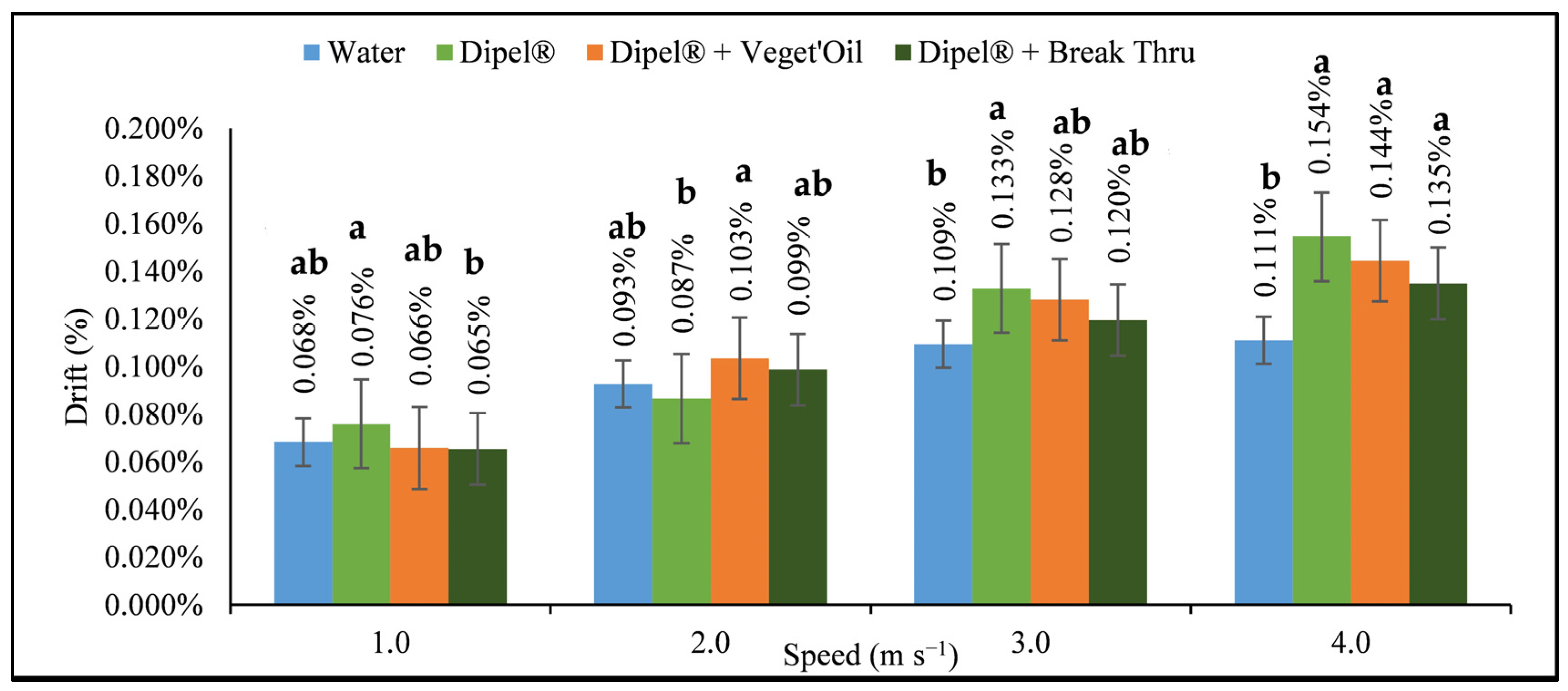
Figure 4 shows the volumes deposited on the targets, converted into deposition percentage, as a function of spray solution composition and air velocity in the lower third.
Although all spray solutions responded positively to increasing air velocity, the relative gain in deposition was more pronounced for Dipel® and the adjuvant-containing mixtures at the highest velocities (3.0 and 4.0 m s−1), whereas water showed a considerably more limited increase. This behavior indicates that increasing air velocity intensifies droplet transport, however, the efficiency of this process depends directly on the stability of the droplet spec-trum and its interaction with the airflow.
Spatial Distribution of Spray Drift
In the descriptive analysis of spray deposition for the treatments, different statistical measures were calculated, as shown in
Table 5. The deposition values showed similar mean and median values, indicating an approximately normal distribution of the data. The variables had coefficients of variation (CV) classified as medium and skewness coefficients ranging from 0.49 to 2.15, indicating a low displacement from the mean value and, consequently, an approximately normal data distribution. According to Lima et al. [
26], data normality does not interfere with semivariogram fitting when geostatistical techniques are used.
Table 6 presents the parameters of the semivariogram models fitted to the spray deposition values (µL) as a function of spray solution composition and air velocity at the time of application. The Gaussian model provided the best fit for deposition at the lowest air velocities, indicating high spatial continuity. In contrast, the linear model performed better at the highest air velocity, suggesting that increasing air velocity tends to intensify droplet transport and reduce spatial continuity. The higher spatial dependence values indicate that nearby points tended to show similar deposition values and that the spray deposition patterns were spatially structured rather than random. The variables showed a range between 0.43 and 1.42 m, indicating that the adopted sampling spacing was sufficient to represent the spatial dependence structure of spray deposition.
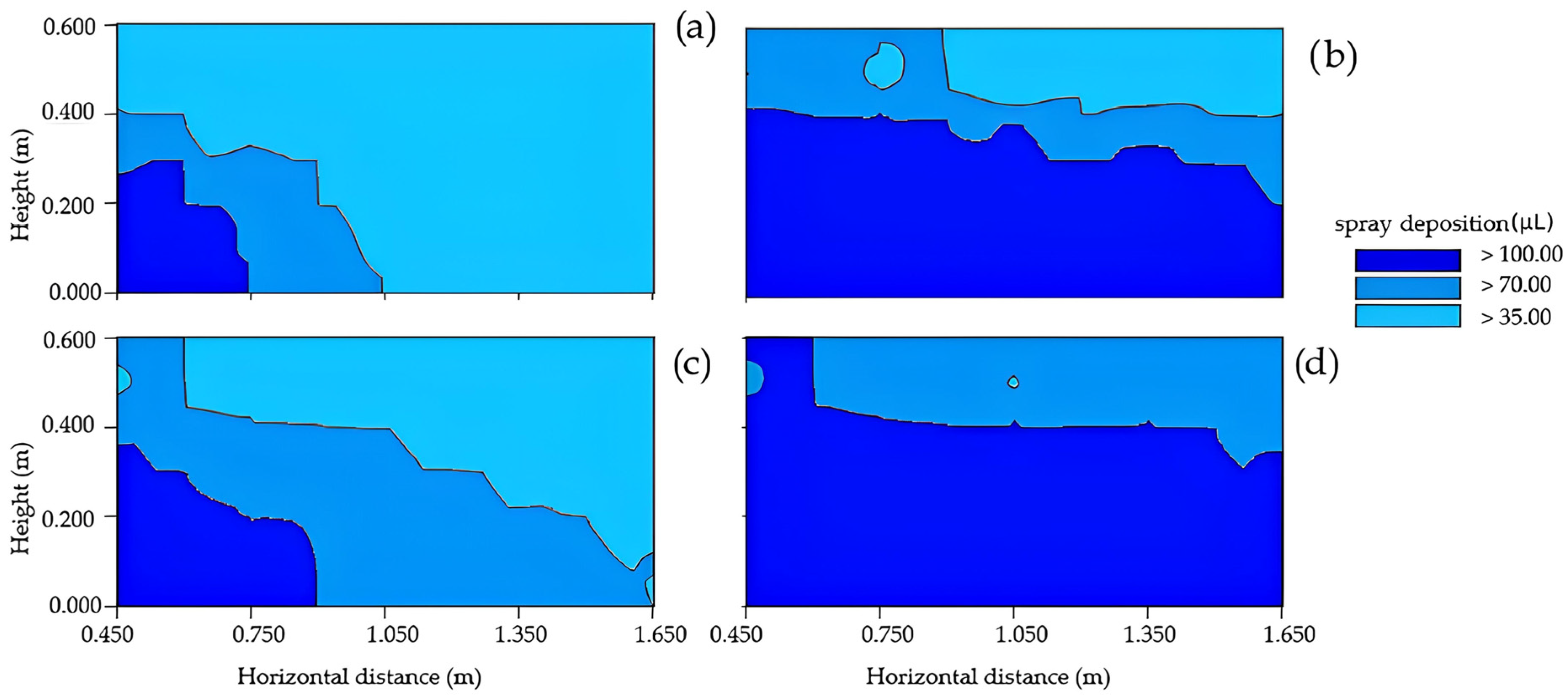
The spatial distribution maps of spray deposition, generated using the ordinary kriging interpolation method, are presented in
Figure 5. The figure shows spray deposition maps for the air velocity of 1 m s
−1, fitted with the Gaussian model, and for the air velocity of 4 m s
−1, fitted with the linear model. It can be observed that higher air velocities resulted in greater spray deposition and greater uniformity, due to the stronger airflow, which tends to intensify droplet transport.
4. Discussion
The results showed that both air velocity inside the wind tunnel and the horizontal distance of the targets significantly influenced spray deposition in the different thirds, with deposits decreasing as distance increased. Under field conditions, spray deposition on the target is influenced by the distance between the spray nozzle and the application target.
In general, the data obtained in the wind tunnel can be compared with field deposition data collected outside the application target. In field applications, increasing this distance tends to reduce the amount of spray solution deposited because droplets remain airborne for a longer period, favoring losses through evaporation, wind displacement, and drift, especially for smaller-diameter droplets. Bueno et al. [
27] and Moreira Junior and Antuniassi [
25] reported lower deposition values at greater collection distances under field conditions.
The observation that increasing air velocity resulted in greater retained volumes, particularly in the middle third, reinforces wind speed as a critical determinant of droplet entrainment and penetration. This evidence is strongly supported by Szarka et al. [
15], who identified air velocity as the factor with the greatest impact on deposition, specifically physical drift, even outweighing droplet size classes. This effect was also reported by Vieira et al. [
28], who observed a proportional increase in drift with increasing wind speed. Xu et al. [
29] described the causal mechanism underlying this phenomenon: as airflow velocity increases, velocity differentials and gradients in the atmosphere generate aerodynamic drag and lift forces acting on the droplets.
The analysis of the spray solutions showed that the bioinsecticide Dipel
® resulted in higher mean deposition in both the upper and middle thirds, whereas its combination with Break Thru
® significantly reduced retention. This behavior is consistent with the findings of Baio et al. [
8], who reported that the adjuvant Break Thru
® reduces surface tension, promotes spreading, and may reduce retention on target surfaces.
In the lower third of the collectors, a positive synergy was observed between the air velocity of 4 m s
−1 and the spray solution formulated with vegetable oil (Veget’Oil
®). This interaction reflects the balance between induced kinetic energy and the elastic forces of the fluid. As explained by Xu et al. [
29], adequate velocities, in this case the energy generated at 4 m s
−1, are essential to provide droplets with sufficient momentum to overcome the mechanical barrier, or shielding effect, imposed by the upper portions of the target and to avoid the “escape phenomenon” associated with weak airflow conditions.
The descriptive analysis revealed moderate to high variability (CV ranging from 32 to 59%), consistent with the stochastic nature of droplet movement in wind tunnels. The positive skewness values indicate that most observations were concentrated below the mean, a pattern also reported by Corado Neto [
30] in similar deposition studies.
The geostatistical fits revealed strong spatial dependence (>80%) for all treatments, according to the classification proposed by Dalchiavon and Carvalho [
31], indicating that deposition values were similar among nearby points and that the deposition patterns were well structured. The Gaussian model performed better up to 3 m s
−1, whereas the linear model provided the best fit at 4 m s
−1, indicating possible saturation of the spatial dependence range and showing greater and more uniform spray deposition caused by the stronger airflow, which tends to intensify droplet transport away from the application target.
The transition from a better fit of the Gaussian model at 3 m s
−1, corroborating Lacerda [
32] and Rodrigues et al. [
33], to the linear model at 4 m s
−1 is fully supported by micrometeorological data reported in the literature. Wind speeds up to 3.3 m s
−1 are classified as “low,” whereas values from 3.4 m s
−1 onward fall into the “moderate” category, a physical threshold at which the magnitude and persistence of long-distance drift increase substantially [
34].
The spatial dependence and linear fit observed at 4 m s
−1 can be explained by the fact that, at higher velocities, aerodynamic shear forces and intense airflow overcome droplet resistance and gravitational settling [
35]. This promotes the continuous and more uniform transport of the fine droplet fraction (<100 µm) away from the target before gravity can act to deposit them [
36].
Finally, the deposition maps showed a tendency toward greater accumulation in the initial regions of the sampled area and between the lower and middle thirds, a pattern also described by Pita [
37], who attributed greater deposition to the combined effect of airflow direction and intensity on droplet trajectory. This behavior, characterized by very high concentrations in the initial regions, results from the balance of forces: larger droplets have greater mass and higher terminal velocity, which provides sufficient kinetic energy to overcome the drag force of lateral wind and fall rapidly under the action of gravity [
29,
38].
5. Conclusions
Air velocity inside the wind tunnel significantly influenced spray deposition, with applications performed at higher air velocities resulting in an increase in deposition percentage.
In the upper third, the use of the adjuvant Veget’Oil® did not reduce spray deposits compared with the spray solution containing only the biological insecticide Dipel®. However, the mixture containing the adjuvant Break Thru® resulted in lower deposit values on the collector targets.
In the middle third, the spray solution containing only Dipel® showed the highest deposition values. Furthermore, the use of adjuvants reduced the deposited volumes, with no statistical difference between the Dipel® + Veget’Oil® spray solution and the control treatment, water. The combination of Dipel® + Break Thru® resulted in the lowest deposition on the collector targets.
For the lower third, at an air velocity of 1 m s−1, the addition of the adjuvant Break Thru® resulted in lower deposition compared with the spray solution containing Dipel®. However, at an air velocity of 4 m s−1, the use of adjuvants did not significantly reduce deposition compared with the spray solution prepared with the biological insecticide, with no statistical difference among treatments.
Spray deposition in the wind tunnel can be analyzed using geostatistics, as this variable showed a high degree of spatial variability for all treatments studied. The lower air velocities were fitted by the Gaussian model, whereas the highest velocity was fitted by the linear model.
Spray deposition maps represent an important tool in application technology because they make it possible to visualize the spatial distribution of deposition and quantify its extent within the experimental area.




 ,
,