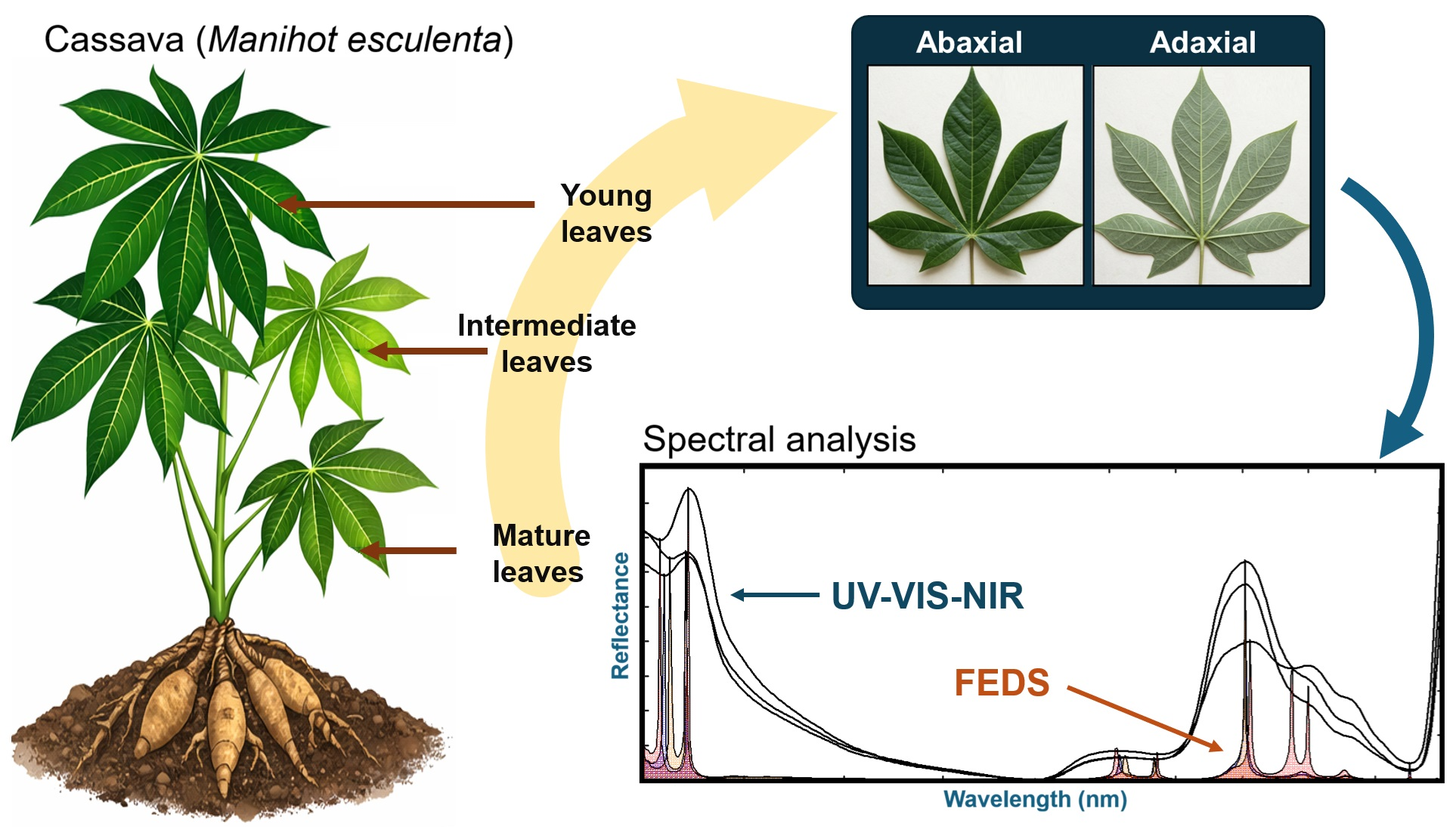


Spectral Signatures and Indices of Cassava Leaves by Multiregional Spectral Analysis (UV-VIS-NIR) and Functionally Enhanced Derivative Spectroscopy (FEDS): Leaf Ontogeny and Induced Senescence

Abstract
1. Introduction
2. Materials and Methods
2.1. Experimental Location
2.2. Leaf Tissue Sampling
2.3. Pretreatment and Storage of Leaf Tissue Samples
2.4. Experimental Design and Dataset Structure
2.5. UV–VIS–NIR Measurements
2.6. Spectral Data Processing
2.6.1. Data Pretreatment
- Smoothing: Prior to normalization, spectra were subjected to a smoothing process to reduce instrumental noise without compromising spectral resolution. Three smoothing methods were evaluated: Savitzky–Golay filtering (or polynomial derivative filters) [56,57,58], moving average [59,60,61], and Gaussian filtering [62,63]. Based on comparative performance in terms of peak preservation and noise reduction, the Savitzky–Golay filter was selected, using a 9-point window. The Savitzky–Golay smoothing method is based on fitting a polynomial of degree to a moving window of consecutive data points using a least-squares approach. For each central point , the smoothed value is calculated as follows:where are the original data of the signal in the window analysis, and are the deconvolution coefficients calculated as a function of the polynomial order and the window size [56,57,58]. The moving average method involves replacing each point in the spectrum with the average of its neighbors within a defined window bywhere parameters in Equation (3) are equivalent to those described for Equation (2) [59,60,61]. On the other hand, the Gaussian filter consists of applying weighted smoothing where points near the center have greater weight, following a normal distribution, such that:where are Gaussian weights defined bywith denotes the standard deviation of the Gaussian function controlling the smoothing level, is the window half-size, denotes the exponential function and [62,63].
- Normalization: For the normalization and elimination of negative values from the spectra, a min-max rescaling function was applied to obtain values in the range from 0 to 1; for this, the maximum and minimum reflectance values ( and , respectively) were first selected, and then, point by point, the following equation was applied:where is the normalized and scaled reflectance, and is the reflectance at one wavelength [64,65].
- Conversion between reflectance and pseudo-absorbance measurements in leaf tissues: To facilitate qualitative interpretation and comparison with spectra obtained by transmission, reflectance measurements () were transformed to pseudo-absorbance values (), which is defined according to the equation described below:
2.6.2. Spectral Segmentation
2.7. Use of FEDS for the Identification of Characteristic Signals
2.8. Spectral Indices
2.9. Analysis of Data
2.9.1. Descriptive Statistical Analysis
2.9.2. Analysis of Spectral Data Correlations
2.9.3. Analysis of Variance
2.10. Induced Senescence Experiments
3. Results and Discussion
3.1. Characterization of the UV-VIS-NIR Spectral Signature of Cassava Leaf Tissue
3.2. Influence of Physiological Development on the UV-VIS-NIR Optical Response of Leaf Tissue
3.3. Influence of Leaf Anatomy on Differences in Spectral Response
3.4. Multiregional Correlational Analysis Based on Pearson Coefficients
3.4.1. Correlative Dynamics for the UV-VIS-NIR Spectrum
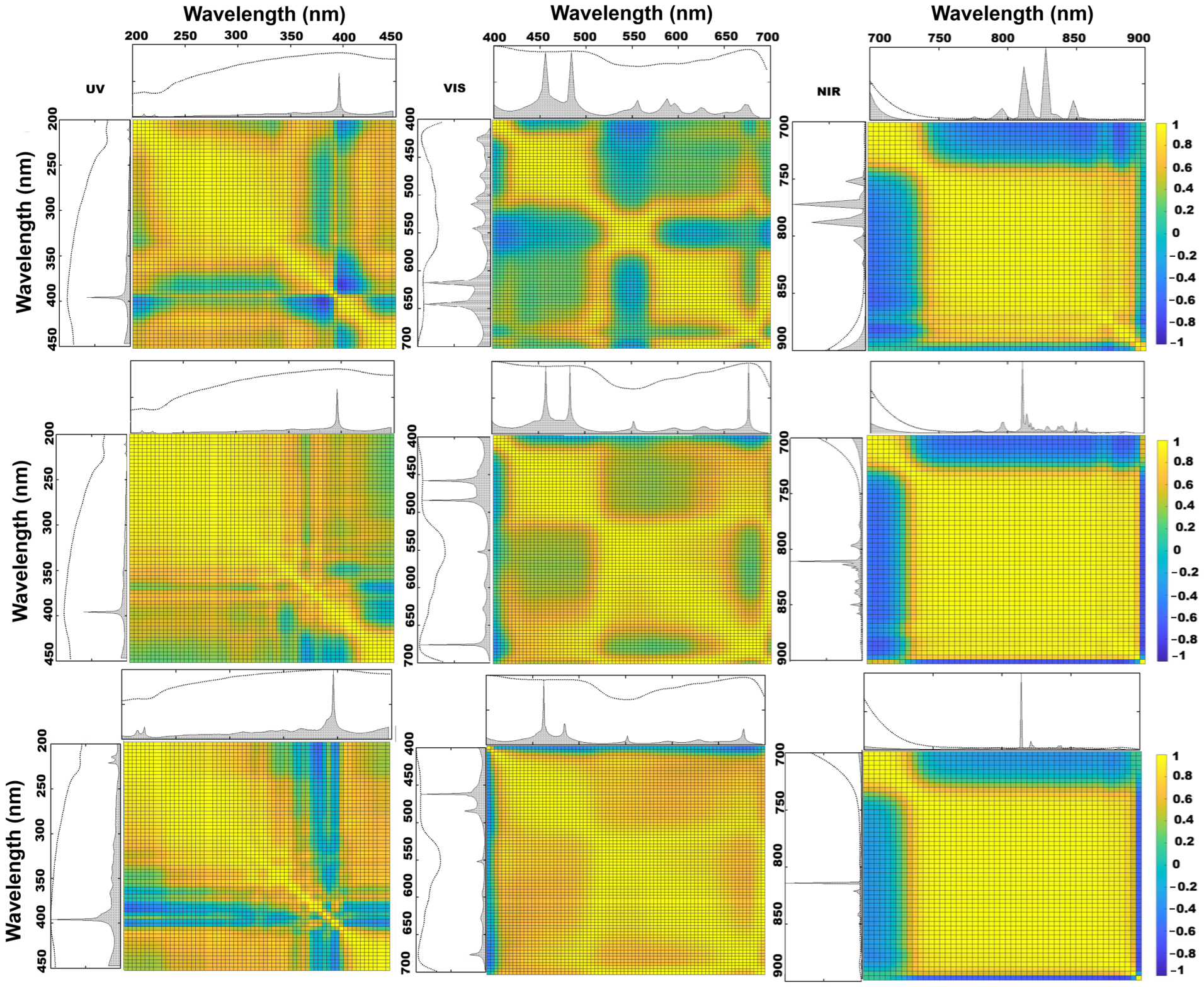
- UV Region: A moderate correlation was identified between 350–370 nm (flavonoids; a4′) and 200–230 nm (simple phenols; a1), with 0.5–0.6. The variability in these bands coincides with the increase in phenolic compounds, which is consistent with lignification pathways and secondary metabolite synthesis [96]. With ontogenetic development, the correlation increased in intermediate leaves and reversed in mature leaves (), which is consistent with the structural consolidation and optical coupling described in mature leaves [97]. Finally, a strong and negative correlation was observed between 380–395 nm (a5) and 200–230 nm (a1) in young leaves (). This decoupling gradually disappeared towards intermediate and mature stages, indicating a process of optical homogenization possibly associated with the integration of pigments and cellular structures [97].
- VIS Region: This region exhibits marked negative correlations between 550 nm (minimum photosynthetic absorption; b5) and 590 nm (weak absorption of chlorophyll b, b6) (), as well as with 420 nm (blue absorption of carotenes and chlorophyll a) (). This behavior reflects a relatively low concentration of chlorophylls in early stages, and a greater influence of carotenoids and phenolic compounds. The above is consistent with the inversion of the correlation as a sign of increased codependence and optical homogeneity during maturation, which is a behavior consistent with the transition to states of greater photosynthetic activity [98].
- NIR Region: The correlation patterns observed in this region were very similar between the maturation stages, with greater spectral decoupling in young leaves, especially between 700–740 nm (VIS-NIR transition region) and 740–900 nm (region of high structural dispersion), suggesting less structural integration and greater anatomical heterogeneity.
3.4.2. Comparison Between Ontogenetic Groups, Differential Correlation () and Statistical Significance Using Permutations in UV-VIS-NIR
3.5. Evaluation of the Variability Associated with the Ontogeny of Leaf Tissue Spectral Indices Derived from UV-VIS-NIR (ANOVA and Kruskal–Wallis)
FEDS-Based UV-VIS-NIR Spectral Indices
3.6. Analysis of the Temporal Dynamics of Spectral Indices Through Induced Leaf Degradation Experiments
3.6.1. Structural and General Vigor Indices (NDVI and MCARI)
3.6.2. Water and Structural Integrity Indices (NDWI900, NWI, NIRslope)
3.6.3. FEDS-Based UV-VIS-NIR Indices (NDVI5, NDVI6, NDVI7, NDVI8)
3.7. Analysis of Spectral Variability in the Face of Ontogenetic and Temporal Factors Using Linear Mixed Models (LMMs) and Principal Component Analysis (PCA)
3.7.1. Statistical Validation of Fixed Effects and Interactions Using LMMs
3.7.2. Multivariate Structure and Convergence Trajectories (PCA)
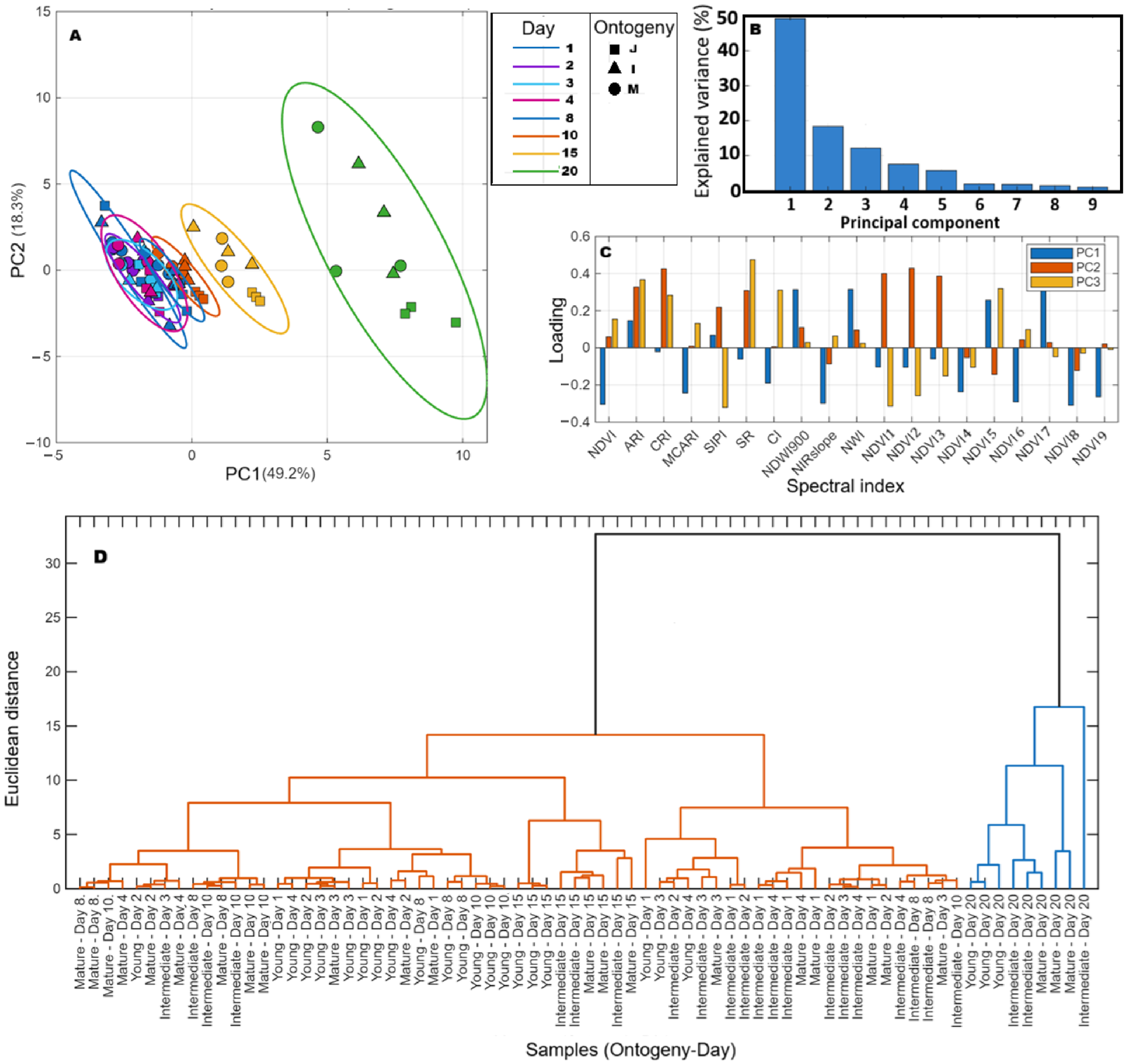
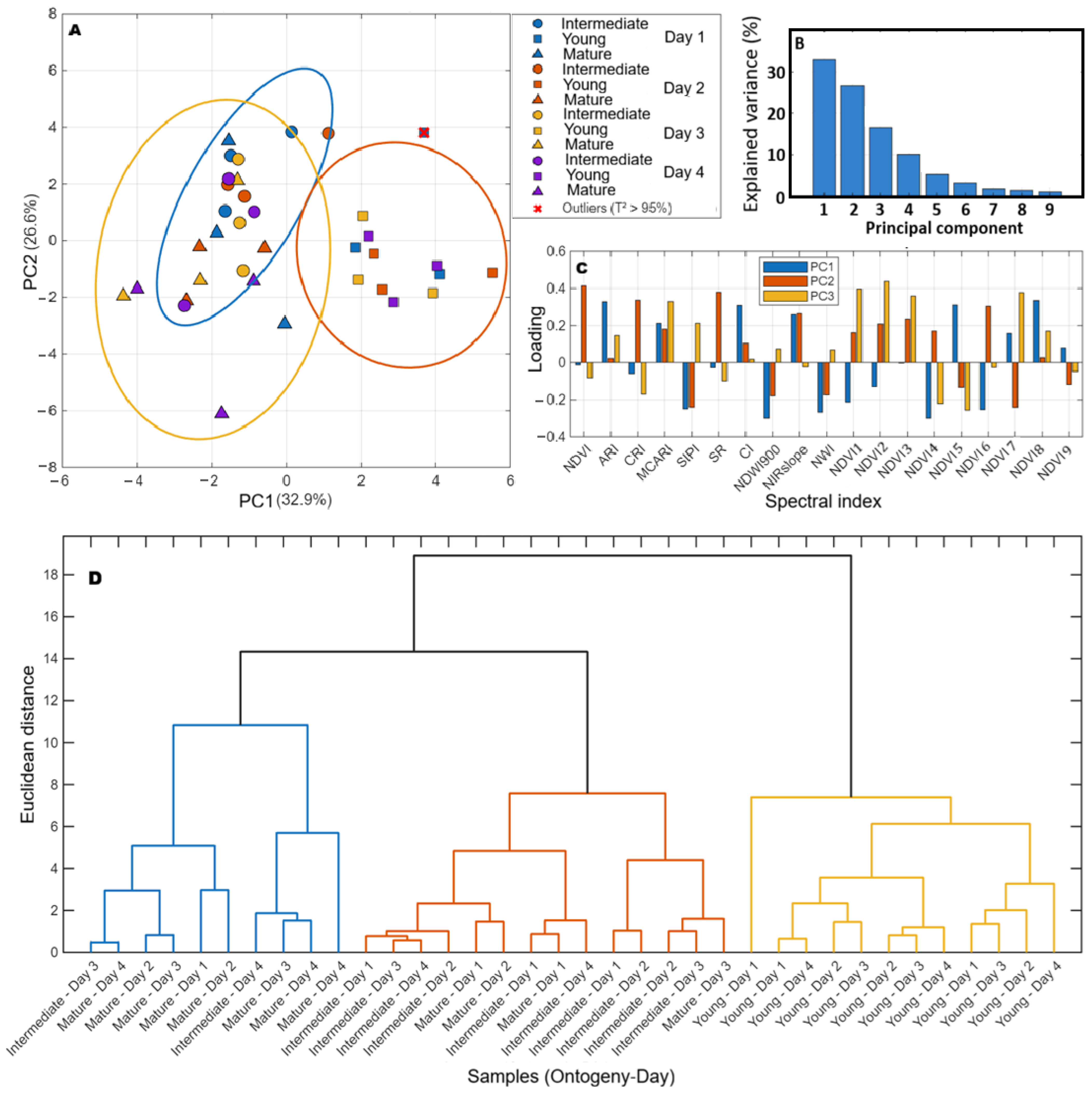
- UV-VIS-NIR: Figure 8 shows the results obtained by PCA of the set of spectral indices using different representative graphs: Figure 8A shows the projections of the scores obtained between principal component 1 (PC1) and principal component 2 (PC2), Figure 8B shows the graph of variance explained (%) by each principal component, and Figure 8C shows the representation of the loadings, that is, the coefficients of the linear combination, whose magnitude and sign represent both the contribution and the direction of each of the variables in the multivariate space. Finally, Figure 8D shows the hierarchical clustering dendrogram obtained from the Euclidean distance between the centroids of the projections in the PC1-PC2 plane.
4. Conclusions
Supplementary Materials
Author Contributions
Funding
Institutional Review Board Statement
Informed Consent Statement
Data Availability Statement
Acknowledgments
Conflicts of Interest
Abbreviations
| Acronyms | |
| ARI | anthocyanin reflectance index |
| ATR | attenuated total reflectance |
| CI | chlorophyll index |
| CRI | carotenoid reflectance index |
| FEDS | functionally enhanced derivative spectroscopy |
| FNDI | FEDS-based normalized differences index |
| FSR | FEDS signal ratio |
| FT0-y | unmodified UV-VIS spectra of intact leaf tissue |
| GNDVI | green normalized difference vegetation index |
| HCA | hierarchical cluster analysis |
| HSD | honestly significant difference |
| LMMs | linear mixed models |
| MCARI | modified chlorophyll absorption in reflectance index |
| NIR | near infrared |
| NIRslope | spectral slope in the near-infrared region |
| NISDI | near-infrared slope difference index |
| NDVI | normalized difference vegetation index |
| NWI | normalized water index |
| NDWI900 | normalized difference water index ~900 nm |
| PCA | principal component analysis |
| PDM-y | powdered dry leaf tissue |
| SIPI | structure-insensitive pigment index |
| SR | simple ratio |
| UV | ultraviolet |
| VIS | visible |
| Latin symbols | |
| values of pseudo-absorbance | |
| deconvolution coefficients | |
| number of points on each side of | |
| number of spectra describing ontogeny | |
| number of plants | |
| polynomial of degree | |
| Correlation coefficient | |
| comparison of Pearson’s correlation coefficients for two datasets | |
| FEDS intensity related to specific | |
| reflectance (with = wavelength) | |
| values of reflectance at wavelength selected by FEDS () | |
| maximum reflectance | |
| minimum reflectance | |
| normalized reflectance | |
| number of analyzed surfaces | |
| initial time | |
| time ( indicates the sampling days) | |
| Gaussian weight | |
| central point in smoothing operations | |
| smoothed value | |
| number of phenological stages | |
| Greek symbols | |
| degree of the root operating in | |
| standard deviation of the Gaussian function | |
| wavelength | |
| difference in the values | |
| differential correlation | |
| observed differential correlation | |
| maximum difference obtained by permutations of | |
References
- Borku, A.W.; Tora, T.T.; Masha, M. Cassava in focus: A comprehensive literature review, its production, processing landscape, and multi-dimensional benefits to society. Food Chem. Adv. 2025, 7, 100945. [Google Scholar] [CrossRef] [Scilit]
- Adejumo, O.; Okoruwa, V.; Abass, A.; Salman, K. Post-harvest technology change in cassava processing: A choice paradigm. Sci. Afr. 2020, 7, e00276. [Google Scholar] [CrossRef] [Scilit]
- Dankwa, K.O.; Gimode, W.; Olasanmi, B. A review of global cassava (Manihot esculenta Crantz) production trends, post-harvest physiological deterioration (PPD) challenge, and control strategies. Discov. Food 2025, 5, 307. [Google Scholar] [CrossRef] [Scilit]
- Otálora, A.; Garces-Villegas, V.; Chamorro, A.; Palencia, M.; Combatt, E.M.; Mendoza, J.S. ‘Cassava, manioc or yuca’ (Manihot esculenta): An overview about its crop, economic aspects and nutritional relevance. J. Sci. Technol. Appl. 2024, 16, 1–10. [Google Scholar] [CrossRef] [Scilit]
- Otálora, A.; Garces-Villegas, V.; Chamorro, A.; Palencia, M.; Combatt, E.M.; Solorzano, A.C. ‘Cassava, manioc or yuca’ (Manihot esculenta): Agronomic aspects. J. Sci. Technol. Appl. 2024, 16, 1–10. [Google Scholar] [CrossRef] [Scilit]
- Canales, N.; Trujillo, M. The cassava value web and its potential for Colombia’s bioeconomy. In Stockholm Environment Institute; SEI: Oaks, PA, USA, 2023; pp. 1–16. [Google Scholar] [CrossRef] [Scilit]
- Chamorro, A.F.; Palencia, M.; Lerma, T.A. Physicochemical Characterization and Properties of Cassava Starch: A Review. Polymers 2025, 17, 1663. [Google Scholar] [CrossRef] [Scilit]
- Rosero, A.; Lenis, J.I.; León, R.; Araujo, H.; García, J.; Orozco, A.; Martínez, R.; Montes, M.; De la Ossa, V.; Cordero, C.; et al. Enhancing Year-Round Cassava Production and Processing in Colombia Through Varieties with Stable Root Dry Matter Content. Plants 2026, 15, 489. [Google Scholar] [CrossRef] [Scilit]
- Martines, D.G.; Feiden, A.; Bariccatti, R.; De Freitas Zara, K.R. Ethanol Production from Waste of Cassava Processing. Appl. Sci. 2018, 8, 2158. [Google Scholar] [CrossRef] [Scilit]
- García-Vallejo, M.C.; Cardona Alzate, C.A. Life cycle assessment of the cassava simplified value chain in Colombia and the use of cassava residues as energy carriers. Ind. Crops Prod. 2024, 210, 118135. [Google Scholar] [CrossRef] [Scilit]
- Martínez-Reina, A.M.; Araujo, H.; Regino, S.M.; Espitia, A.; Tordecilla, L.; Grandett, L.; Pérez, S.; Martínez, R.; Rosero, A. Farmers’ Typologies for the Construction of a Technological and Socioeconomic Baseline of Industrial Cassava Organizations to Guide Research, Production, and Policy Design in Colombian Caribbean Region. Agriculture 2025, 15, 488. [Google Scholar] [CrossRef] [Scilit]
- Phoncharoen, P.; Banterng, P.; Vorasoot, N.; Jogloy, S.; Theerakulpisut, P.; Hoogenboom, G. Identifying Suitable Genotypes for Different Cassava Production Environments-A Modeling Approach. Agronomy 2021, 11, 1372. [Google Scholar] [CrossRef] [Scilit]
- Yuanjit, P.; Vuttipongchaikij, S.; Wonnapinij, P.; Ceballos, H.; Kraichak, E.; Jompuk, C.; Kittipadakul, P. Evaluation of Yield Potential and Combining Ability in Thai Elite Cassava Varieties for Breeding Selection. Agronomy 2023, 13, 1546. [Google Scholar] [CrossRef] [Scilit]
- Anyaegbu, C.N.; Okpara, K.E.; Taweepreda, W.; Akeju, D.; Techato, K.; Onyeneke, R.U.; Poshyachinda, S.; Pongpiachan, S. Impact of Climate Change on Cassava Yield in Nigeria: An Autoregressive Distributed Lag Bound Approach. Agriculture 2023, 13, 80. [Google Scholar] [CrossRef] [Scilit]
- Weraikat, D.; Šorič, K.; Žagar, M.; Sokač, M. Data Analytics in Agriculture: Enhancing Decision-Making for Crop Yield Optimization and Sustainable Practices. Sustainability 2024, 16, 7331. [Google Scholar] [CrossRef] [Scilit]
- Chergui, N.; Kechadi, M. Data analytics for crop management: A big data view. J. Big Data 2022, 9, 123. [Google Scholar] [CrossRef] [Scilit]
- Cao, H.; Zhao, R.; Xia, L.; Wu, S.; Yang, P. Trends in crop yield estimation via data assimilation based on multi-interdisciplinary analysis. Field Crops Res. 2025, 322, 109745. [Google Scholar] [CrossRef] [Scilit]
- Bist, D.R.; Chapagaee, P.; Kunwar, A.; Khatri, L. The role of big data in sustainable agriculture: Advancing environmental sustainability in precision farming systems. Cogent Food Agric. 2026, 12, 2620180. [Google Scholar] [CrossRef] [Scilit]
- Cravero, A.; Sepúlveda, S.; Gutiérrez, F.; Muñoz, L. From Precision Agriculture to Intelligent Agricultural Ecosystems: A Systematic Review of Machine Learning and Big Data Applications. Agronomy 2026, 16, 516. [Google Scholar] [CrossRef] [Scilit]
- Ahmed, N.; Shakoor, N. Advancing agriculture through IoT, Big Data, and AI: A review of smart technologies enabling sustainability. Smart Agric. Technol. 2025, 10, 100848. [Google Scholar] [CrossRef] [Scilit]
- Ram, B.G.; Oduor, P.; Igathinathane, C.; Howatt, K.; Sun, X. A systematic review of hyperspectral imaging in precision agriculture: Analysis of its current state and future prospects. Comput. Electron. Agric. 2024, 222, 109037. [Google Scholar] [CrossRef] [Scilit]
- Faizan Ali, F.; Razzaq, A.; Tariq, W.; Hameed, A.; Rehman, A.; Razzaq, K.; Sarfraz, S.; Rajput, N.A.; Zaki, H.E.M.; Ondrasek, G. Spectral Intelligence: AI-Driven Hyperspectral Imaging for Agricultural and Ecosystem Applications. Agronomy 2024, 14, 2260. [Google Scholar] [CrossRef] [Scilit]
- Bhargava, A.; Sachdeva, A.; Sharma, K.; Alsharif, M.H.; Uthansakul, P.; Uthansakul, M. Hyperspectral imaging and its applications: A review. Heliyon 2024, 10, e33208. [Google Scholar] [CrossRef] [Scilit]
- Hadiwijaya, Y.; Putri, I.I. Spectroscopy in food and agriculture: A critical review of applications and adoption challenges. Food Humanit. 2025, 5, 100800. [Google Scholar] [CrossRef] [Scilit]
- Zhang, Q.; Luan, R.; Wang, M.; Zhang, J.; Yu, F.; Ping, Y.; Qiu, L. Research Progress of Spectral Imaging Techniques in Plant Phenotype Studies. Plants 2024, 13, 3088. [Google Scholar] [CrossRef] [Scilit]
- Shoaib, M.; Khan, S.U.; AbdelHameed, H.; Qahmash, A. Plant stress detection using multimodal imaging and machine learning: From leaf spectra to smartphone applications. Front. Plant Sci. 2026, 16, 1670593. [Google Scholar] [CrossRef] [Scilit]
- Dai, T.; Chen, J.; Liu, H.; Liu, L.; Fan, S.; Bai, X.; Qian, L.; Liu, H.; Ba, Y. Qiongda Research on the potential of reconstructing spectral indices and dividing crop growth stages based on satellite remote sensing for monitoring soil moisture in farmland. Comput. Electron. Agric. 2025, 239, 110943. [Google Scholar] [CrossRef] [Scilit]
- Anderegg, J.; Yu, K.; Aasen, H.; Walter, A.; Liebisch, F.; Hund, A. Spectral Vegetation Indices to Track Senescence Dynamics in Diverse Wheat Germplasm. Front. Plant Sci. 2020, 10, 749. [Google Scholar] [CrossRef] [Scilit]
- Lata, K.; Arora, M.; Kaur, N. Spectral Discrimination of Crop Types Based on Hyperspectral Sensor. Eng. Proc. 2024, 82, 107. [Google Scholar] [CrossRef] [Scilit]
- Estrada, F.; Flezas, J.; Araus, J.L.; Mora-Poblete, F.; Gonzalez-Talice, J.; Castillo, D.; Matus, I.A.; Méndez-Expinoza, A.M.; Garriga, M.; Araya-Riquelme, C.; et al. Exploring plant responses to abiotic stress by contrasting spectral signature changes. Front. Plant Sci. 2023, 13, 1026323. [Google Scholar] [CrossRef] [Scilit] [PubMed]
- El Azizi, S.; Taia, H.; Bernoussi, A.S.; Amharref, M.; Wozniak, E. A spectral signature-based algorithm for the identifiability of crops and their cultivation conditions. Res. Agric. Eng. 2026, 72, 56–59. [Google Scholar] [CrossRef] [Scilit]
- Revelo Luna, D.; Mejía Manzano, J.; Montoya-Bonilla, B.P.; Hoyos García, J. Analysis of the Vegetation Indices NDVI, GNDVI, and NDRE for the Characterization of Coffee Crops (Coffea arabica). Ing. Desarro. 2020, 38, 298–312. [Google Scholar] [CrossRef] [Scilit]
- Nitu, A.; Florea, C.; Ivanovici, M.; Racoviteanu, A. NDVI and Beyond: Vegetation Indices as Features for Crop Recognition and Segmentation in Hyperspectral Data. Sensors 2025, 25, 3817. [Google Scholar] [CrossRef] [Scilit]
- Vera-Esmeraldas, A.; Pizarro-Oteíza, S.; Labbé, M.; Rojo, F.; Salazar, F. UAV-Based Spectral and Thermal Indices in Precision Viticulture: A Review of NDVI, NDRE, SAVI, GNDVI, and CWSI. Agronomy 2025, 15, 2569. [Google Scholar] [CrossRef] [Scilit]
- Marek Bednář, M.; Šarapatka, B.; Netopil, P.; Zeidler, M.; Hanousek, T.; Homolová, L. The Use of Spectral Indices to Recognize Waterlogged Agricultural Land in South Moravia. Czech Republic. Agriculture 2023, 13, 287. [Google Scholar] [CrossRef] [Scilit]
- Kokhan, S.; Vostokov, A. Using Vegetative Indices to Quantify Agricultural Crop Characteristics. J. Ecol. Eng. 2020, 21, 120–127. [Google Scholar] [CrossRef] [Scilit]
- Song, G.; Wang, Q.; Jin, J. Estimation of leaf photosynthetic capacity parameters using spectral indices developed from fractional-order derivatives. Comput. Electron. Agric. 2023, 212, 108068. [Google Scholar] [CrossRef] [Scilit]
- Ji, J.; Lu, X.; Ma, H.; Jin, X.; Jiang, S.; Cui, H.; Lu, X.; Yang, Y. Estimation of plant leaf water content based on spectroscopy. Front. Plant Sci. 2025, 16, 1609650. [Google Scholar] [CrossRef] [Scilit]
- Gamon, J.A.; Surfus, J.S. Assessing leaf pigment content and activity with a reflectometer. New Phytol. 1999, 143, 105–117. [Google Scholar] [CrossRef] [Scilit]
- Gitelson, A.A.; Zur, Y.; Chivkunova, O.B.; Merzlyak, M.N. Assessing carotenoid content in plant leaves with reflectance spectroscopy. Photochem. Photobiol. 2007, 75, 272–281. [Google Scholar] [CrossRef] [Scilit]
- Khanal, S.; Kushal, K.C.; Fulton, J.P.; Shearer, S.; Ozkan, E. Remote Sensing in Agriculture-Accomplishments, Limitations, and Opportunities. Remote Sens. 2020, 12, 3783. [Google Scholar] [CrossRef] [Scilit]
- Paz Pellat, F.; Romero Sanchez, M.E.; Palacios Velez, E.; Bolaños Gonzalez, M.; Valdez Lazalde, J.R.; Aldrete, A. Scopes and limitations of spectral vegetation indexes: Analysis of broad band indexes. Rev. Terra Latinoam. 2015, 33, 27–49. [Google Scholar]
- Rana, S.; Gerbino, S.; Carillo, P. Study of spectral overlap and heterogeneity in agriculture based on soft classification techniques. MethodsX 2024, 14, 103114. [Google Scholar] [CrossRef] [Scilit]
- Mingrone, M.; Seracini, M.; Cevoli, C. Spectral Reconstruction Applied in Precision Agriculture: On-Field Solutions. Appl. Sci. 2025, 15, 10985. [Google Scholar] [CrossRef] [Scilit]
- Steidle Neto, A.J.; Lopes, D.C.; Pinto, F.A.C.; Zolnier, S. Vis/NIR spectroscopy and chemometrics for non-destructive estimation of water and chlorophyll status in sunflower leaves. Biosyst. Eng. 2017, 155, 124–133. [Google Scholar] [CrossRef] [Scilit]
- Zhang, Y.; Han, X.; Yang, J. Selection of optimal spectral features for leaf chlorophyll content estimation. Sci. Rep. 2024, 14, 25598. [Google Scholar] [CrossRef] [Scilit] [PubMed]
- Ramírez-Rincón, J.A.; Palencia, M.; Combatt, E. Prediction of pH, organic carbon content and effective cation exchange capacity through optical characterization of agricultural soils by near infrared multispectral images. J. Sci. Technol. Appl. 2021, 11, 4–12. [Google Scholar] [CrossRef] [Scilit]
- Ramírez-Rincón, J.A.; Palencia, M.; Combatt, E. Separation of optical properties for multicomponent samples and determination of spectral similarity indices on FEDS0 algorithm. Mat. Today Commun. 2022, 33, 104528. [Google Scholar] [CrossRef] [Scilit]
- Palencia, M. Functional transformation of Fourier-transform mid-infrared spectrum for improving spectral specificity by simple algorithm based on wavelet-like functions. J. Adv. Res. 2018, 14, 53–62. [Google Scholar] [CrossRef] [Scilit] [PubMed]
- Palencia, M. Deconvolution of IR Spectra by Functionally-Enhanced Derivative Spectroscopy (FEDS): Why Does It Work? J. Sci. Technol. Appl. 2020, 9, 18–28. [Google Scholar] [CrossRef] [Scilit]
- Anaya-Tatis, L.A.; Libreros, K.H.; Palencia, V.J.; Atencio, V.J.; Palencia, M. Mid-infrared spectral characterization of fish scales: “Bocachico” (Prochilodus magdalenae) by functionally-enhanced derivative spectroscopy (FEDS)—A methodological approach. J. Sci. Technol. Appl. 2019, 6, 28–39. [Google Scholar] [CrossRef] [Scilit]
- Gomez-Heredia, C.L.; Lerma-Henao, T.A.; Palencia, M. Building of mid-infrared spectral signature of pesticides using functionally-enhanced derivative spectroscopy (FEDS). Infrared Phys. Technol. 2023, 131, 104631. [Google Scholar] [CrossRef] [Scilit]
- Institute of Hydrology, Meteorology and Environmental Studies (IDEAM). Available online: http://dhime.ideam.gov.co/webgis/home/ (accessed on 10 January 2026).
- Luna, J.; Dufou, D.; Tran, T.; Pizarro, M.; Calle, F.; García Domínguez, M.; Hurtado, I.M.; Sánchez, T.; Ceballos, H. Post-harvest physiological deterioration in several cassava genotypes over sequential harvests and effect of pruning prior to harvest. Int. J. Food Sci. Technol. 2020, 56, 1322–1332. [Google Scholar] [CrossRef] [Scilit]
- Ipaz Cuastumal, C.M.; Madero Morales, E.; Ramírez Náder, M.; Gómez Carabalí, A. Cassava Forage Production (HMC-1) in an Entic Haplustol whit different moisture. Acta Agronómica 2010, 59, 170–179. [Google Scholar]
- Raju, M.H.; Friedman, L.; Bouman, T.M.; Komogortsev, O.V. Filtering Eye-Tracking Data From an EyeLink 1000: Comparing Heuristic, Savitzky-Golay, IIR and FIR Digital Filters. J. Eye Mov. Res. 2021, 14, 17. [Google Scholar] [CrossRef] [Scilit] [PubMed]
- Schmid, M.; Rath, D.; Diebold, U. Why and How Savitzky–Golay Filters Should Be Replaced. ACS Meas. Sci. Au 2022, 2, 185–196. [Google Scholar] [CrossRef] [Scilit]
- Rinnan, A.; van den Berg, F.; Balling Engelsen, S. Review of the most common pre-processing techniques for near-infrared spectra. Trends Anal. Chem. 2009, 28, 1201–1222. [Google Scholar] [CrossRef] [Scilit]
- Retzlaff, B.J.; Craig, A.R.; Owen, T.M.; Greer, B.D.; Donnell, A.O.; Fisher, W.W. Identifying Cyclical Patterns of Behavior Using a Moving-Average, Data-Smoothing Manipulation. Behav. Sci. 2024, 14, 1120. [Google Scholar] [CrossRef] [Scilit]
- Vestergaard, R.J.; Bhogilal Vasava, H.; Aspinall, D.; Chen, S.; Gillespie, A.; Adamchuck, V.; Biswas, A. Evaluation of Optimized Preprocessing and Modeling Algorithms for Prediction of Soil Properties Using VIS-NIR Spectroscopy. Sensors 2021, 21, 6745. [Google Scholar] [CrossRef] [Scilit]
- Gao, B.-C.; Liu, M. A Fast Smoothing Algorithm for Post-Processing of Surface Reflectance Spectra Retrieved from Airborne Imaging Spectrometer Data. Sensors 2013, 13, 13879–13891. [Google Scholar] [CrossRef] [Scilit]
- Mewada, H.; Al-Asad, J.F.; Almalki, F.A.; Khan, A.H.; Abdullah Almujally, N.; El-Nakla, S.; Naith, Q. Gaussian-Filtered High-Frequency-Feature Trained Optimized BiLSTM Network for Spoofed-Speech Classification. Sensors 2023, 23, 6637. [Google Scholar] [CrossRef] [Scilit]
- Rybakova, E.O.; Limonova, E.E.; Nikolaev, D.P. Fast Gaussian Filter Approximations Comparison on SIMD Computing Platforms. Appl. Sci. 2024, 14, 4664. [Google Scholar] [CrossRef] [Scilit]
- Mazdeyasna, S.; Shahriar Arefin, M.; Fales, A.; Leavesley, S.J.; Pfefer, T.J.; Wang, Q. Evaluating Normalization Methods for Robust Spectral Performance Assessments of Hyperspectral Imaging Cameras. Biosensors 2025, 15, 20. [Google Scholar] [CrossRef] [Scilit] [PubMed]
- Martinez-Vega, B.; Tkachenko, M.; Matkabi, M.; Ortega, S.; Fabelo, H.; Balea-Fernandez, F.; La Salvia, M.; Torti, E.; Leporati, F.; Callico, G.M.; et al. Evaluation of Preprocessing Methods on Independent Medical Hyperspectral Databases to Improve Analysis. Sensors 2022, 22, 8917. [Google Scholar] [CrossRef] [Scilit]
- Jacq, K.; Debret, M.; Fanget, B.; Coquin, D.; Sabatier, P.; Pignol, C.; Arnaud, F.; Perrette, Y. Theoretical Principles and Perspectives of Hyperspectral Imaging Applied to Sediment Core Analysis. Quaternary 2022, 5, 28. [Google Scholar] [CrossRef] [Scilit]
- Pandey, K.K.; Pitman, A.J. FTIR studies of the changes in wood chemistry following decay by brown-rot and white-rot fungi. Inter. Biodeterior. Biodegrad. 2003, 52, 151–160. [Google Scholar] [CrossRef] [Scilit]
- Barth, A. Infrared spectroscopy of proteins. Biochim. Biophys. Acta (BBA)-Bioenerg. 2007, 1767, 1073–1101. [Google Scholar] [CrossRef] [Scilit]
- Zhang, Y.; Wang, C.; Huang, J.; Wang, F.; Huang, R.; Lin, H.; Chen, F.; Wu, K. Exploring the Optical Properties of Leaf Photosynthetic and Photo-Protective Pigments In Vivo Based on the Separation of Spectral Overlapping. Remote Sens. 2020, 12, 3615. [Google Scholar] [CrossRef] [Scilit]
- Palencia, M. Functionally-Enhanced Derivative Spectroscopy (FEDS): A methodological approach. J. Sci. Technol. Appl. 2020, 9, 29–34. [Google Scholar] [CrossRef] [Scilit]
- Lindsey, J.S.; Taniguchi, M.; Du, H. PhotochemCAD TM. 1998–2026. Available online: https://photochemcad.com/ (accessed on 10 December 2025).
- Dixon, J.M.; Taniguchi, M.; Lindsey, J.S. PhotochemCAD 2: A refined program with accompanying spectral databases for photochemical calculations. Photochem. Photobiol. 2005, 81, 212–213. [Google Scholar] [CrossRef] [Scilit]
- Rahman, M.M.; Govindarajulu, Z. A modification of the test of Shapiro and Wilk for normality. J. Appl. Stat. 1997, 24, 219–236. [Google Scholar] [CrossRef] [Scilit]
- Arnastauskaite, J.; Ruzgas, T.; Brazenas, M. An Exhaustive Power Comparison of Normality Tests. Mathematics 2021, 9, 788. [Google Scholar] [CrossRef] [Scilit]
- Miller, J.N.; Miller, J.C.; Miller, R.D. Statistics and Chemometrics for Analytical Chemistry—Seventh Edition; Pearson: London, UK, 2018; p. 268. [Google Scholar]
- Hsu, J.C. Multiple Comparisons: Theory and Methods; Chapman & Hall/CRC: Boca Raton, FL, USA, 1996; p. 292. [Google Scholar]
- Kim, T.K. Understanding one-way ANOVA using conceptual figures. Korean J. Anesthesiol. 2017, 70, 22–26. [Google Scholar] [CrossRef] [Scilit] [PubMed]
- Bewick, V.; Cheek, L.; Ball, J. Statistics review 10: Further nonparametric methods. Crit. Care 2004, 8, 196–199. [Google Scholar] [CrossRef] [Scilit]
- Agbangba, C.E.; Aide, E.S.; Honfo, H.; Kakai, R.G. On the use of post-hoc tests in environmental and biological sciences: A critical review. Heliyon 2024, 10, e25131. [Google Scholar] [CrossRef] [Scilit]
- Liu, X. Chapter 3—Linear mixed-effects models. In Methods and Applications of Longitudinal Data Analysis; Academic Press: Cambridge, MA, USA, 2016; pp. 61–94. [Google Scholar] [CrossRef] [Scilit]
- Jolliffe, I.T.; Cadima, J. Principal component analysis: A review and recent developments. Philos. Trans. A. Math. Phys. Eng. Sci. 2016, 374, 20150202. [Google Scholar] [CrossRef] [Scilit]
- Tullis, T.; Albert, B. Chapter 9—Special topics. In Measuring the User Experience (Second Edition); Elsevier: Amsterdam, The Netherlands, 2013; pp. 209–236. [Google Scholar] [CrossRef] [Scilit]
- Aluker, N.L.; Lavrentieva, A.L.; Suzdaltseva, Y.M. Direct optical research methods in the analytics of phenol. Opt. Spectrosc. 2020, 128, 422–428. [Google Scholar] [CrossRef] [Scilit]
- Kaeswurm, J.A.H.; Scharinger, A.; Teipel, J.; Buchweitz, M. Absorption coefficients of phenolic structures in different solvents routinely used for experiments. Molecules 2021, 26, 4656. [Google Scholar] [CrossRef] [Scilit]
- Antosiewicz, J.M.; Shugar, D. UV–Vis spectroscopy of tyrosine side-groups in studies of protein structure. Part 1: Basic principles and properties of tyrosine chromophore. Biophys. Rev. 2016, 8, 151–161. [Google Scholar] [CrossRef] [Scilit]
- Boerjan, W.; Ralph, J.; Baucher, M. Lignin biosynthesis. Annu. Rev. Plant Biol. 2003, 54, 519–546. [Google Scholar] [CrossRef] [Scilit]
- Sánchez-Rangel, J.C.; Benavides, J.; Heredia, J.B.; Cisneros-Zevallos, L.; Jacobo-Velázquez, D.A. The Folin–Ciocalteu assay revisited: Improvement of its specificity for total phenolic content determination. Anal. Methods 2013, 5, 5990–5999. [Google Scholar] [CrossRef] [Scilit]
- Ustin, S.L.; Jacquemoud, S. How the Optical Properties of Leaves Modify the Absorption and Scattering of Energy and Enhance Leaf Functionality. In Remote Sensing of Plant Biodiversity; Cavender-Bares, J., Gamon, J.A., Townsend, P.A., Eds.; Springer: Cham, Switzerland, 2020. [Google Scholar] [CrossRef] [Scilit]
- Carter, G.A.; Knapp, A.K. Leaf optical properties in higher plants: Linking spectral characteristics to stress and chlorophyll concentration. Am. J. Bot. 2021, 88, 677–684. [Google Scholar] [CrossRef] [Scilit]
- Gitelson, A.A.; Verma, S.B.; Viña, A.; Rundquist, D.C.; Keydan, G.; Leavitt, B.; Arkebauer, T.J.; Burba, G.G.; Suyker, A.E. Novel technique for remote estimation of CO2 flux in maize. Geophys. Res. Let. 2003, 30, 1486. [Google Scholar] [CrossRef] [Scilit]
- Chen, M. The Tea Plant Leaf Cuticle: From Plant Protection to Tea Quality. Front. Plant Sci. 2021, 12, 655547. [Google Scholar] [CrossRef] [Scilit]
- Lichtenthaler, H.K.; Buschmann, C. Chlorophylls and Carotenoids: Measurement and Characterization by UV-VIS Spectroscopy. Plant Physiol. Biochem. 2001, 45, 577–588. [Google Scholar] [CrossRef] [Scilit]
- Porcar-Castell, A.; Tyystjärvi, E.; Atherton, J.; van der Tol, C.; Flexas, J.; Pfündel, E.E.; Moreno, J.; Frankenberg, C.; Berry, J.A. Linking chlorophyll fluorescence to photosynthesis for remote sensing applications: Mechanisms and challenges. J. Exp. Bot. 2014, 65, 4065–4095. [Google Scholar] [CrossRef] [Scilit] [PubMed]
- Heredia, A.; Benítez, J.J.; Gonzalez Moreno, A.; Domínguez, E. Revisiting plant cuticle biophysics. New Phytol. 2024, 244, 65–73. [Google Scholar] [CrossRef] [Scilit] [PubMed]
- Cordón, G.B.; Lagorio, M.G. Optical properties of the adaxial and abaxial faces of leaves. Chlorophyll fluorescence, absorption and scattering coefficients. Photochem. Photobiol. Sci. 2007, 6, 873–882. [Google Scholar] [CrossRef] [Scilit]
- Cerovic, Z.G.; Samson, G.; Morales, F.; Tremblay, N.; Moya, I. Ultraviolet-induced fluorescence for plant monitoring: Spectral signatures of leaf phenolics and chlorophylls. Agronomie 2002, 19, 543–578. [Google Scholar] [CrossRef] [Scilit]
- Jacquemoud, S.; Ustin, S.L. Variation Due to Leaf Structural, Chemical, and Physiological Traits. In Leaf Optical Properties; Cambridge University Press: Cambridge, UK, 2019; pp. 170–194. [Google Scholar] [CrossRef] [Scilit]
- Gitelson, A.A.; Chivkunova, O.B.; Merzlyak, M.N. Nondestructive estimation of anthocyanins and chlorophylls in anthocyanic leaves. Am. J. Bot. 2009, 96, 1861–1868. [Google Scholar] [CrossRef] [Scilit]
- Luo, X.; An, F.; Xue, J.; Zhu, W.; Wei, Z.; Ou, W.; Li, K.; Chen, S.; Cai, J. Integrative analysis of metabolome and transcriptome reveals the mechanism of color formation in cassava (Manihot esculenta Crantz) leaves. Front. Plant Sci. 2023, 14, 1181257. [Google Scholar] [CrossRef] [Scilit]
- Fachriyah, A.; Haryanto, I.B.; Kusrini, D.; Ria Sarjono, P.; Ngadiwiyana, N. Antioxidant activity of flavonoids from cassava leaves (Manihot esculenta Crantz). J. Kim. Sains Dan Apl. 2023, 26, 10–18. [Google Scholar] [CrossRef] [Scilit]







| Index | Explanation | Mathematical Definition | Spectral Region | ||
|---|---|---|---|---|---|
| Acronym | Meaning | Description | Typical Use | ||
| Normalized Difference Vegetation Index. | It is based on reflectance in the near-infrared (NIR) and red (Red) regions. It provides information about plant vigor, biomass and photosynthetic activity. | General assessment of the state of the vegetation. | VIS-NIR | ||
| Anthocyanin Reflectance Index. | It is based on visible bands (green and near red). It is related to anthocyanin content. | Stress detection, senescence and responses to environmental factors. | VIS | ||
| Carotenoid Reflectance Index. | It is sensitive to wavelengths of carotenoids. It is related to carotenoid content. | Assessment of photoprotective status and oxidative stress. | VIS | ||
| Modified Chlorophyll Absorption in Reflectance Index. | It minimizes the effect of the background. It is related to chlorophyll content. | Accurate estimation of photosynthetic pigments. | VIS | ||
| Structure-Insensitive Pigment Index. | It reduces the effect of leaf structure on the spectral signal. It is related to carotenoid/chlorophyll ratio. | Physiological stress assessment. | VIS-NIR | ||
| Simple Ratio | It is a direct relationship between NIR and red (NIR/Red). It is related to biomass and plant vigor. | A simple alternative to NDVI, with greater sensitivity in certain ranges. | VIS-NIR | ||
| Chlorophyll Index. | It is based on red-edge or NIR bands. It is related to total chlorophyll content. | Monitoring of nutritional status (especially nitrogen). | VIS-NIR | ||
| Normalized Difference Water Index ~900 nm. | It is based on the relationship between NIR and water-sensitive bands (~900 nm). It is related to leaf water content. | Water stress assessment. | NIR | ||
| Spectral slope in the near-infrared region. | It is related to changes in the internal structure of the leaf and water content. | Monitoring of senescence and structural degradation. | NIR | ||
| Normalized Water Index. | It is a normalized index based on water-sensitive bands. It is related to the water status of plant tissue. | Hydration and water stress monitoring. | NIR | ||
| Technique | Spectral Region | Description |
|---|---|---|
| UV-VIS-NIR spectrophotometry | UV (200–400 nm) | Bands associated with absorption from phenolic compounds and other aromatic derivatives. |
| VIS (400–700 nm) | Bands associated with absorption and reflectance regions characteristic of photosynthetic pigments, such as chlorophylls, carotenoids, and anthocyanins, are located. | |
| NIR (700–900 nm) | It is a region where multiple scattering effects predominate, which are related to the internal structure of the leaf. |
| Signal Code | Range of | Description | Stage | Abaxial | Adaxial |
|---|---|---|---|---|---|
| (nm) | (nm) | ||||
| a1 | 200–220 | Aromatic compound absorption band | Y | 203 0.094 | 208 0.071 |
| I | 205 0.096 | 213 0.053 | |||
| M | 205 0.102 | 210 0.053 | |||
| a2 | 220–280 | Reflectance band/internal structural scattering | Y | 225 0.231 | 222 0.097 |
| I | 225 0.289 | 221 0.075 | |||
| M | 225 0.275 | 222 0.062 | |||
| b1 | 400–430 | Minimum absorption of chlorophylls-a and b in the blue | Y | 428 0.004 | Absent |
| I | 428 0.004 | Absent | |||
| M | Absent | Absent | |||
| b2 | 430–440 | Maximum absorption of carotene and chlorophyll-a in the blue | Y | 435 0.003 | Absent |
| I | 435 0.004 | Absent | |||
| M | 435 0.005 | Absent | |||
| b3 | 445–450 | Backscattering by microstructure (mesophyll) | Y | 457 0.004 | 456 0.004 |
| I | 457 0.005 | 459 0.004 | |||
| M | 457 0.005 | 461 0.004 | |||
| b4 | 460–470 | Absorption of carotenoids and chlorophyll-b in the blue | Y | 483 0.004 | 486 0.004 |
| I | 483 0.005 | 484 0.004 | |||
| M | 483 0.005 | 484 0.004 | |||
| b5 | 500–560 | Minimum absorption of pigments (green) | Y | 568 0.019 | 557 0.014 |
| I | 551 0.026 | 552 0.020 | |||
| M | 553 0.024 | 552 0.017 | |||
| b6 | 560–580 | Chlorophyll b absorption (weak) | Y | 574 0.017 | 588 0.015 |
| I | 595 0.013 | Absent | |||
| M | 595 0.013 | Absent | |||
| b7 | 600–610 | Onset of chlorophyll a absorption | Y | 602 0.015 | 599 0.017 |
| I | Absent | 595 0.011 | |||
| M | Absent | 595 0.011 | |||
| b8 | 625–635 | Weak absorption of chlorophyll a in the red | Y | 626 0.017 | 626 0.014 |
| I | 626 0.009 | 626 0.007 | |||
| M | 626 0.018 | 626 0.008 | |||
| b9 | 645–660 | Transition shoulder to the red edge (chlorophyll-a) | Y | Absent | Absent |
| I | Absent | Absent | |||
| M | Absent | Absent | |||
| b10 | 670–680 | Maximum absorption of chlorophyll a in the red and weak absorption of chlorophyll-b | Y | 676 0.004 | 676 0.003 |
| I | 676 0.002 | 676 0.004 | |||
| M | 676 0.000 | 676 0.004 | |||
| c1 | 700–740 | Increasing slope (red edge—NIR) | Y | Absent | Absent |
| I | Absent | Absent | |||
| M | Absent | Absent | |||
| c2 | 850–900 | NIR reflectance plateau | Y | Absent | Absent |
| I | Absent | Absent | |||
| M | Absent | Absent |
| Spectral Region | Ontogeny Comparison | (nm) | (nm) | Compared Signals () | Trend | p-Value (a) | ||
|---|---|---|---|---|---|---|---|---|
| UV (200–400 nm) | Young vs. Intermediate | 212 | 360 | a1, a4′ | −0.40 | ↓ | 0.20 | * |
| 212 | 396 | a1, a5 | 0.70 | ↑ | −0.30 | ** | ||
| 360 | 396 | a4′, a5 | 0.95 | ↑ | −0.15 | ** | ||
| Young vs. Mature | 212 | 360 | a1, a4′ | −0.89 | ↓ | 0.08 | ** | |
| 212 | 396 | a1, a5 | −1.01 | ↓ | 0.09 | ** | ||
| 360 | 396 | a4′, a5 | 0.85 | ↑ | −0.19 | ** | ||
| VIS (400–700 nm) | Young vs. Intermediate | 550 | 590 | b5, b6 | 1.01 | ↑ | −0.03 | ** |
| 420 | 550 | b2, b5 | 0.70 | ↑ | −0.01 | ** | ||
| 550 | 675 | b5, b10 | 0.35 | ↑ | −0.12 | * | ||
| Young vs. Mature | 550 | 590 | b5, b6 | 1.17 | ↑ | −0.01 | ** | |
| 420 | 550 | b2, b5 | 1.19 | ↑ | −0.21 | * | ||
| 550 | 675 | b5, b10 | 0.60 | ↑ | −0.23 | ** | ||
| NIR (700–900 nm) | Young vs. Intermediate | 700 | 730 | c1 (range) | −0.82 | ↓ | 0.14 | ** |
| 732 | 860 | c1, c2 (range) | 0.77 | ↑ | −0.17 | ** | ||
| 876 | 896 | c2 (range) | 0.97 | ↑ | −0.18 | ** | ||
| Young vs. Mature | 700 | 730 | c1 (range) | −0.30 | ↓ | 0.12 | ** | |
| 732 | 860 | c1, c2 (range) | 0.70 | ↑ | −0.13 | ** | ||
| 876 | 896 | c2 (range) | 0.79 | ↑ | −0.11 | ** |
| Classic Indices (See Table 1) | ||||||
|---|---|---|---|---|---|---|
| Index | Shapiro’s Normality Test | Levene’s Homogeneity Test | Applied Test | (a) Global p-Value | Statistical Difference | Post Hoc |
| NDVI | ✓ | ✓ | ANOVA | 0.18 | ✕ | Tukey |
| ARI | ✓ | ✕ | Kruskal–Wallis | ** | ✓ | D-S |
| CRI | ✓ | ✕ | Kruskal–Wallis | 0.011 | ✓ | D-S |
| MCARI | ✓ | ✓ | ANOVA | ** | ✓ | Tukey |
| SIPI | ✓ | ✕ | Kruskal–Wallis | 0.82 | ✕ | D-S |
| SR | ✓ | ✓ | ANOVA | 0.22 | ✕ | Tukey |
| CI | ✓ | ✕ | Kruskal–Wallis | ** | ✓ | D-S |
| NWI | ✓ | ✓ | ANOVA | 0.08 | ✕ | Tukey |
| NDWI900 | ✓ | ✓ | ANOVA | 0.068 | ✕ | Tukey |
| NIRslope | ✓ | ✕ | Kruskal–Wallis | * | ✓ | D-S |
| Experimental Indexes: FEDS-Based UV-VIS-NIR | ||||||
| Index | Shapiro’s Normality Test | Levene’s Homogeneity Test | Applied Test | (a) Global p-Value | Statistical Difference | Post Hoc |
| I1 | ✓ | ✕ | Kruskal–Wallis | 0.98 | ✕ | D-S |
| I2 | ✓ | ✕ | Kruskal–Wallis | 0.97 | ✕ | D-S |
| I3 | ✓ | ✕ | Kruskal–Wallis | 0.89 | ✕ | D-S |
| I4 | ✓ | ✕ | Kruskal–Wallis | ** | ✓ | D-S |
| I5 | ✓ | ✓ | ANOVA | ** | ✓ | Tukey |
| I6 | ✓ | ✕ | K-W | ** | ✓ | D-S |
| I7 | ✓ | ✓ | ANOVA | ** | ✓ | Tukey |
| I8 | ✓ | ✓ | ANOVA | ** | ✓ | Tukey |
| I9 | ✓ | ✓ | ANOVA | 0.36 | ✕ | Tukey |
| NDVI1 | ✓ | ✓ | ANOVA | 0.98 | ✕ | Tukey |
| NDVI2 | ✓ | ✓ | ANOVA | 0.96 | ✕ | Tukey |
| NDVI3 | ✓ | ✓ | ANOVA | 0.57 | ✕ | Tukey |
| NDVI4 | ✓ | ✓ | ANOVA | ** | ✓ | Tukey |
| NDVI5 | ✓ | ✓ | ANOVA | ** | ✓ | Tukey |
| NDVI6 | ✓ | ✓ | ANOVA | ** | ✓ | Tukey |
| NDVI7 | ✓ | ✓ | ANOVA | ** | ✓ | Tukey |
| NDVI8 | ✓ | ✓ | ANOVA | ** | ✓ | Tukey |
| NDVI9 | ✓ | ✓ | ANOVA | 0.37 | ✕ | Tukey |
Disclaimer/Publisher’s Note: The statements, opinions and data contained in all publications are solely those of the individual author(s) and contributor(s) and not of MDPI and/or the editor(s). MDPI and/or the editor(s) disclaim responsibility for any injury to people or property resulting from any ideas, methods, instructions or products referred to in the content. |
© 2026 by the authors. Licensee MDPI, Basel, Switzerland. This article is an open access article distributed under the terms and conditions of the Creative Commons Attribution (CC BY) license.
Share and Cite
Restrepo, D.F.; Combatt, E.M.; Palencia, M. Spectral Signatures and Indices of Cassava Leaves by Multiregional Spectral Analysis (UV-VIS-NIR) and Functionally Enhanced Derivative Spectroscopy (FEDS): Leaf Ontogeny and Induced Senescence. AgriEngineering 2026, 8, 243. https://doi.org/10.3390/agriengineering8060243
Restrepo DF, Combatt EM, Palencia M. Spectral Signatures and Indices of Cassava Leaves by Multiregional Spectral Analysis (UV-VIS-NIR) and Functionally Enhanced Derivative Spectroscopy (FEDS): Leaf Ontogeny and Induced Senescence. AgriEngineering. 2026; 8(6):243. https://doi.org/10.3390/agriengineering8060243
Chicago/Turabian StyleRestrepo, Diego F., Enrique M. Combatt, and Manuel Palencia. 2026. "Spectral Signatures and Indices of Cassava Leaves by Multiregional Spectral Analysis (UV-VIS-NIR) and Functionally Enhanced Derivative Spectroscopy (FEDS): Leaf Ontogeny and Induced Senescence" AgriEngineering 8, no. 6: 243. https://doi.org/10.3390/agriengineering8060243
APA StyleRestrepo, D. F., Combatt, E. M., & Palencia, M. (2026). Spectral Signatures and Indices of Cassava Leaves by Multiregional Spectral Analysis (UV-VIS-NIR) and Functionally Enhanced Derivative Spectroscopy (FEDS): Leaf Ontogeny and Induced Senescence. AgriEngineering, 8(6), 243. https://doi.org/10.3390/agriengineering8060243