Article

Analysis of Human Vibrations Generated During Reduced Tillage That Affect the Operator of an Agricultural Tractor


1
Faculty of Agrobiotechnical Sciences Osijek, Josip Juraj Strossmayer University of Osijek, Vladimira Preloga 1, 31000 Osijek, Croatia
2
Technical Faculty “Mihajlo Pupin”, University of Novi Sad, Đure Đakovića bb, 23000 Zrenjanin, Serbia
*
Author to whom correspondence should be addressed.
AgriEngineering 2026, 8(5), 176; https://doi.org/10.3390/agriengineering8050176
Submission received: 12 March 2026 / Revised: 23 April 2026 / Accepted: 28 April 2026 / Published: 2 May 2026
(This article belongs to the Special Issue Utilization and Development of Tractors in Agriculture)

Abstract

This study analyzes whole-body vibration (WBV) exposure of an agricultural tractor operator during three different primary tillage systems: Standard Tillage (ST), Conservation Tillage Deep (CTD), and Conservation Tillage Shallow (CTS). Measurements were conducted in accordance with ISO 2631-1 and ISO 2631-4 along three orthogonal axes (x, y and z) at the operator’s seat. Descriptive and inferential statistical analyses indicate that while none of the mean vibration values exceeded the regulatory limit value of 1.15 m/s2 defined in Directive 2002/44/EC, several measurements—particularly in the y-axis during ST (0.715 m/s2)—surpassed the exposure action value of 0.5 m/s2. These findings suggest that prolonged daily exposure under similar operational conditions may pose long-term health risks for tractor operators. The highest mean WBV values were recorded in the x- and y-axes during CTS (0.354 m/s2 and 0.446 m/s2, respectively), whereas the z-axis exhibited the highest values during ST (0.426 m/s2). Conservation Tillage Deep (CTD) demonstrated the most favorable vibration profile in the vertical axis (0.344 m/s2), indicating its potential dual benefit for soil structure preservation and operator ergonomics. Although all measured values remained below the regulatory limit, the frequent exceedance of the action value underscores the importance of exposure time management, regular maintenance of suspension systems, and implement selection as practical mitigation strategies. This comparative assessment provides baseline WBV data for reduced-tillage systems on hydromorphic soils and offers axis-specific guidance for optimizing operator comfort in sustainable mechanization practices.

1. Introduction

Whole-body vibration (WBV) is one of the most extensively studied ergonomic risk factors in agricultural tractor operation [1]. Vibrations occur as a result of engine operation, transmission operation, tractor movement during various agricultural operations, movement on different types of agricultural surfaces, varying travel speeds, different tire inflation pressures, and other factors.
Excessive exposure of tractor operators to elevated levels of whole-body vibration can lead to the development of occupational diseases affecting the cardiovascular system, spine, hips, feet and other parts of the musculoskeletal system. Furthermore, such disorders may manifest through improper functioning of bodily organs. Prolonged exposure to WBV, particularly in the 4–8 Hz range, can induce resonance in the lumbar spine, increasing the risk of chronic musculoskeletal disorders and reduced operator comfort [2].
In addition to health risks, excessive vibration significantly affects the operator’s work performance. This influence is manifested through improper operation during various agrotechnical tasks, primarily due to fatigue, irritability, reduced concentration and slower reaction times. In response to the need to reduce whole-body vibration exposure, tractor manufacturers have introduced several technical solutions, including front axle suspension systems, cab suspension systems, improved seat suspension mechanisms and the use of anti-vibration materials.
According to Directive 2002/44/EC [3], the regulatory limit value for daily WBV exposure is 1.15 m/s2, while the exposure action value is set at 0.5 m/s2.
Singh et al. [4] state that predicting lumbar spine health is essential for developing effective ergonomic strategies for tractor operators exposed to WBV. The aim of their study was to predict the static compression dose (Sed), a key indicator of lumbar spine load according to ISO 2631-5 [5], by comparing classical regression models with ensemble machine learning models. Three tractor operating parameters were considered: average speed, average tillage depth and tractive effort, in order to estimate Sed during rotary tillage operations. The results showed that newer modeling approaches provided more accurate predictions. Such research has important implications for improving occupational health and safety among tractor operators and may contribute to improved ergonomic tractor design aimed at reducing lumbar spine strain. Another study conducted by Singh et al. [6] examined the exposure of tractor operators to whole-body vibration in the head–seat system during tractor-loader operations. Measurements were carried out with nine different operators. The researchers developed an Internet of Things (IoT) module for real-time data transmission to improve experimental efficiency and reduce potential human error during measurements. The results indicated that the highest vibration levels occurred in the z-axis direction, exceeding the action value of 0.5 m/s2 specified in Directive 2002/44/EC. Singh et al. [7] investigated the transmission of vibration from the seat to the back of a tractor operator. A smart device was used for real-time data transfer in order to improve measurement reliability and eliminate potential sources of error. The results showed that both the seat panel and the backrest experienced high vibration levels in the vertical z-axis, exceeding the 0.5 m/s2 action value defined by Directive 2002/44/EC.
According to Oncescu et al. [8], whole-body vibration is a potential cause of occupational diseases among tractor operators. To minimize this risk, as well as to reduce fatigue and irritability while improving comfort and safety, electric tractors are increasingly being considered. The same authors reported that a literature review indicated that WBV levels in electric tractors largely depend on the type of agrotechnical operation performed, tractor speed and surface conditions. In their study, measurements were conducted with an electric tractor traveling at 5 km/h on different agrotechnical surfaces (flat road, uneven road, rough road and plowed soil). The results showed that the highest WBV values occurred in the z-axis direction across all surfaces and exceeded the action value of 0.5 m/s2 specified in Directive 2002/44/EC. Further research involved measuring whole-body vibration on an agricultural tractor operating on four different agrotechnical surfaces (straight terrain, uncultivated land, uneven ground and plowed land) at two travel speeds of 5 and 10 km/h. The results showed that vibration values significantly exceeded the action value of 0.5 m/s2 across all surfaces and speeds, as reported by Oncescu et al. [9]. In another study, Oncescu et al. [10] compared WBV exposure between operators of electric and diesel tractors under identical operating conditions. Measurements were conducted on four agrotechnical surfaces and at two travel speeds (5 and 10 km/h). The results indicated that higher vibration levels were consistently recorded in tractors equipped with diesel engines, which was expected due to their mechanical characteristics. Furthermore, recent research by Sláma et al. [11] demonstrated that WBV exposure is not solely dependent on machine type or surface conditions, but varies significantly across specific operational tasks within a single work cycle. In their study of timber forwarding, operators were exposed to different vibration magnitudes for 92.48% of working time, with the highest values recorded during loaded transport and the lowest during stationary loading/unloading operations. This operational dependency underscores the importance of task-specific WBV assessment, a principle that equally applies to tillage operations where implement engagement, travel speed, and soil interaction dynamically influence vibration transmission. Mohammadi et al. [12] stated that whole-body vibration is one of the primary causes of musculoskeletal disorders among tractor operators. Their study investigated regulatory exposure time, the caution limit, and operator response to vibration from the seat of an ITM 475 four-wheel-drive tractor according to ISO 2631-1. The factors considered included engine speed, transmission ratio and road condition. The results indicated that the main factors and their interactions significantly influenced the total vibration transmitted from the tractor seat at the 1% probability level. The minimum regulatory exposure time and the caution limit were determined to be 1.16 h and 0.14 h, respectively, indicating a highly uncomfortable exposure range. Engine speed had a greater influence on regulatory exposure time than gear selection. The maximum vibration value measured was 1.49 m/s2, exceeding the regulatory limit value of 1.15 m/s2 specified in Directive 2002/44/EC. Prakash et al. [13] conducted a study examining whole-body vibration exposure in terms of daily vibration exposure A(8), weighted acceleration response (Awz) at the seat base, health guidance caution zones (HGCZ), and vibration damping ratio (VDR) in three tractor operators. Measurements were performed under three driving conditions: forward speed (five levels), road roughness (five levels) and two driving postures (upright sitting with backrest contact (P1) and free sitting without backrest contact (P2)). The experimental design was based on response surface methodology (RSM). Measured vibration values ranged from 0.62 to 1.00 m/s2 (operator 1), 0.60 to 0.94 m/s2 (operator 2) and 0.49 to 0.90 m/s2 (operator 3), indicating that most values exceeded the action value of 0.5 m/s2. Naveen et al. [14] investigated WBV exposure during tractor transport operations and developed cost-effective mitigation strategies. WBV measurements were conducted at the operator’s seat during transport with a trailer under three loading conditions: no load, half load (3715 kg of soil) and full load (5910 kg of soil). Measurements were performed on two surfaces (asphalt and farm road) at various travel speeds. The speeds recommended by ISO 5008-1979 [15] (10, 12 and 14 km/h on asphalt; 4, 5 and 7 km/h on farm roads) as well as speeds preferred by operators (18, 20 and 22 km/h on asphalt; 8, 10 and 12 km/h on farm roads) were considered. Two vibration reduction interventions were developed: a single-point spring coupling (I1) and a polyurethane (PU) bushing (I2) installed between the tractor and the trailer. Vibration values in the x, y and z axes increased with increasing speed and trailer load on both surfaces. However, the implemented interventions reduced vibration levels in all three axes across all tested speeds and loads. On asphalt, vibration values ranged from 0.44 to 1.32 m/s2, while on farm roads they ranged from 0.33 to 1.54 m/s2, exceeding both the action value (0.5 m/s2) and the regulatory limit value (1.15 m/s2).
Almady et al. [16] measured WBV exposure of a tractor operator during soil cultivation with a disk harrow at three speeds (4.0, 5.5 and 7.0 km/h) and a working depth of 15 cm in sandy loam soil. The results indicated that vibration levels increased with increasing cultivation speed. The highest vibration level (0.80 m/s2) was recorded in the z-axis direction at 7 km/h, while the lowest value (0.12 m/s2) was recorded in the y-axis direction at 4 km/h. The maximum value exceeded the action value of 0.5 m/s2. Pochi et al. [17] emphasized that vibration is one of the key factors affecting operator health and comfort. In an effort to improve tractor design, manufacturers developed a prototype cab equipped with an automatic self-leveling system, designed to maintain proper spinal alignment during demanding agricultural operations such as primary tillage. The prototype cab was tested during tillage operations with a cutting plow and a rooting plow on both flat and sloped terrain. The results showed a reduction in vibration levels when the self-leveling system was active compared with conventional cab configurations. To mitigate soil compaction caused by repeated passes of tractor–implement aggregates, soil loosening through vibration-based methods has been explored as an effective deep tillage technique. Vibratory subsoilers can significantly reduce the tractive force required compared to conventional implements, enabling the use of smaller and less powerful tractors. Fanigliulo et al. [18] investigated a single tiller equipped with an innovative oscillating working tool, focusing on dynamic energy requirements, tillage quality and whole-body vibration transmitted to the operator. Measurements were performed using two four-wheel-drive tractors with different engine powers and masses, with the oscillating tool alternately activated and deactivated in a dense poplar plantation. The results indicated that the oscillating implement reduced traction force, required traction power, fuel consumption and tractor wheel slip while maintaining tillage efficiency. However, measured vibration levels exceeded the regulatory limit value of 1.15 m/s2 when the oscillating tool was active.
The aim of the present research is to determine the levels of whole-body vibration experienced by an agricultural tractor operator during three different primary soil cultivation methods. Based on the obtained results, recommendations will be provided regarding the soil cultivation method that results in the lowest vibration exposure, thereby minimizing potential health risks for the tractor operator.

2. Materials and Methods

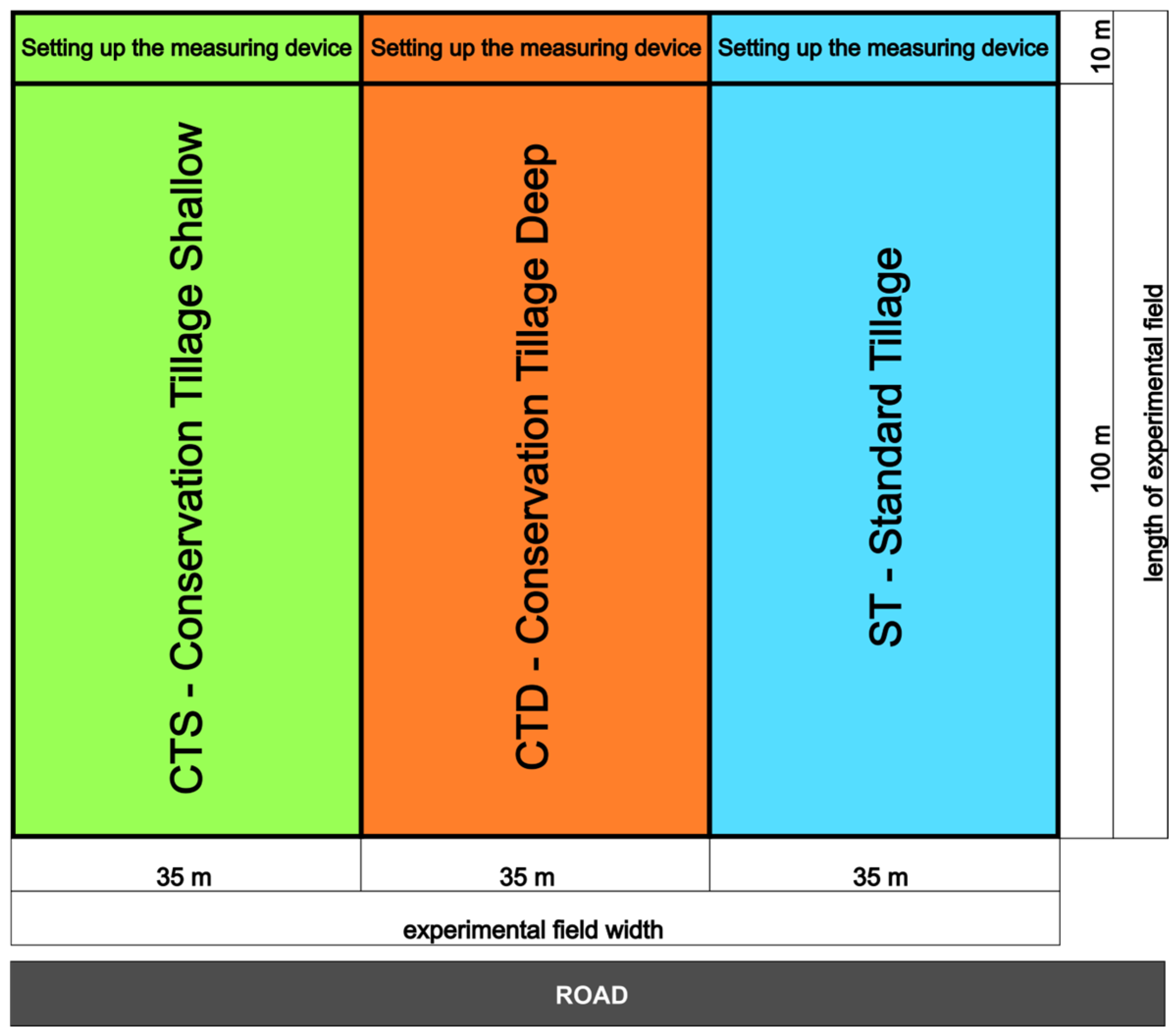
The research was conducted at the experimental field (Figure 1) of the Križevci Polytechnic. Whole-body vibrations of the tractor operator were measured at the seat of an agricultural tractor during different soil tillage operations: ST—Standard Tillage, CTD—Conservation Tillage Deep and CTS—Conservation Tillage Shallow.
The test field was divided into three equal sections according to the tillage operation. Each section was further divided into two parts: a preparatory section of 10 m and a measuring section of 100 m (Figure 1).
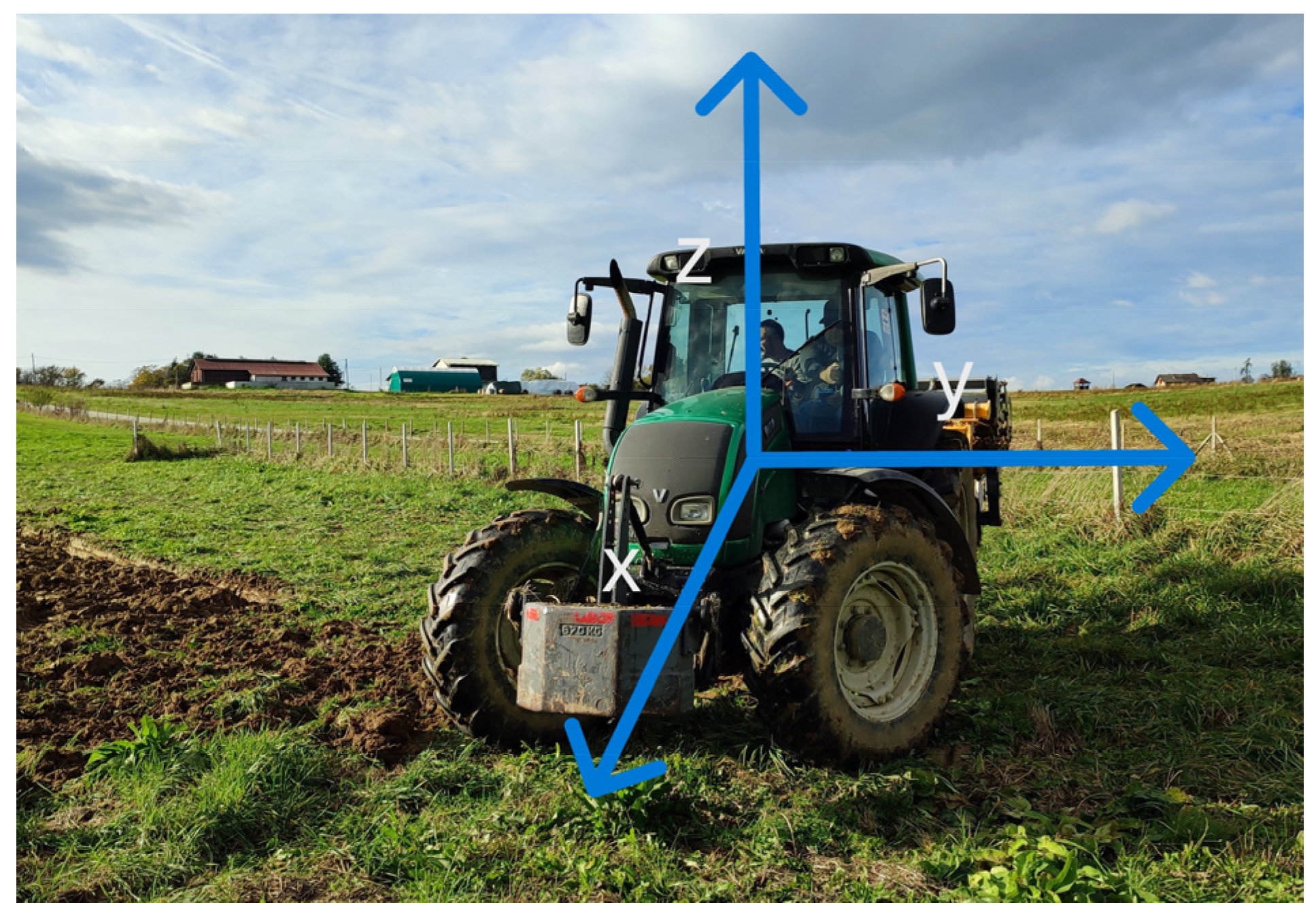
The research was carried out using a device for measuring the whole-body vibration of the tractor operator seated on an agricultural tractor, MMF VM30 (Metra Meß- und Frequenztechnik in Radebeul e.K., Radebeul, Germany) whole-body vibration analyzer (Table 1), equipped with an appropriate sensor. Vibration measurements were performed along all three axes (x, y and z) of the coordinate system. The weighting filters Wd (for the x and y axes) and Wk (for the z axis) were applied during the measurements, in accordance with the requirements of the HRN ISO 2631-1 standard [19] (Figure 2).
The tri-axial accelerometer sensor (KB103SV-100) was mounted on the seat pan according to HRN ISO 2631-1 [19] guidelines, with the sensitive axes aligned to the tractor’s coordinate system (Figure 2). Prior to each measurement session, the sensor was calibrated using the MMF VM30 device’s internal self-test function, and zero-offset verification was performed on a stable surface. The sensor was securely fixed to the seat using the manufacturer’s mounting adapter to ensure consistent positioning across all passes.
According to HRN ISO 2631-1 [19] the R.M.S. method of measurement in motion takes into account intermittent impulse and transient vibrations using a short integration time constant. The vibration magnitude is defined as the maximum transient vibration value (MTVV), which is the maximum for aw(t0):
a w t 0 = 1 τ   t 0 τ t 0 a w t 2 d t 1 2
aw(t)—frequency-weighted instantaneous acceleration (m/s2)
τ—integration time for continuous averaging
t—time (s)
t0—observation time (s)
MTVV = max [aw(t0)]
MTVV—maximum transient vibration value (m/s2)
Measurements were conducted with a single trained operator to minimize inter-operator variability. Each tillage treatment was replicated across multiple passes: ST (n = 27 passes), CTD (n = 16 passes), and CTS (n = 13 passes). The VM30 device recorded vibration data at a sampling frequency of 1000 Hz, with R.M.S. values calculated using a 1 s integration time constant as per HRN ISO 2631-1 [19] requirements. A single operator (male, age 42, height 178 cm, mass 82 kg) with over 15 years of experience in tractor operation performed all measurements to control for inter-subject variability. The operator maintained a standardized seated posture with backrest contact and hands on the steering wheel throughout each pass, as recommended by HRN ISO 2631-4 [20] for seated vibration assessment. Seat position was adjusted to the operator’s ergonomic preference prior to the first measurement and kept constant thereafter.
Guidelines for evaluating the effects of vibration and rotational motion on passenger and operator comfort in transport systems are defined in the HRN ISO 2631-4 standard [20]. The same standard specifies the correct mounting of the torso vibration sensor on the seat, with the axes oriented as follows (Figure 2):
  • x-axis: longitudinal, in the direction of travel—forward (positive)/backward (negative);
  • y-axis: lateral, perpendicular to the direction of travel (left/right);
  • z-axis: vertical, perpendicular to the floor—upward (positive)/downward (negative).
The agricultural tractor used in the research (Figure 2) was a VALTRA model N141 (AGCO Corporation, Suolahti, Finland), manufactured in 2009, with 3278 operating hours. The tractor has an engine power of 111.9 kW, electric transmission and hydraulic control, mechanical cab suspension and a pneumatic seat suspension system. The tractor was equipped with a front counterweight of 670 kg to improve stability and traction, which significantly influences vibration damping and transmission.
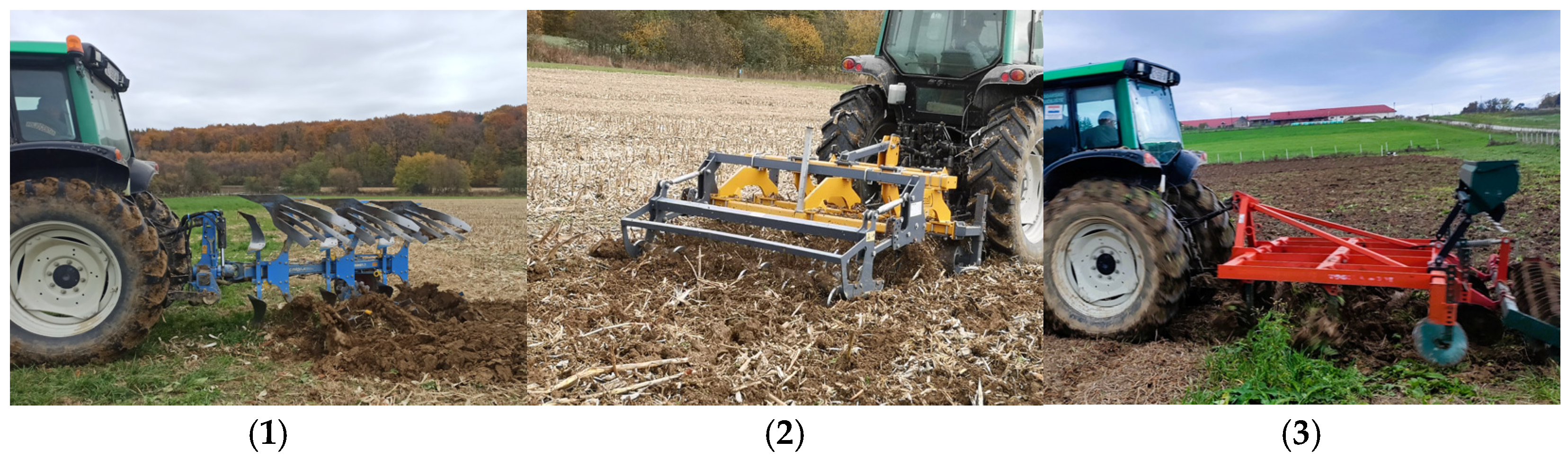
The attached implements (Figure 3) used during the measurements of whole-body vibration (WBV) for different tillage operations had the following working depths (a) and working widths (b):
(1)
Plow (ST) (a = 30 cm, b = 1.5 m);
(2)
Subsoiler (CTD) (a = 30 cm, b = 2.5 m);
(3)
Soil loosener (CTS) (a = 10 cm, b = 3.0 m).
The soil type on which the WBV measurements were conducted was the same for all treatments (hydromorphic soil, Gleysols group). Measurements were conducted under uniform soil moisture conditions (volumetric water content 22–25%, measured with a portable TDR probe at 10 cm depth) to minimize variability in soil mechanical properties. Field surface roughness was visually assessed as homogeneous across the three experimental sections prior to tillage, and no precipitation occurred during the measurement period. Ambient temperature ranged from 18 to 22 °C, within the operational specifications of the measurement equipment. Additionally, the initial field surface was relatively flat with minimal and evenly distributed crop residue from the previous harvest. This uniform starting condition ensured that pre-existing terrain irregularities did not disproportionately bias the whole-body vibration measurements among the different tillage treatments. The travel speed of 8 km/h and tire inflation pressure of 2.4 bar were maintained constant across all treatments to isolate the effect of the tillage implement and working depth on vibration transmission. These values were selected based on typical operational recommendations for the VALTRA N141 tractor during primary tillage operations in the region, as specified in the manufacturer’s operator manual and local agronomic guidelines.
Measurements were performed in such a way that each pass was recorded separately and the average value per pass was subsequently calculated. During the measurements, the measuring range of the whole-body vibration device was set to 12 m/s2. This range was selected to ensure sufficient precision of the measured values (two decimal places).
Statistical analyses were performed separately for each vibration axis (x, y, z) using JASP (version 0.18) (University of Amsterdam, Amsterdam, The Netherlands). Prior to ANOVA, data distribution was assessed using the Shapiro–Wilk test, and homogeneity of variance was evaluated via Levene’s test. While Shapiro–Wilk tests indicated deviations from normality for several treatment groups (p < 0.01), homogeneity of variance was confirmed for all axes (x: p = 0.828; y: p = 0.998; z: p = 0.176). Given the sample sizes (ST: n = 27, CTD: n = 16, CTS: n = 13) and the established robustness of ANOVA to moderate violations of normality under homogeneity of variance, parametric one-way ANOVA was retained. Effect sizes were calculated using partial eta-squared (η2). Post hoc comparisons were conducted using Tukey’s HSD test with α = 0.05. All numerical results are reported using decimal periods per journal standards.

3. Results and Discussion

The following tables and boxplots present the measured values of the operator’s whole-body vibration (WBV) at the seat of the agricultural tractor for each axis separately.
Prior to ANOVA, data normality was assessed using the Shapiro–Wilk test (p > 0.05 for all groups), and homogeneity of variance was confirmed via Levene’s test (p > 0.05). Effect sizes were calculated using partial eta-squared (η2), indicating large effects for the y-axis (η2 = 0.59) and small-to-moderate effects for the x-axis (η2 = 0.16) and z-axis (η2 = 0.15).
The results of descriptive statistics related to the mean values of the measured vibrations in the direction of all three axes show that the largest standard error was observed in the Conservation Tillage Shallow (CTS) treatment. In contrast, the smallest standard error in all three axes was determined in the Standard Tillage (ST) treatment, except for vibrations in the x-axis direction, where the smallest value was determined in the Conservation Tillage Deep (CTD) treatment (Table 2).
The highest WBV levels were recorded in the y- and z-axes during ST and in the x-axis during CTS, consistent with findings reported by [17,21]. These axis-specific patterns can be attributed to implementing soil interaction dynamics. During CTS operations, the reduced working depth (10 cm) likely decreases longitudinal damping, resulting in pronounced forward–backward oscillations and elevated x-axis vibrations. Conversely, ST operation with one set of wheels in the furrow induces lateral chassis tilting, generating higher y-axis vibrations, while simultaneous traversal over uneven terrain contributes to increased z-axis exposure.
Conversely, the lowest vibration levels were observed in the x-axis during ST, the y-axis during CTS, and the z-axis during CTD. The minimal x-axis exposure during ST likely results from the consistent draft resistance of the moldboard plow, which stabilizes longitudinal motion. The wider working width of the CTS implement (3.0 m) enhances lateral stability, reducing y-axis vibrations. Meanwhile, the deeper soil fracturing achieved by the CTD subsoiler appears to distribute vertical loads more evenly, minimizing z-axis transmission.
These mechanistic interpretations warrant experimental validation through integrated measurement of implement forces and tractor kinematics in future research.
While the present study identified the highest mean values in the y- and z-axes during ST, previous investigations s [6,7,9,11,21] reported peak exposures predominantly in the y-axis. Nevertheless, all cited studies, including this one, confirm statistically significant differences in WBV across tillage treatments (p < 0.05), reinforcing the sensitivity of operator exposure to implement selection and operational parameters. The elevated y-axis vibrations during ST can be mechanistically attributed to the asymmetric load distribution when one tractor wheel operates in the furrow, inducing lateral oscillations that propagate through the chassis to the seat suspension. Conversely, the higher x-axis vibrations during CTS likely result from the reduced soil engagement depth of the loosener, which decreases draft resistance stability and promotes longitudinal oscillations under constant throttle. The comparatively lower z-axis vibrations in CTD may reflect the subsoiler’s ability to fracture compacted layers with reduced vertical soil displacement, thereby minimizing vertical impulse transmission.
The analysis of variance (ANOVA) of the mean vibration values in the x, y and z-axis directions (Table 3) indicates statistically significant differences between the mean vibration values obtained for all soil tillage treatments. Similar results were reported by authors [22,23], who also found statistically significant differences in the mean values for all three measurement axes. In contrast, author [22] reported statistically significant differences only in the y and z-axis directions.
The observed differences in WBV across tillage treatments align with the broader principle that vibration exposure is operation-dependent, as recently emphasized by Sláma et al. [11]. While our study focused on implement-specific effects under controlled travel conditions, their findings in forestry operations highlight that even within a single machine setup, WBV can fluctuate substantially based on the immediate task (e.g., active soil engagement vs. transport vs. stationary positioning). This reinforces the practical recommendation that operators should be trained to recognize high-exposure phases and adjust working patterns accordingly. For instance, minimizing time in high-vibration configurations or incorporating brief pauses during prolonged high-exposure operations.
A limitation of this study is the unequal number of replicates across tillage treatments, which, while not violating ANOVA assumptions in our dataset, may reduce statistical power for detecting smaller effect sizes. Future research should aim for balanced replication across treatments and sites.
Multiple comparisons of vibration levels for different tillage treatments using Tukey’s test and the LSD test revealed the same statistically significant differences in the following axes (Table 4):
  • x-axis: comparison between ST and CTD ST and CTS and CTD and ST;
  • y-axis: statistically significant differences were found in all comparisons;
  • z-axis: comparison between ST and CTD and between CTD and ST.
These results differ from those reported by author [22], where multiple comparisons using Tukey’s test identified statistically significant differences only in the y and z-axis directions.
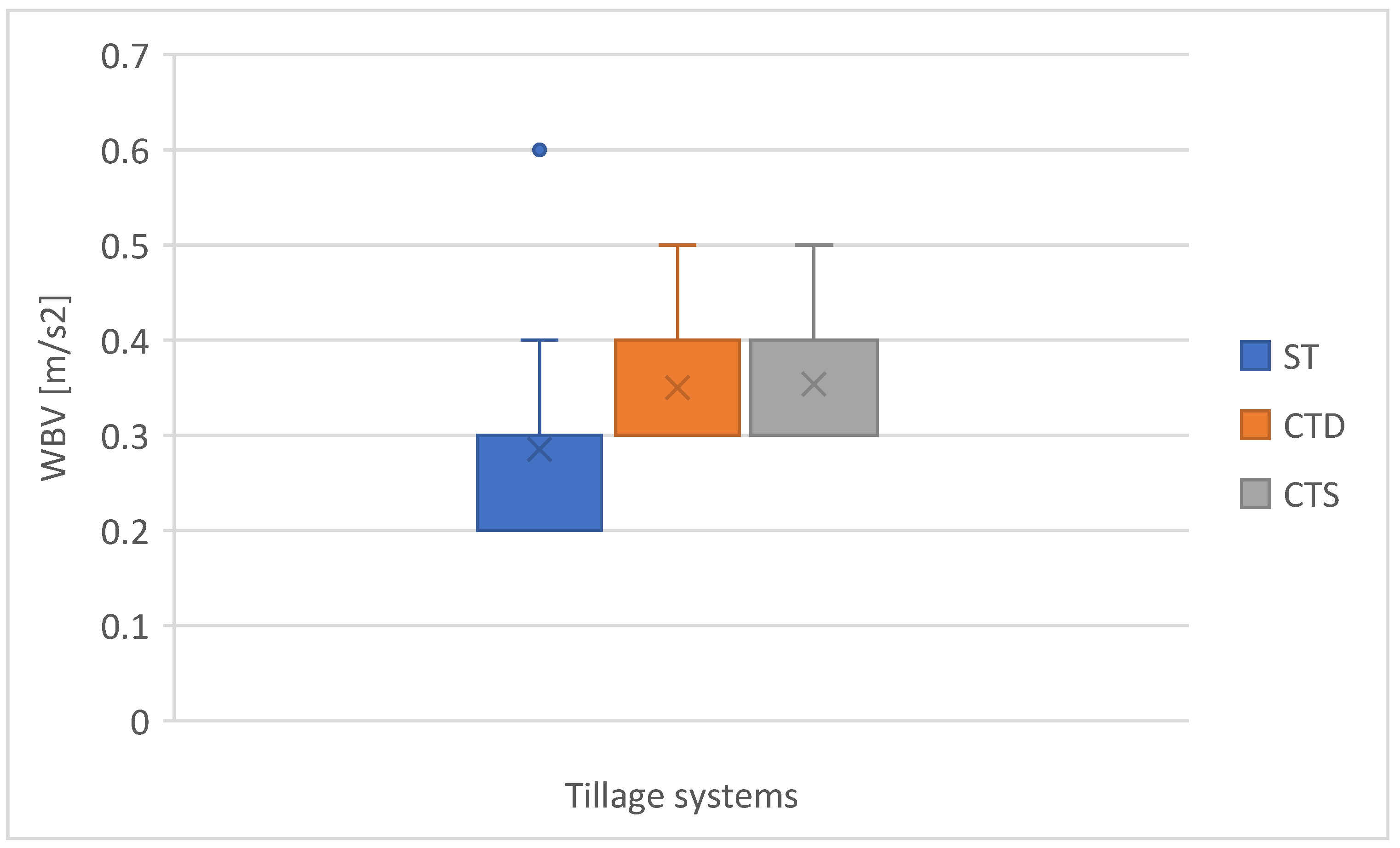
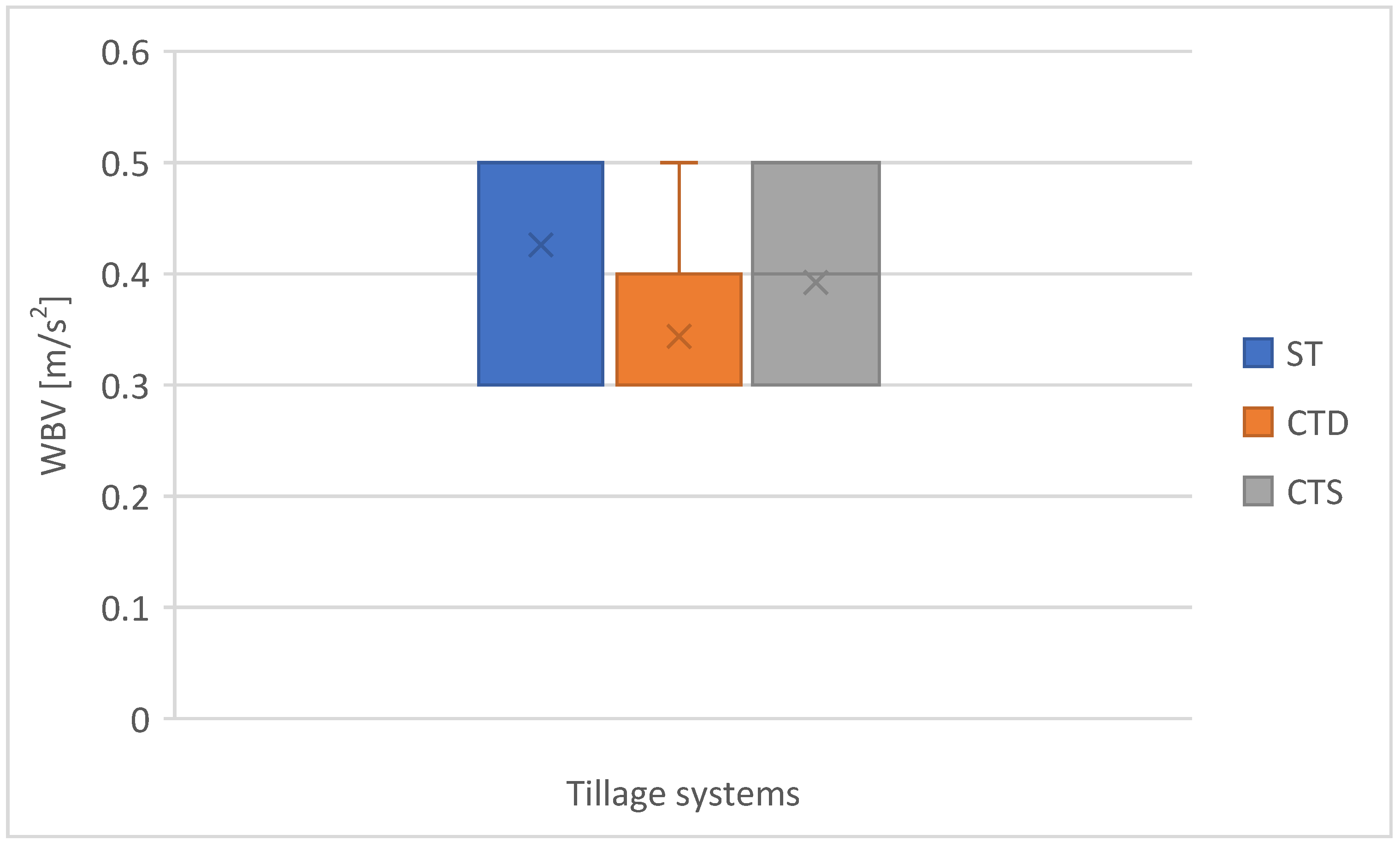
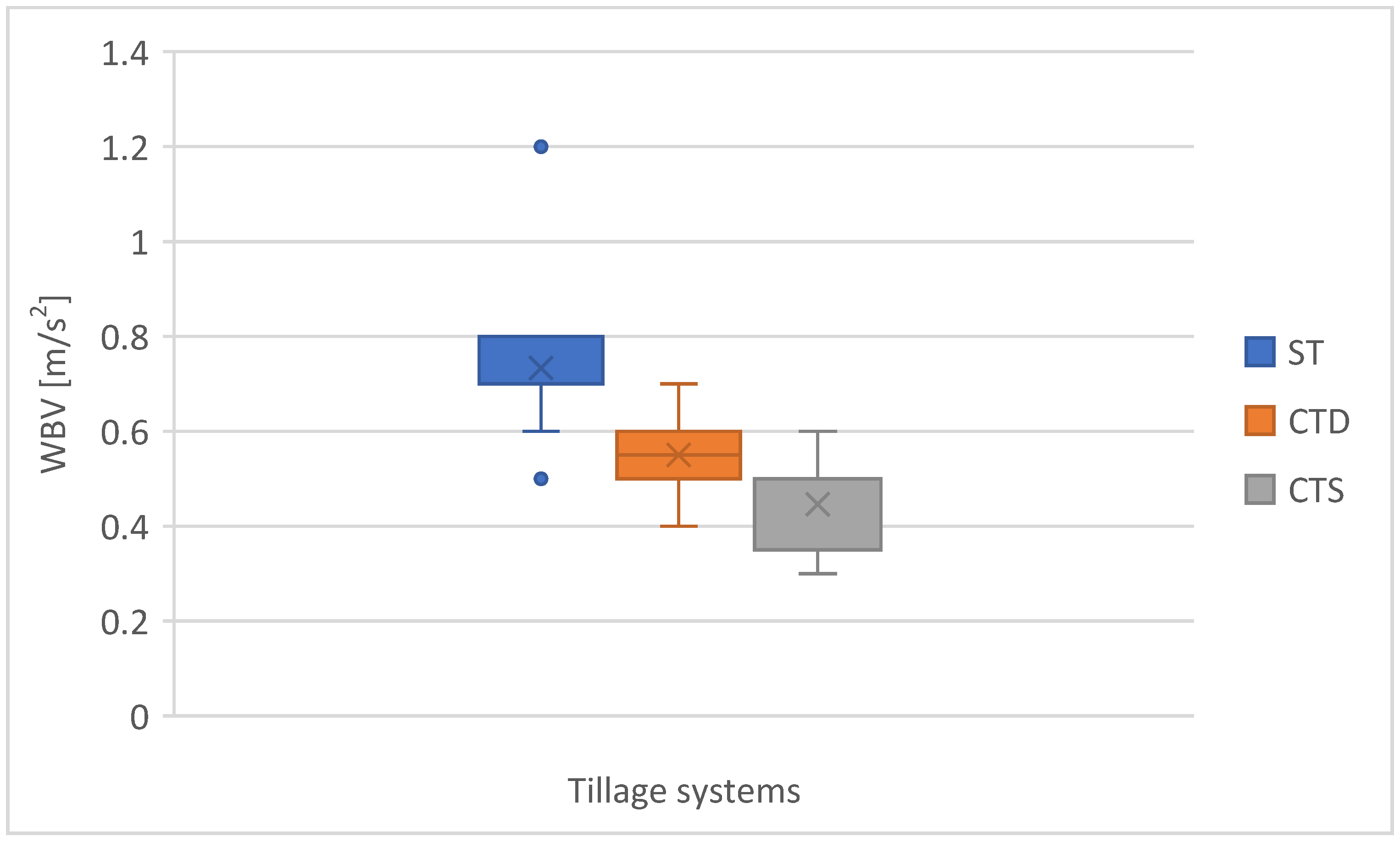
The boxplots (Figure 4, Figure 5 and Figure 6) illustrate both the central tendency and distributional patterns of WBV values across tillage treatments, offering insights that inform mechanistic interpretations. In the x-axis (Figure 4), ST exhibits the lowest median (0.28 m/s2) with minimal outliers and a narrow interquartile range (IQR), indicating stable longitudinal dynamics under constant plow load; in contrast, CTD and CTS show slightly higher medians (~0.35 m/s2) and marginally wider IQRs, likely reflecting reduced soil engagement depth and, consequently, less damping of forward–backward oscillations. In the y-axis (Figure 5), ST displays the highest median (0.71 m/s2) yet the narrowest dispersion, consistent with predictable lateral oscillations induced by one wheel operating in the furrow; conversely, CTS shows the lowest median (0.45 m/s2) but the widest IQR and several mild outliers, potentially attributable to the wider implement interacting with micro-topographic heterogeneity and generating less predictable lateral forces. For the z-axis (Figure 6), CTD demonstrates the most favorable profile with the lowest median (0.34 m/s2) and tightest clustering (smallest IQR), supporting the hypothesis that deeper subsoiling provides more uniform vertical load distribution; ST and CTS exhibit higher central tendencies and broader spreads, possibly reflecting dynamic interactions between the plowshare or loosener tines and variable soil resistance. The absence of extreme outliers across all treatments suggests consistent measurement conditions and operator control. These distributional insights complement mean value comparisons and strengthen the practical relevance of treatment-specific vibration profiles for ergonomic optimization.
The presented boxplots of vibration values for different soil tillage treatments show the following median distributions: in the x-axis direction, the smallest median value was observed for ST while the largest values were equal for CTD and CTS. In the y-axis direction, the smallest median value was recorded for CTS, while the largest was recorded for ST. In the z-axis direction, the smallest median value was determined for CTD, while the largest was recorded for ST.
Furthermore, the smallest dispersion of WBV data is visible in the y-axis direction for ST and CTD and in the z-axis direction for CTD. The largest dispersion was observed in the y-axis direction for CTS and in the z-axis direction for ST and CTS. The dispersion of data in the x-axis direction is similar for all soil tillage treatments (Figure 4, Figure 5 and Figure 6). These results partially correspond to the findings reported by author [23], where greater dispersion was observed in the x and y-axis directions.
The y-axis vibrations (Figure 5) showed the highest variability among the treatments, particularly within the ST group. The ST treatment displayed a significantly higher median and a wider interquartile range compared to CTD and CTS; a notable outlier was recorded at 1.2 m/s2 in ST, which can be attributed to the lateral tilt of the tractor during in-furrow operation, whereas reduced tillage methods maintained more stable lateral profiles.
In Figure 6, the z-axis vibration data revealed a uniform distribution pattern across all three tillage systems. The median values remained consistent between 0.3 and 0.5 m/s2, with symmetrical whiskers and no extreme outliers, suggesting that vertical impacts were relatively balanced regardless of the tillage depth or implement type.
The observed variability in WBV values, particularly for CTS in the y-axis, likely reflects the dynamic interaction between the wider implement and soil heterogeneity, suggesting that operational stability may be more sensitive to field micro-topography under shallow tillage conditions.
Beyond the statistical differences observed between tillage systems, the practical implications of these findings are significant for agricultural occupational health management. The results demonstrate that transitioning from Standard Tillage (ST) to reduced tillage systems (CTD and CTS) not only benefits soil structure but also serves as a proactive measure for risk mitigation regarding whole-body vibration (WBV) exposure. Specifically, the reduction in lateral vibrations (y-axis) during conservation tillage directly lowers the mechanical stress on the operator’s musculoskeletal system, particularly the lumbar spine, where long-term exposure to values exceeding the 0.5 m/s2 action limit is a known precursor to chronic back pain. From a management perspective, these data provide a basis for optimizing operator work shifts. In operations where ST is unavoidable, farm managers should implement shorter rotation periods or more frequent breaks to ensure that the cumulative daily exposure A(8) remains within safe thresholds. Furthermore, the high variability observed in ST suggests that investment in advanced seat suspension systems or automated guidance (to reduce manual steering adjustments in the furrow) should be prioritized for tractors primarily used for moldboard plowing. By quantifying the vibration signatures of specific tillage methods, this study offers a framework for selecting equipment and field techniques that prioritize the long-term health and productivity of agricultural workers.

4. Conclusions

This study provides a comparative assessment of whole-body vibration (WBV) exposure at the seat of an agricultural tractor operator during three primary tillage systems (ST, CTD, CTS) on hydromorphic soil (Gleysols). The analysis confirms that implement selection and working depth significantly influence axis-specific vibration transmission, with conservation tillage methods demonstrating potential for reducing exposure in certain directions compared to conventional plowing.
Key findings indicate the following:
  • The highest mean WBV values were recorded in the y-axis during Standard Tillage (0.715 m/s2), exceeding the exposure action value of 0.5 m/s2 defined in Directive 2002/44/EC, while no measured value surpassed the regulatory limit value of 1.15 m/s2.
  • Conservation Tillage Deep (CTD) yielded the most favorable vibration profile in the vertical (z) axis (0.344 m/s2), suggesting its dual benefit for soil structure preservation and operator ergonomics.
  • Statistical analysis (ANOVA, Tukey’s HSD, LSD) confirmed significant differences between treatments across all three axes, supporting the hypothesis that tillage system choice meaningfully affects WBV exposure.
  • The novel contributions of this work are threefold: (1) It establishes the first comparative WBV baseline for ST, CTD, and CTS systems under identical operational parameters on Gleysols, addressing a gap in the literature focused on reduced-tillage ergonomics; (2) It demonstrates that vibration mitigation can be achieved through implement selection and operational optimization without compromising agronomic objectives, offering practical guidance for farmers and machinery designers; (3) It provides axis-specific recommendations—e.g., prioritizing y-axis damping improvements for plowing operations—thereby supporting targeted ergonomic interventions.
  • While none of the mean values exceeded the regulatory limit value, the frequent exceedance of the action value (particularly in the y-axis during ST) underscores that prolonged daily exposure may still pose health risks. Therefore, we recommend (i) implementing exposure time management strategies, (ii) regular maintenance of seat and cab suspension systems, and (iii) operator rotation during high-exposure operations to mitigate long-term musculoskeletal risks.
  • Future research should expand these findings across diverse soil types, tractor models, and operator demographics, while integrating real-time WBV monitoring, biomechanical modeling, and health outcome tracking to develop evidence-based guidelines for sustainable and ergonomically optimized mechanization.

Author Contributions

Conceptualization. Ž.B. and D.J.; methodology. Ž.B. and D.J.; software. Ž.B.; validation. Ž.B., I.P., T.J., E.D., D.J. and M.M.; formal analysis. Ž.B.; investigation. Ž.B.; resources. Ž.B.; data curation. Ž.B. and T.J.; writing—original draft preparation. Ž.B., T.J., I.P. and M.M.; writing—review and editing. Ž.B., I.P., T.J., E.D., D.J. and M.M.; visualization. Ž.B.; supervision. T.J.; project administration. M.M.; funding acquisition. Ž.B., I.P., T.J., E.D. and D.J. and M.M. All authors have read and agreed to the published version of the manuscript.

Funding

This research received no external funding.

Institutional Review Board Statement

Not applicable.

Informed Consent Statement

Not applicable.

Data Availability Statement

The data presented in this study are available on request from the corresponding author.

Acknowledgments

This research was supported by the Croatian Science Foundation under the project “Assessment of conservation soil tillage as advanced methods for crop production and prevention of soil degradation–ACTIVEsoil” (IP-2020–02–2647) and the scientific project “Prediction of maize yield potential using machine learning models based on vegetation indices and phenological metrics from Sentinel-2 multispectral satellite images (AgroVeFe)—581-UNIOS-30”, which was funded by the European union—NextGenerationEU.

Conflicts of Interest

The authors declare no conflicts of interest.

References

  1. Gubiani, R.; Zucchiatti, N.; Da Broi, U. Whole-Body Vibration for Tractor Drivers. In Proceedings of the AIIA 2022: Biosystems Engineering Towards the Green Deal; Ferro, V., Giordano, G., Orlando, S., Vallone, M., Cascone, G., Porto, S.M.C., Eds.; Springer International Publishing: Cham, Switzerland, 2023; pp. 605–613. [Google Scholar]
  2. Vitale, E.; Vella, F.; Matera, S.; Rizzo, G.C.; Rapisarda, L.; Roggio, F.; Musumeci, G.; Rapisarda, V.; Romano, E.; Filetti, V. Precision Agriculture: Assessment of Ergonomic Risks of Assisted Driving System. Appl. Sci. 2024, 14, 3738. [Google Scholar] [CrossRef] [Scilit]
  3. Directive 2002/44/EC of the European Parliament and of the Council of 25 June 2002 on the minimum health and safety requirements regarding the exposure of workers to the risks arising from physical agents (vibration) (sixteenth individual Directive within the meaning of Article 16(1) of Directive 89/391/EEC). Off. J. Eur. Communities 2002, L 177, 13–20. Available online: https://eur-lex.europa.eu/eli/dir/2002/44/oj/eng (accessed on 5 November 2025).
  4. Singh, A.; Nawayseh, N.; Doyon-Poulin, P.; Milosavljevic, S.; Dewangan, K.N.; Kumar, Y.; Samuel, S. Comparative Analysis of Classical and Ensemble Models for Predicting Whole Body Vibration Induced Lumbar Spine Stress. A Case Study of Agricultural Tractor Operators. Int. J. Ind. Ergon. 2025, 108, 103775. [Google Scholar] [CrossRef] [Scilit]
  5. ISO 2631-5; Mechanical Vibration and Shock—Evaluation of Human Exposure to Whole-Body Vibration—Part 5: Method for Evaluation of Vibration Containing Multiple Shocks. International Organization for Standardization: Geneva, Switzerland, 2018. Available online: https://www.iso.org/standard/50905.html (accessed on 10 March 2026).
  6. Singh, A.; Samuel, S.; Dhabi, Y.K.; Singh, H. Whole-Body Vibration: Characterization of Seat-to-Head Transmissibility for Agricultural Tractor Drivers during Loader Operation. Smart Agric. Technol. 2023, 4, 100164. [Google Scholar] [CrossRef] [Scilit]
  7. Singh, A.; Nawayseh, N.; Dhabi, Y.K.; Samuel, S.; Singh, H. Digital Agriculture: Analysis of Vibration Transmission from Seat to Back of Tractor Drivers Under Multi-Directional Vibration Conditions. Int. J. Ind. Eng. Theory Appl. Pract. 2023, 30, 463–473. [Google Scholar] [CrossRef]
  8. Oncescu, A.-T.; Persu, C.; Dumitru, I.; Prunoiu, D.; Grigorie, L.; Tarnita, D. Influence of the Road Type on the Whole-Body Vibrations Transmitted to the Driver of an Electric Tractor. Acta Tech. Napoc.-Ser. Appl. Math. Mech. Eng. 2022, 65, 387–392. [Google Scholar]
  9. Oncescu, A.; Persu, C.; Tarniță, D.; Biriș, S.; Tunsoiu, N.; Fudulache, O.C. The Measurement and Evaluation of the Large Agricultural Tractor Operator’s Whole–Body Vibration for Four Types of Land and Two Running Speeds. Int. J. Eng. 2024, 22, 8. [Google Scholar]
  10. Oncescu, T.-A.; Persu, I.C.; Bostina, S.; Biris, S.S.; Vilceleanu, M.-V.; Nenciu, F.; Matache, M.-G.; Tarnita, D. Comparative Analysis of Vibration Impact on Operator Safety for Diesel and Electric Agricultural Tractors. AgriEngineering 2025, 7, 40. [Google Scholar] [CrossRef] [Scilit]
  11. Sláma, D.; Staněk, L.; Mergl, V. Magnitude of WBV Affecting the Tractor with a Timber Trailer Operator During Individual Timber Forwarding Operations. South-East Eur. For. 2025, 16, 43–51. [Google Scholar] [CrossRef] [Scilit]
  12. Mohammadi, A.; Kheiralipour, K.; Ghamary, B.; Jahanbakhshi, A.; Shahidi, R. The Driver Responses to the Vibration of Tractor. Agric. Eng. Int. CIGR J. 2023, 25, 66–74. [Google Scholar]
  13. Prakash, C.; Singh, L.P.; Gupta, A. Experiment and Optimisation Analysis of Whole-Body Vibration among Tractor Drivers: A Comprehensive Study. Int. J. Heavy Veh. Syst. 2024, 31, 87–112. [Google Scholar] [CrossRef] [Scilit]
  14. Naveen, R.; Kumar, A.; Kumar, R.; Kushwaha, H.L.; Khanna, M.; Ramasubramanian, V.; Poojith, S. Assessment of Whole-Body Vibration and Development of Mitigation Intervention for Single-Axle Tractor–Trailer Combination. Front. Mech. Eng. 2024, 10, 1426764. [Google Scholar] [CrossRef] [Scilit]
  15. ISO 5008; Agricultural Wheeled Tractors and Field Machinery—Measurement of Whole-Body Vibration of the Operator. International Organization for Standardization: Geneva, Switzerland, 2002. Available online: https://www.iso.org/standard/1743.html (accessed on 10 March 2026).
  16. Almady, S.S.; Al-Janobi, A.A.; Marey, S.A.; Al-Sager, S.M.; Aboukarima, A.M.; Gaddal, Y.H. Establishment of a Measuring Unit Based on Arduino Board for Recording Vibrations on an Agricultural Tractor during Tillage Process. Meas. Control 2025, 58, 1147–1157. [Google Scholar] [CrossRef] [Scilit]
  17. Pochi, D.; Fornaciari, L.; Vassalini, G.; Grilli, R.; Fanigliulo, R. Levels of Whole-Body Vibrations Transmitted to the Driver of a Tractor Equipped with Self-Levelling Cab during Soil Primary Tillage. AgriEngineering 2022, 4, 695–706. [Google Scholar] [CrossRef] [Scilit]
  18. Fanigliulo, R.; Pochi, D.; Grilli, R.; Vassalini, G.; Pagano, M.; Tomasone, R.; Cedrola, C.; Fornaciari, L. Tillage Performance and Whole-Body Vibration Analysis of a Subsoiler Equipped with an Oscillating Working Tool. Agriculture 2026, 16, 339. [Google Scholar] [CrossRef] [Scilit]
  19. HRN ISO 2631-1; Mechanical Vibration and Shock—Evaluation of Human Exposure to Whole-Body Vibration—Part 1: General Requirements. Croatian Standards Institute: Zagreb, Croatia, 2019. Available online: https://repozitorij.hzn.hr/norm/HRN+ISO+2631-1:1999/A1:2019 (accessed on 10 March 2026).
  20. HRN ISO 2631-4; Mechanical Vibration and Shock—Evaluation of Human Exposure to Whole-Body Vibration—Part 4: Guidelines for the Evaluation of the Effects of Vibration and Rotational Motion on Passenger and Crew Comfort in Fixed-Guideway Transport Systems. Croatian Standards Institute: Zagreb, Croatia, 2018. Available online: https://repozitorij.hzn.hr/norm/HRN+ISO+2631-4:2010/A1:2018 (accessed on 10 March 2026).
  21. Barač, Ž.; Plaščak, I.; Jurić, T.; Marković, M. The Impact of Vibrations on the Hand–Arm System and Body of Agricultural Tractor Operators in Relation to Operational Parameters, Approach: Analytical Hierarchical Process (AHP). AgriEngineering 2025, 7, 56. [Google Scholar] [CrossRef] [Scilit]
  22. Huang, Q.; Gao, M.; Guo, M.; Wei, Y.; Zhang, J.; Jin, X. Vibration Comfort Assessment of Tractor Drivers Based on sEMG and Vibration Signals. Comput. Methods Biomech. Biomed. Eng. 2024, 27, 1875–1892. [Google Scholar] [CrossRef] [Scilit] [PubMed]
  23. Barač, Ž.; Jurić, M.; Plaščak, I.; Jurić, T.; Marković, M. Assessing Whole-Body Vibrations in an Agricultural Tractor Based on Selected Operational Parameters: A Machine Learning-Based Approach. AgriEngineering 2025, 7, 72. [Google Scholar] [CrossRef] [Scilit]
Figure 1. Schematic layout of the experimental field at Križevci Polytechnic, showing the division into three tillage treatments (ST, CTD, CTS), each with a 10 m preparatory zone and a 100 m measurement zone.
Agriengineering 08 00176 g001
Figure 2. Coordinate system orientation for whole-body vibration measurement on the tractor seat according to HRN ISO 2631-1 [19]: x-axis (longitudinal, direction of travel), y-axis (lateral), z-axis (vertical).
Agriengineering 08 00176 g002
Figure 3. Implements used for different tillage operations: (1) mouldboard plow for Standard Tillage (ST; working depth 30 cm, width 1.5 m), (2) subsoiler for Conservation Tillage Deep (CTD; depth 30 cm, width 2.5 m), and (3) soil loosener for Conservation Tillage Shallow (CTS; depth 10 cm, width 3.0 m).
Agriengineering 08 00176 g003
Figure 4. Boxplots of vibration with different tillage systems in the x-axis direction.
Agriengineering 08 00176 g004
Figure 5. Boxplots of vibration with different tillage systems in the y-axis direction.
Agriengineering 08 00176 g005
Figure 6. Boxplots of vibration with different tillage systems in the z-axis direction.
Agriengineering 08 00176 g006
Table 1. Technical specifications of the MMF VM30 whole-body vibration analyzer.
Measuring rangeSensor (1 mV/ms−2)Whole body vibration 0.10–12.00/1.0–120.0/10–1200/1000/6000 m/s2peak; Acceleration 0.10–12.00/1.0–120.0/10–1200/1000/6000 m/s2peak;
Speed 0.001–0.120/0.010–1200/0.10–0.12/1.00/60.00 m/s1peak; Shift 0.001–0.120/0.010–1200/0.10–0.12/1.00/60.00 mmpeak.
Accuracy
Non-linearity error
±3% and ±2 digits.
<5% readings in all measurement ranges.
Screen display modeWorking RMS (1 s), maximum working RMS (MTVV), interval RMS (do 10 h), value of the estimated vibration quantity (eVDV), total vibration value (Ahv), highest value (1 s), maximum of the highest value and crest factor
Weighted filtersWb, Wc, Wd, We, Wg, Wh, Wj, Wk, Wm
ScreenGraphic LCD display with 32 × 120 dots and LED backlight, 3 vibration values with units and operating mode
Sensor input3 IEPE inputs, plug type Binder 711, female, 4 pins
IEPE power supply3 constant current sources, 2 A, total voltage 20 V
Recommended sensorsKB103SV-100 (Metra Meß- und Frequenztechnik in Radebeul e.K., Radebeul, Germany) for whole-body vibration measurement (1 mV/s2)
MemoryFlash memory for 1000 to 3000 measured values, depending on the recording mode
Recording modesManually using the SAVE button or Logging mode, time-controlled from 1 s to 10 h
Operating temperature range−20 °C to 40 °C
Dimensions165 × 92 × 31 mm3
Table 2. Descriptive statistics of mean values of vibrations during different soil tillage operations.
NMean
WBV
[m/s2]
Std. DeviationStd. Error95% Confidence Interval for MeanMinMax
Lower BoundUpper Bound
x axis
ST270.2850.08640.01660.2510.3190.20.6
CTD160.3500.06320.01580.3160.3840.30.5
CTS130.3540.07760.02150.3070.4010.30.5
Total560.3200.08400.01120.2970.3420.20.6
y axis
ST270.7150.08640.01660.6810.7490.50.8
CTD160.5500.10330.02580.4950.6050.40.7
CTS130.4460.10500.02910.3830.5100.30.6
Total560.6050.14700.01960.5660.6450.30.8
z axis
ST270.4260.09030.01740.3900.4620.30.5
CTD160.3440.07270.01820.3050.3830.30.5
CTS130.3920.08620.02390.3400.4440.30.5
Total560.3950.09030.01210.3700.4190.30.5
Table 3. Analysis of variance of vibrations during different tillage systems (ANOVA).
Sum of SquaresdfMean SquareFSig.
x axis
Between Groups0.06220.0315.0350.010
Within Groups0.326530.006
Total0.38855
y axis
Between Groups0.70220.35138.2480.000
Within Groups0.486530.009
Total1.18855
z axis
Between Groups0.06820.0344.7320.013
Within Groups0.380530.007
Total0.44855
Table 4. Multiple comparisons of vibrations during different tillage systems.
(I) Soil_Cultivation(J) Soil_CultivationMean Difference (I-J)Std. ErrorSig.95% Confidence Interval
Lower BoundUpper Bound
x axis
TukeySTCTD−0.0648 *0.02480.030−0.125−0.005
CTS−0.0687 *0.02650.032−0.133−0.005
CTDST0.0648 *0.02480.0300.0050.125
CTS−0.00380.02930.991−0.0750.067
CTSST0.0687 *0.02650.0320.0050.133
CTD0.00380.02930.991−0.0670.075
LSDSTCTD−0.0648 *0.02480.012−0.114−0.015
CTS−0.0687 *0.02650.012−0.122−0.016
CTDST0.0648 *0.02480.0120.0150.114
CTS−0.00380.02930.896−0.0630.055
CTSST0.0687 *0.02650.0120.0160.122
CTD0.00380.02930.896−0.0550.063
y axis
Tukey HSDSTCTD0.1648 *0.03020.0000.0920.238
CTS0.2687 *0.03230.0000.1910.347
CTDST−0.1648 *0.03020.000−0.238−0.092
CTS0.1038 *0.03580.0150.0180.190
CTSST−0.2687 *0.03230.000−0.347−0.191
CTD−0.1038 *0.03580.015−0.190−0.018
LSDSTCTD0.1648 *0.03020.0000.1040.225
CTS0.2687 *0.03230.0000.2040.334
CTDST−0.1648 *0.03020.000−0.225−0.104
CTS0.1038 *0.03580.0050.0320.176
CTSST−0.2687 *0.03230.000−0.334−0.204
CTD−0.1038 *0.03580.005−0.176−0.032
z axis
Tukey HSDSTCTD0.0822 *0.02670.0090.0180.147
CTS0.03360.02860.473−0.0350.103
CTDST−0.0822 *0.02670.009−0.147−0.018
CTS−0.04860.03160.283−0.1250.028
CTSST−0.03360.02860.473−0.1030.035
CTD0.04860.03160.283−0.0280.125
LSDSTCTD0.0822 *0.02670.0030.0290.136
CTS0.03360.02860.245−0.0240.091
CTDST−0.0822 *0.02670.003−0.136−0.029
CTS−0.04860.03160.131−0.1120.015
CTSST−0.03360.02860.245−0.0910.024
CTD0.04860.03160.131−0.0150.112
* The mean difference is significant at the 0.05 level.
Disclaimer/Publisher’s Note: The statements, opinions and data contained in all publications are solely those of the individual author(s) and contributor(s) and not of MDPI and/or the editor(s). MDPI and/or the editor(s) disclaim responsibility for any injury to people or property resulting from any ideas, methods, instructions or products referred to in the content.