

An Ultrasonic Phased Array System for Detection of Plastic Contaminants in Cotton

 , , and
Abstract
1. Introduction
2. Materials and Methods
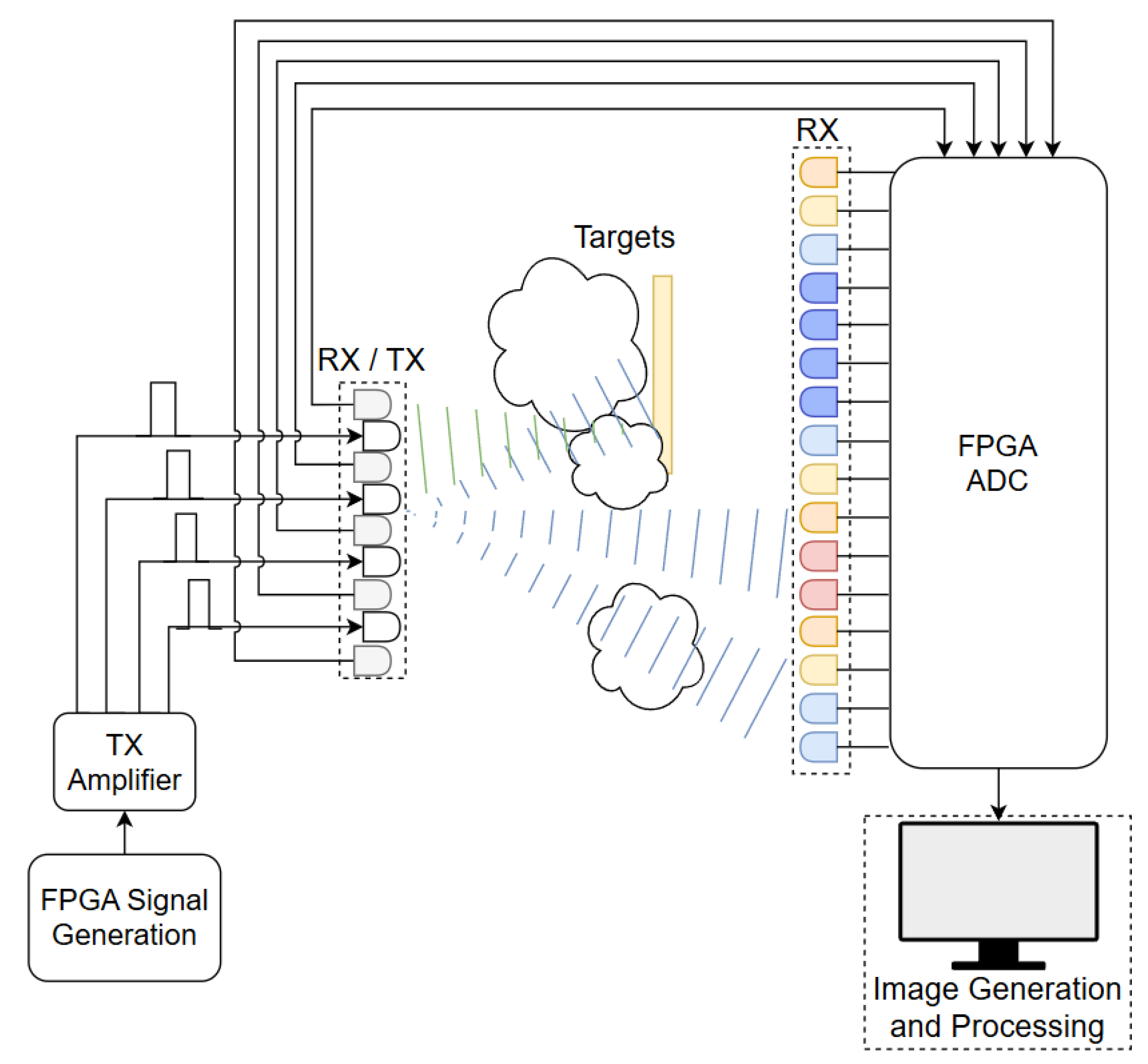
2.1. Theory of Operation
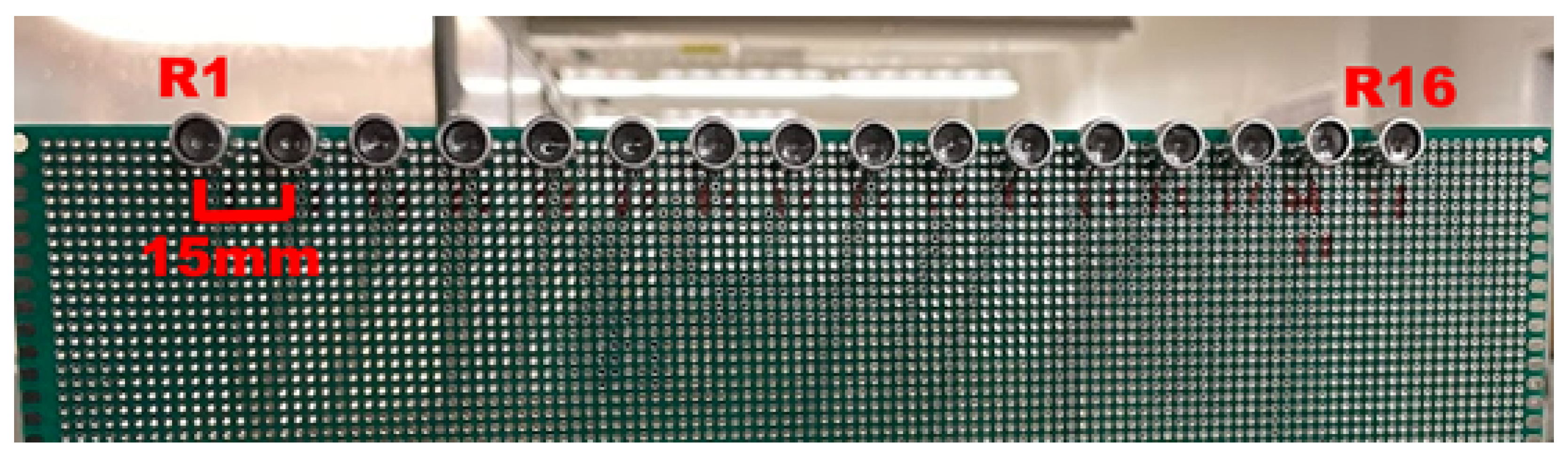
2.2. Hardware Setup
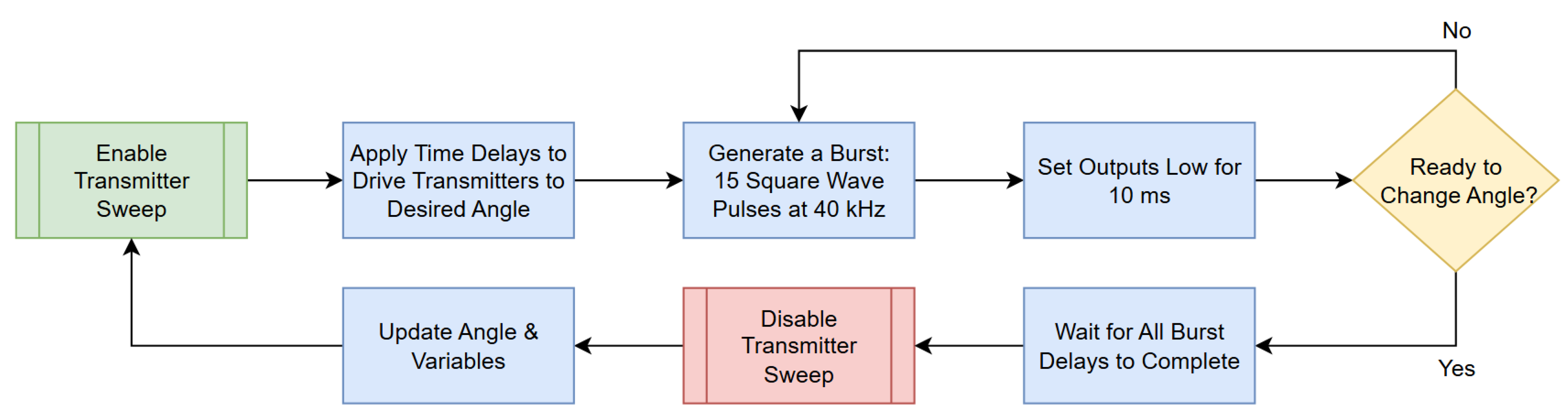
2.3. Software Pipeline
2.3.1. Initialization
2.3.2. Reflection Receiver Data Preprocessing
- 1.
- The system utilizes a 4th-order Butterworth bandpass filter centered at 40 kHz with a 2 kHz bandwidth to process reflection waveforms. This topology was chosen to leverage its maximally flat passband and steep roll-off, ensuring that the 40 kHz signal is isolated from unwanted noise and DC components without introducing distortions. This configuration ensures high signal fidelity for the subsequent imaging algorithms.
- 2.
- Burst segmentation and averaging: the burst semaphore is used to segment the filtered waveform into individual burst periods. Each segment corresponds to the received echoes for a single transmitted ultrasonic burst. These segments are averaged together to form a single burst period in order to reduce random noise.
- 3.
- Calibration: the upper envelope of each averaged burst period is taken in order to smooth out amplitude fluctuations. Then, the averaged burst period obtained from the calibration data is subtracted from the averaged burst period from the measurement data. This subtraction helps to remove (unwanted) signal data from the invariant parts of the scene, e.g., transducer coupling and reflections coming from the transmission receiver setup.
2.3.3. Transmission Data Preprocessing
2.3.4. Beamforming
- 1.
- Interpolation and downsampling: each reflection signal is interpolated to achieve a finer temporal resolution so that the required fractional delays can be implemented as integer sample shifts. To achieve this, the desired time resolution is determined based on the receiver spacing, transmitter sweep step, and propagation speed. The formula for calculating is described by Equation (3), with the transmitter sweep step substituted for in order to produce . The ratio between the original sampling period and is computed and approximated as a rational number . The signal is interpolated by factor and downsampled by factor , resulting in an effective sampling rate ofThis interpolated sampling rate gives a precise temporal resolution that matches the required delay adjustments for each signal.
- 2.
- Delay calculation: based on the known geometry of the reflection receiver array and the transmitter sweep angle, the relative time delays () for each receiver are computed from Equation (3) for each angle. These delays account for the differences in arrival times of echoes due to the spatial separation of the receivers.
- 3.
- Time-shifting and summation: each receiver’s interpolated signal is then circularly shifted by its computed delay. This step aligns the echoes from all receivers so that signals originating from the same spatial location add constructively, helping “steer” sensitivity in the angle of interest. Then, the time-shifted signals are summed to form a composite signal for the given angle.
2.3.5. Image Formation
- 1.
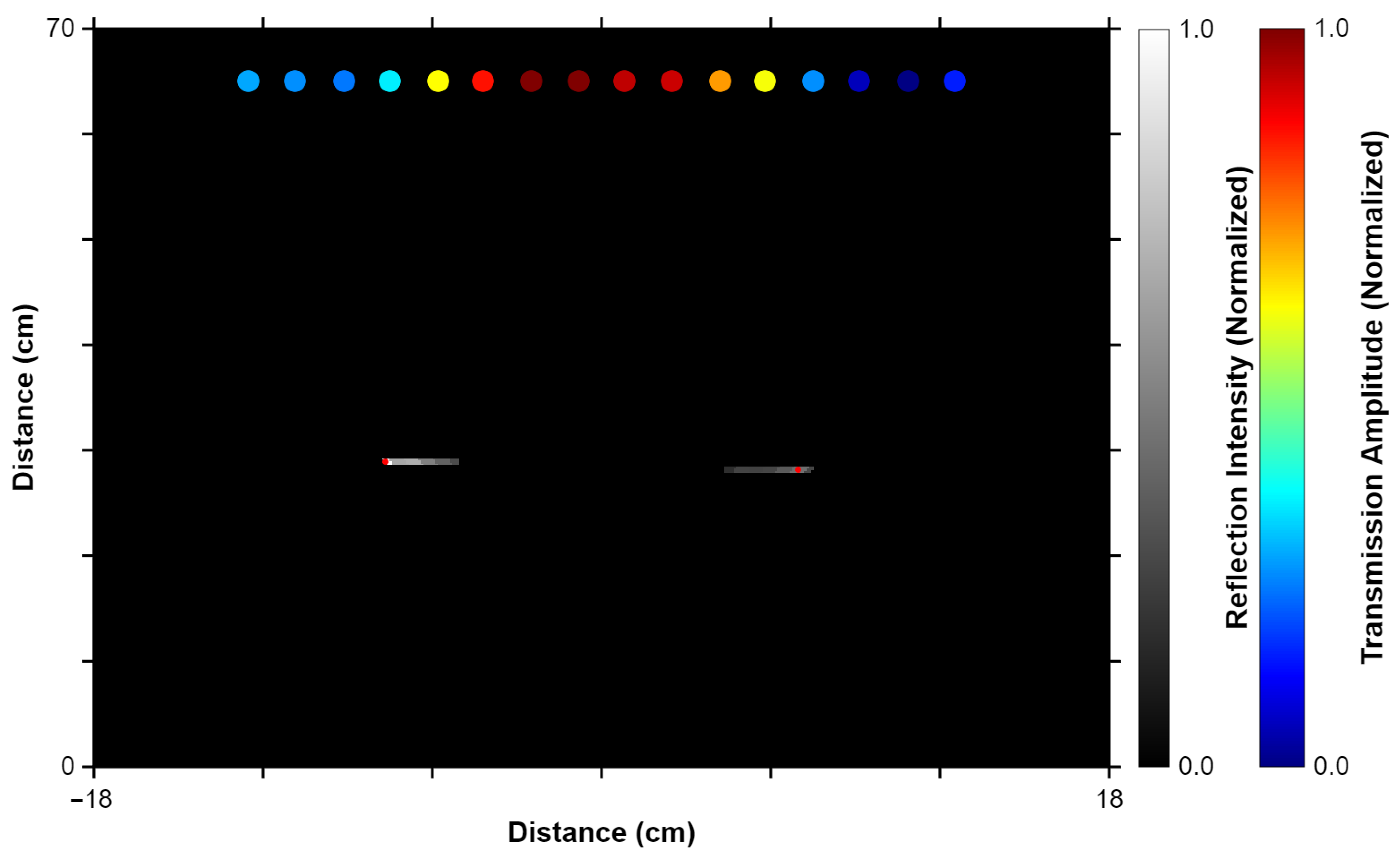
- Mapping reflection data: each point in the composite reflection matrix, which is indexed by time (providing distance information) and beamformed angle, is mapped from polar coordinates into Cartesian coordinates. This conversion assigns a physical x-y location to each amplitude value, with the centroid of the transmitter array acting as the origin of the mapping.
- 2.
- Scaling reflection intensities: the reflection intensities are linearly scaled to a standard grayscale range (e.g., 0–255) so that variations in echo amplitude are visually represented as differences in brightness. Intensities below the noise level are masked to improve the image quality.
- 3.
- Interpolating reflection intensities: gaps in the image arising from discrete angular sampling are filled using two-dimensional interpolation, resulting in a smooth and continuous grayscale background.
- 4.
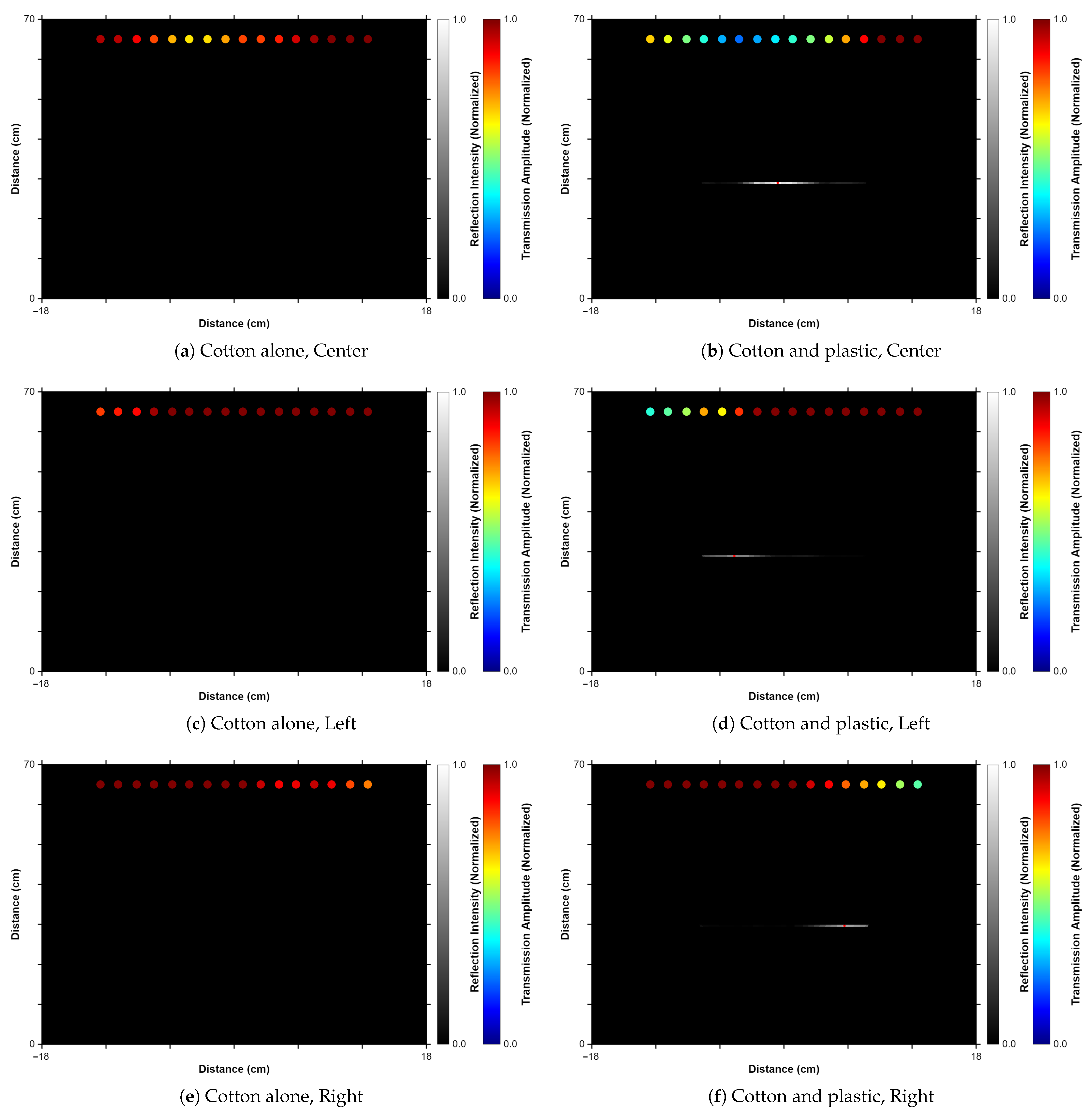
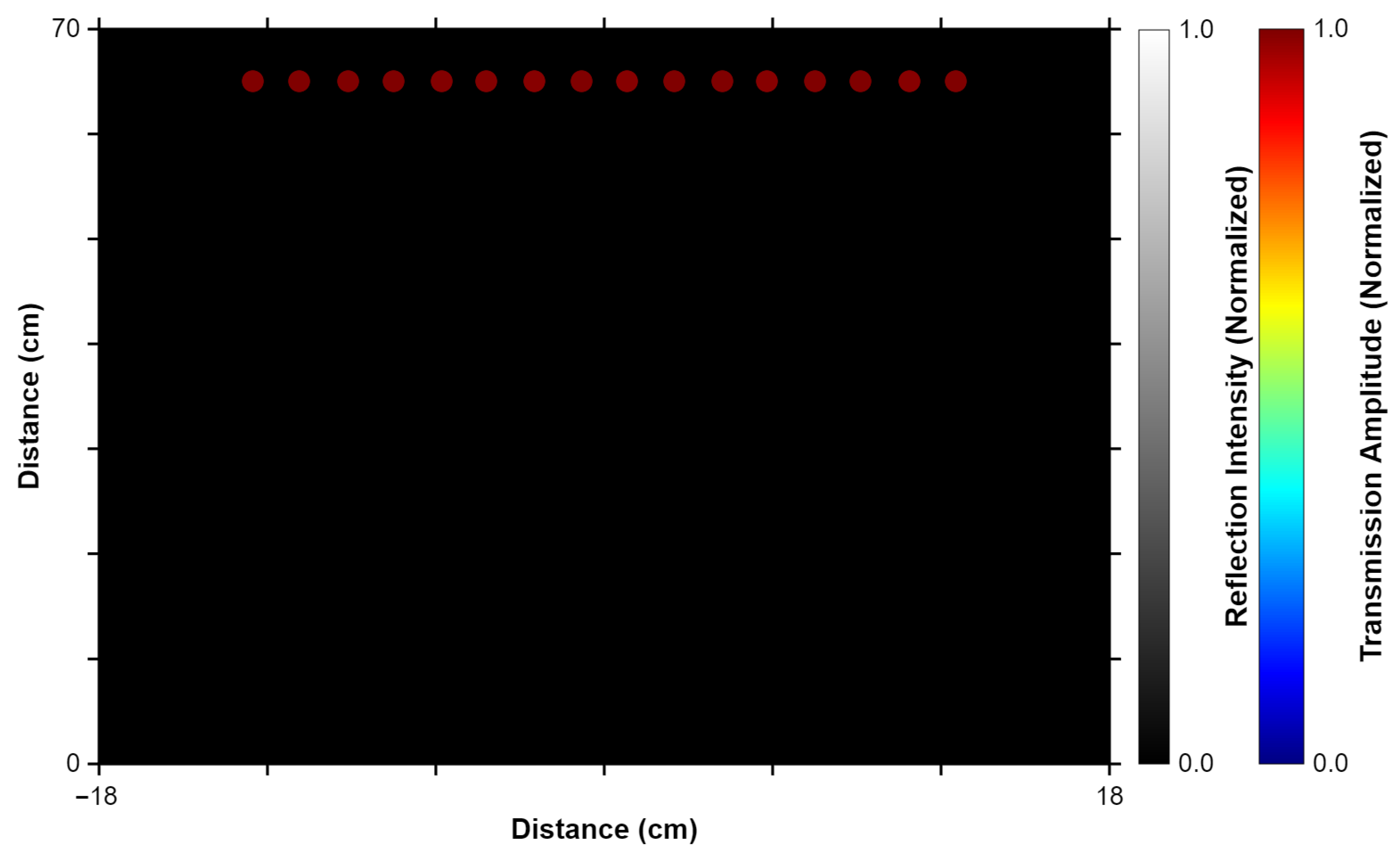
- Overlaying transmission data: the normalized transmission voltage measurements are assigned to spatial locations based on the known geometry of the transmission receivers. These values are color-coded according to a predetermined colormap and overlaid onto the grayscale image, thereby providing additional information about signal attenuation in the scene. In this setup, values mapped to cooler colors correspond to greater obstructions in the path of transmission (i.e., reflective or highly absorbing targets), whereas values mapped to warmer colors correspond to lesser obstructions (i.e., air).
- 5.
- Local maxima filtering: to reduce axial blurring (an artifact characterized by the width of the transmitted pulse), local maxima in the reflection image are detected to identify distinct reflectors. A filter is then applied to retain only those intensities within a narrow axial band around each detected local maximum. This selective filtering confines the image data to regions immediately surrounding the reflectors, thereby sharpening the axial definition.
2.4. Experimental Target Configurations
3. Results and Discussion
3.1. Cotton and Plastic Experiments
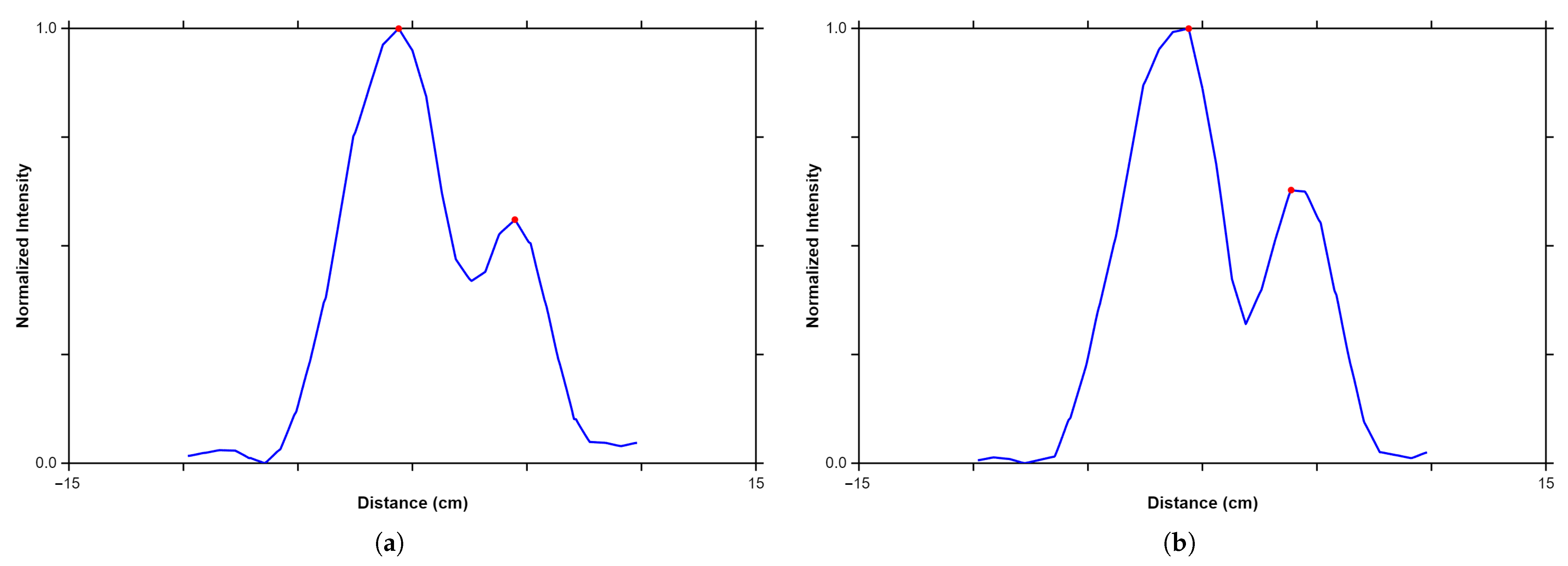
3.2. Lateral Resolution
3.3. Axial Resolution
3.4. Future Work
4. Conclusions
Author Contributions
Funding
Institutional Review Board Statement
Informed Consent Statement
Data Availability Statement
Conflicts of Interest
References
- Khan, M.A.; Ahmad, S.; Hasanuzzaman, M. World Cotton Production and Consumption: An Overview. In Cotton Production and Uses; Ahmad, S., Hasanuzzaman, M., Eds.; Springer: Singapore, 2020. [Google Scholar] [CrossRef] [Scilit]
- Adeleke, A.A. Technological advancements in cotton agronomy: A review and prospects. Technol. Agron. 2024, 4, e008. [Google Scholar] [CrossRef] [Scilit]
- Allen, A.; Foulk, J.; Gamble, G. Preliminary Fourier-transform infrared spectroscopy analysis of cotton trash. J. Cotton Sci. 2007, 11, 68–74. [Google Scholar]
- Himmelsbach, D.S.; Akin, D.E.; Kim, J.; Hardin, I.R. Chemical structural investigation of the cotton fiber base and associated seed coat: Fourier-transform infrared mapping and histochemistry. Text. Res. J. 2003, 73, 281–288. [Google Scholar] [CrossRef] [Scilit]
- USDA-AMS C&T. Plastic Contamination Remains Industry-Wide Focus. 2020. Available online: https://content.govdelivery.com/attachments/USDAAMS/2020/07/24/file_attachments/1502672/2%20-Plastic%20Contamination%20Remains%20Industry-Wide%20Focus,%20final%20Plastic%20article%20with%20header,%207-7-20.pdf (accessed on 10 January 2026).
- Blomquist, G. We Can Stop Contamination—This Is the Way to Do It. In Proceedings of the 1997 Beltwide Cotton Conferences, New Orleans, LA, USA, 6–10 January 1997. [Google Scholar]
- Loptex. The Most Comprehensive and Accurate System for the Detection and Removal of Contamination. 2025. Available online: https://www.loptex.it/spinning.html (accessed on 10 January 2026).
- Haney, B.; Byler, R.K. Plastic Impurities Found in Cotton. In Proceedings of the 2017 Beltwide Cotton Conferences, Dallas, TX, USA, 4–6 January 2017. [Google Scholar]
- Valco, T. Industry Must Stop Contamination. Cotton Farming. 2014. Available online: https://www.cottonfarming.com/research-promotion/industry-must-stop-contamination/ (accessed on 10 January 2026).
- Adeleke, A.A.; Hardin, R.G.; Pelletier, M.G. Design of a plastic removal mechanism for cotton gin. In Proceedings of the 2021 Beltwide Cotton Conferences, Virtual, 5–7 January 2021. [Google Scholar]
- Adeleke, A.A. A review of plastic contamination challenges and mitigation efforts in cotton and textile milling industries. AgriEngineering 2023, 5, 193–217. [Google Scholar] [CrossRef] [Scilit]
- Georgia Cotton Council. Prevention of Plastic Contamination. 2025. Available online: https://georgiacottoncommission.org/prevention-of-plastic-contamination/ (accessed on 25 February 2025).
- Bange, M.P.; van der Sluijs, M.H.J.; Constable, G.A.; Gordon, S.G.; Long, R.L.; Naylor, G.R.S. A Guide to Improving Australian Cotton Fibre Quality, 1st ed.; The Cotton Research and Development Corporation: Narrabri, NSW, Australia, 2017. [Google Scholar]
- Hardin, R.G.; Huang, Y.; Poe, R. Detecting plastic trash in a cotton field with a UAV. In Proceedings of the 2018 Beltwide Cotton Conferences, San Antonio, TX, USA, 3–5 January 2018; pp. 3–5. [Google Scholar]
- Zhiqiang, Z.; Xuegeng, C.; Ruoyu, Z.; Fasong, Q.; Qingjian, M.; Jiankang, Y.; Haiyuan, W. Evaluation of residual plastic film pollution in pre-sowing cotton field using UAV imaging and semantic segmentation. Front. Plant Sci. 2022, 13, 991191. [Google Scholar] [CrossRef] [Scilit] [PubMed]
- Xiong, Y.; Zhang, Q.; Chen, X.; Bao, A.; Zhang, J.; Wang, Y. Large scale agricultural plastic mulch detecting and monitoring with multi-source remote sensing data: A case study in Xinjiang, China. Remote Sens. 2019, 11, 2088. [Google Scholar] [CrossRef] [Scilit]
- Rutherford, R.D.; Arthur, D.L.; Sweers, G.J.; Cory, M.D. Field evaluation update on the VIPR™ system—2020. In Proceedings of the 2020 Beltwide Cotton Conferences, Austin, TX, USA, 8–10 January 2020. [Google Scholar]
- Wanjura, J.D.; Pelletier, M.G.; Holt, G.A.; Barnes, E.M.; Wigdahl, J.; Doron, N. An Integrated Plastic Contamination Monitoring System for Cotton Module Feeders. AgriEngineering 2021, 3, 907–923. [Google Scholar] [CrossRef] [Scilit]
- Pelletier, M.G.; Wanjura, J.D.; Wakefield, J.R.; Holt, G.A.; Kothari, N. Cotton Gin Stand Machine-Vision Inspection and Removal System for Plastic Contamination: Hand Intrusion Sensor Design. AgriEngineering 2024, 6, 1–19. [Google Scholar] [CrossRef] [Scilit]
- Pelletier, M.G.; Wanjura, J.D.; Holt, G.A. Vision-Transformer Model Validation Image Dataset. AgriEngineering 2024, 6, 4476–4479. [Google Scholar] [CrossRef] [Scilit]
- Uster Technologies AG. Uster Jossi Vision Shield: The Most Efficient Solution for Contamination Control. Available online: https://www.uster.com/products/in-line-process-control/uster-jossi-vision-shield/ (accessed on 23 September 2025).
- Truetzschler Group SE. T-SCAN TS-T5: High-End Quality Foreign Part Separation. Available online: https://www.truetzschler.com/en/spinning/products/blow-room/detailed-information/foreign-part-seperator/ (accessed on 23 September 2025).
- Kiron, M.I. Loptex: An Optosonic Sorter; Textile Learner: Dhaka, Bangladesh, 2022; Available online: https://textilelearner.net/loptex-an-optosonic-sorter/ (accessed on 25 February 2025).
- Knitting Industry. New Loepfe Tool for More Efficient Yarn Clearing. 2025. Available online: https://www.knittingindustry.com/new-loepfe-tool-for-more-efficient-yarn-clearing/ (accessed on 25 February 2025).
- Zhang, Q.; Hua, L.; Yao, J. Development of detection system for cotton plastic covering using ultrasonic. Appl. Mech. Mater. 2013, 411–414, 1439–1444. [Google Scholar] [CrossRef] [Scilit]
- Reeder, G.S.; Currie, P.J.; Hagler, D.J.; Tajik, A.J.; Seward, J.B. Use of Doppler techniques (continuous-wave, pulsed-wave, and color flow imaging) in the noninvasive hemodynamic assessment of congenital heart disease. Mayo Clin. Proc. 1986, 61, 725–744. [Google Scholar] [CrossRef] [Scilit] [PubMed]
- CUI Devices. CUSA-T80-15-2400-TH Datasheet; Technical Report; CUI Devices: Lake Oswego, OR, USA, 2020. [Google Scholar]
- CUI Devices. CUSA-R80-15-2500-TH Datasheet; Technical Report; CUI Devices: Lake Oswego, OR, USA, 2020. [Google Scholar]
- Balanis, C.A. Antenna Theory: Analysis and Design, 3rd ed.; John Wiley & Sons: Hoboken, NJ, USA, 2005. [Google Scholar]
- Harput, S. Ultrasonic Phased Array Device for Acoustic Imaging in Air. Master’s Thesis, Sabancı University, Tuzla, Türkiye, 2007. [Google Scholar]
- Elliott, E. An Ultrasonic Phased Array System for Detection of Plastic Contaminants in Cotton. Master’s Thesis, Texas Tech University, Lubbock, TX, USA, 2025. [Google Scholar]
- Digilent, Inc. Zybo Z7 Reference Manual; Technical Report; Digilent, Inc.: Pullman, WA, USA, 2025; Available online: https://digilent.com/reference/programmable-logic/zybo-z7/reference-manual (accessed on 8 February 2025).
- Pelletier, M.G.; Holt, G.A.; Wanjura, J.D. Plastic Imaging, Detection, and Ejection System (PIDES) for Cotton Gins: Results from Commercial Testing and System Updates; Technical Report; U.S. Department of Agriculture, Agricultural Research Service (USDA-ARS): Washington, DC, USA, 2023. [Google Scholar]





| Target | Normalized Reflection Voltage | Normalized Transmission Voltage |
|---|---|---|
| Plastic | 1 | 0.17 |
| Plastic | 0.73 | 0.27 |
| Plastic | 0.56 | 0.34 |
| Plastic | 0.38 | 0.45 |
| Plastic | 0.06 | 0.52 |
| Seed Cotton | 0.06 | 0.46 |
| Cotton | 0.04 | 0.54 |
| Air | 0 | 1 |
| Object Width (Axial Distance = 41 cm) | Object Center–Edge Angular Width | Measured Lateral RMS Reflection Voltage Points |
|---|---|---|
| 50.8 mm | 3.53° | ° |
| 18 mm | 1.25° | ° |
| 13 mm | 0.90° | ° |
| 5 mm | 0.35° | ° |
| 3 mm | 0.21° | ° |
Disclaimer/Publisher’s Note: The statements, opinions and data contained in all publications are solely those of the individual author(s) and contributor(s) and not of MDPI and/or the editor(s). MDPI and/or the editor(s) disclaim responsibility for any injury to people or property resulting from any ideas, methods, instructions or products referred to in the content. |
© 2026 by the authors. Licensee MDPI, Basel, Switzerland. This article is an open access article distributed under the terms and conditions of the Creative Commons Attribution (CC BY) license.
Share and Cite
Elliott, E.; Foster, A.; Bernussi, A.; Sari-Sarraf, H.; Saed, M.; Martin, V.B.; Kothari, N. An Ultrasonic Phased Array System for Detection of Plastic Contaminants in Cotton. AgriEngineering 2026, 8, 153. https://doi.org/10.3390/agriengineering8040153
Elliott E, Foster A, Bernussi A, Sari-Sarraf H, Saed M, Martin VB, Kothari N. An Ultrasonic Phased Array System for Detection of Plastic Contaminants in Cotton. AgriEngineering. 2026; 8(4):153. https://doi.org/10.3390/agriengineering8040153
Chicago/Turabian StyleElliott, Ethan, Allison Foster, Ayrton Bernussi, Hamed Sari-Sarraf, Mohammad Saed, Vikki B. Martin, and Neha Kothari. 2026. "An Ultrasonic Phased Array System for Detection of Plastic Contaminants in Cotton" AgriEngineering 8, no. 4: 153. https://doi.org/10.3390/agriengineering8040153
APA StyleElliott, E., Foster, A., Bernussi, A., Sari-Sarraf, H., Saed, M., Martin, V. B., & Kothari, N. (2026). An Ultrasonic Phased Array System for Detection of Plastic Contaminants in Cotton. AgriEngineering, 8(4), 153. https://doi.org/10.3390/agriengineering8040153