
Article

Integrated Processes Controlling the Functioning and Quality of Sandy Soil Cultivated with Bean Under Biochar Application in a Semiarid Region


by
Raví Emanoel de Melo
1,
Vanilson Pedro da Silva
1,
Julio César Calixto Costa
2,
Maria Fernanda de A. Tenório Alves
1,
Márcio Henrique Leal Lopes
1,
Argemiro Pereira Martins Filho
1,
Gustavo Pereira Duda
1,
Antonio Celso Dantas Antonino
3,
Maria Camila de Barros Silva
1,
Claude Hammecker
4,
José Romualdo de Sousa Lima
1 and
Erika Valente de Medeiros
1,*
1
Postgraduate Program in Agricultural Production (PPGPA), Federal University of Agreste of Pernambuco (UFAPE), Garanhuns 55292-270, PE, Brazil
2
Postgraduate Program in Soil Science (PPGCS), Federal Rural University of Pernambuco (UFRPE), Recife 52171-900, PE, Brazil
3
Department of Nuclear Engineering (DEN), Federal University of Pernambuco (UFPE), Recife 50670-901, PE, Brazil
4
Institute de Recherche Pour le Développement (IRD), Place Pierre Viala, 34060 Montpellier, France
*
Author to whom correspondence should be addressed.
AgriEngineering 2026, 8(3), 95; https://doi.org/10.3390/agriengineering8030095
Submission received: 9 January 2026 / Revised: 23 February 2026 / Accepted: 25 February 2026 / Published: 4 March 2026

Abstract

Biochar application has been proposed as a promising strategy to improve soil functioning, defined as the integrated regulation of water storage, nutrient availability, and biological activity influencing crop productivity and crop performance in water-limited environments. However, its effectiveness depends on soil properties, climatic variability, and dominant processes. This study evaluated the effects of sewage sludge biochar on soil quality, water dynamics, nutrient availability, and bean productivity in sandy soil under rainfed semiarid conditions across two contrasting cropping cycles. A soil quality index (SQI) based on a minimum data set (MDS) derived from principal component analysis (PCA) was used to identify the dominant processes controlling soil functioning under different hydrological regimes. The two cropping cycles corresponded to wetter (Cycle I) and drier (Cycle II) hydrological conditions within the same agricultural year. Biochar application increased soil organic carbon and nitrogen stocks, enhanced phosphorus availability, and improved soil water storage. Despite similar evapotranspiration among treatments, water productivity increased, indicating more efficient conversion of stored soil water into yield. Biological indicators were more responsive during the wetter cycle, whereas physicochemical indicators dominated under drier conditions, revealing a shift in the processes regulating soil functioning. The minimum data set varied between cycles, demonstrating the environmental dependency of the SQI components. Overall, biochar improved soil resilience by enhancing nutrient retention and buffering crop response to water limitation, and the integrative SQI approach effectively captured these functional changes.

1. Introduction

The agricultural systems in semiarid regions are characterized by high climatic variability, irregular precipitation patterns, high evaporative demand, and low soil organic matter (SOM) contents, which are factors that collectively impair soil functioning, water retention, and crop productivity [1]. Under these conditions, soils become highly sensitive to management practices, and their capacity to sustain plant growth depends on the interactions among physical–hydric, biological, and chemical properties that regulate water storage, nutrient cycling, and structural stability. Therefore, understanding soil functioning in dry environments requires an integrative approach capable of linking soil quality indicators to essential ecosystem functions [2]. Recent advances in monitoring the soil–plant continuum further emphasize that the isolated characterization of soil properties is insufficient to explain crop performance under water stress conditions, highlighting the need for integrated analyses [3,4].
In this context, biochar has emerged as a promising strategy for improving soil functioning in water-limited environments because of its physicochemical stability and its potential to modify soil pore architecture, water retention, nutrient dynamics, and microbial habitat. Numerous studies have shown that biochar can enhance the physical–hydric functioning of soils, particularly coarse-textured soils, by increasing water retention and plant-available water, reducing bulk density, and promoting porosity and soil water dynamics under field conditions. These improvements often translate into agronomic benefits, including increased crop productivity and enhanced water and nitrogen use efficiency [5,6,7,8,9,10]. In addition to physical–hydric effects, biochar can influence soil microbial communities and biogeochemical cycles, promoting increases in microbial biomass carbon, stabilizing soil organic carbon, and altering nitrogen cycling processes. These changes have been associated with improved nutrient availability and nitrogen use efficiency under different management practices and water availability conditions [11,12,13,14,15,16]. However, the magnitude and direction of these responses are context dependent and vary with feedstock type, pyrolysis conditions, residence time, application rate, soil texture, and climatic regime [17,18].
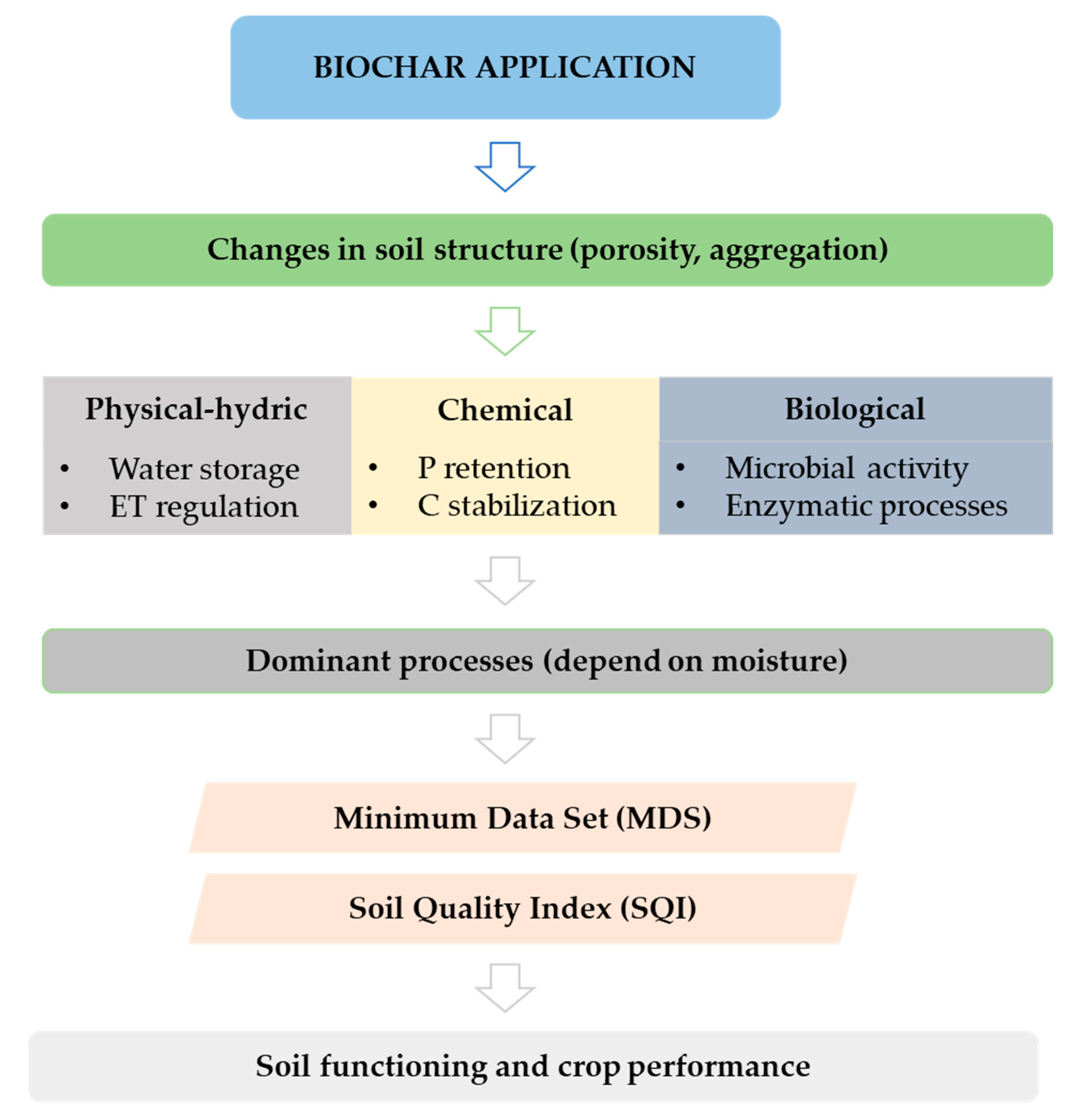
Multivariate and integrative analytical frameworks and functional indices are particularly useful for synthesizing complex data sets and exploring interrelationships among variables spanning the physical–hydric, biological, and chemical domains [19]. Al-Shammary et al. [20] emphasized the importance of considering soil as a multifunctional system in which water regulation, carbon storage, nutrient cycling, and biological activity interact. By integrating multiple soil indicators through combined statistical frameworks, Garg et al. [21] demonstrated an improved understanding of soil properties and crop performance across diverse environments. In this context, soil functioning is treated here as a measurable process-based construct emerging from the interaction between physical–hydric regulation (water storage and flow), chemical regulation (nutrient retention and availability), and biological regulation (microbial activity and organic matter transformation). The soil quality index is therefore interpreted as an operational representation of these interacting processes rather than an isolated statistical indicator. The conceptual relationships among these processes and the role of biochar in modulating soil functioning are illustrated in Figure 1.
Therefore, this study evaluated how biochar modulates the functioning of sandy soil cultivated with rainfed bean under semiarid conditions by integrating soil physical–hydric, biological, and chemical indicators through multivariate analyses and a soil quality index (SQI) approach. We hypothesized that (i) higher biochar application rates improve physical–hydric soil functioning by reducing bulk density and increasing porosity and soil water storage; (ii) biochar increases soil carbon and nitrogen stocks and enhances carbon use efficiency, reflecting more integrated and efficient soil functioning; and (iii) integrative soil quality indices based on a minimum data set (MDS) are more sensitive to management and cropping cycle-related contrasts than individual indicators considered separately, providing a functional synthesis of soil responses across cropping cycles.
Although soil quality indices have been widely applied to synthesize complex soil datasets, most studies treat soil quality as a static property independent of environmental context. Recent advances highlight the need for process-based approaches capable of capturing functional shifts in soil behavior under contrasting conditions. In this study, the novelty lies in demonstrating that the MDS composing the soil quality index is not fixed but changes according to hydrological regime, revealing transitions between biologically mediated processes and structurally controlled processes. Therefore, rather than providing a descriptive soil quality assessment, the MDS–SQI framework is used here as a functional diagnostic tool to identify dominant mechanisms governing soil functioning across cropping cycles. This dynamic interpretation enhances the conceptual framework of soil quality assessment by transitioning from a purely integrative indicator to a mechanistic perspective of soil–water–plant interactions in semiarid systems.

2. Materials and Methods

2.1. Overview of the Study Area

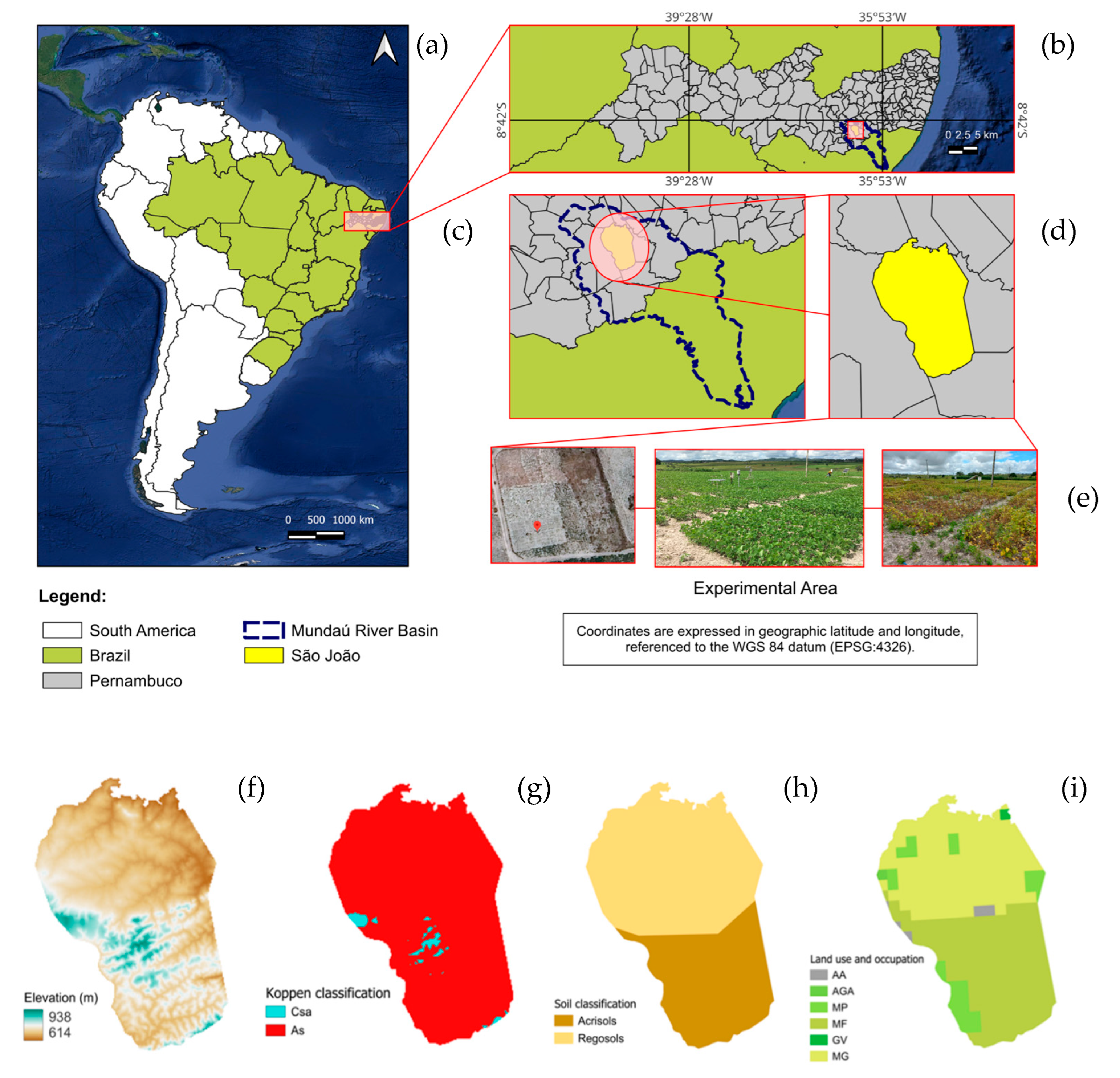
The field experiment was conducted under rainfed conditions at an experimental farm located in the municipality of São João, in the Agreste region of the state of Pernambuco, Brazil (08°50′24″ S; 36°22′49″ W; mean altitude of 715 m; Figure 2a–e). The municipality is situated within the physiographic context of the semiarid region of Brazil and is characterized by gently undulating relief with moderate altitudinal variations (Figure 2f). According to the Köppen climate classification, the regional climate is classified as As’, characterized by a well-defined dry season and irregular annual precipitation, with a historical mean of approximately 782 mm (Figure 2g) [22,23]. The experimental area is located within the Mundaú River basin (Figure 2c) and is dominated by shallow to moderately deep soils, with the occurrence of soil classes such as Acrisols and Regosols (Figure 2h). The land use and land cover in the surrounding area are predominantly agricultural, forming a mosaic of cultivated areas and remaining native vegetation (Figure 2i). A detailed description of the land use and land cover classes adopted for map classification is provided in Table S4 (Supplementary Material).
Crop cultivation was conducted over two contrasting bean growing seasons during the 2022 agricultural year, corresponding to the rainy period (May–July) and the dry period (August–December), allowing the assessment of soil functioning under different hydrological conditions typical of semiarid environments. The two cropping cycles were conducted within the same agricultural year but under naturally contrasting rainfall regimes. Therefore, Cycle I represents a wetter hydrological condition, whereas Cycle II corresponds to a drier condition. The comparison between cycles was thus interpreted as an environmental contrast rather than a temporal progression or residual management effect. The bean phenological stages were defined according to the BBCH scale (Biologische Bundesanstalt, Bundessortenamt and Chemical industry scale), a standardized decimal code describing the phenological development stages of plants with measurements grouped into two main phases: the early growth stage (V0–V4), corresponding to emergence and vegetative development, and the late growth stage (R5–R9), encompassing flowering, pod formation, grain filling, and physiological maturity, following Fernández et al. [24].
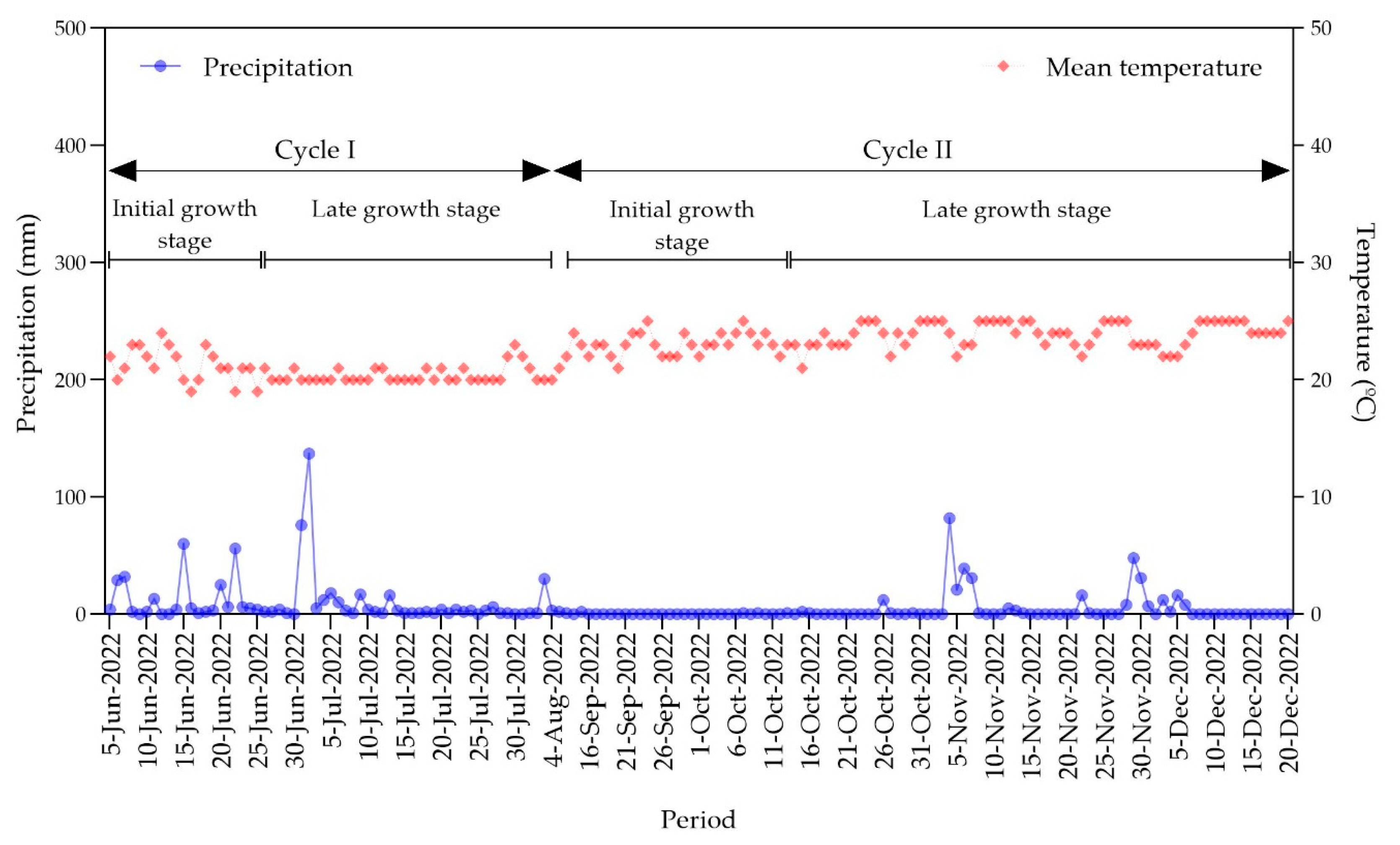
In 2022, the rainfall regime exhibited high intra-annual variability associated with the occurrence of easterly wave disturbances (EWDs) and favorable positioning of the Intertropical Convergence Zone (ITCZ) [25], resulting in intense rainfall events concentrated over short time intervals during the experimental period, as shown in Figure 3.

2.2. Soil and Material Collection

Sewage sludge (SS) was collected from a wastewater treatment plant located in the study region. The initial physical and chemical properties of the soil, as well as the chemical characterization of sewage sludge, sewage sludge biochar, and poultry manure, are summarized in Tables S1 and S2 (Supplementary Material). Detailed procedures for biochar production, soil sampling, and analytical methods were reported in a previous study [10]. Briefly, the sewage sludge was air-dried and subjected to slow pyrolysis in a vertical thermal furnace under limited oxygen conditions, reaching a maximum temperature of approximately 550 °C with a residence time of 10 h. After cooling, the biochar was homogenized and sieved (<2 mm) prior to field application. Poultry manure was obtained from local poultry farms in the same region.
All chemical analyses of SS, sewage sludge biochar (SSB), and poultry manure (CM) followed standardized methodologies, as described in a previous study by Melo et al. [10]. The main physicochemical properties of the SSB are summarized in Table 1, while the complete characterization is provided in the Supplementary Material (Table S2).

2.3. Experimental Design and Sampling

The experimental design comprised seven treatments: conventional mineral fertilization (NPK), SS, CM and four application rates of SSB. The SSB was applied at rates of 5, 10, 20, and 40 t ha−1 (B5, B10, B20, and B40), whereas the SS and CM were applied at 5 t ha−1. A conventional mineral fertilization treatment (NPK) was included as the control. A detailed description of the treatments and application rates is provided in Table S3 (Supplementary Material).
The experimental area consisted of 28 plots, each measuring 9 m2 (3 × 3 m), arranged in a randomized block design. The total experimental area covered 540 m2 (18 × 30 m), including 1 m spacing between plots and blocks, to minimize border effects. Each plot contained seven rows spaced 0.30 m apart, with 0.30 m between plants within rows. Three seeds were sown per planting hole, resulting in approximately 210 seeds per plot, in accordance with regional agronomic recommendations for rainfed common bean cultivation.
The organic amendments (SSB, CM, and SS) were manually applied to the soil surface and uniformly incorporated into the upper 0–20 cm soil layer approximately seven days before sowing. This incorporation depth was selected to enhance contact between the amendments and the root zone, thereby promoting more effective interactions with soil physical, chemical, and biological processes during early crop development.
Mineral fertilization in the NPK treatment followed standard agronomic practices for bean cultivation in the region, as described by Melo et al. [10]. To allow a clear assessment of the effects of sewage sludge biochar as an alternative soil amendment, no additional mineral fertilizers were applied to the remaining treatments.

2.4. Experimental Methods for Soil Sampling and Analyses

The determination of the soil physicochemical properties was carried out via the methods of Embrapa (2017) [26]. Briefly, bulk density (BD) was determined via the core method as the ratio between dry soil mass and soil volume; particle density (PD) was determined via the volumetric flask method by measuring sample mass through weighing and determining its volume; and total porosity (TP) was calculated from the relationship between BD and PD, following the methodology proposed by Embrapa (2017) [26].
The volumetric soil water content under conditions similar to field capacity (θFC) was determined via undisturbed soil samples. The samples were fully saturated by capillary action, and excess water was allowed to drain under gravitational force. The gravimetric water content was determined after oven drying at 105 °C [27] and multiplied by the corresponding bulk density to obtain the volumetric water content for each treatment [28].
The accumulated actual evapotranspiration of beans (ETa, mm) was calculated during the growing season for each phenological stage described in Section 2.1 via the soil water balance equation as follows [29]:
ETa = I + P − Cr − Rf − Dp ± ΔS
where ETa represents evapotranspiration (mm) during the growing season; I represents the amount of irrigation water applied (mm); P represents precipitation (mm); Cr represents capillary rise (mm); Dp represents deep percolation (mm); Rf represents runoff (mm); and ΔS represents the change in soil water storage (mm).
The soil water content in the upper 30 cm of the soil profile was monitored via time domain reflectometry (TDR) with CS616 sensors (Campbell Scientific, Inc., Logan, Utah, USA). Changes in soil water storage (ΔS) were determined as the difference between soil water storage at the beginning (θᵢ) and at the end (θf) of each evaluated period, following Souza et al. [30]:
∆S = (θf − θi) z = (Af − Ai)
where θ is the volumetric soil water content (m3 m−3) and z is the depth of the soil layer considered (m).
The soil water storage (SWS) was calculated according to Silva et al. [29]:
SWS = θ × z
where θ is the volumetric soil water content in the soil layer (m3 m−3) and where z is the depth of the soil layer (m).
Water productivity (WP) was determined according to Platonov et al. [31] via the following equation:
WP = (Grain yield)/(ETa)
where WP is water productivity (kg m−3); crop productivity refers to grain yield (t ha−1) and water use corresponds to seasonal actual evapotranspiration (mm).
The microbial quotient (qMic) in the 0–10 cm soil layer was determined for both cropping cycles, considering the relatively high microbial activity typically observed in surface soil layers. The qMic was calculated as the ratio between microbial biomass carbon and total soil organic carbon, following [32].
The soil organic carbon stock (SOC stock) and total nitrogen stock (N stock) were estimated according to [33], with adaptations proposed by Matias et al. [34], via Equations (5) and (6):
SOC Stock = COS × BD × V
where the SOC stock is expressed in Mg ha−1; SOC corresponds to soil organic carbon (kg t−1); BD is the soil bulk density (Mg m−3); and V is the sampling volume at each soil depth (m3).
N Stock = N × BD × V
here the N stock is expressed in Mg ha−1; N corresponds to total soil nitrogen (kg t−1); and V is the sampling volume at each soil depth (m3).
The soil organic matter (SOM) content in the treatments was determined via the muffle furnace method [26]. The organic matter content was established by mass loss relative to the original oven-dried soil sample. Available phosphorus (Olsen-P) was determined via the Olsen method as described by Irving and Mclaughlin (1990) [35] and analyzed according to Embrapa (2017) [26]. The total sulfate content was determined following the method proposed by [36]. The carbon-to-nitrogen ratio (C:N) was calculated as the ratio between total soil organic carbon and total soil nitrogen, according to Lanarv (1988) [37]. The C:P ratio was calculated on the basis of the total carbon and phosphorus contents.
The total carbon (C), hydrogen (H), and nitrogen (N) contents (%) during the first cropping cycle were analyzed via the dry combustion method with a CHNS/O elemental analyzer (PerkinElmer AD-6, PerkinElmer, Shelton, CT, USA) equipped with an ultramicrobalance and an integrated data acquisition system. Approximately 1 g of a finely ground soil sample was subjected to complete dry combustion at 1000 °C.
The grain weight (GW) was determined in both cropping cycles by counting eight replicates of 100 grains and weighing them on an analytical balance, with the results expressed in grams, following standardized procedures [38]. Pods per plant (PP) were obtained by counting the number of pods in 45 plants during Cycle I and 40 plants during Cycle II and were calculated as the ratio between the total number of pods and the number of evaluated plants within the effective plot area. Plant density differed between cycles due to contrasting rainfall conditions at sowing. In the drier cycle, density was reduced to minimize intra-specific competition for water and ensure uniform establishment under rainfed semiarid conditions. Within each cycle, plant population was uniform across treatments. Plants were randomly selected at early growth stages to avoid interference with subsequent measurements. The number of grains per pod (GP) was determined as the average number of grains in 100 pods collected from the same set of plants evaluated for PP in each cycle.

2.5. Soil Quality Assessment

Soil quality expresses the capacity of soil to perform its functions within natural limits or under management conditions, sustaining agricultural productivity while simultaneously minimizing degradation processes. As a functional and multifaceted concept, soil quality cannot be directly measured in the field or laboratory but is inferred through physical, chemical, and biological attributes that reflect soil system functioning [39,40,41].
In this context, the SQI represents a quantitative approach that integrates multiple soil indicators into a single metric, allowing a synthetic assessment of how management practices influence soil processes and functions [42]. In this study, the SQI was employed as an integrative tool to relate soil physical, chemical, and biological attributes to the adopted management strategies. Its construction was based on a critical soil quality indicator approach, as described by Bhardwaj et al. [43]. Standardized scores, weighting coefficients, and SQI values were calculated independently for the 0–20 cm soil layer in Cycles I and II, enabling the evaluation of soil quality under contrasting hydrological conditions across cropping cycles.
Initially, a set of physical, chemical, and biological variables was considered a candidate soil quality indicator. These variables were subjected to analysis of variance (ANOVA), and only those showing significant differences among treatments (p < 0.05) were selected for the subsequent step. The selected variables were then subjected to principal component analysis (PCA) to reduce data dimensionality and identify a MDS. Principal components with eigenvalues greater than 1 and explaining at least 5% of the total variance were retained. Within each principal component, only the variable with the highest factor loading was retained as the representative indicator, avoiding redundancy among the selected attributes. The original values of the indicators comprising the MDS were normalized via linear scoring functions, resulting in dimensionless scores ranging from 0 to 1. Each indicator was then weighted according to the relative contribution of its respective principal component to the total explained variance so that attributes with greater influence on the soil system received higher weights in the index composition. The SQI was calculated as the weighted sum of the scores of the indicators selected in the MDS, according to Equation (7):
SQI = Σ (Wi × Si)
where Wᵢ represents the weight assigned to indicator i, derived from the PCA, and Sᵢ corresponds to the normalized value of the respective indicator.
The calculation method for variable weights is as follows:
W i = C i i = 1 n C i
In Equation (8), Wi denotes the weight of i, Ci represents the common factor variance of i, and n indicates the number of variables.
When more than one variable presented high loading within the same principal component, only the variable with the highest loading and clearer functional meaning was retained.
An overview of the variables measured across cropping cycles and soil layers, as well as their inclusion in the SQI, is provided in Table S5 (Supplementary Material).

2.6. Statistical Analysis

Initially, the data were tested for normality via the Shapiro–Wilk test (α = 0.05), and when necessary, appropriate transformations were applied to meet this assumption. One-way analysis of variance (ANOVA) was performed, and the homogeneity of variance was verified prior to ANOVA. When significant effects were detected (p ≤ 0.05), post hoc comparisons were conducted via Fisher’s least significant difference (t-LSD) test. Analyses were performed separately for each cropping cycle (Cycle I and Cycle II) and soil layer (0–10 and 10–20 cm).
The experimental unit adopted for statistical analysis was the plot. Soil cores collected within each plot were considered subsamples and composited to obtain a representative value. Thus, ANOVA was performed using plot-level means. Fisher’s LSD test was used after significant ANOVA due to the balanced experimental design and number of treatments, which allows adequate statistical power in agronomic experiments. Principal component and correlation analyses were performed using plot-level replicate data rather than treatment means to preserve variability structure among observations.
Experimental data analyses were carried out via GraphPad Prism® version 10.0 for Windows (https://www.graphpad.com/ (accessed on 15 January 2026) and Microsoft Excel 2019 (https://www.microsoft.com/ (accessed on 15 January 2026). XLSTAT® 2025.27.1 (https://www.xlstat.com/ (accessed on 20 January 2026) was used for Pearson correlation and principal component analyses. Linear regression analysis and graphical plotting were performed via GraphPad Prism® version 10.0 for Windows (GraphPad Software). The SQI was calculated separately for each cropping cycle (Cycles I and II).

3. Results

3.1. Sandy Soil Properties Across Different Cropping Cycles

BD responded consistently to soil changes across cropping cycles and soil layers (Table 2). In Cycle I, the biochar treatments, particularly B20 and B40, presented lower BD values (1.69–1.70 g cm−3) than the NPK and SS treatments did, especially in the 0–10 cm layer, with similar trends observed in the 10–20 cm layer. In Cycle II, differences in BD among treatments persisted but were less pronounced. PD showed limited variation among treatments and cycles, indicating that structural changes were associated mainly with pore arrangement rather than with mineral composition. TP did not differ among treatments in most cases; however, in Cycle II, significant differences were detected in the 10–20 cm layer, with higher TP values in biochar-amended soils than in those under mineral fertilization. θFC showed moderate variation among the treatments, with higher values under organic fertilization during Cycle I, particularly in the deeper layer, whereas the θFC values were more uniform among the treatments in Cycle II. Overall, biochar application promoted moderate improvements in the soil physical structure and water retention, especially during the wet cropping cycle.
SWS varied significantly among the treatments, phenological stages, and cropping cycles (Table 3). In Cycle I, SWS increased from the early to the late growth stage across all the treatments, with the highest values observed in B10 during the late growth stage. In contrast, during Cycle II, the SWS values were markedly lower at both phenological stages, reflecting drier conditions, although B10 and B20 maintained higher SWS values than mineral fertilization did. Overall, biochar treatments, particularly at intermediate application rates, promoted greater soil water storage, with more pronounced effects during the wetter cropping cycle.
ETa had similar magnitudes among the treatments within each cropping cycle and phenological stage (Table 4). In Cycle I, ETa increased markedly from the early to the late growth stage, reflecting increased atmospheric demand and crop development. In Cycle II, the ETa values were substantially lower during the early growth stage and increased during the late growth stage, following the distributions of precipitation and soil water availability (Figure 2). Overall, the ETa patterns were driven primarily by climatic conditions and crop phenology rather than by soil management treatments.
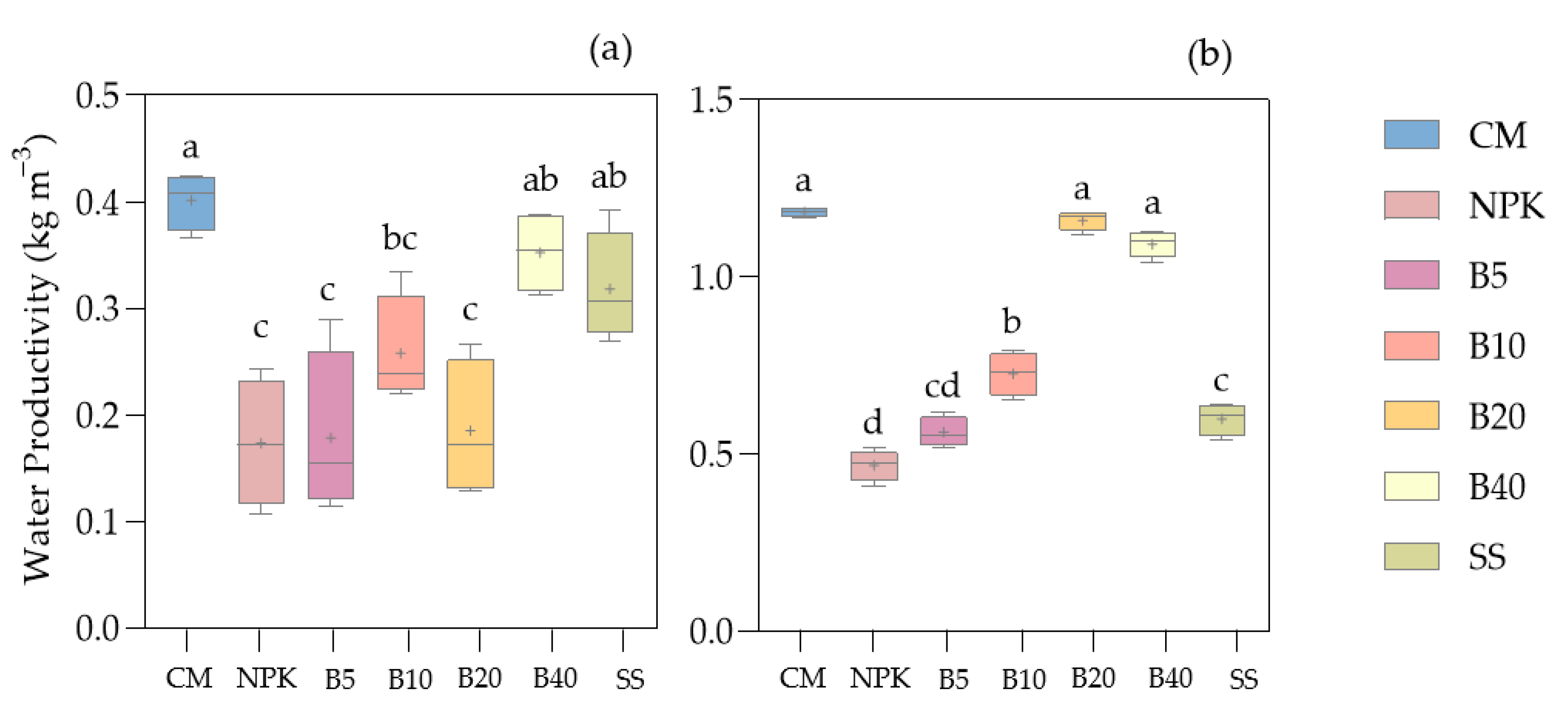
WP differed significantly among the treatments in both cropping cycles (Figure 4). In Cycle I, higher WP values were observed in the biochar treatments, particularly at higher application rates, than in the mineral fertilization treatments. In Cycle II, the WP values were generally lower, reflecting drier conditions; however, the biochar treatments maintained higher WPs than did the NPK treatments did, indicating improved water use efficiency under limited water availability.
qMIC differed among the treatments in both cropping cycles (Table 5). In Cycle I, higher qMIC values were observed under mineral fertilization and higher biochar application rates, whereas SS presented the lowest values. In Cycle II, the qMIC values decreased in most treatments, with biochar-amended soils exhibiting lower qMICs than NPK-amended soils did, indicating a reduced microbial contribution to soil organic carbon under drier conditions.
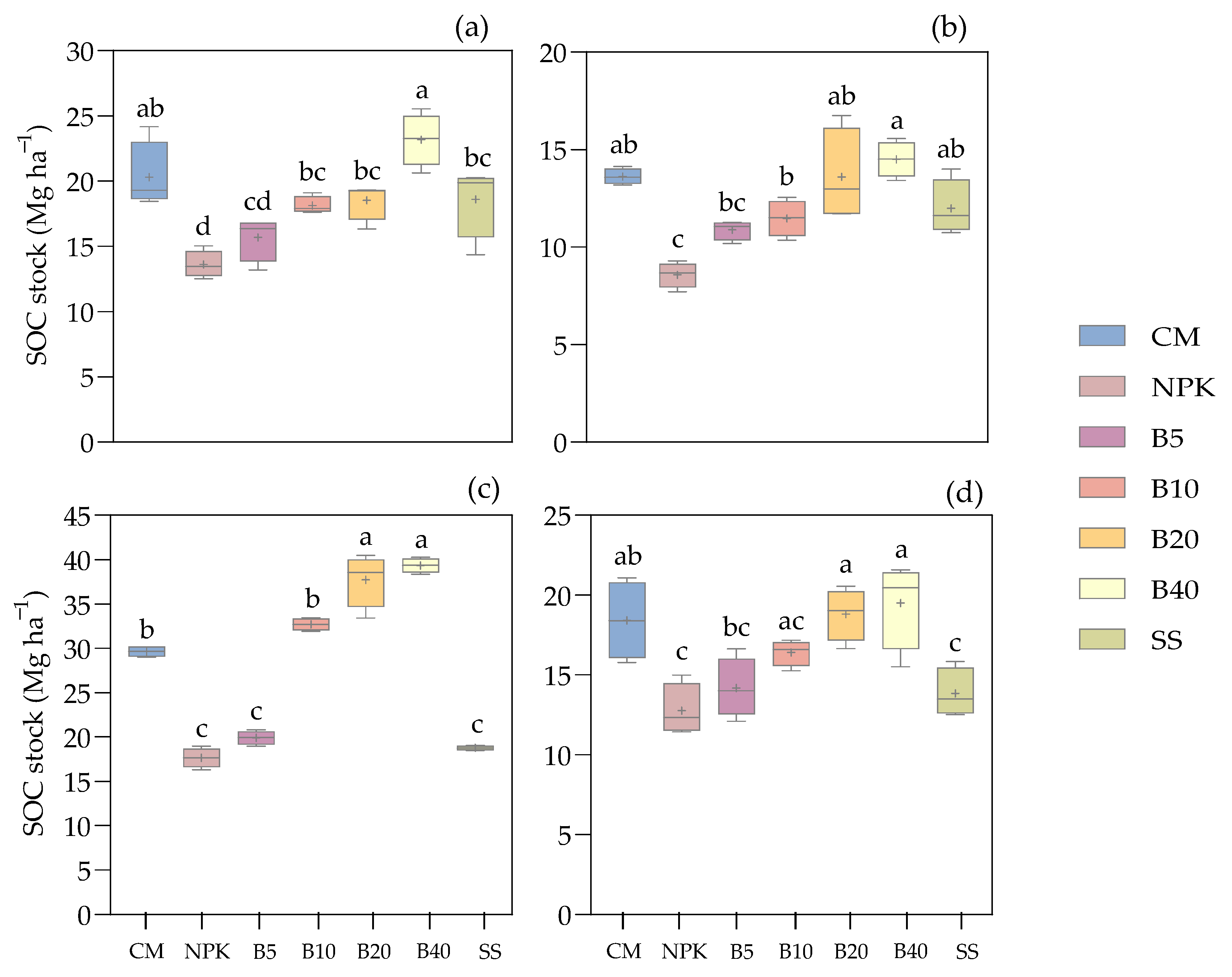
The SOC stock differed significantly among the treatments across the cropping cycles and soil layers (Figure 5). In Cycle I, higher carbon stocks were observed in the biochar treatments, particularly at higher application rates, in both the 0–10 cm and 10–20 cm layers. In Cycle II, the carbon stocks were generally lower, with differences among the treatments remaining evident mainly in the surface layer, whereas the responses in the deeper layers were less pronounced. Overall, biochar application increased the soil carbon stocks, with stronger effects in the upper soil layer and during the wetter cropping cycle.
The N stock differed significantly among the treatments in both soil layers during Cycle I (Table 6). Higher N stocks were observed under organic fertilization, particularly with CM and higher biochar application rates, whereas the NPK treatment presented the lowest values, especially in the 10–20 cm layer. The biochar treatments presented intermediate N stock values, with similar values between the soil layers. The C:N ratio showed little variation among treatments in the 0–10 cm layer but differed significantly in the 10–20 cm layer, where higher values were observed under NPK, whereas lower ratios prevailed in the biochar and CM treatments. Overall, compared with mineral fertilization, organic fertilization increased soil nitrogen storage and promoted more balanced C:N ratios.
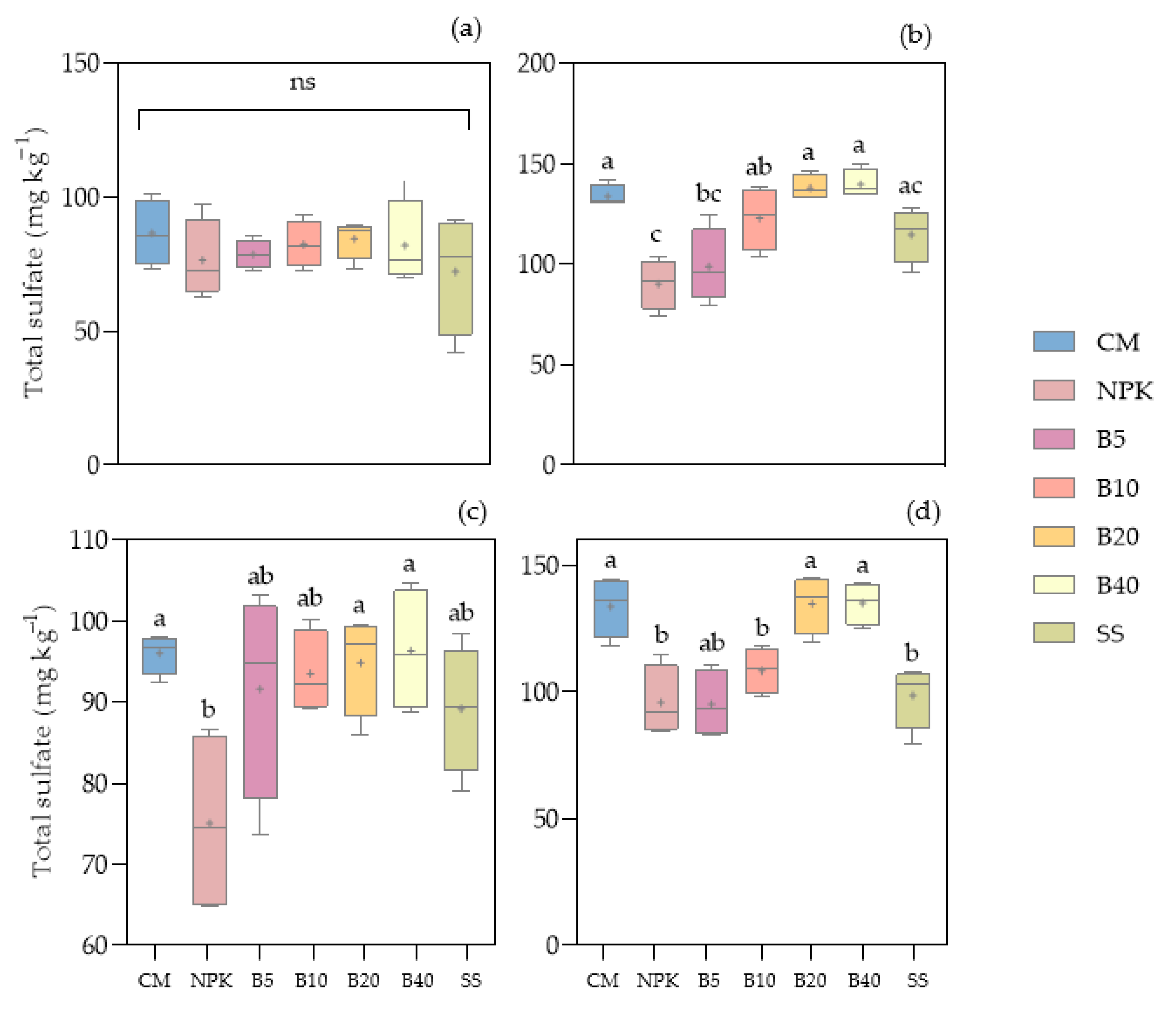
The total soil sulfate content (SO42−) varied among the treatments depending on the cropping cycle and soil layer (Figure 6). In Cycle I, significant differences were observed mainly in the surface layer, with higher sulfate contents in the organic fertilization and biochar treatments than in the mineral fertilization treatment. In Cycle II, the treatment effects were less pronounced, with nonsignificant differences in some layers and more homogeneous sulfate levels among the treatments. Overall, the sulfate distribution reflected both the soil management practices and the contrasting hydrological conditions between the cropping cycles.
SOM and Olsen-P differed significantly among the treatments across the cropping cycles and soil layers (Table 7). In both cycles, higher SOM contents were observed under biochar and organic fertilization than under mineral fertilization, with more pronounced differences in the surface layer. Olsen-P showed similar patterns, with higher values in the biochar treatments, particularly at higher application rates, in both soil layers. The C:P ratio varied among the treatments and increased with soil depth, with generally higher values observed under biochar and organic fertilization, especially during Cycle II. Overall, biochar application increased SOM and P availability and modified the soil C:P balance across cropping cycles and soil layers.
Elemental analysis revealed limited variation in the nitrogen (N) and hydrogen (H) contents among the treatments during Cycle I, with no significant differences detected (Table 8). In contrast, the carbon (C) content differed significantly among the treatments, with the highest values observed at the highest biochar application rate (B40), whereas the other treatments presented similar C contents. Overall, the elemental composition reflected treatment-specific differences in carbon accumulation, whereas the N and H contents remained relatively stable.
The yield components differed significantly among the treatments in both cropping cycles (Table 9). In Cycle I, greater grain weights and numbers of pods per plant were observed under CM and higher biochar application rates, particularly B40, whereas NPK and lower biochar rates presented lower values. The number of grains per pod followed a similar pattern, with higher values under CM and B40. In Cycle II, yield components were generally lower; however, biochar treatments, especially B20 and B40, maintained a greater number of pods per plant and grains per pod than mineral fertilization did. Overall, biochar application contributed to improved yield components, with more consistent effects observed under conditions of limited water availability.

3.2. Soil Quality Assessment

Soil quality is defined as the capacity of soil to function within ecosystem boundaries, sustaining productivity, environmental quality, and biological health [39,44]. The SQI integrates multiple physical, chemical, and biological attributes into a quantitative indicator to evaluate whether soil functioning is improving or degrading under different management conditions [45,46].
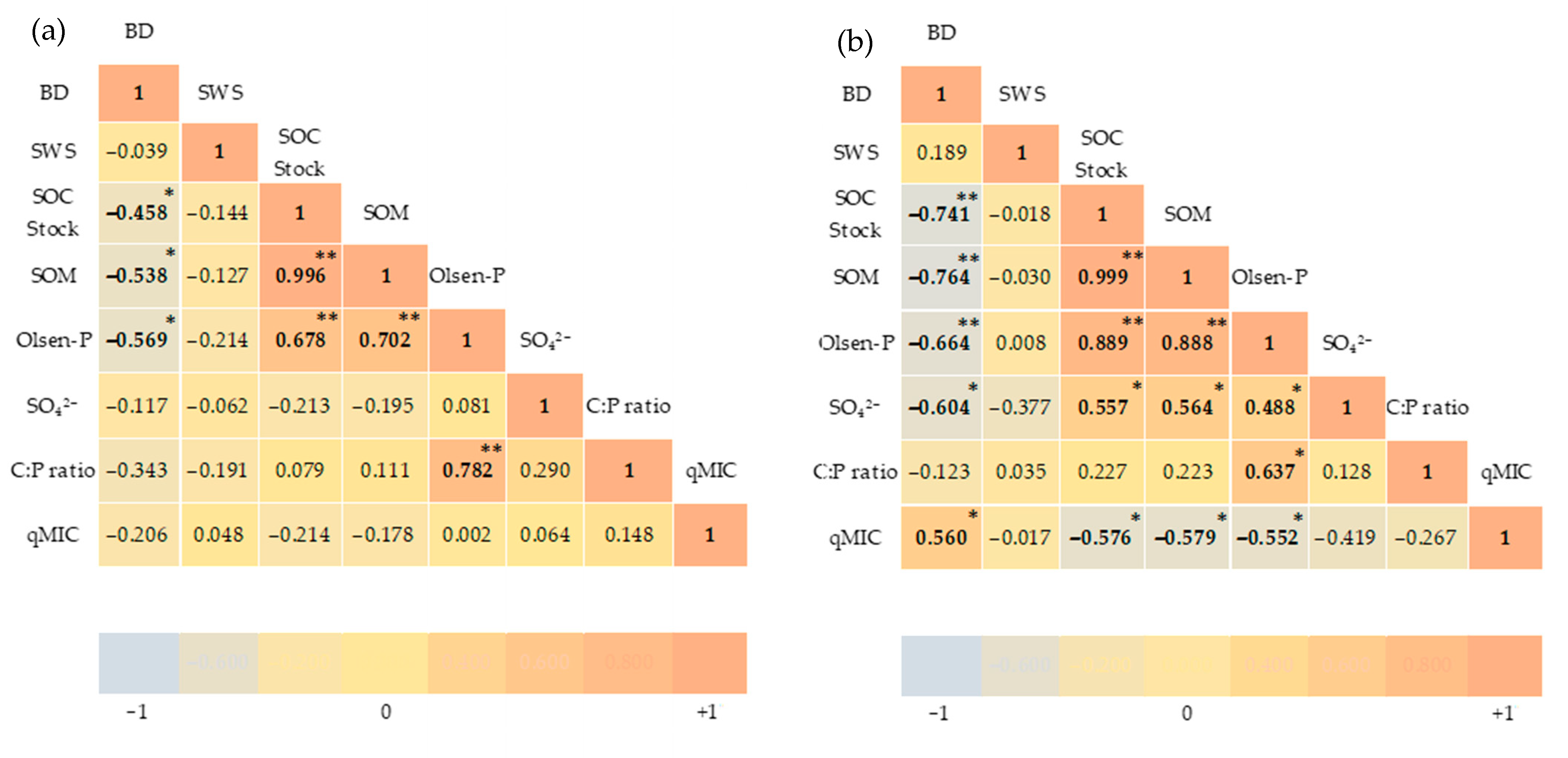
A set of physical, chemical, biological, and hydrological indicators (BD, SWS, SOC stock, SOM, Olsen-P, SO42−, C:P ratio, and qMIC) was evaluated as candidates for the MDS. One-way analysis of variance (ANOVA) identified indicators with significant treatment effects (p < 0.05), which were retained as MDS components and subsequently used in Pearson correlation analysis and principal component analysis (PCA) (Figure 7).
In Cycle I, a strong positive correlation was observed between carbon-related indicators (SOC stock and SOM; r = 0.996, p < 0.001), as was a positive correlation between Olsen-P and the C:P ratio (r = 0.782, p < 0.001). The soil bulk density exhibited moderate to strong negative correlations with the carbon and nutrient indicators. qMIC exhibited weak to moderate correlations with most variables. In Cycle II, the correlations were even more consistent, with very strong associations between SOM and the SOC stock (r = 0.999, p < 0.001) and strong positive correlations between SOM and Olsen-P (r = 0.888, p < 0.05). The soil bulk density maintained significant negative correlations with chemical and hydrological attributes.
The SQI was calculated from a minimum data set derived by PCA. For each principal component, the variable with the highest loading was selected to represent an independent soil functional process and avoid redundancy among correlated indicators.
In Cycle I, the first three principal components (PCs) explained 75.624% of the total variance. PC1 (40.369%) was associated mainly with Olsen-P, PC2 (21.114%) was associated with the qMIC, and PC3 (14.142%) was associated with soil water storage (SWS). In Cycle II, the first three PCs explained 84.298% of the variance. PC1 dominated (56.013%) and SOM, whereas PC2 (16.332%) and PC3 (11.952%) were associated mainly with SWS and Olsen-P (Table 10).
The SQI varied among treatments and between cycles, reflecting changes in nutrient availability, biological activity, and soil water dynamics (Table 11). In Cycle I, higher SQI values were observed in B20 and CM, indicating that improved soil quality was driven mainly by higher Olsen-P and qMIC scores, whereas NPK and B5 presented the lowest SQI values. In Cycle II, the SQI values increased overall, with CM, B20, and B10 exhibiting the highest indices associated with greater contributions of organic matter and Olsen-P. Conversely, NPK and SS consistently presented lower SQI values across cycles. These results highlight the positive effects of organic-based management practices on soil functioning and confirm the sensitivity of the SQI to management-induced changes.
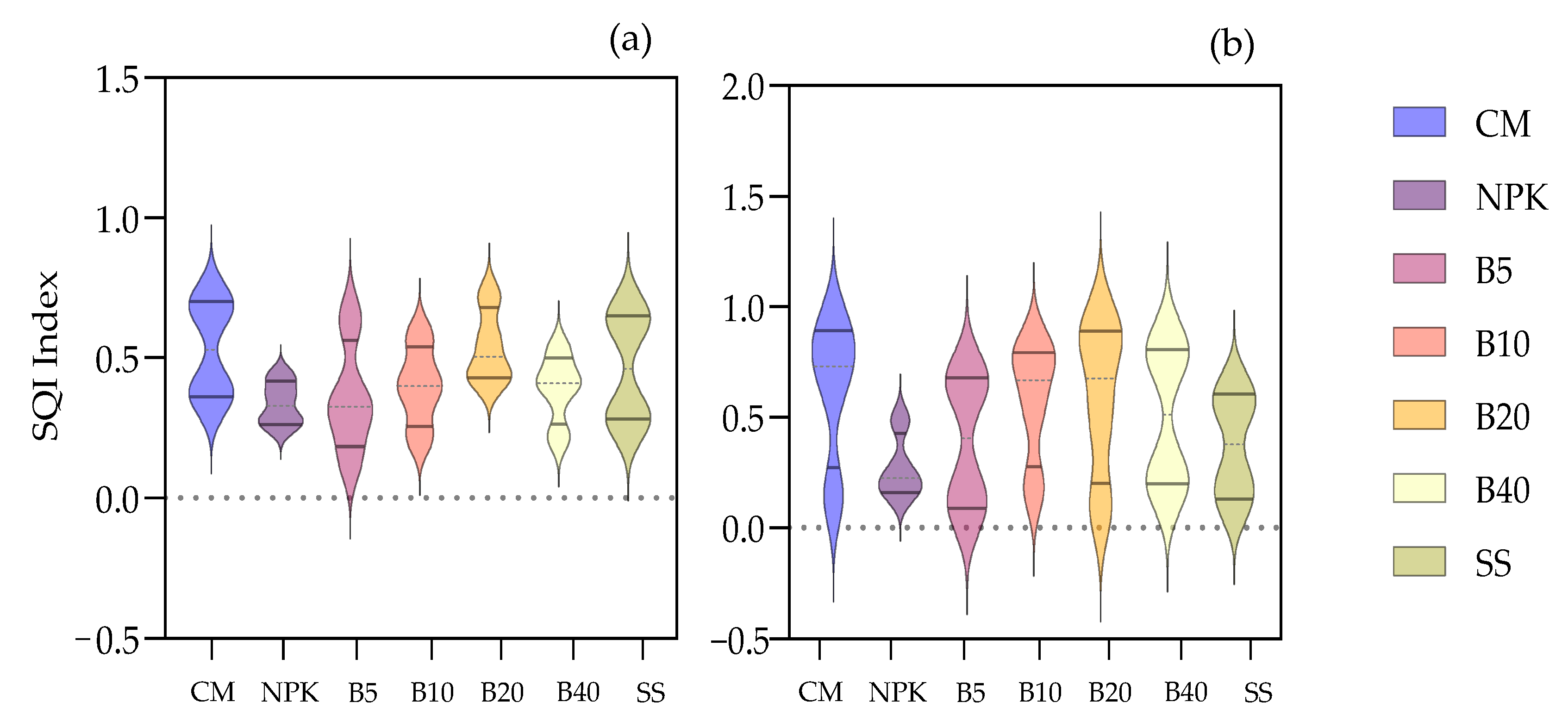
Violin plots illustrate the distribution of the SQI values for each treatment across both cropping cycles (Figure 8). In Cycle I, greater variability in the SQI among treatments was observed, with broader distributions indicating contrasting soil responses to management practices. The B20 and CM treatments presented higher median values, whereas the NPK and B5 treatments were associated with lower SQI values. In Cycle II, the SQI distributions became more homogeneous, with an overall increase in median values, indicating a progressive improvement in soil quality over time, particularly in the treatments associated with higher organic inputs.

4. Discussion

4.1. MDS as a Tool for Assessing Soil Quality in Sandy Soil Under Biochar Management

The differences observed between Cycle I and Cycle II should not be interpreted as a temporal carryover effect but as a response to contrasting hydrological conditions. The wetter cycle favored biologically mediated processes, whereas the drier cycle emphasized structural and physicochemical controls of soil functioning. Soil microbial activity and nutrient cycling are strongly regulated by water availability, with moisture pulses stimulating biological processes while water limitation shifts soil regulation toward physicochemical stabilization mechanisms and organic matter persistence [47,48]. This distinction explains the shift in dominant indicators composing the MDS and reinforces the environmental dependency of soil functional responses.
Biochar influences soil functioning through multiple interacting mechanisms that depend on water availability. Under wetter conditions, the porous structure of biochar can improve soil pore architecture and create microhabitats that favor microbial activity and functional responses [49]. In contrast, under drier conditions, water limitation constrains microbial metabolism and can shift the dominant controls toward physicochemical mechanisms, increasing the relative importance of adsorption and stabilization pathways [50]. The high specific surface area and surface functional groups of biochar contribute to adsorption-related mechanisms, including phosphate sorption/complexation, which can reduce nutrient losses depending on soil and biochar properties [51]. Biochar can also promote soil organic carbon retention through aggregation-related protection mechanisms, supporting physicochemical stabilization of organic matter [52].
The higher biochar application rates were adopted to identify functional response thresholds rather than to represent immediate agronomic recommendations. Sandy soils in semiarid environments typically exhibit low organic matter content, weak aggregation, and limited nutrient retention, requiring greater amendment inputs to produce measurable functional changes [53,54]. Therefore, the upper rate (40 t ha−1) represents an experimental boundary condition that allows the identification of dominant soil processes and improves the sensitivity of integrative soil quality indices. From a practical perspective, biochar is commonly applied progressively through repeated amendments, and the observed responses indicate potential cumulative benefits rather than single large incorporations [55].
Several studies have used physical–hydric, chemical, and biological indicators to assess soil quality; however, owing to the strong correlations among these properties, only a limited number of attributes are typically selected to compose the MDS. In this study, soil quality under conservation management with biochar, which was evaluated across contrasting cropping cycles, was analyzed via PCA and MDS approaches. The results revealed that the MDS varied between cycles, reflecting shifts in the dominant soil functioning processes. In Cycle I, the MDS consisted of Olsen-P, qMIC, and SWS, whereas in Cycle II, it was composed of SOM, Olsen-P, and SWS. The recurrence of indicators associated with carbon, phosphorus availability, and soil water dynamics is consistent with recent studies identifying these attributes as highly sensitive for discriminating management practices in sandy soils under hydrological variability [56,57,58].
Biochar affects the physicochemical properties of the soil system, simultaneously influencing water retention, nutrient availability, and the efficiency of biological processes. However, the relative importance of these mechanisms varies according to the hydrological regime. This integrated role of biochar has been consistently reported in previous studies, which demonstrated that improvements in soil water retention and nutrient dynamics are context-dependent and particularly pronounced in coarse-textured soils under water-limited conditions [59,60]. The predominance of Olsen-P indicates that, in sandy soils, the ability of biochar to increase phosphorus retention and availability through charged surfaces, complexation with functional groups, and reduced losses by leaching constitute one of the main drivers of soil quality improvement [61]. Fan et al. [62] demonstrated that biochar amendment substantially increased soil available phosphorus in soils cultivated with foxtail millet, maize, soybean, and mung bean by 40.61%, 44.69%, 29.29%, and 33.69%, respectively, indicating that biochar has strong potential to increase plant-available P without altering total soil phosphorus pools. SWS has emerged as a key indicator because it directly reflects the soil’s capacity to capture and retain rainfall water, a process strongly influenced by biochar-induced modifications in pore structure. qMIC, in turn, expresses the relative efficiency of microbial biomass in incorporating available organic carbon, functioning as a sensitive indicator of biological activity under favorable moisture conditions [63]. Razzaghi et al. [64] reviewed the effects of biochar on the soil bulk density and water retention parameters and reported significant increases in the soil water content at field capacity in coarse-textured soils. The authors further demonstrated that improvements in plant-available water decreased as the soil texture became finer, highlighting the greater effectiveness of biochar in sandy soils. Thus, in Cycle I, soil quality was determined by a coupling between water availability, phosphorus supply, and microbial efficiency, highlighting a functionally active system that is responsive to management practices.
Lower qMIC values observed under drier conditions should not be interpreted solely as a reduction in microbial biomass, but rather as a shift in microbial functioning and carbon accessibility. Water limitation imposes osmotic stress and increases microbial maintenance energy requirements, reducing microbial growth efficiency and biomass accumulation [65]. At the same time, decreased soil moisture limits substrate diffusion and enzyme–substrate interactions, restricting microbial access to labile organic carbon and suppressing decomposition processes [66]. In addition, dry conditions favor the stabilization of soil organic carbon through enhanced mineral association and physical protection mechanisms, reducing its bioavailability to microorganisms [67].
The reorganization observed in the agroecosystem during Cycle II, with the replacement of qMIC by SOM in the MDS, suggests that under water restriction, microbial activity becomes limited, and soil quality increasingly depends on the structural and chemical buffering capacity provided by accumulated organic matter rather than on short-term biological processes. In this context, SOM acts as a more stable reservoir of carbon and nutrients, contributing to water retention, physical protection of carbon, and long-term maintenance of soil fertility [68]. Ramírez et al. [69] demonstrated that water retention at field capacity was associated primarily with organic sorbents relevant to soil aggregation. These results highlight the need to reevaluate the role of soil organic carbon, as well as the interaction between soil texture and compaction, in controlling soil water retention mechanisms. The persistence of Olsen-P and SWS in the MDS across both cycles reinforces that phosphorus availability and soil water dynamics constitute persistent structural controls of sandy soil functioning in semiarid environments, regardless of seasonal climatic conditions [61,70,71].
This transition in the MDS indicates a functional shift in the system: while in the wetter cycle, soil quality is regulated by dynamic and biologically mediated processes, in the drier cycle, it becomes sustained by structural attributes with greater inertia, such as organic matter, retained phosphorus, and soil water storage capacity. The central implication is that the MDS-based SQI not only discriminates the effects of biochar management but also identifies which processes dominate under each climatic context, providing a robust and ecologically coherent mechanistic interpretation of soil quality in semiarid agricultural systems [72]. As highlighted by Lenka et al. [73], scaling up soil quality indices is essential for capturing spatial heterogeneity, supporting land-use planning, and enhancing the applicability of soil health assessments for decision-making under diverse environmental conditions.
SOM and Olsen-P are among the most recurrent indicators included in the MDS for soil quality assessment. SOM plays a central role in soil biological functioning by regulating edaphic biota activity and directly influencing nutrient cycling rates. Olsen-P is the most widely adopted indicator for estimating phosphorus availability in soils and is commonly used in fertility diagnosis and soil nutritional status assessment [74]. These results demonstrate that SSB represents a promising strategy to increase the resilience of semiarid agricultural systems while promoting the sustainable recycling of organic residues and aligning agricultural productivity, soil quality, and circular economy principles. Taken together, these indicators describe a functional gradient ranging from rapid, biologically mediated processes (qMIC) to more stable structural and physicochemical controls (SOM, SWS, and Olsen-P), explaining why the MDS varied between cycles and confirming the ability of the SQI to synthesize the dominant mechanisms governing soil functioning.

4.2. Soil Water Storage Processes Under Biochar Fertilization

In rainfed semiarid environments, water represents the main limiting factor for soil–plant system functioning, especially in sandy soils, where low water-holding capacity intensifies the effects of irregular rainfall [10]. In this context, the effects of biochar on agronomic performance do not necessarily manifest through changes in total crop water consumption but rather through the modulation of water availability within the soil profile and the efficiency with which this water is converted into biomass and yield. Park et al. [75] demonstrated that biochar application consistently increased the soil water content across contrasting climatic conditions. The authors reported that biochar improved soil physicochemical properties during both dry and wet years, increasing soil resilience under water stress. The grain yield was greater in the wet year than in the dry year. Thus, the integrated analysis of SWS, ETa, and WP provides an essential mechanistic basis for understanding the role of biochar in semiarid systems.
The results demonstrated that SWS responded consistently to biochar management, varying among treatments, phenological stages, and cropping cycles. Intermediate biochar application rates, particularly B10 and B20, promoted greater soil water storage, especially during the wetter cycle and at the late growth stage, when the crop water demand was high. In contrast, ETa showed limited variation among treatments within each cycle and was strongly affected by the precipitation distribution, atmospheric demand, and crop phenology. This result indicates that biochar did not significantly alter total water consumption by beans, which is consistent with rainfed systems, where evapotranspiration is predominantly climate driven. This distinction becomes evident when analyzing WP, which was consistently greater in the biochar treatments than in the mineral fertilization treatments, including during the drier cycle. The increase in WP indicates that biochar improved the conversion of soil-stored water into yield, likely by reducing periods of water stress during sensitive phenological stages and by promoting a more stable root environment. Xiao et al. [76], with a global synthesis, demonstrated that biochar application significantly increases crop productivity and water productivity while not increasing and often reducing crop evapotranspiration. According to the authors, this pattern indicates that biochar enhances water use efficiency mainly by reducing soil evaporation and promoting productive transpiration, thereby improving the conversion of soil-stored water into agricultural yield.
The absence of differences in evapotranspiration indicates that biochar did not increase total crop water consumption but altered water availability dynamics. Greater soil water storage reduced short-term water stress events, allowing plants to maintain stomatal conductance and photosynthetic activity for longer periods. Consequently, biomass production increased without additional water use, resulting in higher water productivity. Therefore, the improvement in WP reflects enhanced efficiency of water use rather than increased evapotranspiration [77]. Taken together, these results indicate that biochar makes water more functional for the crop by improving its retention in the soil and synchronizing its availability with plant demand. This mechanism explains why SWS emerged as a recurrent indicator in the MDS and why the WP responded more sensitively to management than did the ETa. Thus, the hydrological axis plays a central role in mediating the effects of biochar on soil functioning and common bean performance, establishing a clear link between soil physical attributes and the observed agronomic responses.

4.3. Nutrient Responses and Agronomic Performance Under Biochar Management

The responses observed in this study reflect the interaction between the physical–hydric effects promoted by biochar and the chemical and biological transformations of the soil throughout the cropping cycles. In sandy soils under semiarid conditions, nutrient use efficiency is strongly affected by water availability within the soil profile such that improvements in water retention tend to amplify the effects of management on soil fertility and crop performance. Bekchanova et al. [78] reported that the use of biochar represents a promising strategy in sustainable agricultural management to improve degraded and low-fertility sandy soils by increasing nutrient availability and crop productivity. Although responses vary in magnitude and direction depending on soil and management conditions, their systematic review demonstrated that biochar generally benefits multiple nutrient cycling processes in sandy soils, thereby increasing agricultural productivity.
The increases in the SOC stock and SOM contents under biochar management, particularly at relatively high application rates and in the surface layer, indicate the effective incorporation of more stable carbon into the system. This accumulation results both from the direct input of recalcitrant carbon from biochar and from reduced carbon losses associated with enhanced physical protection and improved soil structure. In environments with high hydrological variability, SOM acts as a key component for water and nutrient retention, creating a synergistic effect between increased soil carbon and improved edaphic conditions for root growth [79]. Chagas et al. [80] reviewed 169 studies on carbon fractions in biochar-amended soils and demonstrated that biochar application consistently increased the total, organic, labile, and stable SOM carbon fractions. The authors highlighted that SOM fractionation is a robust approach for predicting the long-term behavior and persistence of biochar-derived carbon in soils.
The N stock was greater under organic management and biochar application than under mineral fertilization, particularly in Cycle I. This behavior suggests greater nitrogen retention in the system, possibly associated with reduced leaching due to increased SOM and the adsorption of nitrogen forms onto biochar surfaces. The variations observed in the C:N ratio, especially in deeper soil layers, indicate adjustments in soil stoichiometry, reflecting a more favorable balance between carbon and nitrogen availability under biochar management, which may contribute to greater nitrogen stability over time [81]. Hematimatin et al. [82] reported that biochar significantly increased SOC and enhanced nitrogen retention, particularly following reapplication, although the magnitude of this effect declined over time. The authors highlighted that biochar could improve nitrogen fertilizer efficiency by modifying soil carbon–nitrogen interactions, whereas long-term effects on N mineralization and crop yield remain highly soil and biochar specific.
The observed increases in soil carbon and nitrogen stocks support the initial hypothesis that biochar enhances carbon use efficiency in sandy semiarid soils. Rather than indicating only carbon accumulation, the concurrent increase in nutrient availability suggests improved microbial processing and retention of organic inputs. This indicates a shift from rapid carbon turnover toward greater stabilization and recycling within the soil system, reflecting improved functional efficiency of the soil microbial community [83,84,85].
Olsen-P clearly responded to biochar management, with higher contents observed at higher application rates and under organic fertilization in both cycles. The variations in the C:P ratio indicate that carbon accumulation was accompanied by adjustments in the phosphorus balance, particularly in Cycle II, when water limitation makes the relative availability of nutrients even more relevant for system functioning. qMIC further reinforces the influence of the hydrological regime on soil biological processes. In Cycle I, relatively high qMIC values indicate greater microbial efficiency in incorporating available organic carbon under favorable moisture conditions. In Cycle II, the reduction in qMIC across most treatments suggests a limitation of microbial activity imposed by water stress, indicating that under drier conditions, short-term microbial contributions become less determinant of soil functioning than accumulated stocks of carbon and nutrients are [86,87].
These integrated responses are directly associated with common bean agronomic performance. Compared with mineral fertilization, biochar treatments, particularly at intermediate and higher application rates, resulted in consistent improvements in yield components such as grain weight, number of pods per plant, and number of grains per pod. These results indicate that biochar contributed to reducing nutritional and hydric limitations during critical phenological stages, favoring grain filling and production stability, even during the drier cycle.
Overall, the results demonstrate that biochar management promoted positive coupling between soil fertility, carbon storage, and agronomic performance, which was mediated by improved soil water conditions. This coupling explains why productivity gains were more evident in treatments with greater water-holding capacity and nutrient availability, reinforcing the role of biochar as a promising strategy to increase the productive efficiency and resilience of agricultural systems in sandy soils under semiarid conditions.

5. Conclusions

This study demonstrated that biochar improved, the management of sewage sludge the functioning of sandy soil cultivated with bean under semiarid conditions. The SQI-based approach revealed that the dominant system processes vary between contrasting cropping cycles, with a greater influence on biological indicators and immediate nutrient availability under wetter conditions and a predominance of structural attributes, such as SOM, Olsen-P, and SWS, under water restriction. Biochar did not alter actual evapotranspiration but increased water productivity, indicating greater efficiency in converting soil-stored water into yield. Additionally, biochar management increased the SOC stock and N stock, improved phosphorus availability, and contributed to consistent gains in yield components of the bean. Overall, the results indicate that SSB represents a promising strategy to increase the resilience and productive efficiency of rainfed agricultural systems in sandy soils under semiarid climates. Despite these results, long-term studies under different edaphoclimatic conditions are needed to assess the persistence of biochar effects and their extrapolation to other cropping systems.

Supplementary Materials

The following supporting information can be downloaded at: https://www.mdpi.com/article/10.3390/agriengineering8030095/s1, Table S1. Initial chemical and physical properties of the soil in the experimental area at 0–10 and 10–20 cm depths. Table S2. Chemical properties of the input materials used in the treatments, including sewage sludge (SS), sewage sludge biochar (SSB), and poultry manure (CM). Table S3. Description of treatments, materials applied, and their respective application rates. Table S4. Description of land use and land cover classes adopted for map classification in São João, Pernambuco, Brazil. Table S5. Overview of variables measured across cropping cycles and soil layers, and their inclusion in the Soil Quality Index (SQI).

Author Contributions

Conceptualization, J.R.d.S.L., E.V.d.M., G.P.D., C.H. and R.E.d.M.; methodology, R.E.d.M., M.F.d.A.T.A. and V.P.d.S.; software, J.C.C.C. and R.E.d.M.; validation, J.C.C.C., and A.P.M.F.; formal analysis, R.E.d.M., M.F.d.A.T.A., V.P.d.S. and M.H.L.L.; investigation, R.E.d.M. and V.P.d.S.; resources, A.C.D.A., J.R.d.S.L. and E.V.d.M.; data curation, R.E.d.M., A.P.M.F. and M.C.d.B.S.; writing—original draft preparation, R.E.d.M., M.F.d.A.T.A., V.P.d.S., J.C.C.C., A.P.M.F., M.H.L.L., E.V.d.M. and M.C.d.B.S.; writing—review and editing, R.E.d.M., M.F.d.A.T.A., V.P.d.S., J.C.C.C., C.H., A.P.M.F., M.H.L.L., E.V.d.M. and M.C.d.B.S.; visualization, A.C.D.A., J.R.d.S.L. and E.V.d.M.; supervision, J.R.d.S.L. and E.V.d.M.; project administration, J.R.d.S.L. and G.P.D.; funding acquisition, A.C.D.A. and J.R.d.S.L. All authors have read and agreed to the published version of the manuscript.

Funding

This study was supported by the Pernambuco Science and Technology Support Foundation (FACEPE), which provided a scholarship to the first author (IBPG-1549-5.00/21) and financial support (APQ-1937-2.12/25; APQ-1518-5.01/25; APQ-1582-5.01/24, APQ-1747-5.01/22; APQ-1464-5.01/22). This study was supported by the National Council for Scientific and Technological Development (CNPq) by grants (445579/2024-2; 313421/2021-8).

Institutional Review Board Statement

Not applicable.

Informed Consent Statement

Not applicable.

Data Availability Statement

The data presented in this study are available upon request from the corresponding author.

Acknowledgments

The authors are grateful for the support of the BINSAH Project (Biochar and the Food and Water Security Nexus) and the National Institute of Science and Technology—National Observatory of Water and Carbon Dynamics in the Caatinga Biome (INCT/ONDACBC). The authors also thank COMPESA (Companhia Pernambucana de Saneamento) for providing the sewage sludge.

Conflicts of Interest

The authors declare that they have no conflicts of interest.

References

  1. Heidari, F.; Tilaki, G.A.D.; Kooch, Y.; Abdollahi, M. Improving soil function properties in semi-arid regions using modified-chitosan and biochar. J. Environ. Manag. 2025, 390, 126334. [Google Scholar] [CrossRef]
  2. Ghimire, R.; Thapa, V.R.; Acosta-Martinez, V.; Schipanski, M.; Slaughter, L.C.; Fonte, S.J.; Shukla, M.K.; Bista, P.; Angadi, S.V.; Mikha, M.M.; et al. Soil Health Assessment and Management Framework for Water-Limited Environments: Examples from the Great Plains of the USA. Soil Syst. 2023, 7, 22. [Google Scholar] [CrossRef]
  3. Acharya, B.S.; Dodla, S.; Wang, J.J.; Pavuluri, K.; Darapuneni, M.; Dattamudi, S.; Maharjan, B.; Kharel, G. Biochar impacts on soil water dynamics: Knowns, unknowns, and research directions. Biochar 2024, 6, 34. [Google Scholar] [CrossRef]
  4. Zeng, Y.; Verhoef, A.; Vereecken, H.; Ben-Dor, E.; Veldkamp, T.; Shaw, L.; Ploeg, M.V.D.; Wang, Y.; Su, Z. Monitoring and Modeling the Soil-Plant System Toward Understanding Soil Health. Rev. Geophys. 2025, 63, e2024RG000836. [Google Scholar] [CrossRef]
  5. Lima, J.R.S.; Oliveira, J.E.S.; Moura, A.S.; Silva, C.F.; Medeiros, É.V.; Hammecker, C. Produção e eficiência no uso de água do feijão comum adubado com biochar. Divers. J. 2019, 4, 1146–1155. [Google Scholar] [CrossRef]
  6. Lima, J.R.S.; Goes, M.C.C.; Hammecker, C.; Antonino, A.C.D.; Medeiros, É.V.; Sampaio, E.V.S.B.; Silva, M.C.B.; Silva, V.P.; Souza, E.S.; Souza, R. Effects of poultry manure and biochar on Acrisol soil properties and yield of common bean. A short-term field experiment. Agriculture 2021, 11, 290. [Google Scholar] [CrossRef]
  7. Wei, B.; Peng, Y.; Lin, L.; Zhang, D.; Ma, L.; Jiang, L.; Li, Y.; He, T.; Wang, Z. Drivers of biochar-mediated improvement of soil water retention capacity based on soil texture: A meta-analysis. Geoderma 2023, 437, 116591. [Google Scholar] [CrossRef]
  8. Han, M.; Zhang, J.; Zhang, L.; Wang, Z. Effect of biochar addition on crop yield, water and nitrogen use efficiency: A meta-analysis. J. Clean. Prod. 2025, 420, 138425. [Google Scholar] [CrossRef]
  9. Jiang, Z.; Huang, S.; Meng, Z. Long-term effects of biochar on the hydraulic properties of soil: A meta-analysis based on 1–10 years field experiments. Geoderma 2025, 458, 117318. [Google Scholar] [CrossRef]
  10. Melo, R.E.D.; Silva, V.P.D.; Costa, D.P.D.; Alves, M.F.D.A.T.; Lopes, M.H.L.; Barbosa, E.D.; Júnior, J.H.D.S.; Filho, A.P.M.; Duda, G.P.; Antonino, A.C.D.; et al. Sewage Sludge Biochar Improves Water Use Efficiency and Bean Yield in a Small-Scale Field Experiment with Different Doses on Sandy Soil Under Semiarid Conditions. AgriEngineering 2025, 7, 227. [Google Scholar] [CrossRef]
  11. Deshoux, M.; Sadet-Bourgeteau, S.; Gentil, S.; Prévost-Bouré, N.C. Effects of biochar on soil microbial communities: A meta-analysis. Sci. Total Environ. 2023, 902, 166079. [Google Scholar] [CrossRef] [PubMed]
  12. Gross, A.; Bromm, T.; Polifka, S.; Fischer, D.; Glaser, B. Long-term biochar and soil organic carbon stability—Evidence from field experiments in Germany. Sci. Total Environ. 2024, 954, 176340. [Google Scholar] [CrossRef]
  13. Liu, Q.; Wu, Y.; Ma, J.; Jiang, J.; You, X.; Lv, R.; Zhou, S.; Pan, C.; Liu, B.; Xu, Q.; et al. How does biochar influence soil nitrification and nitrification-induced N2O emissions? Sci. Total Environ. 2024, 908, 168530. [Google Scholar] [CrossRef] [PubMed]
  14. Zhang, P.; Liu, J.; Wang, M.; Zhang, H.; Yang, N.; Ma, J.; Cai, H. Effects of irrigation and fertilization with biochar on the growth, yield, and water/nitrogen use of maize on the Guanzhong Plain, China. Agric. Water Manag. 2024, 295, 108786. [Google Scholar] [CrossRef]
  15. Sharma, M.; Kaushik, R.; Pandit, M.K.; Lee, Y.-H. Biochar-Induced Microbial Shifts: Advancing Soil Sustainability. Sustainability 2025, 17, 1748. [Google Scholar] [CrossRef]
  16. Castellini, M.; Bondì, C.; Leogrande, R.; Giglio, L.; Vitti, C.; Mastrangelo, M.; Bagarello, V. Evaluating the Effects of Compost, Vermicompost, and Biochar on Physical Quality of Sandy-Loam Soils. Appl. Sci. 2025, 15, 3392. [Google Scholar] [CrossRef]
  17. Akhil, D.; Lakshmi, D.; Kartik, A.; Vo, D.-V.N.; Arun, J.; Gopinath, K.P. Production, characterization, activation and environmental applications of engineered biochar: A review. Environ. Chem. Lett. 2021, 19, 2261–2297. [Google Scholar] [CrossRef]
  18. Mansoor, S.; Kour, N.; Manhas, S.; Zahid, S.; Wani, O.A.; Sharma, V.; Wijaya, L.; Alyemeni, M.N.; Alshahli, A.A.; El-Serehy, H.A.; et al. Biochar as a tool for effective management of drought and heavy metal toxicity. Chemosphere 2021, 271, 129458. [Google Scholar] [CrossRef] [PubMed]
  19. Mirzaei, M.; Rodrigo-Comino, J.; Szabo, S.; Radicetti, E.; Li, Y.; Ahmed, B.; Mousavi, S.M.N.; Bernardo, F.S.; Caballero-Calvo, A. Integrative Approaches to Enhance Soil Quality and Crop Performance Through Residue Management and Nitrogen Fertilization in Diverse Cropping Rotations. J. Soil Sci. Plant Nutr. 2025, 1–14. [Google Scholar] [CrossRef]
  20. Al-Shammary, A.A.G.; Al-Shihmani, L.S.S.; Fernández-Gálvez, J.; Caballero-Calvo, A. A comprehensive review of impacts of soil management practices and climate adaptation strategies on soil thermal conductivity in agricultural soils. Rev. Environ. Sci. Biotechnol. 2025, 24, 513–543. [Google Scholar] [CrossRef]
  21. Garg, A.; Kwakye, S.; Cates, A.; Peterson, H.; LaBine, K.; Olson, G.; Sharma, V. Integrated soil health management influences soil properties: Insights from a US Midwest study. Geoderma 2025, 455, 117214. [Google Scholar] [CrossRef]
  22. Köppen, W. Climatologia: Con Un Estudio de Los Climas de la Tierra; Fondo de Cultura Económica: Mexico City, Mexico, 1948. [Google Scholar]
  23. Almeida, A.V.L.; Corrêa, M.M.; Lima, J.R.S.; Souza, E.S.; Santoro, K.R.; Antonino, A.C.D. Atributos físicos, macro e micromorfológicos de Neossolos Regolíticos no Agreste Meridional de Pernambuco. Rev. Bras. Ciênc. Solo 2015, 39, 1235–1246. [Google Scholar] [CrossRef]
  24. Fernandez, F.; Gepts, P.; Lopez, M. Etapas de desenvolvimento na planta frijol. In Frijol: Investigação y produção. Programa das Nações Unidas (PNUD); López Genes, M., Fernández, O., Fernando, O., van Schoonhoven, A., Eds.; Centro Internacional de Agricultura Tropical (CIAT): Cali, Colombia, 1985; pp. 61–78. [Google Scholar]
  25. Marengo, J.A.; Alcantara, E.; Cunha, A.P.; Seluchi, M.; Nobre, C.A.; Dolif, G.; Gonçalves, D.; Dias, M.A.; Cuartas, L.A.; Bender, F.; et al. Flash floods and landslides in the city of Recife, Northeast Brazil after heavy rain on May 25–28, 2022: Causes, impacts, and disaster preparedness. Weather Clim. Extrem. 2023, 39, 100545. [Google Scholar] [CrossRef]
  26. Embrapa. Manual de Métodos de Análise de Solo, 3rd ed.; Teixeira, P.C., Ed.; Embrapa: Brasília, Brazil, 2017; 574p. [Google Scholar]
  27. Vaz Carlos, M.P.; Jones, S.; Meding, M.; Tuller, M. Evaluation of standard calibration functions for eight electromagnetic soil moisture sensors. Vadose Zone J. 2013, 12, vzj2012.0160. [Google Scholar] [CrossRef]
  28. Mohanty, M.; Sinha, N.K.; Reddy, K.S. Pedotransfer Functions for Estimating Water Content at Field Capacity and Wilting Point of Indian Soils using Particle Size Distribution and Bulk Density. J. Agric. Phys. 2014, 14, 1–9. [Google Scholar]
  29. Silva, R.A.B.; Lima, J.R.S.; Antonino, A.C.D.; Gondim, P.S.S.; Souza, E.S.; Barros Júnior, G. Balanço hídrico em Neossolo regolítico cultivado com braquiária (Brachiaria decumbens Stapf). Rev. Bras. Ciênc. Solo 2014, 38, 147–157. [Google Scholar] [CrossRef]
  30. Souza, R.M.S.; Souza, E.S.; Antonino, A.C.D.; Lima, J.R.S. Balanço hídrico em área de pastagem no semiárido pernambucano. Rev. Bras. Eng. Agríc. Ambient. 2015, 19, 449–455. [Google Scholar] [CrossRef]
  31. Platonov, A.; Thenkabail, P.S.; Biradar, C.M.; Cai, X.; Gumma, M.; Dheeravath, V.; Cohen, Y.; Alchanatis, V.; Goldshlager, N.; Ben-Dor, E.; et al. Water Productivity Mapping (WPM) Using Landsat ETM+ Data for the Irrigated Croplands of the Syrdarya River Basin in Central Asia. Sensors 2008, 8, 8156–8180. [Google Scholar] [CrossRef]
  32. Anderson, T.-H.; Domsch, K.H. The metabolic quotient for CO2(qCO2) as a specific activity parameter to assess the effects of environmental conditions, such pH, on the microbial biomass of forest soil. Soil Biol. Biochem. 1993, 25, 393–395. [Google Scholar] [CrossRef]
  33. De Oliveira Ferreira, A.; Sá, J.C.D.M.; Harms, M.G.; Miara, S.; Briedis, C.; Quadros Netto, C.; Santos, J.B.D.; Canalli, L.B. Carbon balance and crop residue management in dynamic equilibrium under a no-till system in Campos Gerais. Rev. Bras. Ciência Solo 2012, 36, 1583–1590. [Google Scholar] [CrossRef][Green Version]
  34. Matias, M.D.C.B.D.S.; Salviano, A.A.C.; Leite, L.F.D.C.; Araújo, A.S.F.D. Biomassa microbiana e estoques de C e N do solo em diferentes sistemas de manejo, no Cerrado do Estado do Piauí. Acta Scientiarum. Agron. 2009, 31, 517–521. [Google Scholar] [CrossRef][Green Version]
  35. Irving, G.C.J.; Mclaughlin, M.J. A rapid and simple field test for phosphorus in Olsen and Bray No. 1 extracts of soil. Commun. Soil Sci. Plant Anal. 1990, 21, 2245–2255. [Google Scholar] [CrossRef]
  36. Bardsley, C.E.; Lancaster, J.D. Sulfur. In Methods of Soil Analysis: Part 2 Chemical and Microbiological Properties; Black, C.A., Evans, D.D., Ensminger, L.E., White, J.L., Clark, F.E., Eds.; American Society of Agronomy: Madison, WI, USA, 1965; pp. 1103–1116. [Google Scholar]
  37. LANARV; Laboratório Nacional de Referência Vegetal. Análise de Corretivos, Fertilizantes e Inoculantes—Métodos Oficiais; Secretaria Nacional de Defesa Agropecuária—Ministério de Agricultura: Brasília, Brazil, 1988; 104p.
  38. Brasil. Regras Para Análise de Sementes (RAS); Ministério da Agricultura, Pecuária e Abastecimento, Secretaria de Defesa Agropecuária: Brasília, Brazil, 2009.
  39. Doran, J.W.; Parkin, T.B. Defining and assessing soil quality. In Defining Soil Quality for a Sustainable Environment; Doran, J.W., Coleman, D.C., Bezdicek, D.F., Stewart, B.A., Eds.; SSSA Special Publication 35; Soil Science Society of America: Madison, WI, USA, 1994; pp. 3–21. [Google Scholar]
  40. Diack, M.; Stott, D. Development of a Soil Quality Index for the Chalmers Silty Clay Loam from the Midwest USA; Purdue University, USDA-ARS National Soil Erosion Research Laboratory: West Lafayette, IN, USA, 2001; pp. 550–555. [Google Scholar]
  41. Stocking, M.A. Tropical Soils and Food Security: The Next 50 Years. Science 2003, 302, 1356–1359. [Google Scholar] [CrossRef] [PubMed]
  42. Vasu, D.; Tiwari, G.; Sahoo, S.; Dash, B.; Jangir, A.; Sharma, R.P.; Naitam, R.; Tiwary, P.; Karthikeyan, K.; Chandran, P. A Minimum Data Set of Soil Morphological Properties for Quantifying Soil Quality in Coastal Agroecosystems. Catena 2021, 198, 105042. [Google Scholar] [CrossRef]
  43. Bhardwaj, A.K.; Jasrotia, P.; Hamilton, S.K.; Robertson, G.P. Ecological management of intensively cropped agro-ecosystem improves soil quality with sustained crop productivity. Agric. Ecosyst. Environ. 2011, 140, 419–429. [Google Scholar] [CrossRef]
  44. Karlen, D.L.; Andrews, S.S.; Doran, J.W. Soil quality: Current concepts and applications. Adv. Agron. 2001, 74, 1–40. [Google Scholar] [CrossRef]
  45. Andrews, S.S.; Karlen, D.L.; Cambardella, C.A. The soil management assessment framework: A quantitative soil quality evaluation method. Soil Sci. Soc. Am. J. 2004, 68, 1945–1962. [Google Scholar] [CrossRef]
  46. Karlen, D.L.; Ditzler, C.A.; Andrews, S.S. Soil quality: Why and how? Geoderma 2003, 114, 145–156. [Google Scholar] [CrossRef]
  47. Li, G.; Kim, S.; Han, S.H.; Chang, H.; Du, D.; Son, Y. Precipitation affects soil microbial and extracellular enzymatic responses to warming. Soil Biol. Biochem. 2018, 120, 212–221. [Google Scholar] [CrossRef]
  48. Li, H.; Yang, S.; Semenov, M.V.; Yao, F.; Ye, J.; Bu, R.; Ma, R.; Lin, J.; Kurganova, I.; Wang, X.; et al. Temperature sensitivity of SOM decomposition is linked with a K-selected microbial community. Glob. Change Biol. 2021, 27, 2763–2779. [Google Scholar] [CrossRef] [PubMed]
  49. Yang, C.; Liu, J.; Ying, H.; Lu, S. Soil pore structure changes induced by biochar affect microbial diversity and community structure in an Ultisol. Soil Tillage Res. 2022, 224, 105505. [Google Scholar] [CrossRef]
  50. Lehmann, J.; Cowie, A.; Masiello, C.A.; Kammann, C.; Woolf, D.; Amonette, J.E.; Cayuela, M.L.; Camps-Arbestain, M.; Whitman, T. Biochar in climate change mitigation. Nat. Geosci. 2021, 14, 883–892. [Google Scholar] [CrossRef]
  51. Han, J.; Lee, S.; Hyun, S.; Kim, M. Phosphate sorption mechanisms in biochar: Insights from depth profiling of porous structure across pH and pyrolysis conditions. Bioresour. Technol. 2025, 418, 131953. [Google Scholar] [CrossRef]
  52. Xu, P.; Wang, Q.; Duan, C.; Huang, G.; Dong, K.; Wang, C. Biochar addition promotes soil organic carbon sequestration dominantly contributed by macro-aggregates in agricultural ecosystems of China. J. Environ. Manag. 2024, 359, 121042. [Google Scholar] [CrossRef]
  53. Jeffery, S.; Verheijen, F.G.A.; van der Velde, M.; Bastos, A.C. A quantitative review of the effects of biochar application to soils on crop productivity using meta-analysis. Agric. Ecosyst. Environ. 2011, 144, 175–187. [Google Scholar] [CrossRef]
  54. Agegnehu, G.; Srivastava, A.K.; Bird, M.I. The role of biochar and biochar-compost in improving soil quality and crop performance: A review. Appl. Soil Ecol. 2017, 119, 156–170. [Google Scholar] [CrossRef]
  55. Lehmann, J.; Joseph, S. Biochar for Environmental Management: Science, Technology and Implementation; Routledge: London, UK, 2015. [Google Scholar] [CrossRef]
  56. Shah, T.I.; Shah, A.M.; Bangroo, S.A.; Sharma, M.P.; Aezum, A.M.; Kirmani, N.A.; Lone, A.H.; Jeelani, M.I.; Rai, A.P.; Wani, F.J.; et al. Soil Quality Index as Affected by Integrated Nutrient Management in the Himalayan Foothills. Agronomy 2022, 12, 1870. [Google Scholar] [CrossRef]
  57. Hussain, Z.; Deng, L.; Wang, X.; Cui, R.; Li, X.; Liu, G.; Hussain, I.; Wali, F.; Ayub, M. Determination of Minimum Data Set for Soil Health Assessment of Farmlands under Wheat–Maize Crop System in Yanting County, Sichuan, China. Agriculture 2024, 14, 951. [Google Scholar] [CrossRef]
  58. Huera-Lucero, T.; Lopez-Piñeiro, A.; Bravo-Medina, C. Soil Quality Indicators for Different Land Uses in the Ecuadorian Amazon Rainforest. Forests 2025, 16, 1275. [Google Scholar] [CrossRef]
  59. Blanco-Canqui, H. Does biochar improve all soil ecosystem services? Glob. Change Biol. Bioenergy 2021, 13, 291–304. [Google Scholar] [CrossRef]
  60. Kabir, E.; Kim, K.-H.; Kwon, E.E. Biochar as a tool for the improvement of soil and environment. Front. Environ. Sci. 2023, 11, 1324533. [Google Scholar] [CrossRef]
  61. McDowell, R.W.; Noble, A.; Pletnyakov, P.; Haygarth, P.M. A global database of soil plant available phosphorus. Sci. Data 2023, 10, 125. [Google Scholar] [CrossRef] [PubMed]
  62. Fan, B.; Zhao, L.; Yang, F.; Zhao, C.; Li, Z. Biochar Promotes Phosphorus Solubilization by Reconstructing Soil Organic Acid and Microorganism Networks. Agronomy 2025, 15, 1163. [Google Scholar] [CrossRef]
  63. Kumar, Y.; Ren, W.; Tao, H.; Tao, B.; Lindsey, L.E. Impact of biochar amendment on soil microbial biomass carbon enhancement under field experiments: A meta-analysis. Biochar 2025, 7, 2. [Google Scholar] [CrossRef]
  64. Razzaghi, F.; Obour, P.B.; Arthur, E. Does biochar improve soil water retention? A systematic review and meta-analysis. Geoderma 2020, 361, 114055. [Google Scholar] [CrossRef]
  65. de Vries, F.T.; Griffiths, R.I.; Bailey, M.; Craig, H.; Girlanda, M.; Gweon, H.S.; Hallin, S.; Kaisermann, A.; Keith, A.M.; Kretzschmar, M.; et al. Soil bacterial networks are less stable under drought than fungal networks. Nat. Commun. 2018, 9, 3033. [Google Scholar] [CrossRef]
  66. Poulsen, P.H.B.; Magid, J.; Luxhøi, J.; de Neergaard, A. Effects of fertilization with urban and agricultural organic wastes in a field trial—Waste imprint on soil microbial activity. Soil Biol. Biochem. 2013, 57, 794–802. [Google Scholar] [CrossRef]
  67. Liu, S.; Wang, H.; Tian, P.; Yao, X.; Sun, H.; Wang, Q.; Delgado-Baquerizo, M. Decoupled diversity patterns in bacteria and fungi across continental forest ecosystems. Soil Biol. Biochem. 2020, 144, 107763. [Google Scholar] [CrossRef]
  68. Petropoulos, T.; Benos, L.; Busato, P.; Kyriakarakos, G.; Kateris, D.; Aidonis, D.; Bochtis, D. Soil Organic Carbon Assessment for Carbon Farming: A Review. Agriculture 2025, 15, 567. [Google Scholar] [CrossRef]
  69. Ramírez, P.B.; Machado, S.; Singh, S.; Plunkett, R.; Calderón, F.J. Addressing the effects of soil organic carbon on water retention in US Pacific Northwest wheat–soil systems. Front. Soil Sci. 2023, 3, 1233886. [Google Scholar] [CrossRef]
  70. Ndede, E.O.; Kurebito, S.; Idowu, O.; Tokunari, T.; Jindo, K. The Potential of Biochar to Enhance the Water Retention Properties of Sandy Agricultural Soils. Agronomy 2022, 12, 311. [Google Scholar] [CrossRef]
  71. Zhang, L.; Chang, L.; Liu, H.; Puy Alquiza, M.J.; Li, Y. Biochar application to soils can regulate soil phosphorus availability: A review. Biochar 2025, 7, 13. [Google Scholar] [CrossRef]
  72. Bahena-Osorio, Y.; Franco-Hernández, M.O.; Pueyo, J.J.; Vásquez-Murrieta, M.S. Development of a Quality Index to Evaluate the Impact of Abiotic Stress in Saline Soils in the Geothermal Zone of Los Negritos, Michoacán, Mexico. Agronomy 2023, 13, 1650. [Google Scholar] [CrossRef]
  73. Lenka, N.K.; Meena, B.P.; Lal, R.; Khandagle, A.; Lenka, S.; Shirale, A.O. Comparing four indexing approaches to define soil quality in an intensively cropped region of Northern India. Front. Environ. Sci. 2022, 10, 865473. [Google Scholar] [CrossRef]
  74. Si, F.; Chen, B.; Wang, B.; Li, W.; Zhu, C.; Fu, J.; Yu, B.; Xu, G. Soil Quality Assessment and Influencing Factors of Different Land Use Types in Red Bed Desertification Regions: A Case Study of Nanxiong, China. Land 2024, 13, 1265. [Google Scholar] [CrossRef]
  75. Park, J.-H.; Yun, J.-J.; Kim, S.-H.; Park, J.-H.; Acharya, B.S.; Cho, J.-S.; Kang, S.-W. Biochar improves soil properties and corn productivity under drought conditions in South Korea. Biochar 2023, 5, 66. [Google Scholar] [CrossRef]
  76. Xiao, L.; Lin, Y.; Chen, D.; Zhao, K.; Wang, Y.; You, Z.; Zhao, R.; Xie, Z.; Liu, J. Maximizing crop yield and water productivity through biochar application: A global synthesis of field experiments. Agric. Water Manag. 2024, 305, 109134. [Google Scholar] [CrossRef]
  77. Blum, A. Effective use of water (EUW) and not water-use efficiency (WUE) is the target of crop yield improvement under drought stress. Field Crops Res. 2009, 112, 119–123. [Google Scholar] [CrossRef]
  78. Bekchanova, M.; Campion, L.; Bruns, S.; Kuppens, T.; Lehmann, J.; Jozefczak, M.; Cuypers, A.; Malina, R. Biochar improves the nutrient cycle in sandy-textured soils and increases crop yield: A systematic review. Environ. Evid. 2024, 13, 3. [Google Scholar] [CrossRef]
  79. Wang, Y.; Zhang, M.; Sun, A.; Fu, X.; Peng, Z.; Xu, H.; Xue, C. Biochar Application Enhances Soil Carbon Sequestration in the North China Plain by Improving Soil Properties and Reshaping Microbial Community Structure. Agronomy 2025, 15, 2539. [Google Scholar] [CrossRef]
  80. Chagas, J.K.M.; Figueiredo, C.C.; Ramos, M.L.G. Biochar increases soil carbon pools: Evidence from a global meta-analysis. J. Environ. Manag. 2022, 305, 114403. [Google Scholar] [CrossRef] [PubMed]
  81. Karhu, K.; Kalu, S.; Seppänen, A.; Kitzler, B.; Virtanen, E. Potential of biochar soil amendments to reduce N leaching in boreal field conditions estimated using the resin bag method. Agric. Ecosyst. Environ. 2021, 316, 107452. [Google Scholar] [CrossRef]
  82. Hematimatin, N.; Igaz, D.; Aydin, E.; Horák, J. Biochar application regulating soil inorganic nitrogen and organic carbon content in cropland in the Central Europe: A seven-year field study. Biochar 2024, 6, 14. [Google Scholar] [CrossRef]
  83. Manzoni, S.; Taylor, P.; Richter, A.; Porporato, A.; Ågren, G.I. Environmental and stoichiometric controls on microbial carbon-use efficiency in soils. New Phytol. 2012, 196, 79–91. [Google Scholar] [CrossRef]
  84. Liang, C.; Schimel, J.P.; Jastrow, J.D. The importance of anabolism in microbial control over soil carbon storage. Nat. Microbiol. 2017, 2, 17105. [Google Scholar] [CrossRef]
  85. Sokol, N.W.; Bradford, M.A. Microbial formation of stable soil carbon is more efficient from belowground than aboveground input. Nat. Geosci. 2019, 12, 46–53. [Google Scholar] [CrossRef]
  86. Lin, L.; Peng, Y.; Zhou, L.; Zhang, B.; Chen, Q.; Chen, H. Impacts of Biochar Application on Inorganic Phosphorus Fractions in Agricultural Soils. Agriculture 2025, 15, 103. [Google Scholar] [CrossRef]
  87. Duarte, A.C.S.; Oliveira, J.D.C.D.; Oliveira, W.R.D.; Freitas, I.C.D.; Cardoso, Á.D.S.; Couto, A.J.S.; Matrangolo, W.J.R.; Silva, K.T.D.; Pegoraro, R.F.; Frazão, L.A. Restoring Soil Health with Legume-Based Integrated Farming Systems. Sustainability 2025, 17, 3340. [Google Scholar] [CrossRef]
Figure 1. Conceptual framework describing how biochar influences soil physical–hydric, chemical, and biological processes and how these processes are integrated into the minimum data set (MDS) and soil quality index (SQI) to represent soil functioning.
Agriengineering 08 00095 g001
Figure 2. Geographic location and environmental characterization of the experimental area in the municipality of São João. (a) Location of the state of Pernambuco within the context of South America and Brazil; (b) location of the municipality of São João within the state of Pernambuco; (c) location of the study area within the Mundaú River basin; (d) municipal boundary of São João; (e) representative photographs of the experimental area and cropping system; (f) digital elevation model of the study area, highlighting altitudinal variability; (g) Köppen climate classification indicating an As’ climate type; (h) predominant soil classes in the area, including Acrisols and Regosols; (i) land use and land cover map showing the predominance of agricultural areas and remnants of native vegetation. Land use classes: AA = Artificial Area; AGA = Agricultural Area; MP = Managed Pasture; MF = Mosaic of land use within forest areas; GV = Grassland Vegetation; MG = Mosaic of Agricultural and Grassland Areas.
Agriengineering 08 00095 g002
Figure 3. Daily precipitation (mm) and mean air temperature (°C) during the experimental period, encompassing two cropping cycles (Cycle I and Cycle II). The arrows indicate the duration of each cycle, which is subdivided into the initial growth stage and late growth stage, corresponding to early vegetative development and the reproductive phase, respectively. Precipitation is shown on the left y-axis, and the mean air temperature is shown on the right y-axis, illustrating the climatic conditions prevailing during each phenological phase.
Agriengineering 08 00095 g003
Figure 4. Water productivity (WP) of bean under different soil management treatments during two cropping cycles. Boxplots representing the distribution of water productivity values (kg m−3) for each treatment in Cycle I (a) and Cycle II (b). The central line represents the median, boxes indicate the interquartile range (25–75th percentiles), whiskers represent minimum and maximum values, and the cross symbol represents the mean. The treatments correspond to CM, NPK, B5, B10, B20, B40, and SS. Different letters indicate statistically significant differences among treatments within each cropping cycle according to Fisher’s least significant difference (t-LSD) test (p ≤ 0.05), following analysis of variance (ANOVA).
Agriengineering 08 00095 g004
Figure 5. Soil carbon stock (Mg ha−1) under different management treatments in two cropping cycles and soil layers: cycle I at 0–10 cm (a) and 10–20 cm (b) and cycle II at 0–10 cm (c) and 10–20 cm (d). Boxplots represent the distribution of values for each treatment, where the central line indicates the median, boxes represent the interquartile range (25–75th percentiles), whiskers indicate minimum and maximum values, and the cross symbol (+) represents the mean. Different lowercase letters above the boxplots indicate significant differences among treatments within each panel, according to analysis of variance (ANOVA) followed by Fisher’s least significant difference (t-LSD) test (p ≤ 0.05).
Agriengineering 08 00095 g005
Figure 6. Soil total sulfate content (SO42−, mg kg−1) under different management treatments in two cropping cycles and soil layers: cycle I at 0–10 cm (a) and 10–20 cm (b), and cycle II at 0–10 cm (c) and 10–20 cm (d). Boxplots represent the distribution of values for each treatment, where the central line indicates the median, boxes represent the interquartile range (25–75th percentiles), whiskers indicate minimum and maximum values, and the cross symbol (+) represents the mean. Different lowercase letters above the boxplots indicate significant differences among treatments within each panel, according to analysis of variance (ANOVA) followed by Fisher’s least significant difference (t-LSD) test (p ≤ 0.05). “ns” indicates nonsignificant differences among treatments within the panel (p > 0.05).
Agriengineering 08 00095 g006
Figure 7. Pearson correlation matrices among the soil indicators selected for the MDS. (a) Cycle I, including Olsen-P, qMIC, soil water storage (SWS), and associated soil attributes; (b) cycle II, including organic matter (SOM), Olsen-P, and SWS. The color gradients represent the strength and direction of the correlations, ranging from strong negative (dark tones) to strong positive correlations (light tones). Pearson correlation coefficients (r) are displayed within each cell. Values in bold indicate statistically significant correlations (* (p < 0.05) and ** (p < 0.01)).
Agriengineering 08 00095 g007
Figure 8. Violin plots of the SQI under different management treatments in Cycle I (a) and Cycle II (b). The violin plots represent the full distribution of SQI values, combining kernel density estimation with measures of central tendency and dispersion. The dashed horizontal line within each violin indicates the median, whereas the upper and lower solid lines denote the interquartile range (25–75th percentiles). The width of each violin reflects the density of observations at a given SQI value. SQI values are bounded between 0 and 1, with higher values indicating better soil quality and overall soil functioning.
Agriengineering 08 00095 g008
Table 1. Main physicochemical properties of sewage sludge biochar used in the experiment.
PropertyValue
pH7.92
Electrical conductivity (dS m−1)2.20
Total N (g kg−1)9.7
SOC (g kg−1)121.1
P (g kg−1)7.2
K (g kg−1)1.2
Ca (g kg−1)10.2
Mg (g kg−1)1.6
Na (g kg−1)1.8
S (g kg−1)88.6
Values expressed on a dry-mass basis.
Table 2. Bulk density (BD), particle density (PD), total porosity (TP), and volumetric soil water content at field capacity (θFC) in two soil layers and two crop cycles under different management treatments.
TreatmentCycleLayerBD
(g cm−3)
PD
(g cm−3)
TP
(m3 m−3)
θFC
(m3 m−3)
CMCycle I0–10 cm1.69 ± 0.03 c2.74 ± 0.08 a0.382 ± 0.02 a0.206 ± 0.010 a
NPK1.75 ± 0.04 a2.73 ± 0.08 a0.357 ± 0.02 a0.209 ± 0.021 a
B51.73 ± 0.02 bc2.76 ± 0.03 a0.372 ± 0.01 a0.225 ± 0.039 a
B101.70 ± 0.02 ab2.73 ± 0.06 a0.376 ± 0.02 a0.224 ± 0.057 a
B201.69 ± 0.03 a2.74 ± 0.02 a0.382 ± 0.02 a0.190 ± 0.019 a
B401.69 ± 0.02 a2.77 ± 0.05 a0.391 ± 0.01 a0.217 ± 0.028 a
SS1.75 ± 0.02 bc2.72 ± 0.03 a0.357 ± 0.02 a0.251 ± 0.068 a
CM10–20 cm1.70 ± 0.03 ab2.75 ± 0.08 ab0.391 ± 0.02 a0.287 ± 0.022 a
NPK1.73 ± 0.02 b2.70 ± 0.11 ab0.385 ± 0.01 a0.265 ± 0.026 a
B51.72 ± 0.02 b2.67 ± 0.04 b0.396 ± 0.03 a0.261 ± 0.018 a
B101.71 ± 0.03 ab2.75 ± 0.06 ab0.386 ± 0.02 a0.277 ± 0.023 a
B201.69 ± 0.01 a2.66 ± 0.01 b0.378 ± 0.02 a0.241 ± 0.010 a
B401.68 ± 0.02 a2.69 ± 0.02 ab0.384 ± 0.02 a0.266 ± 0.027 a
SS1.72 ± 0.03 ab2.81 ± 0.04 a0.388 ± 0.01 a0.280 ± 0.036 a
CMCycle II0–10 cm1.69 ± 0.03 ab2.71 ± 0.11 a0.373 ± 0.04 a0.190 ± 0.023 a
NPK1.75 ± 0.02 b2.72 ± 0.06 a0.362 ± 0.01 a0.188 ± 0.009 a
B51.72 ± 0.02 ab2.76 ± 0.04 a0.377 ± 0.01 a0.202 ± 0.016 a
B101.70 ± 0.02 ab2.76 ± 0.05 a0.383 ± 0.01 a0.194 ± 0.011 a
B201.69 ± 0.01 a2.76 ± 0.03 a0.389 ± 0.01 a0.193 ± 0.004 a
B401.69 ± 0.02 a2.78 ± 0.09 a0.394 ± 0.01 a0.185 ± 0.005 a
SS1.74 ± 0.02 b2.71 ± 0.04 a0.356 ± 0.01 a0.190 ± 0.008 a
CM10–20 cm1.69 ± 0.03 a2.78 ± 0.12 a0.392 ± 0.02 a0.208 ± 0.030 a
NPK1.74 ± 0.03 b2.71 ± 0.07 a0.357 ± 0.02 ab0.190 ± 0.013 a
B51.72 ± 0.01 ab2.68 ± 0.07 a0.353 ± 0.01 b0.210 ± 0.015 a
B101.69 ± 0.03 a2.76 ± 0.05 a0.384 ± 0.02 ab0.194 ± 0.020 a
B201.69 ± 0.02 a2.70 ± 0.01 a0.371 ± 0.01 ab0.195 ± 0.021 a
B401.68 ± 0.02 a2.68 ± 0.05 a0.369 ± 0.01 ab0.198 ± 0.019 a
SS1.70 ± 0.02 a2.75 ± 0.02 a0.384 ± 0.01 ab0.194 ± 0.015 a
The values are expressed as the means ± standard deviations. Different lowercase letters within the same column, cycle, and soil layer indicate significant differences among treatments according to Fisher’s least significant difference (t-LSD) test (p ≤ 0.05). The soil layers correspond to depths of 0–10 cm and 10–20 cm.
Table 3. Soil water storage (SWS) during different phenological stages of common bean under different management systems across two crop cycles.
TreatmentSoil Water Storage (mm)
Cycle ICycle II
Initial Growth StageLate Growth StageInitial Growth StageLate Growth Stage
CM24.72 ± 3.5 a41.25 ± 18.7 ab12.36 ± 0.9 b16.9 ± 4.6 b
NPK19.55 ± 3.0 b43.45 ± 16.4 ab8.80 ± 0.7 e11.19 ± 3.6 d
B518.51 ± 3.2 b32.52 ± 17.9 b9.98 ± 1.0 d11.77 ± 4.2 cd
B1020.17 ± 3.6 b50.39 ± 19.6 a14.06 ± 1.2 a19.48 ± 6.8 a
B2023.79 ± 3.5 a43.87 ± 18.8 ab12.18 ± 1.1 b15.56 ± 5.9 b
B4024.17 ± 3.9 a45.16 ± 17.5 ab10.75 ± 0.9 cd13.46 ± 5.2 bd
SS25.07 ± 4.0 a36.24 ± 16.9 b11.03 ± 0.8 c14.26 ± 5.5 bc
The values represent the means ± standard deviations of soil water storage (mm) calculated for the initial growth stage (V0–V4) and late growth stage (R5–R9) of common bean during Cycle I and Cycle II. Treatments correspond to different soil and nutrient management strategies (CM, NPK, B5, B10, B20, B40, and SS). Different letters indicate statistically significant differences among treatments within each cropping cycle according to Fisher’s least significant difference (t-LSD) test (p ≤ 0.05), following analysis of variance (ANOVA).
Table 4. Actual evapotranspiration (ETa) during the crop cycle under different soil management treatments.
TreatmentActual Evapotranspiration (mm)
Cycle ICycle II
Initial Growth StageLate Growth StageInitial Growth StageLate Growth Stage
CM258.93367.058.88341.65
NPK256.46370.567.53342.29
B5258.94366.439.56342.99
B10257.24363.528.71339.59
B20257.33369.1110.26339.84
B40256.43369.348.89341.70
SS259.38371.547.37343.62
Actual evapotranspiration (ETa) accumulated (mm) during the initial (V0–V4) and late (R5–R9) phenological growth stages in Cycles I and II under different soil management treatments. ETa was estimated from the daily soil water balance via time domain reflectometry (TDR) measurements. The values represent the cumulative evapotranspiration for each phenological stage. Therefore, no statistical comparison among treatments was performed.
Table 5. Microbial quotient (qMIC) in the 0–10 cm soil layer during Cycle I and Cycle II under different soil management treatments.
TreatmentCycle ICycle II
qMIC (%)
CM1.55 ± 0.25 ab1.13 ± 0.03 bc
NPK1.62 ± 0.39 a1.53 ± 0.28 a
B51.49 ± 0.34 ab1.47 ± 0.21 ab
B101.43 ± 0.09 ab0.97 ± 0.04 c
B201.59 ± 0.08 a1.02 ± 0.04 c
B401.53 ± 0.12 ab0.98 ± 0.12 c
SS0.90 ± 0.16 b0.97 ± 0.06 c
The qMIC was calculated as the ratio between microbial biomass carbon (MBC) and soil organic carbon (SOC), expressed as a percentage. The values are presented as the means ± standard deviations. Different lowercase letters within a column indicate significant differences among treatments according to Fisher’s least significant difference (t-LSD) test (p ≤ 0.05).
Table 6. Nitrogen stock (N stock, Mg ha−1) and carbon-to-nitrogen ratio (C:N) in two soil layers (0–10 and 10–20 cm) under different treatments during Cycle I.
TreatmentN Stock (Mg ha−1)
Layer 0–10 cmLayer 10–20 cm
CM1.16 ± 0.15 a1.21 ± 0.18 a
NPK0.62 ± 0.17 c0.32 ± 0.07 d
B50.73 ± 0.11 bc0.75 ± 0.12 bc
B100.78 ± 0.03 bc0.80 ± 0.08 bc
B200.80 ± 0.13 bc0.82 ± 0.07 bc
B401.00 ± 0.10 ab1.00 ± 0.14 ab
SS0.87 ± 0.08 bc0.60 ± 0.21 cd
C:N ratio (adimensional)
CM17.55 ± 1.10 a11.55 ± 2.30 b
NPK22.85 ± 4.10 a28.21 ± 5.60 a
B522.19 ± 2.60 a15.09 ± 3.40 b
B1023.43 ± 1.80 a14.45 ± 2.10 b
B2023.56 ± 2.40 a16.82 ± 4.20 ab
B4023.32 ± 0.30 a15.19 ± 3.10 b
SS21.67 ± 4.90 a23.09 ± 9.40 ab
Different lowercase letters within the same column indicate significant differences among treatments according to Fisher’s least significant difference (t-LSD) test (p ≤ 0.05). The nitrogen stock was calculated from the total nitrogen concentration, soil bulk density, and layer volume. The C:N ratio was calculated as the ratio of soil organic carbon to total nitrogen. The values are expressed as the means ± standard deviations.
Table 7. Soil organic matter (SOM), available phosphorus (Olsen-P), and the carbon-to-phosphorus ratio (C:P) under different soil management treatments, cropping cycles, and soil layers.
TreatmentCycleLayerSOM
(g kg−1)
Olsen-P
(mg kg−1)
C:P ratio
CMCycle I0–10 cm20.71 ± 2.54 ab23.23 ± 2.40 a195.6 ± 30.9 a
NPK13.36 ± 0.49 d10.22 ± 1.34 c132.0 ± 20.7 b
B515.94 ± 2.02 cd12.26 ± 0.57 bc134.0 ± 15.6 b
B1018.35 ± 0.77 bc13.10 ± 0.54 bc123.2 ± 6.9 b
B2018.86 ± 1.15 bc15.98 ± 2.58 b146.6 ± 23.2 ab
B4023.66 ± 2.17 a22.29 ± 2.74 a164.7 ± 33.8 ab
SS18.82 ± 2.64 bc16.18 ± 2.09 b153.9 ± 22.8 ab
CM10–20 cm13.75 ± 0.58 ab18.92 ± 1.32 a237.6 ± 23.6 a
NPK8.48 ± 0.63 d6.79 ± 1.81 c139.6 ± 38.0 b
B510.80 ± 0.38 cd8.83 ± 1.94 c141.5 ± 36.1 b
B1011.56 ± 0.97 bc11.36 ± 2.02 bc171.2 ± 41.6 ab
B2013.30 ± 2.19 ab16.13 ± 4.90 ab201.6 ± 43.9 ab
B4014.77 ± 0.69 a17.87 ± 1.55 a208.6 ± 11.6 ab
SS11.50 ± 1.47 bc11.56 ± 1.71 bc171.3 ± 30.4 ab
CMCycle II0–10 cm30.16 ± 0.14 a41.55 ± 6.63 a237.6 ± 41.56 a
NPK17.50 ± 0.91 b16.87 ± 1.89 c165.7 ± 13.04 b
B519.96 ± 0.79 b18.45 ± 1.26 c159.6 ± 15.41 b
B1033.16 ± 0.67 ab30.82 ± 2.16 b160.2 ± 9.41 b
B2038.56 ± 3.10 a41.73 ± 1.93 a188.0 ± 24.63 ab
B4040.23 ± 0.91 a47.24 ± 1.79 a202.6 ± 10.39 ab
SS18.59 ± 0.28 b21.71 ± 3.42 c201.7 ± 33.78 ab
CM10–20 cm18.78 ± 2.47 a32.73 ± 4.43 a303.0 ± 47.32 a
NPK12.65 ± 1.43 b16.81 ± 1.39 b223.6 ± 24.53 b
B514.22 ± 1.99 b17.88 ± 1.81 b219.7 ± 33.48 b
B1016.66 ± 1.02 ab24.68 ± 2.50 b250.3 ± 22.14 ab
B2019.17 ± 1.63 a34.64 ± 2.55 a312.8 ± 18.38 a
B4019.92 ± 2.84 a35.82 ± 7.05 a304.3 ± 30.45 a
SS14.08 ± 1.64 b17.88 ± 0.84 b221.4 ± 31.07 b
The values are expressed as the means ± standard deviations. Different lowercase letters within the same column, cropping cycle, and soil layer indicate significant differences among treatments according to Fisher’s least significant difference (t-LSD) test (p ≤ 0.05). The soil organic matter (OM) content is expressed in g kg−1, the available phosphorus (P-Olsen) content is expressed in mg kg−1, and the C:P ratio is dimensionless. The soil layers correspond to depths of 0–10 cm and 10–20 cm, and measurements were conducted separately for Cycle I and Cycle II.
Table 8. Carbon (C), nitrogen (N), and hydrogen (H) contents determined by elemental analysis in bean samples under different management treatments during Cycle I.
TreatmentNitrogen (N), Carbon (C) and Hydrogen (H) (%)
NCH
CM3.86 ± 0.52 a36.64 ± 3.36 b4.80 ± 0.34 a
NPK4.28 ± 0.41 a41.32 ± 4.33 ab5.58 ± 0.74 a
B53.72 ± 0.31 a37.95 ± 1.23 b4.55 ± 0.70 a
B103.89 ± 0.05 a36.50 ± 0.98 b4.79 ± 0.19 a
B204.16 ± 0.48 a37.38 ± 1.80 b4.91 ± 0.17 a
B404.19 ± 0.14 a47.21 ± 2.91 a5.22 ± 0.33 a
SS3.70 ± 0.24 a36.33 ± 1.98 b4.83 ± 0.30 a
The values are presented as the means ± standard deviations. The percentage contents of carbon (C), nitrogen (N), and hydrogen (H) were determined via elemental analysis. Different lowercase letters within a column indicate significant differences among treatments according to Fisher’s least significant difference (t-LSD) test (p ≤ 0.05).
Table 9. Yield components of the crop under different soil management treatments during Cycle I and Cycle II.
TreatmentCycleGrain Weight (g)Pods per Plant (Unit)Grains per Pod (Unit)
CMCycle I25.58 ± 0.54 a8.78 ± 0.76 a6.08 ± 0.10 a
NPK23.86 ± 1.19 ab5.78 ± 1.33 c4.45 ± 0.47 c
B523.63 ± 2.31 ab5.54 ± 1.57 c4.87 ± 0.33 bc
B1024.50 ± 1.71 ab7.38 ± 0.60 ac5.05 ± 0.38 bc
B2022.03 ± 1.66 b5.91 ± 1.34 bc4.84 ± 0.18 bc
B4025.53 ± 0.63 a8.26 ± 0.42 ab5.90 ± 0.28 a
SS24.81 ± 0.57 ab7.87 ± 0.69 ac5.49 ± 0.40 ab
CMCycle II23.12 ± 0.48 ab8.53 ± 0.29 a11.62 ± 0.21 a
NPK21.65 ± 0.76 cd3.99 ± 0.29 d10.52 ± 0.36 cd
B522.14 ± 0.15 bd4.61 ± 0.23 c10.65 ± 0.33 cd
B1022.59 ± 0.51 abc5.61 ± 0.33 b10.99 ± 0.30 bc
B2023.24 ± 0.48 a8.39 ± 0.15 a11.58 ± 0.19 ab
B4023.14 ± 0.40 ab8.09 ± 0.10 a11.39 ± 0.13 ab
SS21.32 ± 0.38 d5.43 ± 0.30 b10.07 ± 0.15 d
The grain weight, number of pods per plant, and number of grains per pod were evaluated as yield components during Cycle I and Cycle II under different soil management treatments. Comparisons between treatments were performed separately for each cycle. Different lowercase letters within each column indicate significant differences among treatments according to Fisher’s least significant difference (t-LSD) test (p ≤ 0.05). The values are presented as the means ± standard deviations.
Table 10. Eigenvalues, variance explained, weights, and eigenvectors of the soil quality indicators derived from principal component analysis (PCA) for Cycle I and Cycle II.
Cycle I
Principal Component IPrincipal Component IIPrincipal Component III
Eigen value3.2291.6891.131
Percentage of variance explained40.36921.11414.142
Cumulative percentage40.36961.48275.624
Weighting *0.5340.2790.187
Eigenvectors
BD−0.701−0.214−0.430
SWS−0.229−0.1220.737
SOC stock0.866−0.4430.007
SOM0.894−0.3990.058
Olsen-P0.9280.254−0.080
SO42−−0.0180.510−0.197
ratio C:P0.5220.671−0.163
qMIC−0.0600.7060.573
Cycle II
Eigen value4.4811.3071.050
Percentage of variance explained56.01316.33211.952
Cumulative percentage56.01372.34584.298
Weighting *0.6650.1940.141
Eigenvectors
BD−0.8380.2290.167
SWS−0.1240.800−0.500
SOC stock0.9390.046−0.203
SOM0.9450.031−0.204
Olsen-P0.9220.2860.735
SO42−0.691−0.4790.119
ratio C:P0.3990.5390.523
qMIC−0.707−0.1000.103
Eigenvalues, percentage of variance explained, cumulative variance, weighting factors, and eigenvectors obtained from principal component analysis (PCA) of selected soil quality indicators for cycles I and II. Only principal components with eigenvalues > 1 were retained. * The weighting factor (W) for each principal component was calculated as the ratio between the variance explained by the component and the total variance explained by all retained components. Positive and negative eigenvector values indicate the direction and strength of the contribution of each variable to the respective principal component. The soil quality indicators included bulk density (BD), soil water storage (SWS), soil organic carbon stock (SOC stock), soil organic matter (SOM), available phosphorus (Olsen-P), total sulfate (SO42−), the carbon-to-phosphorus ratio (C:P), and the microbial quotient (qMIC). PCA was performed independently for each cropping cycle.
Table 11. Soil quality index (SQI) and scoring (S) and weighting (W) values of the minimum data set (MDS) indicators for Cycles I and II.
TreatmentCycle I
Olsen-PqMICSWSSQI
SWSWSW
CM0.5970.5340.6950.2790.1010.1870.531 ± 0.184
NPK0.4030.5340.3610.2790.1110.1870.337 ± 0.081
B50.3010.5340.6360.2790.1050.1870.358 ± 0.206
B100.3710.5340.6240.2790.1430.1870.399 ± 0.148
B200.5240.5340.8310.2790.1390.1870.538 ± 0.135
B400.3870.5340.5610.2790.1450.1870.391 ± 0.127
SS0.5030.5340.4840.2790.3260.1870.465 ± 0.205
Cycle II
OMOlsen-PSWS
CM0.6600.6650.5960.1410.5620.1940.632 ± 0.315
NPK0.2100.6650.2080.1410.5290.1940.272 ± 0.143
B50.3530.6650.4200.1410.4950.1940.390 ± 0.297
B100.6080.6650.6170.1410.4490.1940.579 ± 0.275
B200.6480.6650.5500.1410.4140.1940.589 ± 0.320
B400.5450.6650.5060.1410.3730.1940.506 ± 0.292
SS0.3610.6650.4740.1410.3340.1940.372 ± 0.241
The values of scoring (S), weighting factors (W), and the soil quality index (SQI) were calculated via principal component analysis (PCA) for the minimum data set (MDS) selected in each cycle. In Cycle I, the SQI was derived from available phosphorus (Olsen-P), the microbial quotient (qMIC), and soil water storage (SWS), whereas in Cycle II, the SQI was calculated from organic matter (SOM), available phosphorus (Olsen-P), and soil water storage (SWS). The SQI values are expressed as the means ± standard deviations. Higher SQI values indicate better soil quality and improved soil functioning under the evaluated management practices.
Disclaimer/Publisher’s Note: The statements, opinions and data contained in all publications are solely those of the individual author(s) and contributor(s) and not of MDPI and/or the editor(s). MDPI and/or the editor(s) disclaim responsibility for any injury to people or property resulting from any ideas, methods, instructions or products referred to in the content.