
CalmMobility in the Smart City: From Techno-Solutionism to Human-Paced Mobility Transitions


Highlights
- Across seven smart city mobility cases on four continents, a city’s shift to new mobility arrangements was taken up more smoothly when the change was well paced, sequenced, and co-created with residents, and the type of technology or instrument deployed mattered much less.
- Comparable instruments diverged sharply in legitimacy, as an alternatives-first, trial-based congestion charge in Stockholm followed a very different acceptance path from a single-step access charge in London.
- Calm smart mobility reframes smart city transitions around how change is paced, sequenced, and experienced—options-first and co-created—and not only around what technology is deployed.
- Planners can raise legitimacy and durability by providing credible alternatives before restrictions, phasing change through reversible pilots, and treating residents as co-authors of the transition.
Abstract
1. Introduction
Data Dictionary and Key Definitions
2. Background and Conceptual Foundations
2.1. Smart Mobility and Its Discontents
2.2. Public Acceptance and Sustainable Mobility Transitions
2.3. Calm Technology and Why It Speaks to Mobility
2.4. From Calm Technology to Calm Smart Mobility
3. The Calm Smart Mobility Framework
3.1. CalmMobility Pillars
3.1.1. Comprehensiveness
3.1.2. Pacing–Sequencing–Inclusion
3.1.3. Future-Readiness
3.2. Mapping the Pillars onto the Recurring Challenges of Smart Mobility
3.3. Using the Framework as an Analytical Lens
3.4. Theoretical Positioning
4. Methodology
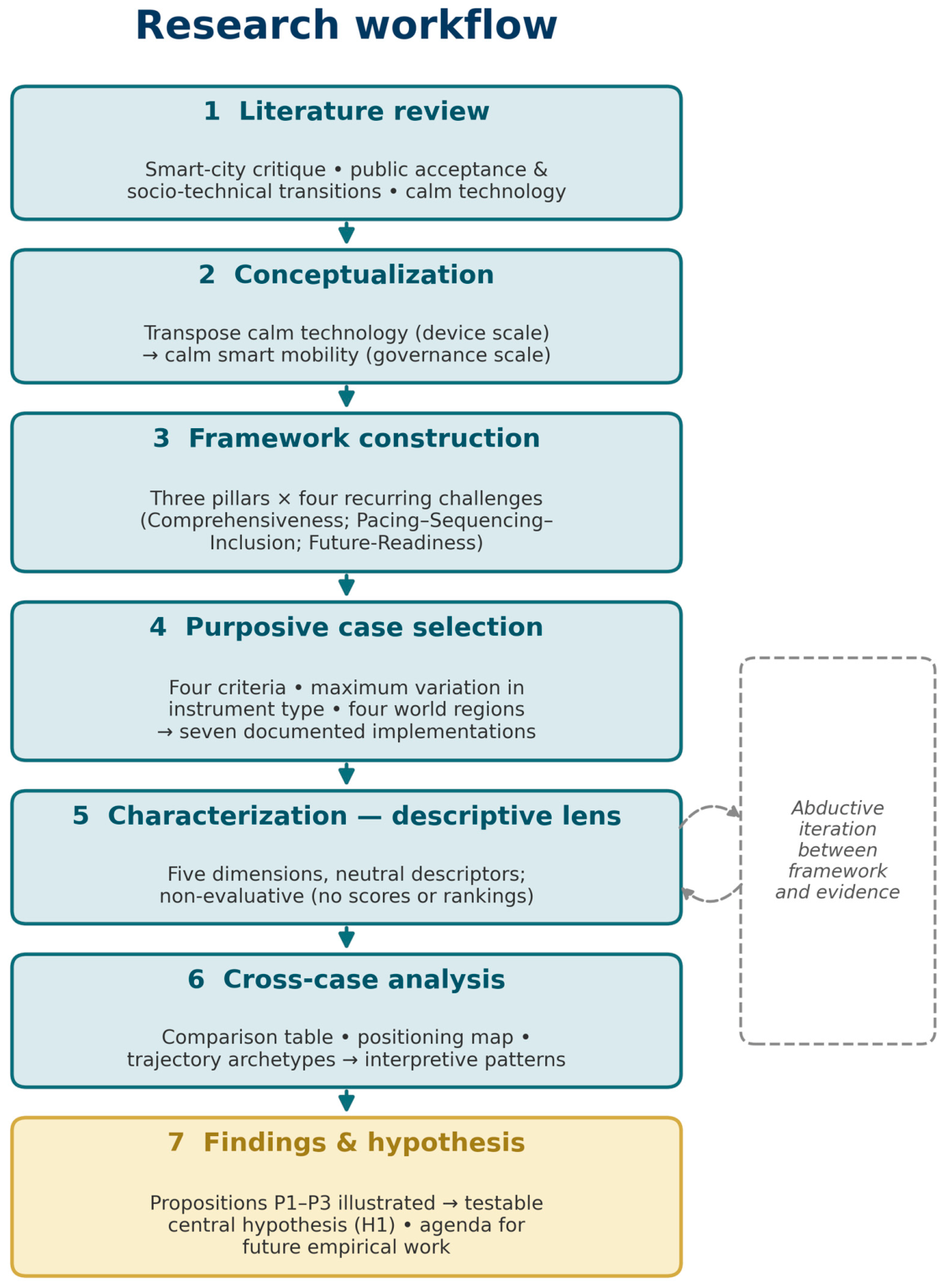
- The implementation is well documented in academic, official, or otherwise credible sources;
- It is a recognized smart or sustainable mobility intervention;
- The set exhibits maximum variation in instrument type, spanning spatial reorganization, economic (pricing/access), mass-transit investment, service-and-platform, and integrated data–platform interventions;
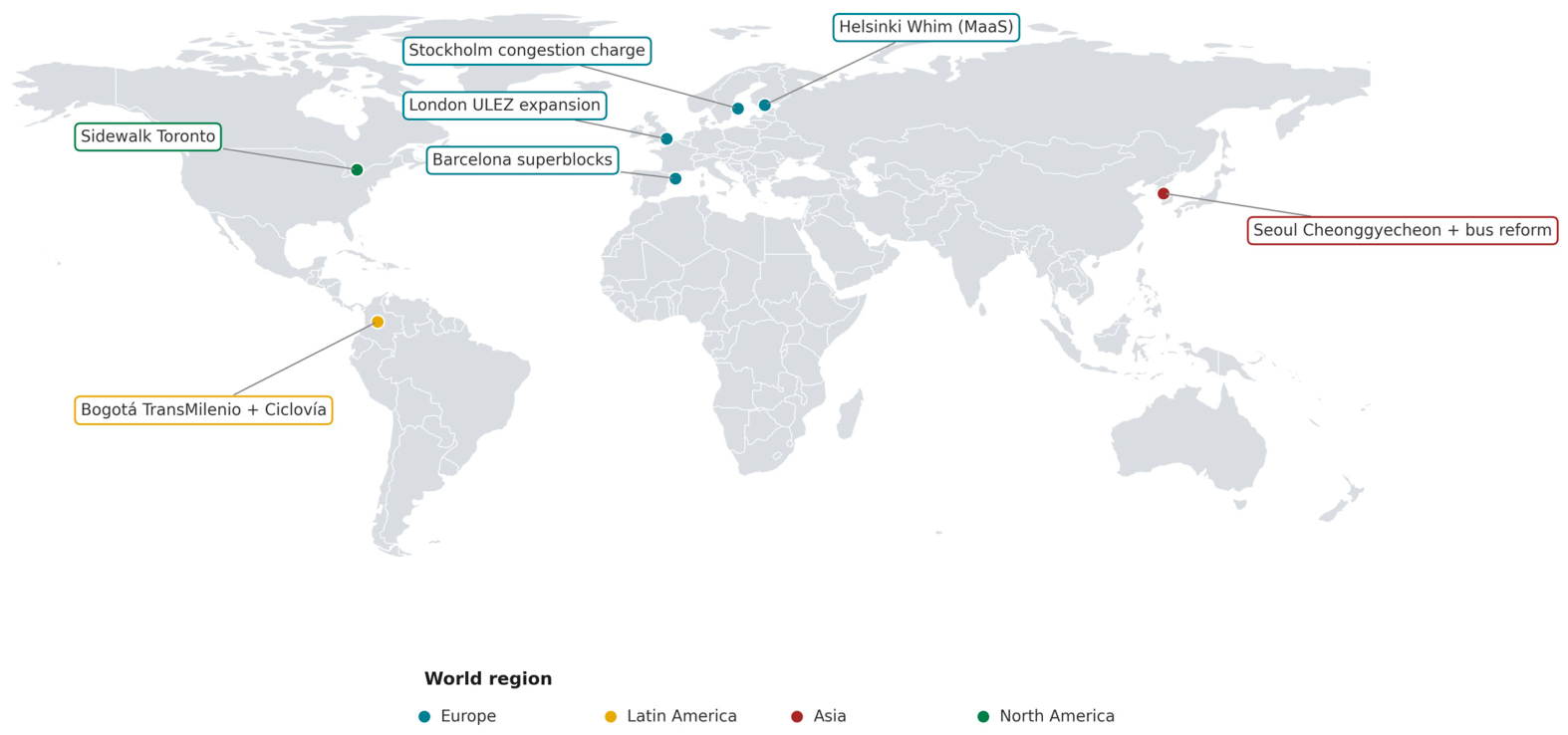
- The set spans a range of outcomes, from broadly accepted to contested, commercially failed, and abandoned. This maximum-variation design [49,50] guards against selecting only confirming cases; the cases were also chosen to span several world regions (Europe, Latin America, Asia, and North America) so as to illustrate the framework’s reach beyond a single institutional context, rather than to constitute a representative sample. Because the purpose of the study is illustrative rather than confirmatory, it was decided to give preference to well-documented and widely studied, and therefore often iconic, cases. The reason is that their dense evidentiary record makes the dimensions of the framework traceable, whereas more obscure interventions were considered but offered too thin a documentary basis for reliable characterization. Such cases also tend to fit the framework readily, and for that reason the analysis is presented as probing the framework rather than testing it. In addition, two of the cases sit at the edge of the smart city label and were included deliberately, in order to examine the reach of the framework across different instrument types. Bogotá’s Ciclovía predates the smart city discourse, and Seoul’s Cheonggyecheon is primarily a spatial and environmental intervention; nevertheless, both are treated throughout the sustainable- and smart mobility studies as reference points for citizen-centred mobility [51,52,53,54]. What is more, the scope of this article is explicitly smart and sustainable mobility, and not digital technology alone.
5. Cross-Case Analysis
5.1. Case Characterizations
- (1)
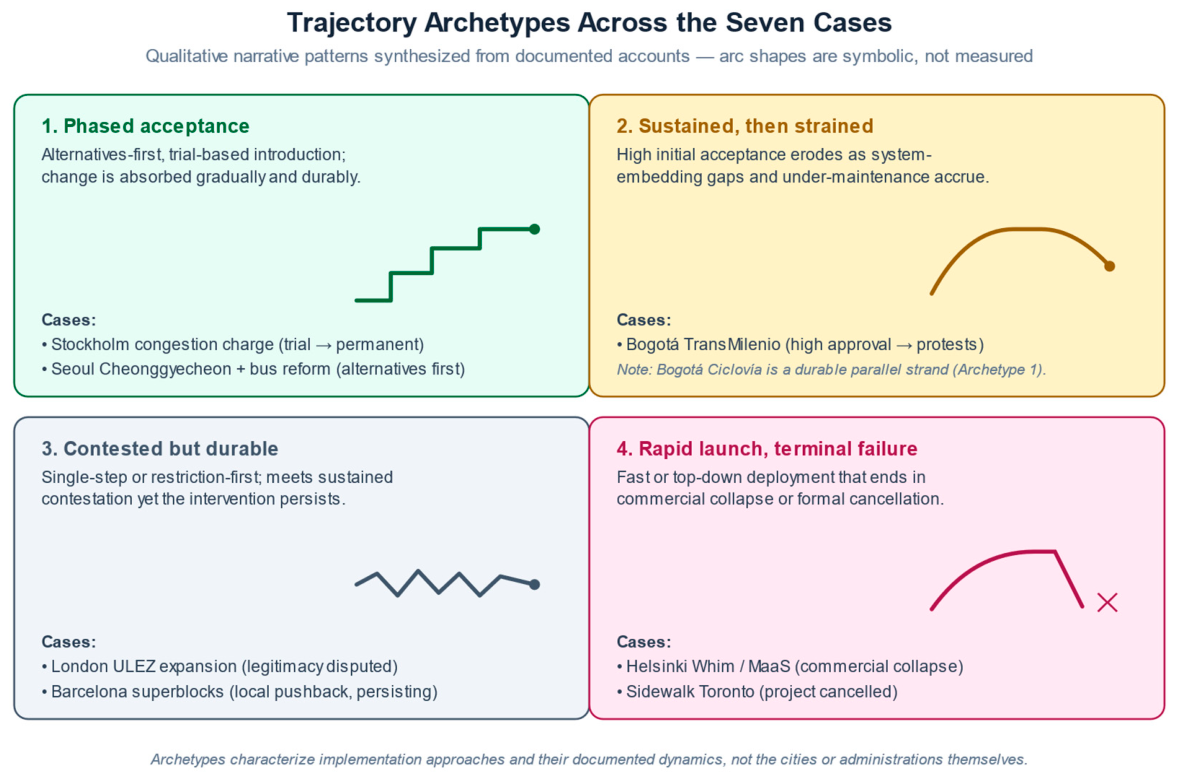
- Stockholm congestion charge—Stockholm introduced its charge first as a seven-month trial in 2006 (3 January–31 July), followed by a referendum and permanent reintroduction in 2007. The expansion of public transport services preceded the trial, so that residents could experience a credible alternative before the charge became permanent [44]. Over the trial, traffic across the cordon fell by roughly 20–25%, and public opinion moved from majority opposition to majority support (about 53% voting to retain the charge in the September 2006 referendum) as the effects on travel time were directly experienced [44,50]. In the framework’s descriptive terms, the approach is characterized by alternatives-first provision, a phased and trial-based pace, and a decision legitimized through direct experience and a vote, an approach paired with transit investment rather than standing alone.
- (2)
- Bogotá TransMilenio and Ciclovía—Bogotá built its sustainable mobility reputation on provision rather than restriction. The TransMilenio bus rapid transit system, opened in 2000 (carrying roughly 800,000 passengers a day at first and over two million daily by the early 2010s, with first-year approval above 90%), supplied a high-capacity, pro-poor alternative to car travel, while the Ciclovía, which since 1974 has closed major streets to cars every Sunday (more than 120 km, drawing on the order of a million participants), embedded active travel in the city’s culture [51,52]. In the framework’s terms, the approach is strongly alternatives-first and, in the case of Ciclovía, co-created and gradually embedded over decades. Yet Bogotá also shows how provision erodes without sustained system embedding: very high initial approval fell as the BRT became overcrowded and underfunded and continued to coexist with an unreformed traditional-bus sector, and service grievances escalated into protests in 2008 and 2012 [51]. The case thus illustrates both the power of an alternatives-first posture and the fragility of any single instrument that is not maintained as part of a wider system.
- (3)
- Seoul Cheonggyecheon and bus reform—Seoul paired a bold spatial intervention with the prior provision of alternatives. Before and alongside the 2003–2005 removal of the elevated freeway over the Cheonggyecheon stream (which had carried some 168,000 vehicles a day), the city carried out a comprehensive 2004 bus reform that reorganized routes, added median bus-only corridors, and integrated fares and ticketing across bus and metro [53]. Because a credible transit alternative was already in place, removing a major road did not produce the gridlock many feared; congestion fell rather than rose, and the restored stream, drawing on the order of ninety thousand visitors a day, became a celebrated landmark [53]. Restoring roughly 5.8 km of stream cost about ₩386 billion (around US$281 million) over 2003–2005 [53,54]. Descriptively, the approach is alternatives-first and strongly system-embedded, though decision-making was largely led by the mayoralty; an initial pilot in the city’s north-east stalled against opposition from bus operators and resumed only after about a year of stakeholder negotiation (some 4200 meetings with affected merchants [53,54]), a reminder that even well-sequenced change involves contestation.
- (4)
- Barcelona superblocks—The Superilles programme pursued an ambitious spatial vision tested first in a Poblenou pilot (opened in September 2016, within an original vision of some 503 superblocks), which met visible protest before the model was iterated and extended, eventually toward the Eixample “green axes” (freeing roughly one street in three from through traffic, with a bus route retained through the Poblenou superblock at residents’ request) [55]. Descriptively, the approach is marked by a pilot-and-learn pace and participatory aims, alongside residents’ reported surprise at some street closures, recurring criticism that traffic was displaced to surrounding streets (a system-embedding tension the Comprehensiveness dimension highlights), and a loss of institutional momentum after the 2023 change in administration. It illustrates an iterative spatial approach whose continuity proved sensitive to the political cycle.
- (5)
- London ULEZ expansion—The London-wide expansion of the Ultra Low Emission Zone in August 2023 (on 29 August, extending the zone to about 1500 km2 and some nine million residents, around five million newly included, at a daily charge of £12.50) achieved its core technical aims, with compliance reaching roughly 95% and favourable emission outcomes [56]. Descriptively, it was introduced across all boroughs in a single step, framed predominantly as a charge, accompanied by a £160 million scrappage scheme that many stakeholders judged too small and too late, and met with judicial review and sustained protest [57]. The approach is thus characterized by restriction-first sequencing and a top-down mode, situated within a longer air-quality strategy. The juxtaposition with Stockholm is the analysis’s most instructive observation: two economic/access instruments of comparable rationale followed very different legitimacy trajectories, distinguished by how they were sequenced and framed rather than by what they were.
- (6)
- Helsinki Whim (MaaS). Whim, the world’s first commercial Mobility-as-a-Service platform (founded in 2015), was a genuine pioneer that integrated multiple modes into a single subscription, but it did not achieve a sustainable business model, halting operations and entering bankruptcy in 2024 despite substantial investment (on the order of €149 million) [58]. Its founder’s retrospective that the venture tried to go “from zero to one in one step” describes, in the framework’s vocabulary, a rapid and unphased introduction; modal integration was a genuine strength, while coordination with public transport governance remained limited and the design proved financially non-resilient. Helsinki is a reminder that a difficult adoption trajectory need not take the form of street protest; here it appeared as commercial collapse and modest uptake (the Whim app had reached roughly 10,000 active monthly users [56]).
- (7)
- Sidewalk Toronto (Quayside). The Alphabet-affiliated smart-district proposal was technologically ambitious and widely discussed, conceived as a data-and-sensor-led master vision for the roughly 12-acre Quayside site; it nonetheless drew sustained privacy and governance controversy and limited civic buy-in, and the project was discontinued in 2020 (after about two and a half years of public controversy) [9]. Descriptively, it is characterized by a master-planned, technology-first approach with a largely top-down mode and a proprietary rather than open orientation. The latter matters because the Future-Readiness dimension values openness and interoperability over technological novelty as such.
5.2. Cross-Case Patterns
6. Discussion
6.1. What Do the Cases Reveal?
6.2. Calm Smart Mobility Within the Smart City Agenda
6.3. Implications for Policy and Smart City Practice
6.4. Limitations
7. Conclusions
Funding
Data Availability Statement
Acknowledgments
Conflicts of Interest
References
- United Nations, Department of Economic and Social Affairs, Population Division. World Urbanization Prospects: The 2018 Revision; United Nations: New York, NY, USA, 2019. [Google Scholar]
- Yigitcanlar, T.; Kamruzzaman, M.; Buys, L.; Ioppolo, G.; Sabatini-Marques, J.; da Costa, E.M.; Yun, J.J. Understanding ‘smart cities’: Intertwining development drivers with desired outcomes in a multidimensional framework. Cities 2018, 81, 145–160. [Google Scholar]
- Morozov, E. To Save Everything, Click Here: The Folly of Technological Solutionism; Public Affairs: New York, NY, USA, 2013. [Google Scholar]
- Hollands, R.G. Will the real smart city please stand up? Intelligent, progressive or entrepreneurial? City 2008, 12, 303–320. [Google Scholar] [CrossRef]
- Kitchin, R. The real-time city? Big data and smart urbanism. GeoJournal 2014, 79, 1–14. [Google Scholar] [CrossRef]
- Greenfield, A. Against the Smart City; Do Projects: New York, NY, USA, 2013. [Google Scholar]
- Flynn, S. Equality in the City: Imaginaries of the Smart Future; Flynn, S., Ed.; Intellect Books: Bristol, UK, 2022. [Google Scholar]
- Sengupta, U.; Sengupta, U. Why Government Supported Smart City Initiatives Fail: Examining Community Risk and Benefit Agreements as a Missing Link to Accountability for Equity-Seeking Groups. Front. Sustain. Cities 2022, 4, 960400. [Google Scholar]
- McCord, C.; Becker, C. Sidewalk and Toronto: Critical Systems Heuristics and the Smart City. arXiv 2019, arXiv:1906.02266. [Google Scholar]
- Park, J.; Chung, H. Toward Trustworthy Urban IT Systems: The Bright and Dark Sides of Smart City Development. IT Prof. 2021, 23, 52–57. [Google Scholar]
- Yigitcanlar, T.; Lee, S.H. Korean ubiquitous-eco-city: A smart-sustainable urban form or a branding hoax? Technol. Forecast. Soc. Change 2014, 89, 100–114. [Google Scholar] [CrossRef]
- Norton, P.D. Autonorama: The Illusory Promise of High-Tech Driving; Island Press: Washington, DC, USA, 2021. [Google Scholar]
- Sheller, M.; Urry, J. The new mobilities paradigm. Environ. Plan. A 2006, 38, 207–226. [Google Scholar] [CrossRef]
- Norton, P.D. Fighting Traffic: The Dawn of the Motor Age in the American City; MIT Press: Cambridge, MA, USA, 2008. [Google Scholar]
- Banister, D. The sustainable mobility paradigm. Transp. Policy 2008, 15, 73–80. [Google Scholar] [CrossRef]
- Martens, K. Transport Justice: Designing Fair Transportation Systems; Routledge: New York, NY, USA, 2017. [Google Scholar]
- Turoń, K. Sustainable Urban Mobility Transitions—From Policy Uncertainty to the CalmMobility Paradigm. Smart Cities 2025, 8, 164. [Google Scholar] [CrossRef]
- Weiser, M.; Brown, J.S. The coming age of calm technology. In Beyond Calculation: The Next Fifty Years of Computing; Denning, P.J., Metcalfe, R.M., Eds.; Copernicus/Springer: New York, NY, USA, 1997; pp. 75–85. [Google Scholar]
- Case, A. Calm Technology: Principles and Patterns for Non-Intrusive Design; O’Reilly Media: Sebastopol, CA, USA, 2015. [Google Scholar]
- Arnstein, S.R. A ladder of citizen participation. J. Am. Inst. Plan. 1969, 35, 216–224. [Google Scholar] [CrossRef]
- Caragliu, A.; Del Bo, C.; Nijkamp, P. Smart cities in Europe. J. Urban Technol. 2011, 18, 65–82. [Google Scholar] [CrossRef]
- Albino, V.; Berardi, U.; Dangelico, R.M. Smart cities: Definitions, dimensions, performance, and initiatives. J. Urban Technol. 2015, 22, 3–21. [Google Scholar] [CrossRef]
- Giffinger, R.; Fertner, C.; Kramar, H.; Kalasek, R.; Pichler-Milanović, N.; Meijers, E. Smart Cities: Ranking of European Medium-Sized Cities; Centre of Regional Science, Vienna University of Technology: Vienna, Austria, 2007. [Google Scholar]
- Shaheen, S.; Cohen, A. Mobility on demand (MOD) and mobility as a service (MaaS): Early understanding of shared mobility impacts and public transit partnerships. In Demand for Emerging Transportation Systems; Elsevier: Amsterdam, The Netherlands, 2020; pp. 37–59. [Google Scholar] [CrossRef]
- Jonek-Kowalska, I.; Wolniak, R. Smart Cities in Poland: Towards Sustainability and a Better Quality of Life? Routledge: London, UK, 2023. [Google Scholar] [CrossRef]
- Wolniak, R.; Jonek-Kowalska, I. Housing infrastructure as a determinant of quality of life in selected Polish smart cities. Smart Cities 2022, 5, 924–946. [Google Scholar] [CrossRef]
- Lucas, K. Transport and social exclusion: Where are we now? Transp. Policy 2012, 20, 105–113. [Google Scholar] [CrossRef]
- Schade, J.; Schlag, B. Acceptability of urban transport pricing strategies. Transp. Res. Part F Traffic Psychol. Behav. 2003, 6, 45–61. [Google Scholar] [CrossRef]
- Geels, F.W. The multi-level perspective on sustainability transitions: Responses to seven criticisms. Environ. Innov. Soc. Transit. 2011, 1, 24–40. [Google Scholar] [CrossRef]
- Marsden, G.; Reardon, L. Questions of governance: Rethinking the study of transportation policy. Transp. Res. Part A Policy Pract. 2017, 101, 238–251. [Google Scholar] [CrossRef]
- Smith, G.; Sochor, J.; Karlsson, I.C.M. Mobility as a Service: Development scenarios and implications for public transport. Res. Transp. Econ. 2018, 69, 592–599. [Google Scholar] [CrossRef]
- Weiser, M. The computer for the 21st century. Sci. Am. 1991, 265, 94–104. [Google Scholar] [CrossRef]
- Geels, F.W. Technological transitions as evolutionary reconfiguration processes: A multi-level perspective and a case-study. Res. Policy 2002, 31, 1257–1274. [Google Scholar] [CrossRef]
- Markard, J.; Raven, R.; Truffer, B. Sustainability transitions: An emerging field of research and its prospects. Res. Policy 2012, 41, 955–967. [Google Scholar] [CrossRef]
- Chesbrough, H.W. Open Innovation: The New Imperative for Creating and Profiting from Technology; Harvard Business School Press: Boston, MA, USA, 2003. [Google Scholar]
- Yun, J.J.; Zhao, X.; Ahn, H.; Park, K. Individual AI mechanism design based on the open innovation dynamics. Eur. J. Innov. Manag. 2026, 29, 1561–1584. [Google Scholar] [CrossRef]
- Carayannis, E.G.; Campbell, D.F.J. ‘Mode 3’ and ‘Quadruple Helix’: Toward a 21st century fractal innovation ecosystem. Int. J. Technol. Manag. 2009, 46, 201–234. [Google Scholar] [CrossRef]
- Adhikari, A.; Afshari, M.; Gohari, S.; Temeljotov-Salaj, A.; Johansen, A. A Living Lab Framework for Participation in Mobility Projects: A Case of Trondheim. Procedia Comput. Sci. 2026, 278, 1623–1630. [Google Scholar] [CrossRef]
- Loorbach, D. Transition management for sustainable development: A prescriptive, complexity-based governance framework. Governance 2010, 23, 161–183. [Google Scholar] [CrossRef]
- Voytenko, Y.; McCormick, K.; Evans, J.; Schliwa, G. Urban living labs for sustainability and low carbon cities in Europe: Towards a research agenda. J. Clean. Prod. 2016, 123, 45–54. [Google Scholar] [CrossRef]
- Bulkeley, H.; Coenen, L.; Frantzeskaki, N.; Hartmann, C.; Kronsell, A.; Mai, L.; Marvin, S.; McCormick, K.; van Steenbergen, F.; Palgan, Y.V. Urban living labs: Governing urban sustainability transitions. Curr. Opin. Environ. Sustain. 2016, 22, 13–17. [Google Scholar] [CrossRef]
- Samuelson, W.; Zeckhauser, R. Status quo bias in decision making. J. Risk Uncertain. 1988, 1, 7–59. [Google Scholar] [CrossRef]
- Kahneman, D.; Tversky, A. Prospect theory: An analysis of decision under risk. Econometrica 1979, 47, 263–291. [Google Scholar] [CrossRef]
- Eliasson, J. The Stockholm Congestion Charges: An Overview; CTS Working Paper 2014:7; Centre for Transport Studies: Stockholm, Sweden, 2014. [Google Scholar]
- Kraus, S.; Koch, N. Provisional COVID-19 infrastructure induces large, rapid increases in cycling. Proc. Natl. Acad. Sci. USA 2021, 118, e2024399118. [Google Scholar] [CrossRef] [PubMed]
- Haasnoot, M.; Kwakkel, J.H.; Walker, W.E.; ter Maat, J. Dynamic adaptive policy pathways: A method for crafting robust decisions for a deeply uncertain world. Glob. Environ. Change 2013, 23, 485–498. [Google Scholar] [CrossRef]
- Walker, W.E.; Marchau, V.A.W.J.; Swanson, D. Addressing deep uncertainty using adaptive policies. Technol. Forecast. Soc. Change 2010, 77, 917–923. [Google Scholar]
- Yin, R.K. Case Study Research and Applications: Design and Methods, 6th ed.; SAGE: Thousand Oaks, CA, USA, 2018. [Google Scholar]
- Flyvbjerg, B. Five misunderstandings about case-study research. Qual. Inq. 2006, 12, 219–245. [Google Scholar] [CrossRef]
- Börjesson, M.; Eliasson, J.; Hugosson, M.B.; Brundell-Freij, K. The Stockholm congestion charges—5 years on. Effects, acceptability and lessons learnt. Transp. Policy 2012, 20, 1–12. [Google Scholar] [CrossRef]
- Hidalgo, D.; Pereira, L.; Estupiñán, N.; Jiménez, P.L. TransMilenio BRT system in Bogotá: High performance and positive impact, main results of an ex-post evaluation. Res. Transp. Econ. 2013, 39, 133–138. [Google Scholar] [CrossRef]
- Sarmiento, O.L.; Torres, A.; Jacoby, E.; Pratt, M.; Schmid, T.L.; Stierling, G. The Ciclovía-Recreativa: A mass-recreational program with public-health potential. J. Phys. Act. Health 2010, 7, S163–S180. [Google Scholar] [CrossRef] [PubMed]
- Pucher, J.; Park, H.; Kim, M.H.; Song, J. Public transport reforms in Seoul: Innovations motivated by funding crisis. J. Public Transp. 2005, 8, 41–62. [Google Scholar] [CrossRef]
- Ryu, C.; Kwon, Y. How Do Mega Projects Alter the City to Be More Sustainable? Spatial Changes Following the Seoul Cheonggyecheon Restoration Project in South Korea. Sustainability 2016, 8, 1178. [Google Scholar] [CrossRef]
- Puig-Ribera, A.; Arumí-Prat, I.; Cirera, E.; Solà, M.; Codina-Nadal, A.; Palència, L.; Biaani, B.; Pérez, K. Use of the Superblock model for promoting physical activity in Barcelona: A one-year observational comparative study. Arch. Public Health 2022, 80, 257. [Google Scholar] [CrossRef] [PubMed]
- Wang, Y.; Zhong, C. Spatial heterogeneity in human mobility responses to London’s ultra-low emission zone expansion. Transp. Res. Part D Transp. Environ. 2025, 145, 104810. [Google Scholar] [CrossRef]
- Nadal, L.D. Low-emissions, High Tensions: Social Media Groups and the Escalation of Climate Obstruction. Environ. Commun. 2026, 20, 176–197. [Google Scholar] [CrossRef]
- Coordinating Council on Access and Mobility, Technical Assistance Center. Does the Collapse of Maas Global and the Whim Travel App Signify the End for MaaS? Available online: https://www.ccam-tac.org/news/does-the-collapse-of-maas-global-and-the-whim-travel-app-signify-the-end-for-maas/ (accessed on 20 March 2026).
- Rupprecht Consult (Ed.) Guidelines for Developing and Implementing a Sustainable Urban Mobility Plan, 2nd ed.; European Platform on Sustainable Urban Mobility Plans (Eltis): Cologne, Germany, 2019. [Google Scholar]



| Term | Definition as Used in This Article |
|---|---|
| Smart city | An urban model in which information and communication technologies, data, and human and social capital are combined to improve efficiency, sustainability, and quality of life. |
| Smart mobility | The smart city domain that applies data, connectivity, and on-demand digital services to optimize the movement of people and goods; the most visible and politically salient domain of the smart city agenda. |
| Techno-solutionism (solutionism) | The reflex, after Morozov [3], to recast complex social and political questions as neatly solvable engineering or technological tasks. |
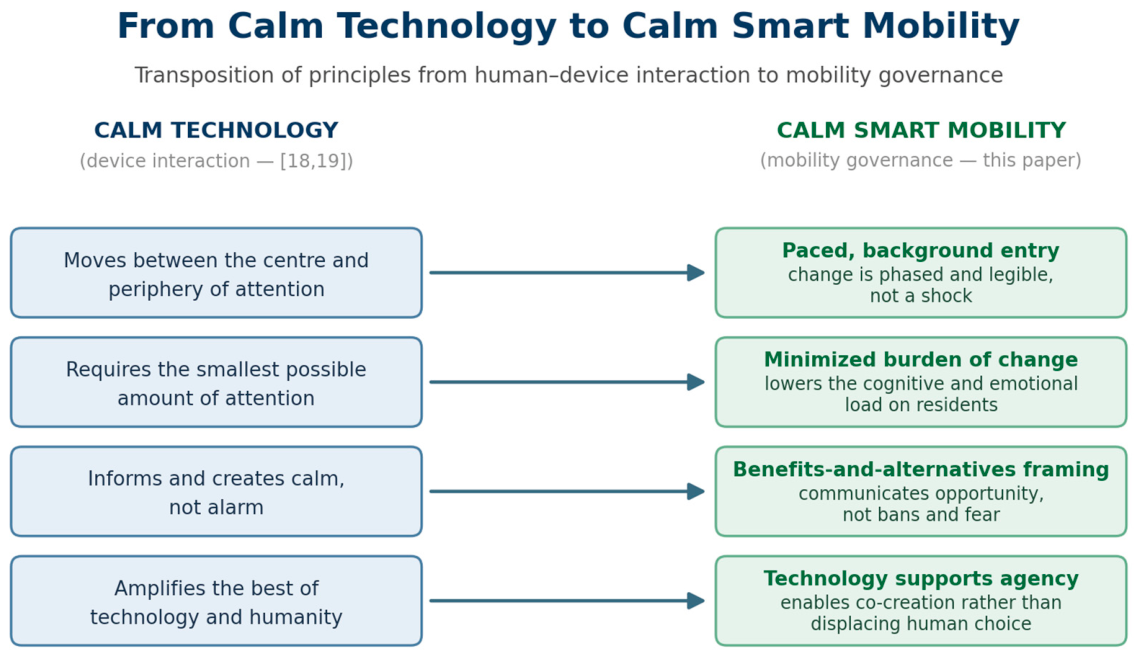
| Calm technology | After Weiser and Brown [18], technology that informs without demanding attention, moving fluidly between the centre and the periphery of awareness rather than competing for it. |
| Loud technology | The contrary posture: change that sits insistently at the centre of attention, foregrounds its own novelty, and imposes a sustained cognitive and emotional load on the people it is meant to serve. |
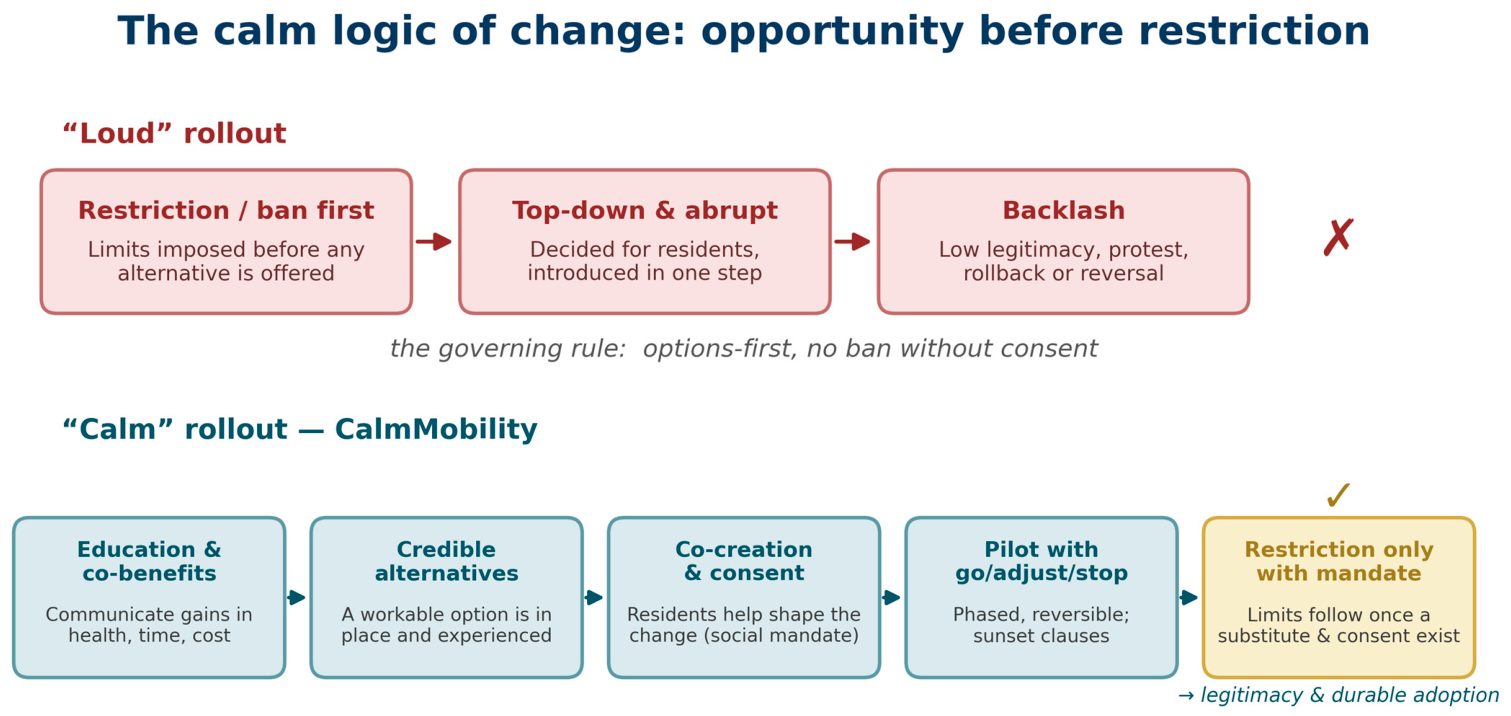
| CalmMobility | The antecedent framework for sustainable mobility transitions [17], built on three pillars (Comprehensiveness; Pacing–Sequencing–Inclusion; Future-Readiness) that address four recurring implementation challenges, and governed by the principle of opportunity over restriction realized through genuine co-creation. |
| Calm smart mobility | This article’s concept: an approach to smart city mobility transitions that proceeds by opportunity rather than restriction and through genuine co-creation, in which technological and spatial innovation enters everyday life gradually, legibly, and with credible alternatives already in place, rather than demanding continuous adaptation from residents. |
| Co-creation | Genuine joint authorship of change with residents, beyond the tokenistic informing or consultation on the lower rungs of Arnstein’s ladder [20], treated here as the implementation engine for embedding transitions socially. |
| Living Lab | A bounded, real-world setting for co-created, reversible experimentation and learning, including learning from failure. |
| Posture of change | The way a transition is paced, sequenced, framed, and shared with residents, comprising the provision of alternatives, the pace and reversibility of introduction, the mode of decision-making (co-created versus imposed), and the resulting felt experience of change, as distinct from the type of instrument deployed. |
| Acceptance | Residents’ approval of a measure; not a fixed attribute but produced over time, tending to rise with direct experience, perceived fairness, and trust. |
| Legitimacy | The perceived rightfulness of a measure and of the process by which it was decided; produced through how change is decided, not only through its outcomes. Broader than acceptance, which it helps generate. |
| Compliance | The extent to which users conform to a measure’s rules (for example, the share of vehicles meeting an emissions standard), a technical outcome that can be high even where legitimacy is contested. |
| Uptake | The degree to which a service or option is actually adopted and used by residents (especially relevant for service- and platform-based interventions). |
| Durability | The capacity of a measure to endure across political cycles without rollback or reversal. |
| Policy success | Achievement of a measure’s stated technical or environmental objectives, analytically distinct from social legitimacy, since a measure can meet its targets while remaining contested. |
| Smart Mobility Instrument Family | Smart City Rationale | Characteristic “Loud” Failure Mode | Calm-Design Question |
|---|---|---|---|
| Sensing & access control (camera-enforced low-emission/access zones) | data-driven air quality and access management | air quality and access management abrupt, charge-framed rollout; surveillance concern | Is a credible alternative in place before access is restricted? |
| Demand pricing platforms (congestion charging) | efficient allocation of scarce road space | imposed pricing read as a “tax”; equity backlash | Is the measure trialled, and is revenue visibly recycled? |
| Mobility-as-a-Service platforms | seamless, integrated multimodal travel | platform-led launch without governance coordination | Are operators, authorities, and users co-creating the service? |
| Spatial reconfiguration (superblocks, circulation plans) | livable, low-traffic public space | displacement to surrounding streets; surprise closures | Does the change avoid sub-optimization and enter gradually? |
| Integrated data districts/platforms | optimization through ubiquitous sensing | proprietary, low-trust, master-planned design | Is the design open, interoperable, and civically governed? |
| Recurring Challenge | Systemic Driver | Pillar That Addresses It | Calming Mechanism |
|---|---|---|---|
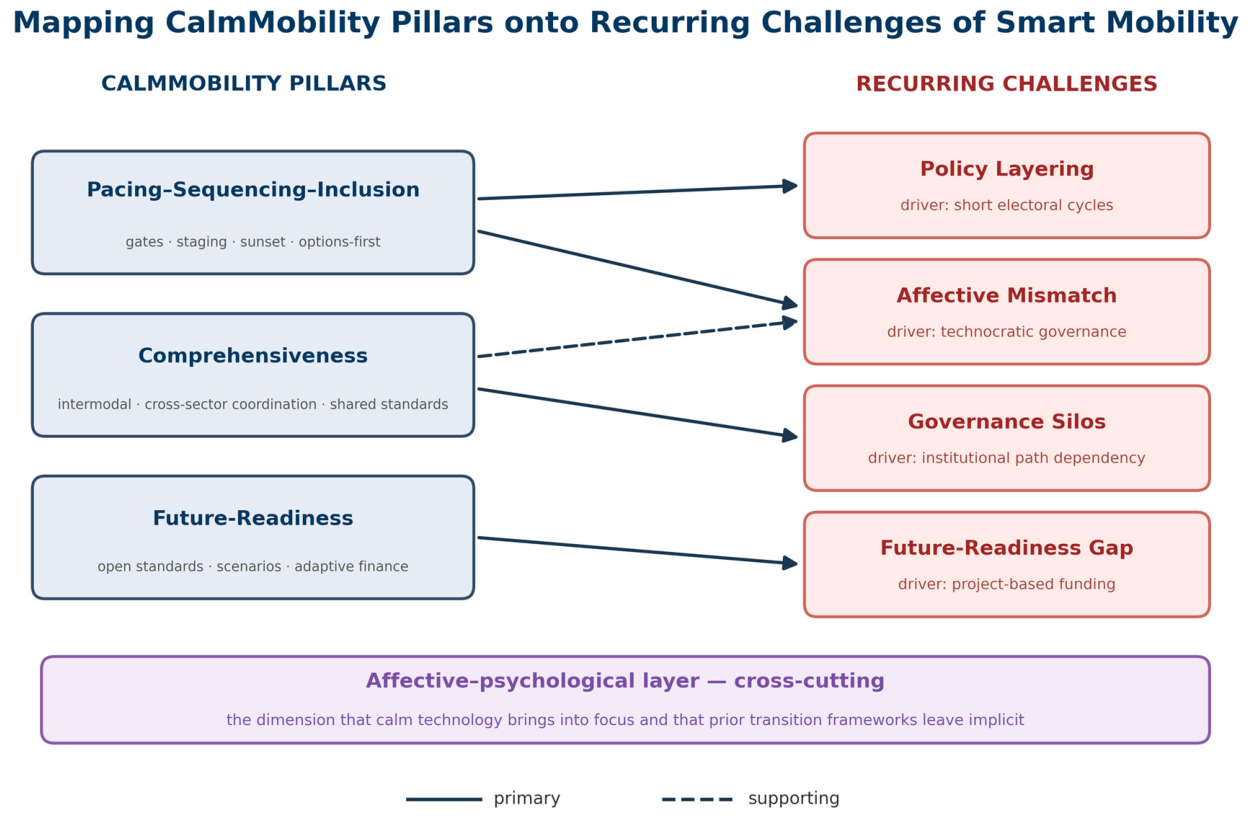
| Policy Layering | Short electoral cycles; flagship-project incentives | Pacing–Sequencing–Inclusion | Go/adjust/stop gates, staged rollout, sunset clauses replace accretion with planned adaptation |
| Affective Mismatch | Technocratic governance; data prioritized over experience | Pacing–Sequencing–Inclusion + Comprehensiveness | Benefits-and-alternatives framing; experiential sequencing; epistemic integration of resident knowledge |
| Governance Silos | Institutional path dependency; separate budgets and KPIs | Comprehensiveness | Open-innovation and quadruple-helix coordination; shared data standards and participation minima |
| Future-Readiness Gap | Project-based funding; fixed-infrastructure logics | Future-Readiness | Open standards, interoperability, scenario planning, adaptive finance, reversibility |
| Dimension | Descriptive Anchors |
|---|---|
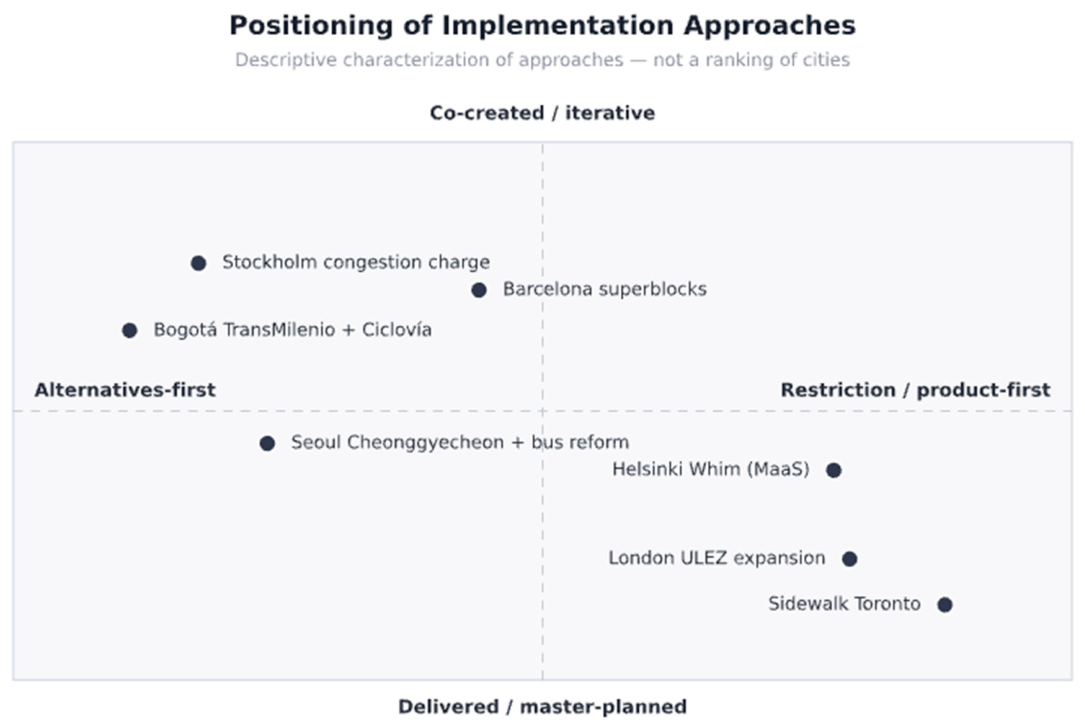
| Provision of alternatives | alternatives-first (a credible alternative is available and experienced before any restriction) ↔ restriction- or product-first |
| Pace of introduction | phased/trial-based ↔ single-step/abrupt |
| Mode of decision-making | co-created/iterative ↔ delivered/master-planned (top-down) |
| System embedding | system-embedded (integrated, coordinated with complementary measures) ↔ stand-alone/traffic-displacing |
| Adaptive/open orientation | open/adaptive (open standards, interoperability, reversibility) ↔ fixed/proprietary |
| Case | Provision of Alternatives | Pace of Introduction | Decision Mode | System Embedding | Documented Adoption Trajectory |
|---|---|---|---|---|---|
| Stockholm congestion charge | Transit expanded before the charge | Phased; trial then referendum | Legitimized by trial and vote | Paired with transit investment | Opposition → support |
| Bogotá TransMilenio + Ciclovía | Alternatives-first: BRT and cycling provision | Phased; BRT 2000, Ciclovía since 1974 | Largely top-down (BRT); co-created (Ciclovía) | Strong, but BRT under-maintained vs. wider system | High approval → overcrowding protests (2008, 2012) |
| Seoul Cheonggyecheon + bus reform | Alternatives-first: bus reform before road removal | Sequenced; bus reform 2004, freeway removal 2005 | Mayor-led; stakeholder negotiation after pilot stalled | Strongly embedded (bus + metro + spatial) | Feared gridlock → congestion fell; celebrated landmark |
| Barcelona superblocks | Partial; active-travel provision | Pilot-first, iterative | Participatory aims; pilot-based | Criticized for traffic displacement | Pilot friction → iteration → reduced political support |
| London ULEZ expansion | Limited up front; scrappage criticized | Single-step expansion | Top-down; contested consultation | Within longer air-quality strategy | High compliance alongside sustained contestation |
| Helsinki Whim (MaaS) | The service was itself the alternative | Rapid market launch, unphased | Platform/market-led | Limited transit-governance coordination | Modest uptake → commercial collapse |
| Sidewalk Toronto | Not the central issue | Master-planned proposal | Technology-led; limited civic input | Stand-alone district; proprietary | Controversy → discontinuation (2020) |
Disclaimer/Publisher’s Note: The statements, opinions and data contained in all publications are solely those of the individual author(s) and contributor(s) and not of MDPI and/or the editor(s). MDPI and/or the editor(s) disclaim responsibility for any injury to people or property resulting from any ideas, methods, instructions or products referred to in the content. |
© 2026 by the author. Licensee MDPI, Basel, Switzerland. This article is an open access article distributed under the terms and conditions of the Creative Commons Attribution (CC BY) license.
Share and Cite
Turoń, K. CalmMobility in the Smart City: From Techno-Solutionism to Human-Paced Mobility Transitions. Smart Cities 2026, 9, 108. https://doi.org/10.3390/smartcities9070108
Turoń K. CalmMobility in the Smart City: From Techno-Solutionism to Human-Paced Mobility Transitions. Smart Cities. 2026; 9(7):108. https://doi.org/10.3390/smartcities9070108
Chicago/Turabian StyleTuroń, Katarzyna. 2026. "CalmMobility in the Smart City: From Techno-Solutionism to Human-Paced Mobility Transitions" Smart Cities 9, no. 7: 108. https://doi.org/10.3390/smartcities9070108
APA StyleTuroń, K. (2026). CalmMobility in the Smart City: From Techno-Solutionism to Human-Paced Mobility Transitions. Smart Cities, 9(7), 108. https://doi.org/10.3390/smartcities9070108