1. Introduction
Railway level crossings are characteristic points within transport networks, where road and rail systems must operate within shared physical space. These interruptions are irregular, vary in duration, and often result in substantial variability in queue formation and dissipation. These features make level crossings difficult to analyse using conventional road traffic assessment methods. Their impact is particularly relevant in countries such as Poland, Great Britain, Colombia, and Australia, where crossings remain widespread and have been studied with respect to safety, delays, and operational performance [
1,
2,
3,
4,
5].
In Poland, historical underinvestment in railway infrastructure led to limited service levels, as described by Taylor [
1]. Recent revitalisation programmes [
2] have increased train frequency, resulting in more frequent and longer road-traffic interruptions. Similar patterns are noted internationally, where closures have been shown to affect mobility, safety, and local network performance [
3,
4,
5].
The effects of such interruptions extend beyond simple delay accumulation. Long queues may propagate into neighbouring intersections, disrupt signal coordination, reduce public transport reliability, and hinder emergency services [
6,
7]. Persistent congestion can deteriorate broader urban mobility performance and influence travel behaviour [
8,
9]. Understanding these mechanisms is critical when evaluating operation or design strategies for sustainable mobility in smart cities.
Although extensive studies address safety, user behaviour, and technological improvements at level crossings [
5,
10,
11], comparatively fewer consider analytical modelling of delays and queue dynamics. Microsimulation tools such as PTV Vissim and SUMO can support such analyses, though their cyclical control logic requires adaptations to reproduce non-cyclical railway closures, which may affect queue estimation.
Given the absence of a dedicated analytical methodology for evaluating traffic performance at level crossings, this study adapts procedures for signalised intersections defined in Polish regulations, based on Highway Capacity Manual (HCM) concepts. The method offers approximate estimates of average time losses and maximum queue lengths. Empirical observations from Wrocław, Poland, enable comparison of analytical and simulation-based results.
The study focuses on urban railway level crossings, where reduced travel speeds, dense intersection spacing, and frequent interactions with upstream signalised intersections create traffic conditions compatible with the assumptions of the proposed analytical approach. Rather than representing drawbacks, these conditions define the intended application domain of the method. The proposed framework is therefore designed to support preliminary assessment of traffic performance under typical urban conditions, while recognising that more detailed analyses may be required in highly complex or atypical settings. Based on the identified research gap, the following section presents the structured methodological framework applied in this study to translate empirical observations into analytical estimates and comparative simulation analysis.
Methodological Overview
The methodological framework adopted in this study consists of three complementary components. First, an analytical procedure derived from HCM-based methods for signalised intersections is adapted to estimate maximum queue length and average delay at railway level crossings under non-cyclical closure conditions. Second, empirical traffic measurements collected at an urban railway level crossing are used to parameterise and illustrate the analytical formulation. Third, microsimulation models developed in PTV Vissim and SUMO are employed as comparative references to examine the sensitivity of analytical estimates to different modelling assumptions. The proposed approach is intended as a diagnostic and preliminary assessment tool and does not aim to optimise traffic control strategies or evaluate alternative infrastructure designs. The main contribution of this work lies in providing a transparent analytical framework that enables preliminary assessment of traffic performance at railway level crossings under irregular, non-cyclical closures, without requiring full microsimulation at early planning stages. The study follows a structured analytical workflow in which empirical observations define the boundary conditions, analytical relationships provide traffic-performance estimates, and microsimulation results are used as a comparative consistency check.
2. Literature Review
The literature extensively examines safety conditions and driver behaviour in the vicinity of railway level crossings, with numerous studies evaluating risk factors, human decision-making and the effectiveness of safety systems [
12,
13,
14]. Research has also addressed safety issues related to passenger boarding and alighting in urban rail systems, which forms an important component of interactions between road and rail environments [
15]. At a broader scale, several studies analyse and optimise railway networks using macroscopic modelling approaches [
16,
17,
18,
19,
20], although these works focus primarily on rail operations rather than their impact on adjacent road traffic.
Despite this substantial body of research, road traffic conditions in the vicinity of railway level crossings have been analysed less frequently. This gap is notable because disturbances generated by level-crossing closures—such as queue formation, recurring congestion, and reduced travel-time reliability—can significantly affect urban transport network performance. Similar challenges relating to the influence of network structure on congestion propagation, traffic performance, and infrastructure loading have been described in other areas of urban mobility research [
21,
22,
23,
24]. Contemporary developments further highlight the increasing complexity of urban traffic environments, particularly with the integration of connected and automated vehicles [
25,
26], which may introduce new behaviours and interactions at critical network points, including level crossings.
Railway level crossings therefore represent key interfaces where road traffic must operate under constraints imposed by rail movements. Efficient management of these locations is important not only for safety but also for maintaining reliable traffic flow, particularly in urban areas characterised by high demand and dense networks of intersections. Neglecting the impact of level-crossing closures can contribute to inefficient traffic flow, increased accident risk, excessive queue formation, and prolonged vehicle delays [
27,
28,
29]. These effects may propagate beyond the immediate vicinity of a crossing, influencing travel behaviour, reducing the attractiveness of public transport, and placing additional load on the urban road network. Such trends were especially visible during the COVID-19 pandemic, when declines in public transport use coincided with increased private vehicle travel [
30,
31,
32,
33], amplifying congestion pressures in many cities.
The aim of this study is to provide an analytical approach that supports understanding and evaluating traffic conditions at railway level crossings, using calculation procedures for signalised intersections defined in Polish regulations [
34]. These regulations incorporate concepts derived from the Highway Capacity Manual (HCM), which serves as a widely recognised standard for evaluating road traffic performance and continues to be developed in various applications [
35,
36,
37]. By applying these procedures, it is possible to estimate average vehicle time loss and maximum queue length—key traffic indicators that can be used to assess whether modifications to road or railway infrastructure are needed to improve operational performance. Such assessments are applicable both at existing level crossings and during the design phase of new infrastructure.
Traffic performance can then be interpreted using level of service (LOS) concepts, commonly applied across road, rail, and multimodal transport analyses [
38,
39]. In this study, empirical data were collected in Wrocław, Poland, including traffic flow measurements, observed queue lengths, and closure durations at an urban railway level crossing. These measurements form the basis for validating analytical outcomes and allow comparison with results generated using PTV Vissim and SUMO (Simulation of Urban MObility) microsimulation tools. The combined use of empirical observations, analytical modelling, and simulation supports a comprehensive evaluation of traffic performance at urban railway level crossings.
Previous studies addressing railway level crossings have predominantly focused on safety analysis, behavioural aspects of driver decision-making, or macroscopic modelling of railway networks. Analytical approaches for estimating queue length and delay are typically developed for signalised or unsignalised road intersections and assume recurring control cycles. In contrast, railway level crossings are characterised by irregular, non-cyclical interruptions driven by rail operations. Although some studies have examined delay mechanisms at rail–road interfaces, no widely adopted analytical methodology exists that directly adapts signalised-intersection capacity procedures to such non-cyclical conditions. The present study addresses this gap by proposing a pragmatic analytical adaptation based on HCM-derived concepts.
Unlike the majority of previous studies, which focus on safety, behavioural analysis, or macroscopic rail operations, this study specifically addresses analytical estimation of queue length and delay at railway level crossings under non-cyclical closure conditions.
3. Materials and Methods
3.1. Description of Survey Methodology for Analysing Traffic Conditions at Railway Level Crossings
This section follows the three-step analytical workflow introduced in the Methodological overview, including empirical data collection, analytical formulation, and comparative simulation assessment. The proposed method is based on the Polish regulations for calculating road traffic capacity at intersections with traffic lights, which are based on HCM methods. All patterns are included in Polish regulations [
34]. The proposed methodology consists of three sequential steps: (I) collection of empirical data describing traffic conditions at railway level crossings, (II) derivation of analytical relationships enabling estimation of queue length and delay, and (III) comparative assessment against microsimulation outputs to verify consistency of results. The procedure is based on determining average time losses and the maximum length of the vehicle queue. The given parameters reflect traffic conditions in the analysed area, making it possible to evaluate them. The required data are the traffic intensity at individual intersection inlets, the red signal digestion time of a given calculation group, and the length of the traffic light cycle. The impact of adjacent intersections should also be taken into account by determining the traffic flow type and type of traffic light. The calculation procedure is presented in the Formulas (1)–(13).
Share of the effective green signal in the cycle:
where, in the case of a railway level crossing, it is assumed that G
e is the effective length of the green signal T minus the time of the entire red signal assumed [s].
The S parameter, which represents the traffic saturation intensity, is 1900 pcu/h in the case of straight connections and 1700 pcu/h in the case of turning connections with one-hour road traffic intensity.
Load degree:
where
.
Parameter r
s is defined as the coefficient taking into account the type of control, and with constant-time signalling, it takes the value 0.5. Meanwhile, the w
s parameter is defined as a coefficient taking into account the presence of neighbouring intersections with traffic lights. Its value is determined by the formula:
where X
s specifies the load level of the adjacent intersection and is calculated according to the Formula (3).
Average value of the maximum queue:
95% quantile from the maximum queue distribution:
95% quantile factor of the maximum queue:
where w
1, w
2, w
3 parameters take on different values depending on the type of control. For constant-time signalling, the parameters are: w
1 = 1.60, w
2 = 1.08, and w
3 = 6.60.
The standard length of vehicles’ position in a queue:
Parameters determining the length of passenger vehicles and trucks for Polish conditions are: lp = 6.2 m, lt = 13 m. At , the value of lt = 12 m, due to the small share of trucks.
Based on the presented method, the next section presents its application for calculating the capacity of area at a railway level crossing. All assumptions and adopted values were also explained.
3.2. Methodology for Analysing Traffic Conditions at Railway Level Crossings
The proposed method, subject to specific assumptions, can be applied to assess road traffic conditions at railway level crossings. The first problem encountered is determining the T cycle. In the case of traffic lights at an intersection, it is usually between 80–120 s. However, if we present the situation in the case of railways, there is no constant cycle, and the movement of trains does not occur at equal intervals. On this basis, an appropriate equivalent cycle time was investigated, leading to the following assumptions. In the case of a maximum queue of vehicles, this problem is not significant, because for longer cycles of more than 5 min, they will not differ significantly. This transformation should be interpreted as a practical analytical approximation introduced to enable the application of established intersection-capacity procedures under non-cyclical railway interruptions. The exception is the situation when the queue does not have time to fully unload before the next railway level crossing closure. In this case, you must specify each cycle separately. However, if this condition is met, any
can be assumed. This issue becomes more critical when determining average time losses. If we assume a 5-min or 40-min cycle, they will not differ significantly. At this stage, we should consider the time in which average time losses should be determined. During the measurements, a new parameter T
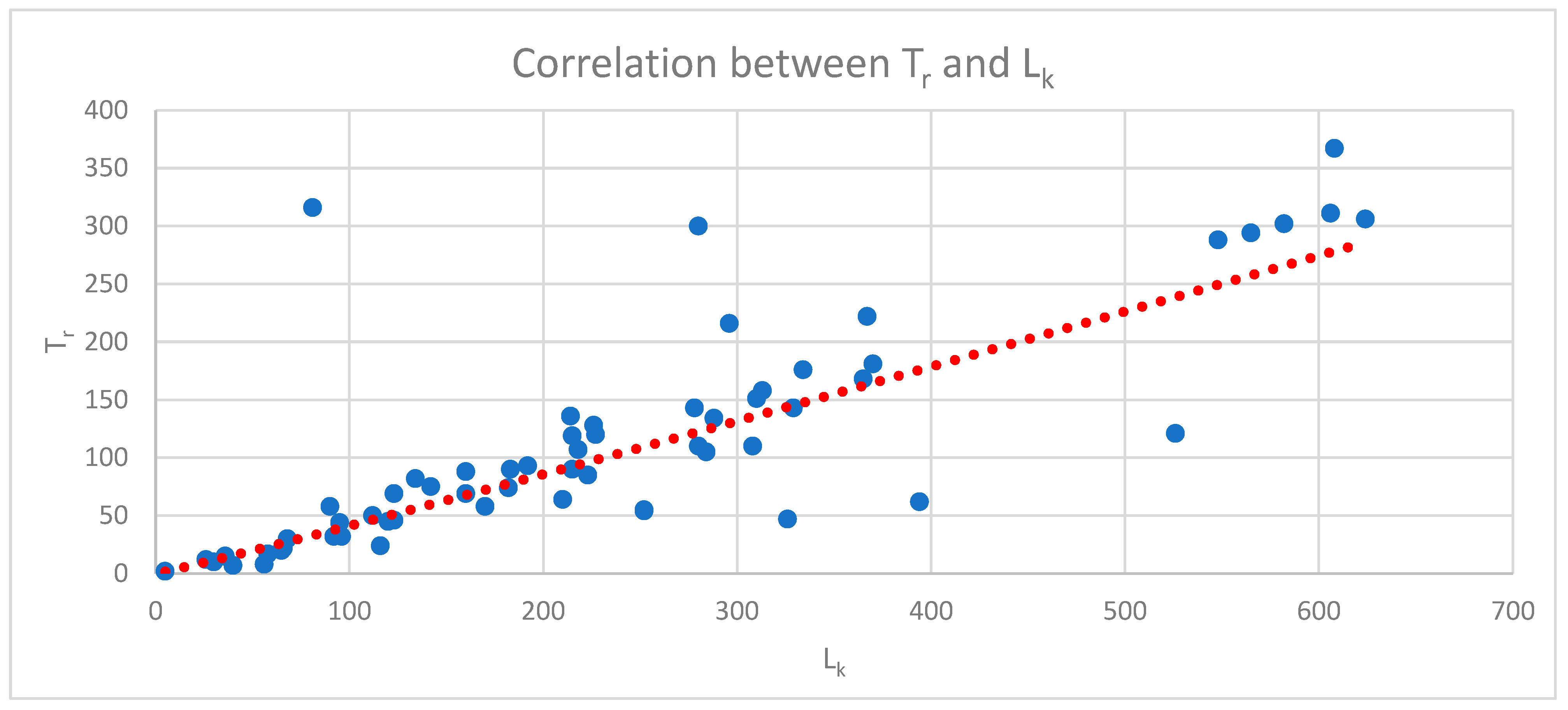
r was measured, which represents the unloading time of the queue of vehicles. The transformation of a non-cyclical railway closure into an equivalent signalised-cycle representation should be interpreted as a heuristic modelling assumption rather than as a theoretical equivalence. This approximation is introduced to enable the application of established analytical procedures and does not imply that railway closures and signal control operate under identical dynamics. Based on the measurements performed, the average T
r parameter per vehicle in seconds was calculated. This parameter is closely related to the maximum length of the L
k vehicles queue. The correlation between T
r and L
k is presented in
Figure 1. Individual T
r values for individual L
k are shown in blue dots. The trend lines are shown in red.
The T
r values corresponding to individual queue lengths exhibit a high degree of variability. However, this value varies depending on the vehicle queue. The longer the L
k, the larger and more stable T
r will be. It is possible to establish the trend line that shows certain dependencies. Based on the trend line, average T
r values were determined for the appropriate queue length. By multiplying the determined T
r values with K
m95, we can determine the time to unload any queue of vehicles. This time added together with the railway level crossing closure time gives the value T. Therefore, an analysed cycle in which average time losses and maximum queue will be calculated can be determined. It should also be noted that with this assumption, T
r is a green signal in our cycle; therefore, it is the value of G
e. In the case of a very short crossing closure time and a small value of the new G
e, the iteration step should be repeated by re-determining L
k, redefining G
e and the new cycle value. This is caused by a change in the calculation of the new maximum queue, which in the new case will be longer. To facilitate calculations, the formula for G
e is described in terms of a function derived from empirical measurements and is presented below:
where L
k is the value obtained in the first iteration.
There are still a few values left in the method that need to be described. The first one is S, which will always take a value of 1900 veh/h due to the lack of turning movements at railway level crossings. The assumption of parameters rs and ws can be omitted. This is due to the fact that the value of d2 in the case of such a long cycle is close to 0. Therefore, it can be assumed that . The fitted relationship yielded a coefficient of determination R2 = 0.65, indicating moderate agreement consistent with the limited empirical dataset.
3.3. Measurements and Simulation Assumptions
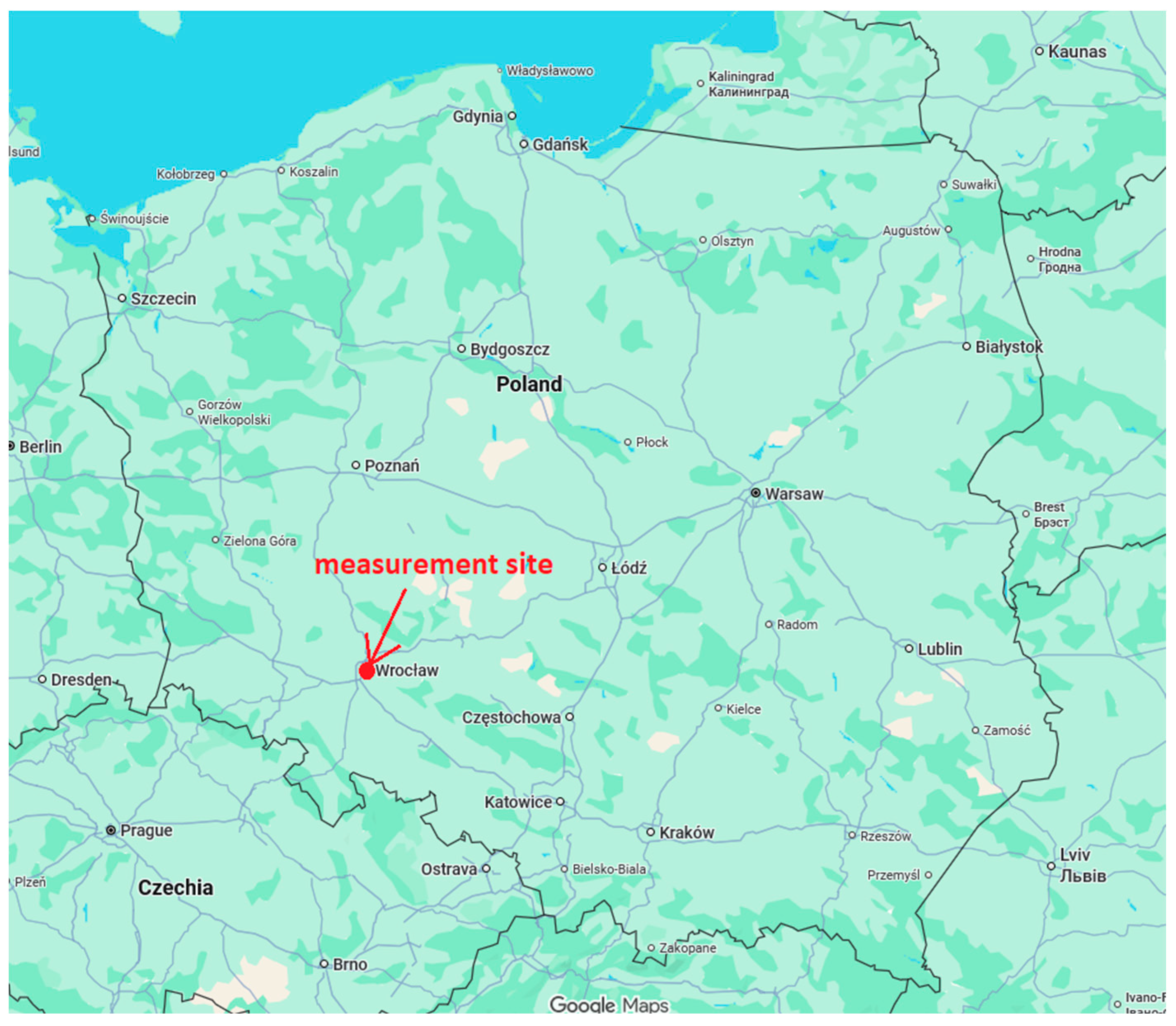
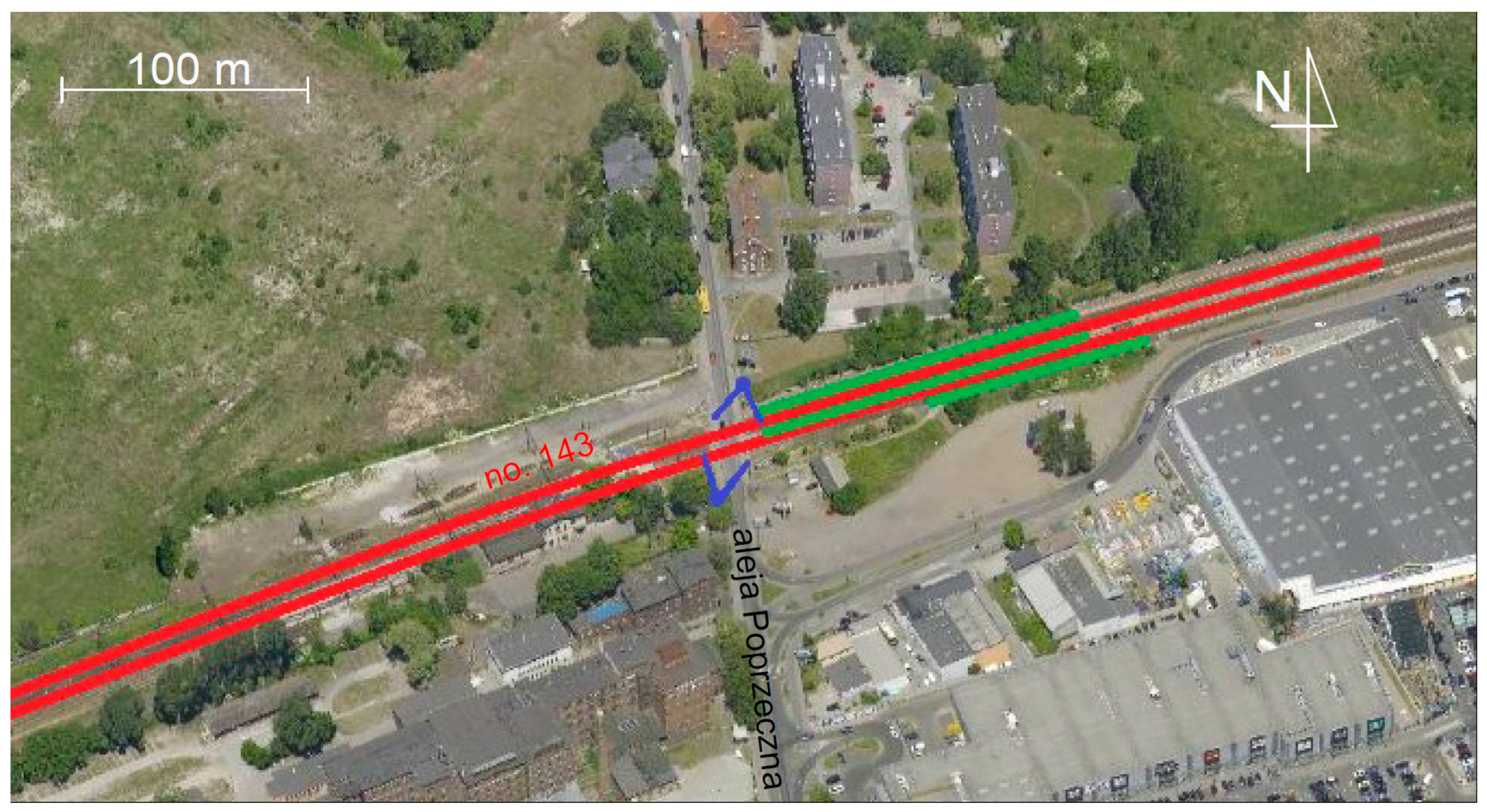
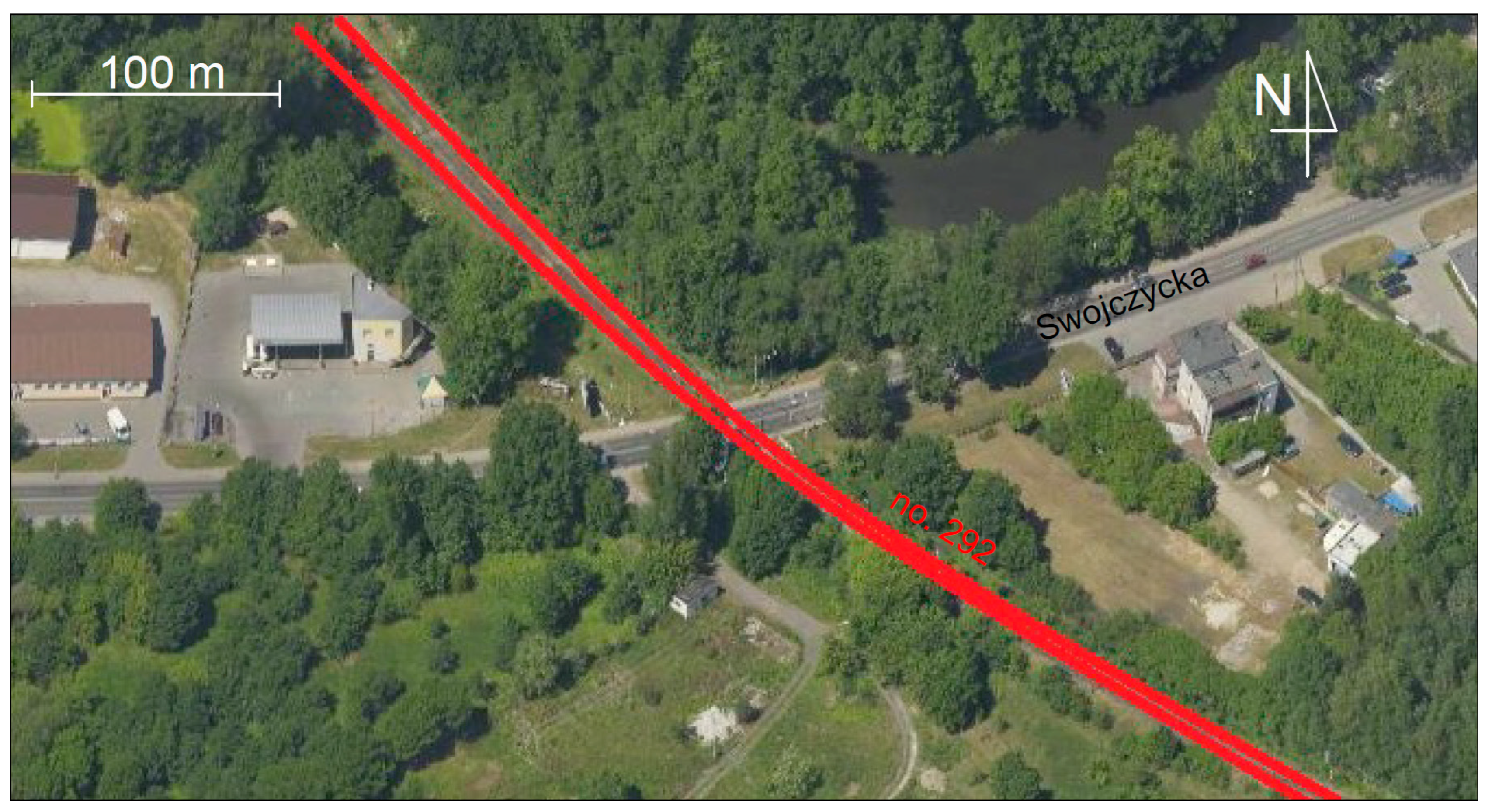
To check the correctness of the described method, measurements had to be carried out in individual areas. The measurements were conducted in one of the largest cities in Poland, Wrocław, as seen in
Figure 2,
Figure 3 and
Figure 4, which show the locations of measurements. The railway line was marked in red to highlight it. Observation points where the cameras were placed during the measurements are marked in blue. Queue lengths were measured using ODOMETER. It is also worth mentioning the impact of the railway stop, which is marked in green in
Figure 3. It significantly extends the closing time of the railway level crossing. Therefore, vehicle queues are much longer in this area. The remaining measurements were performed in other towns, including Oława, Nadolice Wielkie, and Świdnica.
The article focuses on the area shown in
Figure 4. This place was analysed by applying the described method and comparing it with empirical measurements. In addition, simulations were performed in the PTV Vissim software and SUMO software, providing additional insight into the situation. These software packages are widely used for microsimulation of road and pedestrian traffic. Many scientific and building companies and state institutions use the program [
40,
41].
The simulations were conducted using PTV Vissim (version 2021, SP13) and SUMO (version 1.21.0). All simulations were executed using default parameter configurations unless explicitly stated otherwise. Simulation models in both PTV Vissim and SUMO were developed to reflect the traffic conditions observed in the field. The signalised intersection located west of the railway level crossing was included using its real cycle length and phase structure. The maximum permitted speed in the area (50 km/h) was applied to all links. Individual train closures were modelled according to the measured level-crossing closure durations. The road network geometry was imported from OpenStreetMap and subsequently checked and corrected to ensure consistency with field observations and the local layout.
Vehicle acceleration, deceleration, and car-following behaviour followed the predefined urban-network parameters available in each software package, as no established calibration procedure exists for representing isolated, non-cyclical railway closures in microsimulation environments. Traffic demand was assigned using predefined vehicle distributions typical for urban road networks.
All simulations were performed using the default car-following, lane-changing, and priority-control settings available in each software package. These settings represent modelling assumptions and are reported to ensure reproducibility of the simulation framework. The Wiedemann car-following model (Vissim) and the default Krauss model (SUMO) were applied using default parameter settings.
Each scenario was simulated three times. In SUMO, deterministic default settings produced identical outputs; therefore, repeated runs were retained primarily for methodological consistency across simulation environments. Default urban passenger-vehicle classes, standard priority rules at intersections, and fixed-cycle signal control logic were applied in both simulation environments, while train closures were implemented as temporary link blockages consistent with observed field conditions. The simulation outputs serve as a comparative reference to the empirical measurements and the analytical results rather than fully calibrated predictive models. Although railway level crossings can theoretically be modelled as dynamic bottlenecks, robust calibration of microsimulation models for isolated, non-cyclical closures requires dedicated datasets capturing a wide range of traffic and behavioural conditions. Such data were not available in this study. Consequently, predefined urban-network parameters were applied, and microsimulation results were used solely for comparative purposes.
4. Results and Comparative Analysis
Results are presented in the same order as the methodological workflow to facilitate consistent comparison across empirical, analytical, and simulation-based outputs. The purpose of the comparative analysis is not to provide formal validation but to examine consistency between empirical observations, analytical estimates, and microsimulation outputs under comparable traffic conditions.
Table 1 shows measurements during peak traffic hours. Traffic intensity, the railway level crossing closure time corresponding to a given measurement hour, and the maximum length of the vehicle queue were measured. Measurements were made for the western and eastern inlets using manual measurements. A total of five measurements were compiled for each inlet. Results are presented following the same sequence as the methodological workflow, allowing direct comparison between empirical observations, analytical estimates, and simulation outputs.
The following section presents the calculation results of the method used, taking into account the assumptions and approach described in
Section 3.2. They were compared with empirical measurements and the results of simulations performed in the PTV Vissim and SUMO.
Table 2 shows results for the western inlet, and
Table 3 shows results for the eastern inlet. For microsimulation, a reference analysis period was applied for comparative purposes. In the case of average time losses, only the results from calculations and simulations were summarized. The empirical value was omitted due to the lack of measurements of this parameter.
Table 2 presents results for the western inlet. In cases 1 to 4, the values of the maximum vehicle queue length are consistent with the measurements, the proposed method, and the results obtained by the SUMO software. The values do not differ significantly between the three methods. The differences range from 7% to 11%. The situation is different in the case of the PTV Vissim simulation, where the differences are much larger, mainly in cases 2, 3, and 4, where they range from 24% to 38%. In the first case, the maximum vehicle queue length in both simulations and the proposed method differed by only 4%. In the fifth case, the results of PTV Vissim, SUMO, and the proposed method differ significantly from the measurements. The next analysed indicator is the average time loss. In cases 2 to 4, the results of the proposed method and the PTV Vissim software are similar. The differences range from 4% to 10%. In cases 1 and 5, they are larger, at 45% and 22%, respectively.
Table 3 presents results for the eastern inlet. In this case, the measurements of the maximum length of the vehicle queue are much more divergent from the results of calculations and individual simulations. In the first case, the measurements differ by 27% from the closest result obtained by the PTV Vissim software. In the case of the proposed method, the value is comparable. On the other hand, the microsimulation performed in SUMO gave results that differ by as much as 41%. In the second case, the results obtained in SUMO are closest to the measurements and differ by 35%. Additionally, in the case of the proposed method, they differ the most and amount to 51%. In the third case, the situation is similar to the first case, where the PTV Vissim software gives the smallest difference with a result of 24%. On the other hand, the values obtained using the proposed method are the most divergent, with a value of 53%. In the fourth case, the results obtained using the SUMO software coincide with the measurements. The proposed method has differences of the order of 31%. On the other hand, the PTV Vissim software again, as in cases 2 to 4 in
Table 2, shows underestimated values. In the fifth case, the values obtained using the proposed method differ significantly from the other values. However, the results obtained using the PTV Vissim and SUMO software are relatively consistent and close to the measurements. The next parameter to look at in
Table 3 is the average time losses. The results of the proposed method in cases 2 to 5 are in the middle between the two software programs. However, in the first case they are the lowest. In this case, they are 16% lower than the results obtained with SUMO, and 30% lower than the results obtained with PTV Vissim. In the second case, the results of the method are similar to the SUMO software. The observed differences between analytical, simulation-based, and empirical results are further interpreted in the Discussion section.
5. Discussion
The results presented in the previous section are interpreted here within the assumptions of the proposed analytical framework. The empirical dataset used in this study should be interpreted as illustrative rather than statistically independent validation material. Field measurements were employed to parameterise and contextualise the analytical formulation and to provide a basis for comparative evaluation. The limited size and site-specific nature of the dataset restrict the generalisability of the results, which is consistent with the diagnostic character of the proposed method.
The results of the conducted analyses reflect the complexity of evaluating traffic performance at railway level crossings, particularly due to the irregular and non-cyclical nature of crossing closures. The empirical measurements, together with the simulation results and analytical calculations, showed that the three approaches respond differently to changes in closure duration, flow intensity, and queue-dissipation patterns. In the western inlet (
Table 2), the maximum queue lengths estimated using the proposed analytical method and the SUMO software were generally consistent with the field measurements, with deviations typically within 7–11%. Noticeably larger discrepancies appeared in the PTV Vissim simulations, which in cases 2–4 underestimated the queue lengths by 24–38%. These findings indicate that microsimulation models may be sensitive to assumptions regarding vehicle behaviour and the representation of non-cyclical interruptions, particularly when applied without dedicated calibration.
For more irregular conditions, such as those observed in case 5, all methods diverged substantially from measured queue lengths. This outcome reflects the pseudo-random nature of traffic arrivals and the structural variability of the road network surrounding the crossing. Similar tendencies are visible in the eastern inlet (
Table 3), where deviations between the field data, analytical method, and simulation results were considerably larger. In some cases, PTV Vissim performed closer to the empirical data, whereas in other scenarios, SUMO generated results that were more aligned with the measurements. The analytical method, meanwhile, showed both underestimation and overestimation depending on the case, which is expected given its simplified assumptions and limited calibration.
Underestimated queue lengths, particularly in PTV Vissim, are consistent with the stochastic nature of traffic arrivals and sampling. In several scenarios (cases 2–4), PTV Vissim produced shorter queue estimates than field observations. In real traffic conditions, the actual queue may exceed the simulation prediction due to a combination of rare but possible unfavourable circumstances. Conversely, overestimated queues produced by the analytical method may represent theoretical upper bounds that reflect the deterministic nature of the model and may occur under specific traffic-structure conditions. As the traffic system around a railway crossing does not operate under stable, recurring cycles, the likelihood of capturing the “true” maximum queue during field measurements is inherently limited. This limitation distinguishes railway level crossings from signalised intersections, where dozens of comparable cycles can be observed in a short time period, resulting in more reliable empirical baselines.
The discrepancies in average time loss also reveal intrinsic differences between the methods. SUMO tended to underestimate delay values in
Table 2, likely due to its difficulty in reproducing a single long red interval within an otherwise free-flowing traffic scenario. In turn, PTV Vissim and the analytical method provided more comparable results, although the agreement varied between cases. In the eastern inlet (
Table 3), the analytical method produced delay estimates that were intermediate between PTV Vissim and SUMO in most scenarios, suggesting that the method may serve as a stabilising comparative reference. This effect is most evident when vehicle queues are either very short or very long. However, delays for extremely short or long closure durations should be interpreted cautiously, especially because the analytical formulation relies on the parameter Tr, which is sensitive to queue length and was calibrated on a small number of observations.
The comparative analysis also demonstrates that neither PTV Vissim nor SUMO is inherently suited to modelling isolated railway closures without prior adaptation. Both tools are typically used for modelling traffic environments in which cycles repeat multiple times and allow the model to converge toward stable estimations. When applied to one-off closures, particularly with long dissipation times, the simulation results can diverge substantially from field values. Although expert calibration of behavioural models (e.g., car-following, lane-changing, acceleration patterns) may reduce these discrepancies, no commonly accepted modelling procedure exists for such cases. The comparatively low delay values obtained in SUMO may reflect difficulties in reproducing long non-cyclical interruptions under default settings.
The analytical method proposed in this study offers a transparent and structured alternative for estimating maximum queue lengths and average time losses at railway level crossings, particularly in urban environments. Nevertheless, its accuracy remains constrained by the simplified assumptions and limited empirical dataset used for calibration. The method should therefore be considered an indicative tool, useful for preliminary assessment or comparison of design alternatives, rather than a fully predictive substitute for microsimulation or detailed operational modelling. Further development—such as defining an adapted level-of-service scale for long-cycle interruptions or expanding empirical calibration—may significantly improve its applicability.
Overall, the results highlight that none of the examined approaches are free from limitations. Empirical measurements capture only a small subset of possible traffic states; microsimulations must be adapted to model non-cyclical closures; and analytical calculations rely on simplifications that may not hold under all traffic scenarios. When interpreted together, however, the three approaches provide a more complete understanding of traffic performance at level crossings, supporting more informed decision-making in sustainable urban mobility planning.
The analytical method may perform less reliably under extreme but plausible conditions, such as back-to-back train arrivals, highly uneven traffic arrivals, or queue spillback extending beyond the analysed segment. These boundary conditions fall outside the intended application scope and highlight situations where microsimulation or detailed operational analysis is required.
6. Conclusions
Within its explicitly defined scope, the proposed framework provides a transparent and reproducible analytical baseline that can support early-stage assessment of railway level crossings, while more detailed simulation or optimisation studies remain complementary steps for advanced analysis. This study presents an analytical approach for evaluating traffic performance at railway level crossings by adapting procedures originally developed for signalised intersections in Polish regulations, which themselves draw on Highway Capacity Manual (HCM) concepts. The method provides approximate estimates of maximum queue lengths and average vehicle time losses, offering a structured and transparent means of assessing the operational impact of railway closures on urban road traffic. These indicators are essential for evaluating the operational performance of road–rail interfaces and may support preliminary consideration of potential operational issues and the need for further analysis.
Comparisons between empirical measurements, the analytical estimates, and the results of simulations conducted in PTV Vissim and SUMO show that each method exhibits different sensitivities to closure duration, traffic- flow variation, and queue-dissipation dynamics. Microsimulation tools can support analysis of level crossings, yet representing non-cyclical closures in these models requires specific adjustments that may influence queue estimates. The analytical method, while less detailed than simulation-based approaches, produces results that in many cases fall within the plausible range of observed conditions; however, deviations from measured values were also identified. These differences are linked to the simplified nature of the analytical assumptions and the limited set of empirical observations used for calibration.
Given these characteristics, the proposed analytical method should be interpreted as an indicative tool rather than a predictive model. Its outputs are most meaningful when used to support preliminary assessments, comparative evaluations of design scenarios, or screening-level analysis of potential traffic impacts. The method is particularly suited to railway crossings located in urban, built-up areas, where its underlying assumptions—such as reduced travel speeds, higher intersection density, and interactions with signalised nodes—more closely reflect actual traffic behaviour. Application outside such contexts should therefore be approached with caution and may require further calibration.
The findings of this study highlight the importance of integrating analytical, empirical and simulation-based approaches when assessing traffic performance at railway level crossings. No single method fully captures the stochastic and non-recurring nature of queue formation at these sites; however, the combined use of multiple approaches provides a more complete basis for engineering judgement and supports informed decision-making in sustainable urban mobility planning. Future work may focus on refining the analytical formulation through expanded datasets, adapting level-of-service criteria for long-cycle interruptions, and developing modelling guidelines that better address the operational characteristics of level crossings. The findings contribute to the broader objectives of sustainable urban mobility by supporting informed decision-making at critical road–rail interfaces within smart-city transport systems.
In practical applications, the proposed method may be used as a screening tool to identify locations where queue length or delay values indicate potential operational issues. When estimated indicators exceed acceptable thresholds or when results differ substantially across methods, more detailed microsimulation or field-based analyses are recommended. Taken together, the analytical, empirical, and simulation-based results consistently support the use of the proposed framework as a structured preliminary assessment tool for traffic conditions at urban railway level crossings within the defined scope of the study.
This research did not receive any specific grant from founding agencies in the public commercial or not-for-profit sectors.