
Metaverse of Things (MoT) Applications for Revolutionizing Urban Living in Smart Cities

Highlights
- The Metaverse of Things (MoT) aims to provide a comprehensive and immersive digital–physical hybrid environment that enhances urban infrastructure, fosters social ties, and optimises resource management. Several MoT applications have been discovered and explored in various areas of smart cities.
- MoT applications present a transformative approach to urban living in smart cities, offering improvements in planning, sustainability, safety, and citizen engagement. Several challenges such as data privacy, security, cybersecurity threats, interoperability, etc., are addressed.
- The implications of MoT applications in smart cities are profound, influencing various aspects, such as the technological, social, economic, and environmental, of urban living.
- Integration and interoperability, data management and security, enhanced civic engagement, digital divide, and new business models, particularly in areas such as virtual retail, remote work, and smart services, sustainable urban development, resilience to environmental changes, data-driven decision making, and policy and regulation are the implications of MoT applications.
Abstract
1. Introduction
1.1. Objective
1.1.1. Main Objective
1.1.2. Problem
1.1.3. Research Questions
1.2. Motivation
1.3. Scientific Originality/Novelty
1.4. Research Gap
1.5. Contribution
1.6. Organisation
2. Materials and Methods
2.1. Literature Review
2.1.1. Search Strategy
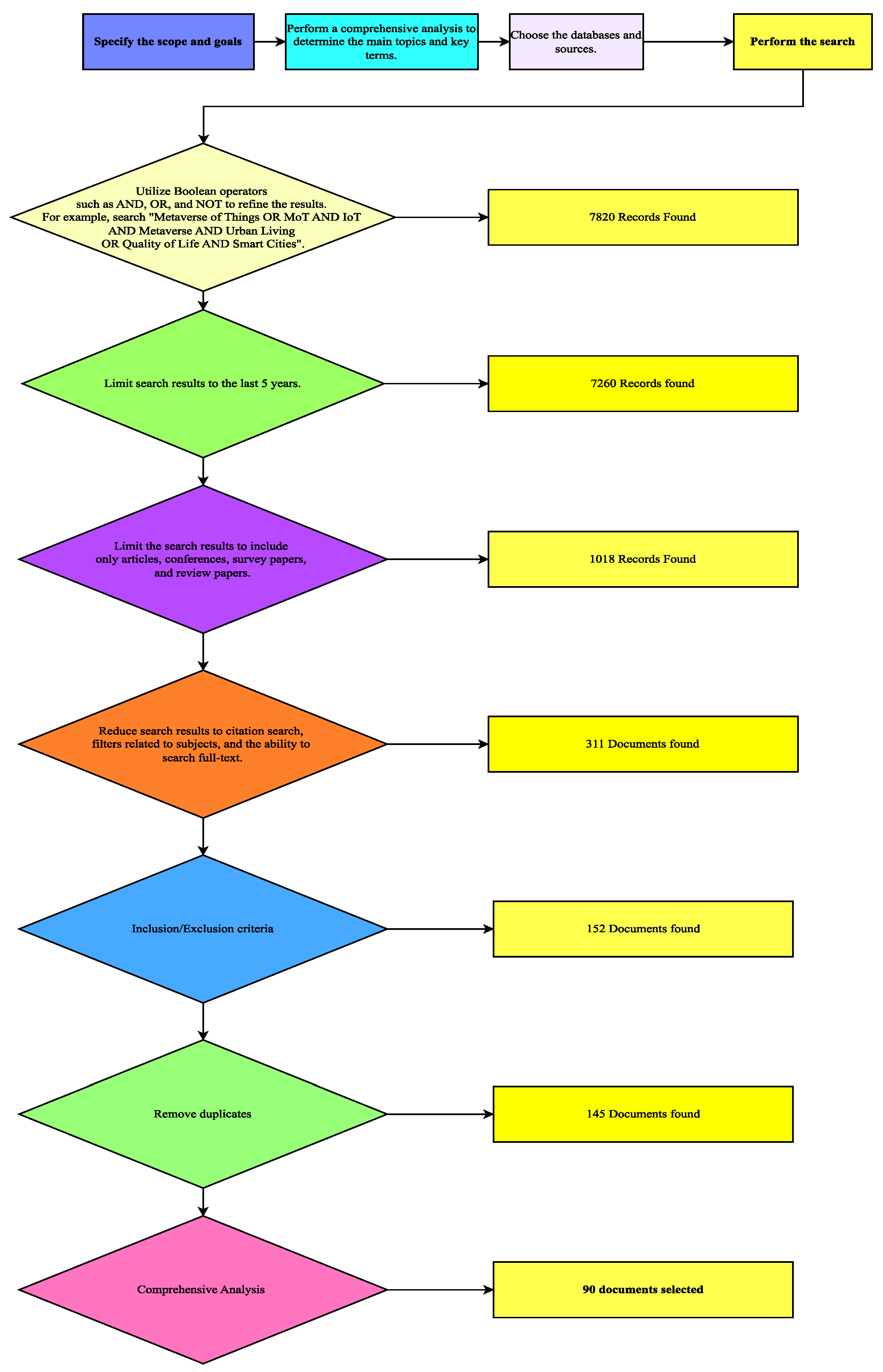
- Specify the scope and goals.
- II.
- Determine the main subjects and key terms.
- III.
- Choose databases and sources.
- Academic databases including IEEE Xplore, ACM Digital Library, Springer, ScienceDirect, and Google Scholar.
- Sources encompass online platforms, academic dissertations, and intellectual property rights documents.
- IV.
- Perform the search:
- Boolean operators: The author employed the use of AND, OR, and NOT operators to merge phrases and refine search outcomes. The author acquired 7820 research papers by employing the search term “ Metaverse of Things OR MoT AND IoT AND Metaverse AND Urban Living OR Quality of Life AND Smart Cities.”
- Utilize filters:
- Limit the search results to the previous 5 years. The author acquired a total of 7260 papers.
- Limit the search results to include only articles, conferences, survey papers, and review papers. The author acquired a total of 1018 documents.
- Utilize advanced search functionalities, such as database-specific capabilities like citation search, subject-specific filters, and resources for doing full-text searches. The author selected the most appropriate 311 articles.
- Apply inclusion/exclusion criteria. The author selected the most appropriate 152 articles.
- Remove duplicate documents. The author selected the most appropriate 145 articles.
- V.
- Conduct a comprehensive review and choose the most suitable literature.
- Abstract Screening: The author rapidly evaluated abstracts for their pertinence and thereafter examined the chosen works in detail.
- Citation Tracking: The author traced the references in important works to discover additional relevant literature.
2.1.2. Inclusion and Exclusion Criteria
2.1.3. Summarize the Relevant Literature
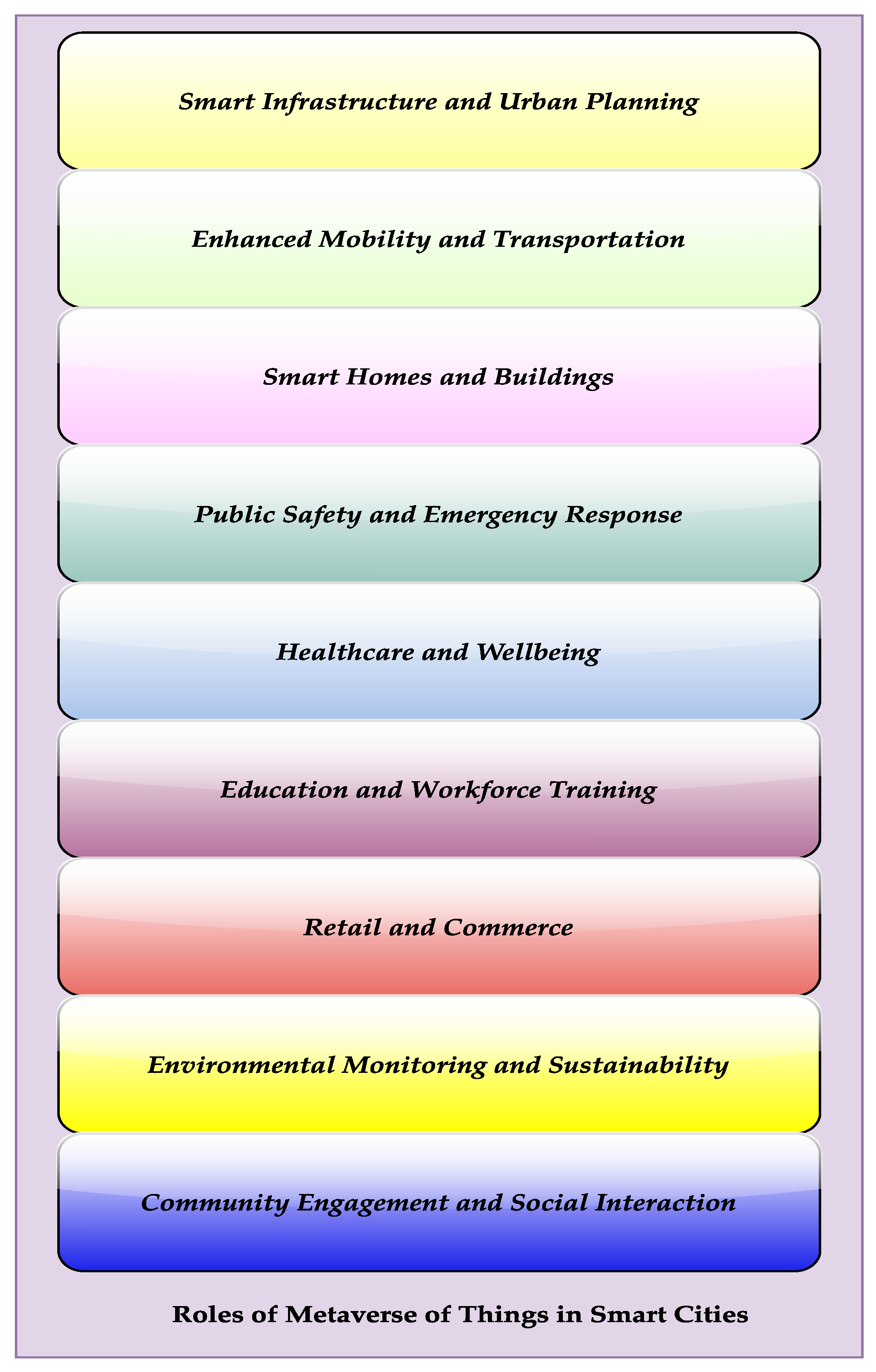
3. Roles of MoT in Smart Cities
3.1. Smart Infrastructure and Urban Planning
- Virtual Urban Planning and Design
- 2.
- Smart Infrastructure Management
- 3.
- Enhanced Data Integration and Analysis
- 4.
- Public Participation and Inclusivity
- 5.
- Education and Training
- 6.
- Economic and Environmental Benefits
- 7.
- Safety and Emergency Planning
3.1.1. Digital Twins
3.1.2. AR for Urban Navigation
3.1.3. Predictive Maintenance
3.2. Enhanced Mobility and Transportation
3.2.1. Real-Time Traffic Management
3.2.2. Autonomous Vehicles
3.2.3. AR Navigation Aids
3.3. Smart Homes and Buildings
3.3.1. Integrated Home Management Systems
3.3.2. Virtual Real Estate Tours
3.4. Public Safety and Emergency Response
3.4.1. Virtual Training Simulations
3.4.2. Enhanced Surveillance and Monitoring
3.5. Healthcare and Wellbeing
3.5.1. Telemedicine and Remote Monitoring
3.5.2. VR Rehabilitation and Therapy
3.6. Education and Workforce Training
3.6.1. Immersive Virtual Classrooms
3.6.2. Simulation-Based Job Training
3.7. Retail and Commerce
3.7.1. Virtual Shopping Experiences
3.7.2. Supply Chain Optimization
3.8. Environmental Monitoring and Sustainability
3.8.1. Real-Time Environmental Data Visualization
3.8.2. Sustainable Urban Planning
3.9. Community Engagement and Social Interaction
3.9.1. Virtual Public Spaces
3.9.2. Participatory Governance
4. Challenges
- MoT applications rely heavily on collecting and analysing vast amounts of data from IoT devices and sensors embedded throughout the urban environment. Ensuring the privacy and security of this data is paramount to protect individuals’ personal information and prevent unauthorised access or misuse.
- The diverse array of IoT devices, platforms, and protocols used in smart cities can hinder the interoperability and seamless integration of MoT applications. Establishing common standards and protocols is essential to facilitate data exchange, interoperability, and collaboration among different systems and stakeholders.
- There is a risk that MoT applications may exacerbate digital divides and exclude segments of the population who lack access to or are unfamiliar with digital technologies. Ensuring equitable access, affordability, and usability of MoT applications is crucial to prevent widening socioeconomic disparities and promote inclusivity in smart cities.
- Deploying MoT applications requires robust infrastructure and reliable connectivity to support real-time data transmission, processing, and communication. However, inadequate infrastructure and connectivity in certain urban areas may limit the scalability and effectiveness of MoT solutions, particularly in developing regions or underserved communities.
- The immersive nature of MoT applications raises ethical concerns related to privacy, consent, autonomy, and societal impact. For instance, AR experiences in public spaces may raise questions about surveillance, consent, and intrusion into individuals’ personal lives. Addressing these ethical considerations requires careful deliberation, stakeholder engagement, and transparent governance frameworks.
- Smart cities are vulnerable to cybersecurity threats, including hacking, data breaches, and ransomware attacks, which can disrupt critical infrastructure and compromise public safety. MoT applications introduce additional attack vectors and cybersecurity risks, necessitating robust cybersecurity measures, incident response plans, and resilience strategies to safeguard urban infrastructure and services.
- The rapid pace of technological innovation in MoT applications outpaces the development of regulatory and legal frameworks to govern their deployment and use. Establishing clear regulations, standards, and policies is essential to address liability, accountability, intellectual property rights, and other legal issues associated with MoT applications in smart cities.
- While MoT applications offer opportunities to enhance resource efficiency and sustainability in smart cities, they also consume energy and require material resources for manufacturing and operation. To mitigate adverse environmental consequences, it is essential to ensure that MoT solutions are designed with environmental sustainability in mind, minimising their carbon footprint and ecological impact.
5. Opportunities
- Implementing MoT applications to revolutionise urban living in smart cities presents several opportunities.The MoT application could improve traffic flow and reduce congestion through real-time traffic management and dynamic routing. The impacts are shorter travel times, lower emissions, and increased convenience for commuters.
- MoT can optimise the energy consumption in smart buildings and public infrastructure through IoT and AI. The impacts are reduced energy costs, lower carbon footprint, and enhanced sustainability in urban areas.
- Enhanced surveillance and quicker emergency response through smart cameras and IoT-based alert systems are possible using the MoT. The impacts are increased safety, faster response times in emergencies, and reduced crime rates.
- Remote patient monitoring and telehealth services enable continuous care and early detection of health issues. The impacts are improved health outcomes, reduced healthcare costs, and increased access to medical services.
- Development of new industries and job roles focused on MoT technology, infrastructure, and services. The impacts are economic diversification, new employment opportunities, and the growth of tech-driven urban economies.
- Interactive platforms and AR applications that facilitate greater citizen participation in urban planning and services. The impacts are more responsive and inclusive governance, better public services, and increased civic engagement.
- Personalized shopping experiences and efficient inventory management through MoT will enhance customer satisfaction, reduce operational costs, and increase retail revenue.
- MoT provides AR/VR classrooms and remote learning platforms that provide immersive and interactive educational experiences. The impacts are improved learning outcomes, wider access to education, and the ability to tailor learning to individual needs.
- AR-enhanced tours and VR experiences make cultural sites and historical information more accessible and engaging. The impacts are increased tourism, better preservation of cultural heritage, and enriched visitor experiences.
- Digital twins and real-time data analytics support efficient urban planning and infrastructure development. The impacts are more effective use of resources, reduced planning errors, and enhanced urban liveability.
- Real-time tracking of environmental conditions through IoT sensors for air, water, and soil quality is possible through MoT. The impacts are better environmental protection, informed policy-making, and improved public health.
- MoT-enabled urban farming and precision agriculture maximise yield and resource efficiency. The impacts are increased local food production, reduced transportation costs, and enhanced food security.
- Smart water management, waste management, and public transportation systems enhance service delivery using MoT. The impacts are higher efficiency, lower operational costs, and better quality of public services.
6. Applications of the MoT in Real-Life Scenarios
- Digital amusement.
- 2.
- Online gathering
- 3.
- Entertainment that is centred around active involvement and interaction.
- 4.
- Enhanced instructional sessions
- 5.
- Educating both current and future generations.
- 6.
- Immediate assistance provided by virtual specialists
- 7.
- An improved existence
- 8.
- A world without borders where travel is done virtually.
- 9.
- An unfamiliar social environment.
- 10.
- Encouraging and fostering innovative and imaginative thought processes.
- 11.
- Investigating inaccessible regions.
- 12.
- Enhanced collaboration
- 13.
- Enhanced productivity by the utilisation of design, research, and prototyping.
- 14.
- Real estate
- 15.
- Emerging market prospects.
- 16.
- Future Development opportunities.
7. Discussion
8. Conclusions
Funding
Data Availability Statement
Conflicts of Interest
Abbreviations
| Acronyms | Definition |
| IoT | Internet of Things |
| ML | machine learning |
| MoT | Metaverse of Things |
| VR | virtual reality |
| AR | augmented reality |
| XR | extended reality |
| CAGR | compound annual growth rate |
| AI | artificial intelligence |
| AV | autonomous vehicles |
References
- Colding, J.; Nilsson, C.; Sjöberg, S. Smart Cities for All? Bridging Digital Divides for Socially Sustainable and Inclusive Cities. Smart Cities 2024, 7, 1044–1059. [Google Scholar] [CrossRef] [Scilit]
- Qadir, A.M.; Fatah, A.O. Platformization and the metaverse: Opportunities and challenges for urban sustainability and economic development. EAI Endorsed Trans. Energy Web 2023, 10, 1–29. [Google Scholar] [CrossRef] [Scilit]
- Metaverse: Worldwide, Statista Market Forecast Report. Available online: https://www.statista.com/outlook/amo/metaverse/worldwide (accessed on 22 August 2024).
- Chen, Z.; Gan, W.; Wu, J.; Lin, H.; Chen, C.M. Metaverse for smart cities: A surveys. Internet Things Cyber-Phys. Syst. 2024, 4, 203–216. [Google Scholar] [CrossRef] [Scilit]
- Zeng, F.; Pang, C.; Tang, H. Sensors on Internet of Things Systems for the Sustainable Development of Smart Cities: A Systematic Literature Review. Sensors 2024, 24, 2074. [Google Scholar] [CrossRef] [Scilit]
- Ditlhokwa, G.; Cann, V.E. Postcolonial Analysis of Transcultural News Frames: A Case Study of Facebook Rebranding. J. Transcult. Commun. 2024. [Google Scholar] [CrossRef] [Scilit]
- Zhong, Z. The Impact of Virtual Reality on Gaming. Highlights Sci. Eng. Technol. 2024, 93, 179–184. [Google Scholar] [CrossRef] [Scilit]
- Bibri, S.E.; Jagatheesaperumal, S.K. Harnessing the Potential of the Metaverse and Artificial Intelligence for the Internet of City Things: Cost-Effective XReality and Synergistic AIoT Technologies. Smart Cities 2023, 6, 2397–2429. [Google Scholar] [CrossRef] [Scilit]
- Allam, Z.; Sharifi, A.; Bibri, S.E.; Jones, D.S.; Krogstie, J. The Metaverse as a Virtual Form of Smart Cities: Opportunities and Challenges for Environmental, Economic, and Social Sustainability in Urban Futures. Smart Cities 2022, 5, 771–801. [Google Scholar] [CrossRef] [Scilit]
- de Almeida, G.G.F. Cities and Territorial Brand in The Metaverse: The Metaverse SEOUL Case. Sustainability 2023, 15, 10116. [Google Scholar] [CrossRef] [Scilit]
- Yaqoob, I.; Salah, K.; Jayaraman, R.; Omar, M. Metaverse applications in smart cities: Enabling technologies, opportunities, challenges, and future directions. Internet Things 2023, 23, 100884. [Google Scholar] [CrossRef] [Scilit]
- Li, K.; Cui, Y.; Li, W.; Lv, T.; Yuan, X.; Li, S.; Ni, W.; Simsek, M.; Dressler, F. When internet of things meets metaverse: Convergence of physical and cyber worlds. IEEE Internet Things J. 2022, 10, 4148–4173. [Google Scholar] [CrossRef] [Scilit]
- Wang, J.; Hao, Y.; Hu, L.; Fortino, G.; Alqahtani, S.A.; Chen, M. Urban Sensing of Virtual Internet of Things for Metaverse. IEEE Sens. J. 2024, 24, 5675–5686. [Google Scholar] [CrossRef] [Scilit]
- Wang, Y.; Su, Z.; Zhang, N.; Xing, R.; Liu, D.; Luan, T.H.; Shen, X. A survey on metaverse: Fundamentals, security, and privacy. IEEE Commun. Surv. Tutor. 2022, 25, 319–352. [Google Scholar] [CrossRef] [Scilit]
- Park, S.M.; Kim, Y.G. A metaverse: Taxonomy, components, applications, and open challenges. IEEE Access 2022, 10, 4209–4251. [Google Scholar] [CrossRef] [Scilit]
- Ball, M. The Metaverse: What It Is. Where to Find It, Who Will Build It, and Fortnite, 13. 2020. Available online: https://www.matthewball.co/all/themetaverse (accessed on 22 August 2024).
- Vishkaei, B.M. Metaverse: A new platform for circular smart cities. In Cases on Circular Economy in Practice; IGI Global: Hershey, PA, USA, 2022; pp. 51–69. [Google Scholar] [CrossRef] [Scilit]
- Ali, M.; Naeem, F.; Kaddoum, G.; Hossain, E. Metaverse communications, networking, security, and applications: Research issues, state-of-the-art, and future directions. IEEE Commun. Surv. Tutor. 2023, 26, 1238–1278. [Google Scholar] [CrossRef] [Scilit]
- Hadi, R.; Melumad, S.; Park, E.S. The Metaverse: A new digital frontier for consumer behavior. J. Consum. Psychol. 2024, 34, 142–166. [Google Scholar] [CrossRef] [Scilit]
- Wang, H.; Wang, Z.; Chen, D.; Liu, Q.; Ke, H.; Han, K.K. Metamobility: Connecting Future Mobility With the Metaverse. IEEE Veh. Technol. Mag. 2023, 18, 69–79. [Google Scholar] [CrossRef] [Scilit]
- Bibri, S.E. The social shaping of the metaverse as an alternative to the imaginaries of data-driven smart Cities: A study in science, technology, and society. Smart Cities 2022, 5, 832–874. [Google Scholar] [CrossRef] [Scilit]
- Zawish, M.; Dharejo, F.A.; Khowaja, S.A.; Raza, S.; Davy, S.; Dev, K.; Bellavista, P. AI and 6G into the metaverse: Fundamentals, challenges and future research trends. IEEE Open J. Commun. Soc. 2024, 5, 730–778. [Google Scholar] [CrossRef] [Scilit]
- Kusuma, A.T.; Supangkat, S.H. Metaverse fundamental technologies for smart city: A literature review. In Proceedings of the 2022 International Conference on ICT for Smart Society (ICISS), Virtual, 10–11 August 2022; IEEE: Piscataway, NJ, USA, 2022; pp. 1–7. [Google Scholar] [CrossRef] [Scilit]
- Han, Y.; Leung, C.; In Kim, D. IoT-Assisted Metaverse Services. Metaverse Commun. Comput. Netw. Appl. Technol. Approaches 2023, 241–265. [Google Scholar] [CrossRef] [Scilit]
- To, W.M.; Yu, B.T.; Chung, A.W.; Chung, D.W. Metaverse: Trend, emerging themes, and future directions. Trans. Emerg. Telecommun. Technol. 2024, 35, e4912. [Google Scholar] [CrossRef] [Scilit]
- Chaudhuri, A.; Anand, A. Enable the metaverse and smart society with trustworthy and sustainable ‘things’. J. Data Prot. Priv. 2023, 5, 363–373. [Google Scholar] [CrossRef] [Scilit]
- Ning, H.; Wang, H.; Lin, Y.; Wang, W.; Dhelim, S.; Farha, F.; Ding, J.; Daneshmand, M. A Survey on the Metaverse: The State-of-the-Art, Technologies, Applications, and Challenges. IEEE Internet Things J. 2023, 10, 14671–14688. [Google Scholar] [CrossRef] [Scilit]
- Venugopal, J.P.; Subramanian, A.A.V.; Peatchimuthu, J. The realm of metaverse: A survey. Comput. Animat. Virtual Worlds 2023, 34, e2150. [Google Scholar] [CrossRef] [Scilit]
- Richa, G.; Jindal, V. Metaverse: Interdependent Architecture and Applications. In Applications of Artificial Intelligence in Wireless Communication Systems; IGI Global: Hershey, PA, USA, 2023; pp. 64–91. [Google Scholar] [CrossRef] [Scilit]
- Zhao, L.; Yang, Q.; Huang, H.; Guo, L.; Jiang, S. Intelligent wireless sensing driven metaverse: A survey. Comput. Commun. 2024, 214, 46–56. [Google Scholar] [CrossRef] [Scilit]
- Shi, F.; Ning, H.; Zhang, X.; Li, R.; Tian, Q.; Zhang, S.; Zheng, Y.; Guo, Y.; Daneshmand, M. A new technology perspective of the Metaverse: Its essence, framework and challenges. Digit. Commun. Netw. 2023. [Google Scholar] [CrossRef] [Scilit]
- Jim, J.R.; Hosain, M.T.; Mridha, M.F.; Kabir, M.M.; Shin, J. Towards Trustworthy Metaverse: Advancements and Challenges. IEEE Access 2023, 11, 118318–118347. [Google Scholar] [CrossRef] [Scilit]
- Aslam, A.M.; Chaudhary, R.; Bhardwaj, A.; Budhiraja, I.; Kumar, N.; Zeadally, S. Metaverse for 6G and Beyond: The next revolution and deployMent ChallenGes. IEEE Internet Things Mag. 2023, 6, 32–39. [Google Scholar] [CrossRef] [Scilit]
- Gaber, T.; Awotunde, J.B.; Torky, M.; Ajagbe, S.A.; Hammoudeh, M.; Li, W. Metaverse-IDS: Deep learning-based intrusion detection system for Metaverse-IoT networks. Internet Things 2023, 24, 100977. [Google Scholar] [CrossRef] [Scilit]
- Jamshidi, M.; Dehghaniyan Serej, A.; Jamshidi, A.; Moztarzadeh, O. The meta-metaverse: Ideation and future directions. Future Internet 2023, 15, 252. [Google Scholar] [CrossRef] [Scilit]
- Ismail, L.; Buyya, R. Metaverse: A Vision, Architectural Elements, and Future Directions for Scalable and Realtime Virtual Worlds. arXiv 2023, arXiv:2308.10559. [Google Scholar] [CrossRef] [Scilit]
- De Giovanni, P. Sustainability of the Metaverse: A transition to Industry 5.0. Sustainability 2023, 15, 6079. [Google Scholar] [CrossRef] [Scilit]
- Carrión, C. Research streams and open challenges in the metaverse. J. Supercomput. 2023, 80, 1598–1639. [Google Scholar] [CrossRef] [Scilit]
- Hudson-Smith, A.; Batty, M. Designing the urban metaverse: Visual analytics for urban design. In The Routledge Handbook of Urban Design Research Methods; Routledge: Oxfordshire, UK, 2023; pp. 427–438. [Google Scholar] [CrossRef] [Scilit]
- Xu, X.; Sheng, Q.Z.; Benatallah, B.; Chen, Z.; Gazda, R.; Saddik, A.E.; Singh, M.P. Metaverse services: The way of services towards the future. In Proceedings of the 2023 IEEE International Conference on Web Services (ICWS), Chicago, IL, USA, 2–8 July 2023; IEEE: Piscataway, NJ, USA, 2023; pp. 179–185. [Google Scholar] [CrossRef] [Scilit]
- Chen, Z. Metaverse office: Exploring future teleworking model. Kybernetes 2023, 53, 2029–2045. [Google Scholar] [CrossRef] [Scilit]
- Aljanabi, M.; Mohammed, S.Y. Metaverse: Open possibilities. Iraqi J. Comput. Sci. Math. 2023, 4, 79–86. [Google Scholar] [CrossRef] [Scilit]
- Kang, G.; Koo, J.; Kim, Y. Security and Privacy Requirements for the Metaverse: A Metaverse Applications Perspective. IEEE Commun. Mag. 2023, 62, 148–154. [Google Scholar] [CrossRef] [Scilit]
- Ramalingam, M.; Yenduri, G.; Baza, M.; Srivastava, G.; Gadekallu, T.R. GPT for the Metaverse in Smart Cities. In Proceedings of the 2023 26th International Symposium on Wireless Personal Multimedia Communications (WPMC), Tampa, FL, USA, 19–22 November 2023; IEEE: Piscataway, NJ, USA, 2023; pp. 1–6. [Google Scholar] [CrossRef] [Scilit]
- Lytras, M.D. Future Smart Cities Research: Identifying the Next Generation Challenges. In Smart Cities and Digital Transformation: Empowering Communities, Limitless Innovation, Sustainable Development and the Next Generation; Emerald Publishing Limited: Bradford, UK, 2023; pp. 1–11. [Google Scholar] [CrossRef] [Scilit]
- Karthikeyan, M.P.; Nidhya, M.S.; Radhamani, E.; Ananthi, S. A Smart City Metaverse Using the Internet of Things with Cloud Security. In AI-Aided IoT Technologies and Applications for Smart Business and Production; CRC Press: Boca Raton, FL, USA, 2023; pp. 271–287. [Google Scholar] [CrossRef] [Scilit]
- Xu, H.; Berres, A.; Shao, Y.; Wang, C.R.; New, J.R.; Omitaomu, O.A. Toward a Smart Metaverse City. In Advances in Scalable and Intelligent Geospatial Analytics; Taylor Francis Group: Abingdon, UK, 2023; pp. 245–257. [Google Scholar] [CrossRef] [Scilit]
- Bibri, S.E. The Metaverse as a Virtual Model of Platform Urbanism: Its Converging AIoT, XReality, Neurotech, and Nanobiotech and Their Applications, Challenges, and Risks. Smart Cities 2023, 6, 1345–1384. [Google Scholar] [CrossRef] [Scilit]
- Bhattacharya, P.; Saraswat, D.; Savaliya, D.; Sanghavi, S.; Verma, A.; Sakariya, V.; Tanwar, S.; Sharma, R.; Raboaca, M.S.; Manea, D.L. Towards future internet: The metaverse perspective for diverse industrial applications. Mathematics 2023, 11, 941. [Google Scholar] [CrossRef] [Scilit]
- Huynh-The, T.; Pham, Q.V.; Pham, X.Q.; Nguyen, T.T.; Han, Z.; Kim, D.S. Artificial intelligence for the metaverse: A survey. Eng. Appl. Artif. Intell. 2023, 117, 105581. [Google Scholar] [CrossRef] [Scilit]
- Yoo, S.C.; Piscarac, D.; Kang, S. Digital outdoor advertising tecoration for the metaverse smart city. Int. J. Adv. Cult. Technol. 2022, 10, 196–203. [Google Scholar] [CrossRef]
- Huang, Y.; Li, Y.J.; Cai, Z. Security and privacy in metaverse: A comprehensive survey. Big Data Min. Anal. 2023, 6, 234–247. [Google Scholar] [CrossRef] [Scilit]
- Lv, Z.; Shang, W.L.; Guizani, M. Impact of Digital Twins and Metaverse on Cities: History, Current Situation, and Application Perspectives. Appl. Sci. 2022, 12, 12820. [Google Scholar] [CrossRef] [Scilit]
- Suanpang, P.; Niamsorn, C.; Pothipassa, P.; Chunhapataragul, T.; Netwong, T.; Jermsittiparsert, K. Extensible metaverse implication for a smart tourism city. Sustainability 2022, 14, 14027. [Google Scholar] [CrossRef] [Scilit]
- Asif, R.; Hassan, S.R. Exploring the confluence of IoT and metaverse: Future opportunities and challenges. IoT 2023, 4, 412–429. [Google Scholar] [CrossRef] [Scilit]
- Ud Din, I.; Awan, K.A.; Almogren, A.; Rodrigues, J.J. Integration of IoT and blockchain for decentralized management and ownership in the metaverse. Int. J. Commun. Syst. 2023, 36, e5612. [Google Scholar] [CrossRef] [Scilit]
- Mukherjee, S. Application of Metaverse and Its Underlying Challenges in the 21st Century. In How the Metaverse Will Reshape Business and Sustainability; Springer Nature: Singapore, 2023; pp. 195–205. [Google Scholar] [CrossRef] [Scilit]
- Veeraiah, V.; Gangavathi, P.; Ahamad, S.; Talukdar, S.B.; Gupta, A.; Talukdar, V. Enhancement of meta verse capabilities by IoT integration. In Proceedings of the 2022 2nd International Conference on Advance Computing and Innovative Technologies in Engineering (ICACITE), Greater Noida, India, 28–29 April 2022; IEEE: Piscataway, NJ, USA, 2022; pp. 1493–1498. [Google Scholar] [CrossRef] [Scilit]
- Kumar, S. Virtual Power Plants: Metaverse for the Power Sector. 2022. Available online: https://www.financialexpress.com/opinion/virtual-power-plants-metaverse-for-the-power-sector/2511907/ (accessed on 22 August 2024).
- Di Pietro, R.; Cresci, S. Metaverse: Security and privacy issues. In Proceedings of the 2021 Third IEEE International Conference on Trust, Privacy and Security in Intelligent Systems and Applications (TPS-ISA), Virtual, 13–15 December 2021; IEEE: Piscataway, NJ, USA, 2021; pp. 281–288. [Google Scholar] [CrossRef] [Scilit]
- Richter, S.; Richter, A. What is novel about the Metaverse? Int. J. Inf. Manag. 2023, 73, 102684. [Google Scholar] [CrossRef] [Scilit]
- Ball, M. The Metaverse: And How It Will Revolutionize Everything; Liveright Publishing: New York, NY, USA, 2022. [Google Scholar] [CrossRef] [Scilit]
- Ambolis, D. What Is Metaverse Of Things (MoT) and How It Is Different from IoT, Blockchain Magazine. 2023. Available online: https://blockchainmagazine.net/what-is-metaverse-of-thingsmot-and-how-it-is-different-from-internet-of-things-iot/ (accessed on 22 August 2024).
- Grijpink, F.; Kutcher, E.; Menard, A.; Ramaswamy, S.; Schiavotto, D.; Manyika, J.; Chui, M.; Hamill, R.; Okan, E. Connected World. An Evolution in Connectivity beyond the 5G Revolution/McKinsey Global Institute. 2020. Available online: https://www.mckinsey.com/industries/technology-media-and-telecommunications/our-insights/connected-world-an-evolution-in-connectivity-beyond-the-5g-revolution (accessed on 22 August 2024).
- Hemmati, M. The metaverse: An urban revolution. Tour. Cult. 2022, 2, 53–60. [Google Scholar] [CrossRef]
- Tukur, M.; Schneider, J.; Househ, M.; Dokoro, A.H.; Ismail, U.I.; Dawaki, M.; Agus, M. The metaverse digital environments: A scoping review of the techniques, technologies, and applications. J. King Saud Univ.-Comput. Inf. Sci. 2024, 36, 101967. [Google Scholar] [CrossRef] [Scilit]
- Li, Y.; Song, X. Toward a Metaverse Era: A Study on the Design of Smart Home Entertainment Scene Experience for Empty-Nest Youth. In Proceedings of the Tenth International Symposium of Chinese CHI, Guangzhou, China, 22 October 2022; pp. 62–71. [Google Scholar] [CrossRef] [Scilit]
- Lim, D.; Lim, W.Y.; Jiang, H.; Ng, W.C.; Niyato, D. The Real Estate Metaverse. In Proceedings of the IEEE INFOCOM 2024-IEEE Conference on Computer Communications Workshops (INFOCOM WKSHPS), Vancouver, BC, Canada, 20 May 2024; IEEE: Piscataway, NJ, USA, 2024; pp. 1–2. [Google Scholar] [CrossRef] [Scilit]
- Wu, Y.; Zhu, Y.; Wang, L.; Wu, B. An emergency rescue system architecture based on metaverse. In Proceedings of the 2022 IEEE CyberSciTech/PICom/DASC/CBDCom 2022, Calabria, Italy, 12 September 2022; IEEE: Piscataway, NJ, USA, 2022; pp. 1–6. [Google Scholar] [CrossRef] [Scilit]
- Ljungholm, D.P. Metaverse-based 3D visual modeling, virtual reality training experiences, and wearable biological measuring devices in immersive workplaces. Psychosociological Issues Hum. Resour. Manag. 2022, 10, 64–77. [Google Scholar] [CrossRef] [Scilit]
- Andrejevic, M. Meta-surveillance in the digital enclosure. Surveill. Soc. 2022, 20, 390–396. [Google Scholar] [CrossRef] [Scilit]
- Ullah, H.; Manickam, S.; Obaidat, M.; Laghari, S.U.; Uddin, M. Exploring the potential of metaverse technology in healthcare: Applications, challenges, and future directions. IEEE Access 2023, 11, 69686–69707. [Google Scholar] [CrossRef] [Scilit]
- Damaševičius, R.; Abayomi-Alli, O.O. The Future of Telemedicine: Emerging Technologies, Challenges, and Opportunities. Metaverse Appl. Intell. Healthc. 2024, 306–338. [Google Scholar] [CrossRef] [Scilit]
- Cho, K.H.; Park, J.B.; Kang, A. Metaverse for Exercise Rehabilitation: Possibilities and Limitations. Int. J. Environ. Res. Public Health 2023, 20, 5483. [Google Scholar] [CrossRef] [Scilit]
- Mitra, S. Metaverse: A potential virtual-physical ecosystem for innovative blended education and training. J. Metaverse 2023, 3, 66–72. [Google Scholar] [CrossRef] [Scilit]
- Phakamach, P.; Senarith, P.; Wachirawongpaisarn, S. The metaverse in education: The future of immersive teaching & learning. RICE J. Creat. Entrep. Manag. 2022, 3, 75–88. Available online: https://www.ricejournal.net/index.php/rice/article/view/54/56 (accessed on 22 August 2024).
- Saeed, A.; Ali, A.; Ashfaq, S. Employees’ training experience in a metaverse environment? Feedback analysis using structural topic modeling. Technol. Forecast. Soc. Chang. 2024, 208, 123636. [Google Scholar] [CrossRef] [Scilit]
- Bourlakis, M.; Papagiannidis, S.; Li, F. Retail spatial evolution: Paving the way from traditional to metaverse retailing. Electron. Commer. Res. 2009, 9, 135–148. [Google Scholar] [CrossRef] [Scilit]
- Swilley, E. Moving virtual retail into reality: Examining metaverse and augmented reality in the online shopping experience. In Looking Forward, Looking Back: Drawing on the Past to Shape the Future of Marketing: Proceedings of the 2013 World Marketing Congress, Melbourne, Australia, 2 December 2015; Springer International Publishing: Cham, Switzerland; pp. 675–677. [CrossRef] [Scilit]
- Dolgui, A.; Ivanov, D. Metaverse supply chain and operations management. Int. J. Prod. Res. 2023, 61, 8179–8191. [Google Scholar] [CrossRef] [Scilit]
- Vlăduțescu, Ș.; Stănescu, G.C. Environmental sustainability of metaverse: Perspectives from Romanian developers. Sustainability 2023, 15, 11704. [Google Scholar] [CrossRef] [Scilit]
- Kovacova, M.; Machova, V.; Bennett, D. Immersive extended reality technologies, data visualization tools, and customer behavior analytics in the metaverse commerce. J. Self-Gov. Manag. Econ. 2022, 10, 7–21. [Google Scholar] [CrossRef] [Scilit]
- Dorostkar, E.; Najarsadeghi, M. Sustainability and urban climate: How Metaverse can influence urban planning? Environ. Plan. B Urban Anal. City Sci. 2023, 50, 1711–1717. [Google Scholar] [CrossRef] [Scilit]
- Bernasconi, C.; Blume, L.B. Theorizing architectural research and practice in the metaverse: The meta-context of virtual community engagement. Archnet-IJAR Int. J. Archit. Res. 2023. [CrossRef] [Scilit]
- Hong, R.; He, H. Interference and consultation in virtual public space: The practice of intermedia art in metaverse. In Proceedings of the 2021 17th International Conference on Mobility, Sensing and Networking (msn), Exeter, UK, 13 December 2021; IEEE: Piscataway, NJ, USA, 2021; pp. 792–797. [Google Scholar] [CrossRef] [Scilit]
- Uzun, M.M. Metaverse Governance. In Metaverse: Technologies, Opportunities and Threats; Springer Nature: Singapore, 2023; pp. 231–244. [Google Scholar] [CrossRef] [Scilit]
- Swami, P. Metaverse: Transforming the User Experience in the Gaming and Entertainment Industry. In Research, Innovation, and Industry Impacts of the Metaverse; IGI Global: Hershey, PA, USA, 2024; pp. 115–128. [Google Scholar] [CrossRef] [Scilit]
- Kim, H.; Kim, M. Presence and effectiveness of online learning using a metaverse platform: Gather. town. Int. J. Inf. Educ. Technol. 2023, 13, 690–695. [Google Scholar] [CrossRef] [Scilit]
- Evans, L.; Frith, J.; Saker, M. Entertainment worlds. In From Microverse to Metaverse; Emerald Publishing Limited: Bradford, UK, 2022; pp. 65–73. [Google Scholar] [CrossRef] [Scilit]
- Shu, X.; Gu, X. An empirical study of A smart education model enabled by the edu-metaverse to enhance better learning outcomes for students. Systems 2023, 11, 75. [Google Scholar] [CrossRef] [Scilit]



| Reference | Authors and Year | Focused | Technology Used | Applications | Limitations | Novel Contributions |
|---|---|---|---|---|---|---|
| [8] | Bibri et al. (2023) | Linking the Ability of the Metaverse and Artificial Intelligence for the Internet of City Things | XReality and AIoT Technologies | Urban planning and design, tourism, real estate, smart retail, healthcare, and entertainment and events. | No focus on the integrated application of the metaverse and IoT. | Introduction of the integration of the metaverse and AI for IoT. |
| [9] | Allam et al. (2022) | Metaverse as a Virtual Form of Smart Cities | VR/AR | Social interactions in urban form, urban climate change, urban tourism, quality of life, and urban governance. | No focus on urban infrastructure, and limited real-world data integration. | Exploring the opportunities and challenges for environmental, economic, and social sustainability in urban futures. |
| [10] | de Almeida (2023) | Cities and Territorial Brand in The Metaverse: The Metaverse SEOUL Case | Metaverse | Metaverse city, Seoul’s urban–regional involvement, and urban–regional strategies. | No focus on the integrated application of the metaverse and IoT. | Integration of IoT data for enhanced urban services, and novel interaction models. |
| [11] | Yaqoob et al. (2023) | Metaverse applications in smart cities | AR, VR, MR, and XR | Smart homes, transportation, energy, supply chain management, healthcare, retail industry, and banking. | No focus on the integrated application of the metaverse and IoT. | Introducing the enabling technologies, opportunities, challenges, and future directions. |
| Proposed | MoT applications for Revolutionizing Urban Living in Smart Cities | IoT + Metaverse | Several areas, including urban management, public safety, and cultural experiences. | None (as identified). | Reviewing MoT applications to revolutionise urban living in smart cities. |
| Reference | Authors | Year | Focus | Methodology |
|---|---|---|---|---|
| [11] | Yaqoob et al., | 2023 | Exploring the potential of metaverse-driven smart city applications: analysing prospects, challenges, the technology that makes it possible, and potential future developments. | Smart Cities, Metaverse |
| [12] | Li et al., | 2022 | The integration of the IoT and the metaverse erases the clear separation between the physical and digital domains. | IoT, Metaverse |
| [13] | Wang et al., | 2024 | Utilising the Virtual IoT, urban sensing is conducted in the metaverse. | IoT, Metaverse |
| [14] | Wang et al., | 2022 | A comprehensive examination of the metaverse, encompassing fundamental aspects such as security and privacy. | IoT, Metaverse, security and privacy |
| [15] | Park and Kim | 2022 | The essential elements, potential uses, unresolved issues, and categorisation of a metaverse. | Metaverse |
| [16] | Ball, | 2020 | Definition of metaverse. The topics of discussion are the construction, location, and the video game Fortnite. | Metaverse, Gaming |
| [17] | Vishkaei, | 2022 | The metaverse is a novel platform that circular, smart cities can utilise. | Smart Cities, Metaverse |
| [18] | Ali et al., | 2023 | This text discusses research topics pertaining to metaverse communications, networking, security, and applications. It also covers existing best practices and potential future advancements in these areas. | Metaverse |
| [19] | Hadi et al., | 2024 | The metaverse represents a novel digital frontier in relation to consumer behaviour. | Metaverse |
| [20] | Wang et al., | 2023 | Metamobility establishes a connection between upcoming modes of transport and the metaverse. | Mobility, Metaverse |
| [21] | Bibri, | 2022 | The investigation of the metaverse’s social development is being conducted using the perspectives of science, technology, and society rather than the principles of data-driven smart cities. | Smart Cities, Metaverse |
| [22] | Zawish et al., | 2024 | Exploring the basics, challenges, and future research of metaverse artificial intelligence in the context of 6G technology. | AI, Metaverse |
| [23] | Kusuma and Supangkat, | 2022 | An analysis of the use of metaverse-based technologies in the development of smart city infrastructure. | Smart Cities, Metaverse |
| [24] | Han et al., | 2023 | Metaverse services are utilising the capabilities of the IoT. | IoT, Metaverse |
| [25] | To et al., | 2024 | The metaverse encompasses novel ideas, trends, and perspectives regarding the future. | Metaverse |
| [26] | Chaudhuri and Anand, | 2023 | Develop durable and dependable objects to facilitate the advancement of the intelligent society and metaverse. | Smart Society, Metaverse |
| [27] | Ning et al., | 2023 | A comprehensive examination of the metaverse: present comprehension, tools, applications, and obstacles. | Metaverse |
| [28] | Venugopal et al., | 2023 | An investigation of a domain within the metaverse. | Metaverse |
| [29] | Gupta and Jindal | . 2023 | The metaverse: applications and interdependent design. | Metaverse |
| [30] | Zhao et al., | 2024 | A survey was conducted on metaverses that are powered by sophisticated wireless sensing. | Metaverse |
| [31] | Shi et al., | 2023 | An analysis of the metaverse, focusing on its fundamental aspects, environment, and obstacles from the perspective of state-of-the-art technology. | Metaverse |
| [32] | Jim et al., | 2023 | Establishing a reliable metaverse: progress and obstacles. | Metaverse |
| [33] | Aslam et al., | 2023 | The metaverse, in the context of 6G and beyond, signifies the forthcoming revolution and implementation of cognitive obstacles. | Metaverse |
| [34] | Gaber et al., | 2023 | Metaverse-IDS is an intrusion detection system that utilises deep learning techniques and is specifically built to operate within metaverse–IoT networks. | Metaverse, Deep Learning, IoT |
| [35] | Jamshidi et al., | 2023 | Exploration of the conceptual framework and potential future paths for the meta-metaverse. | Metaverse |
| [36] | Ismail and Buyya, | 2023 | The metaverse presents a comprehensive plan encompassing architectural elements for creating virtual worlds that can operate in real-time and can be easily expanded. | Metaverse |
| [37] | De Giovanni, | 2023 | Implementing Industry 5.0 concepts will guarantee the metaverse’s sustainability in the long run. | Metaverse |
| [38] | Carrión, | 2023 | Areas of study and unresolved issues in the field of metaverse research. | Metaverse |
| [39] | Hudson-Smith and Batty, | 2023 | The utilisation of visual analytics in urban planning: constructing the metaverse of the city. | Metaverse |
| [40] | Xu et al., | 2023 | Future prospects of metaverse services. | Metaverse |
| [41] | Chen, | 2023 | It is evaluating a prospective idea for a metaverse-based workplace that enables employees to work from a distance. | Metaverse |
| [42] | Aljanabi and Mohammed, | 2023 | The metaverse offers numerous opportunities. | Metaverse |
| [43] | Kang et al., | 2023 | What are the essential elements for ensuring safety and privacy in the metaverse? This review examines the topic from the viewpoint of metaverse applications. | Metaverse |
| [44] | Ramalingam et al., | 2023 | GPT in the metaverse refers to the ability to sense and understand the physical properties and phenomena within the virtual environment of smart housing. | GPT, Metaverse |
| Proposed | Tanweer Alam | 2024 | Metaverse of Things (MoT) applications for revolutionizing urban living in smart cities | Metaverse, IoT, Urban Living, Smart Cities |
Disclaimer/Publisher’s Note: The statements, opinions and data contained in all publications are solely those of the individual author(s) and contributor(s) and not of MDPI and/or the editor(s). MDPI and/or the editor(s) disclaim responsibility for any injury to people or property resulting from any ideas, methods, instructions or products referred to in the content. |
© 2024 by the author. Licensee MDPI, Basel, Switzerland. This article is an open access article distributed under the terms and conditions of the Creative Commons Attribution (CC BY) license (https://creativecommons.org/licenses/by/4.0/).
Share and Cite
Alam, T. Metaverse of Things (MoT) Applications for Revolutionizing Urban Living in Smart Cities. Smart Cities 2024, 7, 2466-2494. https://doi.org/10.3390/smartcities7050096
Alam T. Metaverse of Things (MoT) Applications for Revolutionizing Urban Living in Smart Cities. Smart Cities. 2024; 7(5):2466-2494. https://doi.org/10.3390/smartcities7050096
Chicago/Turabian StyleAlam, Tanweer. 2024. "Metaverse of Things (MoT) Applications for Revolutionizing Urban Living in Smart Cities" Smart Cities 7, no. 5: 2466-2494. https://doi.org/10.3390/smartcities7050096
APA StyleAlam, T. (2024). Metaverse of Things (MoT) Applications for Revolutionizing Urban Living in Smart Cities. Smart Cities, 7(5), 2466-2494. https://doi.org/10.3390/smartcities7050096