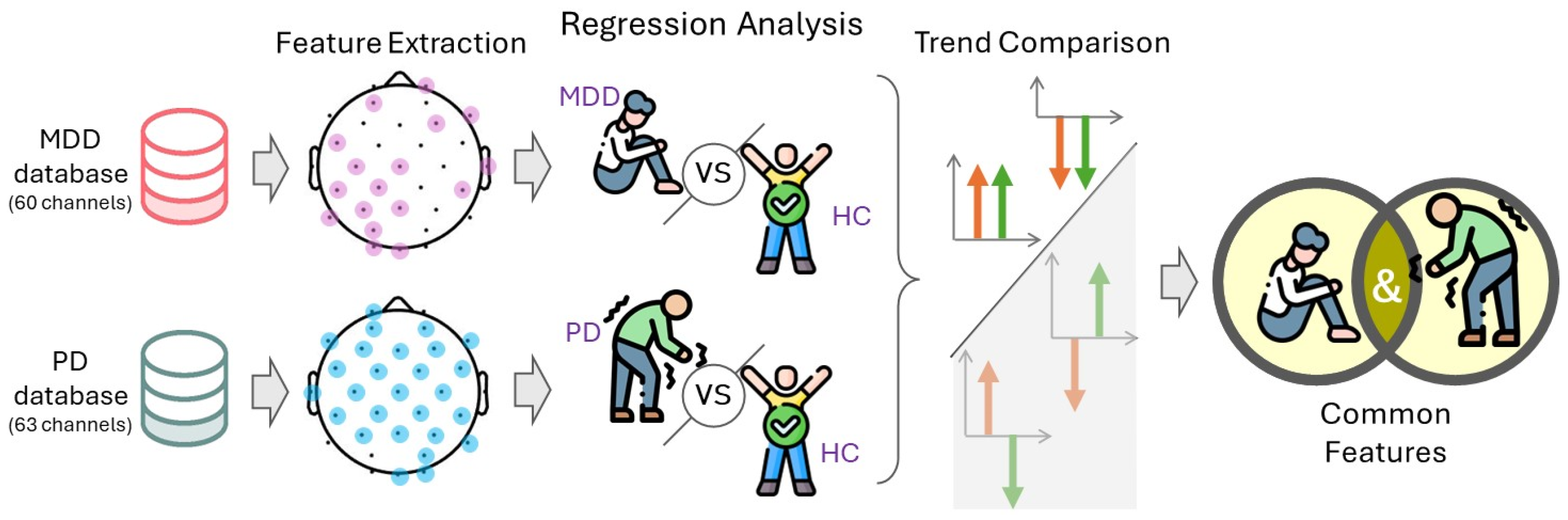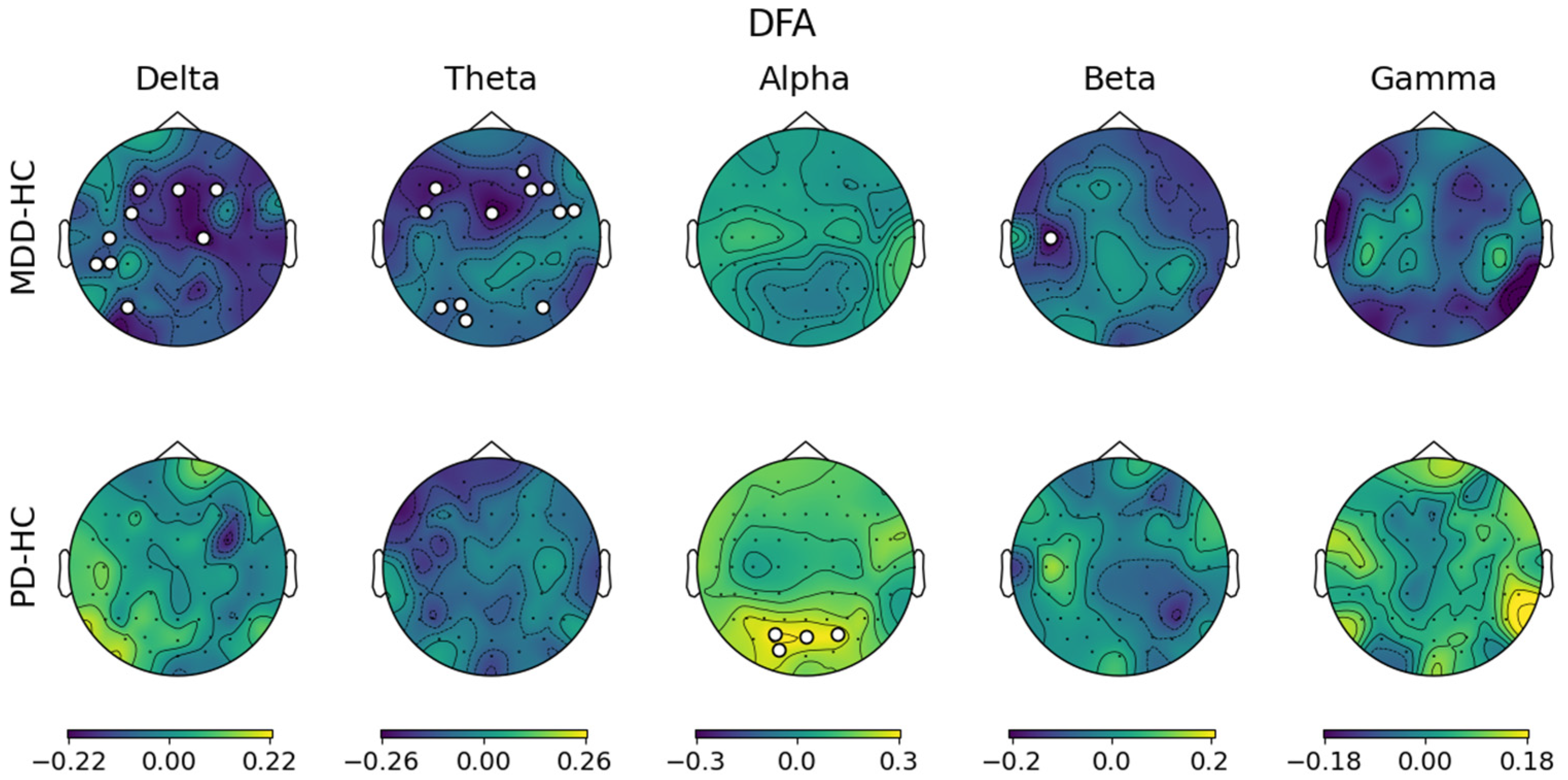

Exploratory Analysis of Electroencephalography Characteristics Shared by Major Depressive Disorder and Parkinson’s Disease: A Database Study

Abstract
1. Introduction
1.1. Parkinson’s Disease
1.2. Depressive Disorder
1.3. Connections Between Depression and PD
- Mitochondrial dysfunction: Mitochondrial dysfunction can trigger oxidative stress by disrupting the mitochondrial electron transport chain, resulting in overproduction of reactive oxygen species (ROS), including free radicals. Excessive ROS can damage cellular lipids, proteins, and DNA, impairing cellular function and stability. DNA breakage, in particular, is a pivotal factor in the pathogenesis of both depression and PD, serving as a fundamental mechanism underlying the progression of these disorders.
- Monoamine hypothesis: Decreased levels of monoamine neurotransmitters can impair neuronal communication, leading to compromised brain functions and symptoms characteristic of depression and PD. For instance, decreased serotonin due to neuronal mutations in the midbrain raphe nucleus may affect the striatum and prefrontal cortex, influencing sleep, mood, and appetite regulation. Furthermore, psychological stress can activate the hypothalamic–pituitary–adrenal (HPA) axis, leading to a reduction in dopamine neurons in the substantia nigra pars compacta, which contributes to depression and cognitive impairment in PD. Stress-induced increases in the norepinephrine level in the locus coeruleus may influence brain regions, leading to inattention, fatigue, and abnormalities in the sympathetic nervous system.
- Inflammation hypothesis: Research on depression has indicated that chronic stress can over-activate the immune system, triggering inflammatory responses, which in turn, disrupt amino acid metabolism, induce neurotoxicity, deplete glial cells, and impair the negative feedback regulation of the HPA axis, causing sickness behavior. Similarly, studies on PD have suggested that dysregulation of the HPA axis can affect glucocorticoid release, increasing the permeability of the blood–brain barrier. This increased permeability allows cytotoxic molecules to penetrate the brain, leading to degeneration of dopamine neurons and the onset of clinical symptoms associated with PD.
2. Materials and Methods
2.1. Datasets
2.1.1. PD Dataset
2.1.2. MDD Dataset
2.2. EEG Processing
- Mean frequency: The sum of the product of the spectrogram intensity and the frequency, divided by the total sum of the spectrogram intensity. , where f is frequency and F(f) is Fourier transformation of signals at that frequency.
- Frequency power: This is the relative power calculated in each band, and it is divided by the sum of the power across the entire frequency.
- Sample entropy: Template vectors, Ym(i), constructed using a given embedding dimension m were used to measure the negative natural logarithm of the probability ln(ψm(r)/ψm + 1(r)), where ψm(r) denotes the number of template vectors having a distance, d(Ym(i), Ym(j)) = max|xi + k − xj + k|, smaller than tolerance r.
- DFA: A cumulative sum, Y(i), calculated from the time-series data set x, where i = 0, 1, …, N, was divided into time windows of length n and was linearly fitted using least-squared errors. The slope of the log of the root-mean-square deviation from the trend, denoted as , where n = 0.2, 0.25, 0.3, …, 2, against log n within each time window was then calculated using least-squares.
- Interhemispheric asymmetry: A total of 14 pairs (i.e., FP1-FP2, AF3-AF4, F3-F4, F7-F8, FC1-FC2, FC5-FC6, C3-C4, T7-T8, CP1-CP2, CP5-CP6, P3-P4, P7-P8, PO3-PO4 and O1-O2) indices were calculated as (R − L)/(R + L), where R and L are right and left hemisphere powers, respectively.
2.3. Statistical Analysis
3. Results
3.1. Differences in EEG Features Between Patient and Healthy Subject Groups
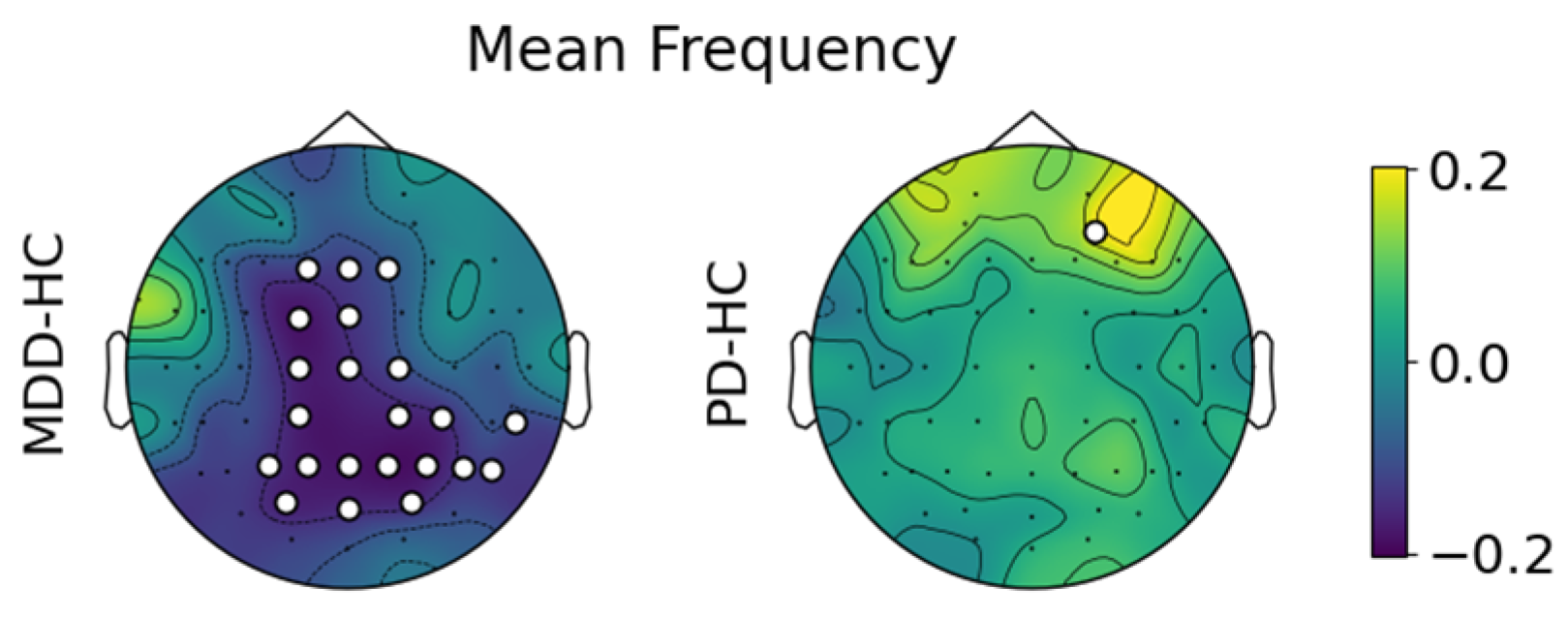
- Mean frequency: MDD patients exhibited significant disease effects (p < 0.05, FDR-corrected) compared with HCs in the fronto-central, central, centroparietal, parietal, and parieto-occipital areas, whereas PD patients showed differences only in the right frontal area. No overlapping significant differences were found between the two groups (Figure 2).Figure 2. Topographic maps of EEG power differences with electrode location profiles, based on statistical analysis of mean frequency between patients (PD or MDD) and HCs. White circles indicate electrodes significant for PD or MDD.Figure 2. Topographic maps of EEG power differences with electrode location profiles, based on statistical analysis of mean frequency between patients (PD or MDD) and HCs. White circles indicate electrodes significant for PD or MDD.

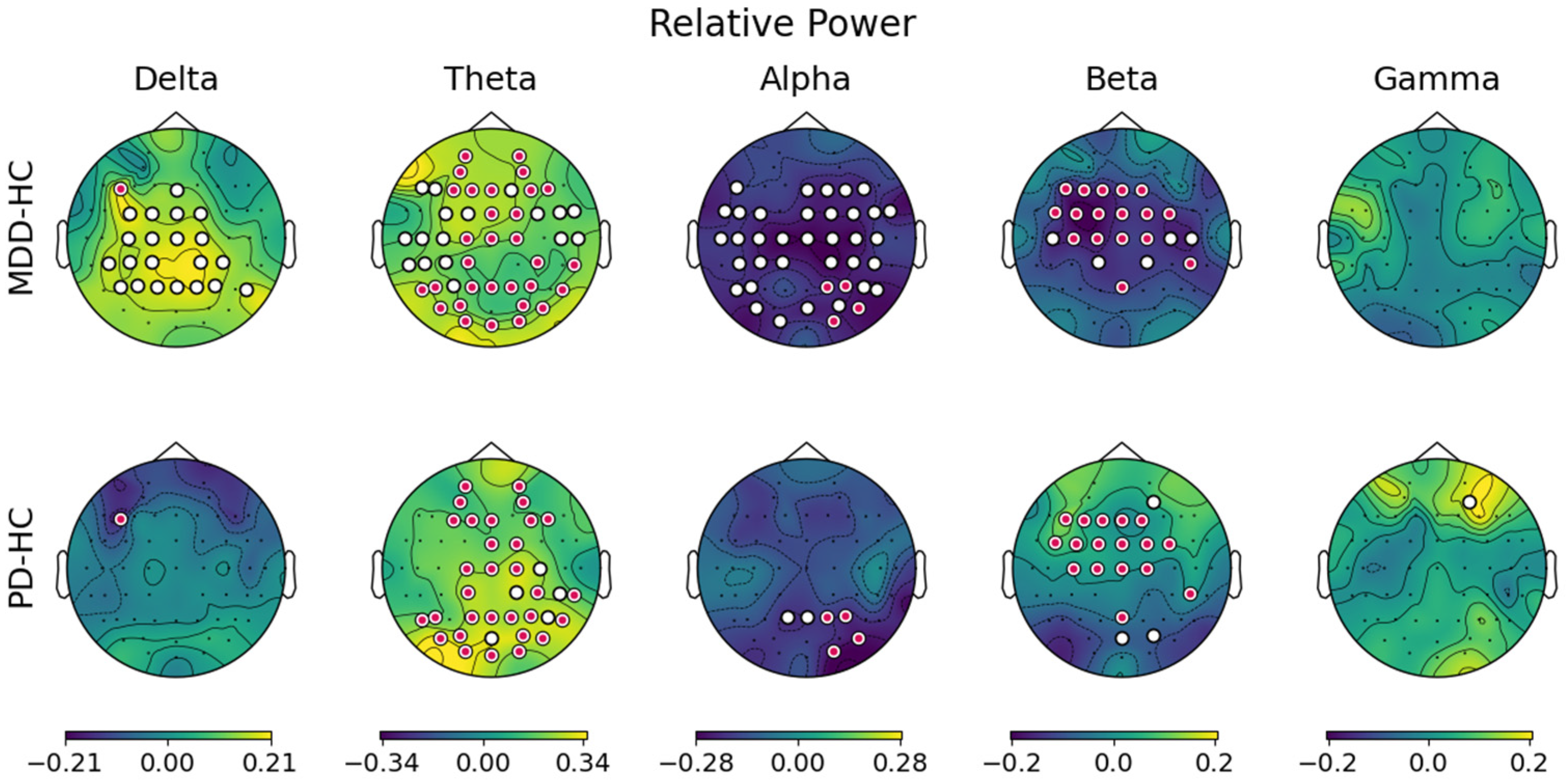
- Frequency power: MDD patients exhibited significant disease effects (p < 0.05, FDR-corrected) compared with HCs in the theta and alpha bands across nearly the entire brain. In the delta band, differences were found in the fronto-central, central, centroparietal, and parietal areas, while the beta band showed differences in the frontal, fronto-central and central areas. PD patients also showed significant differences in the theta band across almost the entire brain area. In the delta band, differences were discovered at F5; in the alpha band they were found over the right parietal area; in the beta band, across the frontal, fronto-central, central and parieto-occipital areas; and in the gamma band, at AF4. Notably, the two groups showed overlapping significant differences in the theta band (across nearly the entire brain area), the alpha band (within the right parietal area) and the beta band (across the frontal, fronto-central, central areas) (Figure 3).Figure 3. Topographic maps of EEG power differences with electrode location profiles, based on statistical analysis of relative power between patients (PD or MDD) and HCs. White circles indicate electrodes significant for PD or MDD, while red circles indicate electrodes significant for both conditions.Figure 3. Topographic maps of EEG power differences with electrode location profiles, based on statistical analysis of relative power between patients (PD or MDD) and HCs. White circles indicate electrodes significant for PD or MDD, while red circles indicate electrodes significant for both conditions.

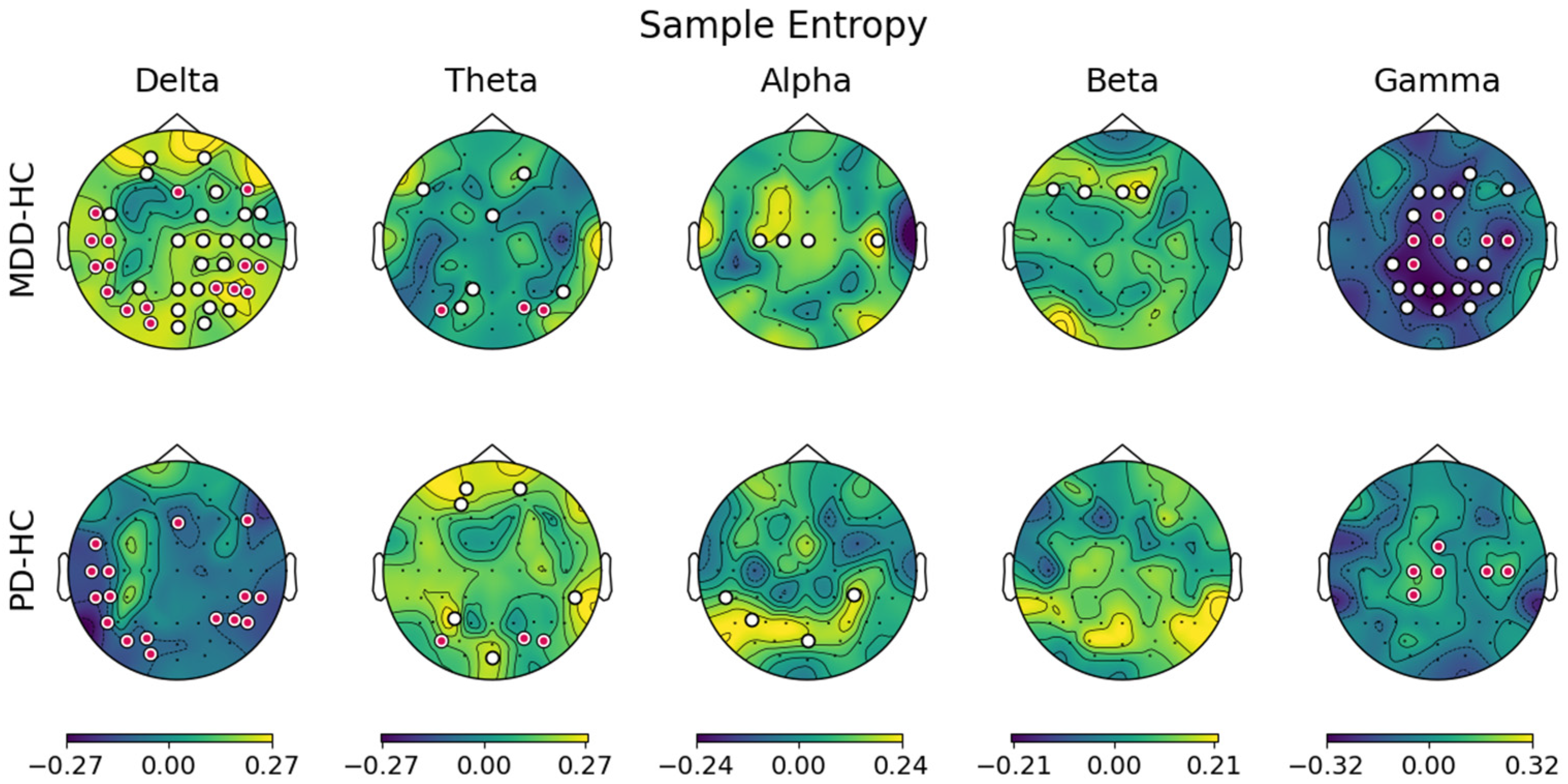
- Sample entropy: MDD patients exhibited significant disease effects (p < 0.05, FDR-corrected) compared with HCs in the delta band across nearly the entire brain. In the theta band, differences were discovered in the frontal, parietal, and parieto-occipital areas; in the alpha band, they were found in the central area; in the beta band, over the frontal area; and in the gamma band, across the frontal, central, centroparietal, parietal and parieto-occipital areas. Conversely, PD patients showed significant differences in the delta band within the centroparietal, temporal, and parietal areas. In the theta band, differences were discovered in the frontal and parieto-occipital areas; in the alpha band, they were found in the parietal area; and in the gamma band, over the central area. Furthermore, the two groups showed overlapping significant differences in the delta band (centroparietal, temporal, and parietal areas), the theta band (parieto-occipital area), and the gamma band (central area) (Figure 4).Figure 4. Topographic maps of EEG power differences with electrode location profiles, based on statistical analysis of sample entropy between patients (PD or MDD) and HCs. White circles indicate electrodes significant for PD or MDD, while red circles indicate electrodes significant for both conditions.Figure 4. Topographic maps of EEG power differences with electrode location profiles, based on statistical analysis of sample entropy between patients (PD or MDD) and HCs. White circles indicate electrodes significant for PD or MDD, while red circles indicate electrodes significant for both conditions.



- 4.
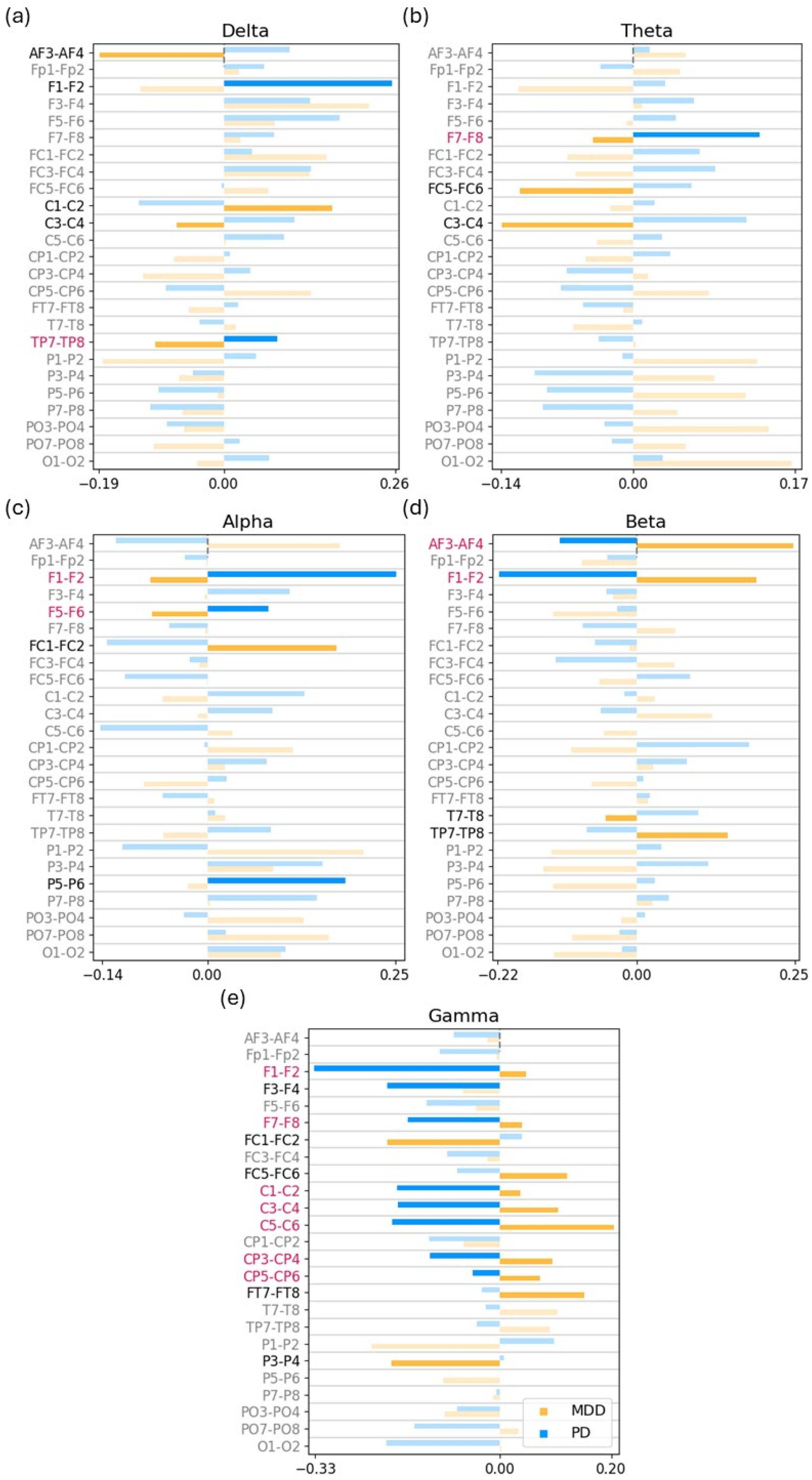
- Interhemispheric asymmetry: Compared with HCs, MDD patients exhibited significant disease effects (p < 0.05, FDR-corrected) in the delta band at AF3-AF4, C1-C2, C3-C4 and TP7-TP8. In the theta band, significant differences were found at F7-F8, FC5-FC6 and C3-C4; in the alpha band, they were found at F1-F2, F5-F6 and FC1-FC2; in the beta band, they were found at AF3-AF4, F1-F2, T7-T8 and TP7-TP8; and in the gamma band, they were found across the frontal, fronto-central, central, and centroparietal areas. Similarly, PD patients showed significant differences in the delta band at F1-F2 and TP7-TP8. In the theta band, a significant difference was found at F7-F8. In the alpha band, significant differences were found at F1-F2, F5-F6 and P5-P6; in the beta band, they were found at AF3-AF4 and F1-F2; and in the gamma band, they were found across the frontal, central, and centroparietal areas. Furthermore, the two groups showed overlapping significant differences in the delta band at TP7-TP8, in the theta at F7-F8, in the alpha at F1-F2 and F5-F6, in the beta band at AF3-AF4 and F1-F2, and in the gamma band at F1-F2, F7-F8, C1-C2, C3-C4, C5-C6, CP3-CP4 and CP5-CP6 (Figure 6).
3.2. Similarity in EEG Features Between PD and MDD Groups
- Frequency power: Compared with HCs, patients with PD and MDD showed significant increases in the theta band at 31 of 56 electrodes (trend ratio = 0.55), including AF3, AF4, Fp1, Fp2, F1, F3, F4, F6, Fz, FC2, FCz, C1, C2, CP1, CP4, Cz, TP8, P1, P2, P4, P5, P7, P8, Pz, PO3, PO4, PO7, PO8, O1, O2 and Oz (refer to Figure 3). Conversely, significant decreases were observed in the alpha (at PO4, PO7, and PO8) and beta bands (at C2, Fz, and Pz).
- Sample entropy: Compared with HCs, patients with PD and MDD showed significant increases were observed in the theta band at PO4, PO7 and PO8. Conversely, significant decreases were observed in the gamma band at FCz.
4. Discussion
4.1. Differences in EEG Features Between Patient and Healthy Subject Groups
4.2. Similarity in EEG Features Between PD and MDD Groups
4.3. Limitations
5. Conclusions
Author Contributions
Funding
Data Availability Statement
Acknowledgments
Conflicts of Interest
Abbreviations
| PD | Parkinson’s disease |
| EEG | Electroencephalography |
| HCs | Healthy controls |
| MDD | Major depressive disorder |
| DSM-5 | Diagnostic and Statistical Manual of Mental Disorders, Fifth Edition |
| BDI | Beck depression inventory |
| ROS | Reactive oxygen species |
| HPA | Hypothalamic–pituitary–adrenal |
| DFA | Detrended fluctuation analysis |
| ShEn | Shannon entropy |
| CD | Correlation dimension |
| BP | Band power |
| FAA | Frontal alpha asymmetry |
| GABA | Gamma-aminobutyric acid |
References
- World Health Organization. Parkinson Disease. 2023. Available online: https://www.who.int/news-room/fact-sheets/detail/parkinson-disease (accessed on 19 March 2024).
- Guedes, B.F.S.; Cardoso, S.M.; Esteves, A.R. The impact of microRNAs on mitochondrial function and immunity: Relevance to Parkinson’s disease. Biomedicines 2023, 11, 1349. [Google Scholar] [CrossRef] [PubMed]
- Schapira, A.H.V.; Chaudhuri, K.R.; Jenner, P. Non-motor features of Parkinson disease. Nat. Rev. Neurosci. 2017, 18, 435–450. [Google Scholar] [CrossRef] [PubMed]
- Yuvaraj, R.; Murugappan, M.; Omar, M.I.; Ibrahim, N.M.; Sundaraj, K.; Mohamad, K.; Satiyan, M. Emotion processing in Parkinson’s disease: An EEG spectral power study. Int. J. Neurosci. 2014, 124, 491–502. [Google Scholar] [CrossRef]
- Iyer, K.K.; Au, T.R.; Angwin, A.J.; Copland, D.A.; Dissanayaka, N.N. Theta and gamma connectivity is linked with affective and cognitive symptoms in Parkinson’s disease. J. Affect. Disord. 2020, 277, 875–884. [Google Scholar] [CrossRef]
- Pappalettera, C.; Miraglia, F.; Cotelli, M.; Rossini, P.M.; Vecchio, F. Analysis of complexity in the EEG activity of Parkinson’s disease patients by means of approximate entropy. GeroScience 2022, 44, 1599–1607. [Google Scholar] [CrossRef] [PubMed]
- World Health Organization. Depression. 2021. Available online: https://www.who.int/news-room/fact-sheets/detail/depression (accessed on 19 March 2024).
- Pitsillou, E.; Bresnehan, S.M.; Kagarakis, E.A.; Wijoyo, S.J.; Liang, J.; Hung, A.; Karagiannis, T.C. The cellular and molecular basis of major depressive disorder: Towards a unified model for understanding clinical depression. Mol. Biol. Rep. 2019, 47, 753–770. [Google Scholar] [CrossRef]
- Mumtaz, W.; Xia, L.; Ali, S.S.A.; Yasin, M.A.M.; Hussain, M.; Malik, A.S. Electroencephalogram (EEG)-based computer-aided technique to diagnose major depressive disorder (MDD). Biomed. Signal Process. Control 2017, 31, 108–115. [Google Scholar] [CrossRef]
- Liu, S.; Liu, X.; Yan, D.; Chen, S.; Liu, Y.; Hao, X.; Ou, W.; Huang, Z.; Su, F.; He, F.; et al. Alterations in patients with first-episode depression in the eyes-open and eyes-closed conditions: A resting-state EEG study. IEEE Trans. Neural Syst. Rehabil. Eng. 2022, 30, 1019–1029. [Google Scholar] [CrossRef]
- Wu, Z.; Zhong, X.; Lin, G.; Peng, Q.; Zhang, M.; Zhou, H.; Wang, Q.; Chen, B.; Ning, Y. Resting-state electroencephalography of neural oscillation and functional connectivity patterns in late-life depression. J. Affect. Disord. 2022, 316, 169–176. [Google Scholar] [CrossRef]
- Yang, L.; Youngblood, H.; Wu, C.; Zhang, Q. Mitochondria as a target for neuroprotection: Role of methylene blue and photobiomodulation. Transl. Neurodegener. 2020, 9, 19. [Google Scholar] [CrossRef]
- Duarte, P.; Cuadrado, A.; Leon, R. Monoamine oxidase inhibitors: From classic to new clinical approaches. In Handbook of Experimental Pharmacology; Springer: Cham, Switzerland, 2020; Volume 264, pp. 229–259. [Google Scholar] [CrossRef]
- Yeung, S.S.H.; Ho, Y.S.; Chang, R.C.C. The role of meningeal populations of type II innate lymphoid cells in modulating neuroinflammation in neurodegenerative diseases. Exp. Mol. Med. 2021, 53, 1251–1267. [Google Scholar] [CrossRef]
- Xu, Y.; Li, Y.; Wang, C.; Han, T.; Liu, H.; Sun, L.; Hong, J.; Hashimoto, M.; Wei, J. The reciprocal interactions between microglia and T cells in Parkinson’s disease: A double-edged sword. J. Neuroinflamm. 2023, 20, 33. [Google Scholar] [CrossRef]
- Cavanagh, J.F.; Kumar, P.; Mueller, A.A.; Richardson, S.P.; Mueen, A. Diminished EEG habituation to novel events effectively classifies Parkinson’s patients. Clin. Neurophysiol. 2018, 129, 409–418. [Google Scholar] [CrossRef]
- Cavanagh, J.F.; Bismark, A.W.; Frank, M.J.; Allen, J.J.B. Multiple dissociations between comorbid depression and anxiety on reward and punishment processing: Evidence from computationally informed EEG. Psychiatry Res. 2019, 3, 1–17. [Google Scholar] [CrossRef] [PubMed]
- Yuvaraj, R.; Murugappan, M. Hemispheric asymmetry non-linear analysis of EEG during emotional responses from idiopathic Parkinson’s disease patients. Cogn. Neurodyn. 2016, 10, 225–234. [Google Scholar] [CrossRef]
- Yuvaraj, R.; Murugappan, M.; Ibrahim, N.M.; Omar, M.I.; Sundaraj, K.; Mohamad, K.; Palaniappan, R.; Mesquita, E.; Satiyan, M. On the analysis of EEG power, frequency and asymmetry in Parkinson’s disease during emotion processing. Behav. Brain Funct. 2014, 10, 10–12. [Google Scholar] [CrossRef] [PubMed]
- Betrouni, N.; Delval, A.; Chaton, L.; Defebvre, L.; Duits, A.; Moonen, A.; Leentjens, A.F.G.; Dujardin, K. Electroencephalography-based machine learning for cognitive profiling in Parkinson’s disease: Preliminary results. Mov. Disord. 2019, 34, 210–217. [Google Scholar] [CrossRef]
- Pezard, L.; Jech, R.; Ruzicka, E. Investigation of non-linear properties of multichannel EEG in the early stages of Parkinson’s disease. Clin. Neurophysiol. 2001, 112, 38–45. [Google Scholar] [CrossRef]
- Obukhov, Y.V.; Gabova, A.V.; Zaljalova, Z.A.; Illarioshkin, S.N.; Karabanov, A.V.; Korolev, M.S.; Kuznetsova, G.D.; Morozov, A.A.; Nigmatullina, R.R.; Obukhov, K.Y.; et al. Electroencephalograms features of the early stage Parkinson’s disease. Pattern Recognit. Image Anal. 2014, 24, 593–604. [Google Scholar] [CrossRef]
- Chaturvedi, M.; Hatz, F.; Gschwandtner, U.; Bogaarts, J.G.; Meyer, A.; Fuhr, P.; Roth, V. Quantitative EEG (QEEG) measures differentiate Parkinson’s disease (PD) patients from healthy controls (HC). Front. Aging Neurosci. 2017, 9, 3. [Google Scholar] [CrossRef]
- Saikia, A.; Hussain, M.; Barua, A.R.; Paul, S. EEG-EMG correlation for Parkinson’s disease. Int. J. Eng. Adv. Technol. 2019, 8, 1179–1185. [Google Scholar] [CrossRef]
- Prabhu, K.S.; Martis, R.J. Diagnosis of Parkinson’s disease using computer-aided tool based on EEG. In 2020 IEEE: 17th India Council International Conference (INDICON), New Delhi, India, 10–13 December 2020; IEEE: Piscataway, NJ, USA, 2020; pp. 1–4. [Google Scholar] [CrossRef]
- Aljalal, M.; Aldosari, S.A.; AlSharabi, K.; Abdurraqeeb, A.M.; Alturki, F.A. Parkinson’s disease detection from resting-state EEG signals using common spatial pattern, entropy, and machine learning techniques. Diagnostics 2022, 12, 1033. [Google Scholar] [CrossRef]
- Averna, A.; Coelli, S.; Ferrara, R.; Cerutti, S.; Priori, A.; Bianchi, A.M. Entropy and fractal analysis of brain-related neurophysiological signals in Alzheimer’s and Parkinson’s disease. J. Neural Eng. 2023, 20, 051001. [Google Scholar] [CrossRef]
- Yang, C.Y.; Chen, H.Y. Analysis and Discrimination of electroencephalography features for Parkinson’s disease during the induction of negative mood. J. Med. Biol. Eng. 2023, 43, 386–393. [Google Scholar] [CrossRef]
- Mahato, S.; Goyal, N.; Ram, D.; Paul, S. Detection of depression and scaling of severity using six-channel EEG data. J. Med. Syst. 2020, 44, 2. [Google Scholar] [CrossRef] [PubMed]
- Saeedi, M.; Saeedi, A.; Maghsoudi, A. Major depressive disorder assessment via enhanced k-nearest neighbor method and EEG signals. Phys. Eng. Sci. Med. 2020, 43, 1007–1018. [Google Scholar] [CrossRef]
- Nassibi, A.; Papavassiliou, C.; Atashzar, S.F. Depression diagnosis using machine intelligence based on spatiospectrotemporal analysis of multi-channel EEG. Med. Biol. Eng. Comput. 2022, 60, 3187–3202. [Google Scholar] [CrossRef]
- de Aguiar Neto, F.S.; Rosa, J.L.G. Depression biomarkers using non-invasive EEG: A review. Neurosci. Biobehav. Rev. 2019, 105, 83–93. [Google Scholar] [CrossRef] [PubMed]
- Khosla, A.; Khandnora, P.; Chand, T. Automated diagnosis of depression from EEG signals using traditional and deep learning approaches: A comparative analysis. Biocybern. Biomed. Eng. 2022, 42, 108–142. [Google Scholar] [CrossRef]
- Halje, P.; Brys, I.; Mariman, J.J.; Cunha, C.D.; Fuentes, R.; Petersson, P. Oscillations in cortico-basal ganglia circuits: Implications for Parkinson’s disease and other neurologic and psychiatric conditions. J. Neurophysiol. 2019, 122, 203–231. [Google Scholar] [CrossRef] [PubMed]
- Bockova, M.; Rektor, I. Impairment of brain functions in Parkinson’s disease reflected by alterations in neural connectivity in EEG studies: A viewpoint. Clin. Neurophysiol. 2019, 130, 239–247. [Google Scholar] [CrossRef]
- Grin-Yatsenko, V.A.; Baas, I.; Ponomarev, V.A.; Kropotov, J.D. EEG power spectra at early stages of depressive disorders. J. Clin. Neurophysiol. 2009, 26, 401–406. [Google Scholar] [CrossRef] [PubMed]
- Özçoban, M.A.; Tan, O. Electroencephalographic markers in major depressive disorder: Insights from absolute, relative power, and asymmetry analyses. Front. Psychiatry 2025, 15, 1480228. [Google Scholar] [CrossRef]
- Roh, S.C.; Kim, J.S.; Kim, S.; Kim, Y.; Lee, S.H. Frontal alpha asymmetry moderated by suicidal ideation in patients with major depressive disorder: A comparison with healthy individuals. Clin. Psychopharmacol. Neurosci. 2020, 18, 58–66. [Google Scholar] [CrossRef]
- da Rocha, T.F.; Costa, V.; Camargo, L.; Fernandes, E.B.; Gianlorenço, A.C. Resting-state EEG alpha asymmetry as a potential marker of clinical features in Parkinson’s disease. J. Pers. Med. 2025, 15, 291. [Google Scholar] [CrossRef]
- Marcu, G.M.; Szekely-Copîndean, R.D.; Radu, A.M.; Bucuță, M.D.; Fleacă, R.S.; Tănăsescu, C.; Roman, M.D.; Boicean, A.; Băcilă, C.I. Resting-state frontal, frontlateral, and parietal alpha asymmetry: A pilot study examining relations with depressive disorder type and severity. Front. Psychol. 2023, 14, 1087081. [Google Scholar] [CrossRef]
- Luo, Y.; Tang, M.; Fan, X. Meta-analysis of resting frontal alpha asymmetry as a biomarker of depression. npj Ment. Health Res. 2025, 4, 2. [Google Scholar] [CrossRef] [PubMed]
- Lau, Z.J.; Pham, T.; Chen, S.H.A.; Makowski, D. Brain entropy, fractal dimensions and predictability: A review of complexity measures for EEG in healthy and neuropsychiatric populations. Eur. J. Neurosci. 2022, 56, 5047–5069. [Google Scholar] [CrossRef]
- Faust, O.; Ang, P.C.A.; Puthankattil, S.D.; Joseph, P.K. Depression diagnosis support system based on EEG signal entropies. J. Mech. Med. Biol. 2014, 14, 1450035. [Google Scholar] [CrossRef]
- Kanunikov, I.E.; Kleeva, D.F. Electroencephalography entropy and depression. S.S. Korsakov J. Neurol. Psychiatry 2022, 122, 106–110. [Google Scholar] [CrossRef]
- Yi, G.S.; Wang, J.; Deng, B.; Wei, X.L. Complexity of resting-state EEG activity in the patients with early-stage Parkinson’s disease. Cogn. Neurodyn. 2017, 11, 147–160. [Google Scholar] [CrossRef] [PubMed]
- Keller, S.M.; Gschwandtner, U.; Meyer, A.; Chaturvedi, M.; Roth, V.; Fuhr, P. Cognitive decline in Parkinson’s disease is associated with reduced complexity of EEG at baseline. Brain Commun. 2020, 2, fcaa207. [Google Scholar] [CrossRef] [PubMed]
- Rahmati, M.; Jalaeianbanayan, A.; Vahedi, J.; Najafzadeh, H.; Danesh, B. Novel EEG-based diagnostic framework for Major Depressive Disorder using microstate and entropy features. Cogn. Neurodyn. 2025, 19, 116. [Google Scholar] [CrossRef]
- Lee, C.H.; Juan, C.H.; Chen, H.H.; Hong, J.P.; Liao, T.W.; French, I.; Lo, Y.S.; Wang, Y.R.; Cheng, M.L.; Wu, H.C.; et al. Long-Range Temporal Correlations in Electroencephalography for Parkinson’s Disease Progression. Mov. Disord. 2025, 40, 266–275. [Google Scholar] [CrossRef]
- Salomon, R.M.; Cowan, R.L. Oscillatory serotonin function in depression. Synapse 2013, 67, 801–820. [Google Scholar] [CrossRef]
- Nyström, C.; Matousek, M.; Hällström, T. Relationships between EEG and biochemical parameters in major depressive disorder. Acta Psychiatr. Scand. 1988, 77, 457–462. [Google Scholar] [CrossRef]
- Olbrich, S.; Trankner, A.; Chittka, T.; Hegerl, U.; Schonknecht, P. Functional connectivity in major depression: Increased phase synchronization between frontal cortical EEG-source estimates. Psychiatry Res. Neuroimaging 2014, 222, 91–99. [Google Scholar] [CrossRef] [PubMed]
- Ip, C.T.; Bardeci, M.D.; Kronenberg, G.; Pinborg, L.H.; Seifritz, E.; Brunovsky, M.; Olbrich, S. EEG-vigilance regulation is associated with and predicts ketamine response in major depressive disorder. Transl. Psychiatry 2024, 14, 64. [Google Scholar] [CrossRef]
- Buddhala, C.; Loftin, S.K.; Kuley, B.M.; Cairns, N.J.; Campbell, M.C.; Perlmutter, J.S.; Kotzbauer, P.T. Dopaminergic, serotonergic, and noradrenergic deficits in Parkinson disease. Ann. Clin. Transl. Neurol. 2015, 2, 949–959. [Google Scholar] [CrossRef]
- Kemp, A.F.; Kinnerup, M.; Johnsen, B.; Jakobsen, S.; Nahimi, A.; Gjedde, A. EEG frequency correlates with α2-receptor density in Parkinson’s disease. Biomolecules 2024, 14, 209. [Google Scholar] [CrossRef]
- Schreiner, S.J.; Imbach, L.L.; Valko, P.O.; Maric, A.; Maqkaj, R.; Werth, E.; Baumann, C.R.; Baumann-Vogel, H. Reduced regional NREM sleep slow-wave activity is associated with cognitive impairment in Parkinson disease. Front. Neurol. 2021, 12, 618101. [Google Scholar] [CrossRef] [PubMed]
- Waninger, S.; Berka, C.; Karic, M.S.; Korszen, S.; Mozley, P.D.; Henchcliffe, C.; Kang, Y.; Hesterman, J.; Mangoubi, T.; Verma, A. Neurophysiological biomarkers of Parkinson’s disease. J. Park. Dis. 2020, 10, 471–480. [Google Scholar] [CrossRef]



| Dataset | Group | Gender | Age | BDI | UPDRS |
|---|---|---|---|---|---|
| PD dataset | PD | 13 M: 7 F | 69.75 (8.59) | 7.64 (5.23) | 22.25 (7.92) |
| HC | 11 M: 9 F | 69.30 (9.40) | 5.27 (4.20) | - | |
| MDD dataset | MDD | 8 M: 12 F | 18.91 (1.34) | 21.52 (5.66) | - |
| HC | 7 M: 13 F | 18.82 (1.96) | 1.14 (1.36) | - |
| Disease | Selected Features | Reference |
|---|---|---|
| PD | Absolute power density, ApEn, Band power (BP), Correlation dimension (CD), DFA, Fractal dimension, Higher order spectrum, Hurst exponent, Interhemispheric (absolute) power asymmetry, Kolmogorov complexity, Largest Lyapunov exponent, Log energy entropy, Localized entropy, Lyapunov exponent, Mean frequency, Multiscale entropy, Norm entropy, Permutation entropy, Relative power, Relative power density, Relative spectral power, SampEn, Shannon entropy (ShEn), Slope asymmetry, Sure entropy and Threshold entropy | [18,19,20,21,22,23,24,25,26,27,28] |
| MDD | Alpha asymmetry, Alpha power variability, ApEn, BP, Brain laterality, C0-complexity, CD, Cluster coefficient, Coherence, DFA, Functional connectivity, Higuchi’s fractal dimension, Hjorth activity, Hjorth complexity, Hjorth mobility, Interhemispheric asymmetry, Kolmogorov-entropy, Lempel–Ziv complexity, Maximum Lyapunov exponent, Mean frequency, Median frequency, Paired asymmetry, Path-length, Phase lag index, Phase synchronization, Power-spectrum density, Power-spectral entropy, Rayleigh-entropy, Relative band power, Root-mean-square, SampEn, ShEn, Singular-value deposition entropy and Spectral asymmetry index | [29,30,31,32,33] |
Disclaimer/Publisher’s Note: The statements, opinions and data contained in all publications are solely those of the individual author(s) and contributor(s) and not of MDPI and/or the editor(s). MDPI and/or the editor(s) disclaim responsibility for any injury to people or property resulting from any ideas, methods, instructions or products referred to in the content. |
© 2026 by the authors. Licensee MDPI, Basel, Switzerland. This article is an open access article distributed under the terms and conditions of the Creative Commons Attribution (CC BY) license.
Share and Cite
Yang, C.-Y.; Kuo, F.-N.; Chen, H.-Y. Exploratory Analysis of Electroencephalography Characteristics Shared by Major Depressive Disorder and Parkinson’s Disease: A Database Study. Signals 2026, 7, 46. https://doi.org/10.3390/signals7030046
Yang C-Y, Kuo F-N, Chen H-Y. Exploratory Analysis of Electroencephalography Characteristics Shared by Major Depressive Disorder and Parkinson’s Disease: A Database Study. Signals. 2026; 7(3):46. https://doi.org/10.3390/signals7030046
Chicago/Turabian StyleYang, Chia-Yen, Fan-Ning Kuo, and Hsin-Yung Chen. 2026. "Exploratory Analysis of Electroencephalography Characteristics Shared by Major Depressive Disorder and Parkinson’s Disease: A Database Study" Signals 7, no. 3: 46. https://doi.org/10.3390/signals7030046
APA StyleYang, C.-Y., Kuo, F.-N., & Chen, H.-Y. (2026). Exploratory Analysis of Electroencephalography Characteristics Shared by Major Depressive Disorder and Parkinson’s Disease: A Database Study. Signals, 7(3), 46. https://doi.org/10.3390/signals7030046