Systematic Review

Auditory Historical Religious Place Experience: A Systematic Review and Thematic Analysis for Identifying Experiential and Perceptual Indicators


by
Zinah Al-bayyar
* and
Papatya Nur Dokmeci Yorukoglu
Department of Interior Architecture, Acoustics Research and Application Center, Çankaya University, 06530 Ankara, Türkiye
*
Author to whom correspondence should be addressed.
Acoustics 2026, 8(3), 43; https://doi.org/10.3390/acoustics8030043
Submission received: 23 March 2026 / Revised: 18 June 2026 / Accepted: 18 June 2026 / Published: 23 June 2026

Abstract

The acoustics and soundscapes of historical religious places (HRPs) have been investigated in the literature. Some of these places are still used for their original functions and for tourism purposes. Being susceptible to alterations and renovations that directly affect the auditory environment, assessing users’ perceptions under these changes becomes important. To clarify users’ experience in HRPs, this study conducted a systematic review by following the PRISMA guidelines. Two phases of literature review were followed. The first phase focused on acoustics-related studies. The results indicated that they address the physical and architectural acoustics of HRPs without including perceptual or experiential assessment. This led to the second phase which used perceptual and soundscape-related keywords. The results showed that there were 24 studies that included subjective evaluation and perceptual descriptors. Based on these results, perceptual attributes (indicators) and assessment scopes were thematically synthesized. The findings revealed a significant gap in linking objective acoustics conditions with subjective experience in HRPs, calling for an integration of both approaches in future studies.

1. Introduction

Religious places are architectural types that have spanned centuries and various civilizations. They are used for different functions in addition to their religious significance, such as touristic attractions or cultural landmarks. The physical elements presented by light, sound, or color provide the required religious and spiritual experience that are expected from users [1,2]. Accordingly, their physical properties play an important role in forming users’ perception of the place.
Religious places introduce an interwoven relationship between the acoustic environment and the properties of the space based on the nature of liturgy and theology of the practiced religion [2]. Additionally, and because of their time-spanning and cultural representation nature, historical religious places are not limited to worshippers—as they can be used for touristic purposes as well. Similarly, the acoustic properties of the place can be different from the original and across various periods of time as works of preservation and renovation take place. Accordingly, the perception of the acoustic environment and the religious spirituality would be different among users.
Several studies have investigated the sound phenomena when historical religious places (HRPs) are experienced. Archaeoacoustic studies have investigated the current and original acoustic environment of various historical religious places [3,4,5,6,7]. These studies highlighted the acoustic conditions of these places in terms of sustaining speech and/or music clarity and sense of spirituality based on on-site measurements and acoustic simulation techniques. However, user assessment generally is not included in these measurements.
Other auditory experience studies in HRPs are found in the literature. For instance, one study investigated the physical and spatio-temporal properties of historical churches and the resulting sensory experience of visitors [8]. Another study explored user perception of an ancient mosque’s soundscape and concluded that indoor soundscape, spatial function, and place identity are interrelated and can have direct effect on users’ response to the place’s physical elements [9]. The acoustic environments of Buddhist temples were evaluated based on four aspects: quietness, comfort, harmony, and sound preference. The study has found that different sound sources were preferred according to the type and relevance of these sources to the temple [10]. Additionally, studies about sense of place and user relation to places have investigated the role of sound phenomena on user perception [11,12,13,14]; however, acoustic measurements were not involved.
Both approaches highlight important factors regarding user perception of HRPs and the acoustic environment. Acoustic-focused research primarily evaluates objective parameters, whereas experience-focused studies utilize various perceptual indicators and assessment scopes. They are rarely synthesized across disciplines. As a result, the assessment of auditory experience in HRPs, the perceptual indicators used in these assessments, and the indicators’ relation to experiential constructs are still not covered in the literature. Therefore, this review aims to address this gap through a systematic identification and thematic analysis of perceptual and experiential indicators used in assessing HRPs when auditory experience is involved as an effective factor of perception. It aims to find (a) the indicators in the literature that assess the subjective response to experiencing historical context when auditory experience is involved, (b) the indicators in the literature that assess the subjective response of experiencing religious context when auditory experience is involved, and (c) the objective acoustic parameters that are considered influential on these indicators.

2. Materials and Methods

PRISMA (Preferred Reporting Items for Systematic Reviews and Meta-Analyses) guidelines were followed for conducting the review. Three phases were included for the process, as shown in Figure 1 and Figure 2. No formal risk-of-bias assessment was conducted as the review synthesizes the assessment scopes and perceptual indicators rather than evaluating intervention effectiveness or study quality.

2.1. Literature Review Design

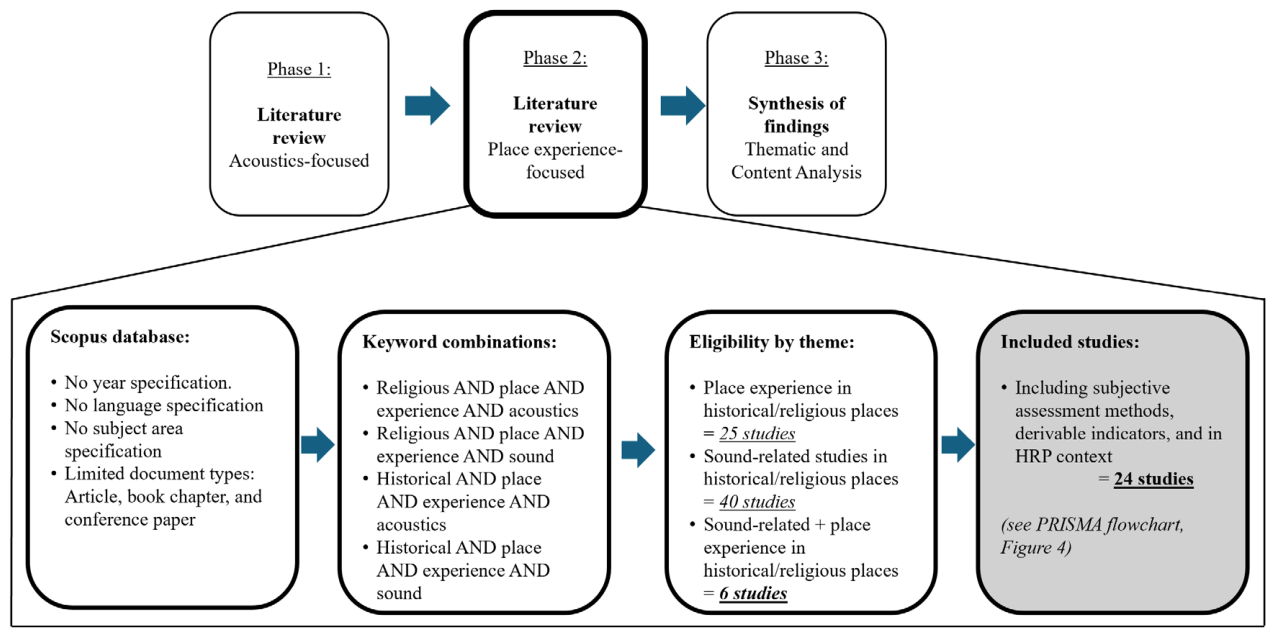
The first and second phases of the study were to identify the literature regarding HRPs (See Supplementary document S1_search strategy). The first phase, the literature review/acoustics-focused, was decided as a diagnosis step that aimed to gather studies that investigate place experience in acoustics-related studies, as shown in Figure 1.
Scopus was the sole database used for retrieving the literature, with last search performed in August 2025. Several aspects were considered to determine the appropriate studies. No specifications for year of publication, language of research, or subject areas were applied. However, the document type was limited to articles, book chapters, and conference papers.
As the initial research aimed to identify the acoustic-based studies inclusion of subjective and experiential evaluation, the absence of this assessment constituted a key finding and motivated the second phase with different keywords’ combinations, as shown in Figure 2.
Phase 2 review targeted literature that directly addresses the place experience, perceptual descriptors, and auditory experience in HRPs. For this purpose, broader perceptual and place experience-wise terms were used (Figure 2).

2.2. Eligibility Criteria, Screening, and Selection Process

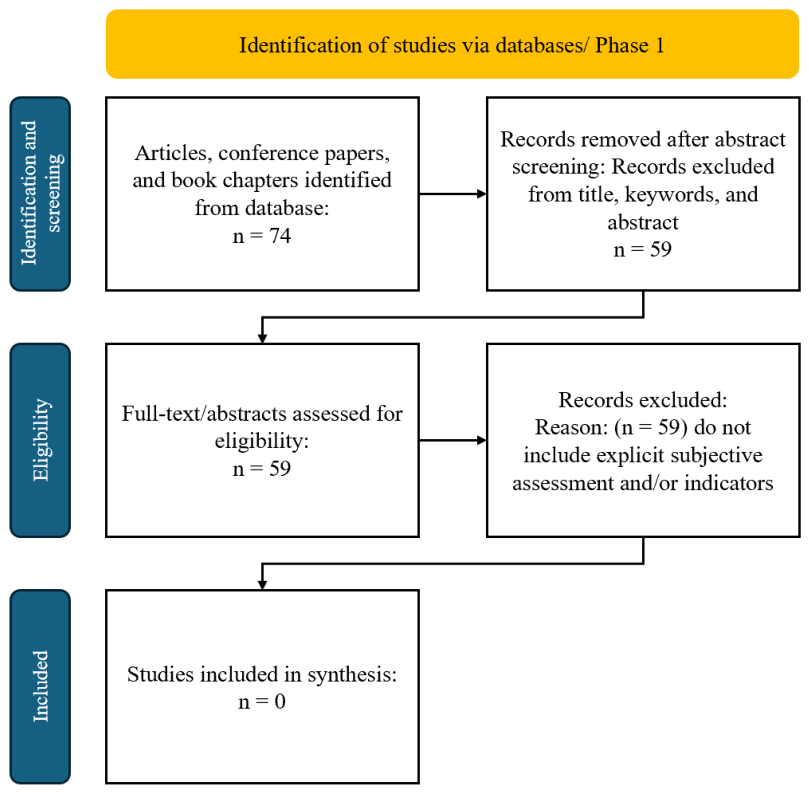
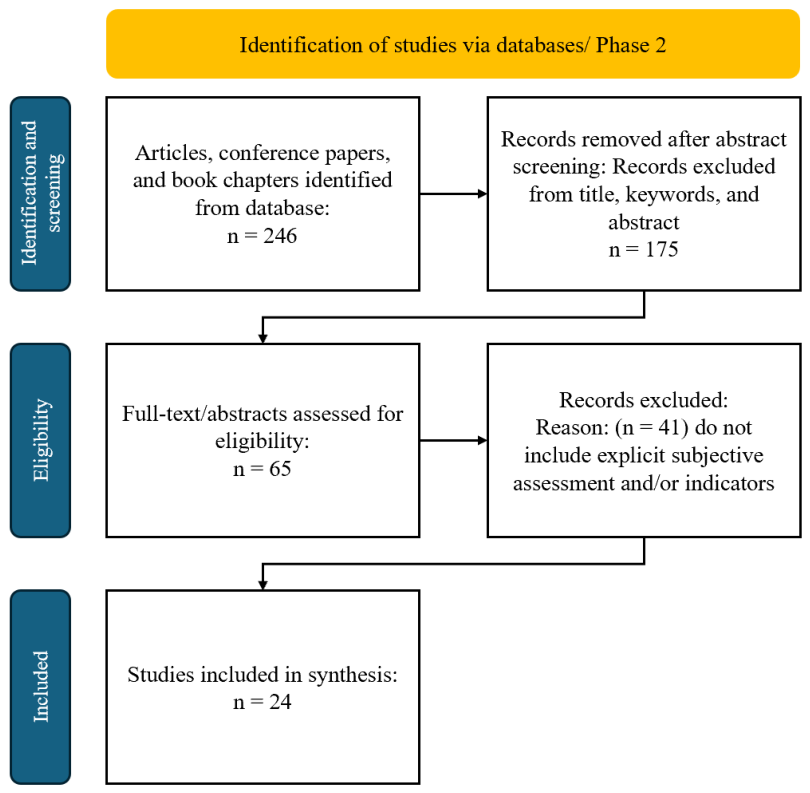
The eligible studies were decided by reading the abstract, followed by a full-text review. The eligibility was decided when the study was found to be conducted in historical and/or religious context and have direct subjective assessment and/or perceptual and experiential indicators. Studies that focused on objective acoustic measurement and simulation with no user perception and those that inspected neither historical nor religious contexts were excluded (Figure 3 and Figure 4).
The eligible studies were identified based on their context being historical, religious, or both; based on assessment scope which was decided through thematic analysis; based on their perceptual indicators; and based on the inclusion or exclusion of auditory/acoustic conditions in the context (see results, Table 1).

2.3. Data Extraction and Synthesis

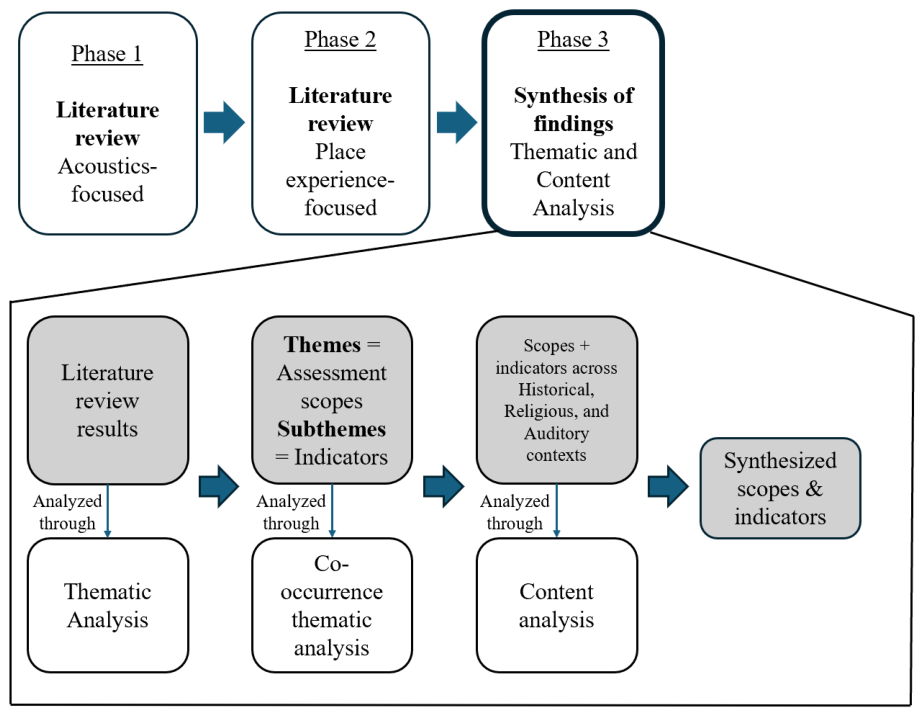
The third phase of the methods was the synthesis of findings which employed thematic and content analyses. Each study was found to assess HRP based on a specific theme with indicators, either used as terms or statements, to describe these assessments. Accordingly, the analysis assigned the ‘assessment scope’ as the theme, and the ‘indicators’ as subthemes [15] (Figure 5).
The resulting assessment scopes from the thematic analysis were set into co-occurrence thematic screening considering three contextual dimensions: historical context, religious context, and auditory inclusion. A content analysis was then conducted upon the remaining studies to confirm their relevance to experiencing HRPs and to identify cases in which auditory environment and other physical environmental factors were treated as influential factors of the experience. The results represent the assessment scopes and their indicators that are used in the literature and reflect experience in historical and/or religious places, including studies that explicitly address auditory conditions (Table 1 and Table 2).
Table 1. Studies identified in Phase 2, showing the context, assessment scopes, indicators, auditory inclusion, and the corresponding author.
ContextTheme: Assessment ScopeSubtheme: IndicatorsAuditory IncludedAuthor
Church/cathedral/chapel—historicalOverall impressionUnique/ordinary
Sacred/profane
Joyful/sad
Warm/cold
Pleasant/unpleasant
Well maintained/not maintained
Silent/noisy
Significant/not significant
Yes[8]
Perceived restorativeness soundscapeFascination (awakening, fascinating)
Being-away (anti-routine, refuge)
Extent (limitless, quality, coherent)
Yes
Ambience scaleWelcoming
Lively
Austere
Ordered
Grand
Protective
Open
Oppressive
Intimate
Historical
Beautiful
Peaceful
Yes
Being-in-place“I feel good”
“forget outside world”
“would stay for hours”
“I feel small”
“I dare not do”
“I feel free”
“I feel sad”
“I feel powerful”
“I lose track of time”
Yes
Church-visitingEnergetic
Clarifying thoughts
Anti-stress
Pondering
Connecting to self
Calming
New perspective
Refuge
Yes
SuitabilityRelaxing
Discovery of history
Appreciation of architecture
Reflection
Contemplation
Prayer
Music clarity
Speech clarity
Cultural aspects
Yes
Sense of placePlace identity
Place attachment
Place dependence
Yes[12]
Sense of placeSpirituality/preference of stimuliNo[16]
Mosque—historicalSoundscapeTranquil
Peaceful
Impressive
Mystique
Yes[9]
Quality of speechSatisfactionYes[17]
Sense of placeSpirituality in physical components
Sensory components
Socio-individual components
Functional components
Yes[14]
Temple/shrine—historicalAcoustic comfortComfort
Harmony
Quietness
Yes[10]
Kessler psychological distressNervousness
Restlessness
Fatigue
Negative effect
Yes[18]
Religious—not historicalSoundscapePleasant
Loud
Yes[19]
EmotionsSad
Tense
Nostalgic
Spiritual
Inspired
Cheerful
Thrilled
Yes[20]
Sense of placePlace identity
Place attachment
Place dependence
Perception of arch. Design
Perception of social env.
Perception of spiritual atmosphere
No[21]
Sense of placePlace identity
Place dependence
Emotional experience
Destination loyalty
No[22]
Sense of placePlace attachment
Place identity
Place dependence
No[23]
Historical—not religiousSoundscapeLoud/silent
Annoying/pleasant
Artificial/natural
Yes[24]
SoundscapeAppreciation
Maintenance
Importance
Relevance
Activity
Yes[25]
SoundscapeUnpleasant/pleasant
Noisy/clear
Chaotic/orderly
Scattered/concentrated
Anxiety/relaxation
Dislike/like
Conflict/harmony
Yes[26]
Weinstein’s noise sensitivity scaleSensitivity to noiseYes[25]
Sense of placePlace identity
Place attachment
Place dependence
No[13]
Sense of placeLocal characteristics
Informative
Audio-visual harmony
Yes[26]
ActivitiesVibrant/boring
Chaotic/calm
Yes[24]
Importance/relevanceOrdinary/evocative
Worthless/important
Monotonous/interesting
Yes
Maintenance/managementDirty/clean
Untidy/tidy
Not verdant/verdant
Dangerous/safe
Yes
AppreciationAnnoying/pleasant
Disappointing/satisfactory
Irritating/relaxing
Yes
Restorativeness scaleFascination
Being away
Coherence
Scope
Yes[25]
Qualitative aspectsHistorical aspects
Cultural aspects
Yes
Restorativeness scaleBeing-away
Scope
Fascination
Coherence
No[27]
Landscape perceptionAesthetics
Historical
Unique
Pleasant
Natural
Safety
No
Sense of placePlace identity
Place dependence
No
Sense of placePlace attachment
Place identity
Place dependence
No[28]
Sense of placePlace attachment
Place identity
Place dependence
No[29]
Table 2. The results of the co-occurrence thematic analysis showing the assessment scopes, the number of studies that use them, the inclusion of auditory, religious, and/or historical aspects (Y = included/N = not included; LAeq = equivalent continuous sound pressure level).
Assessment ScopeNo. of Studies Using ItAuditory (Y/N)Religious (Y/N)Historical (Y/N)Notes
Overall impression1YYY
Perceived restorativeness soundscape1YYY
Sense of place11YYYMainly used in environmental psychology; only two auditory inclusions in the literature.
Ambience1YYY
Being-in-place1YYY
Religious visiting1YYY
Suitability1YYY
Soundscape5YYYMainly LAeq-based.
Quality1YYY
Acoustic Comfort1YYY
Kessler Psychology Distress1YYY
Emotions1YYN
Weinstein’s noise sensitivity scale1YNY
Activities1YNY
Importance1YNY
Maintenance1YNY
Appreciation1YNY
Restorativeness2YNY
Qualitative aspects1YNY
Landscape perception1NNY

3. Results

3.1. Phase 1: Acoustic-Focused Studies

The results from Phase 1 have shown that there are 59 studies that investigate acoustics in HRP. Full-text screening has indicated that subjective assessment of the acoustic environment and the presence of perceptual or experiential indicators were missing. The literature mainly focused on on-site measurements and acoustic simulation to obtain the acoustic characteristics of these places. Frequently examined acoustic characteristics are observed to be RT, EDT, C80, and D50 for cathedrals and mosques, and low frequency resonance and vibration phenomena for prehistoric HRPs. Despite assigning perceptual interpretation to these characteristics, such as enhanced spirituality and intelligibility, no subjective assessment scopes were included. These findings indicate that acoustic-related studies in HRPs focus mainly on objective metrics without subjective evaluation of users. These resulted motivated the second phase from which perceptual indicators were extracted, as detailed in the following section.

3.2. Phase 2: Place Experience-Focused Studies

In Phase 2, the results have led to 24 studies that directly report subjective assessment scopes and perceptual indicators of experiencing HRPs. The studies covered acoustic-related studies, non-auditory studies, studies in historical non-religious places, studies in religious non-historical places, and studies in HRPs, as shown in Table 1 and Supplementary document S2_data extraction.
A total of 20 distinct assessment scopes with clearly stated indicators were found. Nine of them referred to either historical or religious context with including auditory aspects. A total of 11 assessment scopes were found to inspect HRP with auditory aspects taken into consideration.

3.3. Thematic Synthesis

The assessment scopes identified in the previous phase were set into co-occurrence thematic analysis to identify the studies that mutually assess HRPs with auditory experience included. The results are shown in Table 2.
It is observed from Table 2 that the most frequently used assessment scope to evaluate HRPs is sense of place, with 11 studies providing perceptual and experiential indicators. Two of them include auditory experience in the place. This is followed by Soundscape assessment scope, with five studies using explicit indicators of experiencing HRPs. The other scopes are shown to be used only once, except for Restorativeness scale, which appeared twice. Nine scopes of assessments are found to simultaneously address the three aspects of investigating an HRP with auditory experience included, representing the set of scopes used to evaluate HRPs under acoustic or auditory conditions.

4. Discussion and Conclusions

Historical religious places are interesting and important cases for assessing place experience of users in correlation with the acoustic environment. This is justified by the fact that these places span various eras and cultures with rather unchanged functions performed in the place and different type of usages and users. Furthermore, they are consistently susceptible to modifications and renovations that directly affect the acoustic environment of the place. Furthermore, differences across types of religious places (for instance, churches, mosques, or temples) may influence the perceptual response to the acoustic condition. Additionally, and through recent and developing technologies in acoustic simulation and auralization, these acoustic environments are being presented virtually to users [30,31], reflecting the historical and religious essence of the sacred place.
Several studies have investigated the objective acoustic properties of HRPs. These properties were suggested to be significant to ancient people’s expectations of and relation to the place. For instance, high RTs were associated with enhanced spirituality in prehistoric sacred sites and hypogeum [3], in historical churches and cathedrals [6], and in mosques [32]. These studies highlight a set of acoustic attributes that may be essential for users’ experience of HRPs.
On the other hand, soundscape studies, environmental psychology, and heritage studies explored the subjective perception of HRPs. These studies have shown how the current acoustic environment is perceived by users, as well as the historical and religious values of these places. For instance, it was found that the experienced acoustic environment is correlated with the overall perception of a historical church [8,33], with the satisfaction of speech quality in a historical mosque [17], with the soundscape perception of a sacred place [19], and with the sense of place of a historical setting [26]. These various studies imply that evaluating the acoustic environment effects on HRP is based on various perceptual and experiential indicators that each represent different aspects of the experience. However, there is no unified approach that describes how these perceptual indicators are related to or affected by the acoustic conditions. As a result, this exploratory study focuses on identifying and synthesizing the existing objective acoustic parameters, the perceptual indicators, and the assessment scopes provided in the literature in HRPs.
The co-occurrence analysis showed variability in assessing HRPs across disciplines. Sense of place is the most frequently used scope, mainly used in environmental psychology and heritage studies. Few usages of this scope integrated the auditory experience. A direct relationship between sense of place and acoustic conditions is shown in previous studies [34,35] which suggests that its indicators are viable for assessing HRP when integrating the auditory experience.
The second most used scope is Soundscape, which explicitly includes the auditory conditions as influential factors in perceiving the sound environment such as LAeq, perceived loudness, and clarity. The contribution of these conditions to tranquility, spirituality, or pleasantness highlights the relevance of the soundscape approach in assessing HRPs as the auditory environment is involved. However, soundscape scope is noticed to be limited to urban open spaces and in a few numbers of studies that call for further implication of the scope into HRP experience.
Other assessments such as Restorativeness, Ambience, and Suitability are generally from the environmental psychology discipline [36,37,38]. These assessments investigate the impact of environmental factors on users’ relationships to the place and the conducted activities. They appear infrequently in studies; yet, they present important psychological and experiential indicators that reflect the HRP experience.
As for Quality and Acoustic Comfort, they were found to directly assess HRP as acoustic conditions are the influential factors. These scopes’ indicators evaluate direct effects of auditory environment in HRP experience.
The results of the review have indicated an inconsistency in the way the perceptual constructs are identified across disciplines. Similar experiential dimensions were noticed to be used without conceptual alignment across studies—such as spirituality, sacred, atmosphere, or ambience. This limits the ability to compare studies or to integrate the findings across the disciplines. Thus, it is noticed that there are incoherent conceptual indicators in the literature that represent HRP experience under auditory conditions.
As a result, the current systematic review could conclude the following points:
  • The literature in acoustic-focused studies investigates the objective auditory environment and excludes subjective assessment.
  • The literature in various disciplines showed variety and abundance of assessment scopes and indicators.
  • The integration of both HRP experience and auditory environments is a gap in the literature that indicates a need to build a unified set of subjective indicators and objective parameters for assessing HRPs.
This study is subject to several limitations. Initially, it was limited to Scopus database and excluded several document types such as technical reports or theses. This may be reflected in the number of the retrieved documents used in the review and the relevant studies in the field, particularly where graduate research contributes to empirical investigation. Additionally, variability in terminology across disciplines, for both indicators and acoustic conditions, may have limited the results of the relevant studies. The selected keywords aimed to capture broad interdisciplinary scope. Although the search strategy included several auditory-related terms, the exclusion of additional terms such as ‘worship’ and ‘sacred’ may have limited the derivation of some relevant studies.
Future work will analyze the semantic relationship among the identified indicators by utilizing the Natural Language Processing methods in order to test their reliability and validity for assessing HRP through auralization means and listening tests.

Supplementary Materials

The following supporting information can be downloaded at https://www.mdpi.com/article/10.3390/acoustics8030043/s1, Spreadsheet S1_search strategy, Spreadsheet S2_data extraction, and S3_PRISMA 2020 Checklist. The review was not prospectively registered, and no review protocol was prepared prior to conducting the review.

Author Contributions

Conceptualization, Z.A.-b. and P.N.D.Y.; methodology, Z.A.-b. and P.N.D.Y.; software, Z.A.-b.; validation, Z.A.-b. and P.N.D.Y.; formal analysis, Z.A.-b.; investigation, Z.A.-b.; resources, P.N.D.Y.; data curation, Z.A.-b.; writing—original draft preparation, Z.A.-b.; writing—review and editing, Z.A.-b. and P.N.D.Y.; visualization, Z.A.-b.; supervision, P.N.D.Y. All authors have read and agreed to the published version of the manuscript.

Funding

This research received no external funding.

Data Availability Statement

The original contributions presented in this study are included in the article/Supplementary Material. Further inquiries can be directed to the corresponding author.

Conflicts of Interest

The authors declare no conflicts of interest.

Abbreviations

The following abbreviations are used in this manuscript:
HRPHistorical Religious Place
PRISMAThe Preferred Reporting Items for Systematic and Meta-Analysis

References

  1. Blesser, B.; Salter, L.-R. Spaces Speak, Are You Listening? Experiencing Aural Architecture; The MIT Press: Cambridge, MA, USA, 2007. [Google Scholar]
  2. Bardley, D.T.; Ryherd, E.E.; Ronsse, L.M. (Eds.) Worship Space Acoustics: 3 Decades of Design; Springer: New York, NY, USA, 2016. [Google Scholar] [CrossRef]
  3. Cox, T.J.; Fazenda, B.M.; Greaney, S.E. Using scale modelling to assess the prehistoric acoustics of stonehenge. J. Archaeol. Sci. 2020, 122, 105218. [Google Scholar] [CrossRef]
  4. Debertolis, P.; Coimbra, F.; Eneix, L. Archaeoacoustic Analysis of the Hal Saflieni Hypogeum in Malta. J. Anthropol. Archaeol. 2015, 3, 59–79. [Google Scholar] [CrossRef][Green Version]
  5. Debertolis, P.; Zivic, M. Archaeoacoustic analysis of Cybele’s temple, Imperial Roman Palace of Felix Romuliana, Serbia. An interpretation using a method complementary to archaeology. J. Anthropol. Archaeol. 2015, 3, 1–19. [Google Scholar] [CrossRef][Green Version]
  6. Adeeb, A.H.; Sü Gül, Z. Investigation of a Tuff Stone Church in Cappadocia via Acoustical Reconstruction. Acoustics 2022, 4, 419–440. [Google Scholar] [CrossRef]
  7. Kitapci, K.; Çelik Başok, G. The Acoustic Characterization of Worship Ambiance and Speech Intelligibility in Wooden Hypostyle Structures: The Case of the Aslanhane Mosque. Acoust. Aust. 2021, 49, 425–440. [Google Scholar] [CrossRef]
  8. Laplace, J.; Guastavino, C. Evaluating the restorative potential of church buildings. In Proceedings of the INTER-NOISE 2022—51st International Congress and Exposition on Noise Control Engineering, Glasgow, UK, 21–24 August 2022. [Google Scholar] [CrossRef]
  9. Yilmazer, S.; Acun, V. A grounded theory approach to assess indoor soundscape in historic religious spaces of Anatolian culture: A case study on Hacı Bayram Mosque. Build. Acoust. 2018, 25, 137–150. [Google Scholar] [CrossRef]
  10. Zhang, D.; Liu, X.; Mo, W. Comparison of Soundscape Evaluation in Forest-Type and Urban-Type Han Chinese Buddhist Temples. Forests 2023, 14, 79. [Google Scholar] [CrossRef]
  11. Hill, D.R.; Saroka, K.S. Sonic patterns, spirituality and brain function: The sound component of neurotheology. NeuroQuantology 2010, 8, 509–516. [Google Scholar] [CrossRef]
  12. Murphy, E.K.M. A sense of place: Hearing English Catholicism in the Spanish Habsburg territories, 1568–1659. In Sensory and Sacred: Medieval and Early Modern Cultures; Routledge: London, UK, 2018; pp. 136–157. [Google Scholar] [CrossRef]
  13. Pratiwi, M.A.; Ernawati, J.; Yusran, Y.A. Sense of Place Dimensions of Historic Streets as Urban Heritage Tourism Sites: Streets in Kayutangan, Malang, Indonesia. ISVS e-J. 2023, 10, 300–317. [Google Scholar] [CrossRef]
  14. Sadeghi Habibabad, A.; Salimei, G. The characteristics of spirituality in Islamic architecture from the perspective of experts. J. Spiritual. Ment. Health 2023, 26, 104–127. [Google Scholar] [CrossRef]
  15. Braun, V.; Clarke, V. Thematic Analysis. In APA Handbook of Research Methods in Psychology, Vol. 2: Research Designs: Quantitative, Qualitative, Neuropsychological, and Biological; Cooper, H., Camic, P.M., Long, D.L., Panter, A.T., Rindskopf, D., Sher, K.J., Eds.; American Psychological Association: Washington, DC, USA, 2012; pp. 57–71. [Google Scholar]
  16. Matracchi, P.; Habibabad, A.S. Prioritizing the effect of “Light” in the religious places and environments with an emphasis on the sense of spirituality. Ain Shams Eng. J. 2022, 13, 101514. [Google Scholar] [CrossRef]
  17. Elkhateeb, A.; Eldakdoky, S. The Optimal Reverberation for Masjids A Subjective Assessment for Worshippers’ Demands. Int. J. Archit. Eng. Technol. 2022, 9, 73–99. [Google Scholar] [CrossRef]
  18. Zhang, D.; Kong, C.; Zhang, M.; Kang, J. Religious Belief-Related Factors Enhance the Impact of Soundscapes in Han Chinese Buddhist Temples on Mental Health. Front. Psychol. 2022, 12, 774689. [Google Scholar] [CrossRef] [PubMed]
  19. De Oliveira, P.L.; Da Rosa Oiticica, M.L.G.; Miranda, E.F.V. Mapping the soundscape: Impacts of the sounds of faith. Urbe 2021, 13, e20210073. [Google Scholar] [CrossRef]
  20. Algargoosh, A.; Soleimani, B.; O’Modhrain, S.; Navvab, M. The impact of the acoustic environment on human emotion and experience: A case study of worship spaces. Build. Acoust. 2022, 29, 85–106. [Google Scholar] [CrossRef]
  21. Mazloomi, S.M.; Ariffin, S.I.; Shahminan, R.N.R. A comparative analysis of perceptual and demographic predictors of sense of place dimensions in the State Mosques of Malaysia. Asian J. Soc. Psychol. 2014, 17, 128–140. [Google Scholar] [CrossRef]
  22. Patwardhan, V.; Ribeiro, M.A.; Woosnam, K.M.; Payini, V.; Mallya, J. Visitors’ loyalty to religious tourism destinations: Considering place attachment, emotional experience and religious affiliation. Tour. Manag. Perspect. 2020, 36, 100737. [Google Scholar] [CrossRef]
  23. Mei, L.; Liu, K.; Xiong, L.; Zhu, B.W. Approach Based on Data Mining for Exploring the Hierarchical Decision-Making Rules between the Generation of Transnational Immigrants’ Sense of Place in Religious Spaces and Perception of the Environment. Religions 2022, 13, 195. [Google Scholar] [CrossRef]
  24. Masullo, M.; Toma, R.A.; Maffei, L. Further investigation on pockets of quiet within historical city centres: The case of widenings. In Proceedings of the INTER-NOISE 2021—50th International Congress and Exposition on Noise Control Engineering, Virtual, 1–5 August 2021. [Google Scholar] [CrossRef]
  25. Masullo, M.; Ozcevik Bilen, A.; Toma, R.A.; Akin Güler, G.; Maffei, L. The restorativeness of outdoor historical sites in urban areas: Physical and perceptual correlations. Sustainability 2021, 13, 5603. [Google Scholar] [CrossRef]
  26. Ye, J.; Chen, L.; Zheng, Y. Effect of an Artificial Sound-Based Index on the Perception of Historical Block Environments. Buildings 2023, 13, 2372. [Google Scholar] [CrossRef]
  27. Li, J.; Luo, J.; Deng, T.; Tian, J.; Wang, H. Exploring perceived restoration, landscape perception, and place attachment in historical districts: Insights from diverse visitors. Front. Psychol. 2023, 14, 1156207. [Google Scholar] [CrossRef] [PubMed]
  28. El-Barbary, M.N.; Ikeda, M.; Uekita, Y. Local people’s “sense of place” toward cultural heritage sites: Correlation with demographic and socio-economic characteristics. J. Cult. Herit. Manag. Sustain. Dev. 2024, 14, 636–653. [Google Scholar] [CrossRef]
  29. Abukarki, H.J.; Uzunahmet, H.A.; Onur, Z. The Influence of Place Attachment on Heritage Discourse in Contemporary Places: A Case Study of Jordanian Byzantine Mosaics. Sustainability 2023, 15, 8395. [Google Scholar] [CrossRef]
  30. Poirier-Quinot, D.; Katz, B.F.G.; Lyzwa, J.-M. Interactive Production of the “Virtual Concert in Notre-Dame”. In Proceedings of the 19th Forum International du Son Multicanal (FISM), Paris, France, 18–19 November 2016. [Google Scholar]
  31. Postma, B.N.J.; Poirier-Quinot, D.; Meyer, J.; Katz, B.F.G. Virtual Reality Performance Auralization in a Calibrated Model of Notre-Dame Cathedral. In Proceedings of the EuroRegio 2016, Porto, Portugal, 13–15 June 2016; pp. 1–10. [Google Scholar]
  32. Omar, N.M.; Al-Sayad, Z.M.; Maarouf, I.S.; Al-Hagla, K.S. The documentation of archaeoacoustics identity of Sultan-Barquq complex. Alex. Eng. J. 2020, 59, 4159–4169. [Google Scholar] [CrossRef]
  33. Laplace, J.; Guastavino, C. Exploring sonic experiences in church spaces: A psycholinguistic analysis. Senses Soc. 2022, 17, 343–358. [Google Scholar] [CrossRef]
  34. Al-bayyar, Z.; Kitapci, K. An acoustic sense of place evaluation framework based on the room acoustic indicators. In Proceedings of the Forum Acusticum 2020—8th European Congress on Acoustics, Lyon, France, 20–24 April 2020. [Google Scholar] [CrossRef]
  35. Al-bayyar, Z.; Kitapci, K. Effects of reverberation time and sound source composition on sense of place constructs. Appl. Acoust. 2022, 185, 108427. [Google Scholar] [CrossRef]
  36. Ouellette, P.; Kaplan, R.; Kaplan, S. The monastery as a restorative environment. J. Environ. Psychol. 2005, 25, 175–188. [Google Scholar] [CrossRef]
  37. Hartig, T.; Korpela, K.; Evans, G.W.; Gärling, T. A measure of restorative quality in environments. Scand. Hous. Plan. Res. 1997, 14, 175–194. [Google Scholar] [CrossRef]
  38. Hartig, T.; Böök, A.; Garvill, J.; Olsson, T.; Gärling, T. Environmental influences on psychological restoration. Scand. J. Psychol. 1996, 37, 378–393. [Google Scholar] [CrossRef] [PubMed]
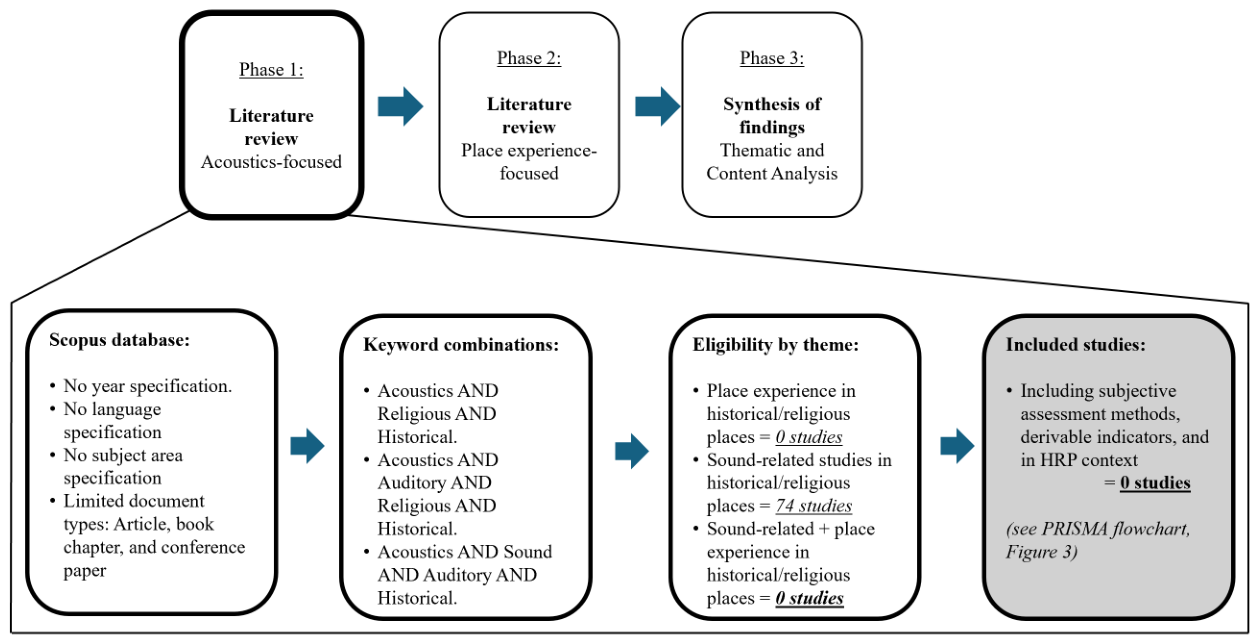
Figure 1. The 3 phases of the methods followed in the literature review, detailing Phase 1.
Acoustics 08 00043 g001
Figure 2. The 3 phases of the methods followed in the literature review, detailing Phase 2.
Acoustics 08 00043 g002
Figure 3. Systematic review process based on PRISMA 2020 flow diagram for Phase 1—acoustics-focused.
Acoustics 08 00043 g003
Figure 4. Systematic review process based on PRISMA 2020 flow diagram for Phase 2—place experience-focused.
Acoustics 08 00043 g004
Figure 5. The 3 phases of the methods followed in the literature review, detailing Phase 3—thematic and content analysis.
Acoustics 08 00043 g005
Disclaimer/Publisher’s Note: The statements, opinions and data contained in all publications are solely those of the individual author(s) and contributor(s) and not of MDPI and/or the editor(s). MDPI and/or the editor(s) disclaim responsibility for any injury to people or property resulting from any ideas, methods, instructions or products referred to in the content.